





If you've ever turned up the volume during a movie only to get blasted by the next action scene, you know why soundbars exist. TV speakers are terrible—thin, cramped, and designed more for saving space than delivering good audio. But with soundbars ranging from under $200 to over $1,500, figuring out what you actually need can be overwhelming.
The Samsung HW-B630F and JBL Bar 1000 represent two completely different philosophies for solving the "my TV sounds awful" problem. At the time of writing, these systems sit in very different price brackets—the Samsung costs roughly one-third of the JBL's price—but they're both trying to make your entertainment sound dramatically better than those tiny TV speakers ever could.
Before diving into specifics, it's worth understanding what separates different types of soundbars. The market essentially breaks down into three categories: basic 2.1 systems (two channels plus a subwoofer), mid-range 3.1 systems that add a dedicated center speaker, and premium multi-channel systems that attempt to recreate full surround sound.
The numbers matter because they directly affect what you hear. A 2.1 system can make things louder and add bass, but dialogue often gets lost in the mix. A 3.1 system like the Samsung HW-B630F adds that crucial center channel—a speaker specifically designed to handle voices and dialogue. Meanwhile, a 7.1.4 system like the JBL Bar 1000 goes all-in with seven main channels, one subwoofer, and four height channels for overhead effects.
That ".4" designation refers to Dolby Atmos height channels—speakers that bounce sound off your ceiling or fire directly upward to create the illusion that helicopters are actually flying overhead. It's not just marketing; when done properly, the effect is genuinely impressive.
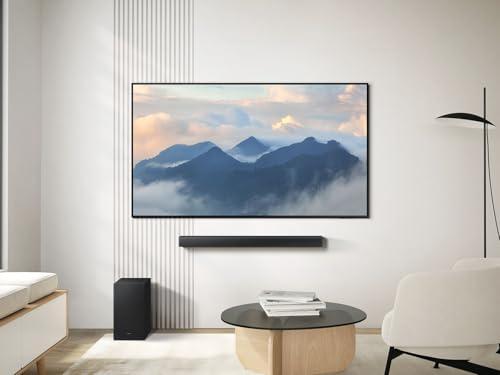
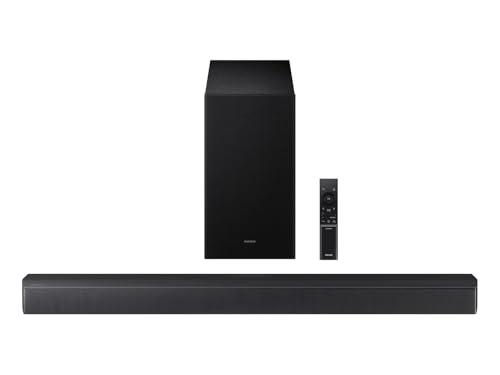
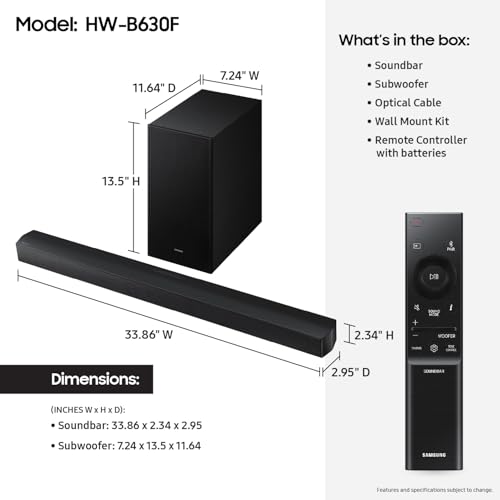
Released in 2024 as part of Samsung's budget-focused B-series lineup, the Samsung HW-B630F represents the Korean giant's approach to affordable TV audio improvement. This is fundamentally a 3.1 system, meaning it has three speakers across the front (left, center, right) plus a wireless subwoofer that you can tuck anywhere in your room.
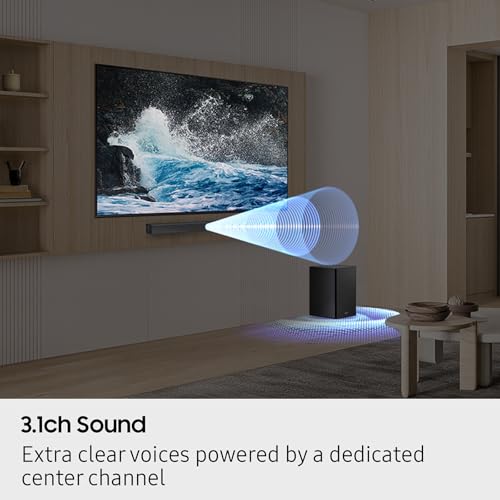
The star of the show here is that dedicated center channel. While your TV tries to create the illusion of centered dialogue by playing the same sound through left and right speakers, the Samsung HW-B630F has an actual physical speaker pointed directly at you. This makes an enormous difference for TV shows, movies, and anything with spoken content.
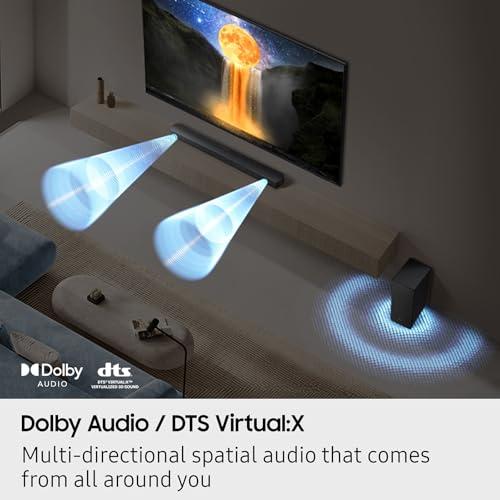
Samsung has also loaded this system with processing tricks to maximize its 3.1 setup. DTS Virtual:X technology analyzes incoming audio and uses psychoacoustic processing—essentially exploiting how your brain interprets sound reflections—to create the impression of sounds coming from beside and behind you. It's clever, but it's still an illusion rather than the real thing.
The system includes what Samsung calls Adaptive Sound, which continuously analyzes what you're watching and adjusts the audio balance accordingly. Watching a quiet drama? It boosts dialogue and reduces dynamic range so you don't need to constantly adjust volume. Action movie? It opens up the soundstage and lets explosions hit harder while keeping voices clear.
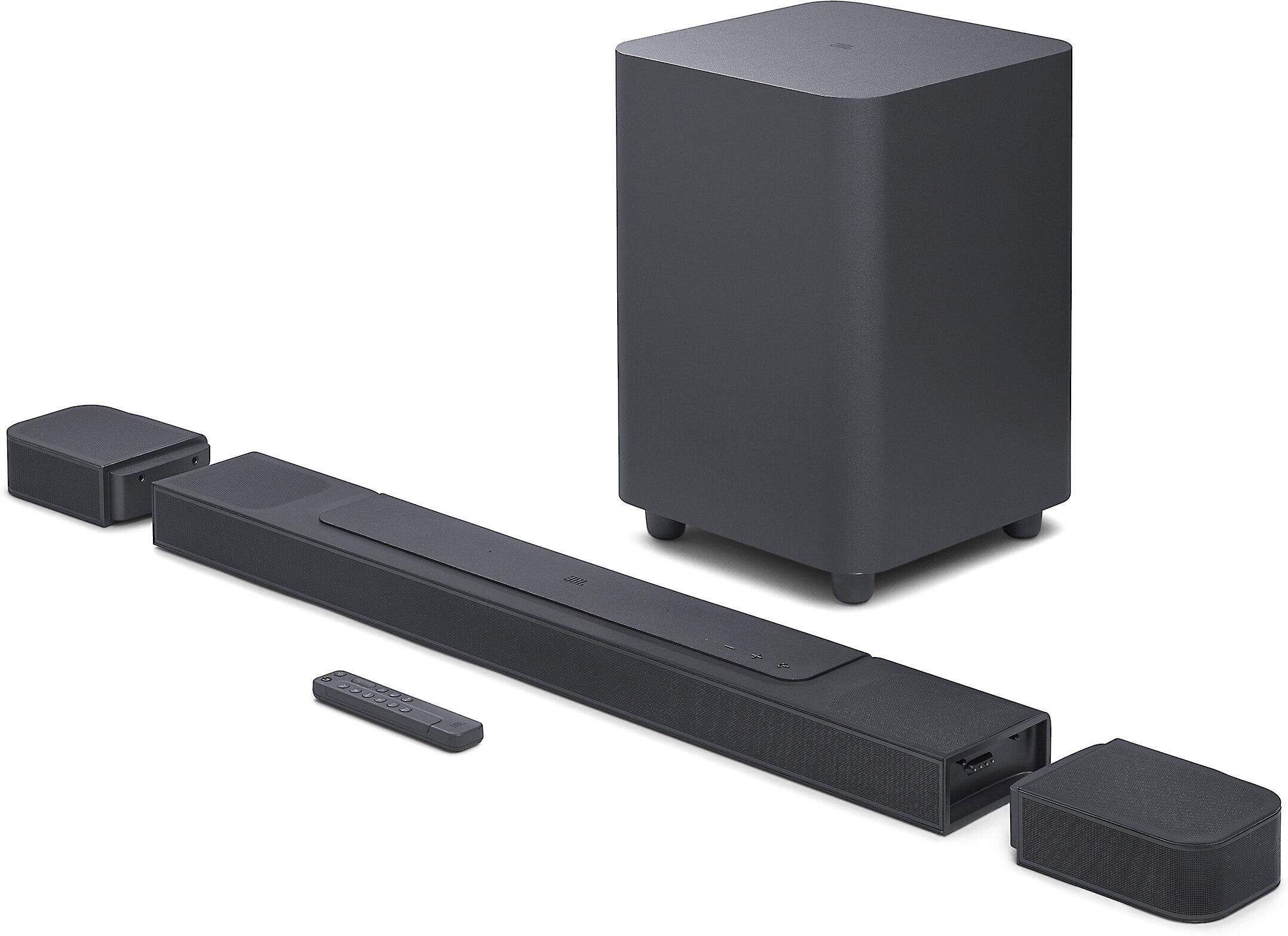
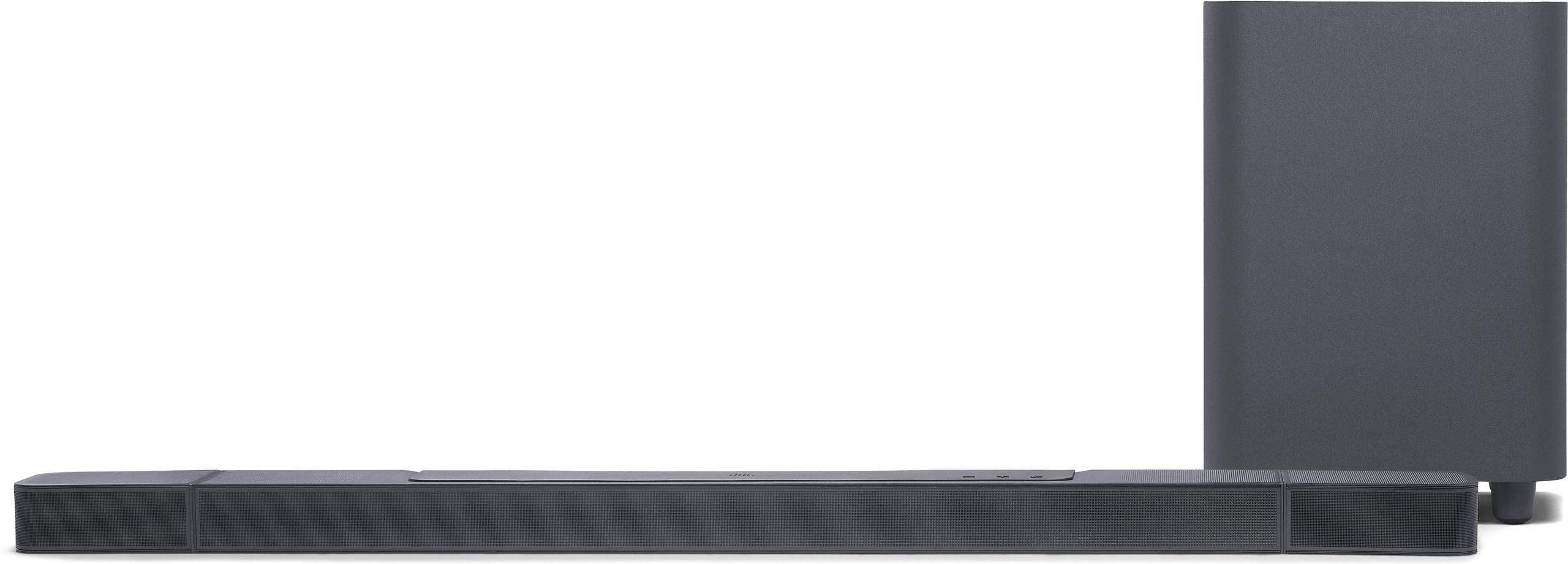
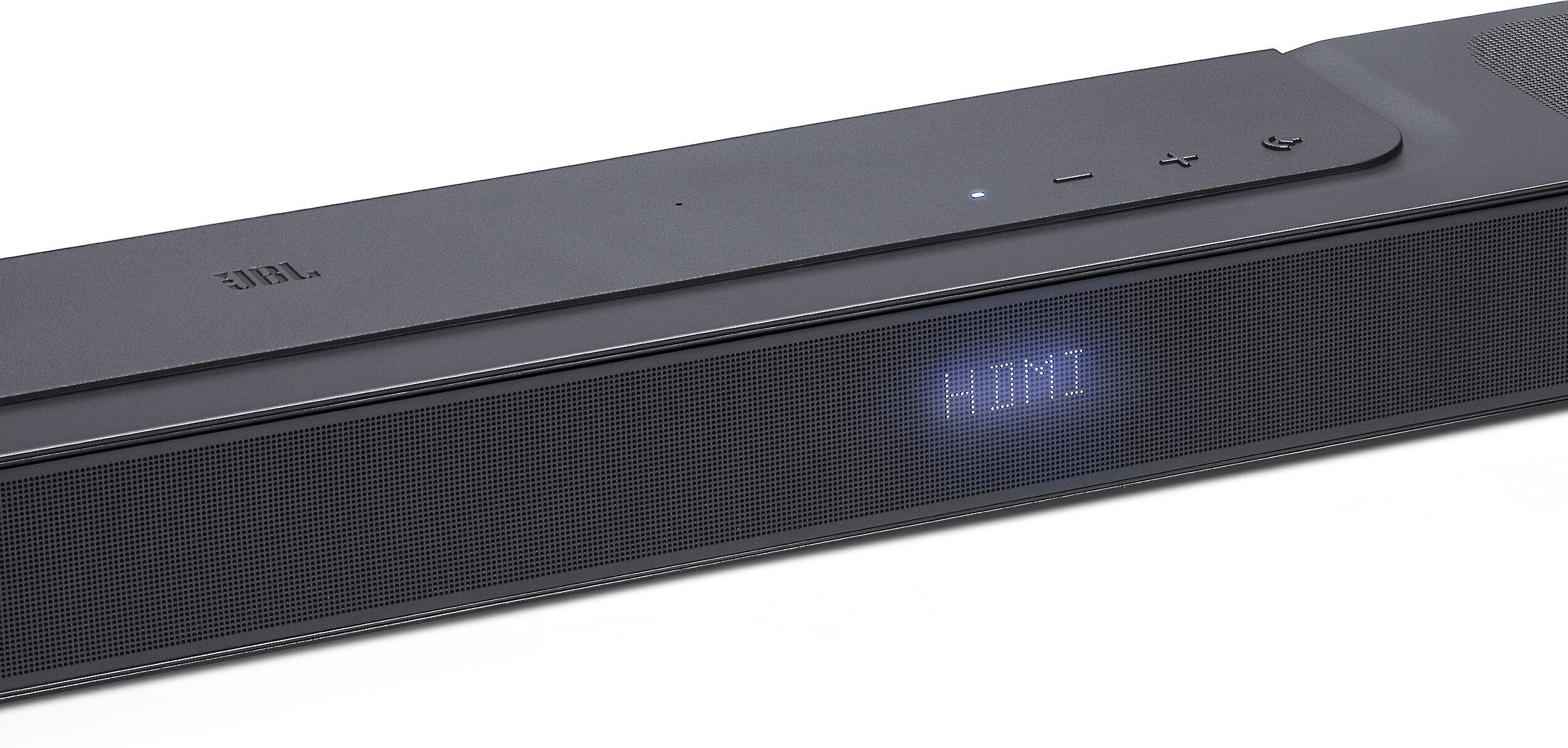
The JBL Bar 1000, launched in late 2022, takes a completely different approach. This is a true 7.1.4 surround system that doesn't rely on audio tricks—it actually puts speakers around your room.
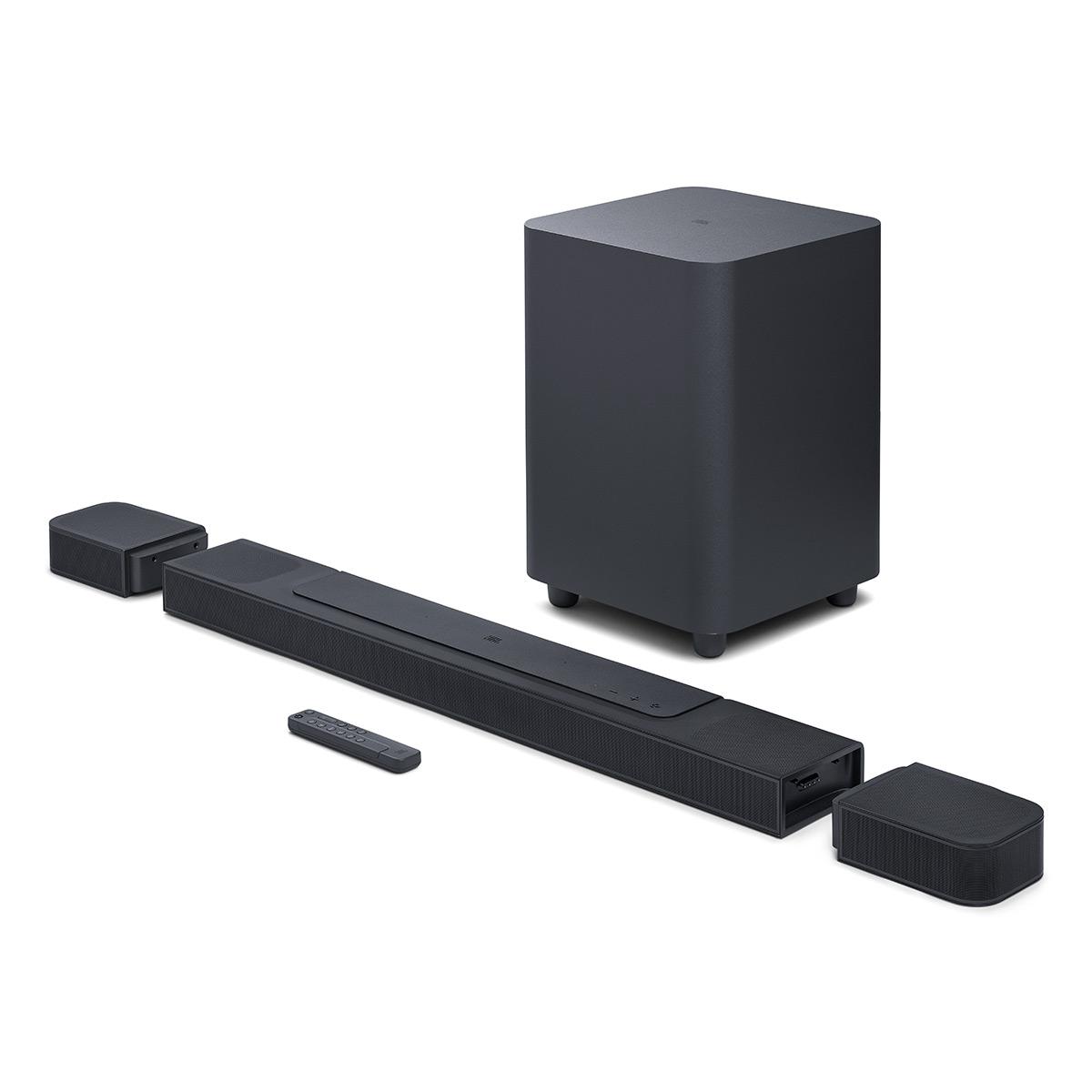
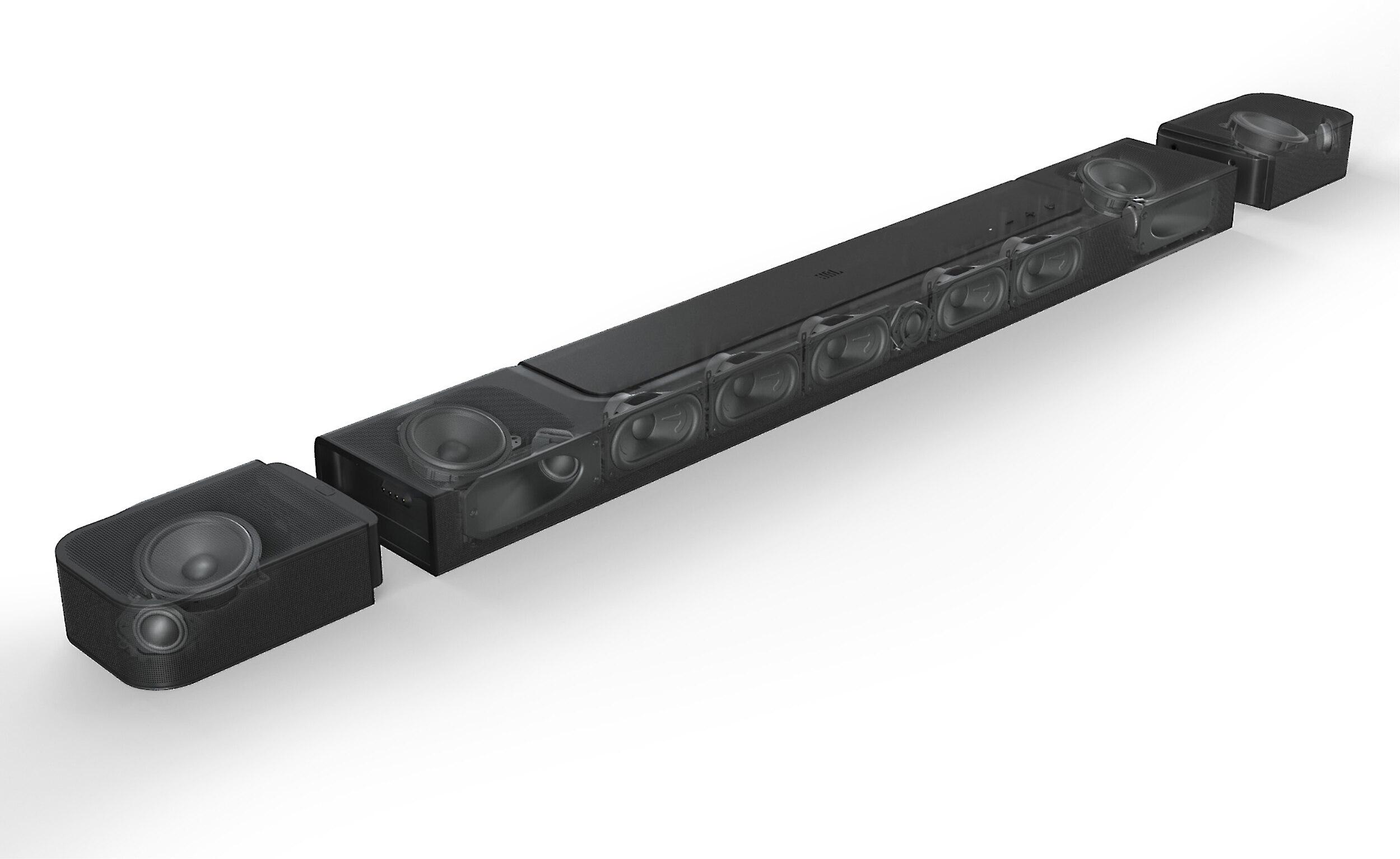
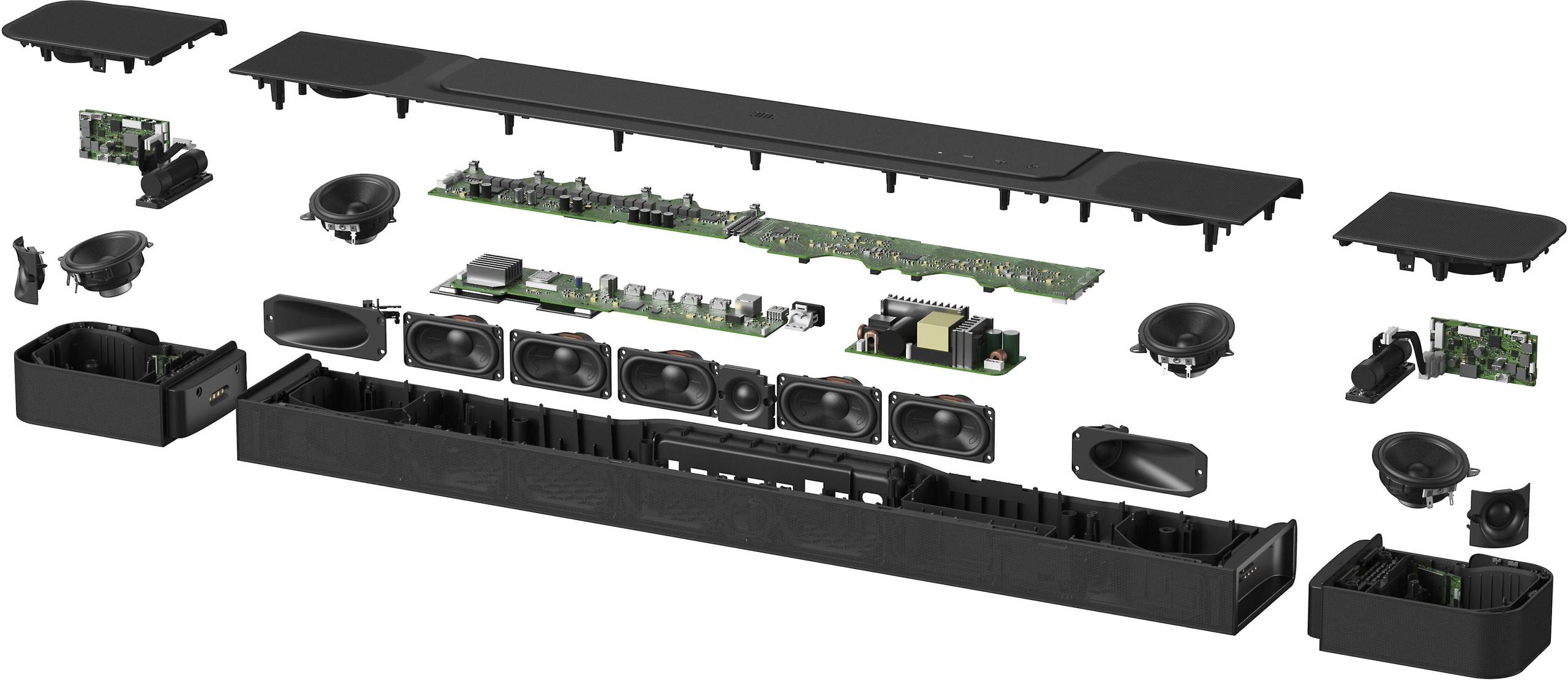
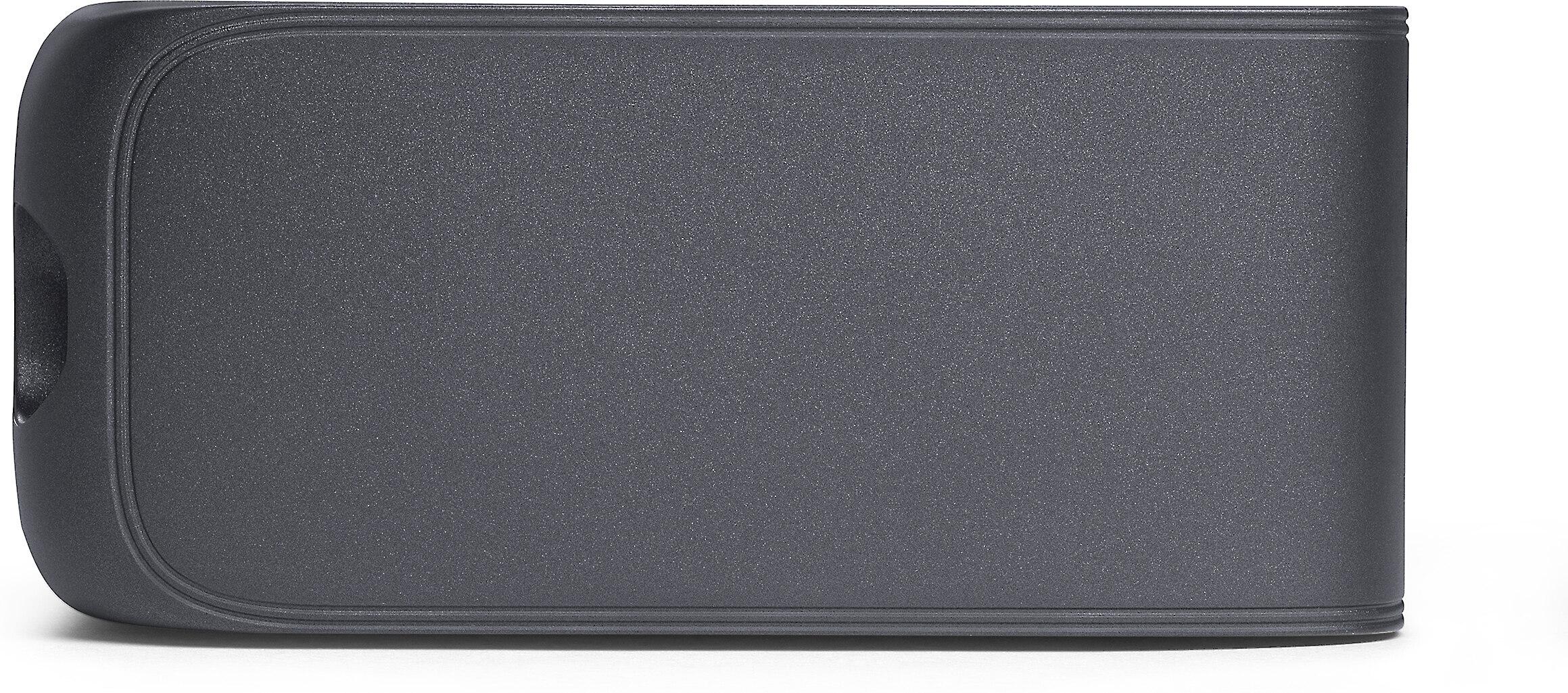
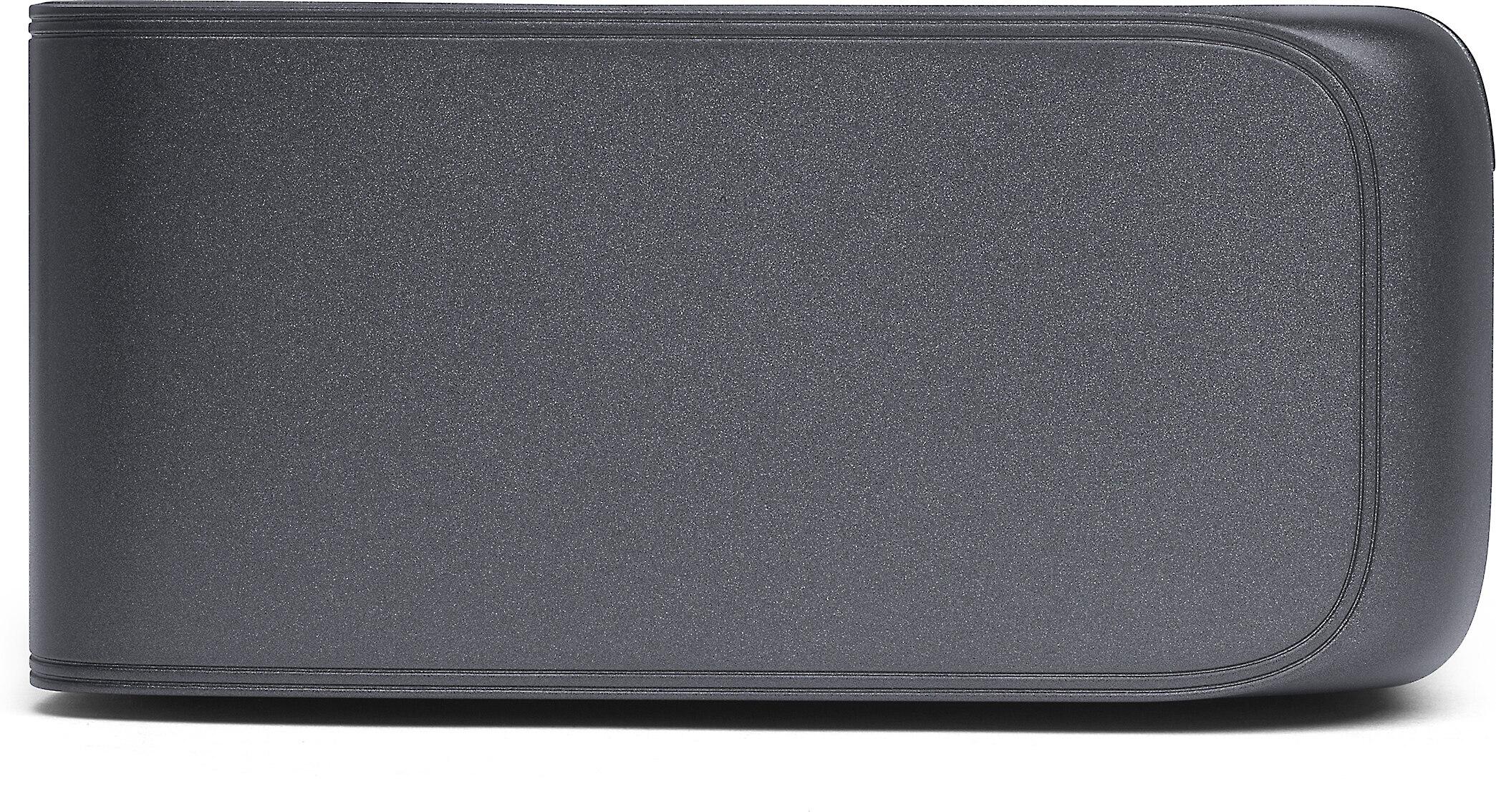
The key innovation here is those detachable rear speakers. Most surround systems require you to run wires to the back of your room and find power outlets, which is why many people never bother. JBL solved this by making the rear speakers completely wireless with built-in batteries that last about 10 hours. When not in use, they dock magnetically to the main soundbar to charge.
This system includes four physical up-firing drivers—two in the main bar and one in each rear speaker. These fire sound directly at your ceiling, where it bounces down to create genuine overhead effects. Combined with the rear speakers providing true surround sound, the JBL Bar 1000 can deliver audio that actually surrounds you rather than just simulating the effect.
The 10-inch wireless subwoofer is substantially larger than most soundbar subs, with enough power to shake your couch during action sequences. At 300 watts dedicated to bass alone, it can reproduce frequencies down to 33Hz—low enough to feel the rumble of explosions and the thump of movie soundtracks.
This is where the Samsung HW-B630F truly shines. That dedicated center channel, combined with Samsung's Voice Enhance mode, makes dialogue remarkably clear even at low volumes. If you've ever struggled to hear what characters are saying during movies or found yourself constantly adjusting volume between dialogue and action scenes, this system addresses that frustration directly.
The JBL Bar 1000 includes PureVoice technology for dialogue enhancement, but its broader focus means voice clarity, while still excellent, isn't quite as laser-focused as Samsung's approach. However, the JBL's overall dynamic range means that when dialogue is mixed properly in movies, it can sound more natural within the full acoustic environment.
Here's where the systems diverge significantly. The Samsung HW-B630F includes a wireless subwoofer that's adequate for most TV content and smaller rooms. It'll add the low-frequency punch that TV speakers completely lack, making action scenes more impactful and music more full-bodied.
The JBL Bar 1000, however, operates in a different league entirely. That 10-inch sub can reproduce genuinely deep bass that you feel as much as hear. Movie explosions have real impact, and music with deep electronic elements or orchestral content sounds properly weighted. This isn't just about being louder—it's about reproducing frequency ranges that the Samsung system simply can't reach.
This represents the fundamental difference between these systems. The Samsung HW-B630F uses sophisticated processing to create virtual surround effects from its front-facing speakers. DTS Virtual:X and Samsung's Surround Sound Expansion can genuinely make the soundstage seem wider than the bar itself, and environmental effects in movies do seem to extend beyond the speakers' physical boundaries.
But virtual is still virtual. The JBL Bar 1000 provides authentic surround sound with those detachable rear speakers creating true 360-degree audio. Sounds actually originate from behind you, not just seem to. The four up-firing drivers create genuine height effects—helicopters, rain, and overhead ambient sounds position themselves above your listening position rather than just being processed to suggest height.
For movies with immersive soundtracks—think big-budget action films, nature documentaries, or anything mixed in Dolby Atmos—the difference is substantial. The JBL creates a genuine acoustic bubble around your seating position that virtual processing can't match.
Both systems offer benefits for gaming, but in different ways. The Samsung HW-B630F includes a dedicated Game Mode that emphasizes directional audio cues within its 3.1 setup. This helps with competitive gaming where you need to locate footsteps or gunfire, though the directional information remains limited to left-center-right positioning.
The JBL Bar 1000 doesn't have a specific gaming mode, but its true surround capabilities provide superior spatial awareness. In open-world games or anything with immersive audio design, having actual speakers positioned around your room creates much more accurate positional audio than any virtual processing can achieve.
Your room significantly affects which system makes sense. The Samsung HW-B630F works well in small to medium-sized spaces—think typical bedrooms, apartments, or living rooms up to about 250 square feet. Its power output is designed for reasonable volumes in intimate spaces, and its virtual surround processing works best when you're seated relatively close to the bar.
The JBL Bar 1000 is built for larger rooms where its 880 watts of total power can properly fill the space. Those detachable rear speakers need room to breathe—literally. The system works best in spaces where you can position the rears several feet behind your seating area, and the powerful subwoofer needs space to pressurize the room effectively.
If you're trying to improve audio in a small apartment, the Samsung's more modest power output and Night Mode (which compresses dynamic range to avoid disturbing neighbors) makes more sense. If you have a dedicated media room or large living space, the JBL can deliver the kind of room-filling performance that makes the investment worthwhile.
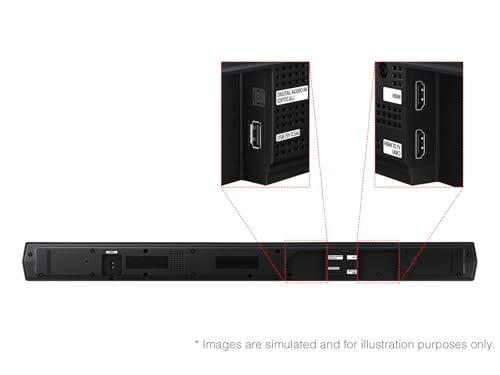
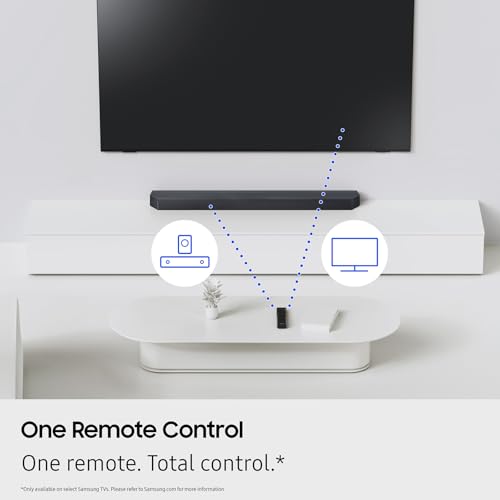
Here's where day-to-day usability becomes important. The Samsung HW-B630F is genuinely plug-and-play. Connect one HDMI cable to your TV, plug in the wireless subwoofer, and you're essentially done. The system automatically pairs with the sub, and if you own a Samsung TV, it integrates seamlessly with your existing remote. Total setup time is typically under 10 minutes.
The JBL Bar 1000 requires significantly more investment in setup. Those detachable rear speakers need initial charging, positioning around your room, and the system benefits greatly from running the room calibration routine through JBL's mobile app. This calibration process takes about 10 minutes but makes a real difference in performance—the system analyzes your room's acoustics and adjusts its output accordingly.
You'll also need to manage the rear speakers' battery life. Ten hours of playback is reasonable, but it means remembering to dock them back on the main bar after extended viewing sessions. Some users find this annoying; others appreciate that the speakers can double as portable Bluetooth speakers when undocked.
At the time of writing, these systems represent very different value propositions. The Samsung HW-B630F costs roughly one-third of the JBL Bar 1000's price, but delivers maybe 70% of the improvement over TV speakers that most people care about. If your primary need is clearer dialogue and better overall TV audio, that math works strongly in Samsung's favor.
The JBL Bar 1000 costs significantly more but provides capabilities that the Samsung fundamentally cannot match. True surround sound, genuine height effects, and room-shaking bass represent qualitative improvements rather than just incremental ones. You're not paying three times as much for three times better performance—you're paying for capabilities that are simply different.
Both systems represent current thinking in soundbar design, but they've evolved along different paths. Samsung's B-series launched in 2024 with improvements in virtual processing and better TV integration compared to previous generations. The focus has been on making virtual surround more convincing while keeping costs down.
The JBL Bar 1000, introduced in 2022, was part of JBL's push into premium soundbars with innovative physical solutions—those detachable speakers were genuinely novel when introduced. Since then, the technology has proven reliable, and JBL has refined the wireless implementation and battery management through software updates.
The Samsung HW-B630F makes sense if you primarily watch TV shows, news, and movies where dialogue clarity matters most. It's ideal for smaller spaces, apartments where powerful bass might be problematic, and situations where you want maximum improvement for minimum complexity and cost. Samsung TV owners get additional integration benefits that make the system even more appealing.
The JBL Bar 1000 justifies its higher cost for movie enthusiasts with larger rooms who want authentic surround sound. If you regularly watch action movies, play immersive games, or listen to music through your TV setup, the additional capabilities provide genuine benefits that virtual processing cannot replicate.
Based on extensive research into user experiences and expert evaluations, the Samsung HW-B630F delivers exceptional value for its intended use case—it makes TV dialogue dramatically clearer and provides satisfying bass improvement at a reasonable price. The JBL Bar 1000 succeeds as a premium product that actually delivers premium performance, with true surround capabilities and powerful bass that justify the investment for serious home theater use.
The choice ultimately depends on how much your audio experience matters to you and whether you have the room and budget to take advantage of what a premium system offers. Both products successfully solve the TV audio problem, but they solve different versions of that problem for different types of users.
| Samsung HW-B630F B-Series | JBL Bar 1000 |
|---|---|
| Channel Configuration - Determines how sound is positioned around your room | |
| 3.1 channels (left, center, right + subwoofer) | 7.1.4 channels (7 main + sub + 4 height speakers) |
| Surround Sound Method - Virtual processing vs. physical speakers | |
| DTS Virtual:X creates simulated surround from front speakers | True surround with detachable wireless rear speakers |
| Dolby Atmos Support - Overhead sound effects in movies | |
| No true Atmos (uses virtual height processing) | Full Dolby Atmos with 4 physical up-firing drivers |
| Total System Power - How loud and impactful the audio gets | |
| Not specified (estimated budget-tier amplification) | 880W maximum (room-filling power for large spaces) |
| Subwoofer Size - Affects bass depth and impact | |
| Wireless subwoofer (size not specified) | 10-inch wireless subwoofer with 300W dedicated power |
| Frequency Response - Range of sounds the system can reproduce | |
| Not specified (typical budget range) | 33Hz - 20kHz (captures deep sub-bass frequencies) |
| Setup Complexity - Time and effort required to get optimal performance | |
| Plug-and-play (5-10 minutes, auto-pairing) | Complex setup with room calibration (30-45 minutes) |
| Rear Speaker Solution - How surround sound is achieved | |
| No physical rears (virtual processing only) | Detachable battery-powered rears (10-hour battery life) |
| HDMI Connectivity - Video quality and audio format support | |
| HDMI ARC, 1080p pass-through only | HDMI eARC with 4K Dolby Vision pass-through |
| Smart Features - Streaming and app integration | |
| Bluetooth only, no Wi-Fi or streaming apps | Built-in Wi-Fi, AirPlay, Chromecast, Alexa integration |
| Room Size Suitability - Where each system performs best | |
| Small to medium rooms (under 250 sq ft) | Large rooms (300+ sq ft) that can utilize full power |
| TV Integration - How well it works with your existing setup | |
| Excellent Samsung TV integration with One Remote | Universal compatibility with comprehensive app control |
| Dialogue Enhancement - Critical for TV shows and movies | |
| Dedicated center channel with Voice Enhance mode | PureVoice technology with full dynamic range |
| Maintenance Requirements - Ongoing user involvement needed | |
| Zero maintenance (always-powered wireless sub) | Periodic rear speaker charging and battery management |
The Samsung HW-B630F B-Series excels at dialogue clarity thanks to its dedicated center channel speaker and Voice Enhance mode. This 3.1 system is specifically tuned to make voices stand out clearly, even at lower volumes. While the JBL Bar 1000 also has good dialogue performance with PureVoice technology, the Samsung is more focused on speech intelligibility for TV shows and movies.
The Samsung HW-B630F B-Series uses a 3.1 configuration with three front speakers plus a subwoofer, relying on virtual processing to simulate surround sound. The JBL Bar 1000 features a true 7.1.4 setup with seven main channels, one subwoofer, and four height channels using physical speakers placed around your room for authentic surround sound and Dolby Atmos effects.
The Samsung HW-B630F B-Series offers plug-and-play simplicity, requiring just one HDMI connection and automatic wireless subwoofer pairing. Setup takes 5-10 minutes. The JBL Bar 1000 requires more complex installation including rear speaker positioning, room calibration via mobile app, and initial charging of detachable speakers, typically taking 30-45 minutes.
The Samsung HW-B630F B-Series creates virtual surround effects using DTS Virtual:X processing from its front-facing speakers, which provides a wider soundstage but not true directional audio. The JBL Bar 1000 includes physical detachable rear speakers that provide authentic surround sound with sounds actually originating from behind you.
The Samsung HW-B630F B-Series is ideal for small to medium rooms under 250 square feet, with power output designed for intimate spaces and Night Mode for apartment living. The JBL Bar 1000 is built for larger rooms over 300 square feet where its 880W of power can properly fill the space without overwhelming smaller areas.
Dolby Atmos creates overhead sound effects by bouncing audio off your ceiling or using up-firing speakers. The Samsung HW-B630F B-Series doesn't support true Atmos, using virtual height processing instead. The JBL Bar 1000 features full Dolby Atmos with four physical up-firing drivers that create genuine overhead effects for movies and games.
The JBL Bar 1000 significantly outperforms in bass with its 10-inch wireless subwoofer delivering 300W of dedicated power and frequency response down to 33Hz for room-shaking impact. The Samsung HW-B630F B-Series includes a wireless subwoofer adequate for most TV content but lacks the depth and power of the JBL system.
The detachable rear speakers on the JBL Bar 1000 provide true surround sound without permanent wiring, running on 10-hour batteries and charging magnetically on the main bar. This offers authentic 360-degree audio that the Samsung HW-B630F B-Series cannot match with virtual processing alone, though they require periodic charging.
The Samsung HW-B630F B-Series offers seamless integration with Samsung TVs through One Remote Control, allowing your TV remote to control soundbar functions. It also supports HDMI-CEC and Q-Symphony technology. The JBL Bar 1000 works with all TV brands but requires its own remote or mobile app for full control.
The Samsung HW-B630F B-Series doesn't specify total power output but uses budget-tier amplification suitable for moderate volumes. The JBL Bar 1000 delivers 880W maximum power with room-filling capabilities for large spaces and high-volume listening without distortion.
The Samsung HW-B630F B-Series includes a dedicated Game Mode with directional processing to help locate in-game sounds within its 3.1 setup. The JBL Bar 1000 doesn't have a specific gaming mode but provides superior spatial awareness through true surround speakers positioned around your room.
The Samsung HW-B630F B-Series requires zero maintenance with its always-powered wireless subwoofer and simple operation. The JBL Bar 1000 needs periodic charging of the detachable rear speakers every few days with regular use, plus occasional software updates through the mobile app for optimal performance.
We've done our best to create useful and informative comparisons to help you decide what product to buy. Our research uses advanced automated methods to create this comparison and perfection is not possible - please contact us for corrections or questions. These are the sites we've researched in the creation of this article: samsung.com - bhphotovideo.com - crutchfield.com - youtube.com - bestproducts.com - videoandaudiocenter.com - pcrichard.com - bhphotovideo.com - samsung.com - youtube.com - requiremints.com - karlsonline.com - crutchfield.com - youtube.com - donstv.com - samsung.com - bhphotovideo.com - youtube.com - youtube.com - crutchfield.com - costco.ca - rtings.com - crutchfield.com - accio.com - bhphotovideo.com - manuals.plus - samsung.com - saraappliance.com - zdnet.com - jbl.com - jbl.com - pcrichard.com - rtings.com - d21buns5ku92am.cloudfront.net - ro.harmanaudio.com - target.com - harmanaudio.com - dell.com - mm.jbl.com - dolby.com - jbl.com.my - videoandaudiocenter.com

Privacy Policy
Terms and Conditions - Affiliate Policy
Home Security
© Copyright 2008-2026.
11816 Inwood Rd #1211, Dallas, TX 75244