





When your TV's built-in speakers make dialogue sound like it's coming from inside a tin can, it's time to consider a soundbar system. But the jump from basic TV audio to immersive home theater can feel overwhelming, especially when you're comparing products at vastly different price points. The Ultimea Aura A40 and JBL Bar 1000 represent two distinct approaches to solving the same problem: how to get great sound without the complexity of a full surround sound system.
These aren't really competing products in the traditional sense—they're more like different answers to different budgets and expectations. At the time of writing, the Ultimea Aura A40 sits in the budget-friendly category, while the JBL Bar 1000 commands premium pricing that reflects its flagship features. Understanding which approach fits your situation requires looking beyond the marketing claims to understand what these systems actually deliver.
The soundbar market has evolved dramatically since these systems were released. The Ultimea Aura A40 arrived in 2023 as part of Ultimea's push to bring advanced features to budget-conscious buyers, while the JBL Bar 1000 launched as JBL's flagship offering, showcasing what's possible when engineering resources aren't constrained by cost targets.
Modern soundbar systems tackle several key challenges that separate good options from great ones. Audio processing power determines how effectively a system can create the illusion of surround sound from a limited number of speakers. Connectivity options affect how easily the system integrates with your existing setup—something that becomes crucial when you're dealing with modern TVs that may have limited audio outputs. Room acoustics optimization separates systems that sound good in showrooms from those that perform well in real living spaces.
The most important performance metrics come down to three areas: how well voices cut through background noise (dialogue clarity), how convincingly the system creates spatial audio effects (surround sound accuracy), and how much low-frequency impact the system delivers (bass response). These characteristics determine whether a soundbar feels like a meaningful upgrade or just a slightly louder version of your TV speakers.
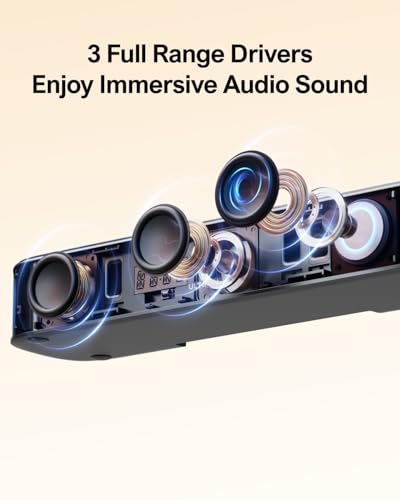
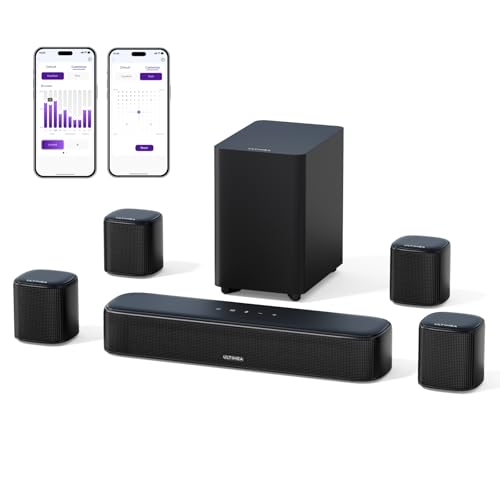
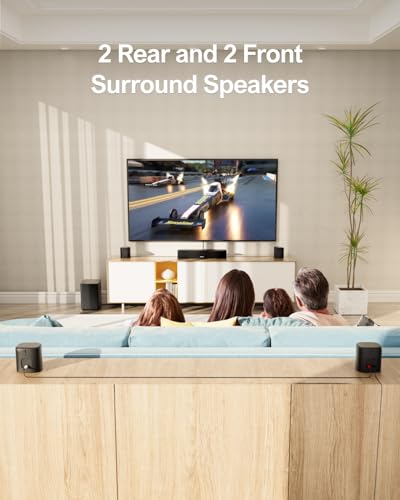
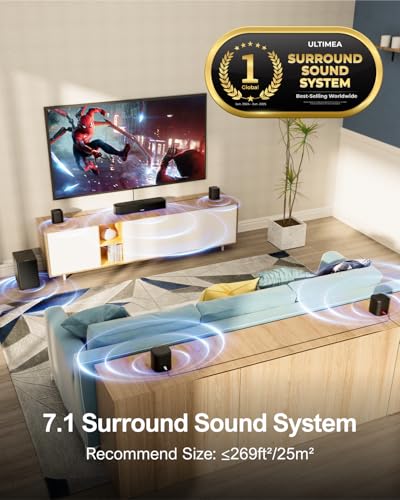
The Ultimea Aura A40 takes an interesting approach to the budget soundbar challenge. Instead of stripping features to hit a low price point, Ultimea packed in technologies typically reserved for more expensive systems. The result is a 7.1 virtual surround system that includes four physical surround speakers—two that connect to the front of the soundbar and two rear speakers that pair wirelessly but require wired power connections.
This configuration creates what Ultimea calls a "360-degree sound field" using their proprietary SurroundX technology. In practical terms, this means the system uses digital signal processing (DSP)—essentially computer algorithms—to simulate how sound would behave in a larger speaker array. The four 2-inch drivers in the surround speakers work with the three drivers in the main soundbar to create the impression that sound is coming from more locations than the physical speakers actually occupy.
The BassMX technology represents another cost-effective engineering solution. Rather than relying purely on a larger subwoofer, BassMX uses digital processing to enhance the perception of bass from the included 4-inch subwoofer. This approach works reasonably well for the system's intended use case—improving TV dialogue and adding some impact to movie soundtracks—but it reveals limitations when pushed hard or used for music listening.
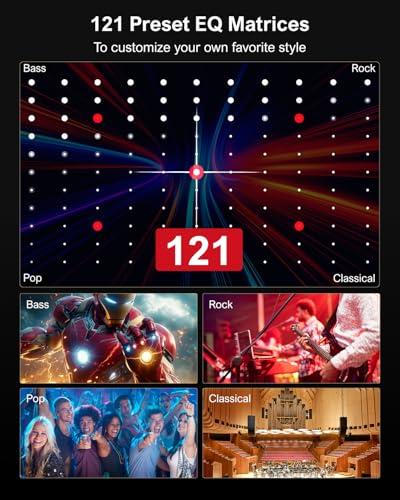
Where the Ultimea Aura A40 truly shines is in customization options. The ULTIMEA Smart App provides access to 121 preset equalizer matrices and a 10-band equalizer that rivals systems costing several times more. This level of control lets users compensate for room acoustics and personal preferences in ways that many premium systems don't allow. The six EQ modes (Movie, Music, Voice, Sport, Game, Night) provide quick optimization for different content types, while the 13 adjustable surround levels help tailor the system to room size and speaker placement.
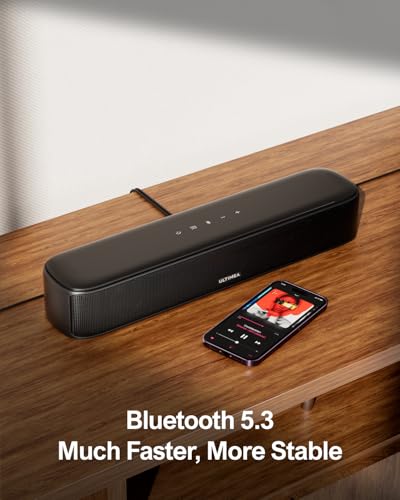
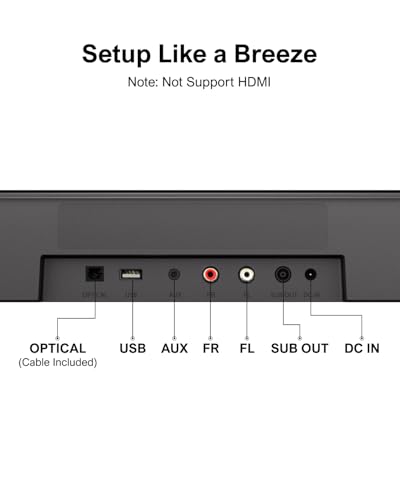
From a connectivity standpoint, the Ultimea Aura A40 covers the basics with optical, AUX, and Bluetooth 5.3 connections. The absence of HDMI inputs—particularly HDMI eARC—represents a significant limitation for users with modern TV setups, but for many budget-conscious buyers using older TVs or those comfortable with optical connections, this isn't a dealbreaker.
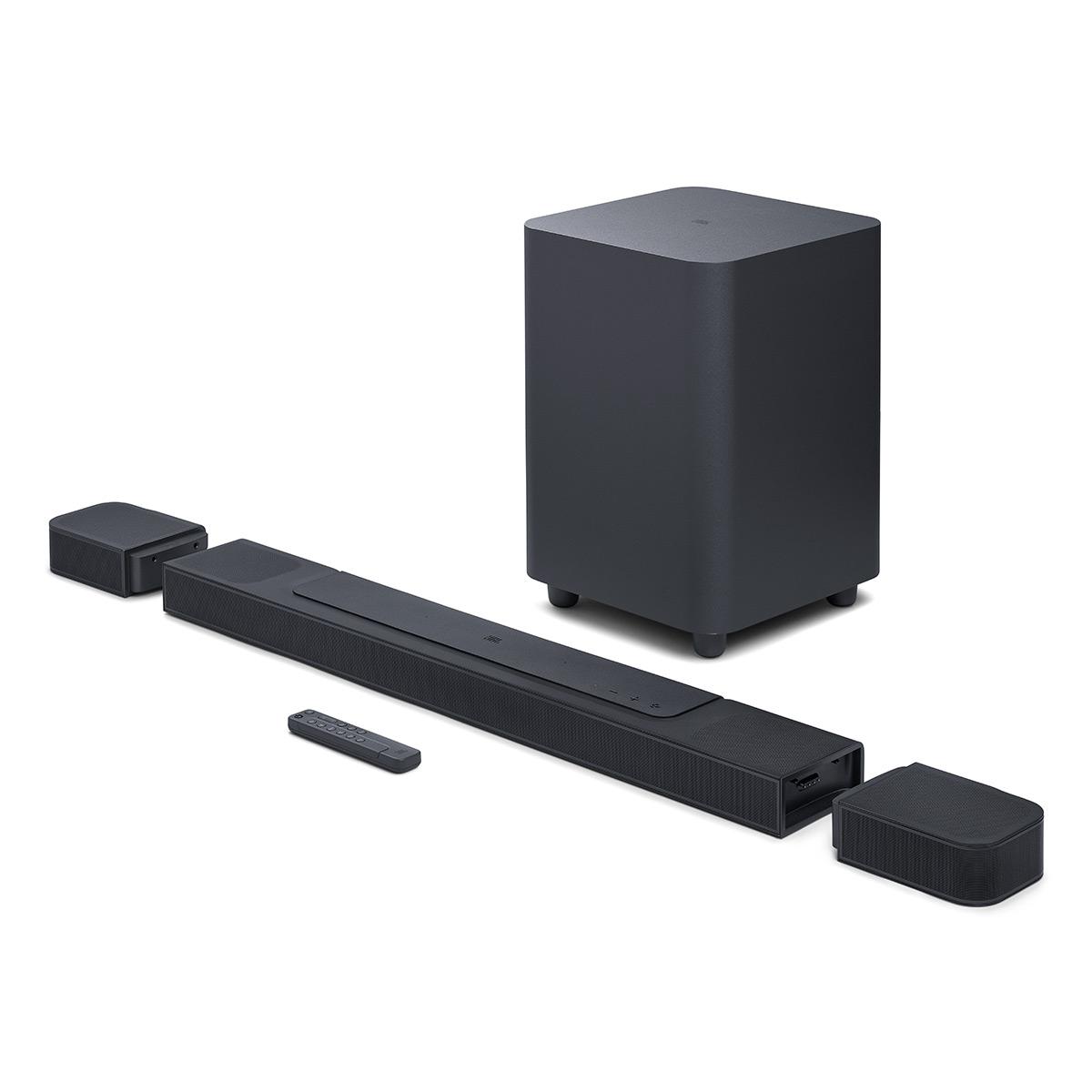
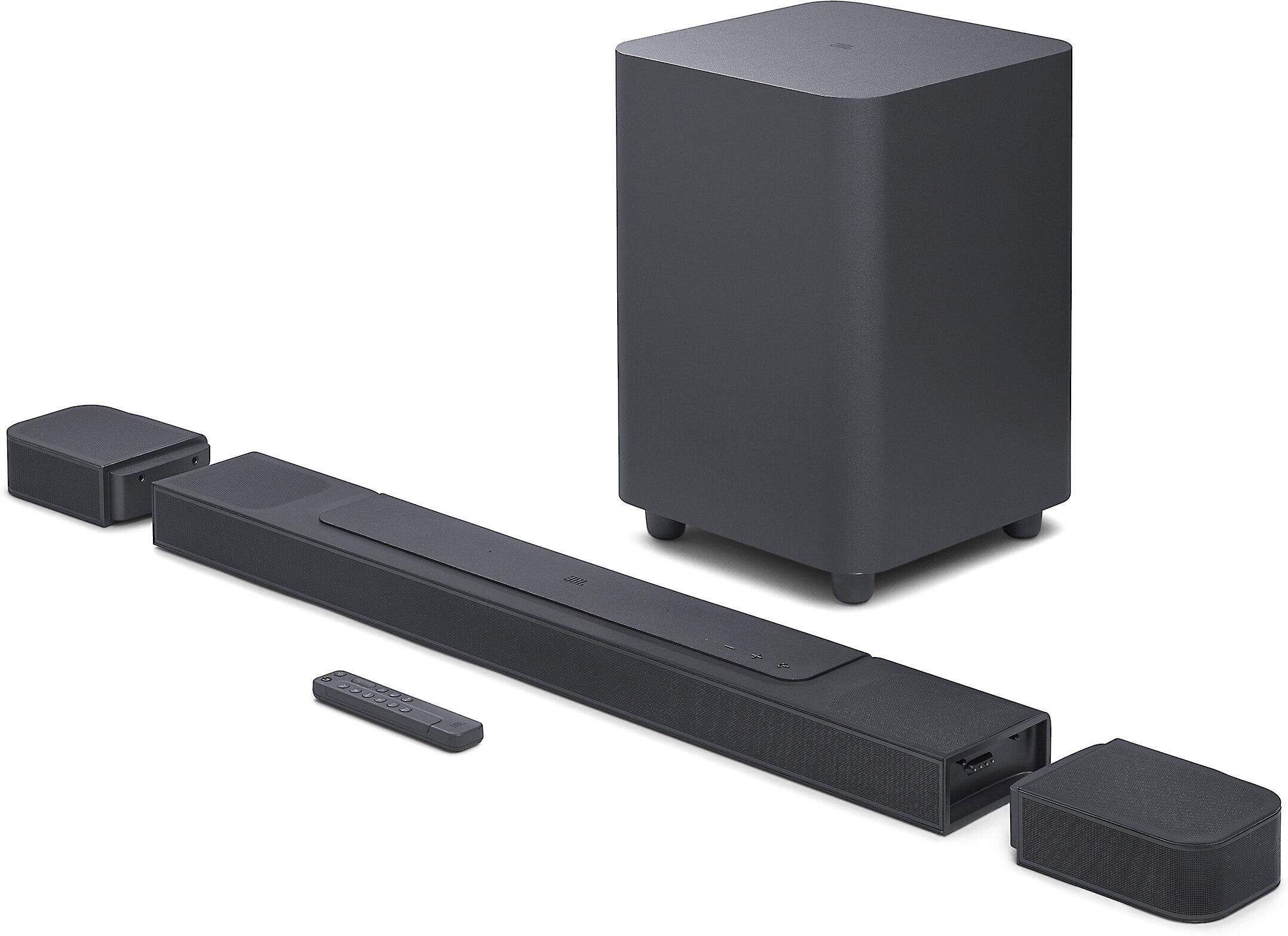
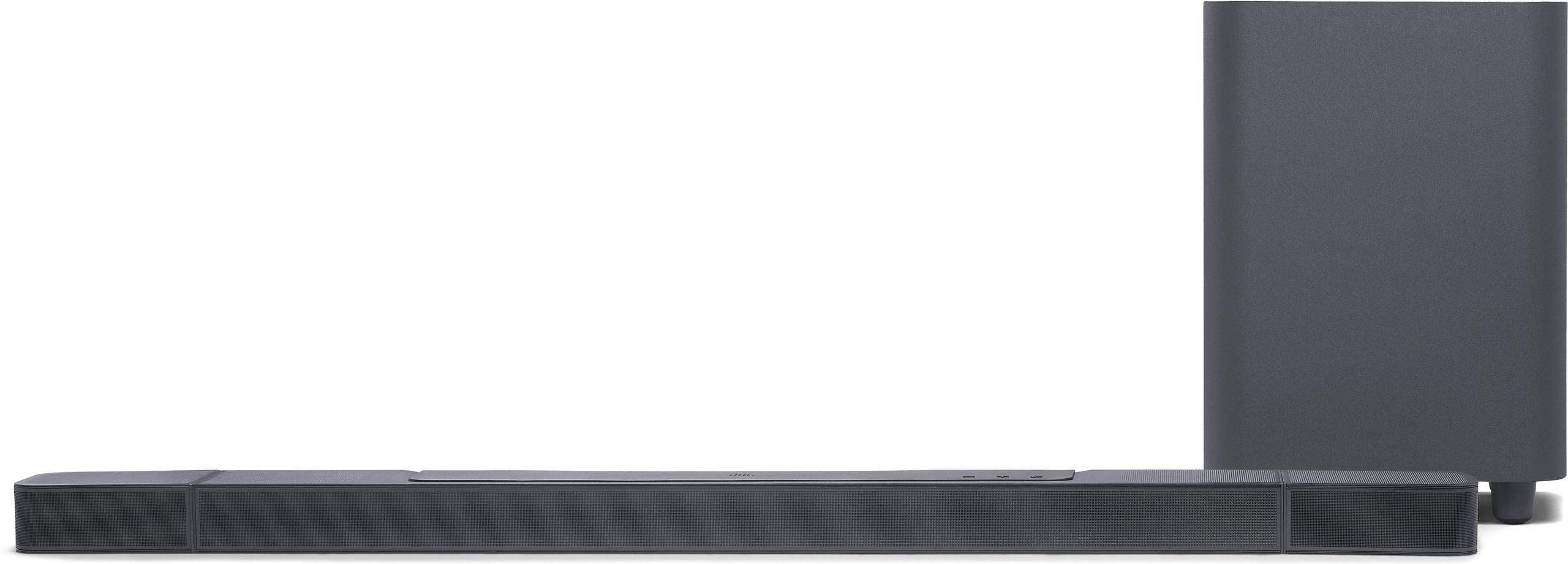
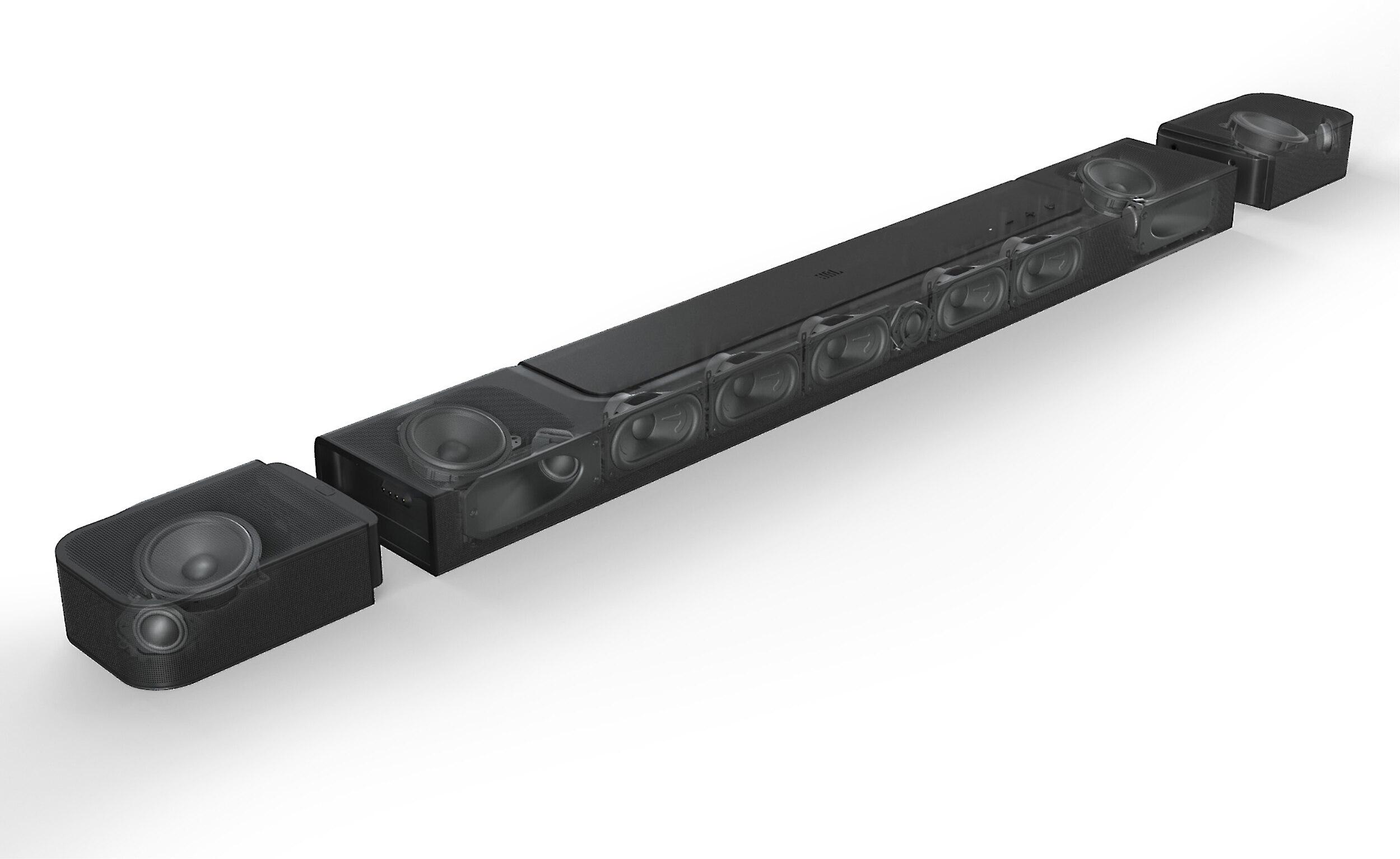
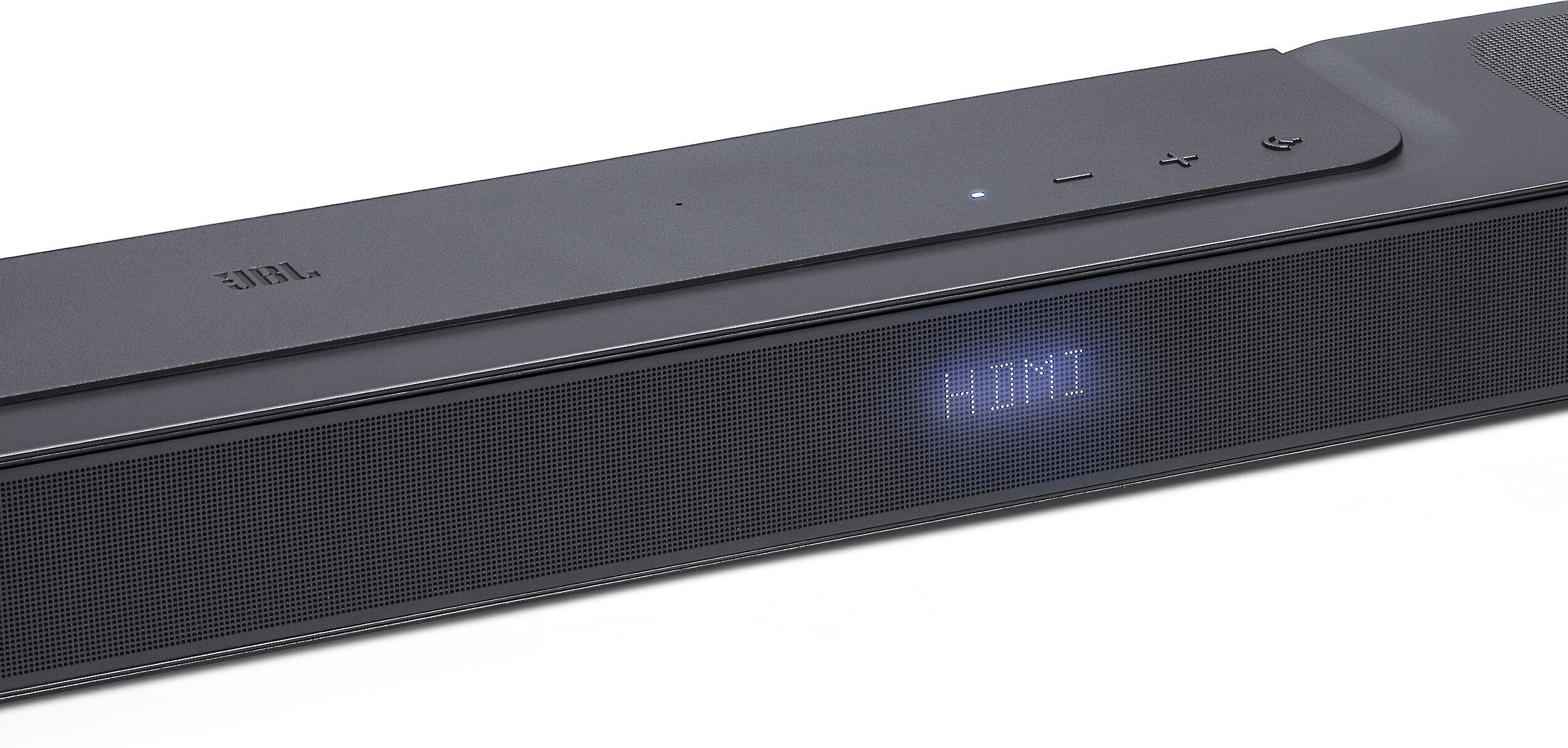
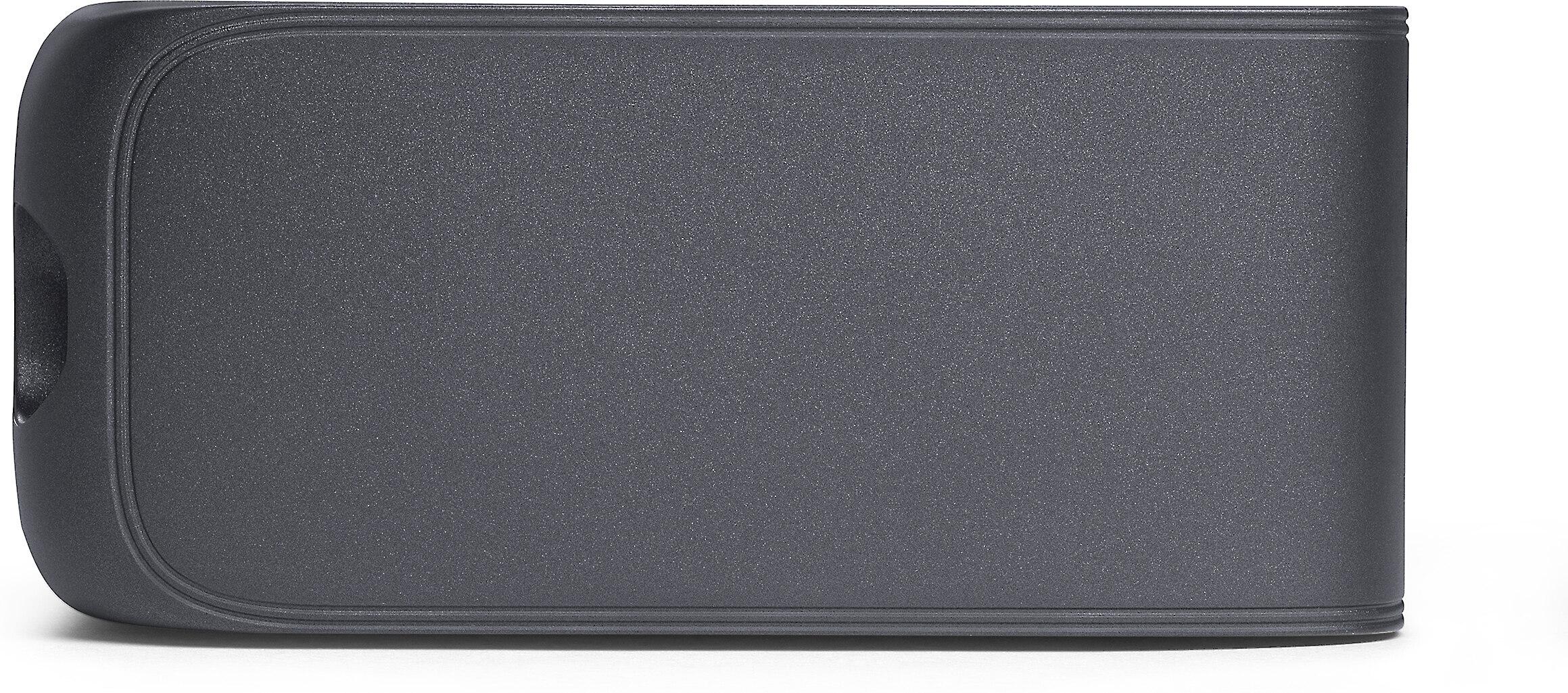
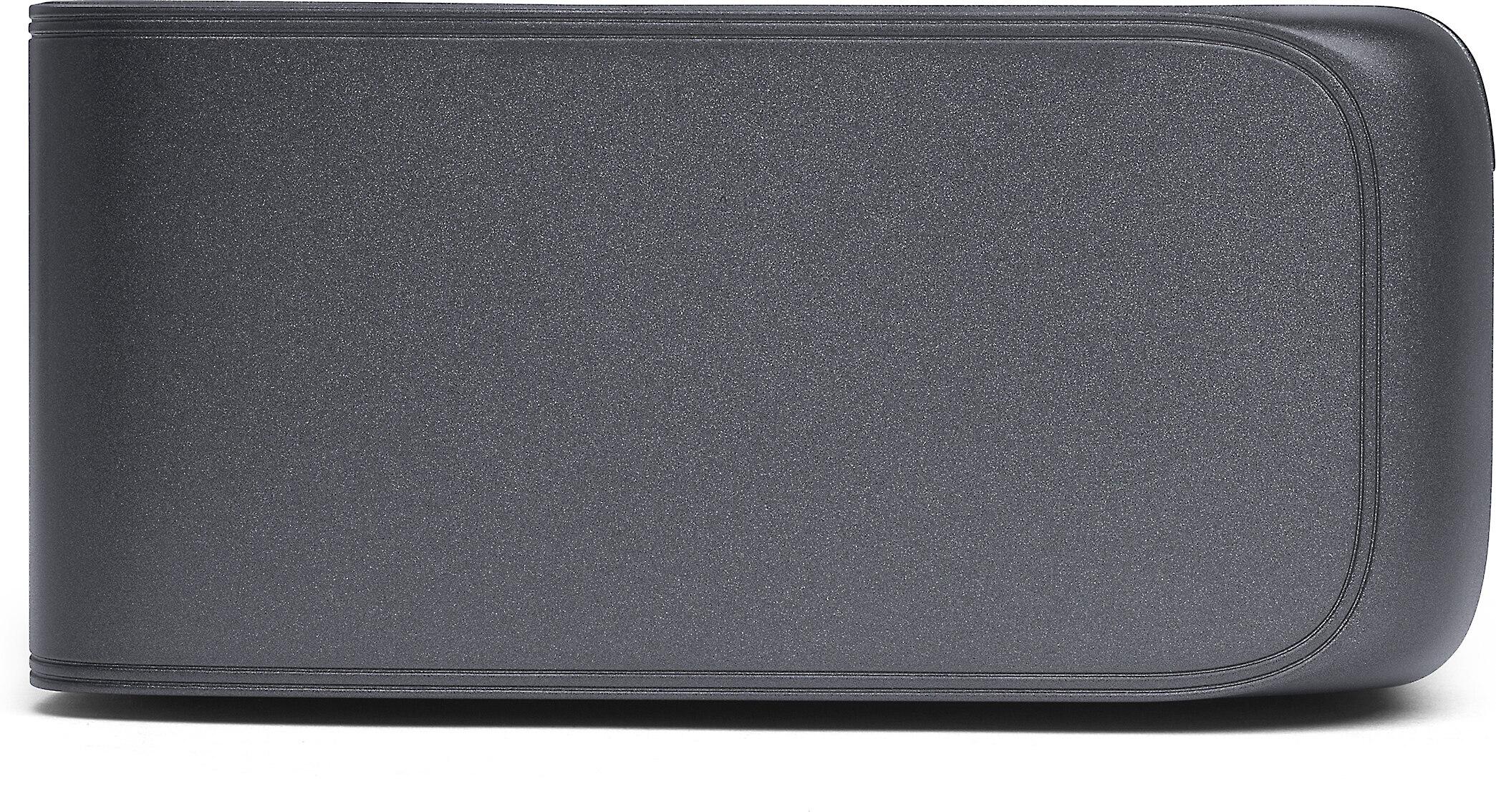
The JBL Bar 1000 approaches the home theater challenge from a completely different angle. Instead of using clever processing to simulate surround sound, it delivers true Dolby Atmos and DTS:X through a 7.1.4 speaker configuration that includes four up-firing drivers. These up-firing speakers—two in the main soundbar and two in the detachable rear speakers—bounce sound off your ceiling to create the height channels that define modern object-based audio formats.
This distinction matters more than the technical jargon might suggest. Dolby Atmos treats sounds as objects that can be precisely positioned in three-dimensional space, rather than just assigning them to specific channels. When a helicopter flies overhead in a movie, true Atmos systems can make that sound travel convincingly through your room's airspace. The JBL Bar 1000's four up-firing drivers working with its MultiBeam technology create this three-dimensional soundstage in ways that virtual processing simply cannot match.
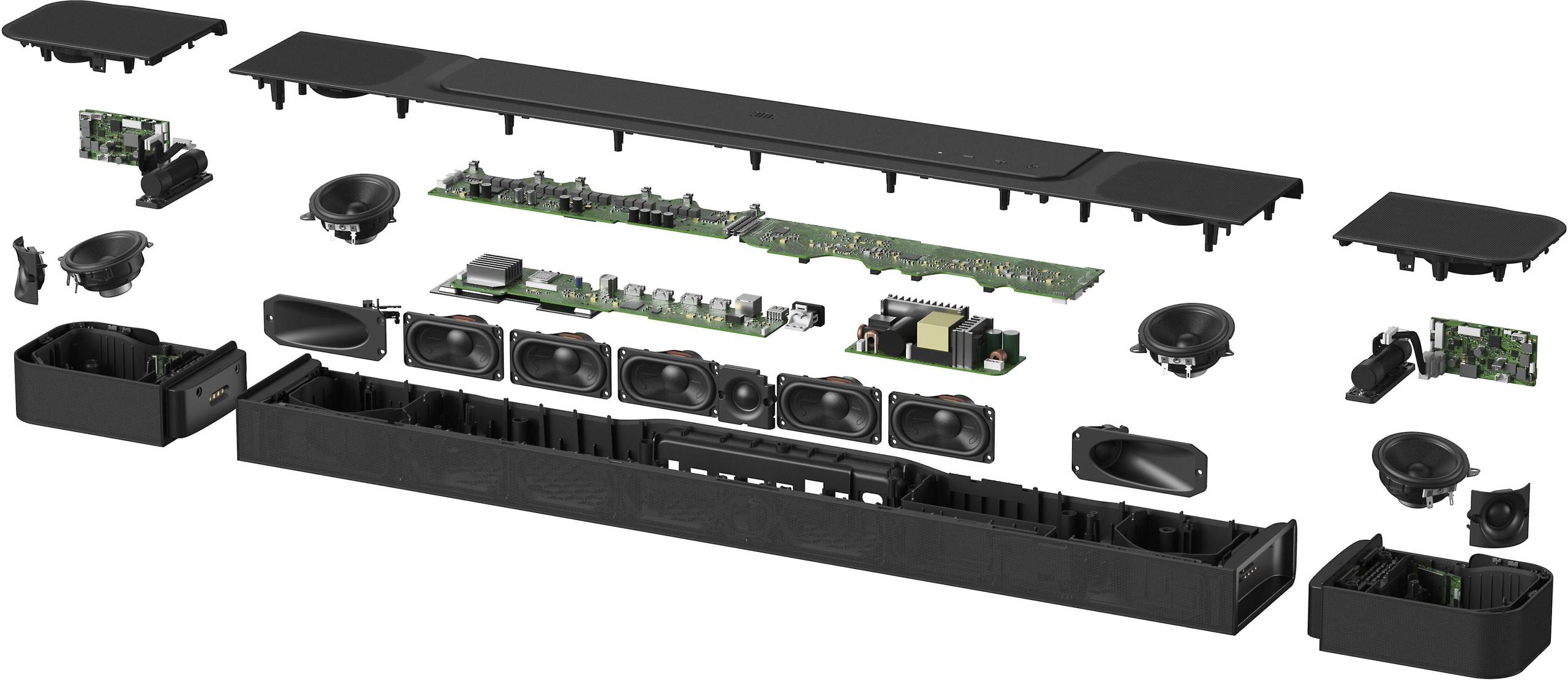
The system's 880 watts of total power gets distributed across carefully engineered driver arrays. The main soundbar uses five racetrack drivers (oval-shaped for better midrange response), three 0.75-inch tweeters for crisp highs, and two up-firing drivers for height effects. The detachable rear speakers mirror this approach with their own tweeters and up-firing drivers, creating true discrete surround channels rather than simulated ones.
Perhaps the most impressive engineering achievement in the JBL Bar 1000 is the PureVoice dialogue enhancement technology. This isn't just an EQ adjustment—it's sophisticated processing that analyzes audio content in real-time to ensure dialogue remains clear even during loud action sequences. Based on user feedback, this technology consistently delivers on its promise, keeping conversations intelligible without requiring constant volume adjustments.
The 10-inch wireless subwoofer deserves special attention. Unlike smaller budget subwoofers that rely on processing tricks to simulate deep bass, this driver can reproduce genuine low-frequency content down to 33Hz. That's the difference between feeling bass and just hearing it—action movie explosions and music with serious low-end content benefit dramatically from this extended frequency response.
Understanding the real-world performance differences requires looking beyond marketing claims to examine how these systems actually behave in typical home environments. Based on extensive user feedback and expert evaluations, clear patterns emerge that help predict how each system will perform.
The most significant performance gap appears in music listening. The JBL Bar 1000 consistently receives praise for its musical reproduction, with users describing "clean, clear, dynamic, and punchy" sound that rivals dedicated hi-fi systems. The combination of quality drivers, substantial amplification, and sophisticated processing creates a coherent soundstage that works well for everything from acoustic music to electronic genres.
The Ultimea Aura A40, meanwhile, shows its budget constraints most clearly during music playback. Multiple reviews describe the sound as "tinny, boxy, and metallic," particularly noticeable during extended listening sessions. The 2-inch drivers throughout the system simply cannot reproduce midrange frequencies with the accuracy and smoothness that larger, higher-quality drivers provide. For casual background music, this limitation may not matter, but anyone planning to use their soundbar system for serious music listening will find the Ultimea Aura A40 lacking.
Both systems excel at improving dialogue clarity compared to TV speakers, but they achieve this goal through different methods. The JBL Bar 1000's PureVoice technology actively processes audio to maintain voice intelligibility, while the Ultimea Aura A40 relies on user-adjustable voice modes and EQ settings.
In practice, the JBL Bar 1000 provides more consistent performance across different content types without requiring user intervention. The Ultimea Aura A40 can achieve good dialogue clarity, but often requires manual adjustment of settings when switching between different shows or movies—something that becomes tedious over time.
The surround sound experience reveals perhaps the most dramatic difference between these approaches. The JBL Bar 1000's true discrete channels and up-firing drivers create convincing spatial effects that users consistently describe as "hauntingly accurate" and immersive. Movie soundtracks designed for Atmos reproduction showcase effects that seem to move through the room with precision.
The Ultimea Aura A40's virtual surround approach works better than TV speakers, but cannot match the spatial accuracy of true discrete channels. The four physical surround speakers do provide some directional audio cues, but the system fundamentally relies on processing tricks rather than actual sound placement. For users coming from TV speakers, the improvement feels significant. For those experienced with higher-end surround systems, the limitations become more apparent.
Bass performance shows another clear dividing line. The JBL Bar 1000's 10-inch subwoofer with 300 watts of dedicated power delivers what users describe as "perfection" in bass quality—deep, controlled, and impactful without being overwhelming. The 33Hz frequency response means genuine low-end content gets reproduced rather than simulated.
The Ultimea Aura A40's 4-inch subwoofer with BassMX enhancement provides adequate bass for TV viewing but reveals its limitations quickly. The 65Hz frequency response cutoff means true deep bass simply gets filtered out, and reviews consistently describe the bass as "flabby and loose." For casual viewing, this may suffice, but action movies and music with substantial low-end content expose the system's constraints.
The connectivity story reflects each system's target market and design philosophy. The JBL Bar 1000 includes HDMI eARC support, which provides a single-cable connection to modern TVs while supporting uncompressed Dolby Atmos and DTS:X audio. The built-in Wi-Fi enables access to over 300 streaming services through AirPlay, Chromecast, and Alexa integration, essentially turning the soundbar into a smart audio hub.
The Ultimea Aura A40 takes a more basic approach with optical, AUX, and Bluetooth connections. While the ULTIMEA Smart App provides extensive customization options, the lack of HDMI connectivity can create setup challenges with modern TVs that have limited optical output capabilities or don't support advanced audio formats over optical connections.
For users with older TV setups or those comfortable with optical connections, this difference may not matter. However, anyone planning to use advanced audio formats or integrate the soundbar into a smart home ecosystem will find the JBL Bar 1000's connectivity options more future-proof.
Room compatibility represents another crucial factor where these systems diverge significantly. The Ultimea Aura A40 works best in smaller spaces—apartments, bedrooms, or compact living areas between 108-270 square feet. In these environments, the system's 330 watts provides adequate volume, and the wired surround speaker connections remain manageable.
The JBL Bar 1000 scales effectively to larger rooms thanks to its 880-watt power output and wireless rear speakers. The battery-powered detachable surrounds eliminate the wire-running challenges that plague many surround systems, while the automatic room calibration adjusts performance based on actual acoustic measurements rather than user guesswork.
This scaling difference matters more than the raw numbers suggest. A system that sounds impressive in a small room may disappoint in a larger space, while a powerful system optimized for large rooms might overwhelm a compact apartment with neighbors to consider.
At the time of writing, these systems occupy distinctly different value territories that reflect their intended markets. The Ultimea Aura A40 delivers remarkable feature density for its budget-friendly price point—physical surround speakers, extensive app control, multiple connection options, and comprehensive customization options that would cost significantly more from traditional audio brands.
The JBL Bar 1000 justifies its premium pricing through engineering excellence and genuine performance advantages. True Dolby Atmos reproduction, professional-grade drivers, wireless convenience, and consistent audio quality across different content types represent meaningful improvements that matter for serious home theater use.
These aren't competing value propositions—they're different answers to different questions. The Ultimea Aura A40 answers "How can I get the most features and improvement for the least money?" while the JBL Bar 1000 answers "What's the best home theater experience I can get in a soundbar form factor?"
The decision between these systems ultimately comes down to matching their strengths with your priorities and constraints. Choose the Ultimea Aura A40 if your primary goal is dramatic improvement over TV speakers within a strict budget, you're comfortable with some setup complexity for surround speakers, and you enjoy tweaking audio settings to optimize performance. This system excels for apartment dwellers, casual viewers, and first-time soundbar buyers who want to experience surround sound without premium pricing.
The JBL Bar 1000 makes sense when audio quality isn't negotiable, you have the room and budget to support a premium system, and you value the convenience of wireless setup with professional-grade results. This system suits serious home theater enthusiasts, music lovers who expect high fidelity from their audio systems, and users with larger living spaces who need the power to fill them effectively.
Neither system is objectively better—they're optimized for different users with different needs. The Ultimea Aura A40 succeeds brilliantly at bringing advanced features to budget-conscious buyers, while the JBL Bar 1000 delivers on the promise of premium home theater performance in a relatively simple package. Understanding which category matches your situation, budget, and expectations will guide you toward the right choice for your home entertainment setup.
| Ultimea Aura A40 U2601 | JBL Bar 1000 |
|---|---|
| Audio Format Support - Determines compatibility with premium streaming content | |
| Virtual 7.1 surround using SurroundX technology | True Dolby Atmos 7.1.4 and DTS:X with MultiBeam |
| Total System Power - Affects volume levels and dynamic range | |
| 330W peak (adequate for small-medium rooms) | 880W total (excellent for large spaces) |
| Subwoofer Configuration - Controls bass depth and placement flexibility | |
| 4" wired subwoofer with BassMX enhancement | 10" wireless subwoofer with 300W dedicated power |
| Surround Speaker Setup - Impacts installation complexity and sound quality | |
| 4 wired speakers (2 front, 2 rear with 6m cable) | 2 detachable battery-powered wireless rear speakers |
| Connectivity Options - Affects compatibility with modern TVs and devices | |
| Optical, AUX, Bluetooth 5.3 (no HDMI) | HDMI eARC, optical, Bluetooth with 4K passthrough |
| Smart Features - Determines streaming and control capabilities | |
| Ultimea Smart App with 121 EQ presets | Built-in Wi-Fi, AirPlay, Chromecast, Alexa integration |
| Frequency Response - Shows how deep bass extends and how clear highs sound | |
| 65 Hz - 18 kHz (limited deep bass) | 33 Hz - 20 kHz (full range with true deep bass) |
| Room Calibration - Ensures optimal sound for your specific space | |
| Manual adjustment via app with 13 surround levels | Automatic room calibration with one-button setup |
| Driver Configuration - Affects sound quality and spatial accuracy | |
| 8 total: 3 in bar + 4 surround (all 2" drivers) + subwoofer | Professional array: racetrack drivers, tweeters, up-firing speakers |
| Voice Enhancement - Critical for clear dialogue during loud scenes | |
| Voice EQ mode with manual treble/midrange adjustment | PureVoice technology with automatic dialogue optimization |
| Installation Flexibility - Impacts setup ease and room aesthetics | |
| Wall mountable bar and surrounds (wired connections required) | Wall mountable with wireless rear speakers (battery powered) |
| Target Room Size - Manufacturer recommendations for optimal performance | |
| 108-270 sq ft (small to medium rooms) | Medium to large rooms (no specific limit given) |
The Ultimea Aura A40 offers exceptional value in the budget category with physical surround speakers, extensive app customization, and 7.1 virtual surround sound. The JBL Bar 1000 justifies its premium pricing with true Dolby Atmos, professional-grade audio quality, and wireless convenience. Your choice depends on whether you prioritize maximum features per dollar or uncompromising audio performance.
Yes, the JBL Bar 1000 delivers true Dolby Atmos 7.1.4 surround sound with four up-firing drivers that bounce sound off your ceiling for genuine height effects. The Ultimea Aura A40 uses virtual 7.1 surround processing to simulate spatial audio but cannot reproduce actual Dolby Atmos content as intended by filmmakers.
The JBL Bar 1000 significantly outperforms the Ultimea Aura A40 in bass quality with its 10-inch wireless subwoofer that extends down to 33Hz for true deep bass. The Ultimea Aura A40's 4-inch subwoofer with 65Hz response provides adequate bass for TV viewing but lacks the impact needed for action movies and music.
No, the Ultimea Aura A40 uses wired surround speakers that connect to the main soundbar with included cables (6m for rear speakers). The JBL Bar 1000 features detachable battery-powered rear speakers that operate wirelessly, eliminating the need to run cables across your room.
The Ultimea Aura A40 is specifically designed for smaller spaces (108-270 sq ft) and offers good performance in apartments without overwhelming neighbors. The JBL Bar 1000 has more power that may be excessive in compact spaces, though its room calibration can help optimize performance for any environment.
Only the JBL Bar 1000 includes HDMI eARC support for single-cable connection to modern TVs with full Dolby Atmos compatibility. The Ultimea Aura A40 relies on optical, AUX, and Bluetooth connections, which may limit advanced audio format support depending on your TV's capabilities.
Both systems improve dialogue significantly over TV speakers, but the JBL Bar 1000's PureVoice technology automatically optimizes speech clarity without user intervention. The Ultimea Aura A40 offers manual voice enhancement through EQ modes that require adjustment for optimal dialogue clarity across different content.
The JBL Bar 1000 offers comprehensive streaming with built-in Wi-Fi, AirPlay, Chromecast, and access to 300+ services. The Ultimea Aura A40 supports Bluetooth 5.3 streaming from devices but lacks built-in Wi-Fi and direct streaming service access, requiring a connected device for music playback.
The Ultimea Aura A40 excels in customization with 121 EQ presets, 10-band equalizer, and detailed surround level adjustments through the ULTIMEA Smart App. The JBL Bar 1000's JBL One app focuses more on streaming integration and basic controls, with automatic room calibration reducing the need for manual adjustments.
The JBL Bar 1000 offers simpler installation with wireless rear speakers and one-button room calibration. The Ultimea Aura A40 requires running cables for all four surround speakers and manual positioning, making setup more complex but offering greater placement flexibility for optimal sound.
The Ultimea Aura A40 performs optimally in small to medium rooms (108-270 sq ft) where its 330W power output provides adequate volume. The JBL Bar 1000 with 880W total power scales effectively to larger living spaces and can fill bigger rooms with immersive surround sound without strain.
For serious music listening, the JBL Bar 1000 delivers superior audio quality with professional-grade drivers and clean, dynamic sound reproduction. The Ultimea Aura A40 focuses primarily on TV audio enhancement and shows limitations in musical accuracy, making it better suited for casual background music rather than critical listening sessions.
We've done our best to create useful and informative comparisons to help you decide what product to buy. Our research uses advanced automated methods to create this comparison and perfection is not possible - please contact us for corrections or questions. These are the sites we've researched in the creation of this article: walmart.com - newegg.com - youtube.com - ultimea.com - youtube.com - device.report - ultimea.co - manuals.plus - homestudiobasics.com - youtube.com - bestbuy.com - community.ultimea.com - manuals.plus - eu.ultimea.com - navesapeugeot.com.br - bestbuy.com - images.thdstatic.com - provantage.com - ultimea.com - bestbuy.com - zdnet.com - jbl.com - jbl.com - pcrichard.com - rtings.com - d21buns5ku92am.cloudfront.net - ro.harmanaudio.com - target.com - harmanaudio.com - dell.com - mm.jbl.com - dolby.com - jbl.com.my - videoandaudiocenter.com

Privacy Policy
Terms and Conditions - Affiliate Policy
Home Security
© Copyright 2008-2026.
11816 Inwood Rd #1211, Dallas, TX 75244