












If you're tired of constantly adjusting your TV volume—turning it up to hear dialogue clearly, then scrambling for the remote when explosions suddenly blast through your living room—you're definitely ready for a soundbar. The question isn't whether you need better audio (you absolutely do), but which type of soundbar will transform your viewing experience.
Today we're comparing two fundamentally different approaches to upgrading your TV's sound: the VIZIO 5.1 Soundbar SE Dolby Atmos Surround System and the Sonos Ray Soundbar. These represent opposite philosophies in home audio—one gives you everything at once for less money, while the other focuses on premium quality and long-term flexibility.
The soundbar category has evolved dramatically since these compact speakers first appeared in the early 2000s. What started as simple solutions to improve TV dialogue has grown into sophisticated audio systems that can rival traditional surround sound setups.
Modern soundbars fall into several categories. Stereo soundbars like the Sonos Ray use two or more drivers (the individual speakers inside the unit) to create left and right audio channels, significantly improving over TV speakers while maintaining a simple setup. Surround sound systems like the VIZIO 5.1 add dedicated speakers around your room to create true directional audio—meaning you can actually hear helicopters flying overhead or footsteps approaching from behind.
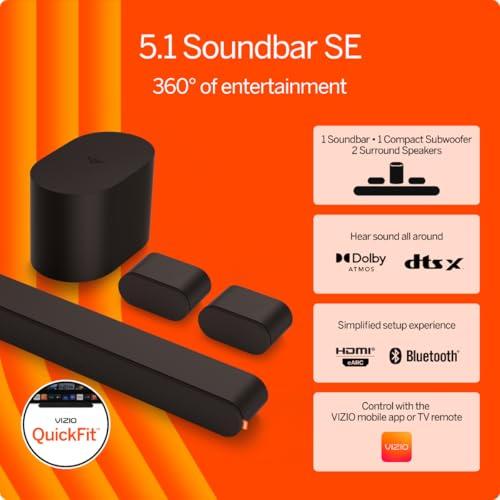
The numbers in audio specifications tell an important story. When you see "5.1," that means five main speakers (front left, center, front right, surround left, surround right) plus one subwoofer (the ".1") dedicated to low-frequency sounds like explosions and bass-heavy music. A "2.0" system has just left and right channels with no dedicated subwoofer.
Dolby Atmos represents the latest evolution in surround sound technology. Traditional surround systems move sounds around you in a horizontal plane—left to right, front to back. Atmos adds height to create truly three-dimensional audio, so rain can seem to fall from above or planes can fly overhead. The VIZIO system processes Atmos content through its existing speakers, while the Sonos Ray cannot decode these height effects at all.
Room acoustics play a crucial role in soundbar performance. Hard surfaces like tile floors and bare walls reflect sound waves, creating echoes that can muddy dialogue. Soft furnishings like couches, curtains, and carpets absorb sound, reducing reflections but sometimes making rooms feel "dead." The best soundbars adapt to these challenges through room correction technology or manual adjustment options.
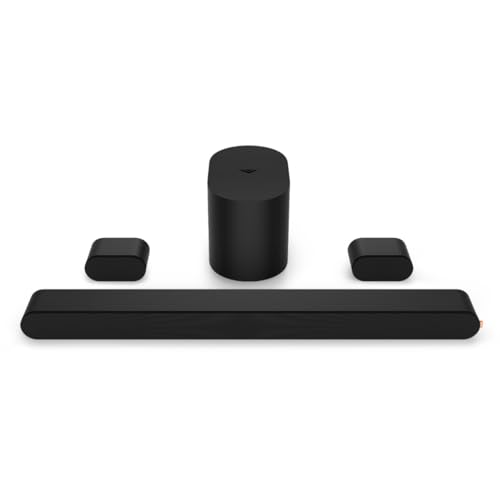
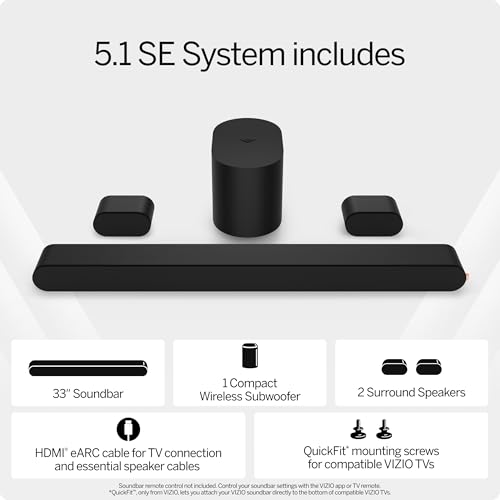
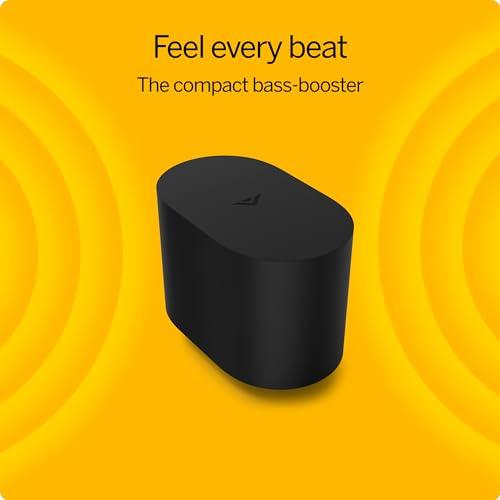
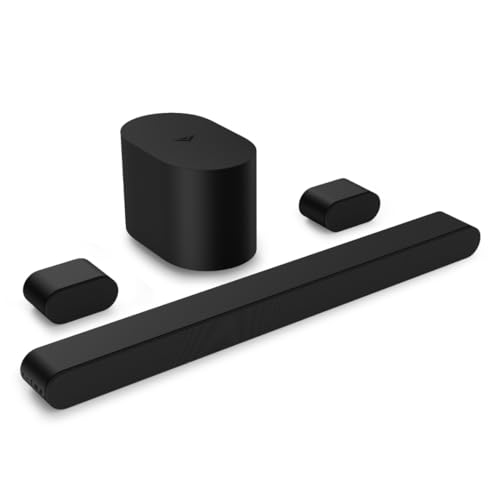
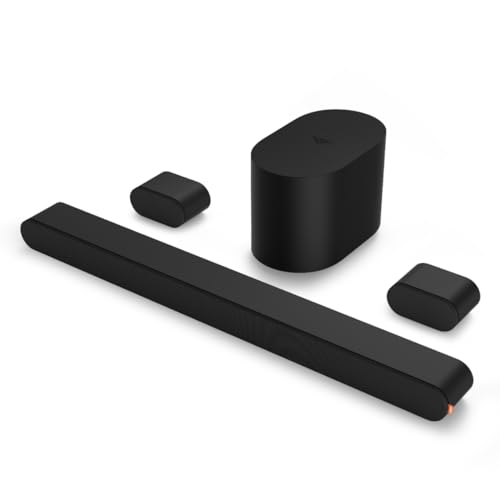
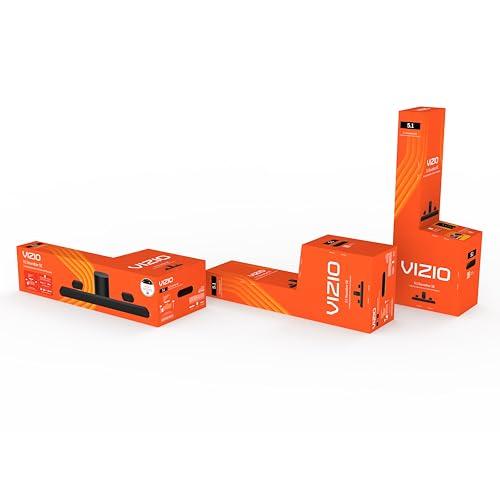
Released in 2022, the VIZIO 5.1 Soundbar SE represents the "everything included" approach to home theater audio. At around $200 at the time of writing, this system includes a 33-inch main soundbar, a wireless subwoofer, and two surround speakers—essentially everything you need for movie theater-style surround sound.
The main soundbar houses three full-range drivers handling left, center, and right channels. The center channel deserves special attention because it's responsible for dialogue—arguably the most important element in any TV show or movie. Having a dedicated center speaker means voices stay anchored to the screen instead of seeming to float somewhere between your left and right speakers.
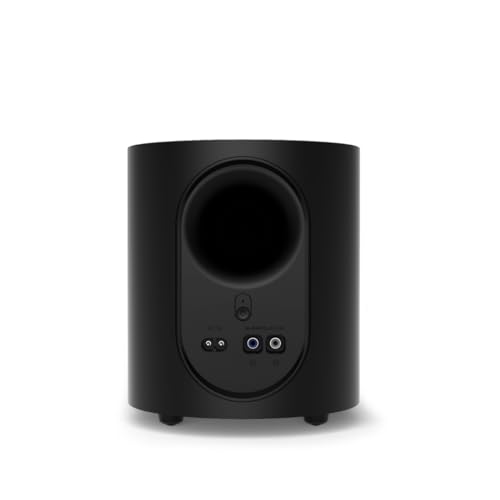
VIZIO's wireless subwoofer connects without any cables, giving you flexibility in placement while delivering bass frequencies down to 50Hz. For context, most adult male voices bottom out around 85Hz, while the rumble of thunder or explosion sound effects can reach down to 20Hz or lower. The closer a subwoofer gets to that 20Hz mark, the more you'll feel those dramatic moments rather than just hearing them.
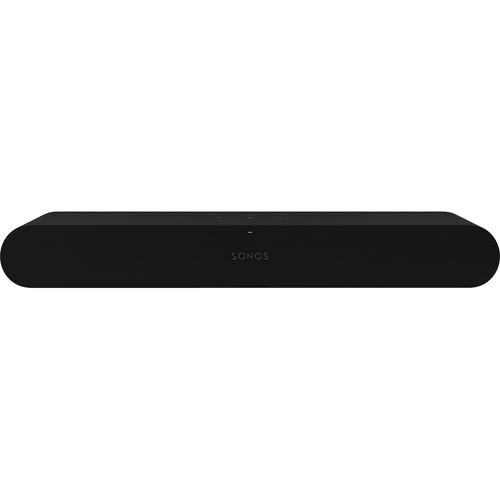
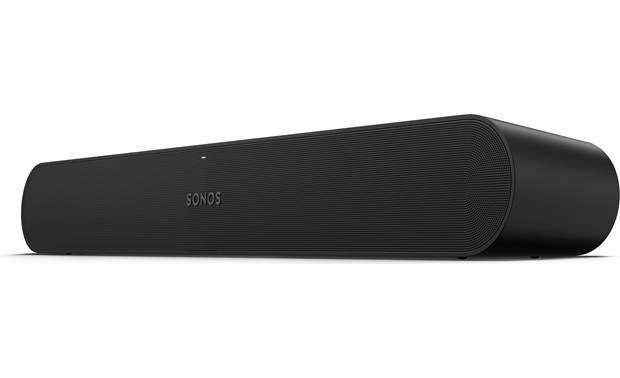
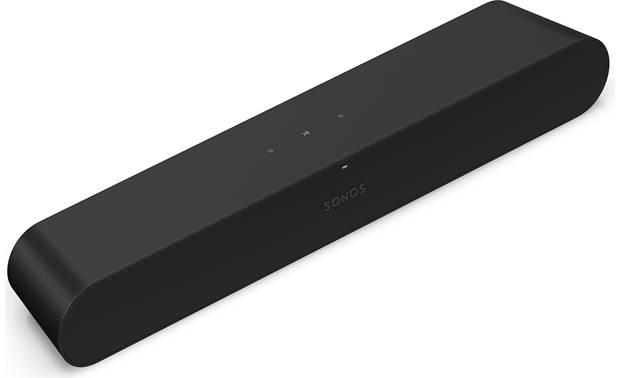
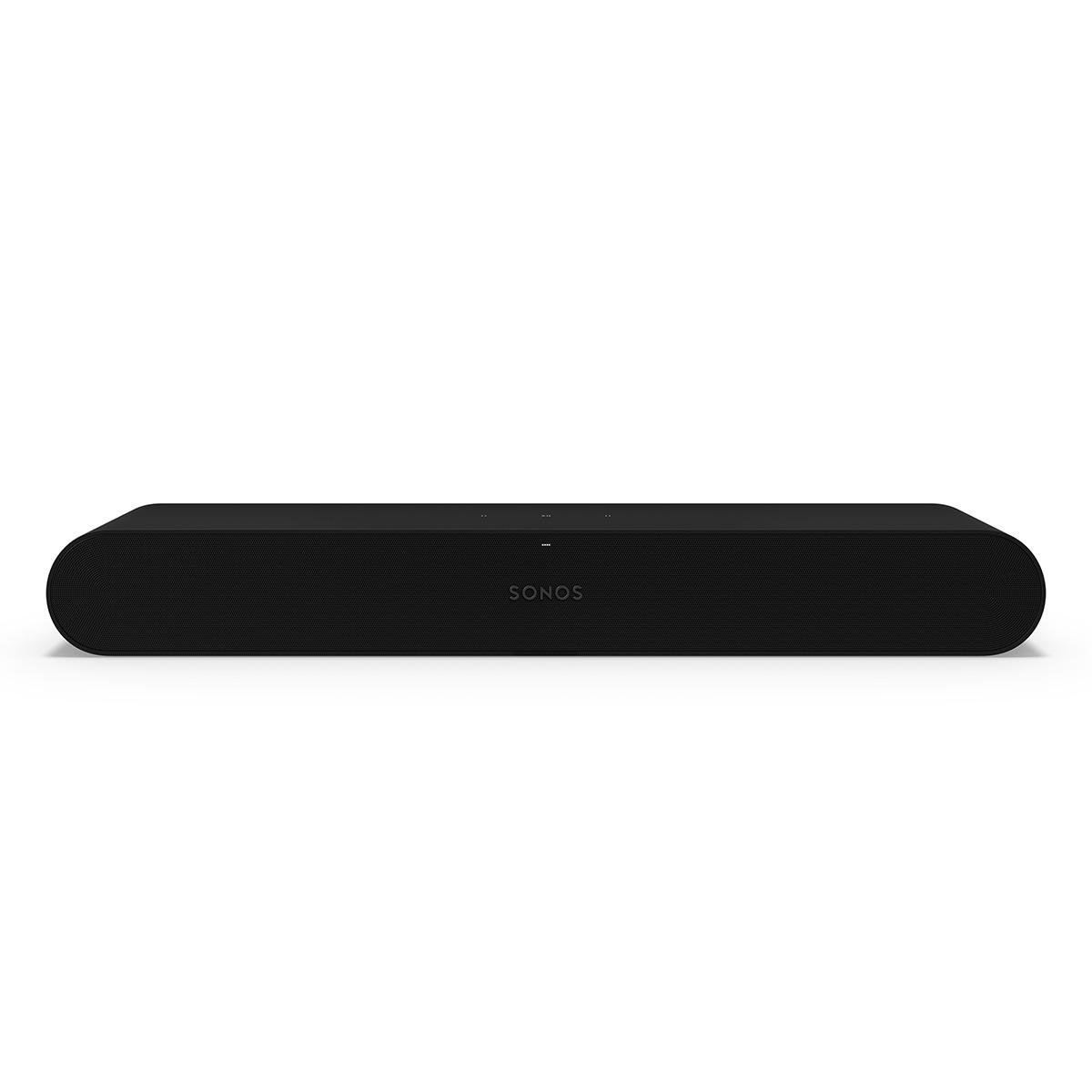
Also launching in 2022, the Sonos Ray takes a completely different approach. This 22-inch stereo soundbar prioritizes audio quality and smart home integration over surround sound effects. At roughly $280 at the time of writing, it costs more per channel than the VIZIO system but brings Sonos's reputation for exceptional audio engineering.
The Ray features custom-designed waveguides—specially shaped channels that control how sound disperses from the speakers. Think of them like acoustic lenses that focus and spread sound waves to create a wider soundstage than the physical speaker should theoretically produce. Combined with advanced digital signal processing (DSP), which fine-tunes the audio signal before it reaches your ears, this creates surprisingly immersive stereo sound from a compact unit.
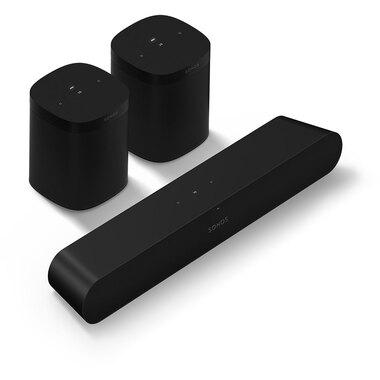
Sonos built its reputation on multiroom audio systems, and the Ray serves as an entry point into that ecosystem. Unlike traditional soundbars that connect only to your TV, the Ray can stream music wirelessly throughout your home when paired with other Sonos speakers.
This comparison isn't even close—the VIZIO system delivers true surround sound while the Sonos Ray cannot. When watching movies with the VIZIO setup, you'll hear helicopters approaching from behind, ambient forest sounds surrounding you during outdoor scenes, and musical scores that seem to envelope your entire listening area.
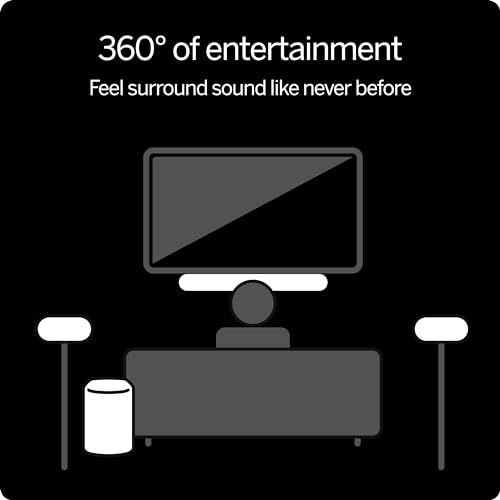
The difference comes down to physics and speaker placement. The VIZIO system's surround speakers sit behind or beside your listening position, creating actual directional audio cues. When a character walks from the front of the screen to the back of a scene, you hear their footsteps travel around the room because different speakers are producing those sounds at different times.
The Sonos Ray can only simulate surround effects by manipulating the stereo signal from its front-facing speakers. While this creates a wider soundstage than typical TV speakers, it cannot replicate the immersive experience of having actual speakers behind you. It's like the difference between watching a movie on your phone versus in a theater—both show you the same content, but the experience differs dramatically.
For Dolby Atmos content, the VIZIO system processes height information through its existing speakers, creating some sense of vertical space. However, neither system includes dedicated upward-firing drivers, so the height effects remain subtle compared to premium Atmos systems that cost significantly more.
Here's where things get interesting, and where the Sonos Ray fights back against the VIZIO system's surround sound advantage. Dialogue clarity matters more than any other audio characteristic because if you can't understand what characters are saying, no amount of surround sound effects will save your viewing experience.
The Sonos Ray was engineered specifically for voice reproduction, with input from Hollywood sound engineers who understand how dialogue should sound in home environments. Its frequency tuning emphasizes the midrange frequencies where human speech lives, typically between 300Hz and 3,000Hz. The result is exceptionally clear, natural-sounding dialogue that cuts through background music and sound effects.
The VIZIO system's dedicated center channel also excels at dialogue reproduction, but its tuning prioritizes overall dynamic range over midrange precision. In practice, this means voices sound clear and present, but they might not have the same natural, effortless quality as the Sonos Ray.
Both systems include dialogue enhancement features. The Ray offers Speech Enhancement mode, which boosts vocal frequencies without affecting other audio elements. The VIZIO system allows center channel level adjustment through its mobile app, letting you make voices louder relative to the surround speakers and subwoofer.
The VIZIO system's dedicated subwoofer creates a significant advantage in low-frequency reproduction that the Sonos Ray simply cannot match. Bass response depends largely on the volume of air a speaker can move, and the VIZIO's 6-inch subwoofer driver moves far more air than the Ray's compact internal drivers.
This difference becomes apparent immediately when watching action movies or listening to bass-heavy music. Explosions feel impactful rather than just sounding loud, musical instruments like organs and synthesizers reproduce with proper weight and authority, and even everyday sound effects like car engines or thunder storms carry more realistic presence.
The Sonos Ray does include carefully tuned bass reflex ports—openings that allow internal air pressure to escape in a controlled manner, enhancing low-frequency output. For a soundbar without a dedicated subwoofer, the Ray produces surprisingly solid bass response. However, it cannot compete with an actual subwoofer, especially at higher volume levels where the Ray's small drivers reach their physical limitations.
When it comes to music reproduction and streaming capabilities, the Sonos Ray demonstrates why the company built its reputation on audio quality. The Ray's precise frequency balance, low distortion characteristics, and sophisticated digital signal processing create remarkably accurate sound reproduction across all volume levels.
The Ray supports TruePlay room tuning, a feature that uses your iPhone's microphone to measure your room's acoustic characteristics and automatically adjusts the soundbar's output accordingly. This technology can dramatically improve performance in challenging acoustic environments—rooms with hard surfaces that create echoes, or rooms with unusual shapes that create acoustic dead spots.
For music streaming, the Ray connects to over 100 music services and supports high-quality wireless protocols like Apple AirPlay 2. The difference in music quality becomes apparent when listening to acoustic instruments, vocal performances, or any content where tonal accuracy matters more than raw impact.
The VIZIO system handles music adequately, but its tuning prioritizes movie soundtrack reproduction over musical accuracy. The dedicated subwoofer does provide an advantage for bass-heavy genres like hip-hop or electronic music, but the overall sound signature favors dynamic range over tonal precision.
Today's soundbars must integrate seamlessly with smart TVs, streaming devices, and home automation systems. Both systems approach connectivity differently, reflecting their distinct design philosophies.
The VIZIO system includes HDMI eARC (enhanced Audio Return Channel), which has become the standard connection for modern soundbars. This single cable carries high-quality audio from your TV while allowing you to control volume using your existing TV remote. The system also includes a mobile app for adjusting equalizer settings, surround speaker levels, and other advanced features.
The Sonos Ray surprisingly omits HDMI connectivity entirely, relying on optical audio connection. While optical can carry Dolby Digital 5.1 signals, it cannot handle the higher-bandwidth formats that HDMI supports. This limitation reflects Sonos's focus on the Ray as a dialogue-focused, music-streaming device rather than a home theater centerpiece.
However, the Ray's wireless capabilities far exceed the VIZIO system's offerings. Native support for dozens of music streaming services, Apple AirPlay 2 compatibility, and integration with voice assistants (through other Sonos speakers) create a more sophisticated smart home experience.
At the time of writing, these systems occupy similar price ranges while delivering completely different experiences. The VIZIO 5.1 system typically costs around $200 and includes everything needed for surround sound, while the Sonos Ray costs approximately $280 for stereo-only operation.
From a pure hardware perspective, the VIZIO system offers exceptional value—you receive five speakers plus a subwoofer for less money than many single soundbar units from premium brands. The immediate transformation in your viewing experience, especially for movies and gaming, justifies the investment for most users.
The Sonos Ray's higher per-channel cost reflects different priorities: premium component quality, sophisticated engineering, and ecosystem integration capabilities. While it costs more upfront, the Ray serves as an entry point into Sonos's multiroom platform, which can eventually grow into a comprehensive whole-home audio system.
For dedicated movie watching and gaming, the VIZIO 5.1 system provides a more engaging experience. The surround speakers create genuine immersion during action sequences, the subwoofer adds visceral impact to explosions and musical scores, and the overall system makes your living room feel more like a commercial theater.
Gaming benefits particularly from true surround sound. Competitive players can identify enemy positions more accurately when footsteps and gunshots come from directional speakers rather than stereo approximation. Single-player adventure games become more immersive when ambient sounds—wind through trees, distant conversations, approaching vehicles—seem to originate from appropriate locations around the room.
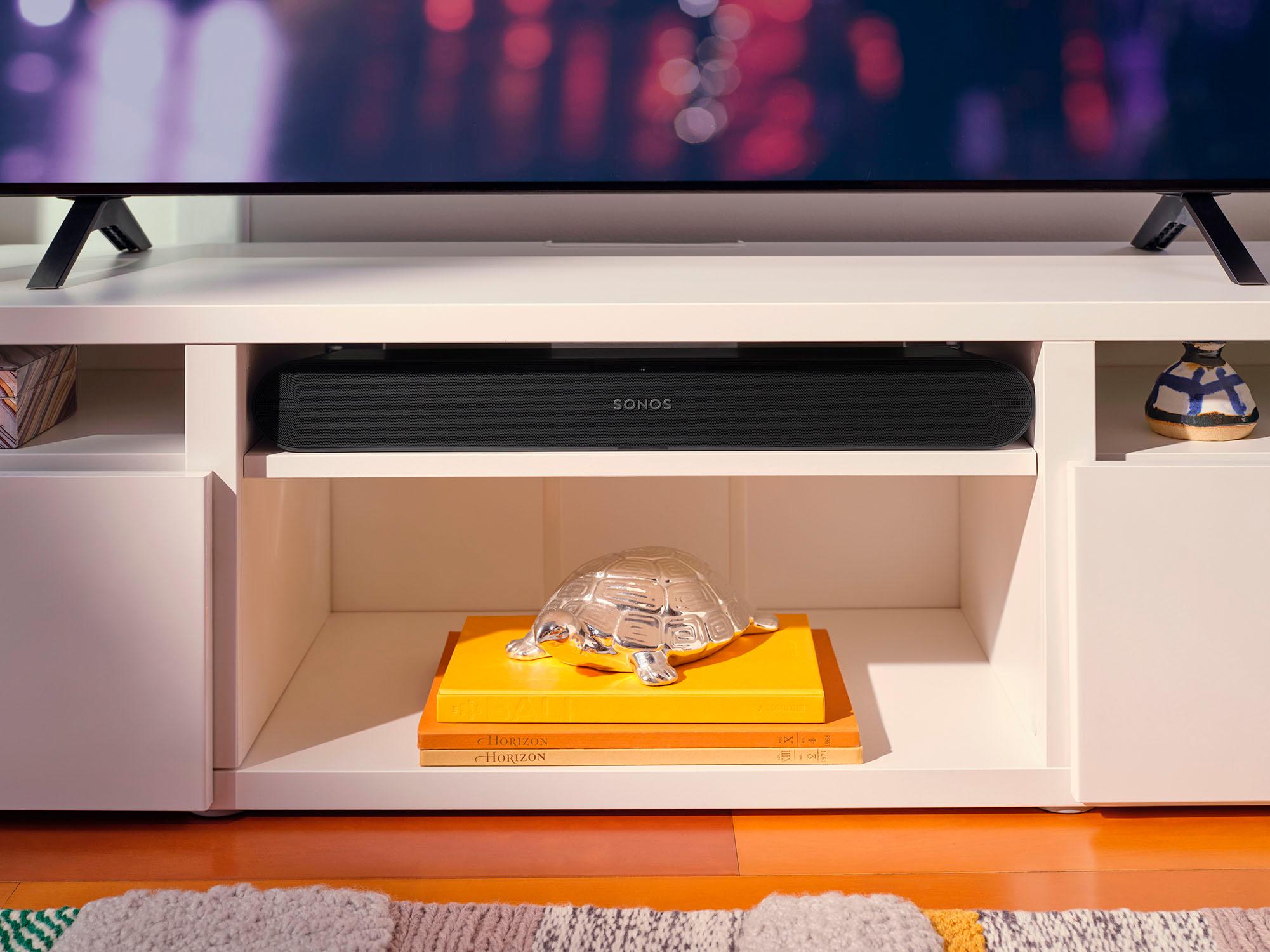
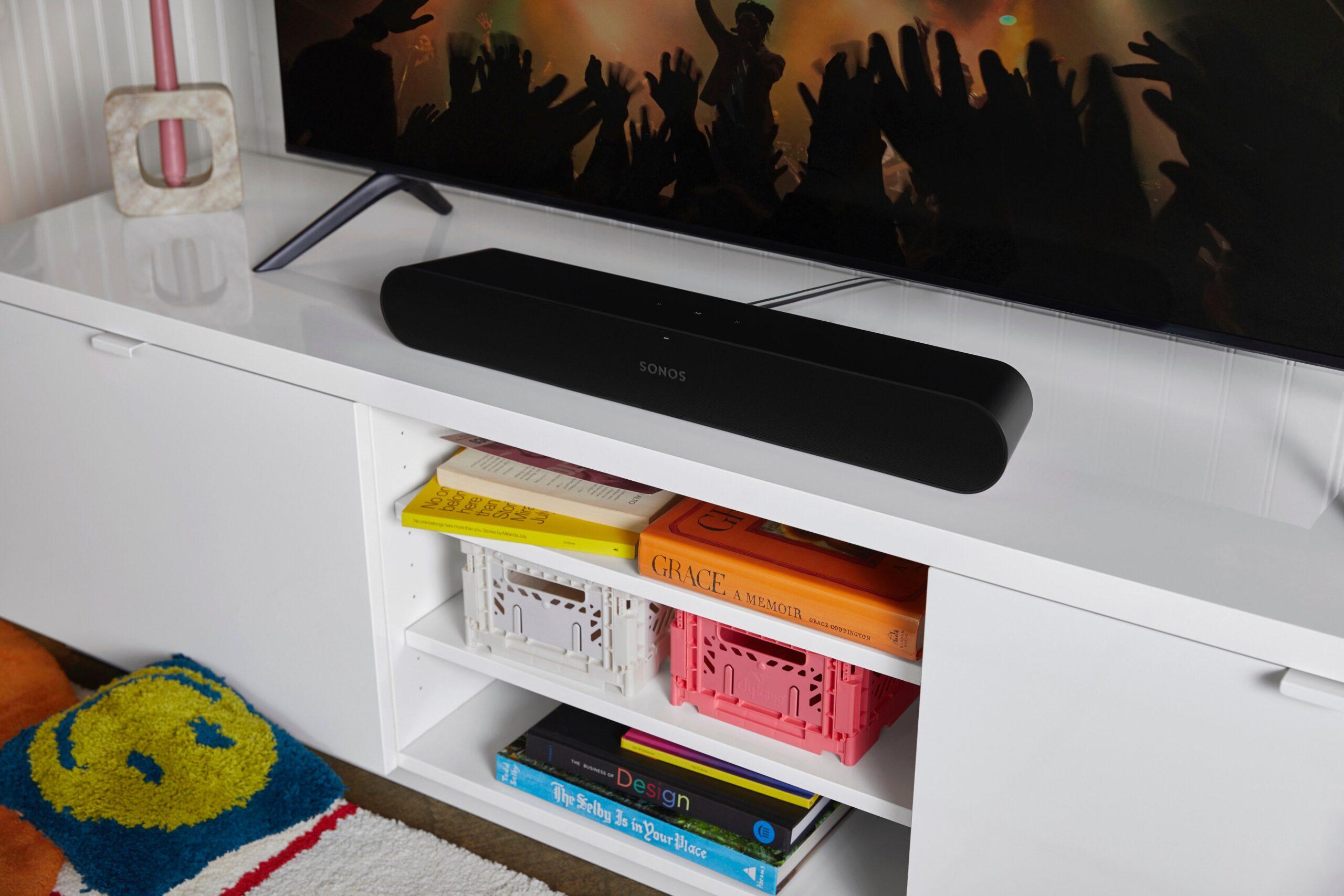
The Sonos Ray cannot replicate these positional audio cues, but it excels in other home theater scenarios. For dialogue-heavy content like documentaries, news programs, or character-driven dramas, the Ray's exceptional voice clarity creates a more refined viewing experience. The compact design also works better in bedrooms, kitchens, or other spaces where multiple speakers aren't practical.
This is where the Sonos Ray truly shines. Its integration with streaming services makes it incredibly convenient for background music, podcast listening, or any audio content beyond TV viewing. The TruePlay room correction ensures optimal performance regardless of placement, and the ability to group with other Sonos speakers creates seamless multiroom audio experiences.
The VIZIO system handles music adequately, especially genres that benefit from substantial bass response, but it lacks the sophisticated streaming capabilities and tonal accuracy that make the Ray compelling for music lovers.
Choose the VIZIO 5.1 Soundbar SE Dolby Atmos System if you want immediate, dramatic improvement in your movie and gaming experiences. This system makes sense for medium to large living rooms where you can properly position the surround speakers, and for users who prioritize maximum audio impact per dollar spent. If you primarily watch action movies, play video games, or enjoy content with dynamic soundtracks, the VIZIO's surround sound capabilities will transform your entertainment experience.
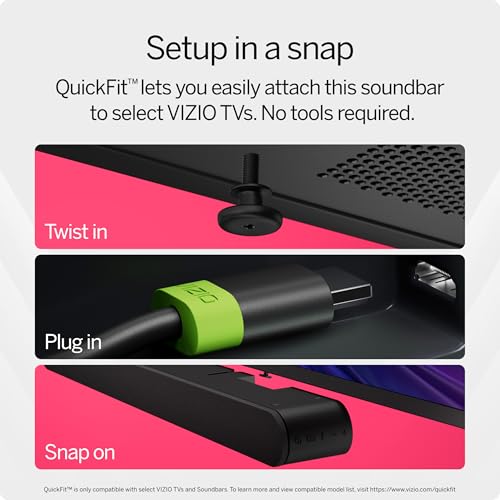
The VIZIO system also makes sense if you want a traditional, straightforward setup. Connect one HDMI cable to your TV, place the wireless subwoofer and surround speakers in appropriate locations, and you have a complete surround sound system that works with your existing TV remote.
Choose the Sonos Ray if audio quality and dialogue clarity matter more than surround sound effects. This soundbar excels in smaller spaces, bedrooms, or any location where a clean, minimalist setup is preferred. The Ray makes particular sense if you frequently stream music, value smart home integration, or plan to build a multiroom audio system over time.
The Sonos approach also appeals to users who want premium build quality and sophisticated features like room correction. While you pay more per channel initially, the Ray's integration with the broader Sonos ecosystem provides long-term flexibility and upgradeability that the VIZIO system cannot match.
These soundbars represent fundamentally different approaches to the same problem: making your TV sound dramatically better than it does right now. The VIZIO 5.1 system delivers maximum immediate impact through true surround sound and dedicated bass reproduction, while the Sonos Ray prioritizes long-term flexibility, premium audio quality, and smart home integration.
Your choice ultimately depends on how you consume entertainment and what you value most in your daily audio experience. If cinematic immersion and gaming enhancement drive your decision, the VIZIO system provides unmatched value in its price range. If dialogue clarity, music quality, and ecosystem flexibility matter more, the Sonos Ray justifies its premium positioning through superior engineering and long-term capabilities.
Both systems will dramatically improve your TV viewing experience compared to built-in speakers. The question isn't whether you need a soundbar—it's which approach best fits your space, preferences, and long-term audio goals.
| VIZIO 5.1 Soundbar SE Dolby Atmos Surround System | Sonos Ray Soundbar |
|---|---|
| Audio Configuration - Determines surround sound capabilities and immersion level | |
| 5.1 channels with dedicated surround speakers and wireless subwoofer | 2.0 stereo channels only |
| Dolby Atmos Support - Creates height effects for modern movies and shows | |
| Virtual Dolby Atmos processing supported | Not supported (stereo downmix only) |
| Physical Setup - Impacts room aesthetics and placement flexibility | |
| 4-piece system: 33" soundbar + wireless sub + 2 surround speakers | Single 22" soundbar unit |
| Connectivity Options - Affects compatibility with modern TVs and devices | |
| HDMI eARC for high-quality audio and TV remote control | Optical connection only (no HDMI) |
| Bass Response - Critical for movie impact and music enjoyment | |
| Dedicated 6" wireless subwoofer (50Hz response) | Built-in drivers with bass ports (no dedicated sub) |
| Smart Features - Determines streaming and home integration capabilities | |
| Basic VIZIO app control and Bluetooth streaming | Advanced Wi-Fi streaming, AirPlay 2, 100+ music services |
| Room Correction - Optimizes sound for your specific space | |
| Manual EQ adjustments via mobile app | TruePlay automatic room tuning (iPhone required) |
| Ecosystem Integration - Long-term expandability and multiroom potential | |
| Standalone system with no expansion options | Entry point to full Sonos multiroom ecosystem |
| Dialogue Clarity - Most important spec for TV and movie watching | |
| Dedicated center channel for clear voice reproduction | Hollywood-tuned stereo imaging with Speech Enhancement |
| Build Quality and Design - Affects durability and premium feel | |
| Functional design with fabric grilles | Premium materials with custom waveguides |
| Music Streaming Quality - Important if you plan to stream music frequently | |
| Movie-optimized tuning, basic Bluetooth connectivity | Audiophile-grade tuning with native streaming service support |
| Value Proposition - What you get for your investment | |
| Complete surround system with immediate dramatic upgrade | Premium stereo quality with long-term ecosystem potential |
The VIZIO 5.1 Soundbar SE Dolby Atmos Surround System is significantly better for movies due to its true 5.1 surround sound with dedicated rear speakers and wireless subwoofer. It creates immersive directional audio where you can hear helicopters flying overhead and explosions with real impact. The Sonos Ray Soundbar only offers stereo sound, so all surround effects get downmixed to two channels, making it less engaging for action movies and cinematic content.
Yes, the VIZIO 5.1 Soundbar SE supports virtual Dolby Atmos processing, which adds height effects to compatible content for a more three-dimensional sound experience. The Sonos Ray does not support Dolby Atmos at all and can only process stereo audio, meaning you'll miss out on the vertical dimension that modern movies and shows are designed to deliver.
Both excel at dialogue but in different ways. The Sonos Ray Soundbar has exceptional voice clarity thanks to Hollywood sound engineer tuning and a dedicated Speech Enhancement mode that boosts vocal frequencies. The VIZIO 5.1 SE uses a dedicated center channel speaker specifically for dialogue reproduction. For pure dialogue clarity, the Sonos Ray has a slight edge, while the VIZIO system keeps voices properly anchored to the screen.
The VIZIO 5.1 Soundbar SE includes a wireless subwoofer that dramatically improves bass response for movies and music. The Sonos Ray has no subwoofer but can be paired with the optional Sonos Sub for deep bass extension. If you want impactful low-end sound immediately, the VIZIO system provides it out of the box, while the Sonos Ray requires additional investment for comparable bass performance.
The Sonos Ray Soundbar is much simpler to set up since it's a single unit that connects via optical cable. The VIZIO 5.1 SE requires positioning a soundbar, wireless subwoofer, and two surround speakers around your room, though the wireless connections make this easier than traditional wired systems. If you want minimal setup complexity, choose the Sonos Ray; if you don't mind placing multiple speakers for better sound, the VIZIO system rewards the extra effort.
The Sonos Ray Soundbar excels at music streaming with native support for over 100 music services, Apple AirPlay 2, and audiophile-quality sound reproduction. The VIZIO 5.1 SE supports basic Bluetooth streaming but lacks the sophisticated wireless capabilities and musical tuning of the Sonos Ray. For frequent music listening, the Sonos Ray provides a superior experience.
The Sonos Ray Soundbar is ideal for small spaces due to its compact 22-inch size and single-unit design that won't overwhelm tight quarters. The VIZIO 5.1 SE requires space for surround speakers and a subwoofer, making it better suited for medium to large rooms where you can properly position all components. In apartments or bedrooms, the Sonos Ray delivers excellent sound without the space requirements.
Both soundbars work with virtually any TV. The VIZIO 5.1 SE connects via HDMI eARC for the best experience with modern TVs, allowing TV remote volume control. The Sonos Ray uses optical connection, which works with almost any TV made in the last 15 years but doesn't support TV remote control. The VIZIO system offers more convenient integration with contemporary televisions.
The VIZIO 5.1 Soundbar SE provides exceptional value by including a complete 5.1 surround system with subwoofer and rear speakers for less than many single soundbar units cost. The Sonos Ray costs more per channel but offers premium build quality, advanced features, and ecosystem expandability. Choose the VIZIO system for maximum immediate audio impact per dollar, or the Sonos Ray for long-term flexibility and premium quality.
The Sonos Ray Soundbar serves as an entry point into the comprehensive Sonos multiroom ecosystem, allowing you to add more speakers throughout your home and eventually create true surround sound. The VIZIO 5.1 SE is a complete standalone system with no expansion options—what you buy is what you get. For future growth potential, the Sonos Ray offers more flexibility despite its higher initial cost.
The VIZIO 5.1 Soundbar SE significantly enhances gaming with true surround sound that helps identify enemy positions through directional audio cues. The rear speakers create immersive environmental sounds that make games more engaging. The Sonos Ray improves game audio over TV speakers but cannot provide the positional advantages that competitive gamers value. For serious gaming, the VIZIO system delivers a clear advantage.
For a dedicated home theater focused on movies and TV shows, the VIZIO 5.1 Soundbar SE provides superior cinematic immersion with true surround sound and impactful bass that transforms your viewing experience. The Sonos Ray excels in multi-purpose rooms where you want premium dialogue clarity and music streaming capabilities in a clean, minimalist package. Choose the VIZIO system for maximum movie theater impact, or the Sonos Ray for refined audio quality and smart home integration.
We've done our best to create useful and informative comparisons to help you decide what product to buy. Our research uses advanced automated methods to create this comparison and perfection is not possible - please contact us for corrections or questions. These are the sites we've researched in the creation of this article: bestbuy.com - vizio.com - rtings.com - vizio.com - vizio.com - vizio.com - youtube.com - vizio.com - vizio.com - cnet.com - samsclub.com - walmart.com - nfm.com - finelinesdesignstudio.com - dugoutnorthbrook.com - bestbuy.com - techradar.com - soundandvision.com - youtube.com - appleinsider.com - youtube.com - sonos.com - cnet.com - howtogeek.com - pcrichard.com - en.community.sonos.com - epicsystems.tech - en.community.sonos.com - cepro.com - videoandaudiocenter.com

Privacy Policy
Terms and Conditions - Affiliate Policy
Home Security
© Copyright 2008-2026.
11816 Inwood Rd #1211, Dallas, TX 75244