






When your TV's built-in speakers make dialogue sound like it's coming from a tin can, it's time for an upgrade. But the soundbar market can feel overwhelming, with options ranging from basic stereo bars to complex multi-speaker systems. Today we're comparing two fundamentally different approaches: the Ultimea Aura A40, a budget-friendly system that delivers true surround sound through multiple physical speakers, and the Sennheiser AMBEO Mini, a premium single-unit soundbar that uses advanced processing to simulate surround sound.
These products represent opposing philosophies in soundbar design. One prioritizes maximum immersion through discrete speakers, while the other focuses on convenience and audio refinement in a compact package. Understanding their differences will help you choose the right approach for your space and priorities.
Before diving into specifics, let's clarify what we mean by "surround sound." Traditional surround systems use multiple speakers positioned around your listening area to create a three-dimensional audio experience. When a helicopter flies across the screen, you hear it move from your left, overhead, and out to your right – just like in real life.
Virtual surround processing takes a different approach. Instead of physically placing speakers around you, it uses digital signal processing (DSP) and psychoacoustics – essentially tricking your brain into perceiving sounds as coming from directions where no speakers exist. This technology has improved dramatically since the early 2010s, but it still can't fully replicate the discrete channel separation that physical speakers provide.
The Ultimea Aura A40 launched in 2023 as part of the growing trend toward affordable multi-speaker soundbar systems. Meanwhile, the Sennheiser AMBEO Mini, also released in 2023, represents the latest evolution of premium virtual surround technology, building on Sennheiser's decades of acoustic research.
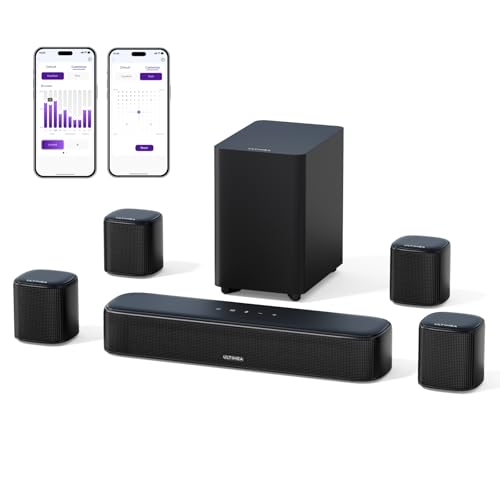
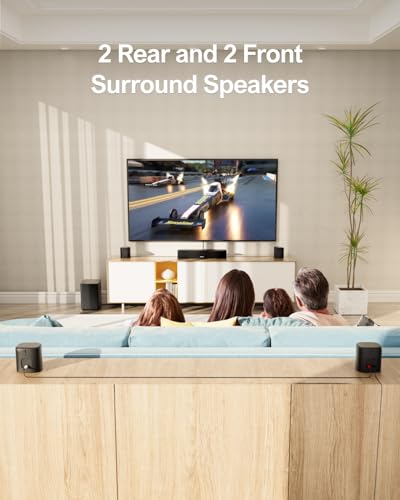
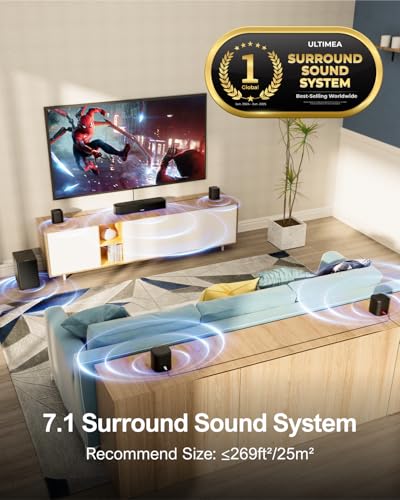
The Ultimea Aura A40 takes the "more is better" approach to surround sound. Instead of trying to simulate surround effects, it gives you eight actual speakers: three in the main soundbar, four dedicated surround speakers (two front, two rear), and one subwoofer. At the time of writing, this complete system costs roughly what you'd pay for a mid-range single soundbar – remarkable value for a true 7.1 setup.
What makes this system interesting is its SurroundX technology, which Ultimea developed to optimize how these speakers work together. Rather than simply splitting audio signals between speakers, SurroundX analyzes the incoming audio and intelligently distributes sounds to create precise localization effects. When you're watching an action movie and bullets whiz past the protagonist, you'll hear them travel in a convincing arc around your room.
The system's BassMX technology deserves particular attention. Most budget soundbars struggle with bass because small drivers simply can't move enough air to create deep, impactful low frequencies. The Ultimea Aura A40 solves this with a dedicated 4-inch subwoofer that handles everything below about 150Hz. This frequency crossover point (where the main speakers hand off to the subwoofer) is crucial – get it wrong, and you'll hear a gap in the sound or boomy, uncontrolled bass.
Installing the Ultimea Aura A40 requires more thought than a traditional soundbar. The front surround speakers need placement near your TV, while the rear speakers should be positioned behind or to the sides of your seating area. The system uses a combination of wired connections for the front speakers and wireless transmission for one of the rear speakers, reducing cable clutter without sacrificing audio quality.
The subwoofer placement is particularly important. Bass frequencies are omnidirectional (they spread in all directions), but room acoustics dramatically affect how they sound. Corner placement typically amplifies bass output, while positioning along a wall provides more controlled response. The Ultimea Aura A40 includes six adjustable surround levels, allowing you to fine-tune the intensity based on your room size and speaker placement.
Where the Ultimea Aura A40 truly shines is customization. The ULTIMEA Smart App provides access to a 10-band equalizer – meaning you can adjust ten different frequency ranges independently. Most soundbars offer basic treble and bass controls, but ten bands let you target specific problem frequencies in your room or compensate for the system's inherent limitations.
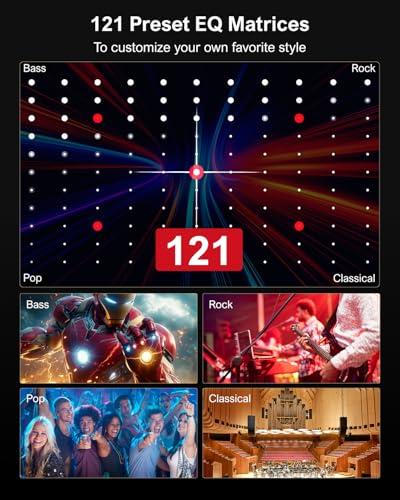
The system also includes 121 preset EQ matrices covering everything from classical music to heavy metal. These aren't just generic settings – they're specifically tuned for different content types and can dramatically improve the listening experience. The "Voice" mode, for example, emphasizes the 2-4kHz range where most human speech occurs, making dialogue clearer during movies with heavy background music or effects.
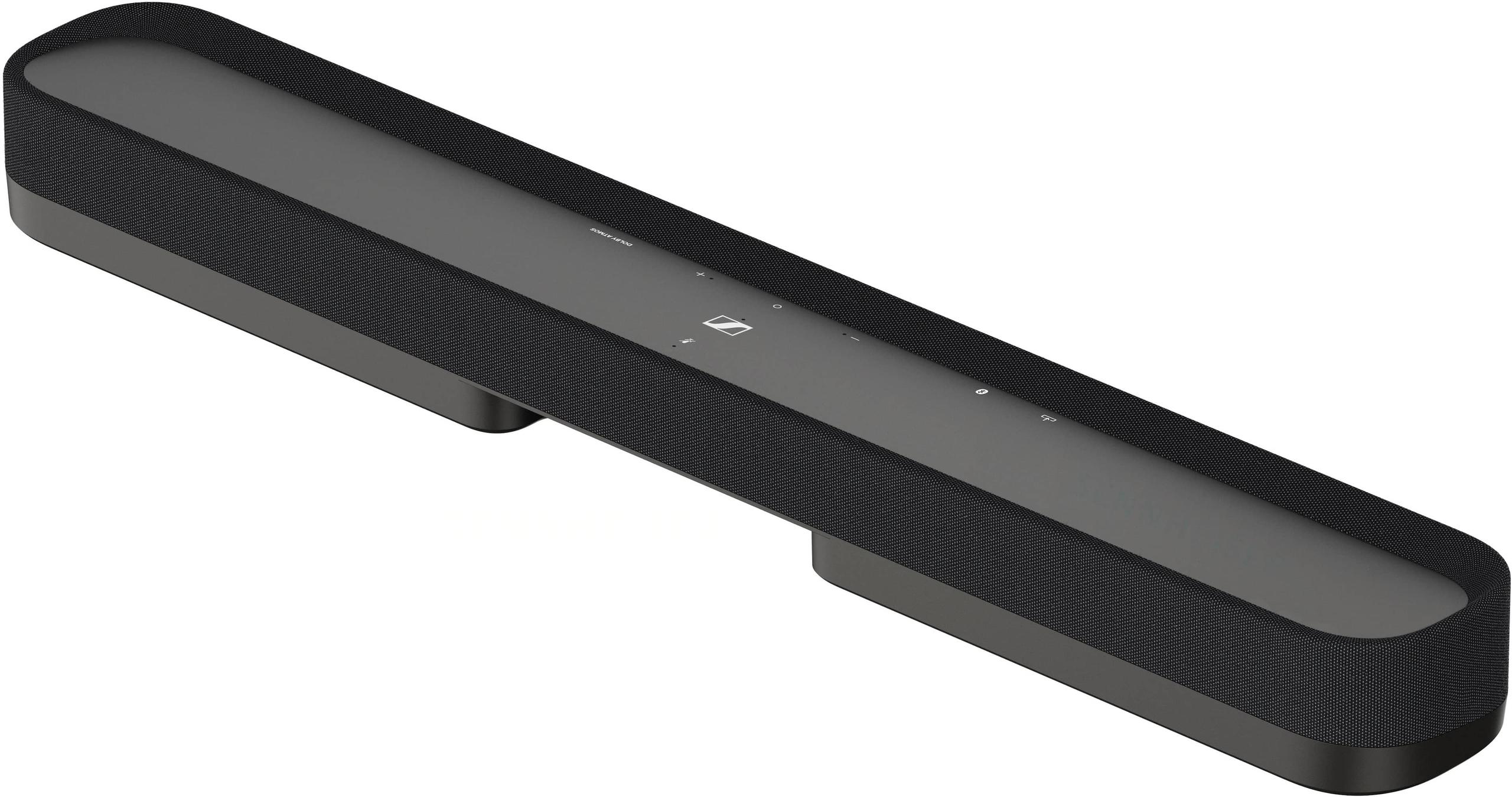
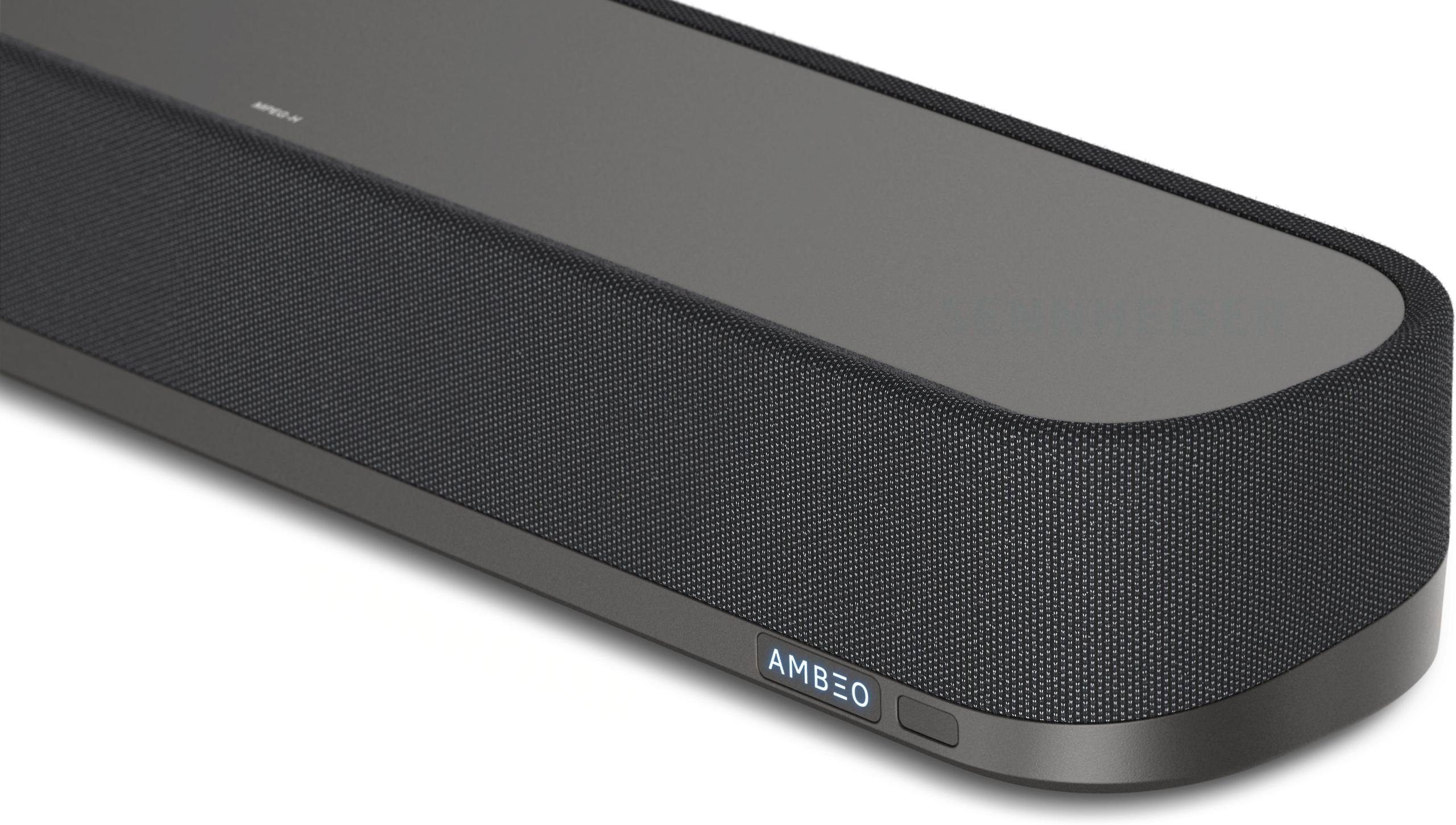
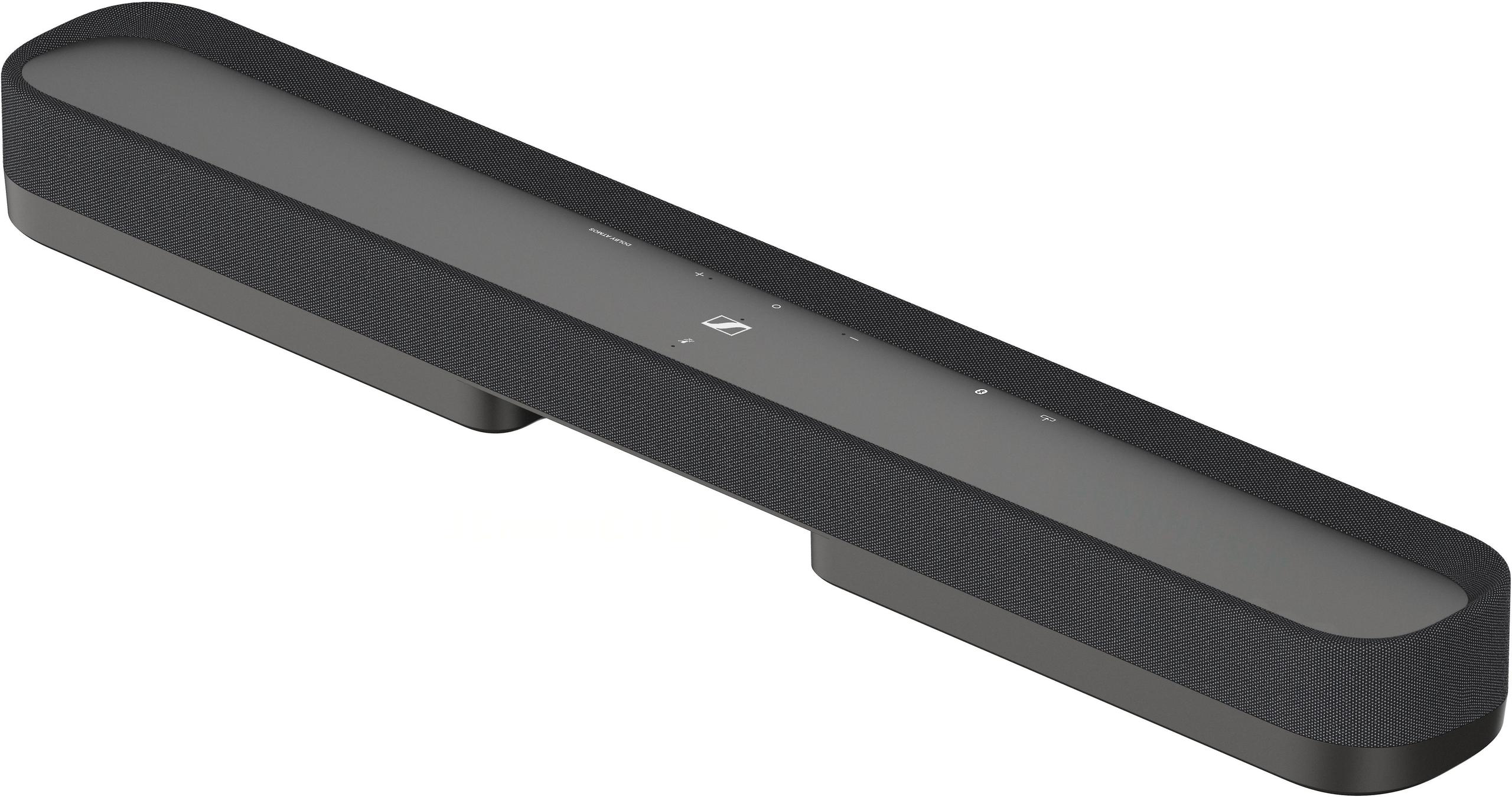
The Sennheiser AMBEO Mini represents the opposite philosophy: maximum performance from minimal components. Instead of multiple speakers, it uses advanced AMBEO virtualization technology developed in partnership with the Fraunhofer Institute, a German research organization known for creating the MP3 audio format.
This virtualization relies on psychoacoustic processing – understanding how your brain interprets sound cues to create the illusion of surround effects. The Sennheiser AMBEO Mini analyzes incoming audio and applies phase shifts, time delays, and frequency adjustments to trick your ears into perceiving sounds as coming from locations where no speakers exist. It's sophisticated technology, but it has inherent limitations compared to discrete speakers.
At the time of writing, the Sennheiser AMBEO Mini costs roughly four times more than the Ultimea Aura A40, positioning it firmly in the premium category. That price difference reflects both Sennheiser's brand reputation and the substantial research investment required for effective virtualization.
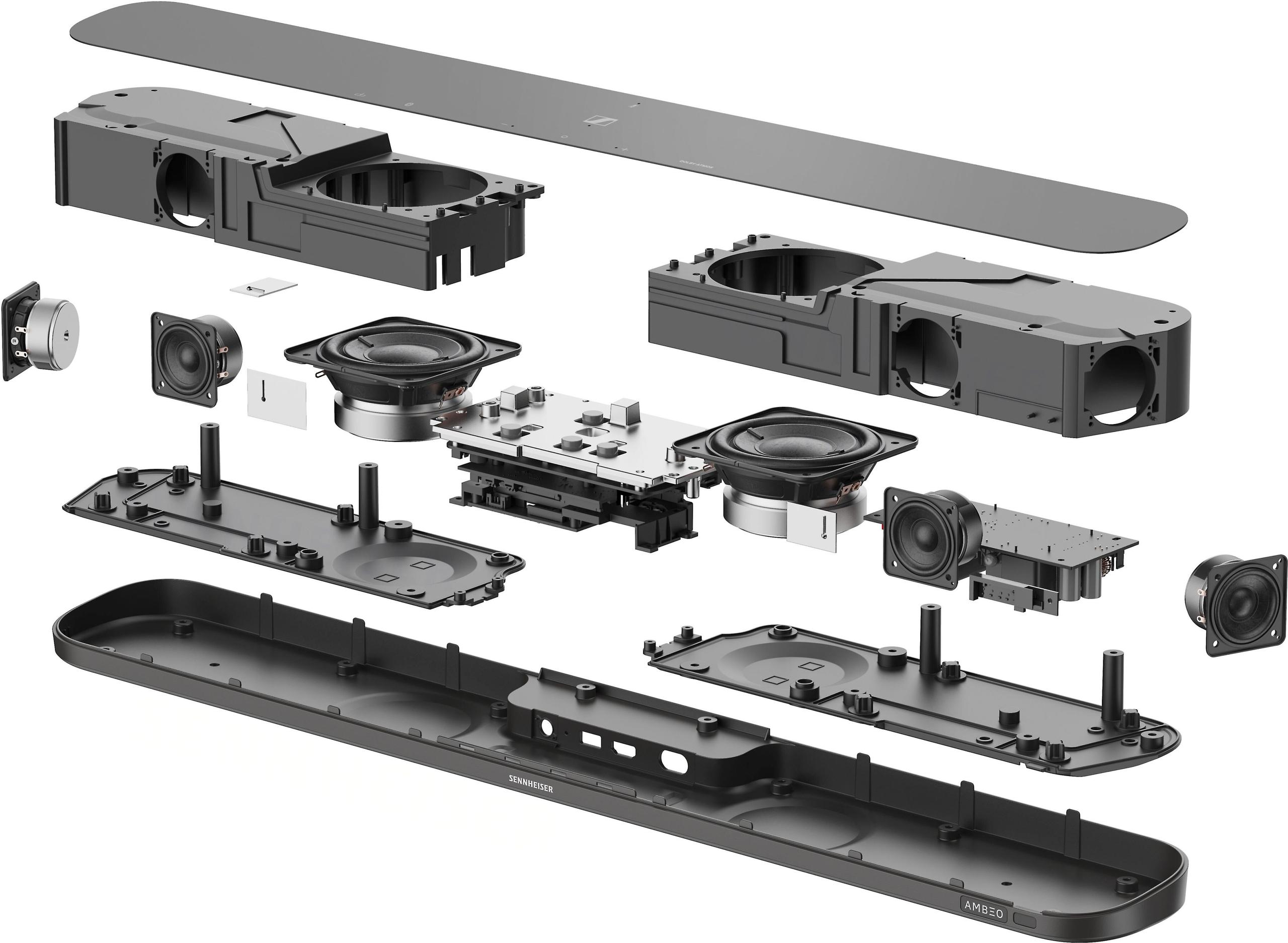
The Sennheiser AMBEO Mini compensates for its lack of discrete channels with superior component quality. Where the Ultimea system uses budget drivers that produce a somewhat metallic, tinny sound signature, Sennheiser employs precision-engineered full-range drivers that deliver balanced, natural sound reproduction.
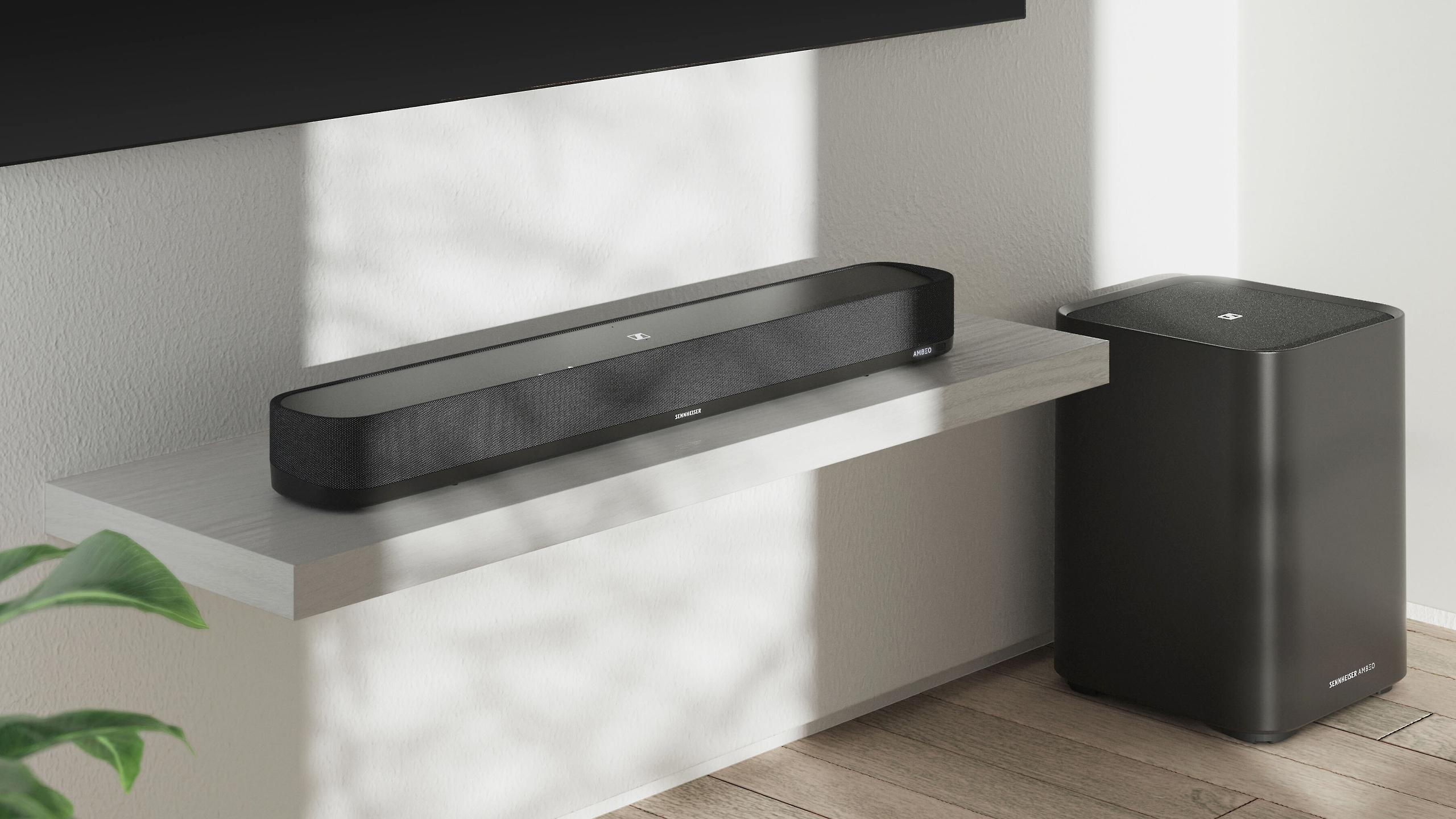
The soundbar includes dual 4-inch subwoofers built into the main unit – an impressive feat of engineering given the compact 27.6-inch width. These integrated subwoofers can't match the output of a dedicated external subwoofer, but they avoid the placement challenges and cable runs that external subs require.
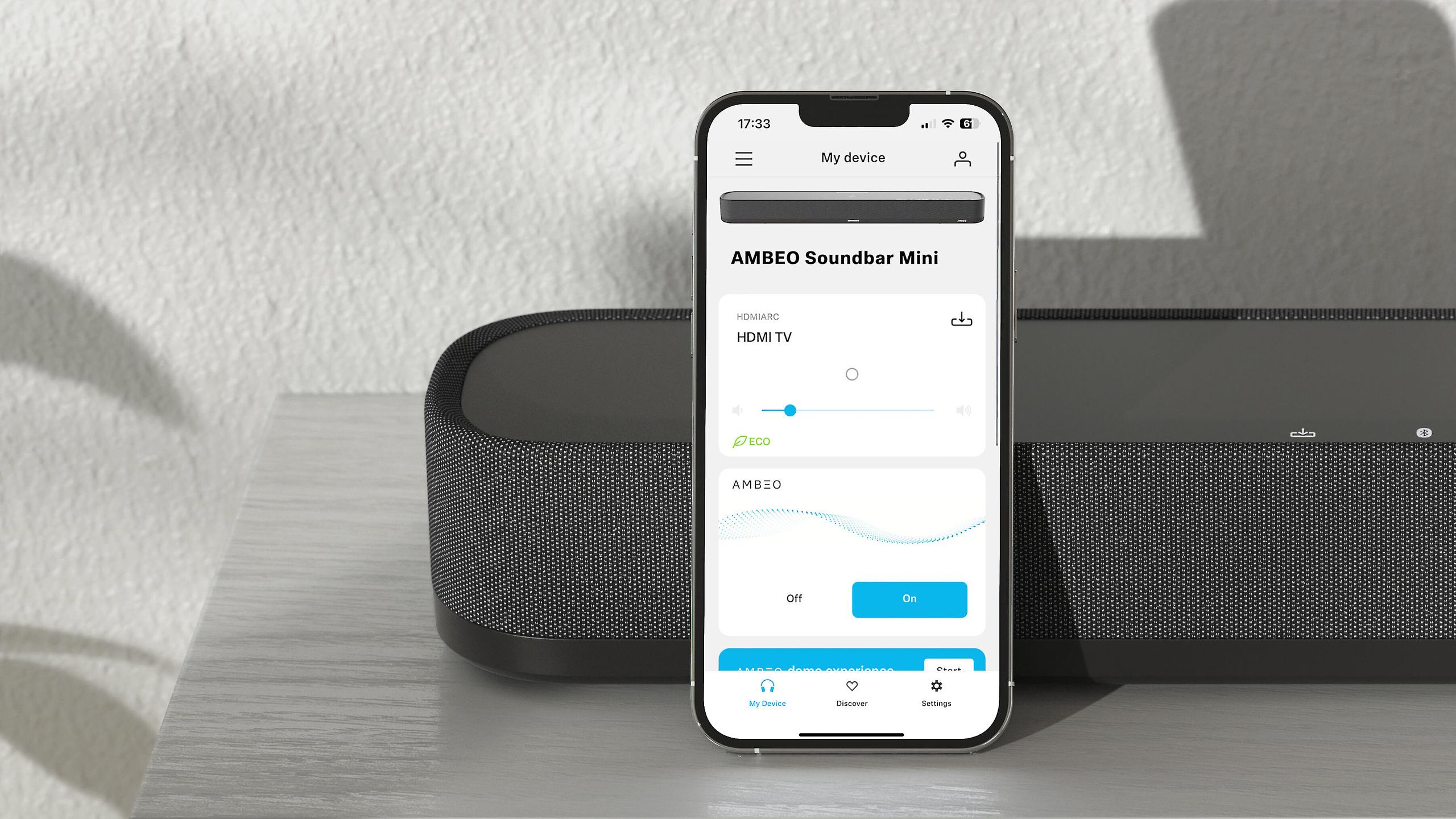
One of the Sennheiser AMBEO Mini's most sophisticated features is its automatic calibration system. Built-in microphones analyze your room's acoustic signature – how sound reflects off walls, furniture, and other surfaces – then adjust the soundbar's output to compensate for these reflections. This room correction technology has trickled down from professional audio equipment and can dramatically improve sound quality in challenging acoustic environments.
The calibration process takes several minutes and requires a relatively quiet room, but the results are often dramatic. Rooms with hard surfaces that create echoes or odd dimensions that cause frequency cancellations can benefit enormously from this automated tuning.
For most people, dialogue clarity is the primary reason for upgrading from TV speakers. Both systems handle this crucial task well, but through different approaches.
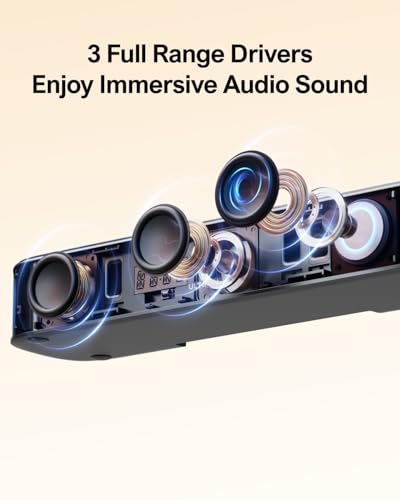
The Ultimea Aura A40 uses three dedicated drivers in its main soundbar to handle center channel duties – the channel responsible for most dialogue in movies and TV shows. This discrete center channel provides excellent vocal separation from background music and effects. Our research into user reviews consistently highlights the system's ability to maintain clear dialogue even during loud action sequences.
The Sennheiser AMBEO Mini lacks a discrete center channel but compensates with voice enhancement processing that emphasizes speech frequencies. The premium driver quality also contributes to natural vocal reproduction without the harshness or shouty character that budget systems often exhibit.
Winner: Ultimea Aura A40 for discrete channel advantage, but the Sennheiser isn't far behind thanks to superior driver quality.
This is where the fundamental difference between these approaches becomes most apparent. The Ultimea Aura A40 creates genuine surround sound through physical speaker placement. When properly positioned, it can achieve convincing 360-degree audio that places sounds precisely in three-dimensional space.
Expert reviews consistently praise the Ultimea system's ability to create immersive soundfields for movies and gaming. The directional audio provides competitive advantages in games where locating enemies by sound is crucial, and the physical separation enhances the cinematic experience during action sequences.
The Sennheiser AMBEO Mini attempts to simulate these effects through processing, and while the results can be impressive, they can't match the discrete separation that physical speakers provide. The effectiveness also varies significantly based on room acoustics and listening position – you need to sit in the "sweet spot" for optimal effect.
Winner: Ultimea Aura A40 by a significant margin for genuine surround immersion.
Bass performance reveals another key difference between these systems. The Ultimea Aura A40's dedicated 4-inch subwoofer provides physical bass extension that you can feel as well as hear. The BassMX technology optimizes this integration, ensuring that low frequencies blend seamlessly with the main speakers.
However, the system's frequency response only extends to 65Hz – respectable for a budget system but not reaching the deep bass frequencies (30-50Hz) found in movie soundtracks and electronic music. You'll need to push the subwoofer fairly hard to achieve satisfying bass levels.
The Sennheiser AMBEO Mini integrates dual 4-inch subwoofers into its compact chassis, a remarkable engineering achievement. The bass is controlled and well-integrated, avoiding the boomy character that poorly designed systems exhibit. However, the compact form factor limits absolute output, and deep bass extension suffers compared to dedicated subwoofers.
Winner: Ultimea Aura A40 for raw bass impact, though the Sennheiser offers more refined integration.
When it comes to music listening, the tables turn somewhat. The Sennheiser AMBEO Mini's superior driver quality and balanced frequency response make it more suitable for critical music listening. The stereo upmixing creates a spacious soundstage that can make two-channel recordings feel more immersive without destroying the original stereo image.
The Ultimea Aura A40 can be tuned for music through its extensive EQ options, but the budget drivers limit ultimate fidelity. The metallic character that user reviews mention becomes more apparent with music than with movie soundtracks, where effects and dialogue mask these colorations.
Winner: Sennheiser AMBEO Mini for refined music reproduction.
Your living situation often determines which approach makes sense. The Ultimea Aura A40 requires strategic placement of five separate components and works best in rooms between 108-270 square feet. If you're renting or have a minimalist aesthetic, running speaker wires and positioning multiple components may not be practical.
The Sennheiser AMBEO Mini excels in space-constrained environments. Its 27.6-inch width fits into most entertainment centers, and the single-cable connection to your TV keeps things clean and simple. This convenience comes at a premium price point, but for many users, the simplified setup and elegant appearance justify the cost.
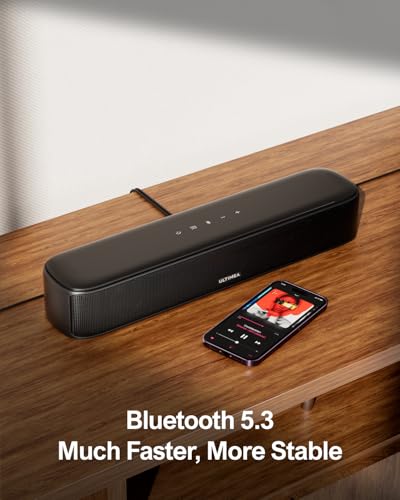
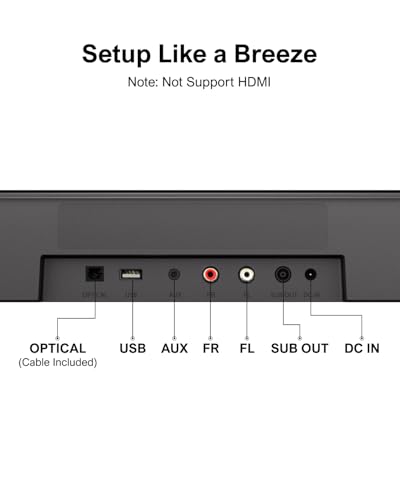
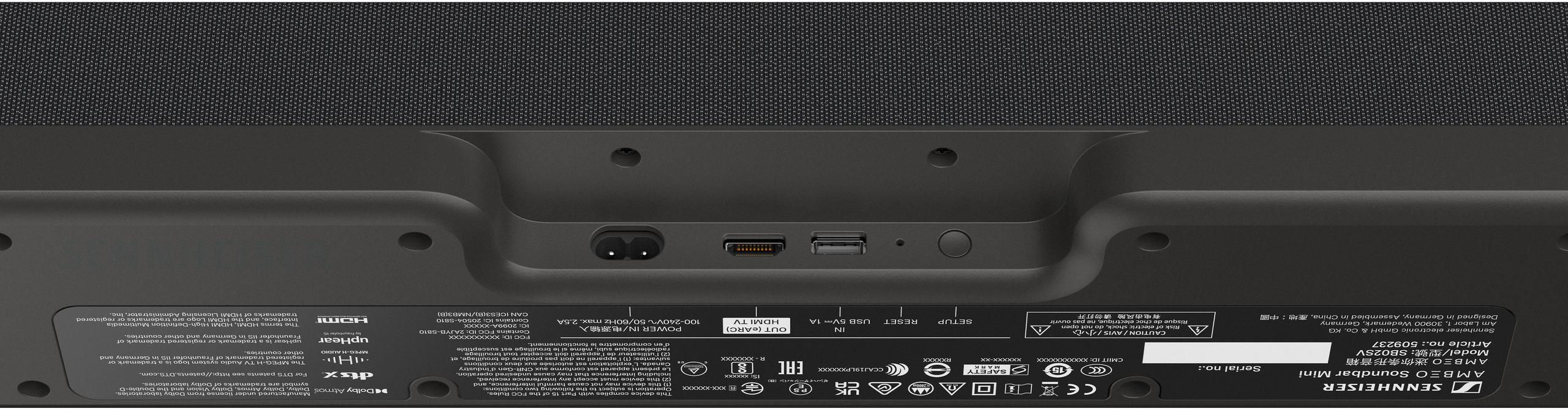
Both systems reflect their price points in connectivity options. The Ultimea Aura A40 covers the basics with optical, AUX, USB, and Bluetooth 5.3 connections. The lack of HDMI eARC is a notable limitation – this connection type provides the highest bandwidth for modern audio formats and simplifies control by allowing your TV remote to adjust soundbar volume.
The Sennheiser AMBEO Mini includes HDMI eARC support along with advanced wireless capabilities like Wi-Fi, AirPlay 2, and Chromecast integration. These features provide direct access to streaming services and support for high-resolution audio formats that Bluetooth can't handle.
After extensive research into expert reviews and user feedback, both systems deliver significant improvements over TV speakers, but they serve different priorities and use cases.
Choose the Ultimea Aura A40 if you want maximum immersion for movies and gaming at an exceptional price point. The true surround sound experience can't be replicated by virtual processing, making it ideal for entertainment enthusiasts willing to accept some acoustic compromises. The extensive customization options and discrete channel separation provide genuine home theater benefits that far exceed what you'd expect at this price level.
The Sennheiser AMBEO Mini makes sense for users who prioritize convenience, build quality, and refined audio reproduction over maximum channel count. If you're primarily watching dialogue-heavy content, listening to music, or working within severe space constraints, the premium single-unit approach offers sophistication that the budget multi-speaker system can't match.
Both products represent excellent value within their respective categories. The Ultimea delivers an almost unbelievable amount of hardware and features for the money, while the Sennheiser provides the convenience and audio refinement that justify its premium positioning. Your choice should align with your priorities: maximum immersion and value, or premium convenience and quality.
The soundbar landscape continues evolving rapidly, with both virtual processing and multi-speaker systems becoming more sophisticated each year. Whichever path you choose, either option will transform your viewing experience far beyond what TV speakers can provide.
| Ultimea Aura A40 U2601 | Sennheiser AMBEO Soundbar Mini |
|---|---|
| Channel Configuration - Determines surround sound authenticity | |
| True 7.1 with physical surround speakers | Virtual 7.1.4 through single soundbar |
| Total Speaker Count - More drivers typically mean better sound separation | |
| 8 speakers (3 soundbar + 4 surround + 1 subwoofer) | Multiple integrated drivers in single unit |
| Subwoofer Setup - Critical for deep bass in movies and music | |
| Dedicated 4-inch wired subwoofer included | Dual 4-inch subwoofers built into soundbar |
| Power Output - Affects maximum volume and dynamic range | |
| 330W peak power across all speakers | 250W total system power |
| Frequency Response - Shows how deep the bass goes and how crisp the highs are | |
| 65Hz - 18kHz (requires subwoofer for low bass) | 43Hz - 20kHz (better low-end extension) |
| Primary Connectivity - HDMI eARC is preferred for modern TVs | |
| Optical, AUX, USB, Bluetooth 5.3 (no HDMI) | HDMI eARC, Wi-Fi, Bluetooth 5.0, USB-A |
| Audio Format Support - Higher-end formats provide better surround effects | |
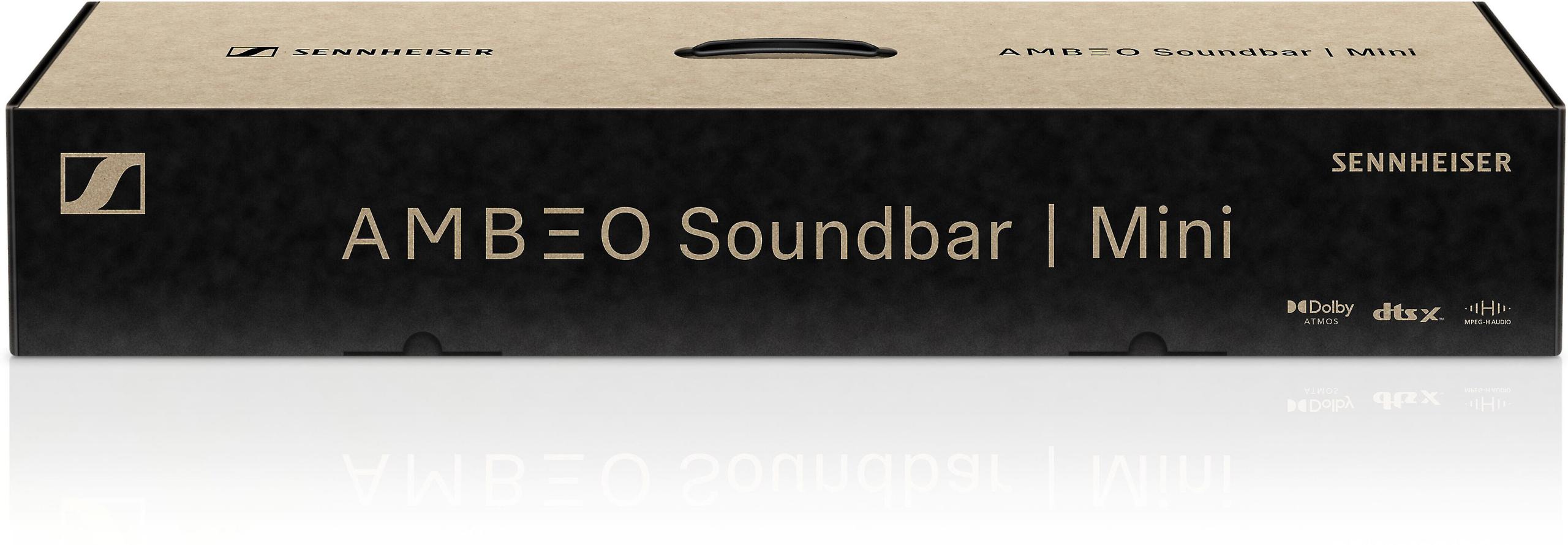
| Standard surround formats | Dolby Atmos, DTS:X, MPEG-H, 360 Reality Audio |
| Room Calibration - Automatically optimizes sound for your space | |
| Manual adjustment via app with 6 surround levels | Automatic room calibration with built-in microphones |
| Control Options - More customization allows fine-tuning to your preferences | |
| ULTIMEA Smart App with 10-band EQ, 121 presets | Basic app control with 4-band EQ |
| Installation Complexity - Consider your tolerance for setup and cable management | |
| 5 separate components requiring strategic placement | Single soundbar with simple TV connection |
| Streaming Integration - Convenience for music listening | |
| Bluetooth only for wireless streaming | Wi-Fi, AirPlay 2, Chromecast, Alexa built-in |
| Recommended Room Size - Ensures optimal performance | |
| 108-270 sq ft (small to medium rooms) | Small rooms (compact design optimized) |
| Build Quality Trade-offs - Affects long-term satisfaction | |
| Budget components with metallic sound character | Premium German engineering with refined audio |
The Ultimea Aura A40 is better for home theater because it provides true 7.1 surround sound with physical speakers placed around your room. This creates authentic directional audio where you can hear helicopters flying overhead or footsteps moving behind you. The Sennheiser AMBEO Mini uses virtual surround processing, which can't match the immersive experience of actual surround speakers for movies and gaming.
The Ultimea Aura A40 includes a dedicated 4-inch subwoofer in the package, so you get deep bass without additional purchases. The Sennheiser AMBEO Mini has dual 4-inch subwoofers built into the soundbar itself, eliminating the need for a separate subwoofer but limiting bass output compared to a dedicated unit.
The Sennheiser AMBEO Mini takes up significantly less space as it's just one 27.6-inch soundbar that sits under your TV. The Ultimea Aura A40 requires placing five separate components around your room: the main soundbar, four surround speakers, and a subwoofer, making it better suited for larger spaces where you can accommodate multiple speakers.
The Sennheiser AMBEO Mini is much easier to set up - just connect one HDMI cable to your TV and run the automatic room calibration. The Ultimea Aura A40 requires positioning and connecting multiple speakers around your room, though the wireless rear speaker reduces some cable management compared to traditional surround systems.
The Sennheiser AMBEO Mini sounds better for music due to its premium drivers and balanced frequency response. It reproduces vocals and instruments more naturally without the metallic character that budget components can exhibit. The Ultimea Aura A40 can be tuned for music through its extensive EQ options, but the driver quality limitations become more noticeable with critical music listening.
The Ultimea Aura A40 offers much more customization with a 10-band equalizer and 121 preset EQ matrices through its smart app. You can fine-tune specific frequency ranges and adjust surround intensity levels. The Sennheiser AMBEO Mini provides basic customization with a 4-band EQ and automatic room calibration, focusing more on plug-and-play simplicity.
The Sennheiser AMBEO Mini is ideal for small spaces since it's a single compact unit that doesn't require running wires or positioning multiple speakers. The Ultimea Aura A40 needs space for speaker placement and works best in rooms between 108-270 square feet, making it less suitable for tight living quarters.
The Sennheiser AMBEO Mini supports advanced formats including Dolby Atmos, DTS:X, and 360 Reality Audio for the latest streaming content and Blu-ray movies. The Ultimea Aura A40 focuses on standard surround formats but creates authentic surround effects through its physical speaker placement rather than relying on advanced processing.
The Sennheiser AMBEO Mini offers superior connectivity with HDMI eARC, Wi-Fi, AirPlay 2, and Chromecast integration for seamless streaming and TV control. The Ultimea Aura A40 uses optical, AUX, USB, and Bluetooth connections but lacks HDMI eARC, which is the preferred connection for modern TVs.
Both systems excel at dialogue clarity but through different approaches. The Ultimea Aura A40 uses three dedicated center channel drivers for speech reproduction and includes voice enhancement modes. The Sennheiser AMBEO Mini relies on premium driver quality and voice enhancement processing to deliver natural, clear dialogue without a discrete center channel.
The Ultimea Aura A40 provides exceptional value with a complete 7.1 surround system including physical speakers and subwoofer at an entry-level price point. The Sennheiser AMBEO Mini costs significantly more but justifies the premium with superior build quality, advanced features, and German engineering. Your choice depends on whether you prioritize maximum features per dollar or premium convenience and refinement.
The Ultimea Aura A40 is a complete system that doesn't offer official expansion options, though individual components could potentially be upgraded over time. The Sennheiser AMBEO Mini is a closed system designed as an all-in-one solution with no expansion capabilities, but it receives firmware updates that can add new features and improvements over time.
We've done our best to create useful and informative comparisons to help you decide what product to buy. Our research uses advanced automated methods to create this comparison and perfection is not possible - please contact us for corrections or questions. These are the sites we've researched in the creation of this article: walmart.com - newegg.com - youtube.com - ultimea.com - youtube.com - device.report - ultimea.co - manuals.plus - homestudiobasics.com - youtube.com - bestbuy.com - community.ultimea.com - manuals.plus - eu.ultimea.com - navesapeugeot.com.br - bestbuy.com - images.thdstatic.com - provantage.com - ultimea.com - bestbuy.com - techradar.com - sennheiser-hearing.com - stereonet.com - rtings.com - youtube.com - youtube.com - newsroom.sennheiser.com - whathifi.com - baybloorradio.com - sennheiser-hearing.com - files.bbystatic.com

Privacy Policy
Terms and Conditions - Affiliate Policy
Home Security
© Copyright 2008-2026.
11816 Inwood Rd #1211, Dallas, TX 75244