


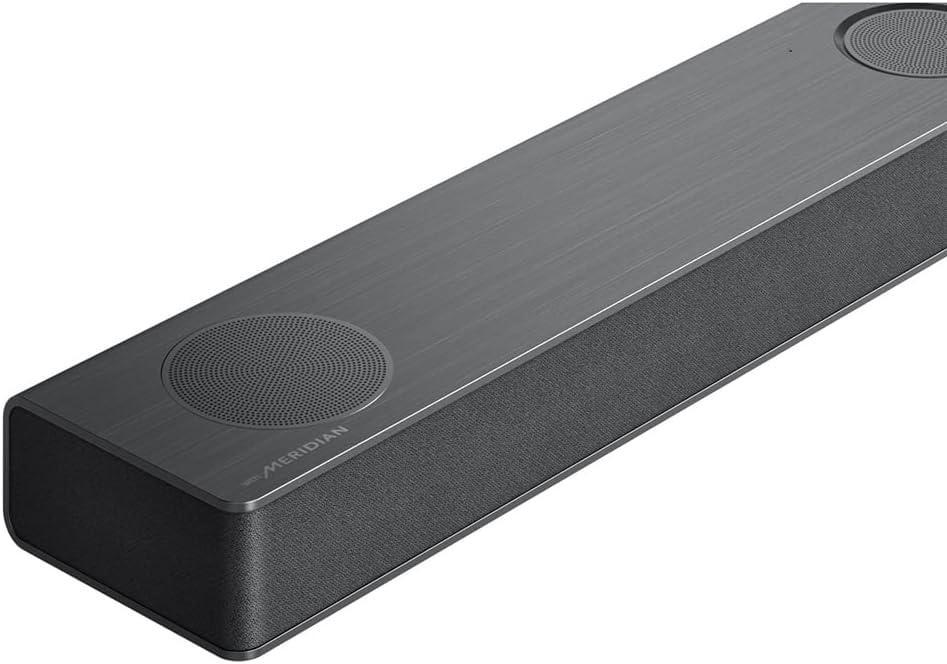

When your TV's built-in speakers just aren't cutting it anymore, you'll quickly discover that the soundbar world offers two fundamentally different philosophies for creating immersive home theater audio. On one side, you have systems like the Ultimea Aura A40 U2601 that throw as many speakers as possible around your room to create a surround bubble. On the other, premium systems like the LG S80TR focus on advanced audio processing and object-based sound formats to transport you into the action.
Understanding these approaches—and their trade-offs—is crucial for making the right choice for your home theater setup. Let's break down what each system brings to the table and help you figure out which path makes more sense for your space, budget, and audio ambitions.
The soundbar category has evolved dramatically since its humble beginnings as simple TV speaker replacements. Today's systems range from basic stereo bars to sophisticated multi-channel arrays that rival traditional component surround systems. The key is understanding what the numbers and specifications actually mean for your listening experience.
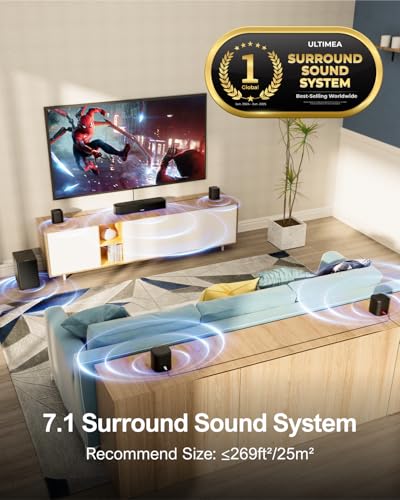
When you see channel configurations like "7.1" or "5.1.3," these numbers tell a specific story. The first digit represents main channels (left, right, center, and surround speakers), the second indicates dedicated subwoofers for bass, and the third number—when present—refers to height channels that fire sound toward your ceiling to create overhead effects. This difference between the Ultimea Aura A40's 7.1 virtual setup and the LG S80TR's 5.1.3 true configuration represents two completely different approaches to surround sound.
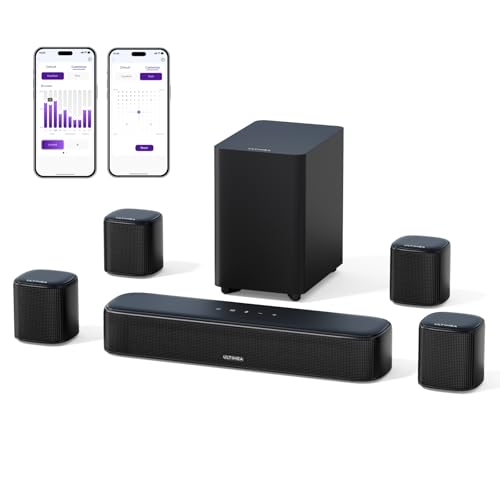
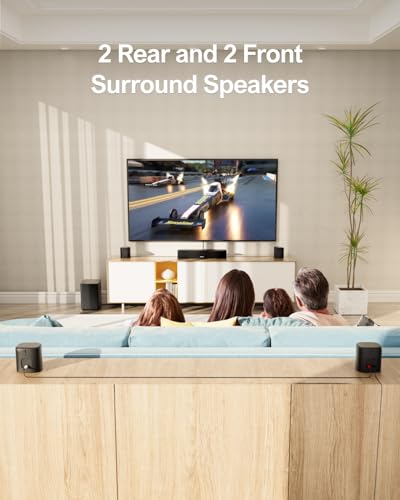
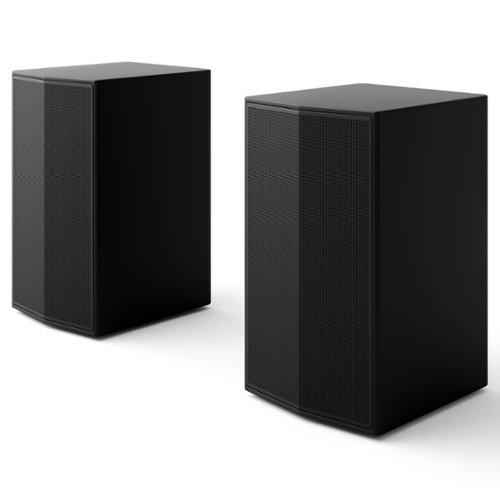
The Ultimea system achieves its 7.1 designation by physically placing multiple speakers around your listening area—four dedicated surround speakers plus a soundbar and subwoofer. It's virtual surround because it uses processing to create the illusion of additional channels beyond what discrete speakers provide. Meanwhile, the LG S80TR uses fewer total speakers but dedicates specific drivers to height channels, creating true three-dimensional audio that matches modern movie soundtracks.
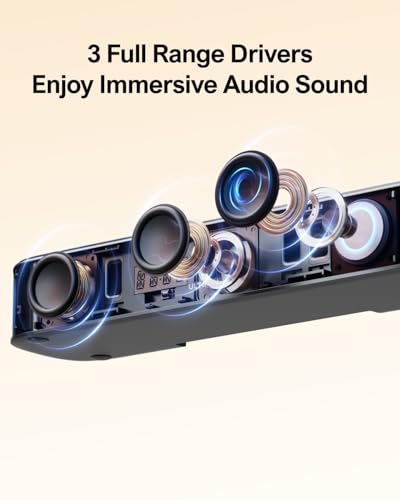
Released around 2023-2024, the Ultimea Aura A40 represents what I'd call the "shotgun approach" to surround sound—if some speakers are good, more speakers must be better. With eight total drivers spread across a main soundbar, four surround speakers, and a dedicated subwoofer, this system literally surrounds you with sound sources.
The appeal here is immediately obvious when you set it up. Having actual speakers positioned behind and to the sides of your seating creates a genuine sense of being inside the audio environment. When a helicopter flies overhead in a movie, you hear it start from your front left, travel across the room through the physical surround speakers, and disappear behind you. This spatial accuracy is something that even sophisticated processing can't entirely replicate.
What makes the Ultimea system particularly interesting is its SurroundX technology, which the company claims expands the perceived soundstage beyond the physical speaker locations. In practice, this means the system tries to create the illusion of sound coming from areas where you don't have speakers. Combined with six adjustable surround levels, you can fine-tune how aggressive or subtle you want the surround effects to be.
The system also includes BassMX technology for optimizing low-frequency output. However, with a frequency response that only extends down to 65Hz, the 4-inch subwoofer needs to work overtime to provide satisfying bass. Most movie soundtracks and music contain significant energy below 50Hz, which means you're missing some of the foundation that gives explosions their punch and music its fullness.
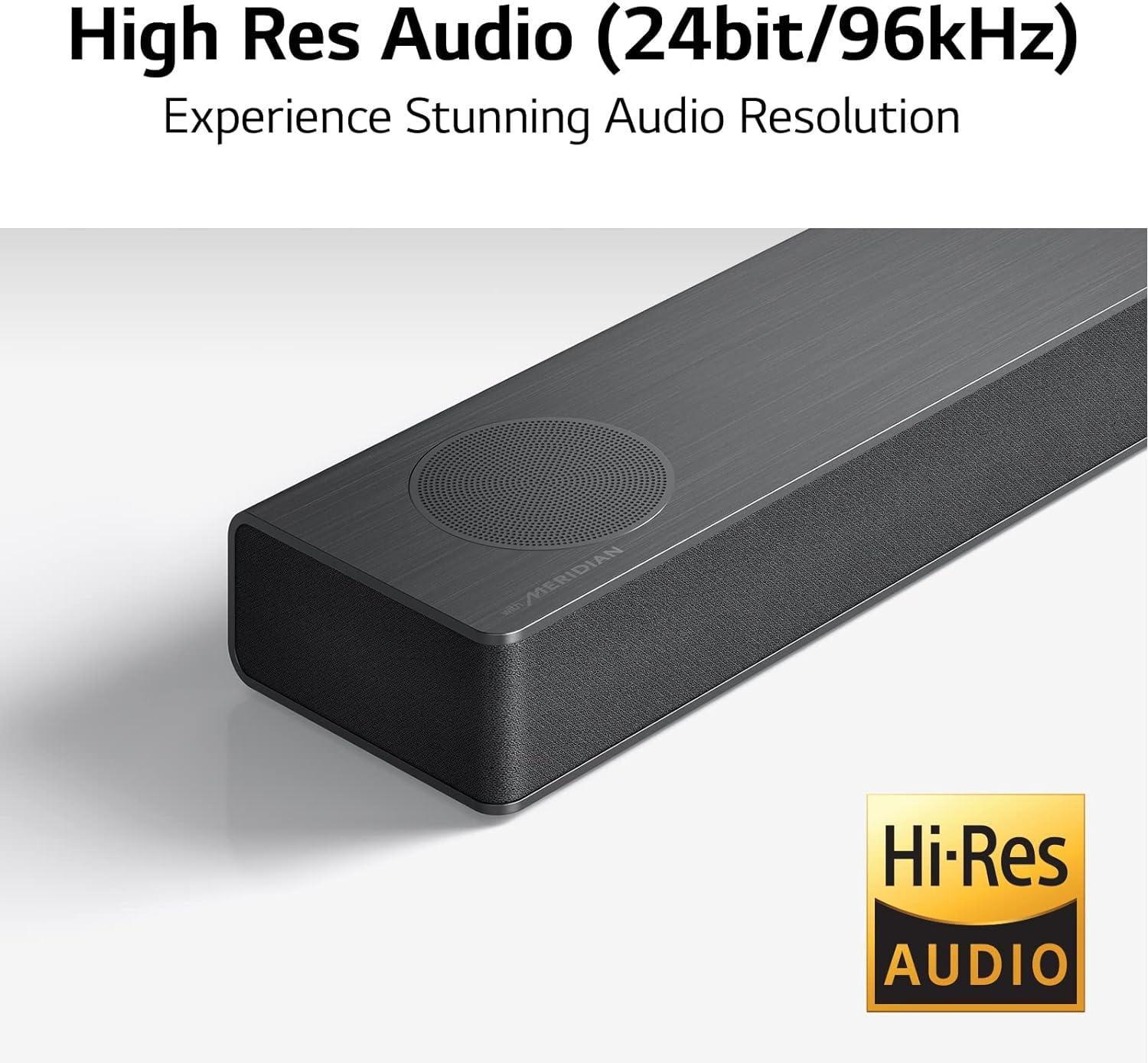
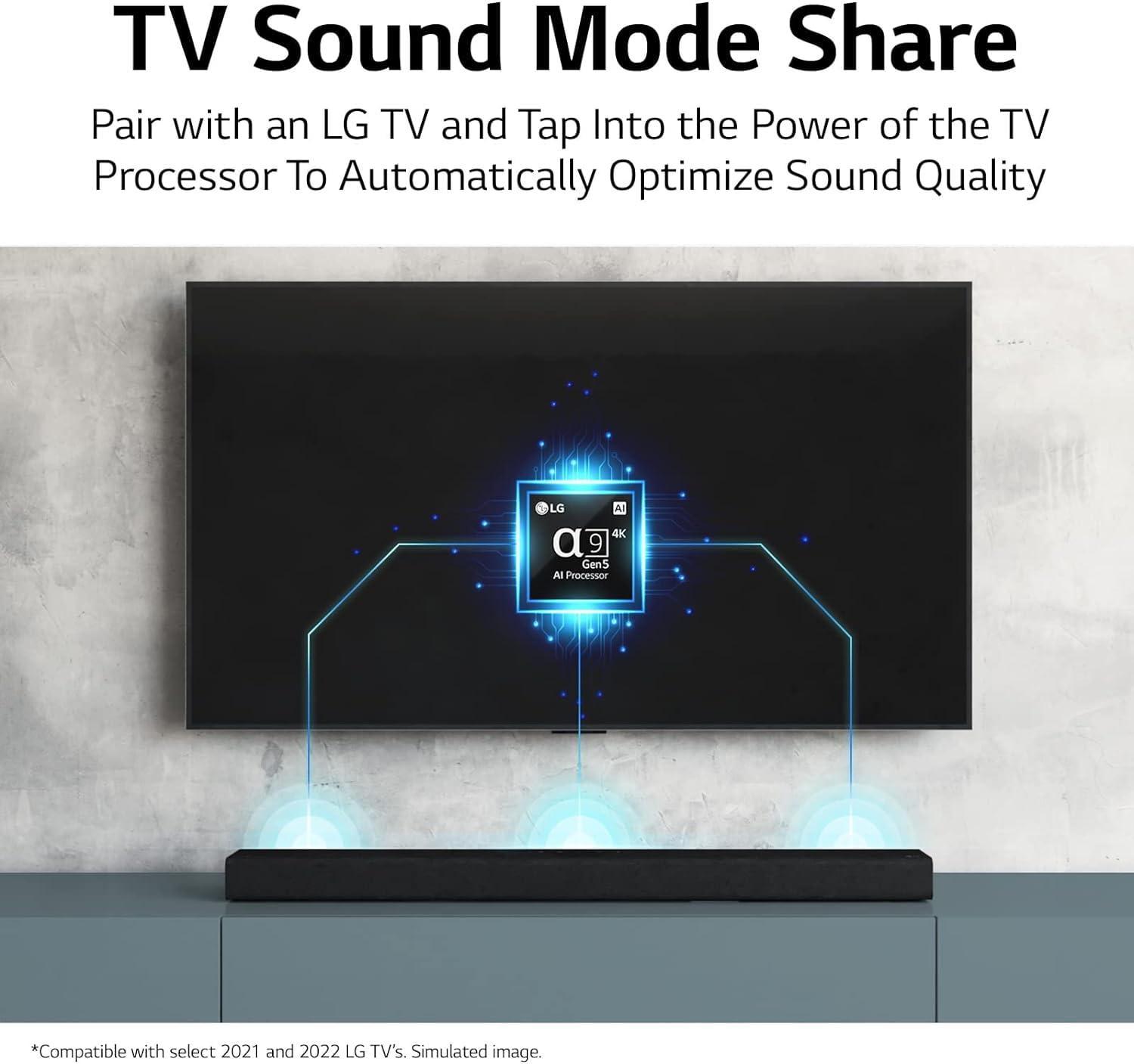
The LG S80TR, launched in 2024, takes the opposite approach. Instead of maximizing speaker count, LG focuses on advanced audio processing and support for cutting-edge formats like Dolby Atmos and DTS:X. These aren't just marketing terms—they represent fundamentally different ways of encoding and reproducing sound.
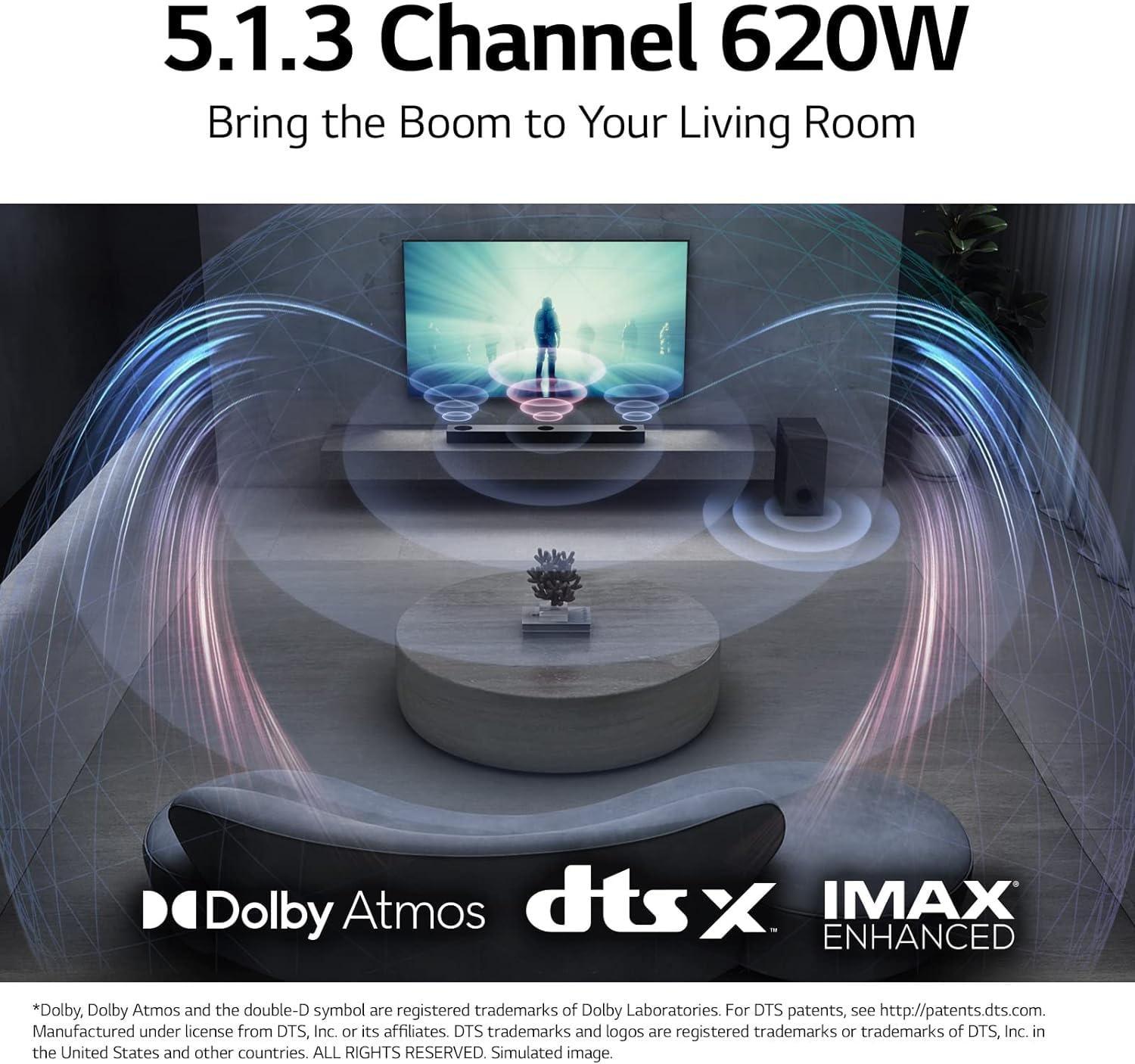
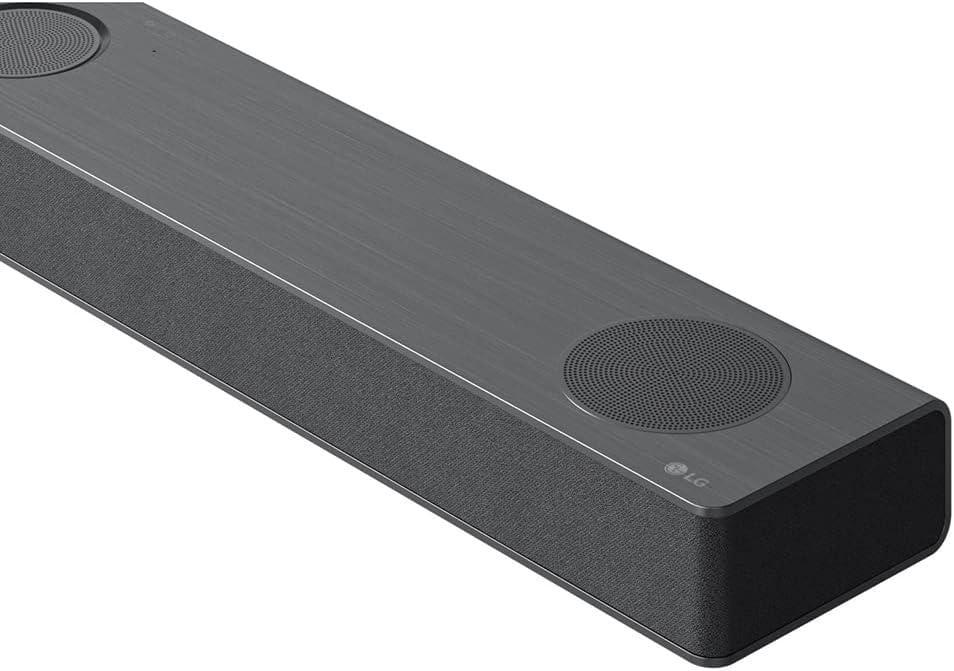
Traditional surround sound works with channels—specific audio tracks sent to designated speakers. Dolby Atmos, by contrast, treats sounds as objects that can be precisely positioned in three-dimensional space. When a raindrop falls in an Atmos movie, the system knows exactly where that drop should appear in your room and routes the audio accordingly. The LG system's up-firing drivers bounce sound off your ceiling to create height effects that traditional channel-based systems simply cannot produce.
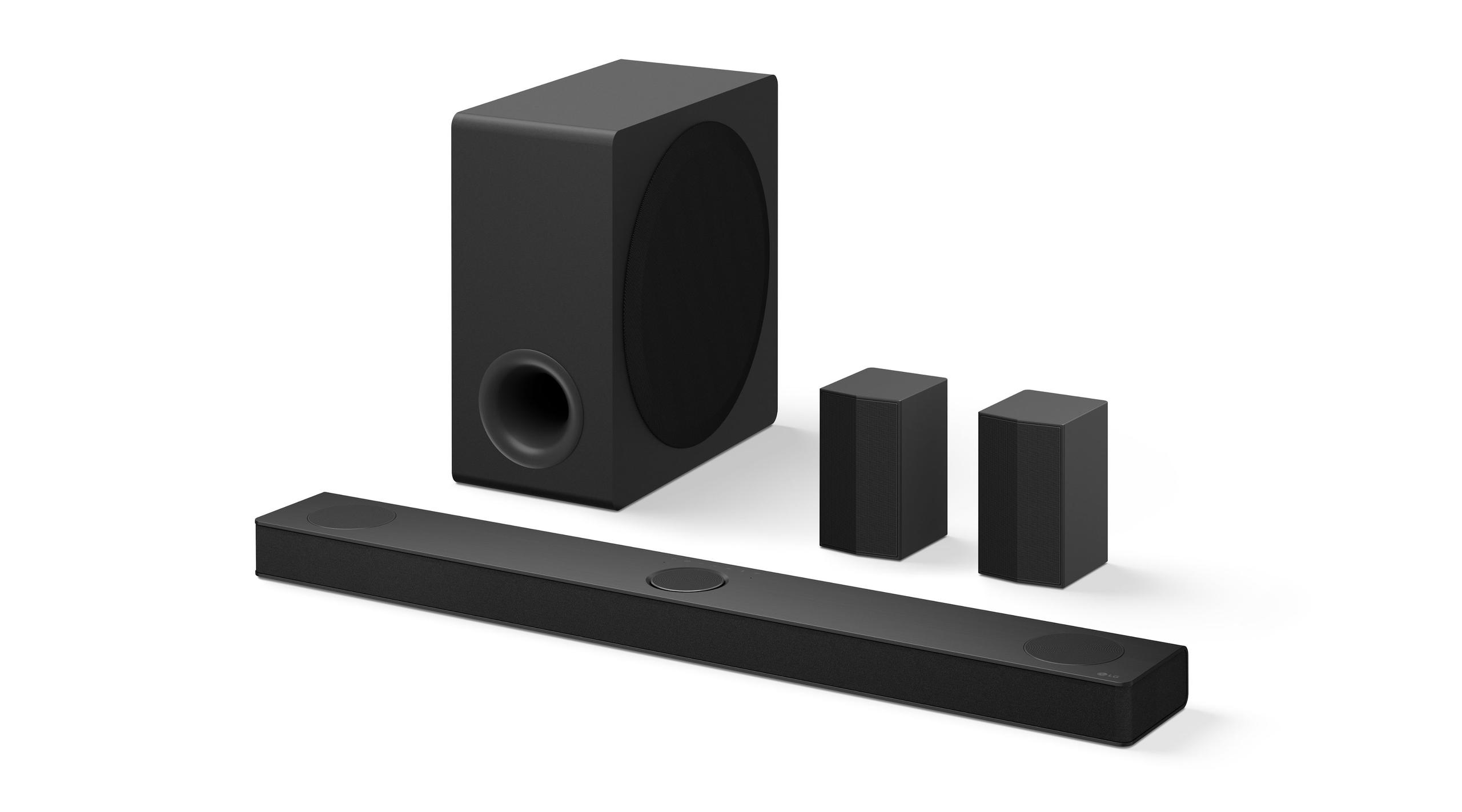
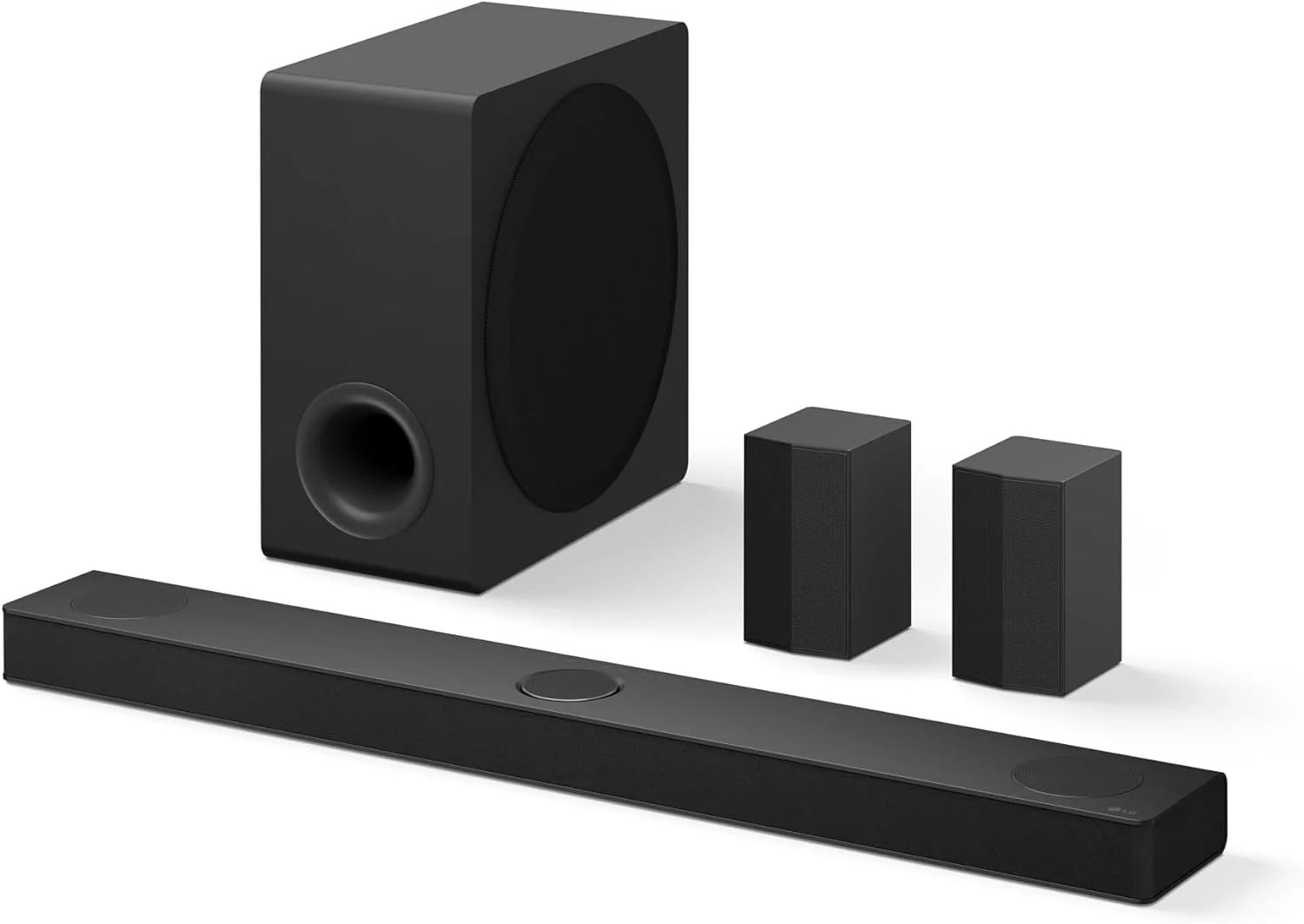
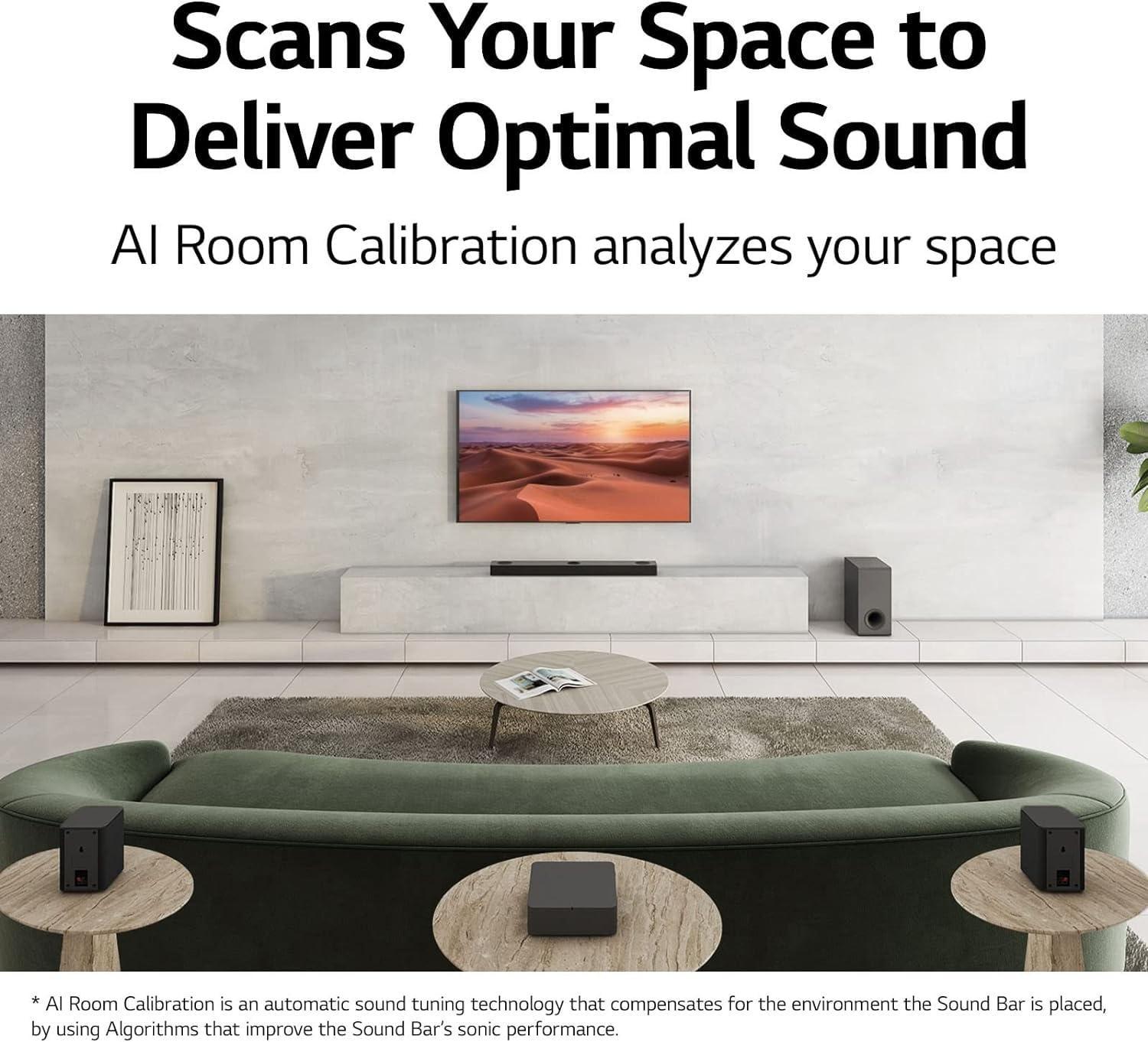
The 5.1.3 configuration means you get five main channels (left, right, center, left surround, right surround), one subwoofer, and three height channels for overhead effects. While that's fewer total speakers than the Ultimea, the processing sophistication is in a completely different league. The system's AI Room Calibration Pro uses built-in microphones to measure your room's acoustics and automatically adjusts the sound accordingly—something the Ultimea system cannot do.
With 580W of total power output compared to the Ultimea's 330W, the LG system also has significantly more headroom for dynamic peaks. This matters more than you might think—movie soundtracks can have enormous differences between quiet dialogue and explosive action scenes, and insufficient power leads to compression and distortion during loud passages.
Based on extensive user feedback and professional evaluations, these systems have distinctly different sonic signatures. The Ultimea Aura A40 provides impressive spatial immersion through its multiple speaker placement, but struggles with overall audio quality. Users consistently describe the sound as having a "tinny" or "metallic" character, particularly in the midrange frequencies where dialogue lives. The bass, while present thanks to the dedicated subwoofer, is often characterized as "loose" or "flabby"—meaning it lacks the tight, controlled impact that premium systems deliver.
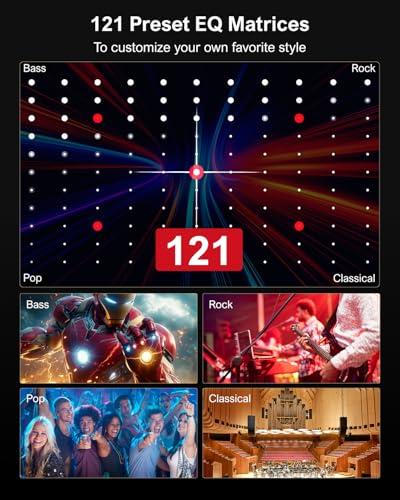
The extensive EQ customization helps address some of these issues. With 121 preset matrices covering everything from classical music to heavy metal, plus a full 10-band equalizer, you can spend considerable time tuning the system to your preferences. This level of control is actually quite impressive at this price point and appeals to users who enjoy tweaking their audio setup.
The LG S80TR, meanwhile, takes a more sophisticated approach to audio quality. The system's balanced frequency response and superior driver quality result in much more natural-sounding dialogue and music reproduction. Where the LG system truly shines is in its handling of dynamic content—the difference between a whispered conversation and a massive explosion is reproduced with proper scale and impact.
The Dolby Atmos implementation deserves special mention. When you're watching properly mastered content, the height effects are genuinely convincing. Rain sounds like it's falling from above, helicopters have proper overhead movement, and ambient sounds fill the space around you in ways that traditional channel-based systems cannot match.
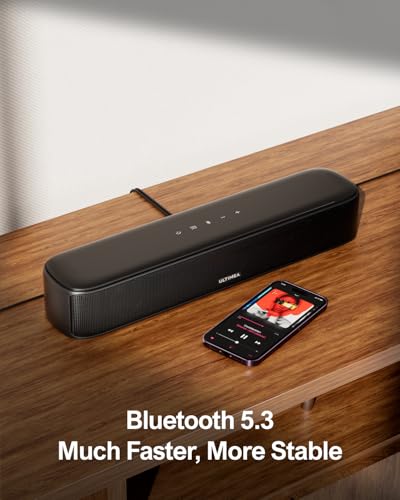
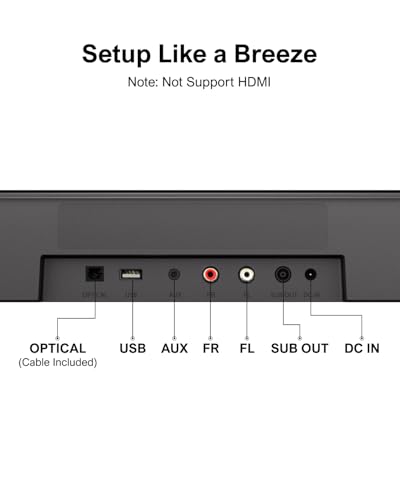
This is where the two systems diverge most dramatically. The Ultimea Aura A40 relies on older connection standards—optical audio, analog AUX, USB, and Bluetooth 5.3. Notably absent is HDMI connectivity, which severely limits its integration with modern TV setups. Most current TVs offer their best audio output through HDMI eARC (enhanced Audio Return Channel), which can pass full-resolution surround sound and advanced formats like Dolby Atmos directly to compatible soundbars.
Without HDMI, the Ultimea system is limited to compressed audio through optical connections or basic stereo through other inputs. This means you're not getting the full quality that streaming services and Blu-ray discs can provide, even for standard surround content.
The LG S80TR offers comprehensive connectivity including HDMI 2.1 with 4K@120Hz passthrough—crucial for modern gaming consoles and high-end streaming devices. The system supports eARC, VRR (Variable Refresh Rate), and ALLM (Auto Low Latency Mode), making it fully compatible with current gaming technology. Add built-in Wi-Fi with support for AirPlay 2, Chromecast, and Spotify Connect, and you have a system that integrates seamlessly with virtually any source device.
The setup experience highlights another fundamental difference between these approaches. The Ultimea system requires running speaker wire from the main unit to four surround speaker positions around your room, plus separate power adapters for the soundbar and surround speakers. For some users, this wired approach offers reliability and the satisfaction of precise speaker placement. For others, it's an installation nightmare.
Room size recommendations matter here. The Ultimea is optimized for spaces between 108-270 square feet—basically small to medium living rooms. In larger spaces, the system's 330W of total power may not provide sufficient volume for satisfying dynamics.
The LG S80TR emphasizes wireless convenience. The subwoofer connects wirelessly to the main bar, and the included rear speakers also communicate without cables. Setup involves positioning the components and letting the AI Room Calibration system handle the acoustic optimization automatically. This approach trades some installation flexibility for significant convenience.
The calibration process deserves explanation. The LG system uses internal microphones to emit test tones and measure how sound reflects in your room. It then creates a custom EQ curve to compensate for acoustic issues like bass buildup in corners or high-frequency absorption by furniture. This type of room correction can make a dramatic difference in sound quality, particularly in problematic rooms.
Perhaps the most significant long-term consideration is format support. The Ultimea Aura A40 handles basic PCM audio, standard Dolby Digital, and stereo content, but lacks support for advanced formats like Dolby Atmos, DTS:X, or even DTS-HD Master Audio from Blu-ray discs. As streaming services increasingly offer Atmos content and physical media continues to use advanced formats, this limitation becomes more significant over time.
The LG S80TR supports virtually every current audio format, including lossless options like Dolby TrueHD and DTS-HD Master Audio. More importantly, its Dolby Atmos and DTS:X capabilities mean you can take full advantage of the increasingly sophisticated soundtracks found on Netflix, Disney+, Apple TV+, and Ultra HD Blu-ray discs.
This format support isn't just about having the latest technology—it directly impacts your entertainment experience. When you watch a movie that was mixed in Dolby Atmos, the LG system can reproduce the filmmaker's intended audio design, while the Ultimea will downmix everything to traditional surround channels.
At the time of writing, these systems occupy very different price segments, with the Ultimea Aura A40 positioned as a budget-friendly entry into multi-speaker surround sound, while the LG S80TR commands premium pricing for its advanced features and format support.
The Ultimea system makes sense for users who prioritize speaker count over audio sophistication, want extensive manual control over their sound, and can accommodate the wired installation requirements. If you're primarily watching standard TV content and older movies, the format limitations won't significantly impact your experience. The system also appeals to audio enthusiasts who enjoy tweaking settings and don't mind spending time with the comprehensive EQ options.
However, the Ultimea's audio quality limitations mean it may disappoint users expecting premium sound. The reported "tinny" character and loose bass suggest that while the system provides surround immersion, it doesn't deliver the refined audio quality that makes extended listening enjoyable.
The LG S80TR targets users who want premium home theater performance without the complexity of separate components. Its wireless setup, automatic calibration, and comprehensive format support make it ideal for users who prefer plug-and-play convenience with professional-grade results. The significantly higher power output also makes it better suited for larger rooms and users who enjoy reference-level volume.
The decision ultimately comes down to your priorities, room characteristics, and long-term audio goals. If you're working with a smaller budget and can manage the wired installation, the Ultimea Aura A40 offers genuine surround speaker placement that creates spatial immersion you can't get from processing alone. Just understand that you're trading audio quality refinement for speaker quantity.
For users who want to fully experience modern movie soundtracks and streaming content, the LG S80TR provides the format support and audio quality that make the premium pricing worthwhile. The wireless convenience, automatic calibration, and future-proof connectivity also mean this system will remain relevant as audio technology continues evolving.
Consider your content sources carefully. If you primarily watch standard broadcast TV or older movies, the Ultimea's format limitations won't significantly impact your experience. But if you're streaming Atmos content on Netflix or watching Ultra HD Blu-rays, the LG system's advanced processing becomes essential for the full experience.
Room size also influences the decision. The Ultimea works well in smaller spaces where its 330W of power is sufficient and where you can position the surround speakers effectively. Larger rooms benefit from the LG system's higher power output and wireless flexibility.
Both systems represent significant upgrades from TV speakers, but they achieve immersion through completely different means. The Ultimea uses physical speaker placement to create spatial effects, while the LG relies on advanced processing and modern formats. Your choice depends on which approach better matches your room, budget, and audio priorities.
| Ultimea Aura A40 U2601 | LG S80TR |
|---|---|
| Channel Configuration - Determines surround sound experience | |
| 7.1 virtual surround with physical speakers | 5.1.3 true surround with height channels |
| Total Speakers - More speakers vs better placement | |
| 8 speakers (3 soundbar + 4 surrounds + 1 sub) | 8 speakers (soundbar array + 2 satellites + 1 sub) |
| Power Output - Critical for room filling and dynamic range | |
| 330W peak (adequate for small-medium rooms) | 580W RMS (excellent headroom for large rooms) |
| Audio Format Support - Determines content compatibility | |
| Basic stereo, PCM, legacy surround formats | Dolby Atmos, DTS:X, all modern and legacy formats |
| HDMI Connectivity - Essential for modern TV integration | |
| None (optical, AUX, USB only) | HDMI 2.1 with eARC, 4K@120Hz passthrough |
| Wireless Components - Affects installation complexity | |
| All wired (requires cable runs throughout room) | Wireless subwoofer and rear speakers |
| Room Calibration - Optimizes sound for your space | |
| Manual EQ adjustment only | AI Room Calibration Pro with automatic optimization |
| Frequency Response - Determines bass extension and clarity | |
| 65Hz-18kHz (limited low-end extension) | Not specified (likely extends lower based on 8" sub) |
| EQ Customization - Control over sound signature | |
| 10-band EQ with 121 presets (extensive manual control) | Standard sound modes with AI processing |
| Subwoofer Size - Impacts bass depth and impact | |
| 4-inch wired subwoofer | 8-inch wireless subwoofer |
| Wireless Streaming - Modern connectivity options | |
| Bluetooth 5.3 only | Wi-Fi, Bluetooth 5.1, AirPlay 2, Chromecast, Spotify Connect |
| Release Year - Technology generation and future-proofing | |
| 2023-2024 (budget-focused design) | 2024 (premium features and latest formats) |
| Ideal Room Size - Performance optimization range | |
| 108-270 ft² (small to medium rooms) | Medium to large rooms (higher power output) |
| Setup Complexity - Installation requirements | |
| Complex (multiple power adapters, speaker wire runs) | Simple (wireless components, automatic calibration) |

Privacy Policy
Terms and Conditions - Affiliate Policy
Home Security
© Copyright 2008-2026.
11816 Inwood Rd #1211, Dallas, TX 75244