



When your TV's built-in speakers just aren't cutting it anymore, soundbars offer the most practical path to better audio. But with hundreds of options available, the choice often comes down to a fundamental question: do you want authentic surround sound with multiple speakers, or premium processing packed into a single sleek unit?
That's exactly the decision you'll face when comparing the Ultimea Aura A40 U2601 and the Sony HT-A3000. These soundbars represent two completely different philosophies in home audio design, and understanding their approaches will help you make the right choice for your space and needs.
Before diving into specifics, it's worth understanding what makes today's soundbars so much better than their earlier counterparts. Modern soundbars use sophisticated digital signal processing (DSP) – essentially computer algorithms that can manipulate audio in real-time – to create convincing surround sound effects even from speakers pointing straight at you.
The magic happens through psychoacoustics, which exploits how our brains interpret sound. By carefully adjusting timing, phase, and frequency response, these systems can trick your ears into hearing sounds coming from locations where no speakers exist. It's genuinely impressive technology, but it has limitations compared to having actual speakers in those positions.
Both the Ultimea Aura A40 and Sony HT-A3000 were released in 2022, during a period when soundbar manufacturers were pushing hard to differentiate their products through either advanced processing or expanded speaker configurations. The timing is significant because 2022 marked a turning point where truly capable surround sound became accessible at more affordable price points.
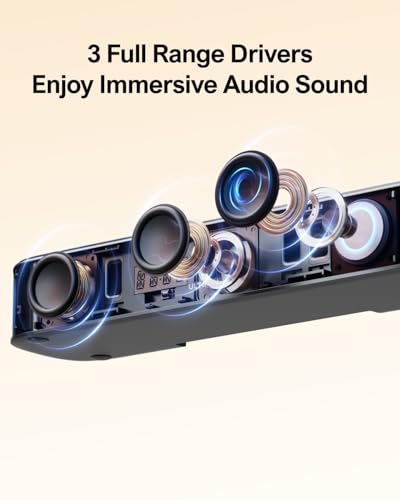
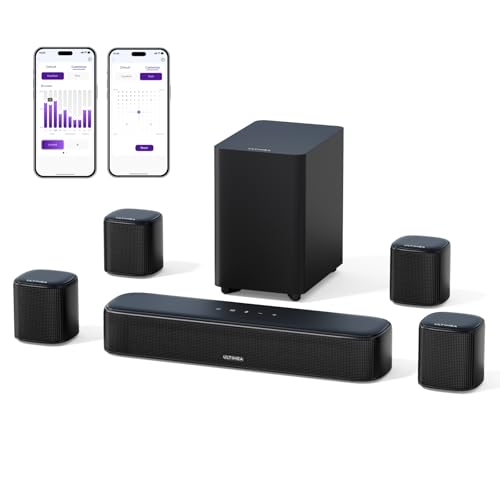
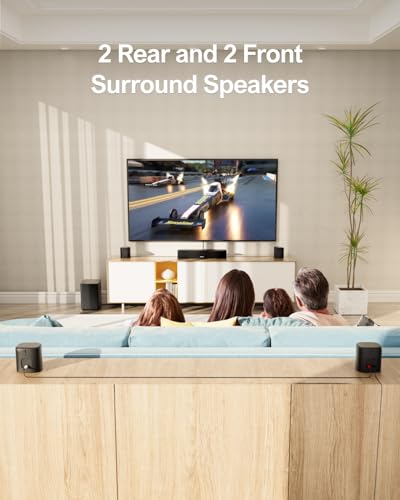
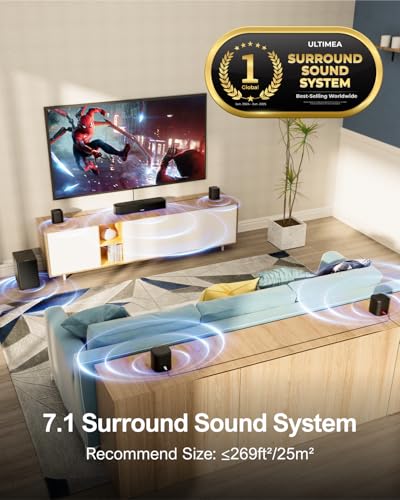
The Ultimea Aura A40 takes the "more speakers equals better sound" approach, and frankly, there's solid logic behind it. This system includes four dedicated surround speakers – two for the front channels and two for the rear – plus a separate subwoofer and the main soundbar unit. That's eight total drivers working together to create what Ultimea calls a 7.1 channel virtual surround experience.
What makes this interesting is the combination of real speaker separation with virtual processing. The SurroundX technology doesn't just rely on psychoacoustic tricks; it has actual speakers positioned around your listening area to work with. When a helicopter flies overhead in a movie, the Ultimea system can move that sound from the front speakers to the rear speakers in a way that your brain immediately recognizes as authentic movement through space.
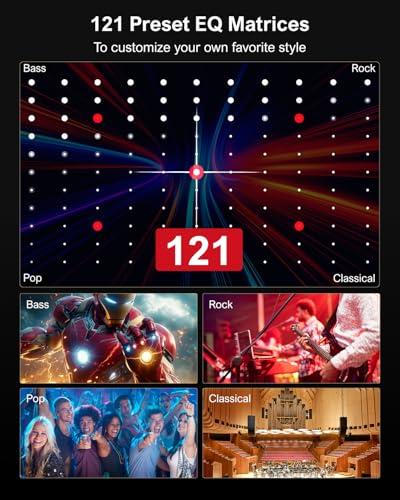
The customization options here are frankly overwhelming – in the best possible way. The Ultimea Smart App provides access to 121 preset equalizer matrices, which sounds like marketing fluff until you realize these are specifically tuned for different music genres, movie types, and listening scenarios. The 10-band equalizer lets you fine-tune everything from the deepest bass to the highest treble, giving you control that typically costs much more.
BassMX technology handles the low-end processing, working with that dedicated 4-inch subwoofer to deliver what our research suggests is genuinely impactful bass. The system's 330W peak power output provides plenty of headroom for dynamic content, though like most manufacturers, Ultimea's power ratings should be taken with some skepticism – real-world performance matters more than peak numbers.
The six listening modes (Movie, Music, Voice, Sport, Game, Night) aren't just marketing checkboxes. Each mode adjusts the entire frequency response and surround processing to optimize for different content types. Gaming mode, for instance, emphasizes directional audio cues that can genuinely improve your performance in competitive shooters.
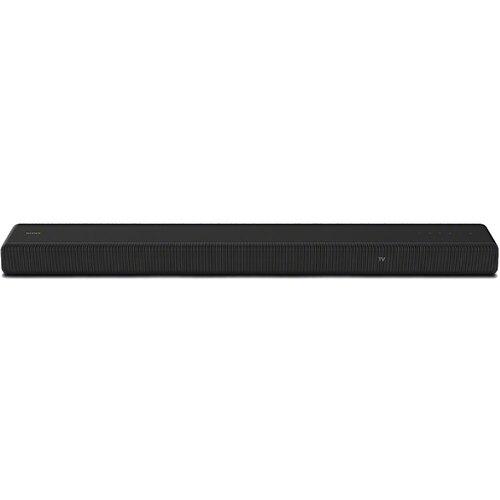
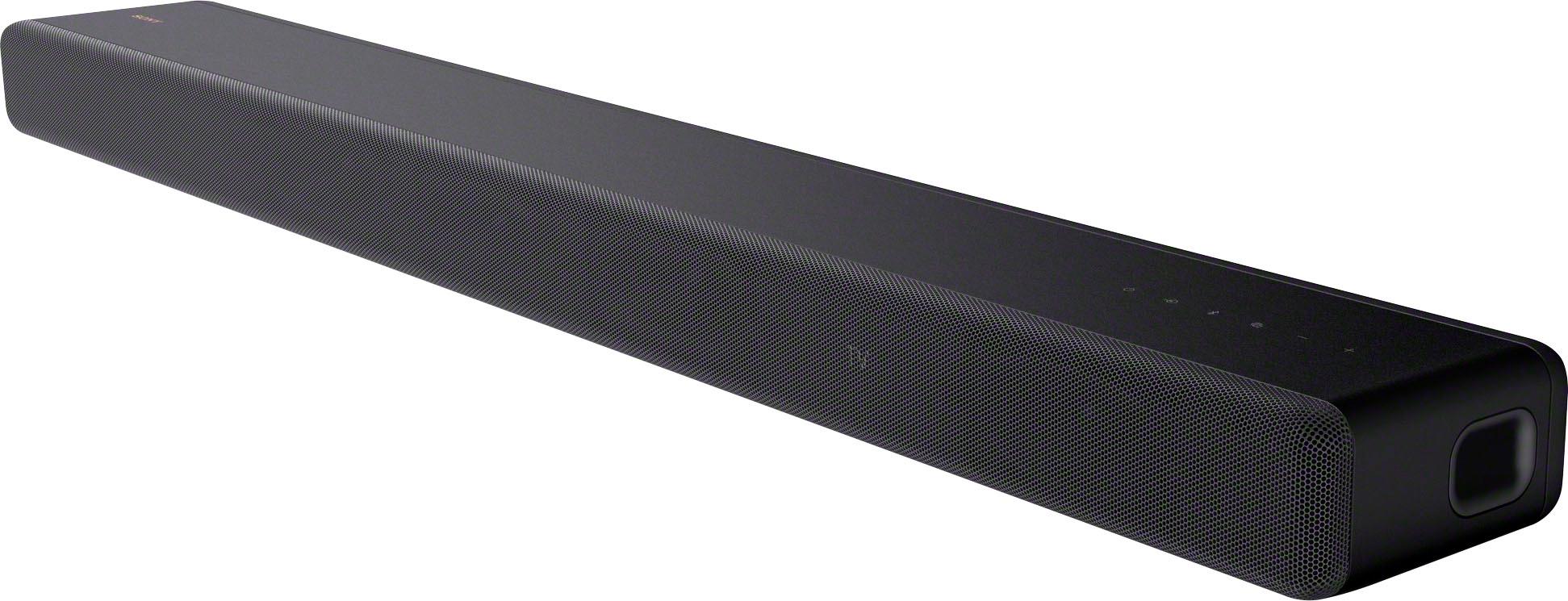
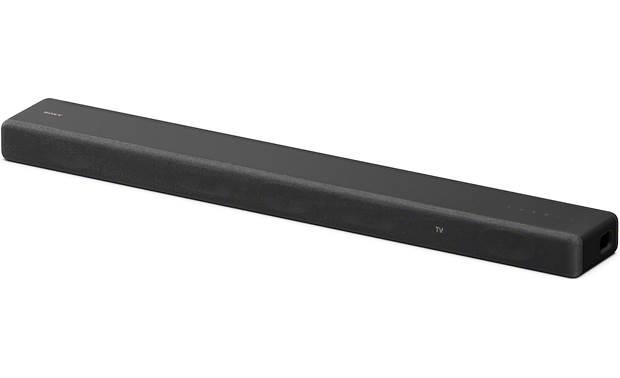
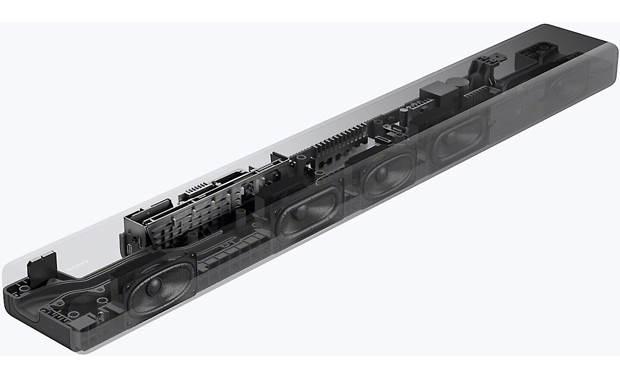
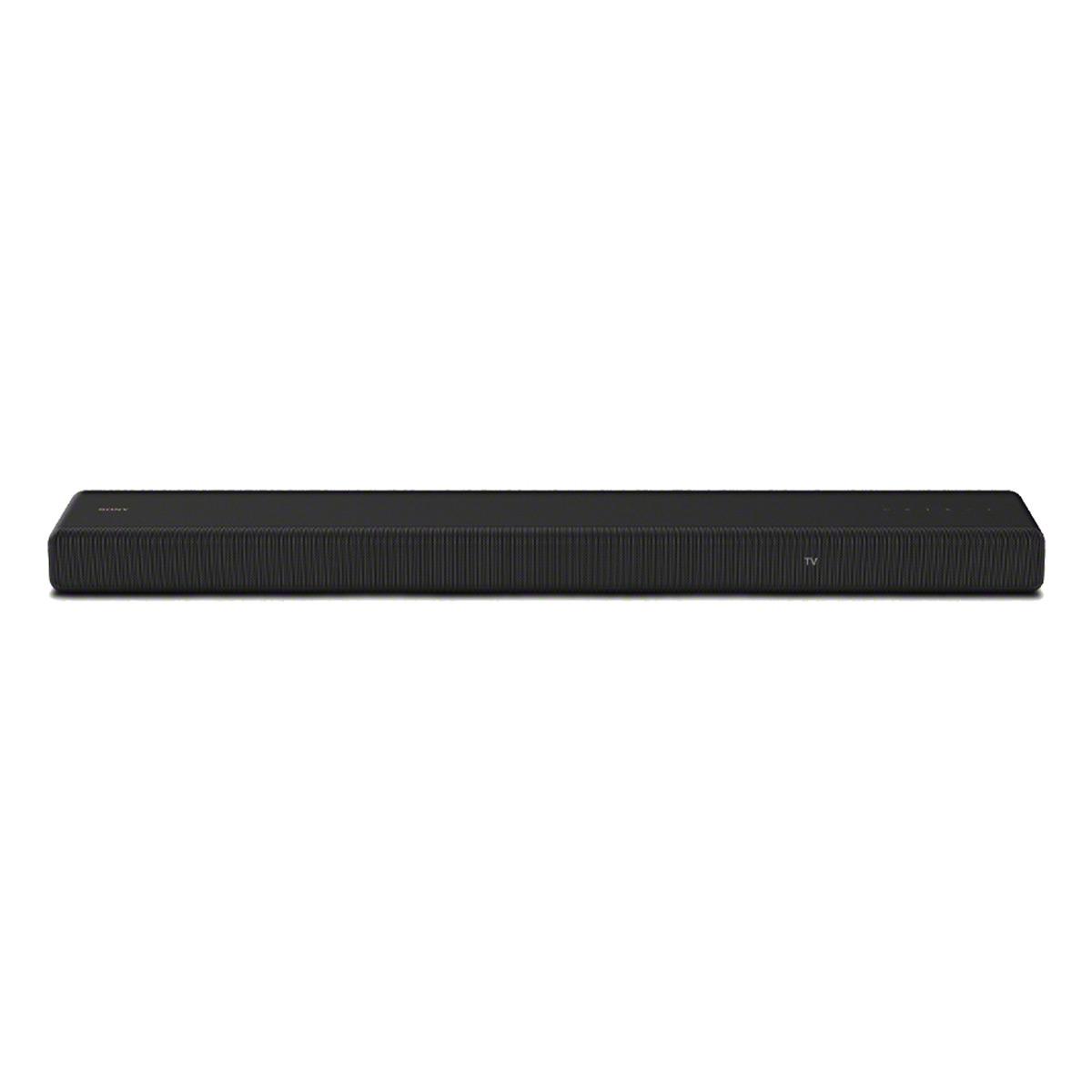
The Sony HT-A3000 represents the opposite philosophy: pack maximum technology into minimum space. This 3.1 channel soundbar includes just three front-firing speakers and dual built-in subwoofers, yet it supports both Dolby Atmos and DTS:X – the current gold standards for immersive audio.
Sony's approach relies heavily on the Vertical Surround Engine and S-Force Pro Front Surround technologies. These are sophisticated processing algorithms that analyze incoming audio and use complex timing and phase adjustments to create the illusion of sound coming from above and behind you. It's essentially computational audio wizardry, and Sony has been refining these techniques for years.
The discrete center channel is crucial here. Unlike many soundbars that use left and right speakers to create a phantom center image, the HT-A3000 has a dedicated driver handling dialogue and vocals. This architectural difference translates to noticeably clearer speech, which matters enormously for TV shows and movies where understanding dialogue is paramount.
Sony's X-Balance driver design is worth understanding because it directly impacts performance. Traditional circular drivers waste space in rectangular enclosures, but X-Balance drivers use an oval shape that maximizes the diaphragm area within the available space. More diaphragm area means more air movement, which translates to better bass response and lower distortion at high volumes.
The dual subwoofers measure 4.375" x 1.8125" each, and their integrated design eliminates the placement challenges that come with separate subwoofers. Sony's engineers positioned them to work together for more even bass distribution across your listening area.
This is where the fundamental difference between these systems becomes most apparent. The Ultimea Aura A40 creates surround sound through actual speaker placement – when something moves from front to back in a movie, you hear it moving from front to back because there are actually speakers in those locations.
The four surround speakers can be positioned optimally for your room layout, and the system includes cables long enough (up to 6 meters for the rear speakers) to accommodate most residential setups. The adjustable surround levels – six different intensity settings – let you dial in exactly how prominent you want the surround effects to be.
Our research into user experiences consistently shows that people notice the difference immediately when switching from virtual surround to physical surround speakers. The Ultimea system provides genuine spatial separation that your brain recognizes as authentic, particularly beneficial for gaming where directional audio can provide competitive advantages.
The Sony HT-A3000, meanwhile, creates surprisingly convincing surround effects for a front-firing system. The Vertical Surround Engine is genuinely impressive technology that can create the sensation of overhead audio without ceiling speakers. However, physics is physics – virtual surround has limits that real speakers don't.
Sony's approach shines in smaller rooms where the psychoacoustic effects work best, typically under 200 square feet. In larger spaces, the illusion becomes less convincing simply because the distance between you and the soundbar reduces the effectiveness of the timing and phase tricks.
Both systems approach bass differently, and each has merits. The Ultimea system uses a traditional approach with a separate subwoofer that can be positioned optimally in your room. Bass response is highly dependent on room acoustics, and having placement flexibility usually results in better overall performance.
The BassMX processing works to optimize the subwoofer's output, though the effectiveness depends heavily on your room's characteristics. Hard surfaces reflect bass, while carpets and furniture absorb it, so your mileage will vary significantly based on your space.
Sony's dual built-in subwoofers in the HT-A3000 represent a more engineered approach. The X-Balance drivers and integrated design mean consistent performance regardless of room placement, though you lose the ability to optimize positioning for your specific acoustics.
Our evaluation of user feedback suggests the Sony system provides more controlled, accurate bass response, while the Ultimea can deliver more raw impact when properly positioned. For music listening, accuracy matters more; for movie watching, impact often takes precedence.
This is where the Sony HT-A3000 demonstrates clear superiority. The discrete center channel architecture, combined with Sony's Voice enhancement mode, consistently delivers exceptional dialogue clarity even during complex audio scenes.
The three-speaker front array in the Ultimea system handles center channel duties differently, using processing to create a phantom center image. While this can work well, it's fundamentally less precise than having a dedicated center speaker.
For home theater applications where dialogue intelligibility is crucial – think complex dramas, foreign films with subtitles, or action movies with dense soundtracks – the Sony system's center channel provides a meaningful advantage.
Music performance reveals another interesting contrast. The Ultimea Aura A40 excels at customization, offering those 121 preset EQ matrices and granular 10-band adjustment. This flexibility means you can optimize the system for your specific musical preferences and room acoustics.
The multiple speaker positions also create a wider soundstage for music, with the surround speakers contributing to an enveloping stereo experience that goes well beyond what traditional two-channel systems provide.
The Sony HT-A3000 takes a more purist approach, emphasizing accuracy over customization. The DSEE Extreme processing uses AI algorithms to upscale compressed music files, restoring high-frequency content lost in compression. For streaming music services, this makes a noticeable difference in clarity and detail.
Sony's support for Hi-Res Audio (up to 24-bit/96kHz) and the LDAC Bluetooth codec means wireless streaming can approach wired quality with compatible devices. The more neutral frequency response works well across various music genres without requiring constant adjustment.
The connectivity story reveals each manufacturer's target user. The Sony HT-A3000 embraces the streaming-first world with built-in support for Spotify, Apple Music, TIDAL, YouTube Music, and Pandora. Both Chromecast and AirPlay 2 support means seamless streaming from any device.
The HDMI eARC connection is particularly valuable for modern TV integration. Enhanced Audio Return Channel allows bidirectional communication between your TV and soundbar, enabling features like automatic volume control and one-remote operation.
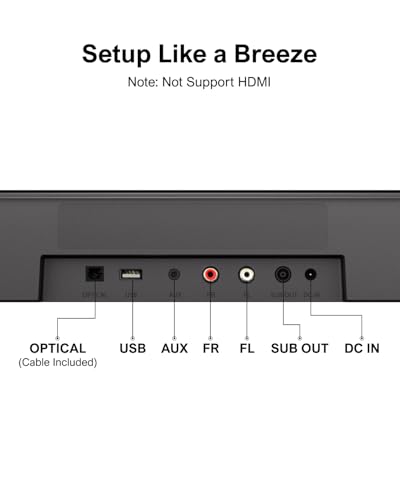
The Ultimea system focuses more on traditional connectivity with optical, AUX, and USB inputs, though notably lacks HDMI entirely. This isn't necessarily a weakness – many people prefer optical connections for their simplicity and immunity to HDMI handshake issues.
The Ultimea Smart App provides comprehensive control and those extensive EQ options, plus over-the-air updates that can add features over time. This forward-looking approach helps extend the product's useful life.
Setting up the Ultimea Aura A40 requires planning and patience. You'll need to position four surround speakers plus the subwoofer, run cables (some quite long), and likely spend time with the app optimizing settings. The payoff is substantial, but it's not a plug-and-play solution.
The system works best in rooms between 108-270 square feet where the surround speakers can be positioned effectively. Smaller rooms might feel overwhelmed by eight speakers, while larger rooms might not achieve optimal surround effects.
The Sony HT-A3000 epitomizes convenience. At just 37.5 inches wide and 5.25 inches deep, it fits most TV stands without dominating the space. Setup involves connecting one HDMI cable and running brief room optimization – you're enjoying better audio within minutes.
The compact design makes the Sony system ideal for apartments, bedrooms, or any situation where multiple speakers aren't practical. The Sound Field Optimization uses built-in microphones to measure your room and adjust accordingly, though it works best with Sony's optional rear speakers.
At the time of writing, both systems occupy different value propositions. The Ultimea Aura A40 typically offers more speakers and features for less money, making it attractive for buyers prioritizing maximum capability per dollar.
The Sony HT-A3000 commands a premium for the Sony brand, advanced processing, and refined engineering. You're paying more for sophistication, build quality, and the convenience of a proven solution.
Consider the total cost of ownership, though. The Ultimea system includes everything needed for full surround sound out of the box. The Sony system works excellently alone but reaches its full potential with optional rear speakers and upgraded subwoofers, which add to the total investment.
Both systems should remain relevant for years. The Ultimea's OTA update capability and extensive customization options provide longevity through software improvements. Sony's format support for current standards like Dolby Atmos and DTS:X ensures compatibility with future content.
Choose the Ultimea Aura A40 if you have the space and patience for a true surround setup. This system rewards listeners who want authentic directional audio for gaming, maximum customization for music, and don't mind spending time optimizing settings. It's particularly compelling for home theater enthusiasts who prioritize immersion over convenience.
The Sony HT-A3000 makes more sense for most people, particularly those in space-constrained environments who prioritize dialogue clarity, streaming integration, and simple setup. It's the better choice for general TV watching, apartment living, or situations where aesthetic minimalism matters.
For dedicated home theater rooms, the Ultimea system provides more authentic surround sound that physical speakers simply deliver better than processing alone. For living rooms that serve multiple purposes, the Sony's sophisticated processing and compact design integrate more naturally into daily life.
Both systems represent significant upgrades over TV speakers and basic soundbars. Your choice ultimately depends on whether you value maximum immersion or refined convenience more. Either way, you'll enjoy substantially better audio than what you're probably hearing now.
| Ultimea Aura A40 U2601 | Sony HT-A3000 |
|---|---|
| Channel Configuration - Determines surround sound authenticity | |
| 7.1 virtual with 4 physical surround speakers | 3.1 with discrete center channel |
| Power Output - Affects maximum volume and dynamic range | |
| 330W peak (adequate for most rooms) | 250W RMS (more accurate rating, still powerful) |
| Dolby Atmos Support - Essential for modern movie formats | |
| Not specified (likely unsupported) | Yes, with height virtualization |
| Subwoofer Configuration - Critical for bass impact | |
| Separate 4" wired subwoofer | Dual built-in 4.375" x 1.8" subwoofers |
| Setup Complexity - Time and effort required | |
| 4 surround speakers + cables to run | Single unit, plug-and-play |
| App Control Features - Customization capabilities | |
| 121 EQ presets, 10-band EQ, OTA updates | Basic remote control, limited app features |
| HDMI Connectivity - Modern TV integration | |
| None (optical, AUX, USB only) | eARC/ARC support for seamless TV control |
| Streaming Services - Built-in music access | |
| Bluetooth only, no built-in services | Spotify, Apple Music, TIDAL, YouTube Music |
| Room Size Optimization - Space requirements | |
| 108-270 sq ft, needs surround speaker placement | Compact design works in any size room |
| Dialogue Clarity - Speech intelligibility | |
| Virtual center channel processing | Dedicated center channel driver |
| Wireless Technology - Streaming quality | |
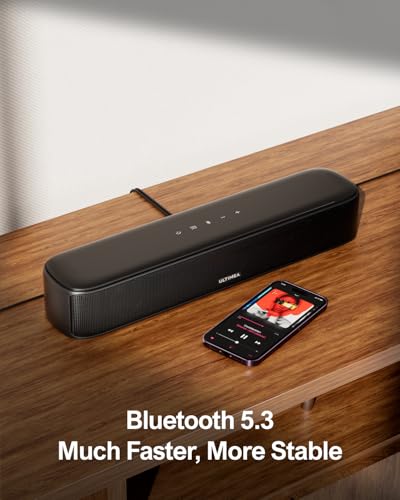
| Bluetooth 5.3 | Bluetooth 5.0 with LDAC, Wi-Fi, Chromecast, AirPlay 2 |
| Future Expandability - Upgrade potential | |
| Complete system included | Compatible with optional Sony rear speakers |
The Ultimea Aura A40 provides more authentic surround sound with four physical surround speakers that create genuine 360-degree audio positioning. The Sony HT-A3000 uses advanced virtual surround processing to simulate surround effects from a single soundbar unit. For true immersive surround sound, the Ultimea system delivers superior spatial separation, while the Sony offers impressive virtualization in a much more compact setup.
The Ultimea Aura A40 includes a separate 4-inch wired subwoofer that requires placement and connection. The Sony HT-A3000 has dual subwoofers built directly into the main unit, eliminating the need for additional components or placement considerations. Both provide good bass response, but the Ultimea's separate subwoofer offers more placement flexibility for optimal room acoustics.
The Sony HT-A3000 is significantly easier to install, requiring only a single HDMI connection to your TV for full functionality. The Ultimea Aura A40 requires positioning and wiring four surround speakers throughout your room, which can take considerable time and planning. If you want immediate improvement with minimal effort, the Sony is the clear winner.
Only the Sony HT-A3000 supports HDMI connectivity with eARC/ARC for seamless TV integration and control. The Ultimea Aura A40 connects via optical digital, AUX, or USB inputs but lacks any HDMI ports. For modern TV setups, the Sony's HDMI eARC connection provides better integration and convenience.
The Sony HT-A3000 excels at dialogue clarity thanks to its dedicated center channel speaker and Voice enhancement mode. The Ultimea Aura A40 uses virtual center channel processing, which can work well but isn't as precise for speech reproduction. For watching dialogue-heavy content like dramas or news, the Sony provides noticeably clearer vocals.
The Sony HT-A3000 fully supports Dolby Atmos and DTS:X with height virtualization technology. The Ultimea Aura A40 does not appear to support these advanced audio formats, focusing instead on traditional surround sound processing. If you want compatibility with the latest movie and streaming formats, the Sony is the better choice.
Both soundbars support Bluetooth streaming, but the Sony HT-A3000 offers superior wireless capabilities with built-in Spotify, Apple Music, TIDAL, Chromecast, and AirPlay 2 support. The Ultimea Aura A40 relies primarily on Bluetooth 5.3 connectivity. For comprehensive streaming options, the Sony provides much more flexibility and convenience.
The Ultimea Aura A40 provides extensive customization with 121 preset EQ matrices, a 10-band equalizer, and multiple listening modes through its smart app. The Sony HT-A3000 offers more limited customization options but includes automatic room optimization. Audio enthusiasts who enjoy fine-tuning their sound will prefer the Ultimea's comprehensive control options.
The Ultimea Aura A40 is optimized for rooms between 108-270 square feet where surround speakers can be effectively positioned. The Sony HT-A3000 works well in any room size due to its compact design and virtual surround processing. Smaller apartments and bedrooms are better suited to the Sony, while larger dedicated home theater spaces benefit from the Ultimea system.
The Ultimea Aura A40 typically offers more speakers and features at a lower price point, making it excellent value for buyers wanting maximum hardware for their investment. The Sony HT-A3000 costs more but provides premium brand reliability, advanced processing, and superior convenience. Value depends on whether you prioritize feature quantity or refined quality.
The Ultimea Aura A40 delivers 330W peak power across its eight speakers, providing plenty of volume for dynamic content. The Sony HT-A3000 outputs 250W RMS, which represents a more conservative but accurate power rating. Both provide sufficient power for most home environments, with the Ultimea offering slightly more headroom for very loud listening.
The Ultimea Aura A40 excels for gaming with its dedicated Game mode, physical surround speakers that provide authentic directional audio cues, and customizable sound profiles. The Sony HT-A3000 offers good gaming performance but lacks the precise directional separation that competitive gaming benefits from. Serious gamers who want authentic positional audio should choose the Ultimea system.
We've done our best to create useful and informative comparisons to help you decide what product to buy. Our research uses advanced automated methods to create this comparison and perfection is not possible - please contact us for corrections or questions. These are the sites we've researched in the creation of this article: walmart.com - newegg.com - youtube.com - ultimea.com - youtube.com - device.report - ultimea.co - manuals.plus - homestudiobasics.com - youtube.com - bestbuy.com - community.ultimea.com - manuals.plus - eu.ultimea.com - navesapeugeot.com.br - bestbuy.com - images.thdstatic.com - provantage.com - ultimea.com - bestbuy.com - rtings.com - electronics.sony.com - crutchfield.com - store.sony.com.au - digitaltrends.com - videoandaudiocenter.com - abt.com - sony.com - merlinstv.com - crutchfield.com - youtube.com

Privacy Policy
Terms and Conditions - Affiliate Policy
Home Security
© Copyright 2008-2026.
11816 Inwood Rd #1211, Dallas, TX 75244