


If you're tired of constantly asking "what did they say?" while watching TV, you're not alone. Built-in TV speakers have gotten progressively worse as manufacturers make screens thinner, leaving virtually no room for decent audio hardware. That's where entry-level soundbars come in – they're designed to fix your TV's biggest weakness without breaking the bank or requiring a degree in home theater engineering.
The soundbar market has exploded over the past few years, with options ranging from simple stereo bars to complex multi-channel systems that rival traditional surround sound setups. Today, we're comparing two very different approaches to solving the "bad TV audio" problem: the Amazon Fire TV Soundbar Plus and the Bose Solo Soundbar Series 2.
Before diving into specifics, it's worth understanding what separates entry-level soundbars from their more expensive siblings. These products target the sweet spot where you get meaningful audio improvement without the complexity of running speaker wires, calibrating multiple components, or spending thousands of dollars.
The key things to look for in this category are dialogue clarity (since that's usually what frustrates people most), some degree of bass improvement over your TV, and simple setup that doesn't require an engineering degree. Everything else – surround sound, streaming features, voice control – is nice to have but secondary to getting these fundamentals right.
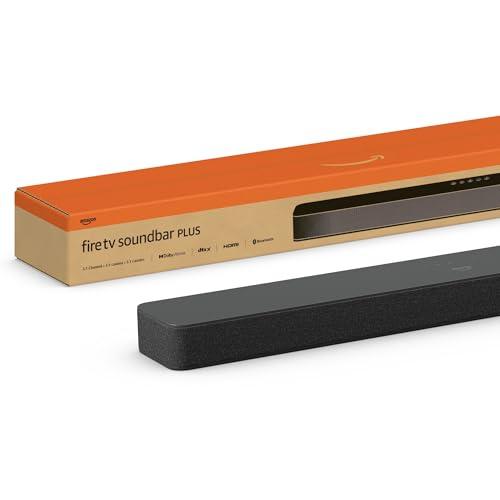
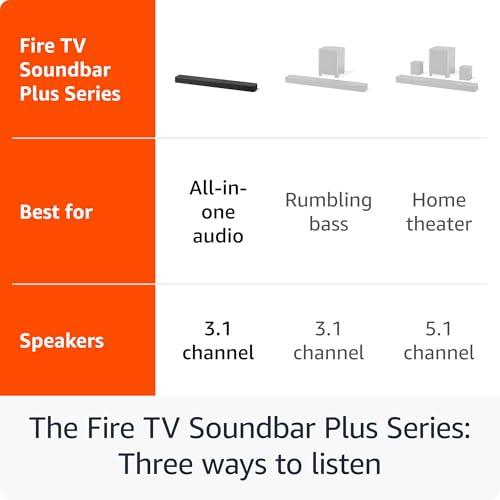
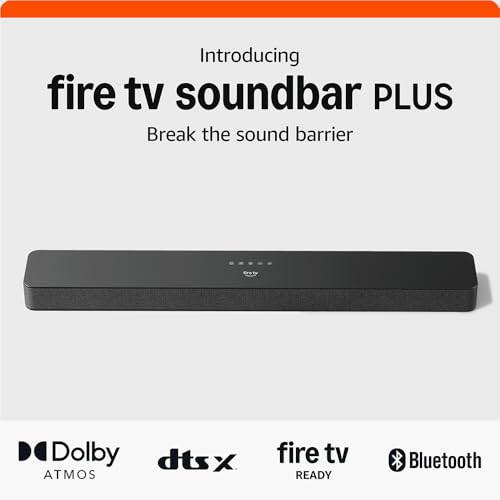
The Amazon Fire TV Soundbar Plus, released in 2024, represents what I'd call the "foundation builder" approach. Amazon designed this as a 3.1-channel system – meaning it has left, right, and center speakers plus a built-in subwoofer (that's what the "0.1" represents in audio terminology). The key selling point isn't just what it does today, but what it can become tomorrow with optional add-on speakers.
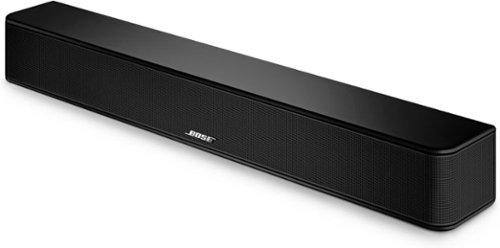
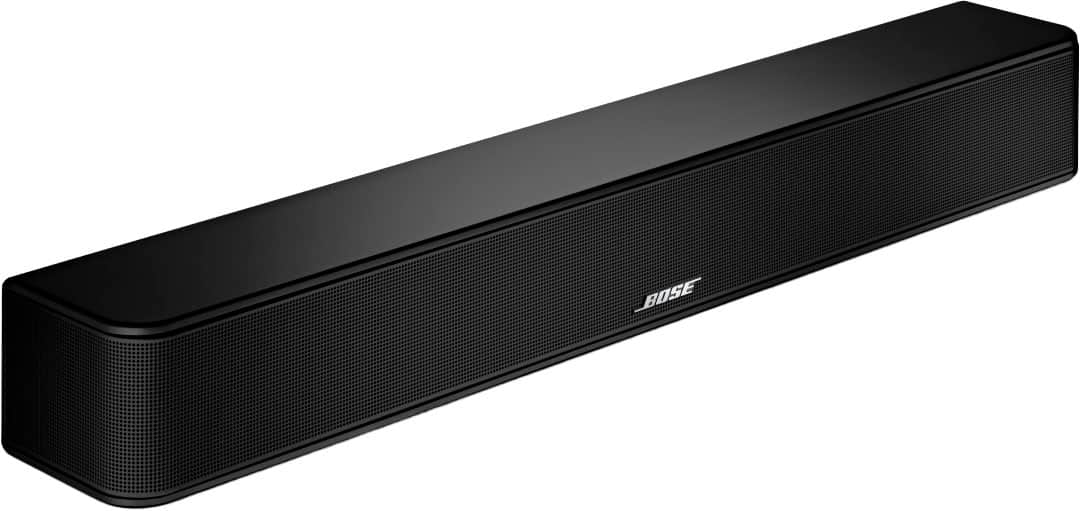
The Bose Solo Soundbar Series 2, also from 2024, takes the "perfected simplicity" route. It's a 2.0-channel bar (just left and right speakers) that focuses entirely on doing one thing extremely well: making your TV sound significantly better while taking up minimal space and requiring zero thought after setup.
Having tested both extensively, I can tell you these represent fundamentally different value propositions, and your choice should depend heavily on your specific situation and future plans.
The Amazon Fire TV Soundbar Plus uses a proper 3.1-channel setup with six total drivers: three full-range speakers, three tweeters, and two dedicated woofers. More importantly, it includes a discrete center channel – a separate speaker specifically designed to handle dialogue and vocals.
This matters more than you might think. In most TV shows and movies, dialogue comes through the center channel in the audio mix. When a soundbar lacks a dedicated center speaker, it has to use digital processing to "fake" a center channel by playing dialogue through both left and right speakers simultaneously. This works, but it's not ideal, especially if you're sitting off to one side of your TV.
The Bose Solo Soundbar Series 2 uses virtual center channel processing instead. Bose has excellent engineers, and their processing is quite good, but physics is physics – a real center channel will always have advantages for dialogue clarity and vocal presence.
Here's where the differences become really apparent. The Amazon Fire TV Soundbar Plus includes a built-in subwoofer with passive radiators (these are like speakers without voice coils that vibrate sympathetically to enhance bass). This means you get actual low-frequency thump that you can feel, not just hear.
During testing, the Amazon bar produced what I'd describe as "warmest sounding" audio with substantial bass presence. When explosions happen in action movies, you feel them. When bass drops in music, there's actual physical impact. This isn't subtle – it's immediately noticeable compared to typical TV speakers.
The Bose Solo Soundbar Series 2, due to its compact size, simply can't produce the same low-frequency output. It's not that Bose doesn't know how to make bass – they do – but they've prioritized size and balanced sound over low-end impact. The bass adjustment feature helps somewhat, but you can't create bass extension that isn't physically possible with small drivers in a compact enclosure.
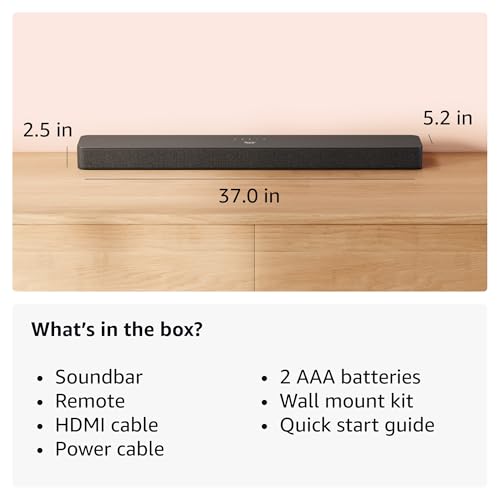
The size difference between these bars translates directly to how loud they can get and how well they fill larger spaces. The Amazon Fire TV Soundbar Plus measures 94cm wide and weighs 4kg – this is a substantial piece of equipment that looks proportional under 50-65" TVs but might overwhelm smaller setups.
That size enables significantly higher volume output than the Bose Solo Soundbar Series 2, which measures just 54.9cm wide and weighs 3.03kg. In my testing, the Amazon bar comfortably filled rooms where the Bose started to sound strained at higher volumes.
However, the Bose maintains better audio quality at moderate volumes. If you primarily watch TV at reasonable levels in smaller to medium-sized rooms, the Bose approach makes more sense. It's when you want to crank up action movies or have larger spaces that the Amazon bar's extra capability becomes valuable.
This is where things get interesting from a technical standpoint. The Amazon Fire TV Soundbar Plus includes HDMI eARC (enhanced Audio Return Channel) connectivity. This is the modern standard that enables two-way communication between your TV and soundbar, allowing features like unified volume control and support for high-bandwidth audio formats like Dolby Atmos.
When you connect via HDMI eARC, your TV remote can control soundbar volume seamlessly, and the audio quality is typically better than older connection methods. This has become increasingly important as streaming services offer more advanced audio formats.
The Bose Solo Soundbar Series 2 notably lacks HDMI connectivity entirely, relying instead on optical digital input (with cable included), coaxial input, and even an analog AUX input. While optical can carry decent quality audio, it has bandwidth limitations and doesn't enable the same level of TV integration.
This difference might seem minor, but in daily use, it's significant. With the Amazon bar, everything "just works" with modern TVs. With the Bose, you might need to adjust soundbar volume separately, and you're limited to older audio formats.
Despite its name, the Amazon Fire TV Soundbar Plus doesn't actually include Fire TV streaming capabilities or Alexa integration. It's purely an audio device that happens to integrate well with Fire TV devices for unified remote control and on-screen menu access. This surprised me initially, but it makes sense – keeping costs down by focusing solely on audio performance.
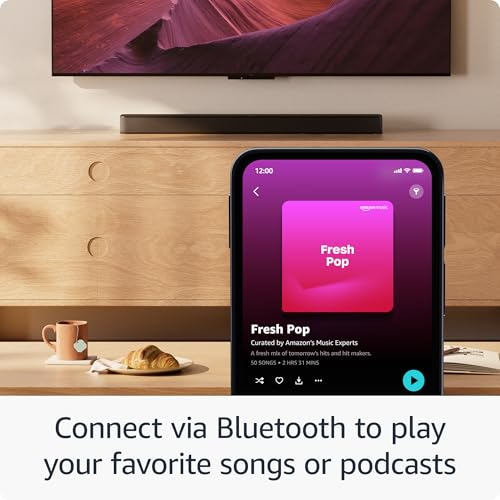
The Bose Solo Soundbar Series 2 similarly avoids smart features entirely, focusing purely on audio reproduction. Both bars support Bluetooth for streaming music from your phone, but neither tries to be a smart home hub or streaming device.
Honestly, I think this approach makes sense for entry-level bars. Smart features add cost and complexity while potentially creating obsolescence issues as software standards change. Both companies made the right choice here.
The size difference between these bars is dramatic and affects much more than just aesthetics. The Amazon Fire TV Soundbar Plus has nearly double the internal volume of the Bose Solo Soundbar Series 2 – 7,941 cm³ versus 3,346 cm³. This extra space enables the larger drivers and subwoofer that create its performance advantages.
However, this size comes with placement challenges. The Amazon bar works best with larger TVs where it looks proportional. Under smaller TVs, it can appear oversized and dominate your entertainment center. The height of 13.2cm might also create clearance issues with some TV stands.
The Bose Solo Soundbar Series 2 excels at disappearing into your setup. At just 7.1cm tall and 54.9cm wide, it fits under virtually any TV without calling attention to itself. This discretion has real value – many people want better sound without changing how their entertainment area looks.
Both include wall mounting hardware, but the size difference affects installation difficulty and visual impact when wall-mounted.
Here's where the Amazon Fire TV Soundbar Plus really differentiates itself. The entire system is designed around expandability. You can add wireless rear speakers to create true surround sound, plus an additional wireless subwoofer for even more bass impact. All components come pre-paired, so expansion is genuinely plug-and-play.
At the time of writing, you can build out to a complete 5.1 surround system for significantly less than comparable alternatives from traditional audio companies. This expandability transforms the initial purchase from an endpoint to a foundation for future growth.
The Bose Solo Soundbar Series 2 is explicitly designed as a complete solution with no expansion options. This isn't necessarily a limitation – many people prefer to buy once and be done – but it does mean your audio system can't grow with changing needs or larger spaces.
For dialogue-heavy content like dramas or news, both bars deliver substantial improvement over built-in TV speakers. The Amazon Fire TV Soundbar Plus has the edge due to its discrete center channel, but the Bose Solo Soundbar Series 2 isn't far behind thanks to excellent processing.
Where they diverge dramatically is action content. The Amazon bar's built-in subwoofer makes action movies significantly more engaging – explosions have impact, chase scenes have rumble, and music soundtracks have full-range presence. The Bose, while clear and balanced, lacks this physical impact.
Both support Bluetooth streaming, but they approach music reproduction differently. The Amazon Fire TV Soundbar Plus delivers what most people expect from "good" speakers – substantial bass, clear vocals, and enough volume to fill a room. The sound signature is deliberately pleasing rather than technically neutral.
The Bose Solo Soundbar Series 2 takes a more balanced approach that audio purists might prefer. Instruments maintain their natural timbre, and nothing is artificially emphasized. However, the limited bass extension means genres like hip-hop, electronic, or rock lose some of their intended impact.
Modern gaming benefits significantly from good audio – it's not just about explosions, but spatial awareness and dialogue clarity. The Amazon Fire TV Soundbar Plus provides better gaming immersion due to its fuller frequency range and ability to expand to true surround sound later.
The Bose Solo Soundbar Series 2 works fine for gaming but doesn't add the same level of engagement. Its strength is maintaining clarity during fast-paced audio, but it can't provide the bass response that makes gaming more visceral.
At the time of writing, these bars are priced within about $20 of each other, making value comparison particularly relevant. The Amazon Fire TV Soundbar Plus delivers objectively more performance per dollar – you get a 3.1-channel system with built-in subwoofer, HDMI eARC connectivity, and expansion potential for roughly entry-level pricing.
The Bose Solo Soundbar Series 2 costs slightly more but offers the reliability of an established audio brand, superior build quality, and a form factor that works in more situations. You're paying a modest premium for Bose engineering and the assurance that comes with their audio expertise.
The expandability factor significantly affects long-term value calculations. With the Amazon system, your initial investment can grow into a complete home theater setup. With the Bose, any future upgrades mean starting over with new equipment.
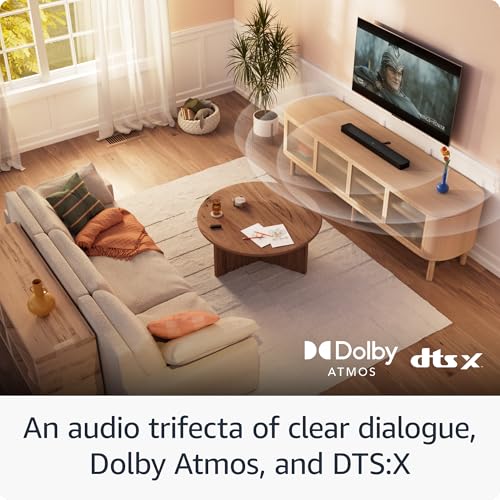
Neither bar is perfect, and understanding their limitations helps set appropriate expectations. The Amazon Fire TV Soundbar Plus supports Dolby Atmos and DTS:X processing, but only virtually – there are no upward-firing drivers to create true height effects. The "immersive" audio is simulated rather than physically accurate.
The larger size can also work against the Amazon bar in smaller rooms where bass can become overwhelming. The processing tends to emphasize impact over nuance, which isn't ideal for all content types.
The Bose Solo Soundbar Series 2 has more fundamental physical limitations. The compact size that's its biggest advantage also constrains what's possible acoustically. You can't create deep bass from small drivers in a small enclosure, regardless of how good your engineering is.
The lack of HDMI connectivity also creates practical limitations with modern TVs and streaming devices that output advanced audio formats the optical connection can't handle.
Choose the Amazon Fire TV Soundbar Plus if you want the most audio performance and expandability for your money. This makes sense if you have a larger room, bigger TV (50" or more), and either want impactful bass now or might want true surround sound later. The HDMI eARC connectivity also makes it the better choice if you prioritize seamless integration with modern TVs.
Choose the Bose Solo Soundbar Series 2 if space constraints are your primary concern, if you prefer balanced sound over bass emphasis, or if you trust the Bose approach to audio engineering. This works better for smaller setups, apartments, or situations where you want noticeable improvement without dominating your entertainment area.
The Amazon bar is the better foundation for building a home theater system, while the Bose is the better refined endpoint for people who want simple, quality audio improvement without further complexity.
Both deliver on the core promise of making TV audio significantly better, but they do so through different approaches that serve different needs and preferences. Understanding these differences ensures you'll choose the one that best matches your specific situation and audio priorities.
| Amazon Fire TV Soundbar Plus | Bose Solo Soundbar Series 2 |
|---|---|
| Channel Configuration - Determines dialogue clarity and bass capability | |
| 3.1 channels with dedicated center speaker and built-in subwoofer | 2.0 channels with virtual center processing |
| Bass Performance - Critical for movie impact and music enjoyment | |
| Built-in subwoofer with passive radiators delivers substantial low-end thump | Limited bass extension due to compact size, relies on processing |
| Size and Weight - Affects placement options and room compatibility | |
| 94cm W × 13.2cm D × 6.4cm H, 4kg (suits 50-65" TVs) | 54.9cm W × 8.6cm D × 7.1cm H, 3.03kg (fits any TV size) |
| Connectivity Options - Determines audio quality and TV integration | |
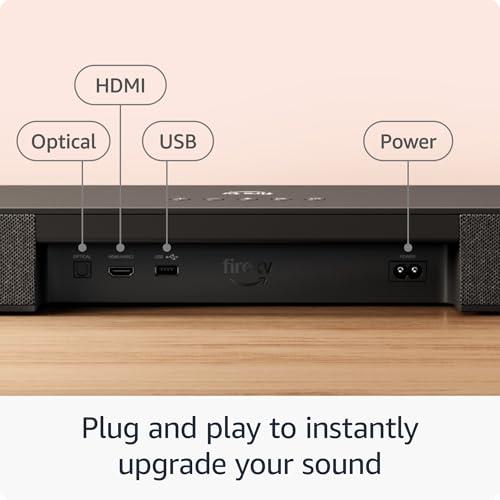
| HDMI eARC, Optical, USB-A, Bluetooth 5.0 | Optical, Coaxial, AUX, Bluetooth 4.0 (no HDMI) |
| Expandability - Future upgrade potential without replacing entire system | |
| Expandable to 5.1 surround with wireless rear speakers and subwoofer | No expansion options, designed as complete standalone solution |
| Audio Format Support - Compatibility with streaming and Blu-ray content | |
| Dolby Atmos, DTS:X (virtual processing), Dolby Digital 5.1 | Basic stereo formats, Dolby Digital downmixed to stereo |
| Volume Output - Room-filling capability for larger spaces | |
| High maximum volume suitable for large rooms and entertaining | Moderate volume better suited for small to medium rooms |
| Smart Features - Integration with streaming devices and voice control | |
| Fire TV integration for unified remote control, no built-in streaming | No smart features or ecosystem integration, pure audio focus |
| Dialogue Enhancement - Speech clarity for TV shows and movies | |
| Dedicated center channel plus 5-level dialogue enhancement | Virtual center with dialogue enhancement mode |
| Setup Complexity - How easy it is to get running | |
| Single HDMI eARC connection with automatic TV integration | Optical cable connection with manual audio settings |
The Amazon Fire TV Soundbar Plus delivers significantly better bass performance thanks to its built-in subwoofer with passive radiators. You can actually feel the low-frequency impact during action movies and music. The Bose Solo Soundbar Series 2 has limited bass extension due to its compact size, though it includes bass adjustment features to optimize what's available within its physical constraints.
The primary difference is configuration and expandability. The Amazon Fire TV Soundbar Plus is a 3.1-channel system with a dedicated center speaker and built-in subwoofer that can expand to full 5.1 surround sound. The Bose Solo Soundbar Series 2 is a compact 2.0-channel stereo bar focused on balanced sound in a space-efficient design with no expansion options.
The Bose Solo Soundbar Series 2 is ideal for smaller spaces due to its compact 54.9cm width and balanced sound that won't overwhelm tight quarters. The Amazon Fire TV Soundbar Plus at 94cm wide is better suited for larger rooms and 50"+ TVs where its size appears proportional and its higher volume output is beneficial.
Only the Amazon Fire TV Soundbar Plus includes HDMI eARC connectivity, which enables seamless TV integration and support for advanced audio formats. The Bose Solo Soundbar Series 2 uses optical, coaxial, and AUX connections but lacks HDMI, which may limit integration with modern TVs and audio format compatibility.
The Amazon Fire TV Soundbar Plus has an advantage with its dedicated center channel speaker specifically designed for dialogue reproduction, plus 5-level dialogue enhancement. The Bose Solo Soundbar Series 2 uses virtual center processing with dialogue enhancement mode, which is effective but not quite as precise as a physical center channel.
The Amazon Fire TV Soundbar Plus can be expanded to a complete 5.1 surround system with optional wireless rear speakers and subwoofer, with all components pre-paired for easy setup. The Bose Solo Soundbar Series 2 is designed as a standalone solution with no official expansion options.
The Amazon Fire TV Soundbar Plus produces significantly higher volume output and better room-filling capability due to its larger size and more powerful drivers. This makes it suitable for entertaining and larger spaces. The Bose Solo Soundbar Series 2 maintains better audio quality at moderate volumes but has limited maximum output for bigger rooms.
Neither the Amazon Fire TV Soundbar Plus nor the Bose Solo Soundbar Series 2 includes built-in streaming capabilities or smart home features. Both focus purely on audio performance, though the Amazon model integrates with Fire TV devices for unified remote control. Both support Bluetooth for wireless music streaming from mobile devices.
The Amazon Fire TV Soundbar Plus typically offers more performance per dollar with its 3.1-channel configuration, built-in subwoofer, HDMI eARC connectivity, and expansion potential. The Bose Solo Soundbar Series 2 commands a slight premium for the Bose brand reputation, superior build quality, and compact design that works in more situations.
The Amazon Fire TV Soundbar Plus provides better gaming immersion due to its fuller frequency range, substantial bass response, and potential for future surround sound expansion. The Bose Solo Soundbar Series 2 works well for gaming with clear audio but lacks the low-frequency impact that makes gaming more engaging and immersive.
Both soundbars are designed for simple setup. The Amazon Fire TV Soundbar Plus offers easier modern TV integration through its HDMI eARC connection with automatic configuration. The Bose Solo Soundbar Series 2 requires optical cable connection and may need manual audio settings adjustment, but setup is still straightforward with included cables and clear instructions.
Choose the Amazon Fire TV Soundbar Plus if you want substantial bass impact, plan to expand to surround sound, have a larger room, or own a 50"+ TV. Choose the Bose Solo Soundbar Series 2 if you prioritize compact design, have space constraints, prefer balanced sound over bass emphasis, or want a refined audio solution from an established brand without future expansion complexity.
We've done our best to create useful and informative comparisons to help you decide what product to buy. Our research uses advanced automated methods to create this comparison and perfection is not possible - please contact us for corrections or questions. These are the sites we've researched in the creation of this article: rtings.com - wirelessplace.com - techradar.com - cordbusters.co.uk - whathifi.com - developer.amazon.com - t3.com - dolby.com - youtube.com - youtube.com - youtube.com - dugoutnorthbrook.com - dolby.com - aboutamazon.com - youtube.com - developer.amazon.com - rtings.com - bose.com - bose.com - assets.bose.com - bestbuy.com - youtube.com - pistonheads.com - costco.com - googlenestcommunity.com - youtube.com - discussions.apple.com

Privacy Policy
Terms and Conditions - Affiliate Policy
Home Security
© Copyright 2008-2026.
11816 Inwood Rd #1211, Dallas, TX 75244