

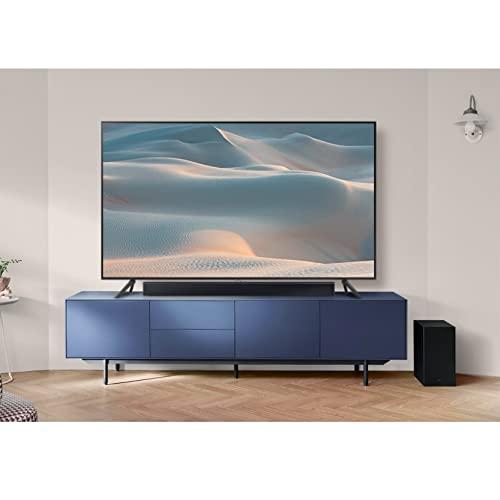
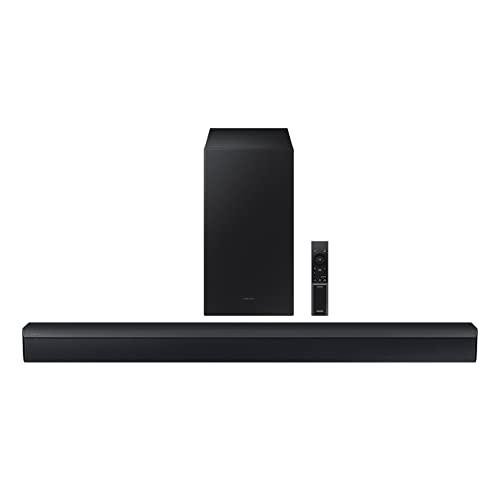
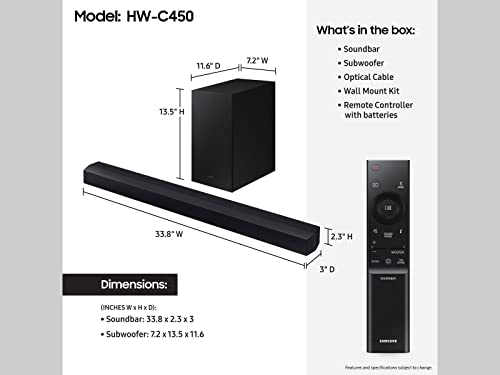
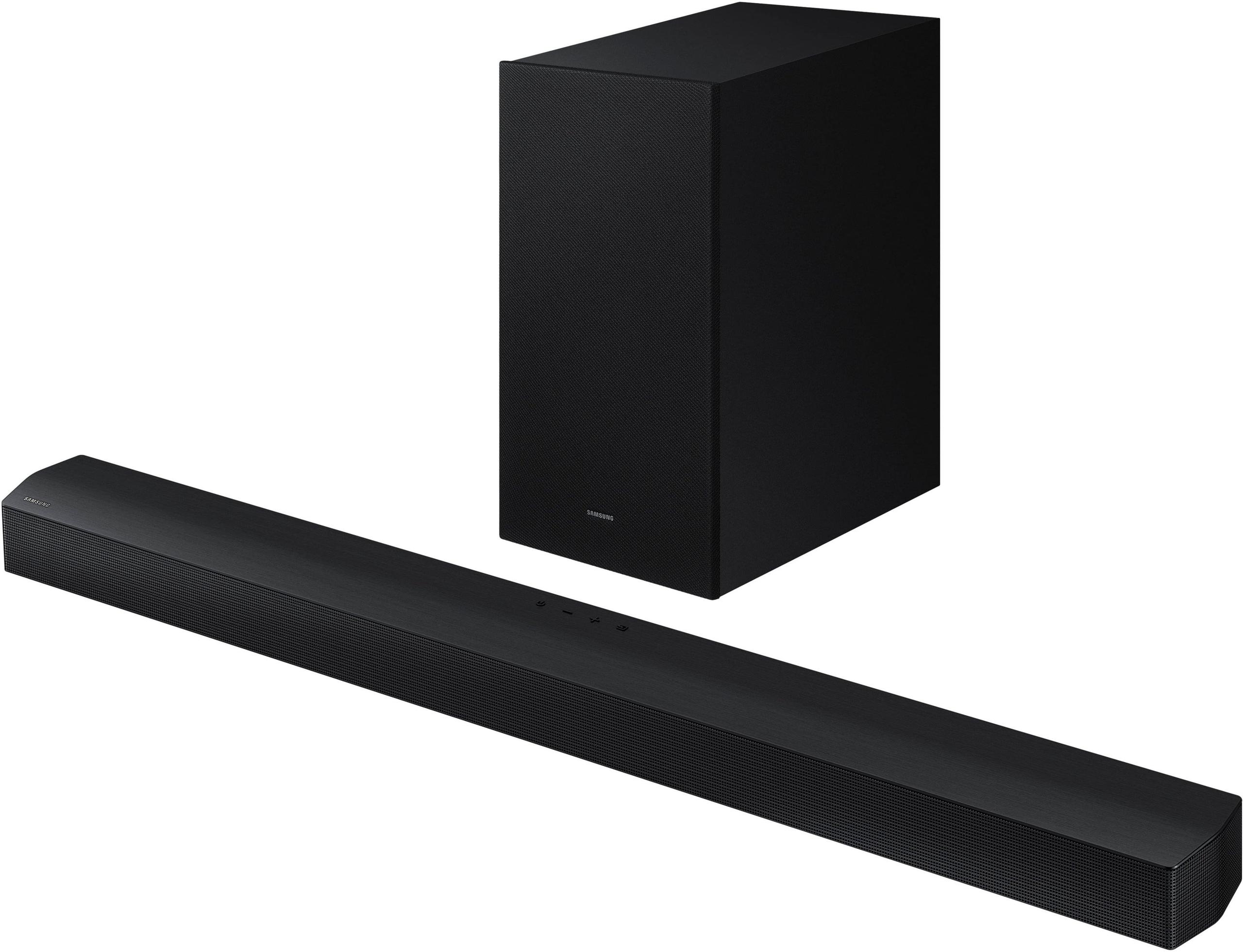
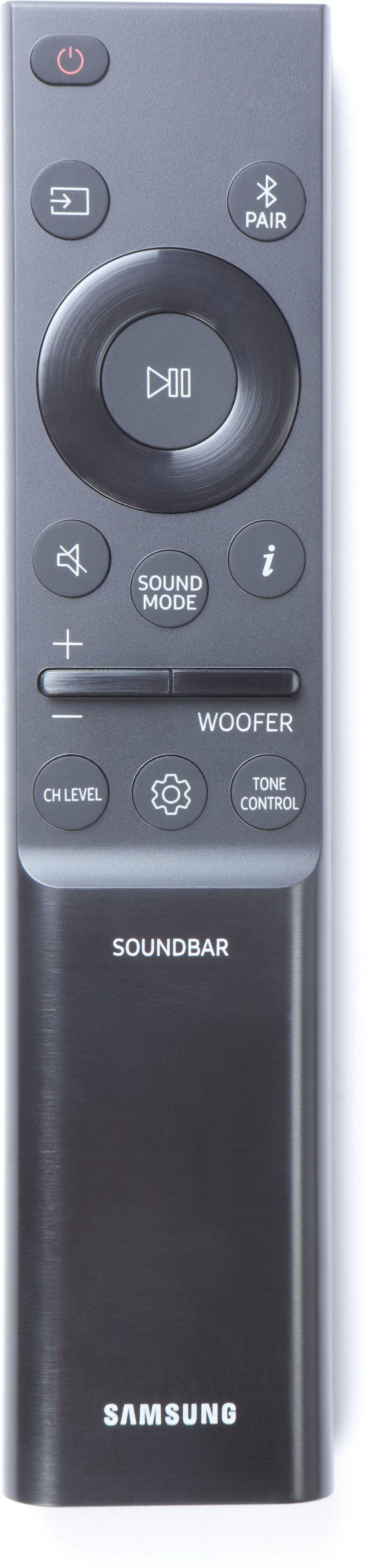
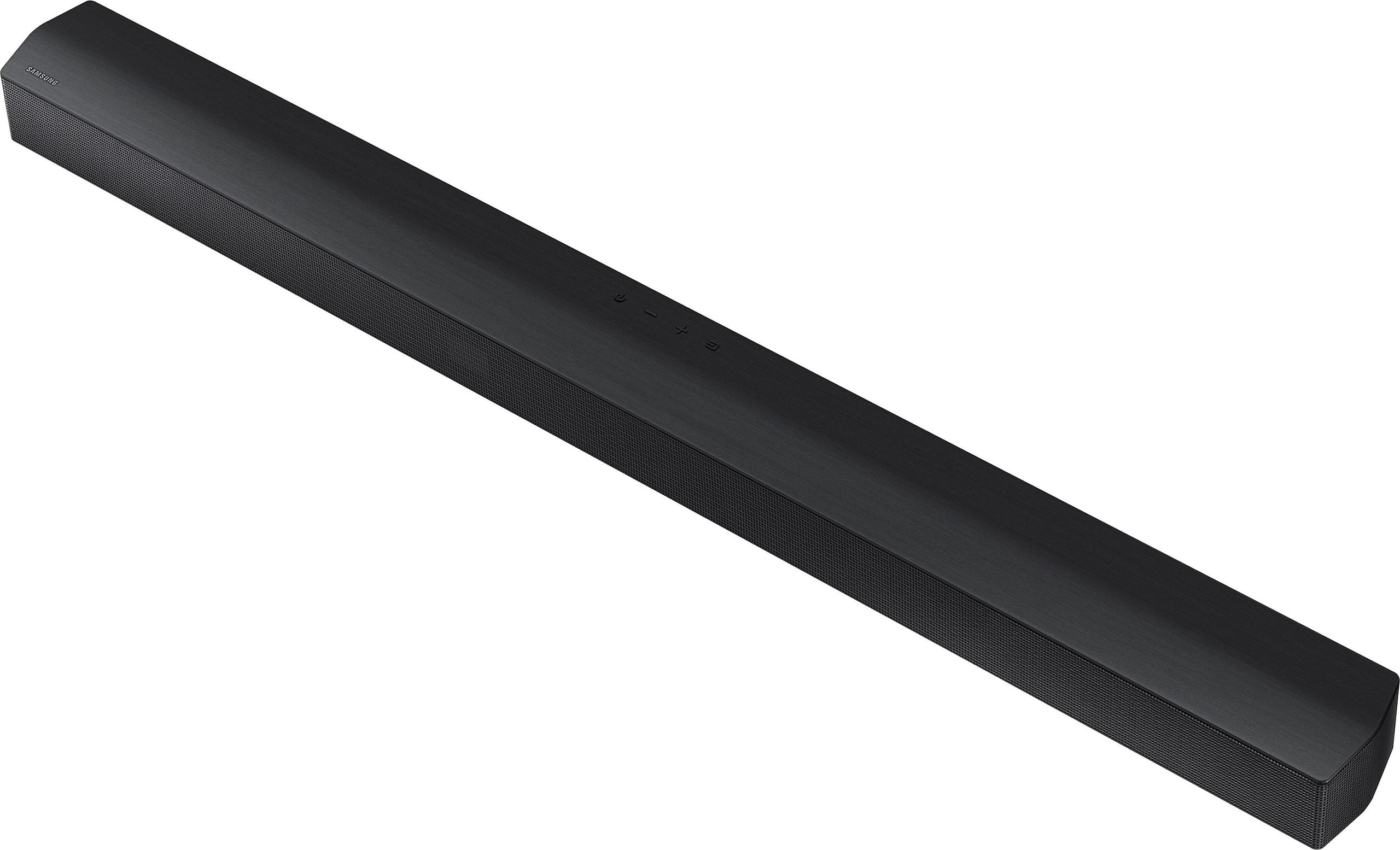

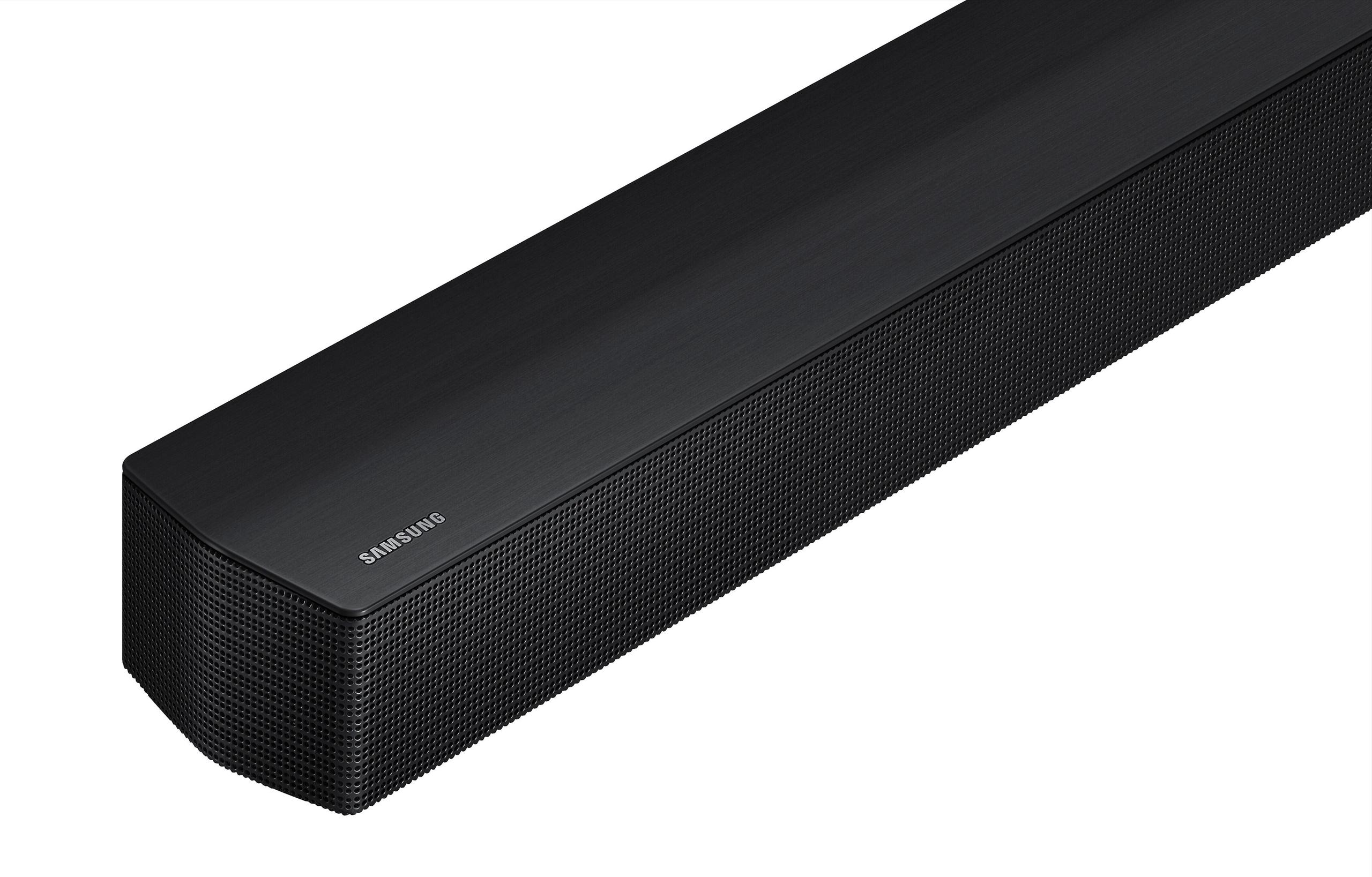


If you're tired of squinting at your TV screen just to catch what characters are saying, or if action scenes sound like muffled explosions through a pillow, you're probably ready to upgrade from your TV's built-in speakers. Samsung's soundbar lineup offers two compelling options that sit at different points on the price and performance spectrum: the entry-level HW-C450 and the more feature-rich HW-B550D.
At the time of writing, these models represent Samsung's approach to budget-friendly audio enhancement, but they take notably different paths to get there. Understanding which one fits your needs requires diving into what makes soundbars tick and how these specific models differ in their technical approach.
Before comparing specific models, it's worth understanding what you're actually buying when you invest in a soundbar. The core job is straightforward: deliver better audio than what's squeezed into your TV's impossibly thin chassis. Modern TVs prioritize visual appeal over audio engineering, leaving little room for proper speaker drivers or acoustic chambers.
Soundbars solve this by dedicating proper space to audio components. The "channels" in a soundbar's description tell you how many discrete audio signals it can process – think of them as separate audio streams for different parts of your room. A 2.1 system processes left, right, and low-frequency effects (the ".1" refers to bass handled by a subwoofer). A 3.1 system adds a dedicated center channel, which significantly improves dialogue clarity since most speech in movies and TV shows is mixed to the center channel.
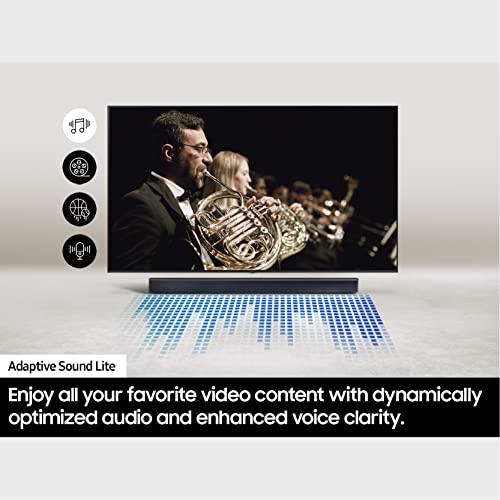
Virtual surround processing deserves special attention since both Samsung models lean heavily on this technology. Instead of placing physical speakers around your room, sophisticated digital signal processing analyzes audio and applies psychoacoustic principles to trick your brain into perceiving sounds coming from directions where no speakers exist. It's clever engineering, though it can't fully replicate the precision of discrete surround speakers.
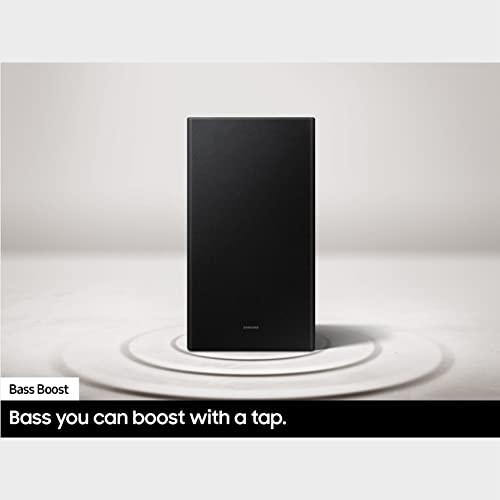
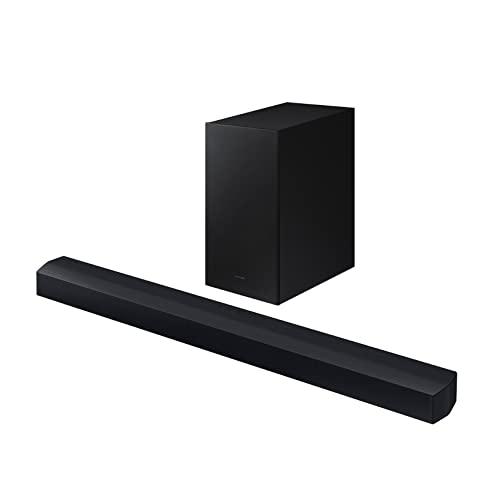
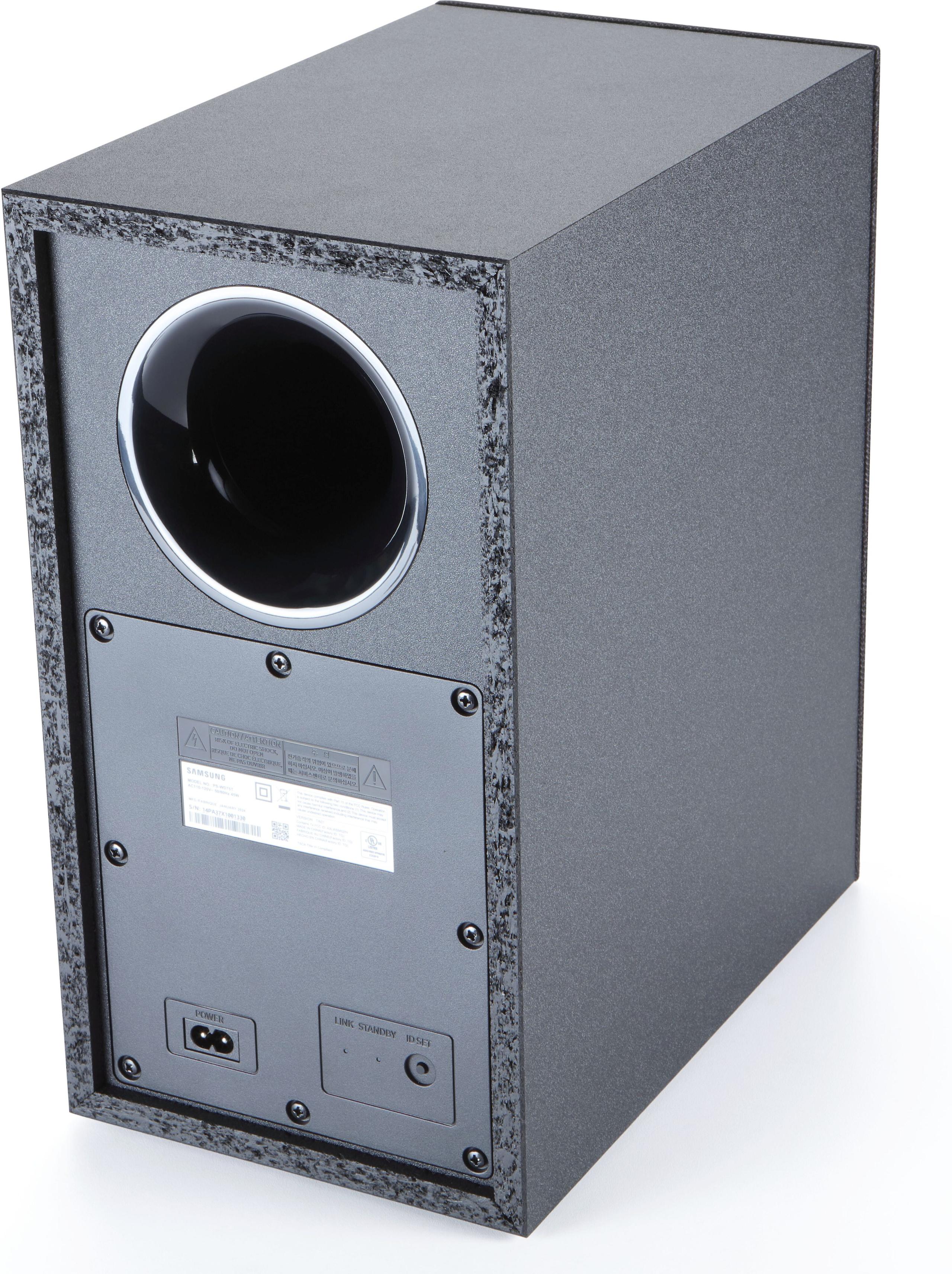
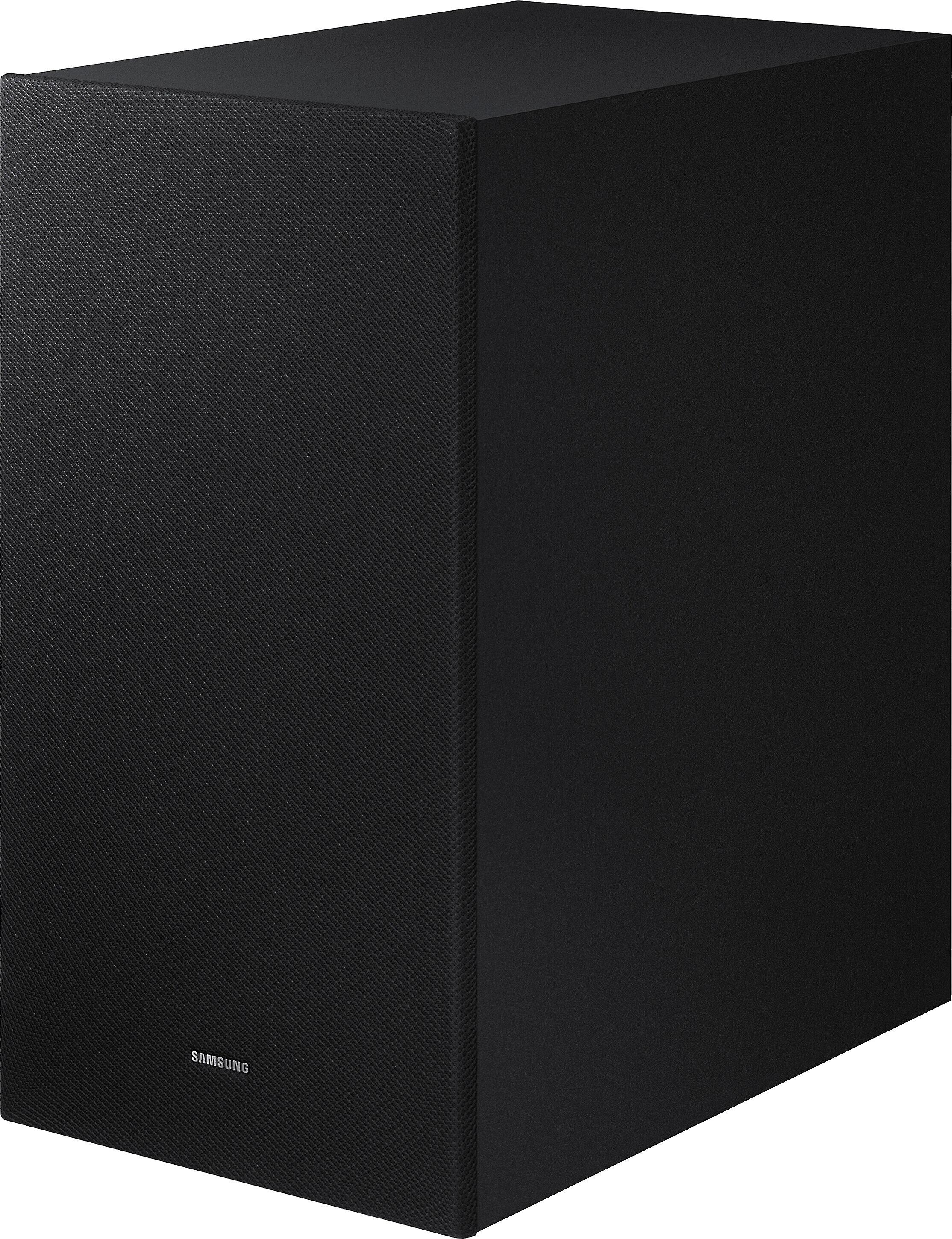
The subwoofer component handles frequencies roughly below 80-120 Hz – the range that creates impact during explosions, gives weight to musical bass lines, and adds presence to sound effects. Wireless subwoofers, found in both Samsung models, connect automatically to the main soundbar without requiring cable runs across your room.
The most significant distinction between the HW-C450 and HW-B550D lies in their channel configuration, which affects every aspect of their performance.
The HW-C450's 2.1-channel setup dedicates one amplifier channel each to left and right main speakers, plus the subwoofer channel. All center information – primarily dialogue – gets mixed between the left and right speakers, creating what audio engineers call a "phantom center." This works reasonably well when you're sitting directly in front of the soundbar, but dialogue clarity suffers if you move off-axis or if the room has challenging acoustics.
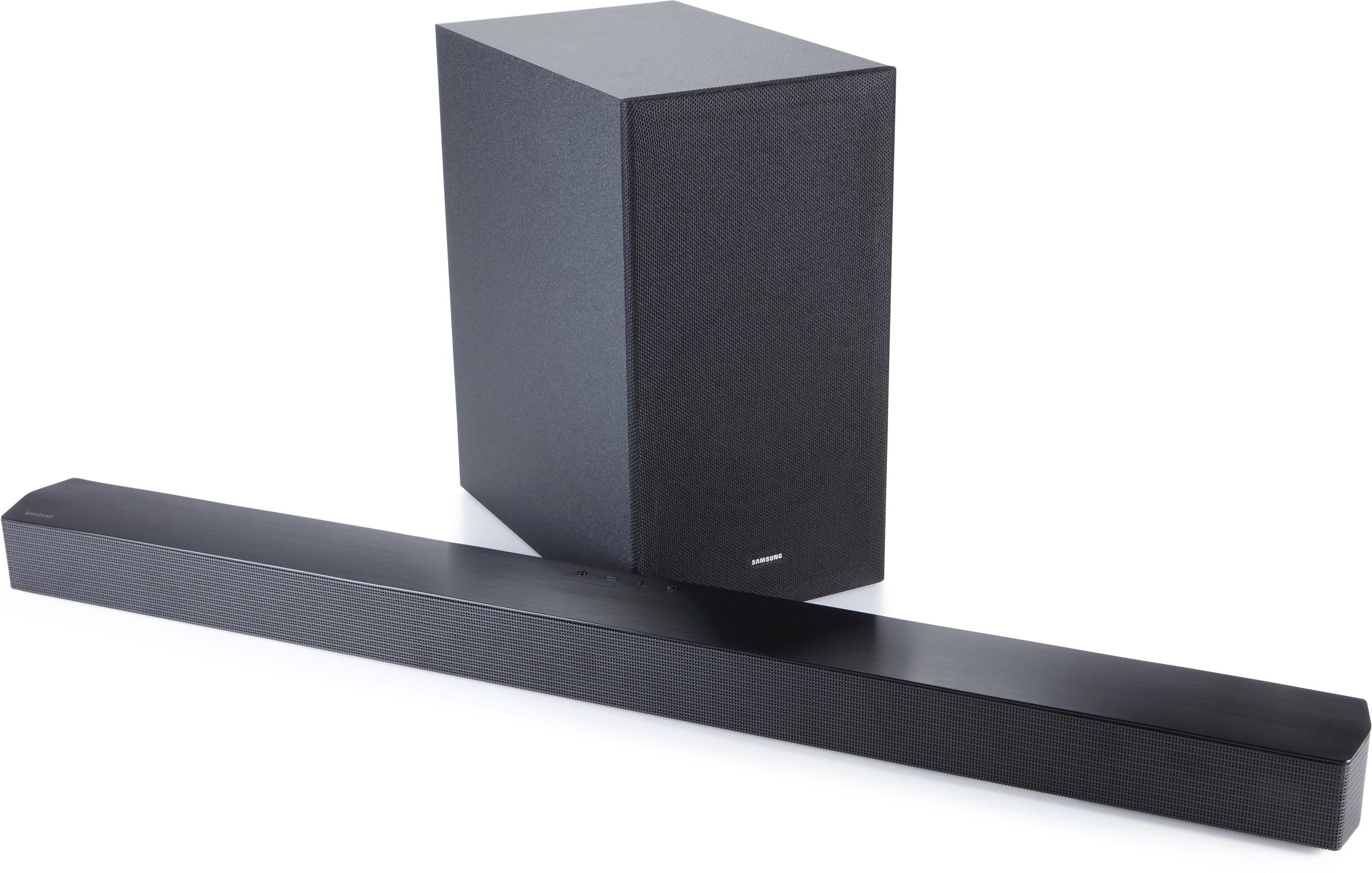
The HW-B550D's 3.1-channel configuration includes a dedicated center speaker driver and amplifier channel. This isn't just a marketing checkbox – it fundamentally changes how dialogue reproduction works. Instead of relying on your brain to piece together phantom center imaging, actual center channel information gets reproduced by a physical driver positioned at screen center. The difference becomes immediately apparent during dialogue-heavy scenes in dramas or comedies where speech intelligibility matters most.
Based on our research into user experiences, this center channel advantage proves especially valuable for viewers who struggle with hearing dialogue over background music and sound effects. Many users report that upgrading from a 2.1 to 3.1 system solved persistent dialogue clarity issues that couldn't be resolved through TV audio settings alone.
Raw power specifications can be misleading in audio equipment, but the difference between these Samsung models reflects meaningful engineering improvements rather than just marketing inflation.
The HW-C450 delivers 300W total power, split roughly between 80W for the main soundbar and 220W for the subwoofer. The HW-B550D increases total power to 370W, with approximately 160W for the main bar and 250W for the subwoofer. These aren't just bigger numbers – they represent larger amplifier sections and improved driver capabilities.
More importantly, the HW-B550D employs better-quality drivers throughout. The center channel uses a dedicated driver optimized for midrange reproduction, while the main left/right speakers can focus on stereo imaging without compromising dialogue clarity. The subwoofer receives a more powerful driver and improved cabinet design, translating to deeper bass extension and tighter control.
In practical terms, this power difference becomes apparent at moderate to high listening levels. The HW-C450 performs admirably at conversational volumes but can sound compressed or strained during peak dynamic passages in action movies. The HW-B550D maintains composure during explosive scenes while preserving dialogue clarity – a crucial advantage for home theater use.
Perhaps the most forward-looking difference between these models lies in their connectivity options, which affect both current usability and long-term relevance.
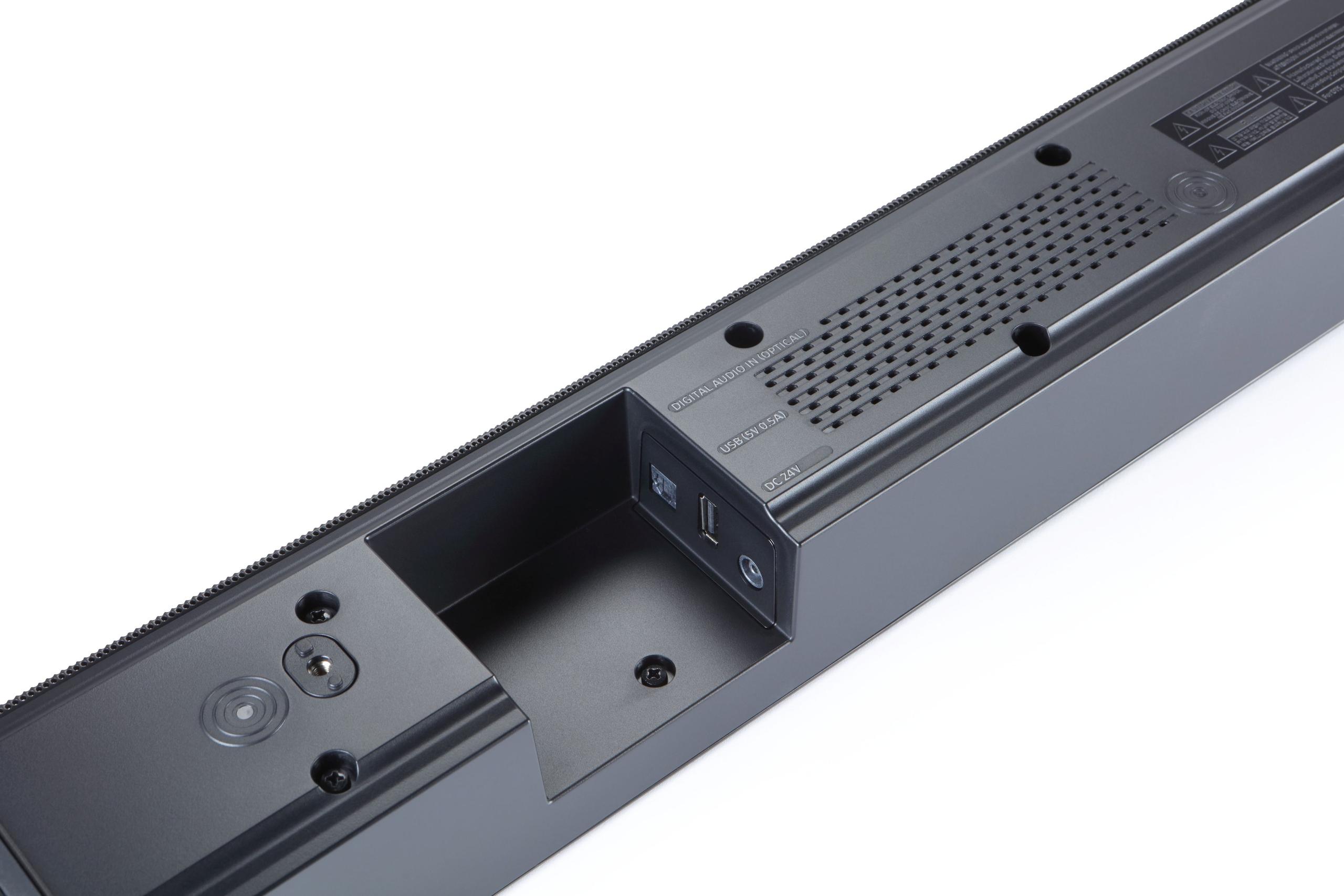
The HW-C450 takes a minimalist approach with optical digital input, USB port, and Bluetooth connectivity. This covers most basic use cases effectively – optical handles TV audio, USB enables direct music playback, and Bluetooth allows wireless streaming from phones and tablets. However, the absence of HDMI connectivity limits future expansion and prevents access to advanced audio formats.
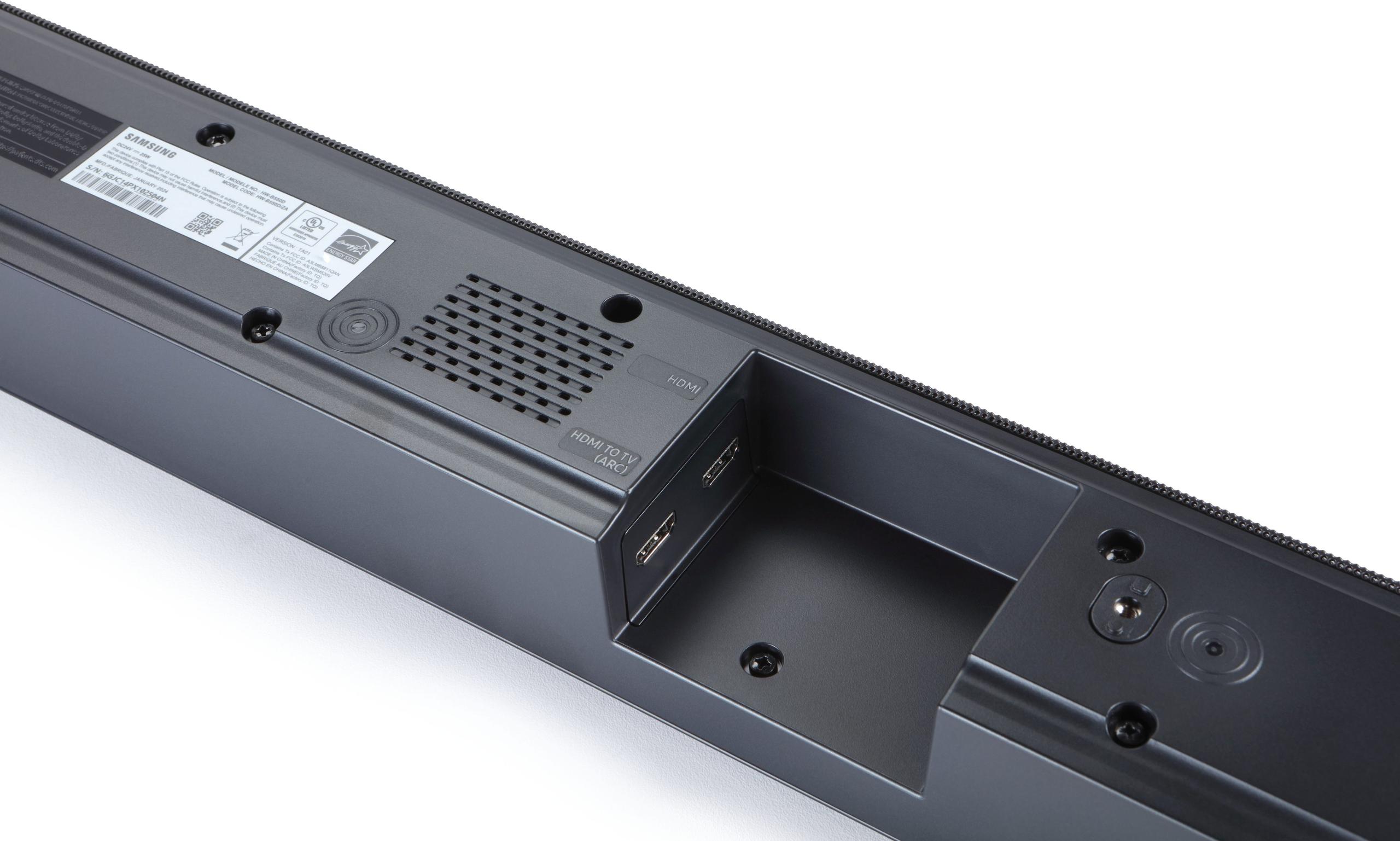
The HW-B550D includes these basic connections plus HDMI eARC (enhanced Audio Return Channel), a critical addition for modern home entertainment. HDMI eARC enables bidirectional communication between your TV and soundbar, allowing lossless audio passthrough from streaming apps and enabling more sophisticated control integration. The difference becomes significant when watching Netflix, Disney+, or other platforms that offer Dolby Atmos soundtracks – information that gets compressed or lost through optical connections.
Wi-Fi connectivity in the HW-B550D opens additional possibilities including Samsung's SmartThings ecosystem integration, multiroom audio capabilities, and direct streaming from music services. While these features might seem secondary today, they add flexibility for changing usage patterns over the typical 5-7 year soundbar lifespan.
Both Samsung models employ virtual surround processing, but with different sophistication levels that create noticeably different listening experiences.
The HW-C450 includes DTS Virtual:X processing and Samsung's Surround Sound Expansion. These technologies analyze incoming audio and apply digital signal processing to create the perception of wider soundstages and ambient effects. During our research, users consistently reported that these modes add spaciousness compared to standard TV speakers, particularly effective for movies and gaming.
The HW-B550D builds on this foundation with more advanced DTS Virtual:X implementation and additional height virtualization. The height processing attempts to create the perception of audio coming from above your listening position – particularly effective during helicopter flyovers, rainfall, or overhead explosions in movies. While it can't match the precision of actual overhead speakers, the effect proves convincing enough to enhance immersion noticeably.
Critical evaluation of user feedback suggests virtual surround effectiveness varies significantly based on room acoustics and listener position. Rooms with hard surfaces reflect audio cues more effectively, while heavily carpeted or furniture-dense spaces may diminish the effect. Both models perform best when positioned appropriately relative to your primary listening position.
While soundbars primarily target TV and movie enhancement, music performance deserves consideration since most users eventually stream music through these systems.
The HW-C450's stereo presentation handles music serviceably, with reasonable imaging between the left and right speakers and adequate tonal balance for casual listening. The wireless subwoofer adds necessary low-end weight for genres that benefit from bass presence. However, the limited channel separation and basic driver configuration constrain detail resolution and stereo imaging compared to dedicated stereo systems.
The HW-B550D offers meaningfully better music reproduction through improved driver quality and more sophisticated processing. The additional channel provides more flexibility for stereo content processing, while the enhanced subwoofer delivers tighter, more controlled bass response. Users who frequently stream music or host gatherings will appreciate the difference in clarity and dynamic range.
Neither model targets serious audiophile applications – dedicated stereo systems or higher-tier soundbars better serve critical music listening. However, for users seeking a single solution for both TV and casual music listening, the HW-B550D's improvements justify consideration.
Gaming audio demands present unique challenges that affect soundbar selection, particularly for users with gaming consoles or PCs connected to their TV.
Both Samsung models include dedicated gaming modes that optimize processing for interactive content. These modes typically reduce audio latency (the delay between visual action and corresponding audio), enhance positional audio cues, and adjust dynamic range for clearer enemy footsteps or environmental sounds.
The HW-B550D's HDMI connectivity provides an advantage for gaming applications, particularly when connected to modern gaming consoles that support advanced audio formats. Lower latency through direct HDMI connection helps maintain audio-visual synchronization during fast-paced gameplay, while the improved channel separation aids in directional audio detection.
Research into user experiences suggests both models handle gaming adequately for casual players, while more serious gamers benefit from the HW-B550D's enhanced processing capabilities and connectivity options.
The smart feature disparity between these models reflects different approaches to modern home entertainment integration.
The HW-C450 focuses on essential functionality with basic Samsung TV remote compatibility and straightforward Bluetooth connectivity. This approach suits users who prefer simple operation without additional complexity or who don't heavily utilize smart home features.
The HW-B550D integrates more deeply with Samsung's ecosystem through SmartThings compatibility, voice assistant support, and advanced TV integration features like Q-Symphony (which coordinates TV and soundbar speakers on compatible Samsung TVs). These features add convenience for users already invested in Samsung's ecosystem while providing flexibility for future smart home expansion.
The HW-C450 arrived in 2023 as part of Samsung's continued focus on accessible audio upgrades, while the HW-B550D emerged as an evolution of previous B-series models with refined features and improved connectivity. This timing matters because both models incorporate relatively current audio processing technologies and wireless standards.
Since their release, streaming platforms have increasingly adopted advanced audio formats, making features like HDMI eARC more valuable for accessing premium content. The HW-B550D's forward-looking connectivity approach positions it better for evolving content landscape requirements.
For dedicated home theater applications, the choice between these models often depends on room size, usage patterns, and performance expectations.
Smaller rooms (under 200 square feet) may not fully utilize the HW-B550D's additional power and processing capabilities, making the HW-C450 a rational choice for secondary TVs or compact spaces. The power difference becomes more apparent in larger rooms where adequate volume levels and dynamic range matter for cinematic immersion.
Both models work well for typical living room setups, though the HW-B550D's superior dialogue clarity and virtual surround processing create more engaging experiences during movie nights. Users planning to build more elaborate home theater setups over time should consider the HW-B550D's connectivity advantages for future expansion possibilities.
At the time of writing, the HW-C450 typically costs roughly $100-150 less than the HW-B550D, positioning them in different value categories rather than direct competition.
The HW-C450 represents excellent value for users seeking fundamental audio improvement over TV speakers without additional complexity. It handles TV shows, casual movie watching, and basic music streaming effectively while remaining budget-friendly and simple to operate.
The HW-B550D justifies its premium through meaningful performance improvements and future-proof features. The superior dialogue clarity alone often validates the price difference for users who watch dialogue-heavy content regularly. Added connectivity options and smart features provide value that extends beyond immediate audio improvement.
Choose the Samsung HW-C450 if you primarily want better TV audio than built-in speakers without spending significantly or dealing with complex features. It's ideal for smaller rooms, secondary TVs, or users who mainly watch news, sitcoms, and casual streaming content. The straightforward setup and operation suit users who prefer simple solutions.
Choose the Samsung HW-B550D if audio quality matters enough to justify the additional investment and you want features that remain relevant as technology evolves. It's the better choice for movie enthusiasts, gamers, or users planning to keep their soundbar for several years. The superior dialogue clarity and enhanced bass response create noticeably better experiences during engaging content.
Based on consensus from user reviews and expert evaluations, most buyers who can afford the HW-B550D find the improvements worthwhile over the typical ownership period. However, the HW-C450 successfully delivers its core promise of significantly better TV audio at an accessible price point.
The decision ultimately depends on your specific priorities: immediate budget constraints versus long-term audio satisfaction, basic functionality versus future-ready features, and simple operation versus enhanced performance. Both models succeed in their intended roles, making the choice more about matching capabilities to your particular needs rather than identifying a clear winner.
| Samsung HW-C450 2.1ch Soundbar | Samsung HW-B550D 3.1 Channel Sound Bar |
|---|---|
| Channel Configuration - Determines dialogue clarity and surround effects | |
| 2.1 channels (relies on phantom center for dialogue) | 3.1 channels (dedicated center speaker for clearer dialogue) |
| Total Power Output - Affects volume and dynamic range | |
| 300W total (80W soundbar + 220W subwoofer) | 370W total (160W soundbar + 250W subwoofer) |
| HDMI Connectivity - Critical for advanced audio formats and TV integration | |
| No HDMI inputs or eARC (optical only) | HDMI eARC support enables lossless audio passthrough |
| Virtual Surround Processing - Creates immersive audio from limited speakers | |
| DTS Virtual:X and Surround Sound Expansion | Advanced DTS Virtual:X with height virtualization |
| Smart Features - Convenience and future-proofing | |
| Basic Samsung TV remote compatibility, Bluetooth only | Wi-Fi, SmartThings integration, voice assistant support |
| Subwoofer Power - Impacts bass depth and control | |
| 220W wireless subwoofer with 5" driver | 250W wireless subwoofer with larger, more powerful driver |
| Bluetooth Version - Affects wireless audio quality and connection stability | |
| Bluetooth 4.2 (basic wireless streaming) | Bluetooth 5.0 (improved range and audio quality) |
| Release Year - Indicates feature set and technology generation | |
| 2023 (entry-level focus) | Updated B-series model with refined features |
| Best Use Cases - Who should consider each model | |
| Budget upgrade, smaller rooms, secondary TVs | Home theater enthusiasts, larger rooms, future-proofing |
The primary difference is channel configuration: the Samsung HW-C450 is a 2.1-channel system while the Samsung HW-B550D is a 3.1-channel system. The HW-B550D includes a dedicated center speaker for clearer dialogue, whereas the HW-C450 relies on phantom center imaging between left and right speakers.
The Samsung HW-B550D provides superior dialogue clarity thanks to its dedicated center channel speaker. This physical center speaker anchors voices to the screen, making speech much clearer than the Samsung HW-C450's phantom center approach, especially important for movie dialogue and TV shows.
Yes, both the Samsung HW-C450 and Samsung HW-B550D work with Samsung TVs. However, the HW-B550D offers deeper integration with HDMI eARC support and SmartThings compatibility, while the HW-C450 provides basic remote control compatibility through optical connection.
The Samsung HW-B550D delivers superior bass with its 250W subwoofer compared to the HW-C450's 220W subwoofer. The HW-B550D also features a larger driver and improved cabinet design for deeper, more controlled bass response.
Both soundbars include gaming modes, but the Samsung HW-B550D offers advantages for gaming with HDMI connectivity providing lower latency and better audio format support. The Samsung HW-C450 handles gaming adequately through optical connection but lacks the advanced features.
For small rooms under 200 square feet, the Samsung HW-C450 provides excellent value and adequate performance. The power difference of the Samsung HW-B550D becomes more apparent in larger spaces, though its superior dialogue clarity benefits any room size.
Neither the Samsung HW-C450 nor the Samsung HW-B550D supports true Dolby Atmos decoding. However, the HW-B550D features advanced DTS Virtual:X with height virtualization that simulates overhead audio effects, while the HW-C450 offers basic virtual surround processing.
Both soundbars support Bluetooth connectivity for wireless phone streaming. The Samsung HW-B550D features Bluetooth 5.0 for improved range and audio quality, while the Samsung HW-C450 uses Bluetooth 4.2 for basic wireless streaming capabilities.
Yes, both the Samsung HW-C450 and Samsung HW-B550D include wall mounting hardware and are designed for wall installation. Both feature slim profiles that work well mounted below or above your TV for a clean, space-saving setup.
For dedicated home theater setups, the Samsung HW-B550D is the better choice with its superior dialogue clarity, more powerful amplification, HDMI eARC connectivity, and advanced virtual surround processing. The Samsung HW-C450 works well for casual viewing but lacks the features serious home theater enthusiasts prefer.
The Samsung HW-C450 typically requires an optical cable for TV connection, which is usually included. The Samsung HW-B550D can use either optical or HDMI eARC connection, with HDMI providing better audio quality and integration features for compatible TVs.
The Samsung HW-B550D provides better long-term value despite higher upfront cost, thanks to HDMI eARC connectivity, Wi-Fi capabilities, and superior audio performance that remain relevant longer. The Samsung HW-C450 offers excellent immediate value for budget-conscious buyers seeking basic audio improvement over TV speakers.
We've done our best to create useful and informative comparisons to help you decide what product to buy. Our research uses advanced automated methods to create this comparison and perfection is not possible - please contact us for corrections or questions. These are the sites we've researched in the creation of this article: e-catalog.com - alibaba.com - smart.dhgate.com - greentoe.com - requiremints.com - versus.com - bhphotovideo.com - rtings.com - soundmachine.com.mt - samsung.com - samsung.com - youtube.com - bhphotovideo.com - newegg.com - images.samsung.com - bestbuy.com - samsung.com - youtube.com - jsappliance.com - gadgetsleo.com - youtube.com - saraappliance.com - walmart.com - bestbuy.com - crutchfield.com - avsforum.com - consumerreports.org - abt.com - pcrichard.com - samsung.com - samsung.com - rtings.com - samsung.com - jeffsappliance.com

Privacy Policy
Terms and Conditions - Affiliate Policy
Home Security
© Copyright 2008-2026.
11816 Inwood Rd #1211, Dallas, TX 75244