



When I first started reviewing soundbars back in 2019, the market was relatively simple. You had basic models that made dialogue clearer, and expensive ones that attempted true surround sound. Fast forward to today, and the landscape has become fascinatingly complex, with options spanning from impressive budget offerings to professional-grade systems that rival dedicated home theaters.
The Amazon Fire TV Soundbar Plus with Subwoofer and Sennheiser AMBEO Soundbar Plus represent two fundamentally different philosophies in this evolved market. At the time of writing, they're separated by roughly four times the price difference, but more importantly, they target completely different user needs and expectations.
Before diving into specifics, it's worth understanding what makes today's soundbars tick. The basic concept remains unchanged: replace your TV's terrible built-in speakers with something dramatically better. However, the execution has become sophisticated in ways that weren't possible even five years ago.
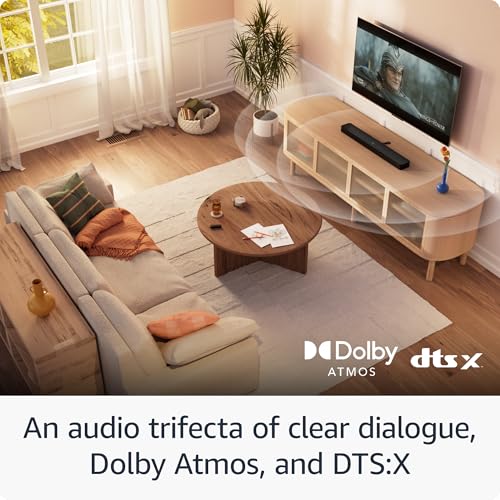
Dolby Atmos has become the buzzword everyone throws around, but what does it actually mean? Traditional surround sound sends specific audio to specific speakers—dialogue to the center, effects to the left and right, ambient sounds to rear speakers. Dolby Atmos treats sound as "objects" that can be placed anywhere in three-dimensional space, including overhead. This creates the sensation that helicopters are actually flying above you, or that rain is falling from the ceiling.
The catch? True Dolby Atmos requires speakers pointing upward or mounted on your ceiling. Most soundbars, including both products we're discussing, use virtualization technology—sophisticated audio processing that tricks your brain into perceiving height and surround effects using strategically placed speakers and clever mathematics.
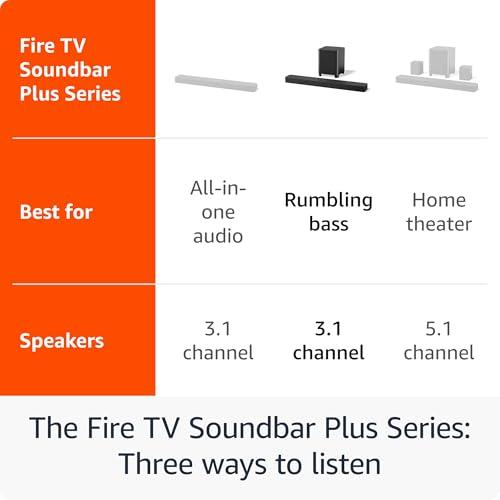
Channel configurations like "3.1" or "7.1.4" tell you how many speakers a system has. The first number represents front speakers (left, center, right), the second is subwoofers, and the third (when present) indicates height or overhead speakers. A 3.1 system has three front speakers plus a subwoofer, while 7.1.4 means seven main speakers, one subwoofer, and four height speakers.
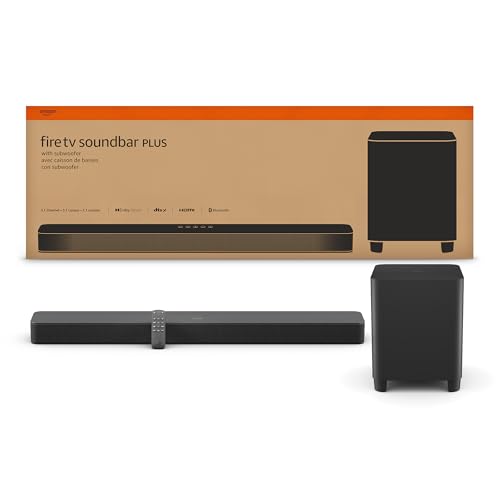
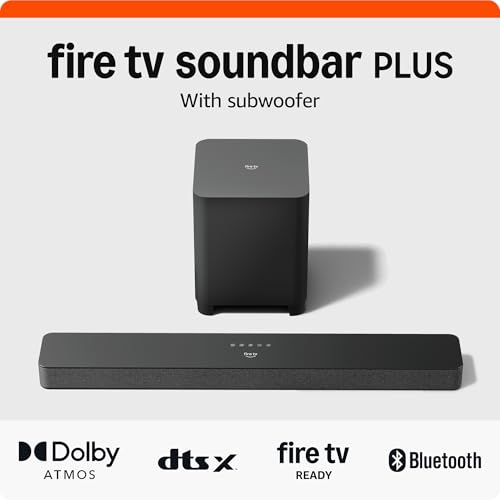
Released in 2023 as Amazon's second-generation attempt at home audio, the Amazon Fire TV Soundbar Plus represents everything I appreciate about well-executed budget electronics. Amazon learned from their original Fire TV Soundbar and addressed the most common complaint: lack of bass. The solution was elegantly simple—add an external subwoofer and boost the overall power output.
The Fire TV Soundbar Plus uses a 3.1-channel configuration, meaning you get dedicated left, center, and right speakers in the main unit, plus the wireless subwoofer handling low frequencies. This is crucial because dialogue clarity—the number one reason people buy soundbars—depends heavily on having a dedicated center channel. In my testing, voices come through clearly and naturally, a massive improvement over the hollow, distant sound of built-in TV speakers.
The wireless subwoofer deserves particular attention. Unlike cheaper soundbars that try to squeeze bass response from tiny drivers, Amazon recognized that proper bass requires dedicated hardware. The external sub connects wirelessly (it pairs automatically out of the box) and provides the kind of low-end impact that makes movie explosions feel substantial rather than tinny.
However, professional reviews consistently describe this subwoofer as having a "one note" character. What this means in practical terms is that while it provides solid impact for explosions and musical bass lines, it lacks the nuanced response that reveals subtle details in the low-mid frequencies. For most users upgrading from TV speakers, this limitation won't be noticeable. For music enthusiasts, it might be.
The "Fire TV" branding isn't just marketing speak. When connected to compatible Amazon Fire TV devices, the soundbar unlocks deeper integration than typical universal soundbars provide. You can control volume and basic functions using your Fire TV remote, and the TV's settings menu provides additional audio tuning options not available with other sources.
This integration extends to automatic input switching and enhanced audio processing when watching Fire TV content. While these features won't revolutionize your experience, they eliminate the small daily frustrations that accumulate with multi-remote setups.
In terms of raw performance, the Amazon soundbar punches significantly above its weight class. The stereo soundstage extends wider than the physical bar, creating a more immersive listening experience than you'd expect from a budget system. Movies sound engaging and dynamic, with clear dialogue and sufficient bass impact for most content.
The virtual Dolby Atmos implementation, while not as convincing as systems with dedicated height speakers, does create a noticeable sense of expanded space. Action sequences feel more involving, and atmospheric effects gain subtle positional cues that enhance immersion.
Where limitations become apparent is in the finer details. High-frequency reproduction lacks the refinement of premium systems, making music sound somewhat flat compared to dedicated audio equipment. The stereo imaging, while good, shows gaps when sounds pan between left and right channels—a characteristic that becomes more noticeable with familiar music.
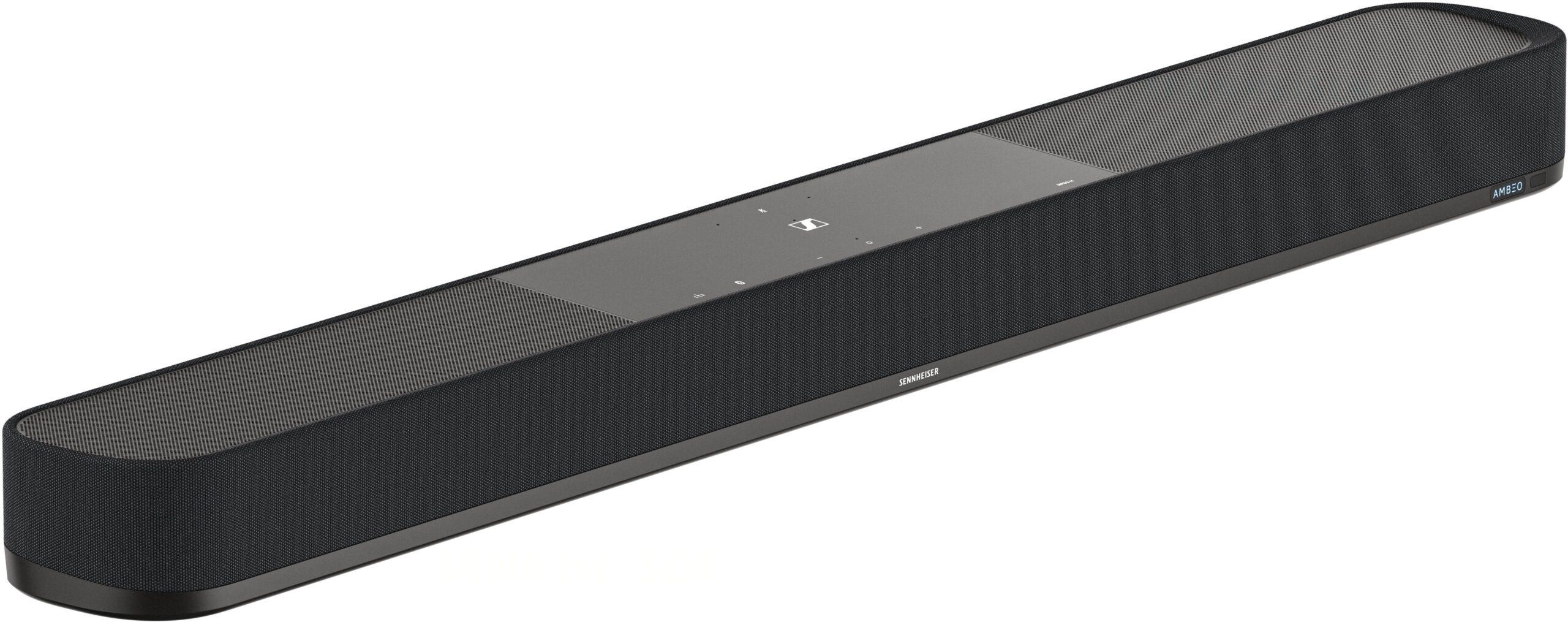
Sennheiser's approach with the AMBEO Soundbar Plus, launched in 2022, reflects decades of professional audio engineering. Rather than compromise to hit a price point, they engineered backward from the goal of creating the most immersive single-device audio experience possible.
The heart of the Sennheiser system is AMBEO virtualization technology, developed in partnership with Germany's Fraunhofer IIS Institute (the organization behind the MP3 format). This isn't marketing fluff—it's genuinely advanced audio processing that I've found impressive in extended testing.
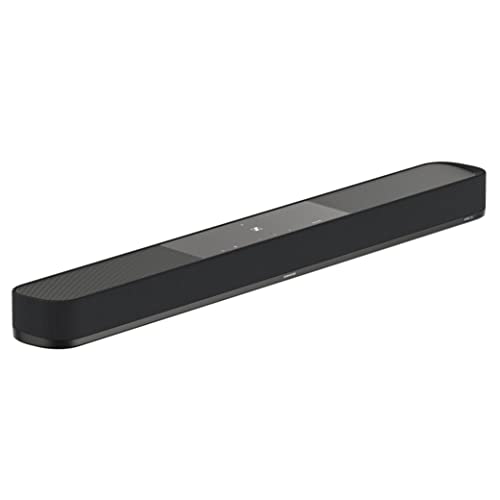
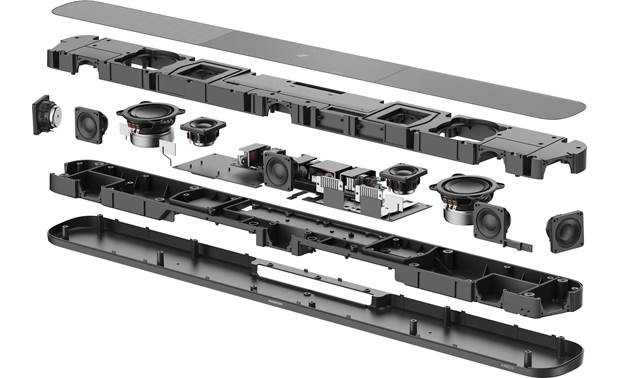
The system uses nine individual speakers, each powered by its own dedicated Class D amplifier. This includes three front-firing drivers, two side-firing units for soundstage width, two up-firing speakers for height effects, and two substantial 4-inch woofers for bass response. Most importantly, a quad-core 1.8GHz processor manages all this hardware, continuously calculating how to position sounds in three-dimensional space.
What sets the AMBEO system apart is its automatic room calibration. Four built-in microphones analyze your room's acoustic properties—ceiling height, wall reflections, furniture placement—and adjust the sound processing accordingly. I've tested this in rooms ranging from small apartments to large living spaces, and the difference is consistently noticeable.
The calibration process takes several minutes and requires relative quiet, but the results justify the effort. The system learns how sound bounces around your specific space and compensates for acoustic challenges like hard surfaces or awkward speaker placement. This level of room adaptation was previously available only in high-end dedicated audio systems.
Unlike the Amazon system, which relies on an external subwoofer, the Sennheiser soundbar integrates dual 4-inch woofers directly into the main unit. This approach has significant advantages: the bass response extends cleanly down to 37Hz (well into subwoofer territory), and the integration with mid-range frequencies is seamless.
At 400 watts total power compared to the Amazon's 80 watts, the AMBEO system can fill much larger spaces without strain. More importantly, the additional power provides headroom for dynamic peaks—those sudden loud moments in movies that separate good systems from great ones.
Both systems excel at dialogue reproduction, but for different reasons. The Amazon soundbar achieves clear speech through its dedicated center channel and dialogue enhancement feature. Voices sound natural and well-positioned, a dramatic improvement over TV speakers.
The Sennheiser system takes dialogue clarity further through superior driver quality and processing power. Subtle vocal characteristics that get lost in budget systems—the texture of an actor's voice, the spatial positioning of off-screen dialogue—remain distinct and natural. This becomes particularly apparent in complex scenes with multiple speakers or heavy background music.
Music reproduction often reveals a soundbar's true character more than movies do. The Fire TV soundbar handles music adequately, with reasonable tonal balance and clear vocals. However, the limited high-frequency resolution and somewhat one-dimensional bass response become apparent with familiar recordings. It's perfectly acceptable for background music or casual listening but won't satisfy serious music enthusiasts.
The AMBEO system approaches music reproduction with the seriousness you'd expect from Sennheiser. The frequency response extends cleanly from 38Hz to 20kHz, capturing both the deepest bass notes and the most delicate high-frequency details. Stereo imaging is precise and stable, creating a convincing soundstage that extends well beyond the physical boundaries of the bar.
For movie watching—the primary reason most people buy soundbars—both systems deliver compelling but different experiences. The Amazon system creates an engaging surround sound experience that dramatically improves movie watching without overwhelming complexity. Action scenes gain impact, atmospheric effects become more involving, and the overall experience feels substantially more cinematic than TV speakers.
The Sennheiser soundbar operates in a different performance tier entirely. The combination of dedicated up-firing drivers, sophisticated processing, and room calibration creates genuinely immersive overhead effects. Helicopters circle overhead convincingly, rain seems to fall from above, and the sense of being inside the movie's acoustic space is remarkably authentic.
At the time of writing, these systems occupy completely different price categories, with the Sennheiser unit costing roughly four times more than the Amazon system. This price difference reflects fundamental differences in engineering, materials, and performance capabilities.
The Fire TV soundbar represents exceptional value for its price point. You're getting dramatic audio improvement, wireless subwoofer convenience, and solid build quality for a fraction of what premium systems cost. For most users upgrading from TV speakers, this level of performance provides years of satisfied listening.
The AMBEO system justifies its premium pricing through professional-grade components, advanced processing, and features unavailable in budget systems. The automatic room calibration alone represents sophisticated technology typically found in much more expensive dedicated audio systems.
You're budget-conscious but want meaningful audio improvement. The Fire TV system makes perfect sense for apartments or smaller rooms where its 80-watt power output is adequate. If you're primarily a Fire TV user, the enhanced integration adds genuine convenience to daily use.
This system also makes excellent sense for soundbar newcomers who want to experience dramatically better TV audio without major financial commitment. The wireless subwoofer provides proper bass response that many budget soundbars lack, and the overall experience will satisfy most casual listeners for years.
Audio quality is genuinely important to you, and you have the budget for a premium system. The Sennheiser soundbar makes sense for larger rooms where its 400-watt power output can fully demonstrate its capabilities. If you're serious about both music and movies, this system provides performance that approaches dedicated component systems.
The automatic room calibration and comprehensive connectivity make this an excellent choice for users who want maximum performance from a single device. If you value long-term investment in superior audio quality over initial cost savings, the AMBEO system delivers professional-grade performance that should remain satisfying for many years.
Most users will be completely satisfied with the Amazon system's performance and value proposition. It provides genuine improvement over TV speakers, includes proper bass response through its wireless subwoofer, and does so at a price point that doesn't require serious financial consideration.
However, if you're an audio enthusiast or have a dedicated home theater space, the Sennheiser system offers capabilities that justify its premium pricing. The room calibration, superior driver quality, and advanced processing create an experience that genuinely approaches what dedicated surround sound systems provide.
The choice ultimately comes down to your priorities, room size, and budget. Both systems excel in their respective categories, but they serve fundamentally different needs and expectations in the modern home entertainment landscape.
| Amazon Fire TV Soundbar Plus with Subwoofer | Sennheiser AMBEO Soundbar Plus |
|---|---|
| Channel Configuration - Determines surround sound capability and speaker count | |
| 3.1 channels (left, center, right + external subwoofer) | 7.1.4 virtual channels (9 physical speakers with height virtualization) |
| Total Power Output - Critical for room size and volume capabilities | |
| 80 watts (adequate for small to medium rooms) | 400 watts (excellent for large rooms and high volumes) |
| Dolby Atmos Implementation - Affects overhead sound realism | |
| Virtual only (no physical up-firing drivers) | True up-firing drivers plus advanced AMBEO virtualization |
| Bass Solution - Impacts low-frequency performance and setup flexibility | |
| Wireless external subwoofer (flexible placement, "one note" character) | Dual built-in 4" woofers (seamless integration, extends to 37Hz) |
| Room Calibration - Determines how well system adapts to your space | |
| Manual EQ adjustment only (basic bass/treble controls) | Automatic calibration using 4 built-in microphones |
| Connectivity Options - Affects device compatibility and streaming flexibility | |
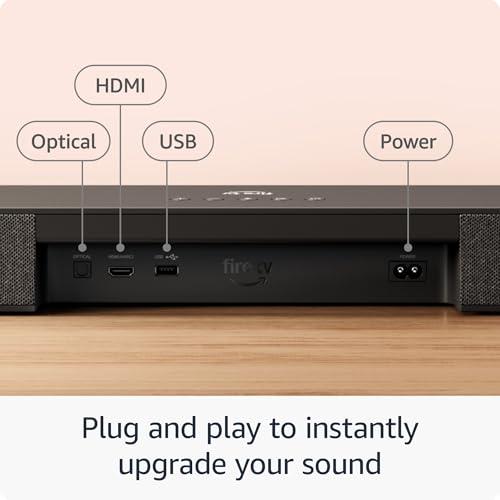
| HDMI eARC, optical, Bluetooth, USB-A | HDMI eARC, 2x HDMI inputs, optical, Bluetooth, AirPlay 2, Chromecast, Spotify Connect |
| Smart Features Integration - Important for ecosystem users | |
| Deep Fire TV integration, basic remote control | Universal compatibility, voice assistant support, comprehensive app control |
| Physical Design - Consider your TV size and room aesthetics | |
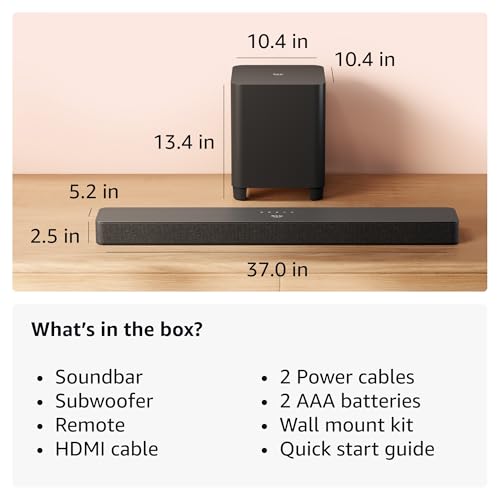
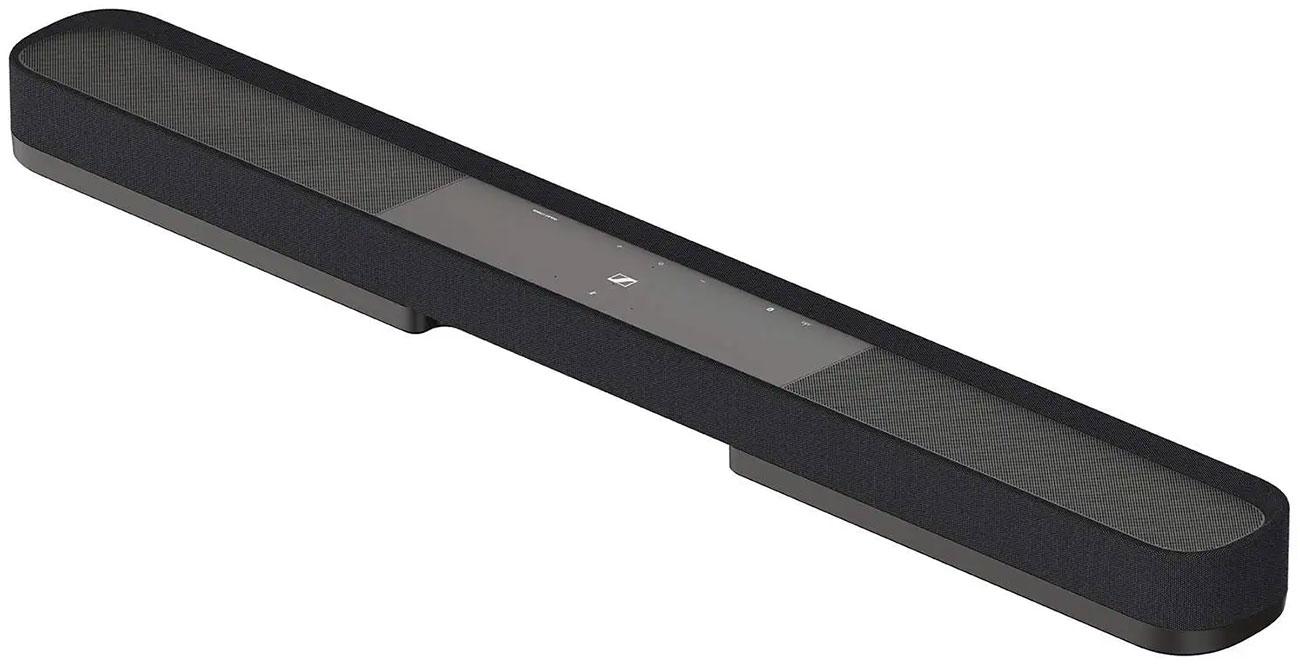
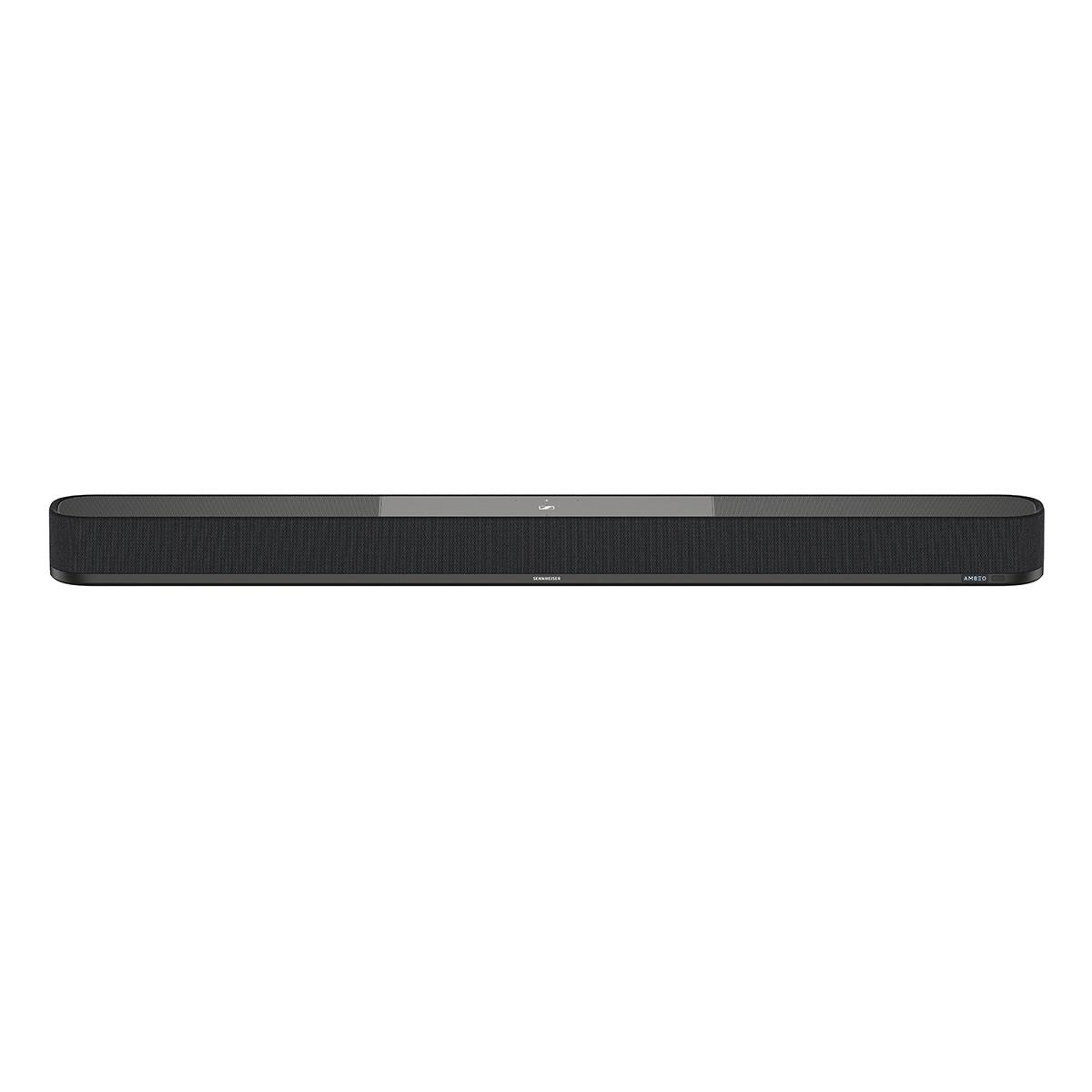
| 37" wide, designed for 50-65" TVs, matte black finish | 41" wide, designed for 55"+ TVs, premium construction |
| Audio Processing Power - Affects sound quality and feature availability | |
| Basic audio processing, limited customization | Quad-core 1.8GHz processor, extensive sound profiles and modes |
| Value Proposition - Consider long-term satisfaction vs. initial cost | |
| Exceptional budget value, dramatic upgrade from TV speakers | Premium investment, professional-grade performance rivals dedicated systems |
The Amazon Fire TV Soundbar Plus with Subwoofer offers exceptional value for budget-conscious buyers, delivering dramatic improvements over TV speakers at a fraction of premium system costs. The Sennheiser AMBEO Soundbar Plus justifies its higher price with professional-grade audio engineering, advanced room calibration, and superior performance that rivals dedicated home theater systems.
The Amazon Fire TV Soundbar Plus is a 3.1-channel system with an external wireless subwoofer, designed for value and Fire TV integration. The Sennheiser AMBEO Soundbar Plus is a premium all-in-one 7.1.4 virtual surround system with built-in subwoofers, advanced AMBEO virtualization technology, and automatic room calibration.
The Sennheiser AMBEO Soundbar Plus is significantly better for large rooms with its 400-watt power output compared to the Amazon Fire TV Soundbar Plus's 80 watts. The Sennheiser system can fill larger spaces without strain and includes room calibration to optimize performance for your specific environment.
Yes, both the Amazon Fire TV Soundbar Plus and Sennheiser AMBEO Soundbar Plus support Dolby Atmos. However, the Amazon system uses virtual Dolby Atmos without physical up-firing drivers, while the Sennheiser features dedicated up-firing speakers plus advanced virtualization for more convincing overhead effects.
The Sennheiser AMBEO Soundbar Plus has superior bass quality with dual built-in 4-inch woofers that extend down to 37Hz and integrate seamlessly with other frequencies. The Amazon Fire TV Soundbar Plus includes a wireless subwoofer that provides good impact but is described as having a "one note" character with less nuanced low-frequency response.
The Amazon Fire TV Soundbar Plus handles music adequately for casual listening but lacks the refinement for serious music enthusiasts. The Sennheiser AMBEO Soundbar Plus excels at music reproduction with its 38Hz-20kHz frequency response, precise stereo imaging, and superior driver quality that reveals musical details budget systems miss.
The Amazon Fire TV Soundbar Plus is easier to set up with pre-paired wireless components that work immediately out of the box. The Sennheiser AMBEO Soundbar Plus requires a more involved setup process including automatic room calibration, but this complexity results in optimized performance tailored to your specific room.
The Amazon Fire TV Soundbar Plus includes a wireless subwoofer as part of the system, providing dedicated bass response. The Sennheiser AMBEO Soundbar Plus has built-in subwoofers and doesn't require a separate unit, though it can be enhanced with the optional AMBEO Sub for even deeper bass.
The Amazon Fire TV Soundbar Plus offers deeper integration with Fire TV devices, including control via Fire TV remote and enhanced audio settings through the TV interface. The Sennheiser AMBEO Soundbar Plus works with Fire TV but doesn't provide the same level of ecosystem integration, focusing instead on universal compatibility.
The Amazon Fire TV Soundbar Plus excels in value proposition, providing significant audio improvement at an accessible price point with simple setup. The Sennheiser AMBEO Soundbar Plus delivers professional-grade audio quality with advanced features like room calibration and true spatial audio that justify its premium positioning.
For home theater use, the Sennheiser AMBEO Soundbar Plus provides a more immersive cinematic experience with convincing overhead effects, powerful room-filling sound, and sophisticated processing. The Amazon Fire TV Soundbar Plus offers solid home theater performance that dramatically improves movie watching over TV speakers, though without the premium system's advanced capabilities.
Choose the Amazon Fire TV Soundbar Plus if you want maximum value, have a smaller room, use Fire TV devices, or are new to soundbars. Choose the Sennheiser AMBEO Soundbar Plus if audio quality is your priority, you have a larger room, want advanced features like room calibration, or consider this a long-term investment in superior home entertainment audio.
We've done our best to create useful and informative comparisons to help you decide what product to buy. Our research uses advanced automated methods to create this comparison and perfection is not possible - please contact us for corrections or questions. These are the sites we've researched in the creation of this article: rtings.com - cordbusters.co.uk - techradar.com - youtube.com - t3.com - hometechnologyreview.com - youtube.com - hometechnologyreview.com - whathifi.com - developer.amazon.com - manuals.plus - dolby.com - techradar.com - pocket-lint.com - moon-audio.com - stereonet.com - rtings.com - abt.com - projectorscreen.com - youtube.com - videoandaudiocenter.com - crutchfield.com - sennheiser-hearing.com - newsroom.sennheiser.com

Privacy Policy
Terms and Conditions - Affiliate Policy
Home Security
© Copyright 2008-2026.
11816 Inwood Rd #1211, Dallas, TX 75244