





Picture this: you're planning a movie night, but instead of crowding around a small laptop screen or being tied to your living room TV, you want the freedom to project a massive image anywhere. Maybe it's a backyard gathering under the stars, a dorm room hangout, or simply the desire to turn your bedroom ceiling into a personal cinema. This is where portable projectors shine, and two standout models from recent years—the JMGO PicoPlay and Anker Nebula Mars 3 Air—represent fascinating yet very different approaches to solving this challenge.
The portable projector market has exploded over the past few years, driven by our increasing desire for flexible entertainment and the miniaturization of display technology. Unlike traditional home theater projectors that require permanent installation and complete darkness, portable projectors prioritize convenience, smart features, and "good enough" performance for casual viewing.
What makes a portable projector successful isn't just about cramming the brightest light source into the smallest package. It's about balancing multiple competing factors: brightness, battery life, image quality, smart features, and true portability. The best models excel by making smart compromises rather than trying to do everything perfectly.
The two projectors we're examining here—released in 2024 and 2025 respectively—showcase how rapidly this category is evolving. Both represent significant technological leaps from earlier generations, incorporating features like automatic setup, HDR support, and sophisticated smart TV platforms that weren't available in budget portable projectors just a few years ago.
The most striking difference between the JMGO PicoPlay and Anker Nebula Mars 3 Air becomes apparent the moment you see them. These projectors embody completely different design philosophies, and understanding this difference is crucial to making the right choice.
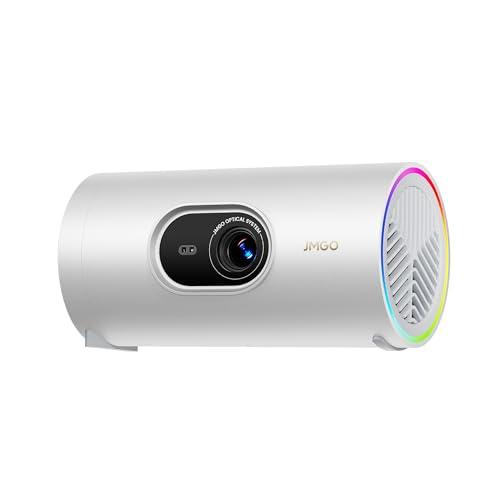
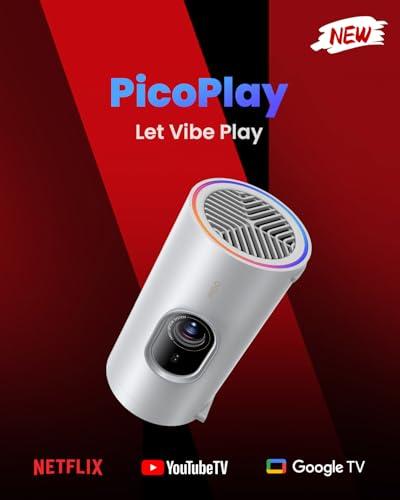
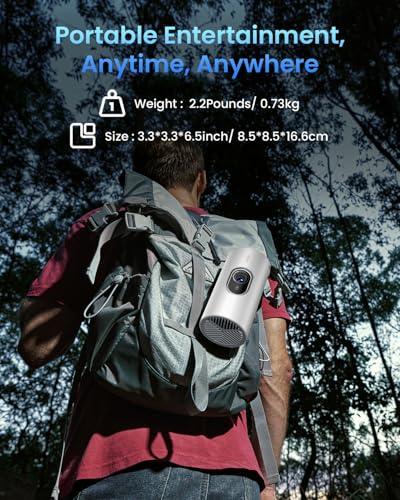
The PicoPlay looks nothing like what you'd expect from a projector. Shaped like an oversized travel mug, it measures roughly the size of a large coffee cup and weighs just over two pounds. This isn't just a design quirk—it's a fundamental reimagining of how portable projection should work.
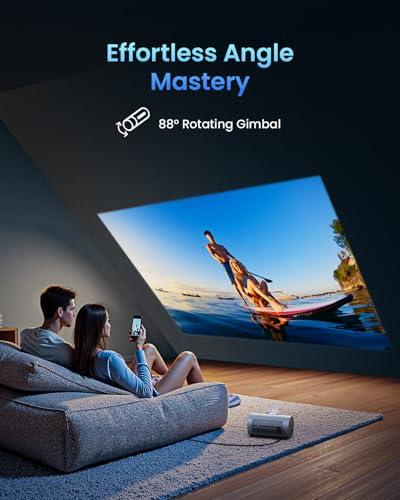
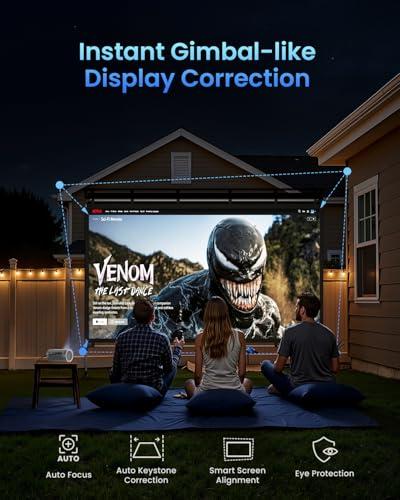
The real magic lies in its 88-degree rotating gimbal system. Think of this as a sophisticated swivel mount built right into the projector's body. You can effortlessly rotate the projection angle from pointing straight ahead at a wall to nearly straight up at the ceiling, or anywhere in between. This means you can set it on a nightstand and project onto the ceiling above your bed, place it on a picnic table for outdoor viewing, or even use it sideways for unique setups that would be impossible with traditional projectors.
This gimbal system addresses one of the biggest pain points with portable projectors: positioning. Usually, getting the right projection angle requires strategic placement, external tripods, or stacking books to achieve the perfect height and angle. The PicoPlay eliminates this hassle entirely.
However, this innovative design comes with a significant trade-off: there's no built-in battery. The projector requires continuous power through its USB-C port, either from a wall outlet or a compatible power bank. While this might seem like a major limitation, JMGO's reasoning is that modern high-capacity power banks can provide longer runtime than any built-in battery while keeping the projector itself lighter and more compact.
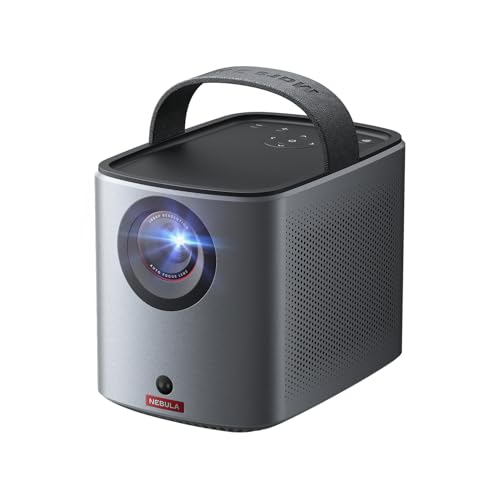
The Mars 3 Air takes a more conventional approach, resembling what most people expect from a portable projector. It's a sleek, rectangular unit weighing about 3.7 pounds—still very portable, but noticeably heftier than the PicoPlay. The build quality feels premium, with a metallic finish and a practical carrying handle integrated into the design.
What the Mars 3 Air lacks in design innovation, it makes up for in practical execution. The built-in battery provides up to 2.5 hours of actual viewing time, which testing has confirmed can stretch to over three hours with careful brightness management. This represents true wireless freedom—you can literally grab it and go without worrying about power sources or carrying extra accessories.
The conventional form factor also allows for better internal component layout, contributing to superior brightness output and more powerful built-in speakers. Sometimes, sticking with proven designs allows engineers to focus their innovation on performance rather than form factor.
When evaluating projector performance, several key metrics matter most: brightness, color accuracy, contrast, and image sharpness. Let's dive deep into how these models compare across these crucial areas.
Brightness is arguably the most critical specification for any projector, as it determines how well you can see the image in various lighting conditions. Both projectors claim similar brightness levels—400 lumens—but the devil is in the details.
The PicoPlay rates at 400 ISO lumens, while the Mars 3 Air claims 400 ANSI lumens but actually measures closer to 450 ANSI lumens in real-world testing. These different measurement standards (ISO vs ANSI) make direct comparison tricky, but independent testing suggests the Mars 3 Air produces a measurably brighter image.
In practical terms, both projectors perform best in dim to dark environments. Neither will compete with a TV in a brightly lit room, but they excel for evening entertainment, bedroom viewing, or outdoor use after sunset. The Mars 3 Air's slight brightness advantage becomes noticeable when there's ambient light you can't control—like street lights filtering through windows or campfire light during outdoor use.
For optimal viewing, both projectors work best with screen sizes between 50-60 inches diagonal. While they can project much larger images (up to 200 inches), brightness gets spread thinner across larger screens, making the image appear dimmer and less vibrant.
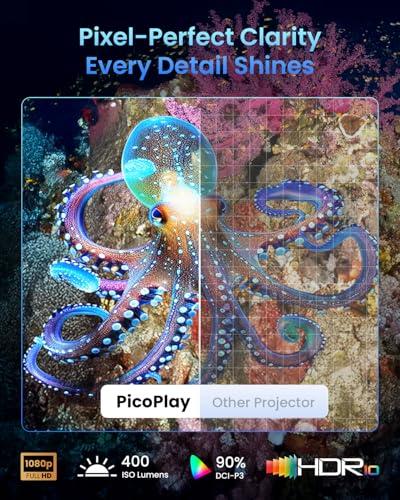
Color reproduction reveals a fascinating role reversal between these projectors. The PicoPlay, despite being the more affordable option, delivers superior color performance with coverage of 124% of the Rec.709 color standard and 90% of the more demanding DCI-P3 color space used in cinema.
What does this mean in plain English? Colors appear more vibrant, accurate, and lifelike. Reds look truly red rather than orange-ish, blues have depth rather than appearing washed out, and skin tones look natural rather than sickly. This superior color reproduction makes the PicoPlay particularly appealing for movie watching and content where visual quality matters most.
The Mars 3 Air delivers solid, reliable color reproduction that's perfectly acceptable for most content, but it doesn't reach the same level of color accuracy. However, its higher brightness often compensates for this difference, making colors appear more vivid simply because the overall image is brighter and more contrasty.
Both projectors achieve similar contrast ratios—around 400:1 for the PicoPlay and 373:1 for the Mars 3 Air. These numbers might seem low compared to high-end home theater projectors, but they're competitive for the portable category and sufficient for enjoyable viewing in controlled lighting conditions.
The more important factor is how this contrast translates to real-world viewing. Both projectors handle dark scenes reasonably well, though neither excels at revealing subtle shadow details in challenging content. For typical streaming content, movies, and TV shows, both provide satisfying image quality that easily surpasses laptop screens or tablets.
Modern portable projectors aren't just display devices—they're complete entertainment systems. Both the PicoPlay and Mars 3 Air run Google TV, providing direct access to streaming services without needing external devices.
Both projectors excel at automated setup, but they achieve this through different approaches. The PicoPlay uses its "FlexiSmart" system, which combines autofocus, automatic keystone correction (fixing image distortion when projecting at angles), and screen alignment. A ToF (Time-of-Flight) sensor—similar to technology used in smartphone cameras—measures distances and automatically adjusts focus and image geometry.
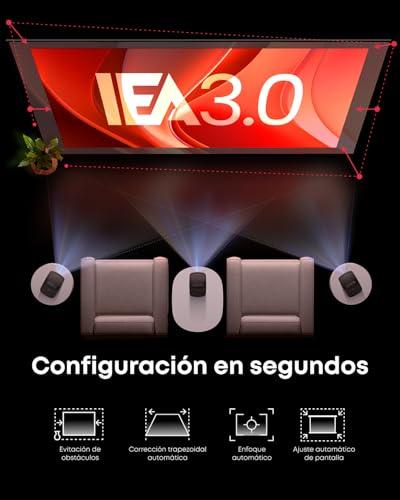
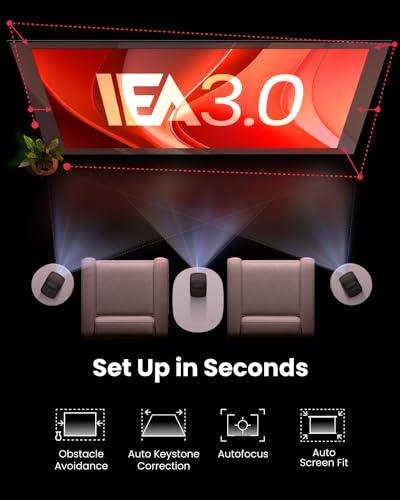
The Mars 3 Air employs its "Intelligent Environment Adaptation 3.0" system, which includes obstacle avoidance technology. This means the projector can detect if something is blocking part of the projection area and automatically adjust the image to fit the available space.
Both systems work impressively well in practice, turning what used to be a frustrating manual adjustment process into a nearly instant, automatic setup. You can place either projector down, power it on, and be watching content within seconds rather than minutes.
The Mars 3 Air holds a significant advantage as the world's first portable projector with official Netflix integration. While this might seem like a minor detail, it's actually quite important. Many portable projectors struggle with Netflix compatibility due to DRM (Digital Rights Management) restrictions, forcing users to rely on workarounds or external streaming devices.
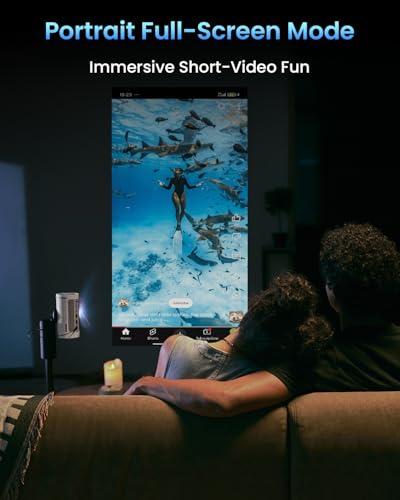
The PicoPlay offers an interesting unique feature: Vertical Play mode. This optimizes the projection for vertical content like TikTok videos, Instagram Reels, or YouTube Shorts. As our content consumption habits shift toward mobile-first platforms, this feature addresses a real gap in the projector market.
Both projectors support Google Cast for wireless streaming from smartphones and tablets, voice control through Google Assistant, and standard connectivity options like HDMI and USB ports.
Built-in audio quality can make or break the portable projector experience. Nobody wants to carry external speakers if the built-in audio is adequate, but poor audio can ruin otherwise great content.
The Mars 3 Air takes a clear advantage here with dual 8-watt speakers totaling 16 watts of power. The stereo separation creates a more immersive soundstage, and the overall volume capability is superior. During testing, the audio quality is described as "expansive and well-rounded," avoiding the thin, harsh sound typical of small speakers.
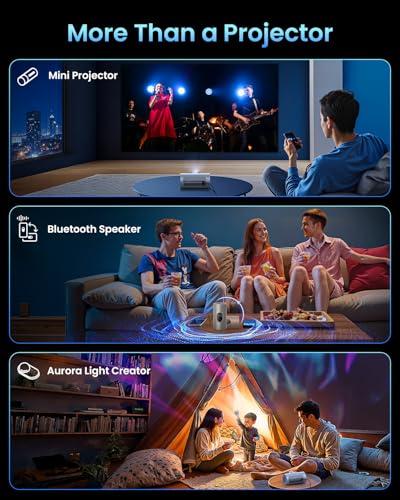
The PicoPlay features a single 8-watt speaker, but it's designed to do double duty. When not projecting, the entire device can function as a Bluetooth speaker, complete with ambient lighting that syncs to the music. This transforms it into a 3-in-1 entertainment device: projector, speaker, and mood light.
For most casual viewing, either projector provides adequate audio. However, if you're planning larger gatherings or want the best possible audio experience, the Mars 3 Air has a clear advantage during projection, while the PicoPlay offers more versatility as an all-around entertainment device.
The power management strategies of these projectors reflect their different design philosophies and target use cases.
The Mars 3 Air's built-in battery approach offers immediate convenience. You can grab it and go without thinking about power sources, cables, or additional accessories. The 2.5-hour battery life covers most movies or several TV episodes, making it ideal for spontaneous entertainment.
However, this convenience comes with limitations. Once the battery dies, you need to wait for charging or find a power outlet. The battery also adds weight and bulk to the projector itself, and battery performance will degrade over time with repeated charging cycles.
The PicoPlay's external power approach requires more planning but offers greater flexibility. A high-capacity power bank can provide longer runtime than any built-in battery, and you can swap power banks for unlimited viewing time. The projector itself remains lighter and smaller, and if a power bank fails or degrades, you can simply replace it rather than the entire projector.
In my experience, the "right" approach depends on your primary use case. For planned movie nights or presentations where you can ensure power access, either works fine. For truly spontaneous use or situations where power outlets aren't available, the Mars 3 Air's built-in battery wins. For extended viewing sessions or users who prefer the flexibility to choose their own power solution, the PicoPlay's approach offers more options.
At the time of writing, these projectors occupy different price tiers, with the PicoPlay positioned significantly lower than the Mars 3 Air. However, value isn't just about the initial purchase price—it's about what you get for your money and how well the device serves your needs.
The PicoPlay represents exceptional value for budget-conscious buyers who want innovative features and solid performance. The unique gimbal design, superior color reproduction, and multi-function capability provide features typically found in much more expensive projectors. The lower price point makes it accessible to students, casual users, or anyone wanting to try portable projection without a major investment.
The Mars 3 Air justifies its premium positioning through superior brightness, built-in battery convenience, better audio performance, and the reliability of an established brand. For users who prioritize convenience and are willing to pay more for a refined, no-compromise experience, the additional cost represents good value.
Understanding when each projector excels helps clarify which might be right for you.
Students and Dorm Life: The compact size, affordable price, and multi-function capability make it perfect for small spaces. The ability to project on the ceiling creates a unique viewing experience in cramped quarters, and the Bluetooth speaker function eliminates the need for separate audio equipment.
Travel and Camping: The minimal size and power bank compatibility make it extremely travel-friendly. The gimbal system means you don't need to pack tripods or worry about finding the perfect surface for placement.
Social Media Enthusiasts: The Vertical Play mode for TikTok and Instagram content addresses a genuine need that other projectors ignore. This feature alone makes it appealing to younger users who consume significant amounts of vertical content.
Budget-Conscious Buyers: Getting innovative features and solid performance at a lower price point makes it attractive for anyone wanting to enter the portable projector market without a major financial commitment.
Outdoor Entertainment: The built-in battery eliminates the need to run extension cords or manage power banks during backyard movie nights or camping trips. The superior brightness also handles ambient outdoor light better.
Family Use: The larger, more powerful speakers and brighter image make it better suited for group viewing. The traditional form factor is also more familiar and less likely to confuse less tech-savvy family members.
Business and Presentations: The professional appearance, reliable built-in battery, and excellent brightness make it suitable for business use. The official Netflix support also ensures compatibility with entertainment during travel.
Convenience-Focused Users: If you want to minimize hassle and accessories, the built-in battery and traditional setup approach require less planning and management.
While neither projector is designed to replace a dedicated home theater setup, both can serve as excellent supplementary displays or primary entertainment sources in smaller spaces.
For home theater use, the Mars 3 Air has several advantages: the brighter output helps in rooms where you can't achieve complete darkness, the stereo speakers provide better audio separation, and the stable, traditional form factor works better with permanent or semi-permanent installations.
However, the PicoPlay's superior color reproduction actually delivers more cinematic image quality once you account for proper room darkening. The gimbal system also opens up unique installation possibilities—imagine mounting it on a side table and projecting onto your bedroom ceiling for comfortable viewing while lying down.
Neither projector will satisfy serious home theater enthusiasts who prioritize absolute image quality, but both can create surprisingly immersive experiences when used appropriately. The key is managing expectations and optimizing your viewing environment for the projector's capabilities.
Choosing between the JMGO PicoPlay and Anker Nebula Mars 3 Air ultimately comes down to your priorities, usage patterns, and budget.
Choose the PicoPlay if you value innovation, want the most portable option possible, prioritize visual quality over convenience, or need to stick to a tighter budget. It's perfect for users who don't mind managing external power sources in exchange for unique capabilities and exceptional value.
Choose the Mars 3 Air if you prioritize convenience, need reliable wireless operation, want the brightest possible image, or prefer the peace of mind that comes with established brand reputation. It's ideal for users who are willing to pay more for a refined, hassle-free experience.
Both projectors represent significant achievements in portable projection technology, just with different strengths and target audiences. The "wrong" choice is the one that doesn't match your actual usage patterns and priorities, regardless of which has better specifications on paper.
The portable projector market continues evolving rapidly, but these two models showcase how the category has matured from novelty gadgets to genuinely useful entertainment devices. Whether you choose innovative design or refined execution, both paths lead to the same destination: the freedom to enjoy big-screen entertainment anywhere you want it.
| JMGO PicoPlay 1080P Smart Portable Projector | Anker Nebula Mars 3 Air Portable Projector |
|---|---|
| Design & Portability - Critical for truly mobile use | |
| Unique canister design with 88° rotating gimbal, 2.2 lbs | Traditional rectangular design with handle, 3.7 lbs |
| Battery Life - Determines wireless freedom | |
| No built-in battery, requires external power bank or outlet | Built-in 2.5+ hour battery for true wireless operation |
| Brightness - Most important for image visibility | |
| 400 ISO lumens (good for dark rooms) | 450 ANSI lumens measured (better for ambient light) |
| Color Performance - Affects image quality and realism | |
| Superior: 124% Rec.709, 90% DCI-P3 color gamut | Standard color reproduction, adequate for most content |
| Audio System - Important when external speakers aren't available | |
| Single 8W speaker, doubles as Bluetooth speaker | Dual 8W speakers (16W total) with stereo separation |
| Smart Features - Convenience and content access | |
| Google TV, Vertical Play mode for social media content | Google TV with official Netflix integration (industry first) |
| Setup Automation - Reduces frustration and setup time | |
| FlexiSmart: autofocus, keystone correction, eye protection | Environment Adaptation 3.0: obstacle avoidance, auto-adjustment |
| Unique Capabilities - Differentiating features | |
| 3-in-1: projector/speaker/ambient light, ceiling projection | Built-in battery convenience, professional appearance |
| Value Positioning - Performance per dollar spent | |
| Budget-friendly with innovative features and superior colors | Premium pricing for convenience and established brand reliability |
The Anker Nebula Mars 3 Air is better for outdoor use thanks to its built-in battery providing 2.5+ hours of wireless operation and higher brightness output (450 ANSI lumens vs 400 ISO lumens). The JMGO PicoPlay requires an external power bank, which adds complexity for outdoor setups, though its rotating gimbal offers more flexible positioning options.
The biggest difference is power management and design philosophy. The JMGO PicoPlay features a unique rotating gimbal design but requires external power, while the Anker Nebula Mars 3 Air has a traditional form factor with a built-in battery for true wireless operation.
The JMGO PicoPlay delivers superior color accuracy with 124% Rec.709 and 90% DCI-P3 color coverage, making colors more vibrant and realistic. However, the Anker Mars 3 Air produces a brighter image overall, which can make it appear more vivid in rooms with ambient light.
Both projectors have adequate built-in audio. The Anker Nebula Mars 3 Air has dual 8W speakers (16W total) with better stereo separation, while the JMGO PicoPlay has a single 8W speaker but can also function as a standalone Bluetooth speaker when not projecting.
The JMGO PicoPlay is significantly more portable at 2.2 pounds with a compact canister design that fits easily in luggage. The Mars 3 Air weighs 3.7 pounds and has a larger footprint, though it includes a convenient carrying handle and eliminates the need to pack power banks.
Yes, both run Google TV with streaming app support. The Anker Nebula Mars 3 Air is the first portable projector with official Netflix integration, ensuring full compatibility. The JMGO PicoPlay also supports Netflix and other streaming services, plus offers a unique Vertical Play mode for TikTok and Instagram content.
The JMGO PicoPlay excels in small spaces due to its compact size and 88° rotating gimbal that allows ceiling projection—perfect for watching from bed. It also serves as a 3-in-1 device (projector, speaker, ambient light), reducing clutter in tight quarters.
Only the Anker Nebula Mars 3 Air has a built-in battery, providing 2.5 hours of video playback or up to 8 hours in Bluetooth speaker mode. The JMGO PicoPlay requires external power but can run indefinitely with power banks or wall power, offering more flexibility for extended viewing sessions.
The JMGO PicoPlay typically offers better value with innovative features like the rotating gimbal, superior color performance, and multi-function capability at a lower price point. The Anker Mars 3 Air costs more but justifies the premium with convenience features, built-in battery, and brighter output.
Both projectors support gaming through HDMI connections, but neither is optimized for competitive gaming due to input lag typical of portable projectors. The JMGO PicoPlay has a low-latency gaming mode, while the Mars 3 Air offers stable, bright images that work well for casual console gaming.
Both projectors excel at automated setup. The JMGO PicoPlay uses FlexiSmart technology for instant autofocus and keystone correction, while the Anker Nebula Mars 3 Air features Intelligent Environment Adaptation with obstacle avoidance. Setup time is comparable, but the Mars 3 Air eliminates power management complexity.
For casual viewing in controlled lighting, both can serve as TV alternatives. The Anker Mars 3 Air is better suited for regular family use with its brighter output and superior built-in audio. The JMGO PicoPlay works well for personal viewing and offers unique ceiling projection capabilities, but may require external power planning for extended daily use.
We've done our best to create useful and informative comparisons to help you decide what product to buy. Our research uses advanced automated methods to create this comparison and perfection is not possible - please contact us for corrections or questions. These are the sites we've researched in the creation of this article: techbuzzireland.com - youtube.com - newatlas.com - projectorcentral.com - youtube.com - thegadgetflow.com - youtube.com - global.jmgo.com - youtube.com - bestbuy.com - projector-database.com - notebookcheck.net - eu.jmgo.com - techradar.com - thesmarthomehookup.com - whathifi.com - thesmarthomehookup.com - cnet.com - whathifi.com - projectorreviews.com - youtube.com - youtube.com - versus.com - projectorcentral.com - practicalmotorhome.com - youtube.com - seenebula.com - us.seenebula.com - harveynorman.ie

Privacy Policy
Terms and Conditions - Affiliate Policy
Home Security
© Copyright 2008-2026.
11816 Inwood Rd #1211, Dallas, TX 75244