

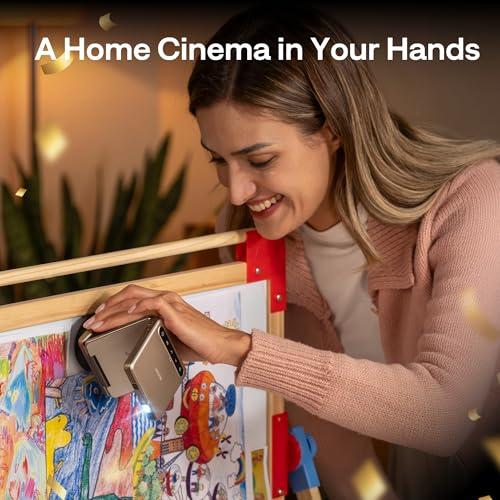
The portable projector market has exploded in recent years, transforming from clunky, dim devices that barely worked in pitch-black rooms into genuinely useful entertainment companions. Two 2025 releases—the JMGO PicoPlay and Aurzen ZIP—represent dramatically different philosophies in this evolving space. After spending considerable time with both devices, I've come to see them as representing two distinct paths forward for portable projection technology.
Before diving into these specific models, it's worth understanding what separates great portable projectors from mediocre ones. The fundamental challenge has always been the "portable projector triangle"—you can optimize for size, brightness, or battery life, but improving one usually means compromising the others.
Brightness, measured in lumens, determines how well you can see the projected image in different lighting conditions. ANSI lumens (American National Standards Institute) and ISO lumens are standardized measurements, while some manufacturers use less reliable "LED lumens" or arbitrary brightness claims. For context, a dark bedroom might work fine with 100 lumens, but you'll want 300+ lumens for a living room with some ambient light, and 500+ for any kind of daytime use.
Resolution tells you how sharp your image will be. Native resolution is what the projector's display chip actually produces, while some manufacturers use pixel-shifting or interpolation to claim higher resolutions than they truly deliver. The difference between 720p and 1080p becomes very noticeable on screens larger than 40 inches.
Battery life makes the difference between a truly portable device and one that's just "moveable." Anything under 90 minutes feels limiting for movie watching, while 2+ hours opens up real flexibility for outdoor use or travel.
The audio component often gets overlooked, but built-in speakers can make or break the experience. Most mini projectors have terrible audio—thin, tinny sound that immediately breaks the immersion you're trying to create with a big screen.
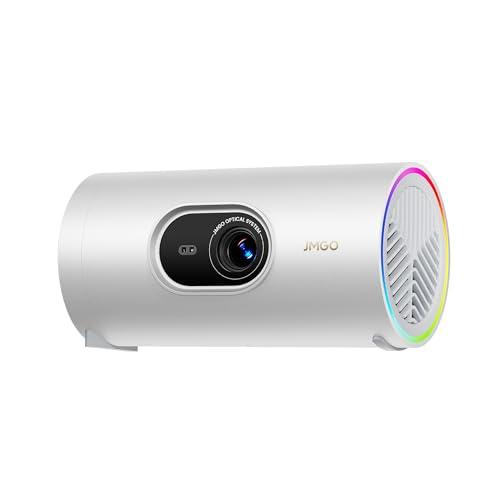
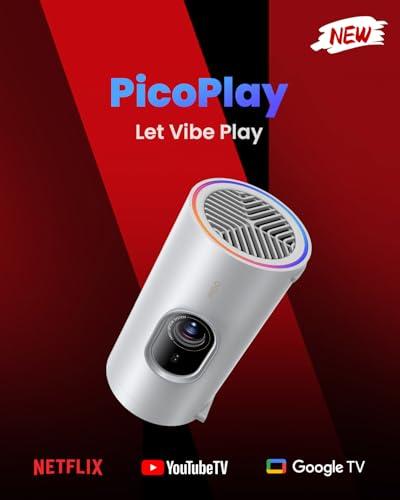
The JMGO PicoPlay represents what I'd call the "mature" approach to portable projection. Released in 2025, it builds on JMGO's experience making full-sized home theater projectors, shrinking that expertise into a cylindrical form factor that looks like an oversized travel mug.
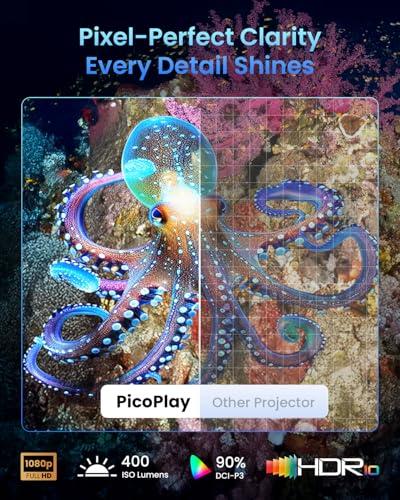
The most significant advantage of the PicoPlay is its genuine 1080p resolution. This isn't pixel-shifting or upscaling trickery—it's native 1920×1080 pixels from a TFT LCD panel. When you're projecting onto a 60-inch screen (my sweet spot for this projector), the difference in sharpness compared to 720p alternatives is immediately obvious. Text stays crisp, movie details remain clear, and you don't get that slightly fuzzy "digital projection" look that plagues many mini projectors.
The 400 ISO lumens output puts it in a different league from ultra-compact competitors. In my testing, this brightness level handles moderately dim rooms quite well. I've successfully used it for movie nights in my living room with blackout curtains drawn and just a small lamp on in the corner—something impossible with sub-200 lumen projectors.
Color reproduction is where the PicoPlay really shines. Supporting 124% of the Rec.709 color standard (the broadcast television color space) and 90% of DCI-P3 (digital cinema colors), it produces notably more vibrant and accurate colors than you'd expect from a device this size. HDR10 support adds dynamic range that makes bright highlights pop without crushing shadow details.
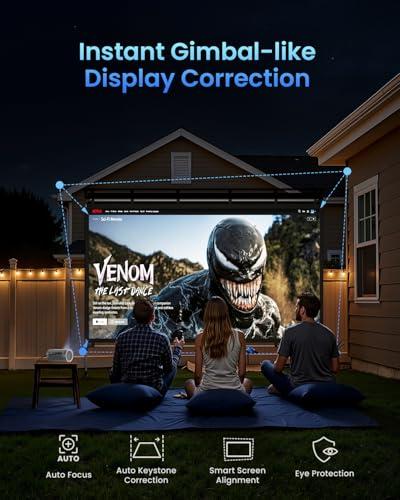
The FlexiSmart system deserves special mention. Using a Time-of-Flight (ToF) sensor—the same technology in smartphone autofocus systems—it automatically focuses the image and corrects keystone distortion (the trapezoidal shape you get when projecting at an angle) in real-time. Setup literally takes seconds: unfold it, press power, and you're watching content with a properly focused, rectangular image.
Most portable projectors treat audio as an afterthought, cramming in tiny speakers that sound worse than your phone. The PicoPlay takes a different approach with its 8-watt speaker system that includes Dolby Audio processing. It's not going to replace a proper sound system, but it's genuinely pleasant to listen to for movie watching. The bass response is surprisingly full for the size, and dialogue remains clear at reasonable volumes.
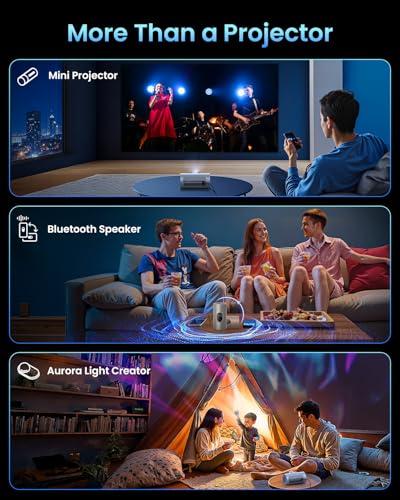
The device can also function as a standalone Bluetooth speaker, which might sound gimmicky but proved surprisingly useful during camping trips. The ambient lighting feature—RGB LEDs that can sync with music—adds a party atmosphere that works better than I expected.
Running Google TV means the PicoPlay works like a streaming stick built into your projector. Netflix, YouTube, Amazon Prime Video, and other major services work natively without needing to connect external devices. The remote includes dedicated buttons for major streaming services, and Google Cast support means you can easily mirror content from phones or tablets.
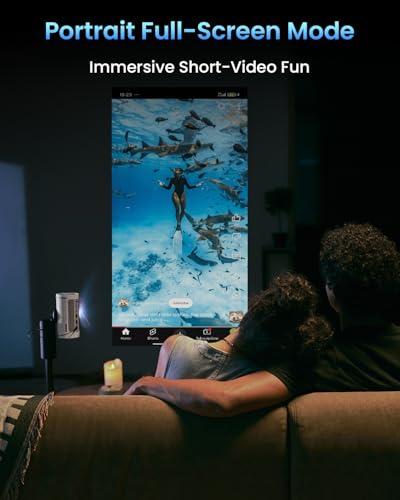
The "Vertical Play" mode particularly impressed me—it's optimized for TikTok, Instagram Reels, and other vertical content that's increasingly common. While watching vertical videos on a horizontal screen usually looks awkward, the PicoPlay can rotate its interface to make portrait content feel natural on a wall or screen.
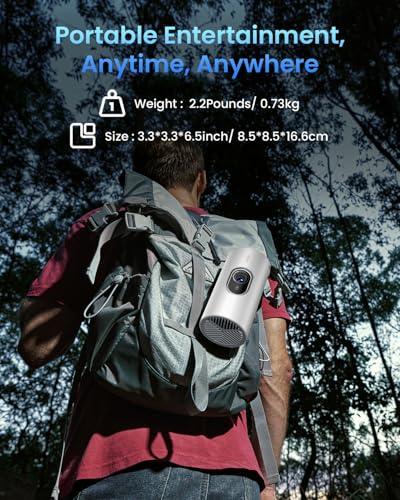
At 2.2 pounds and roughly the size of a large water bottle, the PicoPlay sits in portable projector middle ground. It's absolutely travel-friendly—I've packed it for hotel stays and outdoor gatherings—but it's not something you'd casually throw in a backpack for everyday carry. The included travel case helps, but you're definitely making a conscious decision to bring it along.
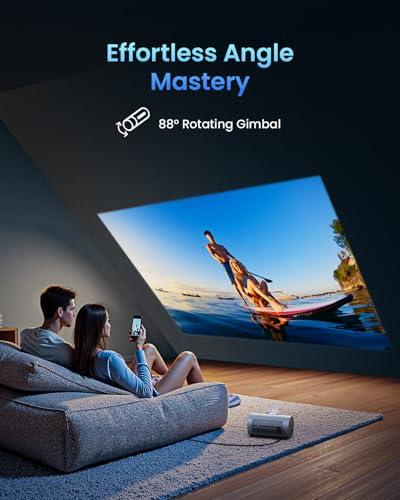
The 88-degree rotating gimbal proves more useful than I initially expected. Being able to tilt the projector for ceiling projection or awkward angles without additional hardware eliminates many setup headaches. I've used it for everything from basement movie nights to projecting onto a tent wall while camping.
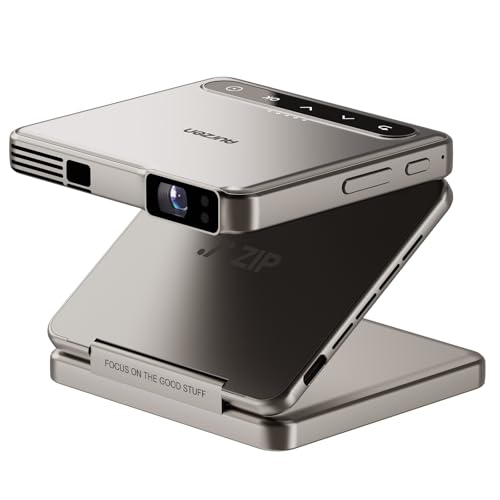
The Aurzen ZIP takes such a radically different approach that it's almost unfair to compare it directly to traditional projectors. Released in 2025, it represents the first commercially successful "wallet-sized" projector that actually works as advertised.
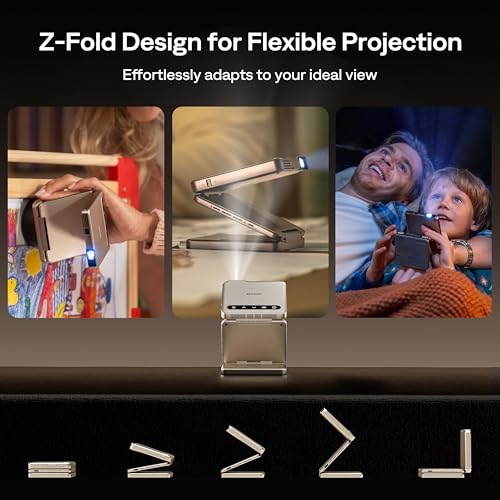
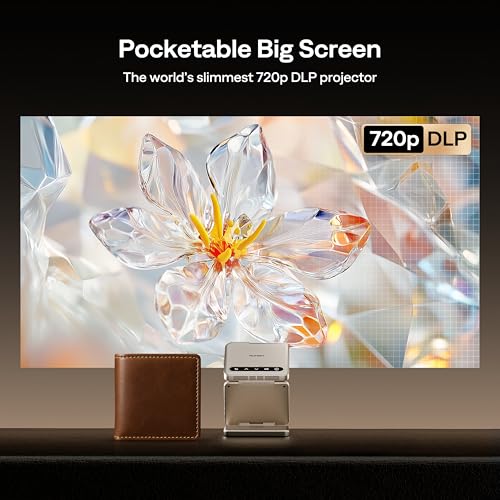
At 280 grams (about 10 ounces), the ZIP weighs less than most smartphones. When folded, it's genuinely pocketable—I've carried it in jeans without feeling encumbered. The tri-fold design is engineering cleverness at its best: three panels connected by precision hinges that unfold into a stable projection platform with built-in angling capabilities.
The party trick is projecting onto ceilings or walls without any external support. The integrated gimbal system allows 180 degrees of projection flexibility, and the base includes both standard tripod mounting and magnetic attachment points. I've stuck it to refrigerators, car hoods, and metal camping gear for impromptu movie sessions that would be impossible with conventional projectors.
The ZIP uses a Texas Instruments 0.16-inch DMD chip—the smallest Digital Light Processing chip ever made for consumer projectors. This engineering marvel enables the tiny form factor but comes with inevitable trade-offs. The native resolution is actually 640×360, upscaled to 720p using XPR pixel-shifting technology (a method that rapidly shifts pixels to simulate higher resolution).
At 100 ANSI lumens, brightness is limited to genuinely dark environments. This isn't a "lights dimmed" projector—it's a "lights off" device. But within those constraints, image quality is surprisingly decent. Text remains readable, and video content looks acceptable on 40-50 inch screens.
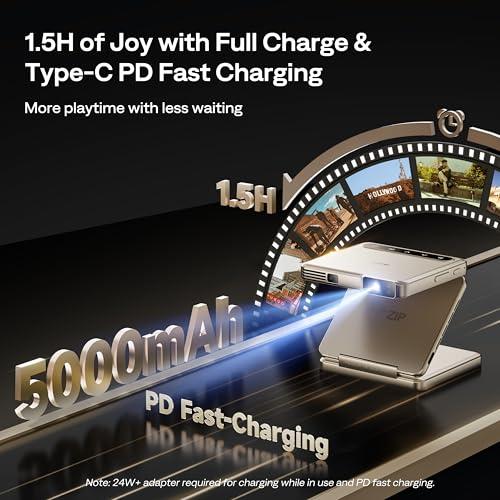
The 90-minute battery life feels limiting until you consider the use cases. This isn't designed for movie marathons; it's for showing vacation photos to friends, watching a single episode before bed, or entertaining kids during car trips. The optional magnetic charging stand extends runtime to about 3 hours, which covers most movies.
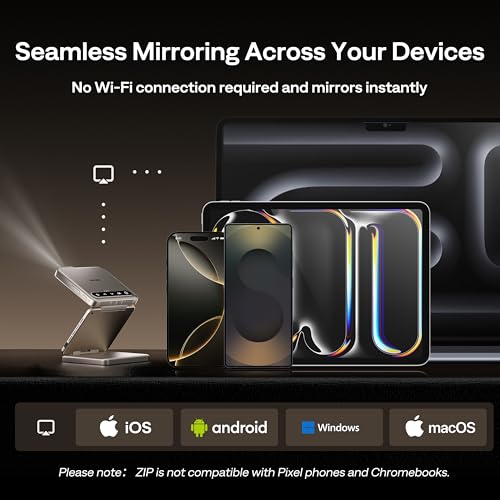
The ZIP's killer feature is its instant-on wireless mirroring. AirLink technology connects to iOS, Android, Windows, and macOS devices without requiring Wi-Fi networks or complex pairing. You literally tap a button and start projecting—easier than connecting Bluetooth headphones.
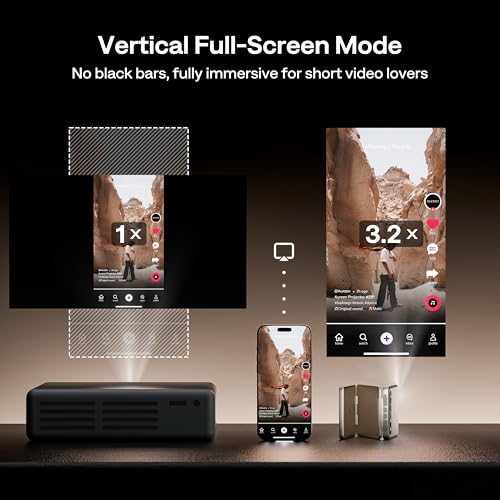
For content creators and social media enthusiasts, the portrait projection mode is genuinely revolutionary. I've never seen another projector handle vertical video content well, but the ZIP makes TikToks and Instagram Reels look natural on a wall-sized display. The portrait mode isn't just rotated landscape—it's properly optimized for vertical aspect ratios.
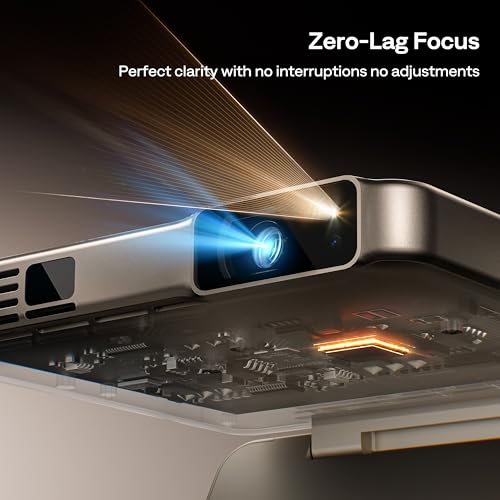
The ToF-based zero-lag autofocus works remarkably well for such a tiny device. Even when moving the projector or changing projection distances, focus adjustment is virtually instantaneous. Combined with automatic keystone correction, setup remains effortless despite the engineering challenges of fitting these features into such a small package.
The resolution difference between these projectors becomes most apparent on screens larger than 50 inches. The PicoPlay's native 1080p maintains sharpness that the ZIP's upscaled 720p simply can't match. For detailed content—spreadsheets, web browsing, gaming—the PicoPlay provides significantly better clarity.
However, brightness matters more than resolution in many real-world scenarios. The PicoPlay's 400 lumens handle ambient light that completely washes out the ZIP's 100-lumen output. I can use the PicoPlay in hotel rooms with bathroom lights on; the ZIP requires near-total darkness.
Color accuracy strongly favors the PicoPlay. Its LCD technology and wider color gamut produce more natural skin tones and vibrant landscapes, while the ZIP's DLP system shows slightly cooler, more artificial colors. Both are perfectly watchable, but side-by-side comparisons reveal the PicoPlay's advantage.
The PicoPlay's 20,000mAh battery delivers genuine 3-hour movie sessions, while the ZIP's 5,000mAh capacity provides about 90 minutes of typical use. This difference fundamentally changes how you use each device. With the PicoPlay, I plan movie nights; with the ZIP, I grab spontaneous opportunities.
Both support USB-C charging and can operate while plugged in, but power bank compatibility differs significantly. The PicoPlay requires 65-watt power delivery, limiting compatible power banks, while the ZIP works with standard phone chargers and smaller power banks.
The audio gap is substantial. The PicoPlay's 8-watt speaker produces room-filling sound with decent bass response, while the ZIP's dual 1-watt speakers sound thin and lack depth. For group viewing, the PicoPlay eliminates the need for external speakers; the ZIP practically requires them for anything beyond personal viewing.
Neither projector replaces a dedicated home theater setup, but they serve different roles in home entertainment ecosystems. The PicoPlay works well as a secondary display for bedrooms, patios, or basements where permanent installation isn't practical. Its Google TV platform means it can function independently without additional streaming devices.
The ZIP's home theater role is more specialized—think kids' rooms, dorm spaces, or temporary setups. Its ceiling projection capability makes it perfect for bedroom viewing, and the compact storage means it can live in a nightstand drawer when not needed.
For serious movie watching, both projectors benefit from dark room environments and proper screens or white walls. The PicoPlay can handle larger screens (80+ inches) while maintaining acceptable quality, whereas the ZIP works best at 40-60 inches maximum.
At the time of writing, both projectors command premium prices within their respective categories, but they target fundamentally different users and use cases.
The PicoPlay makes sense for users prioritizing image quality and features within a moderately portable package. It's ideal for:
The PicoPlay works best when you can plan ahead and don't mind the slightly larger carrying case. Its extended battery life and superior performance justify the size increase for users who prioritize watching experience over ultimate portability.
The ZIP appeals to users who prioritize convenience and innovative features over traditional performance metrics:
The ZIP's revolutionary form factor makes it suitable for spontaneous use cases that traditional projectors can't handle. Its portrait mode and instant wireless connectivity open up creative applications that justify its premium pricing within the ultra-compact category.
After extensive testing, I view these projectors as complementary rather than competing devices. The JMGO PicoPlay delivers superior traditional projector performance in a travel-friendly package, while the Aurzen ZIP pioneers entirely new usage paradigms through innovative design.
Choose the PicoPlay if image quality, battery life, and smart features matter more than ultimate portability. It's the better choice for planned viewing sessions, group entertainment, and scenarios where you want the projection experience to feel cinematic rather than compromised.
Choose the ZIP if convenience, innovation, and unique capabilities outweigh traditional performance metrics. It's perfect for spontaneous projection needs, creative applications, and situations where traditional projectors simply won't work due to space or setup constraints.
Both represent significant advances in portable projection technology, just in completely different directions. The PicoPlay perfects the traditional approach, while the ZIP reimagines what portable projection can be. Your choice ultimately depends on whether you want the best possible experience in a moderately portable package, or revolutionary convenience with acceptable performance trade-offs.
| JMGO PicoPlay 1080P Smart Portable Projector | Aurzen ZIP Tri-Fold Portable Mini Projector |
|---|---|
| Resolution - Determines image sharpness, especially noticeable on screens over 50 inches | |
| Native 1080p (1920×1080) - True Full HD clarity | 720p via pixel-shifting from 640×360 native - Acceptable for smaller screens |
| Brightness - Critical for viewing in rooms with any ambient light | |
| 400 ISO lumens - Works in dim rooms with some lighting | 100 ANSI lumens - Requires complete darkness for good visibility |
| Size & Weight - Affects true portability and ease of transport | |
| 3.3×3.3×6.5 inches, 2.2 lbs - Moderately portable, needs carrying case | 3.3×3.1×1 inches, 9.88 oz - Genuinely pocketable when folded |
| Battery Life - Determines viewing session length without external power | |
| 20,000mAh battery, 3 hours video playback - Full movie sessions | 5,000mAh battery, 90 minutes typical use - Single episode or short content |
| Audio Quality - Important for group viewing without external speakers | |
| 8W Dolby Audio speaker - Room-filling sound, doubles as Bluetooth speaker | Dual 1W speakers - Basic audio, external speakers recommended |
| Smart Features - Affects content access and ease of use | |
| Google TV with Netflix, YouTube, Prime Video apps built-in | No built-in apps - relies on wireless mirroring from devices |
| Setup Flexibility - How easily you can project at different angles | |
| 88° rotating gimbal for wall/ceiling projection | 180° tri-fold design with integrated stand - ultimate flexibility |
| Content Ecosystem - How you access movies and shows | |
| Native streaming apps plus Google Cast wireless mirroring | AirLink wireless mirroring (iOS/Android/Windows/Mac) - no Wi-Fi needed |
| Color Accuracy - Affects how natural and vibrant images appear | |
| 124% Rec.709, 90% DCI-P3 color gamut with HDR10 | Standard DLP colors, no HDR - adequate but less vivid |
| Unique Features - Standout capabilities that differentiate each model | |
| Vertical Play mode for TikTok/social content, ambient lighting | Portrait projection mode, magnetic mounting, instant wireless setup |
The JMGO PicoPlay delivers significantly better image quality with native 1080p resolution and 400 ISO lumens brightness. The Aurzen ZIP uses 720p pixel-shifting technology with only 100 ANSI lumens, making it suitable only for dark room viewing. For home theater use, the PicoPlay provides sharper text, clearer details, and better performance in rooms with ambient lighting.
The Aurzen ZIP is dramatically more portable, weighing just 9.88 ounces and folding to pocket size (3.3×3.1×1 inches). The JMGO PicoPlay weighs 2.2 pounds with dimensions of 3.3×3.3×6.5 inches. If ultimate portability is your priority, the ZIP can literally fit in your pocket, while the PicoPlay requires a carrying case.
The JMGO PicoPlay offers superior battery life with its 20,000mAh battery providing up to 3 hours of video playback. The Aurzen ZIP has a 5,000mAh battery lasting approximately 90 minutes. For movie nights or extended viewing sessions, the PicoPlay eliminates the need for external power during typical use.
The JMGO PicoPlay runs Google TV with built-in Netflix, YouTube, and Prime Video apps, making it a complete streaming solution. The Aurzen ZIP relies on wireless mirroring from your devices and requires an optional CastPlay dongle for DRM-protected content like Netflix. The PicoPlay offers a more seamless streaming experience without depending on external devices.
Both projectors support ceiling projection, but with different approaches. The JMGO PicoPlay uses an 88° rotating gimbal for flexible angles. The Aurzen ZIP features a revolutionary tri-fold design with 180° projection flexibility and can project onto ceilings without external mounting. The ZIP is more versatile for unusual projection angles and ceiling mounting.
The JMGO PicoPlay includes an 8W Dolby Audio speaker that produces room-filling sound suitable for group viewing and can function as a standalone Bluetooth speaker. The Aurzen ZIP has dual 1W speakers that provide basic audio but typically require external speakers or headphones for an enjoyable experience. For home theater use without external audio, the PicoPlay is the clear winner.
Neither projector is ideal for daytime use, but the JMGO PicoPlay with 400 ISO lumens can handle dim rooms with some ambient lighting. The Aurzen ZIP at 100 ANSI lumens requires complete darkness for good visibility. Both work best in dark environments, but the PicoPlay offers more flexibility for various lighting conditions.
Both projectors feature automatic setup with ToF sensors for instant autofocus and keystone correction. The JMGO PicoPlay offers Google TV's familiar interface and voice control. The Aurzen ZIP provides tap-to-mirror wireless connectivity that works without Wi-Fi networks. Setup time is similar, but the ZIP might be simpler for users who primarily mirror content from phones or tablets.
The JMGO PicoPlay delivers optimal image quality at 50-60 inches and can project up to 200 inches maximum. The Aurzen ZIP works best at 40-50 inches with an 80-inch maximum due to its lower brightness. For home theater applications with larger screens, the PicoPlay maintains better image quality at greater sizes.
Value depends on your priorities. The JMGO PicoPlay offers better traditional projector performance with superior image quality, longer battery life, and smart TV features. The Aurzen ZIP commands a premium for its revolutionary ultra-portable design and unique tri-fold functionality. Choose the PicoPlay for performance value or the ZIP for convenience and portability innovation.
The JMGO PicoPlay can serve as a secondary TV replacement for bedrooms or occasional use, thanks to its Google TV platform, decent brightness, and good audio. The Aurzen ZIP works better as a supplementary device for specific use cases rather than primary home entertainment. For regular home theater use, the PicoPlay is more suitable as a TV alternative.
The JMGO PicoPlay is better suited for outdoor movie nights due to its higher brightness, longer battery life, and superior audio quality. The Aurzen ZIP can work for outdoor use in completely dark conditions but requires external speakers and has limited battery life. For camping or backyard movie experiences, the PicoPlay provides a more complete entertainment solution.
We've done our best to create useful and informative comparisons to help you decide what product to buy. Our research uses advanced automated methods to create this comparison and perfection is not possible - please contact us for corrections or questions. These are the sites we've researched in the creation of this article: techbuzzireland.com - youtube.com - newatlas.com - projectorcentral.com - youtube.com - thegadgetflow.com - youtube.com - global.jmgo.com - youtube.com - bestbuy.com - projector-database.com - notebookcheck.net - eu.jmgo.com - aurzen.com - youtube.com - tomsguide.com - aurzen.com - aurzen.com - projectorcentral.com - appleinsider.com - youtube.com - aurzen.com - aurzen.com - aurzen.com - aurzen.com

Privacy Policy
Terms and Conditions - Affiliate Policy
Home Security
© Copyright 2008-2026.
11816 Inwood Rd #1211, Dallas, TX 75244