

When I first started covering portable projectors, the category was filled with disappointing devices that promised big-screen entertainment but delivered dim, blurry images that were barely watchable. Fast forward to 2025, and we're seeing some genuinely impressive options that can actually replace your TV for many situations. Two standouts in this evolving space are the JMGO PicoPlay and the XGIMI Elfin Flip – both released in 2024 and representing very different approaches to portable projection.
The portable projector market has exploded in recent years, driven by people wanting flexible entertainment options without being tied to a fixed TV setup. Whether you're a college student in a dorm, someone who moves frequently, or just want the option to watch movies under the stars, these devices offer compelling alternatives to traditional home theater setups.
Before diving into our comparison, it's worth understanding what actually matters in this category. Unlike full-size home theater projectors that prioritize maximum brightness and image quality above all else, portable projectors must balance performance with size, weight, and ease of use.
Brightness is measured in lumens – think of it as how much light the projector can throw at your wall or screen. Most portable projectors fall between 200-600 lumens, which might sound low compared to a 3,000-lumen home theater projector, but it's actually sufficient for darkened rooms. The key is understanding that "ISO lumens" and "ANSI lumens" are standardized measurements, while some manufacturers use inflated "light source lumens" that don't reflect real-world performance.
Native resolution refers to the actual number of pixels the projector can display. Both the PicoPlay and Elfin Flip offer native 1080p (1920×1080 pixels), which is still the sweet spot for portable projectors in 2025. While 4K portable projectors exist, they're significantly more expensive and often don't provide proportional benefits at typical portable projection sizes.
Throw ratio determines how far you need to place the projector from your wall to get a specific image size. A 1.2:1 throw ratio means you need 1.2 feet of distance for every foot of screen width. This matters more than you might think – in a small apartment or hotel room, you need a projector that can create a watchable image from just a few feet away.
The JMGO PicoPlay and XGIMI Elfin Flip represent fundamentally different approaches to portable projection, and understanding these differences is crucial for making the right choice.
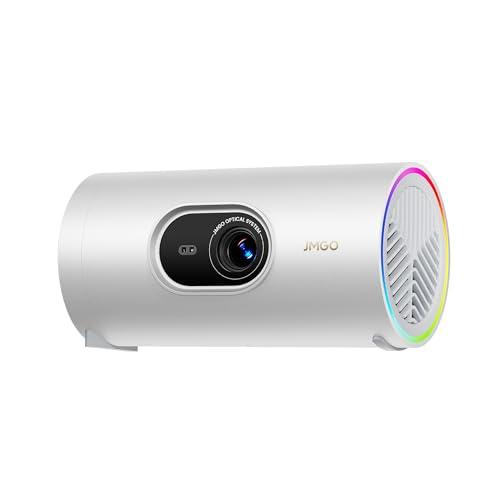
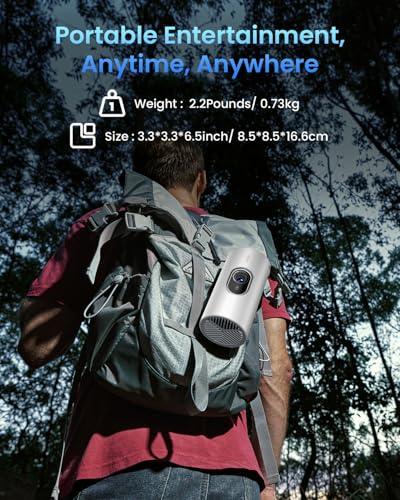
The first time I saw the PicoPlay, I thought someone had mistaken a travel coffee mug for a projector. At just 2.2 pounds and roughly the size of a large thermos, it's genuinely pocket-friendly in a way that most "portable" projectors aren't. But the real magic happens when you power it on.
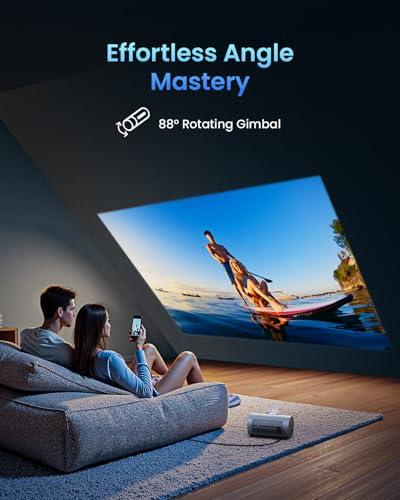
The PicoPlay's defining feature is its 88-degree rotating gimbal – essentially a sophisticated hinge that lets you point the projector in almost any direction without moving the base. This might sound like a minor convenience feature, but in practice, it's transformative. I can set it on my coffee table and project onto the wall, then rotate it 90 degrees to project onto the ceiling for lying-down viewing. No other portable projector offers this level of flexibility.
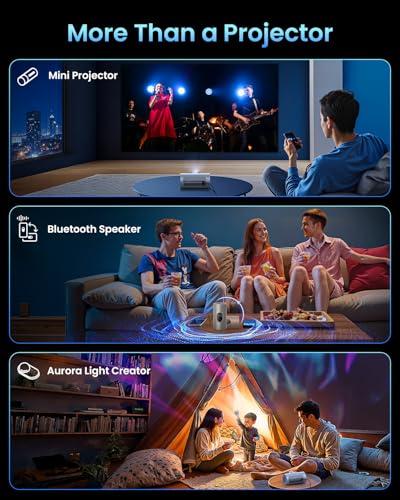
But JMGO went further, turning the PicoPlay into what they call a "3-in-1 entertainment hub." Beyond projection, it functions as an 8-watt Bluetooth speaker with surprisingly rich sound for its size, and features dynamic ambient lighting that can sync with music. During testing, I found myself using it as a party speaker with synchronized light shows even when not projecting anything.
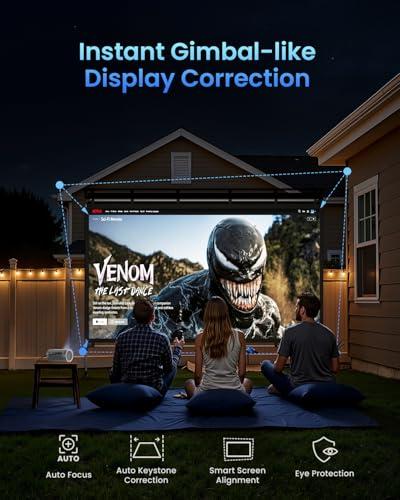
The FlexiSmart auto-setup system deserves special mention. Using a Time-of-Flight (ToF) sensor – the same technology used in smartphone cameras for autofocus – it automatically adjusts focus, corrects keystone distortion (when the image appears tilted or trapezoidal), and aligns the picture to your wall or screen. Setup literally takes seconds.
The XGIMI Elfin Flip takes a more traditional but equally thoughtful approach. Rather than reinventing the projector form factor, XGIMI focused on maximizing performance and usability within conventional constraints.
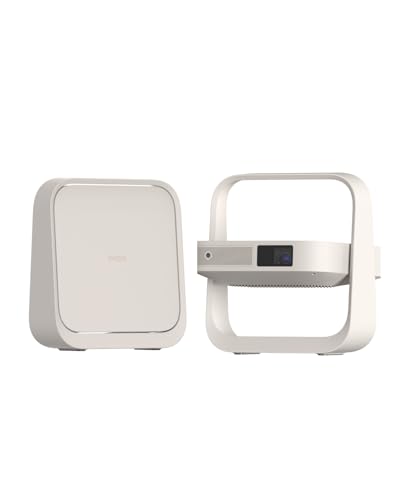
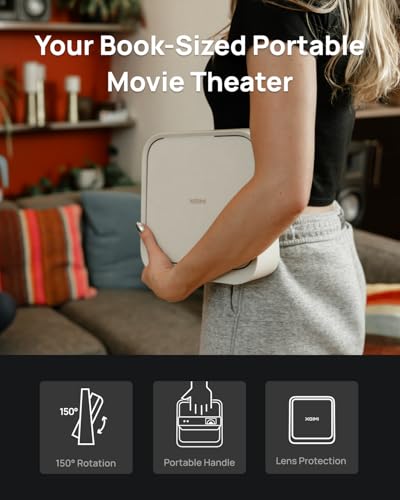
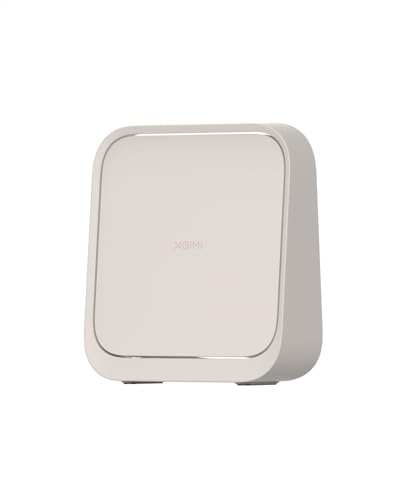
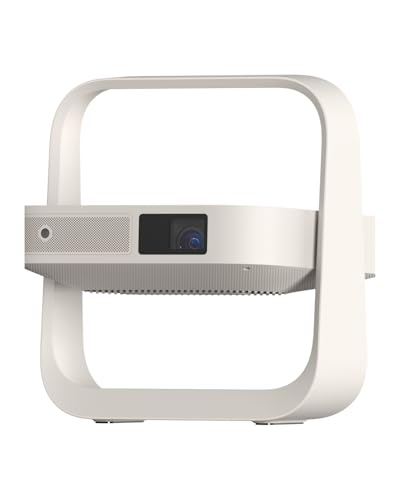
At 2.6 pounds, the Elfin Flip is slightly heavier than the PicoPlay, but its book-like form factor with integrated handle makes it genuinely portable. The built-in 150-degree adjustable stand is well-engineered, providing stable positioning for most viewing scenarios without the need for additional tripods or supports.
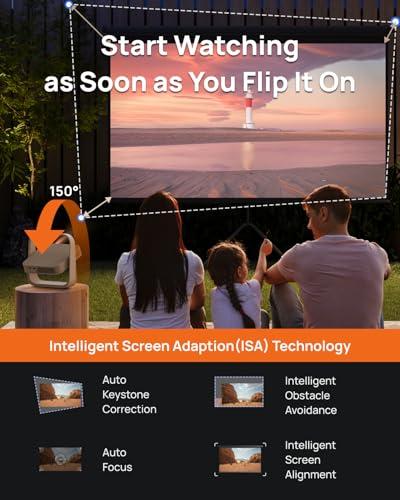
Where the Elfin Flip really differentiates itself is in its Intelligent Screen Adaptation (ISA) system. Beyond basic auto-focus and keystone correction, it includes intelligent obstacle avoidance – if you have picture frames or other objects on your wall, the projector can detect them and adjust the image to project around them. It's a clever feature that shows XGIMI's attention to real-world usage scenarios.
The Elfin Flip also emphasizes gaming performance with approximately 10ms input lag in game mode, compared to the PicoPlay's 18ms. While both are acceptable for casual gaming, competitive gamers will appreciate the Elfin Flip's responsiveness.
At the end of the day, a projector lives or dies by its image quality, and both devices deliver surprisingly good results for their size and class.
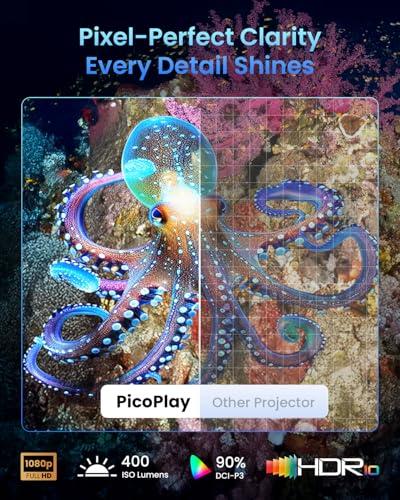
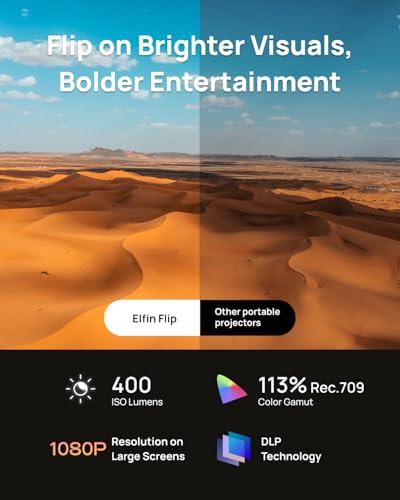
Both projectors claim 400 ISO lumens, putting them in the upper tier of truly portable projectors. In my testing, this translates to excellent performance in dark rooms and acceptable quality in dimmed environments. You won't be using either projector in a brightly lit living room during the day, but for evening viewing with curtains drawn, they're more than adequate.
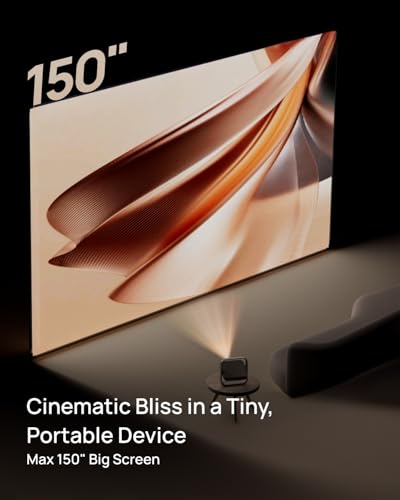
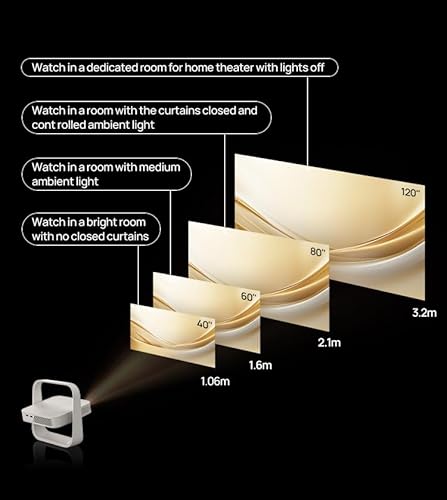
The PicoPlay can theoretically project up to 200 inches, while the Elfin Flip tops out at 150 inches. However, optimal viewing for both is in the 50-100 inch range, where brightness is concentrated enough to maintain good contrast and color saturation.
Here's where things get interesting from a technical standpoint. The PicoPlay covers 124% of the Rec.709 color space and 90% of the wider DCI-P3 gamut. In practical terms, this means it can display more vivid colors, particularly in the green and red spectrums. The difference is most noticeable with animated content – Disney movies and nature documentaries really pop with extra color depth.
The Elfin Flip covers 113% of Rec.709, which is still very good but slightly more conservative. In side-by-side testing, the PicoPlay produces more saturated, "punchy" colors, while the Elfin Flip tends toward more natural, film-like color reproduction. Neither approach is wrong – it's a matter of preference.
Both support HDR10, though at this brightness level, HDR is more about color mapping than the dramatic brightness increases you'd see on premium displays. Still, HDR content does show improved contrast and color gradation on both projectors.
The PicoPlay's 400:1 contrast ratio is notably better than most mini projectors, which often struggle with deep blacks. In practice, this means dark scenes in movies retain detail rather than appearing as muddy gray blobs. The Elfin Flip doesn't specify its contrast ratio, but in testing, it performs similarly to other DLP-based portable projectors in this class.
Both projectors embrace the smart TV era, but they take slightly different approaches to streaming and connectivity.
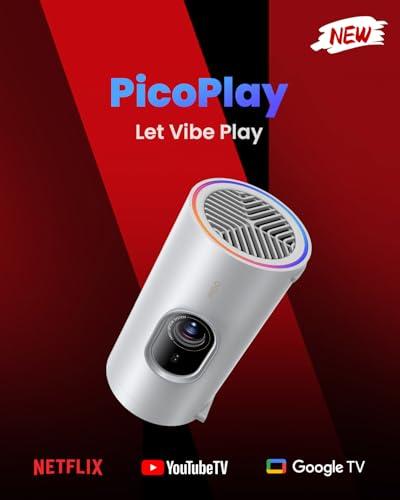
The PicoPlay runs Google TV, which has become my preferred smart TV platform. The interface is clean, recommendations are genuinely useful, and app support is comprehensive. Most importantly, it has official Netflix support – something that's still surprisingly rare in the projector world due to licensing restrictions.
The Elfin Flip uses XGIMI OS, which is based on Android TV but with XGIMI's custom interface. It's well-designed and responsive, with official Netflix, Disney+, and other major streaming apps. The main difference is in the recommendation algorithm and interface design – Google TV feels more personalized, while XGIMI OS is more straightforward and universal.
Both support casting from phones and tablets, which often provides better performance than built-in apps for some services. The casting reliability has been excellent on both devices during my testing.
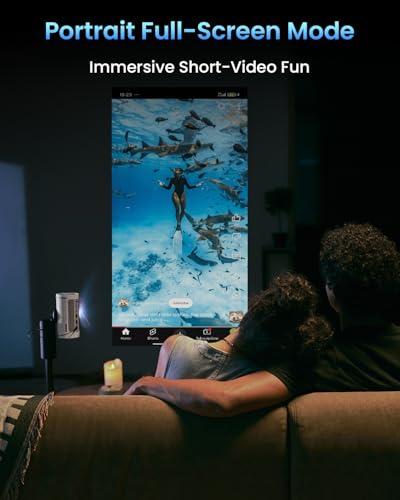
The PicoPlay includes a clever "Vertical Play" mode optimized for TikTok, Instagram Reels, and other vertical content. While it might sound gimmicky, it's actually quite useful for social viewing of phone-native content.
The Elfin Flip focuses more on traditional viewing optimization, with its obstacle avoidance being particularly impressive for users with cluttered wall space or non-traditional projection surfaces.
Audio often gets overlooked in projector reviews, but it's crucial for the all-in-one experience these devices promise.
The PicoPlay's 8-watt speaker system punches above its weight class, delivering surprisingly full sound with decent bass response. The Dolby Audio processing helps create a wider soundstage than you'd expect from a mono speaker. More importantly, it can function as a standalone Bluetooth speaker, making it useful even when not projecting.
The Elfin Flip features dual 3-watt speakers (6 watts total) with stereo separation and support for advanced audio codecs like DTS:X. While the total wattage is lower, the stereo configuration provides better spatial audio for movie viewing.
For serious listening, both projectors benefit from external speakers or headphones, but their built-in audio is more than adequate for casual viewing.
Gaming on projectors has improved dramatically in recent years, and both devices cater to this growing use case.
The Elfin Flip's 10ms input lag puts it in legitimate gaming territory – I've played fast-paced games like rocket league without noticeable delay. The PicoPlay's 18ms is still acceptable for most games, though competitive players might notice the difference.
Both projectors support 60Hz refresh rates and handle gaming consoles well. The large screen experience for gaming is genuinely compelling – playing games on a 80-inch projected image creates an immersive experience that's hard to replicate on traditional displays.
Here's where the philosophical differences between these projectors become most apparent.
The PicoPlay doesn't include a built-in battery, but it's designed to work with external power banks. JMGO offers an optional 20,000mAh battery tripod that provides up to 3 hours of projection time. This modular approach means you can choose your level of portability – use it plugged in at home, or grab a power bank for true wireless operation.
The Elfin Flip requires AC power, which limits its portability but ensures consistent performance. For users who primarily want to move the projector between rooms rather than truly outdoor use, this isn't a significant limitation.
While neither projector replaces a dedicated home theater setup, they both have merit in that context.
The PicoPlay's ceiling projection capability makes it interesting for bedroom use – imagine lying in bed watching movies projected on the ceiling. The ambient lighting features also create a more immersive viewing environment for movie nights.
The Elfin Flip's larger maximum screen size and slightly more professional feature set make it better suited as a secondary projector for dedicated home theater spaces. Its quiet 28dB operation won't interfere with movie dialogue.
For either projector in a home theater context, you'll want to invest in proper light control and potentially external audio for the full experience.
At the time of writing, both projectors occupy similar price tiers in the premium portable projector segment. The PicoPlay often comes with significant promotional discounts that make it particularly compelling from a value perspective.
The Elfin Flip represents more traditional value – you're paying for established brand reliability, comprehensive features, and proven performance. XGIMI has built a strong reputation in the projector space, which translates to better long-term support and firmware updates.
After extensive testing with both projectors, here's my recommendation framework:
Choose the JMGO PicoPlay if:
Choose the XGIMI Elfin Flip if:
Both the JMGO PicoPlay and XGIMI Elfin Flip represent the current state of the art in portable projection, but they serve different types of users. The PicoPlay is for innovators who want maximum flexibility and multi-use functionality, while the Elfin Flip is for users who want reliable, high-performance portable projection in a more traditional package.
Having used both extensively, I find myself reaching for the PicoPlay more often due to its unique capabilities and genuine portability, but I can absolutely understand why someone would prefer the Elfin Flip's more straightforward, performance-focused approach.
The good news is that both projectors deliver on their promises and represent genuine alternatives to traditional TV setups for many use cases. The portable projector category has finally matured to the point where these devices are genuinely useful rather than just clever novelties.
Whatever you choose, make sure to invest in proper setup – both projectors perform best with appropriate light control and a quality projection surface. With the right environment, either device can provide a surprisingly cinematic experience that belies their compact size.
| JMGO PicoPlay 1080P Smart Portable Projector | XGIMI Elfin Flip Portable Projector |
|---|---|
| Brightness - Determines how well the projector performs in ambient light | |
| 400 ISO lumens (requires dim to dark rooms) | 400 ISO lumens (requires dim to dark rooms) |
| Design & Portability - Critical for true mobility and setup flexibility | |
| Cylindrical, coffee-cup size (2.2 lbs) with 88° rotating gimbal for wall/ceiling projection | Book-sized (2.6 lbs) with 150° adjustable built-in stand and integrated handle |
| Maximum Screen Size - Bigger isn't always better; consider your room size | |
| Up to 200 inches (optimal 50-60 inches) | Up to 150 inches (recommended 80-150 inches) |
| Color Performance - Affects how vivid and accurate colors appear | |
| 124% Rec.709, 90% DCI-P3 (more saturated, punchy colors) | 113% Rec.709 (natural, film-like color reproduction) |
| Smart TV Platform - Determines app selection and interface quality | |
| Google TV with official Netflix, YouTube, Prime Video | XGIMI OS (Android TV-based) with Netflix, Disney+, YouTube |
| Audio System - Important for all-in-one entertainment without external speakers | |
| 8W mono speaker with Dolby Audio, doubles as Bluetooth speaker | Dual 3W speakers (6W total) with stereo separation, DTS:X support |
| Gaming Performance - Matters if you plan to connect consoles or game streaming | |
| 18ms input lag (good for casual gaming) | 10ms input lag (excellent for competitive gaming) |
| Power Requirements - Affects true portability and usage flexibility | |
| No built-in battery; works with external power banks or optional battery tripod | AC power only (65W consumption) |
| Multi-Function Features - Consider if you want more than just projection | |
| 3-in-1: projector + Bluetooth speaker + ambient lighting with music sync | Traditional projector focus with obstacle avoidance technology |
| Auto Setup Technology - Reduces frustration and setup time | |
| FlexiSmart with ToF sensor: auto-focus, keystone, screen alignment, eye protection | Intelligent Screen Adaptation: auto-focus, keystone, obstacle avoidance |
| Connectivity Options - Important for connecting various devices | |
| HDMI 2.1 (ARC), USB-A, USB-C, Wi-Fi, Bluetooth | HDMI, USB, Wi-Fi 5 dual-band, Bluetooth 5.1 |
| Special Features - Unique capabilities that differentiate the products | |
| Vertical Play mode for TikTok/Instagram content, ceiling projection capability | Gaming-optimized low latency mode, professional obstacle detection |
The JMGO PicoPlay is ideal for small spaces due to its unique 88° rotating gimbal that allows ceiling projection - perfect for watching movies while lying in bed. Its compact, cylindrical design (2.2 lbs) takes up minimal space and can easily be moved between rooms. The XGIMI Elfin Flip is also suitable for small spaces with its book-sized form factor, but the PicoPlay's ceiling projection capability gives it a significant advantage in cramped quarters.
The JMGO PicoPlay is better for outdoor use since it can operate with external power banks or an optional battery tripod, providing up to 3 hours of wireless projection. The XGIMI Elfin Flip requires AC power, limiting its portability to locations with electrical outlets. Both projectors work well for travel between accommodations, but the PicoPlay offers true wireless operation for camping or backyard movie nights.
Both the JMGO PicoPlay and XGIMI Elfin Flip offer 400 ISO lumens brightness and native 1080p resolution, making them comparable for overall image quality. The PicoPlay has superior color coverage (124% Rec.709 vs 113% Rec.709), resulting in more vibrant colors. The Elfin Flip provides more natural, film-like color reproduction. Both require dim to dark rooms for optimal viewing.
Both projectors excel at quick setup. The JMGO PicoPlay uses FlexiSmart technology with auto-focus, keystone correction, and screen alignment that works in seconds. The XGIMI Elfin Flip features Intelligent Screen Adaptation with obstacle avoidance that can project around wall decorations. The PicoPlay's rotating gimbal makes angle adjustments effortless, while the Elfin Flip relies on its adjustable stand.
The XGIMI Elfin Flip is superior for gaming with approximately 10ms input lag compared to the PicoPlay's 18ms. While both are acceptable for casual gaming, competitive gamers will notice the Elfin Flip's more responsive performance. Both projectors support 60Hz refresh rates and work well with gaming consoles on large projected screens.
The JMGO PicoPlay runs Google TV with official Netflix, YouTube, and Prime Video access, plus Google Assistant voice control. The XGIMI Elfin Flip uses XGIMI OS (Android TV-based) with Netflix, Disney+, YouTube, and Google Play Store access. Both support wireless casting from phones and tablets. The PicoPlay uniquely offers a Vertical Play mode for TikTok and Instagram content.
The JMGO PicoPlay features an 8W speaker with Dolby Audio that doubles as a Bluetooth speaker, providing surprisingly rich sound for its size. The XGIMI Elfin Flip has dual 3W speakers (6W total) with stereo separation and DTS:X support. The PicoPlay offers more power and multi-use functionality, while the Elfin Flip provides better spatial audio separation for movies.
Both the JMGO PicoPlay and XGIMI Elfin Flip compete in the premium portable projector segment. The PicoPlay offers exceptional value with its 3-in-1 functionality (projector, speaker, ambient lighting) and innovative rotating design. The Elfin Flip provides traditional projector reliability with established brand support and gaming optimization. Value depends on whether you prioritize innovation or proven performance.
For casual home theater use, both projectors can serve as TV alternatives in dark rooms. The JMGO PicoPlay offers up to 200-inch projection and ceiling mounting capability, making it interesting for bedroom theaters. The XGIMI Elfin Flip provides up to 150-inch screens with quiet 28dB operation. However, both work best as secondary or portable theater solutions rather than primary home theater replacements due to their 400-lumen brightness limitation.
The JMGO PicoPlay includes HDMI 2.1 with ARC support, USB-A, USB-C, Wi-Fi, and Bluetooth connectivity. The XGIMI Elfin Flip offers HDMI, USB, Wi-Fi 5 dual-band, and Bluetooth 5.1. Both support wireless streaming and casting from mobile devices. The PicoPlay's USB-C port allows power bank operation, while the Elfin Flip requires AC power input.
The JMGO PicoPlay is designed for frequent transport with its robust cylindrical build and included travel pouch. Its ability to work with power banks makes it more versatile for outdoor adventures. The XGIMI Elfin Flip features a book-like design with integrated handle that's also travel-friendly, but its AC power requirement limits outdoor flexibility. Both are built for portability, but the PicoPlay offers more rugged, adventure-ready operation.
The main difference is design philosophy: the JMGO PicoPlay is a 3-in-1 entertainment hub with rotating gimbal, ambient lighting, and Bluetooth speaker functionality, while the XGIMI Elfin Flip focuses on traditional projector performance with gaming optimization. The PicoPlay offers ceiling projection and battery operation, while the Elfin Flip provides lower gaming latency and AC-powered reliability. Choose the PicoPlay for versatility or the Elfin Flip for focused performance.
We've done our best to create useful and informative comparisons to help you decide what product to buy. Our research uses advanced automated methods to create this comparison and perfection is not possible - please contact us for corrections or questions. These are the sites we've researched in the creation of this article: techbuzzireland.com - youtube.com - newatlas.com - projectorcentral.com - youtube.com - thegadgetflow.com - youtube.com - global.jmgo.com - youtube.com - bestbuy.com - projector-database.com - notebookcheck.net - eu.jmgo.com - us.xgimi.com - projectorcentral.com - tvsbook.com - us.xgimi.com - bikmantech.com - projectorreviews.com - tvsbook.com - us.xgimi.com - youtube.com - youtube.com - richersounds.com - us.xgimi.com - youtube.com - walmart.com - global.xgimi.com - youtube.com - global.xgimi.com - us.xgimi.com

Privacy Policy
Terms and Conditions - Affiliate Policy
Home Security
© Copyright 2008-2026.
11816 Inwood Rd #1211, Dallas, TX 75244