


If you're considering ditching your TV for the big-screen experience, you've probably discovered that projectors come in wildly different flavors. Today's market splits between sleek, modern lifestyle projectors and traditional home cinema workhorses—each taking completely different approaches to filling your wall with entertainment.
The JMGO N1S Pro 4K and Epson Home Cinema 1080 perfectly illustrate this divide. Released in 2024 and 2020 respectively, they represent two distinct philosophies about what a home projector should be. One prioritizes cutting-edge convenience and image quality, while the other focuses on proven performance at an accessible price point.
Home projectors have evolved dramatically over the past decade. The category now splits into lifestyle projectors—compact units designed to move around your home easily—and dedicated home cinema projectors built for permanent installation in theater rooms.
The key factors that matter most are image quality (how sharp and vibrant the picture looks), brightness (how well it performs in different lighting conditions), installation flexibility (how easy it is to set up and position), and value (what you get for your money over time).
Brightness gets measured in lumens, with ANSI lumens being the most reliable standard. Think of lumens like the wattage of a light bulb—more lumens mean the projector can overcome ambient light better. For context, a dim movie theater runs around 14 lumens per square meter on the screen, while your living room might need 30-50 lumens per square meter to look good with some lights on.
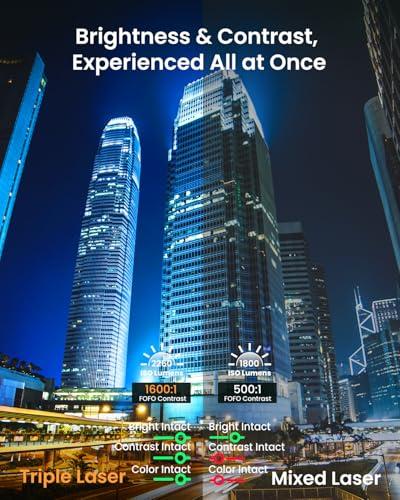
Contrast ratio describes the difference between the darkest blacks and brightest whites a projector can produce. Higher contrast makes images look more three-dimensional and realistic, especially in darker scenes.
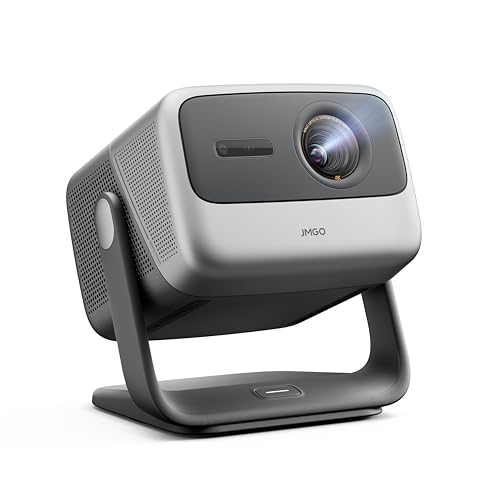
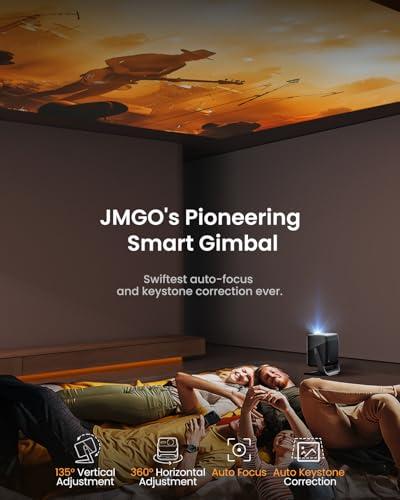
The JMGO N1S Pro 4K represents everything that's exciting about modern projector technology. Released in 2024, it packs true 4K resolution into a surprisingly compact package that weighs less than 10 pounds. But its real innovation lies in the gimbal mount system—imagine a smartphone gimbal, but for your projector.
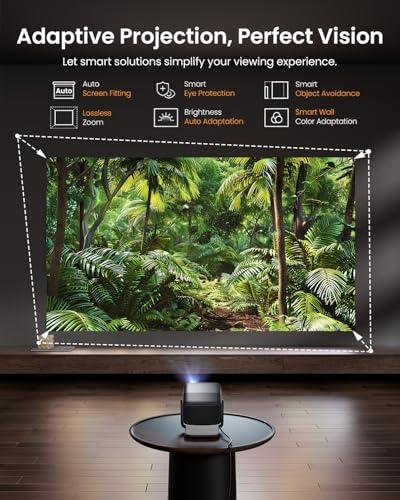
This gimbal allows 360-degree horizontal rotation and 135-degree vertical tilt, meaning you can project onto your wall, ceiling, or even outside onto a fence without moving the base unit. The projector automatically focuses itself, corrects keystone distortion (when the image looks like a trapezoid instead of a rectangle), and even detects if someone walks in front of the beam and dims the laser for eye safety.
The 4K resolution (3840×2160 pixels) provides four times the detail of standard 1080p. On screen sizes over 100 inches, this difference becomes immediately obvious—text looks crisp, and fine details in movies stay sharp instead of turning into pixelated mush.
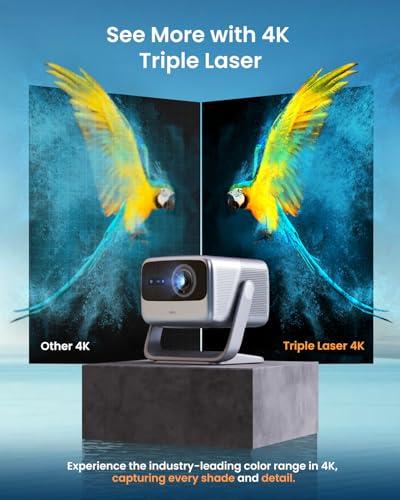
The JMGO uses what they call "MALC 2.0 triple color laser optics," which sounds marketing-heavy but actually delivers meaningful benefits. Traditional projectors use a single white light source that gets filtered into colors, losing brightness in the process. This triple laser system uses separate red, green, and blue lasers, maintaining full brightness while achieving 110% of the BT.2020 color space—a technical way of saying colors look more vibrant and saturated than most competing projectors.
Based on professional reviews and user feedback, the JMGO produces images that immediately grab your attention with their color vibrancy, though pixel-level accuracy isn't quite reference-monitor perfect. For most content, especially HDR movies and streaming shows, this translates to a more engaging viewing experience even if it wouldn't satisfy a professional colorist.
Unlike many projectors that treat smart features as an afterthought, the JMGO N1S Pro 4K runs Google TV natively—the same operating system found in many modern TVs. This means direct access to Netflix, Disney+, Prime Video, and thousands of other apps without needing external streaming devices.
The built-in 20-watt stereo speakers deserve special mention. Most projector speakers sound thin and tinny, but these deliver surprisingly full sound with actual bass response down to 45Hz. You won't mistake them for a dedicated sound system, but they're genuinely usable for casual viewing—something you can't say about most projector audio.
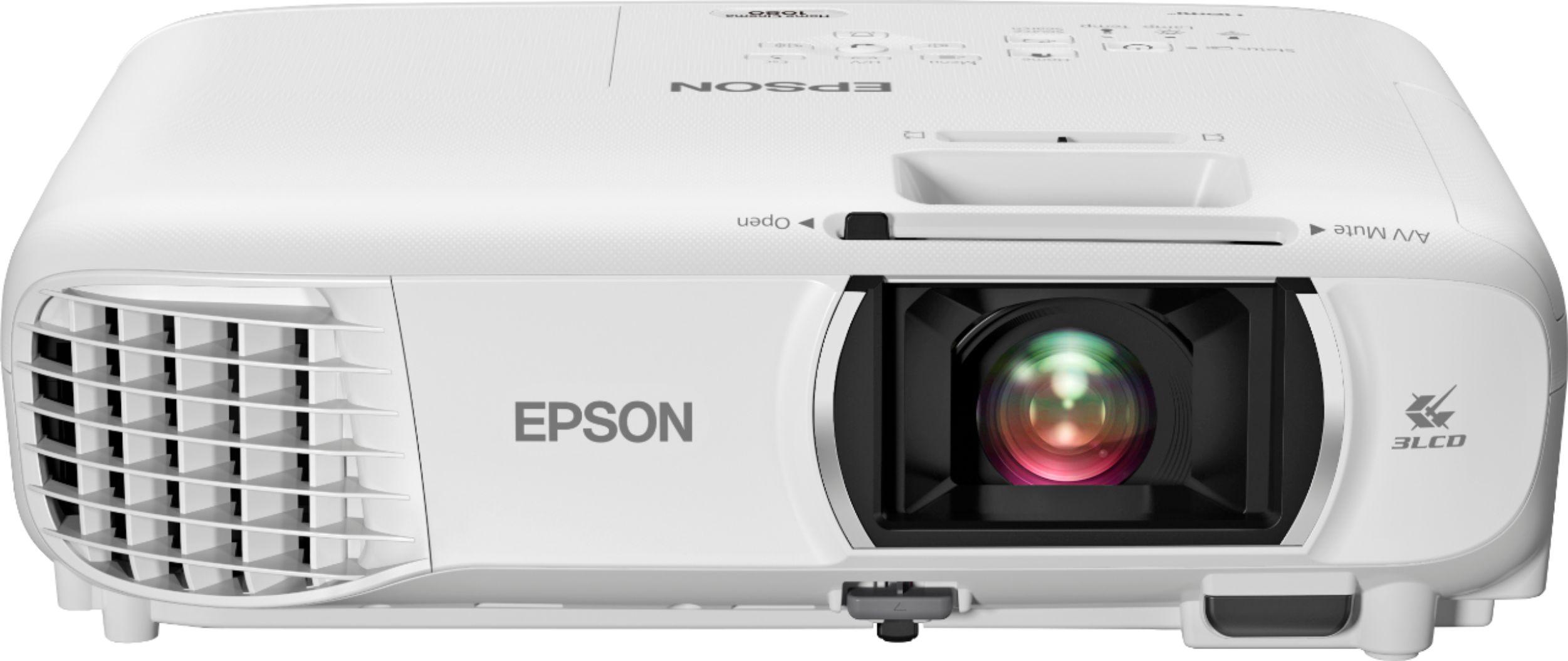
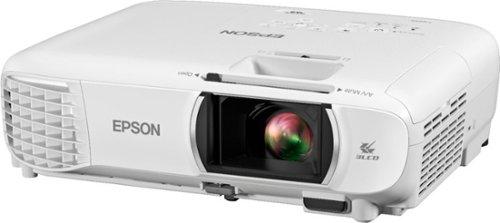
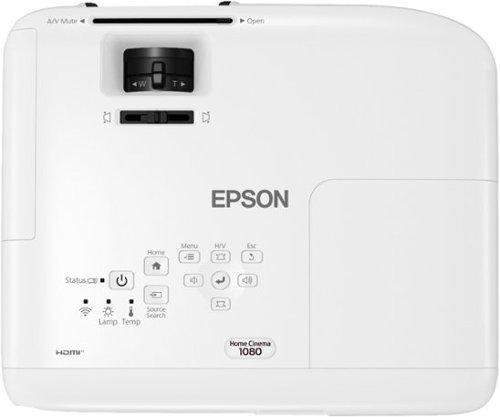
The Epson Home Cinema 1080, released in 2020, takes the opposite approach. Instead of chasing the latest features, it focuses on delivering reliable, bright 1080p images at an extremely competitive price point—at the time of writing, significantly less expensive than the JMGO.
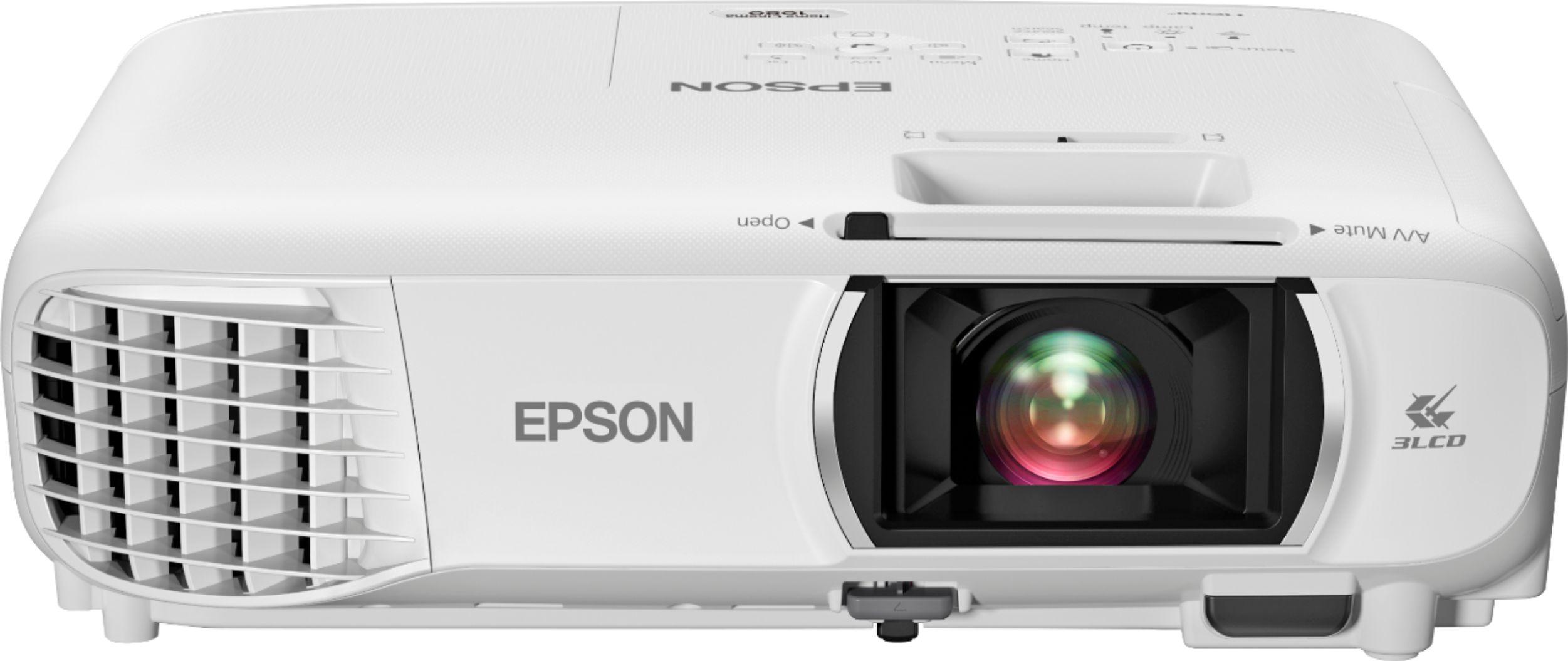
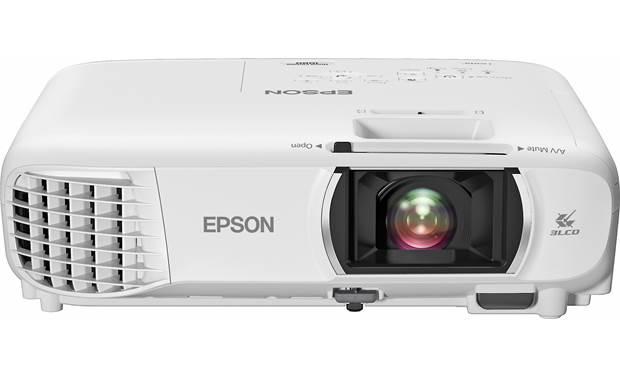
Epson's 3LCD technology represents a mature, proven approach to projection. Unlike single-chip DLP projectors that create colors by spinning a color wheel thousands of times per second, 3LCD splits white light into separate red, green, and blue paths through dedicated LCD panels. This eliminates the "rainbow effect" (brief flashes of rainbow colors) that some people notice with DLP projectors and typically provides more accurate color reproduction.
The most impressive spec on the Epson Home Cinema 1080 is its 3,400 lumens of brightness—both color and white brightness, which is important since some manufacturers only spec white brightness. This level of brightness means you can watch comfortably with room lights on, during the day with curtains drawn, or drive truly massive screen sizes.
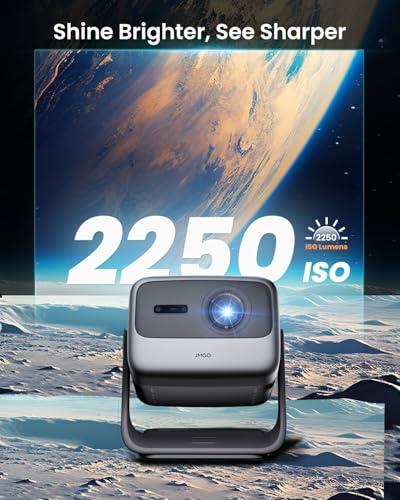
To put this in perspective: the JMGO claims 2,400 ANSI lumens but typically measures closer to 1,200-1,500 lumens in accurate color modes according to professional reviews. That difference matters significantly if you're planning to watch in anything brighter than a dim room or want to go beyond 120-inch screen sizes.
The Epson also achieves up to 16,000:1 contrast ratio through dynamic iris control—the projector automatically adjusts its aperture based on scene content, closing down for darker scenes to achieve deeper blacks. While this isn't as seamless as native contrast, it's effective for most content.
Where the JMGO innovates with its gimbal system, the Epson Home Cinema 1080 provides traditional installation flexibility through 1.2x optical zoom and comprehensive keystone correction. Optical zoom means you can adjust image size without moving the projector—crucial for permanent ceiling installations where you need to hit an exact screen size.
The Epson supports image sizes from 30 to 300 inches, with the upper end being genuinely usable thanks to its high brightness. Many projectors claim large image sizes but become too dim to be enjoyable; the Epson maintains watchable brightness even at 200+ inch sizes in dark rooms.
The 4K advantage of the JMGO N1S Pro 4K becomes most apparent with specific content types. Streaming 4K movies from Netflix, Disney+, or Apple TV+ show significantly more detail than their 1080p counterparts. Text overlays, fine textures, and architectural details maintain sharpness that would blur together at 1080p resolution.
However, much broadcast TV, cable content, and older movies remain 1080p or lower resolution. For this content, both projectors perform similarly, with the Epson's superior brightness often providing a more impactful viewing experience.
Gaming presents an interesting case: modern consoles output 4K, but the JMGO maxes out at 60Hz refresh rates while some competitive gamers prefer higher refresh rates available on gaming monitors. Neither projector targets serious competitive gaming, but both handle casual console gaming well.
Professional reviews consistently show that claimed brightness figures often exceed measured performance, particularly in accurate color modes. The JMGO delivers impressive brightness for its size class but can't match dedicated home theater projectors like the Epson.
In practice, this means the JMGO works best in controlled lighting—think movie night with blackout curtains or evening viewing with just a few ambient lights. The Epson Home Cinema 1080 handles significantly more ambient light, making it suitable for family rooms where you might watch during the day or with multiple light sources on.
The 20-watt stereo speakers in the JMGO genuinely change how you can use the projector. They provide enough volume and bass response for most content, eliminating the immediate need for external speakers. The spatial separation creates a reasonably convincing soundstage for movies and shows.
The Epson's 2-watt mono speaker is essentially unusable for anything beyond menu navigation. You'll need external speakers, a soundbar, or a full surround system—which isn't necessarily bad if you're planning a dedicated theater room anyway.
Projector ownership costs extend beyond the initial purchase. Traditional lamp-based projectors like the Epson require lamp replacements every 6,000-12,000 hours of use, with replacement lamps typically costing several hundred dollars at the time of writing.
The JMGO's laser light source should last 30,000+ hours without replacement—essentially the lifetime of the projector for most users. This shifts more cost upfront but eliminates ongoing maintenance expenses.
For the Epson, you'll also need to budget for a streaming device (since its smart features are basic) and audio system. The JMGO includes these capabilities built-in, making total system costs more predictable.
For traditional home theaters with controlled lighting, permanent seating, and ceiling-mounted installation, the Epson Home Cinema 1080 makes compelling sense. Its high brightness enables larger screen sizes, the 1.2x zoom simplifies installation, and the lower upfront cost leaves budget for a proper audio system and seating.
The lack of 4K becomes less noticeable in dedicated dark rooms where you're primarily watching movies rather than detailed content like sports statistics or gaming interfaces.
The JMGO N1S Pro 4K excels in living rooms, family rooms, and spaces that serve multiple purposes. The gimbal system means you can quickly reposition for different activities—movie night on the main wall, sports on the side wall, or even ceiling projection for unique viewing experiences.
Its compact size and attractive design don't dominate the room when not in use, unlike traditional projectors that often require hiding in ceiling recesses.
Since the Epson's 2020 release, projector technology has advanced significantly. Laser light sources have become more affordable and prevalent, 4K resolution has moved from premium to mainstream, and smart TV integration has become expected rather than novel.
The JMGO represents current-generation thinking about what consumers want from projectors: convenience, quality, and integration over raw specifications alone. Its 2024 release incorporates learnings about how people actually use portable projectors in real homes.
Meanwhile, traditional manufacturers like Epson continue refining proven technologies. 3LCD remains excellent for color accuracy and brightness, while their manufacturing scale keeps costs competitive for budget-conscious buyers.
You want a modern, convenient solution that works well in various rooms and lighting conditions. The 4K resolution future-proofs your investment for streaming content, while the gimbal system and built-in features minimize setup complexity. At the time of writing, it represents excellent value for buyers who prioritize convenience and image quality over maximum brightness.
The JMGO suits households that primarily stream content, want flexibility in projector placement, and value the simplicity of an all-in-one solution. It's particularly appealing for apartment dwellers or anyone who might need to move their setup frequently.
You're building a dedicated theater room, need maximum brightness for large screens or bright rooms, or want to minimize upfront costs while building a system gradually. The Epson's proven 3LCD technology and exceptional brightness make it ideal for permanent installations where you can add components over time.
This approach works best for buyers who already own audio systems, don't mind connecting external streaming devices, and prioritize screen size and brightness over cutting-edge resolution.
These projectors solve different problems excellently. The JMGO N1S Pro 4K brings home projection into the smartphone era—intuitive, feature-rich, and designed around how people actually live. The Epson Home Cinema 1080 delivers traditional home theater performance with no compromises on brightness or screen size potential.
Your choice ultimately depends on whether you value modern convenience and 4K future-proofing, or traditional strengths like maximum brightness and flexibility for large installations. Both represent solid value propositions in their respective categories at the time of writing, just for very different use cases and preferences.
For most people setting up their first projector system, the JMGO offers a more complete and satisfying initial experience. For dedicated enthusiasts building permanent installations, the Epson provides a solid foundation that can grow with additional components over time.
| JMGO N1S Pro 4K | Epson Home Cinema 1080 |
|---|---|
| Resolution - Future-proofing for streaming and gaming content | |
| True 4K (3840×2160) with 10-bit color processing | Full HD (1920×1080) with 10-bit color processing |
| Brightness - Critical for room lighting flexibility and screen size | |
| 2,400 ANSI lumens claimed (measures ~1,200-1,500 in accurate modes) | 3,400 lumens color and white brightness (reliable for bright rooms) |
| Display Technology - Affects color accuracy and rainbow effects | |
| Single DLP chip with RGB triple color laser | 3LCD technology with UHE lamp |
| Contrast Ratio - Determines depth and detail in dark scenes | |
| 1,600:1 native contrast | Up to 16,000:1 dynamic contrast with iris control |
| Installation Flexibility - How easily you can position and adjust | |
| 360° gimbal system with auto-focus and keystone correction | 1.2x optical zoom with ±30° keystone correction |
| Light Source Lifespan - Long-term maintenance costs | |
| 30,000+ hour laser (no replacements needed) | 6,000-12,000 hour UHE lamp (replacement required) |
| Image Size Range - Maximum screen sizes supported | |
| 85" - 180" diagonal | 30" - 300" diagonal |
| Smart Features - Built-in streaming and connectivity | |
| Google TV with native Netflix, Wi-Fi 6, Google Assistant | Basic Wi-Fi with Miracast (requires external streaming devices) |
| Audio System - Whether external speakers are necessary | |
| 20W stereo speakers with Dolby Digital Plus | 2W mono speaker (external audio required) |
| Connectivity Options - Device compatibility and future-proofing | |
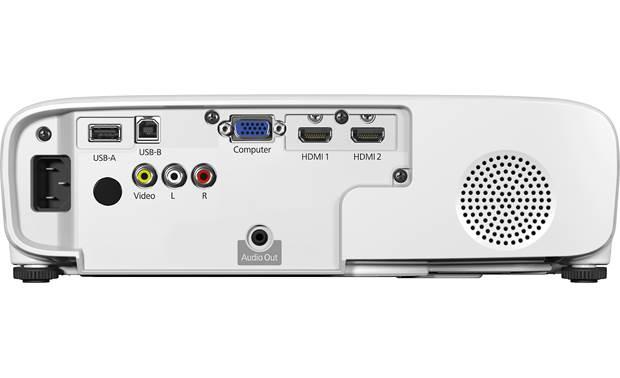
| 2× HDMI 2.1 (one with eARC), USB-A, Bluetooth 5.2 | 2× HDMI, VGA, composite, USB Type-A and Type-B |
| Physical Design - Portability and room aesthetics | |
| Compact 8"×9"×9", 9.9 lbs with modern aesthetic | Traditional 11.9"×9.9"×3.6", 6.2 lbs design |
| Noise Level - Important for quiet movie watching | |
| <26 dB (whisper quiet) | 28-37 dB depending on lamp mode |
| Color Performance - Vibrancy vs accuracy trade-offs | |
| 110% BT.2020 color gamut (vibrant but less accurate) | 3LCD accurate color reproduction (natural tones) |
| 3D Support - Bonus feature for compatible content | |
| Full HD 3D including Blu-ray 3D | Not specified in available documentation |
For dedicated home theaters with controlled lighting, the Epson Home Cinema 1080 is typically the better choice due to its superior brightness (3,400 lumens) and larger screen size capability (up to 300 inches). However, if you want 4K resolution and modern smart features, the JMGO N1S Pro 4K offers better future-proofing with streaming apps built-in.
The primary difference is resolution and approach: the JMGO N1S Pro 4K delivers true 4K resolution with modern lifestyle features like a gimbal mount and Google TV, while the Epson Home Cinema 1080 focuses on bright 1080p performance at a budget-friendly price point for traditional home theater setups.
The Epson Home Cinema 1080 performs significantly better in bright rooms with its 3,400 lumens of brightness compared to the JMGO N1S Pro 4K's measured 1,200-1,500 lumens in accurate color modes. The Epson can handle ambient lighting and daytime viewing much more effectively.
The JMGO N1S Pro 4K includes impressive 20W stereo speakers that work well for most viewing, eliminating the immediate need for external audio. The Epson Home Cinema 1080 has only a basic 2W mono speaker, so you'll definitely need external speakers or a sound system.
The JMGO N1S Pro 4K is much easier to set up and reposition thanks to its compact size, gimbal mount system, and automatic focus/keystone correction. The Epson Home Cinema 1080 is designed for permanent installation and requires manual adjustments when moved.
The JMGO N1S Pro 4K uses a laser light source rated for 30,000+ hours with no replacements needed. The Epson Home Cinema 1080 uses a traditional UHE lamp lasting 6,000-12,000 hours, requiring periodic lamp replacements that add to long-term costs.
The Epson Home Cinema 1080 supports much larger screens, from 30 to 300 inches, and its high brightness makes even 200+ inch screens viable in dark rooms. The JMGO N1S Pro 4K is limited to 85-180 inch screens due to its lower brightness and fixed focal length.
Yes, the JMGO N1S Pro 4K runs Google TV with native Netflix, Disney+, Prime Video, and thousands of other apps built-in. The Epson Home Cinema 1080 has basic Wi-Fi but requires external streaming devices like Apple TV or Roku for most streaming services.
Image quality depends on your priorities: the JMGO N1S Pro 4K delivers sharper 4K resolution with vibrant colors, while the Epson Home Cinema 1080 offers more accurate colors, deeper contrast (16,000:1 vs 1,600:1), and better performance in bright conditions.
Both projectors handle gaming well for casual use. The JMGO N1S Pro 4K supports 4K gaming at 60Hz with modern HDMI 2.1 connectivity, while the Epson Home Cinema 1080 provides 1080p gaming with good brightness for competitive visibility. Neither targets serious competitive gaming.
The JMGO N1S Pro 4K offers better long-term value for most users due to its laser light source (no lamp replacements), built-in smart features, and 4K future-proofing. The Epson Home Cinema 1080 has lower upfront costs but requires additional components and lamp replacements over time.
Choose the JMGO N1S Pro 4K if you watch streaming content, want future-proofing, and prefer screens under 150 inches. Choose the Epson Home Cinema 1080 if you prioritize brightness, want screens over 200 inches, or are building a traditional home theater where resolution matters less than screen size and brightness.
We've done our best to create useful and informative comparisons to help you decide what product to buy. Our research uses advanced automated methods to create this comparison and perfection is not possible - please contact us for corrections or questions. These are the sites we've researched in the creation of this article: techradar.com - projectorcentral.com - gray9.in - projectorreviews.com - howtogeek.com - the-gadgeteer.com - projectorcentral.com - global.jmgo.com - global.jmgo.com - cnet.com - cnet.com - youtube.com - global.jmgo.com - avsforum.com - youtube.com - youtube.com - crutchfield.com - bestbuy.com - officedepot.com - bestbuy.com - bestbuy.com - audioholics.com - rtings.com - avsforum.com - projectorcentral.com - audiogeneral.com - projectorreviews.com - rtings.com - epson.com - youtube.com - epson.com - projectorreviews.com - projectorreviews.com - walmart.com - shop.avispl.com - bhphotovideo.com - staples.com - mediaserver.goepson.com - staples.com - bhphotovideo.com - epson.com - epson.com - dell.com - epson.com - bestbuy.com

Privacy Policy
Terms and Conditions - Affiliate Policy
Home Security
© Copyright 2008-2026.
11816 Inwood Rd #1211, Dallas, TX 75244