

The world of home entertainment has undergone a remarkable transformation in recent years, with portable projectors emerging as versatile alternatives to traditional TVs. Today's models are a far cry from the dim, cumbersome projectors of the past. Modern portable projectors like the Anker Nebula Mars 3 and Epson EpiqVision Mini EF22 pack impressive brightness, sharp resolution, and smart features into increasingly compact packages.
These technological marvels serve multiple purposes beyond simple movie watching. From creating impromptu backyard cinema experiences to delivering business presentations, gaming on an enormous screen, or even taking your entertainment on camping trips—portable projectors have become multimedia Swiss Army knives for the digital age.
When evaluating portable projectors, several key factors determine whether a particular model will suit your needs. Brightness (measured in lumens) dictates how visible the image will be in various lighting conditions. Resolution affects image clarity and detail. Portability considers weight, size, and battery capability. Other crucial elements include connectivity options, smart features, audio quality, and of course, price point.
The Anker Nebula Mars 3 and Epson EpiqVision Mini EF22 represent two premium approaches to portable projection, each with distinct philosophies and strengths. Released in 2023 and 2022 respectively, these projectors incorporate the latest advancements in projection technology while targeting slightly different user priorities. Let's explore how these two competitors stack up across the features that matter most.
The portable projector market spans from budget options under $200 to premium units exceeding $1,500. The Anker Nebula Mars 3 and Epson EpiqVision Mini EF22 both occupy the premium segment, with nearly identical price points:
This pricing places both projectors well above entry-level options but still significantly below the cost of high-end home theater projectors that can run several thousand dollars. For context, traditional home theater projectors with comparable brightness often start around $700, but rarely include the smart features, portability, or versatility these units offer.
While similarly priced, these projectors represent different approaches to portable projection. Anker, known for mobile accessories and portable electronics, has designed the Mars 3 with true mobility in mind. Epson, with decades of experience in the projector market, has created the EF22 as more of a stylish, movable home entertainment device rather than a rugged portable.
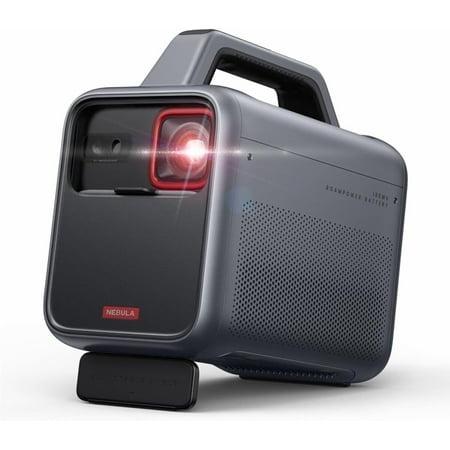
The Anker Nebula Mars 3 was released in early 2023 as the successor to Anker's popular Mars II series. Its design philosophy clearly prioritizes durability and true portability. The projector features a robust rectangular shape with rounded corners and an integrated carrying handle that makes transportation intuitive.
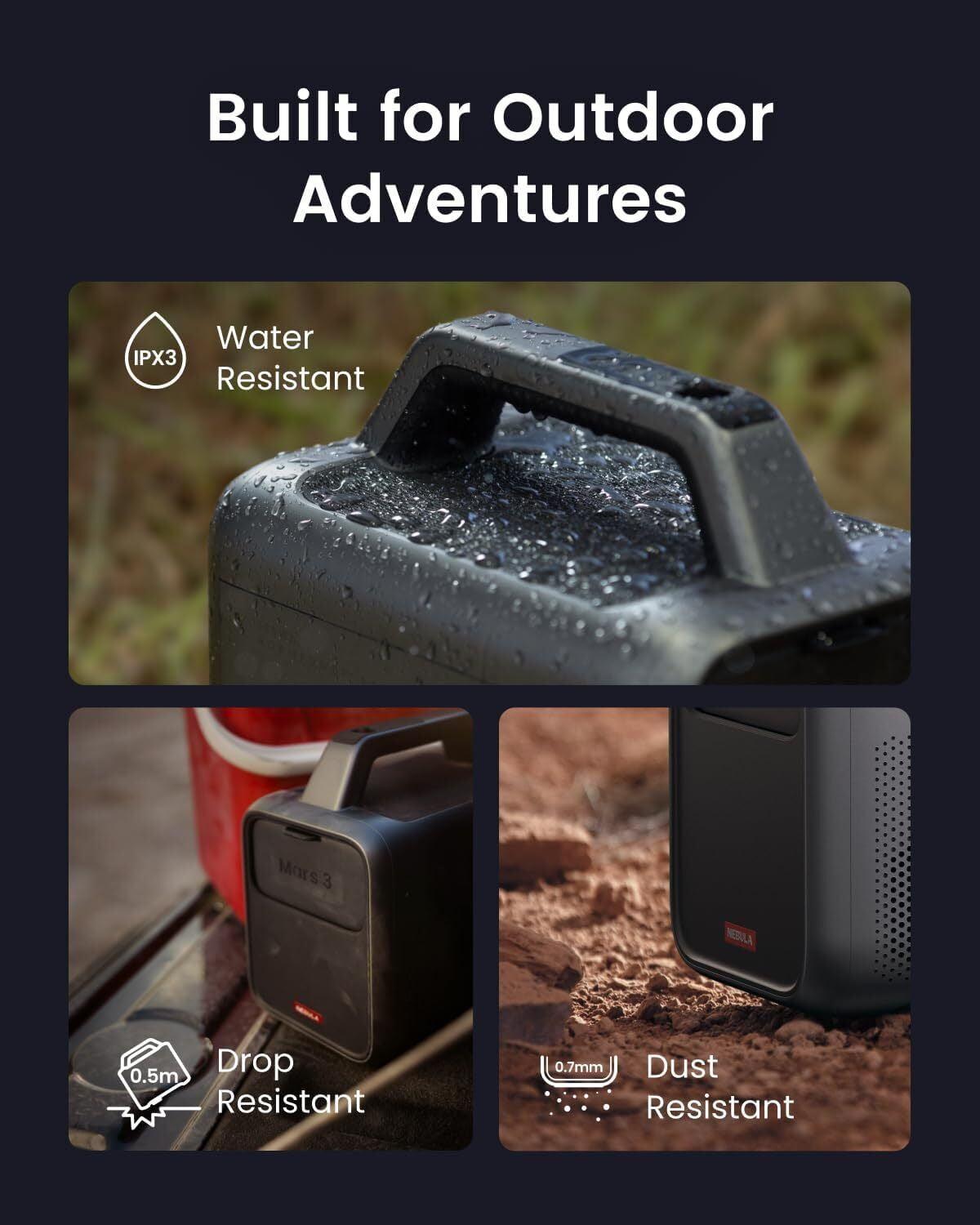
Weighing 9.9 pounds, it's not ultralight, but the weight reflects its substantial battery capacity and speaker system. The exterior showcases Anker's outdoor-ready approach with an IPX3 water resistance rating (meaning it can withstand light water spray from any direction), drop resistance up to 0.5 meters, and dust resistance to particles as small as 0.7mm. These ruggedization features represent significant improvements over previous Mars models that lacked formal water and dust protection.
The projector's dimensions (6.3" x 10.2" x 9.8") make it roughly the size of a small cooler—compact enough to take on adventures but large enough to house serious projection hardware and batteries. The design clearly communicates its intended use: a projector you can confidently take anywhere.
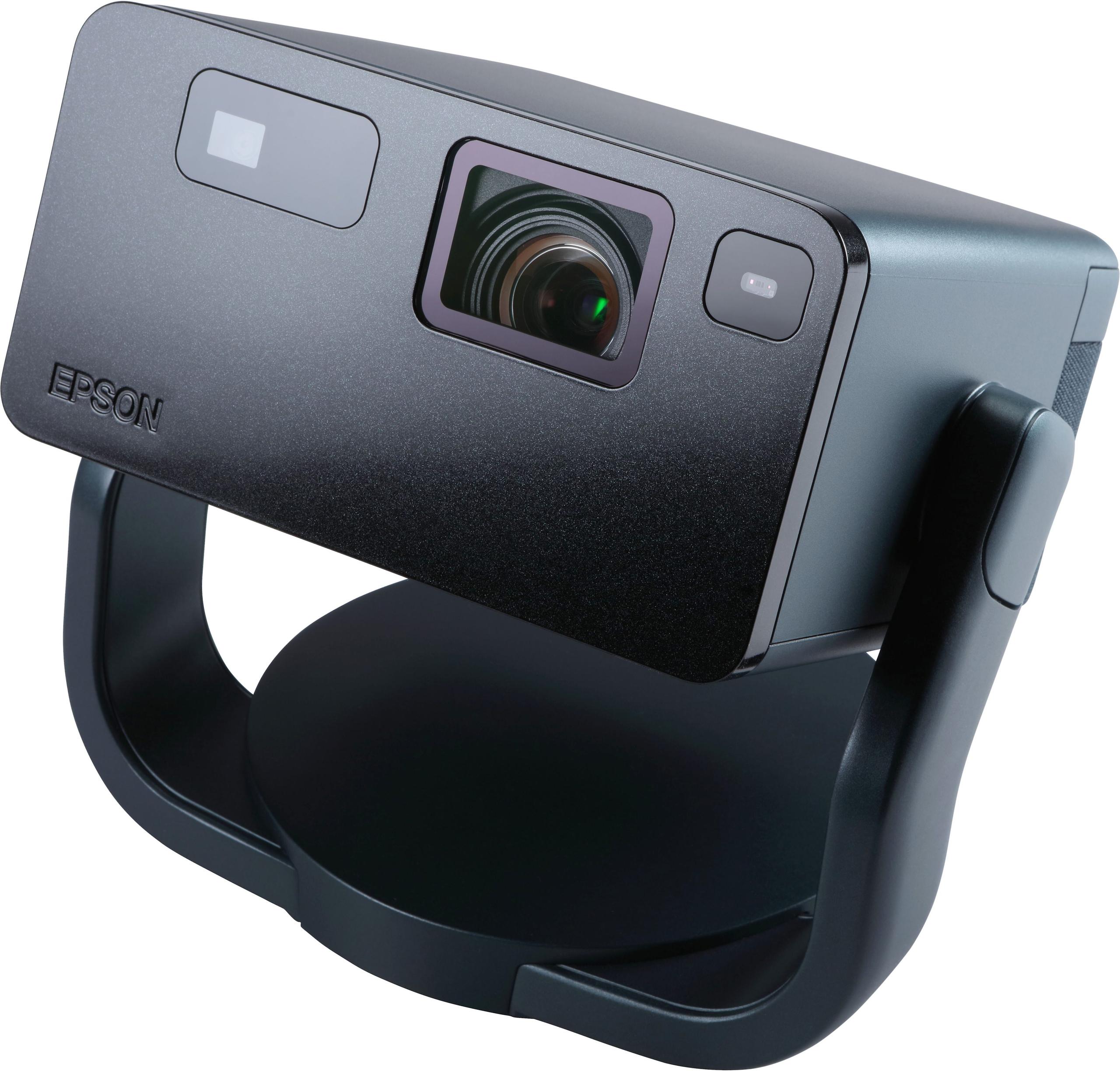
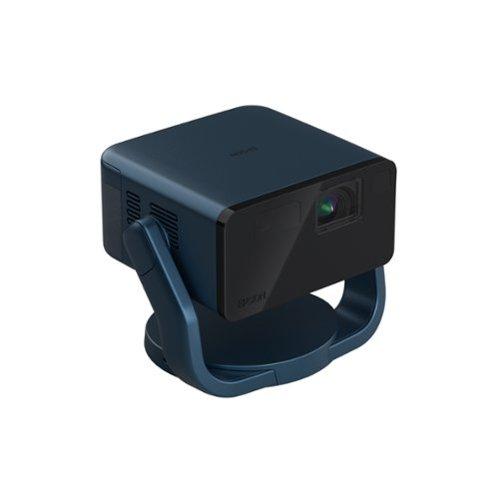
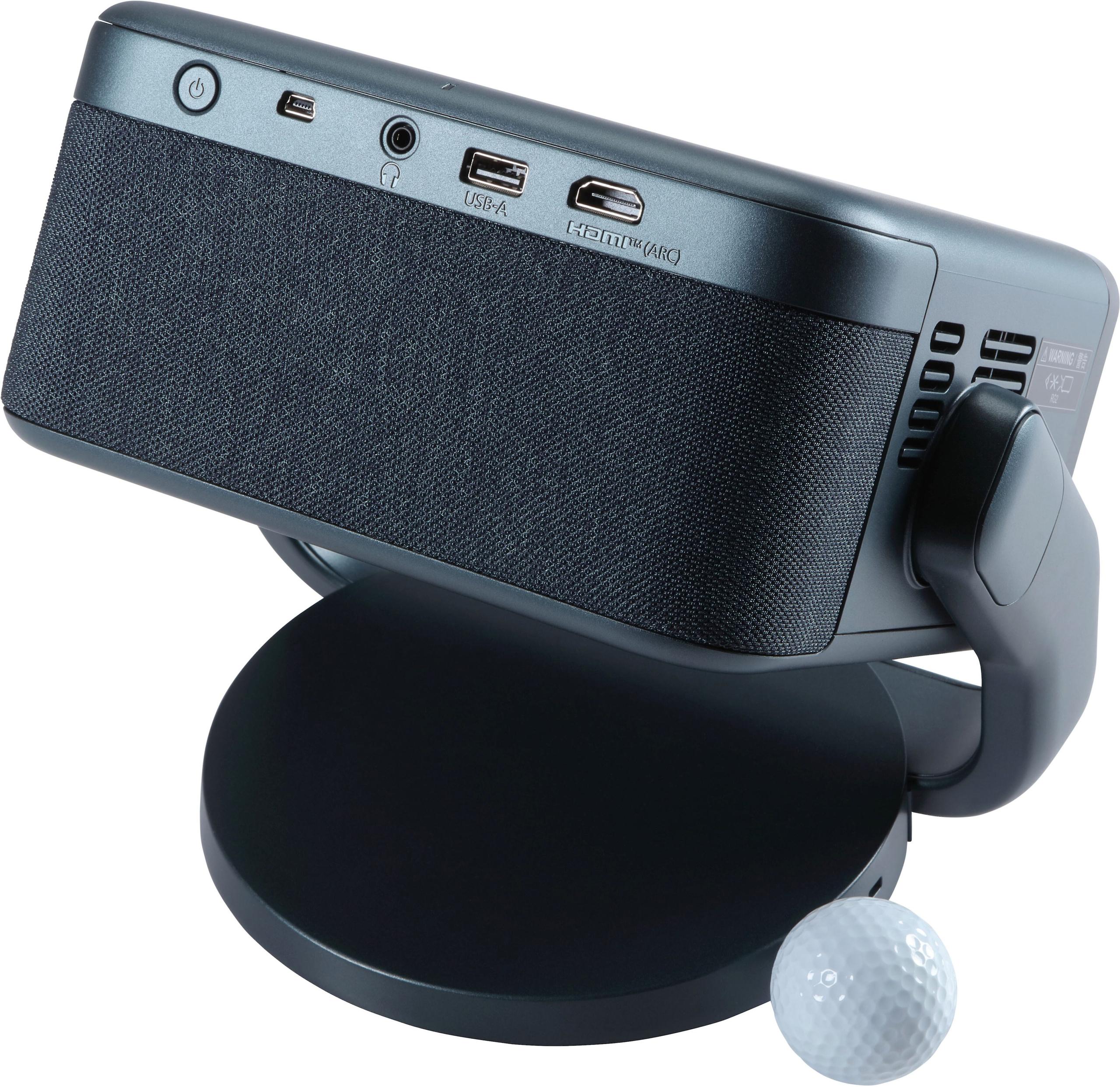
Released in late 2022, the Epson EpiqVision Mini EF22 takes a decidedly different approach to portability. Its design is more fashion-forward and home-oriented, with a cylindrical form factor available in multiple colors including the signature Stone Blue.
At 6.6 pounds, it's significantly lighter than the Mars 3, making it easier to move between rooms. Its dimensions (9.3" x 7.5" x 7.5") create a compact footprint that fits easily on shelves, coffee tables, or nightstands. The EF22 doesn't include weatherproofing or ruggedization features, clearly positioning it as an indoor device that can move between spaces rather than an outdoor adventure companion.
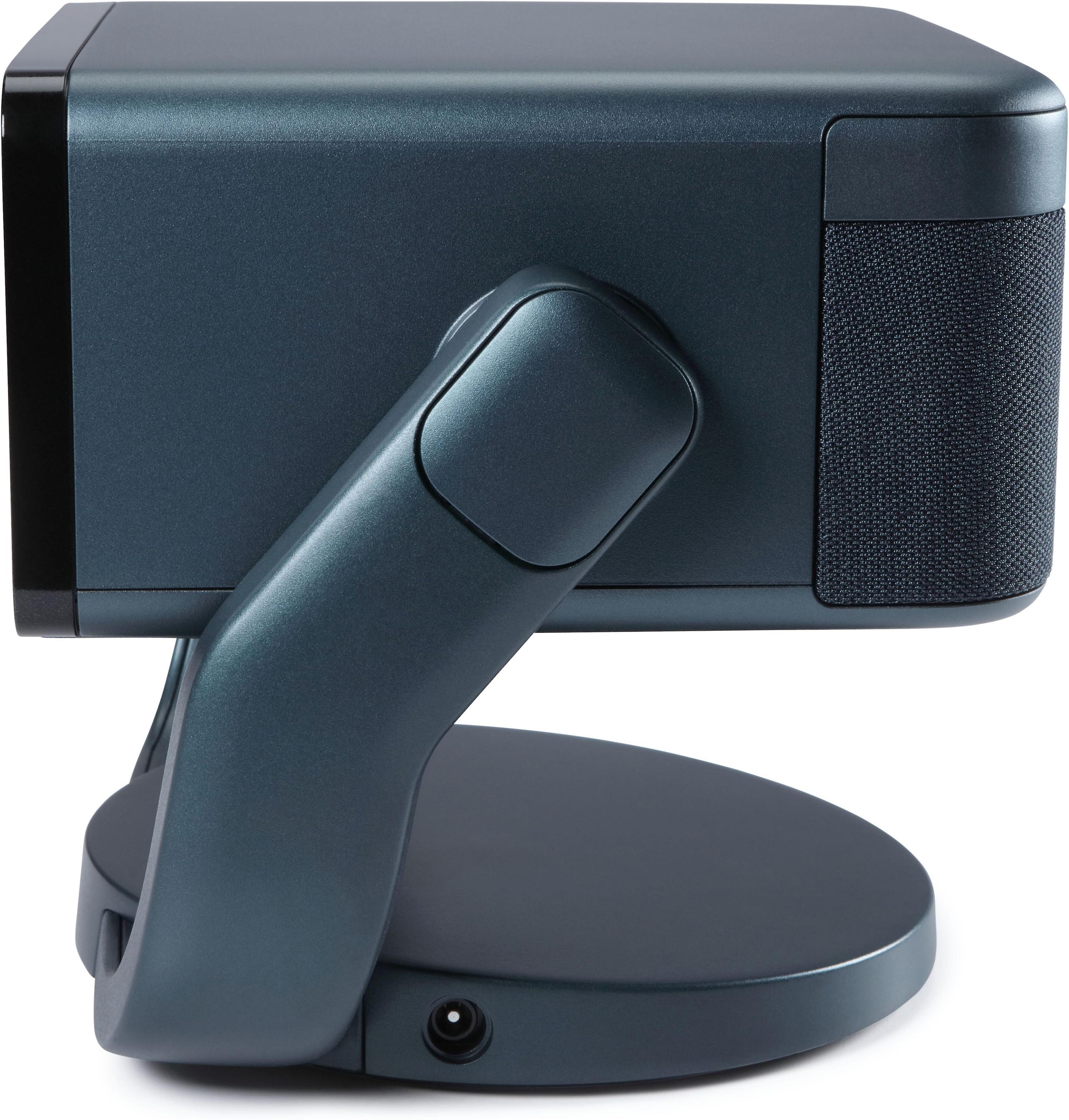
The EF22's standout design element is its innovative 360-degree rotatable stand. This allows the projector to cast images in virtually any direction—from standard front projection to ceiling projection for bedtime viewing—a flexibility the Mars 3 can't match without accessories.
Key Difference: The Mars 3 is built for outdoor adventures with weather resistance, while the EF22 prioritizes stylish aesthetics and flexible indoor placement. Your choice depends largely on where you plan to use your projector most frequently.
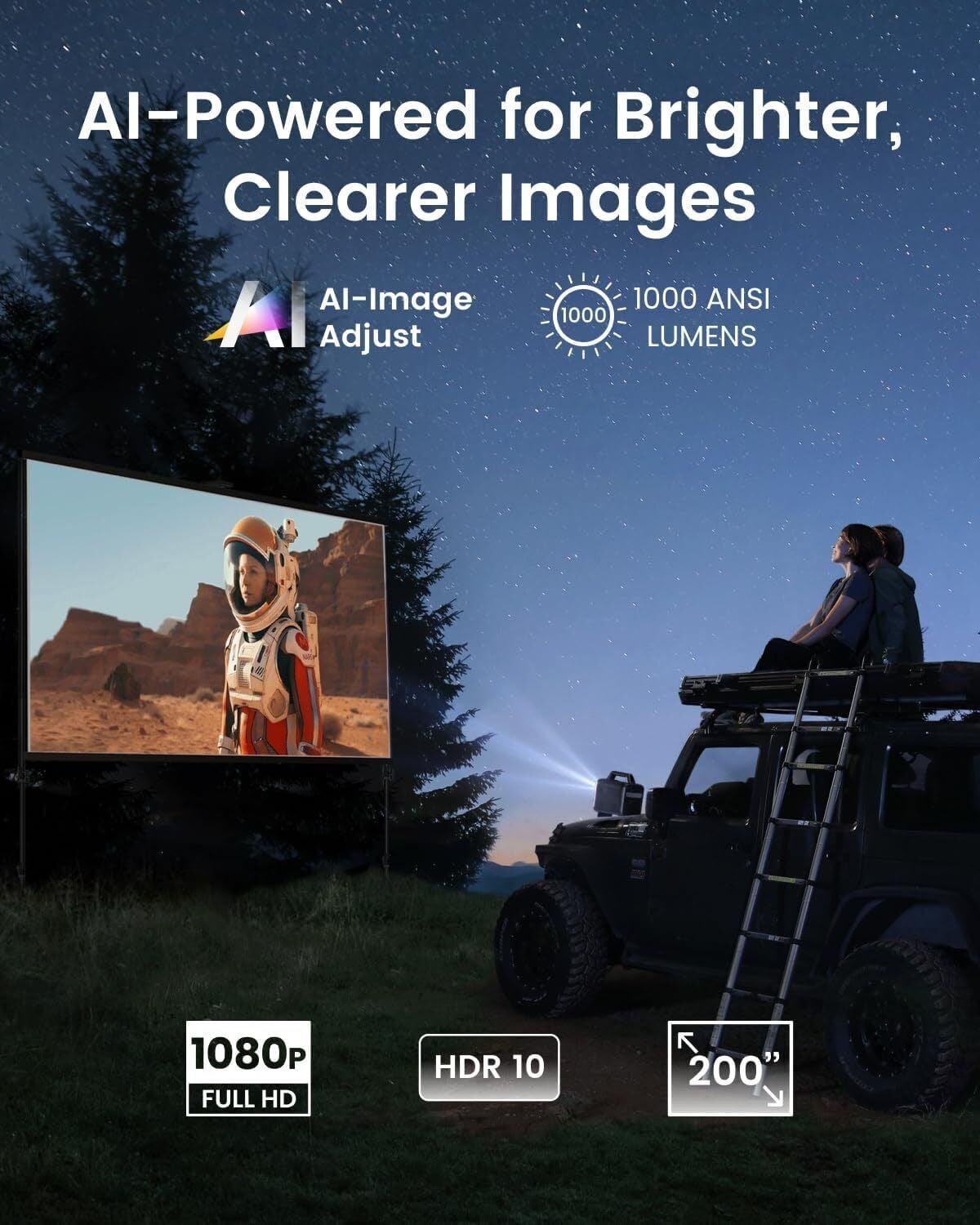
Brightness is perhaps the most crucial factor in projector performance, as it determines how visible your content will be in different lighting conditions. Both projectors advertise 1000 lumens, but their different technologies affect real-world performance.
The Nebula Mars 3 delivers 1000 ANSI lumens through an LED light source. ANSI lumens is a standardized measurement that tends to be more reliable than generic "lumens" claims. LED projection technology offers instant on/off capability and typically produces more vibrant colors than traditional lamp projectors.
The Mars 3's LED light source has an estimated 25,000-hour lifespan, which translates to over 10 years of daily use at 6 hours per day. It supports HDR10 (High Dynamic Range) content, which expands the range of brightness and color the projector can display.
A unique feature of the Mars 3 is its AutoBright AI technology, which uses sensors to detect ambient light conditions and automatically adjust brightness for optimal viewing. This is particularly valuable for outdoor use where lighting conditions can change rapidly as the sun sets.
The EpiqVision Mini EF22 also claims 1000 lumens brightness but uses Epson's proprietary 3LCD laser technology. Unlike single-chip DLP projectors that use a color wheel, 3LCD technology uses three separate LCD panels (one each for red, green, and blue) to produce colors simultaneously. This approach eliminates the "rainbow effect" (color separation artifacts) sometimes visible with DLP projectors and typically produces more accurate colors with better color brightness.
The laser light source has a slightly shorter but still impressive 20,000-hour lifespan and provides consistent brightness throughout its life, unlike lamp projectors that gradually dim. The EF22 supports both HDR10 and HLG (Hybrid Log-Gamma, another HDR format used primarily in broadcast applications).
Perhaps most impressively, the EF22 boasts a 5,000,000:1 contrast ratio, significantly higher than what the Mars 3 claims. This translates to deeper blacks and more dynamic range between the darkest and brightest parts of an image—a crucial factor for home theater applications.
In real-world use, the EF22 typically produces more accurate colors and better contrast in controlled lighting environments, while the Mars 3 might perform better in challenging lighting conditions thanks to its adaptive brightness features.
The Mars 3 can project images from 30 inches up to a massive 200 inches diagonally, with a 1.2:1 throw ratio. Throw ratio is the relationship between the distance from the projector to the screen and the width of the projected image. A 1.2:1 ratio means that for every 1.2 feet of distance, you get 1 foot of image width. This relatively short throw ratio allows for reasonably large images without requiring enormous distances.
The Mars 3 includes intelligent automatic focus and keystone correction through its "Intelligent Environment Adaptation 3.0" system. This uses sensors to automatically adjust the image within seconds of setup, making it extremely user-friendly for portable applications where quick setup is essential.
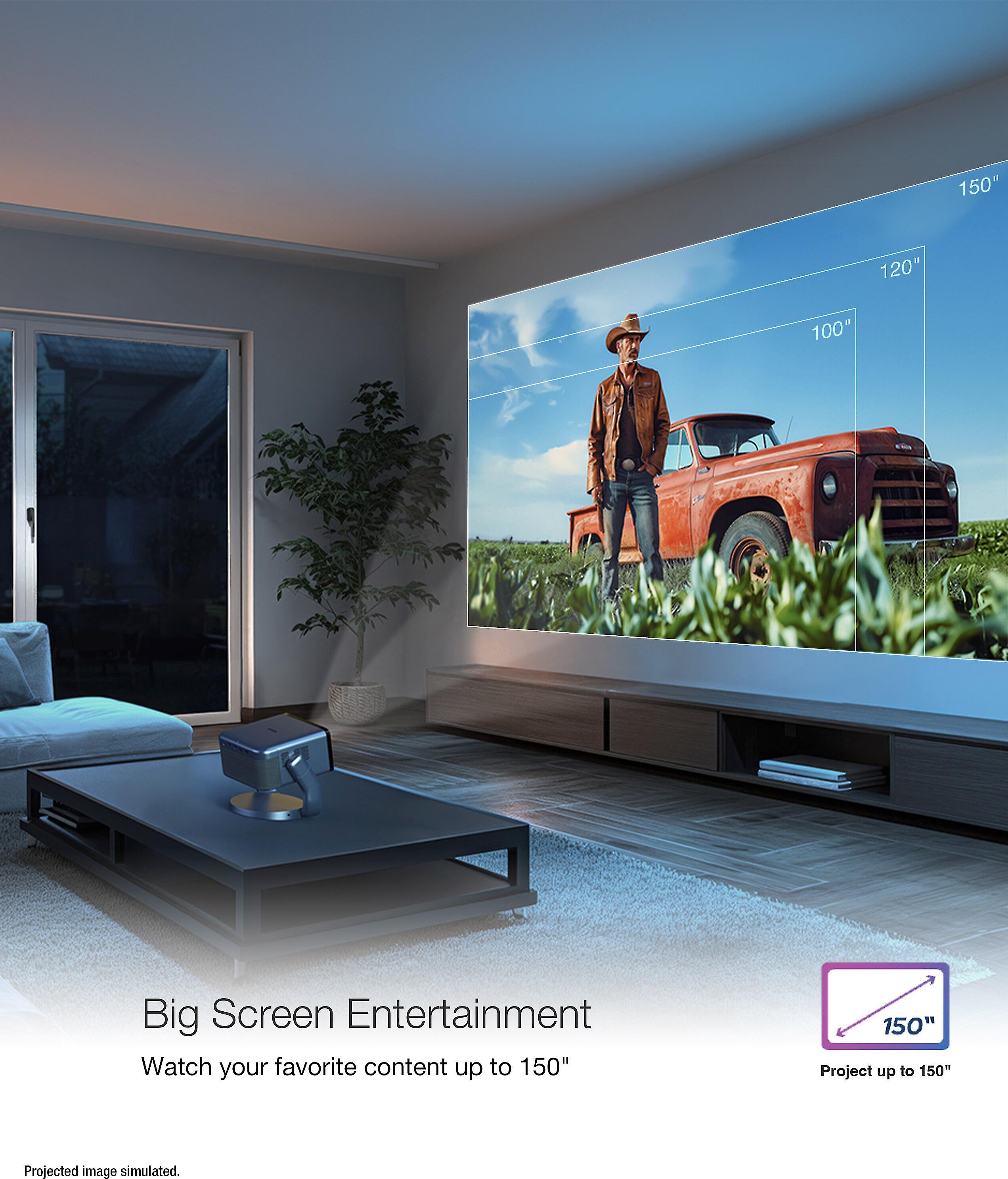
The EF22 projects images from 30 inches up to 150 inches diagonally. While this maximum size is smaller than the Mars 3's, 150 inches still creates an impressive display that dwarfs most TVs. Epson doesn't explicitly state the throw ratio, but it's comparable to the Mars 3 based on user experiences.
The EF22's EpiqSense technology handles automatic focus and keystone correction similar to the Mars 3. However, where the EF22 truly shines is its projection flexibility thanks to the 360-degree rotating stand. This allows users to project onto ceilings, adjacent walls, or even floor surfaces without needing additional mounting hardware.
Key Difference: Both projectors offer excellent automatic setup features, but the Mars 3 can project larger images (up to 200" vs 150"), while the EF22 offers greater flexibility in projection angle through its 360-degree stand. For home theater use, the EF22's superior contrast and color accuracy generally produce a more cinema-like image in controlled lighting.
This category represents perhaps the most significant functional difference between these two premium projectors.
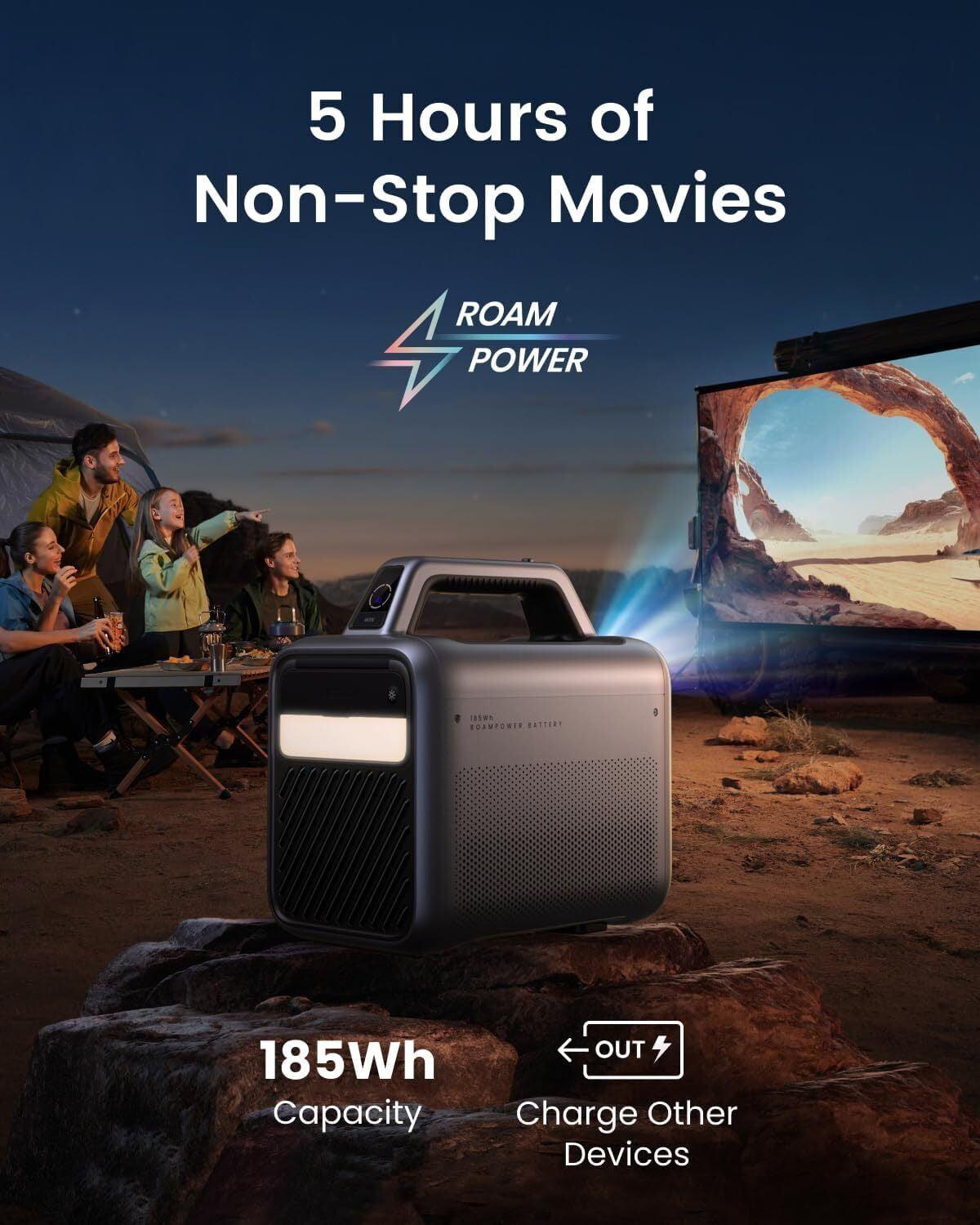
True to Anker's roots in portable power solutions, the Mars 3 includes a substantial built-in battery that provides up to 5 hours of runtime in its power-saving Eco mode or about 2 hours at full brightness. This battery life represents a significant improvement over previous Mars models and enough power for most feature films even at full brightness.
The Mars 3 can also function as a power bank, allowing you to charge phones or other devices from its USB ports—a thoughtful feature for outdoor use where power outlets may be scarce. When the battery is depleted, it can be recharged via standard AC power.
The EF22 does not include a battery and requires constant connection to AC power. This fundamental limitation defines the EF22 as a movable rather than truly portable projector. While it can be easily relocated between rooms or homes, it cannot be used in locations without power access.
Key Difference: The Mars 3's battery power enables true portable use anywhere from backyards to campsites, while the EF22 requires constant access to an electrical outlet. This single difference might be the deciding factor depending on your intended use cases.
Portable projectors need to address audio as well as visual performance since external speakers aren't always practical, especially in outdoor settings.
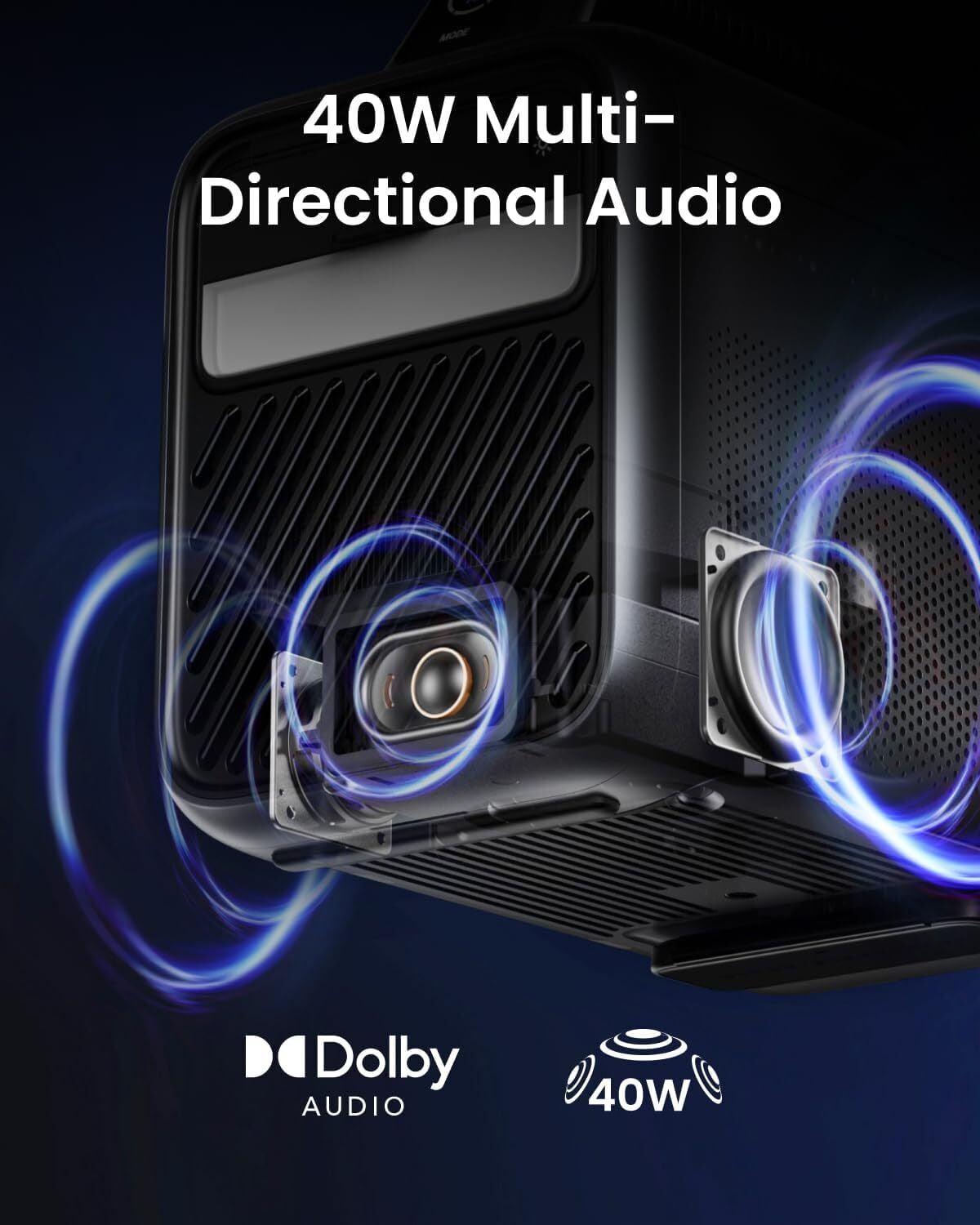
The Mars 3 features an impressive 40W 3-way speaker system with Dolby Audio support. This represents significant audio firepower for a portable device and reflects Anker's understanding that outdoor viewing often requires louder volume to overcome ambient noise. The 3-way system includes dedicated drivers for different frequency ranges, producing more balanced sound than single-driver systems.
In practical use, the Mars 3's audio is loud enough for outdoor group viewing without requiring external speakers—a significant convenience for truly portable applications.
The EF22 includes a 10W stereo speaker system (5W x 2) with Dolby Audio support. While this provides adequate sound for indoor viewing in smaller rooms, it lacks the power and range of the Mars 3's system. For home theater applications, most users would likely want to connect external speakers or a soundbar to the EF22 for a more immersive audio experience.
Key Difference: The Mars 3 offers four times the audio power of the EF22, making it much better suited for standalone use without external speakers, particularly in outdoor environments or larger indoor spaces.
Modern projectors have evolved into full entertainment platforms with smart features that eliminate the need for external streaming devices.
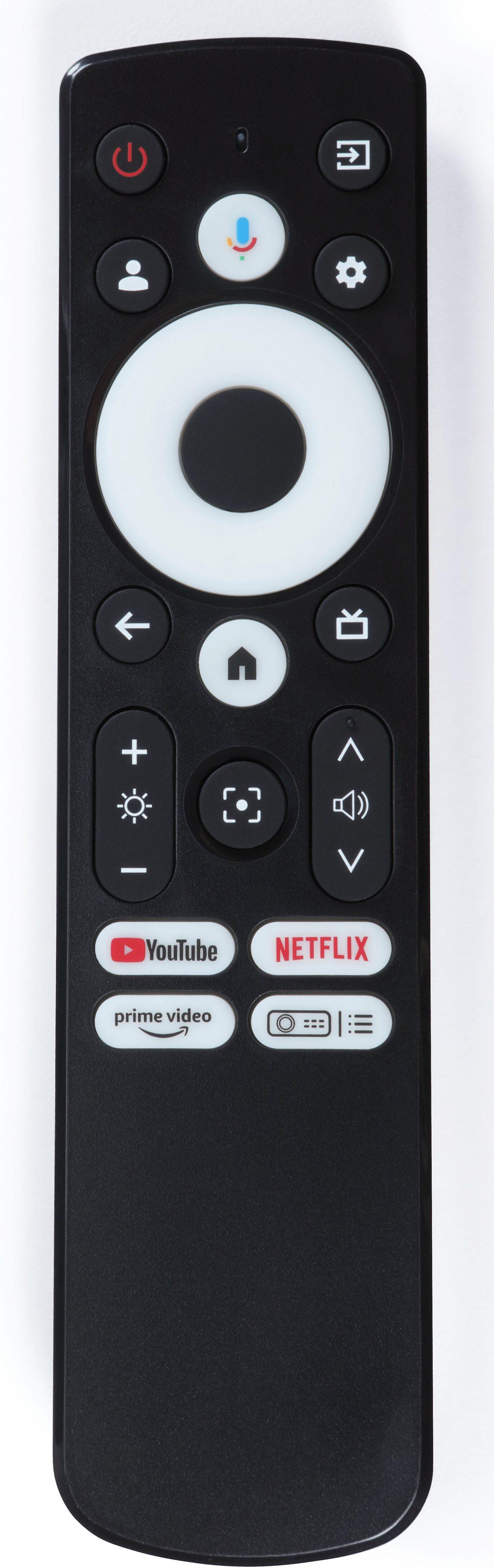
Released in 2023, the Mars 3 runs Android TV 11.0, a smart TV platform that provides access to thousands of apps through the Google Play Store, including popular streaming services like Disney+, Prime Video, and HBO Max. It should be noted that some services like Netflix often require workarounds on projectors.
The Mars 3 includes Google Assistant compatibility for voice control and Chromecast built-in for easy wireless streaming from compatible devices. Physical connectivity includes HDMI, USB-A, USB-C, and a 3.5mm audio output jack. Wireless connectivity options include dual-band Wi-Fi (2.4/5 GHz) and Bluetooth 5.1 for connecting headphones or external speakers.
The EF22 uses Google TV, which is essentially the successor to Android TV with a redesigned interface focusing more on content discovery. Like Android TV, it provides access to thousands of streaming apps and includes Google Assistant for voice control.
The EF22 supports Google Cast (similar to Chromecast) for streaming content from mobile devices. Physical connectivity includes HDMI and USB ports, while wireless options include Wi-Fi and Bluetooth 5.1, matching the Mars 3's capabilities.
Key Difference: Both projectors offer nearly identical smart features and connectivity options, with the primary difference being the underlying OS (Android TV 11.0 vs. Google TV). For most users, this difference is minimal as both platforms provide access to the same major streaming services and features.
Understanding where and how you'll use your projector is crucial for making the right choice between these two premium options.
The Mars 3 excels in scenarios that demand true portability and environmental flexibility:
The EF22 shines in more controlled, home-oriented applications:
Key Difference: The Mars 3 prioritizes go-anywhere versatility and environmental resilience, while the EF22 focuses on superior image quality and flexible viewing angles in powered indoor environments.
For dedicated home theater use, several additional factors come into play:
In a properly darkened room, the EpiqVision Mini EF22 typically produces a more cinema-like image thanks to its 3LCD laser technology and superior contrast ratio. Colors appear more accurate, and black levels are generally deeper than what the Mars 3 can achieve.
The EF22's 360-degree rotatable stand allows for creative installation options without ceiling mounts or other hardware. However, the Mars 3's longer maximum throw distance (enabling up to 200" images) might be preferable for larger home theater spaces.
For serious home theater applications, external audio is almost always preferable to built-in speakers. Both projectors accommodate external audio systems, but the EF22's focus on indoor use makes it more likely to be paired with a permanent audio setup.
The EF22 makes more sense for a fixed home theater setup given its AC power requirement and superior image quality. The Mars 3 would be the better choice if you want a projector that serves double-duty for both home theater and portable applications.
Both projectors represent significant advancements over their predecessors and the broader portable projector market.
The Anker Nebula Mars 3 improves upon previous Mars models with increased brightness (1000 ANSI lumens vs. 500 in the Mars II Pro), better battery life, higher resolution, and the addition of weatherproofing features. Its release in 2023 makes it one of the newest premium portable projectors on the market.
The Epson EpiqVision Mini EF22, released in 2022, represents Epson's push into the lifestyle projector market with laser technology previously reserved for much more expensive models. Its 3LCD laser engine in a compact form factor was revolutionary compared to previous portable projectors that relied on less capable DLP or LCD technologies.
Both projectors incorporate smart technologies that eliminate the need for external streaming devices—a significant advancement over models from just a few years ago that required HDMI connections to access streaming content.
After comparing these two premium projectors across multiple dimensions, the decision comes down to your specific needs and priorities:
Choose the Anker Nebula Mars 3 if:
Choose the Epson EpiqVision Mini EF22 if:
Both the Anker Nebula Mars 3 and Epson EpiqVision Mini EF22 deliver excellent projection experiences, but they serve different needs. The Mars 3 prioritizes go-anywhere versatility while sacrificing some image quality, whereas the EF22 focuses on superior visuals within the constraints of powered locations.
For most home theater enthusiasts, the EF22's superior image quality might be the deciding factor. However, if you envision using your projector in diverse settings both indoors and out, the Mars 3's true portability provides flexibility the EF22 simply cannot match.
Ultimately, your choice between these two excellent projectors should align with how and where you'll use them most frequently. Either way, both represent the cutting edge of what's possible in today's portable projection technology.
| Anker Nebula Mars 3 | Epson EpiqVision Mini EF22 |
|---|---|
| Price - What you'll pay for these premium portable projectors | |
| $1,000-$1,100 | $999 |
| Display Technology - Affects color accuracy, contrast, and longevity | |
| LED light source (25,000-hour lifespan) | 3LCD laser technology (20,000-hour lifespan) |
| Brightness - Determines visibility in various lighting conditions | |
| 1000 ANSI lumens with AutoBright AI adjustment | 1000 lumens (color and white) with fixed output |
| Resolution - Impacts overall image clarity and detail | |
| 1920×1080 (Full HD) with HDR10 support | 1920×1080 (Full HD) with HDR10 and HLG support |
| Contrast Ratio - Higher values produce deeper blacks and more dynamic range | |
| Not specified by manufacturer | 5,000,000:1 (significantly better black levels) |
| Projection Size - Maximum diagonal image size possible | |
| 30-200 inches | 30-150 inches |
| Battery Life - Determines cord-free usage time | |
| Up to 5 hours (Eco mode), 2 hours (Standard mode) | No battery, requires constant AC power |
| Audio System - Built-in sound quality and volume | |
| 40W 3-way speaker system with Dolby Audio | 10W (5W x 2) stereo speakers with Dolby Audio |
| Weight - Affects portability and transport ease | |
| 9.9 lbs | 6.6 lbs |
| Durability - Protection against environmental factors | |
| IPX3 water resistance, 0.5m drop resistance, dust resistance | No specific weatherproofing or ruggedization |
| Special Features - Unique capabilities that enhance usability | |
| Intelligent auto-adjustment, can function as power bank | 360-degree rotatable stand for flexible projection angles |
| Smart Platform - Software that powers streaming and apps | |
| Android TV 11.0 with Google Assistant and Chromecast | Google TV with Google Assistant and Google Cast |
| Connectivity Options - Ways to connect external devices | |
| HDMI, USB-A, USB-C, 3.5mm audio, Wi-Fi, Bluetooth 5.1 | HDMI, USB, Wi-Fi, Bluetooth 5.1 |
| Best Use Cases - Scenarios where each projector excels | |
| Outdoor viewing, camping, travel, power-free locations | Home theater, interior design-conscious spaces, ceiling projection |
The Anker Nebula Mars 3 is significantly better for outdoor movie nights thanks to its built-in battery (lasting up to 5 hours), IPX3 water resistance, and powerful 40W speakers designed for outdoor use. The Epson EpiqVision Mini EF22 requires constant AC power and lacks weatherproofing, making it unsuitable for true outdoor use. If you're planning backyard movie nights away from power outlets, the Anker Nebula Mars 3 is the clear choice.
The Epson EpiqVision Mini EF22 generally offers better image quality thanks to its 3LCD laser technology, which produces more accurate colors and significantly better contrast (5,000,000:1 ratio). The Anker Nebula Mars 3 still provides good 1080p image quality with 1000 ANSI lumens, but in controlled lighting environments, most viewers will notice the Epson EpiqVision Mini EF22's superior color reproduction and deeper blacks, especially for home theater applications.
Only the Anker Nebula Mars 3 can work without being plugged in, offering up to 5 hours of battery life in Eco mode or about 2 hours at full brightness. The Epson EpiqVision Mini EF22 has no battery and requires constant connection to an AC power outlet. This makes the Anker Nebula Mars 3 much more versatile for locations without readily available power.
For dedicated home theater setups, the Epson EpiqVision Mini EF22 typically performs better with its superior contrast ratio (5,000,000:1) and more accurate color reproduction from its 3LCD laser technology. While the Anker Nebula Mars 3 can project larger images (up to 200" vs 150") and has more powerful speakers, most home theater enthusiasts will prefer the Epson EpiqVision Mini EF22's better image quality when used in a properly darkened room.
Yes, both projectors have built-in streaming capabilities. The Anker Nebula Mars 3 runs Android TV 11.0, which provides access to thousands of apps through the Google Play Store. The Epson EpiqVision Mini EF22 uses Google TV, offering a similar range of streaming services with a more content-focused interface. Both support popular streaming platforms like Disney+, Prime Video, and HBO Max, though some services like Netflix might require workarounds.
The Anker Nebula Mars 3 offers true portability with its built-in battery and integrated carrying handle, despite being heavier (9.9 lbs vs 6.6 lbs). The Epson EpiqVision Mini EF22 is lighter and more compact but requires constant AC power, making it "movable" rather than truly portable. For taking a projector anywhere regardless of power availability, the Anker Nebula Mars 3 is much more portable.
The Anker Nebula Mars 3 has significantly better built-in speakers with its 40W 3-way speaker system compared to the Epson EpiqVision Mini EF22's 10W (5W x 2) stereo speakers. Both support Dolby Audio, but the Mars 3's speakers deliver louder, fuller sound with better bass response. For scenarios where external speakers aren't practical, the Anker Nebula Mars 3 provides a much more satisfying audio experience.
Both projectors support gaming, but have different strengths. The Anker Nebula Mars 3 offers portability for gaming sessions anywhere, while the Epson EpiqVision Mini EF22 typically provides better image quality with less input lag in fixed setups. Neither projector advertises specific gaming features like high refresh rates, but both deliver 1080p resolution suitable for casual gaming. For competitive gaming where response time is critical, dedicated gaming projectors might be preferable to either the Anker Nebula Mars 3 or Epson EpiqVision Mini EF22.
The Anker Nebula Mars 3 can project images from 30 inches up to 200 inches diagonally, while the Epson EpiqVision Mini EF22 has a range of 30 inches to 150 inches. This means the Mars 3 offers a 33% larger maximum screen size, which might be important for those wanting truly immersive, cinema-like experiences or for presenting to larger groups.
Yes, both projectors feature automatic image adjustment. The Anker Nebula Mars 3 uses "Intelligent Environment Adaptation 3.0" that automatically handles focus, keystone correction, and screen fitting within seconds. The Epson EpiqVision Mini EF22 employs similar "EpiqSense" technology for automatic focus and keystone correction. Both systems work well for quick setup, though the Mars 3 also includes automatic brightness adjustment based on ambient light conditions.
The Anker Nebula Mars 3 is significantly more durable with IPX3 water resistance (protects against light water spray), 0.5m drop resistance, and dust resistance. It's designed for outdoor use and can withstand environmental challenges. The Epson EpiqVision Mini EF22 has no specific weatherproofing or ruggedization features and is intended primarily for indoor use. For environments where durability matters, the Anker Nebula Mars 3 is much better protected.
At similar price points around $1,000, both projectors offer good value for different uses. The Anker Nebula Mars 3 justifies its price through versatility—combining a projector, battery system, and powerful speakers in a ruggedized package for use anywhere. The Epson EpiqVision Mini EF22 delivers value through superior image quality with its 3LCD laser technology and flexible 360-degree stand. Which represents better value depends on your priorities: the go-anywhere flexibility of the Anker Nebula Mars 3 or the superior image quality of the Epson EpiqVision Mini EF22 for dedicated indoor use.
We've done our best to create useful and informative comparisons to help you decide what product to buy. Our research uses advanced automated methods to create this comparison and perfection is not possible - please contact us for corrections or questions. These are the sites we've researched in the creation of this article: techradar.com - seenebula.com - thesmarthomehookup.com - yuenx.com - projectorcentral.com - seenebula.com - youtube.com - youtube.com - youtube.com - cnet.com - projectorreviews.com - youtube.com - youtube.com - projectorcentral.com - seenebula.com - youtube.com - yuenx.com - techradar.com - bestbuy.com - geekingout.ca - crutchfield.com - whatgear.net - youtube.com - epson.com - crutchfield.com - projectorcentral.com - epson.com - bestbuy.com - whathifi.com - projectorreviews.com - youtube.com - youtube.com - hometheaterhifi.com - projectorreviews.com - bestbuy.com - youtube.com - staples.com - projectorcentral.com - bestbuy.com - mediaserver.goepson.com - epson.com - news.epson.com

Privacy Policy
Terms and Conditions - Affiliate Policy
Home Security
© Copyright 2008-2026.
11816 Inwood Rd #1211, Dallas, TX 75244