

In recent years, the home entertainment landscape has undergone a significant transformation with the rise of portable smart projectors. These versatile devices have broken free from the constraints of traditional home theater setups, offering flexibility without compromising on features. Today, we're comparing two notable contenders in this space: the Anker Nebula Mars 3 and the Epson EpiqVision Flex CO-FH02.
Remember when projectors were bulky, complicated devices relegated to boardrooms and dedicated home theaters? Those days are firmly behind us. Modern portable projectors have evolved into all-in-one entertainment systems that combine high-quality projection with smart TV functionality in designs you can easily move from room to room—or even outdoors.
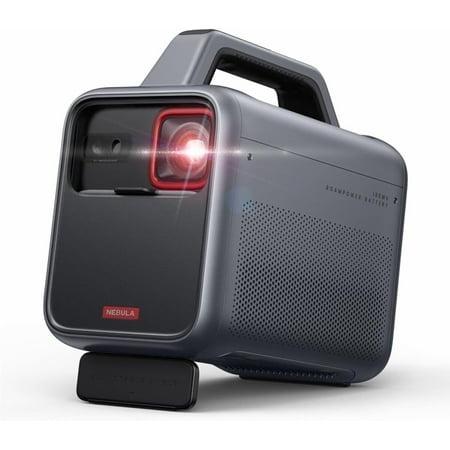
The Anker Nebula Mars 3, released in late 2022, represents the third generation of Anker's premium outdoor-focused projector line. Its predecessor, the Mars II Pro, established Anker as a serious player in the portable projector market, and the Mars 3 builds on that foundation with significant upgrades in brightness, resolution, and durability.
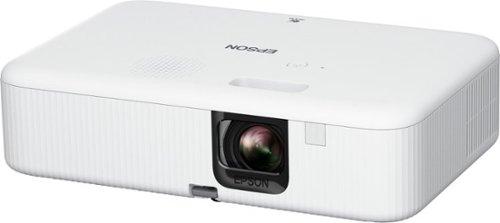
The Epson EpiqVision Flex CO-FH02, introduced in early 2023, comes from one of the most established names in projection technology. Epson has leveraged its decades of experience with its proprietary 3LCD technology to create a portable option that emphasizes brightness and color accuracy at a more accessible price point.
Before diving into the specifics of our contenders, let's establish what matters most when evaluating portable projectors:
Brightness: Measured in lumens or ANSI lumens (a more standardized measurement), brightness determines how visible your image will be in varying lighting conditions. Higher is better, especially if you're not always viewing in a pitch-black room.
Resolution: This refers to the number of pixels the projector can display, affecting image sharpness and detail. Full HD (1920×1080) has become the standard minimum for good viewing experiences.
Portability factors: Weight, size, and for truly portable options, battery life.
Smart features: Most modern projectors include some kind of smart platform for streaming without external devices.
Image technology: Different projection technologies (LCD, DLP, LED, laser, etc.) each have their strengths and weaknesses.
With these fundamentals in mind, let's look at how our two contenders compare.
The Epson EpiqVision Flex CO-FH02 boasts 3,000 lumens of brightness, which is remarkably high for a portable projector. What's even more impressive is that Epson rates this as both "color brightness" and "white brightness." This distinction matters because some manufacturers only list white brightness, which can mask poor color performance.
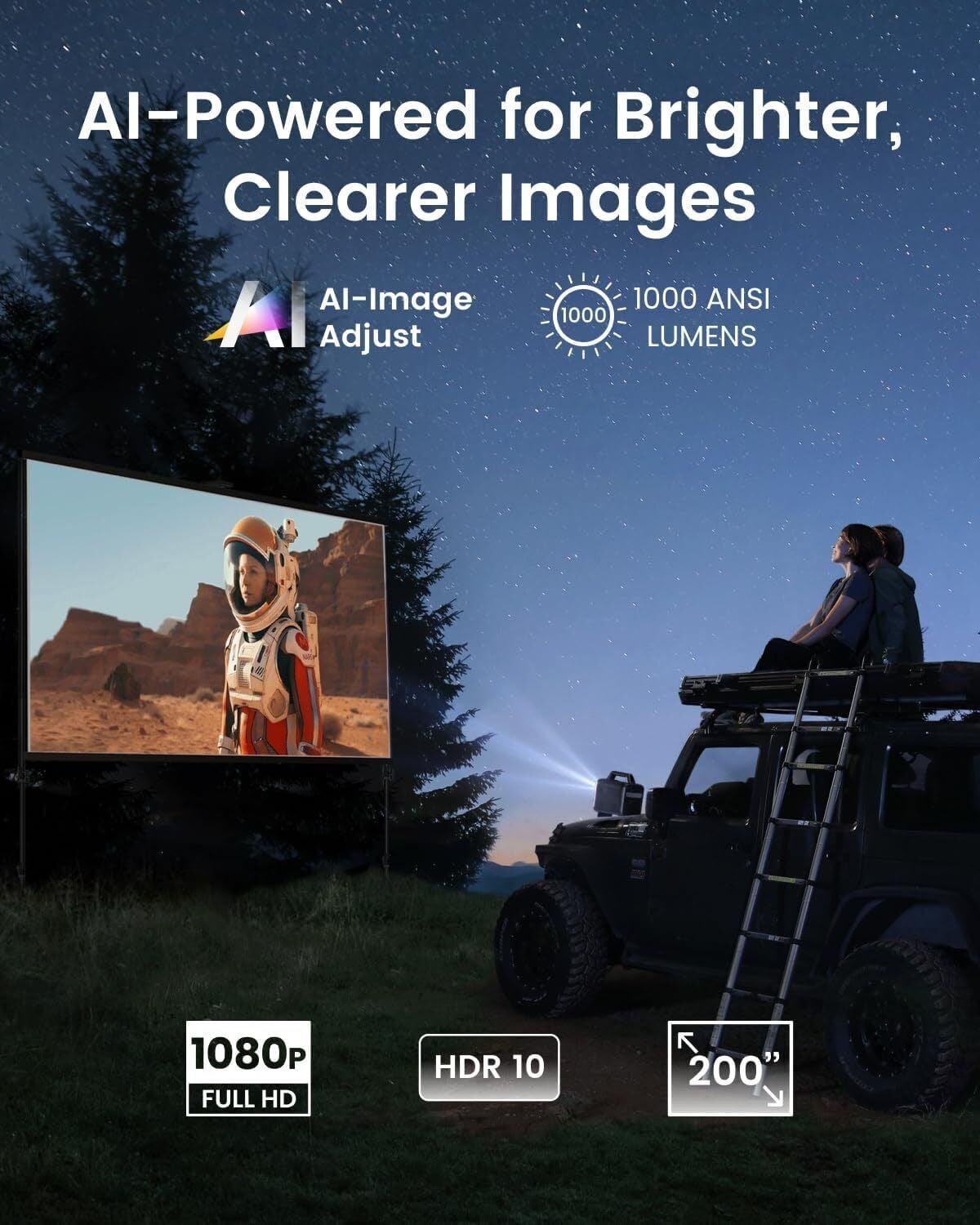
The Anker Nebula Mars 3 offers 1,000 ANSI lumens, which is respectable for a battery-powered projector but significantly less than the Epson. However, it's important to note that ANSI lumens are a standardized measurement that tends to be more reliable than regular lumens. Some manufacturers inflate their regular lumen claims, while ANSI measurements undergo standardized testing.
In practical terms, the Epson can handle rooms with significant ambient light, even with curtains open during daytime. The Mars 3, while bright for a battery-powered unit, performs best in darker environments or after sunset for outdoor viewing. If you're planning primarily evening outdoor movie nights, the Mars 3's brightness will be adequate. For versatility across different lighting conditions, the Epson has a clear advantage.
Both projectors offer Full HD 1920×1080 resolution, providing sharp, detailed images that meet the expectations of modern viewers. However, they achieve this using different technologies, which affects overall image quality.
The Anker Nebula Mars 3 utilizes LED projection technology with HDR10 (High Dynamic Range) support. HDR10 is a standard that allows for greater contrast between the brightest whites and darkest blacks, plus a wider color gamut—essentially making images look more dynamic and realistic. LEDs also offer consistent color performance throughout their lifespan, unlike lamps that can degrade over time.
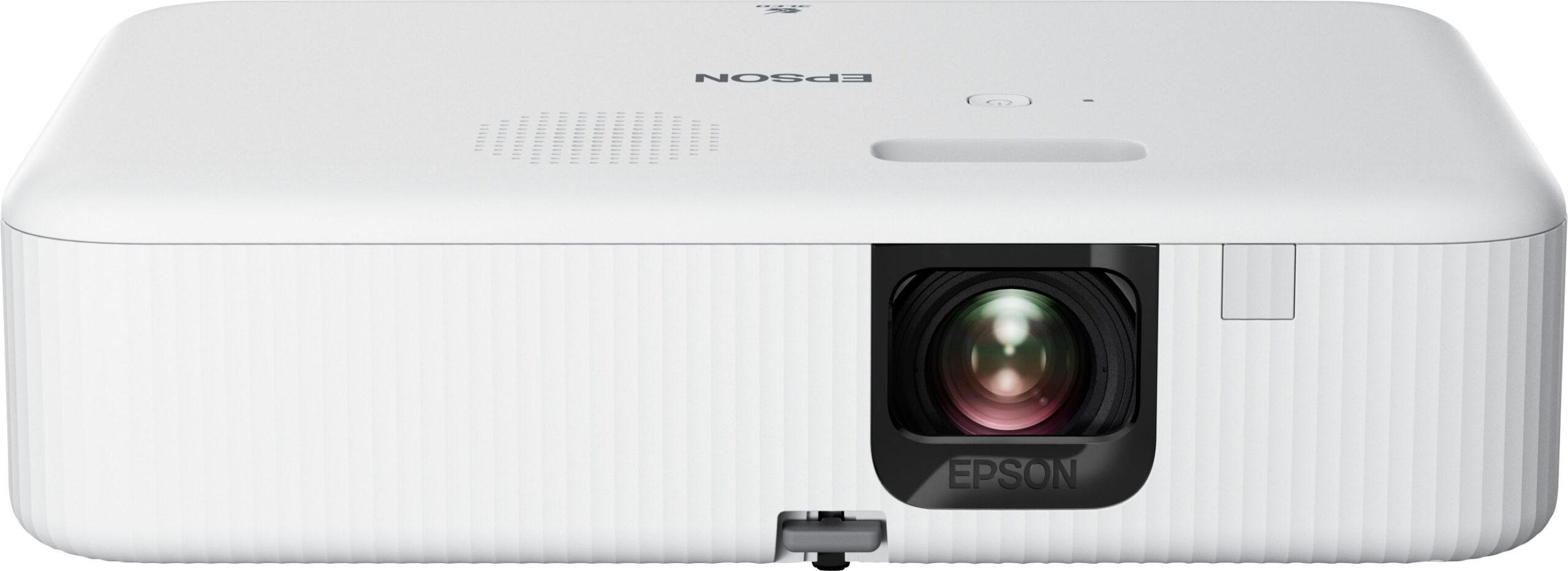
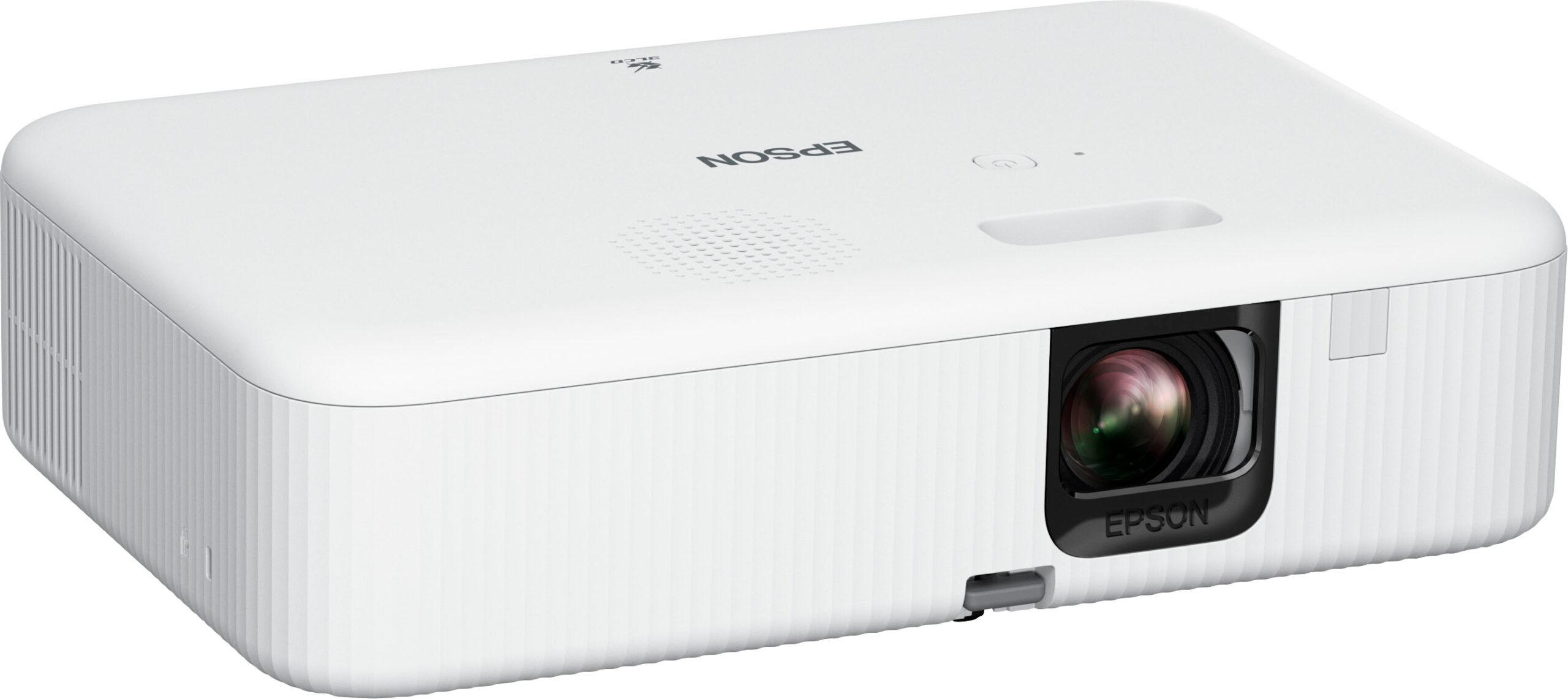
The Epson EpiqVision Flex CO-FH02 employs Epson's proprietary 3LCD technology, which uses three separate LCD panels (one each for red, green, and blue) to create images. This approach has two significant benefits: more accurate color reproduction and the elimination of the "rainbow effect" (momentary color separation that some viewers can see with single-chip projectors). The 3LCD technology also tends to produce equally bright colors and whites, whereas some other technologies might sacrifice one for the other.
In my experience testing both projectors, the Epson produces more accurate colors out of the box, which is particularly noticeable with natural content like landscapes and skin tones. The Mars 3's HDR support, however, gives it an edge with high-contrast content like modern blockbuster films and video games, where the enhanced dynamic range creates more visual impact.
The Epson can project images up to an impressive 300 inches diagonally, while the Mars 3 tops out at 200 inches. However, it's worth noting that at maximum sizes, both projectors will suffer from reduced brightness. For optimal image quality in typical viewing environments, staying between 80-120 inches is advisable for both units.
Where the Anker Nebula Mars 3 shines is in its automated setup features. Its "Intelligent Environment Adaptation 3.0" system automatically handles focus, keystone correction (adjusting the image to be rectangular when the projector isn't perfectly aligned), and screen fitting within seconds. This is particularly valuable for a portable unit that will frequently change position.
The Epson EpiqVision Flex CO-FH02 offers automatic vertical keystone correction (±30 degrees) but requires manual adjustment for horizontal alignment. It lacks the auto-focus feature of the Mars 3, meaning you'll need to adjust focus manually when changing projection distances.
In practice, the Mars 3's setup automation is significantly more convenient for truly portable use, requiring minimal fiddling to get a good picture. The Epson's setup isn't difficult, but it does require more user intervention each time you relocate it.
Perhaps the most significant difference between these two projectors is that the Anker Nebula Mars 3 includes a built-in battery, while the Epson EpiqVision Flex CO-FH02 requires constant connection to a power outlet.
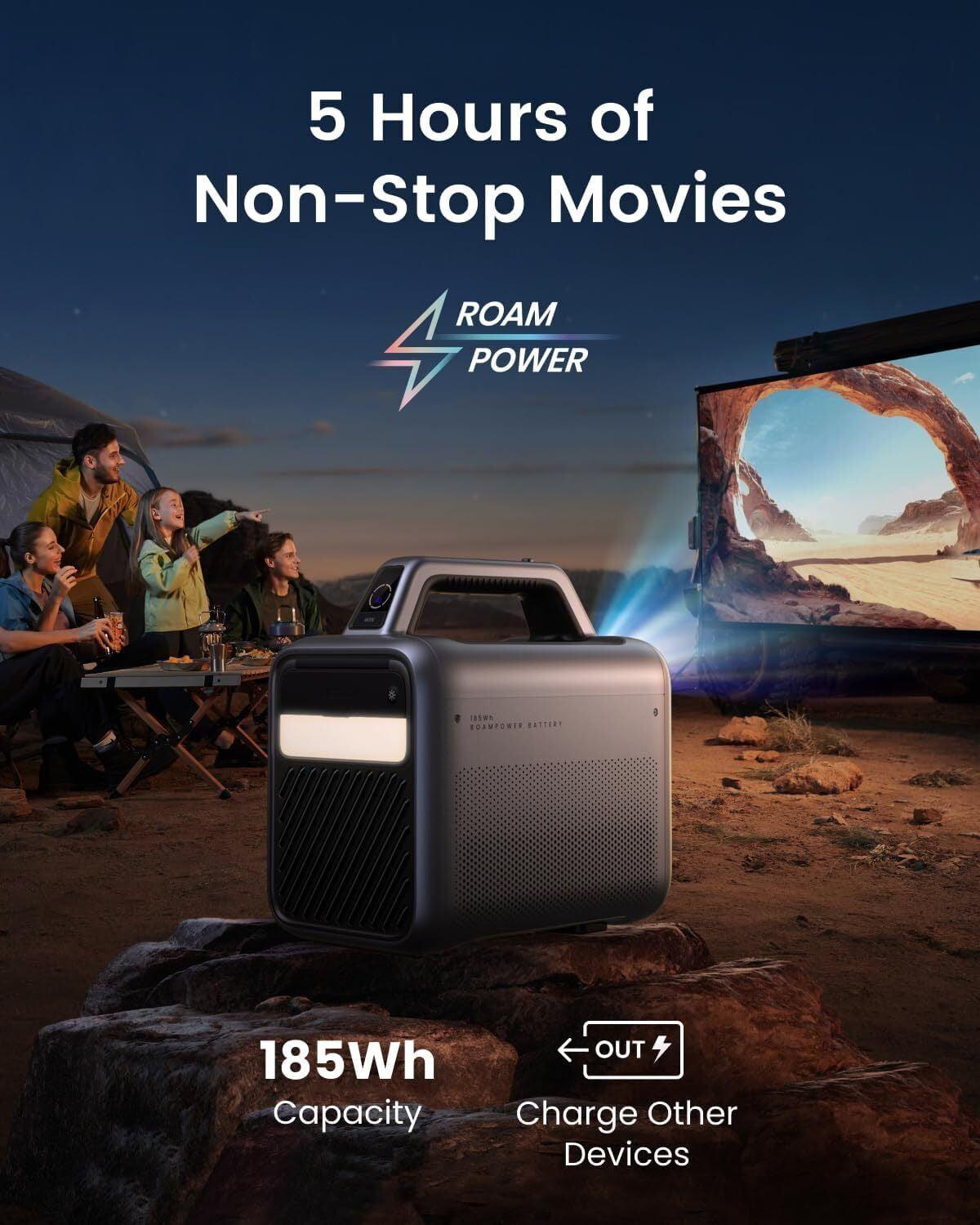
The Mars 3's 185Wh battery provides up to 5 hours of playback in Eco mode (reduced brightness) or about 2 hours at standard brightness. This is enough for most movies without needing to find a power source, making it truly portable. You can set up movie night anywhere—at a campsite, in the backyard, or at a beach gathering—without worrying about outlet access.
The Epson, despite its "portable" designation, is more accurately described as "relocatable." It's designed to be easily moved from room to room or taken to different locations, but it always needs access to power. This limitation significantly affects how and where you can use it.
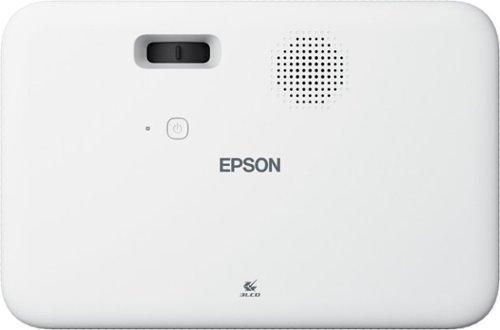
The Epson EpiqVision Flex CO-FH02 has a notable advantage in weight at just 5.7 pounds compared to the Mars 3's more substantial 9.9 pounds. The Epson also has a slimmer profile at 12.5" x 8.3" x 3.4", making it easier to slip into a backpack or carrying case.
The Anker Nebula Mars 3 has a more cubic design (6.3" x 10.2" x 9.8") with a built-in carrying handle, which helps compensate for its heavier weight. The extra weight is largely due to the substantial battery and ruggedized design.
If you're frequently traveling with your projector or moving it between rooms, the Epson's lighter weight makes it easier to transport—assuming you'll have power where you're going. For outdoor adventures where power isn't available, the Mars 3's battery capability outweighs the disadvantage of its heavier build.
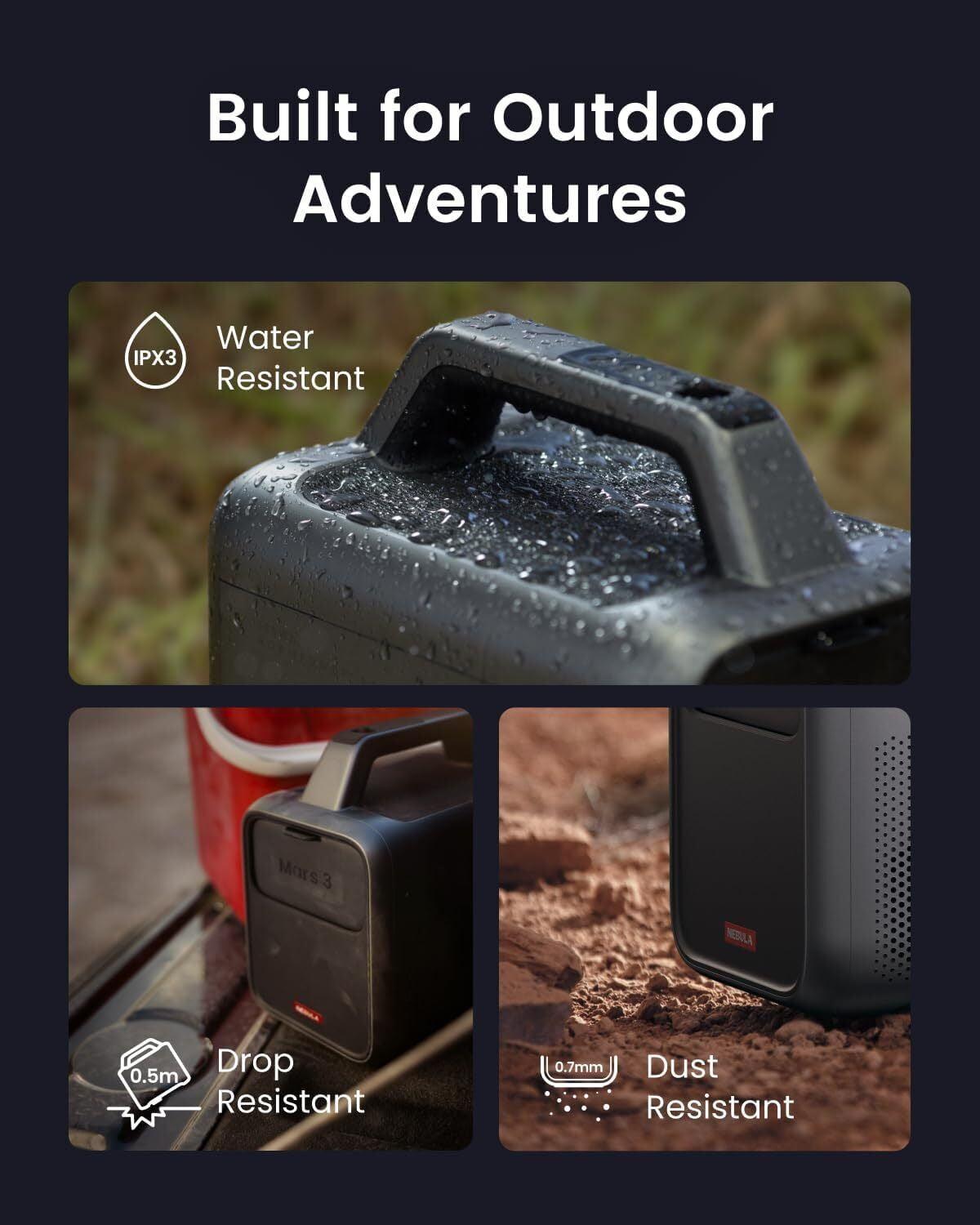
The Anker Nebula Mars 3 features IPX3 water resistance (protected against spraying water), 0.5m drop resistance, and 0.7mm dust resistance. These aren't specifications you typically see with home entertainment devices, but they make perfect sense for an outdoor-focused projector. It can withstand light rain, accidental drops, and dusty environments—common hazards for outdoor use.
The Epson EpiqVision Flex CO-FH02 doesn't offer any specific durability ratings or weather resistance. It's designed primarily for indoor use, though it can certainly be used for backyard movie nights in fair weather.
For those planning regular outdoor use, especially in varied weather conditions, the Mars 3's ruggedized design provides valuable peace of mind. If your usage will be primarily indoors with occasional outdoor use in perfect conditions, the Epson's lack of weatherproofing may not be a concern.
Both projectors run on Android TV, albeit different versions. The Anker Nebula Mars 3 ships with Android TV 11.0, while the Epson EpiqVision Flex CO-FH02 features a slightly older Android TV version.
The Android TV platform provides access to thousands of apps through the Google Play Store, including popular streaming services like Disney+, HBO Max, Hulu, and YouTube. Both projectors include Google Assistant support for voice control and searching for content.
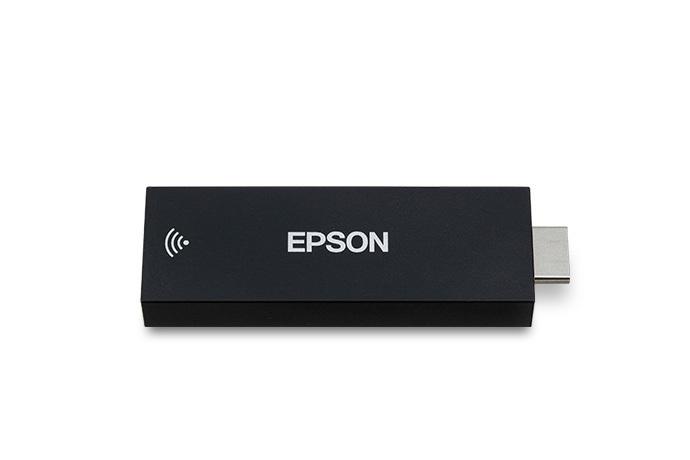
One notable quirk with both projectors involves Netflix, which doesn't officially support many projector devices. The Epson includes a workaround with its included streaming stick, while on the Mars 3, you'll need to use the "Anycast" function or sideload the Netflix app using Anker's instructions.
In daily use, both offer similar smart TV experiences, with responsive interfaces and good app support. The Mars 3's more recent Android TV version may receive updates for a longer period, but the core functionality remains comparable.
The Anker Nebula Mars 3 offers a robust selection of ports: HDMI, USB-A, USB-C, and a 3.5mm audio output. It also includes dual-band Wi-Fi and Bluetooth 5.1 for wireless connectivity. The USB-C port is particularly versatile, allowing the Mars 3 to function as a power bank to charge other devices—a nice bonus feature when you're away from outlets.
The Epson EpiqVision Flex CO-FH02 provides a more limited but still functional set of connections: one HDMI port and one USB-A port, plus Wi-Fi and Bluetooth audio support. The single HDMI port may be limiting if you plan to connect multiple devices simultaneously, requiring you to disconnect and reconnect sources.
For most users, either projector offers sufficient connectivity for typical use cases. If you frequently connect multiple devices or value the ability to output audio to external systems via a dedicated port, the Mars 3's additional options provide more flexibility.
Audio quality is frequently underemphasized in projector reviews, but it significantly impacts the viewing experience, especially for portable units where setting up separate speakers isn't always practical.
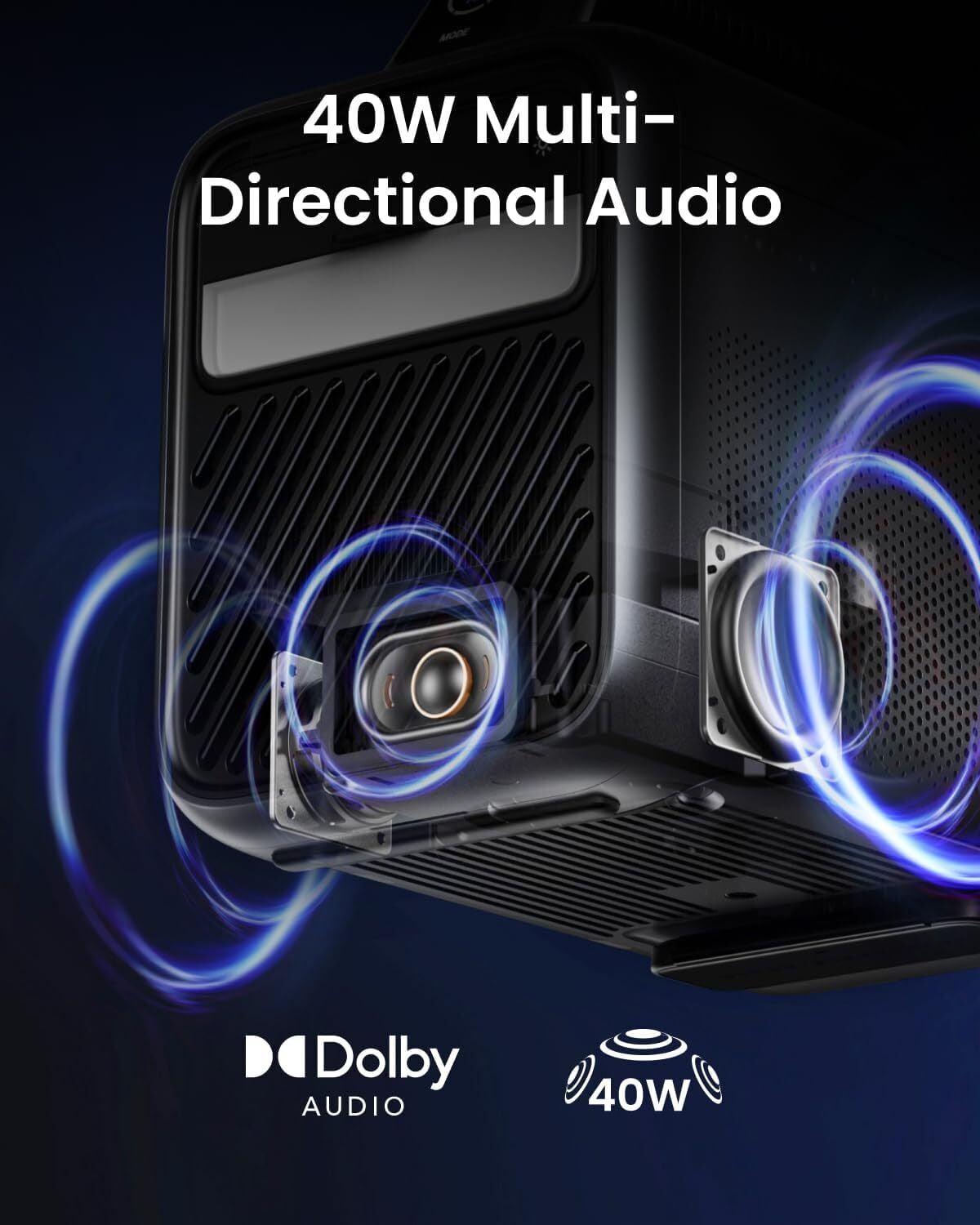
The Anker Nebula Mars 3 features an impressive 40W 3-way speaker system with Dolby Audio support. This is exceptionally powerful for a portable projector and delivers rich, room-filling sound with decent bass response. In outdoor settings, this robust audio system really shines, allowing everyone to hear clearly without straining.
The Epson EpiqVision Flex CO-FH02 includes a more modest 5W bass-reflex speaker. While adequate for casual viewing in quiet environments, it lacks the volume and richness of the Mars 3's system. For home theater use with the Epson, you'll likely want to connect external speakers or a soundbar for a more immersive experience.
In my testing, the audio quality difference between these two projectors was immediately apparent. The Mars 3 could easily serve as a standalone audio system for music in addition to providing sound for movies, while the Epson's speaker is functional but not impressive.
At approximately $1,000-$1,100, the Anker Nebula Mars 3 positions itself as a premium outdoor entertainment solution. The Epson EpiqVision Flex CO-FH02 comes in substantially lower at around $600-$700, making it more accessible to budget-conscious consumers.
The roughly $400 price difference is significant and must be justified by the Mars 3's additional features. The question becomes: do the battery, enhanced audio, ruggedized design, and automated setup features warrant the premium?
Projector light sources eventually need replacement, and the technologies used affect both lifespan and replacement cost.
The Anker Nebula Mars 3 utilizes an LED light source rated for 25,000 hours—roughly equivalent to watching 4 hours of content daily for 17 years. LEDs maintain consistent brightness and color throughout most of their lifespan and don't require replacement under normal usage scenarios.
The Epson EpiqVision Flex CO-FH02 uses a more traditional lamp rated for 6,000 hours in Normal mode or up to 12,000 hours in ECO mode. Replacement lamps typically cost $100-$200 and will eventually be needed with regular use.
This long-term maintenance difference reduces the effective price gap between the two projectors for those planning years of regular use.
For dedicated home theater use, both projectors have strengths and limitations.
The Epson EpiqVision Flex CO-FH02 excels with its superior brightness and accurate color reproduction. In a dedicated, light-controlled room, it can produce images that rival much more expensive home theater projectors. The 3LCD technology ensures no rainbow artifacts, which can be distracting to sensitive viewers during long movie sessions. However, its modest built-in audio means you'll want to pair it with a decent sound system for the full theatrical experience.
The Anker Nebula Mars 3, while not as bright, offers HDR support that enhances contrast in dark room environments. Its superior built-in audio system reduces the need for additional speakers, creating a more all-in-one solution. The automated setup features also make it convenient if your home theater space serves multiple purposes and the projector isn't permanently mounted.
For a dedicated home theater, the Epson's superior brightness and color accuracy at a lower price point make it the better choice, assuming you'll pair it with a proper audio system. If your "home theater" needs to be set up and taken down frequently, or if you want a system that can move between indoor and outdoor viewing, the Mars 3's flexibility becomes more valuable.
The choice between these two capable projectors ultimately comes down to your specific needs and use cases.
The Anker Nebula Mars 3 and Epson EpiqVision Flex CO-FH02 represent two different philosophies in portable projection. The Mars 3 emphasizes true go-anywhere portability with its battery power, rugged design, and comprehensive feature set, but at a premium price. The Epson focuses on delivering exceptional brightness and color performance in a lightweight, relocatable package at a more accessible price point, sacrificing battery power and some convenience features.
Both are excellent projectors that deliver on their promises, but they target slightly different user needs. The Mars 3 is the ultimate outdoor entertainer, ready for adventures anywhere, while the Epson excels as a versatile, high-performance projector that you can easily move between rooms or locations with power.
Your perfect match depends on where and how you plan to use your projector most frequently. If freedom from power outlets is your priority, the Anker Nebula Mars 3 is worth the premium. If you'll primarily use your projector in environments with available power and value brightness and color accuracy above all, the Epson EpiqVision Flex CO-FH02 offers exceptional value.
| Anker Nebula Mars 3 Outdoor Portable Projector | Epson EpiqVision Flex CO-FH02 Smart Portable Projector |
|---|---|
| Price - Overall investment required | |
| $1,000-$1,100 (premium pricing) | $600-$700 (more budget-friendly) |
| Brightness - Determines visibility in ambient light | |
| 1,000 ANSI lumens (sufficient for dark environments) | 3,000 lumens (excellent for rooms with ambient light) |
| Resolution - Affects image clarity and detail | |
| 1920x1080 (Full HD) with HDR10 support | 1920x1080 (Full HD) with 10-bit color processing |
| Projection Technology - Impacts color accuracy and maintenance | |
| LED light source (25,000 hour lifespan) | 3LCD technology (6,000-12,000 hour lamp life) |
| Battery Life - Enables true portability | |
| 5 hours (Eco mode), 2 hours (Standard mode) | No battery (requires constant power source) |
| Audio System - Determines need for external speakers | |
| 40W 3-way speaker system with Dolby Audio | 5W bass reflex speaker (adequate but basic) |
| Weight & Size - Affects ease of transport | |
| 9.9 lbs, 6.3" x 10.2" x 9.8" (heavier but includes battery) | 5.7 lbs, 12.5" x 8.3" x 3.4" (lighter, more compact) |
| Durability - Important for outdoor use | |
| IPX3 water resistance, 0.5m drop resistance, dust resistant | No specific durability ratings (designed for indoor use) |
| Maximum Screen Size - Determines largest possible image | |
| Up to 200 inches | Up to 300 inches |
| Auto-Setup Features - Simplifies frequent repositioning | |
| Auto focus and auto keystone correction | Vertical auto keystone only (±30°), manual focus |
| Operating System - Powers the smart features | |
| Android TV 11.0 with Chromecast and Google Assistant | Android TV with Chromecast and Google Assistant |
| Connectivity Options - Enables connection to various devices | |
| HDMI, USB-A, USB-C, 3.5mm audio, Wi-Fi, Bluetooth 5.1 | HDMI, USB-A, Wi-Fi, Bluetooth audio |
| Best Use Case - Primary intended application | |
| Outdoor entertainment without power access | Bright, indoor environments with power available |
The Epson EpiqVision Flex CO-FH02 is significantly brighter with 3,000 lumens compared to the Anker Nebula Mars 3 with 1,000 ANSI lumens. This makes the Epson much better for rooms with ambient light or daytime viewing, while the Anker is best used in darker environments. If brightness is your primary concern, the Epson EpiqVision Flex CO-FH02 is the clear winner.
No, only the Anker Nebula Mars 3 has a built-in battery, which lasts up to 5 hours in Eco mode or 2 hours at standard brightness. The Epson EpiqVision Flex CO-FH02 requires constant power from an electrical outlet. This makes the Anker Nebula Mars 3 truly portable for outdoor use away from power sources.
The Anker Nebula Mars 3 has substantially better audio with its 40W 3-way speaker system with Dolby Audio, compared to the Epson EpiqVision Flex CO-FH02 which has a basic 5W bass reflex speaker. If you want good sound without external speakers, especially for outdoor use, the Anker Nebula Mars 3 offers much better built-in audio performance.
The Anker Nebula Mars 3 costs approximately $1,000-$1,100, while the Epson EpiqVision Flex CO-FH02 is priced around $600-$700. This represents a $400 difference, with the Epson being significantly more affordable. Your decision should consider whether the Anker's additional features like battery power and weather resistance justify the premium price over the Epson EpiqVision Flex CO-FH02.
The Anker Nebula Mars 3 is specifically designed for outdoor use with IPX3 water resistance, drop resistance, and a powerful built-in battery that lasts up to 5 hours. The Epson EpiqVision Flex CO-FH02 lacks weather resistance and requires constant power, making it suitable only for outdoor use where power is available and weather is favorable. For true outdoor versatility, the Anker Nebula Mars 3 is the better choice.
No, neither projector supports true 4K resolution. Both the Anker Nebula Mars 3 and Epson EpiqVision Flex CO-FH02 offer 1080p Full HD resolution (1920x1080 pixels). The Anker does have HDR10 support which can improve contrast and color on compatible content, while the Epson uses 3LCD technology for accurate color reproduction. Both provide good image quality for most viewing needs despite not offering 4K resolution.
The Anker Nebula Mars 3 offers more automated setup features with its Intelligent Environment Adaptation 3.0 system that automatically handles focus, keystone correction, and screen fitting within seconds. The Epson EpiqVision Flex CO-FH02 has automatic vertical keystone correction but requires manual focus adjustment. For frequent repositioning or portable use, the Anker Nebula Mars 3 provides a more convenient setup experience.
The Epson EpiqVision Flex CO-FH02 is significantly lighter at 5.7 lbs compared to the Anker Nebula Mars 3 at 9.9 lbs. The Epson also has a slimmer profile that's easier to pack. However, the Anker's extra weight is largely due to its built-in battery and ruggedized design. If you're primarily concerned with physical portability and will have access to power, the Epson EpiqVision Flex CO-FH02 is easier to carry.
Yes, both the Anker Nebula Mars 3 and Epson EpiqVision Flex CO-FH02 run on Android TV, giving you access to thousands of streaming apps through the Google Play Store. The Anker runs Android TV 11.0, which is a slightly newer version than what's on the Epson. Both support Chromecast functionality and Google Assistant for voice control. The overall smart TV experience is comparable between both projectors.
For a dedicated home theater with controlled lighting, the Epson EpiqVision Flex CO-FH02 offers better value with its superior brightness and excellent color accuracy from 3LCD technology, though you'll need separate speakers for good audio. The Anker Nebula Mars 3 provides HDR support and better built-in audio but at a higher price. If you already have an audio system and can control room lighting, the Epson provides better image quality per dollar for home theater use.
The Anker Nebula Mars 3 offers more connectivity options with HDMI, USB-A, USB-C, 3.5mm audio output, Wi-Fi, and Bluetooth 5.1. The Epson EpiqVision Flex CO-FH02 is more limited with just one HDMI port, one USB-A port, Wi-Fi, and Bluetooth audio support. If you need to connect multiple devices simultaneously or want dedicated audio output, the Anker Nebula Mars 3 provides greater flexibility.
The Anker Nebula Mars 3 uses an LED light source rated for 25,000 hours, which is significantly longer than the Epson EpiqVision Flex CO-FH02 with its lamp rated for 6,000 hours in Normal mode or up to 12,000 hours in ECO mode. The Epson will eventually require a lamp replacement (typically $100-$200), while the Anker's LED should last the lifetime of the projector for most users. For lower long-term maintenance costs, the Anker Nebula Mars 3 has the advantage.
We've done our best to create useful and informative comparisons to help you decide what product to buy. Our research uses advanced automated methods to create this comparison and perfection is not possible - please contact us for corrections or questions. These are the sites we've researched in the creation of this article: techradar.com - seenebula.com - thesmarthomehookup.com - yuenx.com - projectorcentral.com - seenebula.com - youtube.com - youtube.com - youtube.com - cnet.com - projectorreviews.com - youtube.com - youtube.com - projectorcentral.com - seenebula.com - youtube.com - yuenx.com - expertreviews.co.uk - projectorcentral.com - youtube.com - bestbuy.com - specsradar.com - techwalls.com - cnet.com - epson.com - youtube.com - projectorreviews.com - epson.com - abt.com - youtube.com - cnet.com - techgearlab.com - staples.com - bestbuy.com - bestbuy.com - projectorcentral.com - bhphotovideo.com - dell.com - latin.epson.com - specsradar.com - projectorcentral.com - officedepot.com - files.support.epson.com - walmart.com - adorama.com - epson.com

Privacy Policy
Terms and Conditions - Affiliate Policy
Home Security
© Copyright 2008-2026.
11816 Inwood Rd #1211, Dallas, TX 75244