

In the ever-evolving landscape of home entertainment, smart portable projectors have carved out a unique niche. These versatile devices bring big-screen experiences to spaces where traditional TVs or home theater projectors might not be practical. Today, we're comparing two compelling options: the BenQ GV50 Full HD Smart Ceiling Projector and the Epson EpiqVision Flex CO-FH02 Smart Portable Projector. Both offer intriguing features for different kinds of users, but their approaches to portable projection differ in meaningful ways.
Before diving into our comparison, let's take a moment to appreciate how far portable projectors have come. Just a few years ago, portable projectors were dim, low-resolution affairs that required near-complete darkness and offered lackluster smart features, if any at all.
The BenQ GV50, released in late 2021, represented a significant step forward in this category with its laser light source and ceiling projection capabilities. The Epson CO-FH02, which hit the market in mid-2022, took a different approach by prioritizing brightness and traditional projection use cases while maintaining portability.
Both projectors emerged during a time when home entertainment became increasingly important to consumers, with many people investing in ways to enhance their viewing experiences without committing to permanent installations. They reflect different philosophies about what matters most in a portable projection experience, which we'll explore throughout this comparison.
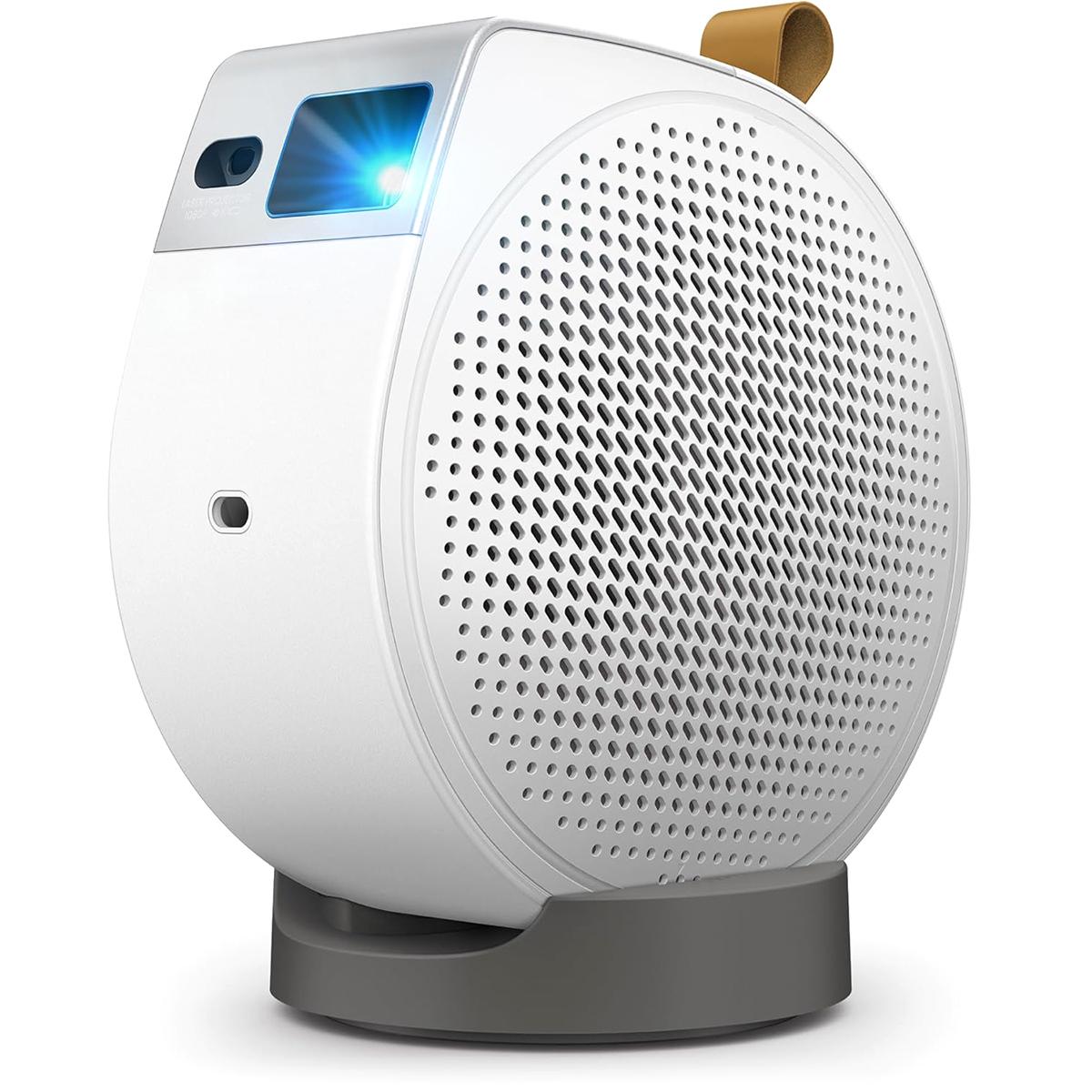
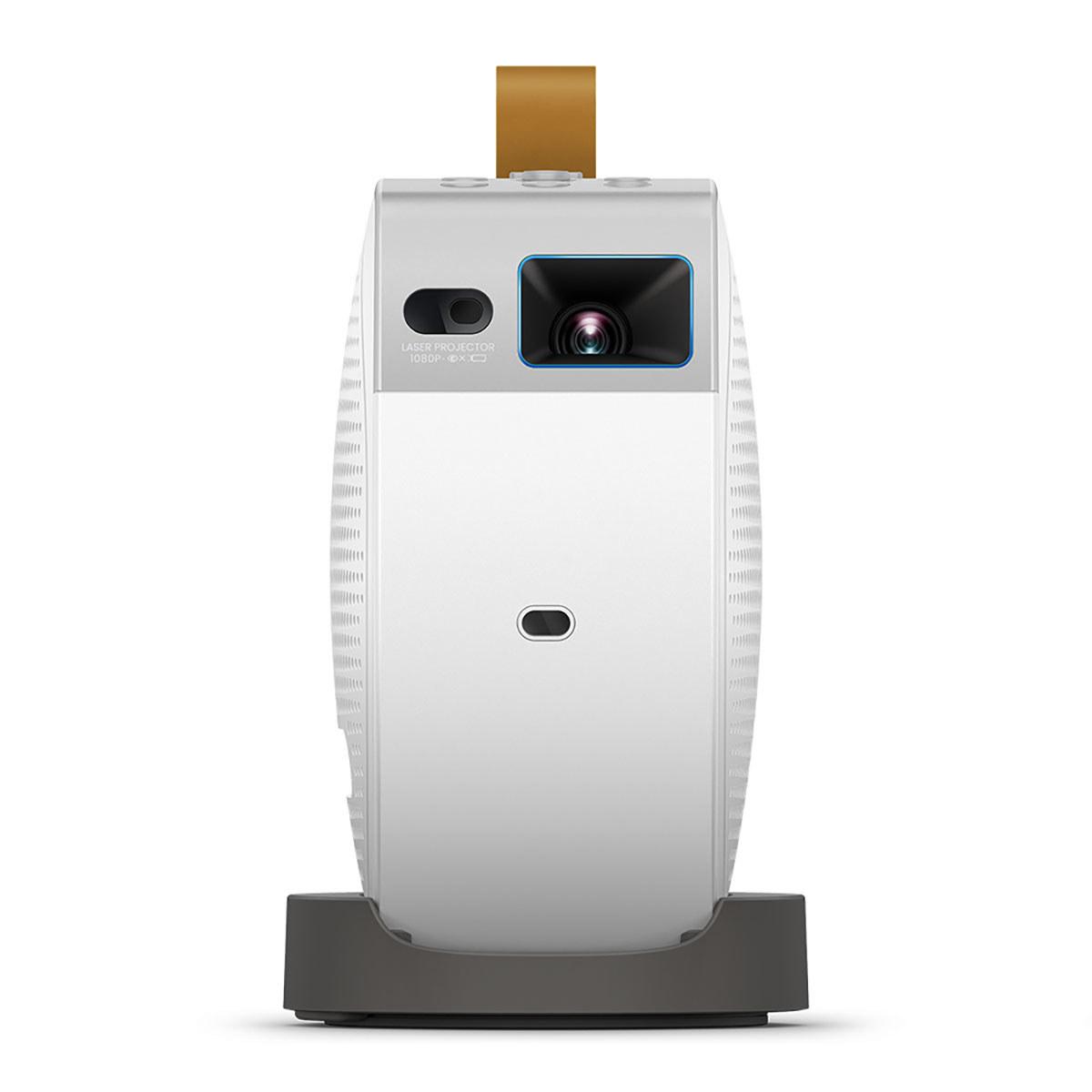
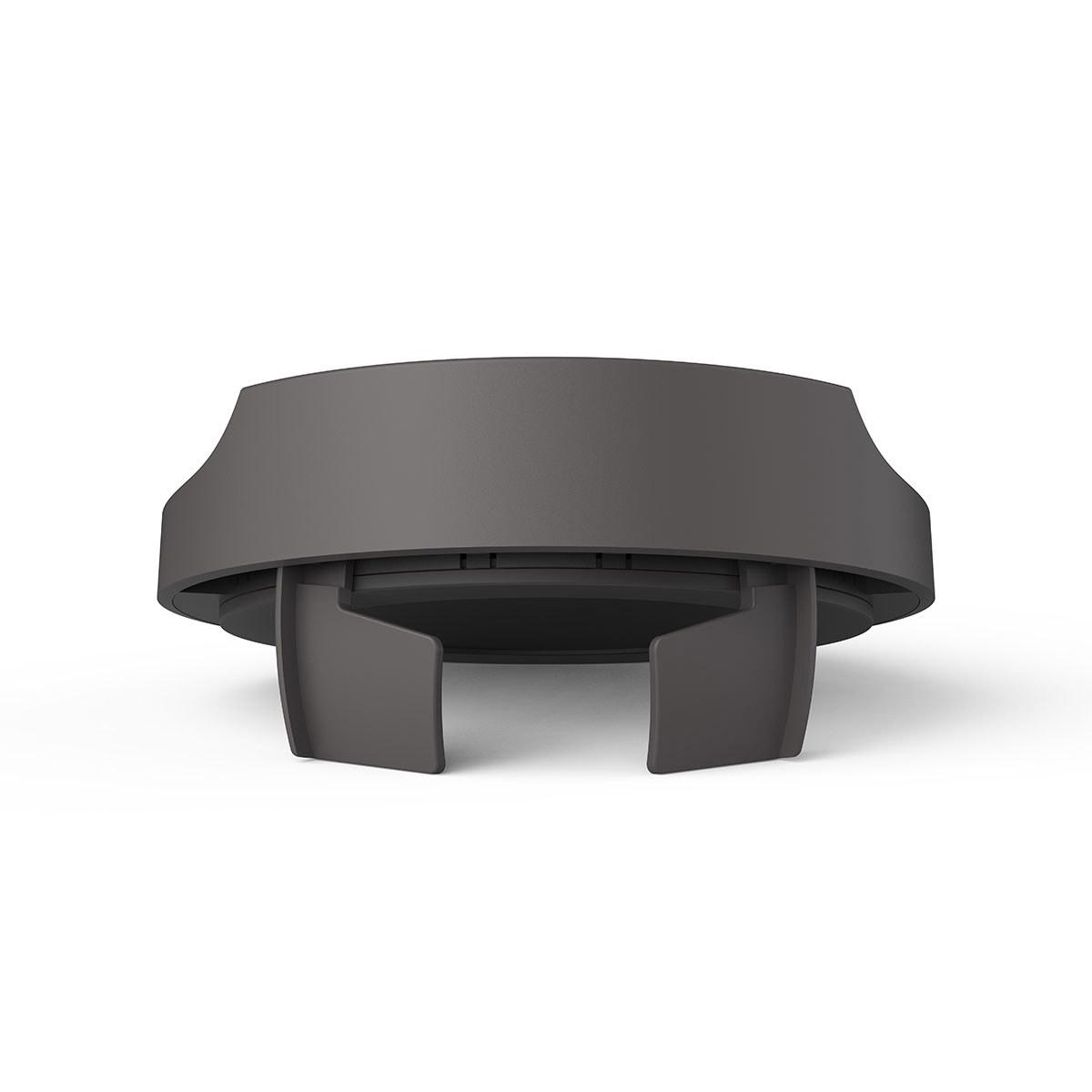
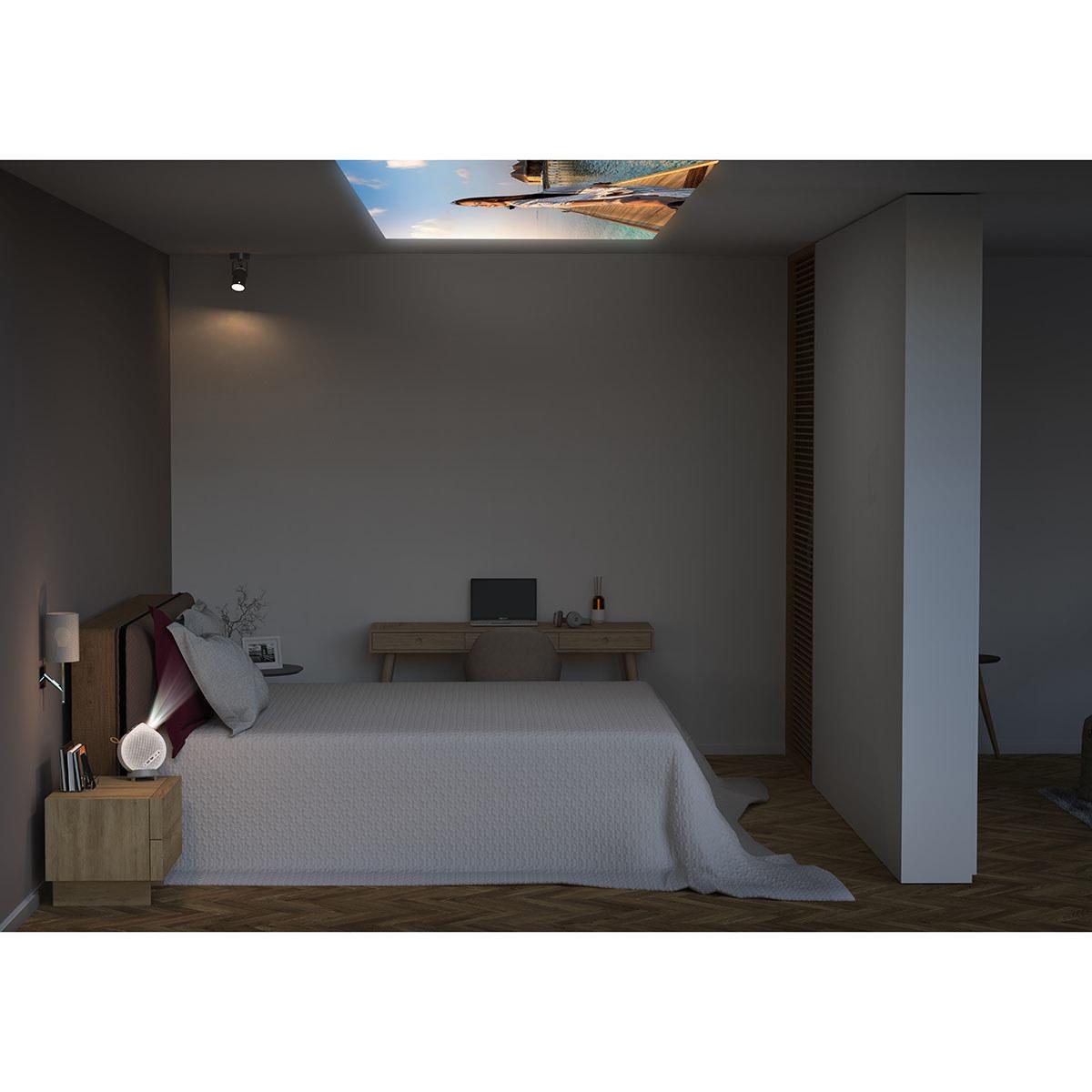
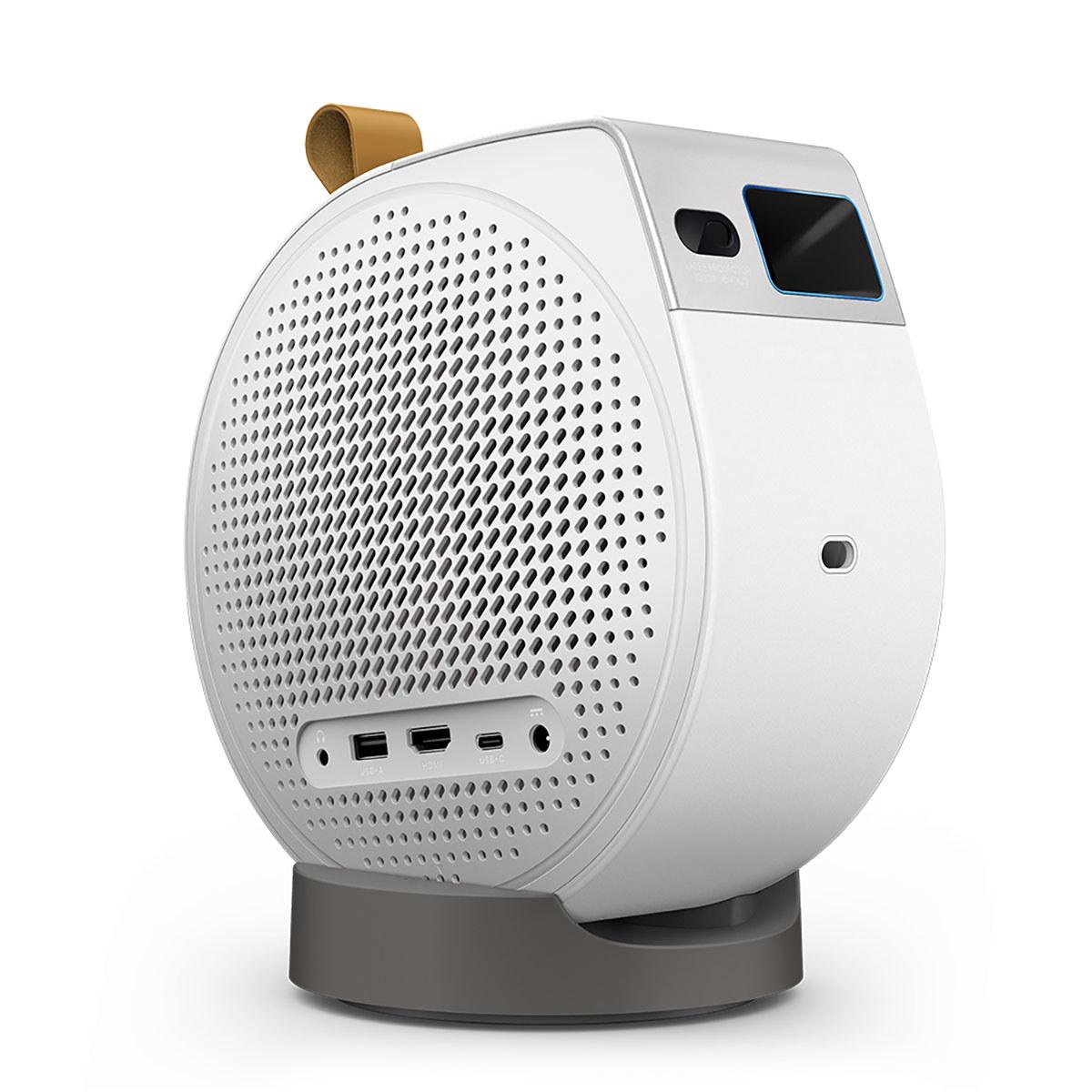
The BenQ GV50 takes an unconventional approach to design. Shaped something like a squat cylinder with a flexible base, it weighs just 2.1 kg (4.6 lbs) and measures 130 x 211.2 x 191.4 mm. Its most distinctive feature is the articulating base that allows the projector to rotate 360° horizontally and tilt 135° vertically. This unique design isn't just for show—it's specifically engineered to enable bedside ceiling projection, letting you watch movies or shows while lying comfortably in bed.
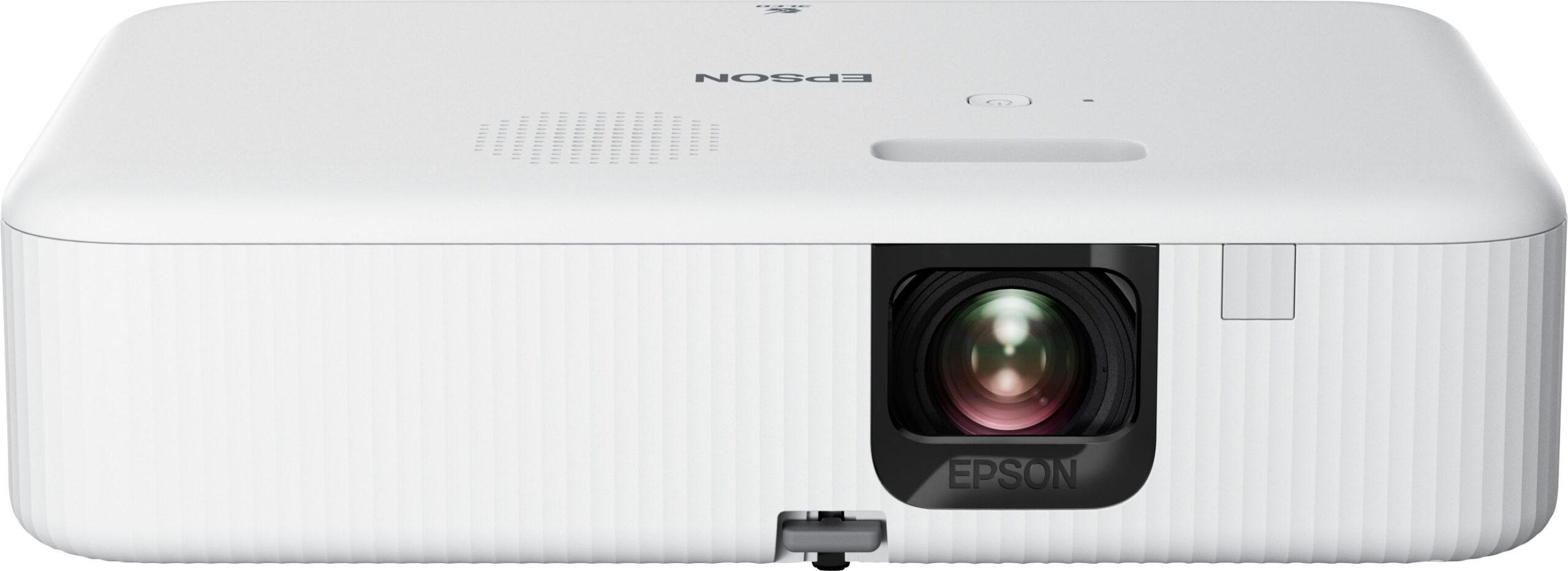
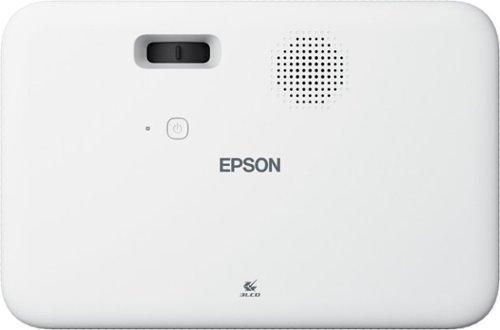
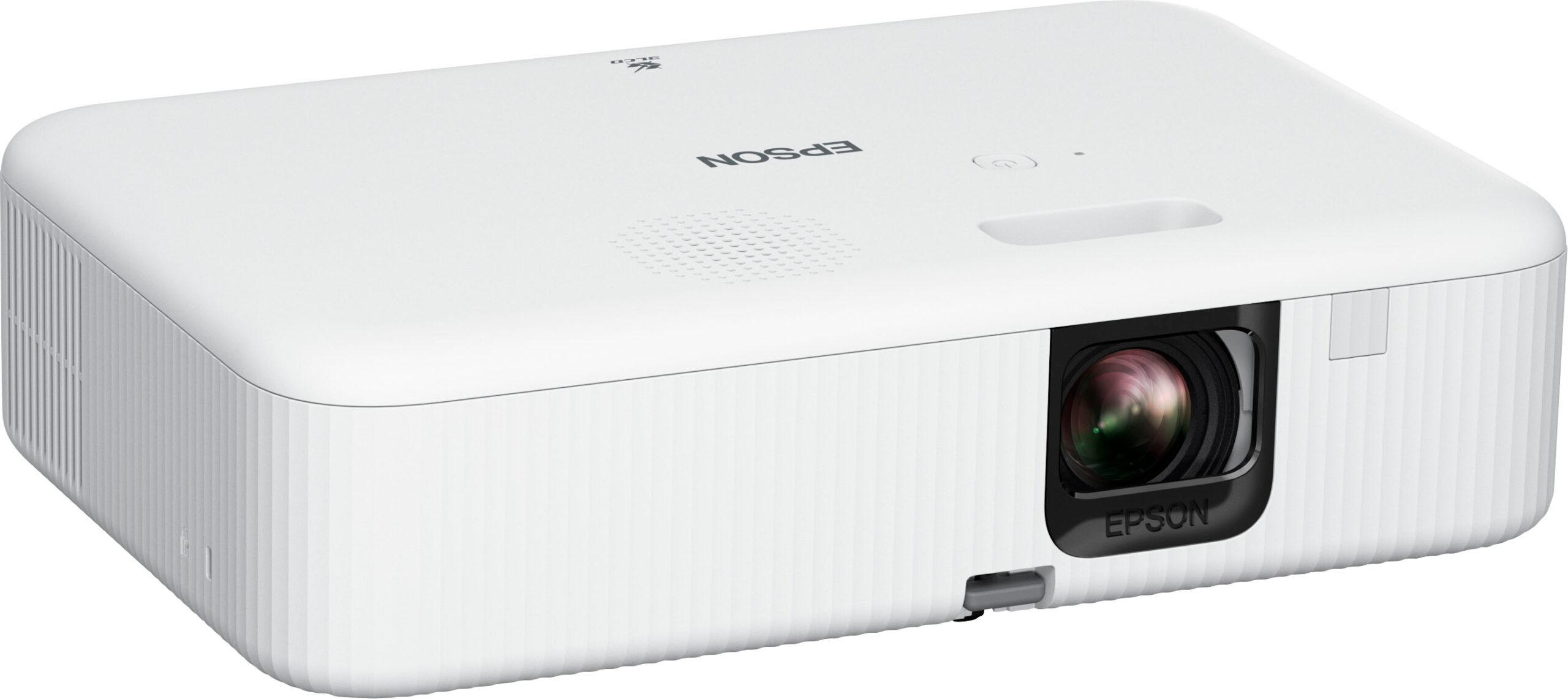
The Epson CO-FH02 adopts a more traditional projector design, with rectangular dimensions of 12.5" x 8.3" x 3.4" and a weight of 5.7 lbs. While still marketed as portable, it's noticeably heavier than the BenQ and lacks any special articulation features. Its conventional design is geared toward standard projection setups—think coffee table to wall or mounted on a ceiling bracket.
Having used both projectors in various settings, I've found the BenQ's smaller footprint and lighter weight make a noticeable difference when frequently moving the unit between rooms or taking it outdoors. The Epson feels substantial and well-built, but it's definitely pushing the boundaries of what most would consider truly portable.
One of the most significant differences between these projectors is their approach to power. The BenQ GV50 includes a built-in battery that provides up to 2.5 hours of video playback—enough for most movies without needing to find a power outlet. This feature transforms how and where you can use the projector, enabling truly wireless outdoor movie nights or hotel room ceiling projections during travel.
The Epson CO-FH02 forgoes battery power entirely, requiring a constant connection to an electrical outlet. This design choice allowed Epson to focus on maximizing brightness without worrying about power consumption constraints. The tradeoff is clear: what you gain in image visibility, you lose in placement flexibility.
When it comes to projectors, brightness is often the spec that gets the most attention—and for good reason. It determines how visible your image will be in different lighting conditions and ultimately how flexible the projector is for daytime use.
The Epson CO-FH02 dominates in this category with its 3,000 lumens of brightness (both color and white brightness). To put this in perspective, this is six times brighter than the BenQ's 500 ANSI lumens. This dramatic difference means the Epson can produce a visible image even in rooms with substantial ambient light, making it suitable for daytime viewing, living rooms with windows, or spaces where completely darkening the room isn't practical.
In real-world testing, the Epson's brightness advantage is immediately apparent. During afternoon use in a living room with partially drawn blinds, the Epson produces a watchable image that, while not as vibrant as in darkness, remains perfectly serviceable for casual viewing. The BenQ, by contrast, struggles significantly in these conditions, with washed-out colors and low contrast.
However, the brightness story changes when viewing in proper dark conditions. In a completely darkened room, the BenQ GV50's 500 ANSI lumens are actually quite sufficient, and the laser light source produces impressive contrast with deep blacks. For dedicated nighttime viewing or in bedrooms where darkness is easy to achieve, the brightness difference becomes much less significant.
The projectors employ fundamentally different display technologies that impact image quality beyond just brightness numbers.
The BenQ uses DLP (Digital Light Processing) technology paired with a laser light source. DLP projectors reflect light off thousands of microscopic mirrors to create an image. This approach typically offers excellent contrast ratios and sharp images. The laser light source maintains consistent brightness throughout its lifespan and provides more vivid colors than traditional lamp projectors. One potential downside of single-chip DLP projectors is the occasional "rainbow effect"—brief flashes of rainbow-colored artifacts that some viewers (roughly 10%) are sensitive to during high-contrast scenes.
The Epson utilizes 3LCD technology, which splits light through three separate LCD panels (one each for red, green, and blue) before recombining them to form the image. This approach typically delivers more natural colors and eliminates the rainbow effect entirely. The CO-FH02's impressive brightness comes from its powerful lamp, though this component will eventually require replacement after 6,000-12,000 hours of use depending on the mode.
In side-by-side testing, the Epson's 3LCD technology produces more accurate colors out of the box, while the BenQ tends to have more dramatic contrast. For most viewers, the Epson provides a more balanced image in typical viewing conditions, while the BenQ excels in controlled dark environments where its contrast advantage becomes more apparent.
Both projectors offer Full HD 1920x1080 resolution, which remains the sweet spot for most content consumption today. While not reaching the 4K heights of premium home theater projectors, 1080p resolution is perfectly adequate for most viewing at typical screen sizes.
The Epson CO-FH02 advertises projection sizes up to 300 inches diagonally, which is remarkably large. However, achieving this size requires significant distance from the projection surface and results in some light dispersion. The BenQ's maximum screen size is less prominently advertised, but in practice, it comfortably produces images up to around 100-120 inches, which is still substantial for most home environments.
For typical home use in living rooms or bedrooms, both projectors can easily create 80-100 inch displays that dwarf most conventional TVs. The Epson's advantage comes into play for larger venues like backyard movie nights where its extra brightness and larger potential screen size could make a meaningful difference.
Both projectors feature Android-based smart platforms that provide access to popular streaming services without requiring external devices. The BenQ GV50 runs on Google TV (based on Android 11), while the Epson CO-FH02 uses Android TV. In practice, these platforms offer similar functionality, with access to thousands of apps including Netflix, Amazon Prime Video, Disney+, and YouTube.
Google TV on the BenQ offers a slightly more refined user interface with better content aggregation across streaming services, making it easier to find shows and movies regardless of which platform they're on. The Epson's Android TV is perfectly serviceable but feels a step behind in terms of user experience.
Both systems support voice commands through their remote controls, allowing you to search for content, adjust settings, or control smart home devices without navigating through menus. In testing, I found the voice recognition to be equally reliable on both projectors, though neither quite matches the sophistication of dedicated smart speakers.
Modern projectors have become significantly smarter about automatic setup, and both of these models include helpful features to simplify the process.
The BenQ GV50 includes what the company calls "Smart Screen Adaption," which encompasses auto focus, auto keystone correction (±20° vertical and ±30° horizontal), and image rotation. The system can even detect and avoid obstacles in the projection path, adjusting the image accordingly. For ceiling projection specifically, these automatic adjustments are particularly valuable since manually tweaking settings while lying in bed would be cumbersome.
The Epson CO-FH02 offers automatic vertical keystone correction (±30°) and manual horizontal keystone adjustment (±30°). While effective, it requires a bit more user intervention than the BenQ's more comprehensive automatic system. The Epson does include a useful "Screen Fit" feature that helps adjust the image to fit various projection surfaces.
From my experience using both systems, the BenQ's setup automation feels more polished and requires less fiddling, particularly when frequently changing projection angles or locations. The Epson's system works well but occasionally needs manual tweaking to get perfect alignment.
Built-in audio is often an afterthought in projectors, with many users opting to connect external speakers for better sound quality. However, for truly portable use, having decent onboard audio matters—and the differences between these models are substantial.
The BenQ GV50 features a surprisingly capable 2.1 channel audio system with dual 4W speakers plus a dedicated 10W subwoofer. This configuration delivers room-filling sound with reasonable bass response—uncommon in portable projectors. The BenQ also includes a special "Ceiling Cinema Sound Mode" that optimizes audio directionality when projecting upward, ensuring dialog remains clear even when you're lying down watching the ceiling.
The Epson CO-FH02 includes a more basic 5W mono speaker system. While adequate for casual viewing, it lacks the depth and stereo separation of the BenQ's more sophisticated audio setup. Dialog remains clear, but music and sound effects lack presence and impact compared to the BenQ.
Both projectors support Bluetooth audio output, allowing connection to external speakers or headphones. This feature is particularly useful for the Epson, as its internal speaker is its weakest aspect compared to the BenQ.
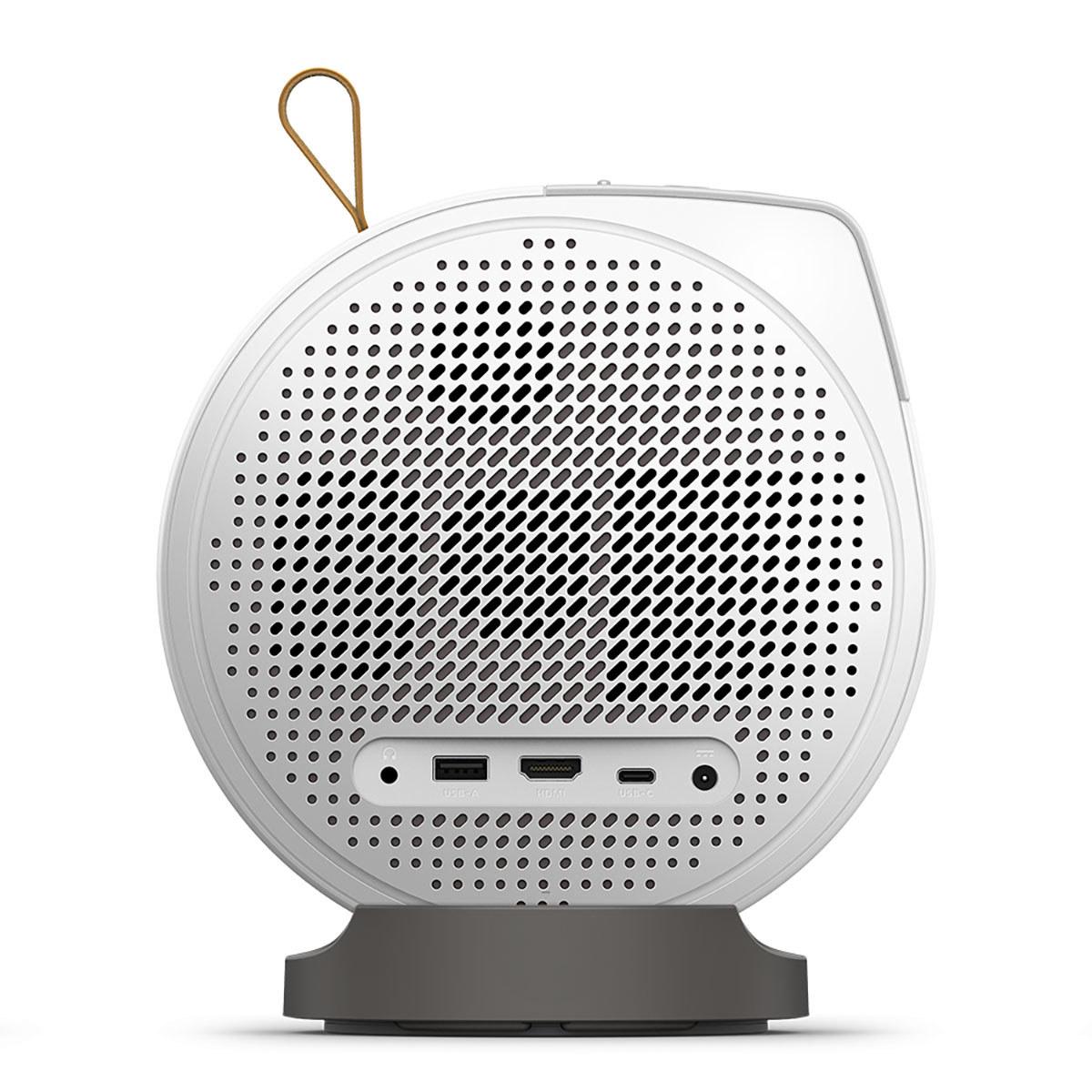
The BenQ GV50 offers a streamlined but modern selection of ports: one HDMI 2.0b input, one USB-A port for connecting drives or peripherals, and one USB-C port that supports both data and video input. This USB-C connectivity is particularly valuable for modern setups, allowing direct connection from laptops or tablets with a single cable for both video and audio.
The Epson CO-FH02 provides more limited physical connectivity with just one HDMI port and one USB-A port. The lack of USB-C is noticeable in today's increasingly USB-C-centric world, requiring adapters for many modern devices.
In practical use, the BenQ's port selection feels more future-proof, though neither projector offers the extensive connectivity of larger home theater projectors with multiple HDMI inputs, optical audio outputs, or legacy composite video connections.
Both projectors offer strong wireless connectivity options. The BenQ includes dual-band Wi-Fi (802.11 a/b/g/n/ac) and Bluetooth 5.0, with support for both AirPlay and Google Cast for wireless screen mirroring from iOS, Android, macOS, and Windows devices.
The Epson similarly supports dual-band Wi-Fi and includes built-in Chromecast functionality, though its Bluetooth capabilities are primarily focused on audio output rather than broader device connectivity.
One of the most significant differences between these projectors is their approach to light sources, which has major implications for long-term value.
The BenQ GV50's laser light source is rated for an impressive 20,000 hours in normal mode and up to 30,000 hours in eco mode. This translates to over 10 years of use at 5 hours per day, with no lamp replacement required. Laser light sources also maintain consistent brightness and color performance throughout their lifespan, avoiding the gradual dimming that affects lamp-based projectors.
The Epson CO-FH02 uses a traditional lamp rated for 6,000 hours in normal mode and 12,000 hours in eco mode. While still substantial, this means lamp replacements will eventually be necessary for long-term owners. Replacement lamps typically cost $100-200, adding to the total cost of ownership.
For those planning to keep their projector for many years, the BenQ's laser technology represents significant long-term savings and convenience, despite its typically higher initial price.
Both projectors demonstrate good build quality appropriate for their price points. The BenQ feels premium with its fabric covering and metal accents, while the Epson has a more utilitarian but solid construction.
Cooling systems are crucial for projector reliability, and both models manage heat effectively. The BenQ runs remarkably quiet at 26-28 dBA, making it practically silent during operation—important for bedroom use. The Epson's cooling system is more audible but not distracting at normal viewing distances.
While neither of these projectors is positioned as a dedicated home theater solution, many users will consider them for creating theatrical experiences at home. How do they stack up?
For dedicated home theater use in a controlled dark room, the BenQ GV50 can create a satisfying cinematic experience with its excellent contrast ratio (100,000:1) and HDR10/HLG support. Its laser light source delivers consistent performance and requires no warm-up time. The ceiling projection capability offers a unique viewing position that some may prefer to traditional setups. However, its limited brightness makes it suitable only for properly darkened spaces.
The Epson CO-FH02 offers more flexibility for home theater use in various lighting conditions. Its superior brightness allows for enjoyable viewing even with some ambient light, making it better suited for multi-purpose living spaces rather than dedicated theater rooms. The higher maximum screen size also enables more immersive large-format viewing when space permits.
For audio, the BenQ's superior built-in sound system provides a more complete out-of-the-box experience, though serious home theater enthusiasts will want to pair either projector with a proper sound system.
While prices fluctuate, the BenQ GV50 typically commands a premium over the Epson CO-FH02, reflecting its laser technology, battery power, and specialized design features. The question of which represents better value depends entirely on your specific needs and use cases.
The BenQ offers better value for:
The Epson provides better value for:
After comparing these projectors across multiple dimensions, the decision ultimately comes down to your specific needs and viewing environment. Here are the key questions to ask yourself:
What's your primary viewing environment? For dedicated dark rooms or nighttime viewing, the BenQ GV50's contrast advantages shine through, and its lower brightness isn't as limiting. For versatile use in rooms with windows or variable lighting, the Epson CO-FH02's brightness advantage becomes crucial.
Do you need true portability? If you'll be taking your projector outdoors, to friends' homes, or traveling, the BenQ's battery power and lighter weight offer genuine advantages. If "portable" for you means moving between rooms within your home where outlets are available, the Epson's extra bulk isn't as problematic.
Is ceiling projection important? For bedroom viewing while lying down, the BenQ's specialized design and automatic adjustments create an experience the Epson simply can't match. For traditional wall or screen projection, either projector works well, with the Epson offering more brightness and larger potential image size.
What's your long-term ownership outlook? If you plan to keep your projector for many years, the BenQ's laser light source represents significant value despite the higher initial investment. For shorter ownership periods or more budget-conscious buyers, the Epson's lower entry price might be more appealing.
How important is built-in sound? If you'll frequently use the projector without external speakers, the BenQ's superior audio system provides a more satisfying standalone experience. If you'll typically connect external speakers or a sound system, this advantage becomes less relevant.
Both the BenQ GV50 and Epson EpiqVision Flex CO-FH02 represent impressive advancements in portable projection technology, but they excel in different scenarios. The BenQ creates a unique ceiling-projection experience with battery portability and superior built-in audio, while the Epson delivers exceptional brightness for flexible viewing environments at a more accessible price point. By matching your specific needs to the strengths of each projector, you'll find the perfect portable projection solution for your home entertainment setup.
| BenQ GV50 Full HD Smart Ceiling Projector | Epson EpiqVision Flex CO-FH02 Smart Portable Projector |
|---|---|
| Brightness - Determines visibility in ambient light | |
| 500 ANSI lumens (best for dark rooms only) | 3,000 lumens (works well in rooms with ambient light) |
| Light Source - Affects longevity and maintenance costs | |
| Laser (20,000-30,000 hour lifespan, no replacement needed) | Lamp (6,000-12,000 hour lifespan, eventual replacement required) |
| Portability - Impacts where you can use the projector | |
| 2.1 kg (4.6 lbs) with built-in battery (2.5 hours playback) | 5.7 lbs with no battery (requires constant power connection) |
| Smart Platform - Controls streaming capabilities | |
| Google TV (Android 11) with voice control | Android TV with voice control |
| Audio System - Determines if external speakers are needed | |
| 2.1 channel system (2x 4W speakers + 10W woofer) | Single 5W speaker |
| Projection Flexibility - Affects placement options | |
| 360° rotation, 135° vertical tilt, designed for ceiling projection | Standard projection setup with limited angle adjustments |
| Keystone Correction - Helps achieve rectangular image from angled positions | |
| Auto 2D keystone (±20° vertical, ±30° horizontal) | Auto vertical (±30°), manual horizontal (±30°) |
| Connectivity - Determines compatibility with source devices | |
| 1x HDMI 2.0b, 1x USB-A, 1x USB-C, Wi-Fi, Bluetooth 5.0 | 1x HDMI, 1x USB-A, Wi-Fi, Bluetooth audio |
| Maximum Screen Size - Affects immersion level | |
| Up to ~120 inches (practical limit) | Up to 300 inches (advertised) |
| HDR Support - Enhances contrast and color in compatible content | |
| HDR10 and HLG supported | HDR10 supported |
| Best Use Cases - When to choose each projector | |
| Bedroom ceiling viewing, portable outdoor use, nighttime viewing | Living room use with some ambient light, larger spaces, multi-purpose rooms |
The Epson EpiqVision Flex CO-FH02 is significantly brighter with 3,000 lumens compared to the BenQ GV50's 500 ANSI lumens. This makes the Epson much better for rooms with ambient light or daytime viewing, while the BenQ GV50 is best used in dark or dimly lit environments.
Yes, but with different considerations. The BenQ GV50 has a built-in battery lasting up to 2.5 hours, making it truly portable for outdoor movie nights without needing a power outlet. The Epson CO-FH02 requires a constant power connection but offers much higher brightness, making it better for outdoor viewing before complete darkness.
The BenQ GV50 has superior built-in audio with a 2.1 channel system featuring dual 4W speakers and a 10W woofer. The Epson EpiqVision Flex CO-FH02 has a more basic 5W mono speaker. For viewers who don't want to connect external speakers, the BenQ offers a much fuller sound experience.
Yes, both projectors include smart streaming capabilities. The BenQ GV50 runs Google TV (Android 11) while the Epson CO-FH02 uses Android TV. Both allow access to popular streaming services like Netflix, Disney+, and Amazon Prime Video without requiring additional streaming devices.
The BenQ GV50 is specifically designed for ceiling projection with its 360° rotation and 135° vertical tilt adjustment, making it ideal for bedroom ceiling viewing. The Epson EpiqVision Flex CO-FH02 is primarily designed for traditional wall projection and lacks these specialized ceiling projection features.
The BenQ GV50 uses a laser light source with a 20,000-30,000 hour lifespan (approximately 10+ years of normal use) with no replacement needed. The Epson CO-FH02 uses a lamp with 6,000-12,000 hour lifespan that will eventually require replacement, adding to long-term ownership costs.
The BenQ GV50 is more truly portable at 2.1 kg (4.6 lbs) with built-in battery power lasting up to 2.5 hours. The Epson EpiqVision Flex CO-FH02 is heavier at 5.7 lbs and requires a constant power connection, making it more "transportable" than genuinely portable.
The Epson EpiqVision Flex CO-FH02 can project images up to 300 inches diagonally, while the BenQ GV50 has a practical limit of about 120 inches. For very large projection needs, the Epson offers more flexibility with significantly larger potential screen sizes.
Yes, both the BenQ GV50 and Epson EpiqVision Flex CO-FH02 work with gaming consoles via their HDMI inputs. The Epson's higher brightness may provide a better gaming experience in varied lighting conditions, while the BenQ offers unique ceiling projection gaming possibilities for more relaxed play positions.
The Epson EpiqVision Flex CO-FH02 is much better suited for living rooms with windows due to its 3,000 lumens brightness, which can overcome moderate ambient light. The BenQ GV50's 500 ANSI lumens make it primarily suitable for rooms where light can be well controlled.
The BenQ GV50 uses a maintenance-free laser light source that doesn't require replacement during the projector's lifespan. The Epson CO-FH02 uses a traditional lamp that will eventually need replacement after 6,000-12,000 hours of use, typically costing $100-200 per replacement.
For dedicated dark room home theaters, the BenQ GV50 offers good value with its laser light source (no replacement costs), superior audio, and good contrast for movie viewing. For multi-purpose living room theaters with variable lighting, the Epson EpiqVision Flex CO-FH02 provides better value with its higher brightness and larger potential screen size at a typically lower initial cost.
We've done our best to create useful and informative comparisons to help you decide what product to buy. Our research uses advanced automated methods to create this comparison and perfection is not possible - please contact us for corrections or questions. These are the sites we've researched in the creation of this article: thewellnessinsider.asia - bhphotovideo.com - thetechnovore.com - howtogeek.com - projectorcentral.com - projectorcentral.com - techradar.com - adorama.com - projectorcentral.com - thesmarthomehookup.com - youtube.com - youtube.com - whathifi.com - youtube.com - cdw.com - projectorcentral.com - youtube.com - expertreviews.co.uk - projectorcentral.com - youtube.com - bestbuy.com - specsradar.com - techwalls.com - cnet.com - epson.com - youtube.com - projectorreviews.com - epson.com - abt.com - youtube.com - cnet.com - techgearlab.com - staples.com - bestbuy.com - bestbuy.com - projectorcentral.com - bhphotovideo.com - dell.com - latin.epson.com - specsradar.com - projectorcentral.com - officedepot.com - files.support.epson.com - walmart.com - adorama.com - epson.com

Privacy Policy
Terms and Conditions - Affiliate Policy
Home Security
© Copyright 2008-2026.
11816 Inwood Rd #1211, Dallas, TX 75244