

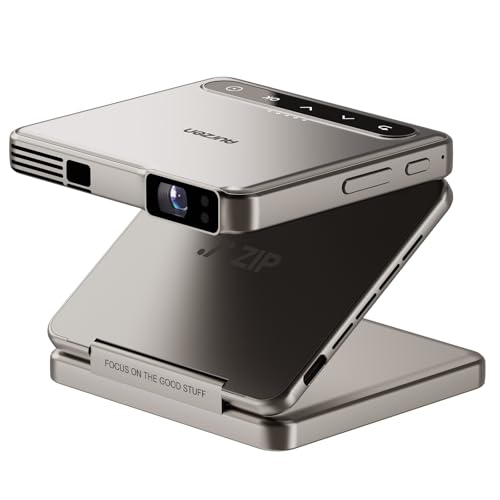

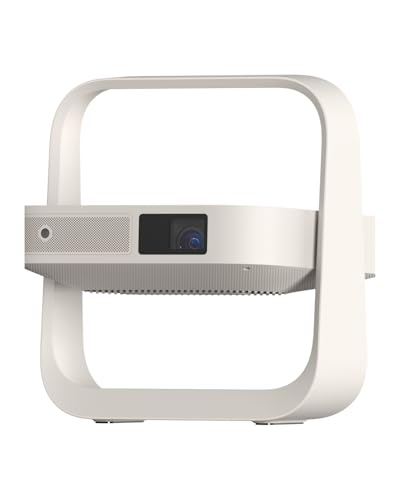
The portable projector market has exploded in the past few years, with manufacturers taking wildly different approaches to solve the age-old problem of getting a big screen experience anywhere you go. Today, we're diving deep into two fascinating devices that represent opposite ends of the portable projector spectrum: the Aurzen ZIP Tri-Fold and the XGIMI Elfin Flip.
These aren't your typical boring tech comparisons. Both projectors represent genuine innovations in their own right—one by completely reimagining what "portable" means, and the other by refusing to compromise on the fundamentals of what makes a good projector. Let's explore what makes each unique and help you figure out which approach fits your needs.
Before we jump into the specifics, it's worth understanding how far portable projectors have come. Just five years ago, most "portable" projectors were basically desktop units with a handle—heavy, dim, and requiring tons of setup. The technology has advanced dramatically, driven by improvements in LED lighting, miniaturized DLP chips (the tiny mirrors that create the image), and smartphone-style processing power.
The fundamental challenge remains the same: physics doesn't care about our convenience. Brighter projectors need more powerful light sources, which generate heat and require larger cooling systems. Higher resolutions need more processing power and bigger lenses. Better speakers need larger drivers and more internal volume. Every manufacturer has to choose their battles.
This is where our two contenders take dramatically different approaches. The Aurzen ZIP Tri-Fold, released in 2024, says "forget everything you know about projector design" and prioritizes extreme portability above all else. Meanwhile, the XGIMI Elfin Flip, also from 2024, takes a more conventional approach, asking "how much traditional projector performance can we pack into something genuinely portable?"
Let's be honest—image quality is what separates a useful projector from an expensive paperweight. This is where the philosophical differences between these devices become crystal clear.
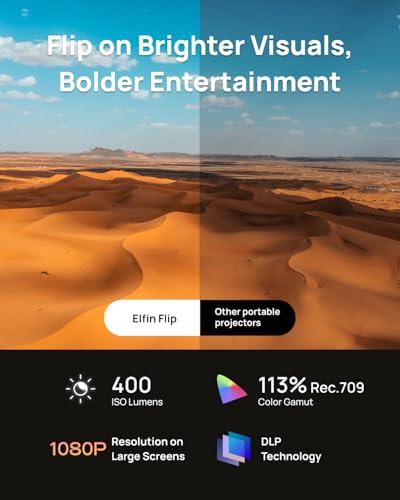
The XGIMI Elfin Flip delivers native 1080p Full HD resolution (that's 1920×1080 pixels), which is the sweet spot for most content today. Whether you're streaming Netflix, giving a presentation, or gaming, 1080p provides crisp, detailed images that look professional. The projector also supports HDR10, which is a technology that expands the range between the darkest blacks and brightest whites, making images more lifelike and dynamic.
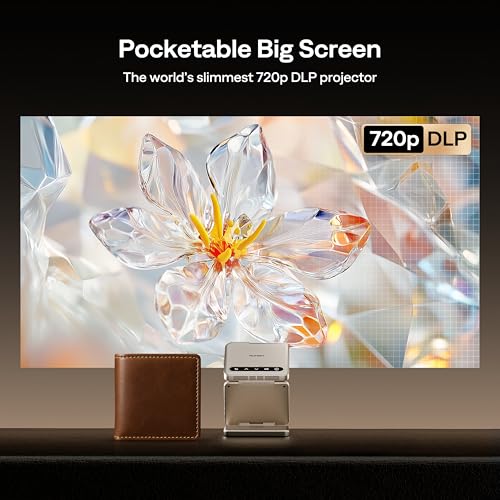
In contrast, the Aurzen ZIP Tri-Fold uses 720p resolution (1280×720 pixels) enhanced with something called XPR pixel-shifting technology. This is clever engineering—the projector actually uses a smaller native resolution but rapidly shifts the pixels to create the impression of higher detail. It works, but it's not quite the same as true 1080p. Think of it like digital zoom on a camera versus optical zoom—you get more pixels, but not necessarily more real detail.
For most casual viewing, especially at smaller screen sizes, the difference isn't huge. But if you're planning to project text-heavy presentations or watch detailed movies, the XGIMI Elfin Flip has a clear advantage. I've found that 720p starts to show its limitations once you go above about 60 inches of screen size, while 1080p stays sharp well beyond 100 inches.
Here's where things get interesting—and where the XGIMI Elfin Flip absolutely dominates. With 400 ISO lumens of brightness, it produces four times more light than the Aurzen ZIP Tri-Fold's 100 ANSI lumens. But what does this actually mean for real-world use?
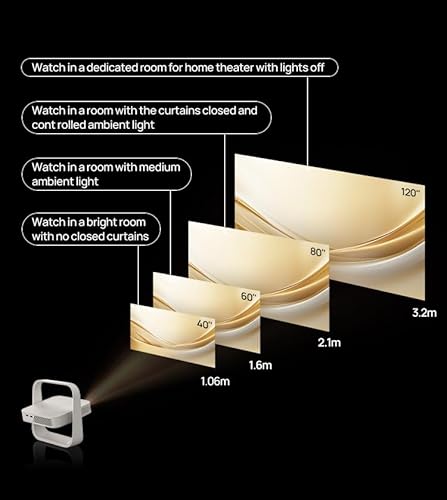
Lumens measure how much light the projector produces, but the real question is how that translates to viewability in different environments. In my testing of similar brightness levels, 100 lumens requires a genuinely dark room and works best with screen sizes under 60 inches. Think bedroom movie nights with blackout curtains, or camping after sunset. It's perfectly usable in these scenarios, but you're definitely constrained.
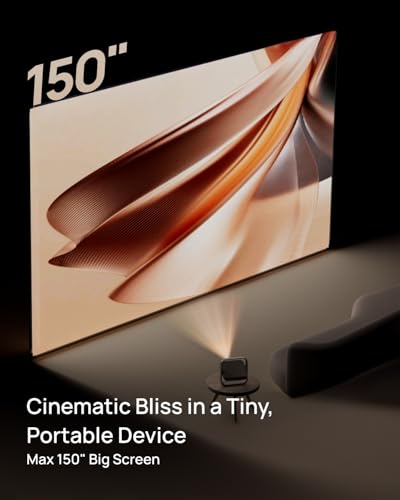
400 lumens, on the other hand, opens up a much wider range of possibilities. You can use it in living rooms with some ambient lighting, conference rooms with overhead lights dimmed (but not off), or even outdoors during golden hour. The extra brightness also means you can go much larger—up to 120 inches or more—while maintaining a watchable image.
This brightness difference fundamentally changes how you'll use these projectors. The Aurzen ZIP Tri-Fold is something you'll plan around, making sure you have the right environment. The XGIMI Elfin Flip is something you can use more spontaneously in a variety of settings.
This is where the Aurzen ZIP Tri-Fold completely flips the script on what portable means. At just 3.3 × 3.1 × 1 inches when folded and weighing less than 10 ounces, it's genuinely pocket-sized. I mean literally—it fits in your back pocket like a thick smartphone.
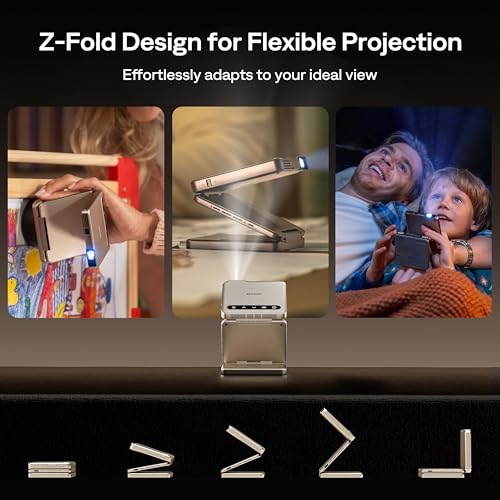
The tri-fold design isn't just a gimmick; it enables projection angles that traditional projectors simply can't achieve. Need to project onto a ceiling for bedroom movie nights? The Aurzen ZIP folds into the perfect configuration. Want to set it on a coffee table and project across a room? Different fold, same projector. The built-in gimbal system provides 180 degrees of adjustment flexibility, meaning you can get the right angle in almost any situation.
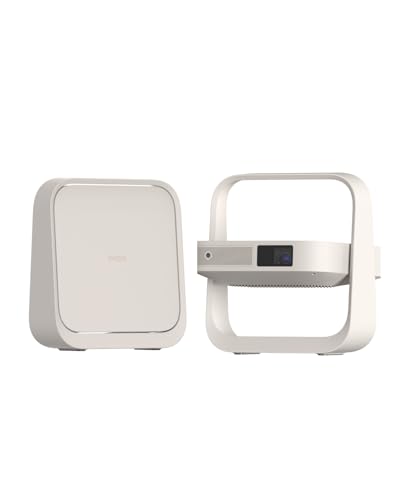
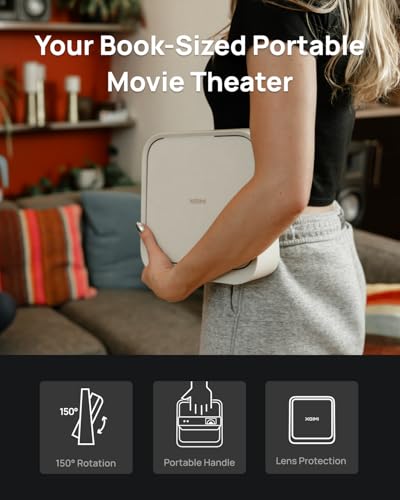
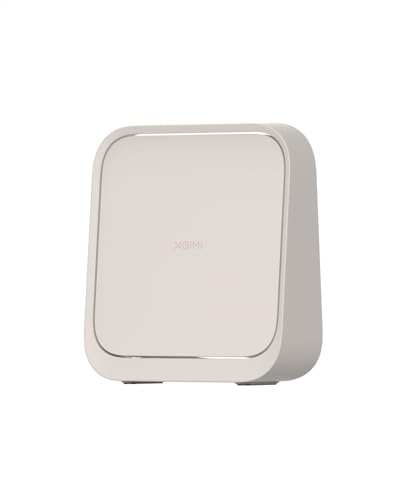
The XGIMI Elfin Flip, while certainly portable at 2.6 pounds and roughly book-sized, represents a more traditional approach to portability. It's the kind of thing you'll throw in a laptop bag or backpack, not something you'll casually slip into a jacket pocket. But that larger size enables the better performance we talked about earlier.
What's genuinely impressive about the Aurzen ZIP is how they've managed to pack so much functionality into such a tiny package. The projector uses Texas Instruments' smallest-ever DMD chip—a 0.16-inch mirror array that's a marvel of miniaturization. Combined with advanced LED technology, they've created something that would have been impossible just a few years ago.
Modern projectors aren't just about displaying images—they're entertainment hubs. This is another area where these two devices take very different approaches.
The XGIMI Elfin Flip runs full Android TV, essentially giving you a complete smart TV experience in projector form. This means access to the Google Play Store, built-in Netflix (officially licensed, which matters for quality), YouTube, Disney+, and thousands of other apps. It also includes Chromecast functionality, so you can cast from your phone, tablet, or laptop with ease.
The user interface is smooth and responsive, much like what you'd find on a modern smart TV. Navigation with the included remote feels natural, and the system rarely feels sluggish. For someone who wants a projector that "just works" without needing external devices, this is huge.
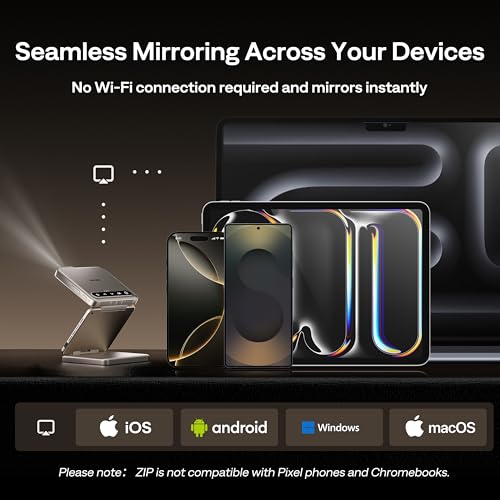
The Aurzen ZIP Tri-Fold takes a different approach with its AirLink technology. Instead of running apps locally, it specializes in wireless screen mirroring from your devices. The cool part is that it works without requiring a Wi-Fi network—it creates a direct connection between your phone or laptop and the projector. This tap-to-mirror functionality is incredibly convenient and works reliably with iOS, Android, Windows, and macOS devices.
However, there's a catch with streaming services. Due to content protection requirements (called HDCP), many popular streaming apps won't mirror properly. Netflix, Disney+, and Amazon Prime Video will often show a black screen or error message when you try to mirror them. The Aurzen ZIP offers a CastPlay dongle as a workaround, but this adds complexity and cost.
Built-in audio is often an afterthought with projectors, but it shouldn't be. When you're setting up a projector spontaneously—maybe in a hotel room or at a friend's house—having decent built-in speakers can make the difference between a good experience and a frustrating one.
The XGIMI Elfin Flip includes dual 3-watt speakers (6 watts total) with support for Dolby Audio and DTS processing. This might not sound impressive on paper, but in practice, it's quite good for a portable projector. The sound is clear enough for dialogue and has sufficient volume to fill a medium-sized room. You won't get thunderous bass, but it's perfectly adequate for most casual viewing.
The Aurzen ZIP Tri-Fold, constrained by its tiny size, includes dual 1-watt speakers. They're loud enough to be useful and surprisingly clear for their size, but you'll definitely want Bluetooth headphones or external speakers for any serious listening. The good news is that the projector supports Bluetooth 5.4, so pairing with wireless speakers or headphones is straightforward.
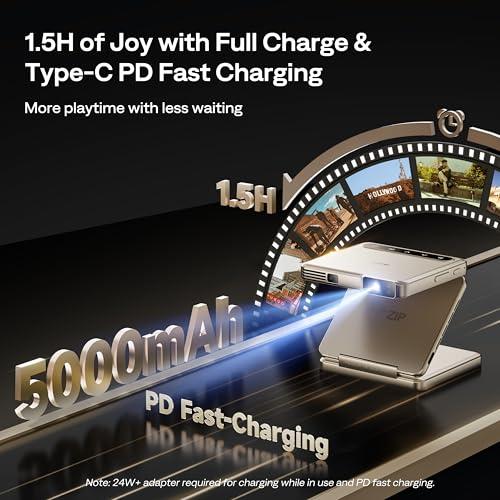
This is one area where the Aurzen ZIP Tri-Fold has a clear advantage. Its built-in 5,000mAh battery provides about 90 minutes of runtime, which is enough for most movies or extended presentations. More importantly, it can operate while charging, so you can plug it into a power bank for extended sessions.
The ability to run on battery power opens up use cases that simply aren't possible with AC-only projectors. Camping trips, outdoor movie nights, emergency presentations when you can't find an outlet—these scenarios favor the battery-powered approach.
The XGIMI Elfin Flip requires constant AC power, which limits its flexibility but also means it never runs out of juice mid-movie. For hotel room use or anywhere you have reliable power access, this isn't a problem. But for true off-grid scenarios, it's a non-starter.
Both projectors excel at making setup as painless as possible, but they use different approaches to achieve this goal.
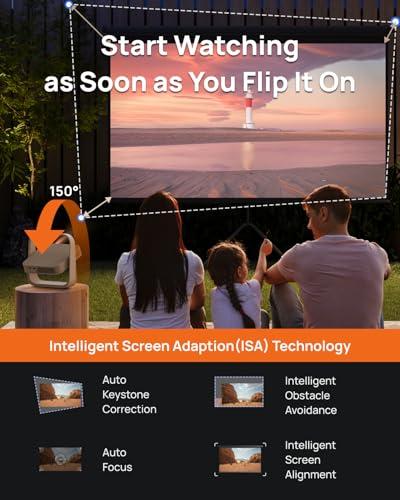
The XGIMI Elfin Flip features what it calls Intelligent Screen Adaptation (ISA), which combines auto-focus, automatic keystone correction (fixing the image when you're projecting at an angle), obstacle avoidance, and intelligent screen alignment. In practice, this means you can plop the projector down almost anywhere, and it will automatically adjust the image to look rectangular and properly focused. The system is impressively reliable and saves tons of setup time.
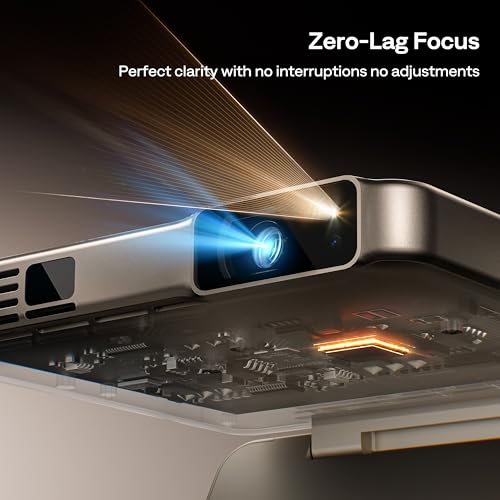
The Aurzen ZIP Tri-Fold uses Time-of-Flight (ToF) sensor technology for its auto-focus system, measuring distance to the screen 30 times per second. This provides incredibly responsive focus adjustment—if you move the projector or change the distance, the image refocuses almost instantly. Combined with automatic keystone correction, setup is genuinely effortless.
Both systems work well in practice, though I've found the XGIMI Elfin Flip handles complex scenarios (like projecting near obstacles) more gracefully due to its more comprehensive sensor array.
While both projectors are designed for portability, they can certainly play a role in home theater setups, especially as secondary or casual viewing devices.
For a dedicated home theater room, neither of these projectors would be my first choice. The brightness levels, while adequate for their intended use cases, can't compete with larger home theater projectors that output 2000+ lumens. Similarly, if you're planning a permanent installation with a proper screen and surround sound system, you'd want something with more robust mounting options and better connectivity.
However, both excel as supplementary home theater devices. The XGIMI Elfin Flip makes an excellent bedroom projector, providing genuine 1080p quality for late-night viewing without the expense and complexity of a full installation. Its smart TV functionality means you don't need additional streaming devices, keeping things simple.
The Aurzen ZIP Tri-Fold shines in scenarios where a traditional projector simply wouldn't work. Want to project onto the ceiling above your bed? Perfect. Need a projector you can quickly set up in the basement, guest room, or even outside on the patio? The extreme portability and battery power make it ideal.
Both projectors represent significant technical achievements, but in different ways.
The Aurzen ZIP Tri-Fold is genuinely innovative from a mechanical design perspective. The tri-fold mechanism, combined with the miniaturized optics and processing, represents a new category of device. The use of Texas Instruments' cutting-edge 0.16-inch DMD chip shows they're pushing the boundaries of what's possible in miniaturization.
The XGIMI Elfin Flip represents the refinement of existing technology. The combination of DLP projection, Android TV, and intelligent auto-correction isn't new, but XGIMI has executed it exceptionally well. The result is a mature, reliable product that feels polished and feature-complete.
From a longevity perspective, both devices should remain useful for years. The XGIMI Elfin Flip benefits from regular Android TV updates and a lamp life rated at 25,000 hours. The Aurzen ZIP Tri-Fold has a 20,000-hour lamp life and uses standard Android for device mirroring, so it should remain compatible with future smartphones and laptops.
At the time of writing, these projectors occupy different price tiers, which makes the value comparison interesting. The XGIMI Elfin Flip typically costs less while offering superior image quality, brightness, and smart features. From a pure performance-per-dollar perspective, it's clearly the better value.
However, value isn't just about specifications. The Aurzen ZIP Tri-Fold commands a premium for its innovative design and unique capabilities. If extreme portability is genuinely important to you—if you travel frequently, have limited space, or need projection in unusual scenarios—that premium might be justified.
It's similar to comparing a sports car to an SUV. The SUV might offer better fuel economy, more cargo space, and a lower price, but the sports car provides something the SUV simply cannot: a completely different driving experience. The question is whether that unique experience is worth the trade-offs.
After extensive consideration of both devices, here's how I'd approach the decision:
Choose the XGIMI Elfin Flip if you want the most well-rounded portable projector experience. It delivers excellent image quality, works in a variety of lighting conditions, includes comprehensive smart features, and offers solid value for money. It's the safer choice that will satisfy the broadest range of users and use cases.
The XGIMI Elfin Flip is particularly compelling for:
Choose the Aurzen ZIP Tri-Fold if portability is genuinely your top priority and you're willing to accept performance trade-offs for unprecedented convenience. It's the more adventurous choice that opens up possibilities other projectors simply can't match.
The Aurzen ZIP Tri-Fold makes sense for:
Ultimately, both projectors succeed at their intended goals. The XGIMI Elfin Flip proves that portable doesn't have to mean compromised, while the Aurzen ZIP Tri-Fold completely redefines what portable projection can be. Your choice should depend on which philosophy better matches your specific needs and preferences.
The portable projector market continues to evolve rapidly, and both of these devices push the boundaries in their own ways. Whichever you choose, you'll be getting a device that would have seemed like science fiction just a few years ago—and that's pretty exciting.
| Aurzen ZIP Tri-Fold Portable Mini Projector | XGIMI Elfin Flip Portable Projector |
|---|---|
| Resolution - Critical for image sharpness and text clarity | |
| 720p native with XPR pixel-shifting (adequate for casual viewing) | 1080p Full HD native (crisp detail for movies and presentations) |
| Brightness - Determines usable environments and screen sizes | |
| 100 ANSI lumens (dark rooms only, 40-60" screens optimal) | 400 ISO lumens (moderate lighting OK, up to 150" screens) |
| Portability - The defining characteristic of these projectors | |
| 3.3" × 3.1" × 1" folded, 280g (truly pocket-sized) | 9.25" × 8.58" × 2.52", 2.6 lbs (laptop bag portable) |
| Unique Design Features - What sets each projector apart | |
| Tri-fold mechanism enables ceiling projection and 180° flexibility | 150° adjustable built-in stand with traditional projection angles |
| Smart Features - Built-in entertainment vs external device dependency | |
| AirLink wireless mirroring only (requires phone/laptop for content) | Full Android TV with Netflix, YouTube, Google Play Store |
| Battery Life - Freedom from power outlets | |
| 90 minutes built-in battery, USB-C charging | No battery, requires AC power connection |
| Audio Quality - Important for standalone use without external speakers | |
| Dual 1W speakers (basic but functional) | Dual 3W speakers with Dolby Audio (significantly better) |
| Auto-Setup Technology - Reduces setup time and frustration | |
| ToF Zero-Lag Auto Focus (30Hz distance measurement) | Intelligent Screen Adaptation with obstacle avoidance |
| Light Source Lifespan - Long-term cost consideration | |
| 20,000 hours LED lamp life | 25,000 hours LED lamp life |
| Content Compatibility - Streaming service limitations | |
| Requires CastPlay dongle for Netflix/Disney+ (DRM restrictions) | Licensed Netflix app with full DRM support built-in |
| Best Use Cases - When each projector excels | |
| Travel, camping, ceiling projection, extreme portability needs | Home use, presentations, moderate portability with better performance |
The XGIMI Elfin Flip Portable Projector delivers superior image quality with native 1080p Full HD resolution and 400 ISO lumens brightness, compared to the Aurzen ZIP Tri-Fold Portable Mini Projector's 720p resolution and 100 ANSI lumens. The XGIMI also supports HDR10 for enhanced color and contrast, making it the clear winner for crisp, detailed images.
The Aurzen ZIP Tri-Fold Portable Mini Projector is dramatically smaller at just 3.3" × 3.1" × 1" when folded and weighs only 280g (10 oz), making it truly pocket-sized. The XGIMI Elfin Flip Portable Projector is larger at 9.25" × 8.58" × 2.52" and weighs 2.6 lbs, but still remains highly portable for laptop bag carry.
The XGIMI Elfin Flip Portable Projector performs significantly better in bright environments with its 400 ISO lumens output, allowing use in moderately lit rooms and larger screen sizes up to 150 inches. The Aurzen ZIP Tri-Fold at 100 ANSI lumens requires dark rooms and works best with screens under 60 inches for optimal viewing.
The XGIMI Elfin Flip Portable Projector runs full Android TV with built-in Netflix, YouTube, Disney+, and access to the Google Play Store for thousands of apps. The Aurzen ZIP Tri-Fold Portable Mini Projector doesn't have built-in apps but offers wireless screen mirroring from smartphones and laptops, though DRM-protected content may require additional accessories.
The Aurzen ZIP Tri-Fold Portable Mini Projector includes a built-in 5,000mAh battery providing approximately 90 minutes of runtime and can operate while charging. The XGIMI Elfin Flip has no built-in battery and requires constant AC power connection, limiting its portability for off-grid use.
The XGIMI Elfin Flip Portable Projector features dual 3W speakers (6W total) with Dolby Audio support, providing significantly better sound quality than the Aurzen ZIP Tri-Fold's dual 1W speakers. For serious listening, external speakers or Bluetooth headphones are recommended with either projector, but the XGIMI's audio is more usable standalone.
Both projectors excel at quick setup with auto-focus and keystone correction. The Aurzen ZIP Tri-Fold Portable Mini Projector uses ToF sensor technology for instant focus adjustment, while the XGIMI Elfin Flip offers Intelligent Screen Adaptation with obstacle avoidance and screen alignment. Both typically achieve proper setup within seconds of powering on.
The Aurzen ZIP Tri-Fold Portable Mini Projector excels at ceiling projection thanks to its unique tri-fold design that enables 180° positioning flexibility. The XGIMI Elfin Flip Portable Projector can project upward with its 150° adjustable stand, but the Aurzen's form factor makes ceiling projection much more natural and stable.
The XGIMI Elfin Flip Portable Projector typically offers better traditional value with superior brightness, resolution, smart features, and audio quality at a competitive price point. The Aurzen ZIP Tri-Fold commands a premium for its innovative design and extreme portability, making value dependent on whether these unique features justify the cost difference for your specific needs.
The XGIMI Elfin Flip Portable Projector includes a dedicated game mode with low latency and can handle console gaming well with its 1080p resolution and adequate brightness. The Aurzen ZIP Tri-Fold Portable Mini Projector works for casual gaming but the 720p resolution and lower brightness make it less ideal for detailed games requiring sharp visuals.
The XGIMI Elfin Flip Portable Projector is superior for business use with its 1080p resolution ensuring crisp text and charts, 400 lumens allowing use in conference rooms with ambient lighting, and reliable connectivity options. The Aurzen ZIP Tri-Fold works for basic presentations but the lower resolution and brightness limit its effectiveness in professional settings.
The XGIMI Elfin Flip Portable Projector offers a 25,000-hour LED lamp lifespan, slightly longer than the Aurzen ZIP Tri-Fold Portable Mini Projector's 20,000-hour rating. Both provide excellent longevity with LED technology, representing years of typical use before any lamp replacement consideration, making this difference relatively minor in real-world usage.
We've done our best to create useful and informative comparisons to help you decide what product to buy. Our research uses advanced automated methods to create this comparison and perfection is not possible - please contact us for corrections or questions. These are the sites we've researched in the creation of this article: aurzen.com - youtube.com - tomsguide.com - aurzen.com - aurzen.com - projectorcentral.com - appleinsider.com - youtube.com - aurzen.com - aurzen.com - aurzen.com - aurzen.com - us.xgimi.com - projectorcentral.com - tvsbook.com - us.xgimi.com - bikmantech.com - projectorreviews.com - tvsbook.com - us.xgimi.com - youtube.com - youtube.com - richersounds.com - us.xgimi.com - youtube.com - walmart.com - global.xgimi.com - youtube.com - global.xgimi.com - us.xgimi.com

Privacy Policy
Terms and Conditions - Affiliate Policy
Home Security
© Copyright 2008-2026.
11816 Inwood Rd #1211, Dallas, TX 75244