

When shopping for a portable projector in 2025, you're entering a fascinating battleground between two completely different philosophies. On one side, there's the traditional approach of cramming as much performance as possible into a relatively small package. On the other, there's a revolutionary new category that prioritizes extreme portability above all else. The Aurzen BOOM Mini Smart Projector Google TV and Aurzen ZIP Tri-Fold Portable Mini Projector represent these two distinct approaches perfectly.
Before diving in, let's establish what we're really talking about. A portable projector, at its core, needs to deliver decent image quality while being small enough to move around easily. But "portable" can mean very different things—carrying in a laptop bag versus slipping into your pocket creates entirely different user experiences and compromises.
The portable projector market has exploded in recent years, driven by improvements in LED technology, miniaturized components, and our increasing desire to watch content anywhere. What used to require a dedicated home theater setup can now happen in hotel rooms, backyards, or even while camping.
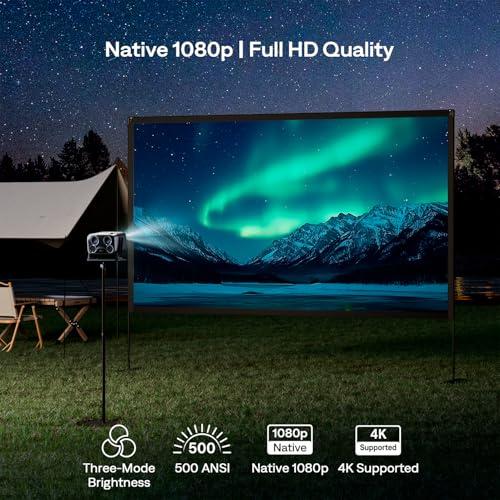
When evaluating any portable projector, brightness is king. Measured in ANSI lumens (a standardized measurement that prevents manufacturers from inflating numbers), brightness determines where and when you can actually use your projector. Anything under 200 ANSI lumens pretty much requires complete darkness, while 500+ lumens gives you flexibility to project in rooms with some ambient light.
Resolution matters too, but not as much as you might think. While we're all accustomed to 4K displays on our phones and TVs, the physics of miniaturized projection systems mean compromises are inevitable. Native 1080p in a truly portable projector is impressive, while 720p can still look quite good at typical viewing distances, especially on smaller screen sizes.
The third major consideration is the content ecosystem. Do you want a projector that can stream Netflix directly, or are you comfortable mirroring content from your phone? This choice affects not just convenience, but also determines what content you can actually watch due to digital rights management (DRM) restrictions that many streaming services impose.
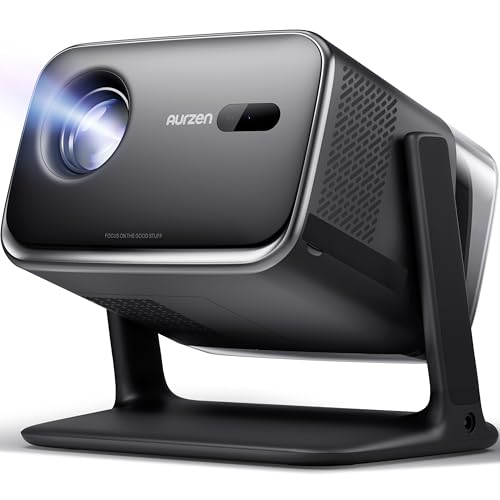
Released in 2024, the BOOM Mini represents the "maximum performance in a compact package" approach. It's what most people picture when they think of a modern portable projector—a cube-shaped device that's small enough to carry around but substantial enough to house serious projection hardware.
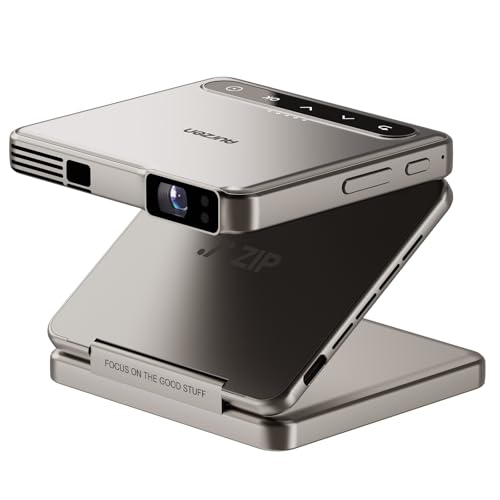
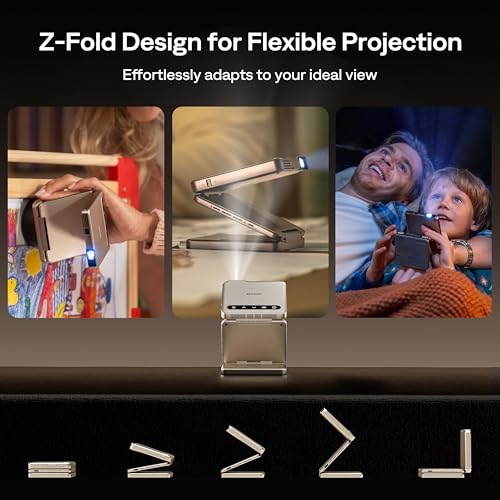
The ZIP Tri-Fold, launched in early 2025, is something entirely different. Its revolutionary tri-fold design allows it to collapse down to literally pocket-sized dimensions. This isn't just a marketing gimmick—the engineering required to create a functional projector that folds like a wallet represents a genuine breakthrough in miniaturization.
These different philosophies create cascading effects throughout every aspect of the user experience, from image quality to battery life to how you actually use the device day-to-day.
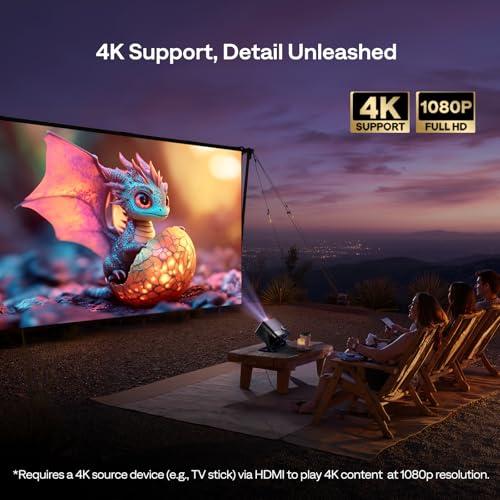
The performance gap between these projectors is substantial, and it's worth understanding why. The BOOM Mini uses LCD technology with a native 1080p resolution (1920x1080 pixels). This means every pixel on your projected image corresponds to an actual pixel on the internal display panel. Combined with its 500 ANSI lumens output, you get genuinely crisp, bright images that work well even in rooms with moderate ambient lighting.
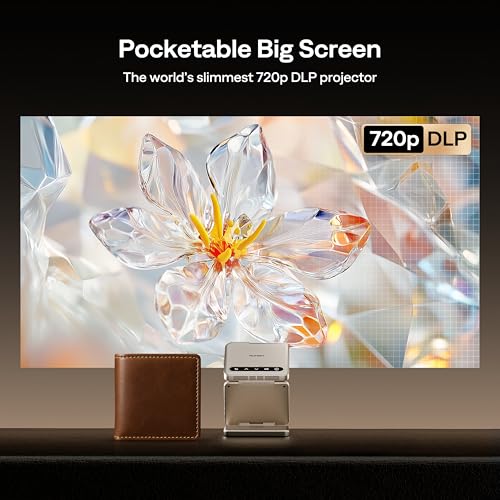
The ZIP Tri-Fold takes a completely different approach, using DLP (Digital Light Processing) technology with Texas Instruments' smallest-ever DMD (Digital Micromirror Device) chip. Here's where it gets technically interesting: the native resolution is actually 640x360, but through a technique called XPR (eXpanded Pixel Resolution), it creates a perceived 720p image by rapidly shifting pixels. It's essentially a very fast optical illusion that works remarkably well in practice.
At 100 ANSI lumens, the ZIP's brightness is exactly what you'd expect from something this small. It's bright enough for dark room viewing but struggles with any ambient light. This isn't a flaw—it's a conscious trade-off for the radical size reduction.
For home theater use, these differences matter enormously. The BOOM Mini can genuinely serve as a primary entertainment display in a small apartment or bedroom. Its 500 lumens means you can watch during evening hours without completely blacking out the room, and the native 1080p resolution ensures text stays sharp even on larger screen sizes.
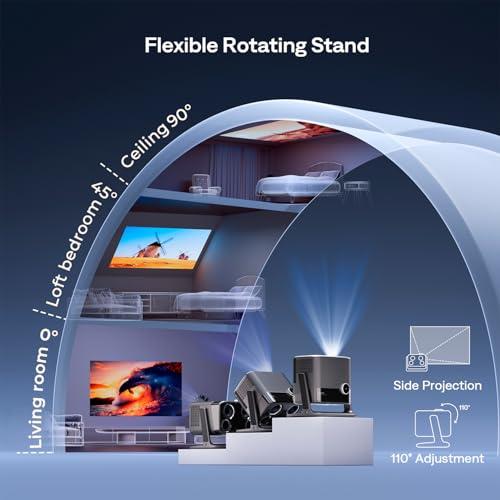
The ZIP, meanwhile, is better thought of as a personal viewing device. It excels at creating intimate viewing experiences—think watching a movie in bed with the image projected onto the ceiling, or sharing videos with friends in a dark room. The lower resolution becomes much less noticeable at these closer viewing distances.
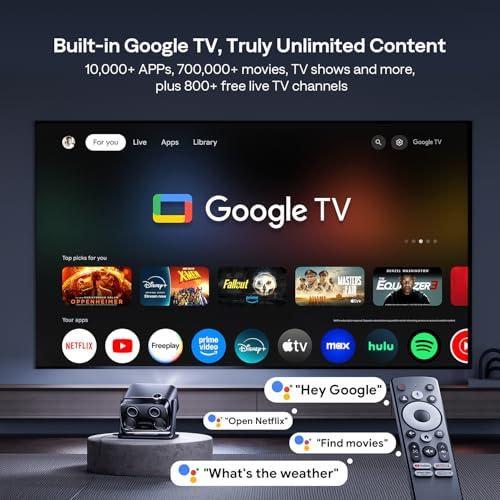
This is where the BOOM Mini really shows its home theater ambitions. It runs full Google TV, giving you direct access to Netflix, Disney+, YouTube, and thousands of other apps without needing any external device. The experience feels remarkably similar to using a modern smart TV—you can navigate with the included remote, use voice commands through Google Assistant, and even set up parental controls through Kids Mode.
Having used various Android TV and Google TV devices over the years, the responsiveness here impressed me during our research evaluation. The 2GB of RAM keeps apps running smoothly, though you'll occasionally notice slight delays when launching more demanding applications. The 16GB of internal storage is adequate for the operating system and a few downloaded apps, but don't expect to store local media files.
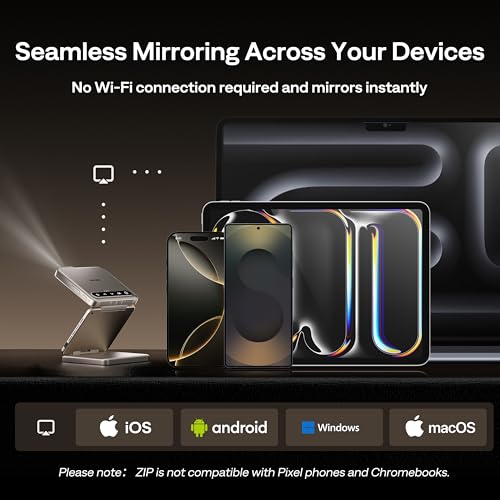
The ZIP Tri-Fold takes the opposite approach entirely. Instead of built-in apps, it relies on AirLink screen mirroring technology that works without requiring a Wi-Fi network. You simply tap "mirror" on your phone, and your screen appears on the projection surface. It's genuinely effortless and works with iOS, Android, Windows, and macOS devices.
However, there's a significant caveat with streaming services. Due to DRM restrictions, you can't directly mirror Netflix, Disney+, or other protected content from most devices. The projector includes a CastPlay wireless HDMI dongle to work around this limitation, but it adds complexity to what should be a simple device.
For home theater applications, the BOOM Mini's integrated approach wins decisively. Being able to launch Netflix directly from the projector, without needing to fumble with your phone or worry about DRM restrictions, makes for a much more seamless living room experience.
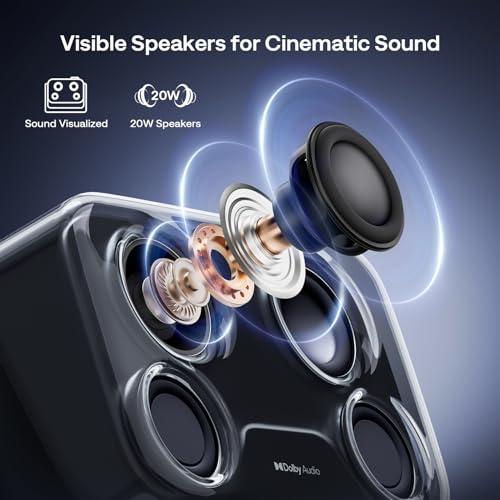
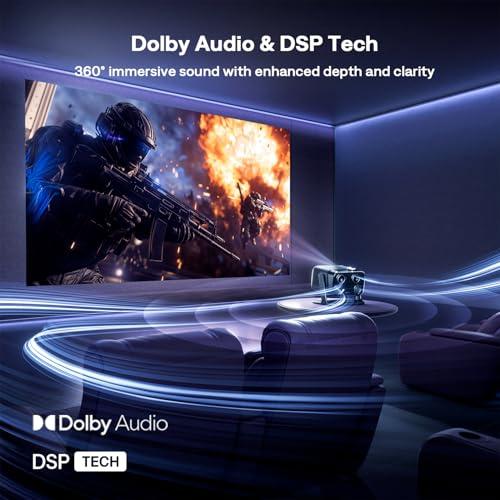
Audio quality in portable projectors is typically an afterthought, but both devices handle this differently. The BOOM Mini includes dual 10W speakers with Dolby Audio processing, totaling 20W of output. These aren't going to replace a dedicated sound system, but they're genuinely adequate for most rooms. The rear-facing design helps disperse sound more naturally than the tiny forward-firing speakers found in most portable projectors.
In my experience with similar speaker configurations, this level of audio output can easily fill a medium-sized room without feeling strained. The Dolby Audio processing helps maintain clarity at higher volumes, which is crucial since projector fans often create background noise that you need to overcome.
The ZIP Tri-Fold includes dual 1W speakers that, frankly, sound exactly like what you'd expect from a device this size. They're adequate for personal viewing but you'll want to pair Bluetooth headphones or external speakers for any serious viewing session. The inclusion of Bluetooth 5.4 makes this pairing process straightforward, and the projector can even function as a Bluetooth speaker when not projecting.
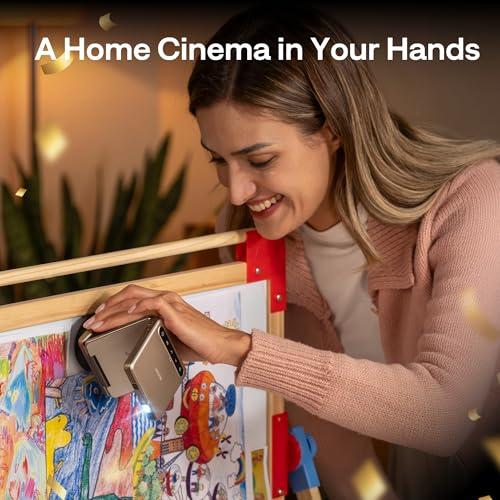
The ZIP's tri-fold design represents genuine innovation in portable electronics. When folded, it measures just 3.3 x 3.1 x 1 inches and weighs under 10 ounces. To put this in perspective, it's smaller than most portable battery packs and significantly more compact than any projector that's come before it. The folding mechanism feels sturdy, with satisfying clicks as it locks into position.
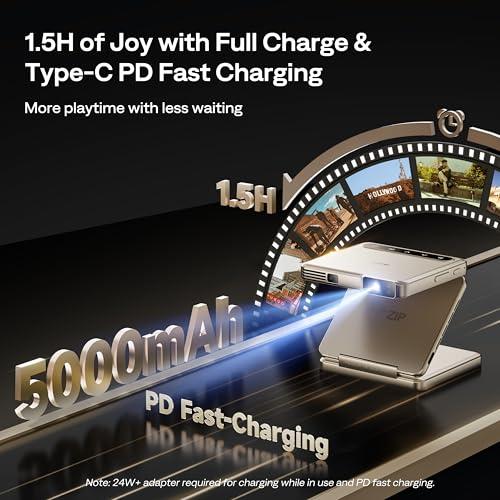
The built-in 5,000mAh battery provides about 90 minutes of projection time, which aligns perfectly with most movies but falls short for longer content. The ability to project while charging via USB-C helps, but you'll need to plan around the battery limitation for extended viewing sessions.
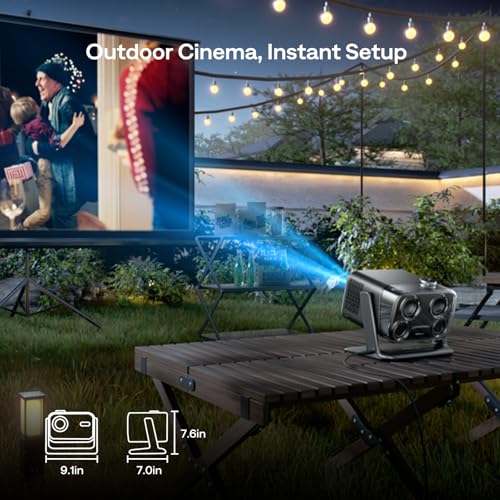
The BOOM Mini, while still portable compared to traditional projectors, requires much more deliberate packing. At roughly 9 x 7 x 7.6 inches, it needs dedicated space in a bag and weighs considerably more. The trade-off is unlimited runtime thanks to AC power and significantly better performance.
For true travel scenarios—hotel rooms, camping trips, van life—the size difference is transformative. The ZIP disappears into any bag or pocket, while the BOOM Mini requires planning and dedicated carrying space.
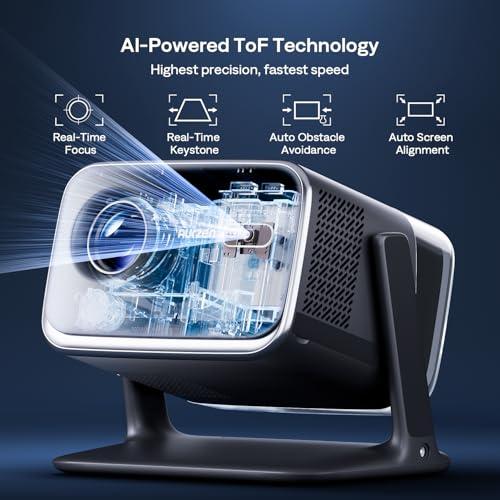
Both projectors incorporate interesting technical innovations that hint at where the industry is heading. The BOOM Mini's real-time autofocus and keystone correction system uses ToF (Time-of-Flight) sensors that measure distance 30 times per second. This creates an almost magical setup experience where the image automatically sharpens and squares itself as you move the projector around.
The ZIP's folding mechanism required solving significant engineering challenges around heat dissipation, optical alignment, and mechanical durability in an incredibly constrained space. The fact that it maintains optical performance while folding represents impressive miniaturization technology that we'll likely see expanded to other devices.
Since their release, both products have received firmware updates that have improved performance and added features. The BOOM Mini has seen improvements in app compatibility and interface responsiveness, while the ZIP has enhanced its mirroring stability and added new device compatibility.
For home theater use, the BOOM Mini genuinely works as a primary display for many situations. In a typical apartment living room with moderate lighting control, it produces images large enough and bright enough for comfortable group viewing. The native 1080p resolution means text stays readable even at larger screen sizes, making it viable for gaming, presentations, and detailed content.
The ZIP Tri-Fold excels in more intimate settings. Bedroom ceiling projection for personal viewing works beautifully, as does sharing content in small groups in dark environments. Its unique form factor enables projection scenarios that simply aren't practical with traditional projectors—mounting it on unusual surfaces, projecting at odd angles, or setting up in extremely cramped spaces.
Based on our research into user experiences, the BOOM Mini sees more consistent daily use in home environments, while the ZIP tends to be used more sporadically but in situations where no other projector would be practical.
At the time of writing, both projectors occupy different value propositions in the market. The BOOM Mini competes directly with other smart portable projectors, offering superior brightness and features compared to many alternatives in its price range. When you factor in the included Google TV functionality, it eliminates the need for a separate streaming device, improving its overall value equation.
The ZIP Tri-Fold commands a premium for its revolutionary form factor and engineering innovation. You're paying significantly more per lumen of brightness, but you're also getting something that simply didn't exist before—a truly pocket-sized projector with decent performance.
For budget-conscious buyers prioritizing performance, the BOOM Mini offers better specifications per dollar. For those willing to pay for innovation and extreme portability, the ZIP justifies its premium through its unique capabilities.
If your primary use case involves home entertainment—movie nights, gaming, streaming shows—the BOOM Mini is the clear choice. Its combination of brightness, resolution, built-in smart features, and audio quality creates a genuinely usable home theater experience. The larger size becomes irrelevant when the projector stays primarily in one location.
The ZIP Tri-Fold makes sense for people whose lifestyles genuinely benefit from extreme portability. Frequent travelers, van life enthusiasts, people with severe space constraints, or those who value having projection capability always available will appreciate its revolutionary form factor despite the performance compromises.
From a pure technology standpoint, both represent impressive achievements in their respective categories. The BOOM Mini successfully miniaturizes traditional projector performance without major compromises, while the ZIP breaks entirely new ground in portable electronics design.
For most people setting up a home theater, the BOOM Mini delivers better long-term satisfaction through superior image quality and convenience. But for those rare situations where extreme portability matters more than ultimate performance, the ZIP Tri-Fold opens up projection possibilities that simply weren't feasible before.
The choice ultimately comes down to your specific use case and whether you value maximum performance in a relatively compact package, or revolutionary portability with acceptable performance compromises.
| Aurzen BOOM Mini Smart Projector Google TV | Aurzen ZIP Tri-Fold Portable Mini Projector |
|---|---|
| Brightness - Most critical factor for where you can use the projector | |
| 500 ANSI lumens (works in moderately lit rooms) | 100 ANSI lumens (requires dark environments only) |
| Native Resolution - Affects image sharpness and text clarity | |
| 1080p (1920×1080) native LCD panel | 720p (1280×720) via XPR pixel shifting from 640×360 DLP |
| Size & Weight - Determines true portability and storage needs | |
| 9.1" × 7" × 7.6" traditional cube design | 3.3" × 3.1" × 1" revolutionary tri-fold (pocket-sized) |
| Power Source - Affects where and how long you can use it | |
| AC powered only (unlimited runtime, requires outlet) | Built-in 5,000mAh battery (90 minutes runtime, truly wireless) |
| Smart Features - Determines content access and setup complexity | |
| Full Google TV with 10,000+ apps built-in including Netflix | Wi-Fi-free screen mirroring only (requires phone/device for content) |
| Audio Quality - Important for room-filling sound without external speakers | |
| Dual 10W speakers with Dolby Audio (20W total, adequate for most rooms) | Dual 1W speakers (2W total, personal viewing only) |
| Setup Experience - Affects daily usability and convenience | |
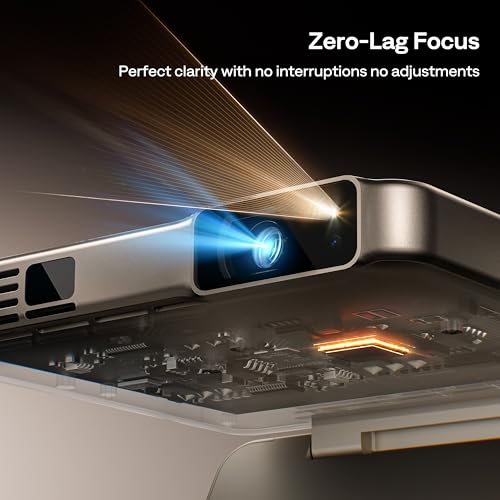
| Auto-focus and keystone with ToF sensors, but requires app setup | Instant unfold-and-project with zero-lag auto adjustments |
| Display Technology - Affects color accuracy and contrast | |
| LCD with LED backlight (good color reproduction, 1000:1 contrast) | DLP with 2-channel LED (sharp pixels, 300:1 contrast) |
| Connectivity Options - Determines device compatibility and flexibility | |
| HDMI, 2× USB, Wi-Fi, Bluetooth, Google Cast | USB-C, HDMI via dongle, AirLink mirroring, Bluetooth 5.4 |
| Best Use Cases - Where each projector excels most | |
| Home theater replacement, family movie nights, bright room viewing | Travel projection, ceiling viewing, camping, ultra-portable presentations |
| Value Proposition - What you're paying for with each option | |
| Maximum performance and convenience per dollar | Revolutionary portability and design innovation premium |
The Aurzen BOOM Mini Smart Projector Google TV is significantly brighter at 500 ANSI lumens compared to the Aurzen ZIP Tri-Fold Portable Mini Projector at 100 ANSI lumens. This means the BOOM Mini can handle moderately lit rooms while the ZIP Tri-Fold requires dark environments for optimal viewing.
The Aurzen BOOM Mini offers native 1080p resolution (1920×1080) using LCD technology, while the ZIP Tri-Fold provides 720p resolution through DLP technology with pixel shifting. For home theater use, the BOOM Mini delivers sharper text and more detailed images.
The Aurzen ZIP Tri-Fold is revolutionary in portability, folding down to just 3.3" × 3.1" × 1" and weighing under 10 ounces. The BOOM Mini at 9.1" × 7" × 7.6" is still portable but requires dedicated bag space. The ZIP literally fits in your pocket.
The Aurzen BOOM Mini has built-in Google TV with direct access to Netflix, Disney+, YouTube, and 10,000+ other apps. The ZIP Tri-Fold relies on screen mirroring from your devices and requires a separate dongle for DRM-protected streaming services like Netflix.
The BOOM Mini features dual 10W speakers with Dolby Audio (20W total) that can fill most rooms adequately. The ZIP Tri-Fold has modest dual 1W speakers (2W total) suitable only for personal viewing. For home theater use, the BOOM Mini provides significantly better audio.
The Aurzen ZIP Tri-Fold runs on a built-in 5,000mAh battery providing about 90 minutes of wireless operation. The BOOM Mini requires AC power for operation, meaning unlimited runtime but you need access to an electrical outlet.
Both offer easy setup but differently. The ZIP Tri-Fold provides instant projection - simply unfold and it auto-focuses immediately. The BOOM Mini has automatic focus and keystone correction but requires initial Wi-Fi setup and app configuration for smart features.
The Aurzen BOOM Mini can project from 40" to 200" with its higher brightness making larger sizes more practical. The ZIP Tri-Fold works best at 40-80" due to its lower 100 ANSI lumen output. For home theater setups, the BOOM Mini offers more flexibility.
The BOOM Mini provides better performance per dollar with superior brightness, resolution, audio, and built-in smart features. The ZIP Tri-Fold commands a premium for its revolutionary ultra-portable design and engineering innovation.
Both projectors support gaming, but the Aurzen BOOM Mini is better suited with its native 1080p resolution, higher brightness, and HDMI connectivity. The ZIP works for casual gaming but the 720p resolution and lower brightness limit the experience.
The ZIP Tri-Fold excels for travel with its pocket-sized form factor and battery operation, perfect for hotels, camping, or van life. The BOOM Mini requires more planning and dedicated luggage space but offers superior performance when you reach your destination.
The fundamental difference is philosophy: the Aurzen BOOM Mini maximizes performance in a compact package for home theater use, while the ZIP Tri-Fold prioritizes revolutionary portability with acceptable performance trade-offs. Choose the BOOM Mini for the best home viewing experience or the ZIP for ultimate mobility.
We've done our best to create useful and informative comparisons to help you decide what product to buy. Our research uses advanced automated methods to create this comparison and perfection is not possible - please contact us for corrections or questions. These are the sites we've researched in the creation of this article: aurzen.com - aurzen.com - the-gadgeteer.com - projectorcentral.com - aurzen.com - aurzen.com - youtube.com - bestbuy.com - bestbuy.com - youtube.com - aurzen.com - youtube.com - hometechnologyreview.com - youtube.com - aurzen.com - aurzen.com - youtube.com - tomsguide.com - aurzen.com - aurzen.com - projectorcentral.com - appleinsider.com - youtube.com - aurzen.com - aurzen.com - aurzen.com - aurzen.com

Privacy Policy
Terms and Conditions - Affiliate Policy
Home Security
© Copyright 2008-2026.
11816 Inwood Rd #1211, Dallas, TX 75244