

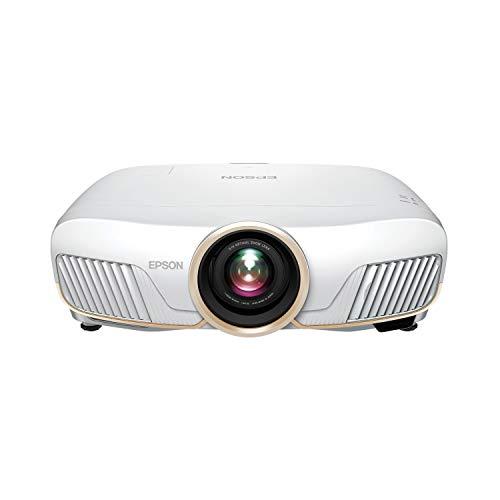
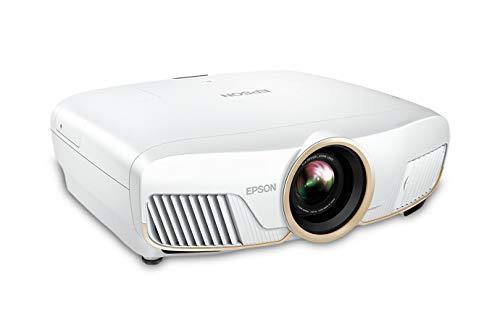
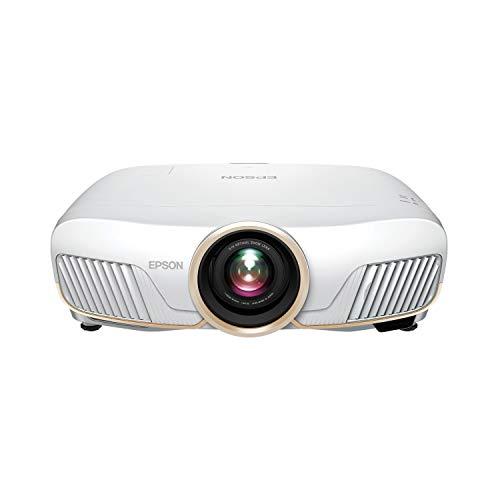
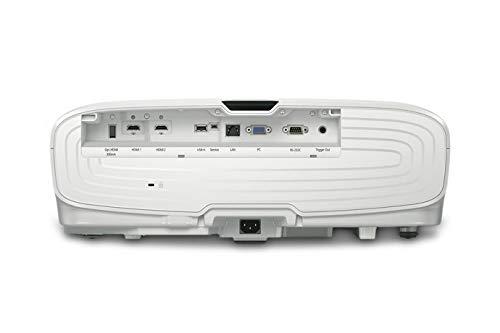
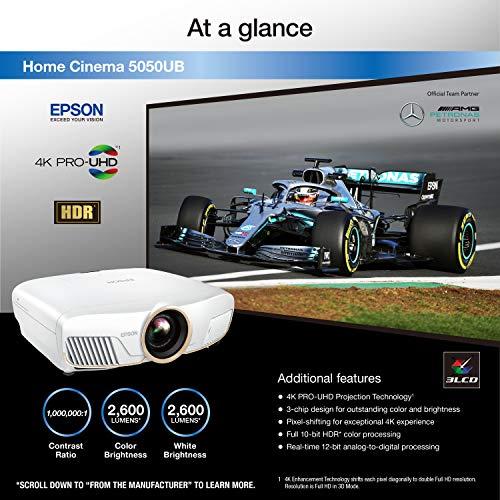
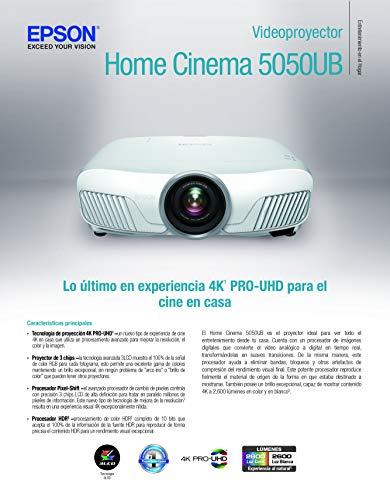
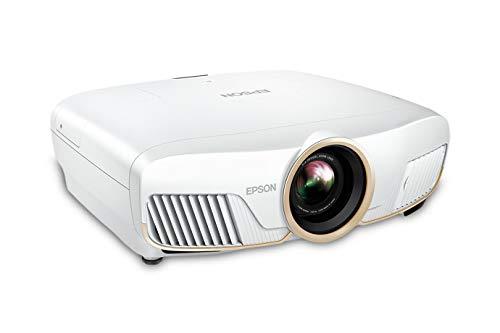
Quick Reality Check: Before diving deep into projector specs and performance metrics, there's something important to clarify. The Epson Home Cinema 5050UB 4K PRO-UHD 3-Chip Projector and the Epson Home Cinema 5050UB Projector are actually identical products. The difference is purely in naming – one uses the full marketing name while the other uses a shortened version. This means you're looking at the same projector with identical specifications, features, and performance characteristics.
When shopping for a home theater projector, you're essentially choosing how you want to experience movies, games, and TV shows on a much larger scale than any traditional television can provide. The projector market has evolved significantly since 2019, when the 5050UB first launched, but certain fundamental principles remain unchanged.
Image quality sits at the top of every serious buyer's priority list. This encompasses several technical aspects: resolution (how sharp the image appears), contrast ratio (the difference between the darkest blacks and brightest whites), color accuracy (how true-to-life colors appear), and HDR performance (how well the projector handles high dynamic range content with enhanced brightness and color information).
Brightness, measured in lumens, determines where and when you can use your projector. A brighter projector gives you more flexibility – you can use it in rooms with some ambient light, project larger images, or place it further from your screen. However, brightness alone doesn't guarantee a good picture; it needs to be balanced with contrast and color accuracy.
Installation flexibility often gets overlooked until you're actually trying to mount your projector. Features like lens shift (the ability to move the image without physically moving the projector), zoom range, and throw distance (how far the projector needs to be from the screen) can make the difference between a simple installation and a major room renovation.
Epson released the Home Cinema 5050UB in 2019 as the successor to the popular 5040UB. At the time, the projector market was transitioning toward 4K content, but true native 4K projectors remained prohibitively expensive for most home theater enthusiasts. Epson's approach with the 5050UB was to use advanced pixel-shifting technology – essentially moving each pixel diagonally by half a pixel width – to create a 4K-enhanced image from native 1080p panels.
Five years later, this approach has proven remarkably prescient. While native 4K projectors have become more affordable, the 5050UB continues to deliver image quality that rivals much more expensive competitors. The projector market has seen the introduction of laser light sources, improved HDR processing, and smart features, but none of these innovations have significantly diminished the 5050UB's appeal for serious home theater applications.
The most significant performance characteristic of the 5050UB is its exceptional contrast ratio. Epson's UltraBlack technology uses a proprietary compensation filter to control light polarization within the projector, dramatically reducing light leakage and improving black levels. This isn't just marketing speak – the real-world difference is immediately apparent when watching dark scenes.
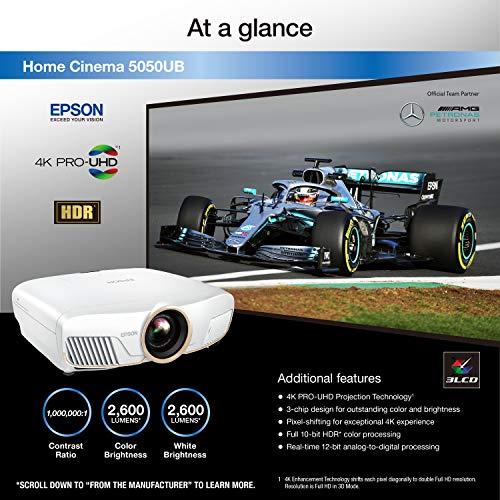
In our research of professional reviews and user experiences, the 5050UB consistently achieves native contrast ratios around 8,000:1, which significantly outperforms most competitors in its price range. When the dynamic iris is engaged, this can extend to the claimed 1,000,000:1 ratio, though like all dynamic contrast measurements, this represents the difference between the darkest and brightest scenes rather than simultaneous contrast within a single frame.
This superior contrast performance translates directly to a more cinematic viewing experience. Dark movie scenes – think of the atmospheric lighting in films like "Blade Runner 2049" or the shadowy sequences in "The Batman" – reveal details that would be lost in the gray blacks of lesser projectors. The difference is particularly striking when comparing the 5050UB to DLP competitors, where the Epson's blacks appear genuinely dark rather than the slightly gray appearance common in single-chip DLP projectors.
The 5050UB employs a true 3-chip 3LCD design, which means it has separate LCD panels for red, green, and blue light. This architecture eliminates the "rainbow effect" – brief flashes of separated colors – that some viewers notice with single-chip DLP projectors. More importantly, it ensures that color brightness matches white brightness, preventing the washed-out colors that can occur when a projector's color output is significantly lower than its rated white brightness.
The projector covers 97% of the DCI-P3 color space, which is the standard used in commercial cinemas. This is significantly wider than the Rec. 709 color space used by HDTVs and represents approximately 50% more colors than standard displays can show. For HDR content, the 5050UB also handles the even wider Rec. 2020 color space respectably, though like all projectors in this price range, it can't cover the full gamut.
Out of the box, color accuracy is excellent, with minimal calibration required for satisfying results. However, the projector includes comprehensive calibration controls including 11-point white balance adjustment and full color management, allowing enthusiasts or professional calibrators to achieve reference-level accuracy. This level of adjustability is typically found in projectors costing significantly more.
HDR (High Dynamic Range) content has become increasingly important as streaming services and Ultra HD Blu-rays adopt these formats. The 5050UB supports both HDR10 and HLG (Hybrid Log-Gamma) formats, though it lacks Dolby Vision support – a limitation that becomes less significant given the projector's excellent HDR processing capabilities.
The key to effective HDR projection is having sufficient brightness to display the expanded range of luminance information. At 2,600 lumens, the 5050UB has enough output to make HDR content genuinely impactful. Many competing projectors either lack the brightness to properly display HDR highlights or compromise contrast to achieve higher brightness numbers.
Epson's implementation includes a unique 16-step HDR adjustment that allows real-time fine-tuning of the HDR curve. This addresses one of the biggest challenges in HDR projection: different content and viewing environments often require different HDR processing approaches. The ability to adjust this on-the-fly means you can optimize the experience for your specific room and preferences.
The 5050UB uses 4K PRO-UHD technology, which is Epson's marketing term for their pixel-shifting implementation. The projector starts with native 1080p (1920 x 1080) LCD panels and uses a precision optical element to shift each pixel diagonally by 0.5 pixels. This effectively doubles the number of discrete pixels displayed, creating what Epson calls "1920 x 1080 x 2" resolution.
This isn't true native 4K – the projector cannot resolve single-pixel 4K test patterns – but the subjective sharpness improvement over standard 1080p is substantial. In practical viewing situations with real content, the difference between the 5050UB and native 4K projectors is much smaller than the technical specifications might suggest, especially at typical viewing distances.
The pixel-shifting works particularly well with film content, where the organic nature of the image and the way movies are shot and processed means that perfect pixel-for-pixel resolution isn't as critical as overall sharpness and detail rendering. For viewers sitting at appropriate distances from reasonably sized screens, the resolution performance is entirely satisfying.
One area where the 5050UB truly distinguishes itself is installation flexibility. The fully motorized lens system includes powered zoom, focus, and lens shift – features typically reserved for much more expensive commercial or high-end residential projectors.
The lens shift capability is particularly impressive: ±96% vertical and ±47% horizontal adjustment means you can move the image significantly without physically repositioning the projector. This is invaluable for ceiling mounting, where precise projector placement might be limited by structural considerations. The horizontal shift also enables off-center mounting, which can be crucial in rooms where a centered position isn't practical.
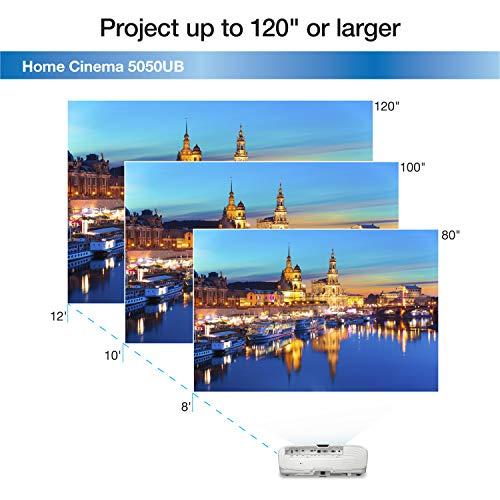
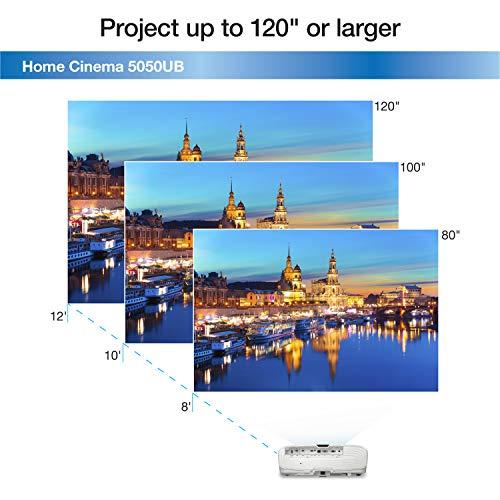
The 2.1:1 zoom range provides additional placement flexibility, allowing screen sizes from 50 inches to 300 inches diagonal. The throw ratio of 1.35:1 to 2.84:1 means you can achieve a 100-inch image with the projector positioned anywhere from about 11 feet to 24 feet from the screen – a range that accommodates most residential installations.
Lens memory adds another layer of convenience, particularly for enthusiasts who watch content in different aspect ratios. You can save settings for 16:9 movies, 2.35:1 scope films, and other formats, then recall them instantly. This feature alone can justify the 5050UB for serious movie enthusiasts who want to experience films in their original theatrical aspect ratios.
While the 5050UB wasn't designed primarily for gaming, its performance is respectable for most gaming scenarios. Input lag measures approximately 22.5 milliseconds at 4K/60Hz, which is acceptable for single-player games and most multiplayer scenarios but not ideal for competitive gaming where every millisecond matters.
The projector is limited to 60Hz refresh rates and doesn't support modern gaming features like Variable Refresh Rate (VRR) or Auto Low Latency Mode (ALLM). This reflects its 2019 design, before these features became standard in gaming displays. However, the excellent image quality – particularly the superior contrast and color accuracy – can make games look spectacular even without cutting-edge gaming features.
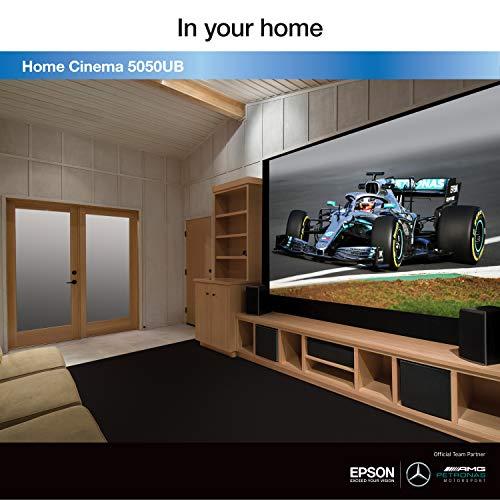
For gaming enthusiasts, the large screen size possible with the 5050UB can be transformative. Playing games on a 120-inch screen creates an immersive experience that's impossible to achieve with even the largest televisions. The high brightness also means gaming remains enjoyable with some room lighting, unlike many projectors that require complete darkness.
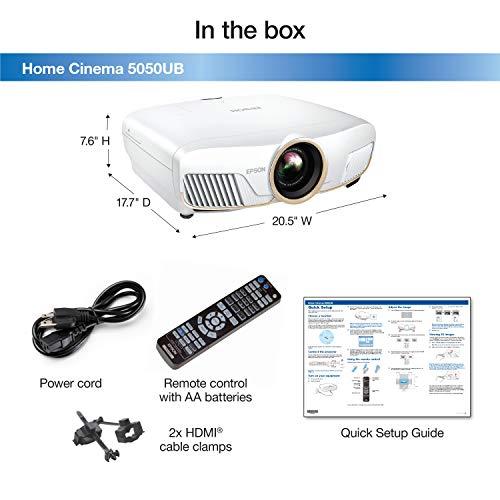
Living with the 5050UB means accepting certain operational realities. The projector is large and heavy at nearly 25 pounds, requiring substantial mounting hardware. Heat generation is significant during operation, necessitating adequate ventilation – particularly important for ceiling-mounted installations.
Fan noise varies considerably with brightness settings. In eco mode, the projector operates quite quietly, but at full brightness, the fan noise becomes more noticeable. This is typical for lamp-based projectors, where higher brightness requires more cooling. Most users find the eco mode provides sufficient brightness for darkened room viewing while maintaining acceptable noise levels.
Lamp life represents the primary ongoing cost consideration. Epson rates the lamp at 5,000 hours in eco mode, declining to 3,500 hours at full brightness. Replacement lamps typically cost several hundred dollars, making this a significant consideration for heavy users. However, at typical usage patterns of 10-15 hours per week, even the shorter lamp life represents several years of use.
At the time of writing, the 5050UB typically sells for several thousand dollars – positioning it as a premium home theater projector but not in the ultra-high-end category. This pricing reflects its position as a prosumer product: offering professional-grade features and performance at a price accessible to serious enthusiasts.
The value proposition becomes clear when comparing the 5050UB to alternatives. Cheaper projectors sacrifice contrast, color accuracy, or brightness. More expensive options might offer native 4K resolution or laser light sources, but often can't match the 5050UB's combination of contrast, color performance, and brightness. Even five years after its introduction, few projectors deliver better overall image quality at a similar price point.
The longevity of the design speaks to Epson's engineering. While projector technology continues advancing, the fundamental compromises that define the 5050UB – using pixel-shifting for 4K enhancement, maintaining lamp-based light sources for high brightness, and prioritizing contrast over absolute resolution – remain valid approaches for home theater projection.
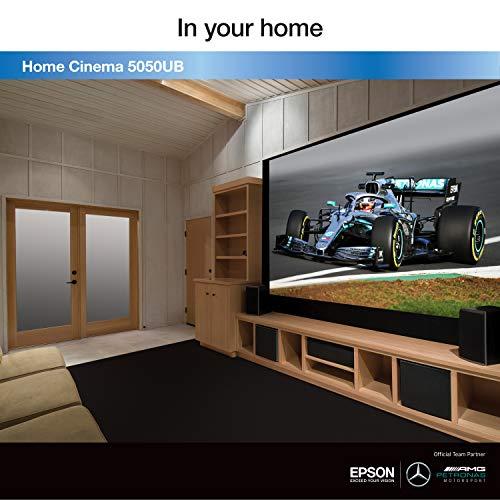
The 5050UB is ideal for several specific scenarios and user types. Home theater enthusiasts who prioritize image quality above all else will appreciate the superior contrast and color accuracy. The projector excels in dedicated theater rooms where lighting can be controlled, allowing its contrast advantages to shine.
Users requiring installation flexibility will find the motorized lens system invaluable. Whether dealing with ceiling mounting limitations, unusual room layouts, or the desire to accommodate multiple screen formats, the 5050UB provides options that many competitors can't match.
The projector also suits users who want professional-grade calibration capabilities without professional pricing. Serious movie enthusiasts who understand the importance of accurate color reproduction and want to achieve reference-level performance will find the comprehensive adjustment controls essential.
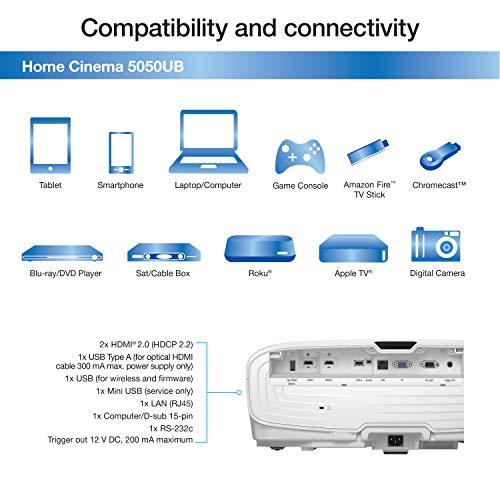
However, the 5050UB isn't ideal for every situation. Users prioritizing absolute resolution should consider native 4K alternatives, despite their higher cost. Those wanting smart features, Wi-Fi connectivity, or integrated streaming capabilities need to look elsewhere – the 5050UB is strictly a display device requiring external sources.
Gaming enthusiasts seeking the latest features like high refresh rates or variable refresh rate support should consider more gaming-focused alternatives. Similarly, users in very bright rooms might benefit from higher-brightness alternatives, though the 5050UB performs surprisingly well in moderate ambient light.
Despite being introduced in 2019, the Epson Home Cinema 5050UB remains one of the most compelling home theater projectors available. Its combination of excellent contrast, accurate colors, high brightness, and installation flexibility creates a package that few competitors can match at any price.
The fact that both product listings you're considering refer to the identical projector simplifies your decision significantly. Focus on finding the best price, warranty terms, and customer service rather than worrying about performance differences that don't exist.
For serious home theater applications where image quality matters most, the 5050UB continues to set the standard in its price category. Its enduring popularity five years after introduction speaks to the fundamental soundness of its design and the continuing relevance of its approach to home theater projection.
| Epson Home Cinema 5050UB 4K PRO-UHD 3-Chip Projector | Epson Home Cinema 5050UB Projector |
|---|---|
| Product Identity - These are identical models with different naming | |
| Same exact projector with full marketing name | Same exact projector with shortened name |
| Native Resolution - Base image sharpness before enhancement | |
| 1920 x 1080 (Full HD) with 4K pixel-shifting | 1920 x 1080 (Full HD) with 4K pixel-shifting |
| Brightness Output - Critical for room flexibility and screen size | |
| 2,600 lumens (excellent for most home theaters) | 2,600 lumens (excellent for most home theaters) |
| Contrast Ratio - Most important spec for cinematic black levels | |
| 1,000,000:1 dynamic with UltraBlack technology | 1,000,000:1 dynamic with UltraBlack technology |
| HDR Support - Essential for modern streaming and disc content | |
| HDR10 and HLG with 16-step adjustment | HDR10 and HLG with 16-step adjustment |
| Color Gamut Coverage - Determines color vibrancy and accuracy | |
| 97% DCI-P3 (professional cinema standard) | 97% DCI-P3 (professional cinema standard) |
| Lens System - Critical for installation flexibility | |
| Fully motorized zoom, focus, lens shift with memory | Fully motorized zoom, focus, lens shift with memory |
| Input Lag - Important for gaming responsiveness | |
| 22.5ms at 4K/60Hz (good for casual gaming) | 22.5ms at 4K/60Hz (good for casual gaming) |
| Lamp Life - Affects long-term operating costs | |
| 3,500-5,000 hours depending on brightness mode | 3,500-5,000 hours depending on brightness mode |
| Physical Size - Impacts mounting and placement options | |
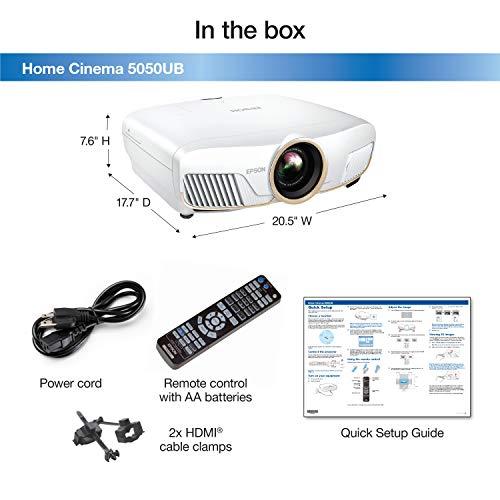
| 20.5" x 17.7" x 7.6", 24.7 lbs (requires sturdy mount) | 20.5" x 17.7" x 7.6", 24.7 lbs (requires sturdy mount) |
| Smart Features - Built-in streaming capabilities | |
| None (requires external streaming device) | None (requires external streaming device) |
| Purchase Decision - What to consider when choosing | |
| Compare retailer warranty, pricing, and service | Compare retailer warranty, pricing, and service |
Yes, the Epson Home Cinema 5050UB 4K PRO-UHD 3-Chip Projector and Epson Home Cinema 5050UB Projector are identical products. The difference is purely in naming - one uses the full marketing name while the other uses a shortened version. Both refer to the exact same model with identical specifications and performance.
There are no differences between the Epson Home Cinema 5050UB 4K PRO-UHD 3-Chip Projector and Epson Home Cinema 5050UB Projector because they are the same device. The "4K PRO-UHD 3-Chip" portion simply describes the projector's key features - pixel-shifting 4K enhancement and 3LCD chip design.
Both the Epson Home Cinema 5050UB 4K PRO-UHD 3-Chip Projector and Epson Home Cinema 5050UB Projector deliver identical image quality since they are the same projector. You'll get 2,600 lumens brightness, exceptional contrast with UltraBlack technology, and 97% DCI-P3 color coverage regardless of which listing you choose.
There is no brightness difference between the Epson Home Cinema 5050UB 4K PRO-UHD 3-Chip Projector and Epson Home Cinema 5050UB Projector. Both deliver 2,600 lumens of color and white brightness, making them suitable for darkened home theaters and rooms with moderate ambient light control.
The contrast performance is identical between the Epson Home Cinema 5050UB 4K PRO-UHD 3-Chip Projector and Epson Home Cinema 5050UB Projector. Both feature Epson's UltraBlack technology delivering up to 1,000,000:1 dynamic contrast ratio, making them excellent choices for dedicated home theater rooms.
Yes, both the Epson Home Cinema 5050UB 4K PRO-UHD 3-Chip Projector and Epson Home Cinema 5050UB Projector support 4K content through pixel-shifting technology. They accept 4K/60Hz signals and use advanced processing to enhance native 1080p resolution for sharp, detailed images.
Gaming performance is identical between the Epson Home Cinema 5050UB 4K PRO-UHD 3-Chip Projector and Epson Home Cinema 5050UB Projector. Both offer 22.5ms input lag at 4K/60Hz, which is suitable for casual gaming but not ideal for competitive gaming that requires ultra-low latency.
Both the Epson Home Cinema 5050UB 4K PRO-UHD 3-Chip Projector and Epson Home Cinema 5050UB Projector support HDR10 and HLG formats with 16-step precision HDR adjustment. Neither supports Dolby Vision, but their HDR processing capabilities are excellent for streaming content and Ultra HD Blu-rays.
Installation flexibility is identical since the Epson Home Cinema 5050UB 4K PRO-UHD 3-Chip Projector and Epson Home Cinema 5050UB Projector are the same projector. Both feature fully motorized lens systems with ±96% vertical and ±47% horizontal lens shift, 2.1x zoom, and lens memory for different aspect ratios.
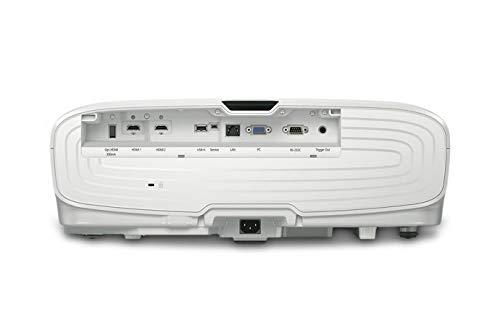
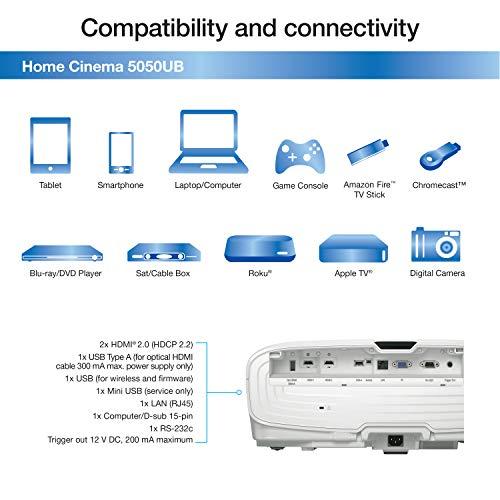
Neither the Epson Home Cinema 5050UB 4K PRO-UHD 3-Chip Projector nor Epson Home Cinema 5050UB Projector include smart TV features, Wi-Fi, or built-in streaming apps. Both require external devices like streaming sticks, game consoles, or Blu-ray players for content sources.
Lamp life is identical between the Epson Home Cinema 5050UB 4K PRO-UHD 3-Chip Projector and Epson Home Cinema 5050UB Projector. Both use the same 250W UHE lamp rated for 3,500-5,000 hours depending on brightness mode, with longer life achieved in eco mode.
Since the Epson Home Cinema 5050UB 4K PRO-UHD 3-Chip Projector and Epson Home Cinema 5050UB Projector are identical, focus on comparing retailer factors like warranty coverage, customer service reputation, shipping options, and return policies rather than product specifications. Choose the listing with the best overall purchase experience.
We've done our best to create useful and informative comparisons to help you decide what product to buy. Our research uses advanced automated methods to create this comparison and perfection is not possible - please contact us for corrections or questions. These are the sites we've researched in the creation of this article: rtings.com - audiogurus.com - hometechnologyreview.com - projectorscreen.com - youtube.com - thesmarthomehookup.com - techgearlab.com - rtings.com - projectorreviews.com - projectorreviews.com - projectorreviews.com - projectorcentral.com - avsforum.com - avsforum.com - rtings.com - avsforum.com - audiogeneral.com - hifiheaven.net - manuals.plus - crutchfield.com - mediaserver.goepson.com - projectorcentral.com - epson.com - bestbuy.com - projectorreviews.com - projectorcentral.com - projectorcentral.com - rtings.com - ngxptech.com

Privacy Policy
Terms and Conditions - Affiliate Policy
Home Security
© Copyright 2008-2026.
11816 Inwood Rd #1211, Dallas, TX 75244