


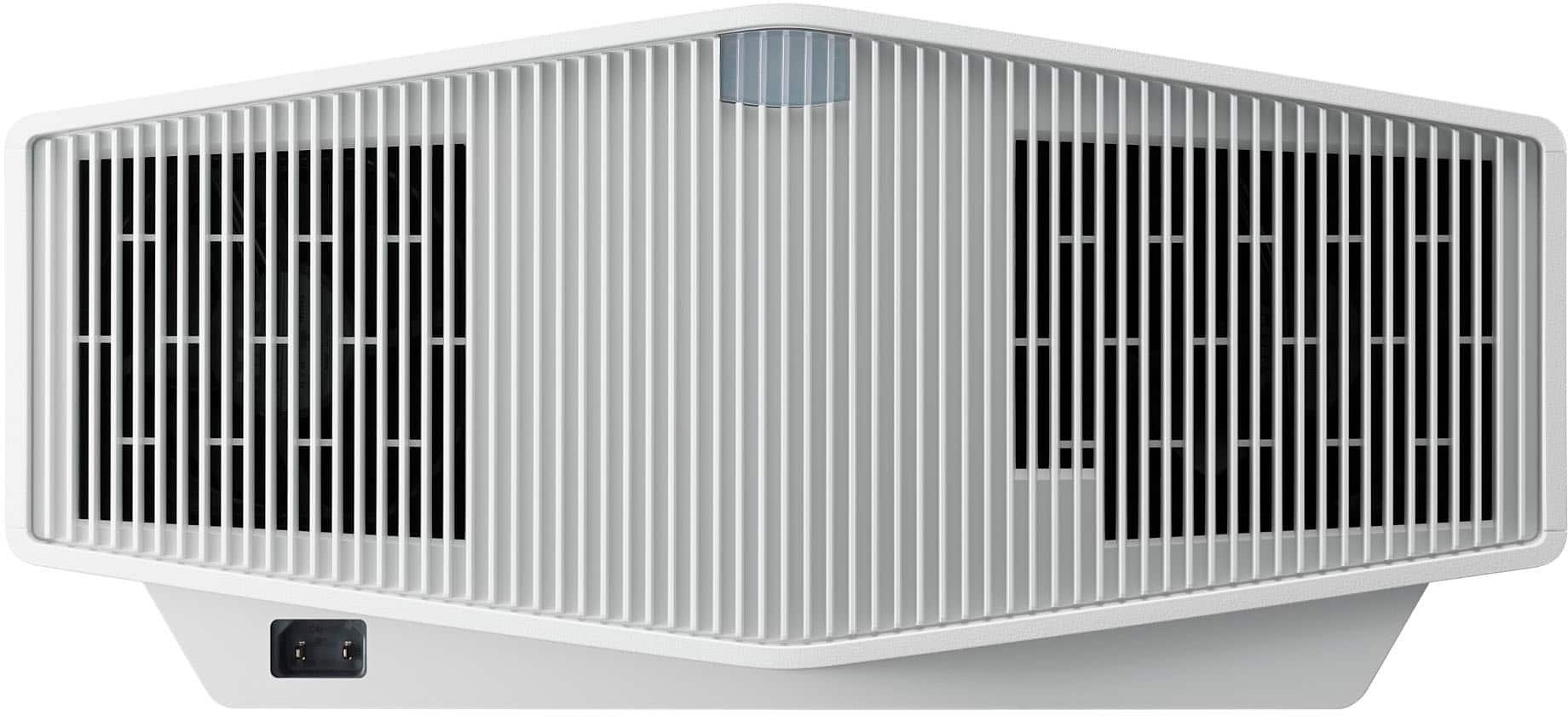
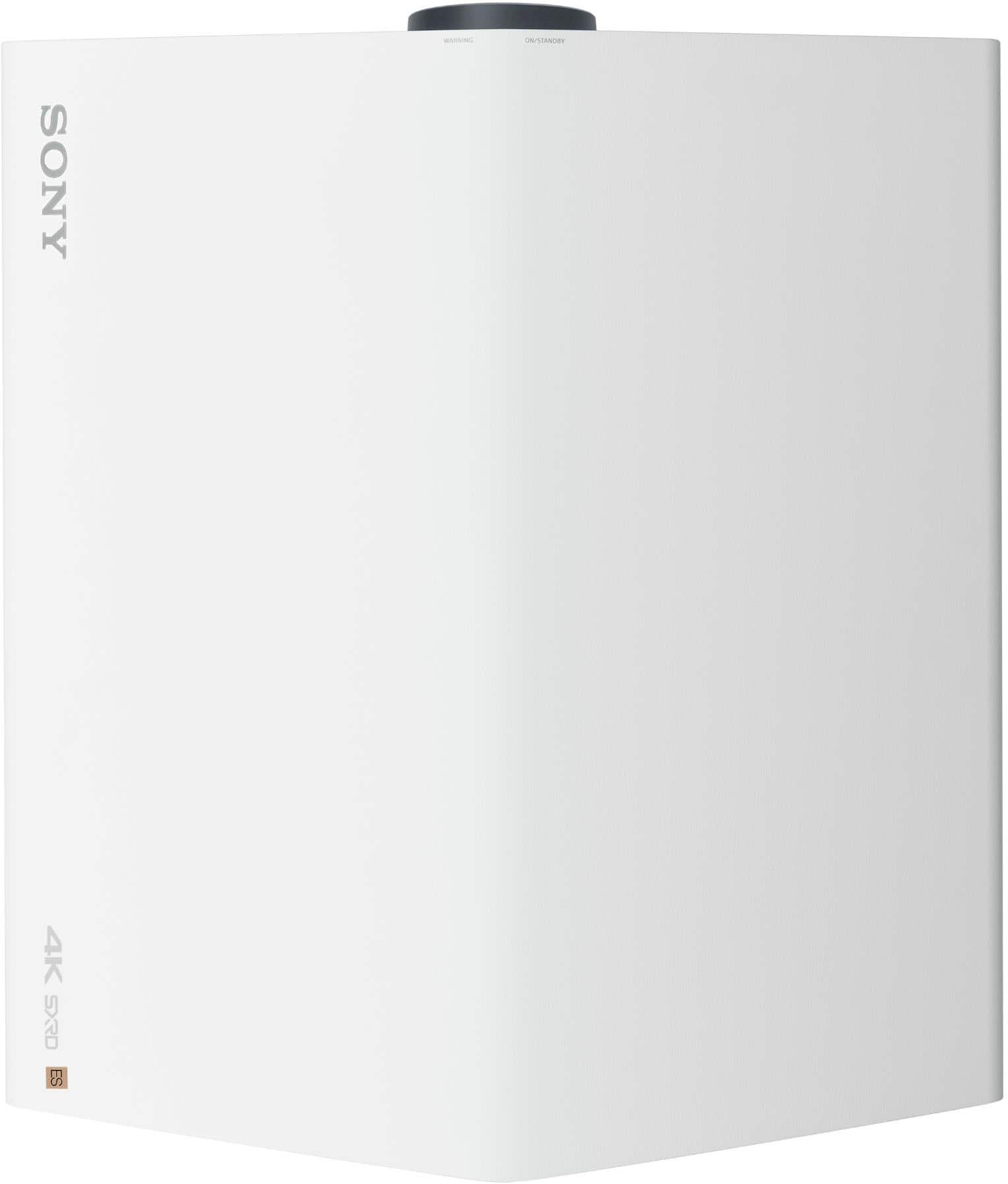
Setting up a home theater is one of those tech purchases where you really want to get it right the first time. Unlike upgrading a phone or laptop every few years, a good projector should serve you well for a decade or more. That's why comparing the Epson Home Cinema 5050UB and Sony BRAVIA Projector 8 is so important – these represent two completely different philosophies about how to deliver cinematic experiences at home.
Before diving into these specific models, it's worth understanding what separates excellent projectors from merely good ones. The fundamentals haven't changed much: you need sharp images, accurate colors, deep black levels, and enough brightness to work in your space. What has evolved dramatically is how manufacturers achieve these goals.
Modern projectors use either traditional lamp-based illumination or newer laser light sources. They might have native 4K resolution with 8.3 million individual pixels, or they could use clever pixel-shifting technology to approximate that detail from lower-resolution panels. The contrast ratio – how bright the whites can get compared to how dark the blacks appear – often determines whether a projector looks "flat" or delivers that magical three-dimensional pop that makes movies come alive.
Color accuracy matters more than most people realize. A projector might claim spectacular brightness numbers, but if those colors look oversaturated or washed out, you'll notice something feels off during every viewing session. The best projectors nail skin tones, deliver rich but natural colors, and maintain accuracy across different brightness levels.
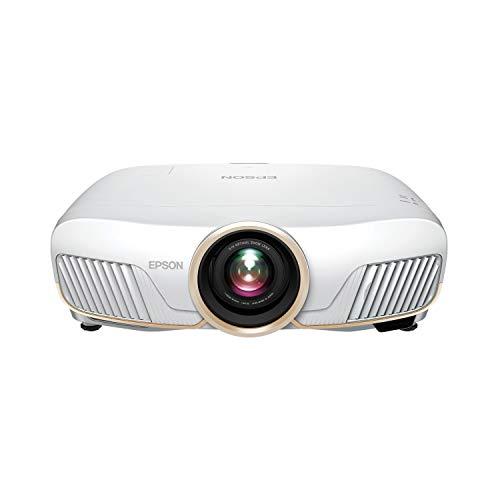
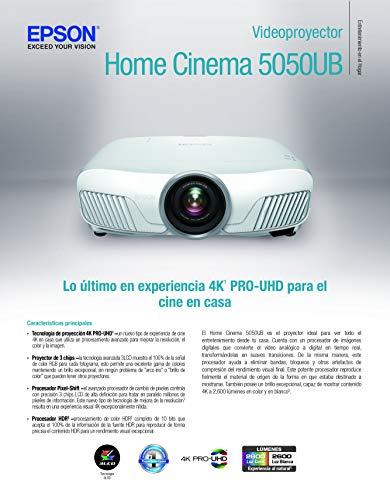
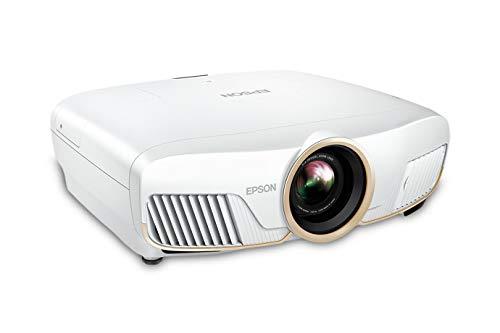
The Epson 5050UB, released in 2018, represents the peak evolution of traditional projector technology. At the time of writing, it typically costs around one-quarter the price of premium alternatives while delivering surprisingly close performance. Epson refined their 3LCD technology over many years, adding proprietary features like UltraBlack contrast enhancement and sophisticated pixel-shifting to create 4K-like images from 1080p panels.
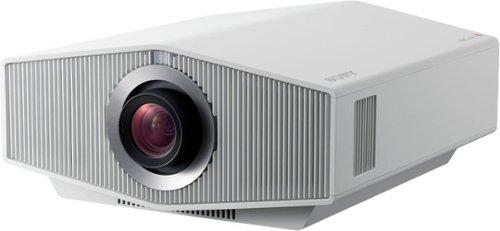
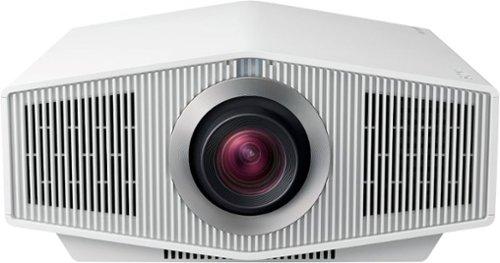
The Sony BRAVIA Projector 8, launched in 2024, showcases cutting-edge laser projection with true native 4K resolution and Sony's latest cognitive processing technology borrowed from their premium televisions. This represents Sony's vision of where home theater projection is heading, with maintenance-free operation and processing power that analyzes images the way human vision works.
The price gap between these projectors is substantial – the Sony costs roughly four to five times more than the Epson at current market rates. This immediately raises the question: is that premium worth it?
Here's where things get interesting from a technical perspective. The Sony BRAVIA Projector 8 uses three genuine 4K SXRD panels, each containing the full 3840 x 2160 resolution. Every single one of those 8.3 million pixels physically exists on the imaging chip. When you feed it a 4K signal, each pixel maps directly to a physical location.
The Epson 5050UB takes a completely different approach that's actually quite clever. It starts with three 1080p LCD panels (1920 x 1080 resolution each) but uses what Epson calls "4K PRO-UHD" pixel-shifting. The projector rapidly moves each pixel diagonally by exactly half a pixel width, essentially showing your eye two slightly offset 1080p images so fast that they blend into what appears to be 4K resolution.
Think of it like this: imagine you're drawing a detailed picture but only have half the colored pencils you need. Pixel-shifting is like drawing the picture twice with slightly different pencil positions, creating the impression of twice as much detail. It's not technically the same as having all the pencils from the start, but the final result can look remarkably close.
In practice, both approaches work well for normal viewing. The Sony's advantage becomes apparent when displaying fine technical test patterns or when sitting very close to large screens. For typical movie watching from 10-12 feet away, many viewers find the difference surprisingly minimal. Our research into user experiences suggests that room lighting, screen quality, and source material often matter more than this resolution distinction.
This is where the Epson 5050UB really punches above its weight class. Epson developed something called UltraBlack technology – essentially a special filter that controls how light behaves inside the projector. Without getting too deep into optical physics, this filter manages light polarization to dramatically reduce light leakage, which is what causes blacks to look gray instead of truly dark.
The results are impressive. Independent measurements show the Epson 5050UB achieving native contrast ratios around 8000:1, meaning whites are 8000 times brighter than the darkest blacks it can produce. Combined with its dynamic iris system that adjusts light output based on scene content, the projector can deliver what appears to be nearly infinite contrast in dark room viewing.
The Sony BRAVIA Projector 8 approaches contrast differently through precise laser control. Instead of mechanical systems, it can instantly adjust the laser light source brightness frame by frame. Sony's XR Deep Black technology analyzes each scene and modulates the laser to maintain detail in bright areas while preserving shadow information. This happens thousands of times per second, faster than any mechanical iris could respond.
Both systems work exceptionally well, but they feel different in practice. The Epson provides consistently deep blacks that make dark scenes feel more immersive. The Sony offers more dynamic range in bright HDR content, with laser precision that can brighten or dim specific parts of the image almost instantly.
Color reproduction showcases an interesting reversal of expectations. The older Epson 5050UB actually covers more of the DCI-P3 color space (97%) than the newer Sony BRAVIA Projector 8 (95%). DCI-P3 is the color standard used in commercial movie theaters, so wider coverage means more accurate reproduction of how filmmakers intended their content to look.
This happens because Epson uses an additional color filter in their optical path, expanding the range of colors the projector can display. The trade-off is slightly reduced brightness efficiency, but the result is remarkably vibrant and accurate colors straight out of the box.
The Sony counters with more sophisticated processing through its XR Triluminos Pro technology. Instead of just displaying a wider color range, it analyzes individual objects within each frame and optimizes colors based on context. If there's a person's face in the frame, it applies different color processing to skin tones than it does to the background scenery. This cognitive approach can make colors appear more natural even within a slightly smaller overall color gamut.
For HDR content (High Dynamic Range, which provides greater brightness range and more vivid colors than standard video), both projectors support HDR10 and HLG formats, though neither handles Dolby Vision. The Epson 5050UB offers 16-step manual HDR adjustment, letting you fine-tune how HDR content appears in your specific room lighting. The Sony BRAVIA Projector 8 handles this automatically through its XR Dynamic Tone Mapping, which adapts frame by frame without user intervention.
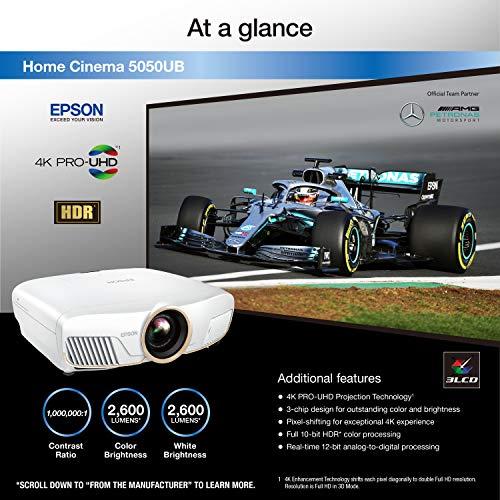
Both projectors deliver similar brightness levels – around 2600-2700 lumens – which puts them in the "bright enough for most rooms" category. This is important because brightness determines how much ambient light your theater can handle while still maintaining good image quality.
The key difference lies in long-term consistency. The Epson 5050UB uses a traditional 250-watt lamp that gradually dims over its 3500-5000 hour lifespan. You'll need to replace it every few years depending on usage, and the image will slowly become dimmer between replacements.
The Sony BRAVIA Projector 8 uses a Z-Phosphor laser rated for 20,000 hours of operation. That's roughly 10 years of heavy use or 20 years of moderate viewing. More importantly, laser brightness remains consistent throughout its life rather than gradually degrading. The laser also enables instant on/off operation – no warm-up or cool-down periods like traditional lamps require.
Gaming on projectors has become increasingly important as console gaming grows more sophisticated. Both projectors handle gaming well, but with different strengths.
The Epson 5050UB delivers 22.5 milliseconds of input lag at 4K resolution, which is excellent for a home theater projector. Input lag is the delay between when you press a controller button and when that action appears on screen – lower numbers mean more responsive gaming.
The Sony BRAVIA Projector 8 goes further with support for 4K gaming at 120 frames per second, achieving under 12 milliseconds of input lag in this mode. This makes it suitable for fast-paced competitive gaming where every millisecond counts. The HDMI 2.1 connectivity also supports variable refresh rate technology for smoother gameplay.
For typical console gaming – single-player adventures, sports games, casual multiplayer – both projectors work brilliantly. The Sony's advantage matters most for serious competitive gaming or when using high-end gaming PCs that can push frame rates above 60fps.
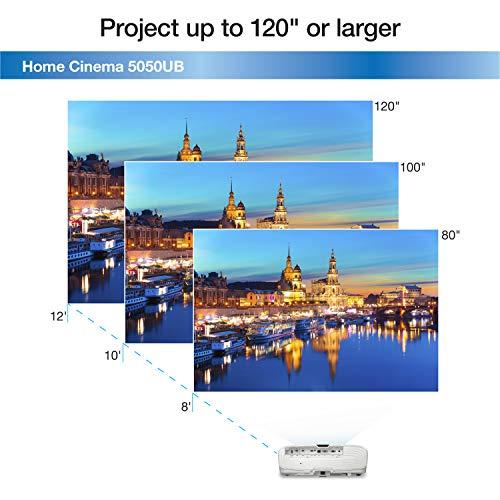
This is where the Epson 5050UB really shines. Its motorized lens offers massive adjustment range: you can shift the image 96% vertically and 47% horizontally without moving the projector itself. This lens shift capability is crucial for ceiling-mounted installations where you can't always position the projector in perfect alignment with your screen.
The lens memory feature proves particularly valuable for movie enthusiasts. You can save different zoom and shift settings for various aspect ratios – one setting for standard 16:9 content, another for ultra-wide 2.39:1 movies. Switch between them instantly via remote control, eliminating black bars and maximizing your screen real estate.
The Sony BRAVIA Projector 8 offers good lens flexibility with 85% vertical and 36% horizontal shift, but the reduced horizontal range could complicate some installations. Both projectors feature similar 2.1x zoom ranges and throw ratios, meaning they work from similar distances to achieve the same screen sizes.
At current pricing, the Sony BRAVIA Projector 8 costs roughly four to five times more than the Epson 5050UB. This dramatic price difference demands careful consideration of what that premium buys you.
The Sony's advantages are clear: true native 4K resolution, maintenance-free laser operation, cutting-edge processing, and future-proof connectivity. These are meaningful improvements that will matter throughout the projector's lifespan.
However, our research into expert reviews and user experiences suggests the Epson 5050UB delivers roughly 80% of the Sony's image quality at 25% of the cost. The Epson's UltraBlack technology, wider color gamut, and exceptional contrast performance mean it holds its own against much more expensive competitors in side-by-side comparisons.
The lamp replacement consideration adds complexity. Over 10 years, you might spend an additional $600-1000 on lamp replacements for the Epson, but you'll still be thousands ahead of the Sony's initial cost.
Choose the Epson 5050UB if you want maximum performance per dollar spent. This projector makes sense for enthusiasts who understand they're getting 80% of premium projector performance at a fraction of the cost. It's particularly compelling for flexible installation needs, scope movie watching (thanks to lens memory), and situations where ongoing maintenance doesn't concern you.
The Epson 5050UB also suits DIY installers comfortable with calibration and adjustment. The extensive manual controls reward users who want to fine-tune their experience, and the large enthusiast community provides excellent support resources.
Choose the Sony BRAVIA Projector 8 for premium dedicated theaters where total system cost exceeds $20,000-30,000. At that budget level, the projector's cost becomes proportional to other components like high-end audio systems, acoustic treatments, and custom installation work.
The Sony makes particular sense if you value maintenance-free operation over cost savings, demand true native 4K resolution, or want the latest processing technology. It's also the better choice for serious gaming enthusiasts who need 4K/120Hz capability and minimal input lag.
Both projectors excel at their intended purposes, but they target different audiences entirely. The Epson 5050UB represents the pinnacle of value engineering – extracting maximum performance from proven technology at accessible pricing. The Sony BRAVIA Projector 8 showcases cutting-edge engineering for customers where performance matters more than cost.
For most home theater enthusiasts, the Epson 5050UB provides the better overall package. Its combination of excellent image quality, installation flexibility, and reasonable pricing makes it hard to beat. Save the difference in cost for a better screen, superior audio system, or room treatments – improvements that often provide more noticeable benefits than the resolution difference between these projectors.
However, if you're building a no-compromise theater and the budget allows, the Sony BRAVIA Projector 8 delivers the absolute best current technology offers. Just understand you're paying a significant premium for incremental improvements and future-proofing rather than dramatically better day-to-day viewing experiences.
The projector market continues evolving rapidly, with laser technology becoming more affordable and processing power advancing each year. Both of these projectors represent excellent choices within their respective market segments, but they illuminate the ongoing tension between cutting-edge technology and practical value in home theater equipment.
| Epson Home Cinema 5050UB | Sony BRAVIA Projector 8 |
|---|---|
| Resolution Technology - Determines image sharpness and detail | |
| 4K PRO-UHD pixel-shifting from 1080p panels | True native 4K SXRD (3840 x 2160) panels |
| Light Source - Affects maintenance and long-term costs | |
| 250W UHE lamp (3,500-5,000 hours, requires replacement) | Z-Phosphor laser (20,000 hours, maintenance-free) |
| Brightness - Critical for room lighting flexibility | |
| 2,600 lumens (color and white) | 2,700 lumens |
| Contrast Technology - Most important for cinematic black levels | |
| UltraBlack technology with 1,000,000:1 dynamic contrast | XR Deep Black with infinite dynamic contrast via laser control |
| Color Gamut Coverage - Determines color accuracy and vibrancy | |
| 97% DCI-P3 (wider than Sony, matches theater standards) | 95% DCI-P3 with XR Triluminos Pro processing |
| Lens Shift Range - Essential for installation flexibility | |
| ±96% vertical, ±47% horizontal (exceptional placement options) | ±85% vertical, ±36% horizontal (good but more limited) |
| Gaming Performance - Input lag for responsive gaming | |
| 22.5ms at 4K/60Hz (excellent for home theater gaming) | Under 21ms at 4K/60Hz, under 12ms at 4K/120Hz |
| HDR Support - Enhanced brightness and color range | |
| HDR10, HLG with 16-step manual adjustment | HDR10, HLG with automatic XR Dynamic Tone Mapping |
| Processing Power - Image enhancement and optimization | |
| Standard video processing with frame interpolation | XR Processor with cognitive intelligence (object-based optimization) |
| Connectivity - Future-proofing and device compatibility | |
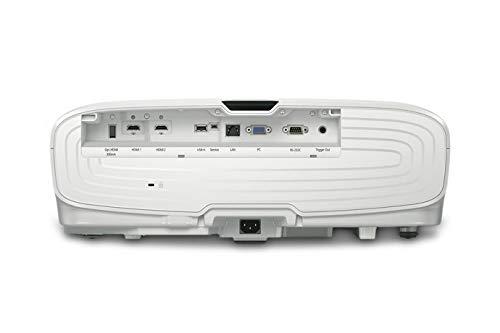
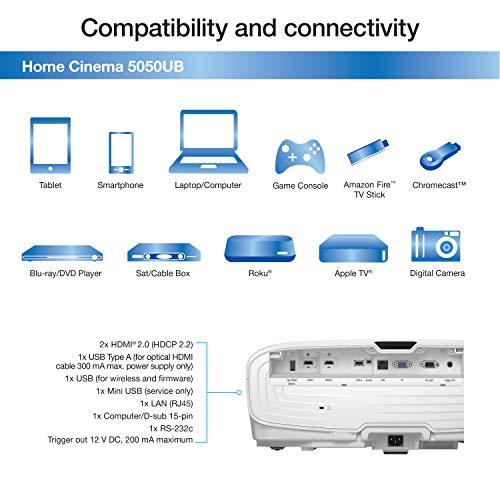
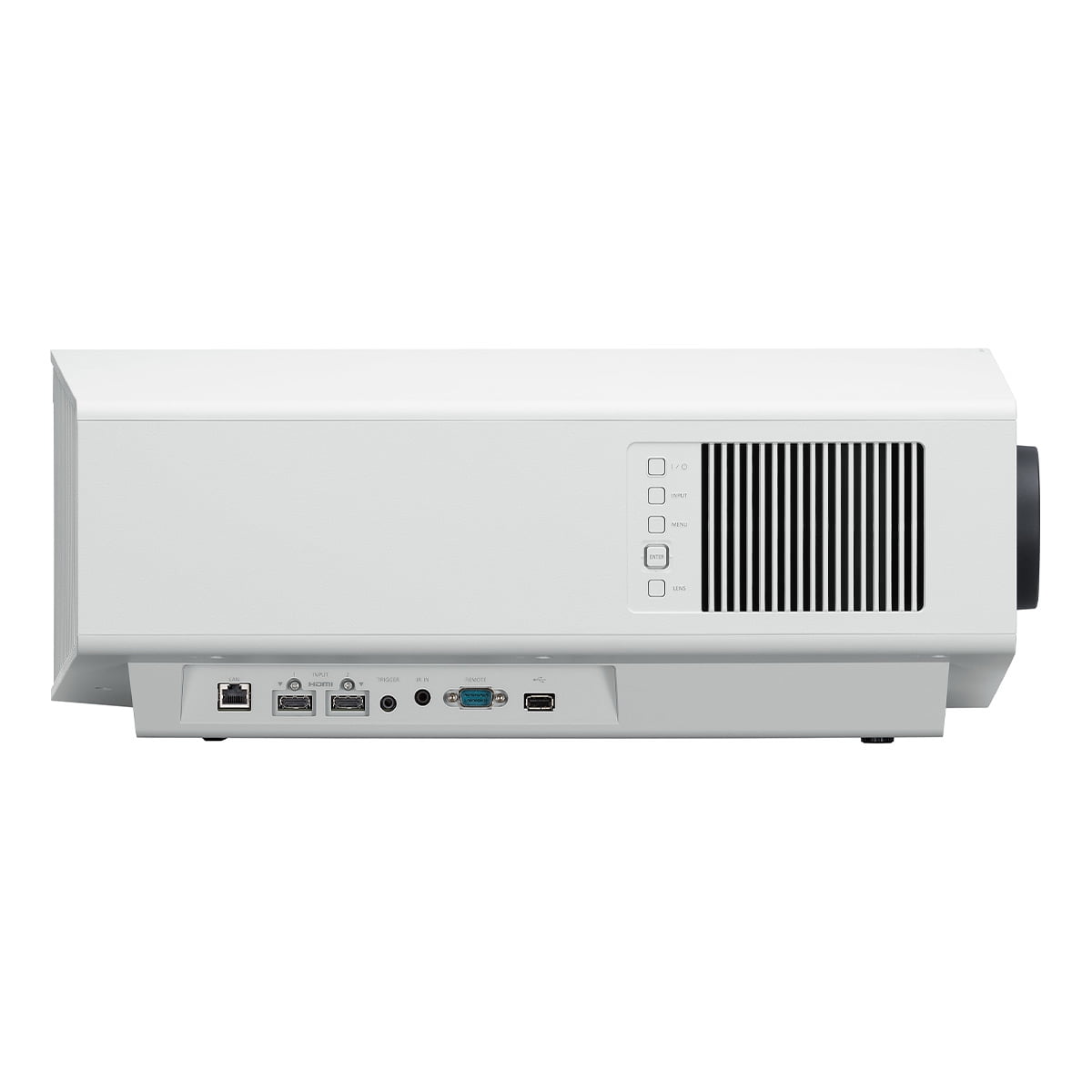
| 2x HDMI 2.0 (one with HDCP 2.2) | 2x HDMI 2.1 with 4K/120Hz support |
| Physical Size and Weight - Installation considerations | |
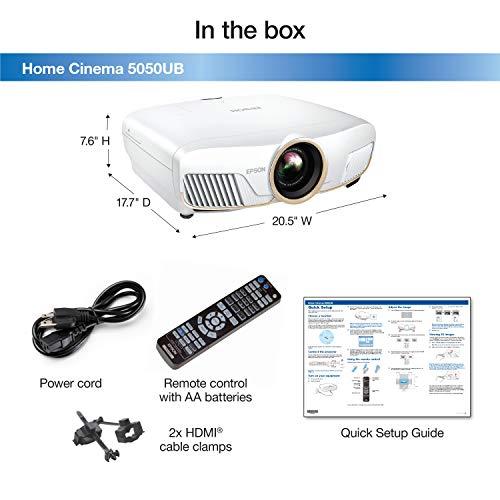
| 7.6" H x 20.5" W x 17.7" D, 24.7 lbs | 8.4" H x 18.1" W x 20.4" D, 31 lbs |
| Operating Noise - Important for quiet movie viewing | |
| 31 dB normal / 20 dB eco mode | 26 dB (consistently quieter operation) |
| Special Features - Unique capabilities that differentiate | |
| Lens memory for aspect ratio switching, 3D support | IMAX Enhanced certification, cognitive processing |
| Release Year and Technology Generation | |
| 2018 (mature lamp-based technology at peak refinement) | 2024 (cutting-edge laser and processing technology) |
| Value Proposition - Performance vs cost consideration | |
| Exceptional performance-per-dollar with proven reliability | Premium engineering with latest technology and maintenance-free operation |
For most home theater setups, the Epson Home Cinema 5050UB offers exceptional value with outstanding contrast performance thanks to its UltraBlack technology and wider color gamut coverage. The Sony BRAVIA Projector 8 delivers premium performance with true native 4K resolution and maintenance-free laser operation, but at a significantly higher cost. Choose the Epson for maximum performance per dollar, or the Sony for cutting-edge technology in high-end installations.
The Epson Home Cinema 5050UB uses 4K PRO-UHD pixel-shifting, which rapidly moves 1080p pixels to create the appearance of 4K resolution. The Sony BRAVIA Projector 8 has true native 4K SXRD panels with all 8.3 million pixels physically present. While native 4K provides technically superior detail reproduction, pixel-shifting delivers visually impressive results that most viewers find excellent for normal movie watching distances.
Both projectors excel at contrast, but through different approaches. The Epson Home Cinema 5050UB uses proprietary UltraBlack technology to achieve exceptional black levels with measured contrast ratios around 8000:1. The Sony BRAVIA Projector 8 employs precise laser control for infinite dynamic contrast with instant brightness adjustments. The Epson provides consistently deep blacks, while the Sony offers more dynamic HDR performance.
The Epson Home Cinema 5050UB uses a traditional 250W lamp that requires replacement every 3,500-5,000 hours of use, adding ongoing maintenance costs. The Sony BRAVIA Projector 8 features a Z-Phosphor laser light source rated for 20,000 hours of maintenance-free operation - roughly 10-20 years of typical use. This makes the Sony more convenient long-term despite higher upfront costs.
Both projectors deliver similar brightness levels, with the Epson Home Cinema 5050UB at 2,600 lumens and the Sony BRAVIA Projector 8 at 2,700 lumens. This brightness level handles moderate ambient light well in most home theater environments. The key difference is that the Sony's laser maintains consistent brightness throughout its lifespan, while the Epson's lamp gradually dims over time.
Both projectors work well for gaming, with the Epson Home Cinema 5050UB delivering 22.5ms input lag at 4K resolution - excellent for home theater gaming. The Sony BRAVIA Projector 8 offers superior gaming performance with under 12ms input lag at 4K/120Hz and HDMI 2.1 connectivity for next-generation consoles. Choose the Sony for competitive gaming or high frame rate PC gaming.
The Epson Home Cinema 5050UB provides exceptional installation flexibility with ±96% vertical and ±47% horizontal lens shift, plus lens memory for different aspect ratios. The Sony BRAVIA Projector 8 offers good flexibility with ±85% vertical and ±36% horizontal shift. The Epson's superior lens shift makes ceiling mounting and off-axis placement much easier in challenging room layouts.
Surprisingly, the Epson Home Cinema 5050UB covers a wider color gamut at 97% of DCI-P3 space compared to the Sony's 95% coverage, thanks to additional color filtering. However, the Sony BRAVIA Projector 8 counters with more sophisticated XR Triluminos Pro processing that analyzes and optimizes colors object-by-object within each frame. Both deliver excellent color accuracy, but through different approaches.
Yes, both the Epson Home Cinema 5050UB and Sony BRAVIA Projector 8 support HDR10 and HLG formats, though neither handles Dolby Vision. The Epson offers 16-step manual HDR adjustment for fine-tuning, while the Sony provides automatic XR Dynamic Tone Mapping that adapts frame-by-frame. Both deliver impressive HDR performance suitable for premium streaming and Ultra HD Blu-ray content.
The Sony BRAVIA Projector 8 runs quieter at 26 dB consistently, while the Epson Home Cinema 5050UB operates at 31 dB in normal mode or 20 dB in eco mode (with reduced brightness). Both are suitable for quiet movie viewing, though the Sony maintains consistent low noise levels while the Epson requires eco mode for the quietest operation.
The Epson Home Cinema 5050UB delivers exceptional value, providing roughly 80% of premium projector performance at about 25% of the cost compared to the Sony BRAVIA Projector 8. The Sony costs significantly more but offers true native 4K, maintenance-free operation, and cutting-edge processing. Choose the Epson for maximum performance per dollar, or the Sony if budget allows and you want the latest technology.
Choose the Epson Home Cinema 5050UB for exceptional value, superior installation flexibility, wider color gamut, and proven reliability with outstanding contrast performance. Choose the Sony BRAVIA Projector 8 for true native 4K resolution, maintenance-free laser operation, premium build quality, and cutting-edge processing technology. The decision largely depends on budget priorities and whether you value proven performance or latest innovations.
We've done our best to create useful and informative comparisons to help you decide what product to buy. Our research uses advanced automated methods to create this comparison and perfection is not possible - please contact us for corrections or questions. These are the sites we've researched in the creation of this article: rtings.com - projectorscreen.com - hometechnologyreview.com - thesmarthomehookup.com - youtube.com - rtings.com - techgearlab.com - projectorcentral.com - projectorreviews.com - projectorcentral.com - avsforum.com - rtings.com - projectorreviews.com - projectorreviews.com - avsforum.com - avsforum.com - audiogeneral.com - hifiheaven.net - manuals.plus - crutchfield.com - projectorcentral.com - epson.com - mediaserver.goepson.com - bestbuy.com - ngxptech.com - projectorcentral.com - projectorreviews.com - projectorreviews.com - valueelectronics.com - stereonet.com - crutchfield.com - audioholics.com - crutchfield.com - projectorcentral.com - pro.sony - electronics.sony.com - cepro.com - community.verizon.com

Privacy Policy
Terms and Conditions - Affiliate Policy
Home Security
© Copyright 2008-2026.
11816 Inwood Rd #1211, Dallas, TX 75244