

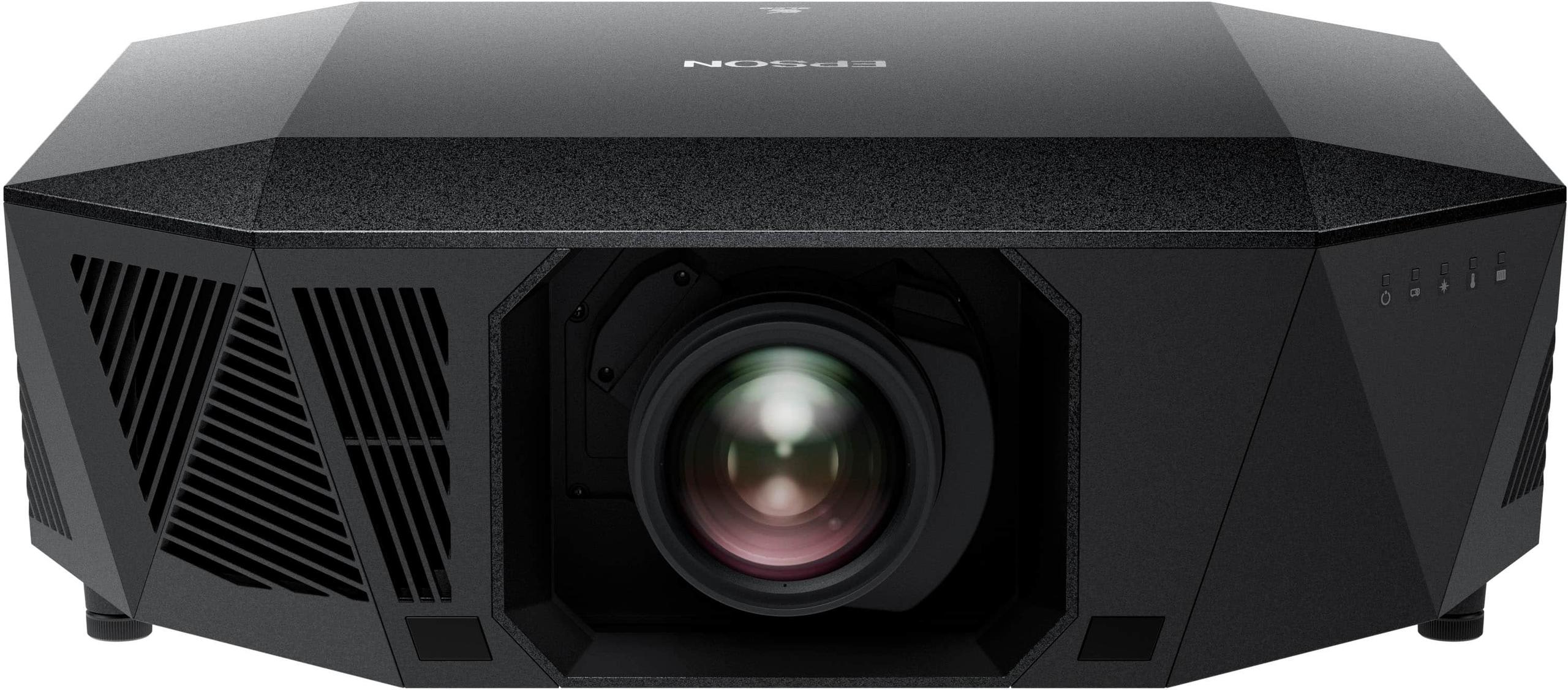
When most people think about buying a projector, they imagine comparing models that are somewhat similar in price and capability. But sometimes the most interesting comparisons happen between products that take completely different approaches to solving the same basic problem: creating a big, beautiful picture on your wall. That's exactly what we have with the Epson Home Cinema 5050UB and the Epson QL7000 4K 3LCD Laser Projector.
These two projectors couldn't be more different if Epson had tried. One costs about as much as a decent used car, while the other costs roughly the same as a brand-new luxury vehicle. One fits comfortably on a coffee table, while the other requires serious mounting hardware. Yet both carry the Epson name and promise excellent image quality. Understanding which one makes sense for your situation requires diving deep into what each projector does best.
Before we get into the specifics, it's worth understanding what separates different types of projectors. The projector world has evolved dramatically over the past decade, with manufacturers pushing brightness higher, adding 4K capabilities, and transitioning from traditional lamps to laser light sources.
The most important factors when choosing a projector are brightness (measured in lumens), contrast ratio (how deep the blacks look compared to the whites), color accuracy, resolution, and the type of light source. Brightness determines whether you can use the projector with room lights on, while contrast ratio affects how cinematic the image looks in dark scenes. The light source—whether it's a traditional lamp or a laser—impacts both the projector's lifespan and ongoing maintenance costs.
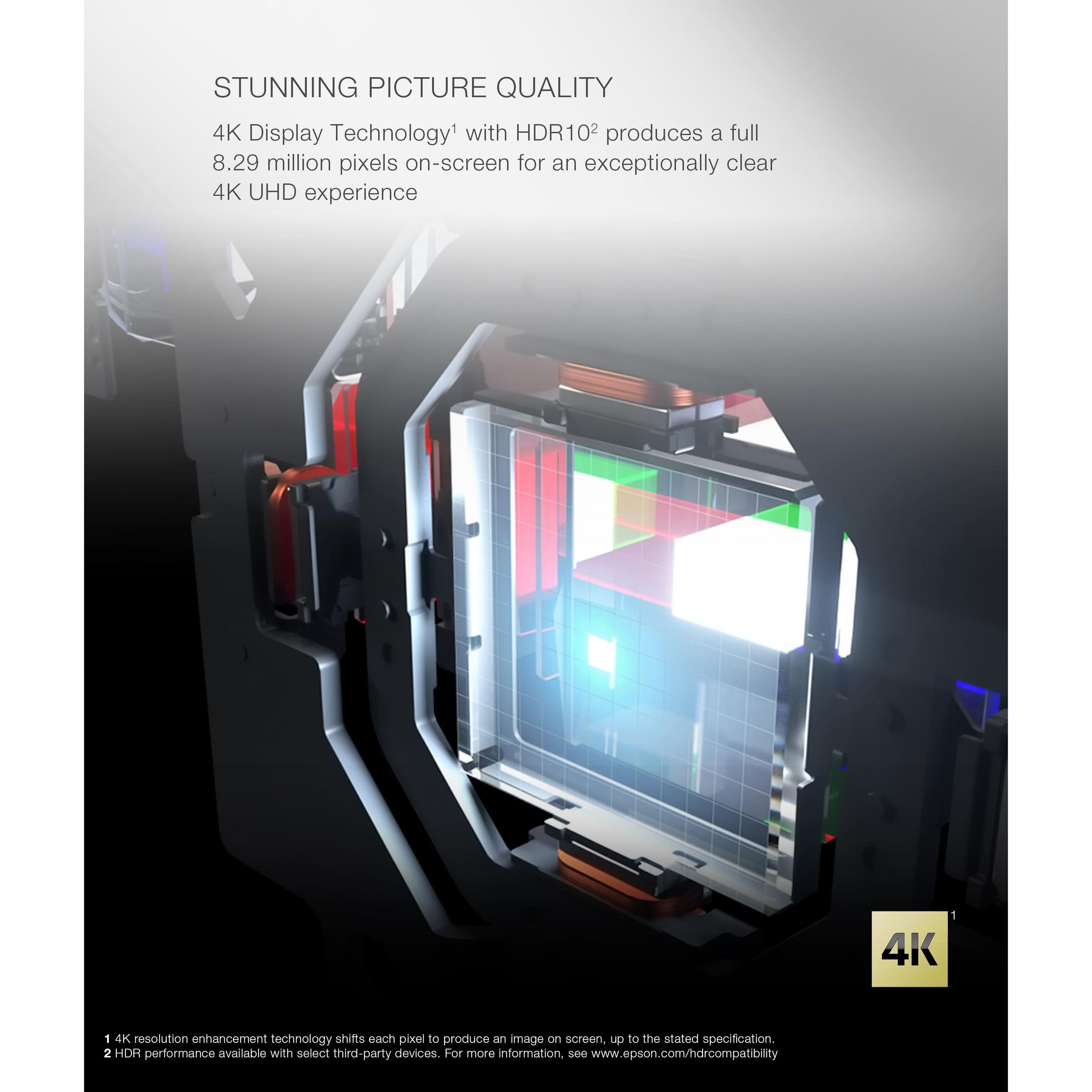
Resolution is where things get interesting with modern projectors. True native 4K projectors use panels with 3840×2160 pixels, but they're extremely expensive. Most consumer projectors, including both models we're discussing, use a technology called pixel-shifting. This takes a native 1080p panel (1920×1080 pixels) and rapidly shifts the image to create the appearance of 4K resolution. While purists debate whether this counts as "real" 4K, the practical difference is often minimal when watching movies or TV shows.
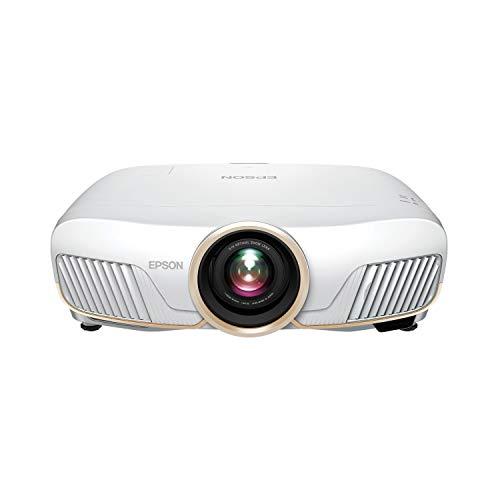
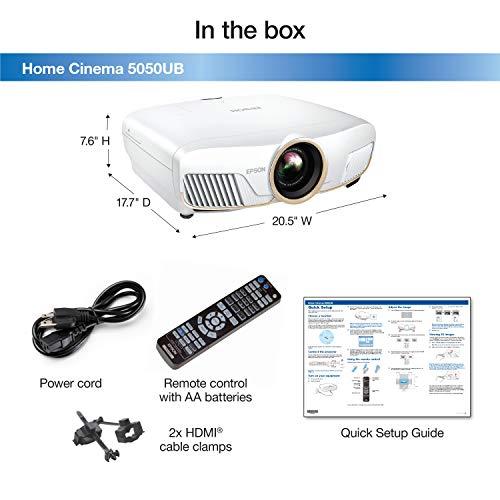
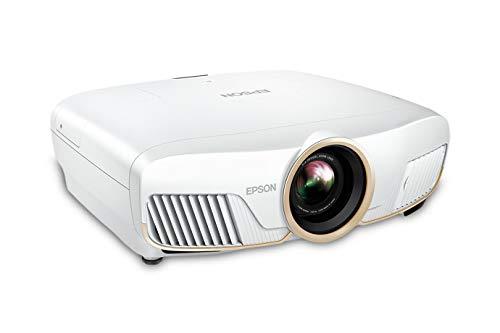
Released in 2019, the Epson Home Cinema 5050UB represents the sweet spot for serious home theater enthusiasts who want exceptional picture quality without breaking the bank. At the time of writing, it typically sells for around $3,000, making it accessible to dedicated movie lovers who have set up proper home theaters.
The "UB" in the name stands for "UltraBlack," which hints at this projector's secret weapon: exceptional contrast performance. Through a combination of Epson's UltraBlack technology and a high-quality iris system, the 5050UB delivers blacks that look genuinely black rather than the grayish blacks you see from many projectors.
This contrast performance comes from several technical innovations working together. The projector uses three separate LCD panels—one each for red, green, and blue light—which eliminates the rainbow effect you sometimes see with single-chip DLP projectors. More importantly, Epson's UltraBlack technology includes a special filter system that controls light polarization within the projector, dramatically reducing stray light that would otherwise wash out dark scenes.
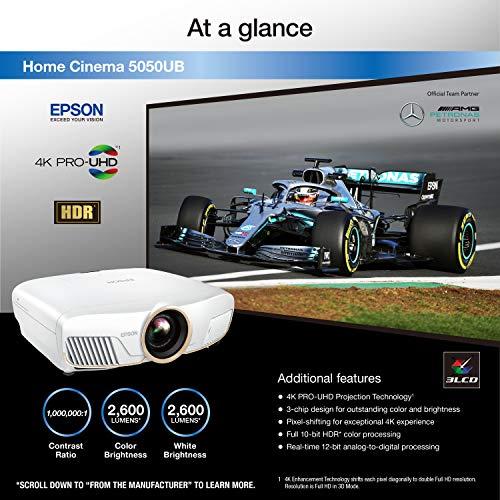
The results are impressive. In our research of professional reviews and user experiences, the 5050UB consistently delivers black levels that measure around 0.047 nits—a technical measurement that translates to blacks that actually look black in a dark room. This gives it a real-world contrast ratio of over 3,000:1, which is exceptional for a projector in this price range.
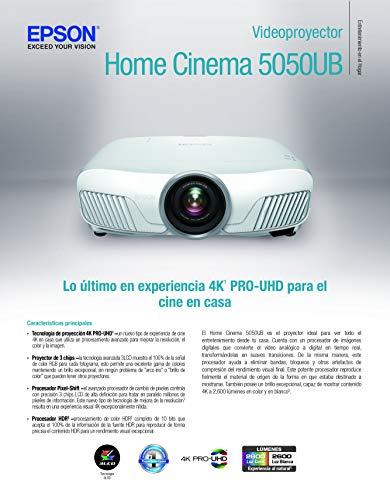
The 5050UB uses Epson's 4K PRO-UHD technology, which employs 2-phase pixel shifting to create 4K images from native 1080p panels. While this isn't true native 4K, the difference is remarkably small when watching actual content. The pixel-shifting happens so quickly that your eyes perceive a sharp, detailed 4K image.
Where the 5050UB really shines is color accuracy. It covers 97% of the DCI-P3 color space—the same color standard used in commercial movie theaters. This wide color gamut, combined with excellent out-of-box calibration, means colors look natural and vibrant without the oversaturated appearance common in many consumer displays.
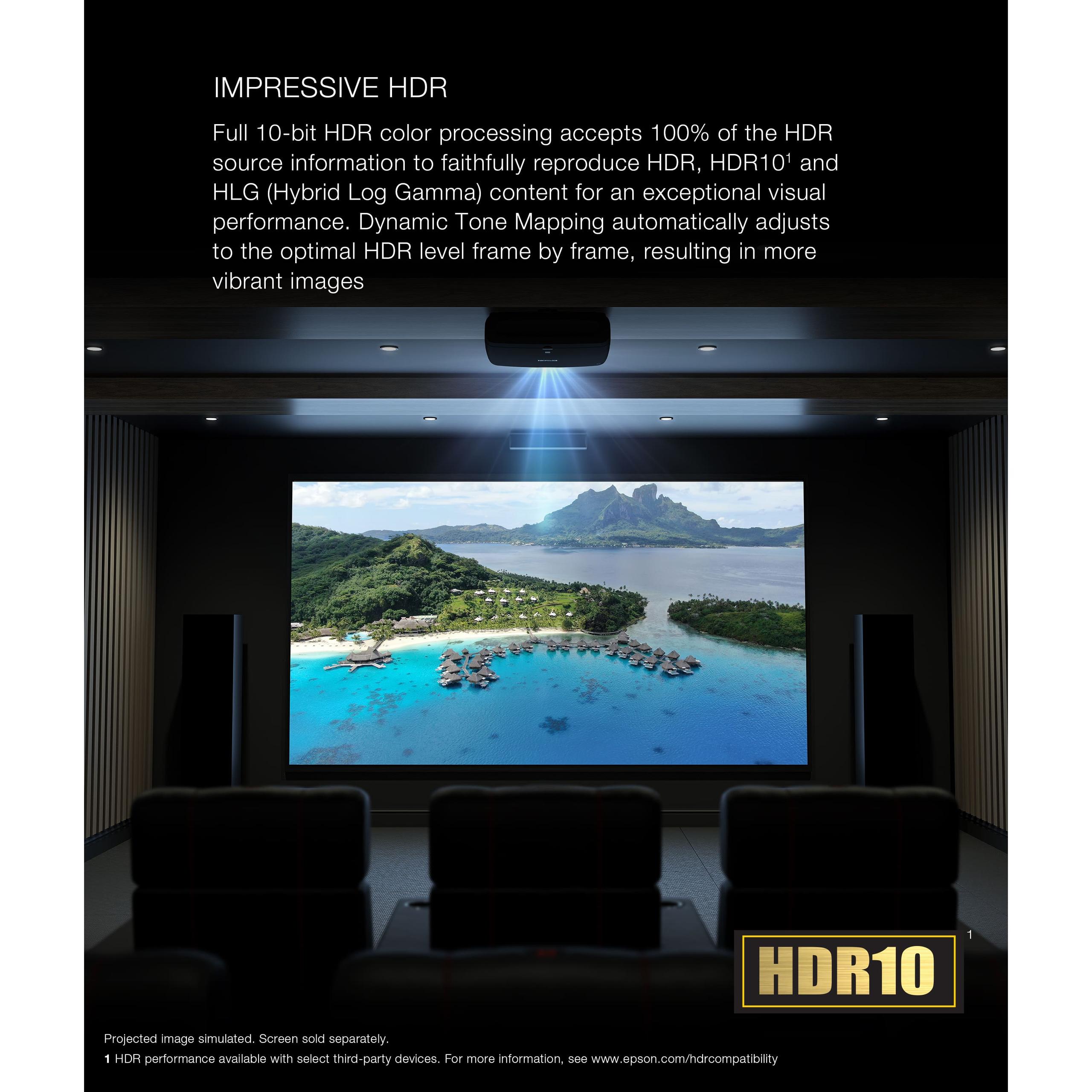
The projector's HDR (High Dynamic Range) implementation deserves special mention. HDR allows for brighter highlights and more color information, but many projectors struggle to display HDR content properly due to brightness limitations. The 5050UB includes 16 different HDR adjustment levels, allowing you to fine-tune the HDR presentation based on your room's lighting and personal preferences. This flexibility is rare at this price point and shows Epson's understanding that one HDR setting doesn't work for every situation.
One of the 5050UB's strongest advantages is its installation flexibility. The included motorized lens offers 2.1x zoom range and massive lens shift capabilities—you can move the image up to 96% vertically and 47% horizontally without moving the projector itself. This means you can mount the projector almost anywhere and still get the image exactly where you want it on your screen.
The lens memory feature adds another layer of convenience. You can save different zoom and lens shift positions, making it easy to switch between different aspect ratios. Want to watch a widescreen movie in 2.35:1 format and then switch to a 16:9 TV show? Just press a button and the projector automatically adjusts.
The 5050UB is optimized for dark room viewing. While it produces 2,600 lumens of brightness—enough for moderate ambient light—it really shows its best performance in dedicated home theater environments with controlled lighting. Those exceptional black levels that make the projector special become less impressive when room lights wash them out.
Fan noise is another consideration. At full brightness, the projector generates about 48 decibels of noise, which is noticeable during quiet movie scenes. Most users find the lower brightness modes much quieter, but it's worth considering if you're sensitive to noise.
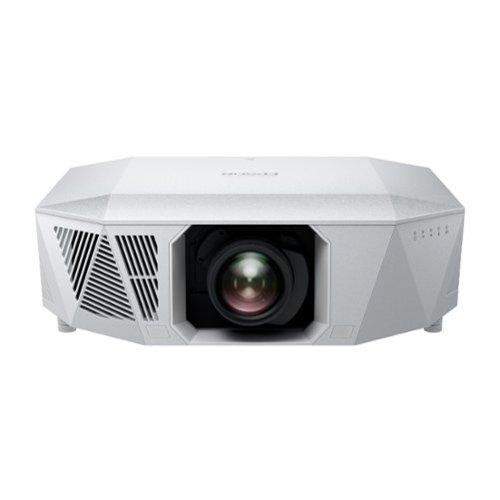
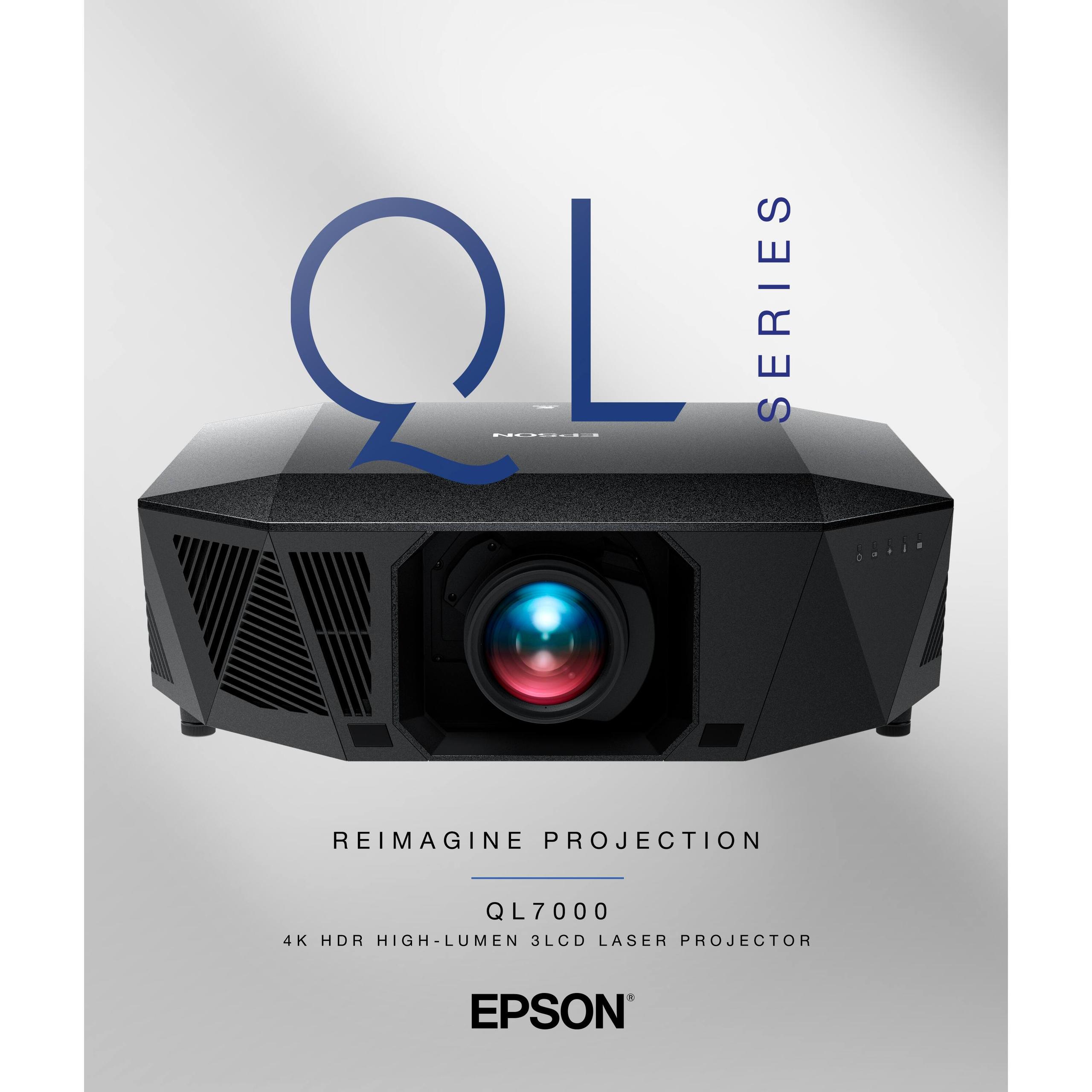
Released in 2024, the Epson QL7000 4K 3LCD Laser Projector represents a completely different philosophy. Where the 5050UB optimizes for dark room performance at a reasonable price, the QL7000 prioritizes raw brightness and professional features regardless of cost. At the time of writing, it typically sells for around $33,000 for just the projector body—lenses are sold separately and can add thousands more to the total price.
The biggest difference between these projectors is their light sources. The 5050UB uses a traditional 250-watt lamp that needs replacement every few thousand hours. The QL7000 uses a laser light source rated for 20,000 hours of operation with no maintenance required.
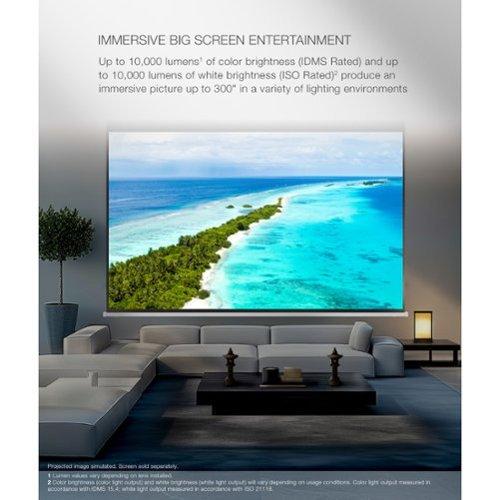
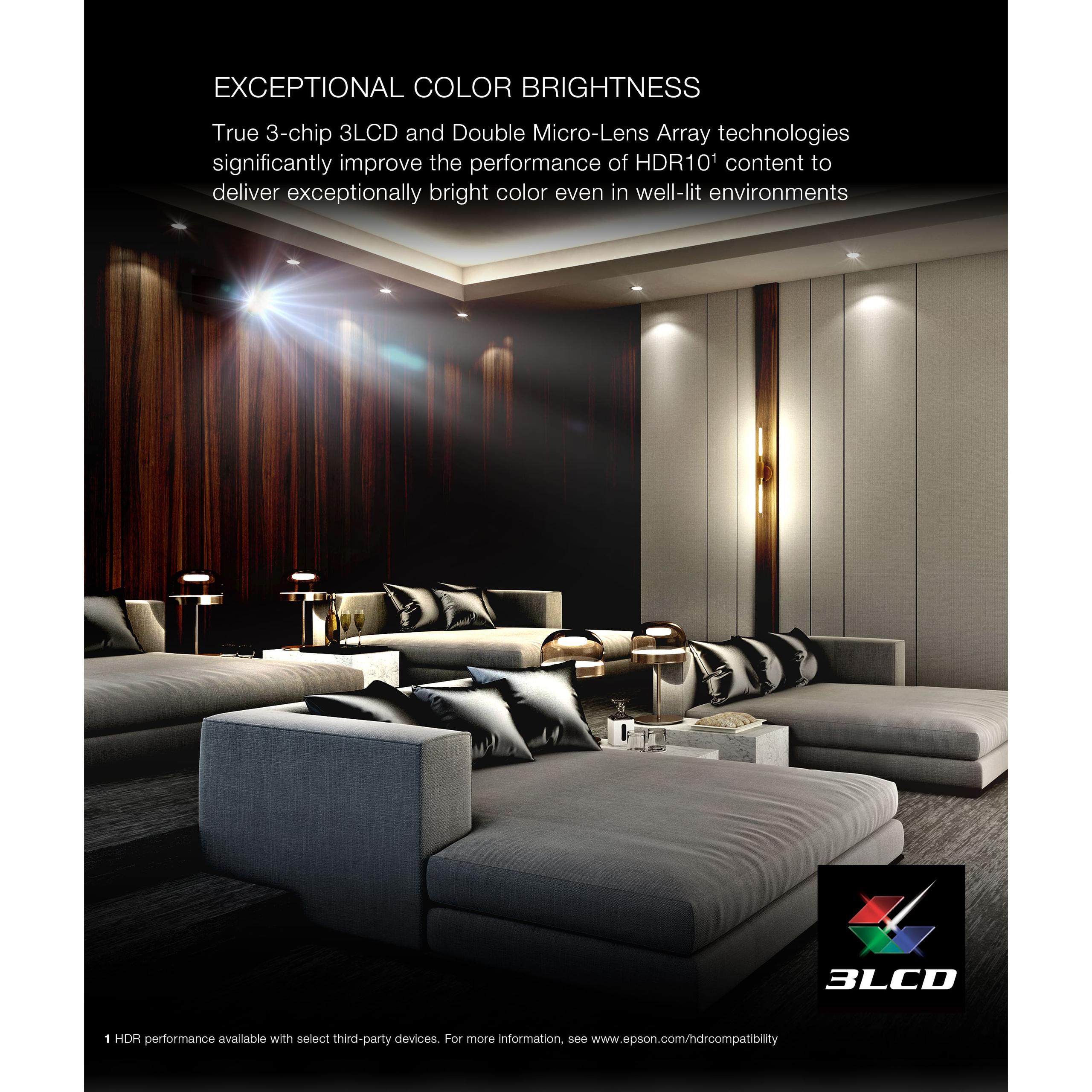
But the real story is brightness. The QL7000 produces an extraordinary 10,000 lumens—nearly four times brighter than the 5050UB. This isn't just a numbers game; it represents a fundamentally different capability. With 10,000 lumens, you can project a watchable image on a 300-inch screen in a room with normal lighting. Try that with the 5050UB and you'll get a washed-out, barely visible picture.
This extreme brightness comes from larger 1.04-inch LCD panels combined with the laser light source's efficiency. The QL7000 can maintain consistent brightness across its entire 20,000-hour lifespan, while traditional lamp projectors gradually dim as their bulbs age.
The QL7000 includes Epson's most advanced video processing technology. The 32-bit QZX processor handles real-time color correction, dynamic contrast adjustment, and HDR tone mapping. More importantly for modern users, it supports native 120Hz refresh rates—double what the 5050UB can handle.
This 120Hz support, combined with Auto Low Latency Mode, makes the QL7000 exceptional for gaming. Modern gaming consoles and high-end PCs can take advantage of the higher refresh rate for smoother, more responsive gameplay. The dual HDMI 2.1 ports support the full bandwidth needed for 4K gaming at 120Hz.
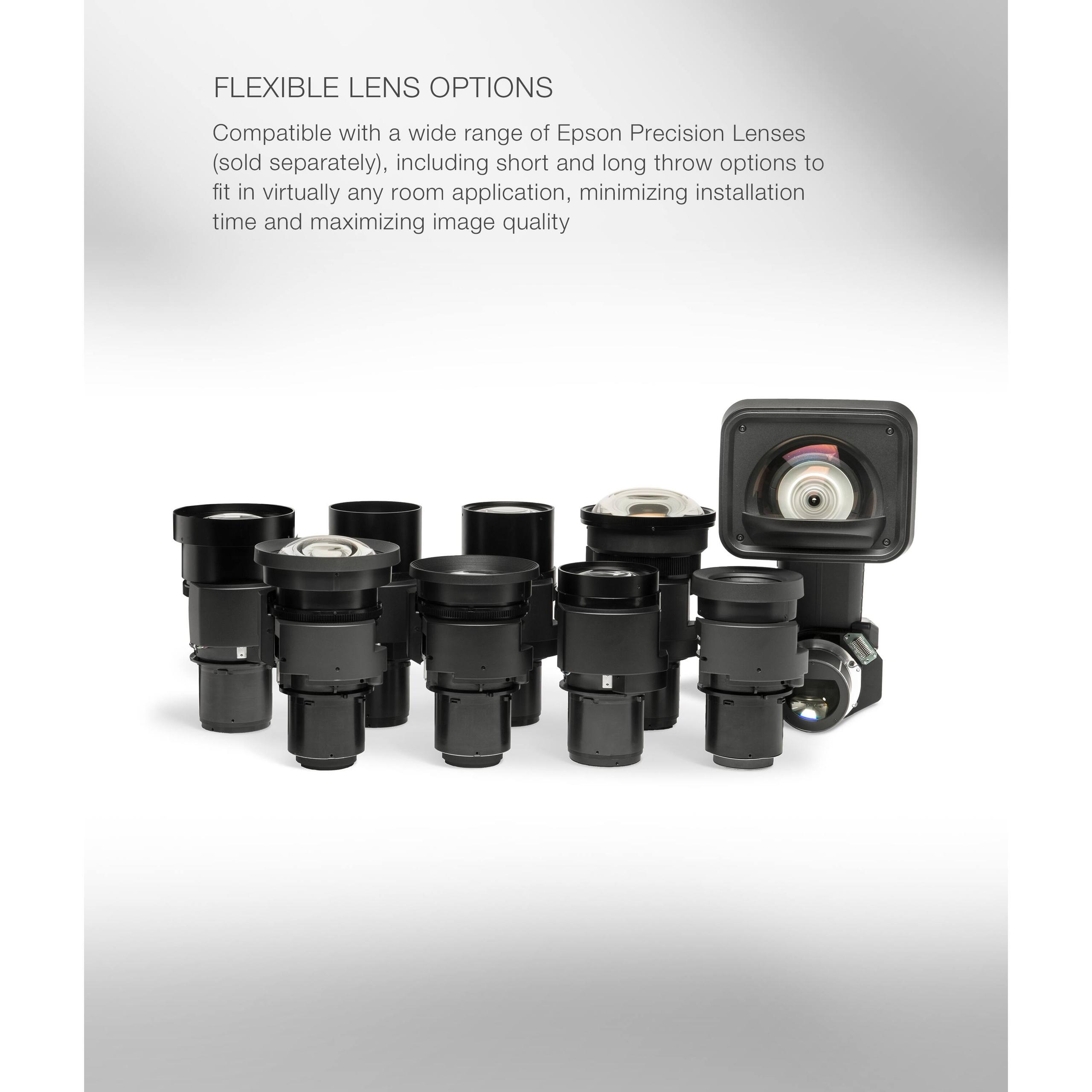
Unlike the 5050UB, which comes complete with everything you need, the QL7000 is sold as "body only"—you must purchase a lens separately. This might seem like a disadvantage, but it's actually a strength for professional installations. Epson offers a complete range of interchangeable lenses, from ultra-short throw options for tight spaces to long-throw lenses for large venues.
The projector integrates with professional control systems like Control4 and Crestron, allowing it to be part of complex automated installations. Web-based control interface and RS-232 connectivity provide remote monitoring and control capabilities that the 5050UB simply doesn't offer.
The QL7000's extreme price reflects its professional positioning. You're paying for 20,000-hour laser life, extreme brightness, professional integration capabilities, and the ability to handle installations that would be impossible with consumer projectors. For most home users, this represents massive overkill—like buying a semi-truck when you need a sedan.
In a properly darkened home theater, the 5050UB actually delivers a more cinematic experience than the QL7000. Its superior black levels create better shadow detail and more three-dimensional image depth. The QL7000's extreme brightness becomes unnecessary in dark environments and can actually be overwhelming.
Based on our research of user experiences, movie enthusiasts consistently prefer the 5050UB for dedicated home theater viewing. The combination of deep blacks, accurate colors, and reasonable brightness creates an engaging, cinema-like experience that's hard to match at any price.
This is where the QL7000 completely dominates. In rooms with ambient light—whether from windows, ceiling lights, or even full daylight—the 5050UB becomes nearly unwatchable while the QL7000 maintains excellent image quality. This isn't subtle; it's the difference between a barely visible image and a bright, colorful picture that commands attention.
For multi-purpose rooms, conference spaces, or anywhere you can't control lighting completely, the QL7000 enables use cases that are simply impossible with traditional home theater projectors.
The QL7000 wins decisively for serious gaming. Its 120Hz support and lower input lag provide smoother, more responsive gameplay. However, the 5050UB remains perfectly adequate for casual gaming, with input lag under 30 milliseconds that most players find acceptable.
Both projectors deliver excellent color performance and sharp 4K images through pixel-shifting technology. The 5050UB has a slight edge in measured color gamut coverage, but both exceed the color capabilities of most home displays.
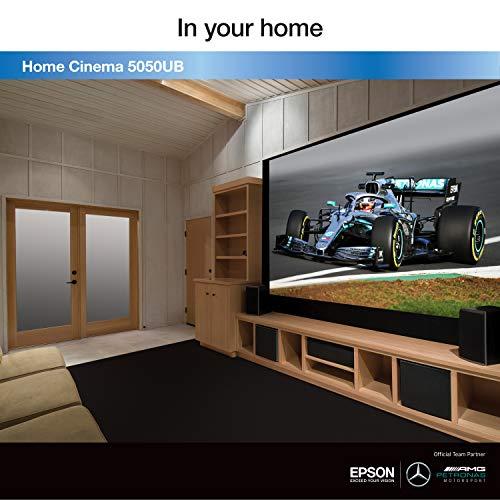
You're setting up a dedicated home theater with controlled lighting. Your screen size will be between 100-150 inches, and your budget is in the few-thousand-dollar range rather than tens of thousands. You prioritize image quality per dollar and want a complete system that's ready to install out of the box.
The 5050UB makes sense for movie enthusiasts who have created proper viewing environments. If you've invested in blackout curtains, acoustic treatments, and comfortable seating, this projector will reward that effort with exceptional picture quality.
You need to overcome significant ambient light, whether for commercial presentations or a multi-purpose home space that can't be darkened completely. Your budget can handle the extreme price premium, and you need professional-grade reliability and integration capabilities.
The QL7000 makes sense for commercial installations, high-end custom theaters with massive screens (200+ inches), or unique situations where extreme brightness is necessary. It's also the choice for serious gamers who want 120Hz performance and have the budget to match.
You need something between these extremes. Epson's LS11000 offers laser technology at a more reasonable price, while other manufacturers like JVC offer true native 4K at various price points.
These projectors represent two completely different approaches to creating large-scale entertainment. The 5050UB optimizes for the best possible picture quality in controlled environments at a price that serious enthusiasts can justify. The QL7000 prioritizes versatility and professional capabilities at a price that reflects its specialized nature.
For most people considering a home theater projector, the 5050UB represents exceptional value and performance. Its combination of deep blacks, accurate colors, and installation flexibility creates a truly cinematic experience that rivals much more expensive options.
The QL7000 serves a different market entirely—one where extreme brightness and professional features justify the premium price. It's not better than the 5050UB in all situations; it's designed for different situations entirely.
The choice ultimately comes down to your specific needs and budget. But understanding what each projector does best helps ensure you'll be happy with your decision for years to come.
| Epson Home Cinema 5050UB | Epson QL7000 4K 3LCD Laser Projector |
|---|---|
| Brightness - Determines usability in different lighting conditions | |
| 2,600 lumens (requires controlled lighting for best performance) | 10,000 lumens (cuts through ambient light, handles large screens) |
| Light Source Technology - Affects maintenance costs and longevity | |
| 250W UHE lamp (3,500-5,000 hour lifespan, requires replacement) | Laser diode (20,000 hours, maintenance-free operation) |
| Black Level Performance - Critical for cinematic dark scene quality | |
| Exceptional 0.047 nits with UltraBlack technology (deep blacks in dark rooms) | Good 3,400:1 native contrast (better than expected for high-brightness projector) |
| 4K Technology - How each achieves 4K resolution | |
| 2-phase pixel shifting from 1080p panels (4K PRO-UHD enhancement) | Dual-axis pixel shifting producing 8.29 million pixels on-screen |
| Gaming Performance - Refresh rate and input lag for gaming | |
| 60Hz max, <30ms input lag (adequate for casual gaming) | Native 120Hz, Auto Low Latency Mode (excellent for serious gaming) |
| Installation Approach - Lens flexibility and mounting requirements | |
| Complete system with 2.1x motorized lens and extensive lens shift | Body-only design requiring separate lens purchase for ultimate customization |
| Screen Size Capability - Optimal viewing scenarios | |
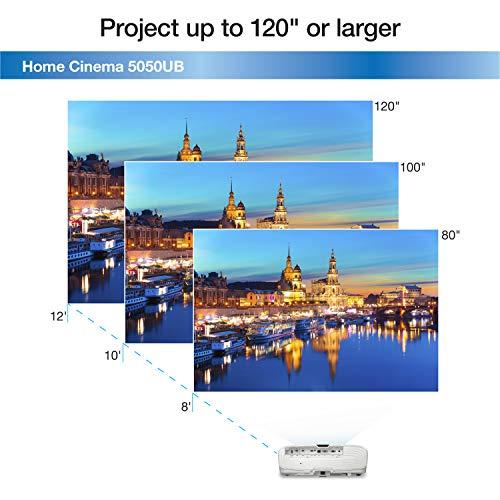
| 50-300 inches (best at 100-150 inches in dark rooms) | 50-300 inches (maintains quality at maximum size in bright environments) |
| Color Performance - Color accuracy and gamut coverage | |
| 97% DCI-P3 coverage with excellent out-of-box accuracy | DCI-P3 support with 32-bit QZX processor and dynamic tone mapping |
| HDR Implementation - High dynamic range content handling | |
| HDR10/HLG with 16-step real-time adjustment (exceptional user control) | HDR10/HDR10+/HLG with automatic dynamic tone mapping |
| Physical Requirements - Size, weight, and power considerations | |
| 20.5" × 18" × 6", 329W power (home-friendly installation) | 22.4" × 7.5" × 22.4", 46.5 lbs, 636W (requires substantial mounting) |
| Professional Features - Integration and control capabilities | |
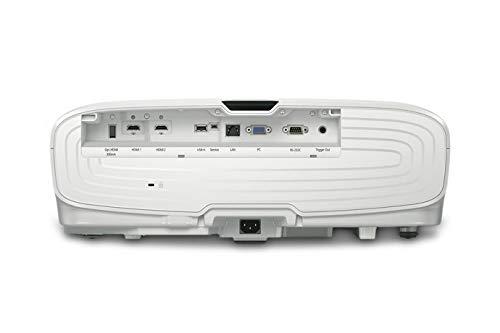
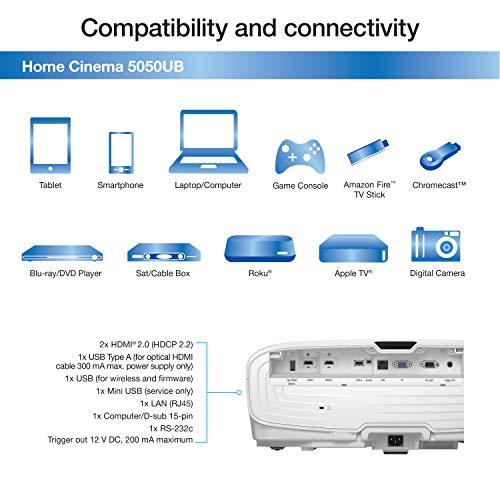
| Basic connectivity, no smart features (home theater focused) | RS-232, Ethernet, Control4/Crestron integration (commercial-grade) |
| Target Market - Who each projector serves best | |
| Dedicated home theaters with light control and moderate budgets | Commercial installations, high-end custom theaters, extreme brightness needs |
The Epson Home Cinema 5050UB is specifically designed for home theaters and delivers superior performance in dark, controlled environments. Its UltraBlack technology produces exceptional black levels and contrast that create a truly cinematic experience. The QL7000 is overkill for most home theaters and costs significantly more while not providing better image quality in dark rooms.
The primary difference is brightness and intended use. The Epson Home Cinema 5050UB produces 2,600 lumens and excels in dark rooms, while the Epson QL7000 delivers 10,000 lumens for bright environments and commercial applications. The QL7000 also uses laser technology versus the lamp-based 5050UB.
The Epson QL7000 dramatically outperforms in bright rooms due to its 10,000-lumen output—nearly four times brighter than the Epson Home Cinema 5050UB. If you can't fully control lighting, the QL7000 maintains excellent image quality while the 5050UB becomes washed out and difficult to watch.
Yes, both the Epson Home Cinema 5050UB and QL7000 deliver 4K images through pixel-shifting technology rather than native 4K panels. The 5050UB uses 2-phase pixel shifting while the QL7000 employs dual-axis pixel shifting. Both produce sharp, detailed 4K images that are visually impressive.
The Epson QL7000 is superior for gaming with native 120Hz support and Auto Low Latency Mode, making it excellent for modern gaming consoles and PCs. The Epson Home Cinema 5050UB maxes out at 60Hz with sub-30ms input lag, which is adequate for casual gaming but not ideal for competitive play.
The Epson Home Cinema 5050UB requires lamp replacement every 3,500-5,000 hours of use, adding ongoing maintenance costs. The QL7000 uses a laser light source rated for 20,000 hours with no bulb changes needed, making it virtually maintenance-free throughout its lifespan.
The Epson Home Cinema 5050UB provides exceptional value for dedicated home theater users, delivering professional-level image quality at a consumer-friendly price point. The QL7000 costs roughly ten times more and is only worthwhile if you specifically need its extreme brightness or professional features.
Both projectors support screens up to 300 inches, but with different optimal conditions. The Epson Home Cinema 5050UB works best with 100-150 inch screens in dark rooms, while the QL7000 can effectively illuminate the full 300-inch range even in brighter environments.
The Epson Home Cinema 5050UB comes complete with a motorized zoom lens and all necessary accessories for immediate setup. The QL7000 is sold as "body only" without a lens, requiring you to purchase Epson's interchangeable lenses separately, adding significant cost to the total system.
The Epson Home Cinema 5050UB delivers superior black levels in dark environments thanks to its UltraBlack technology, measuring exceptionally deep blacks at 0.047 nits. While the QL7000 offers good contrast for a high-brightness projector, it cannot match the 5050UB's performance in controlled lighting conditions.
Both the Epson Home Cinema 5050UB and QL7000 support HDR10 and HLG formats. The 5050UB features 16-step HDR adjustment for fine-tuning, while the QL7000 includes automatic dynamic tone mapping. Both deliver excellent HDR performance within their respective brightness capabilities.
Choose the Epson Home Cinema 5050UB if you have a dedicated home theater with controlled lighting and want exceptional image quality at a reasonable price. Select the QL7000 only if you need extreme brightness for commercial use, can't control ambient light, or require professional integration features and have the budget to match.
We've done our best to create useful and informative comparisons to help you decide what product to buy. Our research uses advanced automated methods to create this comparison and perfection is not possible - please contact us for corrections or questions. These are the sites we've researched in the creation of this article: rtings.com - projectorscreen.com - hometechnologyreview.com - thesmarthomehookup.com - youtube.com - rtings.com - techgearlab.com - projectorcentral.com - projectorreviews.com - projectorcentral.com - avsforum.com - rtings.com - projectorreviews.com - projectorreviews.com - avsforum.com - avsforum.com - audiogeneral.com - hifiheaven.net - manuals.plus - crutchfield.com - projectorcentral.com - epson.com - mediaserver.goepson.com - bestbuy.com - ngxptech.com - projectorcentral.com - projectorreviews.com - youtube.com - epson.com - projectorscreen.com - projectorscreen.com - theaudiosolutions.com - fmaudiovideo.com - thesoundcounsel.com - worldwidestereo.com - hifiheaven.net - thepowercentre.ca

Privacy Policy
Terms and Conditions - Affiliate Policy
Home Security
© Copyright 2008-2026.
11816 Inwood Rd #1211, Dallas, TX 75244