

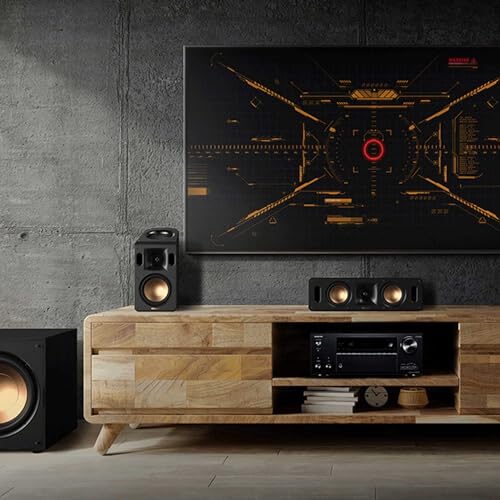
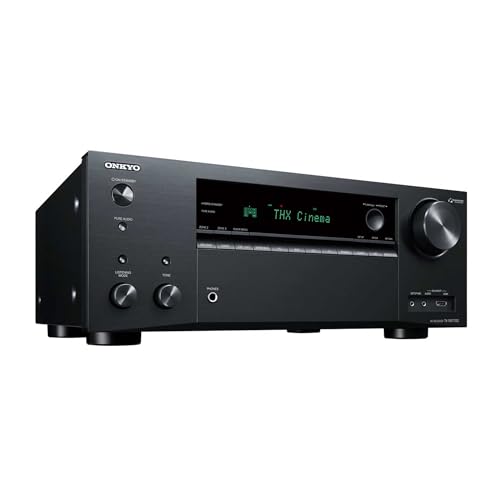
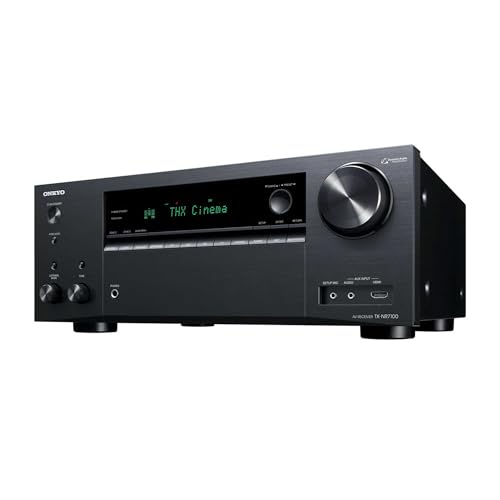
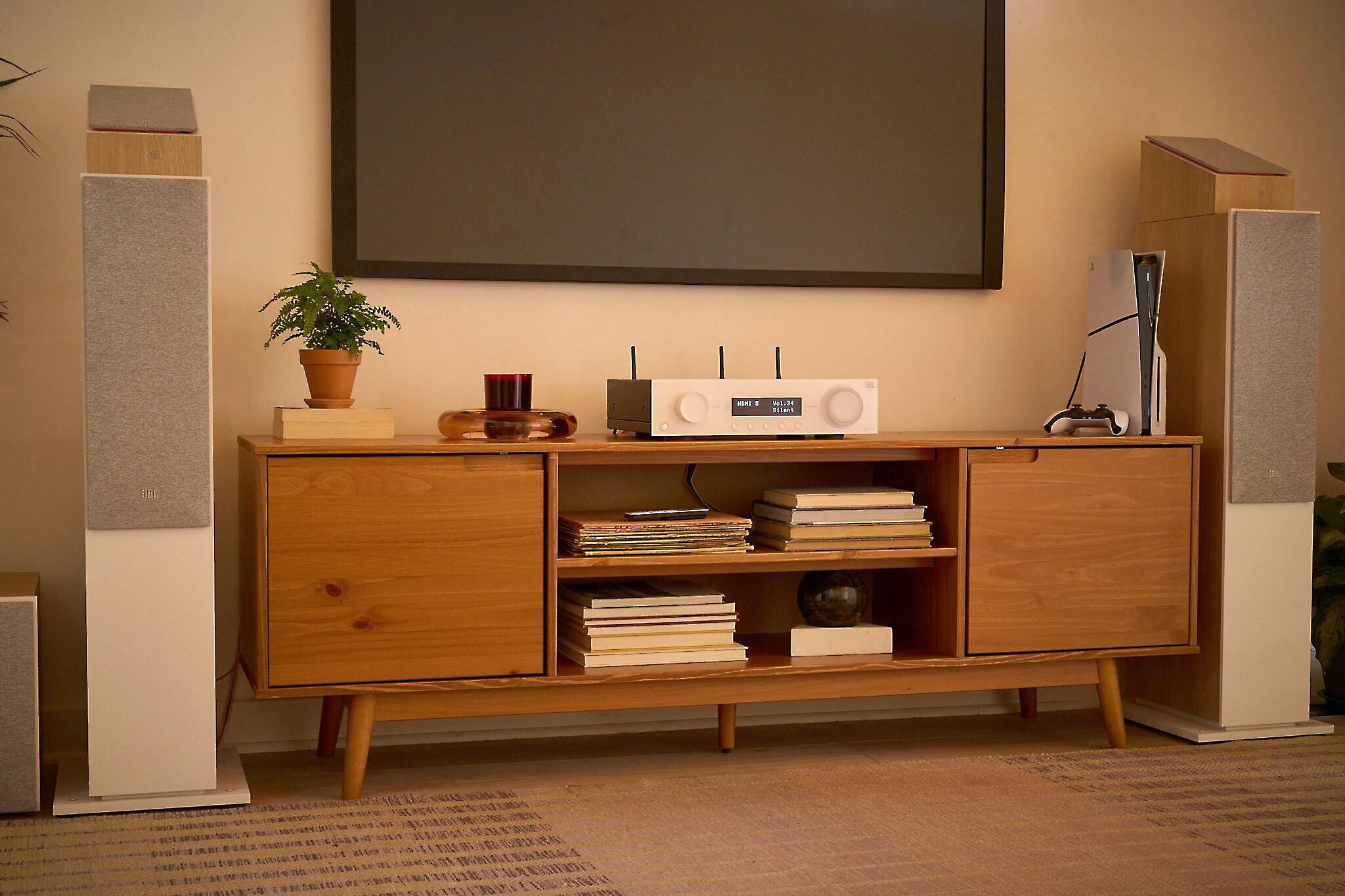
When you're building a home theater system, the AV receiver is arguably your most important purchase decision. Think of it as the brain and muscle of your entertainment setup—it processes all your audio and video signals, powers your speakers, and connects everything from your gaming console to your streaming devices. Get this choice wrong, and you'll be living with the consequences for years to come.
At the time of writing, two receivers have captured serious attention in the competitive mid-range market: the Onkyo TX-NR7100 and the JBL MA710. These represent fundamentally different philosophies in receiver design, and understanding their differences will help you avoid buyer's remorse.
The AV receiver market has evolved dramatically over the past few years. What used to be primarily about raw power and input switching has transformed into a complex balancing act between traditional home theater performance and modern streaming convenience. Today's receivers must handle everything from 8K video passthrough to wireless multi-room audio, all while maintaining the core mission of making movies sound spectacular.
The key considerations haven't changed entirely, though. Channel count still determines how many speakers you can power—more channels mean more immersive surround sound. Audio processing capabilities decide how well your receiver can decode formats like Dolby Atmos, which adds overhead sound effects by bouncing audio off your ceiling. Video connectivity determines what devices you can connect and what resolutions they'll support. But now we also have to consider streaming integration, room correction systems that automatically tune your audio, and gaming features that reduce input lag.
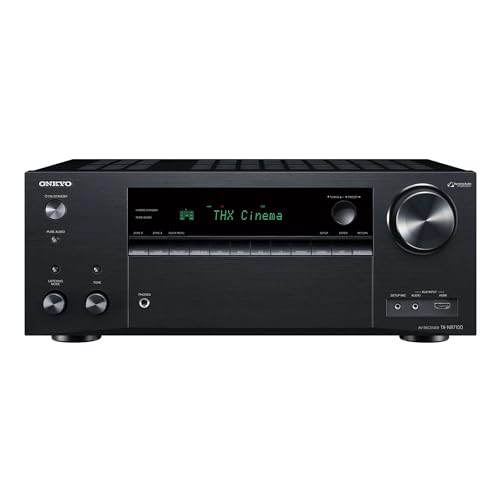
The Onkyo TX-NR7100, released in 2022, represents the traditional enthusiast approach. With 9.2 channels of amplification, it's designed for people who want maximum flexibility and don't mind complexity. Its standout feature is built-in Dirac Live room correction—a professional-grade system that typically costs hundreds of dollars as an add-on feature.
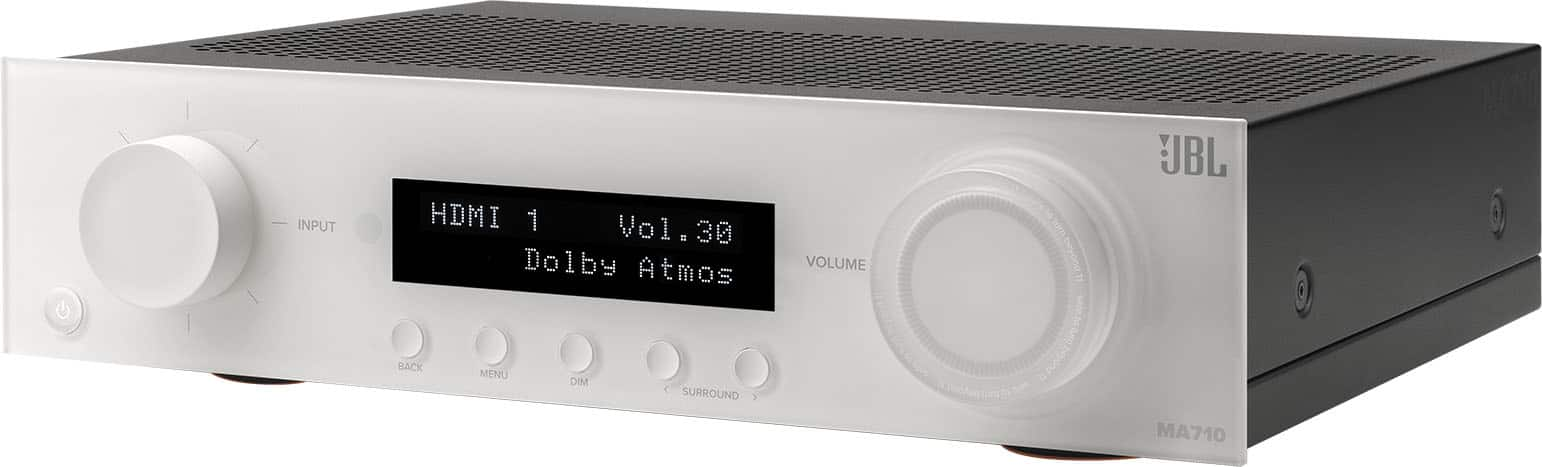
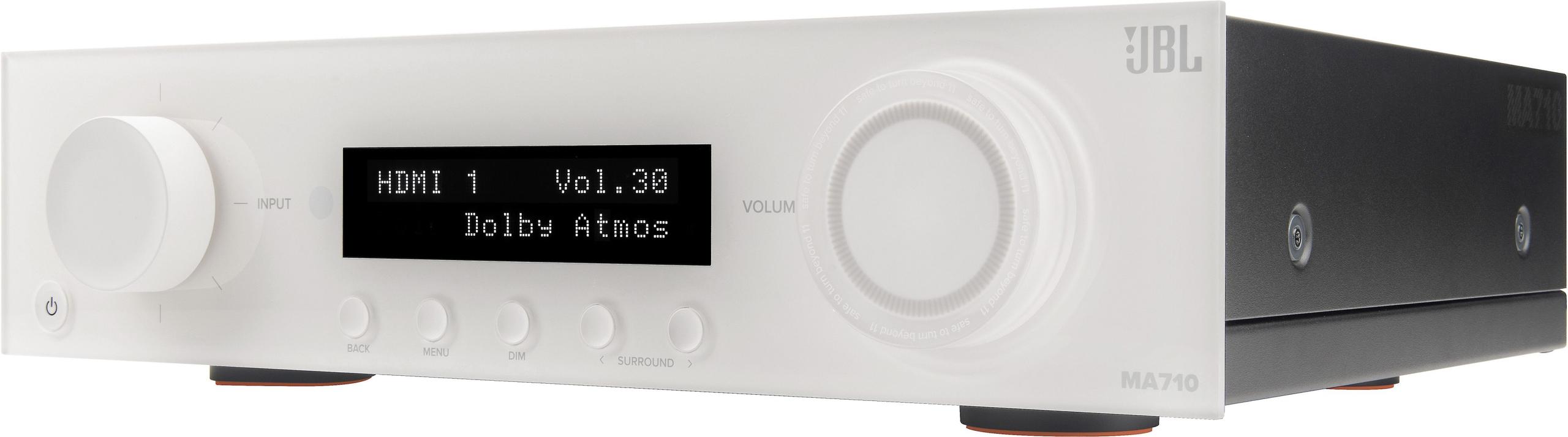
The JBL MA710, arriving in 2024, takes a more modern approach. This 7.2-channel receiver prioritizes gaming performance and elegant design over raw channel count. It's built around Class D amplification, a newer technology that runs much cooler and more efficiently than traditional amplifiers, and features comprehensive HDMI 2.1 support that gamers have been demanding.
At the time of writing, these receivers sit in different price brackets, with the JBL MA710 positioned as the more affordable option despite being the newer product. This pricing dynamic makes the comparison particularly interesting from a value perspective.
When evaluating AV receivers, power output and audio quality should be your primary concerns. Everything else is secondary if your receiver can't make your movies sound great or your music engaging.
The Onkyo TX-NR7100 delivers 100 watts per channel across all nine channels, using traditional Class AB amplification. This might seem lower than some specs you'll see, but Onkyo's approach focuses on consistent power delivery—you get that full 100 watts whether you're driving two channels for music or all nine for an Atmos movie. The traditional amplifier design also tends to have excellent dynamic range, meaning it can handle those explosive movie moments that go from whisper-quiet dialogue to thundering action sequences without strain.
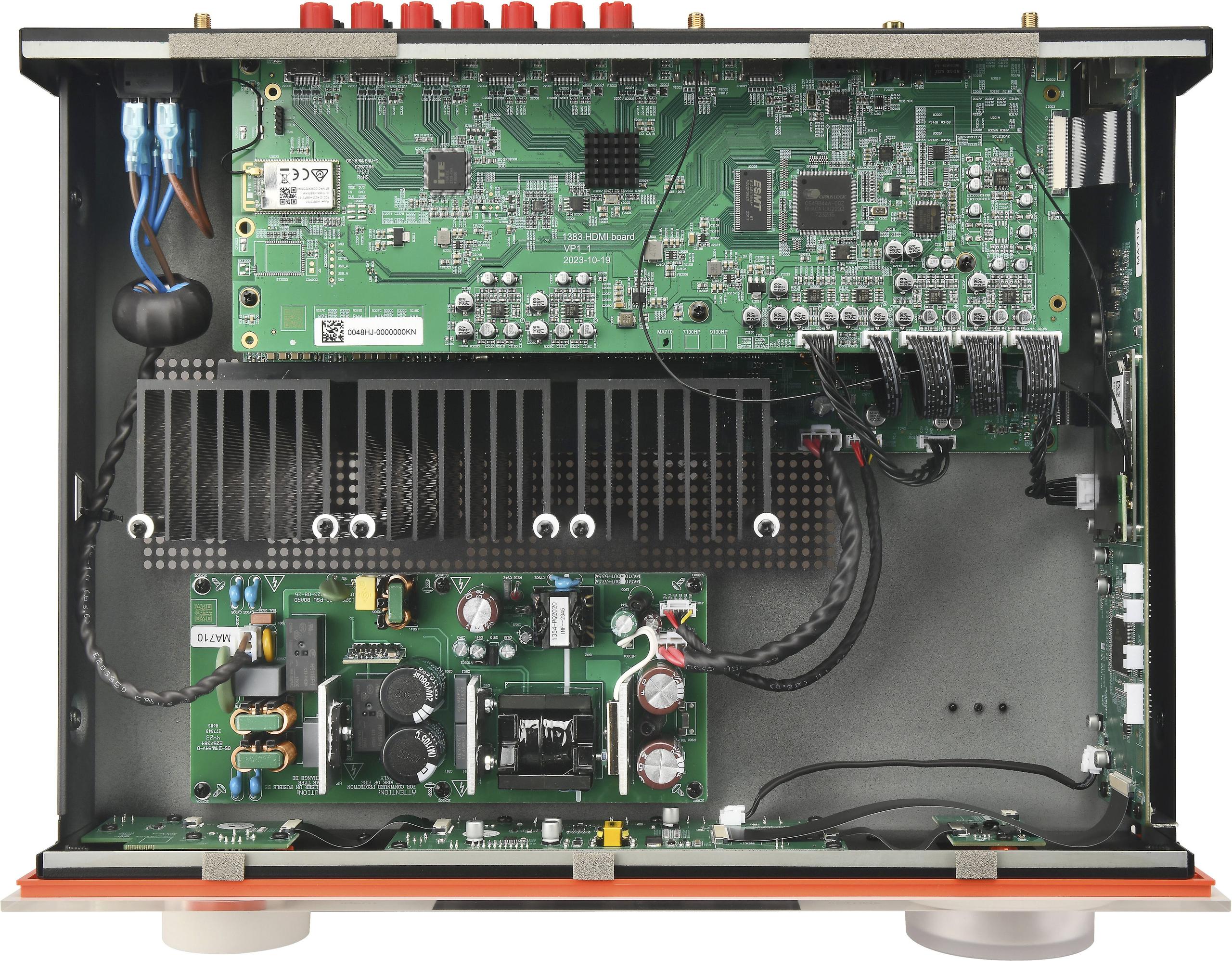
The JBL MA710 takes a different approach with Class D amplification, delivering 110 watts per channel when driving two channels, but this drops to around 90 watts per channel when all seven channels are working simultaneously. Class D amplification is newer technology that uses digital switching to achieve high efficiency—typically around 85-90% compared to 60-70% for traditional designs. In practical terms, this means the JBL runs much cooler and uses less electricity, which is particularly valuable if you're installing it in a cabinet where heat buildup could be problematic.
Based on our research into user experiences and professional reviews, both receivers deliver clean, powerful sound, but with different characteristics. The Onkyo TX-NR7100 tends to excel at dynamic movie soundtracks, where its traditional amplification provides excellent headroom for those sudden loud moments. The JBL MA710 delivers impressive clarity and precision, with the Class D design contributing to a very low noise floor—meaning you'll hear less background hiss during quiet passages.
Here's where these receivers diverge dramatically, and it's probably the most important performance difference for most buyers.
The Onkyo TX-NR7100 includes Dirac Live room correction, and this is genuinely a big deal. Room correction systems analyze how your room affects sound quality and then apply digital filters to compensate. Most rooms have acoustic problems—maybe your couch is too close to the back wall, creating boomy bass, or your ceiling height creates a resonance at certain frequencies.
Dirac Live is considered one of the best room correction systems available, typically found in much more expensive receivers or sold as a costly upgrade. It works in both the frequency domain (adjusting which frequencies are louder or quieter) and the time domain (correcting timing issues caused by sound reflections). The calibration process involves placing a microphone at multiple listening positions while the system plays test tones, then analyzes the results to create a correction profile.
Based on user feedback we've evaluated, the difference Dirac Live makes can be dramatic, especially in challenging rooms. Users consistently report improved bass clarity, better dialogue intelligibility, and more precise stereo imaging after calibration. However, there is a caveat—the included version doesn't support independent subwoofer management, which can be frustrating if you're running dual subwoofers.
The JBL MA710 includes EZ Set EQ, which is a much simpler automatic calibration system. It handles basic level matching and applies some room correction, but it's nowhere near as sophisticated as Dirac Live. Think of it as the difference between a basic tune-up and a complete engine rebuild—both help, but one is far more comprehensive.
For most buyers, this room correction difference alone justifies the Onkyo TX-NR7100 despite its higher price point. Room acoustics affect sound quality more than most people realize, and proper correction can make a mediocre room sound excellent.
Gaming performance has become crucial for AV receivers, particularly with the PlayStation 5 and Xbox Series X supporting advanced display technologies. This is where the JBL MA710 shows its 2024 design advantages.
The JBL MA710 features full HDMI 2.1 implementation across three inputs, supporting Variable Refresh Rate (VRR), Auto Low Latency Mode (ALLM), and Quick Frame Transport (QFT). VRR synchronizes your display's refresh rate with your console's output, eliminating screen tearing during fast action. ALLM automatically switches your TV to its lowest-latency mode when it detects gaming content. QFT reduces the time between when a frame is processed and when it appears on screen.
For serious gamers, these features are transformative. The difference between gaming with and without VRR is immediately apparent in fast-paced games—motion appears smoother and more controlled. ALLM can reduce input lag by 20-30 milliseconds, which might not sound like much but makes a noticeable difference in competitive gaming.
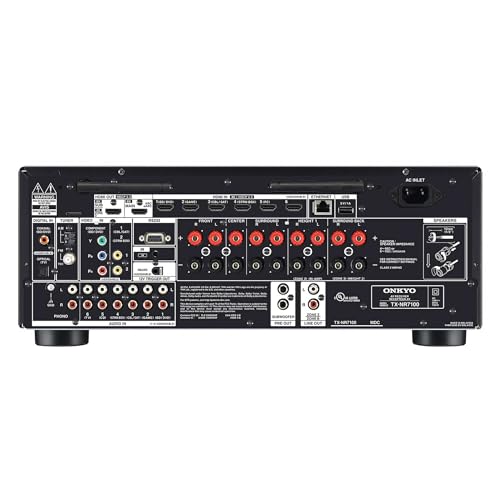
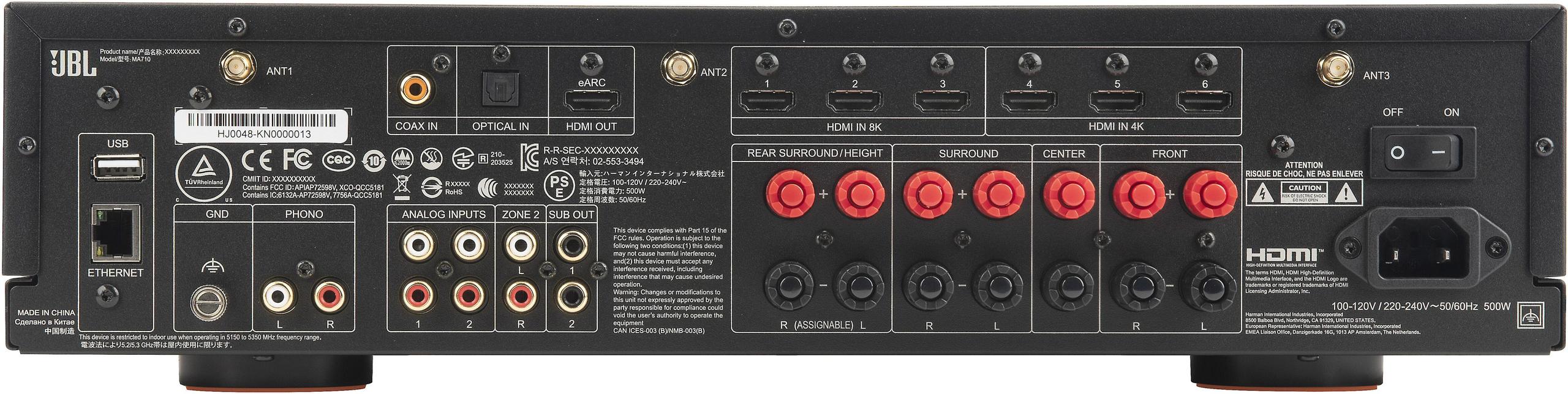
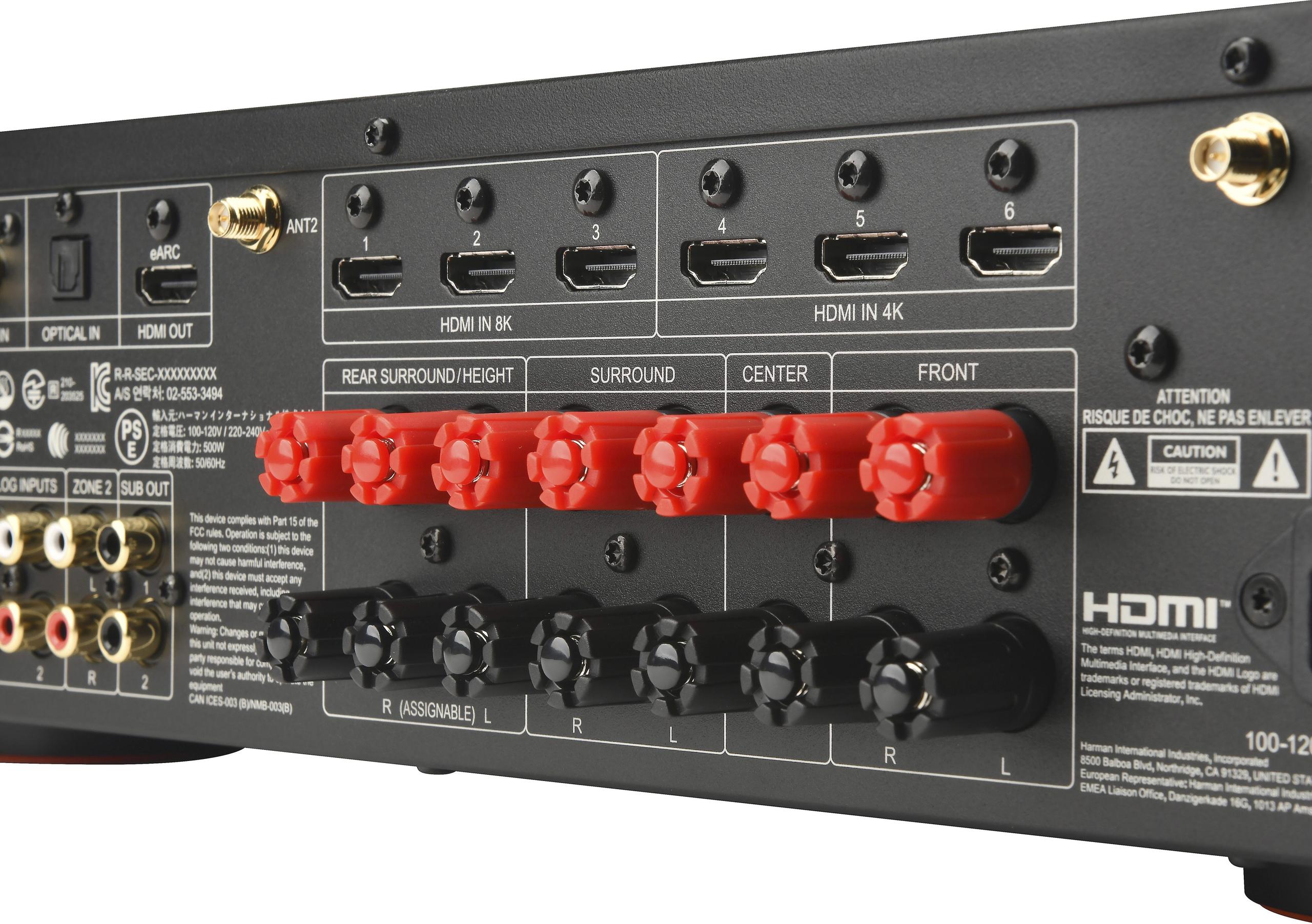
The Onkyo TX-NR7100, being a 2022 design, supports basic HDMI 2.1 features like 4K/120Hz passthrough and some gaming optimizations, but its implementation isn't as comprehensive. However, it compensates with superior HDMI connectivity overall, offering seven inputs versus six on the JBL, plus three HDMI outputs compared to one. This makes multi-zone video distribution possible—you could send different sources to your main TV and a bedroom display simultaneously.
Both receivers handle 8K/60Hz and 4K/120Hz video passthrough, though the JBL MA710's newer processing provides better compatibility with the latest gaming consoles and streaming devices.
The two extra channels in the Onkyo TX-NR7100 create significantly more setup flexibility. While both receivers support Dolby Atmos and DTS:X (immersive audio formats that add height effects), the Onkyo can run more ambitious configurations.
With 9.2 channels, you could run a 5.1.4 setup (five main speakers, one subwoofer, four height speakers) or a 7.1.2 configuration (seven main speakers, one subwoofer, two height speakers). The four-height-speaker arrangement creates a more convincing overhead soundfield, where helicopters seem to fly directly above you and rain appears to fall from the ceiling.
The JBL MA710's 7.2 channels limit you to 7.1 or 5.1.2 configurations. The 5.1.2 setup with two height speakers still provides impressive Atmos effects, but it's not as enveloping as a four-height-speaker arrangement. For many rooms and budgets, this difference won't matter, but in larger spaces or for perfectionist installations, those extra channels become valuable.
The Onkyo TX-NR7100 also offers more multi-zone flexibility. You can assign some of those nine channels to power speakers in another room while maintaining a full 7.1 or 5.1.2 setup in your main theater. The JBL MA710 supports basic Zone 2 operation but with more limited options.
Modern receivers need to integrate seamlessly with streaming services and smart home systems, and this is another area where these products take different approaches.
The Onkyo TX-NR7100 goes all-in on compatibility. It's Works with Sonos certified, meaning you can integrate it into existing Sonos multi-room systems—your home theater becomes another Sonos zone, controllable through the Sonos app. It includes native support for Spotify, TIDAL, Amazon Music HD, Deezer, and several other services, plus DTS Play-Fi for synchronized multi-room playback.
Voice control works with all three major ecosystems: Amazon Alexa, Google Assistant, and Apple HomeKit. This broad compatibility makes it easier to integrate into existing smart home setups, regardless of which ecosystem you've already invested in.
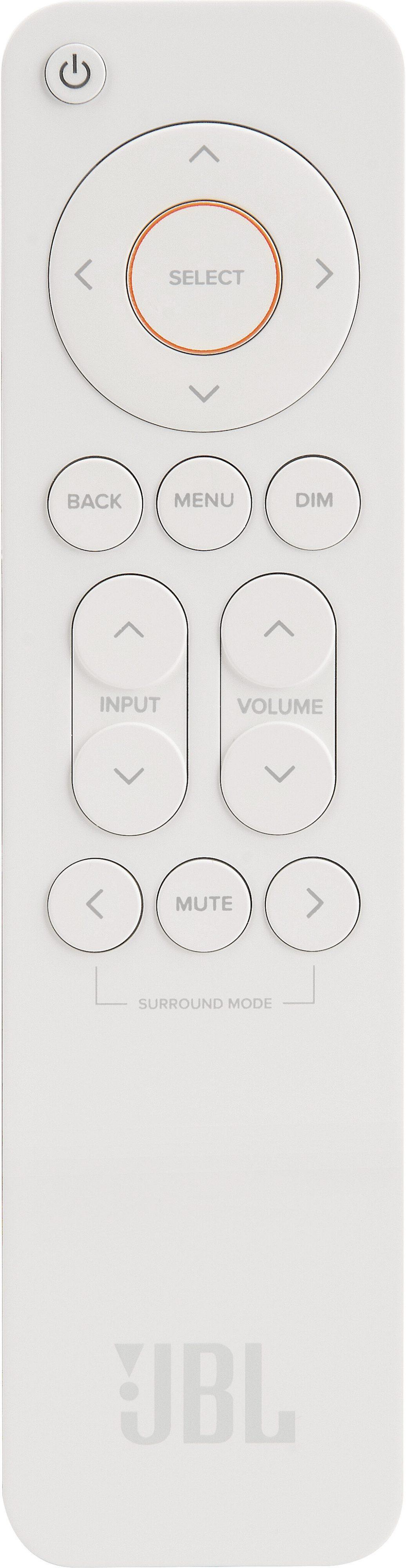
The JBL MA710 takes a more streamlined approach, focusing on core streaming features: AirPlay 2, Chromecast, and high-quality Bluetooth with aptX HD support. These cover the essential bases for most users, but the ecosystem integration isn't as deep. If you're building a simple system or don't need extensive multi-room capabilities, this might actually be preferable—fewer features often means fewer things to go wrong.
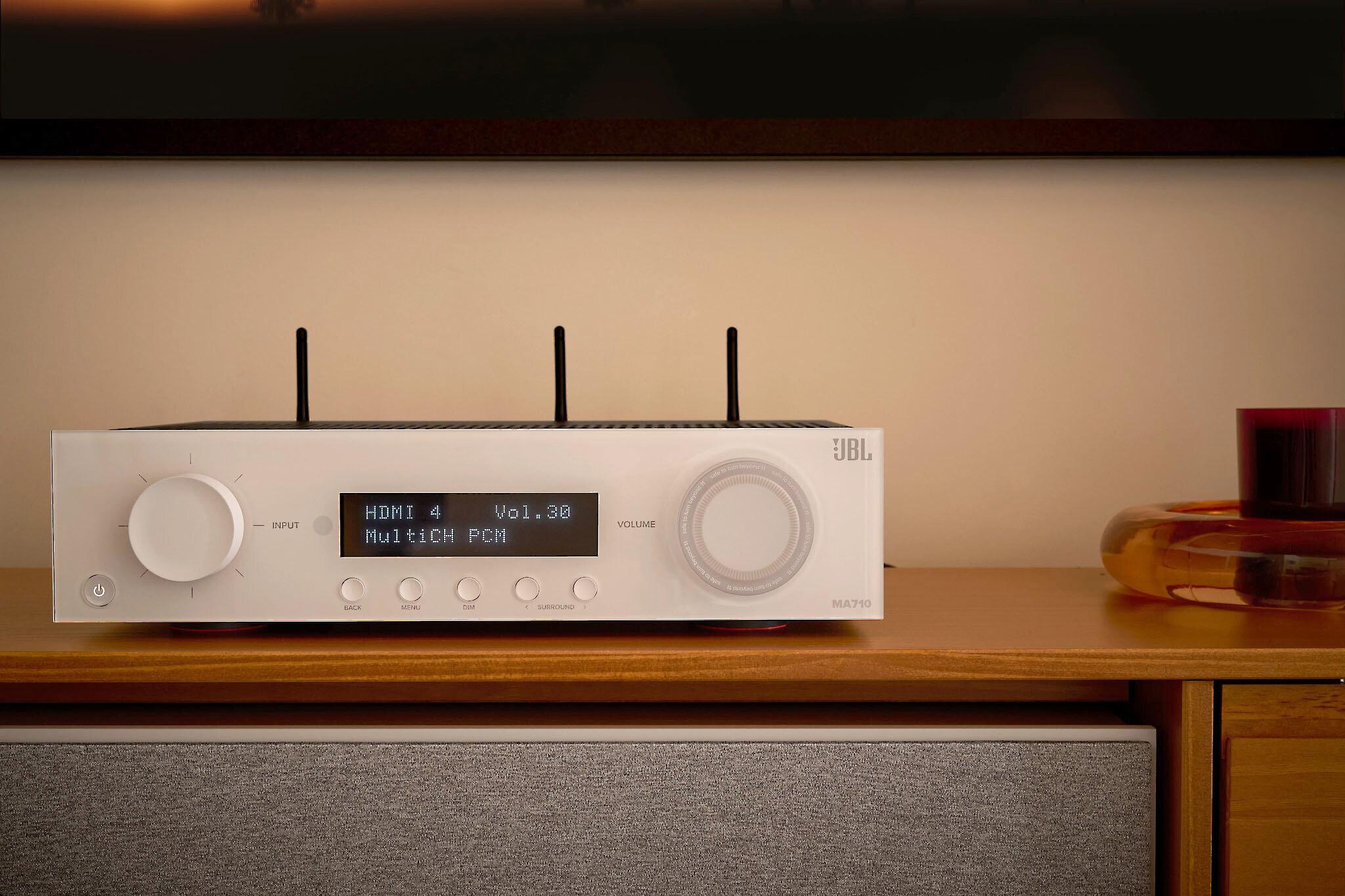
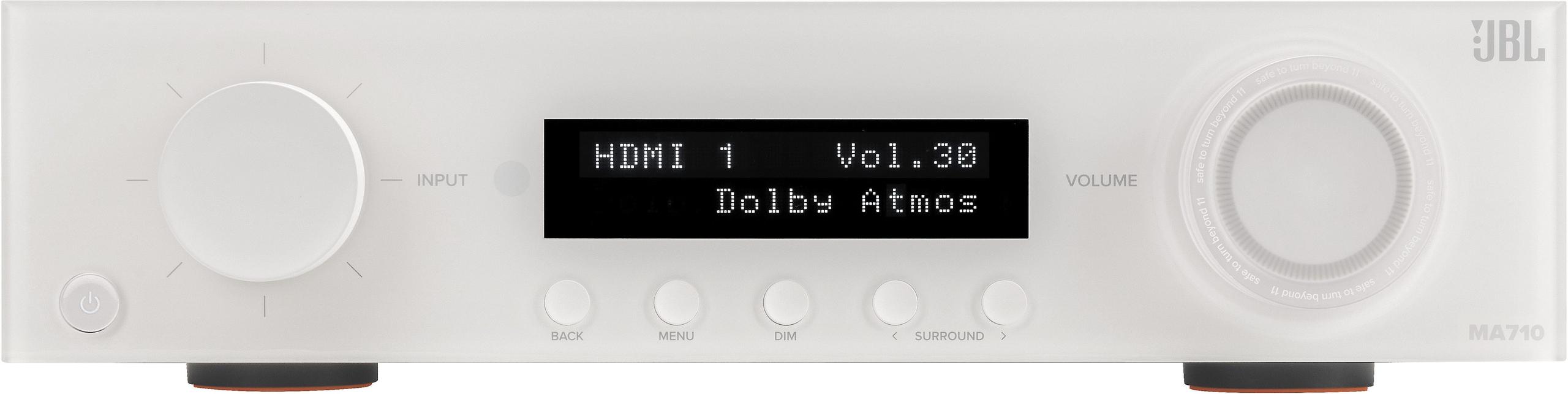
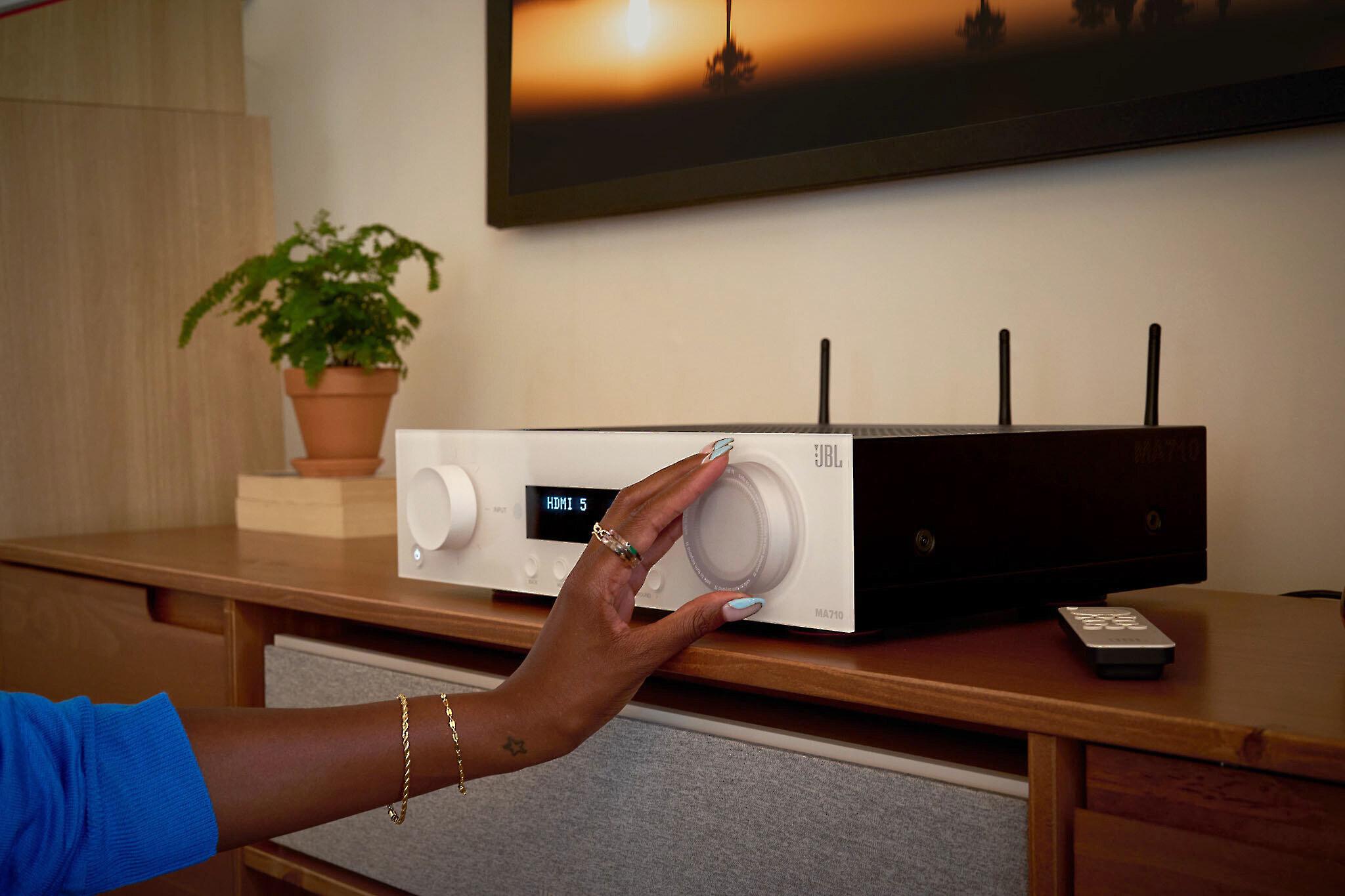
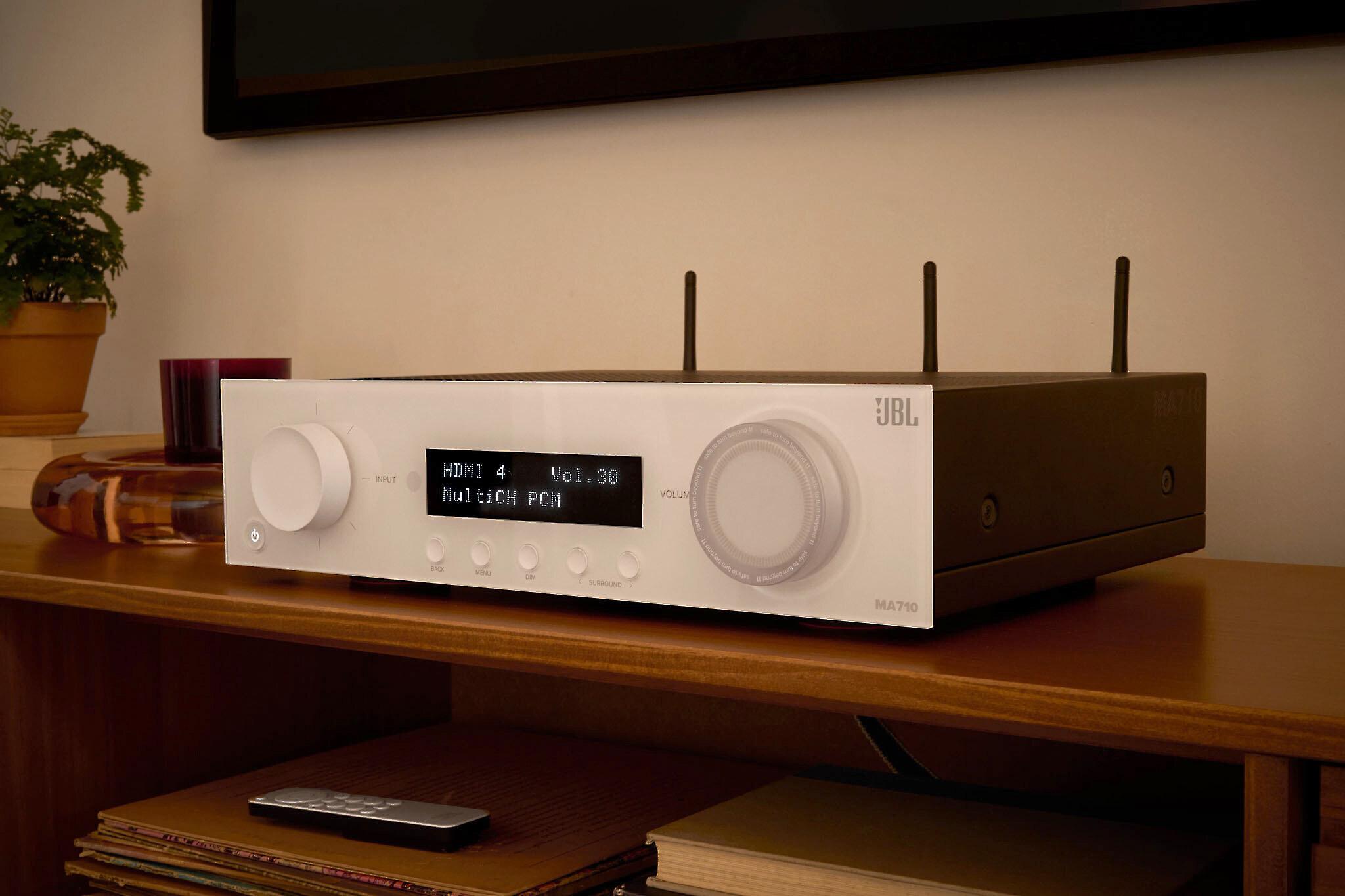
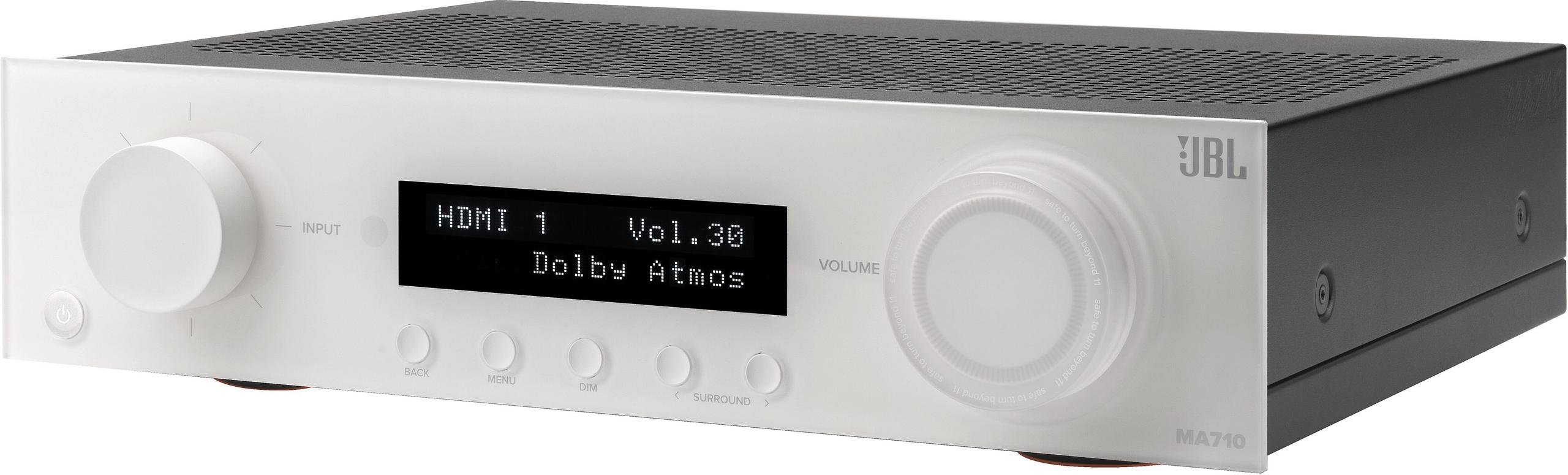
The physical differences between these receivers reflect their design priorities. The JBL MA710 weighs just 13.8 pounds and features an elegant, slim profile available in both black and white finishes. The Class D amplification eliminates the large heat sinks and transformers that make traditional receivers heavy and hot. This makes cabinet installation much more practical and gives you more flexibility in equipment placement.
The Onkyo TX-NR7100 follows traditional receiver design principles with heavier construction that suggests robust power supply and amplification components. While less visually distinctive, this approach typically provides better long-term reliability and consistent performance under demanding conditions.
From an aesthetic standpoint, the JBL MA710 fits better in modern living spaces where the receiver might be visible. The white finish option is particularly appealing for buyers who find traditional black electronics visually intrusive. The Onkyo TX-NR7100 looks like what people expect a high-performance receiver to look like—which might be exactly what you want or exactly what you want to avoid.
At the time of writing, these receivers sit in different price brackets, with the JBL MA710 positioned as the more affordable option despite being newer. This creates an interesting value comparison.
The Onkyo TX-NR7100 includes several features that would cost hundreds of dollars to add separately. Dirac Live alone typically costs $300-500 as an upgrade option on other receivers. The additional amplifier channels represent another $200-300 of value if you were to buy external amplification. The extensive streaming integration and smart home compatibility add further value for users who need these features.
The JBL MA710 offers excellent value in different ways. The comprehensive HDMI 2.1 gaming feature set future-proofs your system for next-generation consoles and PCs. Class D amplification provides energy savings that add up over time—the efficiency difference could save $50-100 annually in electricity costs depending on your usage patterns. The elegant design might eliminate the need for cabinet modifications or equipment hiding, saving installation costs.
Based on our analysis of user reviews and professional evaluations, both receivers deliver excellent performance in their intended roles, but with different strengths.
The Onkyo TX-NR7100 consistently receives praise for its cinema performance. Users report that movie soundtracks have excellent impact and dynamics, with Dirac Live making dramatic improvements in dialogue clarity and bass response. Music playback is described as neutral and engaging, though some users note that the receiver benefits from quality external sources—it's transparent enough to reveal differences in streaming quality and source material.
The JBL MA710 earns consistent praise for its gaming performance and ease of setup. Users appreciate that it just works without extensive tweaking, and gamers specifically note the smooth, lag-free performance with modern consoles. However, some reviews suggest that dynamic range for home theater content isn't quite as impressive as traditional designs, though this may only be noticeable in direct comparisons.
Both receivers demonstrate solid reliability in user reports, though the Onkyo TX-NR7100 benefits from ongoing firmware updates—as recently as late 2024, Onkyo released updates adding new streaming features, suggesting continued manufacturer support.
Choose the Onkyo TX-NR7100 if you're building a serious home theater system where audio performance is paramount. The included Dirac Live room correction alone makes this receiver compelling for anyone with a dedicated theater room or challenging acoustics. The extra channels provide genuine flexibility for ambitious speaker layouts, and the extensive streaming integration makes it future-proof for smart home expansion.
This receiver makes the most sense for enthusiasts who don't mind some complexity in exchange for maximum performance and flexibility. If you're the type of person who researches speaker placement angles and reads about acoustic treatments, the Onkyo TX-NR7100 will reward your attention to detail.
Choose the JBL MA710 if gaming performance and modern convenience are your priorities. The comprehensive HDMI 2.1 feature set makes this the clear choice for serious gamers, and the elegant design works better in contemporary living spaces. The simplified setup process and efficient operation make it ideal for users who want excellent performance without complexity.
This receiver is perfect for users building a modern entertainment system who value plug-and-play convenience and contemporary aesthetics. If you primarily stream content, play games, and want your receiver to disappear into your living space both visually and acoustically (no fan noise from heat buildup), the JBL MA710 delivers exactly that experience.
Both the Onkyo TX-NR7100 and JBL MA710 are excellent receivers that excel in different areas. Your choice should align with your priorities: maximum performance and flexibility versus modern convenience and gaming optimization. Neither is objectively better—they're optimized for different users and use cases.
The Onkyo TX-NR7100 offers more capability and future expandability at the cost of complexity and higher power consumption. The JBL MA710 delivers excellent modern performance with elegant simplicity and gaming-focused features. Consider your room, your usage patterns, and your technical comfort level when making this decision—both receivers will serve you well if matched to the right application.
| Onkyo TX-NR7100 | JBL MA710 |
|---|---|
| Channel Configuration - Determines speaker layout flexibility and immersive audio potential | |
| 9.2 channels (enables 5.1.4 or 7.1.2 Atmos setups) | 7.2 channels (limited to 7.1 or 5.1.2 configurations) |
| Power Output - Affects volume capabilities and speaker compatibility | |
| 100W per channel (all channels driven, traditional Class AB) | 110W per channel (2-ch driven), ~90W (all channels, Class D) |
| Room Correction System - Critical for optimizing sound quality in any room | |
| Dirac Live (professional-grade, $500+ value when sold separately) | EZ Set EQ (basic automatic calibration) |
| HDMI Gaming Features - Essential for PlayStation 5 and Xbox Series X performance | |
| Basic HDMI 2.1 support (4K/120Hz, limited VRR/ALLM) | Full HDMI 2.1 on 3 inputs (complete VRR, ALLM, QFT support) |
| HDMI Connectivity - Determines how many devices you can connect | |
| 7 inputs, 3 outputs (enables multi-zone video distribution) | 6 inputs, 1 output (single zone video only) |
| Streaming Integration - Affects smart home compatibility and music service access | |
| Extensive (Sonos certified, 6+ native services, all voice assistants) | Basic (AirPlay 2, Chromecast, aptX HD Bluetooth) |
| Multi-Zone Audio - Important for whole-house audio systems | |
| Advanced (Zone 2/3 with flexible channel assignment) | Basic (Zone 2 preamp outputs only) |
| Weight and Heat Generation - Impacts installation flexibility and cabinet placement | |
| Heavy traditional design (requires ventilation, robust shelving) | 13.8 lbs, cool Class D operation (cabinet-friendly) |
| Design Aesthetics - Matters for visible installations in living spaces | |
| Traditional black receiver appearance | Elegant slim profile available in black or white |
| Release Year and Future Support - Indicates technology currency and update likelihood | |
| 2022 release (ongoing firmware updates through 2024) | 2024 release (newest HDMI 2.1 implementation) |
The Onkyo TX-NR7100 is generally better for dedicated home theater setups due to its 9.2 channels and built-in Dirac Live room correction. The extra channels allow for more immersive Dolby Atmos configurations like 5.1.4, while Dirac Live significantly improves sound quality in any room. The JBL MA710 works well for home theater too, but is better suited for simpler 7.1 or 5.1.2 setups.
The biggest difference is channel count and room correction. The Onkyo TX-NR7100 offers 9.2 channels with professional Dirac Live room correction, while the JBL MA710 provides 7.2 channels with basic EZ Set EQ. The Onkyo focuses on maximum audio performance and flexibility, while the JBL emphasizes gaming features and modern design.
The JBL MA710 is superior for gaming thanks to its complete HDMI 2.1 implementation with full VRR, ALLM, and QFT support across three inputs. These features eliminate screen tearing and reduce input lag for smoother gaming. The Onkyo TX-NR7100 has basic HDMI 2.1 support but lacks the comprehensive gaming optimizations that modern consoles benefit from.
The Onkyo TX-NR7100 can power up to 11 speakers (9 main channels plus 2 subwoofers), enabling configurations like 5.1.4 or 7.1.2 for Dolby Atmos. The JBL MA710 powers up to 9 speakers (7 main channels plus 2 subwoofers), limiting you to 7.1 or 5.1.2 setups. More channels provide greater flexibility for immersive surround sound.
The Onkyo TX-NR7100 has significantly better room correction with Dirac Live, a professional system that corrects both frequency response and timing issues. This feature alone is worth hundreds of dollars when purchased separately. The JBL MA710 includes basic EZ Set EQ that handles level matching and simple corrections but isn't nearly as sophisticated.
Yes, both the Onkyo TX-NR7100 and JBL MA710 support Dolby Atmos and DTS:X immersive audio formats. However, the Onkyo TX-NR7100 can take better advantage of these formats with its 9 channels, allowing for more overhead speakers and a more convincing three-dimensional soundfield.
The JBL MA710 runs much cooler and more efficiently thanks to its Class D amplification technology, which is about 85-90% efficient compared to 60-70% for traditional designs. This makes it ideal for cabinet installation and reduces electricity costs. The Onkyo TX-NR7100 uses traditional Class AB amplification that generates more heat and requires better ventilation.
The Onkyo TX-NR7100 provides 7 HDMI inputs and 3 outputs, making it better for complex setups with multiple zones. The JBL MA710 offers 6 HDMI inputs and 1 output, which is adequate for most single-zone installations. Both receivers support 8K/60Hz and 4K/120Hz video passthrough.
The Onkyo TX-NR7100 excels at streaming with native support for Spotify, TIDAL, Amazon Music HD, Deezer, and other services, plus Works with Sonos certification. It also supports all major voice assistants. The JBL MA710 offers basic streaming through AirPlay 2, Chromecast, and high-quality Bluetooth, which covers essential needs but with less ecosystem integration.
Yes, but the Onkyo TX-NR7100 offers more advanced multi-zone capabilities with flexible channel assignment and multiple zone outputs. You can power Zone 2 speakers while maintaining a full Atmos setup in the main room. The JBL MA710 supports basic Zone 2 operation but with more limited configuration options.
Value depends on your needs. The Onkyo TX-NR7100 includes premium features like Dirac Live room correction and extra channels that would cost hundreds to add separately, making it excellent value for serious home theater enthusiasts. The JBL MA710 offers great value for gamers and style-conscious buyers who want modern features, efficient operation, and elegant design at a lower price point.
The JBL MA710 weighs just 13.8 pounds with a slim, elegant profile that fits easily in cabinets and looks good in modern living spaces. It's also available in white. The Onkyo TX-NR7100 follows traditional receiver design with heavier construction that requires more robust shelving and ventilation but suggests better long-term durability for demanding applications.
We've done our best to create useful and informative comparisons to help you decide what product to buy. Our research uses advanced automated methods to create this comparison and perfection is not possible - please contact us for corrections or questions. These are the sites we've researched in the creation of this article: crutchfield.com - prohifi.in - bestbuy.com - h-m-entertainment.com - audiosciencereview.com - crutchfield.ca - soundandvision.com - avsforum.com - avgadgets.com - youtube.com - onkyo.com - crutchfield.com - onkyo.com - accessories4less.com - klipsch.com - youtube.com - listenup.com - intl.onkyo-av.com - bestbuy.com - 420spotshop.com - support.onkyousa.com - bestbuy.com - musicdirect.com - safeandsoundhq.com - bestbuy.com - bestbuy.com - puretheatre.com - crutchfield.com - mm.jbl.com - av-connection.com - electronics.woot.com - worldwidestereo.com - th.jbl.com - skybygramophone.com

Privacy Policy
Terms and Conditions - Affiliate Policy
Home Security
© Copyright 2008-2026.
11816 Inwood Rd #1211, Dallas, TX 75244