

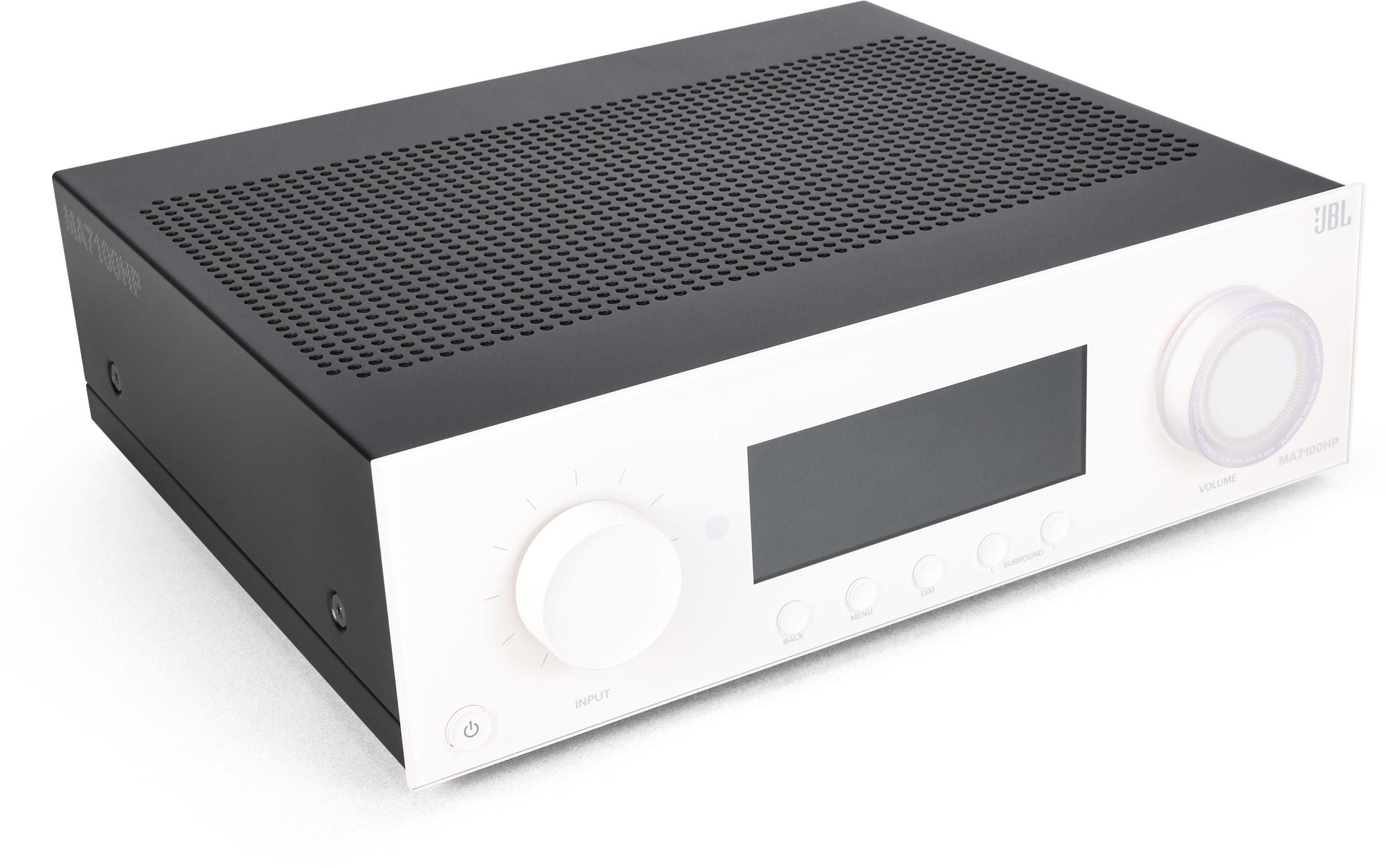
Choosing an AV receiver feels overwhelming—and it should. This single component becomes the brain of your entire home theater system, handling everything from powering your speakers to processing the latest Dolby Atmos soundtracks to switching between your gaming console and streaming device. Get it wrong, and you'll be frustrated for years. Get it right, and you'll wonder how you ever lived without proper surround sound.
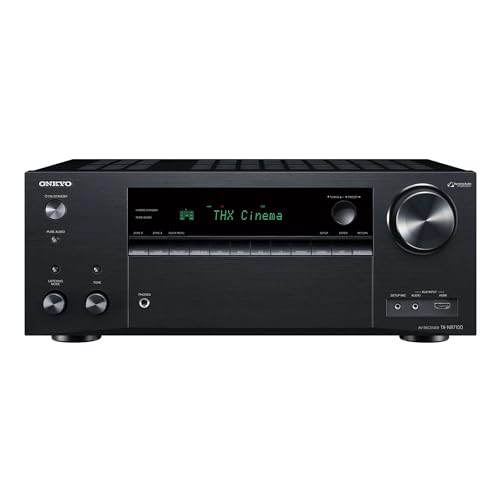
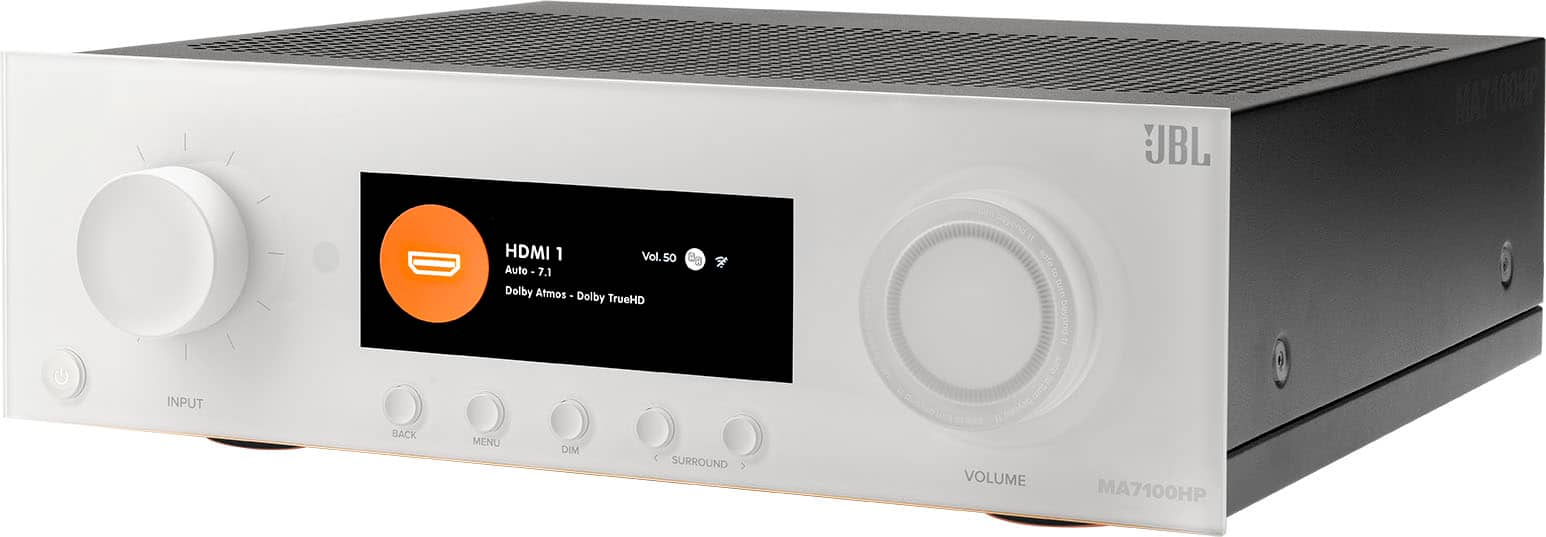
The Onkyo TX-NR7100 and JBL MA7100HP represent two compelling approaches to home theater audio, both priced competitively at the time of writing in the $1,000-$1,200 range. But don't let similar pricing fool you—these receivers target different users with distinct priorities.
Before diving into specifics, let's establish what separates good AV receivers from great ones. An AV receiver combines three critical functions: amplification (powering your speakers), audio processing (decoding surround sound formats), and video switching (routing signals from multiple sources to your TV or projector).
The most important performance characteristics boil down to power delivery, channel count, HDMI capabilities, and room correction. Power output determines how loud and dynamic your system can get without distortion—measured in watts per channel at specific impedance levels (typically 8 ohms). Channel count defines your speaker layout possibilities: 7.2 means seven main speakers plus two subwoofers, while 9.2 adds two more speakers for overhead Dolby Atmos effects.
HDMI connectivity has become crucial as 4K and 8K content proliferated. Modern receivers must handle not just high-resolution video but also gaming features like Variable Refresh Rate (VRR), which synchronizes your display's refresh rate with your gaming console's frame rate to eliminate screen tearing.
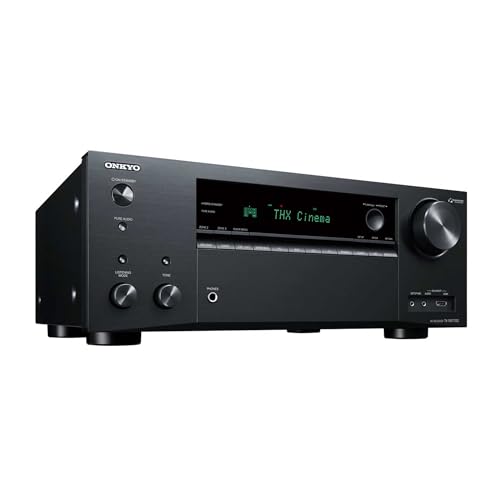
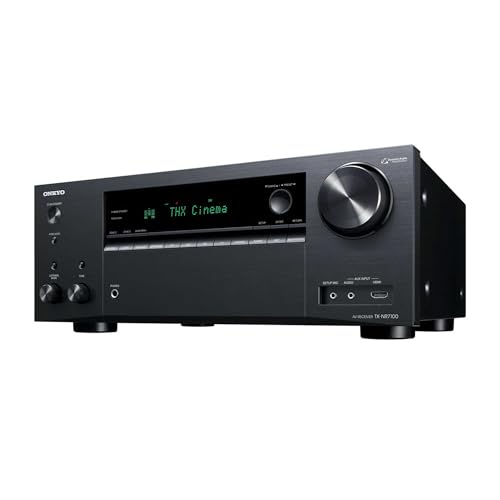
The Onkyo TX-NR7100, released in 2021, arrived during the early HDMI 2.1 adoption period. This timing shows in its mixed implementation—some inputs get full bandwidth while others don't. However, Onkyo packed this receiver with comprehensive streaming features and multi-room audio capabilities that many competitors still can't match.
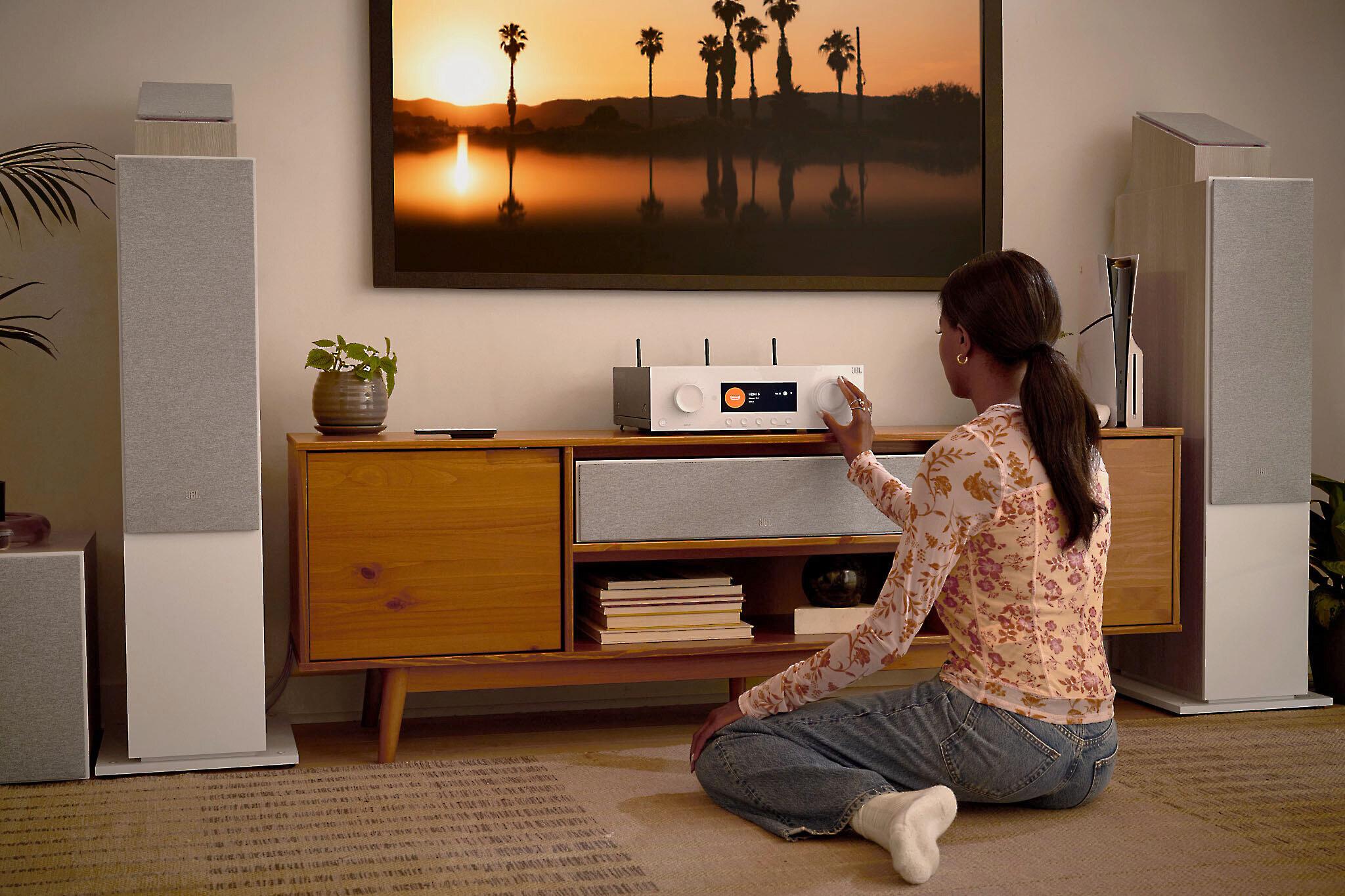
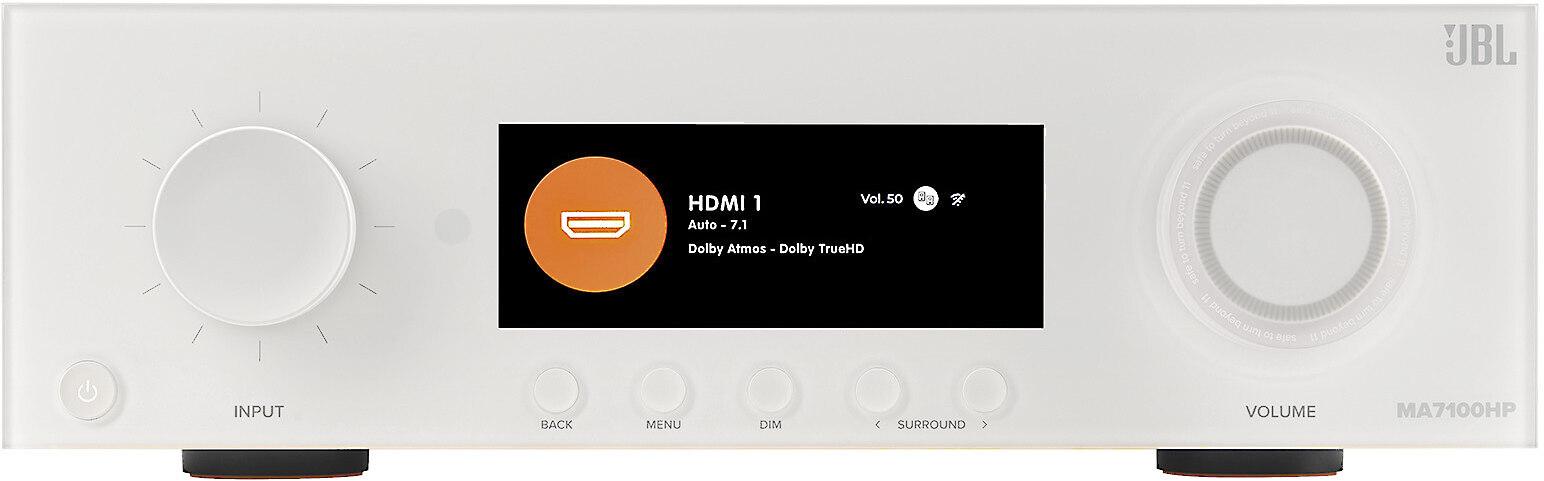
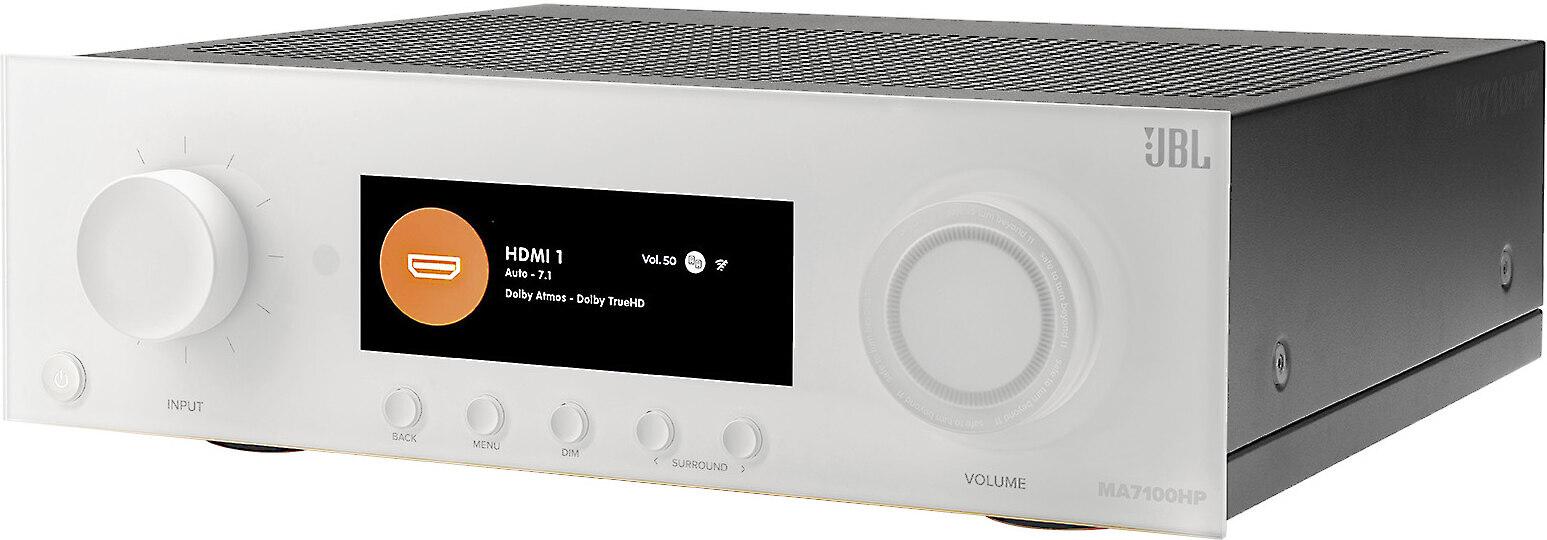
The JBL MA7100HP, launching in late 2023, benefited from mature HDMI 2.1 standards and refined gaming features. JBL focused on consistent performance across all inputs rather than extensive feature breadth, resulting in a more streamlined but powerful approach.
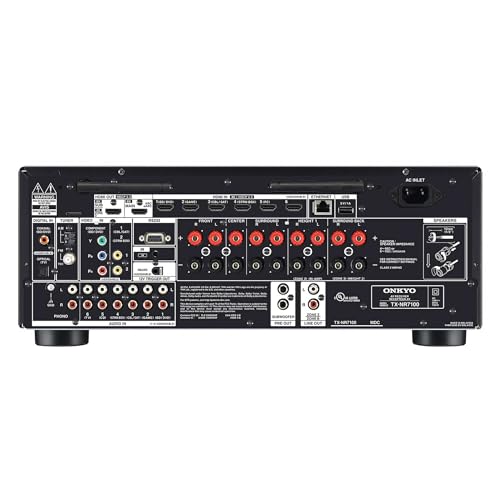
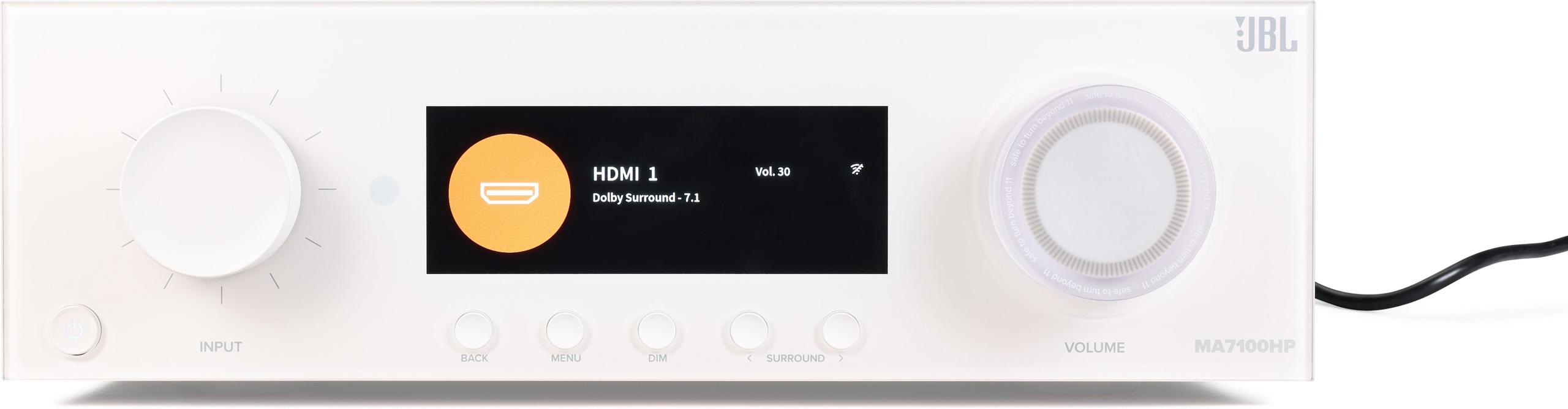
Here's where these receivers diverge most significantly. The Onkyo TX-NR7100 delivers 9.2 channels at 100 watts per channel, while the JBL MA7100HP provides 7.2 channels at 125 watts per channel. This difference affects your entire system design.
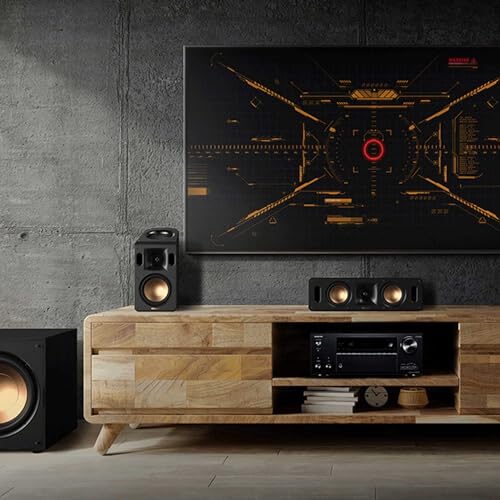
Those extra channels in the Onkyo enable more sophisticated Dolby Atmos configurations. You can run a 5.1.4 setup—five main speakers, one subwoofer, and four overhead speakers—or a 7.1.2 configuration with seven main speakers and two height channels. The JBL maxes out at 5.1.2 or basic 7.1 without dedicated height speakers.
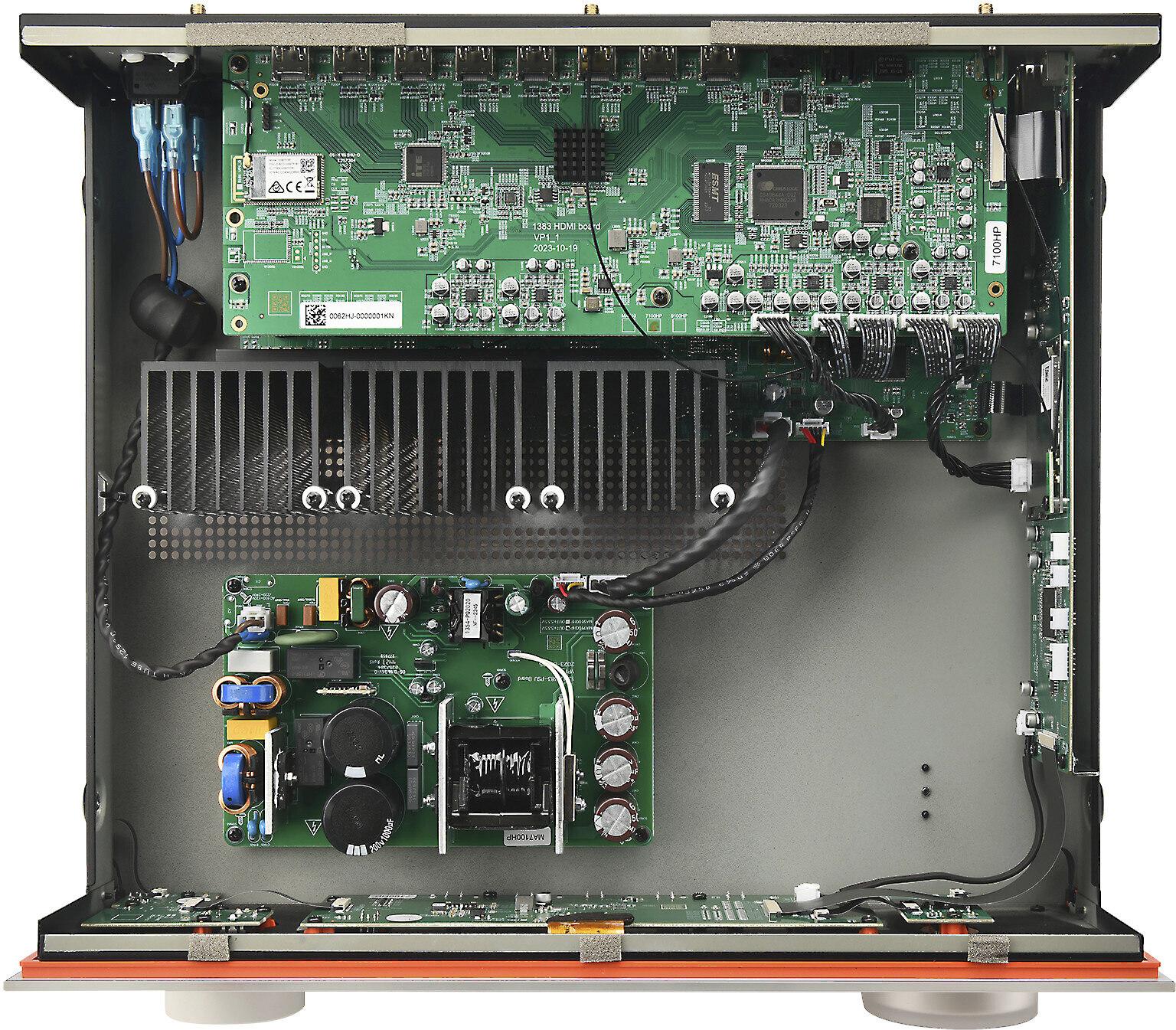
But raw channel count doesn't tell the complete story. The JBL uses Class D amplification, a technology that switches power on and off thousands of times per second to create audio signals. This approach runs cooler, weighs less (16.4 pounds versus 21.7 pounds), and often delivers more consistent power across all channels simultaneously.
The Onkyo employs traditional Class A/B amplification with what they call Dynamic Audio Amplification. This includes discrete output stages (separate transistors for each channel rather than integrated circuits) and High Current Power Supply technology. The advantage shows up in dynamic passages—think movie explosions or orchestral crescendos—where instantaneous power demands spike dramatically.
In practical terms, the JBL handles high-volume listening better thanks to its higher per-channel power output, making it ideal for larger rooms or inefficient speakers. The Onkyo excels with complex, multi-channel material where its additional channels create more enveloping surround effects.
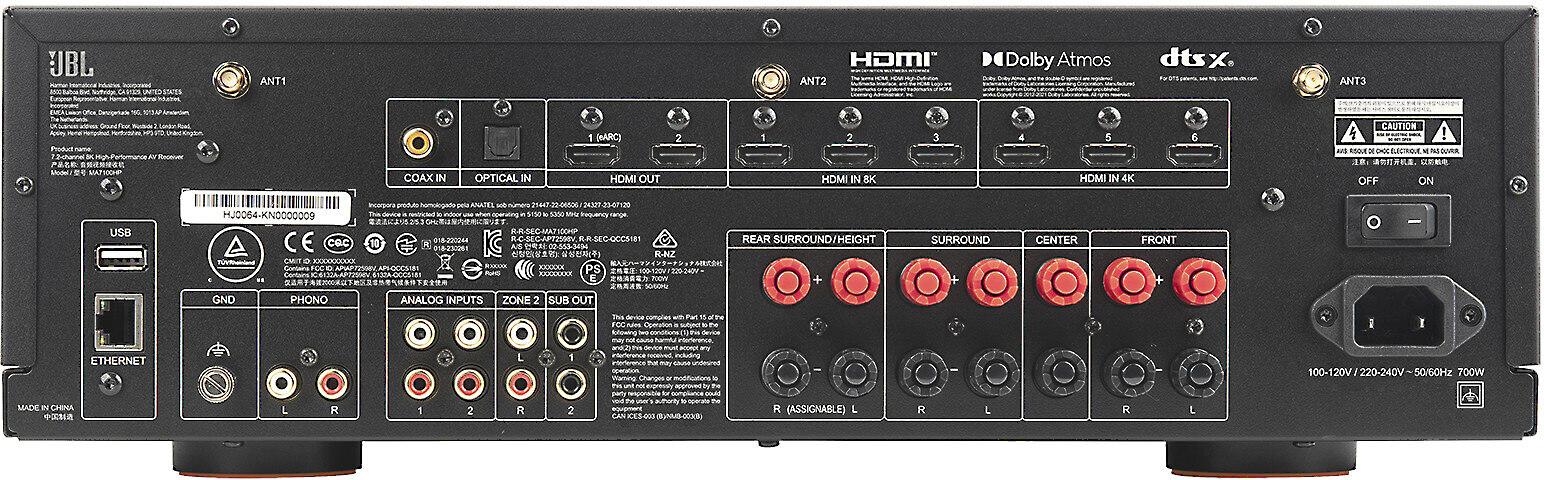
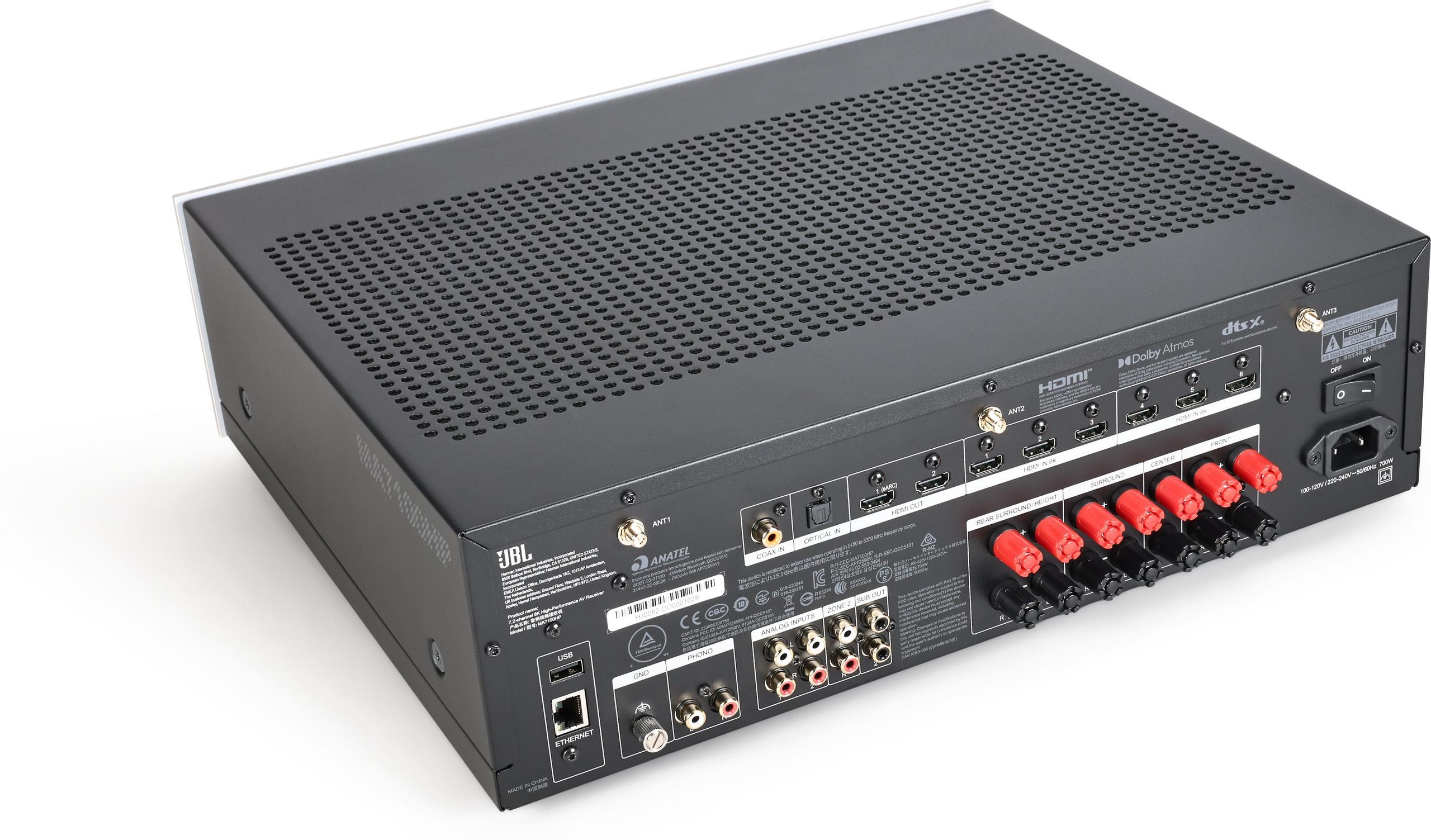
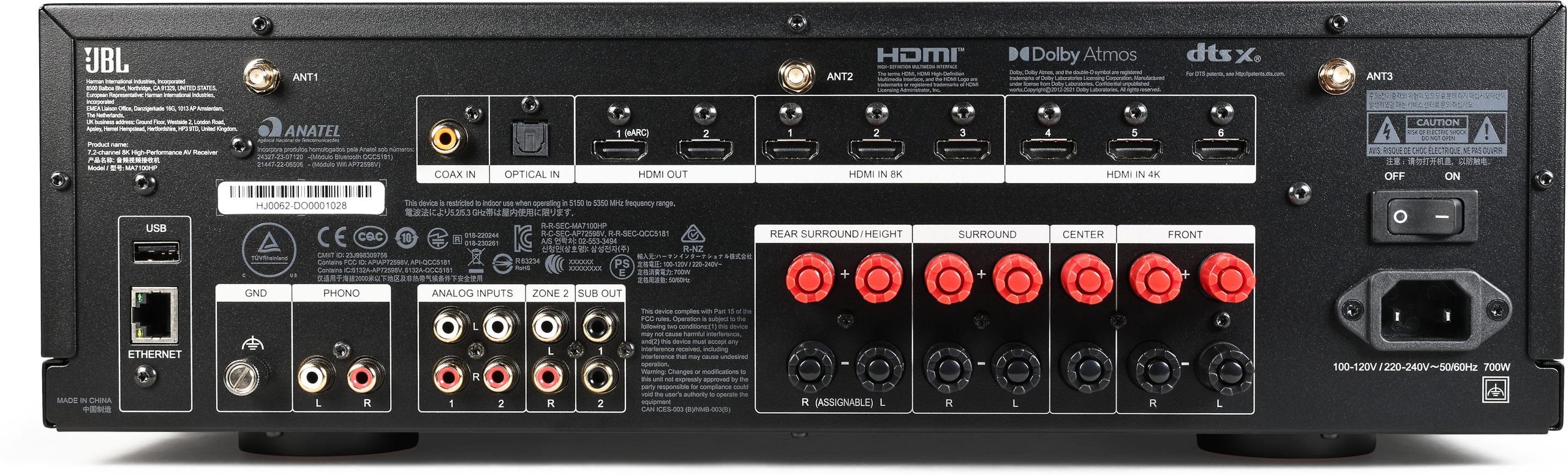
The HDMI situation reveals each receiver's priorities clearly. The JBL MA7100HP implements full HDMI 2.1 support across all six inputs, meaning every connection supports 8K/60Hz, 4K/120Hz, and gaming features like VRR and Auto Low Latency Mode (ALLM). This consistency eliminates the mental gymnastics of remembering which devices connect to which inputs.
The Onkyo TX-NR7100 takes a tiered approach. HDMI inputs 1, 2, and 3 support full 40Gbps HDMI 2.1 bandwidth, while inputs 4, 5, and 6 are limited to 24Gbps. The front panel input only supports HDMI 2.0 features. This means strategic planning—your PlayStation 5 and Xbox Series X must occupy the premium inputs, while older devices like Blu-ray players can use the limited-bandwidth connections.
For most users, the Onkyo's approach works fine. How many people really need more than three full-bandwidth HDMI 2.1 connections? But if you're building a gaming-centric setup with multiple next-gen consoles, high-end gaming PCs, and other 8K sources, the JBL's consistent implementation provides peace of mind.
Both receivers support eARC (Enhanced Audio Return Channel), which sends uncompressed audio formats like Dolby TrueHD and Dolby Atmos from your TV back to the receiver. This feature becomes essential when using streaming apps built into your TV rather than external devices.
Room acoustics dramatically affect sound quality—even more than expensive speakers or cables. Both receivers address this challenge differently, and the distinction matters significantly for audio performance.
The Onkyo TX-NR7100 includes AccuEQ room correction out of the box. This system uses a measurement microphone to analyze your room's acoustic properties, then adjusts speaker levels, timing, and frequency response to compensate for room-induced problems. AccuEQ works automatically and produces noticeable improvements in most rooms without additional investment.
The JBL MA7100HP comes "Dirac Live Ready," supporting the highly regarded Dirac Live room correction system. However, this requires purchasing a separate license, adding to your total cost. The payoff justifies the expense for serious listeners—Dirac Live provides more sophisticated analysis and correction than most built-in systems.
Dirac Live measures your room from multiple positions, creates a detailed acoustic model, then applies precise corrections across the frequency spectrum. It excels at smoothing frequency response problems and optimizing speaker integration, particularly with subwoofers. Many audiophiles consider it among the best room correction systems available.
The trade-off centers on immediacy versus ultimate performance. The Onkyo provides good room correction immediately, while the JBL offers superior correction for additional investment.
The Onkyo TX-NR7100 carries THX Certified Select designation, meeting rigorous standards for cinema reproduction. THX certification requires specific performance criteria for frequency response, distortion levels, and dynamic range. It also includes specialized listening modes optimized for different content types—cinema, music, and gaming modes each apply different processing approaches.
THX certification extends beyond technical specs to practical features like THX Loudness Plus, which maintains tonal balance at lower volumes, and boundary gain compensation to account for speaker placement near walls. The Onkyo also supports IMAX Enhanced content, providing master-quality sound and picture when available.
The JBL MA7100HP forgoes THX certification but emphasizes clean, uncolored amplification. Class D technology, when implemented well, can provide excellent transparency—the amplifier adds minimal distortion or coloration to the original signal. JBL's implementation focuses on accurate reproduction rather than specific listening mode optimizations.
Both receivers decode modern surround formats including Dolby Atmos, DTS:X, Dolby TrueHD, and DTS-HD Master Audio. They also include upmixing technologies—Dolby Surround and DTS Neural:X—that expand stereo or older surround content to use all available speakers.
Here's where the Onkyo TX-NR7100 demonstrates clear superiority. It includes Chromecast built-in, Apple AirPlay 2, DTS Play-Fi, and Works with Sonos certification. This comprehensive approach means you can stream music from virtually any source without additional hardware.
The streaming integration goes deeper than simple connectivity. The Onkyo includes dedicated apps for Spotify, TIDAL, Deezer, Amazon Music, and TuneIn radio. Its multi-room capabilities support up to three independent zones, allowing different music in different rooms simultaneously.
The Sonos integration particularly impresses—the Onkyo can work with up to three Sonos Port devices to create independent streaming zones throughout your home. Each zone can play different content from different services, controlled through the Sonos app ecosystem.
The JBL MA7100HP provides basic streaming through AirPlay 2 and Bluetooth with aptX HD support. While aptX HD delivers better wireless audio quality than standard Bluetooth, the JBL requires external streaming devices like Apple TV or NVIDIA Shield for comprehensive streaming options.
For multi-room audio, the JBL offers basic Zone 2 functionality—you can send audio to a second room but with limited flexibility compared to the Onkyo's three-zone capability.
Gaming represents an increasingly important use case for AV receivers as PlayStation 5 and Xbox Series X push 4K/120Hz gaming into mainstream adoption. The performance differences between these receivers become apparent under gaming loads.
The JBL MA7100HP excels here through consistent implementation. All HDMI inputs support VRR, ALLM, and Quick Frame Transport (QFT)—technologies that reduce input lag and eliminate screen tearing. Having six fully-capable inputs means never worrying about which port supports which gaming features.
The Onkyo TX-NR7100 provides adequate gaming support but requires planning. Only HDMI inputs 1, 2, and 3 support full gaming features at 4K/120Hz. For most setups—one or two gaming consoles plus a gaming PC—this works fine. But the limitation becomes frustrating if you need to frequently swap gaming devices or run multiple simultaneous gaming sessions.
User reports suggest the JBL handles HDMI handshake protocols more reliably, with fewer reported issues switching between gaming and non-gaming sources. The Onkyo occasionally struggles with HDMI switching, particularly when devices enter and exit standby modes.
Based on extensive user feedback and expert reviews, both receivers deliver excellent audio quality within their designed parameters. The Onkyo TX-NR7100 provides more immersive surround experiences thanks to its additional channels, creating convincing overhead effects in properly configured Dolby Atmos systems.
The JBL MA7100HP compensates with superior power delivery and cleaner amplification. Users consistently report excellent dynamics and clarity at higher volume levels, with the Class D amplification maintaining composure during demanding passages.
For movie watching, the Onkyo often provides more enveloping experiences, particularly with action sequences that utilize height channels effectively. The THX certification ensures dialogue clarity and tonal balance across different content types.
For music listening, preferences divide based on personal taste. The JBL typically provides more neutral presentation, allowing speakers' natural characteristics to dominate. The Onkyo adds subtle processing that some prefer for its enhanced spatial presentation, while others find it less accurate.
The Onkyo TX-NR7100 makes sense if you want a complete home entertainment hub. Its comprehensive streaming capabilities, extensive multi-room support, and flexible speaker configurations suit users building whole-home audio systems. The THX certification appeals to movie enthusiasts seeking reference-quality cinema reproduction.
Choose the Onkyo if you plan to stream music frequently without external devices, want to distribute audio throughout multiple rooms, or prefer the flexibility of nine-channel amplification for complex speaker arrangements. The included room correction provides immediate optimization without additional costs.
The JBL MA7100HP targets performance-focused users who prioritize consistent HDMI implementation and maximum power output. Its superior gaming capabilities suit households with multiple gaming devices, while the Dirac Live compatibility appeals to audiophiles willing to invest in premium room correction.
Choose the JBL if you need reliable 4K/120Hz gaming across all inputs, require maximum power for larger rooms or inefficient speakers, or prefer investing in best-in-class room correction rather than comprehensive streaming features.
Both receivers represent excellent value at their respective price points, but they serve different user priorities. The Onkyo TX-NR7100 excels as a comprehensive entertainment hub with superior convenience features, while the JBL MA7100HP focuses on consistent performance and future-proof connectivity.
Your decision ultimately depends on whether you value comprehensive integration and flexibility (Onkyo) or consistent performance and gaming optimization (JBL). Either choice will significantly upgrade your home theater experience—just ensure your selection aligns with your specific usage patterns and priorities.
At the time of writing, both receivers offer competitive value in the premium AV receiver market. The Onkyo provides more features per dollar, while the JBL delivers more power and consistency per dollar. Neither choice will disappoint when properly matched to your system and expectations.
| Onkyo TX-NR7100 | JBL MA7100HP |
|---|---|
| Channel Configuration - Determines speaker layout flexibility and immersion | |
| 9.2 channels (enables 5.1.4 or 7.1.2 Atmos setups) | 7.2 channels (limited to 5.1.2 or basic 7.1) |
| Power Output - Critical for room size and speaker efficiency | |
| 100W per channel (8 ohms, traditional amplification) | 125W per channel (8 ohms, Class D amplification) |
| HDMI 2.1 Implementation - Essential for gaming and 8K content | |
| Mixed: 3 full-bandwidth inputs, 4 limited inputs | Consistent: All 6 inputs support full HDMI 2.1 features |
| Room Correction - Optimizes sound for your specific space | |
| AccuEQ included (immediate optimization, no extra cost) | Dirac Live Ready (superior correction, requires paid license) |
| THX Certification - Ensures reference cinema standards | |
| THX Certified Select with IMAX Enhanced | No THX certification |
| Streaming Integration - Convenience for wireless music | |
| Comprehensive: Chromecast, AirPlay 2, DTS Play-Fi, Sonos | Basic: AirPlay 2 and Bluetooth only |
| Multi-Room Audio - Whole-home entertainment capability | |
| 3 independent zones with dedicated outputs | Basic Zone 2 functionality only |
| Gaming Features - Performance for next-gen consoles | |
| VRR/ALLM on 3 inputs (requires strategic planning) | VRR/ALLM on all inputs (maximum flexibility) |
| Weight and Design - Installation and placement considerations | |
| 21.7 lbs (traditional amplifier design) | 16.4 lbs (efficient Class D design) |
| Release Year - Technology maturity and future support | |
| 2021 (early HDMI 2.1 adoption period) | 2023 (mature HDMI 2.1 implementation) |
The Onkyo TX-NR7100 offers 9.2 channels compared to the JBL MA7100HP with 7.2 channels. This means the Onkyo can power two additional speakers, enabling more immersive Dolby Atmos configurations like 5.1.4 or 7.1.2 setups with dedicated height speakers.
The JBL MA7100HP delivers 125 watts per channel compared to the Onkyo TX-NR7100 at 100 watts per channel. The JBL provides 25% more power per channel, making it better suited for larger rooms or less efficient speakers.
Yes, both the Onkyo TX-NR7100 and JBL MA7100HP support 8K/60Hz video pass-through. However, the JBL offers full HDMI 2.1 support on all six inputs, while the Onkyo only provides full bandwidth on three of its seven HDMI inputs.
The JBL MA7100HP is better for gaming because all six HDMI inputs support full 4K/120Hz, VRR, and ALLM features. The Onkyo TX-NR7100 only offers these gaming features on three specific HDMI inputs, requiring careful device placement.
The Onkyo TX-NR7100 includes AccuEQ room correction built-in at no extra cost. The JBL MA7100HP is "Dirac Live Ready," supporting the more advanced Dirac Live system, but requires purchasing a separate license for this premium room correction technology.
The Onkyo TX-NR7100 offers comprehensive streaming with Chromecast built-in, AirPlay 2, DTS Play-Fi, and Sonos compatibility. The JBL MA7100HP only provides basic AirPlay 2 and Bluetooth streaming, requiring external devices for full streaming functionality.
The Onkyo TX-NR7100 supports three independent audio zones with dedicated outputs for whole-home audio distribution. The JBL MA7100HP offers basic Zone 2 functionality only, limiting multi-room capabilities compared to the Onkyo.
Only the Onkyo TX-NR7100 carries THX Certified Select designation, ensuring it meets reference cinema standards for home theater performance. The JBL MA7100HP does not have THX certification but focuses on clean, accurate amplification.
The JBL MA7100HP uses modern Class D amplification, making it lighter and more efficient while running cooler. The Onkyo TX-NR7100 employs traditional amplification with discrete output stages and high-current power supply technology for dynamic performance.
The JBL MA7100HP weighs 16.4 pounds thanks to its efficient Class D amplifier design. The Onkyo TX-NR7100 weighs 21.7 pounds due to its traditional amplifier components and larger power supply.
Yes, both the Onkyo TX-NR7100 and JBL MA7100HP support Dolby Atmos and DTS:X object-based surround sound. However, the Onkyo can create more immersive Atmos experiences with its additional channels supporting more height speakers.
The Onkyo TX-NR7100 provides better overall value for comprehensive home theaters with its extra channels, built-in streaming, multi-room audio, and THX certification. The JBL MA7100HP offers better value for gaming-focused setups or users prioritizing consistent HDMI 2.1 performance and maximum power output.
We've done our best to create useful and informative comparisons to help you decide what product to buy. Our research uses advanced automated methods to create this comparison and perfection is not possible - please contact us for corrections or questions. These are the sites we've researched in the creation of this article: crutchfield.com - prohifi.in - bestbuy.com - h-m-entertainment.com - audiosciencereview.com - crutchfield.ca - soundandvision.com - avsforum.com - avgadgets.com - youtube.com - onkyo.com - crutchfield.com - onkyo.com - accessories4less.com - klipsch.com - youtube.com - listenup.com - intl.onkyo-av.com - bestbuy.com - 420spotshop.com - support.onkyousa.com - bestbuy.com - audioadvice.com - bestbuy.com - audiosciencereview.com - safeandsoundhq.com - listenup.com - jbl.com - musicdirect.com - crutchfield.com - crutchfield.com

Privacy Policy
Terms and Conditions - Affiliate Policy
Home Security
© Copyright 2008-2026.
11816 Inwood Rd #1211, Dallas, TX 75244