$697.99
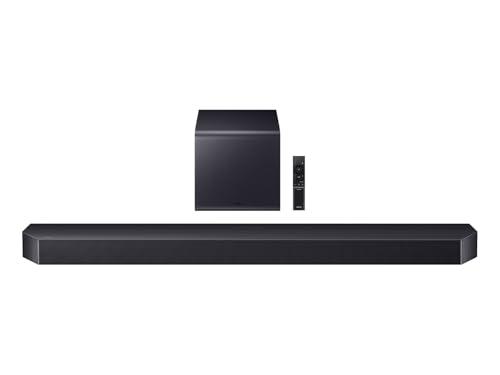
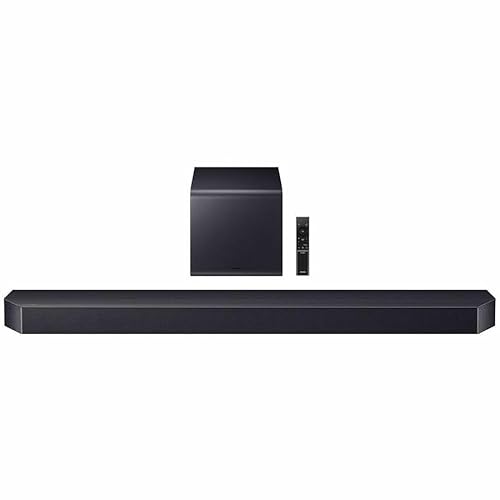
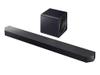
When it comes to premium soundbars, the Samsung HW-Q990F stands as a remarkable achievement in audio engineering. This isn't just another TV speaker upgrade – it's a complete home theater system disguised as a sleek soundbar package. After extensive research into professional reviews and user feedback, it's clear this system represents what many consider the current gold standard for immersive home audio without the complexity of traditional surround sound setups.
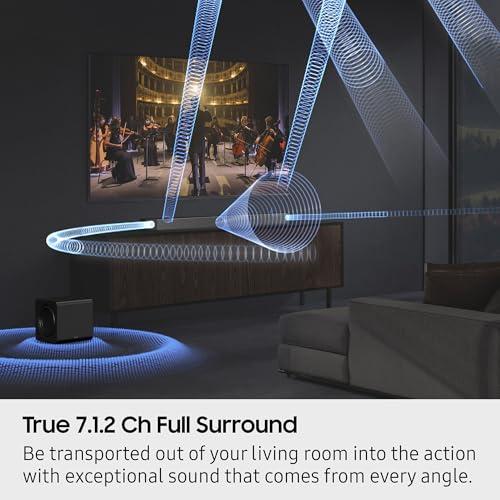
The most striking aspect of the Samsung HW-Q990F is its genuine 11.1.4-channel configuration. To break this down: you get 11 main audio channels, one dedicated subwoofer channel, and four height channels that fire sound upward toward your ceiling. This isn't virtual surround sound created by software tricks – it's real, physical speakers positioned throughout your room.
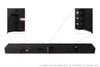
The system includes 23 individual speakers spread across three components. The main soundbar houses 15 speakers, including dedicated drivers that fire sound upward, sideways, and forward. The wireless subwoofer contains dual 8-inch woofers (the speakers that handle deep bass), while the included rear speakers each pack three drivers pointing in different directions.
What makes this setup special is how it creates what researchers describe as a "bubble of sound" around listeners. Unlike traditional soundbars that beam audio from one direction, the HW-Q990F surrounds you with precisely positioned audio. When a helicopter flies overhead in a movie, you actually hear it moving across your ceiling, not just from speakers in front of you.
The Samsung HW-Q990F excels at handling object-based audio formats like Dolby Atmos and DTS:X. Traditional surround sound assigns audio to specific channels – left speaker, right speaker, center speaker, and so on. Object-based audio is different: it treats sounds as individual objects that can move anywhere in three-dimensional space.
Think of it this way: instead of mixing a rainstorm into specific speakers, object-based audio places each raindrop as a separate audio object that can move naturally around and above you. The soundbar's processing power then figures out which of its 23 speakers should play each sound to create the most realistic placement.
Our research into user experiences reveals this technology truly shines with modern movies and streaming content. Users consistently report feeling immersed in action sequences, with bullets whizzing past their ears and explosions creating genuine room-shaking impact. The height channels prove particularly impressive – aircraft flying overhead actually sound like they're above you, not in front of you.
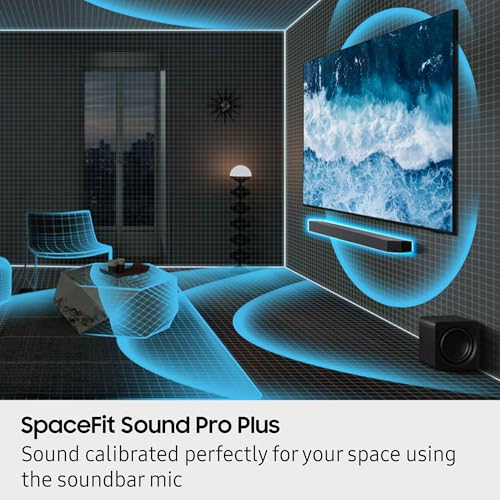
One of the most noteworthy technical features is Samsung's SpaceFit Sound Pro Plus system. Every room sounds different due to factors like wall materials, furniture placement, and room size. The Samsung HW-Q990F uses built-in microphones to analyze your room's acoustic signature and automatically adjusts its output accordingly.
The system sends out test tones, listens to how they bounce around your room, then modifies timing, volume levels, and frequency response to optimize sound quality for your specific space. This process addresses real-world acoustic challenges that can muddy dialogue or create boomy bass in certain rooms.
Researchers note this feature works remarkably well in practice. Users report clearer dialogue and more balanced sound after calibration, with the system effectively compensating for common room problems like hard surfaces that create echo or carpeted areas that absorb too much sound.
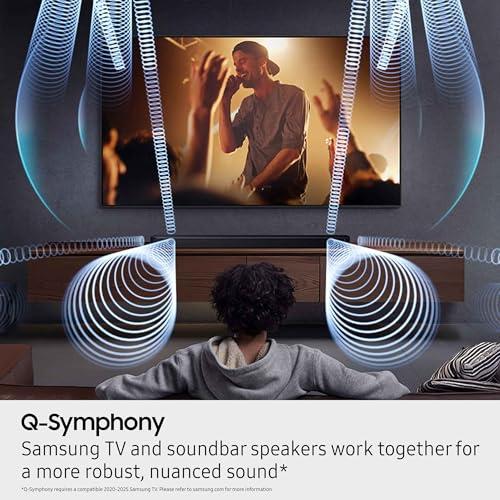
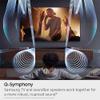
Samsung's Q-Symphony technology represents an innovative approach to soundbar integration. When paired with compatible Samsung TVs from recent years, the Samsung HW-Q990F can synchronize with the TV's built-in speakers instead of replacing them entirely.
This creates an expanded soundstage by utilizing both the soundbar's 23 speakers and the TV's speakers simultaneously. The result is wider sound dispersion and increased channel separation, particularly beneficial for larger rooms or wide seating arrangements. Users with compatible Samsung displays consistently praise this feature for creating a more enveloping audio experience without additional hardware.
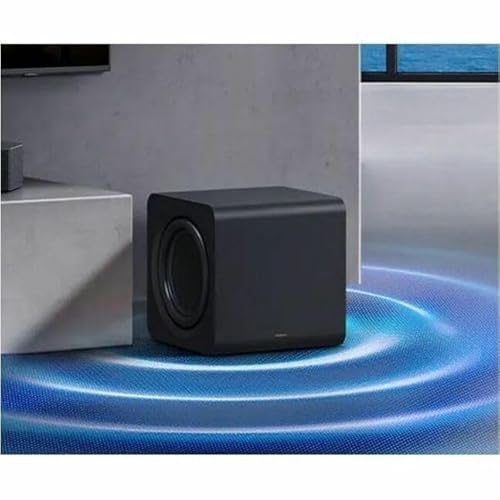
The included subwoofer deserves special attention for its force-canceling woofer design. Traditional subwoofers can create vibrations that rattle furniture or annoy neighbors. The HW-Q990F's subwoofer uses two 8-inch woofers positioned to cancel out mechanical vibrations while doubling their acoustic output.
Additionally, Samsung's Dynamic Bass Control uses artificial intelligence to learn your room's characteristics and predict when distortion might occur. The system then adjusts bass output in real-time to maintain clean, powerful low-frequency reproduction without the muddiness or cabinet rattling common in lesser designs.
User feedback consistently highlights the subwoofer's ability to deliver room-filling bass that feels controlled rather than overwhelming. The dual-woofer design provides substantial low-end extension – you'll feel the rumble of explosions and the deep notes of pipe organs – without the boomy, one-note bass that plagues many soundbar systems.
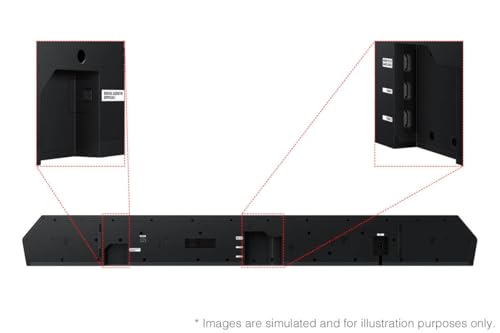
The Samsung HW-Q990F includes comprehensive connectivity options that address current and future device requirements. Three HDMI 2.1 ports support 4K video at 120Hz refresh rates with HDR10+ pass-through – essential for PlayStation 5 and Xbox Series X gaming consoles that can output high-refresh gaming content.
The eARC (enhanced Audio Return Channel) HDMI connection allows the soundbar to receive high-quality audio directly from your TV, including lossless Dolby Atmos streams from built-in TV apps. This eliminates the need to connect every device directly to the soundbar.
Wireless connectivity includes Wi-Fi, Bluetooth 5.3, Apple AirPlay 2, Spotify Connect, and Google Cast. The system is also Roon Ready, meaning audiophiles using Roon music management software can stream high-resolution audio files directly to the soundbar. Support for lossless audio formats up to 24-bit/192kHz ensures compatibility with high-quality music files that exceed CD quality.
Gaming audio receives special attention through the system's Game Mode Pro. This feature optimizes audio processing for interactive content, reducing latency (the delay between on-screen action and corresponding audio) while enhancing directional cues crucial for competitive gaming.
Gamers report significant improvements in spatial awareness – the ability to locate enemies by sound in first-person shooters, for example. The Samsung HW-Q990F maintains the immersive surround effects that make single-player adventures more engaging while providing the precision needed for competitive multiplayer gaming.
While primarily designed for home theater use, the system excels at music reproduction. The wide soundstage created by multiple speaker positions provides impressive stereo imaging, where instruments appear positioned naturally across the audio field rather than coming from obvious speaker locations.
The built-in 7-band equalizer allows fine-tuning for different musical genres, while support for high-resolution audio formats ensures compatibility with audiophile-quality music files. Users consistently praise the system's ability to handle everything from intimate acoustic performances to complex orchestral pieces with equal skill.
At the time of writing, the Samsung HW-Q990F commands premium pricing that reflects its flagship status in Samsung's lineup. However, when compared to building equivalent traditional surround sound systems with AV receivers and multiple speakers, the value proposition becomes compelling.
Consider the alternative: achieving similar surround sound performance would require an AV receiver, at least seven speakers, a subwoofer, speaker wire, wall mounts, and potentially professional installation. The total cost often exceeds the soundbar system's price, while the complexity and visual impact in your living room increases dramatically.
The all-wireless design (except for power connections) eliminates installation challenges while delivering performance that rivals traditional setups. Users frequently cite the convenience factor as a major advantage – professional-level audio performance without the professional-level complexity.
Home theater enthusiasts consistently report transformative experiences when upgrading to the Samsung HW-Q990F. The combination of genuine surround sound, overhead effects, and powerful bass creates cinematic experiences that rival commercial theaters in many respects.
Television content benefits significantly from the Advanced Voice Amplifier technology, which analyzes ambient noise and boosts dialogue frequencies accordingly. This proves particularly valuable for viewers who struggle with dialogue clarity in complex audio mixes or noisy viewing environments.
Within the premium soundbar category, the HW-Q990F represents the current performance pinnacle. While competitors offer various approaches – some emphasizing design aesthetics, others focusing on specific features like voice control or streaming capabilities – none match the comprehensive feature set and authentic surround sound reproduction of Samsung's flagship.
The system's main advantages over competitors include genuine multi-channel surround reproduction (rather than virtualized effects), comprehensive room calibration, extensive connectivity options, and integration capabilities with Samsung's broader ecosystem of displays and smart home devices.
The Samsung HW-Q990F succeeds in delivering on its promise of cinema-quality audio in a convenient soundbar package. The combination of authentic 11.1.4-channel surround sound, intelligent room calibration, comprehensive connectivity, and user-friendly operation creates an audio experience that genuinely transforms home entertainment.
For users seeking the ultimate soundbar experience without compromising on performance or features, this system represents the current technology benchmark. The investment delivers long-term satisfaction through future-proofed connectivity, ongoing software updates, and audio quality that remains impressive as content and streaming standards continue evolving.
The Samsung HW-Q990F proves that soundbar technology has matured to the point where convenience no longer requires significant performance compromises. It's an impressive achievement in audio engineering that successfully bridges the gap between simple TV upgrades and complex traditional surround sound installations.
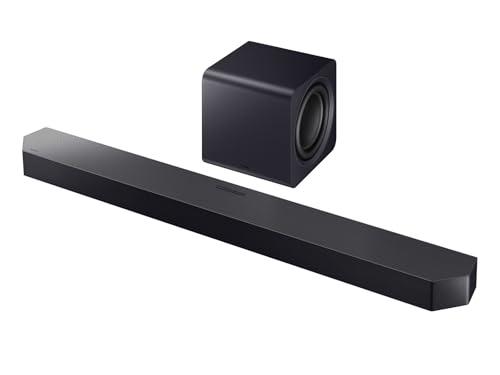
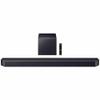
The Samsung Q-Series HW-Q990F Soundbar is a premium 11.1.4-channel home theater system that includes a main soundbar, wireless subwoofer, and wireless rear speakers. With 23 total speakers and support for Dolby Atmos and DTS:X, it delivers true surround sound without the complexity of traditional AV receiver setups.
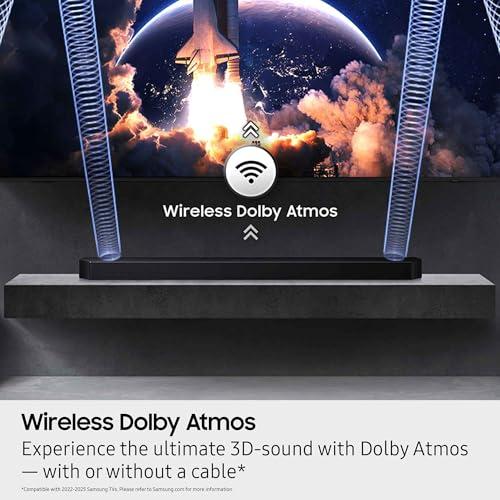
Yes, the Samsung HW-Q990F fully supports Dolby Atmos with dedicated up-firing speakers in both the main soundbar and rear speakers. This creates authentic overhead sound effects that place audio objects above and around listeners for a truly immersive home theater experience.
The Samsung HW-Q990F contains 23 individual speakers total: 15 speakers in the main soundbar, dual 8-inch woofers in the subwoofer, and multiple drivers in each wireless rear speaker. This configuration enables genuine 11.1.4-channel surround sound reproduction.
Absolutely. The Samsung HW-Q990F excels for home theater use with its authentic surround sound, powerful subwoofer, and support for all major audio formats including Dolby Atmos and DTS:X. The system creates cinema-quality audio experiences that rival traditional multi-speaker setups while maintaining soundbar convenience.
The Samsung HW-Q990F works with any TV that has HDMI ARC/eARC or optical audio output. However, it offers enhanced features like Q-Symphony and wireless Dolby Atmos when paired with compatible Samsung QLED, Neo QLED, and OLED TVs from recent model years.
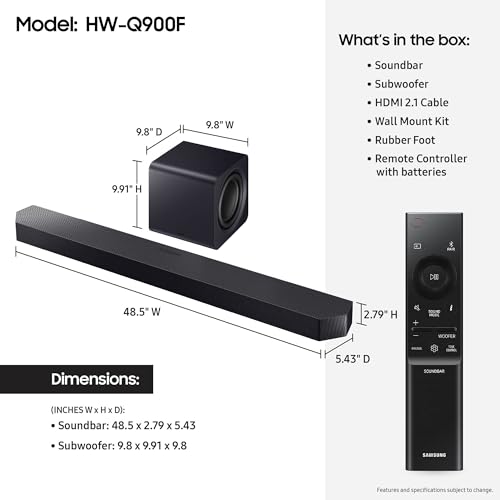
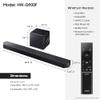
The main Samsung HW-Q990F soundbar measures 48.5 inches wide, 2.8 inches high, and 5.4 inches deep, weighing 16.1 pounds. The wireless subwoofer is 9.8 inches in each dimension and weighs 18.3 pounds. This size makes it ideal for 55-inch and larger TVs.
Yes, the Samsung HW-Q990F includes wireless rear speakers as part of the complete package. Each rear speaker contains three drivers (front-firing, side-firing, and up-firing) that connect wirelessly to the main soundbar for seamless surround sound without running speaker cables.
Yes, the Samsung HW-Q990F supports HDMI CEC control, allowing you to control volume and basic functions with most TV remotes. Samsung TV owners get enhanced integration with full remote control compatibility and the ability to use their TV's existing remote exclusively.
The Samsung HW-Q990F supports all major audio formats including Dolby Atmos, Dolby TrueHD, DTS:X, DTS-HD Master Audio, and standard surround formats. It also handles high-resolution music files up to 24-bit/192kHz through various streaming services and wireless connections.
The Samsung Q-Series HW-Q990F Soundbar is worth it for home theater enthusiasts seeking premium audio quality without AV receiver complexity. Its genuine 11.1.4-channel surround sound, comprehensive features, and future-proof connectivity deliver exceptional value compared to building equivalent traditional surround systems, making it an excellent long-term investment for serious movie and music lovers.
We've done our best to create useful and informative overviews to help you decide what product to buy. Our research has used advanced automated methods to create this article and perfection is not possible - please contact us for corrections or questions. These are the sites we've researched in the creation of this article: rtings.com - crutchfield.com - sound-advice.online - samsung.com - soundandvision.com - samsung.com - whathifi.com - youtube.com - youtube.com - bestbuy.com - avsforum.com - content.syndigo.com - samsung.com - businessinsider.com - dolby.com - youtube.com - abcwarehouse.com
| Samsung HW-Q990F Soundbar |
|---|
| Channel Configuration - Determines surround sound authenticity: 11.1.4 channels (23 total speakers) |
| Audio Power - Controls maximum volume and dynamic range: 756W RMS |
| Dolby Atmos Support - Enables overhead sound effects: Yes, with dedicated up-firing speakers |
| DTS:X Support - Alternative object-based audio format: Yes |
| Room Calibration - Automatically optimizes sound for your space: SpaceFit Sound Pro Plus |
| Subwoofer Type - Affects bass quality and placement flexibility: Wireless dual 8" force-canceling woofers |
| Rear Speakers - Essential for true surround sound: Wireless with front, side, and up-firing drivers |
| HDMI 2.1 Support - Future-proofs for gaming and 4K content: 3 ports with eARC, 4K/120Hz pass-through |
| Q-Symphony - Expands soundstage when paired with Samsung TVs: Yes |
| Voice Enhancement - Improves dialogue clarity: Active Voice Amplifier Pro |
| Streaming Support - Enables wireless music playback: Spotify Connect, AirPlay 2, Google Cast, Roon Ready |
| Voice Assistants - Hands-free control capability: Built-in Alexa and Bixby |
| EQ Controls - Allows sound customization: 7-band graphic equalizer |
| Soundbar Dimensions: 48.5" W x 2.8" H x 5.4" D |
| Soundbar Weight: 16.1 lbs |
| Subwoofer Dimensions: 9.8" W x 9.9" H x 9.8" D |
| Subwoofer Weight: 18.3 lbs |
| Warranty: 1 year parts and labor |
The Ultimea Aura A40 7.1 Channel Soundbar System offers a compelling value proposition for budget-conscious buyers who still want the benefit of physical surround speakers. At roughly one-fifth the cost of the Q990F, it delivers four discrete surround speakers (two front, two rear) that create a more convincing 360-degree sound field than soundbar-only systems at similar price points. The standout feature is the Ultimea Home app, which provides genuinely impressive customization with 121 preset EQ matrices organized by genre, a 10-band equalizer, and 13 adjustable surround levels. This level of fine-tuning control is rare even on more expensive systems and allows users to optimize performance for their specific room and preferences.
However, the performance gap between these systems becomes immediately apparent with modern content. The Ultimea Aura A40 completely lacks Dolby Atmos and DTS:X decoding, relying instead on virtual processing that cannot replicate the precision of true object-based audio. The compact 4-inch subwoofer limits bass response to 65Hz compared to the Q990F's deep 35Hz extension, while the absence of HDMI inputs forces reliance on TV processing and eliminates compatibility with high-end gaming consoles and lossless audio formats. For smaller rooms under 270 square feet and users primarily watching standard TV content, the Aura A40's physical surround speakers and extensive customization options provide meaningful improvements over basic soundbars. But for serious home theater use with modern streaming content and gaming, the fundamental limitations in format support and connectivity make it a poor substitute for the Q990F's flagship capabilities.
🤖 Read Detailed Comparison
👌Ultimea Aura A40 7.1 Channel Soundbar System Details
💵 See Ultimea Aura A40 7.1 Channel Soundbar System Price
The Amazon Fire TV Soundbar Plus Subwoofer takes a fundamentally different approach, prioritizing simplicity and value over premium features. Its 3.1 channel configuration with wireless subwoofer focuses on solving the most common TV audio complaints—weak dialogue and absent bass—without the complexity of rear speakers or advanced processing. The system excels at dialogue clarity through its dedicated center channel and offers meaningful bass extension that transforms the TV watching experience. Setup is refreshingly straightforward with just two components that pair automatically, making it ideal for users who want immediate audio improvement without dealing with speaker positioning or room acoustics considerations.
From a value perspective, the Amazon Fire TV Soundbar Plus delivers roughly 80% of the audio improvement you'd notice over TV speakers at approximately 20% of the Samsung's cost. While it can't match the immersive surround effects or premium build quality of the Q990F, it provides clean, room-filling sound that satisfies most users' needs. The system works particularly well in smaller spaces where the Samsung might be overpowering, and its Fire TV integration offers seamless control for streaming-focused households. For users primarily watching TV shows, streaming content, or casual movie viewing, the Amazon represents a smart middle ground that dramatically improves audio quality without the investment or complexity of a flagship home theater system.
🤖 Read Detailed Comparison
👌Amazon Fire TV Soundbar Plus Subwoofer Details
💵 See Amazon Fire TV Soundbar Plus Subwoofer Price
The Amazon Fire TV Soundbar Plus 5.1 Channel System serves as an excellent budget alternative that delivers genuine 5.1 surround sound at roughly one-third the price. Its standout features include pre-paired wireless components for effortless setup, dedicated rear satellite speakers that create a true wraparound soundstage, and strong dialogue clarity through its center channel. The system excels at providing that crucial upgrade from TV speakers with substantial bass impact from its wireless subwoofer and clear voice reproduction that makes following dialogue much easier. For Fire TV users, the integrated on-screen controls add convenience, allowing adjustments through the familiar TV interface rather than juggling multiple remotes.
However, the performance gap becomes apparent in demanding scenarios. The Amazon system lacks any physical up-firing drivers, meaning Dolby Atmos effects are merely simulated rather than genuinely projected overhead—you'll miss that authentic dome of sound that makes action scenes truly immersive. The subwoofer, while powerful for its price, exhibits a "one-note" character that can overwhelm dialogue during intense action sequences, requiring manual level adjustments. Gaming enthusiasts will notice the lack of HDMI inputs forces all connections through the TV, potentially introducing audio latency. While the Amazon Fire TV Plus represents excellent value for casual viewers upgrading from basic TV audio, it makes significant compromises in spatial audio, connectivity, and processing sophistication that become noticeable when compared to the Samsung's reference-quality performance.
🤖 Read Detailed Comparison
👌Amazon Fire TV Soundbar Plus 5.1 Channel System Details
💵 See Amazon Fire TV Soundbar Plus 5.1 Channel System Price
The Ultimea Poseidon D50 represents a completely different value proposition, delivering genuine 5.1 surround sound at roughly one-tenth the cost of the Q990F. Its standout feature is providing real rear satellite speakers and a wireless subwoofer at an unprecedented price point, where most budget competitors offer only simulated surround effects through digital processing. The system's BassMX technology and 5.25-inch subwoofer deliver surprisingly punchy bass for the price, while the proprietary SurroundX processing creates a convincingly wide soundstage that extends well beyond your TV. Perhaps most impressively, the Ultimea D50 includes smartphone app control with 121 preset EQ matrices and a 10-band equalizer—customization features typically reserved for much more expensive systems.
However, the performance gap becomes apparent with demanding content and advanced audio formats. The Ultimea Poseidon D50 lacks Dolby Atmos support entirely, operating on a traditional two-dimensional surround plane rather than the three-dimensional audio experience of the Q990F. While it provides clear dialogue and adequate bass for most TV content, the smaller drivers and simpler processing can sound harsh at higher volumes, and the overall audio refinement doesn't approach the Samsung's reference-quality performance. For budget-conscious buyers upgrading from TV speakers, the D50 offers exceptional value and will dramatically improve the viewing experience. But for those seeking flagship home theater performance with cutting-edge audio processing, room-filling power, and future-proof format support, the substantial price difference reflects genuinely superior capabilities that justify the premium investment.
🤖 Read Detailed Comparison
👌Ultimea Poseidon D50 5.1 Soundbar Home Theater (2025) Details
💵 See Ultimea Poseidon D50 5.1 Soundbar Home Theater (2025) Price
The Ultimea Skywave F40 stands out as an exceptional value proposition that delivers genuine Dolby Atmos performance at roughly one-quarter the cost of the Samsung. Despite its budget positioning, this system includes physical rear speakers and dedicated up-firing drivers—features that many competitors in this price range omit in favor of simulated surround effects. The Ultimea Skywave F40 achieves impressive immersion through its 5.1.2 configuration with 8 total speakers, while its extensive customization options via a 10-band equalizer and 121 preset EQ matrices actually exceed what Samsung offers. The BassMX technology in its 6.5-inch subwoofer delivers satisfying low-end response that adds real weight to movie soundtracks, and the Xupmix technology powered by Dolby DAP can transform regular stereo content into engaging surround experiences.
In real-world performance, the Ultimea Skywave F40 achieves roughly 80% of the Samsung's audio quality while sacrificing convenience features like wireless connectivity and automatic room calibration. The wired setup requires more planning for cable management, but many users find this manageable since the rear speakers connect directly to the subwoofer rather than requiring separate power outlets. While it can't match the Samsung's 23-speaker precision or room-filling power, the Ultimea creates a surprisingly large and engaging soundstage that dramatically outperforms TV speakers and most budget soundbars. For buyers seeking genuine Dolby Atmos immersion without flagship pricing, the Ultimea Skywave F40 represents one of the best value propositions in the entire soundbar category, proving that true surround sound doesn't require premium investment.
🤖 Read Detailed Comparison
👌Ultimea Skywave F40 Dolby Atmos Soundbar System Details
💵 See Ultimea Skywave F40 Dolby Atmos Soundbar System Price
The Ultimea Poseidon M60 Boom 5.1 Soundbar represents an entirely different approach to home audio, prioritizing exceptional value and simplicity over premium features. At roughly one-tenth the cost, it delivers surprisingly sophisticated performance through clever engineering, including triple-core DSP processors that create convincing virtual surround effects and BassMX technology that maximizes bass output from its compact 5.25-inch subwoofer. The system's plug-and-play design requires minimal setup—just connect the main soundbar and wired subwoofer—making it ideal for users who want significant audio improvement without complex installation or multiple wireless components around their room. Its smartphone app provides extensive EQ customization and preset options that rival more expensive systems, while Bluetooth 5.4 connectivity offers the latest wireless standard for improved range and lower latency.
However, the performance gap becomes evident in direct comparison, particularly for serious home theater use. The Ultimea M60 Boom's virtual surround processing, while impressive for a single-bar system, cannot replicate the authentic immersion of the Samsung's physical rear speakers and dedicated up-firing drivers. Bass extension is limited to 50Hz compared to the Samsung's 27.5Hz capability, missing the deep low-frequency effects that make movie explosions and music truly impactful. The system also reaches its dynamic limits in larger rooms or at high volumes, where some compression occurs. For casual viewers in smaller spaces who prioritize value and simplicity, the Ultimea M60 Boom delivers roughly 80% of the audio improvement over TV speakers for a fraction of the investment. But for dedicated home theater enthusiasts with larger rooms who demand authentic surround sound and reference-level performance, the Samsung's premium features and true multi-channel setup justify the significantly higher cost.
🤖 Read Detailed Comparison
👌Ultimea Poseidon M60 Boom 5.1 Soundbar Details
💵 See Ultimea Poseidon M60 Boom 5.1 Soundbar Price
The Amazon Fire TV Soundbar takes a fundamentally different approach, prioritizing simplicity and affordability over premium features. At its core, this compact 2.0-channel soundbar delivers meaningful improvement over TV speakers through its dual "Racetrack" drivers and DTS Virtual:X processing, which creates simulated surround effects from just two speakers. The bass reflex design with front-firing port allows flexible placement directly against walls, and the straightforward connectivity—HDMI ARC and optical input—means setup is genuinely plug-and-play. For users who primarily watch TV shows, news, and streaming content in smaller rooms, the dialogue clarity improvement is substantial and the virtual surround processing does expand the apparent soundstage beyond the physical speaker locations.
However, the performance gap between these products is vast and immediately apparent with demanding content. The Amazon Fire TV Soundbar simply cannot match the room-filling power, deep bass extension, or genuine surround immersion that the Samsung's multi-component system delivers. Movie explosions lack impact, overhead effects are absent entirely, and the overall scale feels constrained compared to true surround sound. That said, this budget-friendly option excels at its intended purpose—dramatically improving TV audio quality without the complexity, space requirements, or financial commitment of a premium system. For apartment dwellers, casual viewers, or those seeking a simple upgrade for a secondary TV, the value proposition is compelling, even if the performance ceiling is relatively low compared to flagship alternatives.
🤖 Read Detailed Comparison
👌Amazon Fire TV Soundbar Details
💵 See Amazon Fire TV Soundbar Price
The VIZIO 5.1 Soundbar SE Dolby Atmos Surround System takes a dramatically different approach with its innovative mechanically rotating speakers that physically pivot upward when Dolby Atmos content is detected—a unique feature that's both visually striking and functionally clever. This system delivers genuine 5.1.2 surround sound with a wireless subwoofer and rear speakers at a price point that's roughly one-sixth the cost of the Samsung. The rotating speakers create noticeable height effects by bouncing sound off your ceiling, though the Atmos experience feels more localized to the soundbar area rather than the seamless overhead immersion you get with the Samsung's multiple up-firing drivers throughout the system. For smaller to medium rooms with standard ceiling heights, the VIZIO provides a satisfying surround experience that's a massive upgrade over TV speakers, complete with clear dialogue and adequate bass response from its compact subwoofer.
However, the performance gap becomes apparent in direct comparison—the VIZIO's 5.1.2 configuration simply can't match the Samsung's room-filling 11.1.4 soundstage or its sophisticated audio processing. The rear speakers connect via wires to the subwoofer rather than wirelessly to the main bar, limiting placement flexibility, and the system requires manual EQ adjustment through a mobile app rather than automatic room calibration. While the VIZIO lacks the Samsung's advanced gaming features, comprehensive streaming options, and premium build quality, it represents exceptional value for budget-conscious buyers who want to experience Dolby Atmos without the flagship investment. For casual viewing in appropriately sized rooms, the VIZIO delivers 80% of the surround sound benefit at 15% of the cost, making it an excellent entry point into immersive home theater audio.
🤖 Read Detailed Comparison
👌VIZIO 5.1 Soundbar SE Dolby Atmos Surround System Details
💵 See VIZIO 5.1 Soundbar SE Dolby Atmos Surround System Price
The Amazon Fire TV Soundbar Plus takes a fundamentally different approach, prioritizing simplicity and value over flagship performance. Where the HW-Q990F delivers complex multi-component surround sound, the Amazon model focuses on solving the most common TV audio problems—muddy dialogue and weak bass—through a straightforward 3.1-channel design with built-in subwoofer. Its plug-and-play setup means you'll have noticeably better TV sound within minutes of unboxing, without wrestling with rear speaker placement or room calibration. The Fire TV Soundbar Plus also offers genuine expandability, allowing users to start with the basic bar and add wireless subwoofer and rear speakers over time, spreading the investment across multiple purchase cycles.
In real-world performance, the Amazon soundbar delivers about 80% of the dialogue clarity improvements you'd get from the Samsung at roughly 20% of the cost. While it can't match the HW-Q990F's immersive surround bubble or controlled bass response, it provides a dramatic upgrade over TV speakers that satisfies most casual viewers. The virtual Dolby Atmos processing creates a noticeably wider soundstage than your TV alone, and the dedicated center channel ensures voices remain clear even during action sequences. For users in smaller rooms, apartments, or those primarily watching TV shows and streaming content rather than cinematic blockbusters, the Fire TV Soundbar Plus represents exceptional value—delivering the audio improvements that matter most for daily viewing without the complexity or investment of a premium system.
🤖 Read Detailed Comparison
👌Amazon Fire TV Soundbar Plus Details
💵 See Amazon Fire TV Soundbar Plus Price
The Sonos Beam Gen 2 takes a fundamentally different approach that prioritizes dialogue clarity and smart home integration over raw surround sound power. Where the Samsung system creates authentic surround effects through physical speakers, the Sonos achieves remarkable results through sophisticated virtual processing in a compact 25.6-inch form factor. Its standout feature is industry-leading vocal intelligibility – the dedicated center tweeter and Speech Enhancement technology make dialogue so clear that subtitles become virtually unnecessary, even during challenging scenes with accents or overlapping conversations. The built-in Amazon Alexa and Google Assistant, comprehensive streaming service support, and seamless integration into the Sonos multi-room ecosystem make it as much a smart speaker as a soundbar. Room calibration happens automatically through Trueplay technology, and the single HDMI connection setup takes minutes rather than the strategic planning required for the Samsung's multiple components.
However, the Sonos Beam Gen 2 faces physics limitations that no amount of clever processing can overcome. Its built-in drivers and passive radiators produce adequate bass for TV content but lack the depth and impact of the Samsung's dedicated dual 8-inch subwoofer, particularly noticeable during action movies or music listening. The virtual Dolby Atmos processing creates convincing height effects in smaller rooms under 300 square feet, but can't match the physical reality of the Samsung's up-firing drivers bouncing sound off your ceiling. At roughly one-fourth the Samsung's price point, the Sonos represents exceptional value for apartment dwellers or anyone prioritizing dialogue clarity and smart features over cinematic immersion. You can expand it later with a Sonos Sub and rear speakers, though achieving comparable performance to the Samsung system requires additional investment that narrows the initial price advantage while still not matching the authentic surround sound experience of physical rear speakers.
🤖 Read Detailed Comparison
👌Sonos Beam Gen 2 Soundbar Details
💵 See Sonos Beam Gen 2 Soundbar Price
The Sennheiser AMBEO Soundbar Plus takes a completely different approach to premium home theater audio, delivering impressive 7.1.4-channel virtualization from a single sleek unit. Its standout feature is the sophisticated AMBEO 3D processing technology, which uses nine strategically positioned speakers and a quad-core processor to create convincing surround effects by bouncing audio off your room's surfaces. This creates what many users describe as an "audio hologram" effect where sounds appear to emanate from locations far beyond the physical soundbar. The system excels particularly in music reproduction, offering refined, audiophile-quality sound with exceptional stereo imaging that extends well beyond its 41-inch width. Built-in streaming capabilities are also more comprehensive, including Chromecast, multiple high-resolution audio formats, and 360 Reality Audio support for immersive music experiences.
However, the AMBEO Plus faces inherent limitations that the Samsung's discrete approach avoids. The virtualization technology is heavily dependent on room acoustics—requiring hard, reflective surfaces and conventional room shapes to work effectively—while bass performance is constrained by its dual 4-inch built-in woofers compared to Samsung's dedicated 8-inch subwoofer. Gaming enthusiasts will find the HDMI 2.0a connectivity limiting, as it cannot pass 4K/120Hz signals from next-generation consoles. At current pricing, the AMBEO Plus offers compelling value for users prioritizing single-unit convenience and refined music playback, but those seeking authentic surround immersion and room-shaking bass will find Samsung's multi-component approach delivers more convincing home theater performance, especially in challenging room environments or for action-heavy content.
🤖 Read Detailed Comparison
👌Sennheiser AMBEO Soundbar Plus Home Theater System Details
💵 See Sennheiser AMBEO Soundbar Plus Home Theater System Price
The Sony HT-S2000 takes a fundamentally different approach as a budget-focused, all-in-one solution that delivers impressive Dolby Atmos processing at roughly one-fourth the investment. While it can't match the Q990F's physical surround sound experience, Sony's Vertical Surround Engine and S-Force Pro technology create surprisingly convincing virtual height and width effects from just five drivers within the single soundbar chassis. The built-in dual subwoofers provide adequate bass for most TV content and music, and the dedicated center channel ensures dialogue remains clear and natural-sounding. What's particularly appealing is the simplicity – a single HDMI connection gets you up and running immediately with no wireless components to position or configure.
For smaller living spaces or buyers prioritizing ease of use over ultimate performance, the Sony HT-S2000 represents exceptional value. It dramatically improves TV audio quality and provides a genuine Dolby Atmos experience without the complexity or space requirements of a multi-component system. The trade-offs are clear: you lose the room-filling immersion, deep bass impact, and precise positional audio that make the Q990F special, but you gain affordability, simplicity, and a clean aesthetic that works well in apartments or bedrooms. The Sony also offers future expandability with optional wireless subwoofers and rear speakers, making it a practical entry point for those who might upgrade gradually over time rather than investing in a complete premium system upfront.
🤖 Read Detailed Comparison
👌Sony HT-S2000 3.1ch Dolby Atmos Soundbar Details
💵 See Sony HT-S2000 3.1ch Dolby Atmos Soundbar Price
The Klipsch Flexus Core 300 takes a fundamentally different approach with its modular design and audiophile-grade room correction technology. While it starts as a standalone 5.1.2 soundbar with integrated subwoofers rather than a complete surround system, the Flexus Core 300 makes history as the first soundbar to incorporate Dirac Live room correction—sophisticated technology typically reserved for high-end AV receivers costing thousands of dollars. This system uses a calibration microphone to analyze your room's acoustics and apply precise mathematical corrections that can dramatically improve bass definition, frequency balance, and overall clarity. The horn-loaded tweeter technology delivers exceptionally natural vocal reproduction, while the four integrated 4-inch subwoofers provide surprisingly robust bass down to 43Hz without requiring a separate subwoofer placement. For users with challenging room acoustics or those who prioritize audio customization, the Klipsch offers up to 10 different Dirac Live presets and extensive EQ control that the Samsung simply cannot match.
From a value perspective, the Klipsch Flexus Core 300 represents a different investment philosophy. While it starts at a lower price point than the Samsung, achieving comparable surround performance requires purchasing optional wireless rear speakers separately, potentially increasing the total system cost. However, this modular approach allows budget-conscious users to spread their investment over time, starting with an excellent standalone soundbar and expanding as finances allow. The inclusion of premium room correction technology that can transform good sound into exceptional sound—regardless of your room's acoustic challenges—provides long-term value that extends well beyond the initial purchase. For audio enthusiasts, users with space constraints that make separate subwoofer placement difficult, or those who want the flexibility to build their system gradually, the Klipsch offers compelling advantages despite requiring a more substantial total investment for a complete surround setup.
🤖 Read Detailed Comparison
👌Klipsch Flexus Core 300 Soundbar Details
💵 See Klipsch Flexus Core 300 Soundbar Price
The Bose Smart Ultra takes a fundamentally different approach with its premium single-bar design, excelling primarily in dialogue clarity and installation simplicity. Its standout AI Dialogue Mode uses machine learning to automatically optimize speech intelligibility without manual adjustment, making it exceptional for TV shows, news, and dialogue-heavy content. The PhaseGuide technology creates impressive virtual surround effects in ideal room conditions, and the sleek, minimalist design appeals to those who want premium audio without multiple components cluttering their living space. The ADAPTiQ room calibration system with its external microphone provides sophisticated acoustic optimization for the single-bar configuration.
However, the Bose Smart Ultra makes significant performance compromises compared to the Samsung's complete surround system. Without a dedicated subwoofer, it struggles with deep bass extension that's crucial for action movies and music impact—a limitation that multiple expert reviews consistently identify. The virtual surround effects, while impressive for a single bar, cannot match the authentic overhead and rear sound placement that physical speakers provide. At similar price points, the Bose requires substantial additional investment in separate subwoofer and rear speakers to approach the Samsung's included capabilities, while offering limited HDMI connectivity with no input switching. For users prioritizing convenience and dialogue clarity over ultimate home theater immersion, the Bose delivers excellent performance within its constraints, but it represents a clear step down in overall audio capability and value proposition.
🤖 Read Detailed Comparison
👌Bose Smart Ultra Soundbar with Dolby Atmos Details
💵 See Bose Smart Ultra Soundbar with Dolby Atmos Price
The Sonos Arc takes a fundamentally different approach to premium audio, prioritizing software sophistication and elegant integration over raw surround sound power. Where the Q990F delivers true discrete surround through physical speakers, the Arc achieves impressive results through advanced psychoacoustic processing that creates convincing virtual surround from a single 45-inch unit. Its 11 precisely-tuned drivers produce exceptionally refined audio with superior midrange clarity and more accurate tonal balance, making it particularly compelling for music listening. The Arc's smart speaker capabilities are genuinely industry-leading, with far-field microphones and seamless voice assistant integration that transforms it into a premium smart speaker when the TV is off. Its mature streaming ecosystem and intuitive Sonos app provide a more polished daily-use experience than Samsung's implementation.
However, the Arc's single-unit design comes with clear performance trade-offs compared to the Q990F's complete system approach. Without a dedicated subwoofer, bass extension and impact fall short of what the Samsung delivers, and the virtual surround processing, while impressive, cannot match the convincing directional audio that physical rear speakers provide. The Arc's value proposition becomes more complex when you consider expansion costs—adding Sonos's separate subwoofer and rear speakers to match the Q990F's capabilities would cost significantly more than Samsung's all-inclusive system. The Sonos Arc excels as a sophisticated single-unit solution for users who prioritize refinement, smart features, and gradual expandability, but it ultimately cannot deliver the immediate, room-filling immersion that makes the Q990F compelling for dedicated home theater use.
🤖 Read Detailed Comparison
👌Sonos Arc Wireless Sound Bar with Dolby Atmos, Apple AirPlay 2, and Built-in Voice Assistant (White) Details
💵 See Sonos Arc Wireless Sound Bar with Dolby Atmos, Apple AirPlay 2, and Built-in Voice Assistant (White) Price
The Sony BRAVIA Theater Bar 6 takes a fundamentally different approach with its streamlined 3.1.2 channel design that prioritizes simplicity and value over maximum immersion. Sony's standout X-Balanced drivers use a rectangular shape to increase surface area within the same cabinet space, delivering cleaner dialogue and reduced distortion compared to traditional circular speakers. The system excels at voice clarity through its dedicated center channel and Clear Voice algorithms, while the two up-firing speakers create convincing overhead effects for Dolby Atmos content. At roughly 40% of the Samsung's price point, the Sony Theater Bar 6 provides substantial audio improvement over TV speakers with a clean, minimalist design that requires only two components—the main soundbar and wireless subwoofer—making it ideal for smaller rooms or users who prefer avoiding rear speaker placement.
However, the Sony's virtual surround processing cannot match the genuine 360-degree immersion that physical rear speakers provide. While S-Force PRO Front Surround creates a wider soundstage than basic soundbars, effects don't truly wrap around the listener like they do with the Samsung's discrete rear channels. The 6-inch subwoofer delivers adequate bass for most content but lacks the depth and room-filling capability of the Samsung's dual 8-inch force-canceling design. The Sony Theater Bar 6 also offers limited connectivity with just one HDMI input and Bluetooth-only wireless streaming, compared to the Samsung's comprehensive smart features and high-resolution audio support. For buyers seeking significant audio improvement at a reasonable price without the complexity of rear speakers, the Sony represents excellent value, but those prioritizing maximum home theater immersion will find the Samsung's premium worth the investment.
🤖 Read Detailed Comparison
👌Sony BRAVIA Theater Bar 6 Soundbar Details
💵 See Sony BRAVIA Theater Bar 6 Soundbar Price
The JBL Bar 1000 MK2 stands out primarily for its revolutionary detachable, battery-powered rear speakers that completely eliminate the need for power outlets behind your seating area—a genuine innovation that solves one of home theater's most persistent installation challenges. These speakers provide up to 10 hours of runtime and can function as portable Bluetooth speakers when detached, adding versatility the Samsung simply can't match. The JBL also delivers significantly more raw power with 960 watts total output and features a larger 10-inch subwoofer that creates more visceral, wall-rattling bass impact during action movies. This makes it particularly compelling for users who prioritize dramatic sound effects and have challenging room layouts where running power cables isn't feasible.
However, the JBL Bar 1000 MK2 makes notable compromises to achieve its wireless convenience. Its 7.1.4-channel configuration with fewer total speakers means less precise surround sound placement compared to the Samsung's 11.1.4 setup, and it completely lacks HDMI 2.1 gaming features that are essential for modern console and PC gaming. While the JBL typically costs less than the Samsung, making it appealing from a value perspective, its manual calibration requirements and more aggressive sound processing may not suit users seeking refined, balanced audio reproduction. For buyers who can access power outlets for rear speakers and want maximum audio sophistication, the Samsung remains the better choice, but the JBL's wireless innovation and powerful bass make it ideal for renters, those with furniture-constrained spaces, or anyone who values installation simplicity over ultimate channel precision.
🤖 Read Detailed Comparison
👌JBL Bar 1000 MK2 Soundbar System Details
💵 See JBL Bar 1000 MK2 Soundbar System Price
The JBL Bar 300 MK2 takes a fundamentally different approach with its all-in-one design that delivers impressive performance without the complexity of multiple components. Its standout feature is the remarkable audio improvement it provides from a single 32-inch unit weighing just 5.5 pounds—you get virtual Dolby Atmos processing, PureVoice 2.0 dialogue enhancement, and surprisingly punchy integrated bass that eliminates the need for a separate subwoofer. The setup is refreshingly simple with just one HDMI connection and power cord, making it ideal for apartments, smaller living spaces, or anyone who wants dramatic audio improvement without positioning multiple speakers around their room. The JBL Bar 300 MK2 also offers comprehensive streaming capabilities and works seamlessly with any TV brand, providing platform-agnostic compatibility that doesn't favor one ecosystem over another.
While the JBL Bar 300 MK2 cannot match the Samsung's authentic surround immersion or deep bass extension, it delivers approximately 80% of premium soundbar performance at roughly 25% of the cost. For most users watching typical TV content, streaming shows, and casual movies, this represents exceptional value where the difference between TV speakers and the JBL is dramatic and immediately noticeable. The virtual surround processing works surprisingly well in smaller to medium-sized rooms, and the integrated bass handles most content admirably without disturbing neighbors or requiring careful subwoofer placement. If you prioritize convenience, space efficiency, and getting the most audio improvement per dollar spent, the JBL Bar 300 MK2 makes a compelling case as the smarter choice for everyday viewing scenarios.
🤖 Read Detailed Comparison
👌JBL Bar 300 MK2 Soundbar Details
💵 See JBL Bar 300 MK2 Soundbar Price
The Sony HT-A3000 takes a fundamentally different approach as a budget-conscious entry point into better TV audio, excelling in areas where simplicity and value matter most. Its single-unit design eliminates the complexity of positioning multiple components, making it ideal for apartments, bedrooms, or smaller living rooms under 200 square feet. The soundbar's dialogue clarity is genuinely impressive, with Sony's X-Balanced speaker technology and dedicated center channel delivering crisp, intelligible speech that rivals much more expensive systems. For everyday TV watching, news, and dialogue-heavy content, the Sony HT-A3000 provides a remarkably clean and focused listening experience. Its virtual surround processing works convincingly when you're seated directly in front of the soundbar, and the built-in dual subwoofers handle mid-bass adequately for most content types.
However, the performance ceiling becomes apparent when compared to the Samsung's capabilities. The Sony HT-A3000's virtual Dolby Atmos processing simply cannot match the authenticity of physical height channels, and its 250W power output feels thin in larger rooms where the Samsung thrives. The built-in subwoofers lack the depth and impact needed for action movies or gaming, delivering adequate but not exciting bass response. While the Sony represents exceptional value at its price point, expanding it with optional rear speakers and a separate subwoofer pushes the total investment close to the Samsung's cost for inferior surround sound performance. The Sony HT-A3000 succeeds brilliantly as an affordable TV audio upgrade for smaller spaces and basic needs, but it's clearly outclassed when authentic home theater immersion and room-filling performance become priorities.
🤖 Read Detailed Comparison
👌Sony HT-A3000 3.1ch Dolby Atmos Soundbar Details
💵 See Sony HT-A3000 3.1ch Dolby Atmos Soundbar Price
The Polk Audio MagniFi Max AX takes a fundamentally different approach that prioritizes authentic Dolby Atmos reproduction over maximum channel count. Where the Samsung creates immersion through sheer speaker quantity, the Polk focuses on physics-based audio placement using physical up-firing drivers that bounce actual sound waves off your ceiling. This creates genuinely convincing overhead effects—jets in action movies truly sound "above you" rather than just having enhanced stereo width. The included 10-inch subwoofer delivers visceral bass impact that rivals much larger systems, while three HDMI inputs provide practical advantages for households juggling multiple gaming consoles and streaming devices. At roughly half the Samsung's price point, the Polk represents exceptional value for movie enthusiasts who want legitimate Dolby Atmos performance without paying for features they won't use.
The key trade-off becomes apparent in surround sound coverage. While the Samsung's rear speakers create true 360-degree audio envelopment, the Polk MagniFi Max AX excels at forward-facing immersion but lacks behind-the-listener effects unless you purchase optional rear speakers separately. For smaller rooms where forward sound projection works effectively, or for buyers who prefer starting with excellent core performance and expanding later, this staged approach often makes more financial sense than the Samsung's all-inclusive premium pricing. The Polk proves that authentic height effects and powerful bass matter more than channel count for many viewers, delivering proportionally better audio performance per dollar spent while maintaining the flexibility to grow into a complete surround system over time.
🤖 Read Detailed Comparison
👌Polk Audio MagniFi Max AX 3.1.2 Soundbar Details
💵 See Polk Audio MagniFi Max AX 3.1.2 Soundbar Price
The JBL Bar 700 takes a fundamentally different approach to premium surround sound, prioritizing practical innovation over maximum channel count. Its standout feature is the battery-powered detachable rear speakers, which eliminate the biggest pain point of traditional surround setups – finding power outlets behind your seating area. These speakers charge when attached to the main bar and provide up to 10 hours of wireless operation, offering unprecedented placement flexibility for renters or anyone who can't easily modify their living space. The system's 5.1 configuration with a powerful 10-inch ported subwoofer delivers genuine surround sound that feels authentic and immersive, while PureVoice technology ensures dialogue remains crystal clear even during the most chaotic action sequences.
From a value perspective, the JBL Bar 700 represents exceptional bang for your buck, typically costing roughly half as much while still delivering true surround sound performance that many users find more than sufficient. The simpler channel structure actually works to its advantage in smaller to medium-sized rooms, creating a more coherent and focused soundstage without overwhelming the space. While it can't match the HW-Q990F's ultimate immersion or sophisticated room correction, it excels at solving real-world problems – no complicated setup procedures, no perfect room requirements, and no need to run power cables across your living room. For most users seeking a significant upgrade from TV speakers without the complexity or cost of a flagship system, the JBL offers 80% of the premium soundbar experience with considerably more installation flexibility and everyday practicality.
🤖 Read Detailed Comparison
👌JBL Bar 700 Dolby Atmos 5.1 Soundbar with Subwoofer Details
💵 See JBL Bar 700 Dolby Atmos 5.1 Soundbar with Subwoofer Price
The Sony BRAVIA Theater Bar 9 takes a fundamentally different approach with its elegant single-bar design and 360 Spatial Sound Mapping technology. Rather than including physical components like the Samsung, Sony relies on sophisticated signal processing to create virtual surround effects from 13 carefully positioned drivers within the sleek main unit. This approach delivers surprisingly convincing height effects and stereo imaging, particularly excelling with music reproduction where its cleaner tonality and refined stereo accuracy outshine the Samsung's more cinematic coloration. For users prioritizing music listening, acoustic performances, and jazz recordings, the Sony BRAVIA Theater Bar 9 provides superior fidelity without the subtle enhancement processing that movie-optimized systems often introduce.
However, the Sony's minimalist philosophy comes with real-world trade-offs that become apparent in home theater scenarios. Without an included subwoofer, bass-heavy action sequences lack the visceral impact that the Samsung delivers immediately out of the box, and the virtual surround processing, while impressive, cannot replicate the authentic rear-channel immersion that physical speakers provide. The Sony BRAVIA Theater Bar 9 also offers only one HDMI input versus the Samsung's two, limiting direct device connections. While Sony markets optional expansion components, achieving performance parity with the Samsung's complete system requires additional purchases that ultimately exceed the Samsung's total cost. The Sony shines for users in smaller spaces who prioritize clean aesthetics and music performance, but those seeking maximum home theater immersion will find the Samsung's comprehensive approach delivers superior value and immediate satisfaction.
🤖 Read Detailed Comparison
👌Sony BRAVIA Theater Bar 9 Soundbar Details
💵 See Sony BRAVIA Theater Bar 9 Soundbar Price
The Samsung HW-Q990D remains a compelling alternative that delivers nearly identical surround sound performance at a significantly lower price point. This 2024 flagship features the same 11.1.4-channel configuration with 22 speakers, identical spatial audio capabilities, and the same excellent dialogue clarity that makes both systems standout performers. The Q990D's ported subwoofer design produces powerful, room-filling bass that satisfies most users, and its proven track record includes multiple awards and consistently high ratings from both professional reviewers and consumers. For typical movie and TV content, the performance difference between the two systems is minimal – both create the same convincing surround bubble and precise sound placement that rival traditional multi-speaker setups.
Where the Q990D becomes particularly attractive is its value proposition. At current pricing, it typically costs $400-500 less than the Q990F while delivering 95% of the performance. The occasional bass distortion that some users experienced with extremely demanding content like deep subsonic movie sequences affects a small percentage of listening scenarios, and many users never encounter these issues with typical content. For buyers who prioritize getting flagship soundbar performance without paying the premium for the latest generation, the Q990D represents exceptional value. Its comprehensive connectivity, smart features, and award-winning audio quality make it a safe choice that will satisfy most home theater enthusiasts completely, especially those who don't specifically need the Q990F's refined bass control or newest format support.
🤖 Read Detailed Comparison
👌Samsung HW-Q990D 11.1.4 Channel Sound Bar Details
💵 See Samsung HW-Q990D 11.1.4 Channel Sound Bar Price
The LG S40T takes a fundamentally different approach, prioritizing simplicity and affordability over advanced features. Its standout qualities include remarkably easy setup with just two wireless components, a compact design that fits seamlessly in smaller spaces, and Clear Voice Pro technology that significantly improves dialogue clarity compared to TV speakers. For LG TV owners, the WOW Orchestra feature creates an interesting hybrid approach where the TV handles dialogue while the soundbar manages main audio duties. At its budget-friendly price point, the S40T delivers meaningful bass enhancement through its wireless subwoofer and provides a solid foundation for casual movie watching and TV viewing.
However, the performance gap between these systems is substantial and reflects their vastly different target audiences. While the S40T offers satisfying audio improvement for everyday content, it cannot create the immersive surround sound experience that defines the HW-Q990F. The LG lacks Dolby Atmos support, rear speakers, advanced room calibration, and HDMI 2.1 gaming features—limitations that become apparent when watching action movies or playing modern games. For buyers seeking basic audio enhancement in small to medium rooms without the complexity of multi-component systems, the LG S40T represents excellent value. But for those wanting true home theater immersion with spatial audio effects and premium features, it simply operates in a different performance category entirely, making the Samsung's premium positioning justified for serious audio enthusiasts.
🤖 Read Detailed Comparison
👌LG S40T 2.1 Channel Soundbar Details
💵 See LG S40T 2.1 Channel Soundbar Price
The TCL Q85H Q Class 7.1.4 Channel Sound Bar System delivers remarkably competitive surround sound performance at roughly one-third the price of the Samsung. Its standout feature is genuine 7.1.4-channel audio with physical up-firing speakers distributed across both the main soundbar and wireless rear speakers, creating authentic overhead effects that many more expensive systems struggle to match. The Ray Danz technology uses physical acoustic reflectors rather than just digital processing to widen the soundstage, meaning more family members can enjoy optimal sound quality from different seating positions. While the single 6.5-inch subwoofer can't match the Samsung's refined dual-driver setup, it delivers satisfying impact for movies and gaming with punchy bass that makes explosions feel substantial. The AI Sonic room calibration effectively optimizes audio for different spaces, and the system works equally well with any TV brand without requiring ecosystem integration.
In real-world usage, the TCL Q85H provides approximately 75% of the Samsung's immersive experience while costing significantly less, making it exceptional value for users who prioritize surround sound performance over premium features. Gamers particularly benefit from the precise positional audio cues, while movie enthusiasts get convincing helicopter flyovers and ambient effects that create genuine immersion. The trade-offs become apparent in music listening, where the Samsung's superior channel separation and cleaner bass response shine, and in advanced connectivity options where the TCL's more basic feature set may limit some users. However, for the majority of home theater applications, the TCL delivers the core surround sound benefits that transform TV audio from flat and lifeless to truly engaging, proving that flagship-level immersion doesn't necessarily require flagship pricing.
🤖 Read Detailed Comparison
👌TCL Q85H Q Class 7.1.4 Channel Sound Bar System Details
💵 See TCL Q85H Q Class 7.1.4 Channel Sound Bar System Price
The Samsung Q Series 9.1.2 Channel Soundbar represents Samsung's approach to delivering premium surround sound features at a more accessible price point, and it succeeds admirably in several key areas. Its 9.1.2-channel configuration with wireless rear speakers creates genuinely immersive Dolby Atmos experiences that significantly outperform basic soundbars, while the Auto Sub EQ technology effectively compensates for room acoustics to deliver balanced bass response. The Active Voice Amplifier ensures clear dialogue reproduction, and the SpaceFit Sound+ calibration provides noticeable improvements in most listening environments. For users with smaller to medium-sized rooms, the 9.1.2 model delivers impressive surround coverage that feels complete and engaging, particularly with movie content and gaming.
However, when compared directly to the Q990F, the performance gaps become apparent in real-world use. The 9.1.2 soundbar exhibits what reviewers describe as "holes" in the surround field—areas where audio transitions aren't perfectly seamless, creating a less enveloping experience than the flagship's 11.1.4 setup. The two height channels provide convincing overhead effects but lack the precision and naturalness of the Q990F's four-channel approach. Bass performance, while adequate for most content, doesn't match the depth, clarity, and impact of the advanced dual-woofer design. The value proposition remains strong though—the Samsung Q Series 9.1.2 delivers roughly 75-80% of the Q990F's performance at a significantly lower cost, making it an excellent choice for users who want genuine surround sound without flagship pricing, smaller rooms where the additional channels provide diminishing returns, or those prioritizing good performance over absolute audio excellence.
🤖 Read Detailed Comparison
👌Samsung Q Series 9.1.2 Channel Soundbar Details
💵 See Samsung Q Series 9.1.2 Channel Soundbar Price
The Samsung B-Series 5.1 Channel Soundbar with Subwoofer represents Samsung's entry-level approach to soundbar audio, delivering solid performance at a fraction of the Q990F's cost. Its standout feature is exceptional value - you get a complete 5.1-channel system with wireless subwoofer that dramatically improves TV audio clarity and adds satisfying bass impact for action scenes and music. The dedicated center channel ensures dialogue cuts through complex movie soundtracks, while side-firing speakers create a noticeably wider soundstage than typical TV speakers. For smaller rooms under 300 square feet, the B-Series provides adequate surround effects and the performance gap with premium systems becomes less pronounced, making it an excellent first soundbar or secondary system for bedrooms.
However, the limitations become clear when directly compared to the Q990F's capabilities. The Samsung B-Series cannot reproduce Dolby Atmos content, missing the spatial audio tracks that are increasingly common on streaming platforms - those overhead helicopter effects and rain sounds remain locked to ear level. Without included rear speakers, you're not getting true surround sound positioning, and the system struggles to fill larger rooms effectively. The basic sound modes require manual selection rather than intelligent room adaptation, and connectivity is limited to Bluetooth 4.2 without Wi-Fi streaming or smart home integration. While the B-Series delivers meaningful audio improvement for casual viewing, it represents a fundamentally different experience focused on enhancing stereo audio rather than creating the immersive, three-dimensional soundscape that defines modern home theater systems.
🤖 Read Detailed Comparison
👌Samsung B-Series 5.1 Channel Soundbar with Subwoofer Details
💵 See Samsung B-Series 5.1 Channel Soundbar with Subwoofer Price
The Samsung HW-S700D takes a fundamentally different approach with its ultra-slim 1.4-inch profile and 3.1-channel configuration, prioritizing aesthetic integration over maximum performance. Where the HW-Q990F delivers room-filling surround sound through 23 speakers, the S700D focuses on providing clean, balanced audio improvement through just seven speakers while virtually disappearing beneath wall-mounted TVs. Its single 6-inch subwoofer offers controlled bass that works well in apartments and smaller spaces without overwhelming neighbors, though it cannot match the depth and impact of the Q990F's dual 8-inch system. The S700D relies on virtual Dolby Atmos processing rather than physical up-firing drivers, creating simulated height effects that work reasonably well but lack the convincing overhead immersion of true object-based audio.
In real-world use, the Samsung HW-S700D excels as a space-conscious upgrade that solves TV audio problems without requiring room layout changes or complex setup. Its simplified connectivity—with only HDMI eARC output rather than multiple inputs—forces all devices to connect through your TV but eliminates cable clutter and reduces complexity. At roughly one-third the price of the Q990F, it delivers genuine value for users who want better dialogue clarity and fuller sound without the commitment to a full home theater experience. The S700D makes most sense for bedrooms, apartments, or secondary viewing areas where visual integration matters more than maximum audio performance, while the Q990F targets users building dedicated entertainment spaces who want flagship-level immersion regardless of aesthetic or space considerations.
🤖 Read Detailed Comparison
👌Samsung HW-S700D 3.1 Channel Slim Soundbar Details
💵 See Samsung HW-S700D 3.1 Channel Slim Soundbar Price
The Yamaha SR-C20A takes a completely different approach as a compact all-in-one solution that maximizes performance from minimal hardware. Despite measuring just 23.5 inches wide and weighing under 4 pounds, this discontinued 2020 model delivers surprisingly robust bass through its built-in 3-inch subwoofer enhanced by dual passive radiators—a clever engineering solution that extends low-frequency response beyond what such a small driver typically achieves. The unit's warm, musical sound signature reflects Yamaha's decades of experience in musical instruments and professional audio, creating an engaging listening experience that many users find more natural than competing budget soundbars. Its Clear Voice technology effectively enhances dialogue clarity without artificial processing artifacts, while the Bass Extension feature provides additional low-end emphasis when needed for movies or bass-heavy music.
Where the Yamaha SR-C20A truly shines is in value proposition and real-world practicality. At current discontinued pricing, it offers exceptional performance-per-dollar for users seeking dramatic improvement over TV speakers without the complexity or expense of multi-component systems. The single-unit design makes it perfect for apartments, bedrooms, or secondary viewing areas where the Samsung's four-component setup would prove impractical or overwhelming. While it lacks the spatial immersion and overhead effects of true surround sound, the Virtual Surround Technology creates a noticeably wider soundstage that enhances most content types. For users in smaller rooms who primarily watch TV shows, casual movies, and stream music—rather than demanding blockbuster action films or competitive gaming—the Yamaha delivers satisfying performance that punches well above its weight class and price point.
🤖 Read Detailed Comparison
👌Yamaha SR-C20A Compact Sound Bar with Built-In Subwoofer Details
💵 See Yamaha SR-C20A Compact Sound Bar with Built-In Subwoofer Price
The Polk Audio React Sound Bar with Alexa Built-In takes a fundamentally different approach, prioritizing smart home integration and simplicity over raw audio performance. Its standout feature is the always-listening Alexa functionality with built-in far-field microphones, essentially functioning as an Amazon Echo that happens to deliver significantly better TV audio. This dual-purpose design provides genuine daily utility beyond entertainment—you can control smart home devices, check weather, manage shopping lists, and even make calls without touching a remote. The React's compact 34-inch profile makes it ideal for smaller spaces or minimalist setups where the Q990F's multi-component system would be overwhelming. Despite its 2.1-channel limitation, the React delivers surprisingly clear dialogue through its Voice Adjust technology and produces respectable bass from passive radiators, offering a meaningful upgrade over TV speakers at roughly one-third the Q990F's cost.
From a value perspective, the Polk Audio React excels in different scenarios than Samsung's flagship. While it can't match the Q990F's immersive surround capabilities or room-filling power, it provides exceptional utility for smart home enthusiasts and apartment dwellers who want audio improvement without complexity. The React's expandable design allows gradual system building with optional wireless subwoofer and surround speakers, making it accessible to buyers who want to test soundbar benefits before committing to premium pricing. For users who prioritize voice control convenience, space efficiency, and smart speaker functionality alongside decent TV audio enhancement, the React offers compelling value that the more expensive Samsung simply can't match in these specific use cases.
🤖 Read Detailed Comparison
👌Polk Audio React Sound Bar with Alexa Built-In Details
💵 See Polk Audio React Sound Bar with Alexa Built-In Price
The JBL Bar 1000 takes a fundamentally different approach to premium surround sound, prioritizing practical flexibility over maximum channel count. Its standout innovation is the detachable, battery-powered rear speakers that charge directly on the main soundbar and operate wirelessly for up to 10 hours. This solves the most common real-world problem with surround systems—finding power outlets behind your seating area. The system's 10-inch subwoofer also delivers noticeably more powerful bass than the Samsung's dual 8-inch design, providing deeper impact for action movies and more satisfying low-end for music. At high volumes, the JBL Bar 1000 maintains better consistency without the compression issues that affect the Samsung at maximum output.
From a value perspective, the JBL Bar 1000 delivers approximately 85% of the Samsung's immersive performance at roughly half the cost. While it sacrifices the Samsung's superior dialogue processing and additional surround channels, it excels in areas many users prioritize: room flexibility, bass impact, and simplified setup. The 7.1.4 channel configuration still provides convincing Dolby Atmos effects, though without the precise sound placement of Samsung's 11.1.4 system. For most living rooms where running power cables to rear speakers is impractical, or for users who want flagship-level bass performance without flagship pricing, the JBL Bar 1000 represents a compelling alternative that prioritizes real-world usability over specification sheet superiority.
🤖 Read Detailed Comparison
👌JBL Bar 1000 Surround Sound System with 7.1.4 Channel Soundbar, 10" Wireless Subwoofer, Detachable Rear Speakers, and Dolby Atmo Details
💵 See JBL Bar 1000 Surround Sound System with 7.1.4 Channel Soundbar, 10" Wireless Subwoofer, Detachable Rear Speakers, and Dolby Atmo Price
The Yamaha SR-B40A represents a fundamentally different approach to soundbar design, prioritizing musical accuracy and value over raw power and complexity. Where the HW-Q990F overwhelms with its 23-speaker array and premium features, the Yamaha succeeds through refined engineering and Yamaha's century-plus audio expertise. Its 2.1 configuration delivers remarkably natural sound reproduction, particularly excelling at music playback where instruments maintain their authentic timbres and vocals are positioned with precision. The Clear Voice technology proves surprisingly effective at enhancing dialogue clarity, while the wireless subwoofer integrates seamlessly without the overwhelming bass that can dominate smaller rooms. At roughly one-sixth the price, the Yamaha includes features like virtual Dolby Atmos processing and Bass Extension that meaningfully improve the TV watching experience.
In practical terms, the Yamaha SR-B40A serves users who want significant audio improvement without the complexity, space requirements, or premium pricing of flagship systems. While it cannot match the HW-Q990F's genuine surround immersion or room-filling power, it delivers balanced performance that works beautifully in apartments, smaller homes, or secondary viewing areas. The plug-and-play setup contrasts sharply with the Samsung's calibration requirements, making the Yamaha ideal for users who want immediate improvement over TV speakers without extensive configuration. For general TV watching, music streaming, and casual movie viewing, the Yamaha provides exceptional value—proving that sometimes focused execution of core features delivers more real-world satisfaction than feature-packed complexity.
🤖 Read Detailed Comparison
👌Yamaha SR-B40A 2.1-Channel Sound Bar with Wireless Subwoofer Details
💵 See Yamaha SR-B40A 2.1-Channel Sound Bar with Wireless Subwoofer Price
The Denon Home Sound Bar 550 takes a fundamentally different approach that excels in specific use cases where the Samsung falls short. Its compact 25.6-inch design makes it ideal for smaller rooms and apartments where the Samsung's four-component system would overwhelm the space. Most importantly, the Denon delivers superior music reproduction with natural, accurate sound tuning that prioritizes long-term listening satisfaction over cinematic impact. The HEOS multi-room platform adds significant value for music enthusiasts, supporting high-resolution audio up to 192kHz/24-bit and enabling seamless integration with other HEOS speakers throughout your home for synchronized whole-house audio. Setup couldn't be simpler—just connect one soundbar and you're operational in minutes.
However, the Denon Home Sound Bar 550 reveals its limitations when compared to the Samsung's complete surround system. While its virtual processing creates surprisingly convincing surround effects in small spaces, it cannot match the authentic positioning and immersion that physical rear speakers provide. The Denon also requires purchasing an optional subwoofer for adequate bass performance, which significantly increases the total system cost while still lacking the Samsung's true surround capabilities. For users prioritizing home theater immersion, gaming performance, or larger room coverage, the Samsung's comprehensive approach delivers better overall value despite its higher upfront cost. The Denon makes most sense for music-focused users in smaller spaces who value simplicity and natural sound quality over maximum cinematic impact.
🤖 Read Detailed Comparison
👌Denon Home Sound Bar 550 Soundbar Details
💵 See Denon Home Sound Bar 550 Soundbar Price
The Sennheiser AMBEO Soundbar takes a fundamentally different approach to premium home audio, packing all its technology into a single, elegantly engineered unit that relies on advanced virtualization rather than discrete speakers. Its standout feature is the sophisticated Fraunhofer-developed processing that uses 13 precision drivers—including five aluminum dome tweeters and six cellulose sandwich cone woofers—to create convincing three-dimensional soundscapes through psychoacoustic manipulation. The system excels particularly in music reproduction, where its audiophile-grade components deliver remarkably natural, uncolored sound that many consider superior to the Samsung's more processed approach. The AMBEO's room calibration uses built-in microphones to map acoustic reflections and optimize its virtualization algorithms, creating impressively convincing surround effects that work especially well in smaller to medium-sized rooms where wall reflections are more predictable.
However, the Sennheiser AMBEO comes with significant trade-offs that become apparent in real-world use. While its virtualization technology is impressive, it simply cannot match the directional accuracy and immersion of the Samsung's physical rear speakers—when a helicopter pans from front to back in a movie, you hear it as an acoustic illusion rather than genuine movement between actual speaker locations. The integrated bass system, while well-engineered, lacks the room-shaking impact of the Samsung's dedicated subwoofer, making it less satisfying for action movies and bass-heavy music. Most critically, the AMBEO commands a substantial price premium over the Samsung while delivering fewer tangible performance benefits for home theater use. Unless you prioritize aesthetic minimalism and audiophile music reproduction above all else, or have space constraints that make rear speakers impractical, the Samsung offers significantly better value with more convincing surround sound, deeper bass, and gaming-focused features at a considerably lower price point.
🤖 Read Detailed Comparison
👌Sennheiser AMBEO Soundbar Details
💵 See Sennheiser AMBEO Soundbar Price
The Klipsch Flexus Core 200 takes a fundamentally different approach as a premium standalone soundbar that delivers impressive performance without requiring multiple components. Its standout feature is the remarkable bass output from dual integrated 4-inch subwoofers, which provide surprising impact for a single-unit design - eliminating the need for dedicated floor space that a separate subwoofer requires. Klipsch's signature horn-loaded tweeter ensures crystal-clear dialogue reproduction with that distinctive clarity the brand is known for, while the 3.1.2 channel configuration with upward-firing drivers creates convincing Dolby Atmos height effects. At roughly one-third the price of the Samsung system, the Flexus Core 200 offers exceptional value for smaller to medium-sized rooms where a full 11.1.4 setup might be overkill.
However, the Klipsch Flexus Core 200 makes some notable compromises that affect real-world usage. Most significantly, it lacks DTS format support entirely, which means many Blu-ray movies will fall back to basic stereo audio instead of utilizing the soundbar's surround capabilities. The connectivity is also more limited, with only eARC input and no HDMI 2.1 passthrough for gaming consoles. While the modular design allows expansion with separate subwoofer and rear speakers, building a complete surround system ultimately approaches the Samsung's price point while requiring multiple purchases over time. For buyers prioritizing music listening, smaller living spaces, or those wanting to start with quality audio and expand gradually, the Flexus Core 200 represents an excellent entry point into premium soundbar territory - just with clear limitations for home theater enthusiasts with extensive physical media collections or gaming setups.
🤖 Read Detailed Comparison
👌Klipsch Flexus Core 200 3.1.2 Soundbar Details
💵 See Klipsch Flexus Core 200 3.1.2 Soundbar Price
The Klipsch Flexus Core 100 takes a fundamentally different approach to soundbar design, prioritizing simplicity and expandability over the Samsung's all-inclusive premium experience. At its core, this 2.1 system delivers surprisingly robust built-in bass through dual 4-inch woofers and Klipsch's signature clear, present dialogue reproduction—all in a compact package that costs significantly less than the Samsung. The standout feature here is the modular design philosophy: you start with excellent stereo performance and can add wireless rear speakers and a subwoofer over time as your needs and budget grow. This flexibility appeals to users who want dramatic improvement over TV speakers without the immediate investment of a flagship system, or those in smaller spaces where the Samsung's full surround capabilities might be overwhelming.
In real-world terms, the Klipsch Flexus Core 100 excels in scenarios where the Samsung might be overkill—apartments, bedrooms, or smaller living rooms where simple plug-and-play setup and clear dialogue matter more than immersive surround effects. Users consistently praise its "punchy, not boomy" bass performance and the fact that it works immediately with any TV remote via HDMI connection, without the complexity of positioning multiple wireless components. While it can't match the Samsung's 11.1.4 surround immersion or advanced smart features, the Klipsch offers a more accessible entry point into quality audio with the option to build a complete system gradually. For many users, this represents better value—paying for performance they'll actually use rather than flagship features that require specific room configurations and content to fully appreciate.
🤖 Read Detailed Comparison
👌Klipsch Flexus Core 100 Soundbar Details
💵 See Klipsch Flexus Core 100 Soundbar Price
The Sonos Arc Ultra takes a fundamentally different approach with its single-unit design and revolutionary Sound Motion woofer technology. Where the Samsung spreads its audio across multiple components, Sonos packs 14 precisely positioned drivers into one sleek soundbar, using four lightweight motors in its woofer instead of traditional single-motor designs. This engineering breakthrough delivers surprisingly deep, controlled bass that rivals many dedicated subwoofers while maintaining the clean aesthetics of a single unit under your TV. The Arc Ultra excels at music playback with its neutral tuning and exceptional detail retrieval, making it particularly appealing for households that prioritize stereo listening alongside movie watching. Its seamless integration with the broader Sonos ecosystem also provides genuine multi-room audio capabilities that extend well beyond home theater use.
However, the Sonos Arc Ultra makes some significant trade-offs compared to Samsung's complete system approach. With only a single HDMI eARC port, users with multiple gaming consoles or devices may need additional switching equipment, and the lack of DTS:X support limits format compatibility. While the virtualized surround processing is impressive, it simply cannot match the discrete 360-degree immersion that physical rear speakers provide—effects that clearly originate behind you in the Samsung system feel more like clever audio processing with the Sonos. The value equation also shifts dramatically when considering equivalent capability; to match the Samsung's discrete surround setup, you'd need to purchase additional Era 300 speakers and a Sub 4 separately, potentially doubling the total investment. The Arc Ultra shines as a premium single-unit solution for users prioritizing simplicity and music performance, but those seeking maximum movie immersion and immediate complete-system value will find the Samsung's all-inclusive approach more compelling.
🤖 Read Detailed Comparison
👌Sonos Arc Ultra Dolby Atmos Soundbar Details
💵 See Sonos Arc Ultra Dolby Atmos Soundbar Price
The LG S90TR stands out as a more value-focused alternative that still delivers legitimate Dolby Atmos performance through its 7.1.3 channel configuration. Its greatest strength lies in dialogue clarity, where it matches or even slightly edges out the Samsung in everyday TV watching scenarios. The system's balanced frequency response and dedicated center channel make voices crisp and intelligible without the need for complex AI processing. For users who prioritize straightforward operation, the LG's simpler approach to sound modes and settings can actually be preferable to Samsung's feature-heavy interface. The LG S90TR also integrates seamlessly with LG TVs through WOW Orchestra technology, creating a fuller soundstage when both systems work together.
However, the trade-offs become apparent in more demanding scenarios. The LG's 7.1.3 configuration simply can't match the Samsung's spatial precision or room-filling capability, particularly in larger spaces where the additional channels make a tangible difference. Gaming enthusiasts will find the single HDMI input limiting compared to Samsung's dual HDMI 2.1 setup, and music lovers may be frustrated by the AI Sound Pro mode's tendency to create hollow, unnatural effects. The LG S90TR represents solid value for buyers who want quality Dolby Atmos performance without paying for advanced features they may not use, but it ultimately can't match the Samsung's versatility and technical sophistication across different use cases. For typical living room setups focused primarily on TV and movie watching, the performance gap narrows considerably, making the LG's lower price point more compelling.
🤖 Read Detailed Comparison
👌LG S90TR 7.1.3 Channel Soundbar with Wireless Subwoofer and Rear Speakers - Soundbar Details
💵 See LG S90TR 7.1.3 Channel Soundbar with Wireless Subwoofer and Rear Speakers - Soundbar Price
The LG S95TR offers several compelling features that differentiate it from Samsung's flagship, most notably its dedicated center up-firing speaker designed specifically for dialogue clarity and its more affordable price point that brings premium Dolby Atmos capability within reach of more buyers. The system's WOW Orchestra integration works seamlessly with LG TVs to create an expanded soundstage, and its sleeker, rounded aesthetic appeals to users who prioritize visual design. For LG TV owners, the tight ecosystem integration delivers genuine value through coordinated audio processing and simplified control.
However, the LG S95TR makes significant compromises that become apparent in daily use. Its complete lack of a front display forces users to rely on cryptic colored LEDs or constantly check smartphone apps for basic information about inputs and settings, creating ongoing frustration during movie nights or gaming sessions. More critically, the system struggles with the core promise of premium Dolby Atmos performance - lacking the three-dimensional spatial depth and precise sound placement that make the Samsung so immersive. Music reproduction suffers from aggressive AI processing that creates unnatural spatial effects and bloated bass response, while the single HDMI 2.1 input limits connectivity for users with multiple gaming consoles or high-end devices. Despite its lower price, these fundamental limitations in both performance and usability make it difficult to recommend over Samsung's more capable system for buyers seeking the best possible soundbar experience.
🤖 Read Detailed Comparison
👌LG S95TR 9.1.5 Channel Soundbar with Dolby Atmos Soundbar Details
💵 See LG S95TR 9.1.5 Channel Soundbar with Dolby Atmos Soundbar Price
The JBL Bar 1300X stands out with its unique detachable battery-powered rear speakers that can function as independent Bluetooth speakers for up to 12 hours, offering unprecedented flexibility in the soundbar category. With 1,170 watts of total power output and a large 12-inch subwoofer, it delivers thunderous bass and room-filling volume that surpasses the Samsung's capabilities, particularly in larger spaces over 400 square feet. The system excels at streaming with comprehensive support for AirPlay 2, Chromecast, and over 300 music services, while its modular design lets you optimize for movie nights then remove the rear speakers for outdoor entertaining or use in other rooms.
However, the JBL Bar 1300X makes significant compromises that affect daily usability and long-term value. It lacks HDMI 2.1 connectivity entirely, limiting gaming performance with roughly 40ms of audio latency compared to the Samsung's sub-15ms response time—a critical disadvantage for PlayStation 5 and Xbox Series X owners. The system requires manual calibration rather than automatic room optimization, and its V-shaped sound signature with treble compression at higher volumes can impact dialogue clarity and listening comfort during extended sessions. While the JBL costs slightly less and offers unique portability features, the Samsung provides superior gaming integration, automatic optimization, and more refined audio performance that better justifies the premium price point for most home theater setups.
🤖 Read Detailed Comparison
👌JBL Bar 1300X Soundbar with Wireless Subwoofer Details
💵 See JBL Bar 1300X Soundbar with Wireless Subwoofer Price
The Yamaha SR-C30A takes a fundamentally different approach to soundbar design, prioritizing simplicity and value over comprehensive surround sound features. Its standout strength lies in exceptional dialogue clarity for the price, with a Clear Voice mode that significantly improves speech intelligibility compared to TV speakers. The compact design—30% smaller than traditional soundbars—makes it ideal for apartments, bedrooms, or any space where the HW-Q990F's rear speakers simply aren't practical. The wireless 5.1-inch subwoofer delivers clean, well-integrated bass that enhances TV shows and casual movie watching without overwhelming smaller rooms. Setup is genuinely plug-and-play, requiring only a single HDMI or optical connection to transform your TV's audio experience.
While the Yamaha SR-C30A can't match the HW-Q990F's surround sound immersion or room-filling presence, it excels in real-world scenarios where premium features aren't necessary. For viewers who primarily watch TV shows, news, and occasional movies, the SR-C30A provides the core benefits most people actually need: clearer dialogue, fuller sound, and satisfying bass enhancement. The price difference reflects this focused approach—you're not paying for Dolby Atmos processing, room calibration, or wireless rear speakers you might not use. The Yamaha represents the sweet spot for buyers who want dramatic improvement over TV speakers without the complexity or investment of a full home theater system, making it an excellent choice for secondary rooms or as a first soundbar upgrade.
🤖 Read Detailed Comparison
👌Yamaha SR-C30A Soundbar with Subwoofer Details
💵 See Yamaha SR-C30A Soundbar with Subwoofer Price
The Sonos Ray Soundbar takes a fundamentally different approach to improving TV audio, prioritizing simplicity and dialogue clarity over surround sound immersion. Where the Q990F aims to recreate a full theater experience, the Ray focuses on doing stereo audio exceptionally well with its carefully tuned four-driver configuration. Its standout strength lies in vocal reproduction – many users find dialogue sounds more natural and less processed than some premium soundbars, making it particularly effective for TV shows, news, and dialogue-heavy content. The compact single-bar design fits seamlessly into tight spaces and TV stands where the Q990F's multi-component system would be impractical, while the optical-only connectivity eliminates potential HDMI compatibility issues that can plague more complex systems.
From a value perspective, the Sonos Ray costs roughly one-seventh the price of the Q990F while delivering the primary benefit most people seek: dramatically better audio than built-in TV speakers. For secondary rooms, apartments, or users who primarily watch dialogue-heavy content rather than action movies, the Ray's focused approach often provides better real-world satisfaction per dollar spent. However, it cannot match the Q990F's bass depth, surround sound immersion, or room-filling power – making it ideal for users who want reliable TV audio improvement without the complexity, space requirements, or investment of a premium home theater system. The Ray excels when your priorities align with its strengths, but falls short if you're seeking the comprehensive audio experience that the Q990F delivers.
🤖 Read Detailed Comparison
👌Sonos Ray Soundbar Details
💵 See Sonos Ray Soundbar Price
The Denon DHT-S517 represents a fundamentally different approach to soundbar design, prioritizing exceptional value over flagship features. At roughly one-third the cost of the Samsung, it delivers genuine Dolby Atmos through dedicated up-firing drivers and includes a wireless subwoofer—features often missing from budget soundbars. The system's 3.1.2 configuration with seven carefully tuned drivers creates surprisingly wide soundstaging and convincing height effects, though it relies on virtual surround processing rather than physical rear speakers. Its single 5.25-inch subwoofer extends down to about 40Hz, providing satisfying bass impact for most content while maintaining the tight, controlled response that makes dialogue remain clear during action scenes. The Dialogue Enhancer feature offers three levels of speech clarity improvement, giving users direct control over voice intelligibility without the complexity of automatic adjustment systems.
For buyers considering their first serious soundbar upgrade, the Denon DHT-S517 offers remarkable performance accessibility. Its compact two-piece design works exceptionally well in small to medium rooms where the Samsung's multi-component setup might feel overwhelming, while its simplified connectivity (Bluetooth only, no smart features) appeals to users wanting better sound without technological complexity. The trade-offs are significant—no rear speakers means surround effects are virtualized rather than discrete, bass depth cannot match dual 8-inch drivers, and there's no expandability for future upgrades. However, in real-world listening, the difference between 32Hz and 40Hz bass extension matters less for everyday TV watching than the dramatic improvement both systems provide over built-in TV speakers. The Denon proves that excellent soundbar performance doesn't require flagship pricing, making it an outstanding choice for budget-conscious buyers who still want authentic Dolby Atmos and meaningful bass response.
🤖 Read Detailed Comparison
👌Denon DHT-S517 Soundbar with Wireless Subwoofer Details
💵 See Denon DHT-S517 Soundbar with Wireless Subwoofer Price
The Polk Audio Signa S4 takes a fundamentally different approach at roughly one-quarter the price, prioritizing dialogue clarity and simplicity over maximum immersion. Its standout feature is the patented VoiceAdjust technology, which specifically targets the 300Hz-3kHz speech frequency range to dramatically improve dialogue intelligibility without affecting music and sound effects. This targeted approach actually makes it superior to the Samsung for viewers who struggle with unclear speech in movies and TV shows. The system's plug-and-play setup requires only a single HDMI connection, with the wireless subwoofer pairing automatically—you can have improved audio within minutes of unboxing. While it achieves Dolby Atmos through virtualization rather than discrete rear speakers, the 3.1.2 configuration with seven carefully tuned drivers creates a surprisingly wide soundstage that works particularly well in small to medium-sized rooms.
Where the Polk falls short is in true surround sound immersion and room-filling power. Its compact 5.9" subwoofer delivers tight, controlled bass that's impressive for its size but cannot match the Samsung's room-shaking impact. The front-only speaker arrangement relies on psychoacoustic processing to create surround effects, which can be convincing but lacks the precise placement and seamless movement that physical rear speakers provide. However, for apartment dwellers, bedroom setups, or anyone prioritizing dialogue clarity over maximum immersion, the Polk Audio Signa S4 delivers exceptional value by solving the most common TV audio problems—muddy dialogue and weak bass—without the complexity or cost of a premium system. It represents perhaps the best entry point into quality soundbar audio, offering 70-80% of the Samsung's benefits at a fraction of the investment.
🤖 Read Detailed Comparison
👌Polk Audio Signa S4 Dolby Atmos Soundbar with Wireless Subwoofer Details
💵 See Polk Audio Signa S4 Dolby Atmos Soundbar with Wireless Subwoofer Price
The LG S80TR takes a more practical approach to premium soundbar design, offering solid 5.1.3 channel Dolby Atmos performance at a significantly lower price point. Its compact 39.3-inch design makes it ideal for smaller rooms and entertainment centers where the Samsung's larger footprint might be problematic. The system includes wireless rear speakers from the start, ensuring genuine surround sound rather than simulated effects, and features straightforward AI Room Calibration that optimizes audio with a simple test tone sequence. For users who prioritize ease of setup and don't need extensive customization options, the LG S80TR delivers a streamlined experience that gets you up and running quickly without sacrificing core surround sound capabilities.
However, the performance differences become apparent during demanding content. While the LG S80TR provides convincing directional effects and overhead audio, its 11-speaker configuration lacks the spatial precision and three-dimensional placement accuracy of the Samsung's 22-driver system. The single subwoofer extends to 40Hz compared to the Samsung's 32Hz reach, and some users report less refined bass response during intense action sequences. The LG's Clear Voice Pro dialogue enhancement requires manual activation and doesn't adapt to content like the Samsung's intelligent processing. For mainstream users in smaller spaces who want a significant upgrade from TV speakers without premium complexity, the LG S80TR represents excellent value, but serious home theater enthusiasts will notice the performance compromises compared to the flagship Samsung system.
🤖 Read Detailed Comparison
👌LG S80TR 5.1.3 Channel Soundbar with Dolby Atmos and Rear Speakers Soundbar Details
💵 See LG S80TR 5.1.3 Channel Soundbar with Dolby Atmos and Rear Speakers Soundbar Price
The LG S70TR represents a compelling budget alternative that delivers genuine 5.1.1 surround sound with Dolby Atmos at a fraction of the Samsung's cost. Its standout feature is WOW Orchestra, which works exclusively with LG TVs to combine the TV's built-in speakers with the soundbar for a wider, more enveloping soundstage—something the Samsung can't replicate. The system includes wireless rear speakers and a 7-inch subwoofer that provides adequate bass for medium-sized rooms, making it particularly well-suited for apartments where controlled output levels won't disturb neighbors. For gaming enthusiasts, the LG S70TR offers Variable Refresh Rate and Auto Low Latency Mode support up to 120Hz, ensuring smooth performance with modern consoles.
However, the performance gaps become apparent in direct comparison. While the LG S70TR handles movies and TV shows competently, it struggles with music playback, particularly when its AI Sound Pro mode over-processes stereo content into artificial spatial effects. The single height channel provides basic Dolby Atmos functionality but lacks the precise three-dimensional positioning that the Samsung's four height channels deliver. Bass performance, while decent for the price point, can feel bloated compared to the Samsung's refined low-end control. At roughly 25% of the Samsung's cost, the LG S70TR delivers approximately 80% of the performance—exceptional value for budget-conscious buyers seeking genuine surround sound, but a noticeable step down in audio refinement and immersive capability for those prioritizing premium home theater experiences.
🤖 Read Detailed Comparison
👌LG S70TR 5.1.1 Channel Soundbar with Dolby Atmos and WOW Orchestra Soundbar Details
💵 See LG S70TR 5.1.1 Channel Soundbar with Dolby Atmos and WOW Orchestra Soundbar Price
The LG SC9S takes a fundamentally different approach with its focused 3.1.3 channel design that prioritizes front soundstage excellence over complete surround immersion. Its standout feature is the triple up-firing configuration that includes a dedicated up-firing center channel, creating remarkably natural dialogue placement where voices appear to come directly from actors on screen rather than floating below the TV. This unique design, combined with exclusive IMAX Enhanced certification, delivers convincing overhead effects and wide front soundstage projection that works exceptionally well in medium-sized rooms. The system's 400-watt power output proves more than adequate for most listening environments, while the included LG TV mounting bracket creates seamless aesthetic integration that makes the soundbar appear to float beneath compatible OLED displays.
From a value perspective, the LG SC9S costs roughly half of what you'd pay for the Samsung while still delivering substantial audio improvements over built-in TV speakers. The trade-offs are clear: you lose the rear speakers and raw power, but gain a more budget-friendly entry point into premium Dolby Atmos audio with the flexibility to add rear speakers later through LG's expansion kit. For LG TV owners specifically, the WOW Orchestra technology that synchronizes TV and soundbar speakers creates a surprisingly wide and enveloping soundstage that partially compensates for the lack of rear channels. While it can't match the Samsung's complete 360-degree immersion or room-filling power, the LG excels at what it does - creating detailed, well-balanced audio with exceptional dialogue clarity that satisfies most users' needs without the flagship price tag.
🤖 Read Detailed Comparison
👌LG SC9S 3.1.3 Channel Dolby Atmos Soundbar Details
💵 See LG SC9S 3.1.3 Channel Dolby Atmos Soundbar Price
The Sony HT-A5000 takes a fundamentally different approach as a standalone soundbar that relies on sophisticated virtual processing rather than physical surround speakers. Its standout strength lies in exceptional dialogue clarity and precision audio reproduction, making it particularly compelling for TV viewing and dialogue-heavy content. Sony's DSEE Extreme technology and X-Balanced drivers deliver remarkably clean vocals that cut through complex soundtracks without artificial boosting, while the Vertical Surround Engine creates surprisingly convincing virtual height effects from the single unit. At roughly half the price, the Sony HT-A5000 offers excellent value for buyers who prioritize TV viewing over cinematic immersion, especially in smaller rooms where its virtual processing works most effectively.
However, the Sony's single-unit design reveals significant limitations compared to the Samsung's complete system approach. The built-in subwoofers simply cannot match the room-shaking impact of a dedicated 8-inch subwoofer, making action movies and bass-heavy music feel underwhelming. More critically, virtual surround processing, while impressive, cannot replicate the genuine 360-degree immersion that physical rear speakers provide - effects may seem to come from around you, but they don't actually surround you. The Sony HT-A5000 essentially asks you to choose between immediate affordability and modular expansion versus complete surround performance, whereas the Samsung delivers everything needed for premium home theater audio in one purchase. For buyers seeking the ultimate soundbar experience for movies and gaming, the Sony's compromises become apparent, though its modular upgrade path does offer flexibility for those willing to invest in additional components over time.
🤖 Read Detailed Comparison
👌Sony HT-A5000 5.1.2 Channel Home Theater Soundbar Details
💵 See Sony HT-A5000 5.1.2 Channel Home Theater Soundbar Price
The Ultimea Poseidon D70 takes a fundamentally different approach to surround sound, prioritizing physical speaker placement and affordability over premium audio processing. Its standout feature is delivering genuine 7.1 surround sound through four dedicated satellite speakers at a fraction of the HW-Q990F's cost, creating actual directional audio that many virtual surround systems struggle to match. The system's comprehensive app control with 10-band EQ and 121 preset matrices offers extensive customization that exceeds many premium soundbars, while the BassMX technology provides adjustable bass enhancement through its 6.5-inch wireless subwoofer. For buyers who want tangible surround sound improvement without premium pricing, the physical rear speakers create a more convincing surround bubble than basic 2.1 or 3.1 systems.
However, the Ultimea Poseidon D70 operates in an entirely different performance class, lacking the technological sophistication that defines flagship audio systems. While it provides genuine multi-channel audio, it cannot deliver the three-dimensional soundscape, automatic room calibration, or object-based audio processing that make the HW-Q990F a premium investment. The Ultimea requires manual EQ tuning rather than AI optimization, uses virtual processing instead of true Dolby Atmos, and connects surrounds via cables rather than wireless convenience. For budget-conscious buyers or secondary room installations, the Poseidon D70 represents exceptional value engineering that delivers real surround sound benefits, but it fundamentally serves a different market segment than premium home theater systems focused on cutting-edge audio technology and seamless integration.
🤖 Read Detailed Comparison
👌Ultimea Poseidon D70 7.1 Channel Soundbar System Details
💵 See Ultimea Poseidon D70 7.1 Channel Soundbar System Price
The Polk Audio Signa S2 represents a completely different approach to soundbar design, prioritizing simplicity and value over premium features. At roughly one-fifth the cost of the HW-Q990F, the Signa S2 delivers impressive dialogue clarity through its VoiceAdjust technology, which allows users to fine-tune voice levels for better speech intelligibility—a feature that many users specifically praise for making TV shows and news more understandable. Its ultra-slim 2.15-inch profile fits seamlessly in front of any TV without blocking IR sensors, while the compact wireless subwoofer with its 5.25-inch driver provides adequate bass extension down to 45Hz. The system's plug-and-play simplicity means setup takes less than five minutes using the included cables, with no app configuration or rear speaker positioning required.
While the Polk Audio Signa S2 cannot match the HW-Q990F's surround sound immersion or bass depth, it excels in scenarios where the Samsung system might be overkill. For apartment dwellers, smaller rooms, or users primarily watching dialogue-heavy content like sitcoms and news programs, the Signa S2's more restrained output and straightforward operation often prove more practical. Its 2.1-channel configuration with virtual surround processing still creates a noticeably wider soundstage than TV speakers, and the moderate bass output won't disturb neighbors or overwhelm compact spaces. The Signa S2 represents exceptional value for buyers making their first soundbar purchase or those who want substantial audio improvement without the complexity and investment of a premium home theater system.
🤖 Read Detailed Comparison
👌Polk Audio Signa S2 Sound Bar with Wireless Subwoofer Details
💵 See Polk Audio Signa S2 Sound Bar with Wireless Subwoofer Price
The Ultimea Aura A40 U2601 Soundbar System stands out in the budget market by including four physical surround speakers—a feature typically reserved for much more expensive systems. At roughly one-sixth the cost of the HW-Q990F, it delivers genuine directional audio through wired front and rear speakers that create convincing surround effects without relying solely on virtual processing. The Aura A40's ULTIMEA Smart App provides surprisingly sophisticated control with 121 preset EQ matrices and a full 10-band equalizer, offering customization depth that rivals premium systems. Its compact design and 6-meter rear speaker cables make it ideal for apartments and smaller living spaces where the HW-Q990F's power and footprint might be excessive.
In practical terms, the Ultimea Aura A40 delivers clear dialogue, adequate bass for smaller rooms, and immersive surround effects that significantly outperform TV speakers—accomplishing the primary goal of most soundbar buyers at a fraction of premium pricing. However, it lacks the HW-Q990F's HDMI connectivity entirely, limiting it to optical, AUX, and Bluetooth connections that can't access Dolby Atmos or advanced gaming features. While the Aura A40 can't match the Samsung's bass depth, room-filling power, or format support, it proves that impressive surround sound doesn't require flagship pricing, making it an excellent choice for budget-conscious buyers who want real surround speakers and smart app control without the premium investment.
🤖 Read Detailed Comparison
👌Ultimea Aura A40 U2601 Soundbar System Details
💵 See Ultimea Aura A40 U2601 Soundbar System Price
The ULTIMEA Skywave X40 stands out for delivering genuine 5.1.2 Dolby Atmos surround sound with true wireless rear speakers at a remarkably accessible price point. Its CineMesh dual 5GHz wireless technology provides more stable, dedicated audio transmission than many premium competitors that rely on standard Wi-Fi protocols, resulting in fewer dropouts and more consistent performance. The system's GaN amplifier technology operates at 98% efficiency—higher than most traditional amplifiers—while the NEURACORE processing engine handles 24-bit/192kHz audio with impressive precision for its price tier. The 6.5-inch wireless subwoofer with Gravus Ultra-Linear Bass Technology delivers clean, satisfying low-end response down to 35Hz, and the plug-and-play setup with factory-paired components eliminates the complexity often associated with wireless surround systems.
While the ULTIMEA Skywave X40 can't match the Samsung's 11.1.4 channel precision or advanced room calibration features, it provides exceptional value by delivering about 80% of premium soundbar performance at roughly half the cost. The 5.1.2 configuration proves more than adequate for most living rooms under 20 feet, and many users find the simpler channel layout creates more cohesive sound imaging in smaller spaces. The ULTIMEA's dedicated wireless approach often outperforms Wi-Fi-based systems in crowded network environments, making it particularly appealing for apartment dwellers or homes with extensive smart device networks. For buyers seeking authentic surround sound without premium pricing, or those dealing with rental properties where cable management is impractical, the ULTIMEA represents one of the best value propositions in the wireless soundbar market.
🤖 Read Detailed Comparison
👌ULTIMEA Skywave X40 5.1.2 Soundbar System Details
💵 See ULTIMEA Skywave X40 5.1.2 Soundbar System Price
The Bose Smart Soundbar 1100 represents the opposite philosophy—premium compact performance that prioritizes elegance and dialogue clarity over maximum immersion. At just 2.2 inches tall and 27 inches wide, it delivers surprisingly sophisticated sound through proprietary technologies like TrueSpace processing and PhaseGuide beam-forming that create an impressively wide soundstage from a single sleek unit. Bose's AI Dialogue Mode automatically detects speech patterns and optimizes the entire frequency spectrum for crystal-clear vocals without the artificial sound that some voice enhancement systems produce. The setup is refreshingly simple—connect one cable, download the app, and you're enjoying premium audio within 15 minutes, making it ideal for users who want immediate results without positioning multiple components or running room calibration routines.
Where the Bose Smart Soundbar 1100 truly shines is in smaller spaces and dialogue-heavy content, delivering exceptional clarity for TV shows, news, and streaming services that the Samsung's more aggressive processing can sometimes over-enhance. The compact design makes it perfect for bedrooms, apartments, or any situation where a full surround system would overwhelm the space or disturb neighbors. However, the trade-offs are significant—without a dedicated subwoofer or rear speakers, it cannot match the Samsung's bass depth or surround immersion for action movies and gaming. The Bose offers better value for users who prioritize simplicity, space efficiency, and vocal clarity, but those seeking the full home theater experience with effects that truly surround you will find the Samsung's complete system approach more satisfying despite its added complexity.
🤖 Read Detailed Comparison
👌Bose Smart Soundbar 1100 Details
💵 See Bose Smart Soundbar 1100 Price
The Sony HT-A8000 represents a more compact and technologically sophisticated approach to premium soundbar audio, housing 11 speakers within a single sleek unit that uses advanced 360 Spatial Sound Mapping to create phantom surround effects. Its standout feature is Voice Zoom 3 AI technology, which automatically identifies and enhances human speech in real-time without affecting background music or effects - a significant advantage over traditional dialogue enhancement systems. The soundbar also offers full HDMI 2.1 support with 4K/120Hz passthrough, making it genuinely future-proof for PlayStation 5 and Xbox Series X gaming, unlike the Samsung's HDMI 2.0 limitation. For Sony BRAVIA TV owners, the Acoustic Center Sync feature creates an expanded soundstage by using the TV speakers for center channel duties while the soundbar handles surround effects.
From a value and practicality standpoint, the Sony HT-A8000 offers a significantly lower entry price and requires only a single unit installation, making it ideal for space-constrained setups or apartment living where the Samsung's multiple components might not be practical. However, its virtual surround processing works best in smaller rooms under 300 square feet with good acoustic conditions, and the built-in bass, while adequate for dialogue, cannot match the room-shaking impact of Samsung's included subwoofer without purchasing Sony's optional subwoofer. The Sony excels for users who prioritize dialogue clarity, gaming performance, and system flexibility, offering a modular upgrade path where you can start with the soundbar and add components over time based on your evolving needs and budget.
🤖 Read Detailed Comparison
👌Sony HT-A8000 BRAVIA Theater Bar 8 Soundbar Details
💵 See Sony HT-A8000 BRAVIA Theater Bar 8 Soundbar Price
The Devialet Dione Soundbar represents a radically different philosophy in premium audio, prioritizing audiophile engineering and elegant simplicity over the Q990F's comprehensive surround approach. Where the Samsung system uses multiple components to create immersion, the Devialet Dione packs 17 precisely engineered speakers into a single aluminum chassis, including eight push-push subwoofers that deliver surprisingly deep bass without external components. The standout ORB rotating center channel mechanically adjusts to your soundbar's orientation, while proprietary technologies like ADH amplification and SAM speaker matching create exceptionally clean, distortion-free sound that particularly shines with music listening. The system's sophisticated virtualization can create convincing surround effects through psychoacoustic processing, though it can't quite match the authenticity of physical rear speakers for the most demanding home theater content.
From a lifestyle perspective, the Devialet Dione offers unmatched convenience and aesthetic appeal, requiring only a single HDMI connection and no component placement considerations around your room. This plug-and-play approach comes at a significant premium—roughly three times the Q990F's cost—but justifies the price through luxury build quality, unique engineering innovations, and the kind of refined sound signature that appeals to music enthusiasts and minimalist design lovers. While the Dione can't match the Samsung's true surround immersion or gaming-specific optimizations, it excels as a sophisticated all-in-one solution for users who split time between movies and music, prioritize clean room aesthetics, or simply want flagship audio performance without the complexity of a multi-component system.
🤖 Read Detailed Comparison
👌Devialet Dione Soundbar Details
💵 See Devialet Dione Soundbar Price
The Sony HT-A9M2 represents a radical departure from traditional soundbar design, using four identical wireless speakers and advanced 360 Spatial Sound Mapping technology to create immersive surround effects without physical rear channels. This innovative approach offers unmatched placement flexibility since the speakers don't need to be positioned in specific surround locations—they can be placed on furniture, wall-mounted at different heights, or positioned asymmetrically while still delivering a cohesive soundfield. The Sony's phantom center channel and Voice Zoom 3 technology excel at dialogue clarity, often outperforming dedicated center speakers, while the system's seamless integration with PlayStation 5 and BRAVIA TVs provides automatic optimization that feels genuinely futuristic. The wireless design eliminates speaker wire runs and allows for clean, minimalist room aesthetics that appeal to design-conscious users.
However, the Sony HT-A9M2 comes with significant trade-offs that affect both performance and value. Its virtual surround processing relies heavily on room acoustics and wall reflections, making it less effective in heavily furnished rooms, irregular spaces, or very large areas where the Samsung's physical speakers would excel. The Sony's bass output is notably more restrained, lacking the room-filling impact that the Samsung's dual subwoofers provide for action movies and dynamic content. Most importantly, the Sony typically costs substantially more—often two to three times the Samsung's price—while delivering fewer physical audio channels and limited connectivity with just one HDMI port and Bluetooth-only streaming. For users who prioritize maximum surround authenticity, powerful bass, and comprehensive connectivity at a reasonable price, the Samsung represents far better value, though the Sony appeals to those willing to pay a premium for innovative processing technology and wireless convenience.
🤖 Read Detailed Comparison
👌Sony HT-A9M2 BRAVIA Theater Quad 4.0.4-Channel Home Theater System Details
💵 See Sony HT-A9M2 BRAVIA Theater Quad 4.0.4-Channel Home Theater System Price
The Hisense HT Saturn takes a radically different approach to premium soundbar design, replacing the traditional soundbar setup with four wireless satellite speakers plus a subwoofer for maximum placement flexibility. This unique architecture allows users to position speakers more creatively around irregular room layouts, potentially creating a wider soundstage than conventional systems. The Saturn's partnership with Devialet brings high-end acoustic tuning to each satellite's 3-way driver configuration, delivering what the company calls "opera-grade" sound with excellent frequency separation and detail. The system's Hi-Concerto technology can synchronize with Hisense TVs to create an expanded speaker array using both the soundbar system and TV speakers simultaneously, offering a distinctive integration advantage for Hisense TV owners.
However, the Hisense HT Saturn's 4.1.2 channel configuration and lack of dedicated center channel create meaningful performance limitations compared to the HW-Q990F. While the Saturn's phantom center imaging is surprisingly effective thanks to Devialet's tuning, it cannot match the consistent dialogue clarity and vocal positioning of a physical center speaker across different seating positions. The Saturn's single 6.5-inch subwoofer and two height channels also fall short of the HW-Q990F's bass authority and Dolby Atmos immersion, with some users reporting white noise in the lowest frequencies and limited deep bass extension. Most critically, the Saturn typically commands a significant price premium over the HW-Q990F while offering fewer channels, more basic connectivity (Bluetooth-only wireless), and no HDMI 2.1 gaming features – making it a harder value proposition unless you specifically need its unique wireless satellite flexibility or Hisense TV integration.
🤖 Read Detailed Comparison
👌Hisense HT Saturn HTSATURN 4.1.2Ch Sound Bar System Details
💵 See Hisense HT Saturn HTSATURN 4.1.2Ch Sound Bar System Price
The Samsung HW-B630F B-Series 3.1ch Soundbar System delivers excellent value by focusing on the fundamentals that matter most for everyday TV viewing—clear dialogue through its dedicated center channel and solid bass impact from its wireless subwoofer. Where the HW-Q990F employs complex multi-speaker arrays and advanced processing, the B630F achieves remarkable dialogue clarity and room-filling sound through a simpler 3.1-channel design that's easier to set up and integrates seamlessly into most living rooms. Its DTS Virtual:X processing creates convincing width and height effects that significantly enhance the viewing experience beyond what TV speakers can provide, while features like Adaptive Sound automatically optimize audio for different content types without requiring user intervention or technical knowledge.
The HW-B630F's greatest strength lies in its practical approach to soundbar design—it solves the primary problems of poor TV audio without introducing complexity or overwhelming smaller spaces. While it can't match the HW-Q990F's true overhead effects or audiophile-level music reproduction, it delivers the core benefits that most users actually notice in daily viewing: voices that cut through background noise, bass that adds impact to explosions and music, and a wider soundstage that makes everything more engaging. For viewers primarily watching streaming content, broadcast TV, and casual movies in typical living rooms, the B630F provides dramatic improvement over TV speakers at a fraction of the cost, making it the more rational choice unless you specifically need the advanced surround capabilities and have the room size and budget to justify the flagship model's premium features.
🤖 Read Detailed Comparison
👌Samsung HW-B630F B-Series 3.1ch Soundbar System Details
💵 See Samsung HW-B630F B-Series 3.1ch Soundbar System Price
The Hisense AX5140Q 5.1.4Ch Dolby Atmos DTS:X Sound Bar represents remarkable value engineering in the immersive audio space, delivering genuine Dolby Atmos with four real upfiring speakers and discrete wireless rear surrounds at roughly one-third the cost of the Q990F. Its standout achievement is providing authentic height effects and surround immersion without relying on virtual processing—something that was exclusive to premium systems just a few years ago. The 5.1.4 configuration includes a 6.5-inch wireless subwoofer and Hi-Concerto integration with Hisense TVs, plus AI EQ mode that automatically optimizes sound based on content type. While it lacks the channel density and advanced features of the Samsung, the core Dolby Atmos experience remains convincing with overhead effects that genuinely place sounds above and around the listener.
In practical terms, the Hisense AX5140Q proves that exceptional immersive audio doesn't require flagship pricing, making it ideal for budget-conscious buyers entering the Dolby Atmos ecosystem or smaller rooms where the Samsung's additional channels provide diminishing returns. The simplified approach—fewer customization options, basic room calibration, limited streaming features—actually benefits users who want great sound without complexity. For casual movie watching, TV viewing, and moderate gaming, the performance gap between the systems narrows considerably, especially in rooms under 200 square feet where both can provide adequate coverage. The Hisense delivers approximately 80% of the spatial audio experience while focusing resources on core functionality rather than premium refinements, making it a compelling alternative for those who prioritize authentic surround sound over maximum sophistication.
🤖 Read Detailed Comparison
👌Hisense AX5140Q 5.1.4Ch Dolby Atmos DTS:X Sound Bar Details
💵 See Hisense AX5140Q 5.1.4Ch Dolby Atmos DTS:X Sound Bar Price
The Hisense HS2100 represents the budget-conscious approach to soundbar design, delivering exceptional value through focused simplicity rather than comprehensive features. Its standout quality is providing meaningful TV audio improvement at an entry-level price point, with a warm, balanced sound signature that makes dialogue clear and adds satisfying bass impact through its wireless subwoofer. The system's plug-and-play simplicity means you get immediate audio enhancement without complex setup procedures, room calibration requirements, or the need to accommodate multiple speakers around your room. For apartments, secondary rooms, or users upgrading from TV speakers for the first time, the HS2100's compact footprint and straightforward operation provide practical benefits that more complex systems cannot match.
However, the fundamental limitations of its 2.1 channel configuration become apparent when compared to the Q990F's capabilities. The Hisense HS2100 must downmix all surround sound content to stereo, relying on virtual processing that creates only modest spatial effects rather than the genuine three-dimensional audio experience of true surround systems. Its bass extension stops around 45Hz, missing the deep sub-bass frequencies that add visceral impact to action movies, and it lacks advanced features like room correction, comprehensive streaming options, or gaming-optimized modes. While the HS2100 succeeds admirably within its budget constraints and serves a large market of practical upgraders, it represents a stepping stone rather than a destination for serious home theater enthusiasts who want immersive, reference-quality audio performance.
🤖 Read Detailed Comparison
👌Hisense HS2100 2.1 Channel 240W Soundbar System Details
💵 See Hisense HS2100 2.1 Channel 240W Soundbar System Price
The Samsung HW-C450 stands out primarily for its exceptional simplicity and value proposition, offering meaningful audio improvement over TV speakers without the complexity or premium pricing of flagship systems. Its plug-and-play design requires only a single optical cable connection, with the wireless subwoofer pairing automatically for immediate use. The compact form factor makes it ideal for smaller rooms, apartments, or secondary viewing areas where space constraints matter, while its DTS Virtual:X processing creates a reasonable sense of expanded soundstage within the limitations of a 2.1-channel configuration. For users who primarily watch TV shows, news, and casual streaming content, the HW-C450's clear dialogue reproduction and adequate bass response provide a satisfying upgrade that transforms the viewing experience without overwhelming complexity.
However, the performance gap between these systems is substantial and immediately apparent. Where the HW-Q990F creates genuine three-dimensional audio immersion, the HW-C450 relies on psychoacoustic processing that can only simulate surround effects with limited effectiveness. Its single 6-inch subwoofer, while adequate for casual listening, cannot match the depth and control of the HW-Q990F's dual force-canceling woofers, and its narrow soundstage lacks the room-filling presence that true surround speakers provide. The HW-C450's absence of HDMI connectivity also limits future compatibility with advanced gaming features and lossless audio formats. For budget-conscious buyers seeking basic TV audio enhancement or those setting up secondary rooms, the HW-C450 offers excellent value and immediate satisfaction, but it operates in a fundamentally different performance category than premium home theater systems like the HW-Q990F.
🤖 Read Detailed Comparison
👌Samsung HW-C450 2.1ch Soundbar Details
💵 See Samsung HW-C450 2.1ch Soundbar Price
Original price was: $499.99.$369.99Current price is: $369.99.
Original price was: $579.99.$318.99Current price is: $318.99.

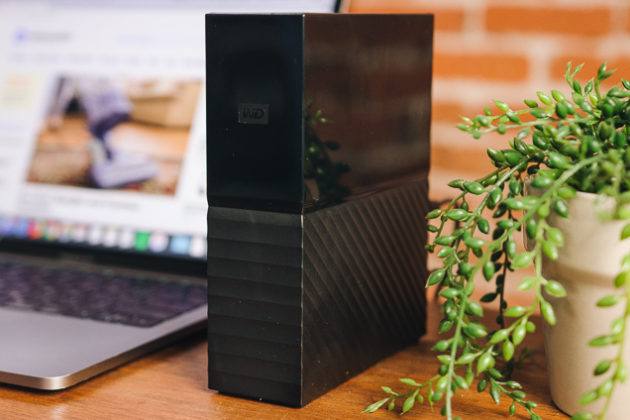

Privacy Policy
Terms and Conditions - Affiliate Policy
Home Security
© Copyright 2008-2026.
11816 Inwood Rd #1211, Dallas, TX 75244