

When you're building or upgrading a home theater system, the AV receiver sits at the heart of everything. It's the brain that processes all your audio and video signals, amplifies sound to your speakers, and connects all your devices together. Think of it as the conductor of your entertainment orchestra – everything flows through it.
At the time of writing, two receivers have caught our attention for representing very different approaches to home theater: the Denon AVR-X2800H and the JBL MA510. Both launched in 2024, but they target completely different users with distinct philosophies about what matters most in a modern receiver.
The receiver market has evolved dramatically over the past few years. Where older units might have struggled with 4K video or lacked wireless connectivity, today's models handle 8K video streams, support object-based surround sound formats like Dolby Atmos (which places sounds in three-dimensional space rather than just around you), and integrate seamlessly with streaming services.
The key considerations when choosing a receiver haven't changed much: you want clean, powerful sound reproduction, reliable video processing, and enough inputs for your devices. What has changed is how these features are implemented and prioritized.
Some manufacturers, like Denon, continue emphasizing traditional audiophile values – pristine sound quality, extensive manual controls, and maximum flexibility. Others, like JBL with their new Modern Audio series, focus on simplification and gaming-specific features. Neither approach is inherently better; they serve different users with different priorities.
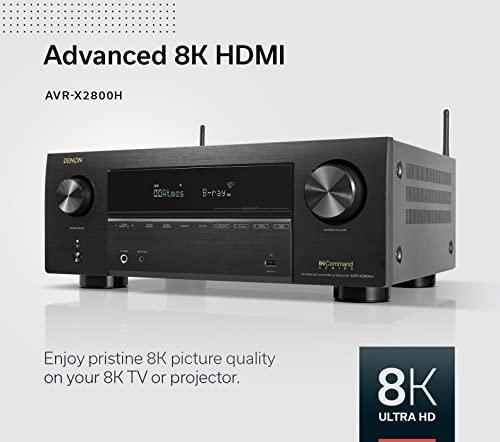
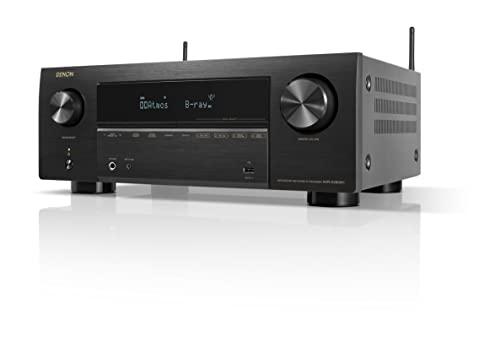
The Denon AVR-X2800H represents the company's mid-tier offering, packing serious features into a 7.2-channel configuration. Denon has been perfecting receiver design for decades, and this model shows that experience. At the time of writing, it commands a premium price that reflects its comprehensive feature set and proven reliability.
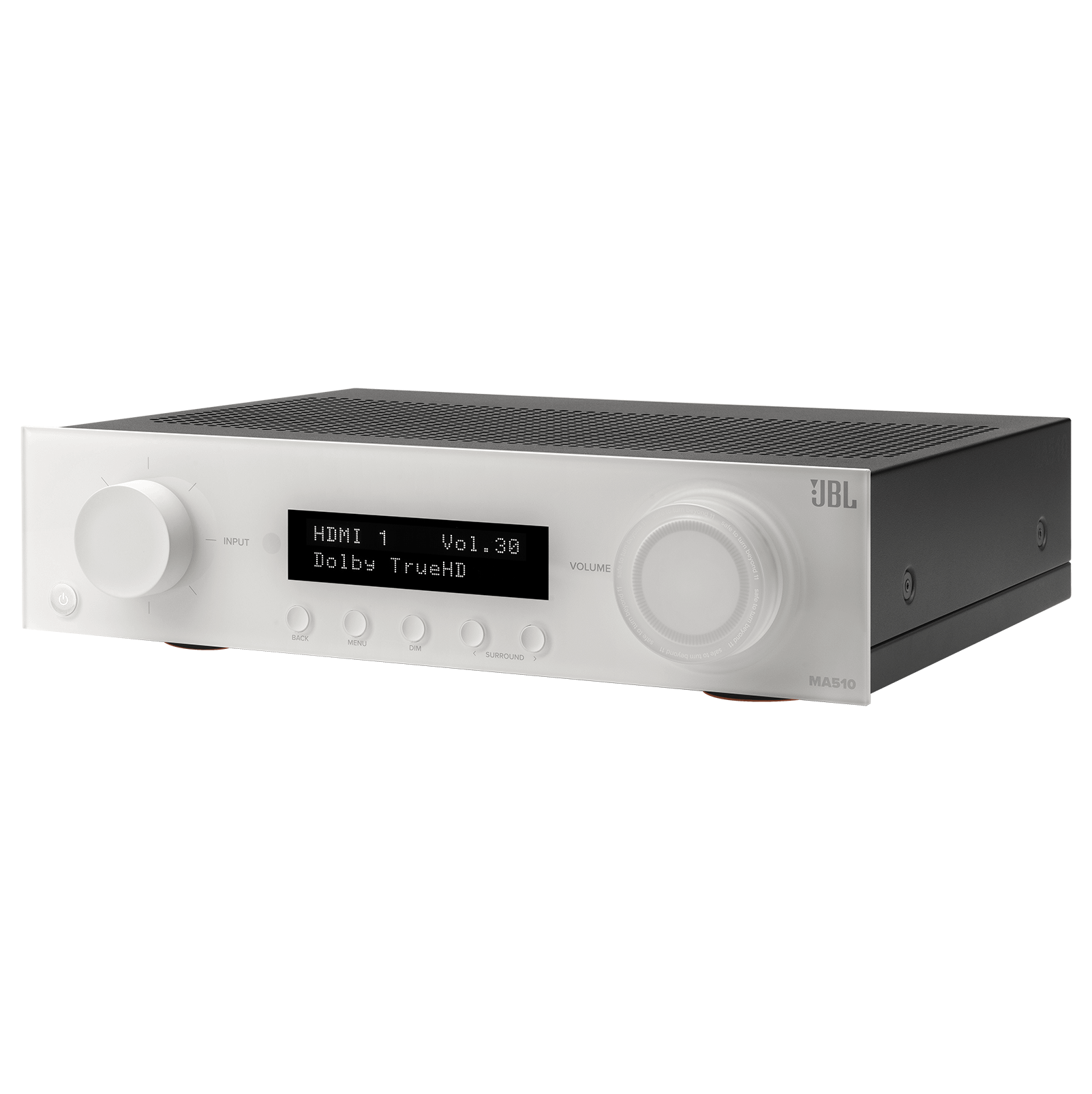
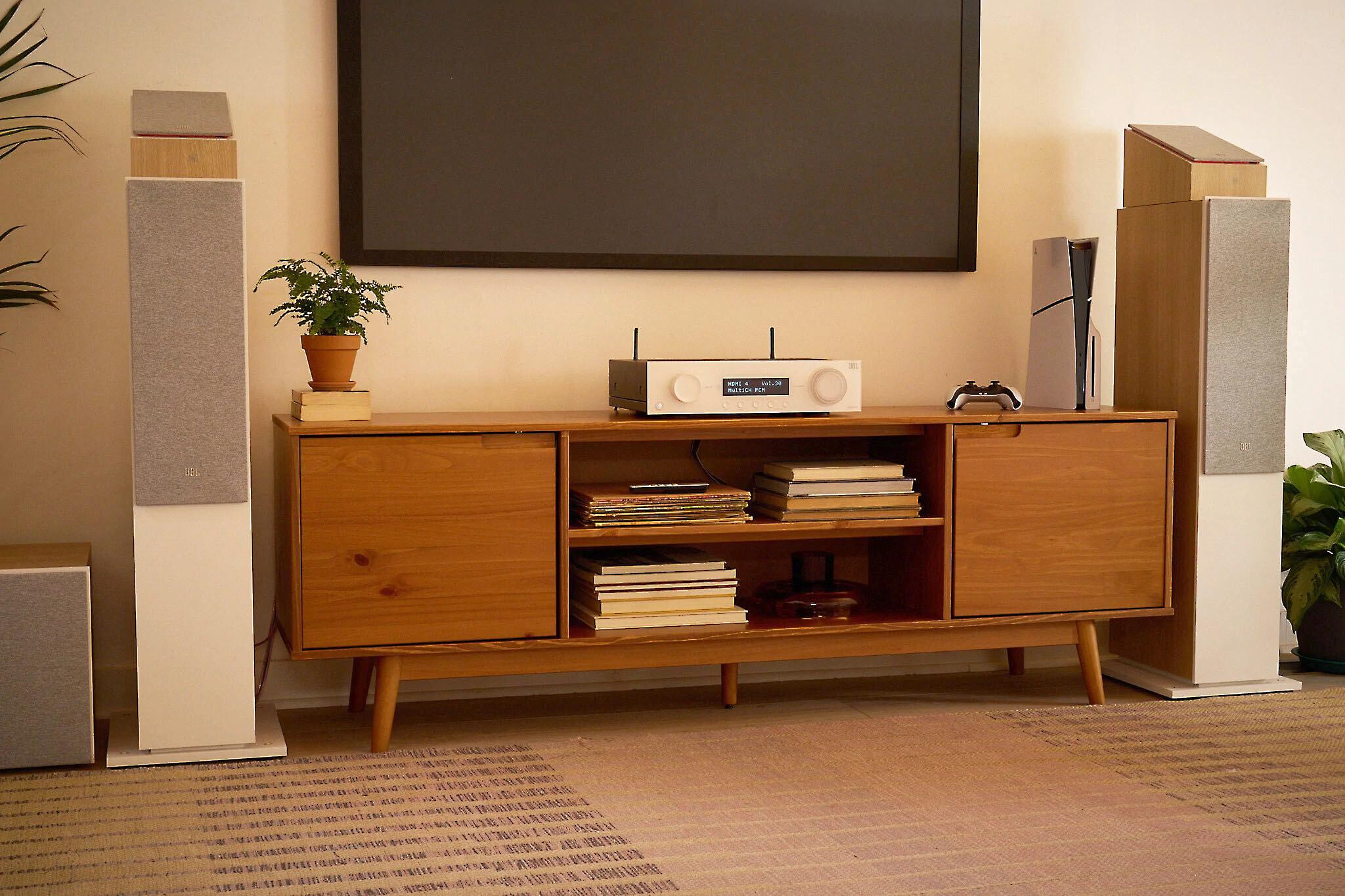
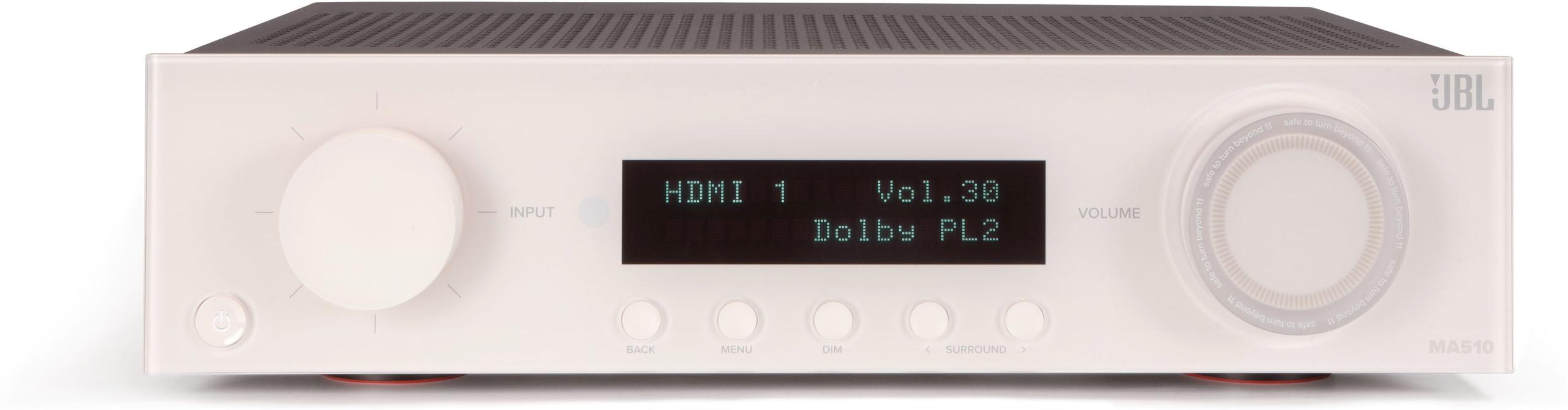
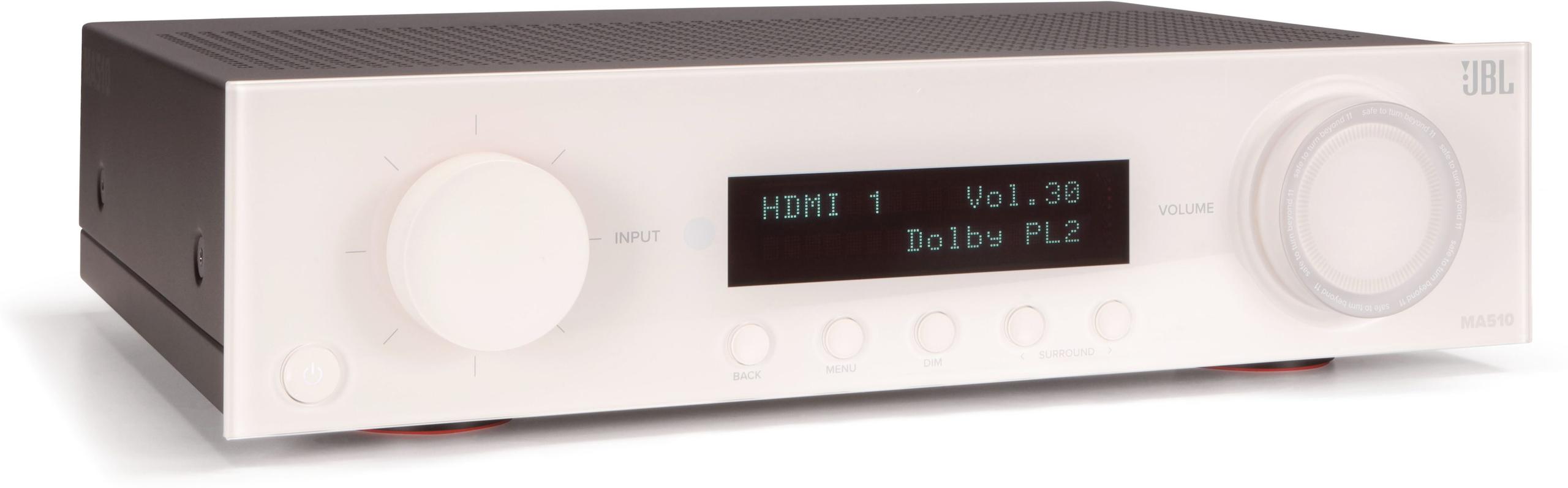
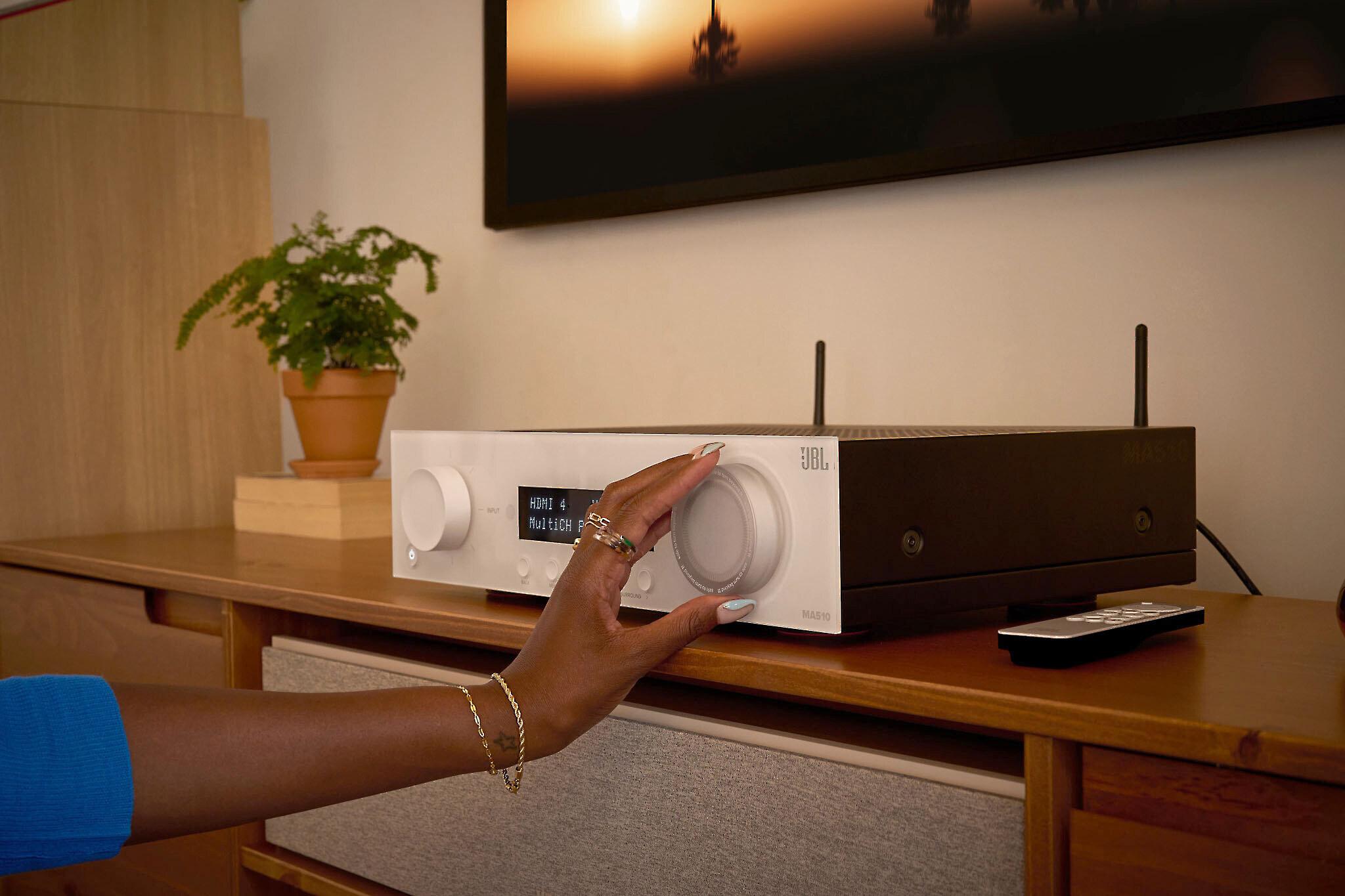
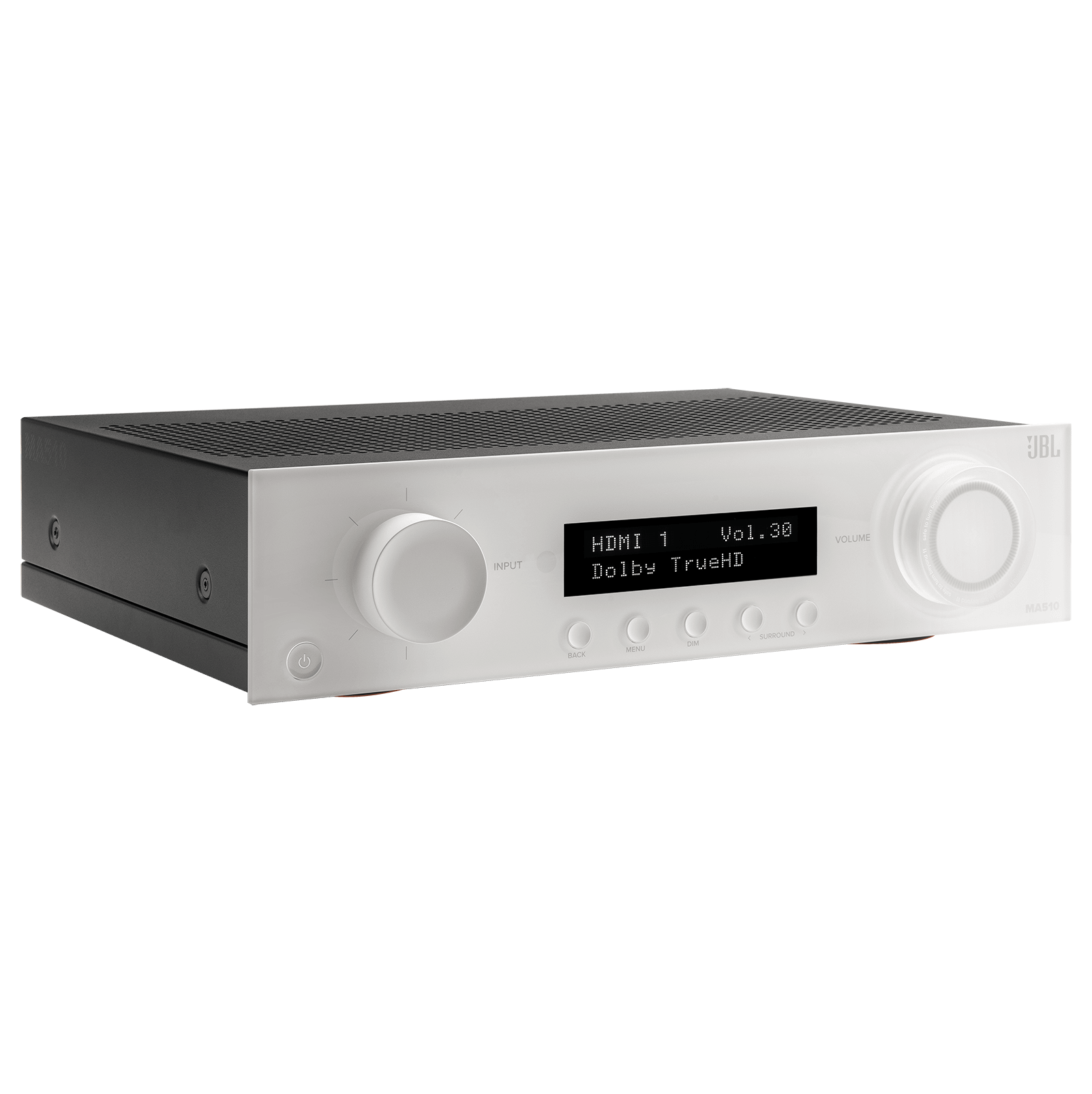
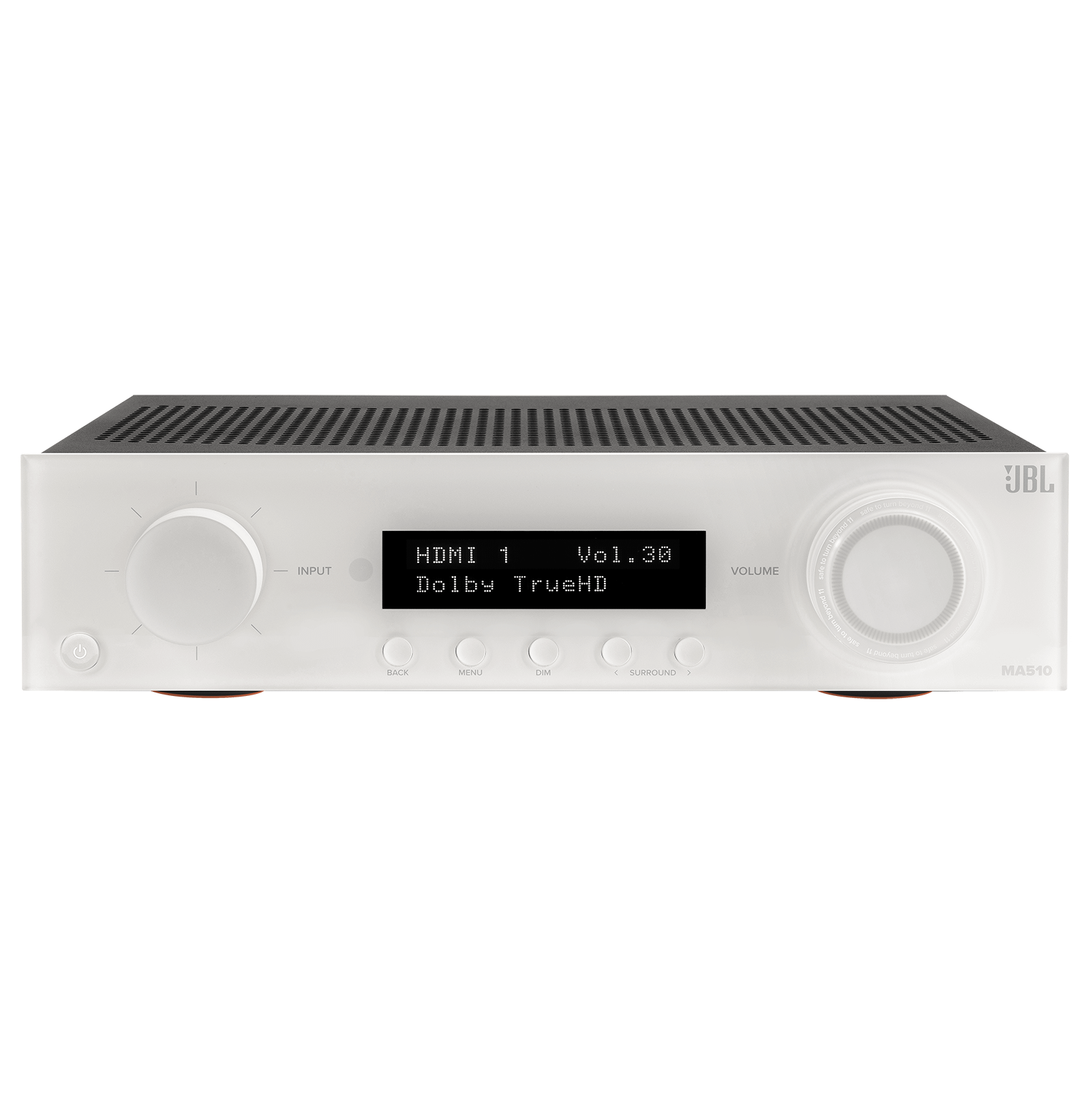
The JBL MA510, meanwhile, is JBL's entry into the receiver market with their new Modern Audio line. It's a 5.2-channel unit that costs significantly less than the Denon while still delivering 8K video support and modern gaming features. JBL's approach prioritizes ease of use and value over maximum flexibility.
The most fundamental difference between these receivers lies in their amplification approach. The Denon AVR-X2800H uses Class AB amplification, which is the traditional approach favored by audiophiles. Class AB amps run warmer and consume more power, but they typically produce a more natural, refined sound signature that's particularly noticeable during quiet passages and acoustic music.
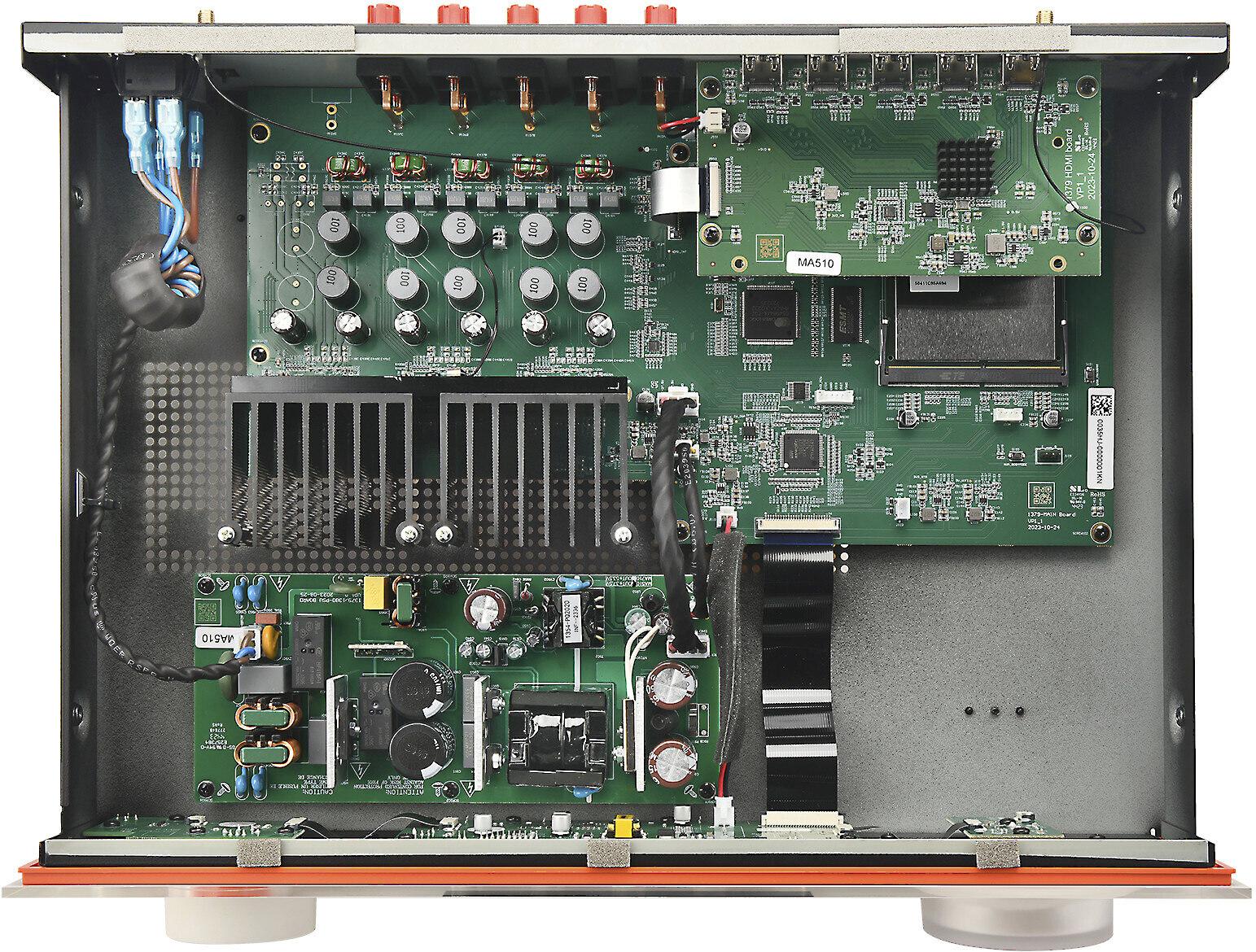
The JBL MA510 employs Class D amplification across all channels. Class D amps are highly efficient, running cooler and using less electricity while still delivering clean power. The trade-off is a slightly more clinical sound signature – perfectly fine for most listeners, but lacking the warmth that analog enthusiasts prefer.
In terms of raw power, the Denon delivers 95 watts per channel into 8-ohm speakers (measured with two channels driven, which is more realistic than the single-channel measurements some manufacturers use). The JBL provides 75 watts into 8 ohms or 100 watts into 4-ohm speakers. While the numbers look close, the Denon's discrete amplifier design and robust power supply give it an advantage when driving demanding speakers or filling larger rooms.
Based on user feedback and professional reviews, the Denon produces a more authoritative, balanced sound with excellent dialogue clarity – crucial for movie watching. The JBL delivers good performance for its price point but doesn't match the Denon's refinement, particularly in complex musical passages.
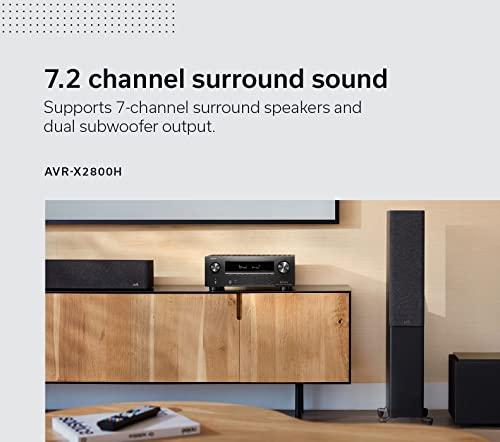
Here's where the products diverge significantly. The Denon AVR-X2800H supports full 7.2-channel configurations, meaning seven main speakers plus two subwoofers. More importantly, it can handle Dolby Atmos and DTS:X in a 5.1.2 setup – that's five traditional surround speakers, one subwoofer, and two height channels that create overhead sound effects.
Dolby Atmos is a game-changer for home theater. Instead of just having sounds come from around you, Atmos places audio objects in three-dimensional space. Rain falls from above, helicopters circle overhead, and debris flies past with startling realism. The technology requires specific speaker placement or upward-firing drivers, but the immersive effect is worth the effort.
The JBL MA510 maxes out at 5.2 channels with traditional surround sound processing. While it handles Dolby Digital and DTS formats well, it doesn't support Atmos or other object-based formats. For many users, especially those in apartments or smaller homes, this limitation isn't problematic. A well-configured 5.1 system still provides excellent surround sound for movies and games.
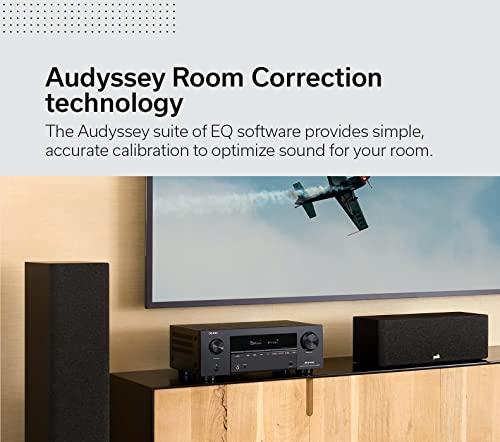
Both receivers include room correction technology, but their approaches differ dramatically. Room correction systems use microphones to measure how your room affects sound, then apply digital filters to compensate for acoustic problems like standing waves (where certain frequencies get amplified or cancelled out) and speaker placement issues.
The Denon features Audyssey MultEQ XT, a sophisticated system that takes measurements from up to eight listening positions and creates detailed frequency response corrections. Audyssey has been refined over many years and is widely respected among audiophiles. The system can dramatically improve sound quality, especially in difficult rooms with hard surfaces or awkward speaker placement.
The JBL takes a simpler approach with their EZ Set EQ system controlled through a smartphone app. The setup process takes under two minutes per speaker group and focuses on basic room corrections. While less sophisticated than Audyssey, it's far more user-friendly and still provides meaningful improvements for most listeners.
From our research of user experiences, the Denon's room correction produces more accurate results but requires more patience during setup. The JBL's system prioritizes convenience and gets most users 80% of the benefit with 20% of the effort.
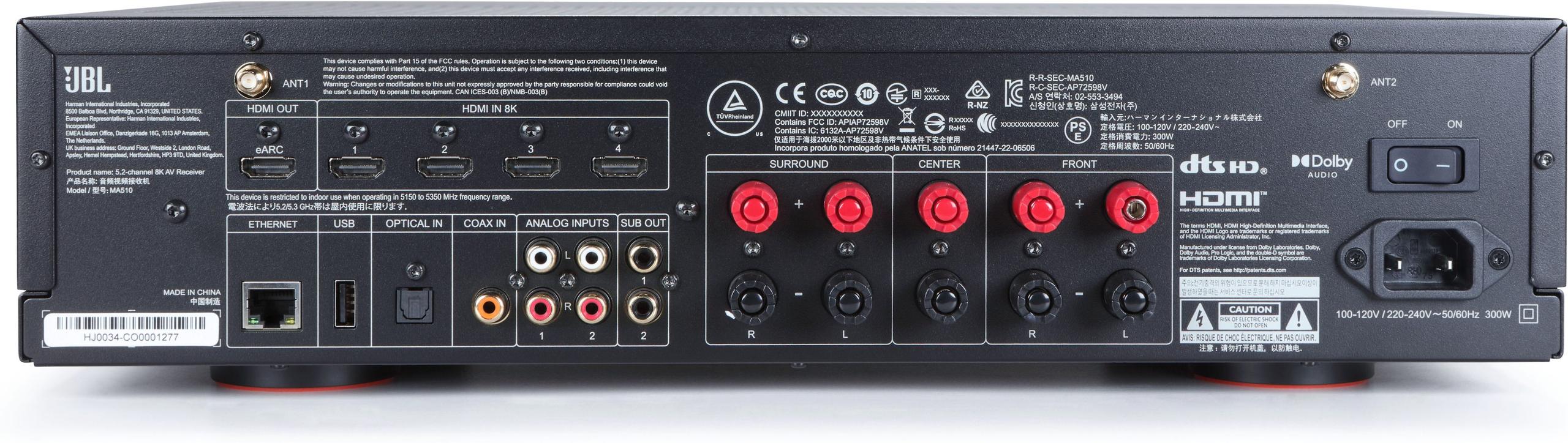
Both receivers handle modern video formats, but with different implementation philosophies. The Denon AVR-X2800H includes six HDMI inputs total – three supporting the latest HDMI 2.1 specification and three using the older HDMI 2.0 standard. HDMI 2.1 is crucial for gaming and future video formats because it supports higher bandwidth for 8K at 60Hz or 4K at 120Hz.
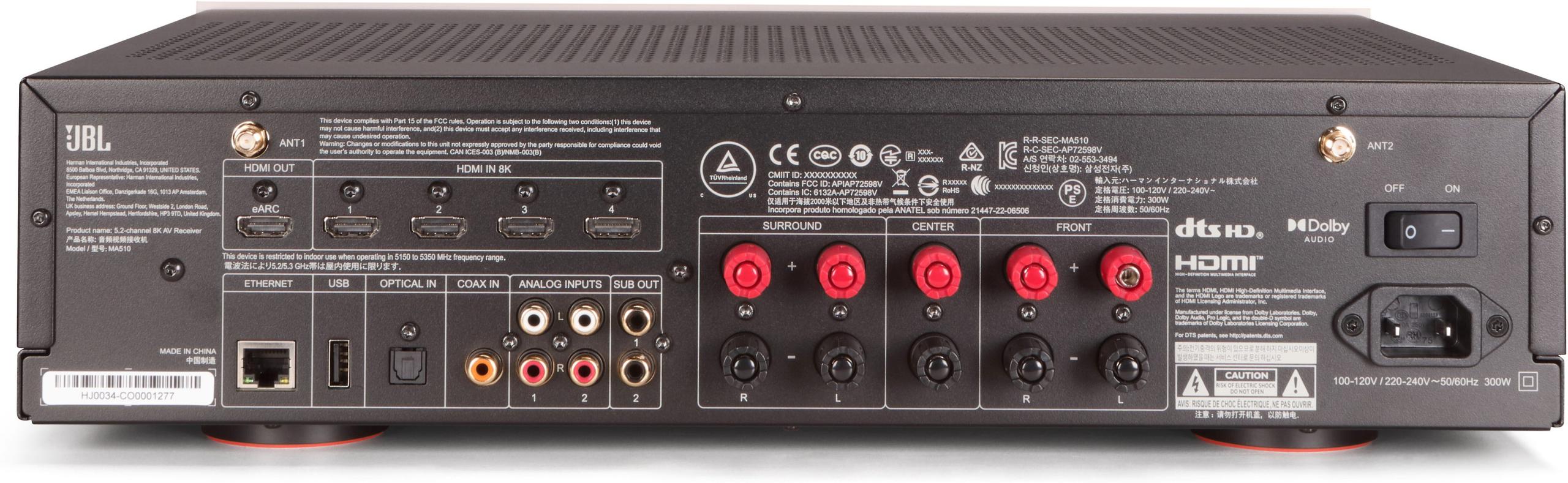
The JBL MA510 takes a different approach: all four HDMI inputs support HDMI 2.1. While you get fewer total inputs, every connection supports the latest features. This design choice reflects JBL's focus on gaming and modern devices rather than legacy equipment.
Both receivers support HDR (High Dynamic Range) formats including HDR10, HDR10+, and Dolby Vision. These formats expand the range of colors and brightness levels that video can display, resulting in more realistic and vibrant images. The difference in HDR processing between these models is negligible – both handle modern streaming services and UHD Blu-ray players without issues.
This is where the JBL MA510 really shines. All its HDMI inputs support Variable Refresh Rate (VRR), Auto Low Latency Mode (ALLM), and Quick Frame Transport (QFT) – features that reduce input lag and eliminate screen tearing during gaming. Modern gaming consoles like PlayStation 5 and Xbox Series X benefit significantly from these technologies.
The Denon supports these gaming features as well, but only on its HDMI 2.1 inputs. If you're connecting multiple gaming devices, you might run out of optimized inputs and need to compromise on older HDMI ports.
For serious gamers, the JBL offers better value since every input provides the same gaming-optimized experience. However, the Denon provides more total connectivity options for users with mixed device types.
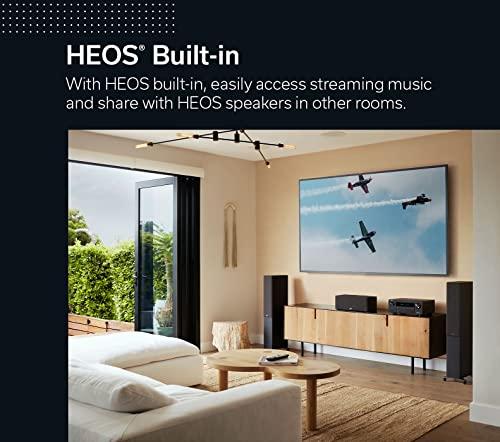
Both receivers embrace modern streaming, but with different feature sets. The Denon AVR-X2800H includes HEOS multiroom technology, which allows you to create a whole-home audio system by connecting multiple Denon or Marantz devices. You can stream different music to different rooms or sync everything for house parties.
The Denon also supports Apple AirPlay 2, Spotify Connect, and various streaming services directly. Voice control works with Alexa, Google Assistant, and Siri, making it easy to control music playback hands-free.
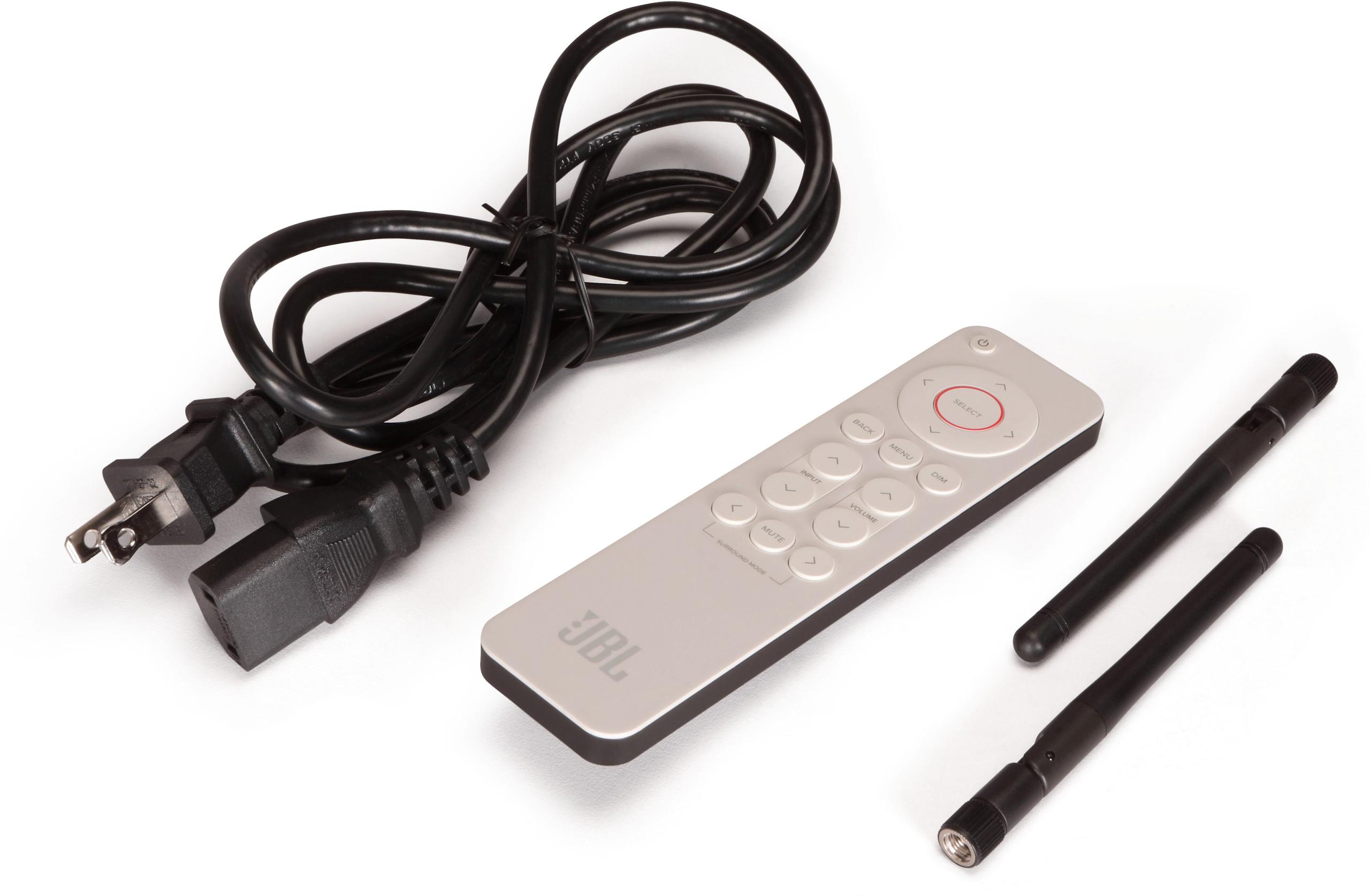
The JBL MA510 focuses on core streaming features without the multiroom complexity. It supports AirPlay 2 and Google Chromecast, plus it's Roon Ready – a feature audiophiles appreciate for high-quality music streaming and library management. The wireless implementation feels more modern and streamlined, though it lacks the Denon's ecosystem expansion possibilities.
Here's where the products' target audiences become clear. The Denon AVR-X2800H includes a built-in phono preamp for connecting turntables directly – a feature vinyl enthusiasts will appreciate. It also provides more analog inputs for older equipment and additional digital connections.
The JBL MA510 focuses on modern digital connections, skipping the phono input and emphasizing HDMI and wireless connectivity. This design choice keeps costs down while serving users who primarily use streaming services, game consoles, and modern media players.
The two receivers represent opposite approaches to setup complexity. The Denon AVR-X2800H offers extensive manual control over audio settings, allowing experienced users to fine-tune everything from crossover frequencies (which determine what sounds go to which speakers) to dynamic range compression (which reduces the difference between loud and quiet sounds for late-night viewing).
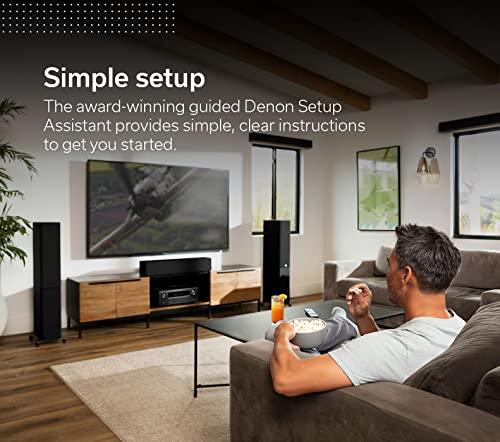
This flexibility comes with complexity. The Denon's menu system is comprehensive but can overwhelm newcomers. However, recent firmware updates have improved the user interface, and the automatic setup gets most users to good sound quality without diving into advanced settings.
The JBL MA510 prioritizes simplicity throughout the experience. The EZ Set EQ system handles room correction automatically, and the streamlined feature set reduces decision paralysis for new users. The trade-off is less flexibility for users who want to customize their sound signature.
Based on our research of user experiences and professional reviews, Denon has established a strong reputation for long-term reliability. The AVR-X2800H represents mature engineering with proven components and extensive quality control. Users report stable performance over years of use, and Denon's customer support network is well-established.
The JBL MA510, being newer to the market, doesn't have the same track record. However, early user reports are positive, and JBL's experience in professional audio suggests they understand build quality requirements. The simpler design with fewer complex features may actually improve long-term reliability.
At the time of writing, the Denon AVR-X2800H commands a significant premium over the JBL MA510 – roughly 75% more expensive. This price difference reflects their different target markets and feature sets.
The Denon justifies its higher cost through superior audio processing, more channels, extensive connectivity options, and proven reliability. If you're building a serious home theater system that you plan to expand over time, the additional cost provides genuine long-term value.
The JBL offers remarkable value for users who don't need maximum flexibility. At its lower price point, you still get 8K video processing, modern gaming features, and adequate power for most rooms. The money saved could go toward better speakers or a subwoofer upgrade – often a better investment than receiver features you won't use.
You're building a serious home theater system in a medium to large room where the 7.2 channel capability will be utilized. The Denon excels when you plan to implement Dolby Atmos with height speakers or want flexibility to expand your system over time.
Vinyl enthusiasts should strongly consider the Denon for its built-in phono preamp – a feature that saves money and rack space compared to external phono stages. Similarly, if you have older audio equipment with analog outputs, the comprehensive connectivity options prove valuable.
The Denon also makes sense for users who prioritize audio quality over convenience. Its refined sound signature and sophisticated room correction system deliver performance that justifies the premium cost for serious listeners.
Gamers represent the JBL MA510's primary audience. With HDMI 2.1 features on every input, it's optimized for connecting multiple gaming consoles without compromising on input lag or refresh rate support.
Budget-conscious buyers who still want modern features will appreciate the JBL. It provides 8K video support and quality amplification at a much lower price point. The money saved can go toward better speakers, which often provides greater performance improvement than receiver upgrades.
First-time home theater builders benefit from the JBL's simplified approach. The streamlined feature set and easy setup process remove barriers that might intimidate newcomers, while still delivering genuinely good performance.
Both receivers succeed in their intended roles, but they serve different needs. The Denon AVR-X2800H provides maximum flexibility and refinement for serious home theater enthusiasts willing to pay for proven performance and expandability. The JBL MA510 delivers excellent value and modern features for users who prioritize gaming, simplicity, and cost-effectiveness.
Consider your room size, budget, and primary use cases. If you're planning a modest 5.1 system focused on gaming and streaming, the JBL provides everything you need at an attractive price. If you're building a reference-quality home theater that might grow over time, the Denon offers the foundation for a truly exceptional system.
The beauty of the current receiver market is that both approaches can deliver satisfying results. Your choice should align with your priorities, room requirements, and long-term plans for your home theater system.
| Denon AVR-X2800H | JBL MA510 |
|---|---|
| Channel Configuration - Determines maximum speaker setup and future expandability | |
| 7.2 channels with Dolby Atmos/DTS:X support (5.1.2 configuration) | 5.2 channels, traditional surround only (no Atmos support) |
| Power Output - Affects volume levels and speaker compatibility | |
| 95W per channel (8Ω, 2-channel driven) with Class AB amplification | 75W @ 8Ω / 100W @ 4Ω with Class D amplification |
| HDMI Connectivity - Critical for connecting modern devices and gaming | |
| 6 inputs (3x HDMI 2.1, 3x HDMI 2.0), 2 outputs with eARC | 4 inputs (all HDMI 2.1), 1 output with eARC |
| Room Correction - Automatically optimizes sound for your specific room | |
| Audyssey MultEQ XT (8-position calibration, professional-grade) | EZ Set EQ via smartphone app (simplified 2-minute setup) |
| Gaming Features - Reduces input lag and improves gaming experience | |
| VRR, ALLM, QFT on HDMI 2.1 inputs only | VRR, ALLM, QFT on all HDMI inputs |
| Analog Connectivity - Important for turntables and older equipment | |
| Built-in phono preamp, multiple analog inputs | No phono input, minimal analog connections |
| Wireless Streaming - Access to music services and multiroom audio | |
| HEOS multiroom, AirPlay 2, Spotify Connect, voice assistants | AirPlay 2, Chromecast, Roon Ready (no multiroom) |
| Video Processing - Handles modern 8K/4K content and HDR formats | |
| 8K/60Hz, 4K/120Hz passthrough with HDR10, HDR10+, Dolby Vision | 8K/60Hz, 4K/120Hz passthrough with HDR10+, Dolby Vision |
| Build Quality & Brand Reputation - Affects long-term reliability and support | |
| Established 7+ decades in audio, proven reliability track record | New to AV receivers (2024), leveraging pro audio experience |
| Target User - Who each receiver serves best | |
| Serious home theater enthusiasts, audiophiles, vinyl collectors | Gamers, first-time buyers, budget-conscious users wanting modern features |
The Denon AVR-X2800H is better for serious home theater setups due to its 7.2 channel configuration and Dolby Atmos support. The JBL MA510 works well for basic home theater but is limited to 5.2 channels without height effects. If you want immersive overhead sound effects and future expandability, choose the Denon.
The Denon AVR-X2800H supports 7.2 channels (seven speakers plus two subwoofers), while the JBL MA510 supports 5.2 channels (five speakers plus two subwoofers). The extra two channels in the Denon allow for rear surround speakers or height speakers for Dolby Atmos, creating more immersive sound in larger rooms.
The Denon AVR-X2800H delivers 95 watts per channel with Class AB amplification, while the JBL MA510 provides 75W at 8Ω or 100W at 4Ω using Class D amplification. The Denon typically sounds more authoritative and handles demanding speakers better, especially in larger rooms.
Yes, both the Denon AVR-X2800H and JBL MA510 support 8K video passthrough and gaming features like VRR and ALLM. However, the JBL provides these gaming features on all four HDMI inputs, while the Denon limits them to three of its six HDMI inputs.
The JBL MA510 is significantly easier to set up with its EZ Set EQ smartphone app that calibrates room acoustics in under two minutes. The Denon AVR-X2800H offers more precise Audyssey room correction but requires more time and patience during setup. First-time users often prefer the JBL's simplified approach.
Only the Denon AVR-X2800H includes a built-in phono preamp for connecting turntables directly. The JBL MA510 lacks a phono input, so vinyl enthusiasts would need an external phono preamp. This makes the Denon the clear choice for vinyl collectors.
The JBL MA510 offers excellent value for budget-conscious buyers, providing 8K support and modern features at a lower price point. The Denon AVR-X2800H costs significantly more but justifies the premium with superior audio processing, more channels, and proven reliability. Value depends on your specific needs and budget.
Yes, both support wireless streaming but with different approaches. The Denon AVR-X2800H includes HEOS multiroom, AirPlay 2, and Spotify Connect for comprehensive streaming options. The JBL MA510 offers AirPlay 2, Chromecast, and Roon Ready support but lacks multiroom capabilities. Choose the Denon for whole-home audio systems.
The JBL MA510 is better optimized for gaming since all four HDMI inputs support HDMI 2.1 gaming features like VRR, ALLM, and low input lag. The Denon AVR-X2800H supports these features but only on three of its six inputs. Gamers with multiple consoles benefit more from the JBL's consistent gaming optimization.
The Denon AVR-X2800H provides six HDMI inputs total (three HDMI 2.1, three HDMI 2.0) plus two outputs. The JBL MA510 offers four HDMI 2.1 inputs and one output. The Denon gives you more total connections, while the JBL ensures all inputs support the latest standards.
Only the Denon AVR-X2800H supports Dolby Atmos and DTS:X for three-dimensional sound with overhead effects in a 5.1.2 configuration. The JBL MA510 is limited to traditional 5.1 surround sound without height channels. For immersive movie experiences with overhead audio, the Denon is the only option.
The Denon AVR-X2800H has decades of proven reliability and established customer support networks. The JBL MA510 is newer to the AV receiver market but leverages JBL's professional audio experience. Early user reports are positive for the JBL, though the Denon has a longer track record of dependable performance in home theater applications.
We've done our best to create useful and informative comparisons to help you decide what product to buy. Our research uses advanced automated methods to create this comparison and perfection is not possible - please contact us for corrections or questions. These are the sites we've researched in the creation of this article: theaudiotailor.com.au - ecoustics.com - simplehomecinema.com - whathifi.com - audioadvisor.com - youtube.com - bestbuy.com - e-catalog.com - crutchfield.com - avsforum.com - crutchfield.com - whathifi.com - richersounds.com - bestbuy.com - accessories4less.com - projectorscreen.com - adiglobaldistribution.us - youtube.com - bestbuy.com - bestbuy.com - sweetwater.com - trustedreviews.com - av-connection.com - skybygramophone.com - bestbuy.com - safeandsoundhq.com - jbl.com - bestbuy.com - audioadvice.com - musicdirect.com - sweetwater.com - crutchfield.com

Privacy Policy
Terms and Conditions - Affiliate Policy
Home Security
© Copyright 2008-2026.
11816 Inwood Rd #1211, Dallas, TX 75244