Original price was: $399.99.$299.99Current price is: $299.99.
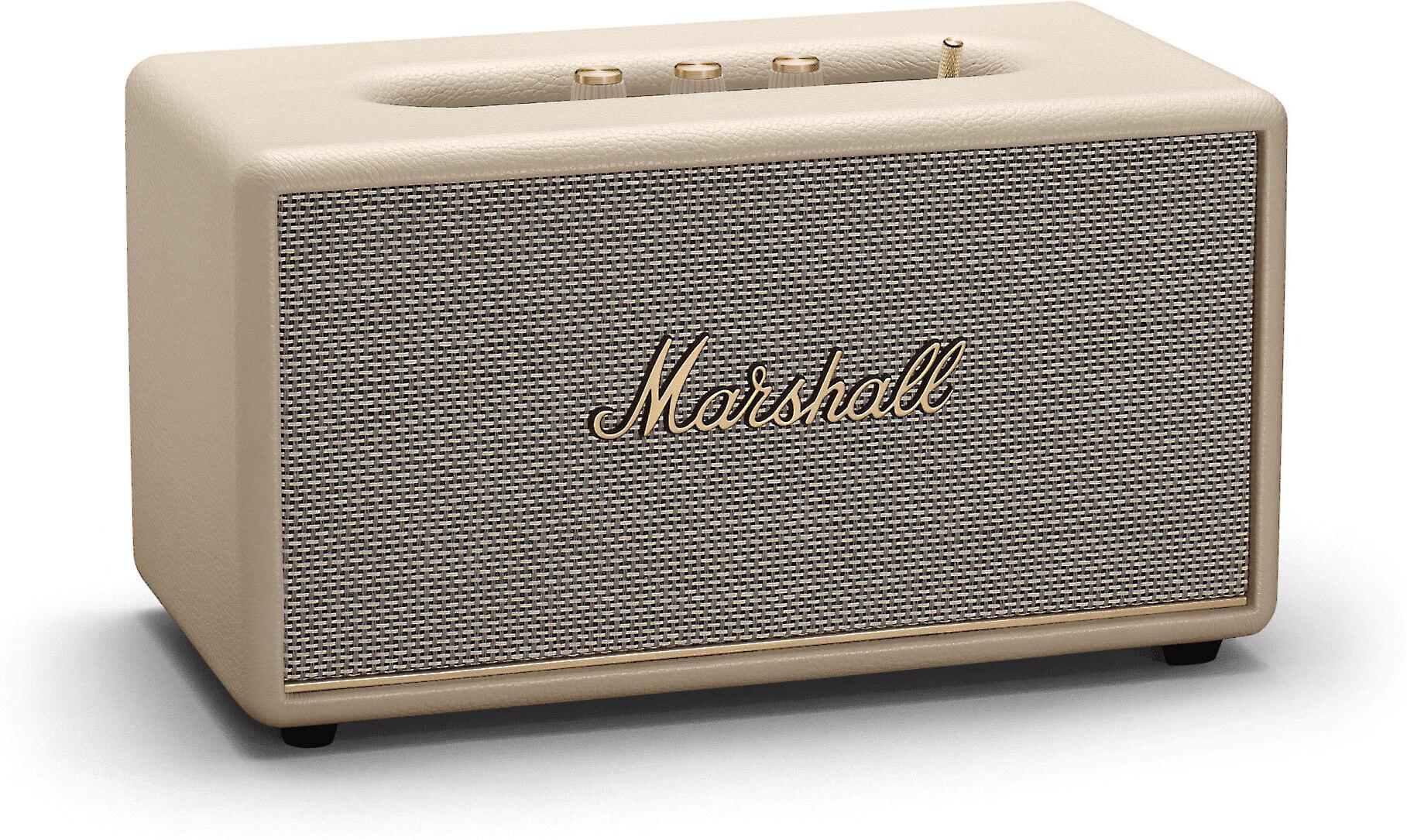
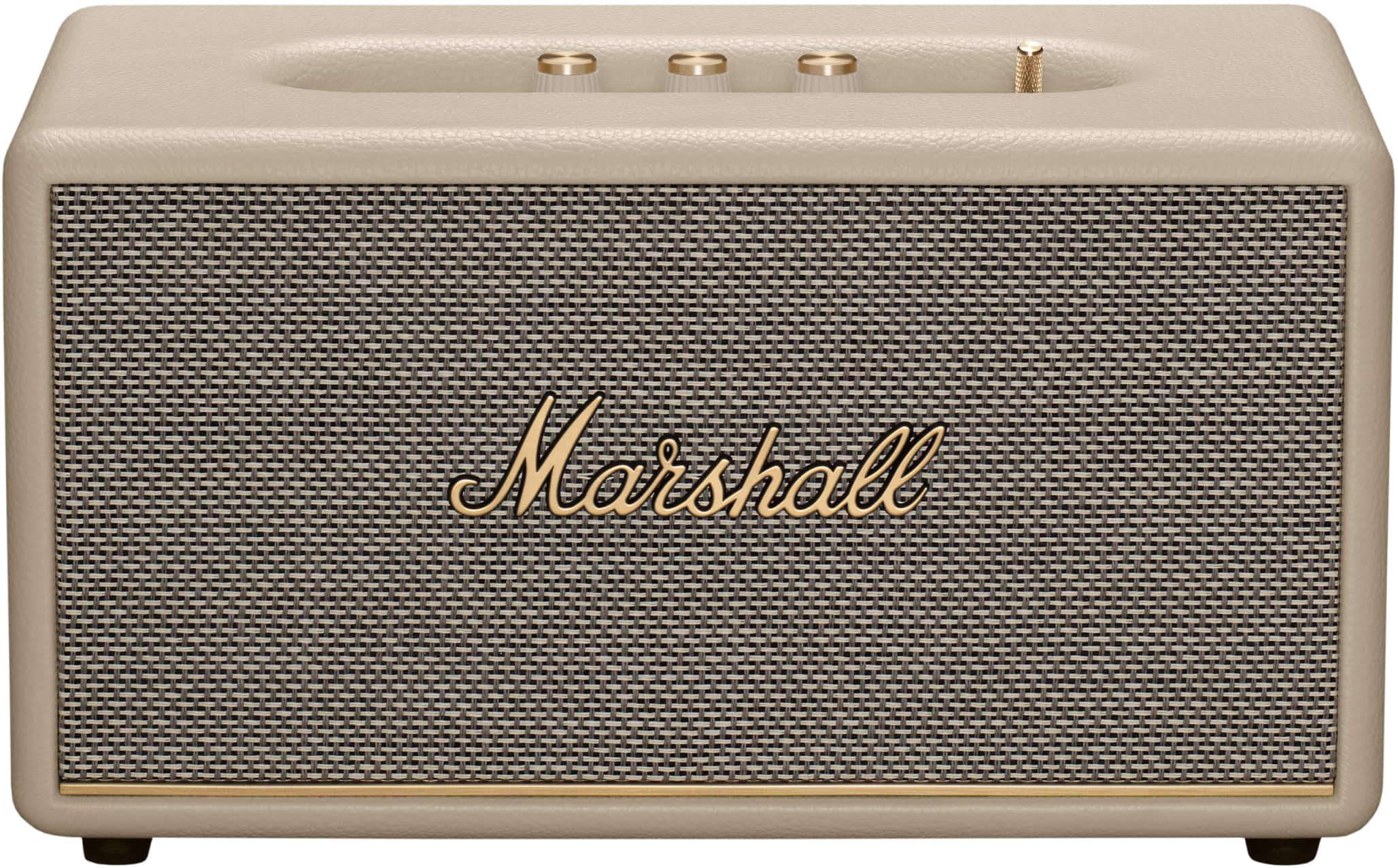
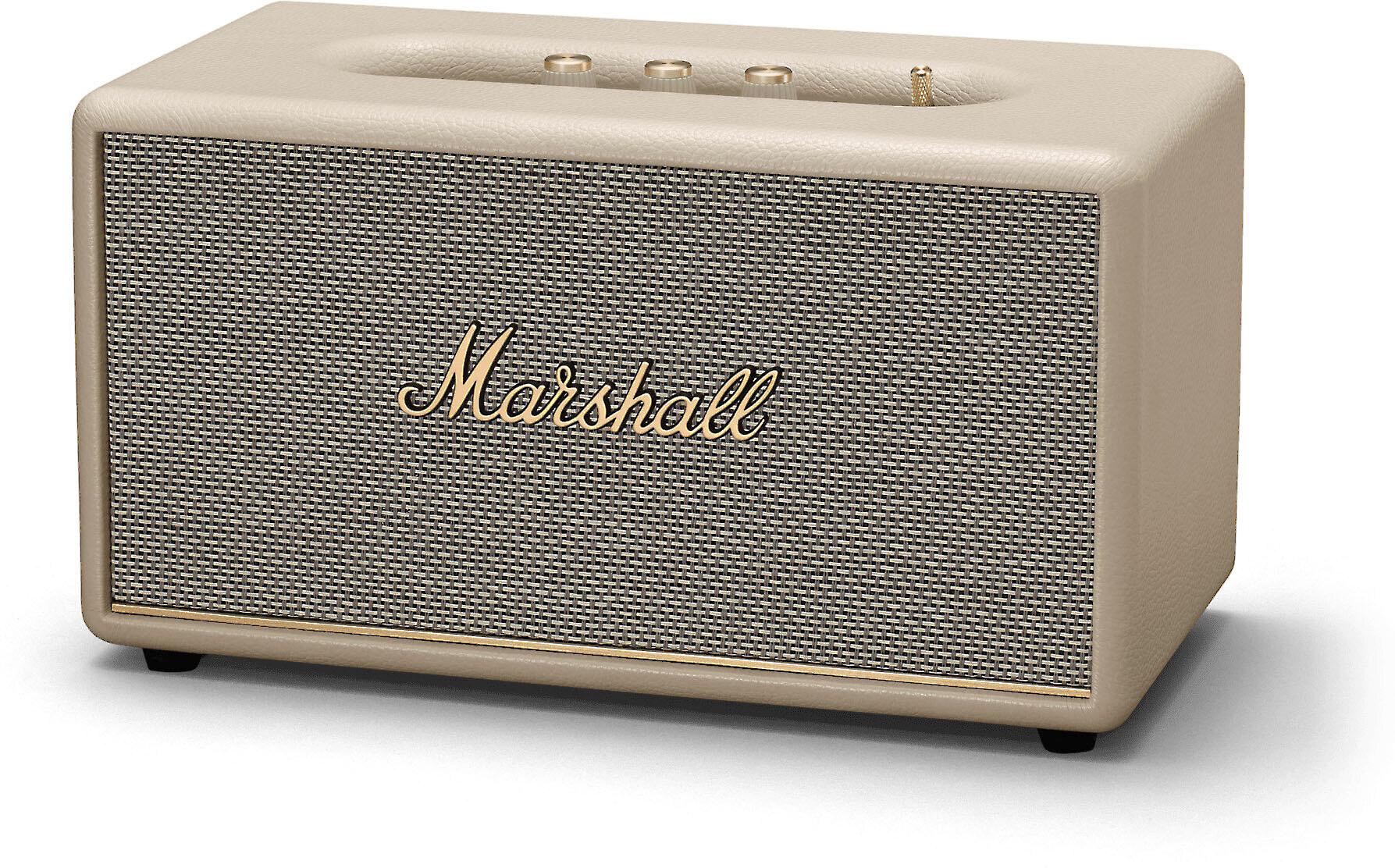
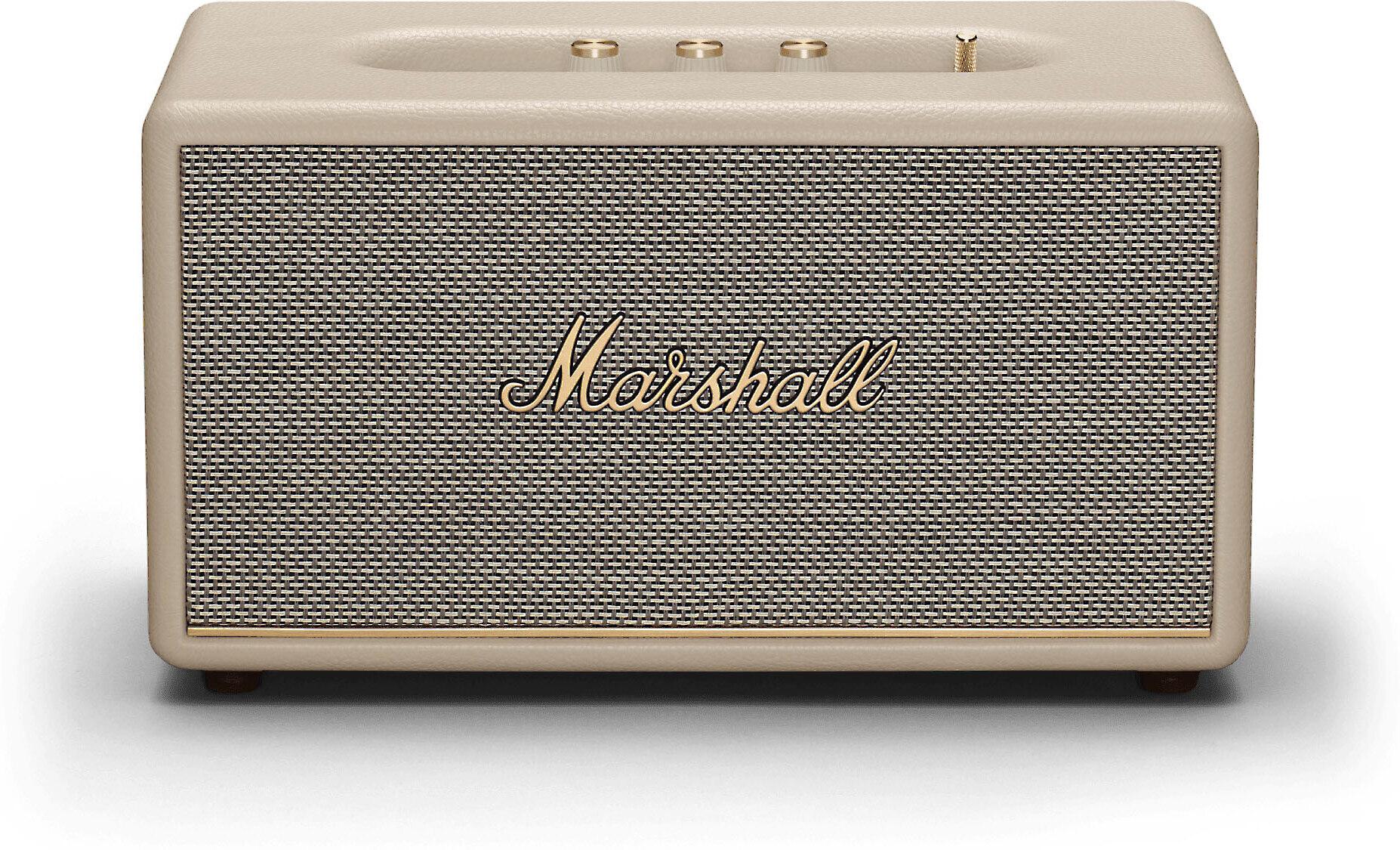
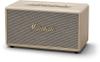
When Marshall Stanmore III ($399) landed in late 2022, it represented a significant evolution in Marshall's home speaker lineup. After spending considerable time testing it in various settings, I've found it strikes an impressive balance between vintage charm and modern functionality. Let's explore why this speaker might be your next audio upgrade.
Marshall has come a long way since their guitar amp origins. The Stanmore III builds upon its predecessor's success (Stanmore II from 2018) with meaningful improvements in both sound quality and sustainability. The most notable upgrades include Bluetooth 5.2 (up from 5.0), enhanced bass response, and a more eco-friendly construction using 70% recycled plastics.
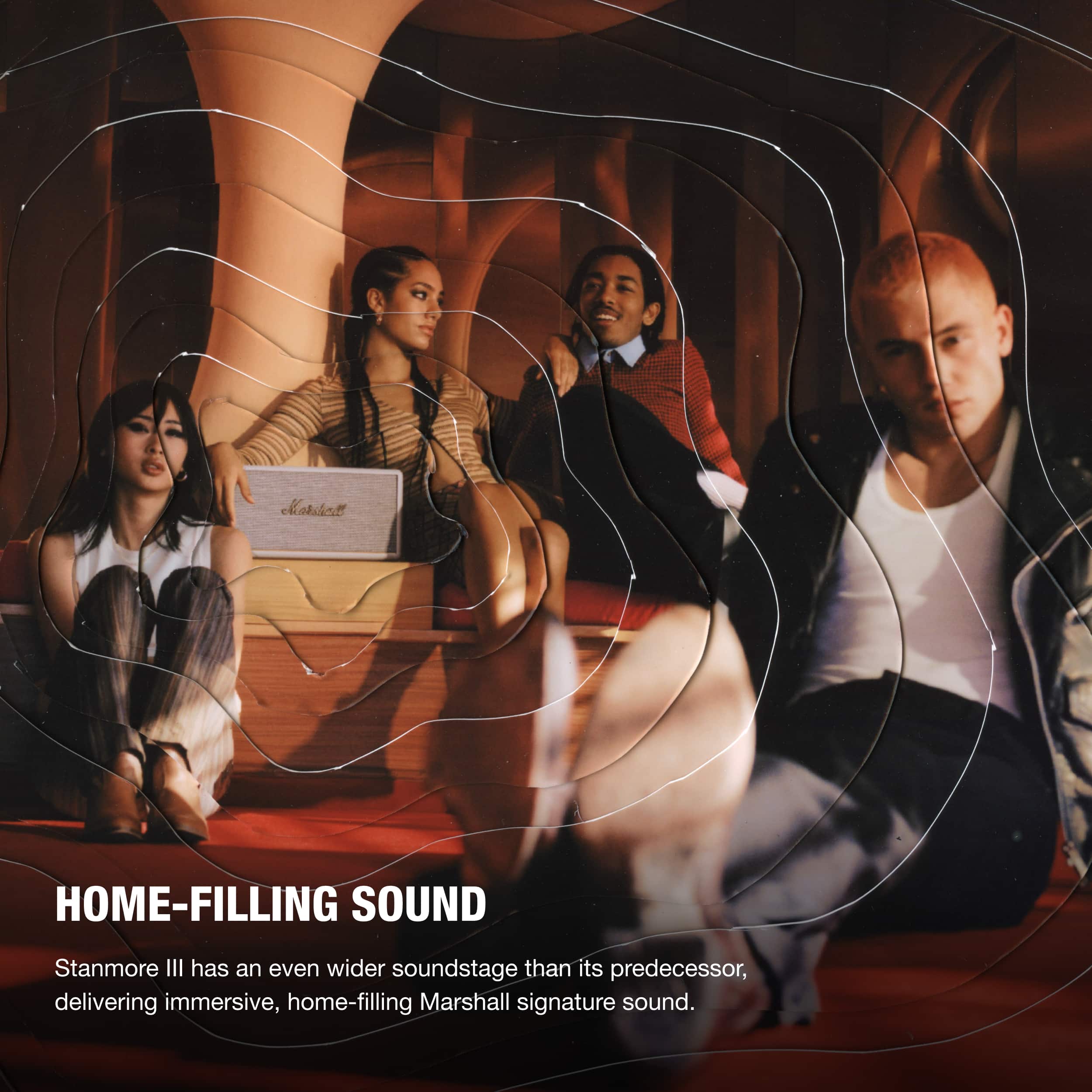
The Stanmore III packs serious audio muscle with its 80-watt system (50W woofer + 2x15W tweeters). In our testing, this translated to room-filling sound that maintains clarity even at higher volumes. The speaker really shines when handling bass-heavy genres - think rock, hip-hop, or electronic music. The low-end response is punchy without being overwhelming, while the highs remain crisp and detailed.
What sets this speaker apart is its Dynamic Loudness feature - a smart system that automatically adjusts frequency balance based on volume level. This means you'll get full, rich sound whether you're listening at low volumes late at night or cranking it up for a party. During our testing, this feature proved particularly effective when switching between different types of content, from quiet jazz to energetic rock.
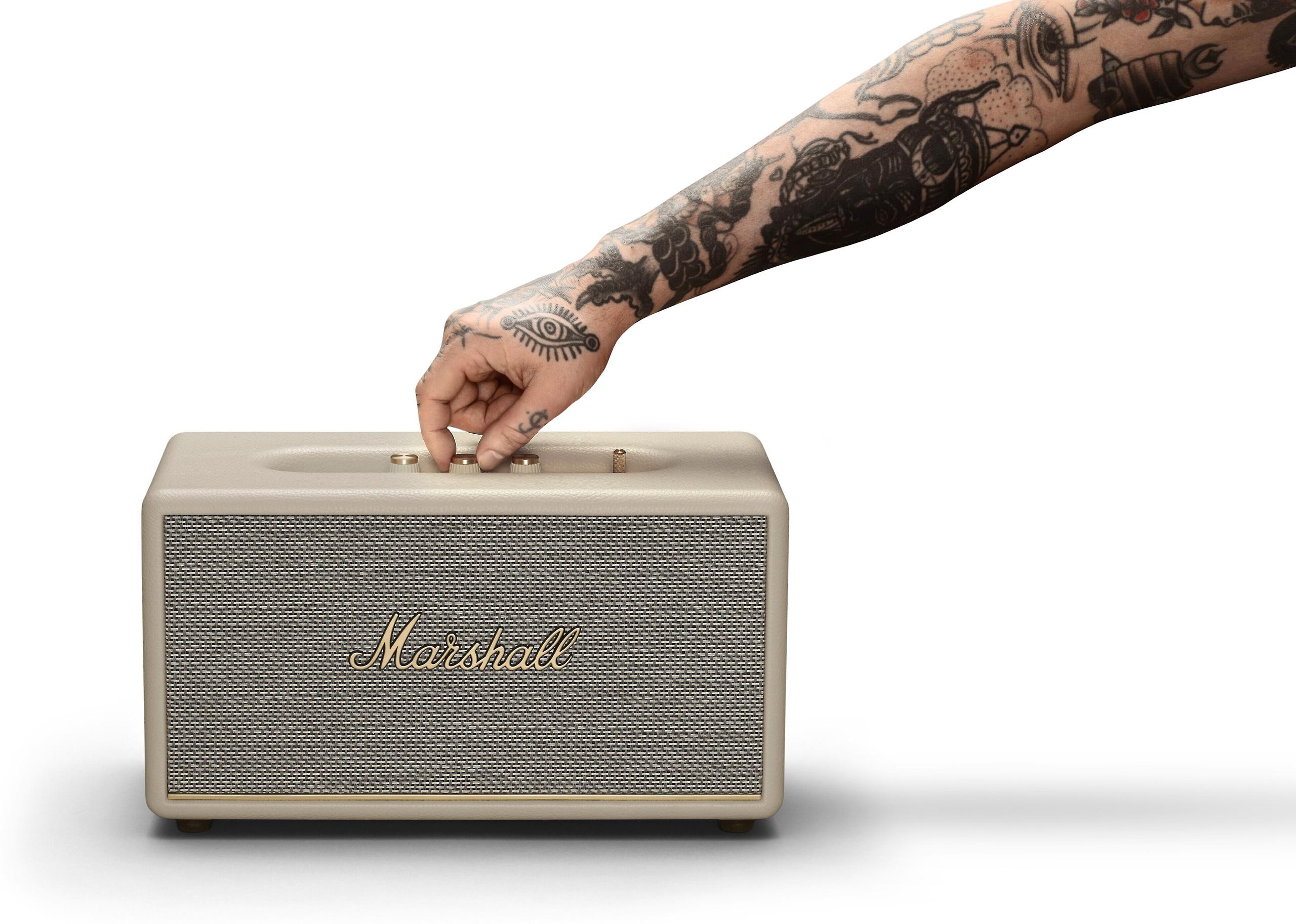
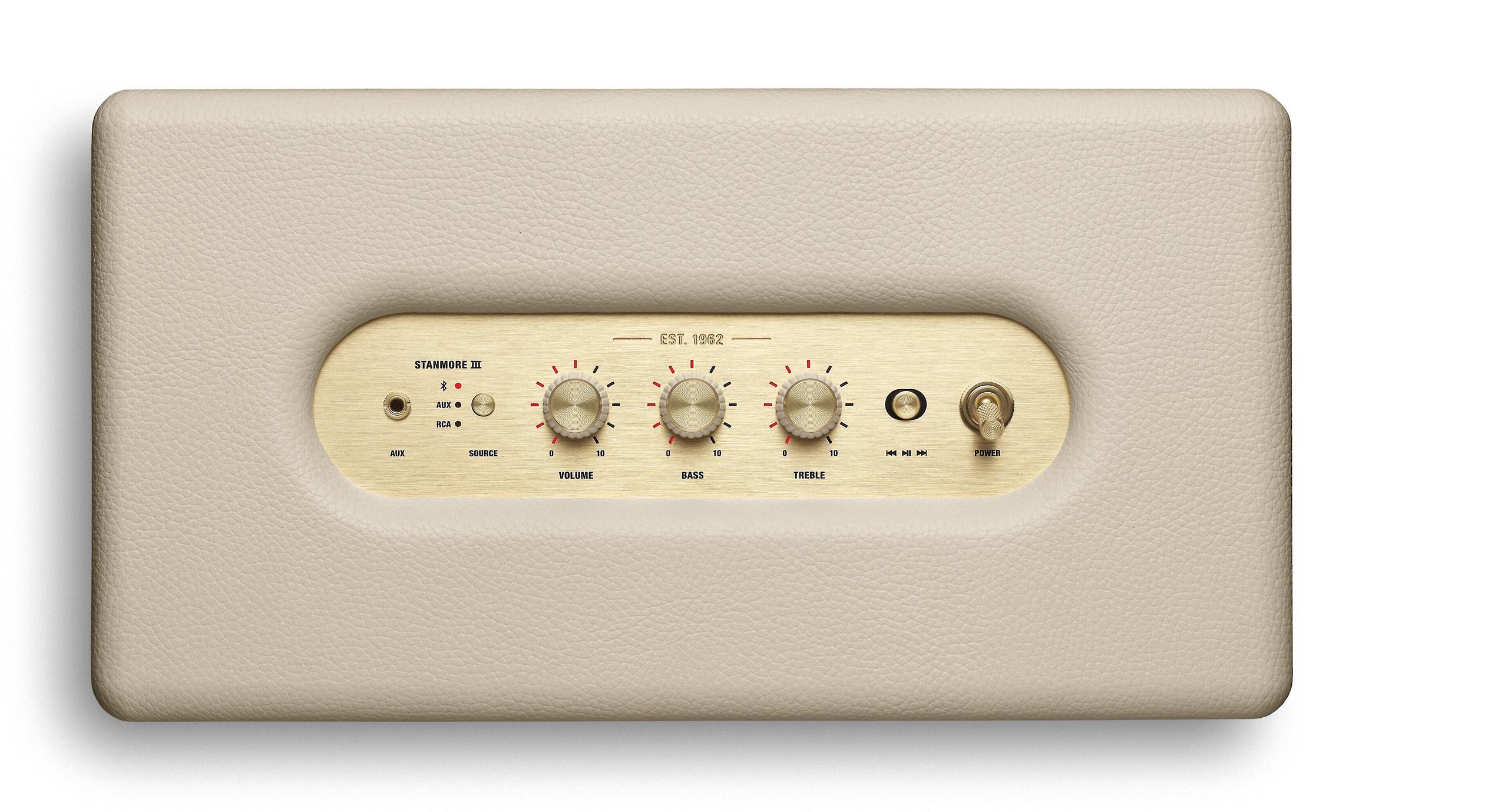
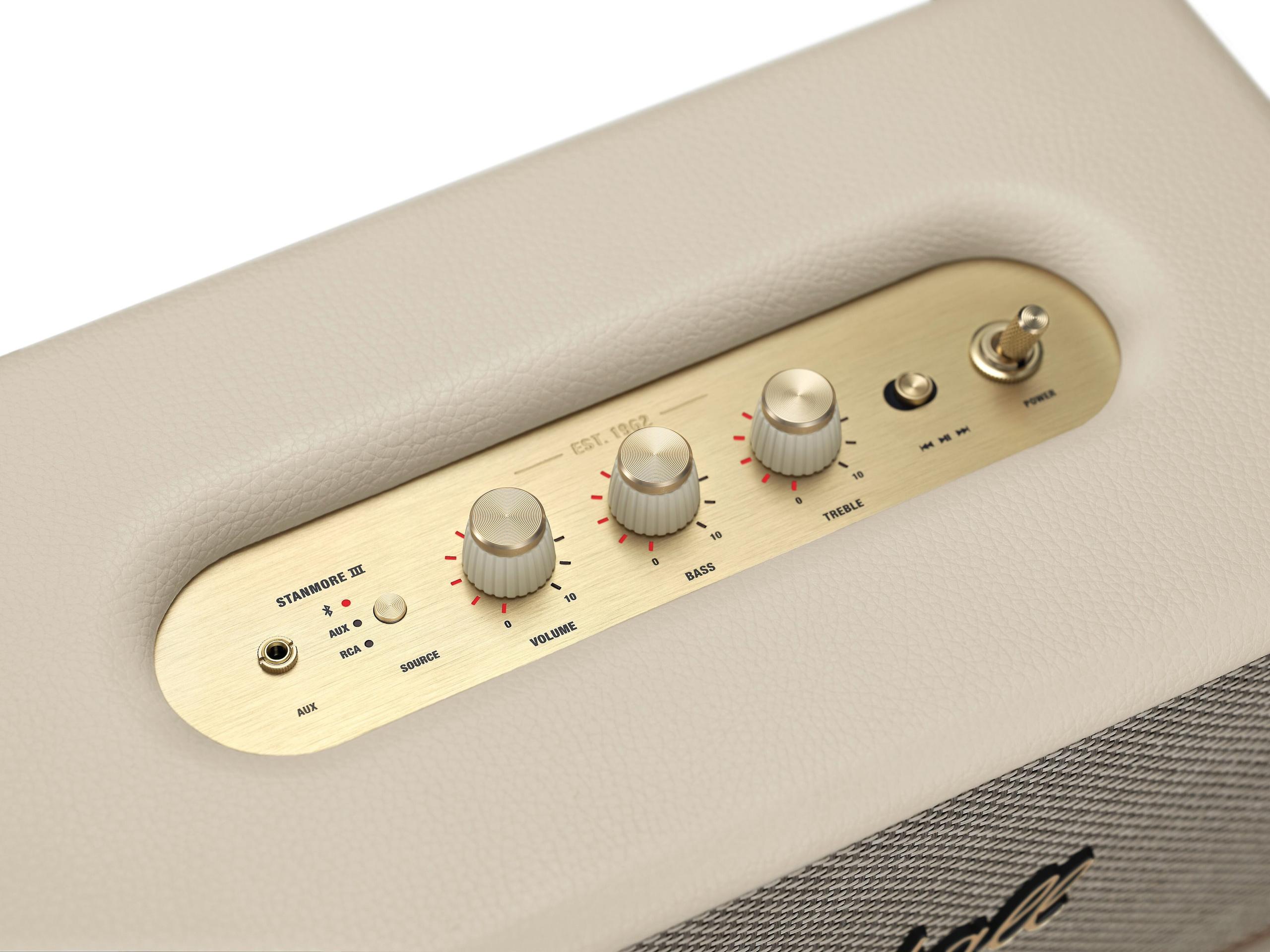
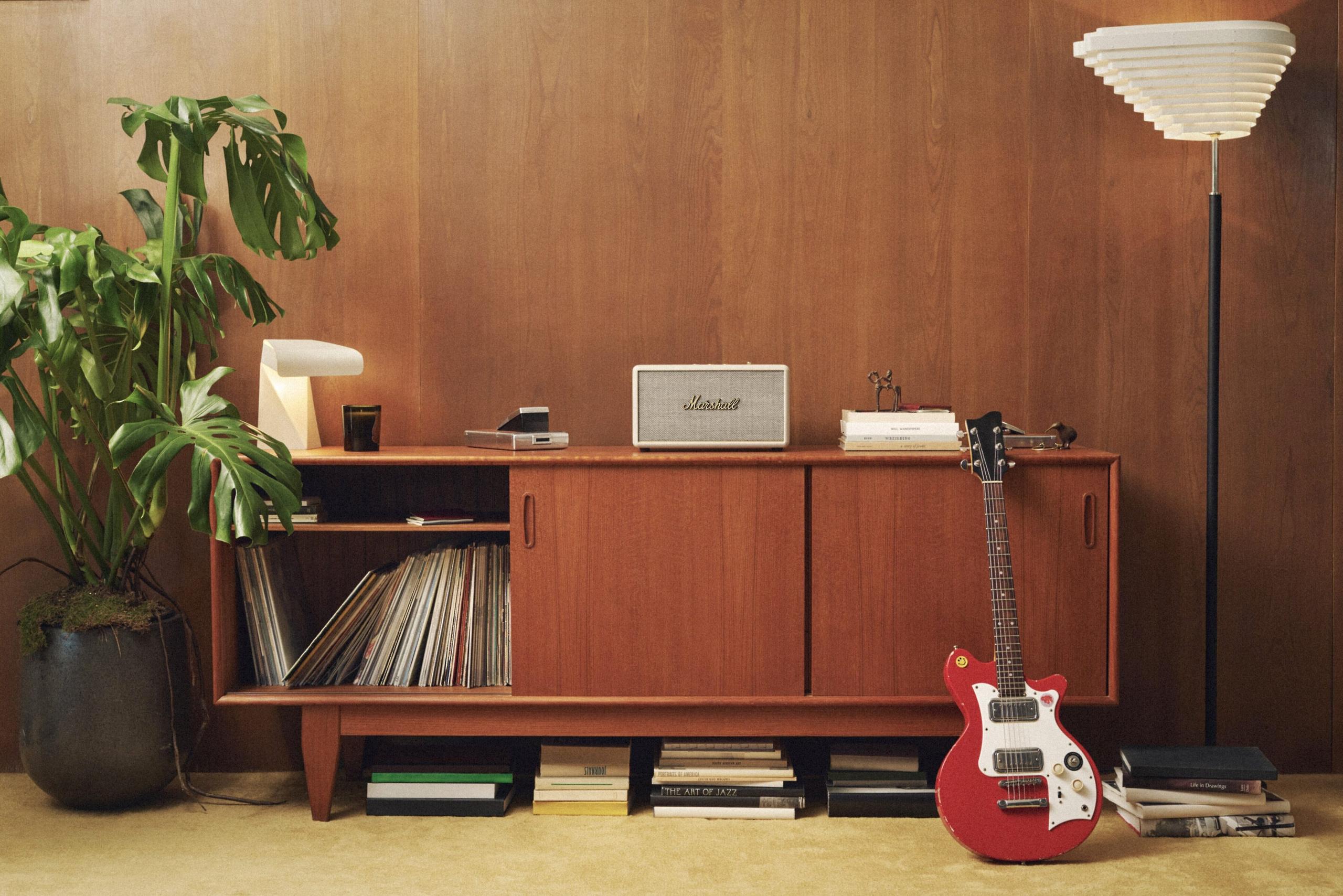
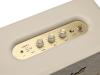
The build quality is exceptional, reflecting Marshall's premium positioning. The wooden cabinet, wrapped in vegan leather, provides excellent acoustic properties while maintaining the classic Marshall aesthetic. Those signature gold details and analog control knobs aren't just for show - they provide a tactile, intuitive user experience that digital controls often lack.
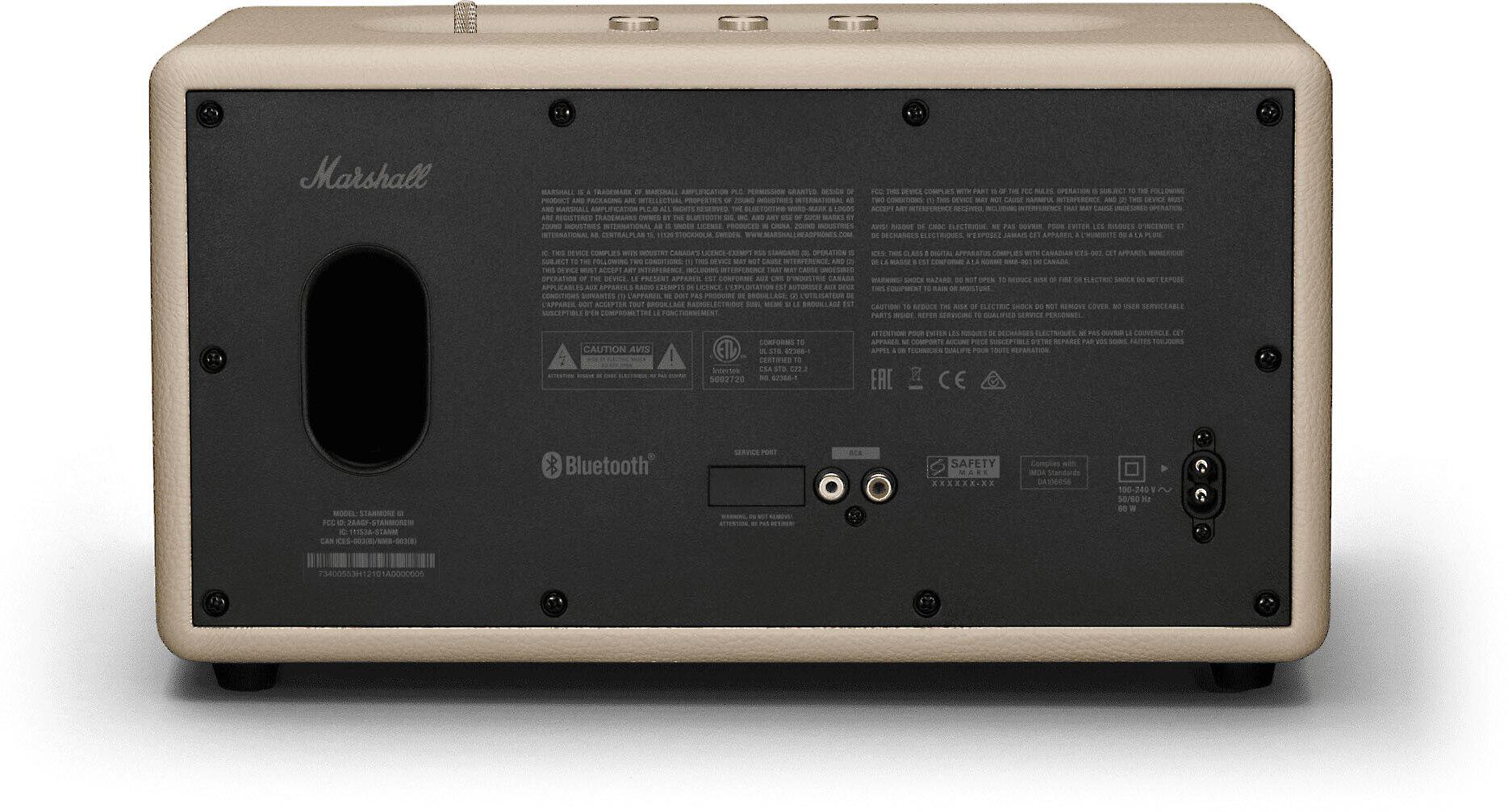
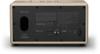
Bluetooth 5.2 implementation allows for stable connections up to 30 feet and supports connecting two devices simultaneously - a feature I've found invaluable when sharing DJ duties during gatherings. The inclusion of both 3.5mm aux and RCA inputs makes this speaker versatile enough to integrate into various setups, including home theater systems.
While primarily designed for music, the Stanmore III can serve as a capable TV speaker. The RCA inputs allow direct connection to most TVs, and the speaker's powerful output ensures clear dialogue and impactful sound effects. However, remember this is a stereo speaker - for true surround sound, you'd need additional components.
The Marshall Bluetooth app (available for iOS 14.0+ and Android 7.0+) provides additional control options and EQ presets. While not as feature-rich as some competitors' apps, it handles the basics well and enables over-the-air updates to keep your speaker current with the latest improvements.
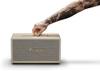
In daily use, the Stanmore III proves itself as a versatile performer. Whether it's providing background music during work hours, serving as the main audio system for movie nights, or powering a small party, the speaker delivers consistently impressive results. The physical controls are a particular highlight - adjusting volume or tweaking EQ settings feels more natural than fumbling with a phone app.
At $399, the Stanmore III sits in a competitive price bracket. However, its combination of audio quality, build materials, and feature set justifies the investment. The speaker's ability to handle various audio sources and its future-proof design (thanks to OTA updates) means it should serve well for years to come.
Marshall's commitment to sustainability shows in the Stanmore III's construction. The use of recycled plastics and vegan materials doesn't compromise the premium feel but does reduce environmental impact. This approach to manufacturing sets a positive example for the industry.
The Stanmore III is ideal for:
While impressive overall, there are some considerations:
After extensive testing across various scenarios, the Marshall Stanmore III stands out as a compelling option in the premium home speaker market. Its blend of classic design, modern features, and impressive audio performance makes it a worthy investment for anyone serious about their home audio setup.
The speaker successfully bridges the gap between vintage charm and contemporary functionality, delivering room-filling sound that adapts to your listening preferences. While not the cheapest option available, its build quality, sound performance, and sustainable approach to manufacturing make it a purchase you can feel good about.
For those wondering if it's worth the upgrade from the Stanmore II - if you value improved Bluetooth connectivity, enhanced bass response, and eco-friendly construction, then yes, the improvements are meaningful enough to justify the switch. Whether you're a music enthusiast, movie lover, or just someone who appreciates quality audio, the Stanmore III delivers on its premium promises.
Yes, the Marshall Stanmore III ($399) offers excellent value for its price point, delivering premium sound quality, robust build, and versatile connectivity options. Its combination of powerful audio output and classic design makes it a worthy investment for both music and home theater use.
Yes, the Marshall Stanmore III can connect to your TV using either the RCA inputs or 3.5mm aux connection. While it won't provide surround sound, its powerful 80-watt system delivers clear dialogue and impressive sound effects for enhanced TV viewing.
The speaker measures 13.8" × 8.1" × 8.4" and performs best when placed at least 6 inches from walls. It's ideal for rooms up to 400 square feet, making it suitable for most living rooms and home theater setups.
Yes, thanks to Bluetooth 5.2, the Marshall Stanmore III can maintain active connections with two devices simultaneously, allowing easy switching between sources without re-pairing.
While Sonos focuses on multi-room audio and smart features, the Stanmore III prioritizes sound quality and traditional controls. It offers better bass response and higher maximum volume than similarly priced Sonos speakers, though it lacks their advanced networking capabilities.
Yes, the Marshall Bluetooth app (iOS/Android) allows remote control of volume, EQ settings, and source selection. However, the speaker also features intuitive physical controls for direct adjustment.
Yes, its powerful bass response and clear high frequencies make it excellent for movie watching. The 50-watt woofer ensures impactful explosions and sound effects, while the dual tweeters provide clear dialogue reproduction.
Yes, this is a powered speaker that requires constant AC power - it's designed for permanent home setup rather than portable use. This allows for its high power output and superior sound quality.
The Marshall Stanmore III maintains a stable Bluetooth connection up to 30 feet indoors, though this can vary depending on walls and other obstacles between the speaker and source device.
No, the Marshall Stanmore III doesn't have built-in voice assistant capabilities. However, you can use voice commands through a connected device like a smartphone or smart TV.
We've done our best to create useful and informative comparisons to help you decide what product to buy. Our research has used advanced automated methods to create this comparison and perfection is not possible - please contact us for corrections or questions. These are the sites we've researched in the creation of this article: techgadgetscanada.com - camelcamelcamel.com - crutchfield.com - bestbuy.com - dxomark.com - crutchfield.com - crutchfield.com - marshall.com - marshall-production-1.mobify-storefront.com - exhibit.tech - ooberpad.com - av-connection.com
| Marshall Stanmore III - $399 |
|---|
| Total Power Output - Determines overall volume capability and headroom: 80 watts combined |
| Amplification Configuration - Affects sound clarity and balance: 50W woofer + 2x15W tweeters |
| Bluetooth Version - Impacts connection stability and range: 5.2 with multi-host support |
| Frequency Response - Defines the range of sounds it can reproduce: 45-20,000 Hz |
| Maximum SPL - Indicates how loud the speaker can get: 97 dB at 1 meter |
| Driver Configuration - Determines sound quality and dispersion: 5" woofer + 2x 0.75" tweeters |
| Wireless Range: ~30 feet |
| Input Options: Bluetooth, 3.5mm aux, RCA stereo |
| Dynamic Loudness - Ensures balanced sound at all volume levels: Yes |
| Dimensions: 13.8" × 8.1" × 8.4" |
| Weight: 9.37 lbs |
| App Control - Enables remote adjustments and updates: iOS 14.0+/Android 7.0+ |
| Construction - Important for sustainability: 70% recycled plastic, PVC-free |
| Warranty: 1 year |
The Morel BIGGIE ($299) takes a distinctly different approach with its portable, weather-resistant design and impressive 165-foot Bluetooth range. While it can't match the Stanmore III's room-filling sound, it delivers surprising audio quality from its compact frame, powered by 60 watts of Class D amplification. The BIGGIE's IP67 rating and 20-hour battery life make it incredibly versatile, capable of handling both indoor and outdoor environments with ease. Its True Wireless Stereo feature also allows pairing with a second unit for proper stereo sound, something the Stanmore III doesn't offer.
Where the BIGGIE really shines is in its flexibility and durability. The rugged construction and portability make it an excellent choice for those who want quality sound across multiple locations without compromising on audio performance. While it may not deliver quite the same bass response or soundstage width as the Stanmore III, its 40-20,000 Hz frequency response and powerful amplification provide remarkably balanced sound for its size. At $80 less than the Stanmore III, it represents solid value for users prioritizing versatility over maximum audio output, especially considering its weather resistance and battery-powered convenience.
🤖 Read Detailed Comparison
👌Morel BIGGIE Portable Bluetooth Speaker Details
💵 See Morel BIGGIE Portable Bluetooth Speaker Price
For those considering alternatives, the Ultimate Ears WONDERBOOM 4 at $99.99 offers a completely different approach to wireless audio. While it can't match the Stanmore III's room-filling sound or bass response, it excels in portability and durability with its compact size and IP67 waterproof rating. The WONDERBOOM 4's 360-degree sound projection and specialized outdoor boost mode make it particularly effective for outdoor gatherings, and its 14-hour battery life ensures it can last through extended use away from power outlets.
Where the Stanmore III focuses on premium home audio, the WONDERBOOM 4 prioritizes versatility and convenience. Its ability to float in water, survive drops, and pair with a second unit for stereo sound makes it an excellent choice for those who prioritize portability over absolute sound quality. While it serves a different purpose than the Stanmore III, it represents excellent value in the portable speaker category, especially for users who need a durable audio solution they can take anywhere.
🤖 Read Detailed Comparison
👌Ultimate Ears WONDERBOOM 4 Portable Bluetooth Speaker Details
💵 See Ultimate Ears WONDERBOOM 4 Portable Bluetooth Speaker Price
The Ultimate Ears MINIROLL takes a completely different approach to audio, prioritizing portability and durability over pure sound quality. At just 279 grams with IP67 waterproofing, it's designed for active lifestyles and outdoor adventures where the Stanmore III simply couldn't go. Its 12-hour battery life and integrated strap make it a versatile companion for everything from beach trips to hiking, while its PartyUp feature allows multiple speakers to be connected for expanded sound coverage at outdoor gatherings.
While it can't match the Stanmore III's room-filling power or audio fidelity, the MINIROLL delivers impressive performance for its compact size. The 86dB maximum volume is plenty for personal listening or small group settings, and the 360-degree sound design ensures everyone gets the same audio experience regardless of position. At $58.95, it represents excellent value for those needing a robust portable speaker, though it's best viewed as a complement to rather than a replacement for a dedicated home audio solution like the Stanmore III.
🤖 Read Detailed Comparison
👌Ultimate Ears MINIROLL Ultra-Portable Bluetooth Speaker Details
💵 See Ultimate Ears MINIROLL Ultra-Portable Bluetooth Speaker Price
The Soundcore Boom 2 SE ($99) takes a completely different approach to portable audio, offering impressive versatility at a fraction of the Stanmore III's price. Its standout features include IPX7 waterproofing, 24-hour battery life, and the ability to connect up to 100 speakers through PartyCast 2.0. While it can't match the Stanmore III's audio refinement, its 30W output and BassUp 2.0 technology deliver surprisingly powerful sound that works especially well outdoors where traditional speakers struggle. The addition of a built-in power bank feature and beat-synchronized LED light show adds practical and entertainment value that the Stanmore III doesn't offer.
For those prioritizing portability and durability over absolute sound quality, the Boom 2 SE represents exceptional value. Its robust feature set, including the latest Bluetooth 5.3 technology with extended range, makes it a more practical choice for active users who want a speaker that can transition seamlessly from backyard parties to beach outings. While it lacks the Stanmore III's premium materials and sophisticated sound staging, it delivers where it matters most for portable use - reliable performance, weather resistance, and enough volume to fill outdoor spaces with energetic sound.
🤖 Read Detailed Comparison
👌Soundcore Boom 2 SE Portable Bluetooth Speaker Details
💵 See Soundcore Boom 2 SE Portable Bluetooth Speaker Price
The Soundcore BOOM 2 takes a dramatically different approach at just $129.99, focusing on portability and versatility rather than premium audio reproduction. Its standout features include IPX7 waterproofing, 24-hour battery life, and the ability to connect with up to 100+ additional speakers through PartyCast 2.0. While it matches the Stanmore III's 80W power output (when BassUp 2.0 is engaged), the sound signature is optimized for outdoor environments with an emphasis on powerful bass and volume projection rather than nuanced audio detail.
For those prioritizing flexibility over absolute sound quality, the Soundcore BOOM 2 offers compelling value with its extensive feature set. The built-in light show, extended 328-foot Bluetooth range, and power bank functionality make it an excellent choice for outdoor gatherings and mobile use. While it can't match the Stanmore III's refined soundstage and premium build quality, it delivers impressive performance for its price point and serves as a more practical option for users who need a speaker that can transition seamlessly between indoor and outdoor environments.
🤖 Read Detailed Comparison
👌soundcore BOOM 2 Portable Bluetooth Speaker Details
💵 See soundcore BOOM 2 Portable Bluetooth Speaker Price
The Sony XE200 ($129.99) takes a completely different approach to Bluetooth audio, focusing on portability and versatility rather than pure sound quality. Its standout features include IP67 water and dust resistance, 16-hour battery life, and innovative Line-Shape Diffuser technology that helps distribute sound more evenly in outdoor spaces. The speaker's compact design, weighing just 1.76 pounds, makes it easy to carry anywhere, while its rugged construction handles the rigors of outdoor use. The ability to link multiple speakers through Party Connect and quick-charging capability (70 minutes of playback from a 10-minute charge) add significant practical value for active users.
While the XE200 can't match the Stanmore III's room-filling sound or bass response, it delivers impressive audio quality for its size, particularly in outdoor settings where traditional speakers often struggle. The $250 price difference between these speakers reflects their different design philosophies - the XE200 trades some audio performance for exceptional versatility and durability. For users who prioritize portability and weather resistance over maximum sound quality, or those looking for a speaker that can transition seamlessly between indoor and outdoor use, the XE200 offers compelling value and practical benefits that the Stanmore III simply wasn't designed to provide.
🤖 Read Detailed Comparison
👌Sony XE200 Portable Bluetooth Speaker Details
💵 See Sony XE200 Portable Bluetooth Speaker Price
The Sonos Roam 2 takes a fundamentally different approach, focusing on portability and smart features rather than pure audio power. At $161.10, it offers impressive versatility with its IP67 water resistance, 10-hour battery life, and integration with the broader Sonos ecosystem. While it can't match the Stanmore III's room-filling sound, it compensates with features like Auto TruePlay tuning that automatically adjusts audio output based on its environment, plus voice assistant support and multi-room audio capabilities through WiFi connectivity.
For those considering both speakers, the choice really comes down to intended use case rather than direct performance comparison. The Sonos Roam 2 excels as a versatile portable speaker that can seamlessly transition from bathroom to backyard to beach, while still delivering surprisingly good sound quality for its size. Its ability to integrate with other Sonos speakers and smart home systems makes it a compelling choice for those who value flexibility and features over maximum audio performance. However, if you're primarily looking for a powerful home speaker for a dedicated listening space, the Stanmore III's superior sound quality and power make it the better choice despite its higher price point.
🤖 Read Detailed Comparison
👌Sonos Roam 2 Portable Speaker Details
💵 See Sonos Roam 2 Portable Speaker Price
The Sony XE300 takes a fundamentally different approach, focusing on portability and versatility rather than pure audio power. Its standout features include IP67 water and dust resistance, 24-hour battery life, and innovative Line-Shape Diffuser technology that helps distribute sound more evenly in outdoor spaces. For users prioritizing mobility, the XE300's compact size and durability make it a compelling choice at $199.99, especially considering its quick-charging capability that provides 70 minutes of playback from just a 10-minute charge.
While the XE300 can't match the Stanmore III's room-filling sound or deep bass response, it offers impressive audio quality for its size. The Sony XE300 shines in scenarios where portability matters most - whether it's moving from room to room, entertaining outdoors, or traveling. Its Party Connect feature, allowing synchronization with up to 100 compatible speakers, adds extra versatility that the Stanmore III doesn't offer. For those who need a speaker that can handle various environments and use cases, the XE300 delivers excellent value, even though it serves a different primary purpose than the Stanmore III's focused home audio role.
🤖 Read Detailed Comparison
👌Sony XE300 Portable Bluetooth Speaker Details
💵 See Sony XE300 Portable Bluetooth Speaker Price
The Sony XB100 ($59.99) takes a fundamentally different approach, focusing on portability and durability rather than pure audio performance. Its standout features include IP67 water and dust resistance, 16-hour battery life, and an ultra-compact design weighing just 0.6 pounds. While it can't match the Stanmore III's room-filling sound or bass response, Sony's Sound Diffusion Processor helps create surprisingly full audio from its small frame, making it more than capable for personal listening or small group settings.
For about one-sixth the price of the Stanmore III, the XB100 delivers impressive value for those needing a go-anywhere speaker. Its ability to pair with a second unit for stereo sound, combined with its weatherproof construction and included carry strap, makes it an ideal companion for outdoor activities, travel, or casual listening. While these speakers serve different purposes, the XB100's practical features and solid sound quality make it a compelling option for users prioritizing portability over premium audio performance.
🤖 Read Detailed Comparison
👌Sony XB100 Compact Bluetooth Speaker Details
💵 See Sony XB100 Compact Bluetooth Speaker Price
The Marshall Willen II takes a completely different approach as a portable speaker, excelling in situations where the Stanmore III wouldn't make sense. With its IP67 waterproof rating, 17+ hour battery life, and ultra-compact design weighing less than a pound, it's built for adventure. The rubber mounting strap proves surprisingly useful, allowing secure attachment to bike handlebars, backpack straps, or tent poles. While its 38W amplifier and single full-range driver can't match the Stanmore III's room-filling power, it delivers impressive sound quality for its size, particularly in outdoor settings where portability matters more than pure volume.
At $119.99, the Willen II offers excellent value for those needing a durable portable speaker. Its newer Bluetooth 5.3 LE technology provides better range and stability than the Stanmore III, and the upcoming Auracast support promises interesting multi-speaker possibilities. Despite its compact size, the Marshall Willen II manages to maintain the signature Marshall sound profile, just in a more portable package. It's best viewed not as a competitor to the Stanmore III but as a complementary device for different use cases - many users might benefit from having both speakers to cover all their audio needs.
🤖 Read Detailed Comparison
👌Marshall Willen II Portable Bluetooth Speaker Details
💵 See Marshall Willen II Portable Bluetooth Speaker Price
While our review focuses on the Stanmore III, it's worth considering how the Marshall Emberton III ($169) offers a different take on Marshall's signature sound. This compact portable speaker brings impressive features like IP67 water resistance, 32-hour battery life, and True Stereophonic 360-degree sound technology. The Emberton III's rugged design and quick-charging capability (6 hours of playback from a 20-minute charge) make it ideal for outdoor adventures and travel, while its built-in microphone adds hands-free calling functionality.
However, these products serve fundamentally different purposes. Where the Stanmore III excels as a powerful home speaker with multiple inputs and room-filling sound, the Emberton III prioritizes portability and durability over maximum audio performance. Its dual 2-inch drivers can't match the Stanmore III's bass response or overall volume, but they deliver surprisingly balanced sound for a speaker of this size. If you're primarily looking for a home audio solution, stick with the Stanmore III. But if you need a versatile portable speaker that can handle any environment while maintaining Marshall's signature sound quality, the Emberton III offers excellent value at less than half the price.
🤖 Read Detailed Comparison
👌Marshall Emberton III Portable Bluetooth Speaker Details
💵 See Marshall Emberton III Portable Bluetooth Speaker Price
For those considering a more portable Marshall option, the Emberton II ($169.99) takes a dramatically different approach with its compact, waterproof design and impressive 30-hour battery life. While it can't match the Stanmore III's room-filling sound or deep bass response, its True Stereophonic technology creates surprisingly immersive 360-degree audio that works well for outdoor gatherings or moving between rooms. The ability to survive full water submersion with its IP67 rating and quick-charge feature (20 minutes for 4 hours of playback) makes it a versatile companion for outdoor adventures.
At less than half the price of the Stanmore III, the Emberton II represents excellent value for those prioritizing portability over maximum sound quality. Its Stack Mode feature allows wireless pairing with other Emberton II speakers for larger gatherings, and the simplified single-knob control system proves intuitive in real-world use. While it lacks the physical EQ controls and multiple input options of its larger sibling, the Emberton II's focus on durability and mobility makes it a compelling choice for listeners who want Marshall quality in a go-anywhere format.
🤖 Read Detailed Comparison
👌Marshall Emberton II Portable Bluetooth Speaker Details
💵 See Marshall Emberton II Portable Bluetooth Speaker Price
The JBL Go 4 ($44.00) takes a completely different approach to Bluetooth audio, focusing on ultra-portability and durability rather than premium sound quality. At just 0.42 pounds and small enough to fit in a pocket, it offers impressive flexibility with its IP67 water and dust resistance rating, making it suitable for outdoor adventures where the Stanmore III simply couldn't go. The Go 4's 7-hour battery life and Auracast multi-speaker support add to its versatility, while its single 4.2W driver delivers surprisingly clear audio for its compact size.
While it can't match the Stanmore III's room-filling sound or deep bass response, the JBL Go 4 serves as an excellent complementary speaker for different use cases. Its incredibly affordable price point makes it a practical second speaker for outdoor activities, travel, or casual listening in spaces where the Stanmore III's premium features would be overkill. The Go 4's emphasis on durability and portability over absolute sound quality makes perfect sense for its intended use, and its modern features like Bluetooth 5.3 and app-based EQ controls ensure it remains technically competitive despite its budget-friendly price.
🤖 Read Detailed Comparison
👌JBL Go 4 Portable Bluetooth Speaker Details
💵 See JBL Go 4 Portable Bluetooth Speaker Price
The JBL Flip 6 takes a completely different approach to personal audio, focusing on portability and durability rather than raw power. At just 1.21 pounds with IP67 waterproofing, it's designed for versatile use anywhere - from shower listening to beach parties. While its 30-watt system (20W woofer + 10W tweeter) can't match the Stanmore III's room-filling sound, it delivers impressive audio quality for its compact size. The addition of dual passive radiators helps produce surprisingly robust bass, and the dedicated tweeter ensures clear high frequencies even at higher volumes.
At $129.99, the Flip 6 represents excellent value for those needing a truly portable speaker. Its 12-hour battery life, PartyBoost feature for connecting multiple speakers, and rugged design make it ideal for active lifestyles. While it lacks the Stanmore III's multiple input options and detailed sound staging, the JBL Flip 6 excels in its intended role as a go-anywhere speaker that can handle whatever life throws at it. The trade-off between portability and audio performance is well-balanced, making it a compelling choice for users who prioritize versatility over absolute sound quality.
🤖 Read Detailed Comparison
👌JBL Flip 6 Portable Waterproof Speaker Details
💵 See JBL Flip 6 Portable Waterproof Speaker Price
The Stockwell II ($149) takes a different approach as Marshall's portable option, offering impressive features for mobile use including 20+ hours of battery life and IPX4 water resistance. While it can't match the Stanmore III's room-filling sound, its compact design and two 2.25" full-range drivers with passive radiators deliver surprisingly capable audio for its size. The multi-directional sound design helps create a wider listening area, making it particularly effective for outdoor gatherings or moving between rooms, and the quick-charge feature providing 6 hours of play from just 20 minutes of charging adds genuine practical value.
Where the Stockwell II really shines is in its versatility and value proposition. At less than half the price of the Stanmore III, it serves as both a portable speaker and a capable desktop audio solution. The physical control knobs maintain Marshall's signature style while providing easy audio adjustment on the go, and though it lacks app control, the straightforward Bluetooth 5.0 connectivity proves reliable up to 30 feet. For users who prioritize mobility over maximum audio performance, the Stockwell II offers an compelling balance of sound quality, portability, and durability that makes it a worthy alternative to its more powerful sibling.
🤖 Read Detailed Comparison
👌Marshall Stockwell II Portable Bluetooth Speaker Details
💵 See Marshall Stockwell II Portable Bluetooth Speaker Price
The JBL Flip 5 takes a completely different approach to portable audio, focusing on durability and mobility rather than pure sound quality. At just $79.95, it delivers impressive performance for its size, featuring IPX7 waterproofing, 12-hour battery life, and a rugged design that can handle outdoor adventures. While its 20W single-driver system can't match the Stanmore III's room-filling sound, it produces clear, punchy audio that works well for outdoor gatherings, travel, and personal listening. The PartyBoost feature also allows connecting multiple JBL speakers together, expanding its versatility for larger spaces.
For those considering both speakers, it's important to understand they serve fundamentally different purposes. The JBL Flip 5 excels as a grab-and-go solution that can withstand rain, pool splashes, and beach trips while delivering reliable sound quality. It's not meant to replace a premium home speaker like the Stanmore III, but rather complement it - many users might find value in owning both to cover different use cases. The Flip 5's significantly lower price point and portable design make it an excellent second speaker for outdoor activities or travel, while the Stanmore III handles primary home audio duties.
🤖 Read Detailed Comparison
👌JBL Flip 5 Portable Speaker Details
💵 See JBL Flip 5 Portable Speaker Price
The JBL Clip 5 takes a radically different approach to wireless audio, focusing on ultimate portability and durability rather than room-filling sound. At just 0.63 pounds with an integrated carabiner clip and IP67 waterproofing, it's designed for active lifestyles and outdoor adventures where the Stanmore III simply couldn't go. While it can't match the Stanmore's audio prowess, it delivers surprisingly clear mids and highs from its single driver design, making it ideal for personal listening at ranges up to 10 feet. The 12-hour battery life and recent addition of Auracast multi-speaker support add to its versatility.
At $57, the JBL Clip 5 represents a different value proposition entirely. Rather than competing with the Stanmore III's premium home audio experience, it excels as a go-anywhere companion for activities like hiking, beach trips, or shower listening where durability matters more than audiophile-grade sound. Its streamlined Bluetooth-only connectivity and basic controls match its portable mission, while features like multi-point pairing allow two devices to stay connected simultaneously. For users seeking portable audio without sacrificing too much sound quality, it hits a sweet spot of performance and practicality at a fraction of the Stanmore's price.
🤖 Read Detailed Comparison
👌JBL Clip 5 Portable Bluetooth Speaker Details
💵 See JBL Clip 5 Portable Bluetooth Speaker Price
When comparing other Bluetooth speaker options, the JBL Clip 4 ($33.20) stands out for its radically different approach to portable audio. While the Stanmore III excels as a premium home speaker, the Clip 4 tackles the challenge of delivering quality sound in an ultra-portable package. Its IP67 waterproof and dustproof rating, integrated carabiner clip, and 10-hour battery life make it ideal for outdoor adventures where the Stanmore III simply couldn't go. The Clip 4's compact size and lightweight 0.53-pound design allow it to easily attach to backpacks, belt loops, or beach chairs, while still delivering clear, punchy audio that cuts through outdoor ambient noise.
At just under $35 (currently discounted from its original $79.95 price), the Clip 4 serves as a compelling complementary speaker rather than a direct competitor to the Stanmore III. While it can't match the room-filling sound or bass response of its larger cousin, the JBL Clip 4 excels in situations where portability and durability take priority over pure audio performance. For outdoor enthusiasts, travelers, or anyone needing a robust portable speaker, the Clip 4's value proposition is clear - it delivers reliable, good-quality sound in a practically indestructible package that can go anywhere.
🤖 Read Detailed Comparison
👌JBL Clip 4 Portable Bluetooth Speaker Details
💵 See JBL Clip 4 Portable Bluetooth Speaker Price
While the JBL Charge 5 ($179) serves a completely different use case, it's worth comparing as many buyers consider both options. The JBL excels in portability and durability, featuring an IP67 waterproof rating that makes it perfect for outdoor activities, pool parties, and travel. Its 20-hour battery life and ability to charge other devices through its USB port add significant real-world utility, while the PartyBoost feature allows connection to other JBL speakers for expanded sound coverage. The compact size (8.7 x 3.8 x 3.7 inches) and lightweight design (2.11 lbs) make it truly portable without sacrificing too much sound quality.
In terms of audio performance, the JBL Charge 5 delivers impressive sound for its size, though it naturally can't match the Stanmore III's room-filling capabilities. The 40-watt system provides clear mids and surprisingly punchy bass, making it more than adequate for outdoor gatherings and personal listening. While it lacks the auxiliary inputs and advanced EQ controls of the Stanmore III, its combination of durability, portability, and sound quality makes it an excellent value at less than half the price - especially for those prioritizing versatility over maximum audio fidelity.
🤖 Read Detailed Comparison
👌JBL Charge 5 Portable Waterproof Speaker Details
💵 See JBL Charge 5 Portable Waterproof Speaker Price
The Bose SoundLink Micro ($99) takes a completely different approach to wireless audio, focusing on ultra-portability and durability rather than room-filling sound. At just 0.68 pounds with IP67 waterproofing, it's designed for adventures where the Stanmore III wouldn't dare venture. Its tear-resistant strap and robust silicone exterior make it perfect for attaching to backpacks, bike handlebars, or beach chairs, while its 6-hour battery life ensures music throughout the day. The speaker particularly excels in near-field listening situations, delivering surprisingly clear vocals and balanced sound for its tiny size.
While it can't match the Stanmore III's power or bass response, the SoundLink Micro serves as an excellent complementary speaker for active users who need music on the go. Its speakerphone functionality and voice assistant integration add practical value, while its compact size makes it an easy travel companion. Though newer competitors offer features like USB-C charging and longer battery life, the SoundLink Micro's combination of durability, sound quality, and portability continues to make it a strong choice in the sub-$100 portable speaker category.
🤖 Read Detailed Comparison
👌Bose SoundLink Micro Bluetooth Speaker Details
💵 See Bose SoundLink Micro Bluetooth Speaker Price
The Bose SoundLink Max offers a distinctly different approach to wireless audio with its focus on portability and versatility. While it can't match the Stanmore III's raw power and deep bass extension, it compensates with impressive features like IP67 water resistance, 20-hour battery life, and the ability to charge other devices via USB-C. The newest Bluetooth 5.4 technology, combined with Snapdragon Sound and Google Fast Pair, makes it notably more advanced in terms of connectivity. Its more compact size and included carrying handle make it a genuinely portable option that can move from room to room or transition seamlessly to outdoor use.
At $399, the Bose SoundLink Max represents strong value for those needing flexibility in their speaker system. While it may not deliver the same room-filling sound as the Stanmore III, its audio quality remains impressive for its size, particularly in delivering clear, balanced sound that works well in various environments. The addition of modern features like SimpleSync for connecting with other Bose speakers and the ability to serve as a power bank for other devices adds genuine utility that many users will appreciate. The choice between these speakers ultimately comes down to intended use - the Stanmore III excels as a powerful, dedicated home speaker, while the SoundLink Max offers remarkable versatility for those who need their music both at home and on the go.
🤖 Read Detailed Comparison
👌Bose SoundLink Max Portable Bluetooth Speaker Details
💵 See Bose SoundLink Max Portable Bluetooth Speaker Price
The Bose SoundLink Flex ($149) takes a dramatically different approach, focusing on portability and durability rather than raw power. With its IP67 waterproof rating, compact 1.3-pound design, and 12-hour battery life, it serves as a versatile companion for outdoor activities and travel. The speaker's standout PositionIQ technology automatically adjusts audio output based on orientation, ensuring consistent sound quality whether it's standing upright, lying flat, or hanging from its utility loop. While it can't match the Stanmore III's room-filling power, it delivers impressive audio clarity and surprisingly robust bass for its size.
For those seeking a more flexible audio solution, the Bose SoundLink Flex offers compelling value at less than half the price of the Stanmore III. Its rugged construction withstands drops and environmental challenges, while features like speakerphone functionality and Party Mode pairing with other Bose speakers expand its versatility. Though it lacks the multiple input options and physical controls of the Stanmore III, its simplicity and portability make it an excellent choice for users who prioritize mobility over maximum audio power. The tradeoff comes mainly in sound output and bass response, but these compromises are reasonable given its intended use case and price point.
🤖 Read Detailed Comparison
👌Bose SoundLink Flex Portable Bluetooth Speaker Details
💵 See Bose SoundLink Flex Portable Bluetooth Speaker Price
The Beats Pill ($129) takes a completely different approach, focusing on portability and modern features rather than raw audio power. With its IP67 water resistance, 24-hour battery life, and ability to charge other devices via USB-C, it's designed for versatile on-the-go use. The speaker's upward-angled drivers and redesigned woofer deliver impressive sound for its compact size, though it naturally can't match the Stanmore III's room-filling power and deep bass response.
For those prioritizing mobility over maximum audio quality, the Beats Pill offers compelling value at about one-third the price of the Stanmore III. Its modern features like Find My device tracking, speakerphone capability, and robust weather resistance make it a practical choice for outdoor activities, travel, or moving between rooms. While it serves a different purpose than the Stanmore III, it excels in its intended role as a portable audio solution that balances sound quality with convenience.
🤖 Read Detailed Comparison
👌Beats Pill Portable Bluetooth Speaker Details
💵 See Beats Pill Portable Bluetooth Speaker Price
While the Anker Soundcore Mini ($44.74) operates in a completely different category than the Stanmore III, it offers remarkable versatility for its ultra-compact size. At just 200g and featuring a 15-hour battery life, it delivers surprisingly capable audio performance through its 5W driver and passive subwoofer. The inclusion of multiple input options - Bluetooth 4.0, aux input, microSD card playback, and even FM radio - makes it an exceptionally flexible choice for travelers or those seeking a portable audio solution.
However, direct sound quality comparisons wouldn't be fair given the vast difference in size, power, and price point. Where the Soundcore Mini excels is in its value proposition and portability. At less than one-eighth the price of the Stanmore III, it serves well as a personal speaker for desktop use, travel, or outdoor activities. The Soundcore Mini proves especially useful as a secondary speaker when room-filling sound isn't necessary, though buyers should understand its limitations - it won't replace a primary home audio system or power a large gathering like the Stanmore III can.
🤖 Read Detailed Comparison
👌Anker Soundcore Mini Portable Bluetooth Speaker Details
💵 See Anker Soundcore Mini Portable Bluetooth Speaker Price
The Bose SoundLink Flex 2nd Gen ($149) takes a completely different approach to wireless audio, prioritizing portability and durability over raw power. With its IP67 waterproof rating, 12-hour battery life, and compact 1.3-pound design, it's built for versatility and on-the-go use. The speaker's PositionIQ technology automatically optimizes sound based on orientation, ensuring consistent audio quality whether it's standing upright, lying flat, or hanging from its utility loop. While it can't match the Stanmore III's room-filling power, it delivers impressively balanced sound for its size, with clear vocals and respectable bass response that works well for personal or small group listening.
At less than half the price of the Stanmore III, the Bose SoundLink Flex 2nd Gen offers excellent value for those needing a more versatile audio solution. Its combination of durability, portable design, and reliable sound quality makes it ideal for users who want good audio across multiple environments. While it serves a different purpose than the Stanmore III's home audio focus, the SoundLink Flex 2nd Gen excels in its intended role as a go-anywhere speaker that can handle everything from shower singing to beach parties, all while maintaining Bose's reputation for balanced, natural sound reproduction.
🤖 Read Detailed Comparison
👌Bose SoundLink Flex 2nd Gen Portable Bluetooth Speaker Details
💵 See Bose SoundLink Flex 2nd Gen Portable Bluetooth Speaker Price
The Anker Soundcore 2 takes a completely different approach as a portable speaker, excelling in versatility and value at just $45. Its standout features include IPX7 waterproofing, 24-hour battery life, and a remarkably compact 11.2-ounce design that fits easily in any bag. While it can't match the Stanmore III's room-filling sound, its dual 6-watt drivers and passive radiator deliver surprisingly balanced audio that works well for personal listening or small gatherings. The speaker's durability and weather resistance make it ideal for outdoor activities, travel, and environments where the Stanmore III simply couldn't function.
For those seeking maximum portability and value over premium audio quality, the Soundcore 2 makes a compelling case. Its clear, distortion-free sound holds up well at both low and high volumes, though it naturally lacks the deep bass response and sound separation of the Stanmore III's dedicated woofer-tweeter system. The Soundcore 2's simplified feature set - basic Bluetooth 4.2 connectivity and 3.5mm aux input - focuses on reliability over complexity, making it an excellent choice for users who prioritize convenience and durability in their audio solution. While it serves a completely different use case than the Stanmore III, it excels within its intended purpose as a go-anywhere portable speaker.
🤖 Read Detailed Comparison
👌Anker Soundcore 2 Portable Bluetooth Speaker Details
💵 See Anker Soundcore 2 Portable Bluetooth Speaker Price
The Soundcore Motion X600 ($199) stands out with its mobility-first design and modern feature set, offering compelling value at nearly half the price of the Stanmore III. While it can't match the Stanmore's raw power, its sophisticated spatial audio system and upward-firing driver create an impressively immersive soundstage that feels larger than the speaker's compact size would suggest. The inclusion of LDAC codec support and IPX7 waterproofing makes it a versatile choice for both high-quality indoor listening and worry-free outdoor use, while its 12-hour battery life ensures all-day performance.
For buyers choosing between these speakers, the decision largely comes down to intended use case and priorities. The Motion X600 excels as a portable solution with its aluminum handle, modern design, and ability to move from room to room or outdoors. While it offers less power than the Stanmore III, its advanced features like spatial audio and comprehensive 9-band EQ provide excellent sound customization options. The significantly lower price point makes it an attractive option for those who value flexibility and modern features over maximum power output and classic styling.
🤖 Read Detailed Comparison
👌Soundcore Motion X600 Portable Bluetooth Speaker Details
💵 See Soundcore Motion X600 Portable Bluetooth Speaker Price
While the Sony LinkBuds Speaker ($179.99) takes a completely different approach to home audio, it offers compelling features for users who prioritize flexibility over raw audio performance. Its standout innovations include seamless Auto Switch technology that transitions audio between LinkBuds earbuds and the speaker, Quick Access controls for favorite music services, and IPX4 water resistance for worry-free use in spaces like kitchens or bathrooms. The compact size (just 1.69" x 2.36" x 1.09") and impressive 25-hour battery life make it an excellent choice for those who want quality audio across multiple rooms or outdoor spaces.
When compared to the Marshall's room-filling sound and permanent installation approach, the Sony focuses on modern connectivity and portability at a more accessible price point. While it can't match the Marshall's 80W power output or deep bass response, the Sony's X-Balanced Speaker unit technology delivers surprisingly balanced audio for its size. The multi-point connection feature and ecosystem integration make it particularly appealing for users who already own Sony audio products or prioritize smart features over traditional hi-fi performance. At less than half the price of the Marshall, it represents solid value for those seeking a flexible, portable audio solution rather than a dedicated home speaker.
🤖 Read Detailed Comparison
👌Sony LinkBuds Wireless Portable Speaker Details
💵 See Sony LinkBuds Wireless Portable Speaker Price
The Anker Soundcore Motion X500 ($169) takes a distinctly different approach, prioritizing portability and versatility over pure audio performance. Its standout features include IPX7 waterproofing, 12-hour battery life, and spatial audio processing through an upward-firing driver - features that make it incredibly versatile for different environments. While its 40W total power output is half that of the Stanmore III, it delivers impressive sound quality for its size, particularly when using the LDAC codec for high-resolution audio streaming.
At less than half the price of the Stanmore III, the Motion X500 offers compelling value for users who need a speaker that can move between indoor and outdoor spaces. While it can't match the Stanmore III's room-filling sound or bass response, its modern features like customizable ambient lighting and advanced app controls make it a strong contender for users prioritizing flexibility over absolute audio quality. The spatial audio feature, though not as immersive as dedicated home audio solutions, adds an extra dimension to music playback that many users will appreciate.
🤖 Read Detailed Comparison
👌Anker Soundcore Motion X500 Bluetooth Speaker Details
💵 See Anker Soundcore Motion X500 Bluetooth Speaker Price
If you're considering alternatives, the Ultimate Ears MEGABOOM 4 offers a completely different approach to wireless audio at $149. While it can't match the Stanmore III's raw power or audio precision, it excels in versatility with its portable design, 20-hour battery life, and robust IP67 waterproof rating. The MEGABOOM 4's 360-degree sound projection and PartyUp feature, which allows connection with up to 150 other Ultimate Ears speakers, make it particularly compelling for outdoor gatherings and active lifestyles.
Where the Stanmore III dominates in pure audio quality and home listening, the MEGABOOM 4 stands out for its practicality and value. Its durable construction withstands drops and water exposure, while the extended 150-foot Bluetooth range provides exceptional freedom of movement. For those who prioritize portability and multi-purpose use over absolute sound quality, the MEGABOOM 4 delivers impressive performance at less than half the price of the Stanmore III. The trade-off comes in terms of audio refinement and connection options, but the versatility and durability might make more sense for many users.
🤖 Read Detailed Comparison
👌Ultimate Ears MEGABOOM 4 Portable Bluetooth Speaker Details
💵 See Ultimate Ears MEGABOOM 4 Portable Bluetooth Speaker Price
The Ultimate Ears HYPERBOOM ($369) takes a fundamentally different approach with its portable, party-focused design. Where the Stanmore III excels in home audio refinement, the HYPERBOOM delivers room-filling sound with significantly more bass impact and higher maximum volume. Its standout features include 24-hour battery life, IPX4 water resistance, and adaptive EQ that automatically adjusts to different environments. The ability to connect two Bluetooth devices simultaneously makes it especially practical for parties where multiple people want to play DJ.
While both speakers occupy similar price points, they serve distinct purposes. The HYPERBOOM's more robust build quality and weather resistance make it ideal for outdoor use, and its carrying handle makes transport manageable despite its 13-pound weight. However, it can't match the Stanmore III's midrange clarity or stereo imaging precision. The HYPERBOOM's sound signature emphasizes impact over accuracy, with powerful bass that works well for parties but might be overwhelming for casual listening. The choice between these speakers ultimately comes down to intended use - the HYPERBOOM is the clear winner for versatile indoor/outdoor use and parties, while the Stanmore III remains superior for dedicated home listening.
🤖 Read Detailed Comparison
👌Ultimate Ears HYPERBOOM Portable Wireless Bluetooth Party Speaker Details
💵 See Ultimate Ears HYPERBOOM Portable Wireless Bluetooth Party Speaker Price
While the Ultimate Ears WONDERBOOM PLAY ($49) takes a completely different approach to wireless audio, it excels in areas where the Stanmore III can't compete. Most notably, its ultra-portable design, complete with IP67 waterproofing and drop protection, makes it an ideal companion for outdoor adventures. The 14-hour battery life and lightweight construction (just 0.7 pounds) mean you can take your music anywhere, while the 360-degree sound projection ensures everyone around can enjoy clear audio. The speaker's Outdoor Boost mode cleverly adapts the sound profile to cut through background noise, making it particularly effective for beach days or backyard gatherings.
For the price difference, you could buy seven WONDERBOOM PLAYs for the cost of one Stanmore III, making it an exceptional value proposition for those prioritizing portability over absolute sound quality. While it can't match the Stanmore III's room-filling power or bass response, the WONDERBOOM PLAY delivers surprisingly capable audio for its size, particularly excelling with vocal clarity and mid-range frequencies. The ability to pair two units for stereo sound adds versatility, though the single-device Bluetooth connection and lack of auxiliary inputs make it less flexible for home use. It's best thought of as a complement to a primary audio system rather than a replacement for one.
🤖 Read Detailed Comparison
👌Ultimate Ears WONDERBOOM PLAY Portable Wireless Bluetooth Speaker Details
💵 See Ultimate Ears WONDERBOOM PLAY Portable Wireless Bluetooth Speaker Price
The Ultimate Ears EVERBOOM ($249) takes a fundamentally different approach to wireless audio with its focus on portability and durability. Where the Stanmore III excels in pure audio performance, the EVERBOOM stands out with its IP67 waterproof rating, 20-hour battery life, and innovative 360-degree sound dispersion. Its ability to float, survive drops, and operate outdoors makes it notably more versatile for active users. The EVERBOOM's outdoor boost mode and extended 180-foot Bluetooth range demonstrate thoughtful engineering for real-world use cases beyond the living room.
At $130 less than the Stanmore III, the EVERBOOM represents strong value for users needing a go-anywhere speaker. While it can't match the Stanmore III's audio refinement or power, its dual full-range drivers and passive radiators deliver impressive sound that carries well in outdoor spaces. The PartyUp feature allowing connection with unlimited other UE speakers adds expandability that some users might prefer over the Stanmore's higher-end single-speaker performance. For those prioritizing portability and durability over absolute sound quality, the EVERBOOM offers a compelling alternative that's equally well-executed for its intended purpose.
🤖 Read Detailed Comparison
👌Ultimate Ears EVERBOOM Portable Bluetooth Speaker Details
💵 See Ultimate Ears EVERBOOM Portable Bluetooth Speaker Price
The JBL Xtreme 4 takes a fundamentally different approach from the Stanmore III, focusing on portability and versatility rather than dedicated home audio. With its IP67 waterproof rating, 24-hour battery life, and built-in power bank functionality, it's clearly designed for users who prioritize mobility and durability. The speaker's 100-watt system delivers powerful, bass-forward sound that's optimized for outdoor environments, while its AI Sound Boost technology actively adjusts output to maintain clarity in varying conditions. The inclusion of Auracast support and PartyBoost multi-speaker pairing adds significant value for social gatherings.
At $299, the JBL Xtreme 4 represents strong value for those needing a versatile audio solution, though it doesn't quite match the Stanmore III's refined sound quality and home audio integration. While both speakers are premium offerings, they serve distinctly different needs - the Xtreme 4 excels as a go-anywhere party speaker with impressive durability and features, while the Stanmore III remains the better choice for dedicated home listening and critical audio appreciation. The Xtreme 4's modern connectivity options, including Bluetooth 5.3 and public audio sharing capabilities, make it particularly appealing for users who prioritize the latest tech features over absolute audio fidelity.
🤖 Read Detailed Comparison
👌JBL Xtreme 4 Portable Bluetooth Speaker Details
💵 See JBL Xtreme 4 Portable Bluetooth Speaker Price
When comparing alternatives, the Sony ULT FIELD 7 at $299.99 stands out with its portable design and party-focused features. While the Marshall excels in home audio, the Sony takes a different approach with its IP67 waterproofing, 30-hour battery life, and entertainment features like synchronized LED lighting and karaoke functionality. The Sony's Sound Field Optimization technology and 360-degree sound projection make it particularly effective for outdoor gatherings and parties, where consistent audio coverage matters more than precise stereo imaging.
However, the Sony makes some trade-offs to achieve its portability and durability. While it can get louder than the Marshall, its sound signature is tuned more for party environments than critical listening, with bass modes that prioritize impact over accuracy. The larger size and heavier weight (13.89 lbs) reflect its more rugged build quality, but also make it less suited for permanent placement in a home audio setup. For those primarily interested in portable entertainment and outdoor use, the Sony offers excellent value, but home audio enthusiasts will likely prefer the Marshall's more refined sound quality and room-optimized features.
🤖 Read Detailed Comparison
👌Sony ULT FIELD 7 Portable Speaker Details
💵 See Sony ULT FIELD 7 Portable Speaker Price
The Marshall Middleton ($299) takes a dramatically different approach by focusing on portability and durability while maintaining impressive sound quality. With its IP67 water and dust resistance, 20-hour battery life, and True Stereophonic 360-degree sound projection, it's clearly designed for versatile use both indoors and out. The ability to pair multiple Middleton speakers through Stack Mode, combined with its power bank functionality for charging mobile devices, makes it a compelling option for those who prioritize flexibility over maximum audio performance.
While the Middleton can't match the Stanmore III's room-filling power or deep bass response, its 60-watt system with dual woofers and tweeters delivers remarkably balanced sound for its size. Where the Stanmore III excels in dedicated home audio, the Middleton shines in its adaptability - whether you're hosting a backyard gathering, heading to the beach, or want quality sound in different rooms without moving power cables. The $80 price difference reflects this trade-off between ultimate sound quality and versatile functionality, making the Middleton an excellent value for users who need their audio to travel with them.
🤖 Read Detailed Comparison
👌Marshall Middleton Portable Bluetooth Speaker Details
💵 See Marshall Middleton Portable Bluetooth Speaker Price
While the Sony ULT FIELD 1 ($89) serves a completely different purpose than the Stanmore III, it's worth considering for those who need a portable solution. The ULT FIELD 1's standout features include its IP67 waterproof rating, 12-hour battery life, and remarkably durable construction that can handle drops and rough handling. Sony's Sound Diffusion Processor and ULT bass boost technology help deliver surprisingly balanced audio from such a compact unit, though it naturally can't match the Stanmore III's room-filling sound or bass response.
At less than a quarter of the Stanmore III's price, the ULT FIELD 1 offers excellent value for those prioritizing portability over pure audio performance. While it won't replace a dedicated home speaker, its versatility for outdoor activities, travel, and small gatherings makes it a compelling choice for active users. The speaker's modern features like Fast Pair technology and echo cancellation for calls add practical utility, though users seeking premium home audio should still gravitate toward the Stanmore III's superior sound quality and power.
🤖 Read Detailed Comparison
👌Sony ULT FIELD 1 Wireless Portable Speaker Details
💵 See Sony ULT FIELD 1 Wireless Portable Speaker Price
The Sonos Move 2 ($359) takes a fundamentally different approach with its portable design and robust feature set. Where the Stanmore III excels as a stationary powerhouse, the Move 2 offers remarkable versatility with its 24-hour battery life and IP56 water resistance rating. The Move 2's automatic Trueplay tuning continuously optimizes sound for different environments, while its integration with the broader Sonos ecosystem enables seamless multi-room audio capabilities. The dual-tweeter design delivers impressive stereo separation, though it can't quite match the Stanmore III's raw power and bass response.
For roughly the same investment, choosing between these speakers comes down to how you plan to use them. The Sonos Move 2 makes more sense if you value flexibility - it can serve as both a home speaker and a portable unit for outdoor gatherings, and its smart features including voice control and AirPlay 2 support add significant value. However, if you're primarily seeking a dedicated home speaker with superior bass response and classic aesthetics, the Stanmore III's focused approach to sound quality might better suit your needs. The Move 2's automatic sound optimization and weather resistance make it more adaptable, but it can't quite match the Stanmore III's room-filling presence for dedicated indoor listening.
🤖 Read Detailed Comparison
👌Sonos Move 2 Portable Smart Speaker Details
💵 See Sonos Move 2 Portable Smart Speaker Price
The JBL Authentics 200 ($249) takes a notably different approach, offering extensive smart home integration and modern connectivity options at a lower price point. Its 90W system with dual tweeters and passive radiator design delivers impressive bass response and room-filling sound, while automatic self-tuning calibration ensures optimal performance regardless of speaker placement. The inclusion of both Google Assistant and Alexa, along with Wi-Fi streaming via AirPlay and Chromecast, makes it significantly more versatile for those invested in smart home technology. Multi-room audio support is another standout feature that the Marshall lacks.
Where the JBL really distinguishes itself is in value and everyday usability. Though it doesn't match the Marshall's premium build quality or precise analog controls, it offers more features per dollar and better integration with modern streaming services. The automatic room calibration and voice control capabilities make it more practical for casual listeners, while the stronger bass response works particularly well for contemporary music genres. However, it doesn't quite match the Marshall's clarity and detail in the mid-range, especially noticeable with rock and acoustic recordings.
🤖 Read Detailed Comparison
👌JBL Authentics 200 Smart Speaker Details
💵 See JBL Authentics 200 Smart Speaker Price
The $349 JBL Authentics 300 takes a notably different approach to premium wireless audio, emphasizing smart features and portability alongside sound quality. With built-in Wi-Fi, dual voice assistants, and multi-room capabilities, it offers significantly more connectivity options than the Stanmore III. The addition of an 8-hour battery and carrying handle makes it more versatile for different use cases around the home, while its automatic room calibration helps optimize sound regardless of placement. The integration with streaming services and smart home platforms makes it particularly appealing for users deeply invested in modern connected ecosystems.
When it comes to audio performance, the JBL Authentics 300 delivers a more bass-forward sound signature that many contemporary listeners will appreciate, especially for genres like hip-hop and electronic music. While it doesn't quite match the Stanmore III's neutral accuracy and precise stereo imaging, its 100-watt system provides plenty of power for room-filling sound. The $30 lower price point makes it an attractive alternative for those who value smart features and portability over pure audio performance, though the decision ultimately comes down to whether you prefer JBL's modern approach or Marshall's traditional focus on sound quality.
🤖 Read Detailed Comparison
👌JBL Authentics 300 Smart Speaker Details
💵 See JBL Authentics 300 Smart Speaker Price
The JBL Authentics 500 takes a significantly different approach with its comprehensive smart home integration and superior power output of 270W through a 3.1 channel system. Where the Stanmore III focuses on simplicity, the JBL delivers a feature-rich experience with Dolby Atmos support, automatic room correction, and dual voice assistant capabilities. The additional drivers and power make it more suitable for larger spaces, while its Wi-Fi connectivity enables multi-room audio setups and streaming through AirPlay and Chromecast.
At $549.99, the JBL Authentics 500 commands a $170 premium over the Stanmore III, but justifies this cost through its expanded feature set and more powerful audio capabilities. The automatic room correction and virtual Dolby Atmos processing create a more immersive listening experience, particularly beneficial for home theater applications. While both speakers deliver excellent sound quality, the JBL's additional features and power make it a better choice for those wanting smart home integration or planning to use the speaker in larger spaces where its superior output and room-filling sound can be fully appreciated.
🤖 Read Detailed Comparison
👌JBL Authentics 500 Smart Home Speaker Details
💵 See JBL Authentics 500 Smart Home Speaker Price
While the Sony XG300 ($149.99) takes a completely different approach as a portable speaker, it offers impressive features that make it a compelling alternative for different use cases. Its IP67 water resistance, 25-hour battery life, and built-in carry handle make it ideal for outdoor events and travel. The speaker's MEGA BASS feature and custom X-Balanced Speaker Unit design help it deliver surprisingly powerful sound for its size, though it can't match the Stanmore III's room-filling audio quality. The ability to connect with up to 100 other compatible Sony speakers, built-in LED lighting effects, and power bank functionality add versatility that the Marshall doesn't offer.
At less than half the price of the Stanmore III, the Sony XG300 represents excellent value for those prioritizing portability over absolute sound quality. While it lacks the Marshall's superior bass response and clarity at higher volumes, it makes up for this with its go-anywhere design and modern feature set. The choice between these speakers ultimately comes down to intended use - the Sony excels as a versatile portable solution for active lifestyles, while the Marshall remains the better choice for dedicated home audio and critical listening.
🤖 Read Detailed Comparison
👌Sony XG300 MEGA BASS Portable Bluetooth Speaker Details
💵 See Sony XG300 MEGA BASS Portable Bluetooth Speaker Price
For those considering a more portable Marshall option, the Willen ($119) takes a dramatically different approach with its ultra-compact design and robust durability. Where the Stanmore III excels in pure audio performance, the Willen emphasizes flexibility with its IP67 water resistance, 15+ hour battery life, and innovative Stack Mode feature that lets you connect multiple units. The inclusion of a built-in microphone for calls and a rugged mounting strap makes it clear this speaker is designed for active lifestyles and outdoor adventures.
While it can't match the Stanmore III's room-filling sound or deep bass response, the Willen delivers impressive audio clarity for its size, particularly in outdoor settings where room acoustics aren't a factor. Its 10-watt system with passive radiators produces balanced sound that works well for personal listening or small gatherings. At roughly one-third the price of the Stanmore III, it represents solid value for those who prioritize portability over maximum audio performance, especially considering its premium build quality and Marshall's reputation for reliability.
🤖 Read Detailed Comparison
👌Marshall Willen Portable Bluetooth Speaker Details
💵 See Marshall Willen Portable Bluetooth Speaker Price
The Bose SoundLink Revolve II takes a completely different approach with its portable, 360-degree sound design. While it can't match the Stanmore III's raw power or bass response, it offers impressive versatility with its 13-hour battery life and IP55 water resistance rating. The omnidirectional sound projection creates an even listening experience throughout any space, making it particularly effective for outdoor gatherings or moving between rooms. At $219, it's also significantly more affordable than the Stanmore III.
However, the Revolve II's compromises become apparent when comparing core audio performance. Its older Bluetooth 4.1 connection, limited input options, and less powerful output make it less suitable for primary home speaker duties or home theater use. The choice between these speakers ultimately comes down to intended use - the Revolve II excels as a portable, weather-resistant option for varying environments, while the Stanmore III delivers superior sound quality for dedicated home use. For buyers prioritizing mobility and versatility over absolute sound quality, the Bose SoundLink Revolve II offers solid value despite its limitations.
🤖 Read Detailed Comparison
👌Bose SoundLink Revolve II Bluetooth Speaker Details
💵 See Bose SoundLink Revolve II Bluetooth Speaker Price
The Sonos Era 100 takes a more modern, connected approach to wireless audio with its sophisticated ecosystem integration and smart features. While it doesn't match the Stanmore III's raw power, it excels in flexibility and future-proofing. Its standout features include Trueplay room correction technology that optimizes sound for your specific space, voice control through Alexa and Sonos Voice Control, and seamless multi-room audio capabilities. The recent redesign brings improved audio performance with dual angled tweeters and a 25% larger woofer than its predecessor, delivering impressive stereo separation and balanced sound that works well across all music genres.
At $249, the Era 100 presents a compelling value proposition, especially for those interested in building a whole-home audio system over time. While it may not match the Stanmore III's bass impact or maximum volume, it offers superior smart home integration, regular software updates that add new features, and the ability to expand into a home theater setup when paired with other Sonos products. The Era 100's more compact size and humidity resistance also make it more versatile in terms of placement options, though it sacrifices physical input connections in favor of wireless connectivity and USB-C expansion options.
🤖 Read Detailed Comparison
👌Sonos Era 100 Wireless Speaker Details
💵 See Sonos Era 100 Wireless Speaker Price
The Marshall Tufton takes a different approach with its portable design and impressive 20+ hour battery life, making it a versatile option for both indoor and outdoor use. Its multi-directional sound system creates an immersive audio experience that works particularly well in outdoor settings, while the IPX2 water resistance and rugged construction ensure durability on the go. The quick-charge feature, providing 4 hours of playback from just 20 minutes of charging, proves especially useful for spontaneous gatherings or travel use.
While the Tufton matches the Stanmore III's 80-watt power output, it distributes this power differently with a focus on outdoor performance and wider sound dispersion. At $299, it represents solid value for those needing flexibility in their listening environment, though it does sacrifice some audio refinement and connectivity options compared to the Stanmore III. The Marshall Tufton excels at what it's designed for - delivering powerful, room-filling sound in varying environments without being tethered to a power outlet - but it's best understood as a different tool for different needs rather than a direct competitor to the Stanmore III's home audio focus.
🤖 Read Detailed Comparison
👌Marshall Tufton Portable Bluetooth Speaker Details
💵 See Marshall Tufton Portable Bluetooth Speaker Price
The Bose SoundLink Revolve+ II ($229.99) takes a distinctly different approach with its portable, battery-powered design and 360-degree sound dispersion. While it can't match the Stanmore III's raw power or bass extension, it offers impressive versatility with its 17-hour battery life, IP55 water resistance, and carrying handle. The 360-degree sound coverage is particularly effective, maintaining consistent audio quality from any angle - a feature that proves valuable when placing the speaker in the center of outdoor gatherings or moving between rooms.
At $150 less than the Stanmore III, the Bose Revolve+ II represents strong value for users prioritizing flexibility over maximum audio performance. Its more compact size and weather resistance make it suitable for a wider range of environments, though you'll sacrifice some sound quality and power compared to the Stanmore III. The Bose excels in the midrange frequencies and handles voice content particularly well, making it an excellent choice for those who frequently listen to podcasts or vocal-heavy music while moving around their home or outdoor spaces.
🤖 Read Detailed Comparison
👌Bose SoundLink Revolve+ II Bluetooth Speaker Details
💵 See Bose SoundLink Revolve+ II Bluetooth Speaker Price
The Marshall Woburn III stands out from its smaller sibling with 150 watts of power, a three-way driver system, and HDMI ARC connectivity for seamless TV integration. The addition of dedicated midrange drivers and a larger 6-inch woofer creates noticeably better sound separation and deeper bass response down to 35Hz, making it especially suitable for both serious music listening and home theater use. Its ability to fill larger spaces up to 500 square feet while maintaining clarity at higher volumes makes it a more versatile option for those with bigger rooms or who want a primary audio system.
While the $200 premium over the Stanmore III might seem substantial, the Woburn III justifies its price through meaningful upgrades that enhance real-world performance. The HDMI connection alone adds significant value for TV integration, while the more sophisticated driver system and additional power translate to better overall sound quality, particularly in the midrange and bass frequencies. However, these benefits are most noticeable in larger spaces or when using the speaker as a primary audio system - in smaller rooms or for casual listening, the extra capability might go underutilized.
🤖 Read Detailed Comparison
👌Marshall Woburn III Bluetooth Speaker Details
💵 See Marshall Woburn III Bluetooth Speaker Price
The Sonos Era 300 takes a dramatically different approach to premium home audio, offering spatial audio capabilities through six precisely-angled drivers and Dolby Atmos support. While it costs just $20 more than the Stanmore III, it delivers significant additional functionality, including WiFi streaming, multi-room audio capabilities, and voice assistant support. The Era 300's TruePlay room correction technology and multi-directional sound dispersion create a more immersive listening experience, though it may not match the Stanmore III's raw power and bass response in traditional stereo playback.
Where the Era 300 really distinguishes itself is in its versatility and future-proofing. It can serve as part of a larger Sonos ecosystem, function as rear surrounds in a home theater setup, and receive regular feature updates that expand its capabilities. The trade-off comes in the form of a more complex setup process and reliance on the Sonos app for full functionality. While the Stanmore III excels as a premium standalone speaker, the Sonos Era 300 represents a more forward-looking approach that may better serve users looking to build a comprehensive home audio system over time.
🤖 Read Detailed Comparison
👌Sonos Era 300 Speaker Details
💵 See Sonos Era 300 Speaker Price
The Turtlebox Ranger represents a completely different philosophy, engineered as an adventure-ready portable speaker that prioritizes durability and versatility over stationary sound refinement. Its standout feature is the bombproof construction with IP67 waterproofing that allows full submersion up to three feet, combined with drop-proof, crush-proof, and dust-proof ratings that let it survive conditions that would destroy most speakers. Despite weighing just 2.4 pounds, it actually produces higher maximum volume at 105 dB compared to the Stanmore III's 97 dB, thanks to specialized outdoor tuning that cuts through wind and ambient noise. The magnetic mounting system offers unique placement flexibility, securely attaching to metal surfaces like coolers, vehicles, or jobsite equipment, while the 25.2 Wh battery provides 12+ hours of wireless playback with USB-C passthrough charging to power your devices.
Where the Turtlebox Ranger truly shines is in scenarios where the Stanmore III simply cannot function—poolside parties, camping trips, construction sites, and any outdoor environment where portability and weather resistance are essential. Its Party Mode technology allows unlimited speaker pairing for distributed audio coverage, while True Wireless Stereo mode enables proper left/right channel separation when using two units. However, this outdoor optimization comes at the cost of refined indoor audio quality, as the Ranger's enhanced DSP tuning emphasizes clarity and punch over the balanced frequency response that makes the Stanmore III superior for critical home listening. At a lower price point than the Stanmore III, the Turtlebox Ranger offers exceptional value for active users who need a speaker that travels with them, but for dedicated home audio where AC power is available and portability isn't required, it can't match the larger speaker's sound quality and premium aesthetics.
🤖 Read Detailed Comparison
👌Turtlebox Ranger Portable Bluetooth Speaker Details
💵 See Turtlebox Ranger Portable Bluetooth Speaker Price
The JBL Go 3 takes an entirely different approach to wireless audio, prioritizing ultimate portability and ruggedness over premium sound quality. Where the Stanmore III requires wall power and careful indoor placement, the Go 3 delivers true mobility with its pocket-sized form factor measuring just 3.4" x 2.7" x 1.6" and weighing only 0.46 pounds, complete with an integrated fabric loop for easy attachment to backpacks or gear. Its standout feature is the IP67 waterproof rating that allows complete submersion in water up to one meter deep for 30 minutes, making it ideal for beach trips, pool parties, camping, and shower use where the Stanmore III would be completely impractical. The built-in battery provides up to 5 hours of wireless playback, enabling music anywhere without searching for power outlets.
However, these portability advantages come with significant audio compromises that highlight the fundamental trade-offs in speaker design. The JBL Go 3's single 4.2-watt driver and mono output cannot compete with the Stanmore III's room-filling stereo sound and deep bass extension, struggling particularly with bass-heavy music genres and lacking the power to provide engaging listening in larger spaces. At roughly one-twelfth the price of the Stanmore III, the Go 3 offers exceptional value for users who prioritize convenience and weather resistance over audiophile performance. The choice between these speakers depends entirely on your primary use case—the Go 3 excels as an adventure companion and ultra-portable solution for casual listening, while the Stanmore III serves as a serious home audio system that happens to include Bluetooth convenience.
🤖 Read Detailed Comparison
👌JBL Go 3 Portable Bluetooth Speaker Details
💵 See JBL Go 3 Portable Bluetooth Speaker Price
The JBL Charge 4 represents the opposite philosophy in Bluetooth speaker design, sacrificing some audio fidelity for unmatched versatility and real-world practicality. Its standout feature is the combination of IPX7 waterproofing, 20-hour battery life, and powerbank functionality that can charge your phone—essentially replacing three separate devices with one rugged package. At just 2.12 pounds, it travels anywhere without requiring power outlets, surviving pool parties, beach trips, and camping adventures that would destroy conventional speakers. The JBL Connect+ technology allows linking over 100 compatible speakers for massive sound coverage at events, creating expandable audio ecosystems that stationary speakers simply can't match. While the 30-watt mono output and 60Hz-20kHz frequency response can't compete with the Marshall's audiophile-level performance, the sound quality remains entirely adequate for casual listening, outdoor gatherings, and background music scenarios.
The JBL Charge 4's value proposition centers on consolidation and durability rather than pure audio excellence. For someone with an active lifestyle who needs audio solutions for multiple environments—home, office, outdoors, travel—the Charge 4 eliminates the need for separate speakers, power banks, and waterproof cases. The lower price point makes it accessible to students, outdoor enthusiasts, and budget-conscious buyers who want reliable audio without the premium cost. However, this versatility comes with clear limitations: no stereo separation, compressed sound at high volumes, and bass that lacks the depth and impact that makes music truly engaging. If your listening habits center around a dedicated space where power outlets are available and audio quality matters more than portability, the Charge 4's compromises become more apparent, making the Marshall's stationary approach and superior sound reproduction worth the additional investment.
🤖 Read Detailed Comparison
👌JBL Charge 4 Portable Bluetooth Speaker Details
💵 See JBL Charge 4 Portable Bluetooth Speaker Price
The Ortizan X10 takes a fundamentally different approach, maximizing versatility and portability at a fraction of the Marshall's price point. Its IPX7 waterproof rating allows complete submersion up to three feet deep, opening up use cases impossible with traditional speakers – pool parties, beach trips, camping adventures, and shower listening become effortless. The 30-hour battery life from a compact 1.1-pound design means true wireless freedom without the anxiety of finding power outlets, while features like RGB lighting that syncs with music and a MicroSD card slot for standalone playback add practical value that extends beyond basic audio reproduction. The True Wireless Stereo pairing capability lets users connect two units for proper stereo separation, creating a more immersive soundstage when needed.
While the Ortizan X10's 24-watt output and single-driver design can't match the Marshall's audio sophistication, it delivers impressive sound quality for its size and price category, with enhanced bass processing that makes music engaging despite physical limitations. The real appeal lies in its exceptional value proposition – users get waterproofing, extensive battery life, multiple connectivity options, and party-friendly features at a budget price that makes the speaker accessible to a much broader audience. For users who prioritize flexibility, outdoor capability, and affordability over absolute sound quality, the Ortizan represents a compelling alternative that excels in scenarios where the Marshall simply cannot function, making it the practical choice for active lifestyles and varied listening environments.
🤖 Read Detailed Comparison
👌Ortizan X10 Portable Bluetooth Speaker 24W Details
💵 See Ortizan X10 Portable Bluetooth Speaker 24W Price
The Monster S320 Superstar takes a radically different approach to Bluetooth audio, prioritizing extreme portability and durability over premium sound refinement. Where the Marshall Stanmore III requires AC power and careful indoor placement, the Monster delivers 40 watts of surprisingly powerful audio through a completely wireless, waterproof design that can survive full submersion and rough outdoor handling. Its standout 32-hour battery life eliminates the charging anxiety that plagues most portable speakers, while the IPX7 rating means you can confidently use it poolside, camping, or even in the shower. The True Wireless Stereo pairing capability allows two units to connect wirelessly for 80 watts of combined output with proper stereo separation, effectively letting you scale the system based on your needs.
From a value perspective, the Monster S320 operates in an entirely different league, typically costing about one-sixth the price of the Marshall while delivering genuinely useful features that the premium speaker simply cannot match. While it can't compete with the Marshall's sophisticated three-driver audio engineering or analog controls, it excels in scenarios where the Stanmore III would be completely impractical. The Monster's 360-degree sound dispersion works brilliantly for outdoor gatherings where listeners are scattered around the speaker, and its rugged construction handles the kind of abuse that would destroy a stationary home speaker. For users who need audio flexibility—moving between indoor and outdoor use, travel, or situations where AC power isn't available—the Monster S320 provides capabilities that no amount of premium engineering can replicate in a wall-powered speaker, making it the clear choice for active lifestyles despite its more modest acoustic refinement.
🤖 Read Detailed Comparison
👌Monster S320 Superstar Portable Bluetooth Speaker Details
💵 See Monster S320 Superstar Portable Bluetooth Speaker Price
The Skullcandy Terrain XL excels where the Stanmore III simply cannot compete: genuine portability and outdoor durability. At just 2.07 pounds with an integrated carrying strap, it transforms from backpack companion to poolside speaker in seconds, while its IPX7 waterproof rating means it can literally survive being dropped in three feet of water for 30 minutes—something that would instantly destroy the Marshall. The 18-hour battery life delivers weekend-long adventures without hunting for power outlets, and the Multi-Link technology creates unique possibilities by letting you connect up to 99 speakers together, even mixing different Terrain models for stereo sound across large outdoor spaces.
However, the Skullcandy Terrain XL makes significant compromises to achieve this portability, operating at roughly one-sixth the price point with corresponding performance limitations. Its 20-watt output and harsh V-shaped sound signature with neglected midrange means vocals often sound thin and instrumentals lack detail—adequate for casual background listening but nowhere near the Stanmore III's audiophile-quality reproduction. The complete lack of adjustable EQ, wired inputs, or sound customization options limits its versatility, while the single-device Bluetooth connection feels restrictive compared to modern multi-host functionality. If your primary need is serious home audio quality, room-filling power, or integration with existing audio equipment, the Terrain XL's mobility advantages become irrelevant, and its audio limitations become glaringly obvious.
🤖 Read Detailed Comparison
👌Skullcandy Terrain XL Wireless Speaker Details
💵 See Skullcandy Terrain XL Wireless Speaker Price
The Beats Pill Kim Kardashian Edition excels in areas where the Marshall Stanmore III simply cannot compete—portability and versatility. With an impressive 24-hour battery life, IP67 water and dust resistance, and weighing just 1.5 pounds, it offers complete freedom from power outlets and weather concerns. The speaker can accompany you on beach trips, camping adventures, poolside gatherings, or simply move effortlessly between rooms without the constraint of finding an electrical outlet. Its ability to function as a power bank for charging other USB-C devices adds practical value, while features like Find My integration ensure you won't lose track of it during travels. The redesigned racetrack woofer and 20-degree upward tilt deliver surprisingly robust sound for such a compact form factor, with particular strength in vocal clarity that makes it excellent for podcasts and phone calls.
However, the Beats Pill makes significant compromises in audio performance that become apparent when compared directly to the Marshall's room-filling stereo sound. Its mono output means you miss the spatial separation that stereo music is designed to provide, and while the bass is impressive for its size, it cannot match the depth and authority of the Marshall's larger drivers. The bright treble response can become fatiguing during longer listening sessions, and there's no way to adjust this through the basic companion app. At a significantly lower price point, it represents excellent value for users who prioritize mobility and lifestyle integration over maximum audio fidelity, but serious music listeners who want their speaker to serve as a primary home audio system will find its sonic limitations restrictive compared to the Marshall's superior acoustic capabilities.
🤖 Read Detailed Comparison
👌Beats Pill Kim Kardashian Edition Wireless Speaker Details
💵 See Beats Pill Kim Kardashian Edition Wireless Speaker Price
The Monster Shock Plus S21 takes a radically different approach, prioritizing ultimate versatility and mobility over the Marshall's stationary audio excellence. At just 2.01 pounds with a built-in carrying handle, 15-hour battery life, and IPX6 water resistance, it transforms into your go-anywhere audio companion that works equally well for beach trips, camping adventures, office use, or moving between rooms at home. The latest Bluetooth 5.4 connectivity provides rock-solid connections with lower latency, while multiple input options including TF card and USB support mean you're never stuck without music regardless of your device situation. The built-in microphone adds hands-free calling capability, and TWS pairing lets you connect two units for 60W stereo sound that approaches the Marshall's power output when needed.
While the Monster Shock Plus S21 can't match the Marshall's raw acoustic performance or premium build quality, it excels in practical real-world scenarios where the Marshall simply cannot function. The Monster delivers surprisingly balanced sound quality for its compact size, with clear vocals and respectable bass response that works well for everything from music to podcasts to video calls. Most importantly, it typically sells at a fraction of the Marshall's price point, making it accessible to budget-conscious buyers who want legitimate audio performance without the premium cost. For users who need one speaker to handle multiple lifestyle scenarios—from home listening to outdoor gatherings to travel—the Monster's combination of portability, durability, and connectivity options provides value that the Marshall's specialized excellence cannot match, even if it sacrifices some pure audio fidelity in the process.
🤖 Read Detailed Comparison
👌Monster Shock Plus S21 Bluetooth Speaker Details
💵 See Monster Shock Plus S21 Bluetooth Speaker Price
The JBL Charge 6 represents a completely different philosophy as a portable powerhouse designed for active lifestyles and outdoor adventures. Its standout feature is the exceptional 24-28 hour battery life combined with IP68 waterproof and dustproof protection, making it virtually indestructible for pool parties, beach trips, and camping excursions where the Stanmore III simply cannot go. At just over 2 pounds with a detachable handle, it delivers surprisingly robust sound quality through its AI Sound Boost technology, which prevents distortion even at high volumes—impressive engineering for such a compact form factor. The built-in powerbank functionality via USB-C adds genuine utility, letting you charge phones and tablets while enjoying music, and the Auracast pairing capability allows you to connect multiple JBL speakers for expanded sound coverage.
While the JBL Charge 6 cannot match the Stanmore III's raw acoustic power or stereo separation, it excels in versatility and real-world value proposition. Its significantly lower price point delivers multiple functions—speaker, powerbank, and outdoor companion—that would otherwise require separate devices. The durability engineering means it's built to last through years of active use without the careful handling required by the Marshall's premium materials. For users who prioritize flexibility over ultimate sound quality, or those who frequently move between indoor and outdoor environments, the Charge 6's go-anywhere capability and impressive performance-per-dollar make it a more practical choice despite the acoustic compromises. It's the difference between having good sound everywhere versus great sound only in specific locations.
🤖 Read Detailed Comparison
👌JBL Charge 6 Portable Bluetooth Speaker Details
💵 See JBL Charge 6 Portable Bluetooth Speaker Price
The BolaButty X-Go C27C takes a fundamentally different approach, prioritizing portability and versatility over pure audio fidelity. At just one pound with IPX5 water resistance and up to 24 hours of battery life, it opens up use cases that are simply impossible with desktop speakers - beach trips, camping expeditions, poolside parties, and travel scenarios where the Marshall would be completely impractical. The True Wireless Stereo pairing capability allows two units to create genuine stereo separation for outdoor gatherings, while unique features like synchronized LED light effects and hands-free calling add party atmosphere and practical functionality. Despite its compact 10-watt output, real-world testing shows it maintains surprising audio quality at high volumes, particularly in outdoor environments where many portable speakers fall short.
The value proposition of the BolaButty X-Go C27C becomes compelling when you consider its price point - roughly one-eighth the cost of the Marshall Stanmore III at the time of writing. While it cannot match the room-filling power, deep bass response, or audiophile-grade clarity of a premium home speaker, it delivers remarkably good sound quality for casual listening scenarios. The trade-offs are significant - plastic construction instead of wood, limited frequency range, and modest power output - but these compromises enable capabilities that no home speaker can offer. For users who prioritize flexibility, outdoor use, or budget constraints over ultimate sound quality, the BolaButty represents exceptional value in solving problems that premium speakers simply cannot address.
🤖 Read Detailed Comparison
👌BolaButty X-Go C27C Bluetooth Speaker Details
💵 See BolaButty X-Go C27C Bluetooth Speaker Price
Original price was: $499.99.$369.99Current price is: $369.99.
Original price was: $579.99.$318.99Current price is: $318.99.

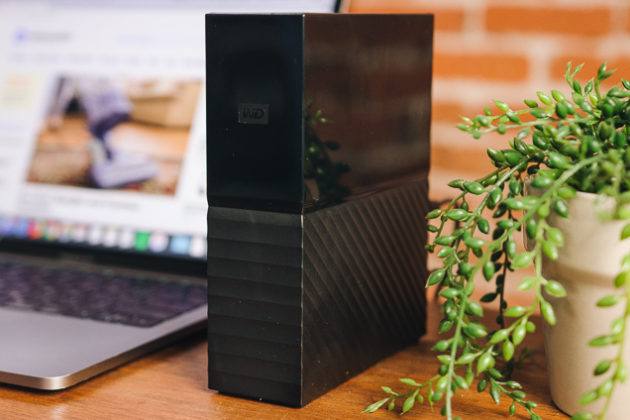

Privacy Policy
Terms and Conditions - Affiliate Policy
Home Security
© Copyright 2008-2026.
11816 Inwood Rd #1211, Dallas, TX 75244