


Finding the right portable projector can feel overwhelming, especially when comparing models that take completely different approaches to solving the same basic problem: how do you create a big-screen experience without mounting a massive projector to your ceiling?
The portable projector market has exploded over the past few years, driven by people wanting flexible entertainment options and the rise of streaming services. Unlike traditional home theater projectors that weigh 20+ pounds and require permanent installation, portable projectors prioritize convenience and versatility. They're designed to work in apartments, dorm rooms, backyards, and anywhere else you want to watch something bigger than your phone screen.
Today we're comparing two projectors that represent fundamentally different philosophies: the budget-focused TCL C1 Google TV Portable Projector and the outdoor-oriented BenQ GS50 Portable Outdoor Projector. At the time of writing, these projectors sit in different price tiers—the TCL typically costs about one-third as much as the BenQ—but they both promise to deliver big-screen entertainment in a compact package.
Before diving into specifics, it's worth understanding what makes portable projectors tick and why brightness is everything in this category.
The biggest challenge facing any portable projector is the brightness versus portability trade-off. Traditional projectors use powerful lamps that generate lots of heat and consume significant electricity. To make a projector truly portable, manufacturers must use LED light sources that are cooler and more efficient, but typically much dimmer. This is why most portable projectors require darkened rooms to produce watchable images.
ANSI lumens and ISO lumens are the two main brightness measurements you'll see. ANSI lumens is the more standardized measurement that professional projector reviewers prefer, while ISO lumens is a newer standard that some manufacturers use. Generally, ANSI measurements tend to be more conservative, so comparing different measurement standards directly isn't always accurate.
For context, a typical living room with some ambient light needs at least 1,000-1,500 lumens for comfortable viewing. Movie theaters use projectors with 10,000+ lumens. Most portable projectors fall between 200-600 lumens, which explains why they work best in dark environments.
Throw ratio is another crucial spec that determines how far back you need to place the projector. A 1.2:1 throw ratio means you need to place the projector 1.2 feet away for every foot of screen width. This matters in small spaces where you can't always position the projector optimally.
Released in the current generation of portable projectors, the TCL C1 represents the "do more with less" philosophy. TCL, primarily known for affordable TVs, applied their budget-engineering expertise to create a projector that maximizes features while minimizing cost.
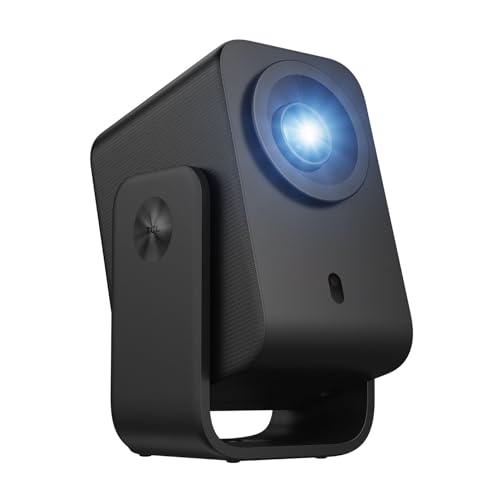
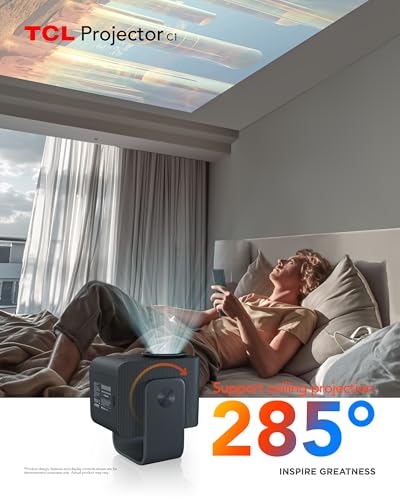
The C1's standout feature is its gimbal design—a 285-degree swiveling mount that lets you point the projector in almost any direction, including straight up at the ceiling. This is genuinely innovative for a projector at this price point. Most budget projectors require you to physically move and reposition them, but the C1's gimbal eliminates that hassle entirely.
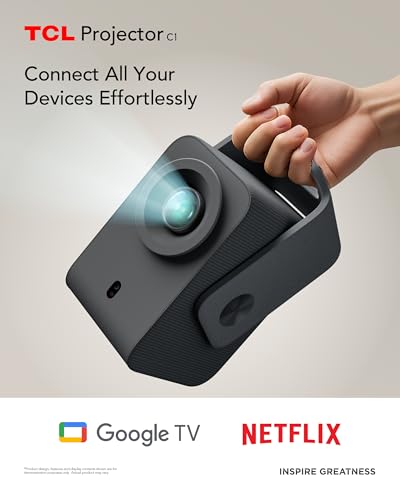
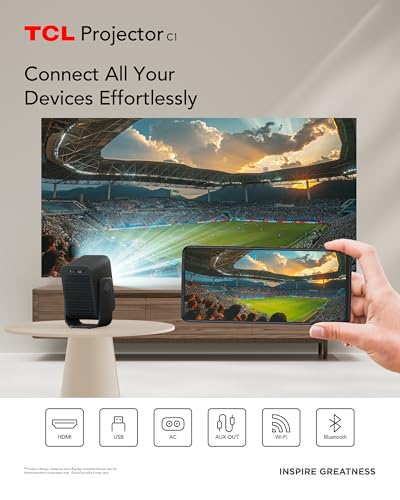
Under the hood, the TCL C1 runs Google TV, which is Google's newest smart TV platform (an evolution of Android TV). This gives you access to Netflix, YouTube, Disney+, and thousands of other apps directly from the projector—no streaming stick required. The interface includes Google Assistant voice control and Chromecast built-in, so you can easily cast content from your phone.
The projector uses a fully-sealed optical engine, which prevents dust from getting inside the lens assembly. This might sound minor, but dust contamination is a common failure point in budget projectors. By sealing the optics, TCL extends the projector's lifespan and maintains image quality over years of use.
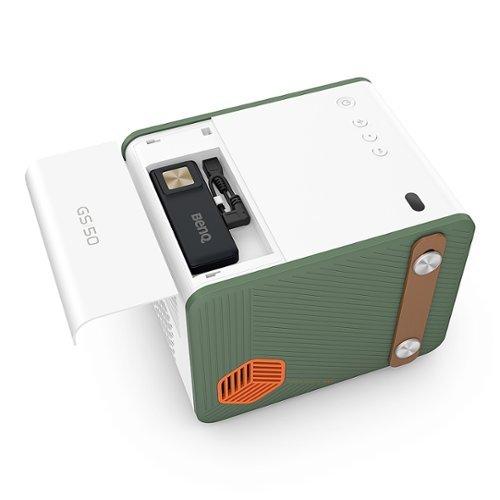
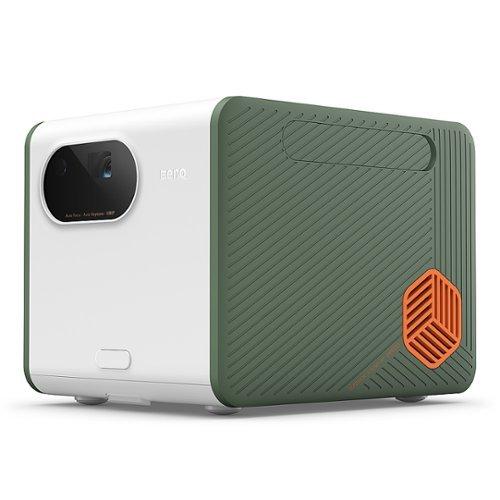
The BenQ GS50, released in 2021, takes a completely different approach. BenQ positioned this as an "outdoor projector," meaning it's designed to work in environments where traditional projectors would fail.
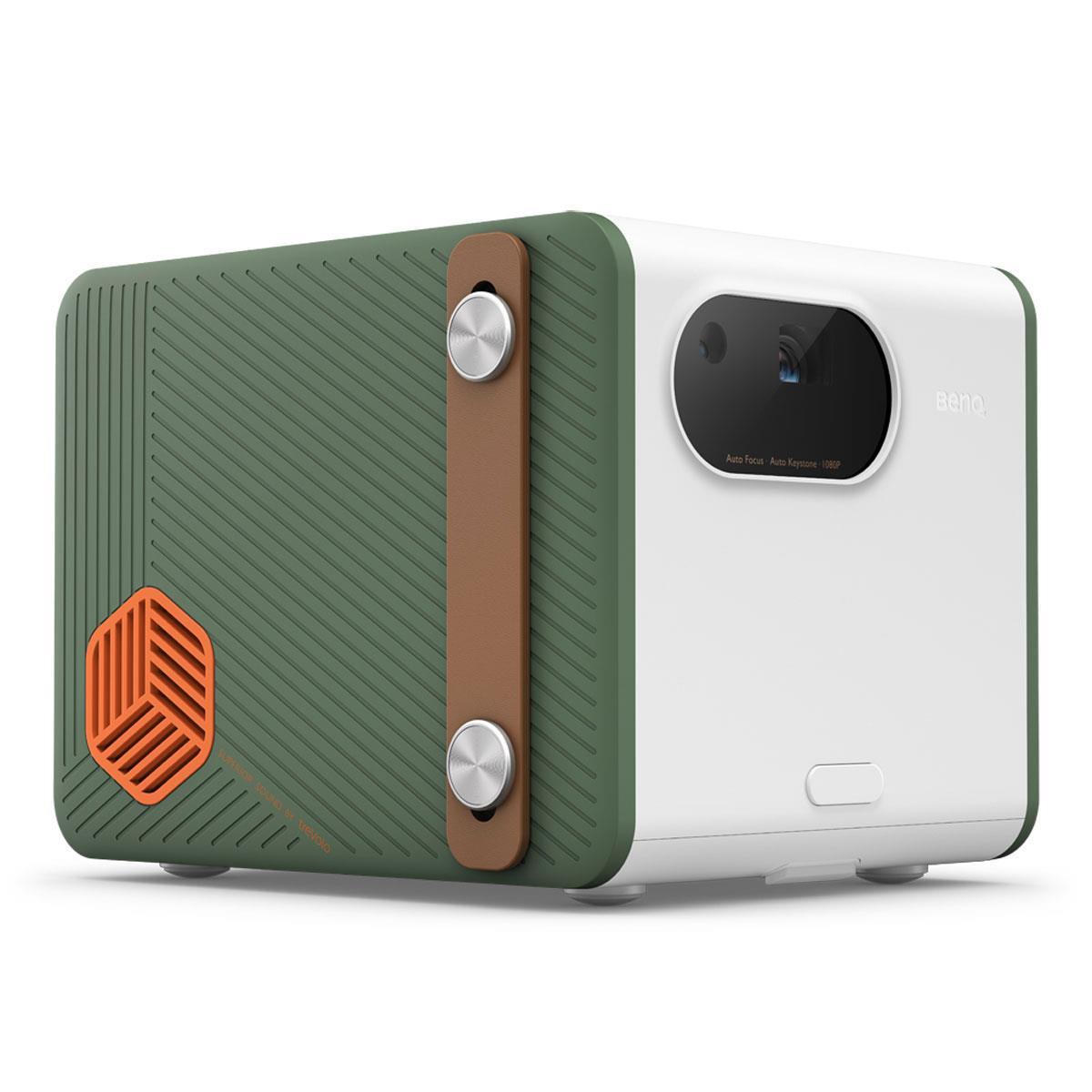
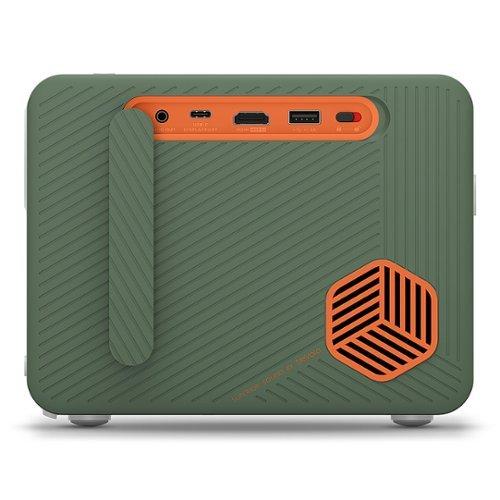
The most obvious difference is the IPX2 rating, which means the projector can handle light water splashes and rain. It's also drop-resistant up to 70cm (about 2.3 feet), so it can survive being knocked over or dropped from a table. These durability features directly target camping, tailgating, and backyard movie scenarios.
But the BenQ GS50's secret weapon is its audio system. Instead of a single speaker like most portable projectors, it includes a 2.1-channel setup with two 5-watt tweeters and a 10-watt subwoofer. The speakers fire in multiple directions to create 270-degree sound projection, filling the space around you rather than just projecting forward. This is crucial for outdoor use where sound needs to travel further and compete with ambient noise.
The GS50 also includes a built-in battery rated for 2-2.5 hours of projection time. This enables true cordless operation—you can literally take it anywhere without worrying about finding a power outlet.
Here's where the fundamental differences become clear. The BenQ GS50 produces 500 ANSI lumens, while the TCL C1 manages 230 ISO lumens. Even accounting for measurement differences, the BenQ is substantially brighter.
In practical terms, this brightness gap determines where and when you can use each projector. Based on extensive user reviews and expert testing, the TCL C1 requires near-complete darkness for satisfying image quality. We're talking about blackout curtains, lights off, and minimal screen glow from phones or other devices. In these conditions, however, the C1 produces surprisingly good images with accurate colors and sharp detail.
The BenQ GS50, with its higher brightness, can handle some ambient light. You won't be watching it in a bright living room during the day, but it works reasonably well with some lamps on or in outdoor settings during twilight hours. This flexibility is crucial if you can't always control your viewing environment.
For home theater enthusiasts specifically, both projectors represent compromises compared to dedicated home theater projectors. Neither has the brightness for large rooms with ambient light, and both lack advanced features like lens shift or extensive color calibration options. However, if you're looking for occasional big-screen entertainment in a small space, the TCL C1 delivers surprisingly cinematic images in dark rooms.
Most people underestimate how much audio quality affects the viewing experience, especially with projectors where the screen and speakers are often far apart.
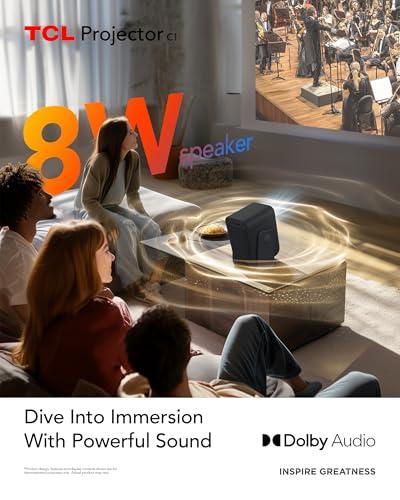
The TCL C1 includes a single 8-watt speaker with Dolby Audio processing. Based on user feedback, it's adequate for small rooms and produces clear dialogue, but lacks the bass response needed for action movies or music. The speaker is rear-facing, which helps with sound dispersion but can be problematic if the projector is placed against a wall.
The BenQ GS50's audio system is in a completely different league. The 20-watt total power (split between a 10W subwoofer and dual 5W tweeters) provides meaningful bass and much fuller sound. Multiple reviews emphasize that the audio quality alone justifies much of the price premium. The 270-degree sound projection creates a more immersive experience, especially important for outdoor use where sound needs to travel further.
Uniquely, both projectors can function as Bluetooth speakers when not projecting, but the BenQ GS50 is actually useful in this role while the TCL C1 is more of a convenience feature.
The TCL C1 benefits from Google TV, which is currently one of the best smart TV platforms available. The interface is fast, intuitive, and includes excellent content recommendations across multiple streaming services. Having Netflix certification is particularly important—many portable projectors force you to use workarounds or external devices to access Netflix.
The BenQ GS50 runs Android TV 9.0, which is Google's previous-generation platform. While functional, it's not as polished or fast as the newer Google TV. However, the GS50 supports both Chromecast and AirPlay, giving it broader compatibility with iOS devices—something the TCL C1 lacks.
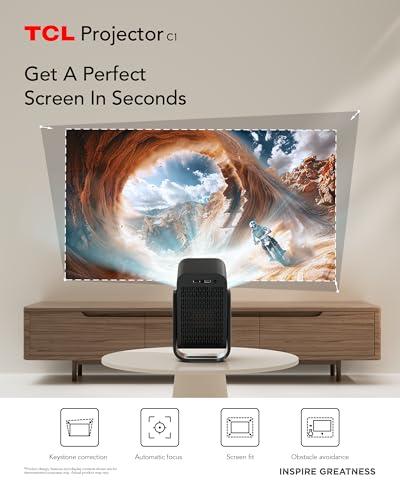
Both projectors include automatic setup features, but they work differently. The TCL C1 uses computer vision to detect the projection surface, automatically focus, correct keystone distortion (the trapezoidal effect when projecting at an angle), and even avoid obstacles. It's genuinely impressive to watch it work.
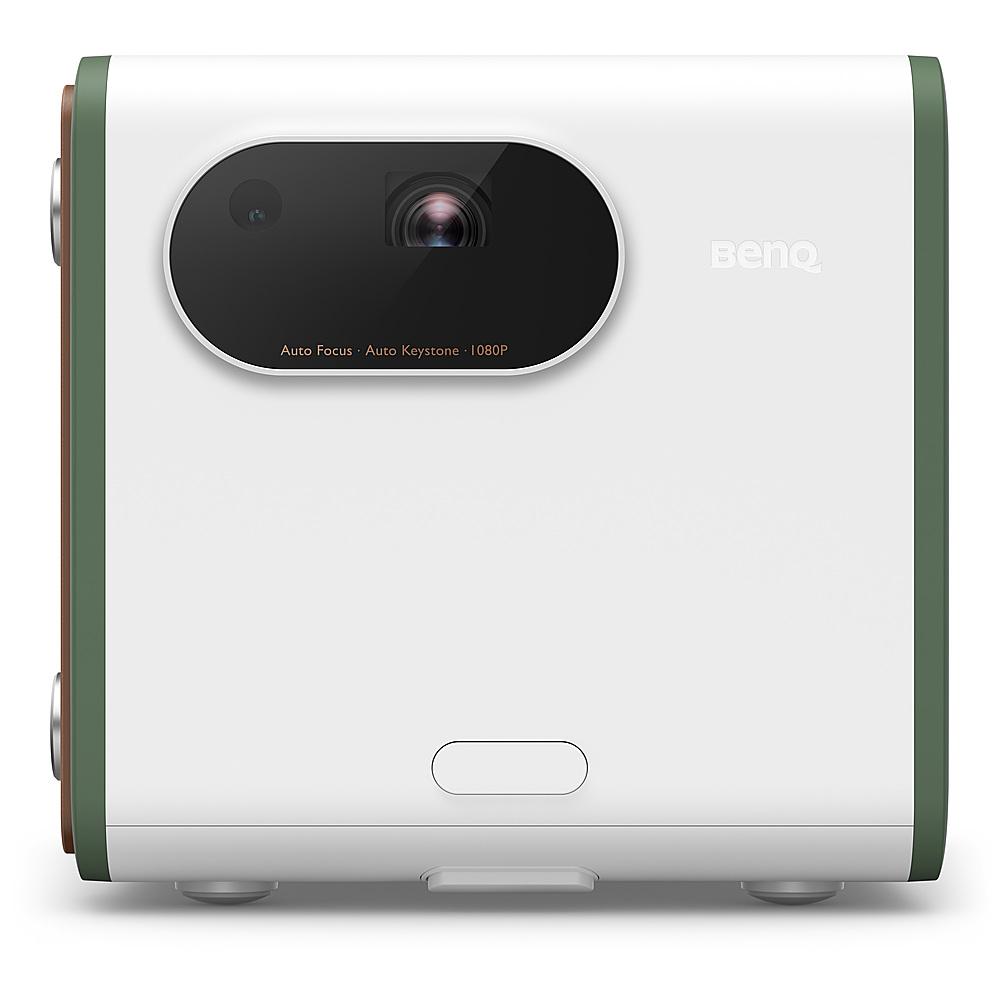
The BenQ GS50 includes auto-focus and keystone correction but requires more manual adjustment. The trade-off is that it offers more manual control for users who want to fine-tune the image.
Modern portable projectors need to connect to everything from smartphones to gaming consoles to laptops, and both projectors handle this differently.
The TCL C1 includes HDMI 2.1, USB-A, and wireless connectivity. The HDMI 2.1 support is notable because it enables higher bandwidth connections for gaming consoles and computers. The projector can also function as a computer monitor and wireless display, making it surprisingly versatile for work presentations or casual gaming.
The BenQ GS50 offers HDMI 2.0, USB-A, and crucially, USB-C with DisplayPort Alt Mode support. This USB-C connection is perfect for modern laptops and can carry both video and audio over a single cable. The dual-band Wi-Fi (2.4GHz and 5GHz) provides more stable streaming than single-band solutions.
Both projectors support 4K input signals but downscale them to their native 1080p resolution. The BenQ GS50 adds HDR10 support, which can improve color and contrast in compatible content, while the TCL C1 lacks HDR processing.
Understanding how these projectors perform in different situations helps clarify which one fits your needs.
For apartment dwellers or anyone with limited space, the TCL C1 excels. Its compact size (roughly the dimensions of a thick hardcover book) and gimbal mount make it easy to set up anywhere. The automatic features mean you can literally just plug it in and start watching—no manual focusing or image adjustment required.
The sealed optical engine and 30,000-hour LED lifespan mean you're not dealing with lamp replacements or dust-related image degradation. For occasional movie nights in a dark room, it delivers a genuinely satisfying big-screen experience.
However, the AC power requirement limits flexibility. You're always tied to an outlet, which affects placement options and eliminates any possibility of outdoor use.
The BenQ GS50 was specifically designed for scenarios where traditional projectors fail. The battery operation means you can set up anywhere—camping sites, beaches, parks, or backyards without convenient outlets.
The weather resistance isn't enough for heavy rain, but it handles light splashes and humid conditions. More importantly, the higher brightness makes it usable during twilight hours when you're transitioning from daylight to darkness.
The superior audio system is crucial outdoors where sound needs to travel further and compete with ambient noise. Multiple users report that the BenQ GS50 provides adequate volume for outdoor gatherings of 10-15 people.
Both projectors work for casual gaming, but with important limitations. Input lag (the delay between controller input and screen response) is acceptable for single-player games but not ideal for competitive gaming.
The TCL C1 can function as a computer monitor via HDMI or wirelessly, making it useful for presentations or work-from-home scenarios. The BenQ GS50's USB-C connection is more convenient for modern laptops.
Since the BenQ GS50 launched in 2021, the portable projector market has evolved significantly. Newer models offer higher brightness, better smart features, and improved connectivity. However, the core trade-offs remain the same—brightness, battery life, size, and cost are still inversely related.
The TCL C1 represents current-generation engineering, taking advantage of improved LED efficiency and more sophisticated image processing. Its Google TV platform receives regular updates, providing better future-proofing than older Android TV implementations.
Neither projector supports emerging technologies like laser light sources or native 4K resolution, which remain expensive and power-hungry for portable applications.
The choice between these projectors ultimately depends on your specific use case and priorities.
Choose the TCL C1 if you prioritize value and convenience for primarily indoor use. At roughly one-third the cost of the BenQ, it delivers 80% of the core functionality with exceptional ease of use. The Google TV integration, automatic setup, and compact design make it ideal for occasional entertainment in controlled environments.
The TCL C1 is perfect for apartment dwellers, students, or anyone who wants big-screen entertainment without the complexity or cost of traditional projectors. It's also excellent for people who value simplicity—just plug it in and it works.
Choose the BenQ GS50 if you need genuine portability and outdoor capability. The battery operation, weather resistance, and higher brightness enable use cases that the TCL simply cannot handle. The superior audio system also makes it worthwhile for users who prioritize sound quality.
The BenQ GS50 is ideal for outdoor enthusiasts, families who want backyard movie nights, or anyone who frequently entertains in spaces without controlled lighting. The premium cost is justified if you'll actually use the outdoor capabilities and battery operation.
Both projectors succeed at their intended purposes, but they serve distinctly different needs. The TCL C1 maximizes value for indoor entertainment, while the BenQ GS50 enables portable cinema in challenging environments.
For most people buying their first portable projector, the TCL C1 offers the better entry point. Its combination of smart features, ease of use, and low cost makes it an excellent way to explore large-screen entertainment without a major investment.
However, if your lifestyle includes outdoor activities, camping, or entertaining in spaces where you can't control lighting, the BenQ GS50 is worth the premium. Its unique capabilities justify the higher cost for users who will actually utilize them.
The key insight is that neither projector tries to be everything to everyone. Instead, they excel in their specific niches, making the choice clearer once you understand your primary use case.
| TCL C1 Google TV Portable Projector | BenQ GS50 Portable Outdoor Projector |
|---|---|
| Brightness - The most critical factor determining where you can use the projector | |
| 230 ISO lumens (requires near-complete darkness) | 500 ANSI lumens (usable with some ambient light and outdoors) |
| Power Source - Determines true portability and setup flexibility | |
| AC power only (always requires outlet connection) | 2.5-hour built-in battery (enables cordless outdoor use) |
| Price Category - Value proposition and target market | |
| Budget-friendly entry-level pricing | Premium pricing for specialized outdoor features |
| Audio System - Critical for immersive viewing experience | |
| Single 8W speaker (basic dialogue clarity) | 2.1-channel with 10W subwoofer + dual 5W tweeters (room-filling sound) |
| Durability Rating - Environmental protection for different use cases | |
| IP5X dust protection only (indoor use only) | IPX2 splash-proof + 70cm drop resistance (outdoor ready) |
| Smart Platform - Access to streaming apps and user experience | |
| Google TV with Netflix certification (latest platform) | Android TV 9.0 (functional but older interface) |
| Setup Automation - Convenience factor for non-technical users | |
| Full auto-focus, keystone, obstacle avoidance | Auto-focus and keystone correction only |
| Physical Design - Portability and placement flexibility | |
| 3.9 lbs with 285° gimbal mount (ultra-compact) | 5.1 lbs with leather handle (ruggedized outdoor design) |
| Connectivity Options - Device compatibility and future-proofing | |
| HDMI 2.1, USB-A, Bluetooth 5.1, single-band Wi-Fi | HDMI 2.0, USB-A, USB-C DisplayPort, dual-band Wi-Fi |
| HDR Support - Enhanced color and contrast for compatible content | |
| No HDR support | HDR10 support for improved dynamic range |
| Projection Range - Screen size flexibility | |
| 40-120 inches diagonal | 30-112 inches diagonal |
| Light Source Lifespan - Long-term ownership costs | |
| 30,000+ hours LED (virtually maintenance-free) | 20,000-30,000 hours LED (excellent longevity) |
The BenQ GS50 Portable Outdoor Projector is specifically designed for outdoor use with IPX2 splash-proof rating, drop resistance up to 70cm, and a built-in battery that provides 2.5 hours of cordless operation. The TCL C1 Google TV Portable Projector requires AC power and lacks weather protection, making it unsuitable for outdoor environments.
The BenQ GS50 Portable Outdoor Projector features a superior 2.1-channel audio system with a 10W subwoofer and dual 5W tweeters, providing room-filling sound with actual bass. The TCL C1 has a single 8W speaker that's adequate for dialogue but lacks the depth and volume for immersive entertainment.
Yes, but differently. The TCL C1 Google TV Portable Projector has official Netflix certification and runs the latest Google TV platform with direct app access. The BenQ GS50 runs older Android TV 9.0 but still supports Netflix and other streaming apps, though the interface isn't as modern.
Neither projector is ideal for bright rooms, but the BenQ GS50 Portable Outdoor Projector performs better in ambient light conditions due to its higher brightness. The TCL C1 requires darkened rooms for satisfactory viewing quality.
The TCL C1 Google TV Portable Projector offers exceptional value for budget-conscious buyers seeking indoor entertainment with smart TV features. The BenQ GS50 costs significantly more but justifies the premium with outdoor capabilities, better audio, and battery operation for specialized use cases.
The TCL C1 features comprehensive automatic setup including auto-focus, keystone correction, obstacle avoidance, and screen alignment - essentially plug-and-play operation. The BenQ GS50 Portable Outdoor Projector includes auto-focus and keystone correction but requires more manual adjustment.
Both projectors accept 4K input signals but display them at their native 1080p resolution. The BenQ GS50 adds HDR10 support for enhanced color and contrast, while the TCL C1 Google TV Portable Projector lacks HDR processing.
The TCL C1 features a fully-sealed optical engine that prevents dust contamination and extends lifespan, with LED rated for 30,000+ hours. The BenQ GS50 Portable Outdoor Projector offers 20,000-30,000 hour LED life but may face more environmental stress due to outdoor use.
For occasional big-screen entertainment in dark rooms, the TCL C1 can supplement a regular TV effectively, especially given its budget-friendly positioning. The BenQ GS50 works better as a specialized entertainment device for outdoor gatherings and camping rather than a primary home theater solution, though its superior audio makes it more immersive than the TCL for movie nights.
We've done our best to create useful and informative comparisons to help you decide what product to buy. Our research uses advanced automated methods to create this comparison and perfection is not possible - please contact us for corrections or questions. These are the sites we've researched in the creation of this article: youtube.com - thegadgetflow.com - notebookcheck.net - shopabunda.com - youtube.com - youtube.com - youtube.com - youtube.com - tcl.com - androidauthority.com - manuals.plus - westcoast.co.uk - cnet.com - hometheaterhifi.com - youtube.com - youtube.com - whathifi.com - youtube.com - bgeek.eu - youtube.com - youtube.com - projectorreviews.com - youtube.com - youtube.com - projectorcentral.com - projectorreviews.com - bestbuy.com - touchboards.com - projectorcentral.com - adorama.com - projectorreviews.com - insight.com - cnet.com

Privacy Policy
Terms and Conditions - Affiliate Policy
Home Security
© Copyright 2008-2026.
11816 Inwood Rd #1211, Dallas, TX 75244