

The world of home audio has transformed dramatically over the past decade. Gone are the days when you needed a separate CD player, preamp, power amp, and tuner stacked high in an entertainment center. Today's integrated amplifiers pack incredible functionality into sleek, single-box solutions that can power your speakers while streaming music from virtually anywhere on the planet.
But this evolution has created an interesting split in the market. Some manufacturers have taken traditional audiophile amplifiers and added streaming capabilities, while others have built streaming devices with amplification added almost as an afterthought. The NAD C 368 and Bluesound PowerNode represent these two philosophies perfectly, and choosing between them requires understanding what each approach does best.
Before diving into specifics, it's worth understanding what makes a good integrated amplifier in today's world. At its core, an integrated amp combines a preamplifier (which controls volume and selects sources) with a power amplifier (which drives your speakers) in one chassis. Modern versions add digital-to-analog converters (DACs) to handle digital sources, and increasingly, wireless streaming capabilities.
The key considerations for any integrated amplifier are sound quality, source flexibility, streaming integration, future-proofing, and overall value. However, different products prioritize these elements differently, leading to distinct user experiences and ideal applications.
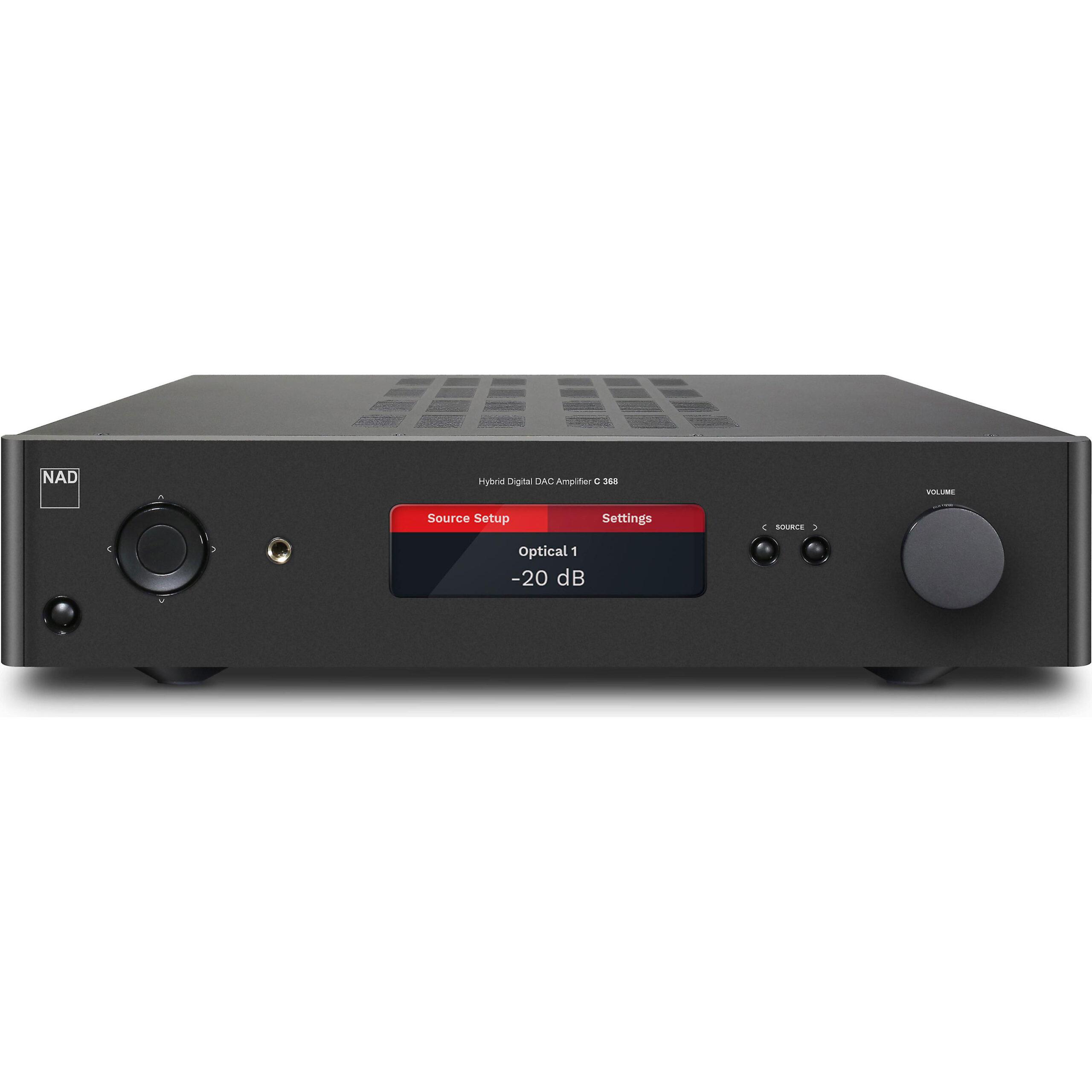
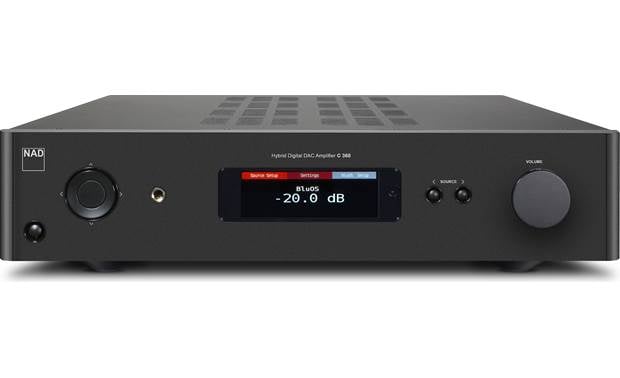
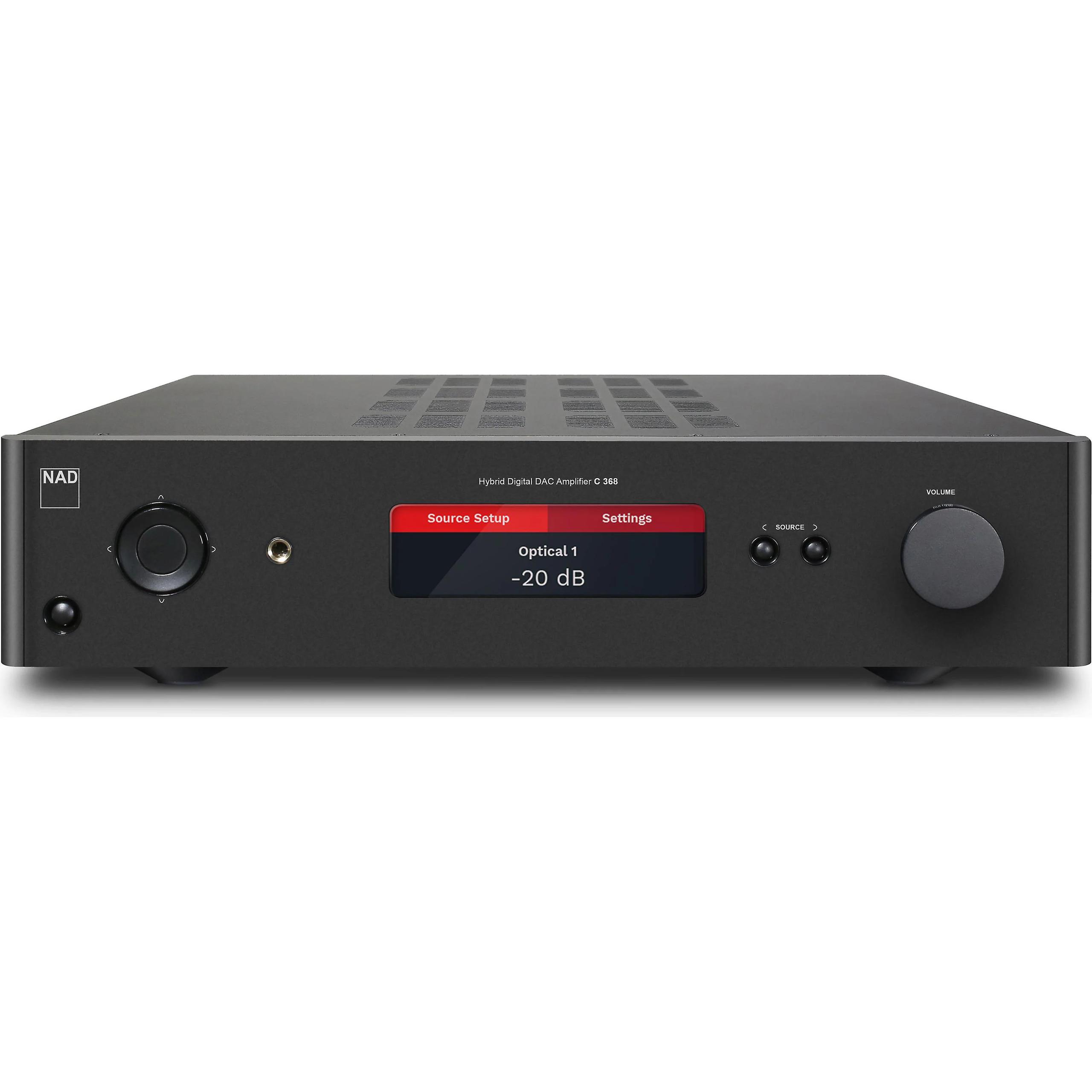
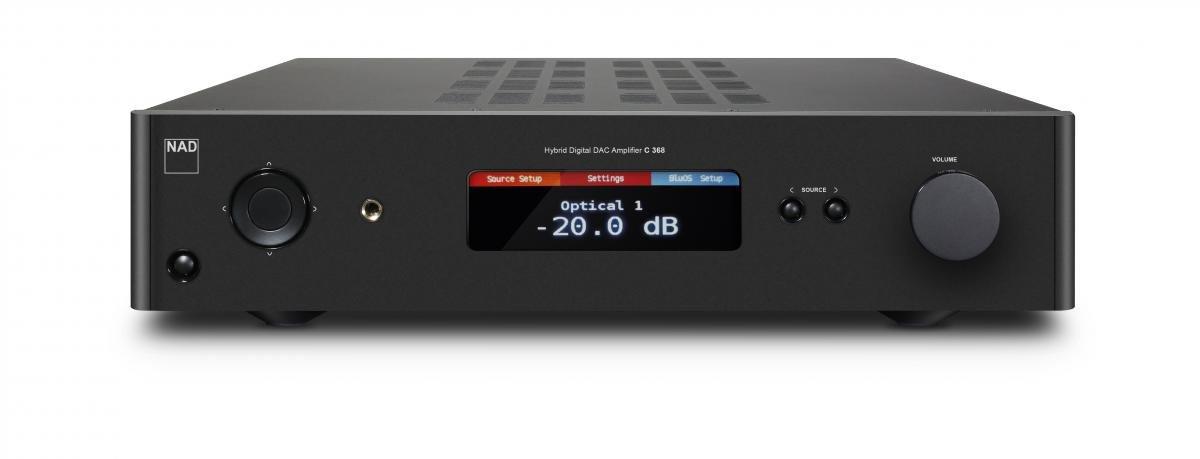
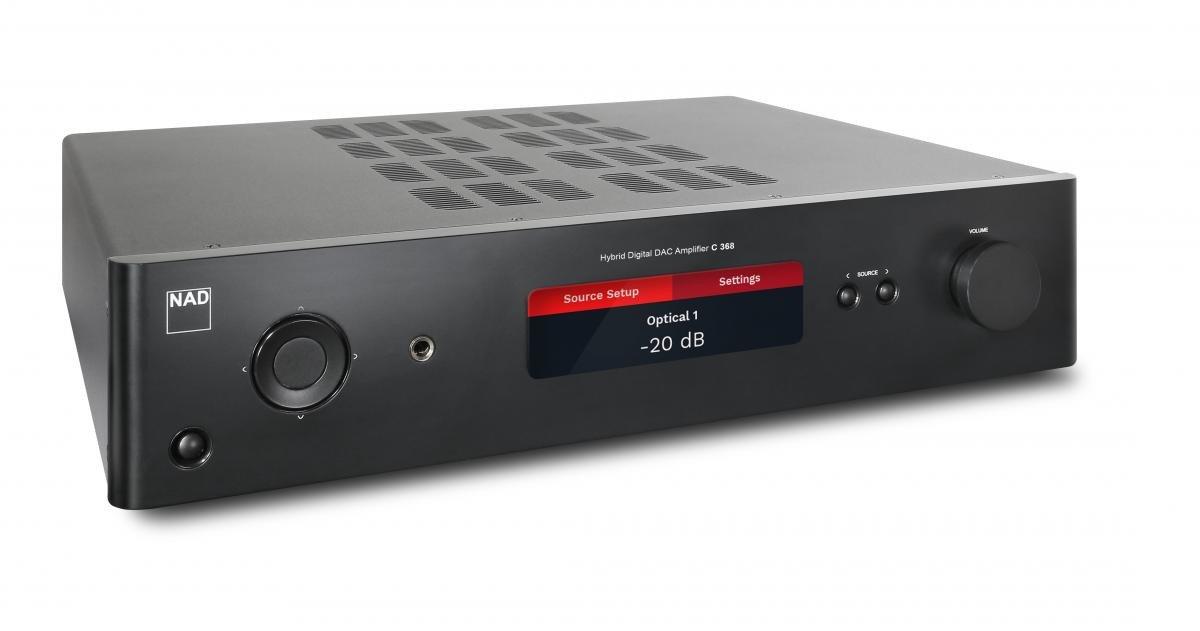
Released in 2016, the NAD C 368 represents the traditional audiophile approach to modern amplification. NAD took their proven amplifier design and added digital capabilities through a modular system that lets users add features over time.
The heart of the C 368 is its sophisticated Class D amplifier section. Now, Class D might sound inferior to the Class A or Class AB amplifiers many audiophiles prefer, but NAD's implementation is anything but basic. They use a customized Hypex UcD output stage – Hypex being a Dutch company renowned for premium Class D modules – configured in what NAD calls a "fully balanced bridge" setup.
What makes this special? Traditional Class D amplifiers can sound harsh or sterile, but the Hypex modules maintain the efficiency benefits of Class D (they run cool and don't waste much power as heat) while delivering the linear, natural sound quality that serious listeners demand. The balanced bridge configuration means each speaker terminal gets its own dedicated amplifier section, which improves power delivery and reduces distortion.
The power supply deserves special mention. While many amplifiers in this price range use basic linear power supplies, the C 368 employs a sophisticated switch-mode design capable of delivering 200 watts continuously and over 600 watts in short bursts for musical transients. Those brief moments when a drum hits or a symphony swells require massive instantaneous power, and this supply handles them without breaking a sweat.
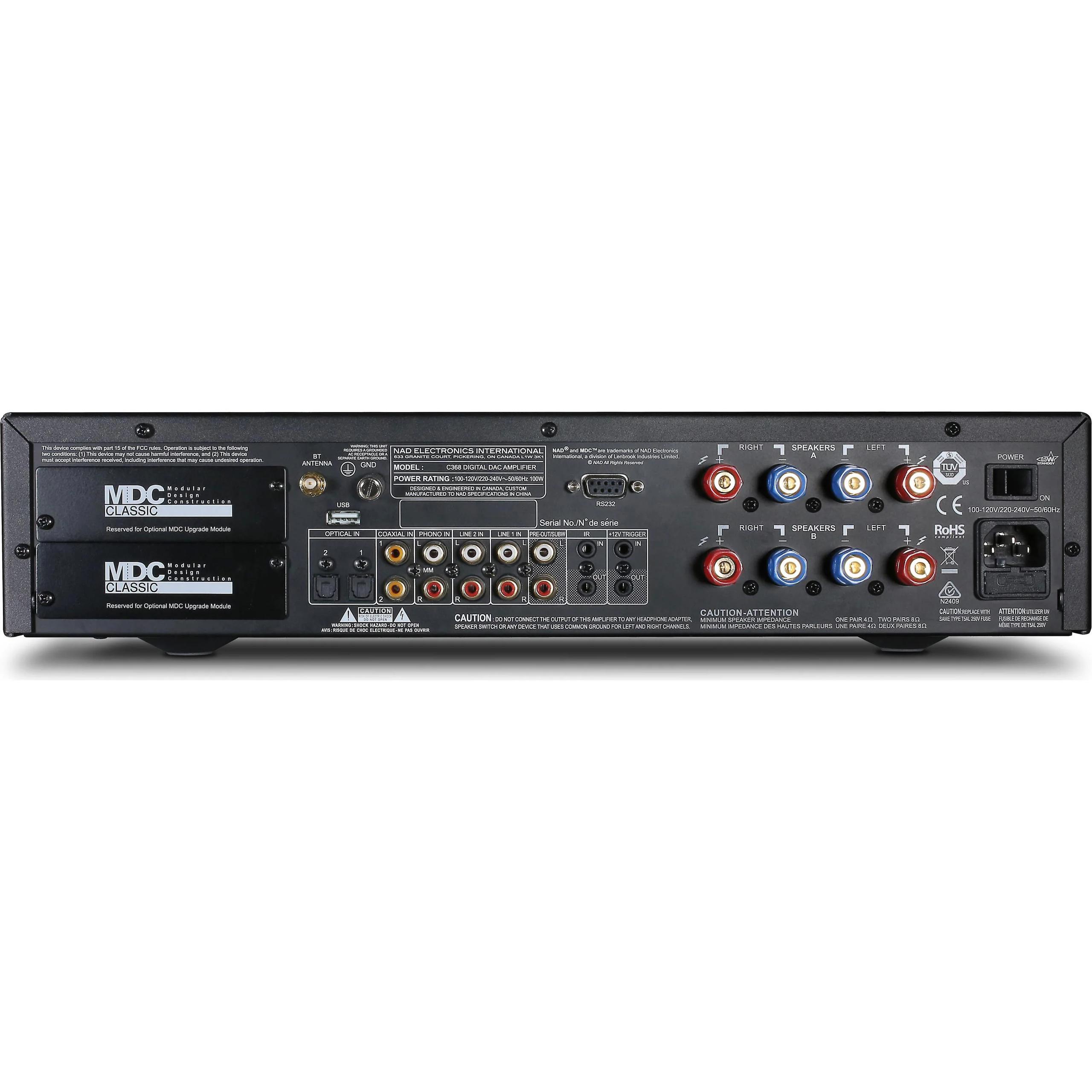
The NAD C 368's most distinctive feature is its Modular Design Construction (MDC) system. Two slots on the back panel can accept upgrade modules, with the most popular being the BluOS streaming module. This approach means you can start with a traditional integrated amplifier and add wireless streaming later, or upgrade to newer technologies as they emerge.
At the time of writing, adding BluOS streaming capability significantly increases the total system cost, but it transforms the C 368 into a fully-featured network player with multi-room capabilities, high-resolution streaming support, and integration with services like Tidal, Qobuz, and Spotify.
Based on extensive user feedback and professional reviews, the C 368's sound character can be described as neutral, detailed, and dynamic. Users consistently report excellent bass control – that tight, punchy low end that makes drums sound realistic rather than boomy. The midrange, where most music lives, is clear and natural, while the treble extends smoothly without harshness.
The built-in DAC handles digital sources up to 24-bit/192kHz, which covers virtually all high-resolution music files and streaming services. The Texas Instruments chips used provide low noise and excellent channel separation, meaning stereo imaging – the sense of instruments positioned in space between your speakers – remains precise and stable.
For vinyl enthusiasts, the MM phono stage is a significant advantage. It includes proper RIAA equalization (the standard frequency curve applied to vinyl records) and handles the low output signals from turntables without adding noise or distortion.
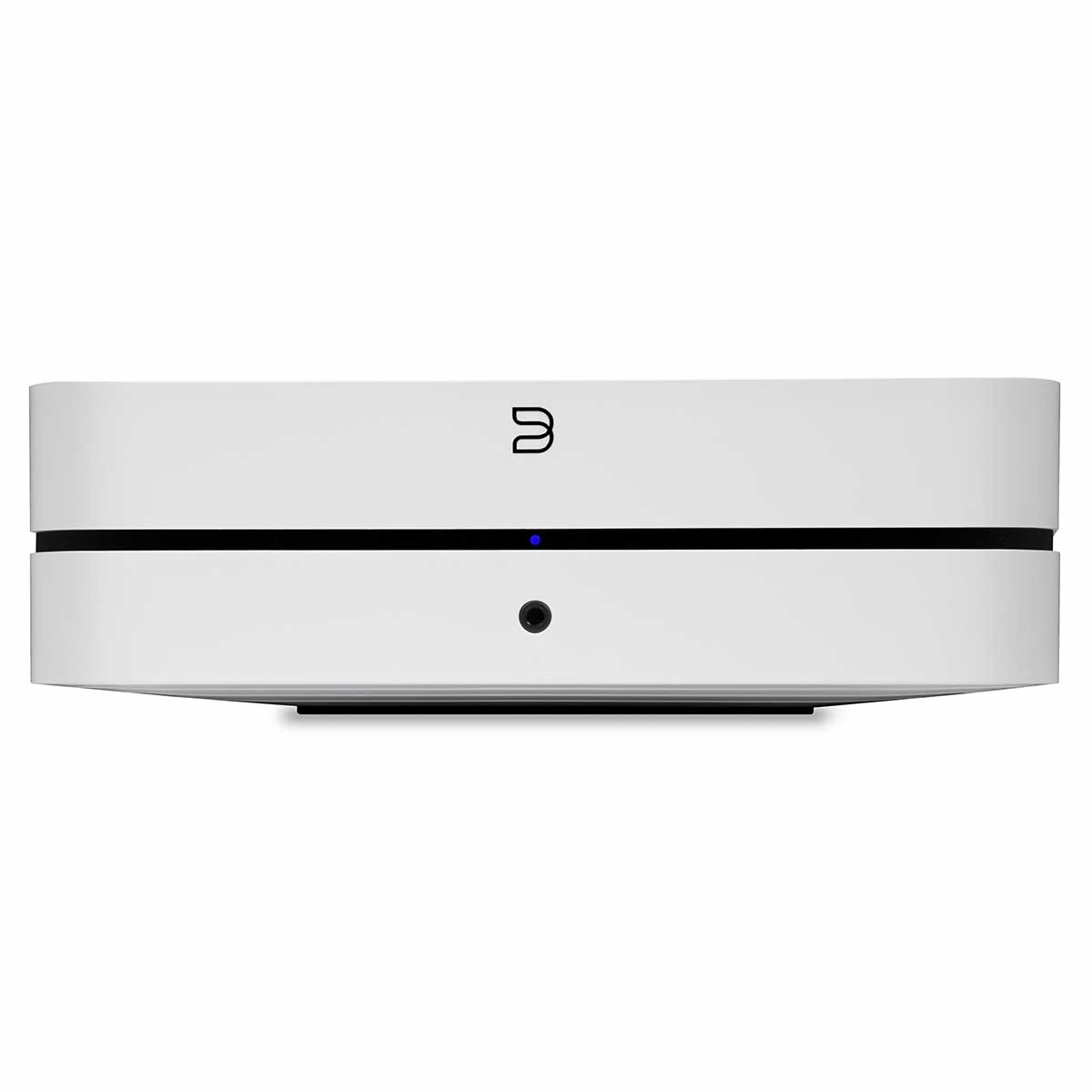
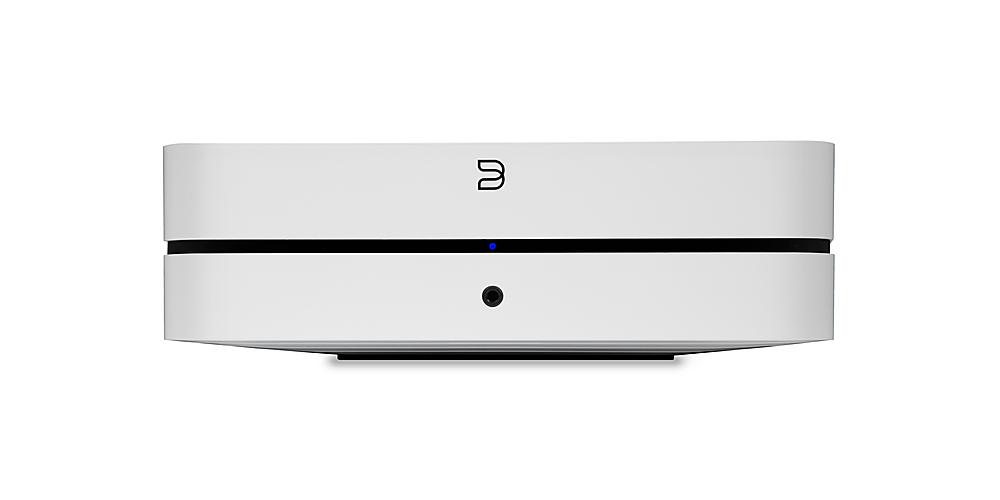
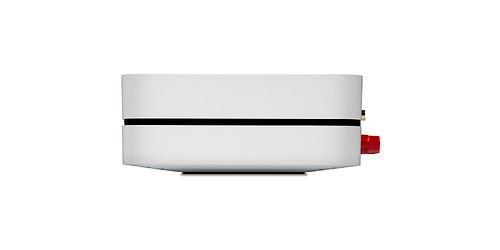
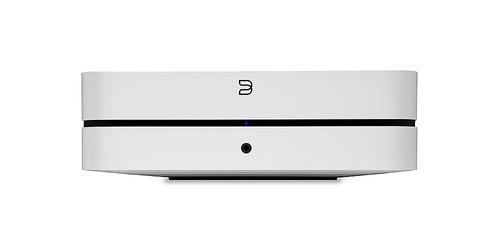
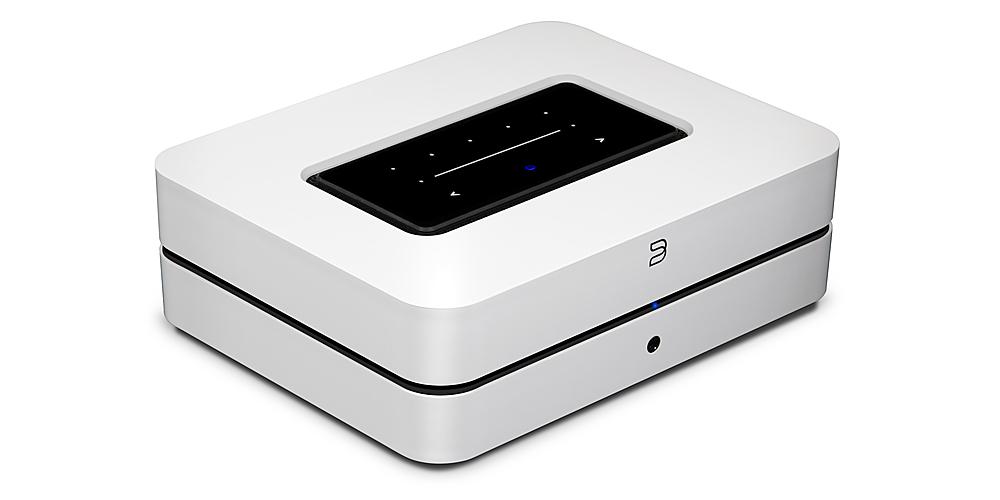
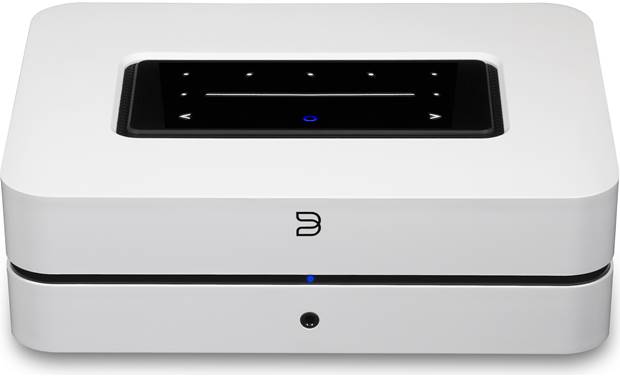
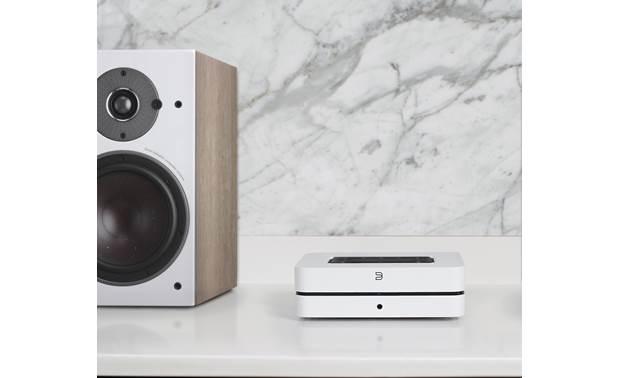
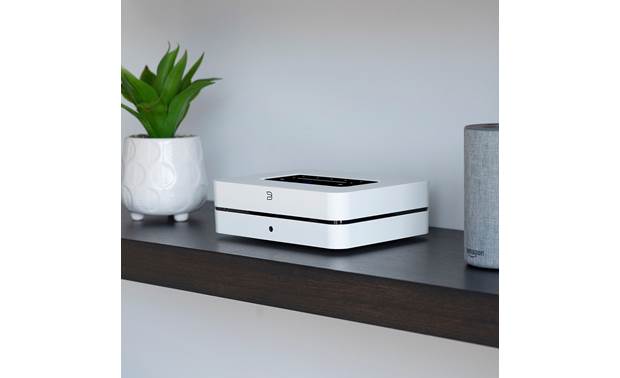
The Bluesound PowerNode, which has evolved through several generations since its initial release around 2017, takes the opposite approach. Rather than starting with traditional amplification and adding streaming, Bluesound built a wireless streaming device and added amplification to eliminate the need for a separate amp.
The latest PowerNode features what Bluesound calls DirectDigital amplification with gallium nitride (GaN) transistor technology. GaN is a newer semiconductor material that switches faster than traditional silicon, allowing for more precise control and lower distortion. While still Class D, this implementation focuses on integration with the streaming platform rather than absolute audiophile performance.
The PowerNode's processor is particularly impressive – a quad-core ARM chip running at 1.8GHz. This computational power handles the complex task of streaming audio from multiple services while managing multi-room synchronization and processing high-resolution audio files.
Where the PowerNode truly shines is streaming integration. The BluOS platform supports over 20 streaming services natively, handles file formats up to DSD256 (an extremely high-resolution format used for audiophile recordings), and manages multi-room audio with up to 64 zones. The system can synchronize playback across multiple rooms within microseconds, creating a seamless whole-house audio experience.
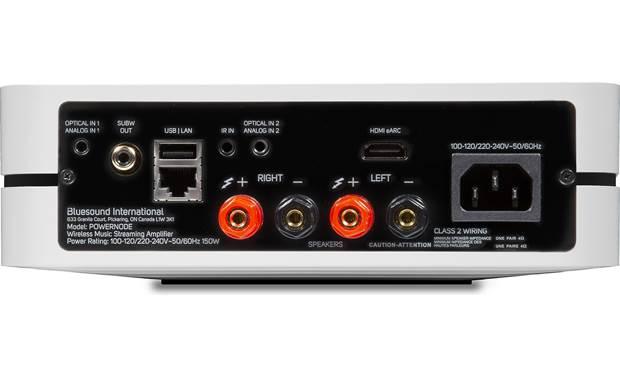
The HDMI eARC input deserves special attention for home theater applications. This connection allows the PowerNode to receive high-quality audio directly from your TV, simplifying setup and eliminating the need for a separate AV receiver in many situations. Combined with Bluesound's wireless surround system, you can create a complete home theater setup without running speaker wires throughout your room.
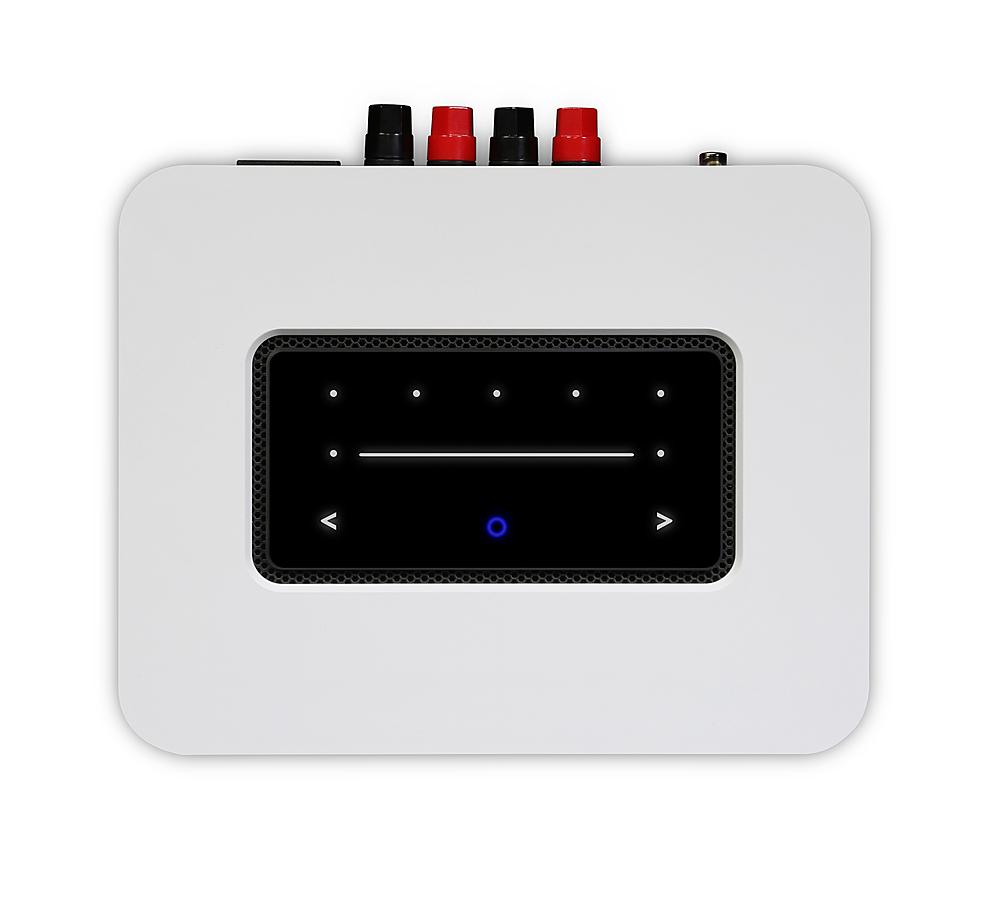
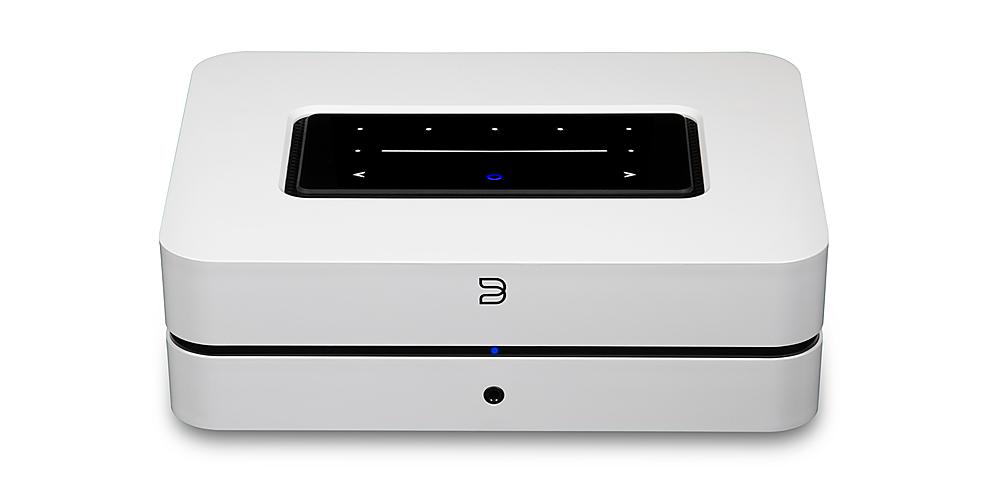
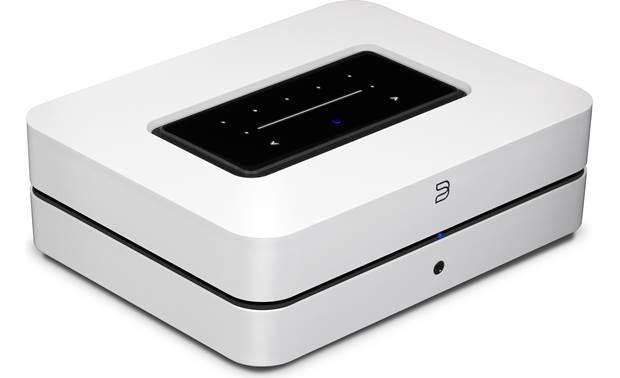
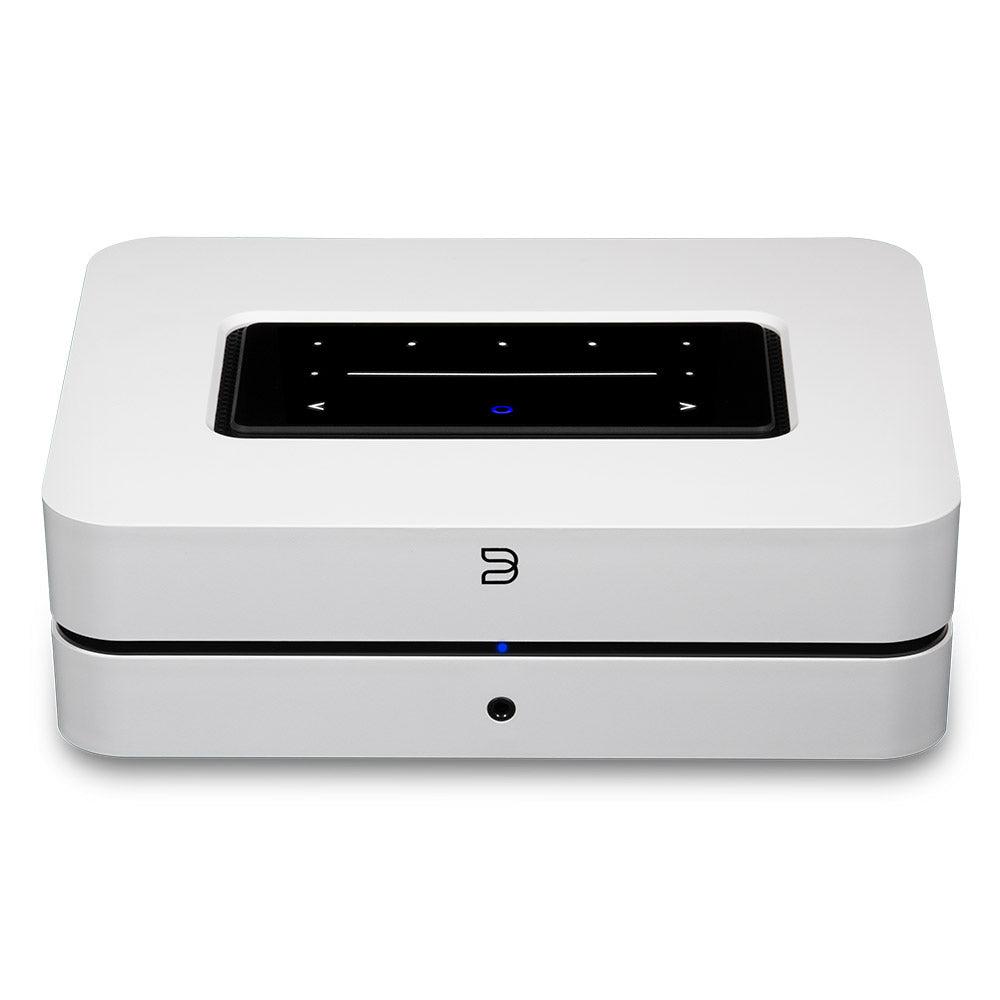
The PowerNode's user interface exemplifies its streaming-first philosophy. The top panel features touch controls with five programmable presets – imagine having your favorite playlist, radio station, or album instantly accessible with a single touch. The BluOS app provides comprehensive control from smartphones, tablets, or computers, with intuitive navigation that makes managing large music libraries effortless.
Bluetooth connectivity supports aptX HD, which provides near-CD quality wireless transmission from phones and tablets. More importantly, the PowerNode can also transmit Bluetooth to headphones, allowing private listening without disturbing others.
Our research into user experiences and professional reviews reveals a consistent pattern: the NAD C 368 delivers superior sound quality, while the PowerNode offers superior convenience. Users who have directly compared both products frequently comment on the C 368's better dynamics, bass control, and overall refinement.
This difference stems from design priorities. The C 368 uses a more sophisticated power supply, higher-grade components, and an amplifier section designed specifically for audio quality. The PowerNode prioritizes integration, compact design, and feature richness, which necessarily involves compromises in pure amplification quality.
For most listeners using efficient speakers in typical rooms, both amplifiers provide adequate power and quality. However, demanding speakers or critical listening sessions favor the NAD.
The C 368 wins for analog sources and traditional hi-fi setups. Its MM phono input handles turntables directly, multiple digital inputs accommodate CD players and other digital sources, and the preamp output allows integration with powered subwoofers using custom crossover settings.
The PowerNode excels for modern, wireless-centric setups. HDMI eARC simplifies TV integration, built-in streaming eliminates additional boxes, and comprehensive wireless connectivity supports everything from AirPlay to Spotify Connect.
These products take fundamentally different approaches to staying current. The C 368's MDC slots allow hardware upgrades – new modules can add capabilities that didn't exist when you bought the amplifier. This approach requires additional investment but provides genuine expandability.
The PowerNode relies on software updates to add features and maintain compatibility with new streaming services. While this approach includes all features from day one, it's limited by the initial hardware capabilities.
Both amplifiers can serve as the foundation for a home theater system, but with different strengths. The PowerNode integrates more naturally with modern TVs through HDMI eARC and can wirelessly connect to additional Bluesound speakers for surround sound. This creates a clean, wire-free setup ideal for living rooms where aesthetics matter.
The C 368 provides better sound quality for the main left and right channels, which handle most of the musical content in movies. However, expanding to surround sound requires additional amplifiers and more complex setup. For dedicated home theater rooms where sound quality trumps convenience, the NAD provides a superior foundation.
At the time of writing, the PowerNode costs significantly less as a complete streaming solution, while the C 368 requires additional investment for full streaming capabilities but provides better amplification quality and future expandability.
The value equation depends on your priorities. If you primarily stream music and want immediate functionality, the PowerNode delivers more features per dollar. If you prioritize sound quality and want flexibility for future upgrades, the C 368 justifies its higher total cost through superior performance and modularity.
Choose the NAD C 368 if you're building a serious hi-fi system where sound quality matters most. Its superior amplification, analog input flexibility, and modular expandability make it ideal for listeners who own vinyl records, plan to upgrade over time, or have demanding speakers that benefit from high-quality amplification.
The PowerNode suits listeners who prioritize convenience and streaming integration. If you primarily listen to Spotify, Tidal, or other streaming services, want multi-room audio, and prefer a simple setup, it provides better value through its comprehensive feature set and lower total cost.
For home theater applications, the PowerNode offers simpler integration with modern TVs and wireless expansion options, while the C 368 provides better stereo performance for music and movie soundtracks.
Both amplifiers represent excellent engineering and thoughtful design, just optimized for different user priorities. The NAD preserves the audiophile tradition of prioritizing sound quality while adding modern convenience, while the Bluesound embraces the streaming future while maintaining competent amplification. Your choice should align with how you listen to music and what matters most in your audio experience.
| NAD C 368 Integrated Amplifier | Bluesound PowerNode Wireless Music Streaming Amplifier |
|---|---|
| Power Output - Determines how loud and clean your speakers will sound | |
| 80W per channel (8/4 ohms) with 600W+ peak for dynamics | 80-100W per channel (varies by generation) with standard Class D |
| Amplifier Technology - Affects sound quality and efficiency | |
| Customized Hypex UcD Class D in balanced bridge config | DirectDigital with GaN transistors (newer models) |
| Built-in Streaming - Whether you need additional modules for wireless | |
| Optional via BluOS module (significant extra cost) | Built-in BluOS with 20+ streaming services included |
| Analog Inputs - Essential for turntables and traditional sources | |
| MM phono stage + 2 RCA line inputs (vinyl-ready) | Limited analog inputs (streaming-focused design) |
| Digital Inputs - For CD players and other digital sources | |
| 4 inputs (2 optical, 2 coaxial) plus USB service port | Primarily streaming-based with minimal traditional digital inputs |
| Modular Expandability - Future upgrade potential | |
| 2 MDC slots for hardware modules (BluOS, HDMI, future tech) | Fixed feature set with software updates only |
| Multi-room Audio - Whole-house music distribution | |
| Yes, when BluOS module installed (matches PowerNode) | Built-in multi-room with up to 64 zones |
| Home Theater Integration - TV and surround sound compatibility | |
| Preamp outputs, requires separate components for surround | HDMI eARC + wireless surround with Bluesound speakers |
| Headphone Output - Quality for personal listening | |
| 1/4" jack with dedicated amp section | 3.5mm with THX AAA technology (newer models) |
| Sound Quality Consensus - Based on user and expert feedback | |
| Superior dynamics, bass control, and overall refinement | Good quality but focused on convenience over audiophile performance |
| Total Cost for Full Streaming - Complete system investment | |
| Higher due to required BluOS module for wireless features | Lower as streaming included from start |
| Best For - Ideal user scenarios | |
| Audiophiles, vinyl collectors, future upgraders, critical listeners | Streaming-first users, multi-room setups, simple installations |
The NAD C 368 delivers superior sound quality with its customized Hypex UcD Class D amplifier and sophisticated power supply design. Users consistently report better dynamics, bass control, and overall refinement compared to the Bluesound PowerNode, which prioritizes streaming convenience over pure audiophile performance.
Yes, the NAD C 368 requires an optional BluOS streaming module for wireless capabilities, which adds significant cost to the total system. The Bluesound PowerNode includes all streaming features built-in from day one, making it more cost-effective for streaming-focused users.
The Bluesound PowerNode offers superior TV integration with HDMI eARC and wireless surround sound capabilities using additional Bluesound speakers. The NAD C 368 can work with TVs but requires more complex setup and additional components for surround sound.
The Bluesound PowerNode provides better value for streaming-focused users with its lower total cost and included wireless features. The NAD C 368 offers better value for audiophiles who prioritize sound quality and future expandability despite its higher overall investment.
Both the NAD C 368 and Bluesound PowerNode deliver 80 watts per channel, but the NAD provides superior power delivery with its advanced switch-mode supply capable of 600+ watts for musical peaks.
The Bluesound PowerNode is much easier to set up with built-in Wi-Fi, touch controls, and immediate streaming access. The NAD C 368 requires more setup complexity, especially when adding the BluOS module for streaming capabilities.
Both amplifiers offer identical multi-room capabilities when the NAD C 368 has the BluOS module installed. However, the Bluesound PowerNode provides this functionality immediately without additional purchases.
When equipped with BluOS, both the NAD C 368 and Bluesound PowerNode support over 20 streaming services including Spotify, Tidal, Qobuz, and Amazon Music, with identical streaming capabilities.
Choose the NAD C 368 if you prioritize sound quality, own vinyl records, or want future upgrade flexibility. Choose the Bluesound PowerNode if you primarily stream music, want immediate wireless functionality, and prefer lower total system cost.
We've done our best to create useful and informative comparisons to help you decide what product to buy. Our research uses advanced automated methods to create this comparison and perfection is not possible - please contact us for corrections or questions. These are the sites we've researched in the creation of this article: avnirvana.com - crutchfield.com - hometheaterhifi.com - hifiheaven.net - crutchfield.com - projectorscreen.com - theabsolutesound.com - dedicatedaudio.com - soundstagesimplifi.com - nadelectronics.com - musicdirect.com - crutchfield.com - safeandsoundhq.com - crutchfield.com - upscaleaudio.com - bluesound.com - bluesound.com - stereophile.com - theaudiofactory.com - audioadvisor.com - musicdirect.com - twitteringmachines.com - futureaudiophile.com - bluesound.com - bluesound.com - moon-audio.com - audioadvisor.com - ecoustics.com

Privacy Policy
Terms and Conditions - Affiliate Policy
Home Security
© Copyright 2008-2026.
11816 Inwood Rd #1211, Dallas, TX 75244