


Choosing the perfect 4K home theater projector can feel overwhelming, especially when you're comparing two very different approaches to achieving cinema-quality images. The BenQ W4100i and Sony BRAVIA Projector 8 represent fascinating contrasts in projector design philosophy—one prioritizes brightness and value, while the other focuses on absolute image quality and professional features.
Both projectors launched in 2024, arriving during a particularly exciting time for home theater technology. The projector market has seen remarkable advances in recent years, with LED and laser light sources largely replacing traditional bulbs, and 4K resolution becoming the standard rather than a luxury. These two models showcase how different manufacturers are tackling the same challenge: delivering stunning large-screen entertainment for your living room.
Before diving into these specific models, it's worth understanding what makes 4K projectors special. Unlike your typical TV, these devices can create massive images—we're talking 100 to 300 inches diagonally—that transform any room into a personal cinema. The "4K" designation means they display roughly 8.3 million pixels, four times more than traditional 1080p displays.
However, not all 4K projectors achieve this resolution the same way. Some use "pixel shifting" technology, where a lower-resolution chip rapidly moves pixels to create the appearance of higher resolution. Others use true "native 4K" panels with all 8.3 million pixels physically present. Both approaches can produce excellent results, but they come with different trade-offs in cost and performance.
The room environment plays a crucial role in projector selection. Unlike TVs, projectors don't produce their own light—they reflect it off a screen. This means ambient light becomes your enemy, washing out colors and reducing contrast. The brightness of your projector, measured in lumens, determines how well it can fight this battle.
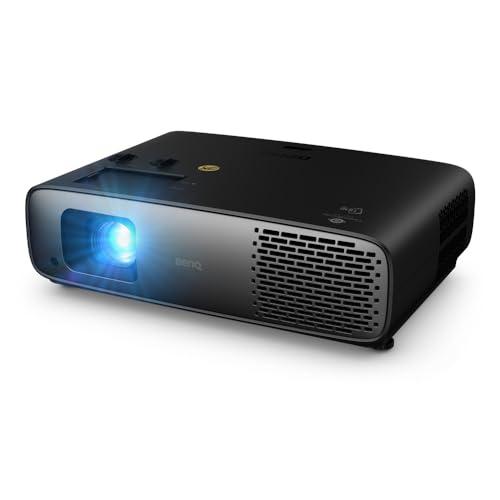
The BenQ W4100i represents what I'd call the "practical enthusiast" approach. At the time of writing, it sits in the upper-mid-range price category, offering impressive specifications without breaking the bank. BenQ has built this projector around a 4-LED light source—essentially four separate LEDs (red, green, blue, and an additional blue) working together to create bright, colorful images. This system produces an impressive 3,200 ANSI lumens, making it one of the brightest projectors you can buy in its price range.
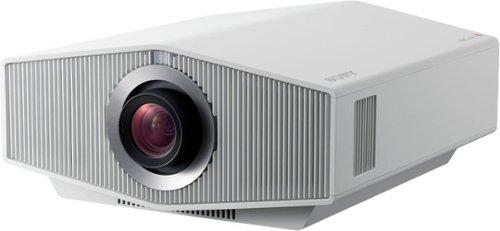
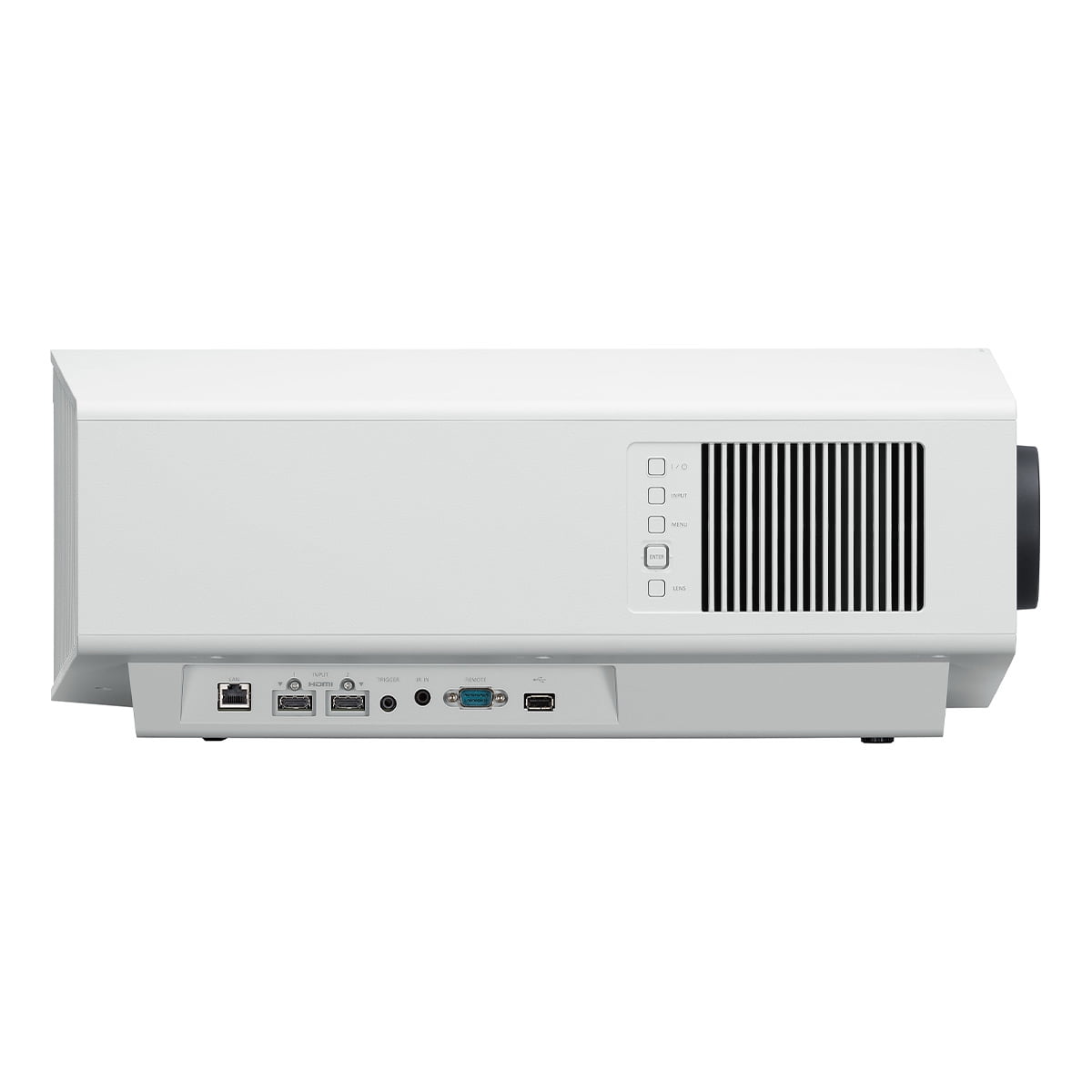
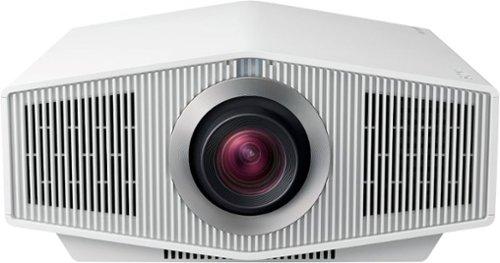
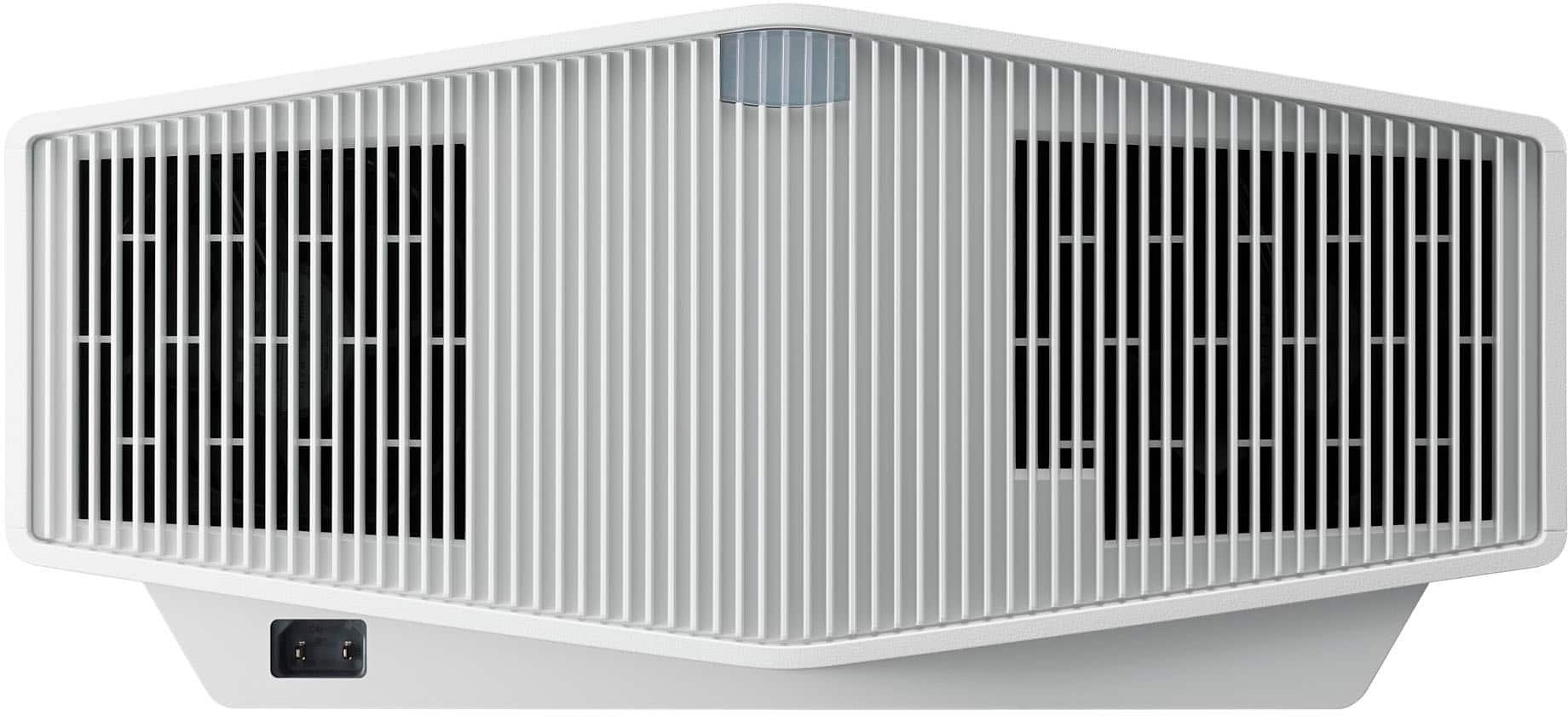
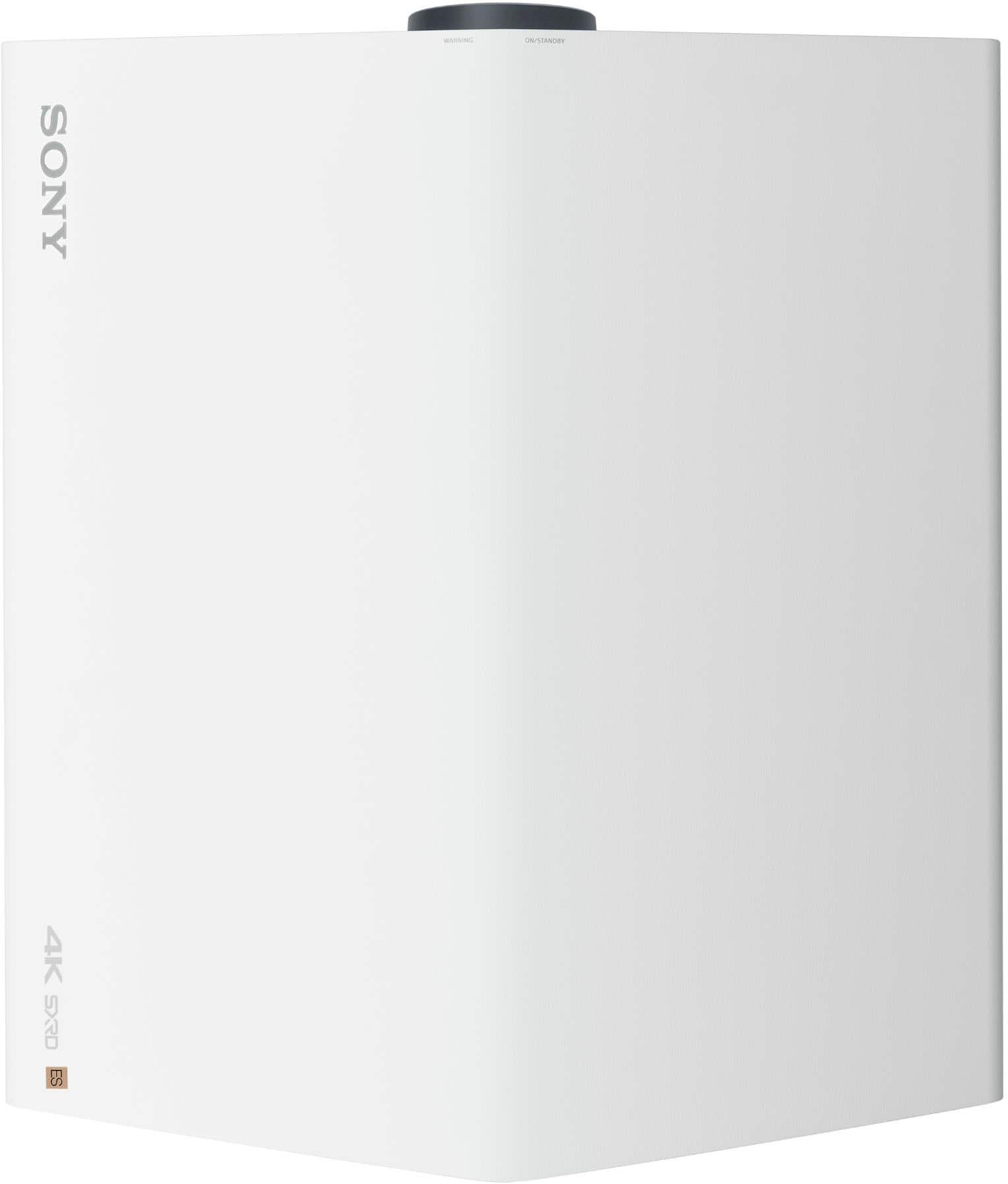
The Sony BRAVIA Projector 8, officially known as the VPL-XW6100ES, takes a premium approach. Sony has engineered this projector for serious home theater enthusiasts who demand the absolute best image quality. It uses true native 4K resolution through three separate SXRD panels—Sony's version of LCD technology—combined with a laser light source that produces 2,700 lumens.
When it comes to image quality, these projectors achieve excellence through completely different methods. The BenQ W4100i uses a single 0.65-inch DLP (Digital Light Processing) chip with XPR technology. XPR is essentially a sophisticated pixel-shifting system that takes the chip's native 2,716 x 1,528 resolution and rapidly shifts each pixel to create the appearance of full 4K detail.
This might sound like a compromise, but in practice, it's remarkably effective. During our research into user and expert reviews, the consensus is clear: the difference between the BenQ's pixel-shifted 4K and true native 4K is difficult to spot during normal viewing, even on large screens. The DLP technology also means virtually no pixel structure is visible, creating smooth, film-like images.
The Sony BRAVIA Projector 8 takes the purist approach with true native 4K resolution through three 0.61-inch SXRD panels. Each panel handles one primary color (red, green, blue), and together they create all 8.3 million pixels without any shifting tricks. This results in absolute detail clarity that becomes more apparent on very large screens (150+ inches) or when sitting close to the image.
Sony's approach also includes their XR Processor, which represents a significant leap forward from previous generations. This processor, originally developed for Sony's high-end TVs, analyzes each frame to optimize sharpness, color, and contrast in real-time. The XR Triluminos Pro technology expands the color palette to over one billion colors, creating more natural-looking skin tones and vibrant landscapes.
Here's where the BenQ W4100i really shines—literally. Its 3,200 ANSI lumens output significantly outpowers the Sony's 2,700 lumens. This 18% brightness advantage might not sound like much on paper, but it's transformative in real-world use.
The BenQ's 4-LED system maintains consistent brightness throughout its lifespan, unlike traditional bulbs that dim over time. The LED system is rated for 30,000 hours of use—that's over 20 years of movie nights if you watch three hours every evening. The multi-LED approach also eliminates the laser speckle that some laser projectors exhibit, creating smoother, more organic-looking images.
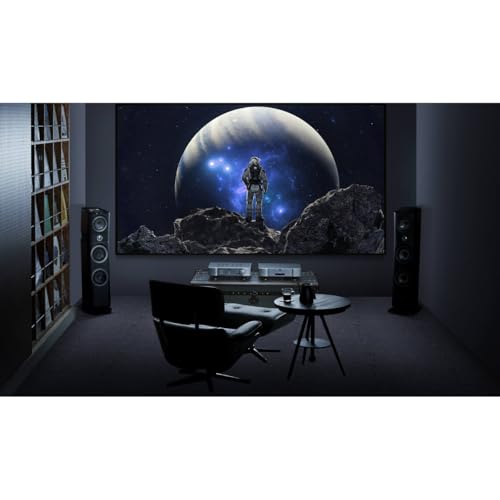
This extra brightness makes the BenQ much more versatile in different room conditions. You can enjoy vibrant, colorful images even with some ambient light—think family movie nights with lamps dimmed but not completely off. The projector maintains good color saturation and contrast even when not used in a completely dark room.
The Sony BRAVIA Projector 8's laser light source offers different advantages. While providing fewer lumens, the laser system delivers incredibly consistent output over its 20,000-hour lifespan. The Z-Phosphor laser technology also enables precise dimming for better black levels—something LED systems struggle with. When the image calls for deep blacks, the laser can reduce or completely shut off light output in specific areas, creating that "infinite contrast" you see in the specifications.
This brings us to one of the most important image quality factors: contrast ratio. Contrast determines how three-dimensional and lifelike your images appear. Poor contrast makes everything look flat and washed out, while excellent contrast creates images that seem to pop off the screen.
The BenQ W4100i achieves its 3,000,000:1 contrast ratio through dynamic adjustments to the LED output. When the image contains bright scenes, the LEDs pump out full power. When darker scenes appear, the system dims the LEDs to deepen blacks. This works well for most content, though the system can't achieve the per-pixel control that makes premium projectors special.
Where the Sony BRAVIA Projector 8 truly excels is in native contrast and black level performance. The SXRD panels themselves offer better native contrast than DLP chips, meaning the difference between the brightest whites and deepest blacks is greater even before any dynamic processing kicks in. Combined with the laser's precise dimming capabilities, dark movie scenes—think space battles or nighttime action sequences—display with remarkable depth and detail.
Sony's XR Deep Black technology analyzes each frame to determine optimal laser output, creating blacks that appear truly black rather than dark gray. This makes a dramatic difference in darkroom viewing, where you want to feel immersed in the movie rather than aware you're watching a projection.
High Dynamic Range (HDR) represents one of the biggest advances in home entertainment since the jump to high definition. HDR content contains a much wider range of brightness levels and colors than standard content, more closely matching what our eyes see in real life.
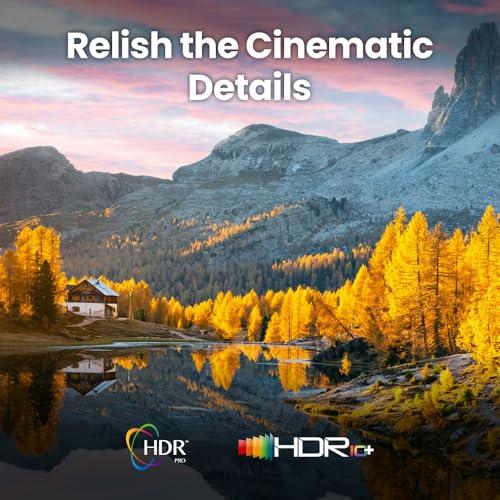
The BenQ W4100i supports all major HDR formats: HDR10, HDR10+, and HLG (Hybrid Log-Gamma). HDR10+ is particularly valuable because it includes dynamic metadata—essentially instructions that tell the projector how to optimize each scene. A sunset scene might need different processing than a cave exploration sequence, and HDR10+ provides scene-by-scene guidance.
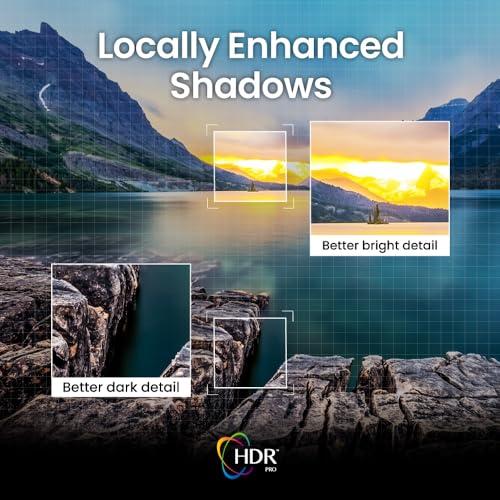
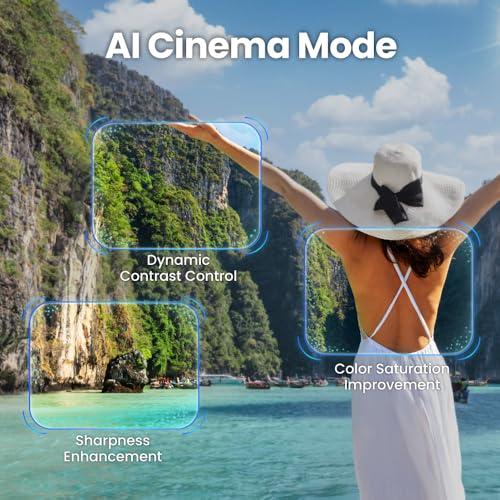
BenQ's HDR-PRO technology with dynamic tone mapping analyzes each frame in real-time, adjusting brightness and color to extract maximum detail from both bright highlights and dark shadows. The AI Cinema Mode takes this further by specifically optimizing streaming content, which often suffers from compression artifacts that can muddy HDR details.
The Sony BRAVIA Projector 8 supports HDR10 and HLG but notably lacks HDR10+ compatibility. However, Sony compensates with superior processing power. The XR Dynamic Tone Mapping system provides three selectable tone curves, allowing you to fine-tune how HDR content appears. Some content might look better with aggressive tone mapping that brings out shadow detail, while other movies benefit from a more conservative approach that preserves the director's intended contrast.
Based on expert reviews, Sony's HDR processing tends to produce more film-like results, while BenQ's approach prioritizes maximum detail extraction. Neither approach is inherently better—it depends on your preferences and content preferences.
Modern gaming demands responsive displays, and both projectors deliver impressive performance, though with different strengths. Input lag—the delay between pressing a button and seeing the result on screen—can make or break competitive gaming experiences.
The BenQ W4100i offers exceptional gaming performance across all resolutions. At 1080p with a 240Hz signal, it achieves just 6.5 milliseconds of input lag—fast enough for professional esports competition. At 4K/60Hz, it maintains a respectable 17.9ms lag. The projector includes three HDMI 2.1 ports, providing flexibility for multiple gaming consoles and other high-bandwidth sources.
The Sony BRAVIA Projector 8 excels at higher-resolution gaming, achieving 12ms input lag at 4K/120Hz and under 21ms at 4K/60Hz. While it only offers two HDMI 2.1 ports compared to BenQ's three, the superior 4K/120Hz performance makes it ideal for next-generation console gaming where frame rates matter most.
Both projectors support Auto Low Latency Mode (ALLM), automatically detecting game signals and switching to optimized settings. This eliminates the need to manually adjust settings when switching between movies and games.
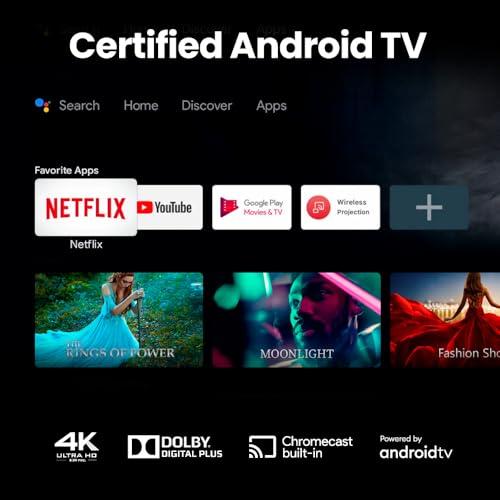
Here's where these projectors diverge most dramatically in philosophy. The BenQ W4100i includes built-in Android TV functionality through an included dongle, providing direct access to Netflix, Prime Video, Disney+, YouTube, and thousands of other apps. Google Assistant integration allows voice search and control, while Chromecast support enables easy streaming from mobile devices.
This integration represents significant value, eliminating the need for external streaming devices and simplifying your entertainment setup. The interface is familiar to anyone who's used Android TV, with personalized recommendations and a unified search across multiple streaming services.
The Sony BRAVIA Projector 8 takes a purist approach, offering no built-in smart features. This might seem like a limitation, but it reflects Sony's focus on pure projection performance. The theory is that dedicated streaming devices—like Apple TV 4K, Nvidia Shield TV, or Xbox Series X—provide better performance and more frequent updates than built-in systems.
For professional installations, Sony includes extensive integration support for control systems like Control4, Crestron, and Savant. This makes the projector ideal for custom home theaters where a professional installer handles all the complexity.
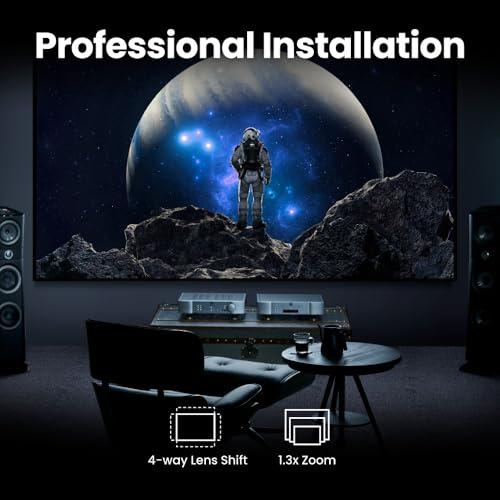
Room layouts rarely accommodate projectors perfectly, making installation flexibility crucial. The BenQ W4100i offers solid flexibility with 1.3x optical zoom, allowing you to adjust image size without moving the projector. The motorized lens shift provides 60% vertical adjustment and 15% horizontal adjustment, helping compensate for off-center mounting positions.
The compact design—roughly the size of a large shoebox—makes the BenQ suitable for tabletop placement or simple ceiling mounting. The 2D keystone correction and four-corner adjustment can fix geometric distortion when perfect alignment isn't possible, though these digital corrections can slightly reduce image quality.
The Sony BRAVIA Projector 8 provides superior installation flexibility through its 2.1x powered zoom lens and extensive lens shift capabilities—36% horizontal and 85% vertical adjustment. This means you can mount the projector significantly off-center from your screen while maintaining perfect geometry.
The larger, heavier design reflects the projector's premium positioning, but the advanced lens system makes challenging installations much easier. Professional installers particularly appreciate these capabilities when dealing with complex room layouts or architectural constraints.
At the time of writing, these projectors occupy different segments of the market, making direct price comparisons somewhat unfair. The BenQ W4100i delivers remarkable performance for its price point, offering features and capabilities that would have cost significantly more just a few years ago.
The value proposition extends beyond the initial purchase. The LED light source eliminates lamp replacement costs, while the integrated Android TV eliminates the need for external streaming devices. When you factor in the excellent gaming performance and room versatility, the BenQ represents outstanding value for families and enthusiasts who want maximum features without premium pricing.
The Sony BRAVIA Projector 8 justifies its premium positioning through superior image quality, professional-grade features, and long-term reliability. The true native 4K resolution, advanced processing, and precise color reproduction appeal to serious cinephiles and custom installation environments.
Sony's approach also considers environmental impact, with 20% less virgin plastic and 15% smaller packaging compared to previous models. The mercury-free laser design eliminates toxic materials while providing consistent performance over its 20,000-hour lifespan.
Your decision should ultimately depend on your specific needs, room environment, and priorities. The BenQ W4100i excels in multi-purpose environments where brightness and convenience matter most. If your projector will live in a family room where complete light control isn't always possible, or if you value having everything integrated into one device, the BenQ represents an excellent choice.
Choose the BenQ if you're setting up a versatile entertainment system for family use, need maximum brightness for ambient light conditions, want the lowest possible gaming input lag, or prefer the convenience of integrated streaming without additional devices.
The Sony BRAVIA Projector 8 makes sense for dedicated home theater environments where image quality takes priority over convenience. If you're building a serious cinema room with proper light control, large screen sizes (150+ inches), and professional installation, Sony's superior processing and native resolution deliver noticeable advantages.
Choose the Sony if you're creating a dedicated theater room with controlled lighting, want the absolute best image quality regardless of price, plan to use very large screen sizes where native resolution matters most, or prefer the reliability and consistency of laser light sources.
Both projectors represent excellent choices within their respective categories. The BenQ W4100i democratizes high-quality 4K projection, making cinema-quality entertainment accessible and practical for more households. The Sony BRAVIA Projector 8 pushes the boundaries of what's possible in home projection, delivering professional-grade performance for serious enthusiasts.
The projector market continues evolving rapidly, with both LED and laser technologies improving each year. Whichever you choose, you'll be getting a device that delivers stunning large-screen entertainment that was unimaginable at these price points just a decade ago. The key is matching the projector's strengths to your specific viewing environment and entertainment priorities.
| BenQ W4100i 4K Home Theater Projector | Sony BRAVIA Projector 8 4K HDR Laser Projector |
|---|---|
| Display Technology - Determines image sharpness and pixel visibility | |
| DLP with XPR pixel-shifting to 4K (excellent perceived sharpness, minimal pixel structure) | True native 4K SXRD panels (absolute detail clarity, especially on 150+ inch screens) |
| Brightness - Critical for room versatility and ambient light handling | |
| 3,200 ANSI lumens from 4-LED system (handles moderate ambient light well) | 2,700 lumens from laser source (best in darkened rooms, 18% less bright than BenQ) |
| Light Source Technology - Affects lifespan, maintenance, and image consistency | |
| 4-LED RGBB system, 30,000-hour lifespan (no lamp replacements, consistent brightness) | Z-Phosphor laser, 20,000-hour lifespan (precise dimming for better blacks, no maintenance) |
| Contrast Performance - Creates image depth and dimensionality | |
| 3,000,000:1 dynamic contrast with LED dimming (solid blacks for price range) | Infinite dynamic contrast with laser control (superior native contrast and deep blacks) |
| HDR Format Support - Determines compatibility with streaming and disc content | |
| HDR10, HDR10+, HLG (broadest format support including dynamic metadata) | HDR10, HLG only (missing HDR10+ but superior processing quality) |
| Gaming Input Lag - Essential for responsive gaming performance | |
| 6.5ms (1080p/240Hz), 17.9ms (4K/60Hz) (excellent for competitive gaming) | 12ms (4K/120Hz), 21ms (4K/60Hz) (better high-resolution gaming performance) |
| HDMI Connectivity - Affects device connection flexibility | |
| 3 × HDMI 2.1 ports with 4K/120Hz support (excellent for multiple gaming consoles) | 2 × HDMI 2.1 ports (sufficient for most setups but less flexibility) |
| Smart Features - Determines need for external streaming devices | |
| Built-in Android TV with Netflix, Prime Video, Disney+ access (all-in-one convenience) | No built-in streaming (requires external devices but allows premium streamers) |
| Installation Flexibility - Important for non-ideal room layouts | |
| 1.3x zoom, ±60% vertical/±15% horizontal lens shift (good basic flexibility) | 2.1x zoom, ±85% vertical/±36% horizontal lens shift (superior installation options) |
| Color Accuracy - Affects realistic color reproduction | |
| 100% DCI-P3 and Rec.709 coverage, factory calibrated to Delta E<2 (excellent out-of-box accuracy) | XR Triluminos Pro with 1+ billion colors (superior color processing and gradation) |
| Physical Size - Impacts placement options | |
| Compact: 16.56" × 5.31" × 12.28", 13.5 lbs (easy tabletop or simple ceiling mount) | Larger: 18.1" × 8.4" × 20.4", 31 lbs (premium build, requires sturdy mounting) |
| Image Processing - Enhances content quality and viewing experience | |
| AI Cinema Mode with HDR-PRO dynamic tone mapping (optimizes streaming content) | XR Processor with Dynamic Tone Mapping (professional-grade processing from TV division) |
The BenQ W4100i is significantly better for bright rooms, delivering 3,200 ANSI lumens compared to the Sony BRAVIA Projector 8's 2,700 lumens. This 18% brightness advantage allows the BenQ W4100i to maintain vibrant colors and good contrast even with moderate ambient light, making it ideal for family rooms where complete darkness isn't always possible.
For most viewers, the BenQ W4100i's pixel-shifting 4K delivers excellent results that are difficult to distinguish from native 4K during normal viewing. However, the Sony BRAVIA Projector 8 offers true native 4K resolution that becomes more noticeable on very large screens (150+ inches) or when sitting close to the image. Unless you're planning an extremely large screen setup, both provide sharp, detailed 4K images.
Both projectors excel at gaming but in different ways. The BenQ W4100i offers ultra-low 6.5ms input lag at 1080p/240Hz, making it ideal for competitive gaming. The Sony BRAVIA Projector 8 provides better 4K/120Hz performance with 12ms input lag. The BenQ also includes three HDMI 2.1 ports versus Sony's two, offering more connectivity for multiple gaming consoles.
The BenQ W4100i uses a 4-LED system rated for 30,000 hours with consistent brightness throughout its lifespan. The Sony BRAVIA Projector 8 employs a laser system lasting 20,000 hours but offers superior contrast control through precise dimming capabilities. Both eliminate traditional lamp replacement costs, but the BenQ's LED system provides longer lifespan while Sony's laser enables better black levels.
The BenQ W4100i includes built-in Android TV with direct access to Netflix, Prime Video, Disney+, and YouTube, making it an all-in-one entertainment solution. The Sony BRAVIA Projector 8 requires external streaming devices but allows you to choose premium options like Apple TV 4K. For convenience, choose the BenQ; for ultimate streaming quality, the Sony with dedicated streamers may be preferable.
The Sony BRAVIA Projector 8 delivers superior contrast with infinite dynamic range through precise laser control, creating deeper blacks and more dimensional images. The BenQ W4100i achieves 3,000,000:1 dynamic contrast through LED dimming, which is excellent for its price range but can't match the Sony's native contrast performance, especially in dark movie scenes.
The Sony BRAVIA Projector 8 provides superior installation flexibility with 2.1x zoom and extensive lens shift (±85% vertical, ±36% horizontal) compared to the BenQ W4100i's 1.3x zoom and more limited lens shift (60% vertical, ±15% horizontal). If you have challenging room layouts or need significant placement flexibility, the Sony offers more options.
The BenQ W4100i supports HDR10, HDR10+, and HLG formats, providing the broadest compatibility including dynamic metadata from HDR10+ content. The Sony BRAVIA Projector 8 supports HDR10 and HLG but lacks HDR10+ compatibility. However, the Sony compensates with superior HDR processing quality through its XR Dynamic Tone Mapping technology.
The BenQ W4100i offers exceptional value, combining high brightness, built-in streaming, excellent gaming performance, and broad HDR support in a competitive price range. The Sony BRAVIA Projector 8 justifies its premium positioning through true native 4K, superior image processing, and professional-grade features. Choose the BenQ for maximum features per dollar, or the Sony for uncompromising image quality.
Both projectors deliver excellent color performance. The BenQ W4100i covers 100% of DCI-P3 and Rec.709 color spaces with factory calibration to Delta E<2 accuracy. The Sony BRAVIA Projector 8 features XR Triluminos Pro technology delivering over one billion colors with sophisticated color processing. The BenQ excels in out-of-box accuracy, while the Sony provides more advanced color gradation and processing.
The Sony BRAVIA Projector 8 operates at just 26 dB, making it extremely quiet for dedicated home theater environments. The BenQ W4100i doesn't specify noise levels in available documentation, but LED-based projectors typically run quieter than lamp-based models. For ultra-quiet operation in a dedicated theater room, the Sony has a clear advantage.
The BenQ W4100i works well with screens up to 150 inches but is optimized for 100-120 inch viewing. Its higher brightness makes it versatile for various screen sizes in different lighting conditions. The Sony BRAVIA Projector 8 excels with larger screens (120-200+ inches) where its true native 4K resolution and superior contrast become more apparent. Choose the BenQ for moderate sizes, the Sony for maximum screen real estate.
We've done our best to create useful and informative comparisons to help you decide what product to buy. Our research uses advanced automated methods to create this comparison and perfection is not possible - please contact us for corrections or questions. These are the sites we've researched in the creation of this article: blog.son-video.com - notebookcheck.net - whathifi.com - newatlas.com - hometheaterhifi.com - benq.com - youtube.com - shop.avispl.com - projectorcentral.com - benq.com - youtube.com - projectorcentral.com - benq.com - device.report - pssav.com - newegg.com - projectorreviews.com - valueelectronics.com - stereonet.com - crutchfield.com - audioholics.com - crutchfield.com - projectorcentral.com - pro.sony - electronics.sony.com - cepro.com - community.verizon.com

Privacy Policy
Terms and Conditions - Affiliate Policy
Home Security
© Copyright 2008-2026.
11816 Inwood Rd #1211, Dallas, TX 75244