

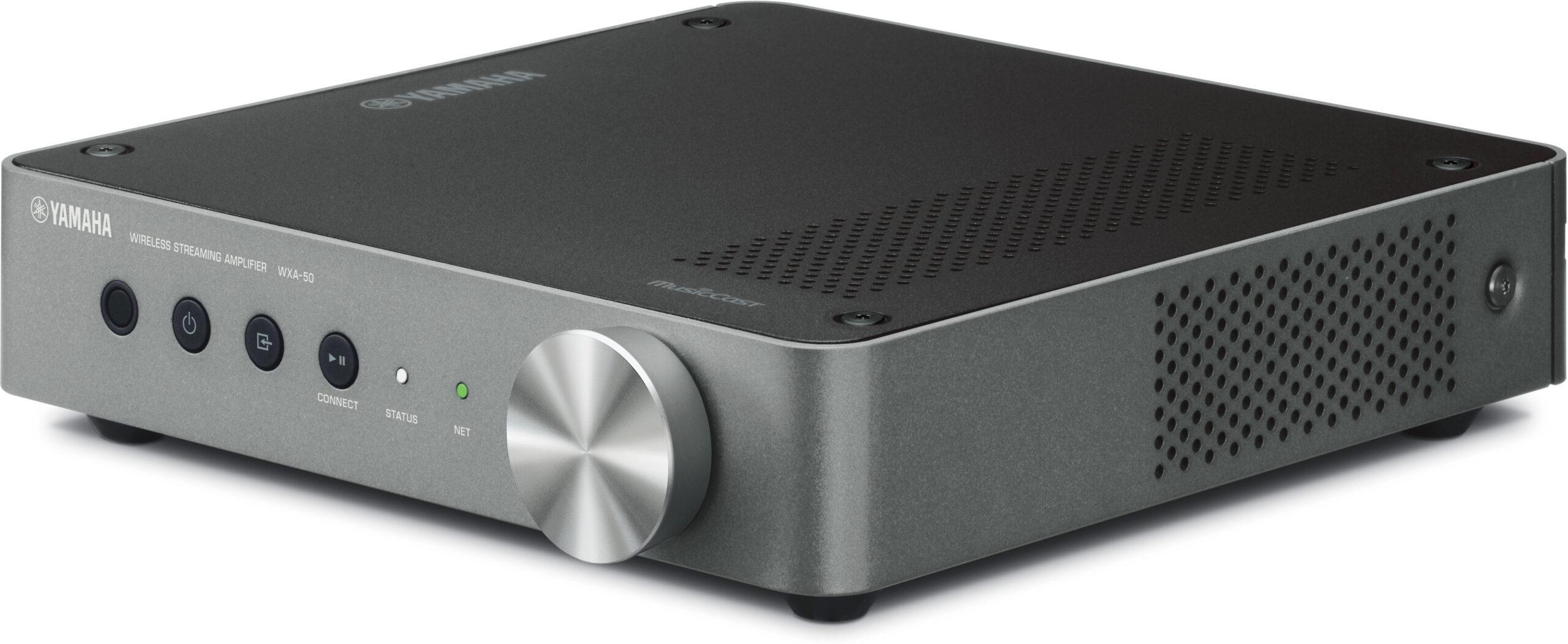
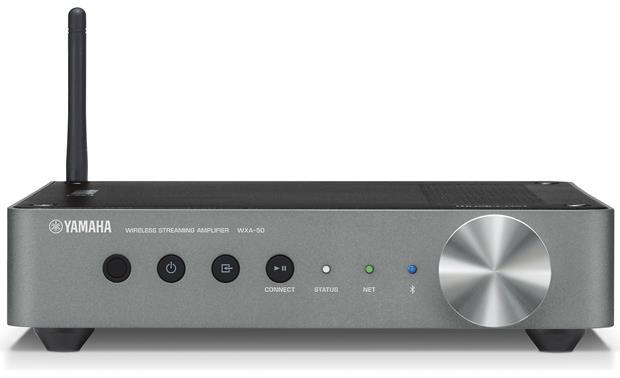
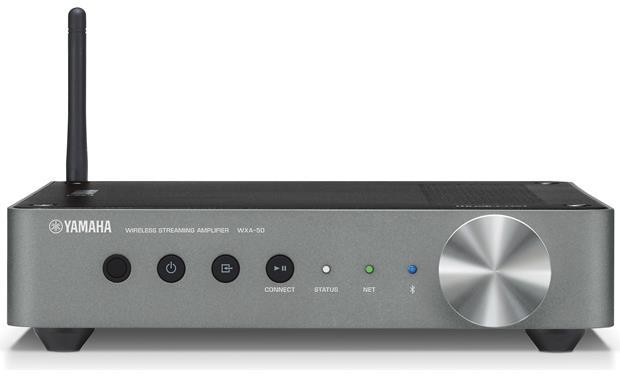
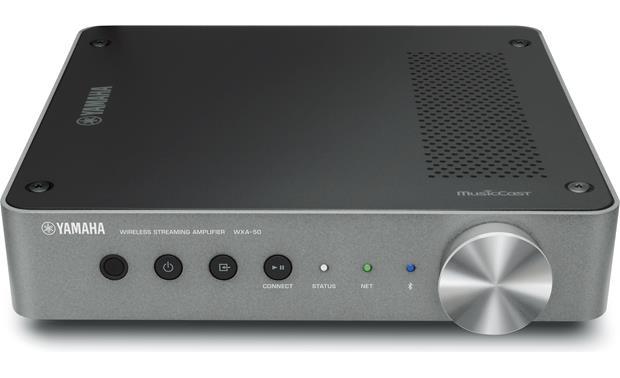
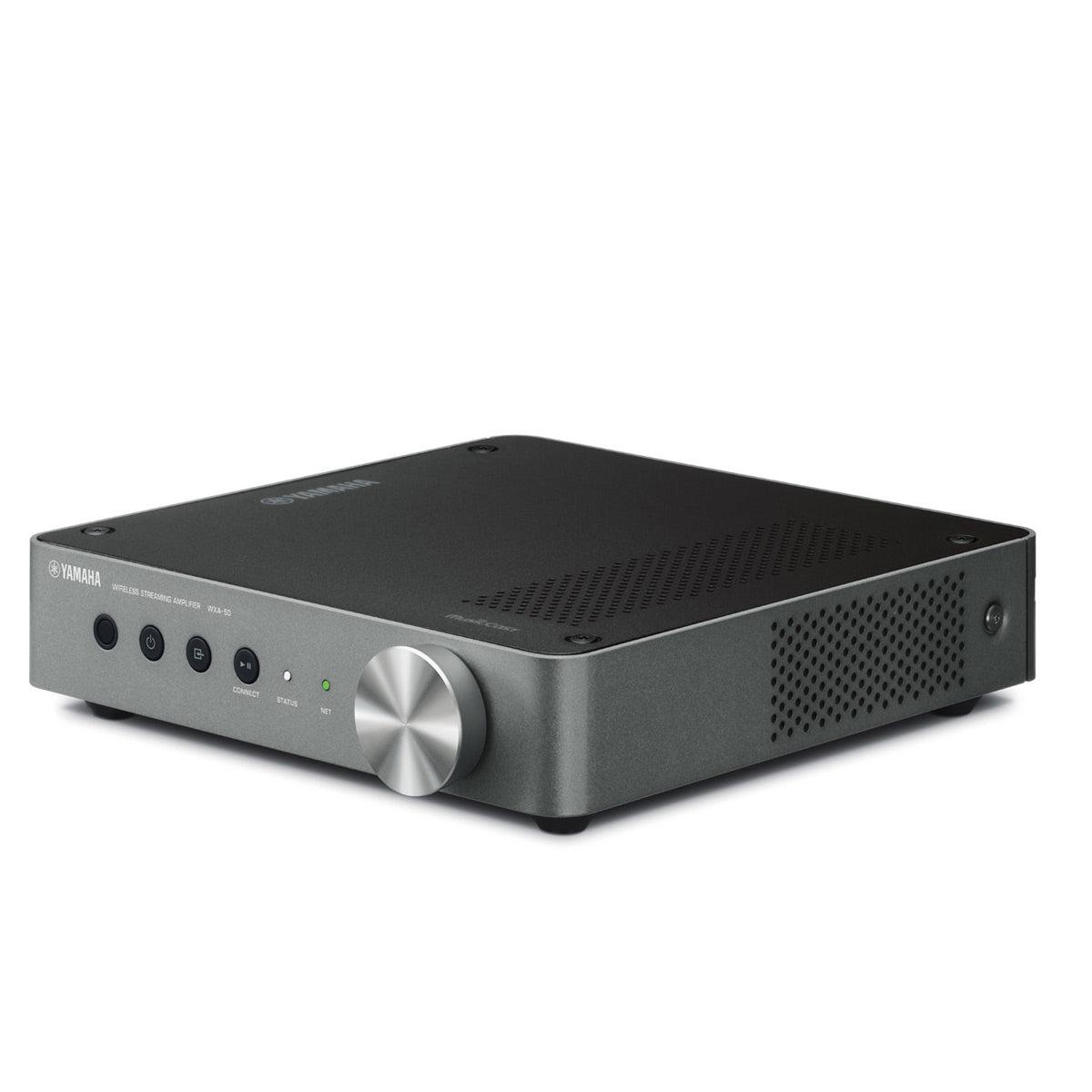
When shopping for an integrated amplifier today, you're not just buying a box that makes your speakers louder. Modern integrated amps have evolved into sophisticated audio hubs that can stream music wirelessly, decode high-resolution files, and even drive headphones. But this evolution has created two distinct paths: streaming-focused convenience versus audiophile-grade performance. The Yamaha MusicCast WXA-50 and NAD D 3045 represent these two philosophies perfectly, each excelling in different ways that matter to different users.
An integrated amplifier combines two essential components: a preamplifier (which handles input switching, volume control, and initial signal processing) and a power amplifier (which provides the muscle to drive your speakers). What makes modern units special is their digital capabilities—built-in DACs (digital-to-analog converters) that transform digital music files into the analog signals your speakers need, streaming capabilities that connect directly to your home network, and processing features that can enhance different types of music.
The key considerations when choosing between products like the Yamaha WXA-50 and NAD D 3045 come down to how you actually listen to music. Do you primarily stream Spotify while moving between rooms? Are you building a dedicated listening room with vinyl records and high-resolution files? Do you need something that works seamlessly with your TV and headphones? These usage patterns determine which technical features matter most.
At the time of writing, both amplifiers occupy similar price points in the mid-range market, typically falling between entry-level and high-end audiophile territory. This makes the choice particularly interesting because you're not comparing budget versus premium—you're comparing two different approaches to solving the same fundamental problem of amplifying audio.
The most fundamental job of any amplifier is driving speakers, and here we see the first major difference in approach. The Yamaha WXA-50 delivers 55 watts per channel into 8-ohm speakers (the most common speaker impedance), scaling up to 70 watts into 6-ohm loads and 105 watts into 4-ohm speakers. This variable power output reflects traditional amplifier behavior where lower impedances allow more current flow.
The NAD D 3045 takes a different approach, delivering a consistent 60 watts per channel whether driving 4-ohm or 8-ohm speakers. This consistency comes from NAD's PowerDrive technology, which maintains stable power delivery regardless of speaker impedance. In practical terms, this means the NAD is more predictable with difficult speaker loads—those power-hungry tower speakers or inefficient bookshelf models that can stress lesser amplifiers.
But raw wattage numbers only tell part of the story. The NAD D 3045 uses Class D amplification with Hypex UcD modules, a hybrid digital design that runs extremely efficiently and stays cool. Class D amplifiers switch rapidly between full on and full off states, using pulse-width modulation to recreate the audio waveform. This efficiency means less heat generation and lower power consumption, though some audiophiles historically preferred the "warmer" sound of traditional Class AB designs.
The Yamaha WXA-50 uses conventional Class AB amplification, where transistors operate in a linear region and generate more heat but potentially fewer switching artifacts. Class AB has been the gold standard for decades, offering a good balance between efficiency and audio quality.
For most bookshelf speakers and moderate listening levels, both amplifiers provide adequate power. However, if you're driving inefficient speakers (sensitivity below 86dB) in a larger room, or if you enjoy dynamic music at higher volumes, the NAD's consistent power delivery and superior current capability give it an edge. The difference becomes more pronounced with demanding speakers that dip below 4 ohms, where the NAD D 3045 maintains its composure while some amplifiers might strain.
Both amplifiers recognize that most of today's music starts as digital files, but they approach digital-to-analog conversion differently. The Yamaha WXA-50 incorporates an ESS Sabre DAC, the same converter used in Yamaha's high-end AV receivers. ESS Sabre chips are known for excellent technical measurements and detailed sound reproduction.
The NAD D 3045 uses an AKM AK4490 DAC, a 32-bit converter that's particularly well-regarded for its natural musicality. While both DACs will sound excellent with most sources, the AKM chip in the NAD supports native DSD (Direct Stream Digital) playback and MQA (Master Quality Authenticated) decoding—two high-resolution formats that audiophiles increasingly care about.
More importantly, the NAD D 3045 supports higher resolution digital inputs: up to 384kHz/24-bit via USB compared to the Yamaha's 192kHz/24-bit maximum. In practical terms, these differences matter primarily if you collect high-resolution music files or stream from services like Tidal Masters. For Spotify, Apple Music, or standard CD-quality files, both amplifiers perform admirably.
The USB implementation deserves special attention. The NAD D 3045 uses asynchronous USB, meaning it controls the timing of data transfer rather than letting the computer dictate pace. This reduces jitter (timing errors) that can affect audio quality. The Yamaha also supports USB input but focuses more on network streaming than computer audio connections.
Here's where these amplifiers reveal their true personalities. The Yamaha WXA-50, released in 2017, was designed from the ground up as a streaming amplifier for the wireless home. It connects directly to your Wi-Fi network and supports numerous streaming services natively: Spotify Connect, Pandora, TIDAL, Deezer, and thousands of internet radio stations. No phone or computer required—just select your music through the MusicCast app.
More significantly, the Yamaha WXA-50 integrates into Yamaha's MusicCast ecosystem, supporting up to 32 connected devices across 10 different zones. This means you could have MusicCast speakers in the kitchen, a MusicCast soundbar in the living room, and the WXA-50 driving bookshelf speakers in your office—all playing synchronized music or different sources entirely.
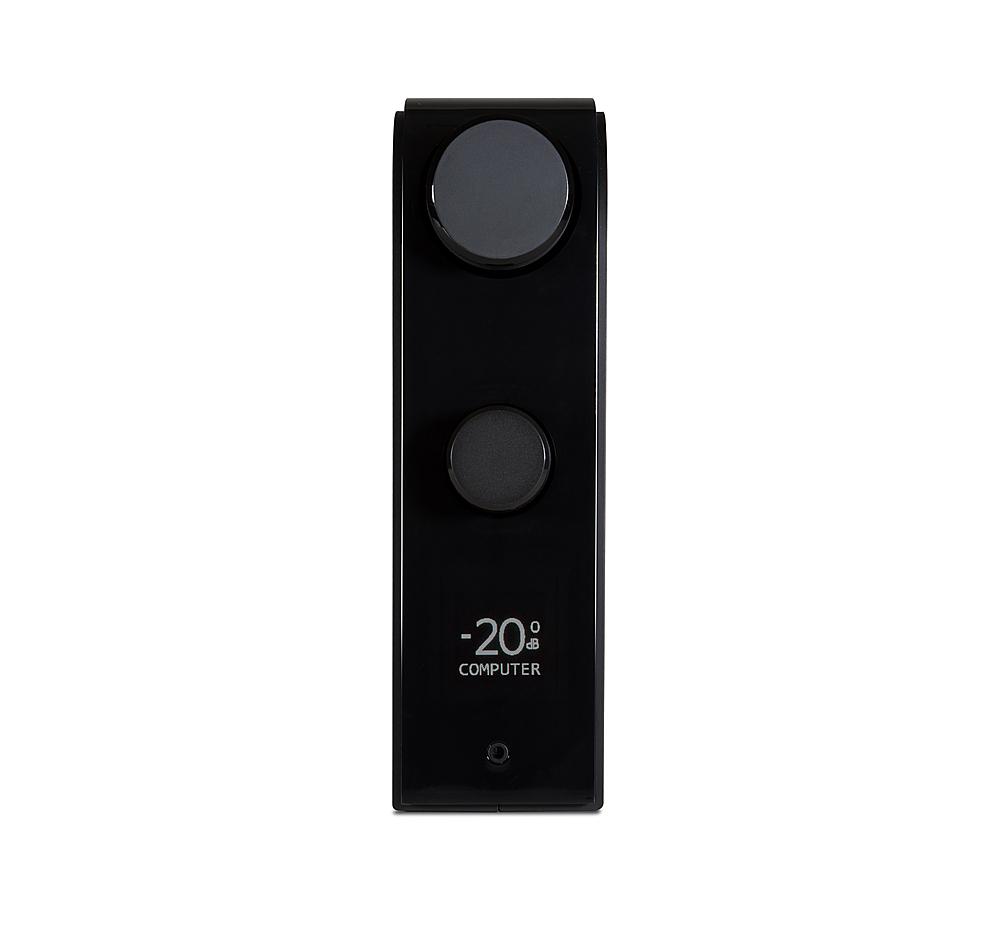
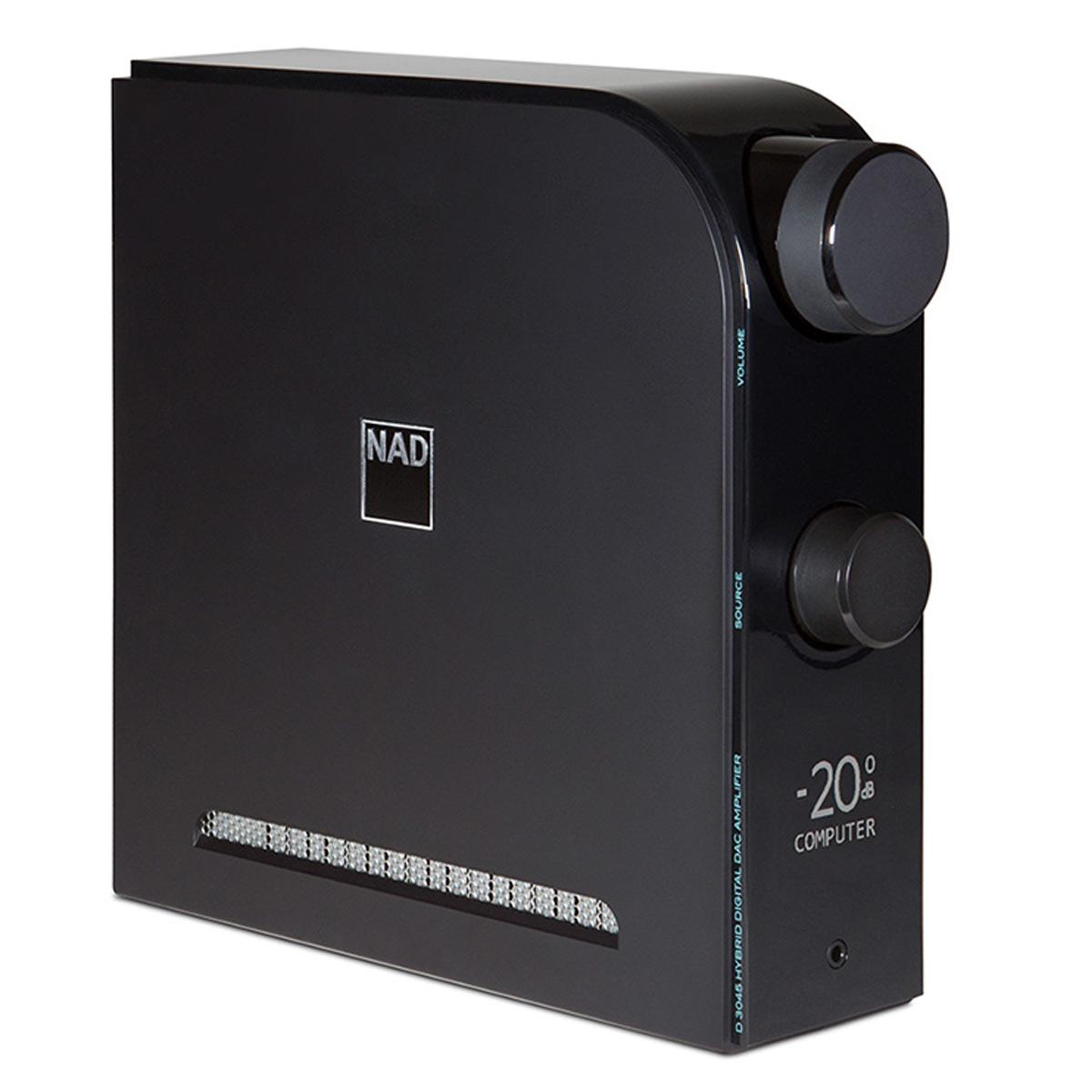
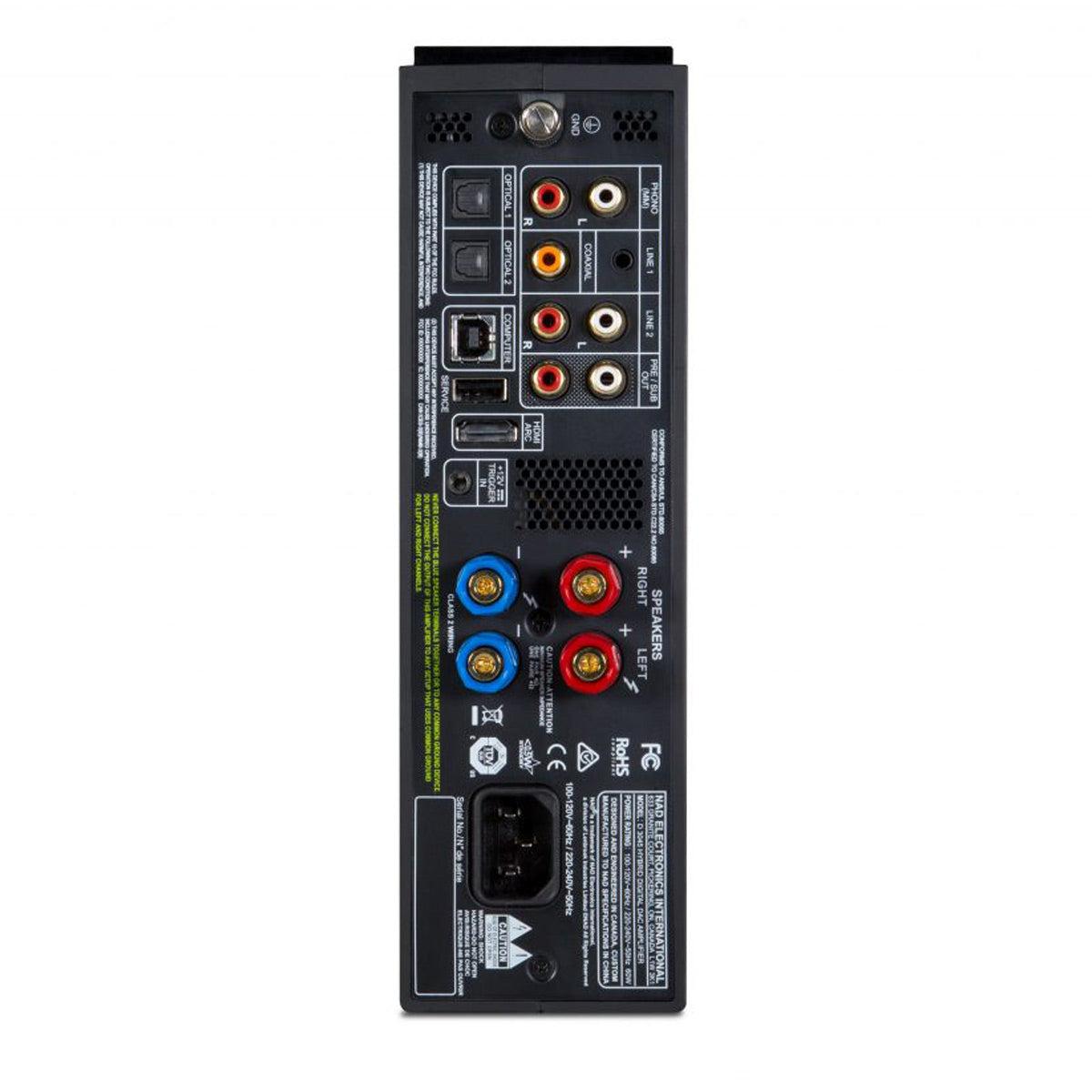
The NAD D 3045, also from 2017, takes a more traditional approach. It includes high-quality Bluetooth with aptX HD support (providing near-CD quality wireless audio), but no Wi-Fi streaming. Instead, NAD focused on comprehensive wired connectivity: two optical digital inputs, one coaxial input, a high-resolution USB input, and even HDMI ARC for direct TV connection.
This difference in philosophy reflects different use cases. If you want to stream music throughout your home while controlling everything from your phone, the Yamaha WXA-50 excels. If you prefer connecting dedicated sources—a CD player, turntable with external phono stage, streaming DAC, or TV—the NAD D 3045 provides more flexibility.
The HDMI ARC input on the NAD D 3045 deserves special mention for home theater users. ARC (Audio Return Channel) allows your TV to send audio back to the amplifier, so you can use the NAD to drive your main speakers for TV watching while controlling volume with your TV remote. This integration makes the NAD particularly attractive if you want high-quality stereo sound for both music and television.
One crucial difference lies in analog source handling. The NAD D 3045 includes a built-in moving magnet (MM) phono stage, meaning you can connect a turntable directly without needing a separate phono preamp. According to our research of expert reviews, this phono stage performs exceptionally well—described as "astonishingly fine" with RIAA equalization that rivals dedicated phono preamps in this price range.
The Yamaha WXA-50 offers only line-level analog inputs, so vinyl enthusiasts need either a turntable with built-in preamp or a separate phono stage. This isn't necessarily a dealbreaker, but it does add complexity and cost for record collectors.
For analog sources beyond vinyl, both amplifiers include standard RCA line inputs, but the NAD D 3045 offers more—two line inputs plus a 3.5mm front-panel input for phones or portable players. The Yamaha focuses more on digital connectivity with just one analog input alongside its streaming capabilities.
Both amplifiers include processing features designed to optimize performance with different speakers and sources, but their approaches differ significantly. The Yamaha WXA-50 includes several proprietary technologies: Compressed Music Enhancer improves the sound of MP3 and other lossy formats by restoring some high-frequency information lost during compression. Volume-Adaptive EQ automatically adjusts bass and treble as you change volume, compensating for how human hearing perceives different frequencies at various levels. Advanced Bass Extension Processing can help smaller speakers produce deeper bass without strain.
The NAD D 3045 takes a more purist approach with fewer processing options but more precise ones. Its Bass EQ can boost low frequencies by up to 6dB to help smaller speakers, while configurable high-pass filters (40Hz, 50Hz, or 120Hz) allow proper integration with subwoofers by removing deep bass that bookshelf speakers can't reproduce effectively.
Both amplifiers offer bypass modes—Pure Direct on the Yamaha and standard bypassing on the NAD—for purist listening without any processing. However, the NAD D 3045's bass management tools are more sophisticated for users who understand speaker limitations and room acoustics.
This category shows perhaps the starkest difference between these amplifiers. The Yamaha WXA-50 includes no headphone output at all—a surprising omission in a modern integrated amplifier. Users wanting headphone capability need a separate headphone amplifier or must rely on source device outputs.
The NAD D 3045 includes what experts consistently describe as an unusually powerful and well-implemented headphone amplifier. Unlike the weak headphone outputs found on many integrated amps, the NAD's dedicated circuit can drive demanding over-ear headphones with authority. Based on measurement reviews, it delivers significantly more power than typical integrated amp headphone sections, making it viable as a desktop headphone system for serious listening.
This difference matters enormously if headphone listening factors into your audio habits. Late-night listening, apartment living, or simply preferring the intimate sound of good headphones makes the NAD D 3045 the obvious choice.
The control experience reveals each amplifier's target audience. The Yamaha WXA-50 centers around the MusicCast app for iOS and Android, which handles source selection, volume control, multi-room management, and streaming service integration. The app generally receives positive reviews for functionality, though some users note it's not quite as polished as Sonos's interface for certain streaming services.
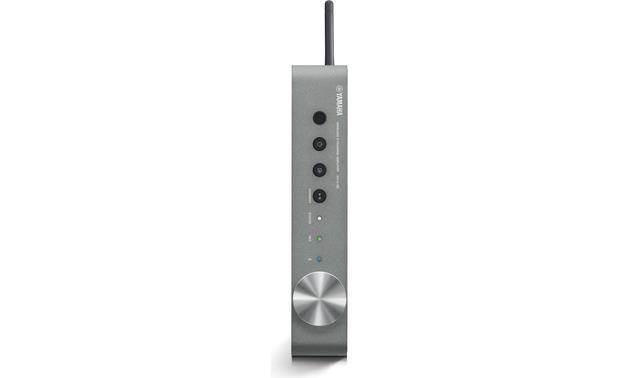
Physical controls on the Yamaha include basic front-panel operation and a slim remote with six preset buttons for quick access to favorite streaming sources or internet radio stations. The "One Push Play" feature automatically powers on and resumes the last source with any button press—a thoughtful convenience feature.
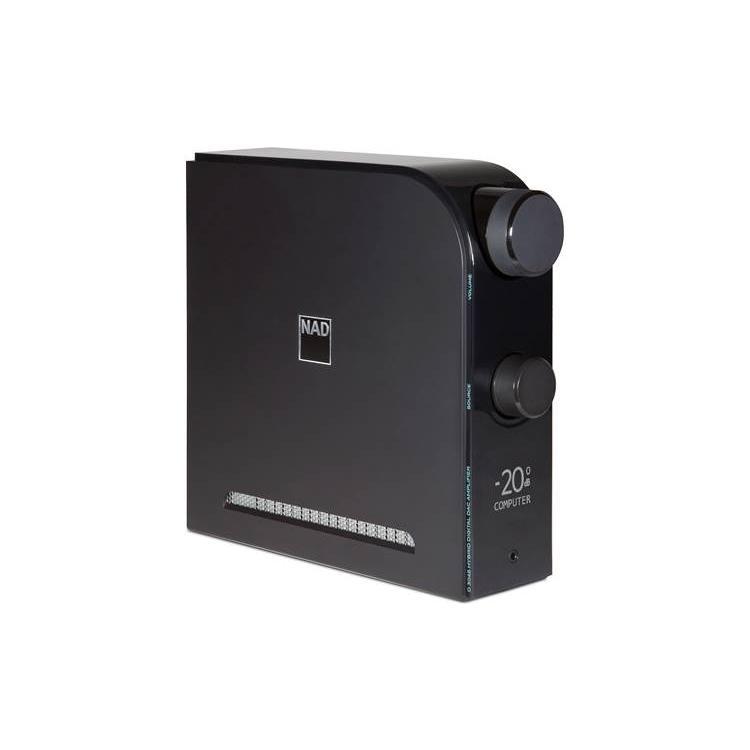
The NAD D 3045 follows traditional hi-fi conventions with comprehensive front-panel controls and a full-function remote. Its compact form factor allows both horizontal and vertical orientation, and the display automatically adjusts orientation accordingly. Volume control uses a precision stepped attenuator rather than a basic potentiometer, providing more accurate channel matching and better sound quality.
For users accustomed to streaming service apps and wireless convenience, the Yamaha feels more modern and integrated. For those who prefer dedicated audio equipment with traditional operation, the NAD's approach feels more natural and reliable.
Both amplifiers can serve in home theater systems, but with different strengths. The NAD D 3045's HDMI ARC input makes TV integration seamless—connect one HDMI cable to your TV, and the amplifier automatically switches to TV audio when you turn on the television. The 12V trigger input allows integration with AV processors or other home theater components for automated power control.
The Yamaha WXA-50 lacks HDMI inputs but offers different home theater value through its MusicCast integration. If you have a Yamaha AV receiver or soundbar with MusicCast, the WXA-50 can serve as zone 2 amplification or provide synchronized music throughout the home. However, for primary TV audio duties, the NAD's direct HDMI connection is more practical.
Both amplifiers include subwoofer/preamp outputs for integrating powered subwoofers, though the NAD D 3045's high-pass filtering provides more sophisticated bass management.
At the time of writing, both amplifiers occupy similar pricing tiers, making the decision more about feature priorities than budget constraints. The Yamaha WXA-50 delivers exceptional value for users building wireless multi-room systems or prioritizing streaming convenience. Its MusicCast integration, native streaming services, and wireless capabilities would require multiple separate components to replicate.
The NAD D 3045 provides superior value for traditional audiophiles who want modern digital capabilities without sacrificing analog performance. The combination of high-quality amplification, comprehensive connectivity, excellent phono stage, and powerful headphone amplifier would be expensive to assemble separately.
Choose the Yamaha MusicCast WXA-50 if your listening habits center around streaming services, multi-room audio, or wireless convenience. It excels for users who want to control music from their phone, stream throughout the house, and enjoy modern features like voice control integration (through compatible MusicCast devices). The Yamaha makes most sense for households where background music and casual listening dominate, where multiple family members want easy access to streaming services, or where running speaker cables to multiple rooms isn't practical.
The NAD D 3045 better serves dedicated listening environments where sound quality takes precedence. Choose it if you collect vinyl records, prefer high-resolution digital files, use demanding headphones, or want comprehensive connectivity for multiple sources. The NAD excels in single-room setups focused on critical listening, home offices where headphone performance matters, or systems where TV integration is important.
Both amplifiers represent excellent engineering and value within their respective philosophies. The Yamaha WXA-50 prioritizes modern convenience and wireless integration, while the NAD D 3045 emphasizes audiophile performance with contemporary connectivity. Your choice should reflect how you actually listen to music—streaming wirelessly throughout the home, or sitting down for focused listening sessions with high-quality sources. Neither approach is inherently superior; they simply serve different musical lifestyles with equal competence.
| Yamaha MusicCast Wireless Streaming Amplifier | NAD D 3045 Integrated Amplifier |
|---|---|
| Power Output - Determines what speakers you can drive effectively | |
| 55W/8Ω, 70W/6Ω, 105W/4Ω (scales with impedance) | 60W continuous into both 4Ω and 8Ω (consistent power delivery) |
| Amplifier Technology - Affects efficiency, heat, and sound character | |
| Class AB (traditional, runs warmer but proven performance) | Hybrid Digital Class D with Hypex modules (efficient, runs cool) |
| Wireless Streaming - Critical for modern music listening convenience | |
| Native Wi-Fi, MusicCast multi-room, Spotify Connect, internet radio | Bluetooth aptX HD only (no Wi-Fi streaming capabilities) |
| Digital Audio Support - Important for high-resolution music files | |
| Up to 192kHz/24-bit, DSD 5.6MHz, ESS Sabre DAC | Up to 384kHz/24-bit via USB, native DSD, MQA support, AKM DAC |
| Analog Inputs - Essential for turntables and other analog sources | |
| 1x RCA line input (requires external phono preamp for vinyl) | MM phono stage built-in plus multiple line inputs (direct turntable connection) |
| Digital Connectivity - Flexibility for modern digital sources | |
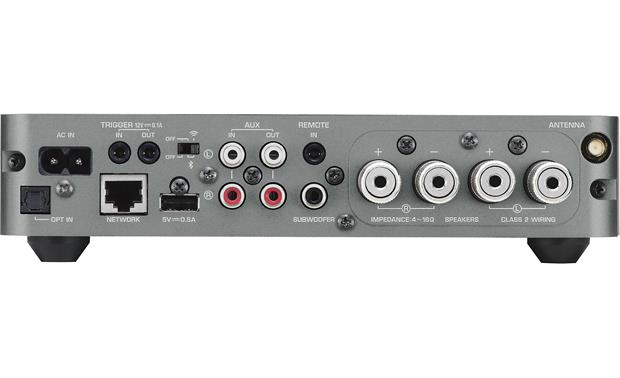
| 1x optical, 1x USB, ethernet for streaming | 2x optical, 1x coaxial, 1x USB-B, HDMI ARC for TV integration |
| Headphone Output - Important for private listening | |
| None (requires separate headphone amplifier) | Dedicated powerful headphone amplifier with 3.5mm output |
| Multi-Room Capability - Value for whole-home audio systems | |
| MusicCast ecosystem supports up to 32 devices across 10 zones | No multi-room capability (single room focus) |
| Control Interface - Daily usability and convenience | |
| MusicCast smartphone app plus basic remote control | Traditional remote and front panel controls (no app required) |
| TV Integration - Useful for home theater setups | |
| Network streaming only (no direct TV connection) | HDMI ARC input with TV remote control compatibility |
| Audio Processing - Features that enhance different music types | |
| Compressed Music Enhancer, Volume-Adaptive EQ, Bass Extension | Bass EQ and configurable high-pass filtering (40/50/120Hz) |
| Physical Design - Installation flexibility and space requirements | |
| Compact horizontal/vertical placement, 4.28 lbs | Ultra-compact with auto-rotating display, 7.9 lbs |
The NAD D 3045 delivers 60 watts per channel consistently into both 4-ohm and 8-ohm speakers, while the Yamaha MusicCast Wireless Streaming Amplifier provides 55 watts into 8-ohm speakers but scales up to 105 watts into 4-ohm loads. For most speakers, both provide adequate power, but the NAD D 3045 offers more predictable performance with difficult speaker loads.
The Yamaha MusicCast Wireless Streaming Amplifier excels at wireless streaming with built-in Wi-Fi, native support for Spotify, Pandora, TIDAL, and internet radio. The NAD D 3045 only offers Bluetooth aptX HD streaming and requires a wired connection for other streaming services. For wireless convenience, the Yamaha MusicCast Wireless Streaming Amplifier is the clear winner.
The NAD D 3045 includes a high-quality moving magnet phono stage, allowing direct turntable connection without additional equipment. The Yamaha MusicCast Wireless Streaming Amplifier requires a separate phono preamp or a turntable with built-in preamp. For vinyl enthusiasts, the NAD D 3045 provides better value and convenience.
The NAD D 3045 features a powerful dedicated headphone amplifier that can drive demanding headphones effectively. The Yamaha MusicCast Wireless Streaming Amplifier has no headphone output whatsoever. If headphone listening is important, the NAD D 3045 is your only option between these two.
The NAD D 3045 includes HDMI ARC input for direct TV connection and control with your TV remote. The Yamaha MusicCast Wireless Streaming Amplifier lacks HDMI inputs but can integrate with Yamaha soundbars and receivers through MusicCast. For simple TV audio integration, the NAD D 3045 is more practical.
The Yamaha MusicCast Wireless Streaming Amplifier is designed for multi-room systems, supporting up to 32 MusicCast devices across 10 zones with synchronized or independent playback. The NAD D 3045 is strictly a single-room amplifier with no multi-room capabilities. For whole-home audio, choose the Yamaha MusicCast Wireless Streaming Amplifier.
The NAD D 3045 supports up to 384kHz/24-bit digital audio via USB, plus native DSD and MQA formats. The Yamaha MusicCast Wireless Streaming Amplifier handles up to 192kHz/24-bit files and DSD up to 5.6MHz. Both handle high-resolution audio well, but the NAD D 3045 offers broader format support for audiophile files.
The Yamaha MusicCast Wireless Streaming Amplifier centers around smartphone app control with streaming service integration and basic remote functions. The NAD D 3045 uses traditional front-panel controls and a comprehensive remote without requiring smartphone apps. Choose based on whether you prefer modern app control or traditional hi-fi operation.
The NAD D 3045 uses efficient Class D amplification that runs cool and consumes less power during operation. The Yamaha MusicCast Wireless Streaming Amplifier uses traditional Class AB amplification that generates more heat but offers proven performance. Both have low standby power consumption under 2 watts.
The NAD D 3045 provides extensive digital connectivity with two optical inputs, one coaxial input, USB, and HDMI ARC. The Yamaha MusicCast Wireless Streaming Amplifier offers one optical input, USB, and ethernet for streaming. The NAD D 3045 wins for users with multiple digital sources like CD players and streaming devices.
Both amplifiers offer excellent value in different ways. The Yamaha MusicCast Wireless Streaming Amplifier provides outstanding value for streaming-focused users wanting multi-room capability and wireless convenience. The NAD D 3045 delivers superior value for audiophiles wanting comprehensive connectivity, analog performance, and headphone capability in one unit.
For home theater use, the NAD D 3045 integrates more easily with HDMI ARC for TV audio and includes bass management features for subwoofer integration. The Yamaha MusicCast Wireless Streaming Amplifier works better if you already have Yamaha AV equipment and want synchronized music throughout your home. Choose the NAD D 3045 for primary TV audio duties.
We've done our best to create useful and informative comparisons to help you decide what product to buy. Our research uses advanced automated methods to create this comparison and perfection is not possible - please contact us for corrections or questions. These are the sites we've researched in the creation of this article: crutchfield.ca - usa.yamaha.com - avluxurygroup.com - crutchfield.com - crutchfield.com - teamiu.com - audiosciencereview.com - snapav.com - avsforum.com - youtube.com - hifiheaven.net - usa.yamaha.com - usa.yamaha.com - audiokarma.org - usa.yamaha.com - bestbuy.com - usa.yamaha.com - ooberpad.com - dugoutnorthbrook.com - parts-express.com - crutchfield.com - crutchfield.com - audio-head.com - safeandsoundhq.com - hifiplus.com - nadelectronics.com - whathifi.com - hometheaterhifi.com - audiosciencereview.com - soundstageaccess.com - soundandvision.com - youtube.com - turntablelab.com - audiosciencereview.com

Privacy Policy
Terms and Conditions - Affiliate Policy
Home Security
© Copyright 2008-2026.
11816 Inwood Rd #1211, Dallas, TX 75244