



When it comes to adding voice control to your home, you're essentially choosing between two very different philosophies. Do you want a device that shows you information on a screen, or one that focuses entirely on delivering great sound? The Amazon Echo Show 11 and Google Nest Audio represent these two approaches perfectly, and understanding their differences will help you make the right choice for your home.
The smart home market has evolved significantly since Amazon launched the first Echo in 2014. Today, we have devices that can either show us information visually or deliver it through high-quality audio. Smart displays like the Echo Show 11 combine a touchscreen with speakers, creating a visual interface for your smart home. Smart speakers like the Nest Audio, released in 2020, focus purely on audio quality and voice interaction without any visual elements.
The fundamental difference lies in how you interact with these devices. A smart display acts like a computer screen that responds to both touch and voice, while a smart speaker relies entirely on audio cues and spoken responses. This distinction affects everything from where you can place the device to how much information it can convey at once.
When choosing between these categories, consider your primary use cases. Smart displays excel at complex tasks that benefit from visual feedback—think recipe instructions, video calls, or controlling multiple smart home devices at once. Smart speakers shine when you want high-quality music playback, discrete voice control, or devices that blend into the background of your daily routine.
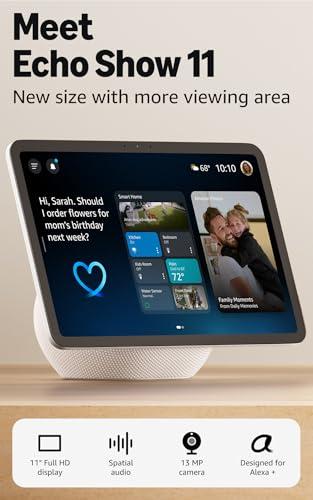
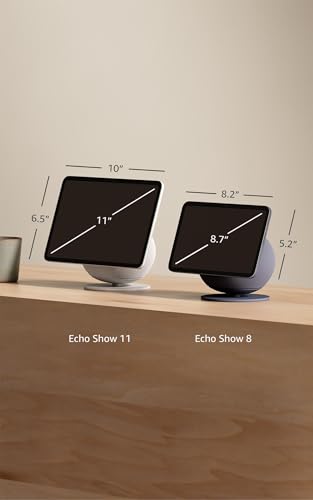
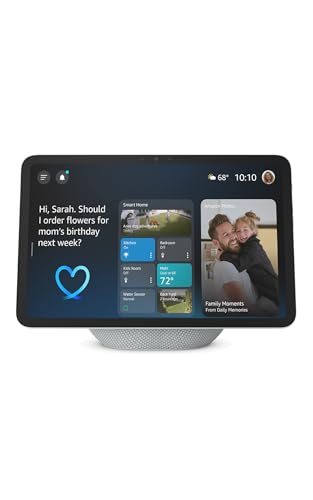
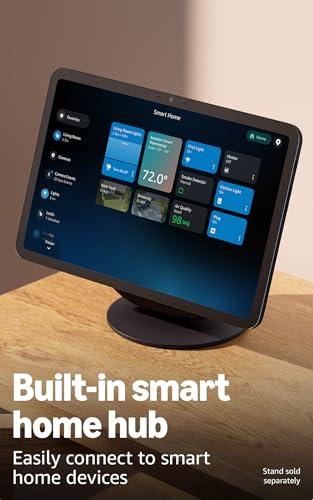
Amazon released the Echo Show 11 in late 2024 as their most advanced smart display yet. This device represents a significant leap forward from earlier Echo Show models, featuring an 11-inch Full-HD touchscreen that uses what Amazon calls "adaptive" technology—meaning the display automatically adjusts brightness and color temperature based on your room's lighting conditions.
The heart of this device is Amazon's custom AZ3 Pro chip, which includes dedicated AI processing hardware. This chip enables the advanced Alexa+ features that make the Echo Show 11 feel more like a conversation partner than a simple voice assistant. The Omnisense sensor fusion platform combines data from multiple sources: a 13-megapixel camera, microphones, ultrasonic sensors, Wi-Fi radar, and even an accelerometer. This sensor array allows the device to detect when you're approaching and automatically display relevant information—like your calendar or smart home status.
The 13-megapixel camera is a major upgrade from previous Echo Show models, which typically featured much lower resolution sensors. This higher-quality camera enables better video calling experiences and more accurate person recognition for personalized responses. The camera can automatically frame you during video calls, adjusting the view to keep you centered even if you move around.
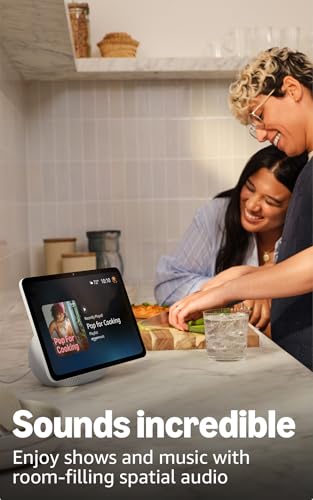
From an audio perspective, the Echo Show 11 includes front-facing drivers and a custom woofer designed to deliver what Amazon calls "spatial audio." While this isn't the same as true surround sound, it creates a wider soundstage than typical smart speakers, making it more engaging for watching videos or listening to music while you're doing other tasks.
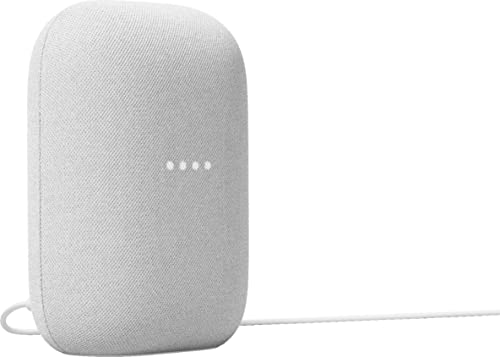
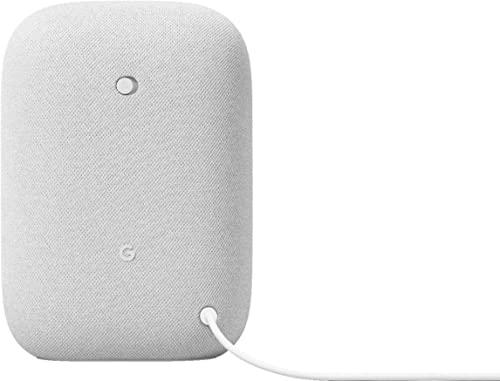
The Google Nest Audio, launched in 2020, took a different path. Google designed this speaker as a direct replacement for the original Google Home, focusing entirely on improving audio quality rather than adding visual features. The result is a device that's 75% louder than its predecessor with 50% stronger bass, according to Google's specifications.
The audio architecture centers around a 75mm woofer—that's the driver responsible for bass and midrange frequencies—paired with a 19mm tweeter for high frequencies. This two-driver setup is optimized specifically for music playback, with real-time audio processing that adjusts the sound signature based on what you're listening to.
One unique feature of the Nest Audio is Ambient IQ technology. This system uses the device's microphones to detect background noise in your room and automatically adjusts the volume of spoken content like podcasts or news. If your dishwasher starts running, the speaker will boost the volume slightly to ensure you can still hear clearly. This feature works particularly well for voice content but doesn't affect music playback in the same way.
The Nest Audio runs on a Quad Core A53 processor running at 1.8 GHz, which might sound modest compared to smartphone processors, but it's paired with dedicated machine learning hardware that handles Google Assistant requests efficiently. This setup enables fast response times for voice commands while keeping power consumption relatively low.
When it comes to pure audio quality, these devices serve different purposes. The Nest Audio was designed from the ground up as a music speaker that happens to be smart, while the Echo Show 11 is primarily a visual device that also needs to sound good.
In our evaluation of expert reviews and user feedback, the Nest Audio consistently delivers better music reproduction. The dedicated woofer and tweeter setup creates a more balanced frequency response, meaning you'll hear clearer vocals, more defined bass, and better separation between instruments. The front-firing design creates a more focused listening experience, though it means the sweet spot is more directional than 360-degree speakers.
The Echo Show 11, by contrast, prioritizes spatial audio that complements its visual interface. The audio system is tuned to work well with video content, ensuring that dialogue from streaming services remains clear and that music doesn't overpower visual elements on screen. While it can certainly play music competently, the audio engineering serves the multimedia experience rather than pure hi-fi listening.
For home theater applications, neither device is designed to replace a dedicated sound system, but they serve different roles. The Echo Show 11 works better as a smart control center for your entertainment setup, letting you adjust lighting, control your TV, and manage multiple devices from one interface. The Nest Audio is better for background music during movie nights or as part of a multi-room audio system that extends your entertainment throughout the house.
The voice assistant experience represents one of the biggest differences between these devices. The Echo Show 11 features Alexa+, Amazon's next-generation AI assistant that goes beyond simple command-and-response interactions. This system can engage in more natural conversations, understand context from previous interactions, and proactively offer suggestions based on your routines and the data from its sensors.
For example, Alexa+ might notice you approaching the device in the morning and automatically display your calendar, weather, and any urgent notifications without you asking. The system learns your patterns and preferences over time, creating a more personalized experience that feels less robotic than traditional voice assistants.
The Nest Audio uses Google Assistant in its more traditional form, which excels at information retrieval and integration with Google's services. Google Assistant's strength lies in understanding natural language queries and providing accurate answers to complex questions. Voice Match technology allows the speaker to recognize individual family members and provide personalized responses, though this requires training the system with voice samples.
Both assistants handle smart home control well, but through different approaches. The Echo Show 11 provides visual feedback for your commands, showing you which lights turned on or confirming thermostat adjustments with clear graphics. The Nest Audio relies on audio confirmations and status updates, which work well for simple commands but can become cumbersome for managing multiple devices simultaneously.
One crucial difference lies in how these devices integrate with your broader smart home ecosystem. The Echo Show 11 functions as a smart home hub, meaning it can directly communicate with devices using protocols like Zigbee, Matter, and Thread. Thread Border Router functionality allows it to create mesh networks with compatible devices, extending their range and reliability throughout your home.
This hub functionality means you can connect smart switches, sensors, and other devices directly to the Echo Show 11 without needing separate bridges or hubs for each manufacturer. The visual interface makes it easy to see the status of all connected devices at a glance and control multiple devices simultaneously through touch commands.
The Nest Audio takes a different approach, working as an endpoint in Google's smart home ecosystem. It supports Matter for device compatibility but relies on cloud-based processing for most smart home functions. This means you'll need separate hubs for protocols like Zigbee, but it also means the device itself is simpler and potentially more reliable since it has fewer complex networking components.
For users building comprehensive smart home systems, the Echo Show 11 offers more flexibility and control. For those who prefer simpler setups or already have smart home hubs in place, the Nest Audio provides excellent integration without the complexity.
Privacy represents a major consideration when choosing between these devices. The Echo Show 11 includes both cameras and microphones, along with sensors that track your presence and movement patterns. While Amazon provides physical controls to disable these sensors and has implemented privacy features like local processing for many commands, the device inherently collects more data about your daily routines.
The Nest Audio takes a more privacy-focused approach by design. With no camera and only three microphones for voice pickup, it collects less environmental data. The physical microphone mute switch provides clear feedback when the device isn't listening, and Google's approach to on-device processing has improved significantly since the device's 2020 launch.
From a design perspective, these devices serve different aesthetic purposes. The Echo Show 11 makes a statement as a modern tech centerpiece, with its floating screen design and premium materials. It demands attention and works best in primary living spaces where its visual capabilities can be fully utilized.
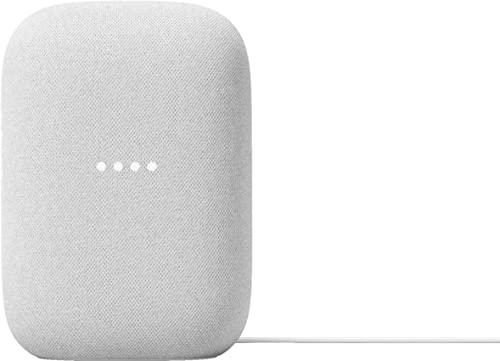
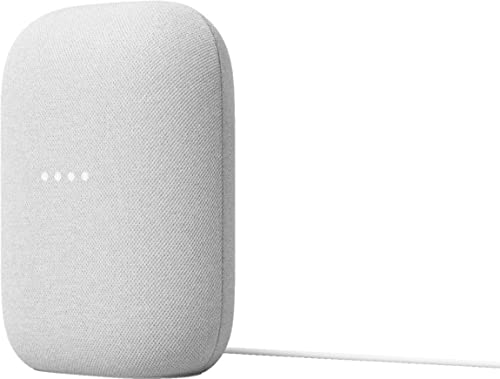
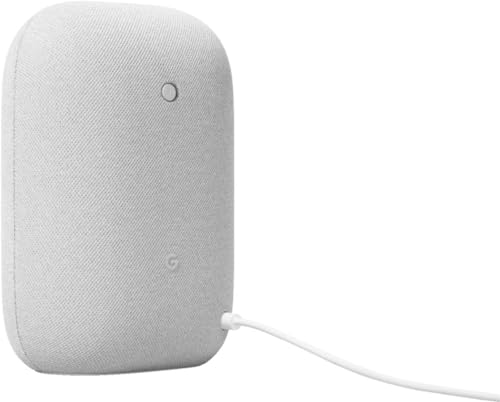
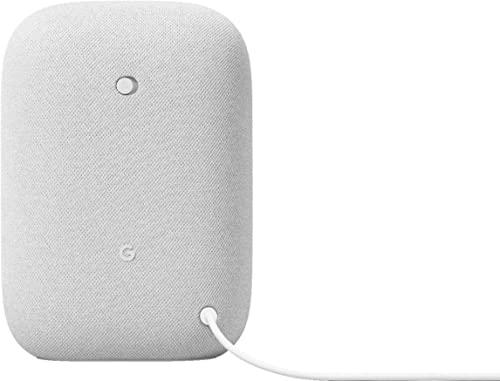
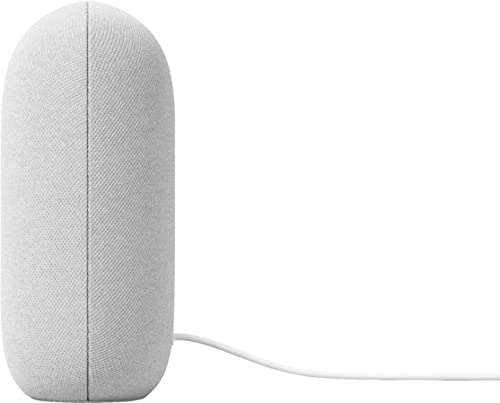
The Nest Audio follows Google's minimalist design philosophy, available in multiple colors that blend with various décor styles. Made from 70% recycled plastic, it's designed to disappear into your environment rather than stand out as a tech showcase.
When evaluating these devices, focus on the performance characteristics that align with your intended use. For the Nest Audio, the most important metrics are frequency response (how evenly it reproduces different musical tones), maximum volume before distortion, and voice recognition accuracy in noisy environments.
Based on expert testing and user feedback, the Nest Audio delivers balanced midrange reproduction that makes vocals clear and natural, though some reviewers note that bass response, while improved from previous models, doesn't match dedicated hi-fi speakers in the same size class. The device performs best at moderate volume levels in medium-sized rooms.
For the Echo Show 11, the key metrics include display quality (brightness, color accuracy, and viewing angles), touch response time, and the integration between visual and audio elements. The Full-HD resolution provides sharp text and images, while the adaptive display technology helps maintain visibility in various lighting conditions.
Response time for both voice commands and touch inputs matters significantly for user experience. The Echo Show 11 benefits from local AI processing, which reduces latency for common commands. The Nest Audio relies more heavily on cloud processing but generally provides quick responses for most Google Assistant functions.
At the time of writing, these devices occupy different price tiers that reflect their distinct approaches. The Echo Show 11 commands a premium price justified by its advanced display technology, AI processing capabilities, and comprehensive smart home hub functionality. This higher cost reflects the complexity of integrating multiple technologies into a cohesive user experience.
The Nest Audio offers better value for users focused primarily on audio quality and basic smart assistant functions. Its more accessible pricing makes it easier to deploy multiple units throughout your home for whole-house audio, and the focused feature set means you're not paying for capabilities you might not use.
Long-term value considerations favor different aspects of each device. The Echo Show 11's advanced AI and comprehensive connectivity standards may provide better future-proofing as smart home technology evolves. However, its complexity also creates more potential points of failure or obsolescence.
The Nest Audio's simpler architecture and focus on core audio functionality may age more gracefully. Google's track record of providing software updates for its hardware products has improved, and the device's straightforward design makes it less likely to become obsolete due to changing standards.
Choose the Amazon Echo Show 11 if you want a central command center for your smart home that can handle complex interactions through both voice and touch. This device excels in kitchens, living rooms, or home offices where you need quick access to calendars, video calls, smart home controls, and entertainment. The visual interface makes it particularly valuable for users who prefer confirmation of their commands or who frequently manage multiple smart devices.
The Echo Show 11 also makes sense for households that prioritize cutting-edge technology and don't mind the higher cost for advanced features. If you're building an Amazon-centered smart home ecosystem or frequently use video calling, the visual capabilities justify the premium pricing.
Opt for the Google Nest Audio if your primary goal is high-quality audio reproduction in a package that respects your privacy and blends seamlessly into your home environment. This speaker works best for music enthusiasts who want better sound quality than typical smart speakers provide, but don't need the visual complexity of a smart display.
The Nest Audio is ideal for creating multi-room audio systems, as bedroom speakers where visual interfaces might be distracting, or for users who prefer simple, reliable technology that focuses on doing a few things exceptionally well rather than everything adequately.
Consider your living situation, tech comfort level, and primary use cases. The Echo Show 11 rewards users who engage with its full feature set, while the Nest Audio satisfies those who want excellent audio and reliable smart assistant functionality without additional complexity.
| Amazon Echo Show 11 Smart Display | Google Nest Audio Speaker |
|---|---|
| Device Category - Fundamentally different approaches to smart home control | |
| Smart display with 11-inch touchscreen and voice control | Smart speaker focused purely on audio quality and voice interaction |
| Display Technology - Key differentiator for visual tasks and smart home management | |
| 11-inch Full-HD adaptive touchscreen with over 1 million pixels | No display - relies entirely on voice feedback and subtle LED indicators |
| Audio Architecture - Critical for music listening and overall sound quality | |
| Enhanced stereo with front-facing drivers and custom woofer for spatial audio | Dedicated 75mm woofer + 19mm tweeter optimized specifically for music reproduction |
| Voice Assistant - Determines smart home capabilities and interaction style | |
| Alexa+ with advanced conversational AI and proactive suggestions | Traditional Google Assistant with Voice Match and superior knowledge base |
| Smart Home Hub Capability - Important for controlling devices without separate bridges | |
| Built-in hub supporting Zigbee, Matter, Thread with Thread Border Router | Matter support only - requires separate hubs for most smart home protocols |
| Camera and Video Features - Essential for video calls and visual recognition | |
| 13-megapixel camera with auto-framing, person recognition, and visual presence detection | No camera - audio-only interaction for enhanced privacy |
| Processor and AI - Affects response speed and advanced features | |
| AZ3 Pro custom silicon with dedicated AI accelerator for local processing | Quad Core A53 1.8 GHz with ML hardware engine for efficient cloud processing |
| Privacy Controls - Important consideration for camera and microphone usage | |
| Physical mic mute plus software camera controls with extensive sensor array | Hardware mic mute switch with no camera, minimal data collection by design |
| Design and Placement - Affects where and how you can use the device | |
| Premium floating screen design requiring dedicated counter/shelf space | Compact fabric-covered design flexible for any room, 70% recycled materials |
| Multi-Room Audio - Key for whole-home sound systems | |
| Can pair with other Echo devices but primarily designed as standalone hub | Excellent for stereo pairing and multi-room synchronization throughout home |
| Connectivity Standards - Future-proofing and device compatibility | |
| Wi-Fi, Bluetooth, Zigbee, Matter, Thread with comprehensive protocol support | Wi-Fi 802.11ac, Bluetooth 5.0, Chromecast built-in, Matter support |
| Primary Use Cases - Who each device serves best | |
| Central smart home command center, video calls, entertainment hub, kitchen companion | Music listening, multi-room audio, privacy-focused voice control, background operation |
The Amazon Echo Show 11 is a smart display with an 11-inch touchscreen that combines visual interaction with voice control, while the Google Nest Audio is a dedicated smart speaker focused purely on audio quality without any screen. The Echo Show 11 acts as a visual command center for your smart home, whereas the Nest Audio prioritizes music playback and voice-only interaction.
The Google Nest Audio delivers superior music quality with its dedicated 75mm woofer and 19mm tweeter designed specifically for audio reproduction. While the Amazon Echo Show 11 offers enhanced stereo sound with spatial audio features, its audio system is optimized for multimedia content rather than pure music listening, making the Nest Audio the better choice for audiophiles.
Only the Amazon Echo Show 11 supports video calls with its 13-megapixel camera and large display. The camera includes auto-framing and person recognition features for high-quality video communication. The Google Nest Audio has no camera and can only handle voice calls through Google services, making the Echo Show 11 the clear winner for video calling needs.
The Amazon Echo Show 11 functions as a comprehensive smart home hub with built-in support for Zigbee, Matter, and Thread protocols, including Thread Border Router functionality. This allows direct device control without separate bridges. The Google Nest Audio supports Matter but requires additional hubs for most smart home protocols, making the Echo Show 11 more suitable for extensive smart home setups.
Neither device replaces a dedicated sound system, but they serve different home theater roles. The Amazon Echo Show 11 works excellently as a smart control center for your entertainment system, managing lighting, TV controls, and streaming services through its visual interface. The Google Nest Audio is better for background music or as part of a multi-room audio system that extends throughout your home during movie nights.
The Google Nest Audio provides better privacy by design with no camera, only microphones for voice pickup, and a physical mute switch. The Amazon Echo Show 11 includes cameras, presence sensors, and extensive data collection capabilities, though it offers physical controls to disable these features. Privacy-conscious users typically prefer the Nest Audio approach.
The Amazon Echo Show 11 offers superior TV control with its visual interface, allowing you to see and select streaming content, adjust settings, and manage multiple entertainment devices simultaneously. The Google Nest Audio can control compatible smart TVs through voice commands and Chromecast functionality, but without visual feedback, making the Echo Show 11 more convenient for TV control.
The Amazon Echo Show 11 excels in kitchen environments with its large display perfect for recipes, cooking timers, and video tutorials while your hands are busy. The touchscreen allows easy interaction even when voice commands might not work well due to cooking noise. The Google Nest Audio works for basic kitchen tasks like timers and music, but lacks the visual recipe support that makes the Echo Show 11 ideal for cooking.
The Google Nest Audio excels at multi-room audio, allowing easy synchronization throughout your home and stereo pairing with another Nest Audio unit. The Amazon Echo Show 11 can work with other Echo devices for multi-room audio, but it's primarily designed as a standalone smart display hub rather than part of a distributed audio system.
Both devices offer excellent voice recognition, but with different strengths. The Amazon Echo Show 11 features advanced Alexa+ with contextual understanding and proactive responses, plus visual confirmation of commands. The Google Nest Audio provides highly accurate Google Assistant with superior knowledge base responses and three far-field microphones for reliable pickup even in noisy environments.
The Google Nest Audio works better in bedrooms due to its compact size, no camera for privacy, and subtle LED indicators that won't disturb sleep. It's perfect for gentle wake-up music or bedtime routines. The Amazon Echo Show 11 can work in bedrooms but its large display and camera may be distracting or privacy-concerning in intimate spaces, though it offers useful features like sunrise alarms and bedside information display.
The value depends on your needs. The Amazon Echo Show 11 offers premium features, advanced AI, and comprehensive smart home integration that may justify its higher cost for users wanting a central command center. The Google Nest Audio provides excellent value for users focused on audio quality and basic smart features, with lower cost enabling multiple units throughout the home for whole-house audio systems.
We've done our best to create useful and informative comparisons to help you decide what product to buy. Our research uses advanced automated methods to create this comparison and perfection is not possible - please contact us for corrections or questions. These are the sites we've researched in the creation of this article: notebookcheck.net - techradar.com - matteralpha.com - bestbuy.com - aboutamazon.com - cordcuttersnews.com - rtings.com - pocket-lint.com - whathifi.com - store.google.com - sypnotix.com - store.google.com - techradar.com - rtings.com - audiosciencereview.com - youtube.com - soundguys.com - audioholics.com - store.google.com - store.google.com - youtube.com - support.google.com - soundguys.com - dxomark.com - thenextweb.com - support.google.com - dimensions.com - store.google.com - store.google.com - bestbuy.com - en.wikipedia.org - store.google.com - cybershack.com.au - matteralpha.com

Privacy Policy
Terms and Conditions - Affiliate Policy
Home Security
© Copyright 2008-2026.
11816 Inwood Rd #1211, Dallas, TX 75244