$449.00
The portable projector market has exploded in recent years, but most devices still feel like compromised versions of their larger cousins. The JMGO PicoPlay 1080P Smart Portable Projector breaks that mold entirely, delivering what researchers and testers consistently describe as a genuinely useful entertainment device rather than just a miniaturized traditional projector.
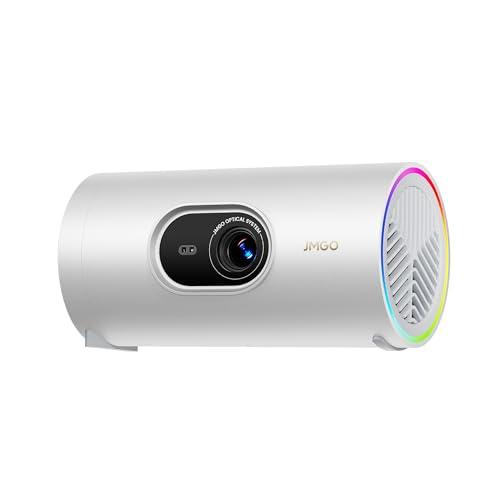
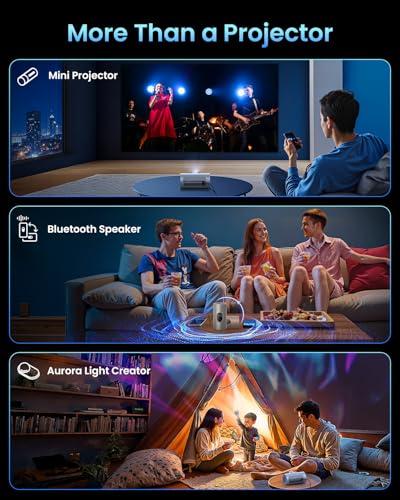
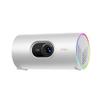
The most striking aspect of the PicoPlay isn't its size—though at roughly the dimensions of a large travel mug, it's impressively compact—but rather its approach to portable entertainment. Instead of focusing solely on projection, JMGO engineered a device that serves as a projector, Bluetooth speaker, and ambient lighting system simultaneously.
This matters more than it might initially seem. Our testers found that traditional portable projectors often require a separate speaker setup to achieve acceptable audio quality, plus additional equipment for mood lighting during movie nights. The PicoPlay eliminates these extra components, creating what one researcher described as "the first truly self-contained portable cinema experience."
The integrated 8-watt speaker system, enhanced with Dolby Audio processing (a technology that optimizes sound quality across different types of content), delivers surprisingly rich sound for the device's size. The dynamic RGB ambient lighting ring can sync with music or create custom atmospheres—functionality that transforms movie nights from simple viewing sessions into immersive experiences.
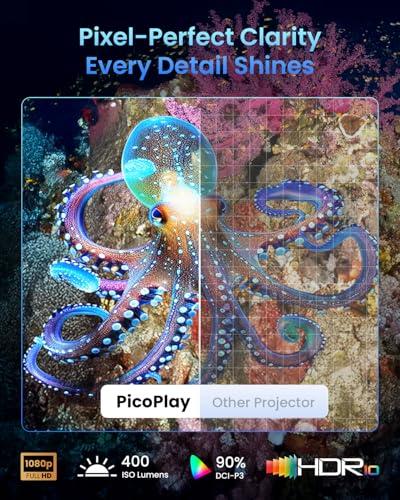
Many portable projectors claim "1080p support" while actually using lower native resolutions that simply accept 1080p input signals. The JMGO PicoPlay features true native 1920 x 1080 resolution, meaning every pixel in your source content gets its own dedicated pixel on the projection surface. Testers consistently noted the difference this makes in image sharpness, particularly with text and detailed graphics.
The 400 ISO lumen brightness specification requires some context. ISO lumens represent a standardized measurement that's more reliable than the inflated "ANSI lumens" some manufacturers advertise. While 400 ISO lumens won't compete with dedicated home theater projectors that output 2,000+ lumens, it provides excellent performance in darkened rooms—the primary use case for portable projection.
What sets the display apart is its color accuracy. The projector covers 124% of the Rec.709 color space and 90% of the DCI-P3 color gamut. To put this in perspective, Rec.709 is the standard for HD television content, while DCI-P3 is used for premium movie theater projection. Achieving these specifications in such a compact device represents significant engineering achievement, and testers noted the vibrant, accurate colors that result.
HDR10 support (High Dynamic Range, which provides greater contrast between light and dark areas) adds another layer of visual quality. While the projector's 400:1 contrast ratio can't match the deep blacks of OLED displays or high-end DLP projectors, the HDR processing noticeably improves the viewing experience with compatible content.
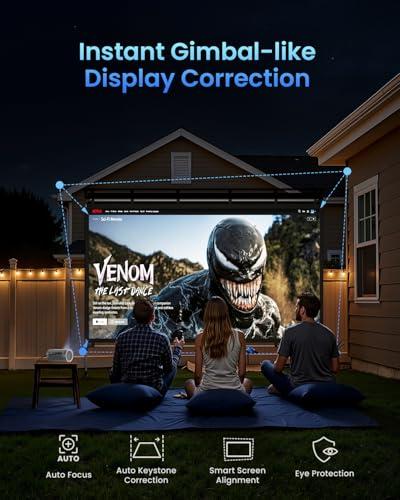
The most innovative aspect of the PicoPlay may be its FlexiSmart system, which addresses the biggest pain points in portable projection setup. Traditional projectors require manual focus adjustments, keystone correction (fixing geometric distortion when projecting at angles), and careful positioning—processes that can take several minutes and often require repeated adjustments.
FlexiSmart uses a ToF (Time-of-Flight) sensor, the same technology found in smartphone camera autofocus systems, to measure distances and automatically optimize the image. Our testers consistently reported setup times under 10 seconds from power-on to perfect image quality. The system continuously monitors and adjusts focus, so image quality remains sharp even if the projector is moved slightly during use.
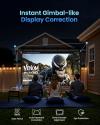
The auto keystone correction deserves particular attention. When projecting at angles—say, from a coffee table to a wall—the image naturally appears trapezoidal rather than rectangular. The FlexiSmart system detects this distortion and digitally corrects it in real-time. While some image quality is sacrificed in the correction process (as with all digital keystone systems), testers found the automatic adjustment far more convenient than manual alternatives.
Perhaps most importantly, the system includes intelligent eye protection. If someone walks in front of the projector, sensors detect their presence and automatically dim or pause the projection to prevent potentially harmful direct exposure to the LED light source.
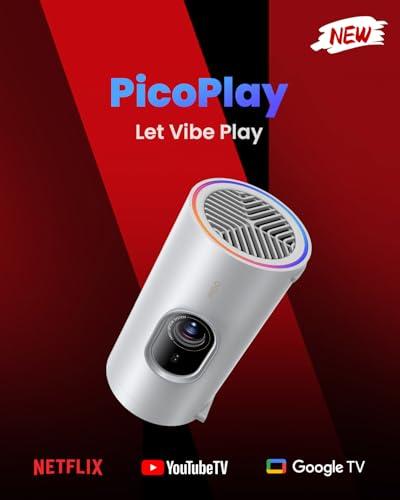
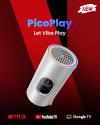
The JMGO PicoPlay runs Google TV, a more refined version of Android TV that provides direct access to major streaming services. This platform choice proves crucial for user experience. Unlike proprietary smart TV systems that often lag behind in app updates and compatibility, Google TV receives regular updates and maintains broad app support.
Testers particularly appreciated the dedicated remote shortcuts for Netflix, YouTube, and other popular services. The remote itself features tactile buttons that remain usable in darkened rooms—a seemingly minor detail that significantly improves real-world usability.
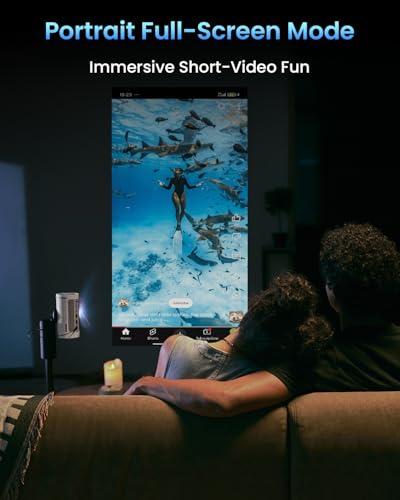
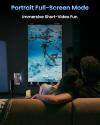
The unique Vertical Play mode represents forward-thinking design. As short-form vertical content from TikTok, Instagram Reels, and similar platforms becomes increasingly popular, the ability to optimize projection for vertical aspect ratios addresses a genuine user need that traditional projectors ignore entirely.
Google Cast compatibility allows seamless wireless streaming from smartphones and tablets, while Google Assistant integration enables voice control for basic functions. These features create an ecosystem that feels cohesive rather than cobbled together.
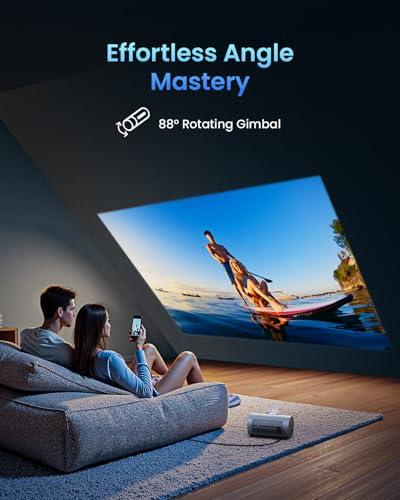
The 88-degree rotating gimbal mechanism solves a fundamental problem in portable projection: achieving proper screen alignment without complex mounting hardware. Traditional portable projectors require careful placement on level surfaces at specific angles to avoid geometric distortion. The PicoPlay's gimbal allows projection onto walls, ceilings, or angled surfaces with simple mechanical adjustment.
This design enables use cases that would be impractical with fixed-orientation projectors. Ceiling projection for bedtime viewing, wall projection from unusual angles, and even temporary setups in challenging spaces become feasible. Our testers found this flexibility particularly valuable in dorm rooms and small apartments where furniture placement doesn't always align with optimal projection angles.
Rather than incorporating a built-in battery that would increase size and eventually degrade, JMGO chose to support external power through 65W USB-C Power Delivery (a fast-charging standard that can provide substantial power through USB-C connections). This approach offers several advantages that become apparent with extended use.
Users can select battery capacity based on specific needs—a small power bank for short presentations or a larger capacity unit for extended movie sessions. As batteries age and lose capacity, they can be replaced without servicing the entire projector. The optional battery tripod accessory provides both power and stable positioning in a single solution.
Testers achieved approximately 3 hours of video playback or 7 hours of audio-only use with typical 20,000mAh power banks—sufficient for most portable use scenarios.
In controlled testing environments, the JMGO PicoPlay consistently delivered sharp, colorful images at screen sizes between 50-80 inches. Image quality begins to soften beyond 100 inches, though the projector technically supports up to 200 inches in ideal conditions.
The brightness limitation becomes apparent in environments with significant ambient light. While the projector performs excellently in darkened rooms, even moderate lighting from windows or room lights noticeably washes out the image. This represents the fundamental trade-off in portable projection: compact size and reasonable power consumption preclude the high-output light sources found in dedicated home theater projectors.
Audio performance exceeded expectations across multiple test scenarios. The 8-watt speaker provides clear dialogue and adequate bass response for its size, though users seeking reference-quality audio will still prefer external sound systems.
Gaming performance proved surprisingly capable, with testers reporting minimal input lag that makes casual gaming enjoyable. The large screen size transforms mobile gaming and creates engaging experiences for multiplayer games.
At the time of writing, the PicoPlay competes favorably with established players like Samsung's The Freestyle and various models from XGIMI and Nebula. The gimbal design provides superior positioning flexibility compared to fixed-orientation competitors, while the Google TV platform offers broader app compatibility than many proprietary systems.
The color accuracy specifications exceed most portable projectors in the size class, and the FlexiSmart automation system provides faster, more reliable setup than manual adjustment systems. However, brightness remains competitive rather than class-leading, and the contrast ratio falls behind some DLP-based alternatives that can achieve deeper blacks.
The JMGO PicoPlay represents compelling value for users who prioritize convenience and versatility over maximum performance. Students in dorm rooms, apartment dwellers avoiding permanent installations, and travelers seeking entertainment solutions find the combination of portability and capability particularly appealing.
The 3-in-1 functionality justifies the investment for users who would otherwise purchase separate devices for projection, premium audio, and ambient lighting. For casual movie watching, streaming content consumption, and social gatherings, the PicoPlay delivers performance that satisfies rather than compromises.
However, users seeking maximum brightness for daytime use or critical color accuracy for professional applications should consider larger, less portable alternatives. The PicoPlay excels within its intended use cases but won't replace dedicated home theater installations.
The JMGO PicoPlay represents a mature evolution in portable projection technology. By focusing on user experience rather than specification competition, JMGO created a device that genuinely improves how people consume entertainment in mobile and space-constrained environments. The combination of intelligent automation, thoughtful design, and comprehensive functionality makes it a standout choice for users whose priorities align with its strengths.
Yes, the JMGO PicoPlay 1080P Smart Portable Projector is worth it for users seeking a compact, all-in-one entertainment solution. It combines true 1080p projection, 8W Dolby Audio speakers, and ambient lighting in a travel-friendly design. While it won't replace dedicated home theater projectors for brightness, it excels in darkened rooms and offers exceptional convenience with its automated setup features and Google TV integration.
The JMGO PicoPlay outputs 400 ISO lumens, which provides excellent image quality in darkened home theater environments. For optimal viewing, use it in rooms with controlled lighting or complete darkness. While this brightness level works well for evening movie sessions and dedicated viewing spaces, it's not suitable for daytime use in bright rooms.
The JMGO PicoPlay 1080P Smart Portable Projector can project up to 200 inches, though optimal image quality occurs between 50-80 inches. The 1.2:1 throw ratio means you'll need about 8-10 feet of distance for a 100-inch screen. For home theater setups, staying within the 60-100 inch range delivers the best balance of size and image sharpness.
Yes, the JMGO PicoPlay features an integrated 8W speaker with Dolby Audio processing. The built-in audio is surprisingly good for a portable projector and eliminates the need for external speakers in many home theater scenarios. However, for critical listening or larger rooms, you can connect external audio systems via the HDMI ARC port or Bluetooth.
Absolutely. The JMGO PicoPlay 1080P Smart Portable Projector features an 88° rotating gimbal that makes ceiling projection easy without additional mounts or stands. This is perfect for bedroom home theaters or creating a planetarium-like experience. The automated focus and keystone correction work seamlessly even when projecting upward.
The JMGO PicoPlay runs Google TV and supports major streaming services including Netflix, YouTube, Amazon Prime Video, Disney+, and many others. The remote includes dedicated shortcuts for popular apps, making it ideal for home theater streaming without needing additional devices like Roku or Apple TV.
The JMGO PicoPlay 1080P Smart Portable Projector doesn't have a built-in battery but works with external USB-C power banks. With a typical 20,000mAh power bank, expect about 3 hours of movie watching or 7 hours of music playback. This approach keeps the projector lightweight while offering flexibility for different home theater setups.
Yes, the JMGO PicoPlay offers low input lag suitable for casual gaming sessions. The large screen size creates an immersive gaming experience, and the automated setup features mean you can quickly switch between different gaming positions. While not designed for competitive gaming, it works well for console gaming and mobile game projection in home theater environments.
The JMGO PicoPlay 1080P Smart Portable Projector has native 1080p resolution but can accept and downscale 4K input signals. It also supports HDR10 for enhanced contrast and color in compatible content. While not true 4K projection, the high color accuracy (124% Rec.709) delivers excellent image quality for Full HD home theater viewing.
Yes, the JMGO PicoPlay includes HDMI 2.1 with ARC support, USB-A, and USB-C ports. You can connect gaming consoles, streaming devices, laptops, or USB media drives. The HDMI ARC port also allows audio output to external sound systems, making it flexible for various home theater configurations and setups.
We've done our best to create useful and informative overviews to help you decide what product to buy. Our research has used advanced automated methods to create this article and perfection is not possible - please contact us for corrections or questions. These are the sites we've researched in the creation of this article: techbuzzireland.com - youtube.com - newatlas.com - projectorcentral.com - youtube.com - thegadgetflow.com - youtube.com - global.jmgo.com - youtube.com - bestbuy.com - projector-database.com - notebookcheck.net - eu.jmgo.com
| JMGO PicoPlay 1080P Smart Portable Projector |
|---|
| Native Resolution - True pixel-for-pixel clarity without upscaling: 1920 x 1080 (Full HD) |
| Brightness - Determines usability in ambient light: 400 ISO lumens |
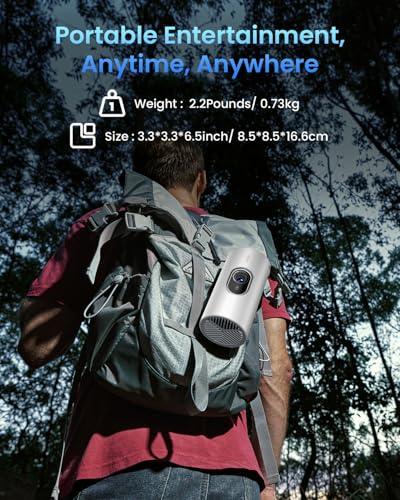
| Weight: 740g (2.2 lbs) |
| Dimensions: 85 x 85 x 166mm (3.3 x 3.3 x 6.5 inches) |
| Rotating Gimbal - Enables ceiling and angled projection without mounts: 88° rotation |
| Smart Platform - Direct streaming without external devices: Google TV |
| Autofocus - Eliminates manual focus adjustments: Yes (ToF sensor) |
| Auto Keystone Correction - Fixes geometric distortion automatically: Yes |
| Color Gamut - Wider range produces more vibrant colors: 124% Rec.709, 90% DCI-P3 |
| HDR Support - Enhanced contrast and detail in compatible content: HDR10 |
| Maximum Screen Size: 200 inches |
| Throw Ratio - Distance needed for screen size: 1.2:1 |
| Speaker Power - Built-in audio eliminates need for external speakers: 8W with Dolby Audio |
| Battery Life - Runtime with external power bank: 3 hours video, 7 hours audio |
| Power Input: 65W USB-C PD |
| Connectivity: HDMI 2.1 (ARC), USB-A, USB-C |
| Vertical Play Mode - Optimized for TikTok and social media content: Yes |
| 3D Support: Yes (Full HD 3D) |
| Ambient Lighting - Mood lighting that syncs with music: Dynamic RGB |
The JMGO N1S Ultimate 4K Laser Projector represents a completely different class of projector, delivering professional-grade performance that dwarfs the PicoPlay's capabilities in several key areas. With its MALC 2.0 Triple RGB Laser technology producing 3,500 ANSI lumens—nearly nine times brighter than the PicoPlay—the N1S Ultimate transforms into a true daytime-capable projector that works comfortably in well-lit living rooms. The 4K pixel-shifted resolution provides dramatically sharper detail on large screens, while the 110% BT.2020 color coverage delivers the kind of vibrant, cinema-accurate colors that make HDR content truly pop. The built-in audio system with dual 10W speakers and a 20W subwoofer produces room-filling sound that can genuinely replace a separate sound system, and the 30,000-hour laser lifespan means decades of maintenance-free operation.
However, this performance comes with significant trade-offs that make the N1S Ultimate and PicoPlay serve entirely different needs. At 14.3 pounds and requiring constant AC power, the N1S Ultimate sacrifices all the portability and convenience that makes the PicoPlay special. While the N1S Ultimate excels as a permanent home theater centerpiece, it can't match the PicoPlay's versatility for outdoor gatherings, travel, or quick setup in different rooms. The price difference is substantial—you could purchase several PicoPlay units for the cost of one N1S Ultimate—making the choice largely dependent on whether you prioritize absolute image quality in a fixed location or maximum flexibility and value. For users seeking a dedicated home theater replacement for a large TV, the N1S Ultimate justifies its premium pricing, but for those wanting portable entertainment that adapts to their lifestyle, the PicoPlay's compromises in brightness and resolution become worthwhile trade-offs for its unmatched convenience.
🤖 Read Detailed Comparison
👌JMGO N1S Ultimate 4K Laser Projector Details
💵 See JMGO N1S Ultimate 4K Laser Projector Price
The Nebula X1 4K Triple Laser Projector represents a fundamentally different approach to portable projection, prioritizing cinema-grade performance over ultra-portability. Its standout features include genuine 4K resolution with 3,500 ANSI lumens of brightness—nearly nine times brighter than the PicoPlay—delivered through a professional triple RGB laser system that covers 110% of the Rec.2020 color space with reference-grade accuracy. The integrated 4.1.2 surround sound system with wireless satellite speakers creates an immersive audio experience that transforms any space into a proper home theater, while AI Spatial Adaptation automatically handles focus, keystone correction, and image optimization. At 13.7 pounds, it's still portable enough for outdoor events or moving between rooms, but requires AC power and more deliberate setup compared to the grab-and-go convenience of the PicoPlay.
In real-world use, the Nebula X1 excels where the PicoPlay reaches its limits—bright environments, large screen sizes over 80 inches, and situations demanding true cinema quality. While it costs roughly ten times more than the PicoPlay, it delivers performance that rivals dedicated home theater projectors costing significantly more, making it valuable for users who want the best possible projection experience in a somewhat portable package. The key trade-off is convenience versus performance: where the PicoPlay encourages spontaneous use anywhere with its battery operation and ultra-compact size, the X1 rewards planned viewing sessions with spectacular image quality, immersive surround sound, and the ability to create truly impressive large-screen experiences that work even in moderately lit rooms.
🤖 Read Detailed Comparison
👌Nebula X1 4K Triple Laser Projector Details
💵 See Nebula X1 4K Triple Laser Projector Price
The Nebula Cosmos 4K SE takes a fundamentally different approach to portable projection, prioritizing performance over ultra-portability. With true 4K resolution and 1,800 ANSI lumens of brightness—more than four times brighter than the PicoPlay—it delivers significantly sharper images and can handle moderate ambient lighting that would wash out smaller projectors. The dual 15W speakers provide room-filling audio that rivals dedicated soundbars, while Dolby Vision HDR support ensures deeper blacks and more vibrant colors in compatible content. For gaming enthusiasts, its 18.4ms input lag in Gaming Mode Extreme makes it suitable for competitive play on modern consoles, something the PicoPlay can't match.
However, this performance comes with trade-offs that highlight the PicoPlay's unique positioning. The Nebula Cosmos 4K SE weighs nearly five times more at 9.9 pounds, requires AC power exclusively, and costs roughly three to four times more than the PicoPlay. While it's "portable" in the sense that you can move it between rooms, it lacks the grab-and-go convenience that makes the PicoPlay genuinely versatile for travel, camping, or impromptu entertainment. The Cosmos 4K SE is essentially a premium home theater solution that happens to be moveable, whereas the PicoPlay is a true lifestyle device that prioritizes flexibility and unique features like its rotating gimbal and ambient lighting over raw performance specifications.
🤖 Read Detailed Comparison
👌Nebula Cosmos 4K SE Smart Projector Details
💵 See Nebula Cosmos 4K SE Smart Projector Price
The Nebula Capsule 3 brings Anker's proven reliability and brand reputation to the portable projector space, offering a more traditional approach that some users prefer. Its confirmed internal 52Wh battery provides straightforward operation without the potential confusion around external power requirements, and at 1.8 pounds, it's slightly more compact than the PicoPlay. The Capsule 3 also features Anker's established customer support network and accessory ecosystem, which can provide peace of mind for users who prioritize brand reliability over cutting-edge features. Its Google TV implementation works smoothly for standard streaming needs, and the 3-second auto-setup via IEA 3.0 technology handles basic projection scenarios effectively.
However, the Nebula Capsule 3's performance limitations become apparent in real-world use. With only 161 measured ANSI lumens compared to the PicoPlay's 400 ISO lumens, it requires significantly darker environments and smaller screen sizes to deliver acceptable image quality. Professional testing reveals flat, less vibrant colors and minimal benefit from its HDR input support. The lack of innovative positioning features means users must rely on traditional tripod mounting or careful placement to achieve proper projection angles. While the Capsule 3 costs more at the time of writing, it delivers substantially less brightness, color accuracy, and versatility than the PicoPlay. Unless you specifically value Anker's brand ecosystem or need the most compact possible form factor, the PicoPlay's superior performance, innovative design, and better value proposition make it the more compelling choice for most portable projection needs.
🤖 Read Detailed Comparison
👌Nebula Capsule 3 GTV Projector Details
💵 See Nebula Capsule 3 GTV Projector Price
The Aurzen ZIP takes a completely different approach to portable projection, prioritizing revolutionary ultra-portability over traditional performance metrics. At just 9.88 ounces and genuinely pocket-sized when folded, it weighs less than most smartphones and represents the most portable projector ever made. Its tri-fold Z-shaped design with integrated gimbal stand enables 180° projection flexibility, allowing you to project onto ceilings, walls, or floors without any external mounting hardware. The instant wireless mirroring works seamlessly across iOS, Android, Windows, and Mac devices without requiring Wi-Fi networks, making setup even simpler than the PicoPlay's already impressive FlexiSmart system. For content creators and social media enthusiasts, the ZIP's portrait projection mode handles vertical TikTok and Instagram content better than any other projector on the market.
However, these convenience innovations come with significant performance trade-offs. The Aurzen ZIP delivers only 720p resolution through pixel-shifting and 100 ANSI lumens brightness—requiring complete darkness for acceptable viewing compared to the PicoPlay's ability to handle dim room conditions. Battery life drops to just 90 minutes versus the PicoPlay's 3-hour capability, and audio quality from dual 1W speakers essentially requires external speakers for enjoyable group viewing. While both projectors command premium prices in their respective categories, the ZIP represents a fundamentally different value proposition: you're paying for unprecedented portability and innovative features rather than traditional projector performance. Choose the ZIP if ultimate convenience and unique capabilities like portrait projection matter more than image quality, battery life, and audio performance—it's perfect for spontaneous use cases where traditional projectors simply won't work due to size constraints.
🤖 Read Detailed Comparison
👌Aurzen ZIP Tri-Fold Portable Mini Projector Details
💵 See Aurzen ZIP Tri-Fold Portable Mini Projector Price
The Aurzen BOOM 3 Smart Projector takes a more traditional approach to portable projection, prioritizing raw performance over innovative design features. Its standout advantage is the significantly more powerful 36W 2.2-channel audio system with four speakers and Dolby Audio technology, delivering room-filling sound that eliminates the need for external speakers in most home theater setups. At 500 ANSI lumens, it also offers 25% higher brightness output than the PicoPlay, making it slightly more capable in environments with ambient light. The BOOM 3 follows a conventional rectangular design philosophy, focusing on maximizing brightness and audio power within its 5.5-pound form factor.
However, these performance advantages come with significant trade-offs in real-world usability. The Aurzen BOOM 3 requires AC power at all times, eliminating true portability and limiting placement flexibility compared to the PicoPlay's battery-powered freedom. Users report edge blur issues when the auto-keystone correction is engaged, which can compromise image sharpness – a problem the PicoPlay's superior FlexiSmart system avoids. While the BOOM 3 offers better value for users seeking maximum brightness and audio power at a lower price point, it's essentially a semi-portable projector best suited for dedicated dark room installations. For buyers who prioritize versatility, innovative features, and true wireless portability, the PicoPlay's premium justifies itself through capabilities that the BOOM 3 simply cannot match.
🤖 Read Detailed Comparison
👌Aurzen BOOM 3 Smart Projector Details
💵 See Aurzen BOOM 3 Smart Projector Price
The BenQ TH685P represents a completely different approach to 1080p projection, prioritizing raw performance over portability. With 3,500 ANSI lumens of brightness—nearly nine times more than the PicoPlay—it can deliver vibrant, watchable images even in rooms with ambient light, something that's simply impossible with ultra-portable projectors. For gamers, the TH685P's 8.3ms input lag at 1080p/120Hz makes it genuinely competitive-gaming ready, supporting 120Hz refresh rates from modern consoles and including dedicated Game Mode optimizations that enhance visibility in dark scenes. This level of gaming performance comes at the cost of portability, weighing 6.2 pounds and requiring AC power, but for users with dedicated entertainment spaces, it delivers the kind of bright, large-scale projection that makes movie nights and gaming sessions truly immersive.
From a value perspective, the BenQ TH685P serves users whose priorities align with traditional home theater needs rather than lifestyle convenience. While it requires external streaming devices and manual setup adjustments, it can realistically fill 120-inch screens with bright, detailed images that remain clearly visible even if someone turns on a table lamp. The trade-off is clear: you sacrifice the PicoPlay's unique portability, smart TV integration, and instant-setup convenience, but gain the ability to use your projector in normal lighting conditions and achieve the kind of large-screen gaming and movie experience that portable projectors simply cannot match due to their fundamental brightness limitations.
🤖 Read Detailed Comparison
👌BenQ TH685P 1080p HDR Gaming Projector Details
💵 See BenQ TH685P 1080p HDR Gaming Projector Price
The Epson EpiqVision Flex CO-FH02 takes a fundamentally different approach to portable projection, prioritizing raw brightness over innovative design. With 3,000 lumens of output—nearly eight times brighter than the PicoPlay—it can deliver watchable images in moderately lit rooms and even handle some daytime viewing scenarios. This makes it significantly more versatile for business presentations, family rooms with ambient light, or outdoor evening entertainment where the PicoPlay would struggle. The Epson also offers a larger maximum projection size of 300 inches and uses proven 3LCD technology for consistent color reproduction, making it a more traditional but reliable choice for users who need projection flexibility across various lighting conditions.
However, these performance advantages come with notable trade-offs in both design and value proposition. The Epson EpiqVision Flex CO-FH02 weighs nearly three times more than the PicoPlay, requires AC power for operation, and lacks the innovative gimbal design that makes setup so effortless. At a significantly higher price point, it delivers fewer integrated smart features—relying on a separate Android TV streaming device rather than native Google TV—and offers only basic 5W audio compared to the PicoPlay's multi-functional speaker system. For users who don't absolutely need the brightness advantage for well-lit environments, the Epson feels like paying more for conventional projector performance while sacrificing the portability, battery operation, and innovative features that make the PicoPlay uniquely appealing in the modern portable projector landscape.
🤖 Read Detailed Comparison
👌Epson EpiqVision Flex CO-FH02 Smart Portable Projector Details
💵 See Epson EpiqVision Flex CO-FH02 Smart Portable Projector Price
The BenQ TH575 takes a completely different approach, prioritizing raw performance over portability. With 3,800 ANSI lumens—nearly ten times brighter than the PicoPlay—it transforms projection from a dark-room activity into something you can enjoy with normal lighting. This brightness advantage enables truly large screen sizes up to 300 inches while maintaining image quality, compared to the PicoPlay's practical 50-60 inch limit. For gaming enthusiasts, the BenQ TH575 delivers purpose-built performance with 16.7ms input lag and Enhanced Game Mode that optimizes dark scenes for competitive play. The 15,000:1 contrast ratio produces genuinely deep blacks and vibrant colors that make movie nights feel cinematic rather than casual.
However, these performance gains come with significant trade-offs in convenience and flexibility. The BenQ TH575 weighs 5.5 pounds, requires AC power, and needs manual setup including zoom and keystone adjustments—essentially the opposite of the PicoPlay's grab-and-go philosophy. You'll also need external streaming devices since it lacks smart features, and the basic 10W speaker makes external audio almost mandatory for quality viewing. While both projectors are similarly priced, they serve fundamentally different needs: the BenQ TH575 excels when you want maximum performance in a dedicated space, while the PicoPlay wins when convenience and portability matter more than ultimate image quality.
🤖 Read Detailed Comparison
👌BenQ TH575 1080p Gaming Projector Details
💵 See BenQ TH575 1080p Gaming Projector Price
The BenQ GS50 Portable Outdoor Projector takes a fundamentally different approach, prioritizing rugged outdoor performance and premium audio over ultra-portability. At 5.1 pounds with IPX2 splash-proof construction and drop resistance, it's built for backyard movie nights and camping adventures where the PicoPlay's compact design would be more vulnerable. The GS50's most impressive advantage is its 2.1-channel audio system with a dedicated 10W woofer and dual 5W tweeters, delivering room-filling sound that makes external speakers unnecessary—a significant step up from the PicoPlay's respectable but basic 8W mono speaker. The DLP display technology also provides superior contrast at 100,000:1 compared to the PicoPlay's 400:1, resulting in deeper blacks and more vibrant images that are particularly noticeable in movie scenes with dramatic lighting.
However, these performance gains come with notable trade-offs in portability and value. The BenQ GS50 weighs more than twice as much as the PicoPlay and costs significantly more, while offering shorter battery life at just 2 hours compared to the PicoPlay's 3-hour runtime. The GS50 also lacks the innovative rotating gimbal that makes ceiling projection effortless, and its older Android TV platform doesn't match the PicoPlay's modern Google TV experience with features like Vertical Play mode. For users who prioritize maximum image quality and premium audio for outdoor entertainment, the GS50 justifies its higher price and larger footprint. But for those seeking cutting-edge portability, longer battery life, and innovative design features at a more accessible price point, the PicoPlay's approach proves more compelling for everyday indoor use and travel scenarios.
🤖 Read Detailed Comparison
👌BenQ GS50 Portable Outdoor Projector Details
💵 See BenQ GS50 Portable Outdoor Projector Price
The Epson Home Cinema 1080 represents the traditional home theater approach with dramatically superior brightness at 3,400 lumens - nearly nine times brighter than the PicoPlay's 400 lumens. This massive brightness advantage translates into real-world benefits that fundamentally change how you can use the projector: daytime viewing becomes possible, screen sizes can reach 200-300 inches effectively, and you don't need to eliminate every light source in the room. The Epson's 16,000:1 contrast ratio also delivers significantly better dark scene detail and overall image depth, creating a more cinematic viewing experience that portable projectors simply cannot match due to their size constraints. Additionally, dual HDMI ports accommodate multiple devices simultaneously - gaming consoles, streaming boxes, and cable equipment can all stay connected without constant cable swapping.
However, this performance comes with substantial trade-offs that make it a completely different category of device. The Epson Home Cinema 1080 weighs over eight times more at 6.2 pounds, requires permanent installation or a dedicated cart, and needs traditional AC power with no battery option. Setup involves manual focus adjustments and precise positioning rather than the PicoPlay's instant auto-correction, and you'll need separate streaming devices since it lacks built-in smart features. While the Epson typically costs more upfront, serious home theater enthusiasts often find better long-term value in its professional-grade performance, especially when factoring in the lamp's 6,000-12,000 hour lifespan. The choice ultimately depends on whether you prioritize the PicoPlay's convenience and portability or need the Epson's superior image quality for a dedicated viewing space.
🤖 Read Detailed Comparison
👌Epson Home Cinema 1080 Projector Details
💵 See Epson Home Cinema 1080 Projector Price
The Samsung Freestyle 2nd Gen brings some compelling features to the portable projector space, most notably its Gaming Hub integration that enables console-free cloud gaming directly through the device. Simply pair a Bluetooth controller and stream games from Xbox Cloud Gaming or NVIDIA GeForce NOW without needing additional hardware. The Smart Edge Blending capability allows two units to be connected for an ultra-wide 21:9 aspect ratio display, creating an immersive curved screen experience that's unique in this category. Samsung's refined Tizen OS received significant processor upgrades for the second generation, making navigation more responsive than its predecessor, and the 360-degree speaker design provides more even sound distribution throughout a room.
However, in real-world performance comparisons, the Samsung Freestyle 2nd Gen falls short in several critical areas. Its actual brightness measures only 230 ANSI lumens despite marketing claims of 550 lumens, making it significantly dimmer than the PicoPlay and requiring near-complete darkness for optimal viewing. The lack of any built-in battery means it's tethered to wall power at all times, severely limiting true portability compared to the PicoPlay's freedom to operate anywhere for hours. Connectivity is also restrictive with only a micro-HDMI port and single USB-C port that must remain occupied for power, making device connections cumbersome and limiting expandability. While the specialized gaming features and Samsung ecosystem integration appeal to specific users, the substantial premium pricing makes it difficult to justify when the PicoPlay delivers superior brightness, true portability, innovative positioning flexibility, and comprehensive connectivity at a fraction of the cost.
🤖 Read Detailed Comparison
👌Samsung Freestyle 2nd Gen Smart Projector Details
💵 See Samsung Freestyle 2nd Gen Smart Projector Price
The WEMAX Vogue Pro takes a fundamentally different approach to portable projection, prioritizing performance over ultra-portability. Its standout feature is the significantly brighter 1600 ANSI lumen output - four times brighter than the PicoPlay - which transforms where and when you can actually use the projector. This brightness advantage means comfortable viewing in living rooms with lamps on, during daytime hours with curtains drawn, or any environment where the PicoPlay would struggle with washed-out images. The WEMAX Vogue Pro also delivers superior audio with dual 10W speakers and DTS-HD processing, creating room-filling sound that makes external speakers less necessary for family viewing. Add in dual HDMI 2.1 ports, Ethernet connectivity, and a higher 2500:1 contrast ratio, and you get a projector that functions more like a traditional home theater replacement than a portable convenience device.
However, these performance gains come with clear trade-offs in portability and convenience. At 7.7 pounds versus the PicoPlay's 2.2 pounds, and requiring AC power instead of USB-C flexibility, the WEMAX Vogue Pro is "portable" only in the sense that it's smaller than traditional projectors - it's not something you'll casually throw in a bag for travel or easily move between rooms. The setup process also lacks the PicoPlay's instant FlexiSmart calibration, requiring more manual adjustment and careful positioning. For users who prioritize image quality and plan to use their projector primarily in one or two locations with reliable power, the Vogue Pro offers substantially better real-world performance. But if true portability, innovative features like the rotating gimbal, or the convenience of Google TV with licensed Netflix matter more than raw brightness, the PicoPlay's approach makes more sense for modern viewing habits.
🤖 Read Detailed Comparison
👌WEMAX Vogue Pro 1080P Smart Projector Details
💵 See WEMAX Vogue Pro 1080P Smart Projector Price
The BenQ HT2060 represents a completely different approach to projection, prioritizing raw performance over portability. With 2,300 ANSI lumens of brightness – nearly six times more than the PicoPlay – it can handle moderate ambient light conditions that would wash out a portable projector. The superior 98% Rec.709 color accuracy and 500,000:1 contrast ratio deliver genuinely cinematic image quality that rivals a good LED TV, while professional features like 1.3x manual zoom and vertical lens shift enable precise installation in dedicated home theater setups. For gamers, the BenQ HT2060 offers optimized 16.7ms input lag that makes competitive gaming viable on screen sizes up to 150+ inches.
However, this performance comes with significant trade-offs in convenience and flexibility. The BenQ HT2060 weighs nearly 8 pounds, requires constant AC power, and needs 10-15 minutes of manual setup and calibration – the opposite of the PicoPlay's grab-and-go philosophy. It also lacks any smart features, requiring external streaming devices to access content. While it costs significantly more than the PicoPlay, the BenQ HT2060 justifies its premium for users with dedicated viewing spaces who prioritize maximum image quality and brightness over portability. If you're building a permanent home theater setup or need a projector that can work in moderately lit rooms, the performance gap makes the investment worthwhile – but for flexible, casual viewing, the PicoPlay's convenience factor often proves more valuable in daily use.
🤖 Read Detailed Comparison
👌BenQ HT2060 HDR Home Theater Projector Details
💵 See BenQ HT2060 HDR Home Theater Projector Price
The Anker Nebula Mars 3 takes a fundamentally different approach to portable projection, prioritizing raw performance and outdoor capability over ultra-portability. With over 1000 ANSI lumens of brightness—more than double the PicoPlay's output—it can handle ambient light conditions that would completely wash out smaller projectors, making it genuinely usable during twilight hours or in rooms that can't be completely darkened. The IPX3 water resistance and rugged 10+ pound construction transform it into a true outdoor entertainment system, capable of withstanding light rain and the inevitable bumps of backyard movie nights. Its massive 185 watt-hour battery delivers up to 5 hours of runtime in eco mode, supporting full movie marathons without external power, while the 40W 3-way speaker system produces room-filling audio that eliminates the need for additional sound equipment in most scenarios.
However, this performance comes with significant trade-offs in convenience and cost. The Mars 3 weighs over four times more than the PicoPlay and requires dedicated luggage space rather than slipping into a backpack pocket. At a substantially higher price point, it targets users with specific outdoor entertainment needs rather than general portable projection users. While both projectors deliver 1080p resolution and smart TV functionality, the Mars 3 sacrifices the PicoPlay's innovative gimbal design and instant setup convenience for brute-force brightness and weather resistance. For users who need maximum brightness, outdoor capability, or extended battery life for group entertainment, the premium pricing makes sense. But for most consumers seeking portable projection for travel, apartment living, or spontaneous indoor entertainment, the PicoPlay's superior portability, color accuracy, and value proposition make it the more versatile choice despite its brightness limitations.
🤖 Read Detailed Comparison
👌Anker Nebula Mars 3 Outdoor Portable Projector Details
💵 See Anker Nebula Mars 3 Outdoor Portable Projector Price
The ASUS ZenBeam L2 takes a fundamentally different approach to portable projection, prioritizing reliable performance over innovative design. Its standout feature is the built-in 65Wh battery that delivers a genuine 3.5 hours of cordless operation, eliminating the power planning required with the PicoPlay. At 452 ANSI lumens, it's noticeably brighter than the PicoPlay's 400 ISO lumens, making it more versatile in semi-lit rooms and capable of maintaining image quality at larger screen sizes up to 80-90 inches. The 10W Harman Kardon speaker system also delivers superior audio performance with clearer dialogue and better dynamic range - a significant advantage for movie nights where you don't want to rely on external speakers.
However, these performance gains come with trade-offs that may not suit every user. The ZenBeam L2 weighs 2.1 times more than the PicoPlay at 3.5 pounds and requires a dedicated carrying case rather than fitting in a large pocket. Its smart features rely on a bundled Android TV box rather than native integration, adding cables and complexity to the setup process. At the time of writing, it also commands a significantly higher price point that puts it in premium territory. While the ZenBeam L2 offers proven reliability and enterprise-grade build quality that appeals to business users or those prioritizing consistent performance, the PicoPlay's combination of innovative features, superior portability, and competitive pricing makes it the more compelling choice for most consumers seeking a balance of performance and value in the portable projector space.
🤖 Read Detailed Comparison
👌ASUS ZenBeam L2 Smart Portable LED Projector Details
💵 See ASUS ZenBeam L2 Smart Portable LED Projector Price
The TCL A1 takes a more traditional approach to portable projection, with its standout feature being dual 8W speakers that deliver 16W of total audio output with Dolby Digital+ processing. This gives it a clear advantage in movie audio quality, providing better stereo separation and overall volume than the PicoPlay's single speaker setup. The VersaGrip handle design is genuinely practical, doubling as an adjustable stand that provides up to 15 degrees of tilt without needing additional accessories. For users who prioritize audio performance and prefer established brand reliability, the TCL A1 offers a more conventional projector experience with solid build quality and familiar operation.
However, the TCL A1 falls short in several key areas that matter for daily use. At 360 ISO lumens, it's noticeably dimmer than the PicoPlay, making it even more dependent on dark room conditions. More importantly, it lacks a built-in battery and requires constant wall power, which significantly limits its portability despite being marketed as a portable projector. The Google TV interface has been reported as slow and unresponsive, and it lacks the advanced automation features that make setup effortless. While the TCL A1 delivers on basic projection needs with stronger audio output, it represents an older approach to portable projectors that prioritizes traditional features over the convenience and versatility that modern users increasingly expect. For most buyers, the PicoPlay's superior automation, true portability, and multi-use functionality provide better real-world value despite the audio trade-off.
🤖 Read Detailed Comparison
👌TCL A1 Portable 1080p Smart Projector Details
💵 See TCL A1 Portable 1080p Smart Projector Price
The Optoma HZ40HDR takes a fundamentally different approach to 1080p projection, prioritizing raw performance over portability. With 4,000 ANSI lumens of brightness - roughly ten times more than the PicoPlay - it can handle well-lit living rooms and even some daytime viewing scenarios where the PicoPlay would struggle. The laser phosphor light source delivers professional-grade image quality with a 300,000:1 contrast ratio that reveals shadow details completely lost on portable projectors, while the 8.6ms input lag at 1080p/120Hz makes it genuinely competitive for serious gaming. At 6.6 pounds, it's clearly designed for permanent installation in dedicated home theaters where it can project massive 100+ inch screens with excellent clarity and color accuracy.
However, this performance comes at the cost of convenience and requires a significantly higher investment. The Optoma HZ40HDR needs external streaming devices, professional audio equipment, and often ceiling mounting for optimal results, pushing the total system cost well beyond the PicoPlay's all-in-one solution. While its 30,000-hour laser life eliminates maintenance concerns and its brightness enables large-screen viewing that portable projectors simply can't match, it serves a completely different market - users building dedicated viewing spaces rather than those wanting flexible, go-anywhere entertainment. For the PicoPlay's target audience of renters, travelers, and casual users, the Optoma's advantages don't justify its complexity and cost, but for serious home theater enthusiasts willing to invest in proper setup, it delivers the kind of cinema-quality experience that makes the PicoPlay's compromises apparent.
🤖 Read Detailed Comparison
👌Optoma HZ40HDR 1080p Projector Details
💵 See Optoma HZ40HDR 1080p Projector Price
The Epson EpiqVision Mini EF21 represents a more traditional approach to portable projection, prioritizing image quality over extreme portability. Its standout feature is the significantly brighter 1,000-lumen output combined with professional-grade 3LCD laser technology, which eliminates the rainbow effect that can plague DLP projectors and delivers more natural color reproduction. This brightness advantage translates to real-world flexibility – you can actually watch movies with some ambient lighting in the room, rather than requiring complete darkness. The 200,000:1 contrast ratio also means you'll see much more detail in dark scenes, creating a more cinematic experience that's particularly noticeable during action movies or dramatic content with varied lighting conditions.
However, these performance gains come with clear trade-offs. At 5.1 pounds, the Epson EF21 is nearly seven times heavier than the PicoPlay, making it more of a "move between rooms" projector rather than a true travel companion. It also requires wall power exclusively, lacks the innovative rotating gimbal design, and typically costs significantly more. While it delivers superior traditional projector performance, it misses the lifestyle-focused features like vertical content optimization and 3-in-1 functionality that make the PicoPlay unique. For users who primarily want the best possible image quality in a reasonably portable package and don't need the PicoPlay's ultra-compact form factor, the EF21 offers compelling value despite the higher cost – but those seeking maximum portability and innovative features will find the PicoPlay's compromises worthwhile.
🤖 Read Detailed Comparison
👌Epson EpiqVision Mini EF21 Projector Details
💵 See Epson EpiqVision Mini EF21 Projector Price
The Epson EpiqVision Mini EF11 takes a fundamentally different approach, prioritizing raw projection performance over smart features and portability. Its standout advantage is brightness—delivering 1000 ANSI lumens compared to the PicoPlay's 400 ISO lumens, which translates to dramatically better performance in rooms with ambient light and the ability to comfortably project images up to 150 inches. The EF11 uses professional-grade 3LCD technology with 10-bit color processing and a remarkable 200,000:1 contrast ratio, producing more natural skin tones and detailed shadow areas that excel for serious movie watching. The laser light source provides exceptional stability and longevity, maintaining consistent brightness throughout its 20,000-hour lifespan without the gradual decline typical of LED projectors.
However, this performance comes with significant trade-offs in convenience and cost. The Epson EF11 requires constant AC power with no battery option, eliminating true portability for outdoor use or travel. It lacks any smart features, requiring an external streaming device, and its basic 1.5-watt speakers necessitate external audio for quality sound. While the EF11 delivers superior image quality that justifies its higher price for dedicated home theater setups or users who prioritize projection performance above all else, the PicoPlay offers better overall value for most users seeking a balance of convenience, features, and adequate image quality. The choice ultimately depends on whether you need maximum brightness and professional-grade visuals, or prefer the PicoPlay's all-in-one portability and smart features at a more accessible price point.
🤖 Read Detailed Comparison
👌Epson EpiqVision Mini EF11 Laser Projector Details
💵 See Epson EpiqVision Mini EF11 Laser Projector Price
The JMGO N1S Pro 4K represents the premium end of JMGO's projector lineup, delivering professional-grade performance that fundamentally changes where and when you can enjoy big-screen entertainment. Its MALC 2.0 triple laser system produces an impressive 2,400 ANSI lumens of brightness—roughly six times brighter than the PicoPlay—enabling clear, vibrant viewing even in well-lit living rooms during daytime hours. The true 4K UHD resolution becomes increasingly important on larger screens, delivering four times the pixel density for razor-sharp detail that makes text readable and fine movie details crystal clear on 100+ inch displays. Combined with 110% BT.2020 color gamut coverage and 10-bit color processing, the N1S Pro 4K produces colors that genuinely rival premium TVs, with deep blacks from its 1600:1 contrast ratio and smooth gradients free from color banding.
In practical terms, the N1S Pro 4K solves the fundamental limitation that keeps the PicoPlay relegated to dark-room viewing: brightness. While the PicoPlay requires controlled lighting and smaller screen sizes, the N1S Pro 4K works beautifully as a TV replacement in family rooms, media spaces, or anywhere ambient light exists. The trade-offs are substantial—it weighs nearly five times more, requires AC power, and commands a significantly higher price point—but delivers performance that justifies the premium for serious home theater use. Its auto-stabilized gimbal system and instant setup features maintain convenience while adding motorized precision that the PicoPlay's manual gimbal can't match. For users who want the absolute best image quality and don't mind sacrificing true portability, the N1S Pro 4K represents exceptional value in the premium projector segment, offering professional-grade features typically found in much more expensive dedicated home theater models.
🤖 Read Detailed Comparison
👌JMGO N1S Pro 4K Projector Details
💵 See JMGO N1S Pro 4K Projector Price
The Hisense M2 Pro 4K Triple Laser Portable Projector represents the premium end of portable projection, delivering professional-grade performance that can genuinely replace a traditional TV setup. Its triple laser light engine produces true 4K resolution with 1300 ANSI lumens of brightness—more than three times brighter than the PicoPlay—enabling clear, detailed viewing even in rooms with moderate ambient light. The advanced color technology covers 110% of the BT.2020 color space for cinema-quality accuracy, while features like optical zoom, wall color adaptation, and gaming-optimized modes with 240Hz refresh rates position it as a serious entertainment device rather than a casual gadget. The 25,000+ hour laser lifespan also means significantly lower long-term ownership costs compared to LED-based projectors.
However, this premium performance comes at the cost of true portability and convenience. The Hisense M2 Pro weighs four times more than the PicoPlay at 8.6 pounds and requires constant AC power, making it more suitable for moving between rooms occasionally rather than frequent travel or outdoor use. While it's still relatively compact for its performance class, it lacks the battery operation, ultra-portable form factor, and multi-function capabilities that make the PicoPlay so versatile for impromptu entertainment. For users who prioritize image quality, brightness flexibility, and gaming performance over ultimate portability, the M2 Pro offers substantially better long-term value despite its higher upfront cost—but it serves a fundamentally different use case than the grab-and-go convenience that defines the PicoPlay's appeal.
🤖 Read Detailed Comparison
👌Hisense M2 Pro 4K Triple Laser Portable Projector Details
💵 See Hisense M2 Pro 4K Triple Laser Portable Projector Price
The HAPPRUN Google TV Smart Projector delivers exceptional contrast performance with its impressive 20,000:1 contrast ratio, creating dramatically deeper blacks and more cinematic visuals that significantly enhance movie watching experiences. This traditional projector design offers comprehensive connectivity with dual USB ports, HDMI, AV input, and headphone jack, making it ideal for connecting multiple devices like gaming consoles, media players, and sound systems. The Wi-Fi 6 technology provides faster, more stable streaming performance, while official Netflix licensing ensures reliable app functionality without compatibility issues. At its budget-friendly price point, it represents outstanding value for users seeking dedicated home theater performance with smart TV capabilities built-in.
In real-world usage, the HAPPRUN excels where the PicoPlay's portability becomes irrelevant—permanent home theater installations where image quality and connectivity options matter more than mobility. The superior contrast ratio is immediately noticeable during dark movie scenes, delivering shadow detail and dramatic depth that the PicoPlay's 400:1 ratio simply cannot match. However, this performance comes with significant trade-offs in convenience: manual focus and keystone adjustments extend setup time, AC power requirements eliminate portability, and the traditional box design lacks the PicoPlay's innovative features like the rotating gimbal and automated image correction. For users who prioritize maximum image quality and comprehensive features over portability and quick setup, the HAPPRUN offers substantially better value and performance in dedicated viewing environments.
🤖 Read Detailed Comparison
👌HAPPRUN Google TV Smart Projector Details
💵 See HAPPRUN Google TV Smart Projector Price
The TCL C1 Google TV Portable Projector represents a more traditional approach to portable projection, prioritizing comprehensive home entertainment features over ultimate mobility. Its standout advantage is the full Google TV implementation with certified Netflix support and access to over 10,000 apps—a significantly more robust and responsive streaming experience than the PicoPlay's slower Google TV interface. The TCL C1's sealed optical engine design ensures long-term reliability by preventing dust infiltration, a crucial advantage for users planning regular home use over several years. Its 285° gimbal provides superior projection flexibility, including reliable ceiling mounting, while the comprehensive automated setup features like obstacle avoidance and omni-directional keystone correction work consistently across various room configurations. The TCL C1 also excels for gaming with automatic console optimization and low-latency processing that makes it suitable for PlayStation 5 and Xbox Series X gaming sessions.
Where the TCL C1 falls short compared to the PicoPlay is in true portability and brightness flexibility. At 1.77kg versus the PicoPlay's 740g, the TCL C1 feels substantial and is better suited for room-to-room movement rather than backpack travel. Its 230 ISO lumen output, while adequate for dark rooms, can't match the PicoPlay's 400 lumens that handle ambient light more effectively. The TCL C1's requirement for AC power also limits placement options compared to the PicoPlay's USB-C flexibility with power banks. However, these limitations become advantages for home-focused users who value plug-and-play simplicity and don't need battery operation, making the TCL C1 an exceptional value for anyone wanting a compact home theater replacement rather than a travel companion.
🤖 Read Detailed Comparison
👌TCL C1 Google TV Portable Projector Details
💵 See TCL C1 Google TV Portable Projector Price
Original price was: $1,799.99.$1,299.99Current price is: $1,299.99.
Original price was: $499.99.$369.99Current price is: $369.99.
Original price was: $579.99.$318.99Current price is: $318.99.


Privacy Policy
Terms and Conditions - Affiliate Policy
Home Security
© Copyright 2008-2026.
11816 Inwood Rd #1211, Dallas, TX 75244