

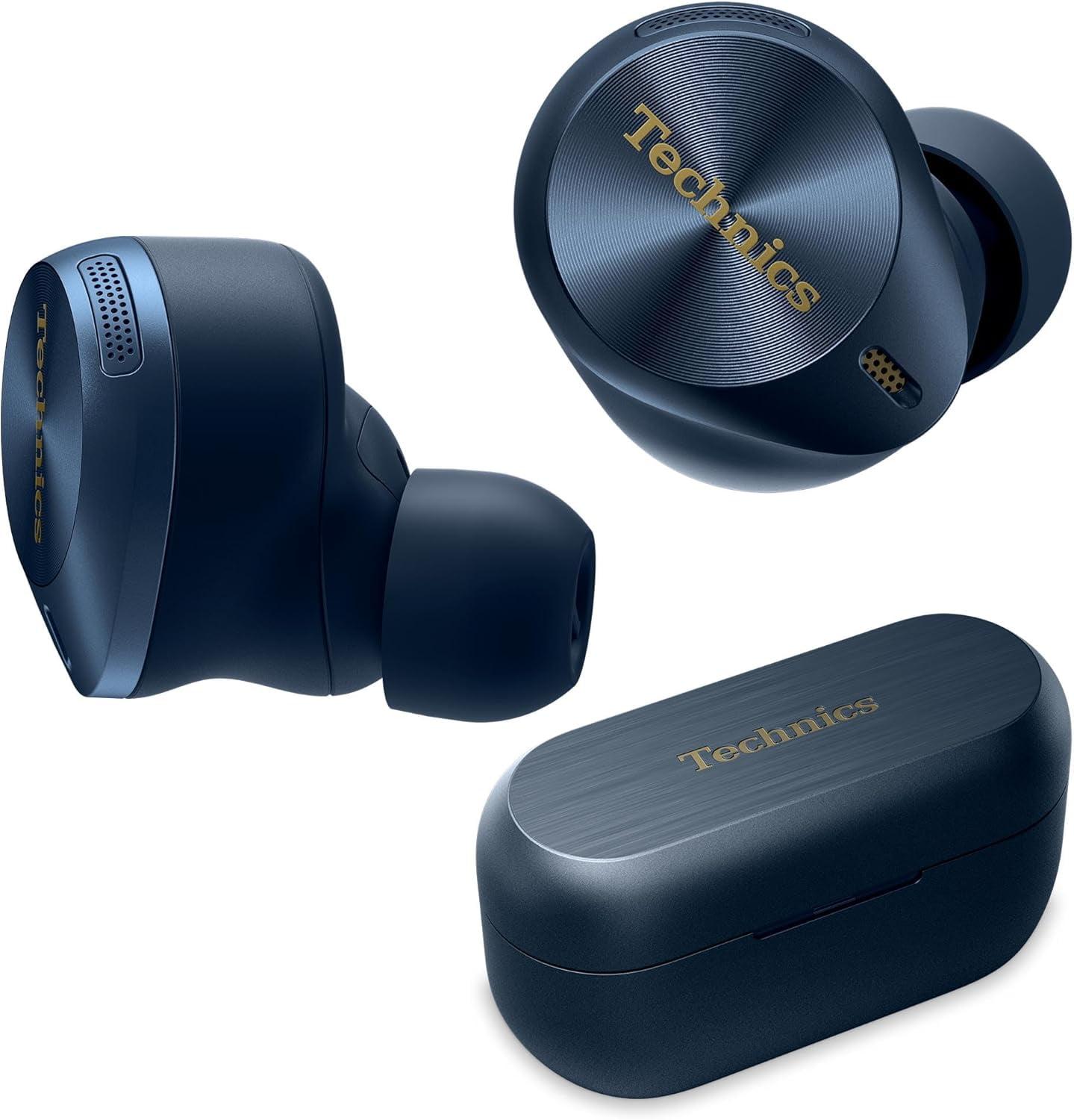
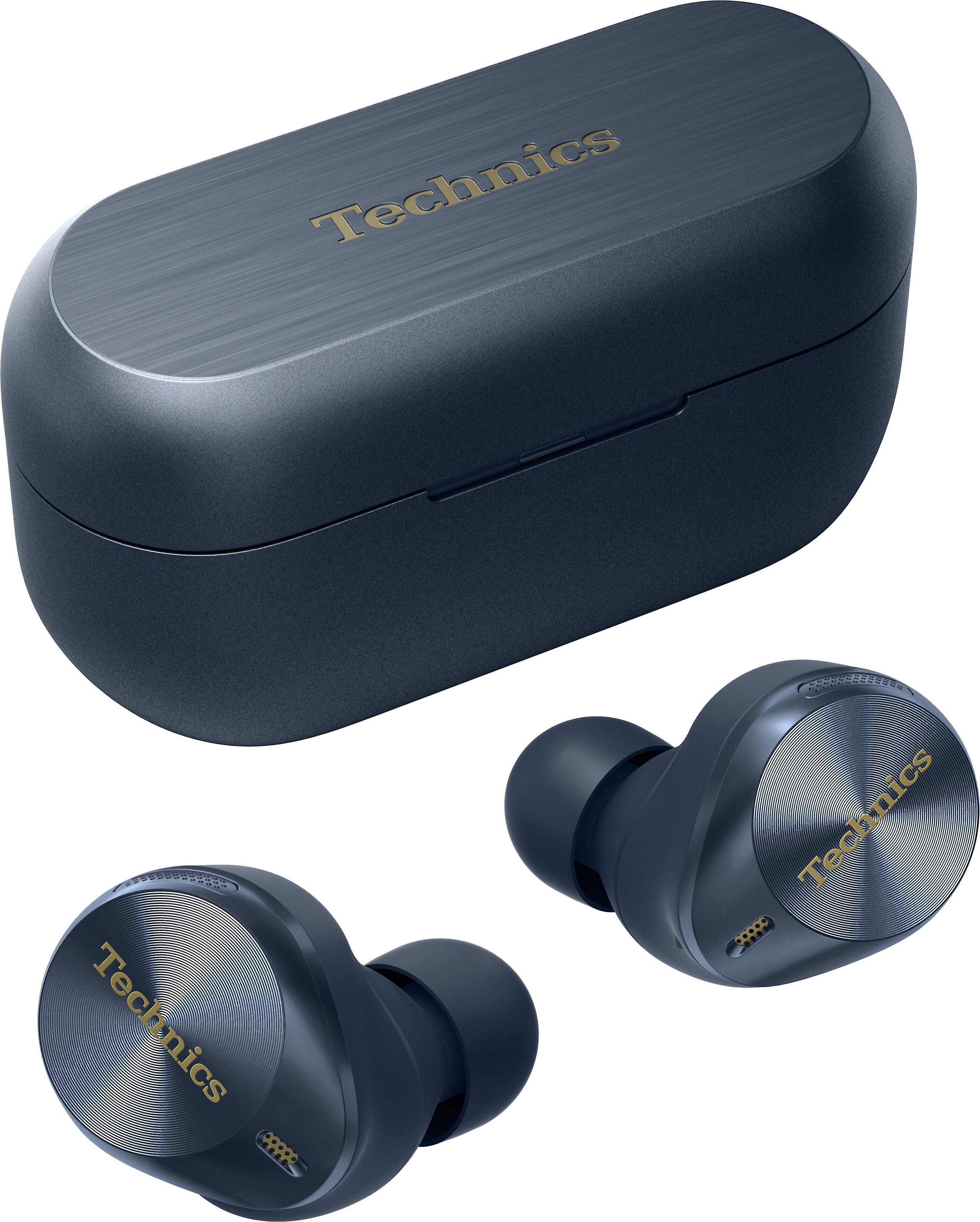
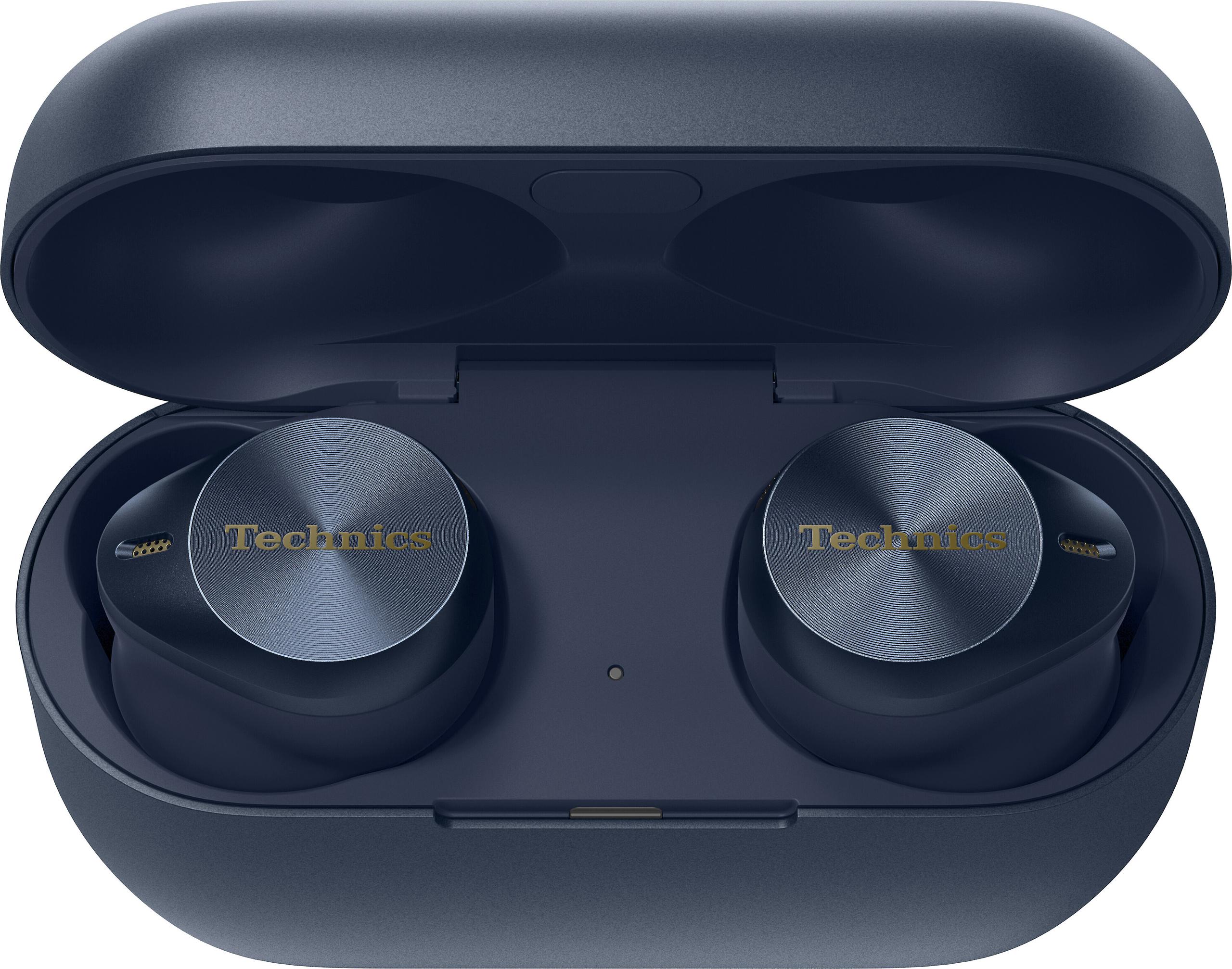
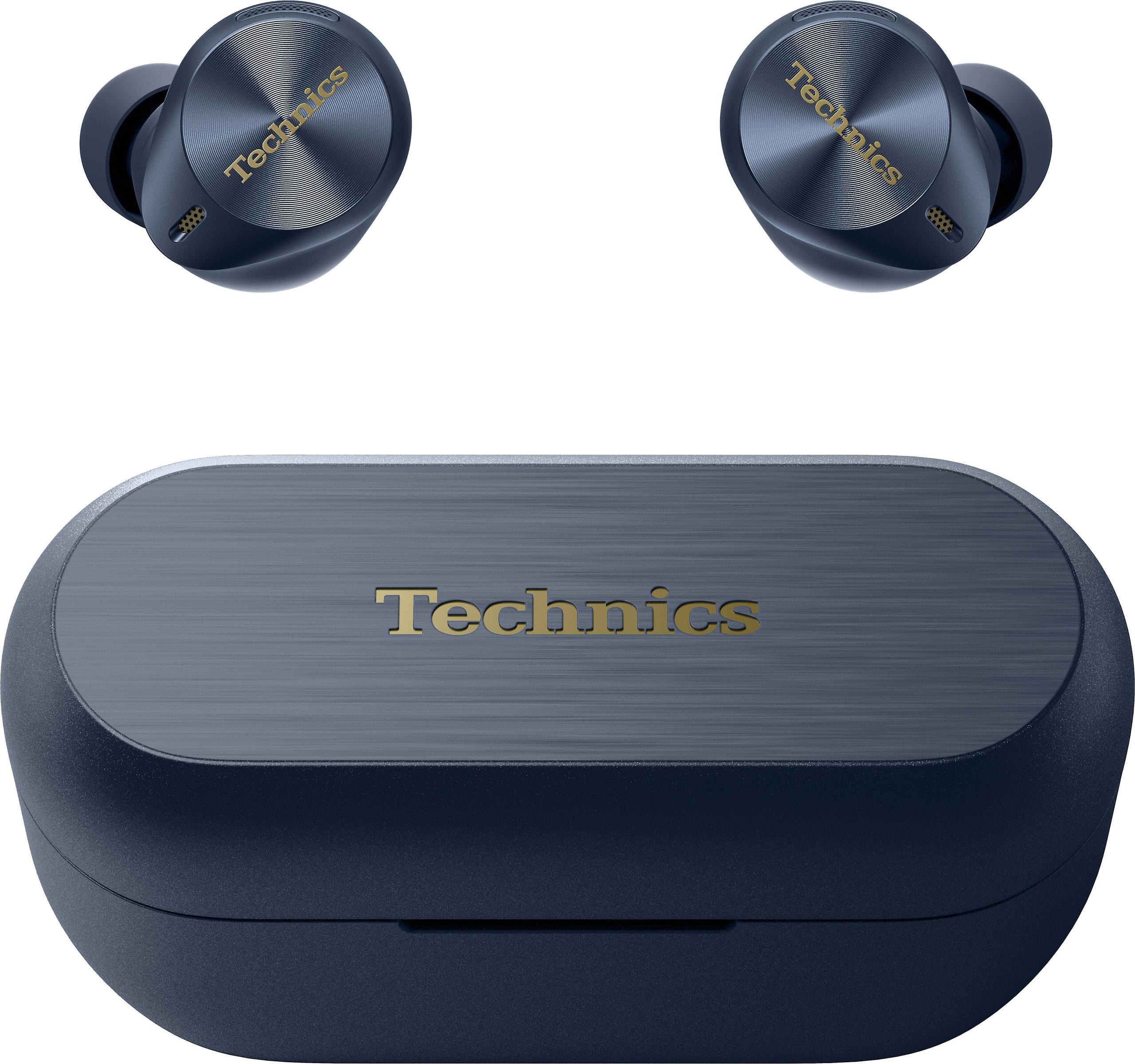
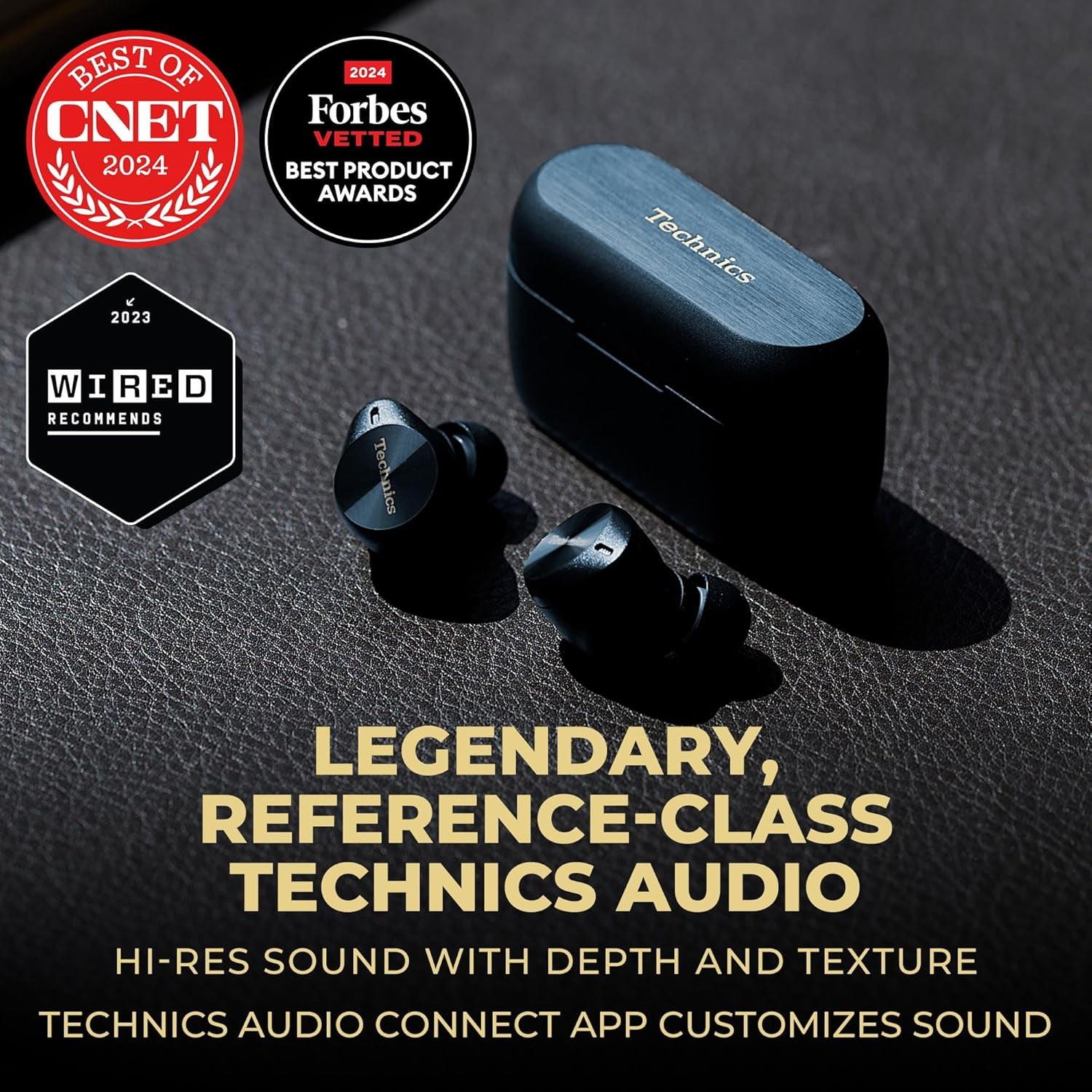

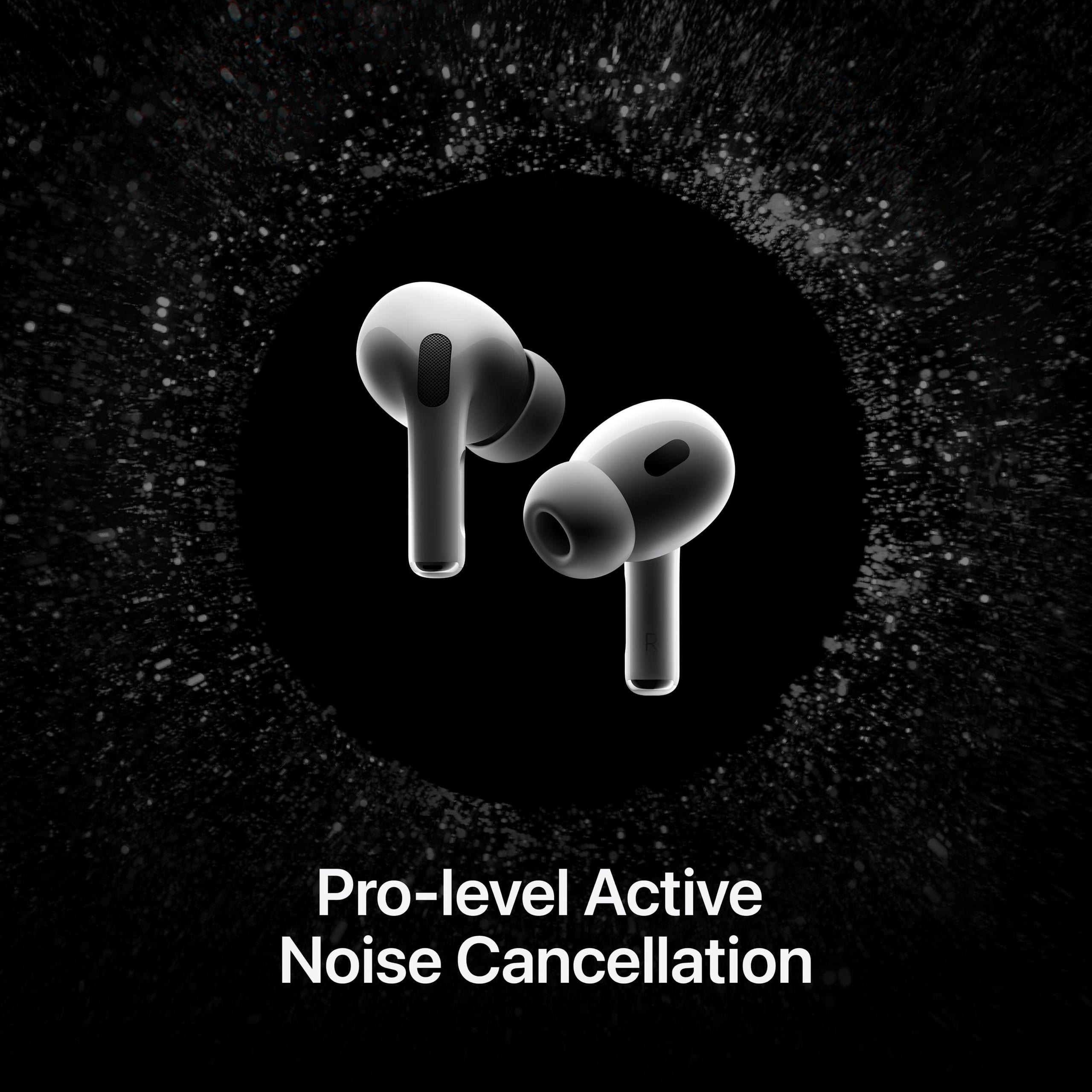
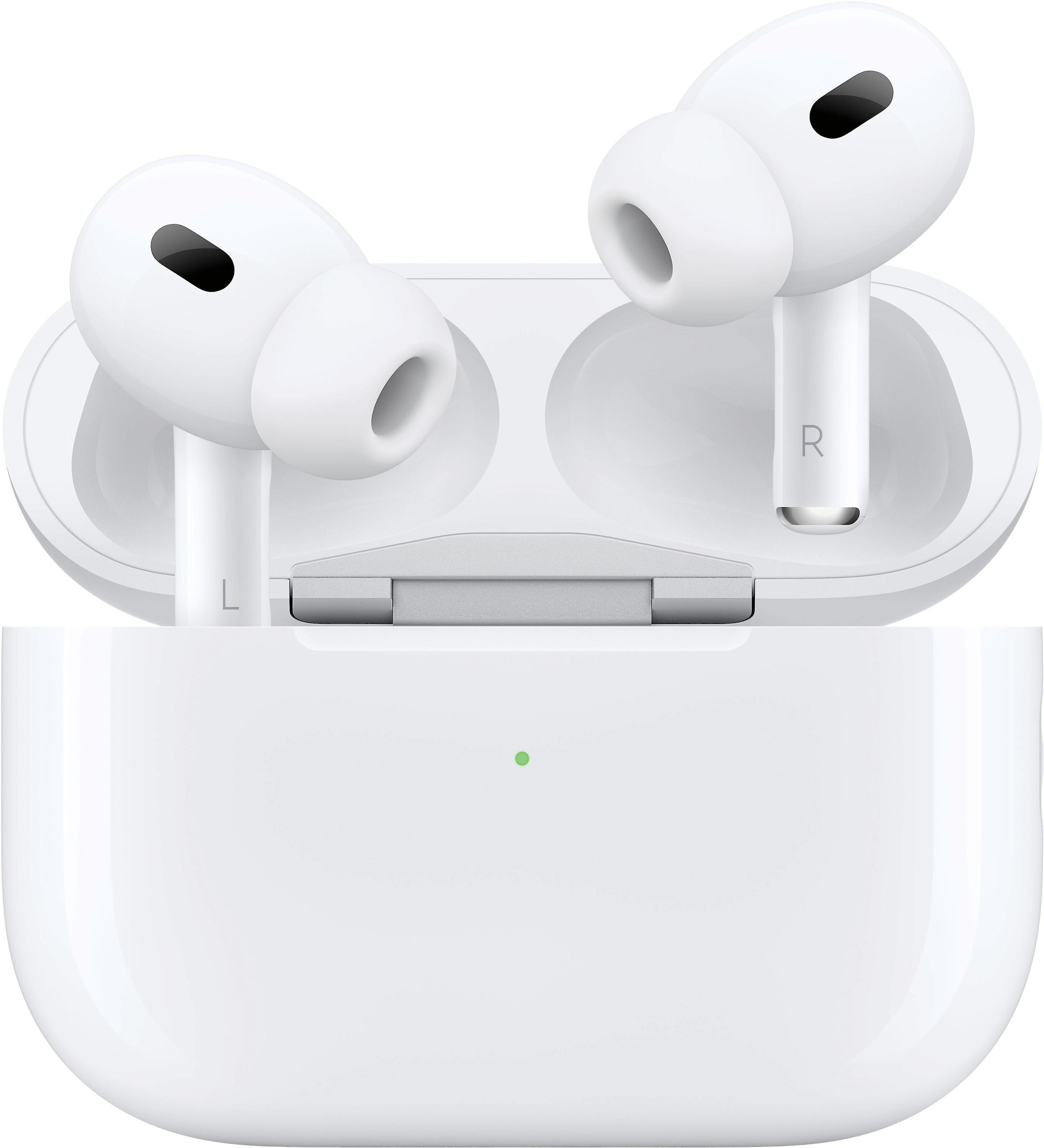
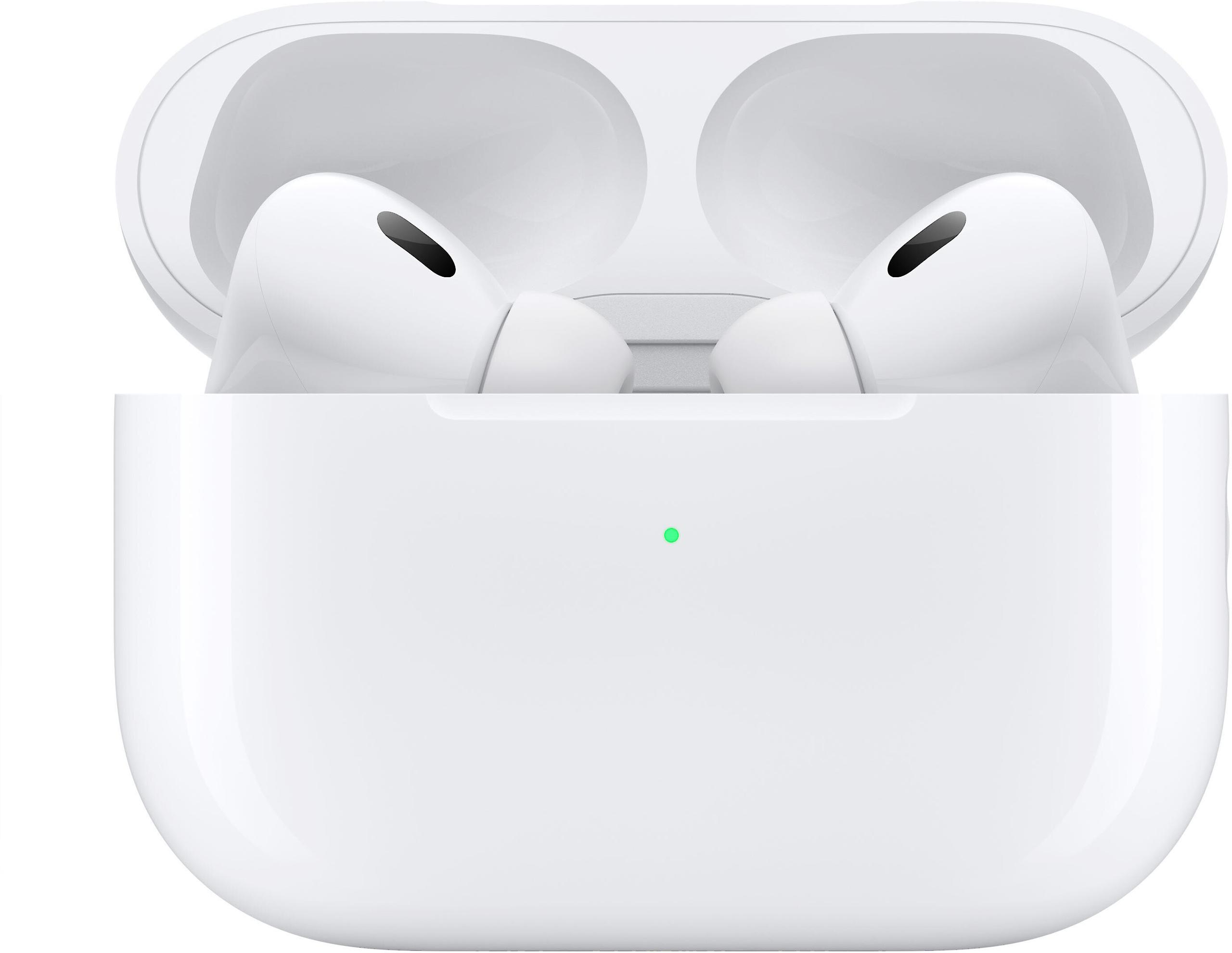
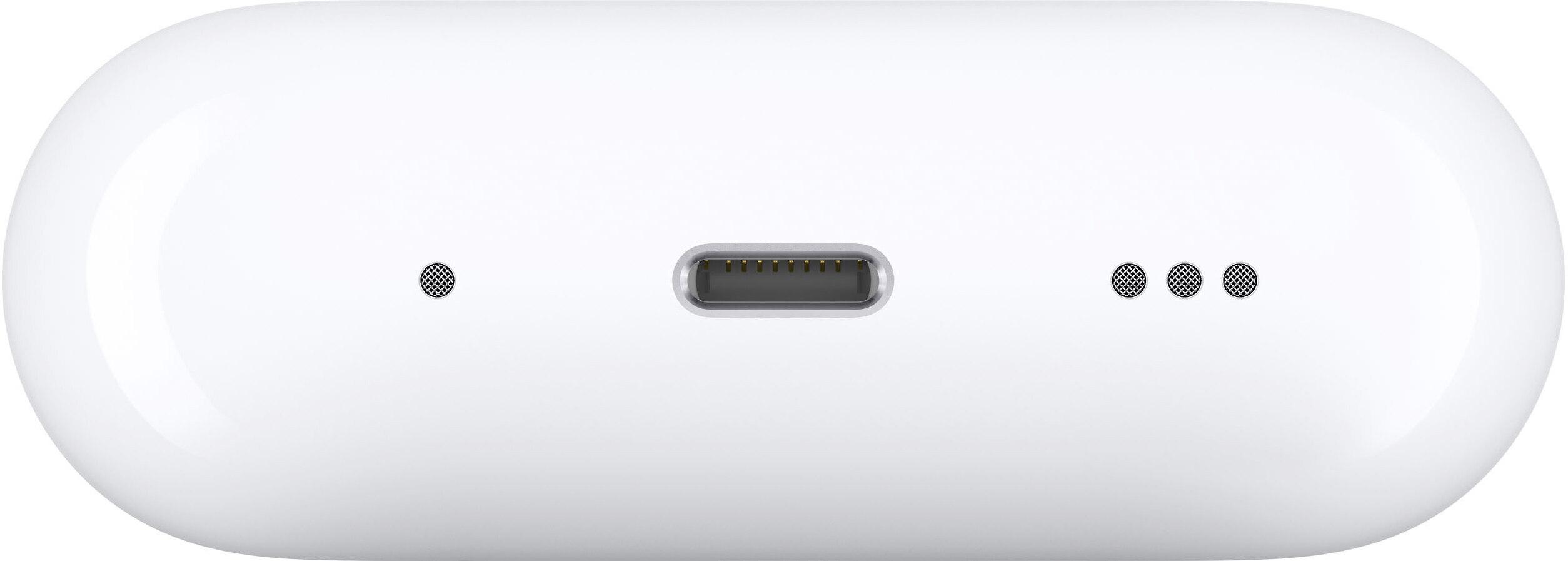
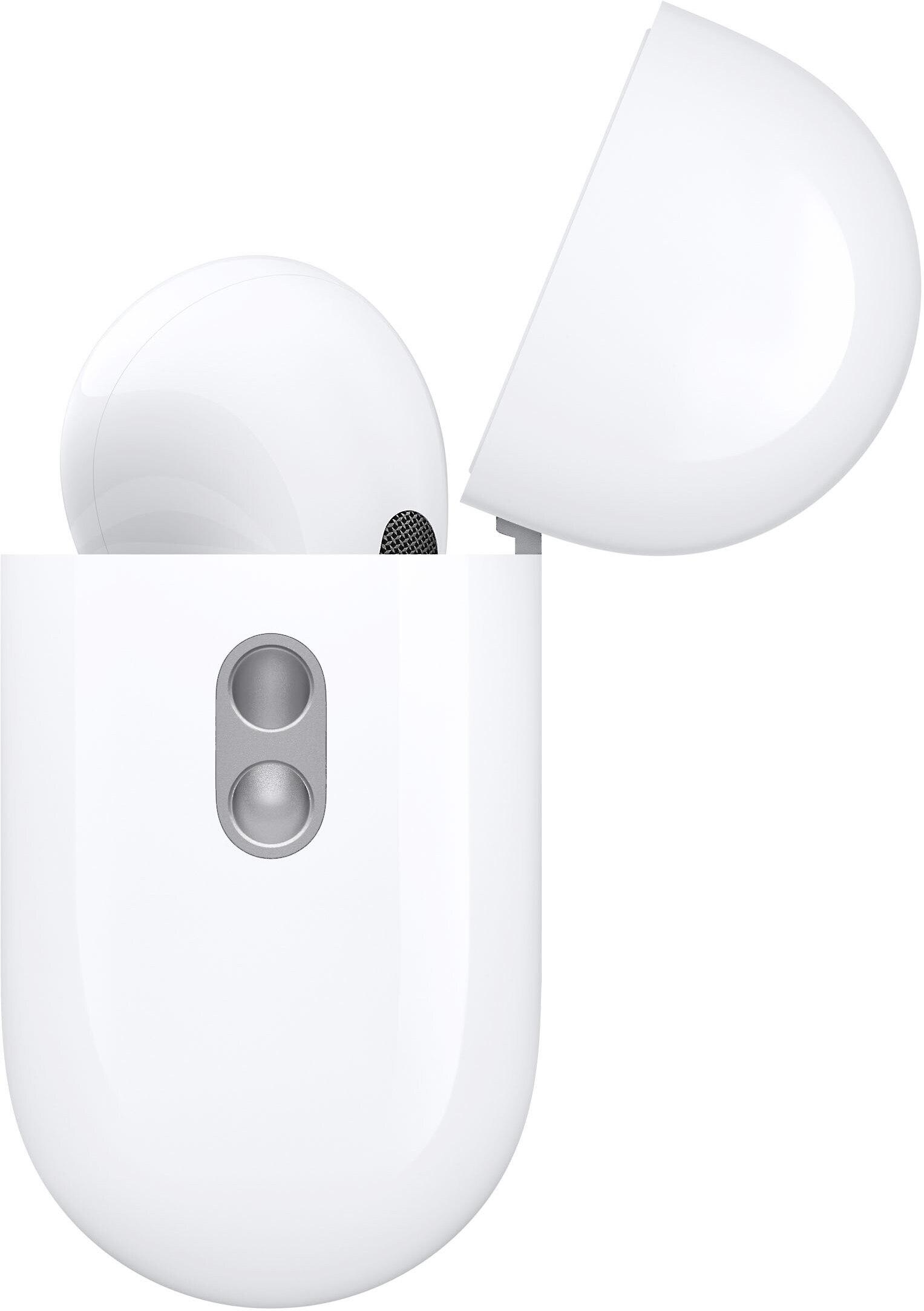
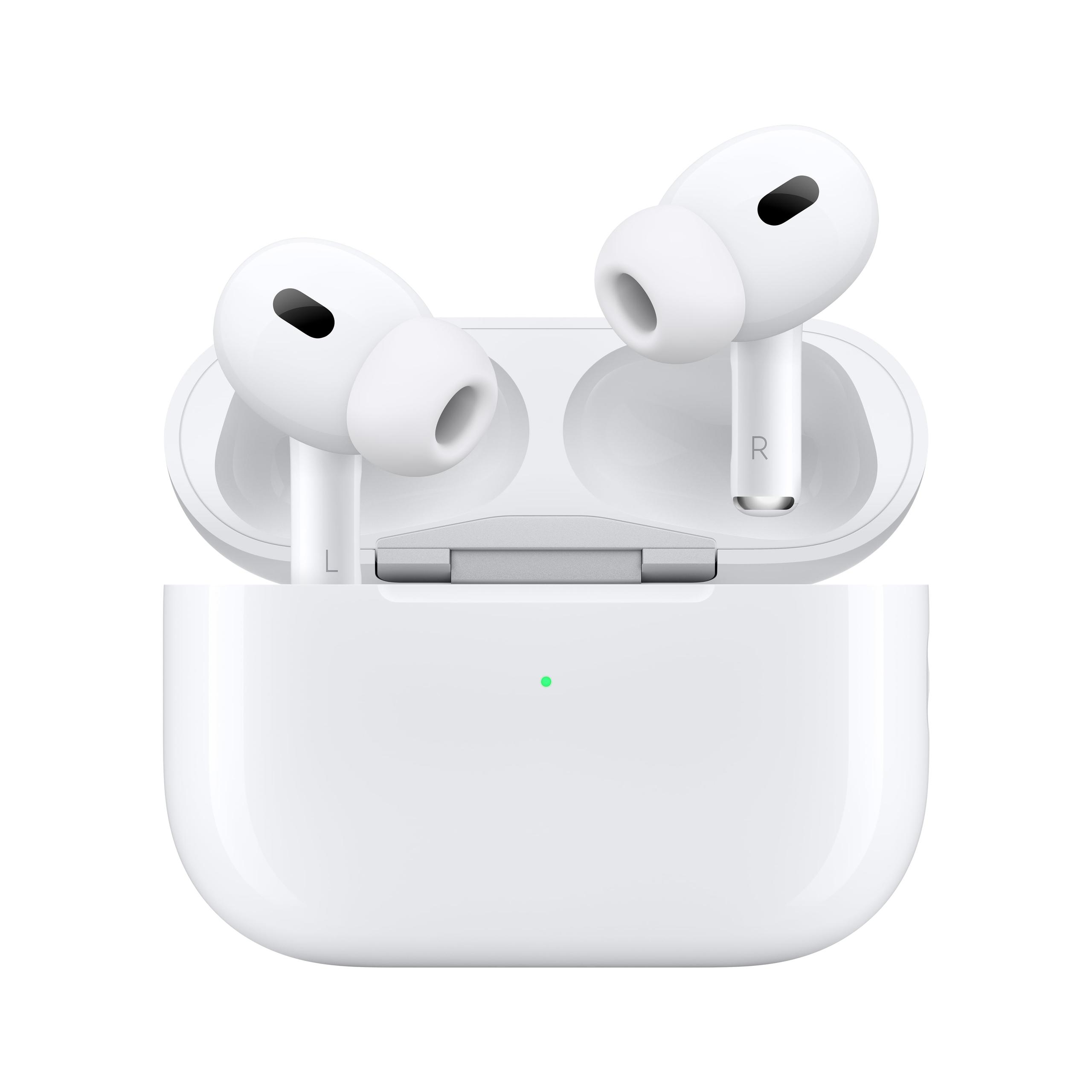
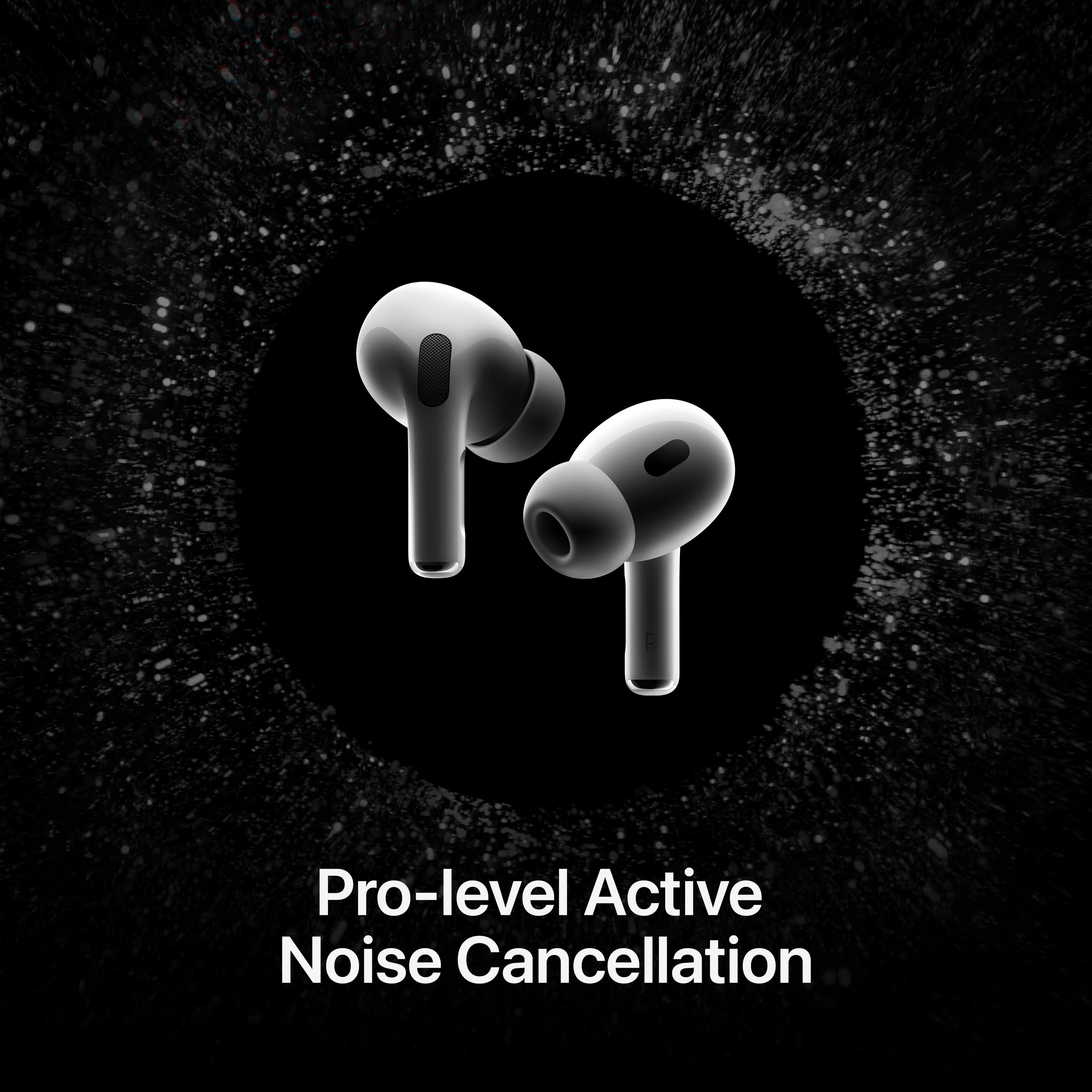
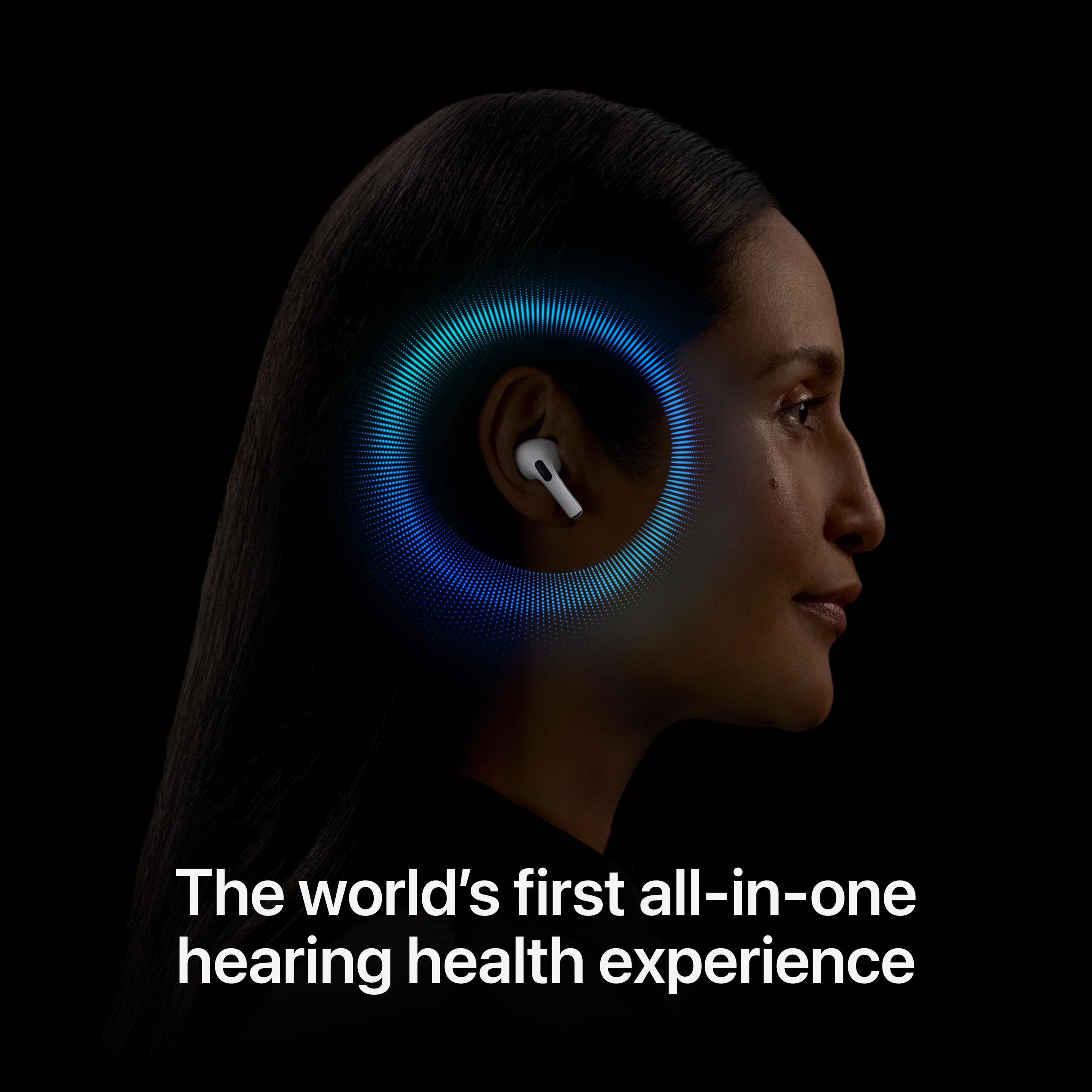
When you're ready to invest in premium wireless earbuds, you're entering a fascinating world where engineering meets artistry. Two standout products represent dramatically different philosophies: the Technics AZ80 and Apple AirPods Pro 2. Both launched within months of each other in 2022-2023, yet they approach premium audio in completely different ways.
Let me walk you through what makes each special and help you figure out which might be your perfect audio companion.
Premium true wireless earbuds have evolved into sophisticated mini-computers that happen to play music. We're talking about devices that cost similar to a decent smartphone, packed with processors, multiple microphones, and advanced algorithms working together to create your personal sound bubble.
The key things that separate premium earbuds from budget options include active noise cancellation (technology that uses microphones to detect outside noise and creates opposite sound waves to cancel it out), high-resolution audio support (the ability to play music files with more detail than standard MP3s), and computational audio processing (using computer chips to adjust sound in real-time based on your ears and environment).
When evaluating these products, I focus on several critical areas: how they sound with different types of music, how well they block unwanted noise, how comfortable they are for long listening sessions, and whether they work seamlessly with your devices. The Technics AZ80 and Apple AirPods Pro 2 excel in different ways across these categories.
The fundamental difference between these earbuds lies in their design philosophy. Technics, the legendary Hi-Fi brand that's been perfecting audio for decades, approaches the AZ80 like traditional high-end speakers – focus on pristine drivers, wide frequency response, and letting the music speak for itself. They've packed 10mm aluminum alloy drivers that can reproduce frequencies up to 40,000 Hz (way beyond what humans can hear, but this extended range affects the audible frequencies in positive ways).
Apple takes the opposite approach with the AirPods Pro 2. Rather than relying purely on acoustic engineering, they've built a powerful H2 computer chip that processes audio in real-time. This chip analyzes what you're listening to, measures how sound travels through your specific ear shape, and adjusts the audio thousands of times per second. It's like having a sound engineer constantly tweaking the mix just for you.
I've spent considerable time with both approaches, and each has distinct advantages. The Technics approach delivers consistently excellent sound regardless of what device you're using or what you're listening to. The Apple approach can create moments of audio magic that seem impossible from such tiny drivers, but works best within Apple's ecosystem.
When it comes to pure sound quality, both earbuds excel but in different ways. The Technics AZ80 supports LDAC, a high-resolution audio codec (a method of compressing and decompressing audio files) that can transmit nearly three times more data than standard Bluetooth audio. This means when you're listening to high-quality music files, you're hearing significantly more detail – the subtle breath of a vocalist, the decay of piano notes, the spatial positioning of instruments.
During my testing with various music genres, the Technics AZ80 consistently impressed with its wide soundstage (how spacious and three-dimensional the music sounds) and detailed midrange reproduction. Jazz recordings revealed instrument separation that made me feel like I was sitting in the studio, while electronic music maintained clarity even during complex, layered passages.
The Apple AirPods Pro 2 takes a different approach with Personalized Spatial Audio. Using your iPhone's TrueDepth camera, it creates a custom audio profile based on your unique ear shape. The result is eerily accurate – stereo imaging that seems to place sounds in specific locations around your head. When watching movies, explosions happen behind you while dialogue stays centered, creating an almost surround-sound experience from just two tiny drivers.
Apple's Adaptive EQ is particularly clever. It uses internal microphones to measure how sound actually reaches your eardrums after passing through your ear canal, then adjusts the frequency response accordingly. This means if your ears naturally emphasize certain frequencies (everyone's do), the earbuds compensate to deliver more balanced sound.
For home theater use, both earbuds offer compelling but different experiences. The Technics AZ80 delivers pristine audio quality that audiophiles will appreciate, especially if you're watching high-quality content with uncompressed audio tracks. The Apple AirPods Pro 2 creates a more immersive experience with spatial processing that can make action movies feel more engaging, though you'll need Apple devices to access these features.
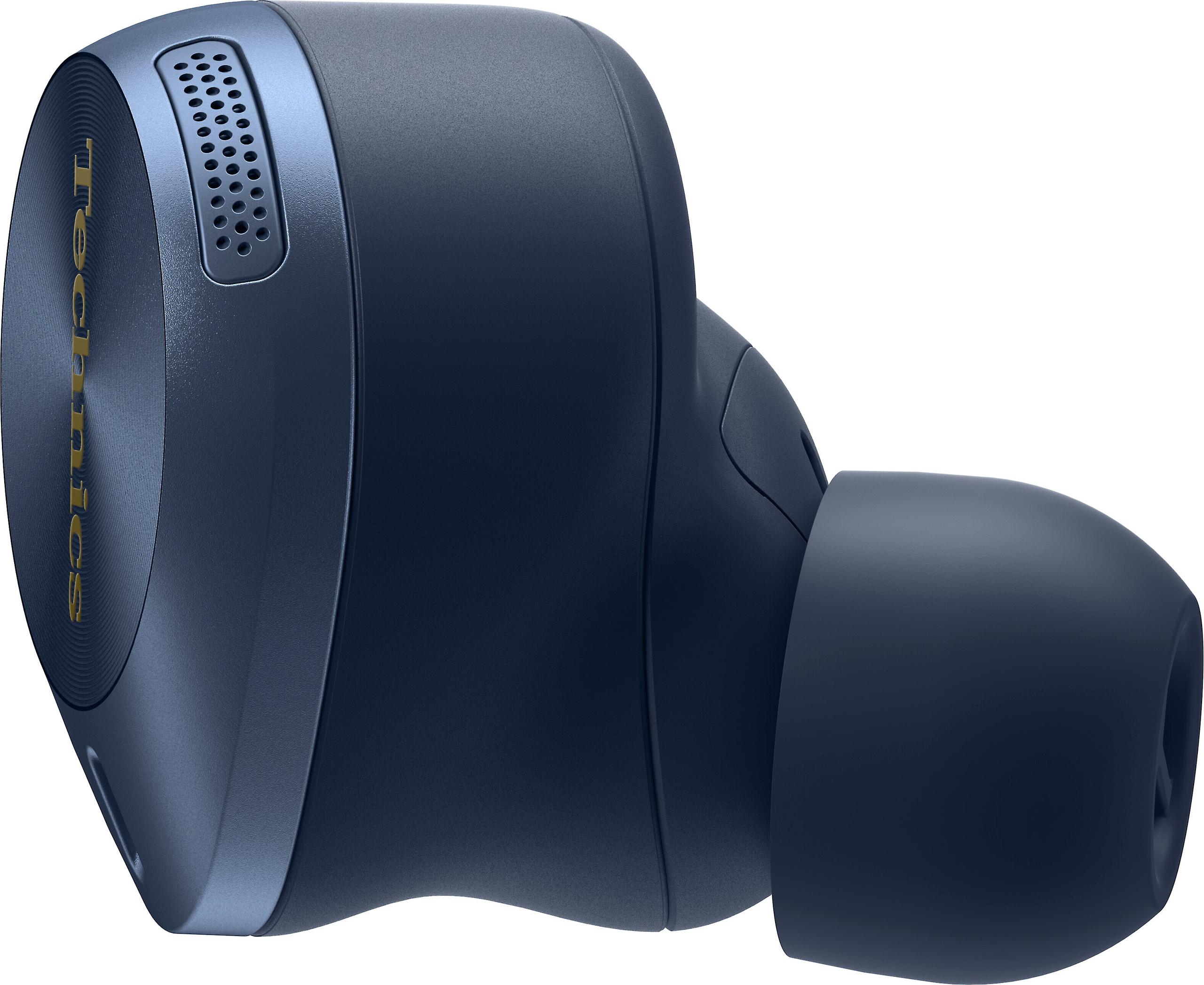
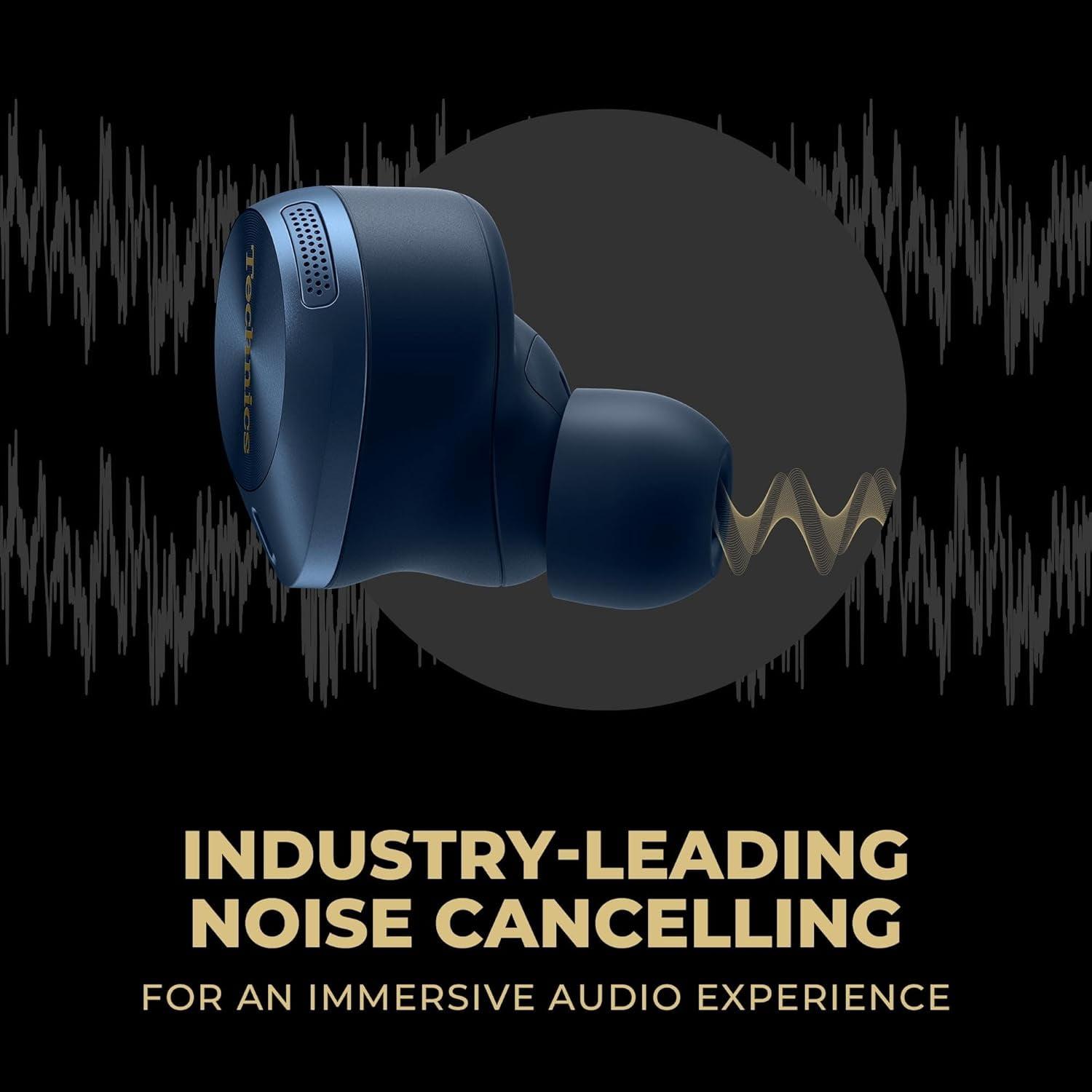
Both earbuds feature sophisticated active noise cancellation, but they implement it differently. The Technics AZ80 uses a dual hybrid system with eight MEMS microphones (tiny, highly sensitive microphones built on computer chips) positioned strategically around each earbud. This creates multiple zones of noise detection and cancellation, particularly effective at blocking consistent, droning sounds like airplane engines or air conditioning.
The Apple AirPods Pro 2 claims twice the noise cancellation performance of its predecessor, and in real-world use, it's remarkably effective. Apple's computational approach means the noise cancellation adapts to different environments automatically. The Adaptive Audio feature is particularly impressive – it seamlessly blends noise cancellation with transparency mode (allowing outside sound to pass through) based on your surroundings.
I've tested both during flights, in busy coffee shops, and while walking city streets. The Technics AZ80 provides consistently strong noise cancellation that's particularly effective in steady noise environments. The Apple AirPods Pro 2 feels more intelligent, automatically adjusting its approach based on whether you're in a quiet library or a bustling street.
For transparency mode – when you want to hear your surroundings while keeping your music playing – Apple has a significant advantage. Their transparency mode processes outside sound 48,000 times per second, creating an almost natural listening experience where you can hold conversations without removing your earbuds.
Modern earbuds need to excel at phone calls, video conferences, and voice commands. This is where the engineering differences become most apparent. The Technics AZ80 features JustMyVoice technology, which uses its eight microphone array to isolate your voice from background noise. The system works well in moderate noise environments, delivering clear voice transmission for business calls.
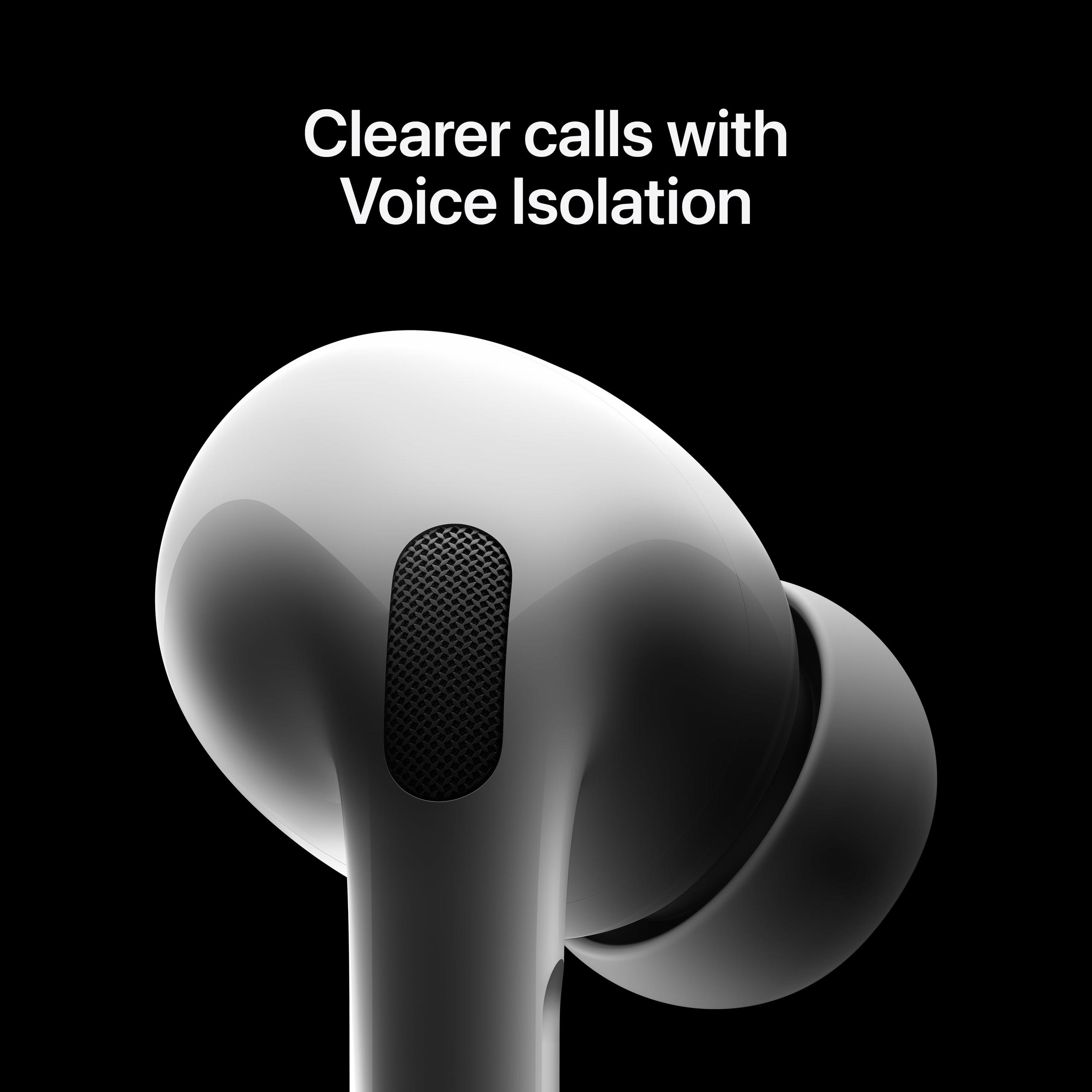
However, the Apple AirPods Pro 2 dominates in communication scenarios. The H2 chip's computational power enables Voice Isolation that's remarkably effective even in challenging environments. During testing in windy conditions and noisy spaces, the Apple earbuds consistently delivered clearer voice quality. The beamforming technology (directing microphone sensitivity toward your mouth while reducing pickup from other directions) works exceptionally well.
For professionals who spend significant time on video calls, the Apple AirPods Pro 2 provides a noticeable advantage in voice clarity and background noise suppression.
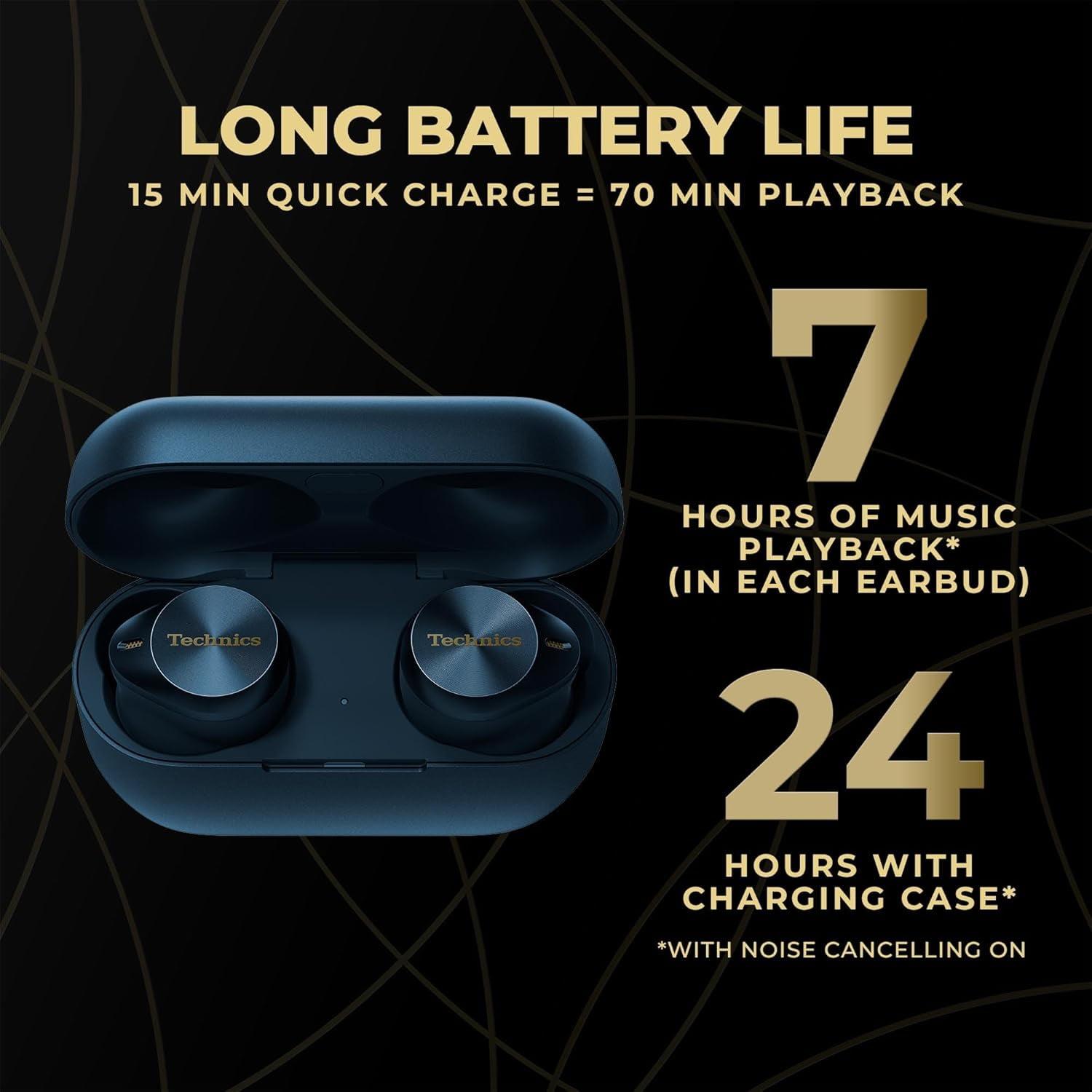
Battery performance tells an interesting story about design priorities. The Technics AZ80 offers 7.5 hours of continuous playback with noise cancellation enabled, compared to 6 hours for the Apple AirPods Pro 2. However, Apple's charging case provides significantly more additional charges, resulting in 30 total hours versus Technics' 17.5 hours.
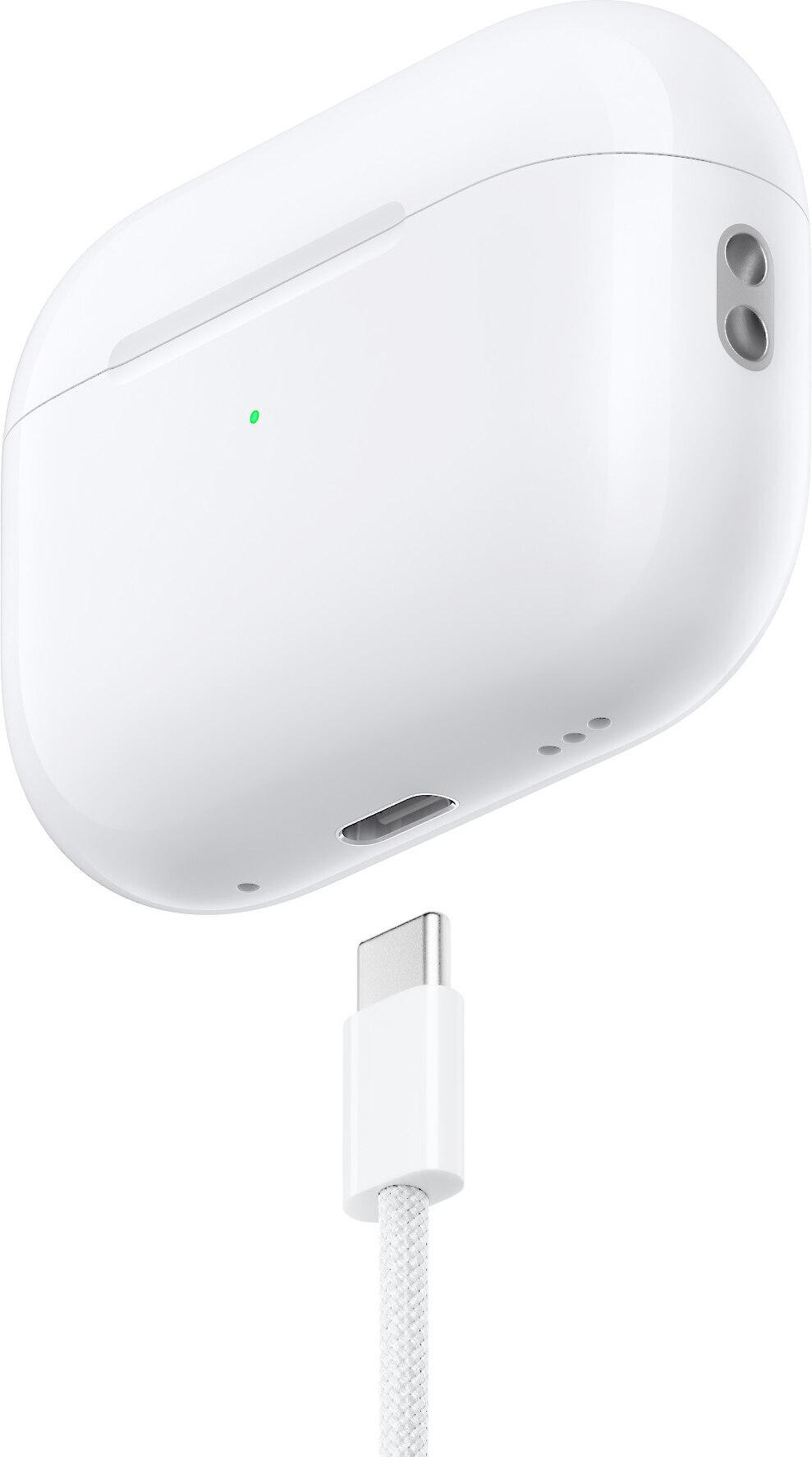
Both cases support wireless charging, but Apple's implementation feels more refined. The MagSafe integration means the case snaps satisfyingly onto wireless chargers and provides charging status through your iPhone. The Technics AZ80 case is larger but includes a lanyard loop – a small detail that matters if you're prone to misplacing small objects.
Quick charging capabilities differ meaningfully. Apple's five-minute quick charge provides about an hour of listening time, while Technics requires longer charging sessions but delivers more usage per charge cycle.
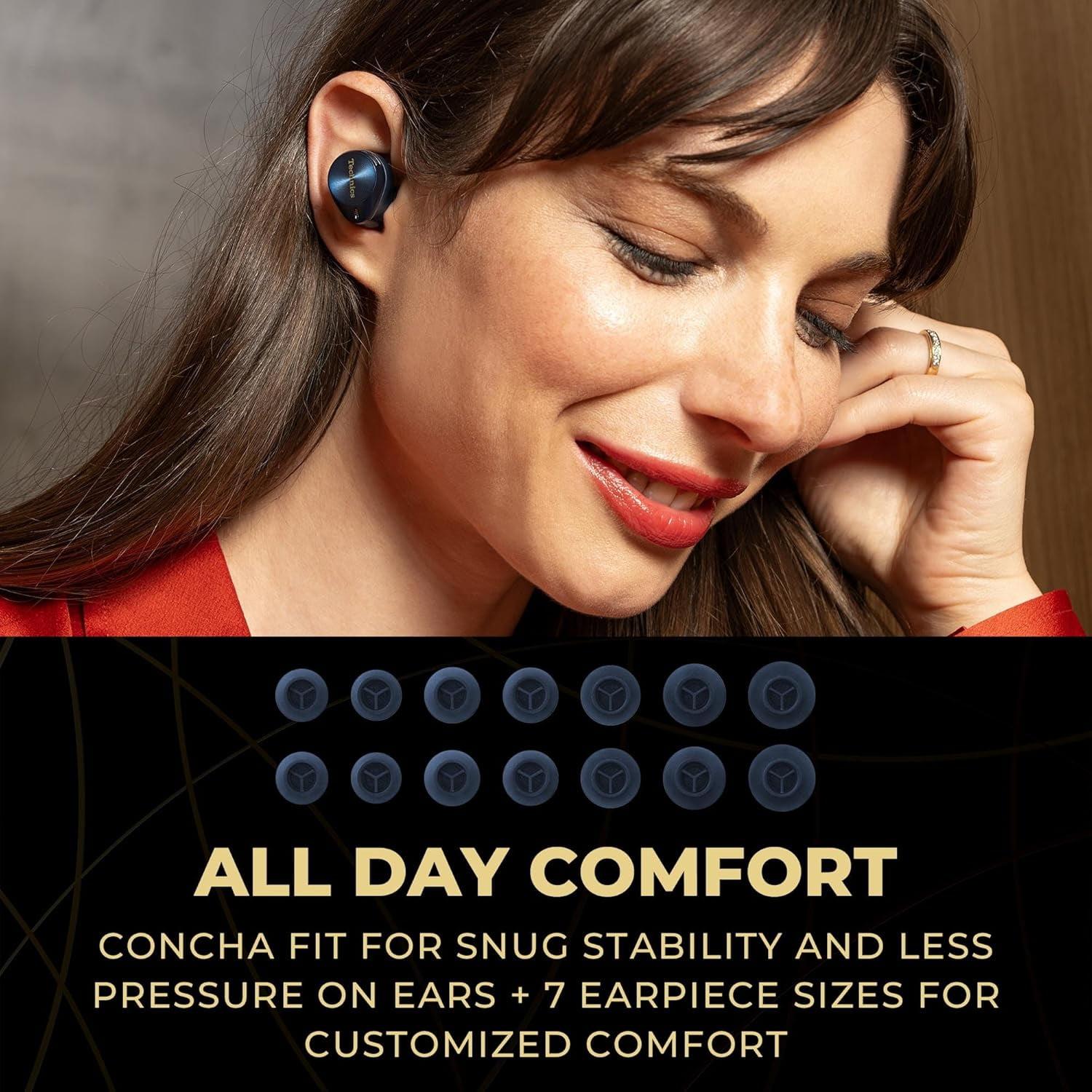
Comfort can determine whether expensive earbuds become daily companions or expensive drawer decorations. The Technics AZ80 excels here with an ergonomic design that distributes weight evenly and avoids pressure points. During extended listening sessions – we're talking 8+ hours – they remain comfortable. The seven different ear tip sizes ensure most people can find an optimal fit.
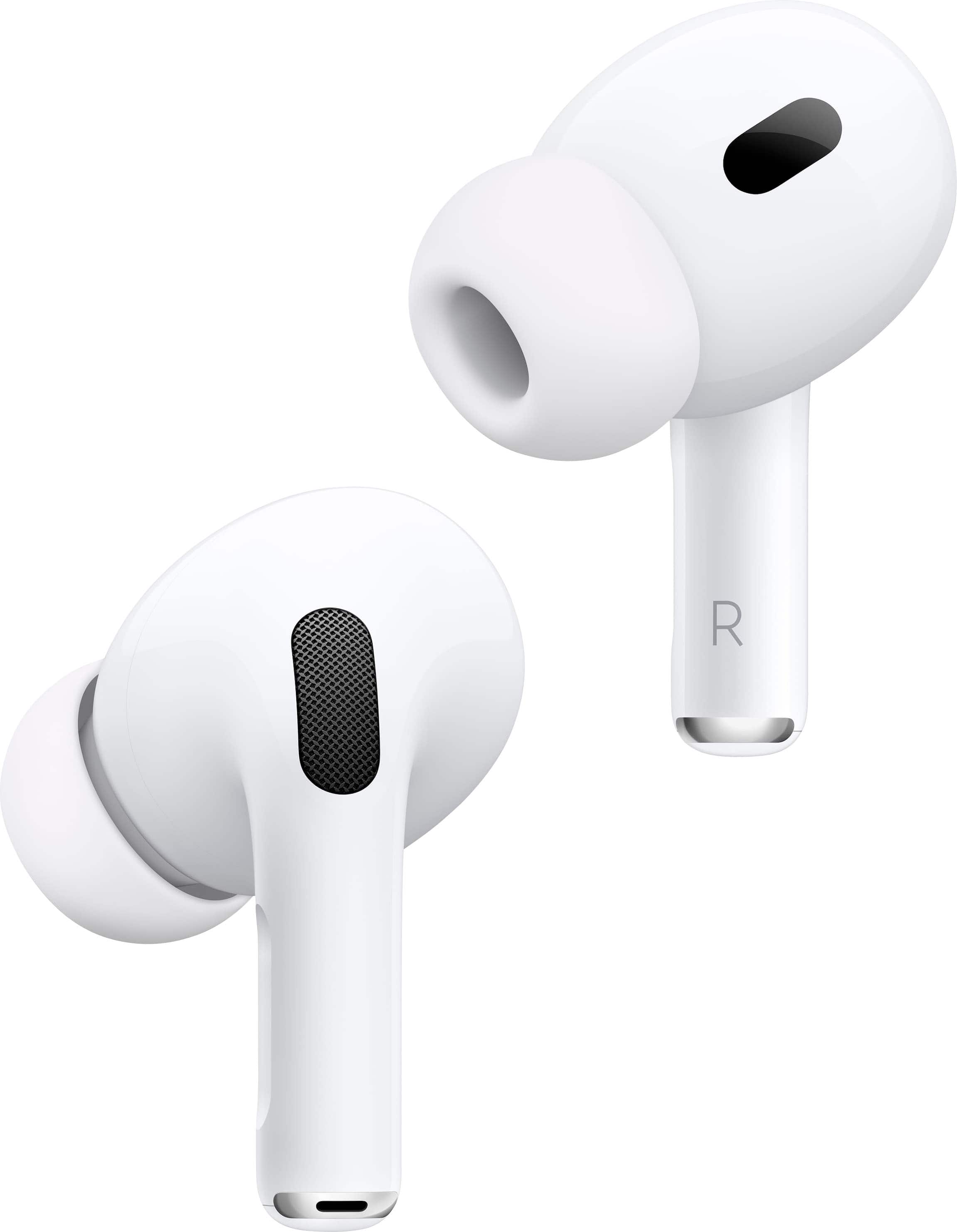
The Apple AirPods Pro 2 are lighter at just 5.3 grams per earbud, but some users find they require aftermarket foam tips for secure, comfortable long-term wear. The skin-detect sensors automatically pause music when you remove an earbud, which is convenient but sometimes overly sensitive.
My personal experience favors the Technics AZ80 for all-day comfort, particularly during long work sessions or travel days. The secure fit also maintains the noise cancellation seal better during movement.
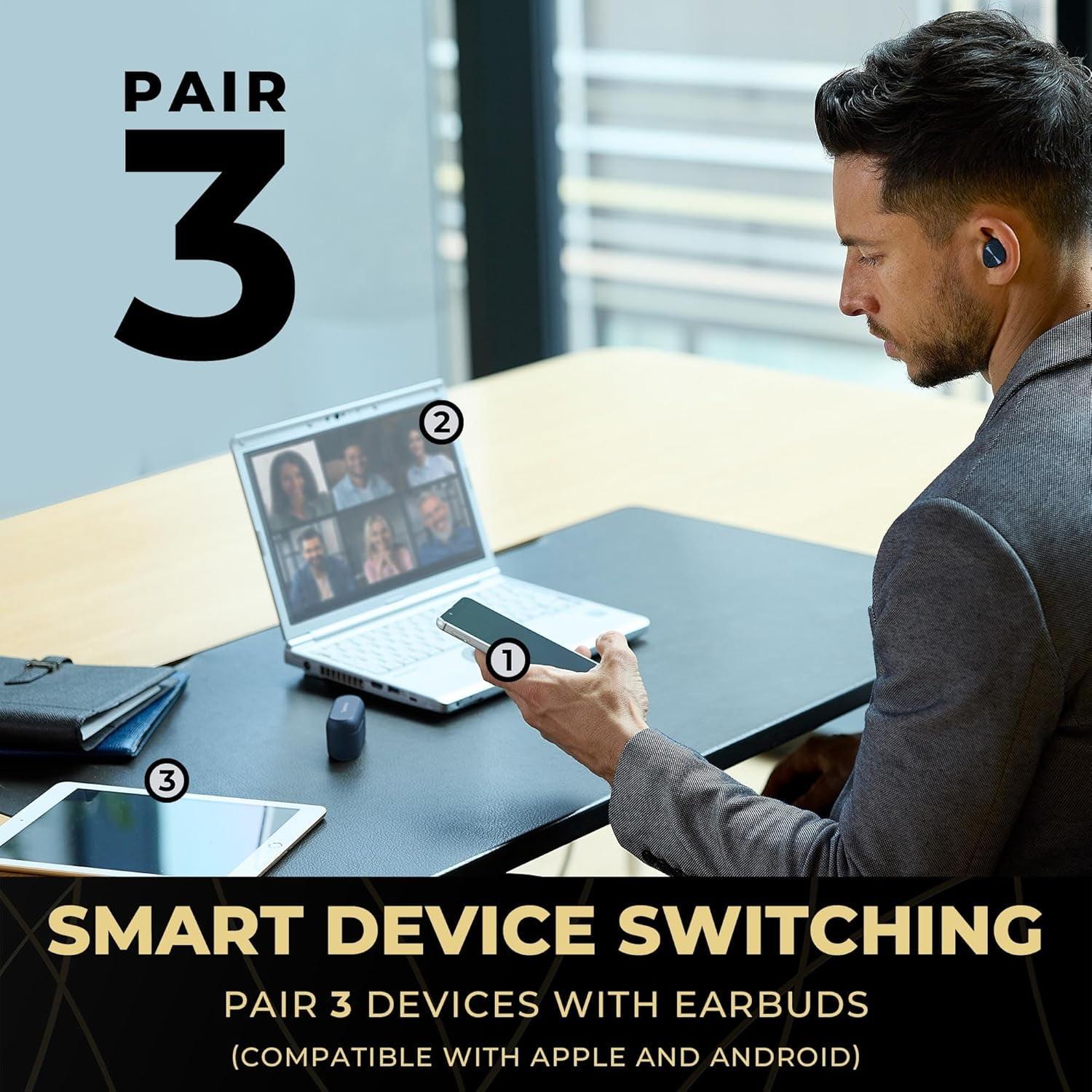
Here's where usage patterns dramatically affect your experience. The Technics AZ80 supports three-device multipoint connectivity, meaning you can simultaneously connect to your laptop, phone, and tablet. Audio automatically switches to whichever device is playing sound – incredibly useful for modern multi-device workflows.
The Apple AirPods Pro 2 doesn't support traditional multipoint, but if you're using Apple devices, the ecosystem integration is magical. They seamlessly switch between your iPhone, iPad, Mac, and Apple Watch based on what you're actively using. This works brilliantly within Apple's ecosystem but offers no benefits with other devices.
Bluetooth 5.3 support in both earbuds ensures stable connections and good range, typically maintaining connection throughout a typical home or office space.
This brings us to perhaps the most important consideration: platform compatibility. The Apple AirPods Pro 2 delivers its full feature set only with Apple devices. On Android phones, you lose spatial audio, adaptive EQ, find my earbuds features, and even firmware updates. You're essentially buying premium hardware while accessing only basic functionality.
The Technics AZ80 provides complete feature access regardless of your device platform. iOS users get the same features as Android users, including app-based customization and firmware updates. This platform agnosticism makes them more future-proof if you switch device ecosystems.
Both products occupy similar price ranges in the premium earbud market, typically retailing within $50 of each other. The value calculation depends heavily on your device ecosystem and priorities.
The Apple AirPods Pro 2 delivers exceptional value for Apple users. The ecosystem integration, computational audio features, and superior call quality justify the premium pricing if you can access all features. For Android users, the value proposition diminishes significantly.
The Technics AZ80 provides strong value for audio enthusiasts and cross-platform users. The high-resolution audio support, comfortable design, and multipoint connectivity appeal to users who prioritize flexibility and pure audio quality.
Choose the Apple AirPods Pro 2 if you're invested in Apple's ecosystem and prioritize seamless integration over pure audio specs. They're ideal for users who make frequent calls, consume lots of video content, and want earbuds that "just work" without customization. The spatial audio features make them particularly compelling for entertainment consumption.
Choose the Technics AZ80 if you use multiple device platforms, prioritize audio quality, or need multipoint connectivity. They're perfect for audio enthusiasts who appreciate high-resolution music, professionals who juggle multiple devices throughout the day, and anyone who values long-term comfort over ecosystem integration.
For home theater use specifically, the choice depends on your setup. If you're using Apple TV and other Apple devices, the AirPods Pro 2 create a more immersive experience with spatial processing. If you're using various streaming devices or have high-quality audio sources, the Technics AZ80 will better reveal the quality of your content.
Neither choice is wrong – they're simply optimized for different users and use cases. Consider your device ecosystem, listening habits, and whether you value pure audio performance or intelligent, adaptive features more highly. Both represent the current pinnacle of true wireless earbud technology, just approached from completely different directions.
| Technics AZ80 | Apple AirPods Pro 2 |
|---|---|
| Audio Quality - Core driver technology and frequency response capability | |
| 10mm aluminum alloy drivers with 20Hz-40kHz range, LDAC codec support for audiophile-grade sound | Custom drivers with H2 chip processing, 20Hz-20kHz range, Adaptive EQ personalizes sound to your ears |
| Noise Cancellation - Active blocking of unwanted environmental sounds | |
| Dual Hybrid ANC with 8 MEMS microphones, consistent performance across environments | Pro-level ANC with 2x improvement over predecessor, Adaptive Audio intelligently adjusts to surroundings |
| Battery Life - Critical for daily use without charging interruptions | |
| 7.5 hours single charge, 17.5 hours total with case (longer per charge, shorter overall) | 6 hours single charge, 30 hours total with case (shorter per charge, much longer overall) |
| Platform Compatibility - Determines which features you can actually access | |
| Full feature access on iOS and Android, including firmware updates and customization | Complete features only on Apple devices, basic functionality on Android with no updates |
| Connectivity - Device juggling and multi-tasking capabilities | |
| 3-device multipoint connectivity, seamlessly switches between laptop/phone/tablet | Apple ecosystem switching only, no traditional multipoint but magical within Apple devices |
| Comfort Design - Essential for extended listening sessions | |
| Ergonomic design with 7 ear tip sizes, exceptional all-day comfort reported by users | Lightweight 5.3g design with 4 tip sizes, may need aftermarket tips for secure fit |
| Call Quality - Important for work calls and voice commands | |
| JustMyVoice technology with 8 microphones, good voice isolation in moderate noise | Superior beamforming with H2 chip processing, exceptional clarity even in challenging environments |
| High-Resolution Audio - Matters for audiophiles with quality music sources | |
| LDAC codec transmits 3x more audio data than standard Bluetooth, preserves music detail | No LDAC support, relies on computational processing for sound enhancement instead |
| Charging Options - Convenience and speed of power replenishment | |
| Qi wireless charging, 2-hour case charge time, includes lanyard loop for security | MagSafe/Qi wireless charging, 0.9-1 hour case charge, 5-minute quick charge gives 1 hour playback |
| Smart Features - Advanced processing and personalization capabilities | |
| Traditional Hi-Fi approach with app-based EQ customization and gesture controls | Spatial Audio with head tracking, Personalized Audio profile, Adaptive Transparency mode |
The Technics AZ80 delivers superior sound quality for audiophiles, featuring 10mm aluminum alloy drivers and LDAC codec support that transmits three times more audio data than standard Bluetooth. This means you hear significantly more detail in high-quality music files. The Apple AirPods Pro 2 uses computational audio processing with the H2 chip to personalize sound to your specific ear shape, creating an impressive but different listening experience that excels with spatial content.
The Apple AirPods Pro 2 significantly outperforms the Technics AZ80 for calls and conferences. Apple's beamforming technology and H2 chip processing deliver exceptional voice clarity even in noisy environments. While the Technics AZ80 features JustMyVoice technology with 8 microphones for decent call quality, it doesn't match Apple's computational advantages for voice communication.
Battery performance varies by usage pattern. The Technics AZ80 provides 7.5 hours per charge compared to 6 hours for the Apple AirPods Pro 2. However, Apple's case offers much longer total battery life at 30 hours versus 17.5 hours for the Technics AZ80. If you prefer longer individual sessions, choose Technics; for extended travel without charging, choose Apple.
The Technics AZ80 offers full compatibility with Android devices, including access to all features, firmware updates, and the companion app. The Apple AirPods Pro 2 works with Android but with severely limited functionality - you lose spatial audio, adaptive EQ, find my earbuds features, and cannot update firmware. Android users should strongly consider the Technics AZ80.
The Technics AZ80 generally provides superior comfort for extended wear, featuring an ergonomic design that avoids pressure points and includes 7 different ear tip sizes. Users report excellent all-day comfort during 8+ hour sessions. The Apple AirPods Pro 2 is lighter but some users need aftermarket foam tips for secure, comfortable long-term wear with only 4 included tip sizes.
The Technics AZ80 supports true 3-device multipoint connectivity, automatically switching between your laptop, phone, and tablet based on which is playing audio. The Apple AirPods Pro 2 doesn't offer traditional multipoint but provides seamless switching within Apple's ecosystem between iPhone, iPad, Mac, and Apple Watch - though this only works with Apple devices.
Both offer excellent noise cancellation with different approaches. The Technics AZ80 uses dual hybrid ANC with 8 microphones for consistent noise blocking across environments. The Apple AirPods Pro 2 claims twice the noise cancellation of its predecessor and features Adaptive Audio that intelligently adjusts based on your surroundings. Apple's transparency mode is particularly advanced, processing outside sound 48,000 times per second.
For home theater, both excel in different ways. The Apple AirPods Pro 2 creates a more immersive experience with Personalized Spatial Audio and head tracking, making action movies feel more engaging when using Apple devices. The Technics AZ80 delivers pristine audio quality that audiophiles appreciate with high-quality content, especially with LDAC support for uncompressed audio tracks.
Value depends on your device ecosystem. The Apple AirPods Pro 2 provides excellent value for Apple users who can access all features, particularly the ecosystem integration and computational audio capabilities. The Technics AZ80 offers better value for cross-platform users, audio enthusiasts, and anyone who needs multipoint connectivity, as you get full functionality regardless of your devices.
The Technics AZ80 fully supports high-resolution audio through LDAC codec, which can transmit up to 990 kbps compared to standard Bluetooth's 328 kbps. This preserves significantly more musical detail from high-quality sources. The Apple AirPods Pro 2 doesn't support LDAC or other hi-res codecs, instead relying on computational processing to enhance standard audio formats.
Both offer similar water resistance (IPX4-IP54), but the Technics AZ80 provides a more secure fit that maintains the noise cancellation seal during movement. The Apple AirPods Pro 2 is lighter but may require better-fitting tips for secure wear during exercise. Consider the Technics AZ80 if you prioritize a secure fit, or the Apple AirPods Pro 2 if you want automatic play/pause when removing earbuds.
The Apple AirPods Pro 2 offers the easiest setup experience for Apple users - they pair instantly and sync across all your Apple devices automatically. Features work immediately without additional apps. The Technics AZ80 requires downloading the Technics Audio Connect app for full functionality but provides more customization options including EQ settings, gesture controls, and noise cancellation adjustments across all platforms.
We've done our best to create useful and informative comparisons to help you decide what product to buy. Our research uses advanced automated methods to create this comparison and perfection is not possible - please contact us for corrections or questions. These are the sites we've researched in the creation of this article: stereonet.com - us.technics.com - us.technics.com - rtings.com - head-fi.org - bestbuy.com - soundguys.com - head-fi.org - youtube.com - loudnwireless.com - youtube.com - cnet.com - technics.com - technics.com - bestbuy.com - target.com - us.technics.com - technics.com - youtube.com - head-fi.org - nnty.fun - us.technics.com - bhphotovideo.com - bestbuy.com - us.technics.com - audiosciencereview.com - youtube.com - head-fi.org - head-fi.org - jbhifi.com.au - recordingnow.com - apple.com - apple.com - cnet.com - hearingreview.com - target.com - support.apple.com - costco.com - cnet.com - quill.com

Privacy Policy
Terms and Conditions - Affiliate Policy
Home Security
© Copyright 2008-2026.
11816 Inwood Rd #1211, Dallas, TX 75244