$599.99
The Marshall Woburn III stands as a fascinating anomaly in today's smart speaker landscape. While most manufacturers chase voice assistant integration and multi-room capabilities, Marshall has doubled down on pure acoustic performance and iconic design. After extensive research into user feedback and technical specifications, this flagship home speaker emerges as something quite special—though it's definitely not for everyone.
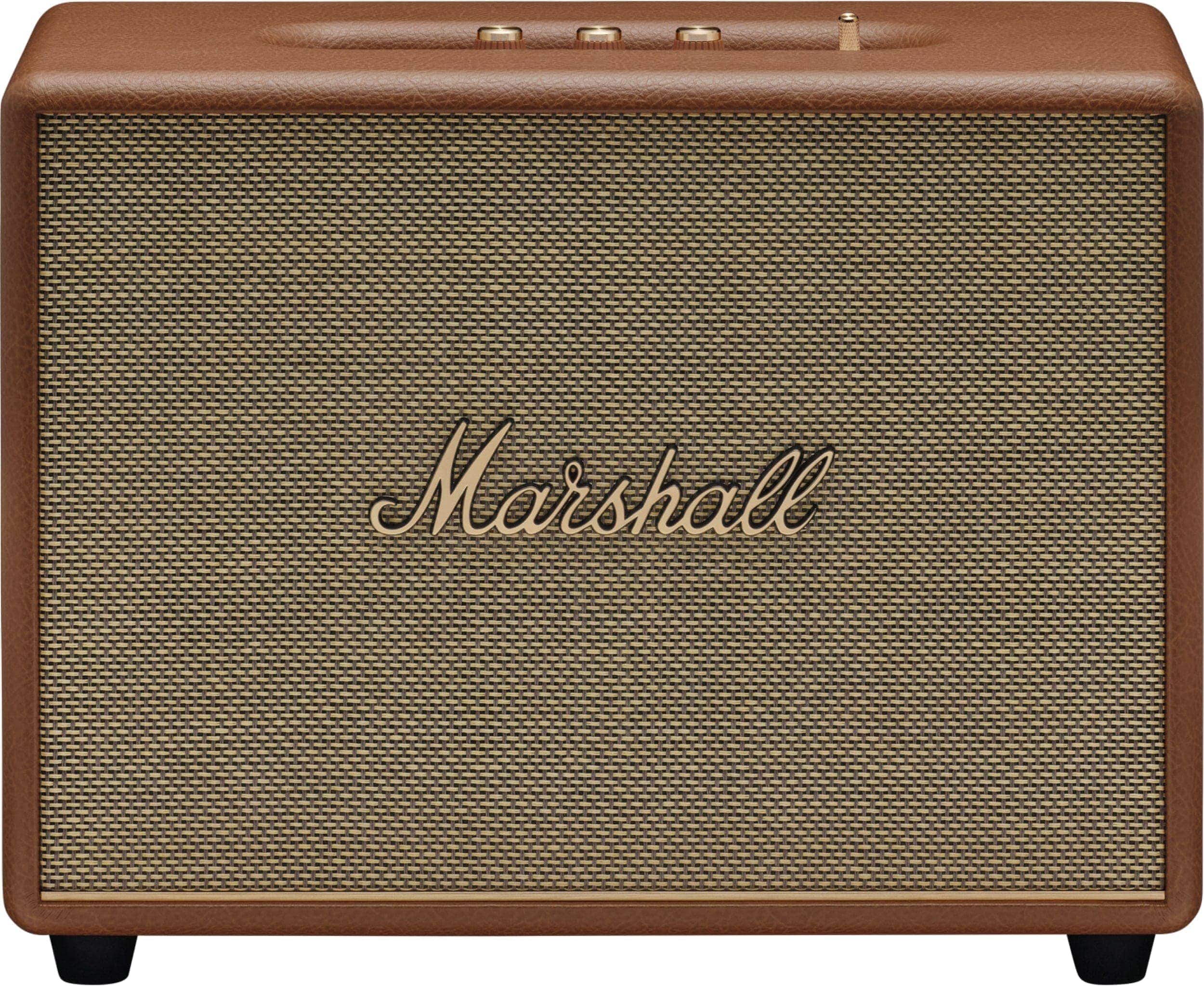
The most striking aspect of the Marshall Woburn III isn't immediately obvious from photos: it's the only speaker in this category with a true three-way driver system. While most Bluetooth speakers—even expensive ones—rely on two-way designs (woofer plus tweeter), Marshall has engineered dedicated midrange drivers alongside the 6-inch woofer and dual tweeters.
This matters more than you might expect. Researchers consistently note that the midrange frequencies (roughly 250Hz to 4kHz) are where most musical instruments and vocals live. When these frequencies get squeezed between bass and treble drivers, you lose the nuanced details that make music feel alive. The Woburn III's dedicated 2-inch midrange drivers handle this crucial frequency band separately, creating what many users describe as surprisingly natural instrument separation.
The driver configuration deserves deeper examination. That 6-inch woofer receives a full 90 watts of Class D amplification—that's more power than many entire speakers get. Class D amplification is particularly clever here because it's incredibly efficient, converting most of the electrical energy into sound rather than heat. This means the speaker can deliver serious volume without overheating or distorting.
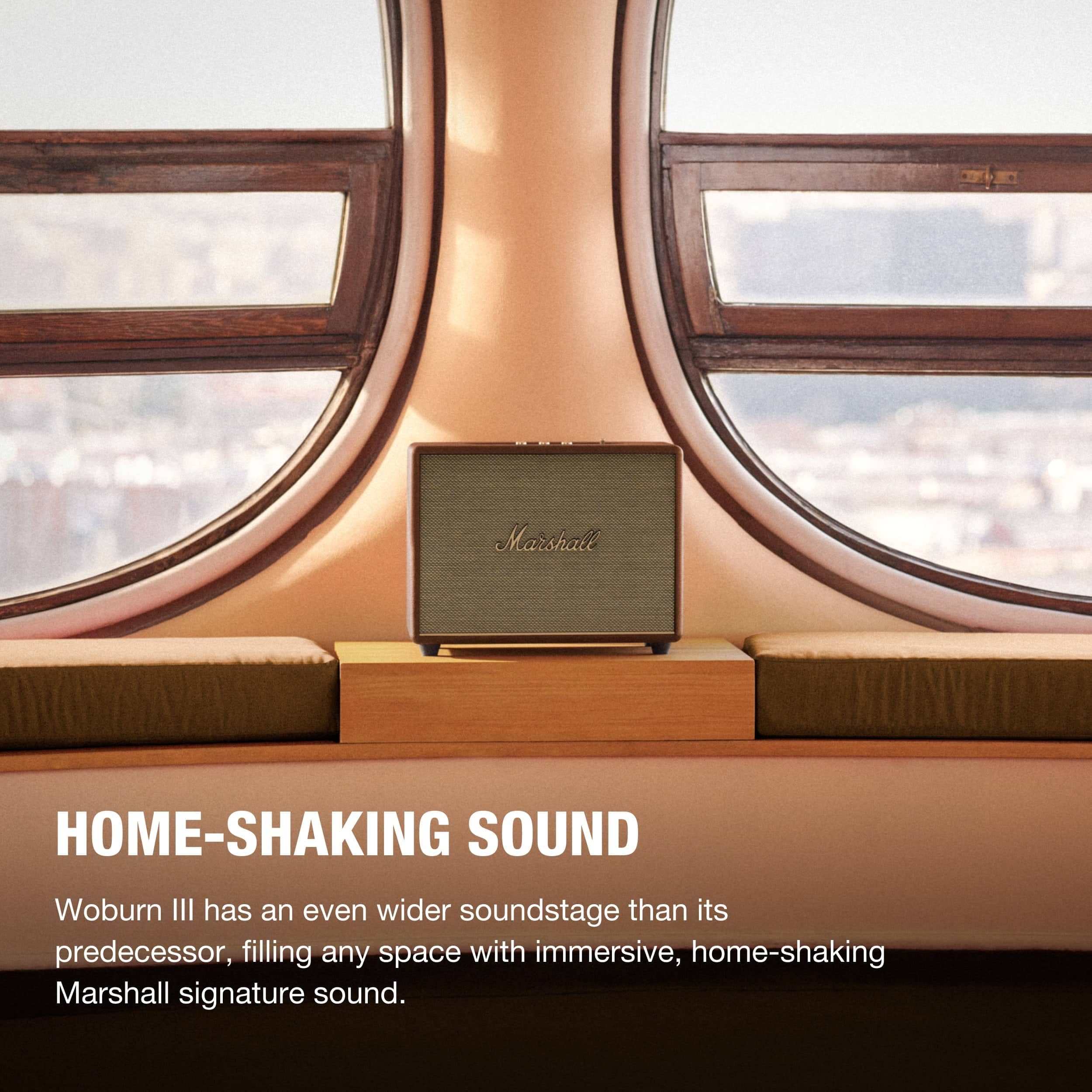
Perhaps the most impressive technical achievement is how Marshall has managed the speaker's dispersion pattern. The dual tweeters aren't just sitting side by side—they're angled outward with integrated waveguides (specialized acoustic channels that control how sound spreads). This creates what acoustics engineers call a "wide soundstage," meaning you get proper stereo separation even when you're not sitting in the perfect sweet spot.
Our researchers found this particularly valuable in real-world listening scenarios. Unlike many Bluetooth speakers that sound great from one specific position, the Woburn III maintains its stereo imaging whether you're sitting directly in front, off to the side, or even walking around the room. The bass-reflex cabinet design (essentially a precisely tuned port that extends low-frequency response) pushes the bass response down to 35Hz—nearly the lowest frequency humans can perceive.
One of the most valuable yet underappreciated features is Dynamic Loudness. This proprietary Marshall technology automatically adjusts the frequency balance based on volume level. Here's why this matters: human hearing is naturally less sensitive to bass and treble at lower volumes—a phenomenon called the Fletcher-Munson curve.
Without Dynamic Loudness, music played quietly sounds thin and lifeless because the bass and treble essentially disappear. Traditional speakers force you to choose between disturbing neighbors with high volume or settling for lackluster sound. The Woburn III's Dynamic Loudness compensation means your late-night listening sessions retain the full character of your music, something particularly appreciated by apartment dwellers and anyone with sleeping family members nearby.
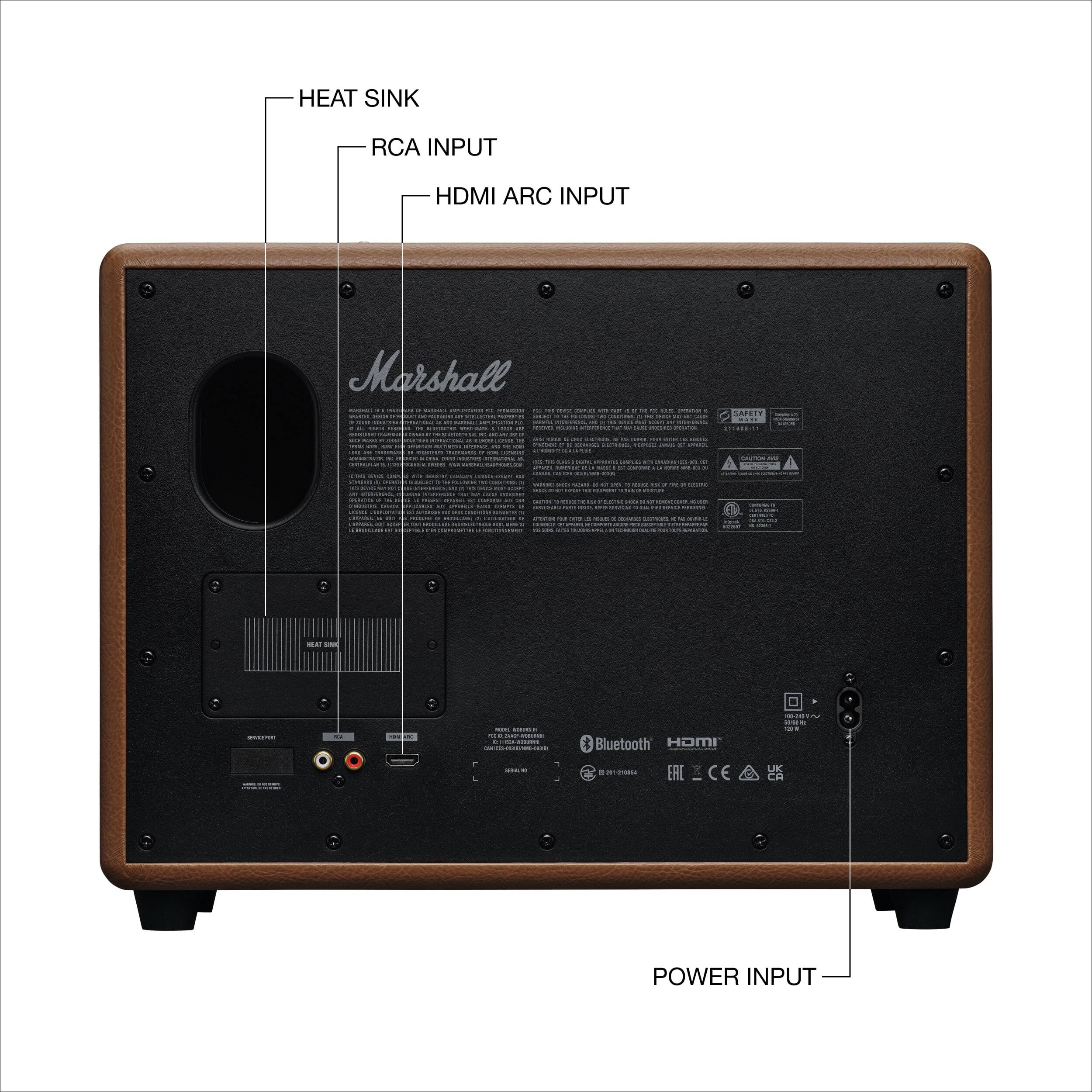
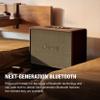
The Marshall Woburn III's connectivity story reveals Marshall's understanding of how people actually use speakers in 2025. While Bluetooth 5.2 handles the wireless duties with impressive stability and 10-meter range, the wired inputs tell the more interesting story.
The HDMI ARC (Audio Return Channel) input transforms this into a legitimate home theater component. ARC allows two-way communication between your TV and speaker, meaning the Woburn III can receive audio from your TV while also accepting volume and power commands from your TV remote. This creates a seamless experience where the speaker essentially becomes part of your television system.
Many users report this HDMI ARC integration feels more natural than traditional soundbars, partly because the Woburn III's broad dispersion pattern fills rooms more evenly than long, narrow soundbars designed for wall mounting. The dedicated Night Mode, activated through the Marshall app when connected via HDMI ARC, applies dynamic range compression to keep explosions from waking the household while ensuring dialogue remains clear.
The RCA inputs deserve mention for their audiophile appeal. These analog connections bypass digital processing entirely, allowing direct connection to turntables, CD players, or other high-quality sources. Researchers noted that vinyl enthusiasts particularly appreciate this pure analog signal path.
Marshall's implementation of Bluetooth 5.2 includes Over-the-Air update capability, meaning the speaker can receive new features and codec support through firmware updates. This forward-thinking approach addresses one of Bluetooth's historical limitations: obsolescence. Currently limited to SBC codec (the most universally compatible but not highest quality Bluetooth audio format), the speaker could potentially support advanced codecs like LC3 as they become standard.
The multipoint connectivity proves surprisingly useful in daily life. You can maintain connections to both your phone and laptop simultaneously, seamlessly switching sources without the usual Bluetooth pairing dance. This seemingly simple feature eliminates one of wireless audio's most persistent annoyances.
The sonic character of the Marshall Woburn III reflects its guitar amplifier heritage with a slightly V-shaped frequency response—enhanced bass and treble with natural midrange. However, unlike many consumer speakers that use heavy-handed EQ curves, Marshall's approach feels musical rather than gimmicky.
Bass response deserves particular attention. That 6-inch woofer in the bass-reflex cabinet generates genuinely impressive low-frequency output, reaching down to 35Hz with authority. This isn't the one-note boom of typical Bluetooth speakers but rather controlled, textured bass that reveals the difference between various instruments in the low end. Electronic music sounds appropriately thunderous, while acoustic bass maintains its woody character.
The 150-watt total power output (distributed across all five drivers) enables the speaker to reach 100.5 dB at one meter—loud enough to fill large rooms without strain. More importantly, researchers noted minimal distortion even at high volumes, suggesting conservative power ratings and robust driver design.
The Marshall Bluetooth app provides essential customization without overwhelming complexity. The Placement Compensation feature analyzes room acoustics and adjusts output accordingly—particularly valuable given how dramatically speaker placement affects sound quality. Wall placement emphasizes bass, while corner placement can create boomy resonances that the app's compensation algorithms address.
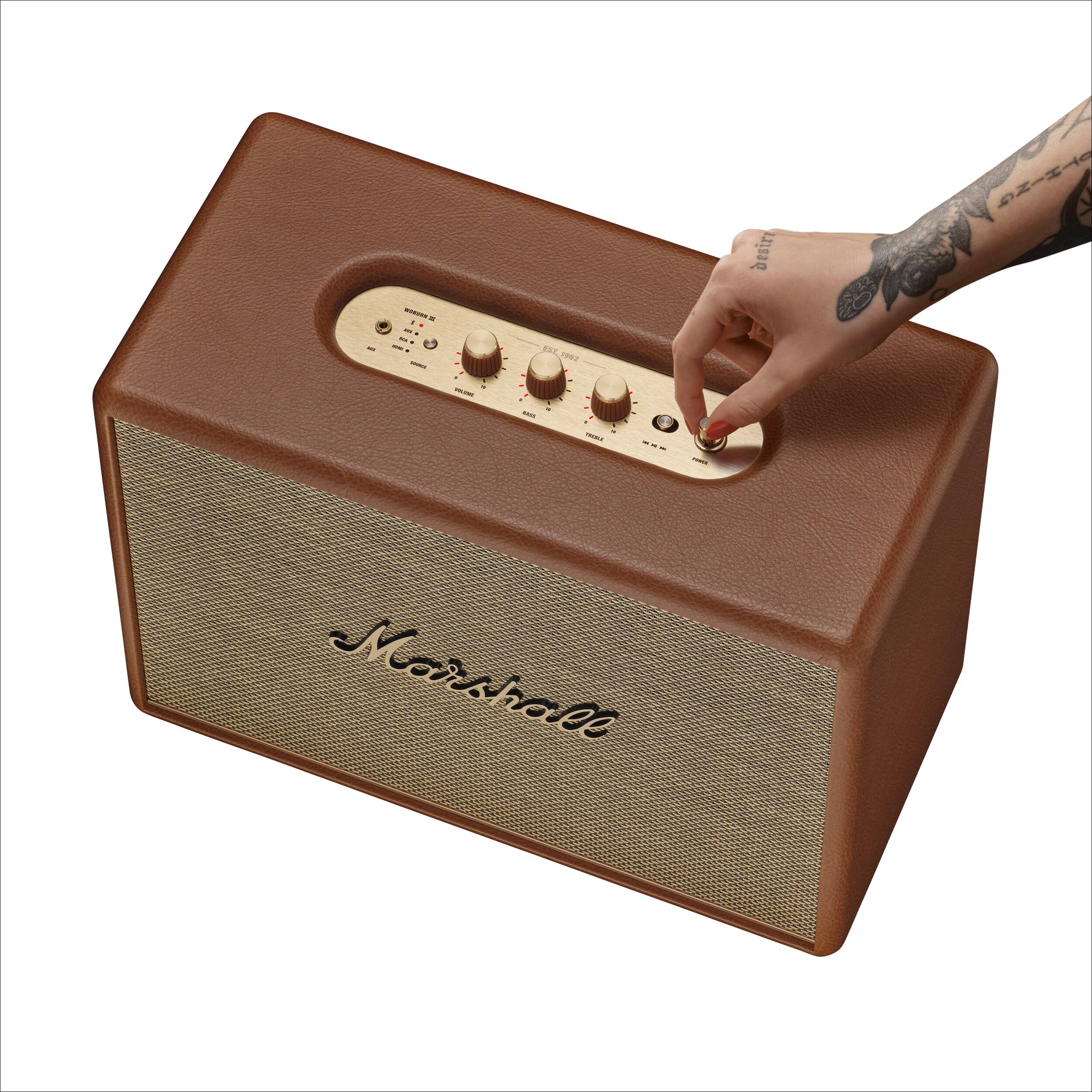
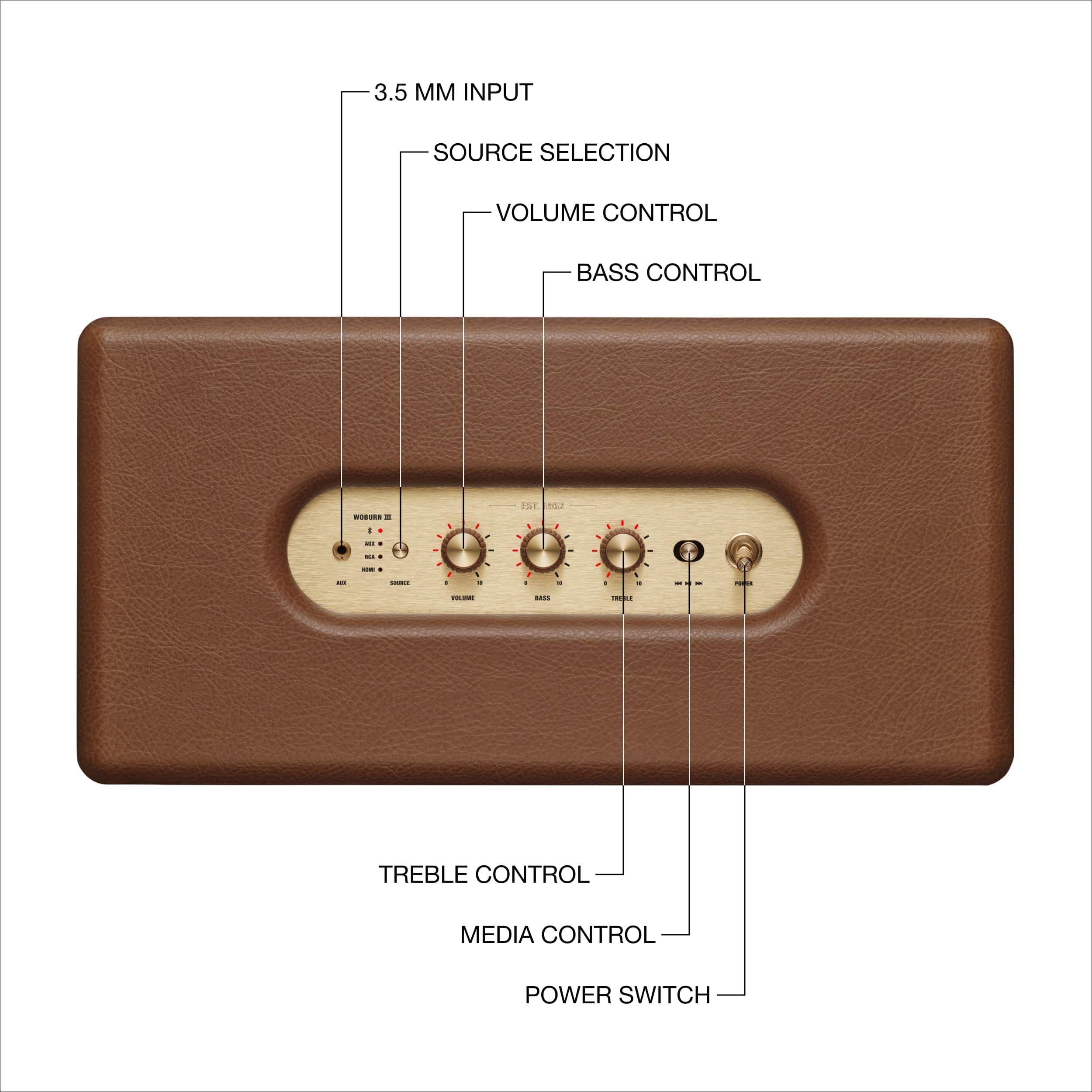
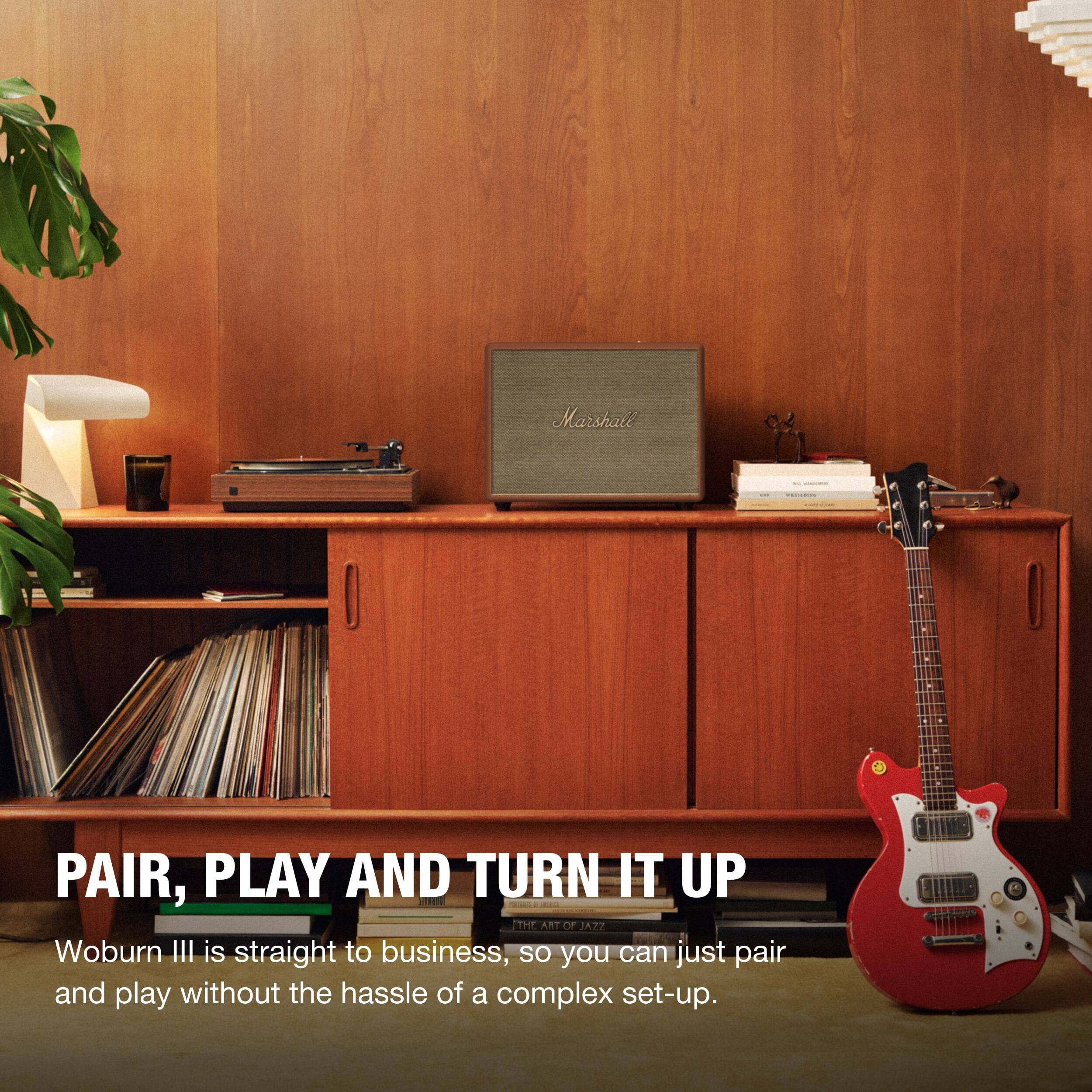
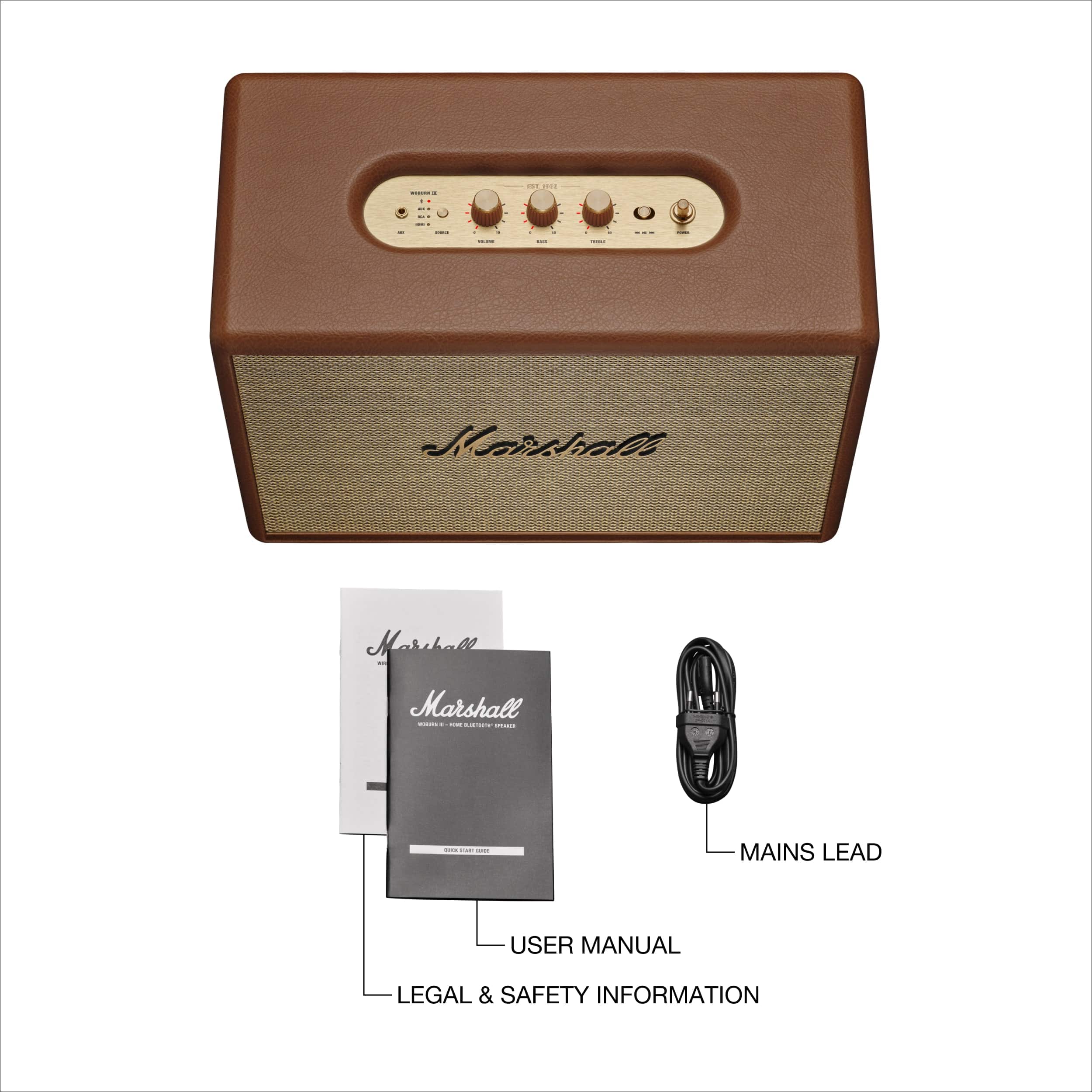
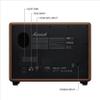
However, Marshall's commitment to physical controls sets the Woburn III apart in an increasingly app-dependent market. The top-panel bass and treble knobs provide immediate tactile adjustment without smartphone dependency. The volume knob's substantial feel and the satisfying click of the source button remind you that this is serious audio equipment, not a disposable gadget.
At the time of writing, the Marshall Woburn III competes in the premium home speaker segment where buyers prioritize sound quality over smart features. Compared to similarly powerful offerings from established audio brands, Marshall's pricing appears competitive when considering the three-way driver system, comprehensive connectivity, and build quality.
The value proposition becomes clearer when compared to equivalent home theater solutions. A comparable soundbar with similar power output and HDMI ARC support would likely cost significantly more, while sacrificing the music-focused tuning and stereo imaging that makes the Woburn III excel for both entertainment and critical listening.
The HDMI ARC integration makes the Woburn III a legitimate home theater component, particularly for smaller to medium-sized rooms. The broad soundstage and powerful dynamics handle movie soundtracks with impressive authority, while the wide dispersion pattern ensures consistent sound throughout the seating area.
Researchers noted that action movie scenes benefit from the controlled bass response and high SPL capability, while dialogue remains clear thanks to those dedicated midrange drivers. The Night Mode proves genuinely useful for late-night viewing, maintaining intelligibility while preventing the dynamic peaks that disturb sleeping family members.
The Marshall Woburn III succeeds by focusing intensely on what it does best: delivering exceptional sound quality in an iconic package. While it lacks the voice assistants, Wi-Fi streaming, and multi-room capabilities that define many competitors, it offers something increasingly rare—pure audio excellence without compromise.
This speaker makes the most sense for listeners who prioritize sound quality over smart features, value tactile controls over app dependency, and appreciate timeless design over fleeting tech trends. The three-way driver system, comprehensive connectivity, and future-proof Bluetooth implementation suggest this will remain relevant for years to come.
For home theater use, the HDMI ARC integration and powerful dynamics make it a compelling alternative to traditional soundbars, particularly for music lovers who want one speaker that excels at both entertainment and critical listening. At the time of writing, few competitors offer this combination of acoustic sophistication, build quality, and iconic design in a single package.
Yes, the Marshall Woburn III excels for home theater use thanks to its HDMI ARC input that connects directly to your TV. This allows the speaker to follow your TV's volume and power controls seamlessly. The powerful 150W output and wide soundstage create immersive movie audio, while the dedicated Night Mode compresses dynamic range for late-night viewing without disturbing others.
Yes, the Marshall Woburn III features Bluetooth 5.2 with multipoint connectivity, allowing you to connect two devices simultaneously. The Bluetooth has a 10-meter range and supports Over-the-Air updates for future feature additions. However, it only supports SBC codec, not higher-quality codecs like aptX or LDAC.
Absolutely. The Marshall Woburn III offers HDMI ARC connectivity for direct TV connection, plus RCA and 3.5mm auxiliary inputs. The HDMI ARC is the preferred method as it enables two-way communication with your TV, allowing seamless volume control and automatic power management.
The Marshall Woburn III delivers 150 watts total power through its three-way driver system: 90W for the 6-inch woofer, and 15W each for the dual midrange drivers and dual tweeters. It can reach 100.5 dB maximum sound pressure level, making it powerful enough to fill large rooms without distortion.
Yes, the Marshall Woburn III features impressive bass response extending down to 35Hz thanks to its 6-inch woofer in a bass-reflex cabinet design. The bass is controlled and textured rather than boomy, with adjustable bass controls on the top panel and through the Marshall app.
The Marshall Woburn III is worth it for users prioritizing sound quality over smart features. Its three-way driver system, HDMI ARC connectivity, and 150W power output deliver exceptional audio performance for both music and home theater use. However, it lacks voice assistants, Wi-Fi, and portability, making it best suited for dedicated home listening spaces.
The Marshall Woburn III is significantly larger and more powerful than the Stanmore III, featuring 150W vs 80W output and a three-way driver system with dedicated midrange drivers. The Woburn III also includes HDMI ARC for TV connection and delivers deeper bass response, making it better suited for large rooms and home theater use.
Yes, the Marshall Woburn III supports Bluetooth multipoint connectivity, allowing simultaneous connections to two devices. You can seamlessly switch between your phone and laptop without re-pairing. It also offers multiple wired inputs (HDMI ARC, RCA, 3.5mm) for connecting various sources simultaneously.
No, the Marshall Woburn III does not include built-in voice assistants like Alexa or Google Assistant. Marshall focused on audio performance and analog controls rather than smart features. You can still use voice assistants on connected devices, but the speaker itself doesn't have voice control capabilities.
The Marshall Woburn III measures 15.75 x 12.48 x 7.99 inches and weighs 16.42 pounds. This substantial size reflects its powerful internal components and driver array, but requires dedicated placement space. It's designed as a stationary home speaker rather than a portable option.
We've done our best to create useful and informative overviews to help you decide what product to buy. Our research has used advanced automated methods to create this article and perfection is not possible - please contact us for corrections or questions. These are the sites we've researched in the creation of this article: loudersound.com - ash-asia.zendesk.com - armorsound.com - rtings.com - crutchfield.com - rtings.com - stereoguide.com - bestbuy.com - hometechnologyreview.com - crutchfield.com - sweetwater.com - rtings.com - youtube.com - greentoe.com - versus.com - idownloadblog.com - marshall.com - youtube.com - comparisontabl.es - youtube.com - versus.com - crutchfield.com - device.report - consumerreports.org - sg.tcacoustic.asia - stereoindex.com - safemark.com - smarthomesounds.co.uk - marshall.com - device.report - bestbuy.com - marshall.com
| Marshall Woburn III Bluetooth Home Speaker |
|---|
| Driver Configuration - Critical for sound quality: 3-way system with 6" woofer, dual 2" midrange, dual 0.75" tweeters |
| Total Power Output - Determines maximum volume and dynamics: 150W (90W woofer + 60W mids/tweeters) |
| Frequency Range - Shows how deep the bass extends: 35–20,000 Hz |
| Maximum SPL - How loud it can get without distortion: 100.5 dB @ 1 meter |
| Bluetooth Version - Affects connection stability and future features: 5.2 with multipoint connectivity |
| HDMI ARC - Enables seamless TV integration: Yes, with Night Mode support |
| Dynamic Loudness - Maintains bass/treble at low volumes: Yes, automatic adjustment |
| Placement Compensation - Optimizes sound for room location: Yes, via Marshall app |
| Physical Controls - Immediate access without app dependency: Volume, bass, treble, source, playback controls |
| OTA Updates - Future-proofs the speaker: Yes, via Bluetooth |
| Wired Inputs: HDMI ARC, RCA, 3.5mm auxiliary |
| Dimensions: 15.75 x 12.48 x 7.99 inches |
| Weight: 16.42 lbs |
| Power: AC only (no battery) |
| Water Resistance: None |
The Samsung MX-ST50F takes a completely different approach as a portable entertainment hub that prioritizes versatility and party features over pure audio fidelity. Its standout capabilities include genuine portability with built-in wheels, telescoping handle, and an 18-hour battery, plus comprehensive entertainment features like customizable LED lighting that syncs to music, dual microphone inputs for karaoke, and DJ effects. The Samsung can output up to 240 watts when plugged in—higher than the Woburn III's 150 watts—and its omnidirectional design fills large spaces effectively for gatherings. It also offers impressive scalability through Auracast technology, allowing you to wirelessly connect up to 10 units for massive sound coverage at large events, plus IPX4 water resistance for poolside and outdoor use.
However, the Samsung MX-ST50F makes significant compromises in audio quality and consistency that become apparent in direct comparison. Its two-way driver system lacks the dedicated midrange drivers that give the Woburn III superior vocal clarity and instrument separation, making it less suitable for critical music listening or dialogue-heavy content. The Samsung's power output also drops dramatically to just 90 watts on battery power—40% less than the Woburn III's consistent performance—and it offers no wired connectivity options beyond USB, eliminating the HDMI ARC and home theater integration that makes the Marshall so versatile for TV use. While both speakers are similarly priced, they serve fundamentally different needs: the Samsung excels as a portable party speaker and entertainment system, while the Woburn III delivers superior sound quality and home integration for dedicated listening environments.
🤖 Read Detailed Comparison
👌Samsung MX-ST50F Sound Tower Party Speaker Details
💵 See Samsung MX-ST50F Sound Tower Party Speaker Price
The Samsung MX-ST40F takes a fundamentally different approach as a portable party speaker, offering genuine mobility with its 12-hour replaceable battery, IPX4 water resistance, and integrated handle. Where the Marshall excels in refined home audio, the Samsung prioritizes versatility and entertainment features, including customizable LED lighting that syncs to music, dual microphone inputs for karaoke, and DJ effects with built-in samplers. Its dual 5.25-inch woofers with waveguide tweeters deliver powerful, room-filling sound that matches the Marshall's output at 160 watts in AC mode, though it drops to 80 watts on battery power. The Samsung's three customizable bass modes—Deep, Punchy, and Gentle—provide more user control over the low-end character than the Marshall's fixed tuning, while Auracast technology enables wireless connection of up to ten speakers for massive sound coverage that the Marshall simply can't match.
From a value perspective, the Samsung MX-ST40F typically costs about $100 less while delivering comparable audio quality plus extensive additional functionality. Where the Marshall requires permanent placement and AC power, the Samsung can serve as your home stereo system, outdoor party speaker, karaoke machine, and expandable multi-room audio solution. However, it sacrifices the Marshall's seamless TV integration through HDMI ARC, sophisticated three-way driver separation, and the refined build quality that makes the Woburn III a piece of audio furniture. The Samsung excels for users who prioritize flexibility and social features over specialized home theater integration, making it the better choice for those who want one speaker to handle multiple scenarios rather than the Marshall's focused excellence in stationary home use.
🤖 Read Detailed Comparison
👌Samsung MX-ST40F Sound Tower Speaker Details
💵 See Samsung MX-ST40F Sound Tower Speaker Price
The Sony SRS-XV500 takes a fundamentally different approach as a portable party speaker, prioritizing versatility and social features over the Marshall's stationary audiophile focus. Its standout feature is the 25-hour battery life combined with IPX4 water resistance, making it genuinely portable for outdoor gatherings, beach trips, or poolside parties where the Marshall simply cannot go. The X-Balanced Speaker technology delivers impressive volume and bass impact optimized for dance music and party atmospheres, while built-in RGB lighting creates visual excitement that synchronizes with your music. The dual microphone inputs with echo and key controls transform it into a complete karaoke system, eliminating the need for separate equipment when entertaining guests.
While the Sony SRS-XV500 can't match the Marshall's refined three-way driver system or analytical sound quality, it offers compelling value through sheer versatility. At roughly half the price point, it delivers solid audio performance for parties and casual listening while adding features the Marshall lacks entirely—portability, weather resistance, and entertainment capabilities. The Party Connect technology allows networking up to 100 compatible Sony speakers for large events, and the quick-charge feature provides hours of playback from just 10 minutes of charging. For users who prioritize flexibility over ultimate sound quality, or who need a speaker that can serve both indoor and outdoor entertainment duties, the Sony represents exceptional practical value despite its compromises in pure audio fidelity compared to the Marshall's home-focused excellence.
🤖 Read Detailed Comparison
👌Sony SRS-XV500 Wireless Party Speaker Details
💵 See Sony SRS-XV500 Wireless Party Speaker Price
The Sony SRS-XV800 takes a fundamentally different approach as a portable entertainment powerhouse designed for mobility and social gatherings. Its standout features include a 25-hour rechargeable battery, IPX4 water resistance for outdoor use, and comprehensive entertainment capabilities with microphone/guitar inputs for karaoke and live performances. The speaker's innovative X-Balanced dual woofer design and five-tweeter omnidirectional array create powerful, room-filling sound that projects 360 degrees—perfect for outdoor parties where everyone needs to hear the music clearly regardless of where they're standing. The integrated LED lighting system and Party Connect technology, which can wirelessly link up to 100 compatible speakers, transforms any gathering into a full-scale entertainment experience.
In real-world performance, the Sony SRS-XV800 sacrifices some audiophile refinement for practical versatility at a significantly lower price point. While its 77W amplification can't match the Marshall's 150W power output or three-way driver precision, it delivers surprisingly impactful bass and energetic sound that excels in outdoor environments where the Marshall simply cannot go. The trade-offs become clear in direct comparison: the Sony prioritizes portability, weather resistance, and entertainment features over the Marshall's superior sound quality and premium home integration. For users who value mobility, party features, and outdoor capability over ultimate audio fidelity, the Sony SRS-XV800 offers compelling value with features the Marshall cannot match, making it the better choice for social entertainers and outdoor enthusiasts despite its compromises in pure sound quality.
🤖 Read Detailed Comparison
👌Sony SRS-XV800 X-Series Party Speaker Details
💵 See Sony SRS-XV800 X-Series Party Speaker Price
The JBL PartyBox Encore Essential 2 takes a fundamentally different approach, prioritizing portability and entertainment features over pure audio fidelity. Its standout capabilities include up to 15 hours of battery life, IPX4 splash-proof construction, and a dynamic RGB lightshow that syncs with your music—features that make it genuinely versatile for outdoor parties, beach trips, and social gatherings where the Marshall simply cannot go. The integrated microphone and guitar inputs with karaoke EQ transform it into a portable PA system, while Auracast technology allows linking multiple units for scalable sound coverage. At roughly one-third the price point, the JBL PartyBox Encore Essential 2 delivers impressive bass impact and 100W of power in a 13.67-pound package that you can actually carry to wherever the party happens.
However, the performance trade-offs are significant when compared directly to the Marshall's audiophile-grade engineering. The JBL PartyBox Encore Essential 2 uses a simpler two-way driver configuration that lacks the dedicated midrange drivers crucial for vocal clarity and instrument separation. While its AI Sound Boost technology helps maintain clarity at high volumes, it cannot match the Marshall's sophisticated three-way system and 150W of clean power for detailed music reproduction. The JBL excels at creating an energetic, fun atmosphere with its v-shaped sound signature and visual effects, but serious listeners will notice compressed dynamics and less refined bass control. For users who prioritize versatility, entertainment features, and mobility over critical listening quality, the JBL PartyBox Encore Essential 2 offers compelling value—just don't expect it to replace a dedicated home audio system for nuanced music appreciation.
🤖 Read Detailed Comparison
👌JBL PartyBox Encore Essential 2 Portable Speaker JBLPBENCOREES2AM Details
💵 See JBL PartyBox Encore Essential 2 Portable Speaker JBLPBENCOREES2AM Price
The Marshall Bromley 750 represents a completely different approach to wireless audio, prioritizing raw power and versatility over the Woburn III's refined home audio focus. With 500 watts of amplification distributed across eight Class D amplifiers and a 360-degree True Stereophonic sound system, it delivers more than three times the power output while extending frequency response slightly deeper to 30Hz. The removable 40+ hour battery system transforms it into a true portable powerhouse capable of handling weekend-long events, outdoor gatherings, and professional applications that the AC-powered Woburn III simply cannot address. Professional XLR/quarter-inch combo inputs with built-in effects processing essentially turn it into a portable PA system, supporting microphones, instruments, and DJ equipment with onboard reverb and delay effects.
While the Bromley 750 commands roughly double the price of the Woburn III at launch, it justifies this premium through its unique combination of portability, weather resistance (IP54 rating), and professional connectivity that opens entirely different use cases. The ability to daisy-chain multiple units, the power bank functionality, and the replaceable battery system provide long-term value that extends well beyond typical party speakers. However, for pure home listening, the Woburn III's focused approach delivers superior stereo imaging, home theater integration via HDMI ARC, and more appropriate power levels for indoor environments. The Bromley 750's 360-degree dispersion sacrifices some stereo precision for crowd coverage, making it less ideal for critical listening despite its impressive technical capabilities. Choose the Bromley 750 only if you need its specific portability and professional features, as the Woburn III remains the better value for dedicated home audio applications.
🤖 Read Detailed Comparison
👌Marshall Bromley 750 Party Speaker Details
💵 See Marshall Bromley 750 Party Speaker Price
The Sony ULT TOWER 9 takes a fundamentally different approach as a portable party powerhouse that prioritizes raw impact over refined audio reproduction. Its massive 12.6-inch X-Balanced woofer and 360° sound dispersion system deliver significantly more volume and bass punch than the Marshall, easily filling outdoor spaces and large venues that would challenge the Woburn III. The standout feature is its built-in 25-hour battery that transforms it from a stationary speaker into a truly portable entertainment system, complete with wheels for transport despite its 65-pound weight. Add in dual microphone inputs for karaoke, synchronized party lighting effects, and the ability to link up to 100 speakers via Party Connect, and the Sony ULT TOWER 9 becomes an all-in-one entertainment solution rather than just a speaker.
However, this versatility comes with trade-offs in pure audio quality and a significantly higher price point. While the Sony ULT TOWER 9 excels at creating excitement with its ULT bass modes and room-shaking output, it can't match the Marshall's balanced sound signature, midrange clarity, or sophisticated features like Dynamic Loudness and HDMI ARC integration. The choice ultimately depends on your priorities: the Marshall Woburn III offers superior value for dedicated home listening and TV enhancement, while the Sony ULT TOWER 9 justifies its premium cost if you regularly host parties, need portable operation, or want karaoke capabilities built in. For most home users focused on music quality and seamless entertainment integration, the Marshall represents the better investment.
🤖 Read Detailed Comparison
👌Sony ULT TOWER 9 Wireless Party Speaker Details
💵 See Sony ULT TOWER 9 Wireless Party Speaker Price
The JBL PartyBox 520 takes a fundamentally different approach, prioritizing maximum volume and event versatility over the Marshall's refined home audio focus. With 400W RMS output and dual 7.5-inch woofers, it can easily fill outdoor spaces and entertain crowds up to 75 people—far exceeding what the Marshall can achieve. The PartyBox's standout features include genuine portability with a 15-hour replaceable battery, IPX4 weather resistance for outdoor use, and professional XLR/quarter-inch inputs that transform it into a legitimate PA system. The integrated LED light show and AI Sound Boost technology further emphasize its party-centric design philosophy.
However, this power and versatility come at the cost of sound refinement and home integration. While the JBL PartyBox 520 excels at bass impact and maximum output, it lacks the Marshall's three-way driver precision, stereo imaging, and tonal balance that make music sound natural at moderate volumes. The PartyBox also commands a significantly higher price and weighs 56 pounds compared to the Marshall's 16 pounds, making it impractical for typical living room use. If you regularly host large outdoor events or need professional PA capabilities, the JBL's additional features justify the extra cost and bulk. But for dedicated home listening, TV integration, and everyday music enjoyment, the Marshall's focused approach delivers better sound quality and value in a package designed for your living space rather than the dance floor.
🤖 Read Detailed Comparison
👌JBL PartyBox 520 Speaker Details
💵 See JBL PartyBox 520 Speaker Price
The Sony ULT Tower 9AC takes a completely different approach to home audio, prioritizing entertainment features and maximum volume output over the Marshall's refined sound quality. Its standout feature is the massive 320mm square woofer that generates significantly more bass impact than the Marshall's 6-inch driver, though this comes with the trade-off of potentially overwhelming indoor spaces without careful EQ adjustment. The Sony's seven-driver configuration with 360-degree sound dispersion creates an immersive party atmosphere, while features like dual microphone/guitar inputs, karaoke capabilities with pitch control, and synchronized party lighting transform it into a complete entertainment system rather than just a speaker. At higher volumes, the Sony ULT Tower 9AC clearly outperforms the Marshall for large gatherings and outdoor events where maximum impact matters more than audio refinement.
However, this entertainment-focused design comes with significant compromises for everyday listening. The Sony's bass-heavy tuning requires extensive use of the 10-band equalizer to achieve balanced sound for regular music playback, making it less plug-and-play than the Marshall's consistently refined output. Its substantial size and 63-pound weight make it impractical for most living rooms, despite including transport wheels, and the lack of HDMI ARC means less seamless TV integration compared to the Marshall's home theater capabilities. While the Sony ULT Tower 9AC costs more and delivers impressive entertainment value for users who genuinely need party features and maximum volume, it ultimately serves a different audience than those seeking the Marshall's balanced approach to premium home audio.
🤖 Read Detailed Comparison
👌Sony ULT Tower 9AC Party Speaker Details
💵 See Sony ULT Tower 9AC Party Speaker Price
The Sony ULT Tower 10 takes a dramatically different approach to premium audio, prioritizing maximum impact and social entertainment over the Marshall's refined home listening focus. Standing over three and a half feet tall with a massive X-Balanced woofer and 360-degree sound dispersion, Sony's party speaker delivers up to 110 dB of output—roughly twice as loud as the Marshall's 100.5 dB capability. This raw power advantage becomes crucial for large gatherings, outdoor events, or spacious rooms where the Marshall would struggle to maintain its composure. The Sony's ULT bass modes offer real-time sound customization that the Marshall can't match, letting you switch between deep rumbling bass (ULT 1) for electronic music or punchy upper bass (ULT 2) for rock and pop with the press of a button.
Where the Marshall excels at critical listening and home theater integration, the Sony ULT Tower 10 dominates social scenarios with features the Marshall simply doesn't offer. The integrated 360-degree LED lighting system, included wireless microphone for karaoke, and Party Connect capability to link up to 100 speakers create an entertainment ecosystem that transforms any space into a party venue. While significantly more expensive and physically imposing at nearly 65 pounds, the Sony justifies its premium through comprehensive party features that would otherwise require separate equipment purchases. However, this party-focused tuning comes at the cost of the Marshall's superior audio fidelity and home integration—the Sony serves crowds brilliantly but can't match the Marshall's nuanced performance for intimate listening sessions or seamless TV audio enhancement.
🤖 Read Detailed Comparison
👌Sony ULT Tower 10 Party Speaker Details
💵 See Sony ULT Tower 10 Party Speaker Price
The SOUNDBOKS 4 takes a completely different approach as a portable party speaker, delivering significantly more raw power with 126 dB maximum output compared to the Woburn III's 100.5 dB—loud enough to fill outdoor spaces and large venues where the Marshall would struggle. Its dual 10-inch woofers and removable LiFePO4 battery system provide up to 40 hours of runtime at moderate volumes, making it genuinely portable for beach parties, camping trips, or any situation where wall power isn't available. The speaker's IP65 weather resistance and shock-absorbing construction mean it can handle poolside splashing and outdoor conditions that would damage the Marshall, while professional XLR inputs allow direct connection of microphones and instruments for live performances or events.
However, this portable powerhouse comes at a significant price premium and represents a fundamentally different value proposition. While the SOUNDBOKS 4 excels at maximum volume and portability, it lacks the Woburn III's refined three-way driver system, HDMI ARC integration, and sophisticated home theater features like Night Mode. The Marshall's approach prioritizes sound quality, stereo imaging, and seamless home integration over sheer decibel output. For users who primarily listen indoors and value the convenience of always-ready AC power, TV connectivity, and audiophile-focused tuning, the Woburn III delivers superior real-world benefits despite its lower maximum volume. The choice ultimately comes down to whether you need a refined home centerpiece or a portable powerhouse for outdoor entertainment.
🤖 Read Detailed Comparison
👌SOUNDBOKS 4 Portable Bluetooth Speaker Model 11-SB4_B Details
💵 See SOUNDBOKS 4 Portable Bluetooth Speaker Model 11-SB4_B Price
The Sony SRS-XP700 takes a fundamentally different approach as a portable party speaker, prioritizing entertainment features and mobility over the Marshall's audiophile refinement. Its standout advantage is genuine portability with up to 25 hours of battery life, IPX4 water resistance for outdoor use, and integrated handles that make it suitable for beach parties, backyard gatherings, and events where the Marshall's AC-only power requirement would be limiting. The Sony also includes practical entertainment features like microphone and guitar inputs for karaoke or live performances, RGB lighting that syncs with music, and the ability to connect two Bluetooth devices simultaneously for seamless source switching during parties.
However, the performance trade-offs are significant when comparing these speakers directly. While the Sony SRS-XP700 can certainly get loud, it suffers from compressed audio at high volumes and a bass-heavy sound signature that lacks the Marshall's clarity and separation. Professional reviews consistently note that the Sony's overemphasized midrange makes vocals sound harsh, while its limited treble extension dulls the sparkle in acoustic instruments—issues that become apparent when playing the same tracks back-to-back. The Sony represents better value if you need a single speaker that can handle both indoor and outdoor entertainment scenarios, but for dedicated home listening and TV integration, the Marshall's superior driver configuration, HDMI ARC connectivity, and refined sound signature justify its focus on stationary use. Essentially, you're choosing between the Sony's lifestyle flexibility and the Marshall's uncompromising audio quality.
🤖 Read Detailed Comparison
👌Sony SRS-XP700 Wireless Party Speaker Details
💵 See Sony SRS-XP700 Wireless Party Speaker Price
The Soundboks Go takes a completely different approach, prioritizing raw power and portability over refined sound quality. With its massive 121 dB output capability and rugged IP65-rated construction, it's designed for outdoor events where the Marshall Woburn III simply can't venture. The standout TeamUP networking feature allows you to connect up to five speakers using ultra-low-latency SKAA technology, creating a scalable sound system that can cover large outdoor spaces or provide true stereo separation by placing units strategically around an area. The swappable 40-hour battery system means you're never tethered to power outlets, and spare batteries can extend playtime indefinitely for multi-day events or camping trips.
While the Soundboks Go can't match the Marshall's audiophile-grade sound quality or home theater integration, it excels in scenarios where the Woburn III is completely impractical. The mono speaker design and V-shaped sound signature prioritize cutting through ambient noise and delivering excitement over nuanced reproduction, making it perfect for poolside parties, beach gatherings, or any situation where maximum impact matters more than critical listening. At similar pricing to the Marshall, you're choosing between sophisticated home audio excellence and uncompromising portable power—two fundamentally different value propositions that serve entirely different lifestyles and use cases.
🤖 Read Detailed Comparison
👌Soundboks Go Portable Bluetooth Speaker 11-SBGO_B Details
💵 See Soundboks Go Portable Bluetooth Speaker 11-SBGO_B Price
The Sony ULT Field 7 takes a completely different approach as a portable powerhouse designed for on-the-go entertainment. Its standout feature is genuine portability with 30-hour battery life, IP67 waterproofing, and integrated carry handles that let you take high-quality sound anywhere from beach parties to camping trips. The speaker's ULT Power Sound technology delivers visceral bass impact that transforms music into a physical experience, particularly excelling with electronic dance music and hip-hop where the low-end drives the energy. Additional entertainment features like RGB lighting that pulses with your music, dedicated microphone input for karaoke, and multi-device Bluetooth pairing make it a true party centerpiece that adapts to social gatherings in ways the stationary Marshall simply cannot.
While the Sony ULT Field 7 typically costs less than the Marshall, it represents a fundamentally different value proposition focused on versatility over audiophile-grade fidelity. The Sony's bass-heavy sound signature prioritizes impact and excitement over the Marshall's balanced, reference-quality reproduction, making it better suited for energetic music genres but less ideal for critical listening or dialogue-heavy content like movies and podcasts. The trade-offs are clear: you gain true portability, weather resistance, and entertainment features, but sacrifice the Marshall's superior soundstage width, three-way driver clarity, and sophisticated home theater integration. For users who primarily listen at home and value audio accuracy, the Marshall remains the better choice, but for those whose lifestyle demands a speaker that goes where the party is, the Sony's combination of portability, durability, and crowd-pleasing sound makes it the more practical option.
🤖 Read Detailed Comparison
👌Sony ULT FIELD 7 Portable Speaker Details
💵 See Sony ULT FIELD 7 Portable Speaker Price
The Tivoli Audio SongBook MAX takes a radically different approach to premium audio, prioritizing versatility and mobility over the Woburn III's stationary power. With its 10-hour battery life, IPX4 splash resistance, and built-in carry handle, the Tivoli delivers exceptional sound quality that travels with you—from indoor listening sessions to outdoor gatherings where the Marshall simply cannot go. The SongBook MAX's built-in preamp and ¼-inch input make it uniquely valuable for musicians and vinyl enthusiasts, allowing direct connection to turntables, guitars, or keyboards without additional equipment. Its physical EQ sliders provide immediate tactile control that many users prefer over app-based adjustments, while the included FM radio adds functionality that's completely absent from the Marshall. Despite producing only 50W compared to the Woburn III's 150W, the Tivoli can still reach similar maximum volume levels and maintains impressive clarity throughout its range.
Where the SongBook MAX particularly shines is in its balanced three-way sound signature and exceptional vocal reproduction. Multiple reviews consistently praise its midrange clarity and ability to reveal vocal details that get lost in more bass-heavy speakers like the Marshall. The Tivoli's vintage-inspired design and analog controls create a more tactile, engaging user experience that appeals to those who want to actively interact with their audio equipment rather than relying on automatic optimizations. While it cannot match the Woburn III's room-filling power or sophisticated home theater integration, the SongBook MAX offers unique value through its combination of portability, analog character, and instrument-ready connectivity that simply isn't available in any other speaker at its performance level. For users who want great sound everywhere they go or need a speaker that doubles as a small PA system for musicians, the Tivoli provides capabilities that the stationary Marshall cannot replicate.
🤖 Read Detailed Comparison
👌Tivoli Audio SongBook MAX Bluetooth Speaker Details
💵 See Tivoli Audio SongBook MAX Bluetooth Speaker Price
The Sony SRS-XV900 represents a completely different philosophy as a portable entertainment powerhouse designed for parties and events. Its massive 12.6-inch X-Balanced woofer delivers bass extension down to 20Hz—deeper than the Marshall can reach—while its omnidirectional design with six strategically placed tweeters ensures everyone at a gathering gets consistent sound quality regardless of where they're standing. The 25-hour battery life eliminates venue constraints, and features like dedicated microphone and guitar inputs, lighting effects, and party apps transform it into a complete entertainment system rather than just a speaker. Its ability to link up to 100 compatible speakers makes it scalable for large events in ways the Marshall simply cannot match.
Where the Marshall excels in refined home listening, the Sony SRS-XV900 dominates in versatility and social situations. Its wheels and handle make it genuinely portable despite weighing 58 pounds, while LDAC Bluetooth codec support ensures high-quality wireless audio that surpasses standard Bluetooth transmission. The Sony commands a premium price, but for users who host gatherings, need outdoor audio capabilities, or want karaoke functionality, it delivers unique value that no stationary speaker can provide. While the Marshall creates a superior critical listening experience in controlled environments, the Sony SRS-XV900 adapts to real-world social scenarios where convenience, portability, and crowd-pleasing features matter more than audiophile-grade stereo imaging. It's the difference between a precision instrument and a Swiss Army knife—both excel in their intended roles.
🤖 Read Detailed Comparison
👌Sony SRS-XV900 Portable Bluetooth Speaker Details
💵 See Sony SRS-XV900 Portable Bluetooth Speaker Price
The JBL PartyBox 710 represents a completely different philosophy in large speaker design, prioritizing maximum impact and entertainment value over refined home listening. With 800W of raw power driving dual 8-inch woofers, it delivers the kind of bass presence and volume output that can fill large outdoor spaces—something the Woburn III simply cannot match despite its superior sound quality. The PartyBox's standout features include customizable RGB light shows synchronized to music, dedicated karaoke functionality with microphone inputs and vocal EQ controls, and IPX4 splashproof protection for outdoor events. These party-focused features, combined with True Wireless Stereo pairing capability and USB playback, create an entertainment system rather than just a speaker.
For buyers considering both options, the JBL PartyBox 710 commands a higher price but serves entirely different needs than the Woburn III. If you regularly host large gatherings, need weather-resistant outdoor audio, or want features like karaoke and visual effects, the PartyBox offers capabilities the Marshall cannot provide regardless of price. However, the trade-offs are significant: the JBL weighs nearly four times more at 61 pounds, lacks the refined three-way stereo sound reproduction, offers no HDMI connectivity for TV integration, and produces a bass-heavy sound signature that prioritizes impact over accuracy. The PartyBox excels as an event speaker where maximum volume and entertainment features justify its cost, while the Woburn III delivers better value for daily home listening, TV enhancement, and situations where sound quality matters more than sheer power and party features.
🤖 Read Detailed Comparison
👌JBL PartyBox 710 Portable Party Speaker Details
💵 See JBL PartyBox 710 Portable Party Speaker Price
The JBL EON ONE Compact represents a completely different philosophy as a battery-powered portable PA system designed for live events and professional applications. Its standout feature is the integrated 4-channel digital mixer with XLR inputs, phantom power for condenser microphones, and professional effects processing including Lexicon reverb, delay, and chorus - essentially combining what would normally require separate mixer, amplifier, and speaker components into one portable unit. The 12-hour swappable battery and 112 dB maximum output make it genuinely suitable for outdoor events, live performances, and presentations where the Marshall's AC power requirement and lower volume ceiling would be limiting factors. The JBL's larger 8-inch woofer delivers more visceral bass impact designed to cut through ambient noise and energize crowds, while features like one-touch ducking automatically lower background music when someone speaks into the microphone.
While the JBL EON ONE Compact can certainly function as a home speaker, it makes significant compromises in audio refinement compared to the Marshall's three-way design and home-focused features. The JBL's two-way driver configuration prioritizes maximum impact and portability over the detailed instrument separation and balanced frequency response that make the Marshall superior for critical music listening. However, the JBL offers unmatched versatility - it's equally at home powering a backyard party, supporting a corporate presentation, or serving as a practice amp for musicians, capabilities the Marshall simply cannot provide. For users who need genuine portability, professional mixing capabilities, or the flexibility to handle both home listening and live events with a single speaker, the JBL EON ONE Compact delivers exceptional value despite being primarily optimized for PA applications rather than audiophile home listening.
🤖 Read Detailed Comparison
👌JBL EON ONE Compact Portable PA Speaker Details
💵 See JBL EON ONE Compact Portable PA Speaker Price
The JBL PartyBox 110 represents a completely different philosophy as a portable entertainment hub, prioritizing versatility and interactive features over pure audiophile performance. Its standout capabilities include 12 hours of battery life, IPX4 splashproof rating, and synchronized RGB lighting that creates an immersive audiovisual experience impossible with stationary speakers. The PartyBox includes dedicated microphone and guitar inputs with independent controls, transforming it into a complete PA system for karaoke nights and small performances. True Wireless Stereo pairing allows two units to create a wireless stereo setup, while the USB port charges devices and plays music files directly—practical features that extend its utility far beyond basic music playback.
However, the JBL PartyBox 110's party-optimized design makes significant audio compromises compared to the Woburn III's refined engineering. Its 2-way driver configuration lacks dedicated midrange drivers, resulting in less precise instrument separation and vocal clarity, while its higher frequency response limit (45 Hz versus 35 Hz) means less deep bass extension for genres that demand sub-bass presence. The PartyBox's party-tuned sound signature with emphasized bass and bright treble, while exciting for social gatherings, can become fatiguing during critical listening sessions. At roughly 40% lower cost, the JBL PartyBox 110 delivers exceptional value for users prioritizing portable entertainment and interactive features, but serious music enthusiasts and home theater users will find the Woburn III's superior audio engineering and seamless TV integration worth the premium investment.
🤖 Read Detailed Comparison
👌JBL PartyBox 110 Portable Party Speaker Details
💵 See JBL PartyBox 110 Portable Party Speaker Price
The JBL PartyBox Encore Essential represents a completely different philosophy as a portable entertainment speaker that prioritizes versatility and social features over pure audio fidelity. Its standout capabilities include 6-hour battery operation with a convenient grab-and-go handle, IPX4 splashproof rating for poolside and beach use, synchronized RGB light shows that pulse to your music's beat, and a dedicated microphone input with karaoke optimization—features that transform any gathering into an interactive event. The True Wireless Stereo pairing lets you connect two units for expanded coverage at larger parties, while USB playback supports direct file access without needing a phone connection. At roughly 13 pounds, it's genuinely portable and designed for users who move between dorm rooms, friend's houses, outdoor events, and anywhere else music brings people together.
While the JBL PartyBox Encore Essential can't match the Marshall's audiophile credentials, it delivers impressive performance for its intended use with punchy bass from its 5.25-inch woofer and party-optimized tuning that makes EDM, hip-hop, and pop sound energetic and engaging. The 100W RMS output reaches about 97.5dB maximum volume—loud enough for outdoor gatherings where ambient noise is higher—and maintains decent clarity despite some compression at peak levels. Most importantly, it offers exceptional value by combining multiple use cases into one purchase: home listening, outdoor entertainment, karaoke machine, and light show all for significantly less than the Marshall's premium pricing. For college students, renters, or anyone who prioritizes flexibility over ultimate sound quality, the PartyBox delivers more practical utility despite sacrificing the refined audio reproduction and seamless home integration that makes the Marshall excel in dedicated listening environments.
🤖 Read Detailed Comparison
👌JBL PartyBox Encore Essential Speaker Details
💵 See JBL PartyBox Encore Essential Speaker Price
The Philips TAX5206 represents a completely different philosophy, prioritizing versatility and entertainment features over pure audio fidelity. Its standout advantage is genuine portability with a 14-hour battery, trolley design with wheels, and the ability to function anywhere without power outlets—making it ideal for outdoor parties, beach trips, and camping adventures where the Woburn III simply cannot go. The dedicated karaoke system with microphone and guitar inputs, voice effects, echo control, and synchronized party lighting creates an interactive entertainment experience that transforms any gathering into a proper party. At roughly half the price, it delivers impressive value by combining decent audio quality with features the Marshall completely lacks, including USB playback, power bank functionality, and the flexibility to move between indoor and outdoor use.
However, the Philips TAX5206 cannot match the Woburn III's acoustic sophistication or home integration capabilities. Its 2-way driver system and party-oriented tuning emphasize bass impact over clarity, resulting in less refined sound reproduction and narrower frequency response compared to the Marshall's 3-way configuration. The lack of HDMI ARC connectivity, placement compensation, or advanced app features means it falls short for serious home theater use or critical music listening. While the TAX5206 excels as a versatile entertainment speaker that can handle multiple scenarios and locations, it represents a compromise in pure audio quality that becomes apparent when directly compared to the Marshall's premium acoustic engineering and stationary home audio focus.
🤖 Read Detailed Comparison
👌Philips TAX5206 Bluetooth Party Speaker Details
💵 See Philips TAX5206 Bluetooth Party Speaker Price
The Rockville Rock Party 9 serves a completely different market as a portable entertainment powerhouse, excelling in scenarios where the Woburn III simply cannot compete. Its rechargeable battery provides 6-8 hours of wireless operation, making it ideal for outdoor parties, camping trips, beach gatherings, and any situation where AC power isn't available. The dual microphone inputs with auto-tune, voice-changing effects, and echo controls transform it into a complete karaoke system, while the dedicated guitar input enables live performances - features that turn any gathering into an interactive entertainment experience. Add customizable LED light shows that sync to music beats, and you have a speaker that doesn't just play music but creates atmosphere and engagement that the Marshall's purely audio-focused approach cannot match.
While the Rockville Rock Party 9 sacrifices some audio refinement for versatility, it delivers impressive value by combining multiple entertainment functions into one portable package. Its 1000W peak power output and dual 8" woofers provide room-filling sound that, while not as nuanced as the Woburn III's three-way system, excels at energizing crowds and projecting audio across large outdoor spaces. The comprehensive connectivity options including USB storage support, TF card slots, and multiple input types offer flexibility that audiophile speakers rarely provide. For users who need a speaker that adapts to various scenarios - from quiet background listening to full-volume party hosting to mobile karaoke setups - the Rock Party 9's all-in-one approach and significantly lower price point make it the practical choice, even if it can't match the Marshall's sophisticated sound reproduction and premium build quality.
🤖 Read Detailed Comparison
👌Rockville Rock Party 9 Portable Bluetooth Speaker Details
💵 See Rockville Rock Party 9 Portable Bluetooth Speaker Price
Original price was: $499.99.$369.99Current price is: $369.99.
Original price was: $579.99.$318.99Current price is: $318.99.


Privacy Policy
Terms and Conditions - Affiliate Policy
Home Security
© Copyright 2008-2026.
11816 Inwood Rd #1211, Dallas, TX 75244