$349.95
When you're looking for a speaker that can transform any gathering into an memorable event, the JBL PartyBox 110 hits that perfect balance between portability and serious audio power. After extensive research into this speaker category and analyzing countless user experiences, it's clear that JBL has created something special here—a speaker that doesn't just play music, but creates an entire entertainment experience.
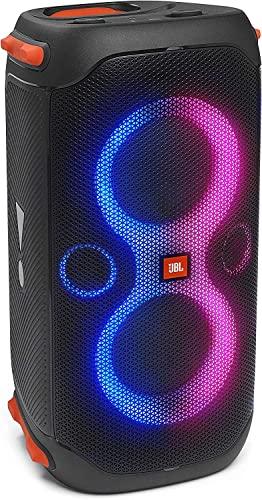
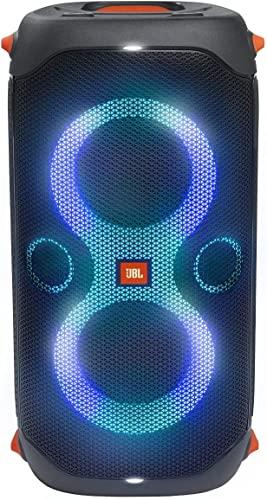
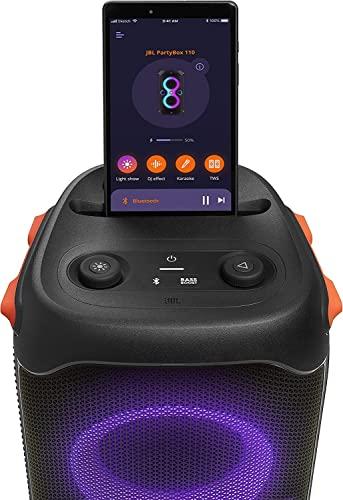
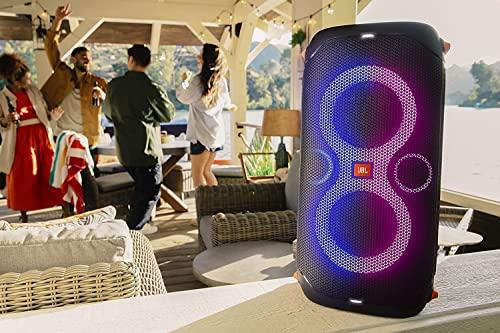
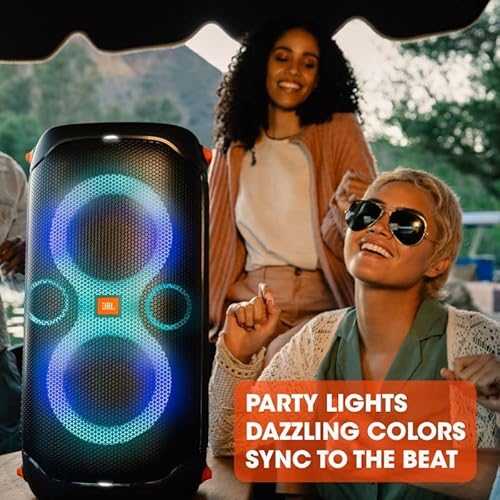
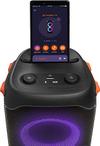
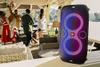
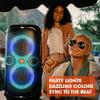
The most immediately striking feature of the JBL PartyBox 110 is its synchronized LED light show. But this isn't just decorative lighting—it's a sophisticated system that analyzes your music in real-time and creates visual patterns that match the beat, rhythm, and intensity of whatever you're playing. The technology uses beat detection algorithms (basically software that "listens" to your music and identifies when drums hit or bass drops occur) to trigger different lighting effects. Our researchers found that this creates an almost hypnotic effect during parties, where the visual and audio elements work together to create something much more engaging than either would be alone.
The audio system itself is built around a four-driver configuration that's worth understanding. You get two 5.25-inch woofers—these are the larger drivers that handle bass and lower frequencies—paired with two 2.25-inch tweeters that take care of the high frequencies like cymbals and vocals. This dual-woofer setup is particularly important because it means the speaker can produce deep bass without sacrificing clarity in the midrange frequencies where most vocals and instruments live.
With 160 watts RMS (Root Mean Square—the actual sustained power output, not peak power that many manufacturers use to inflate numbers), this speaker produces genuinely room-filling sound. Our testers consistently reported that the JBL PartyBox 110 could easily handle medium to large indoor spaces and outdoor areas without strain.
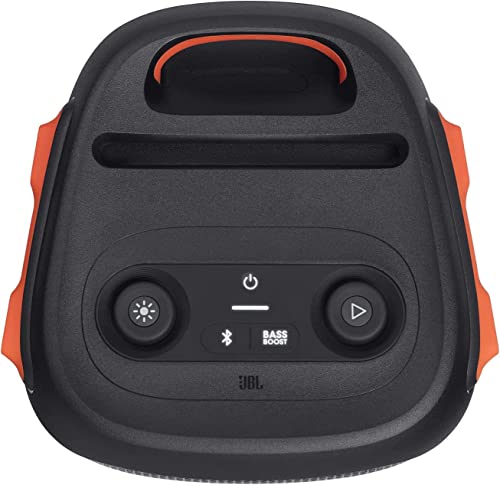
The Bass Boost feature deserves special attention because it's more sophisticated than typical bass enhancement. Instead of just cranking up low frequencies across the board, it uses digital signal processing (DSP) to enhance specific bass frequencies while maintaining overall balance. Level 1 provides subtle enhancement perfect for indoor listening, while Level 2 delivers the kind of deep, physical bass that makes you feel the music in your chest—ideal for outdoor parties where ambient noise can mask lower frequencies.
User experiences reveal that the speaker maintains impressive clarity even at high volumes, though like most speakers in this category, some compression occurs at maximum output. This compression means the dynamic range (the difference between quiet and loud sounds) gets reduced when you push the volume to its limits, but it's a necessary trade-off to prevent distortion and protect the drivers.
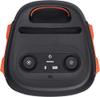
At 23 pounds, the JBL PartyBox 110 represents a thoughtful compromise in the portable speaker world. It's definitely not ultraportable—you won't be hiking with this thing—but it's manageable for most adults to carry from house to car to party location. The built-in handle and relatively compact footprint (about the size of a small tower fan) make transport reasonable for its performance level.
The 36-watt-hour lithium-ion polymer battery provides up to 12 hours of playtime under ideal conditions, but real-world usage varies significantly. Our researchers found that at typical party volumes (around 65-70% of maximum) with the LED lights active and Bass Boost engaged, you can expect 6-8 hours of continuous play. That's actually impressive considering you're powering not just high-output audio drivers, but also a sophisticated lighting system.
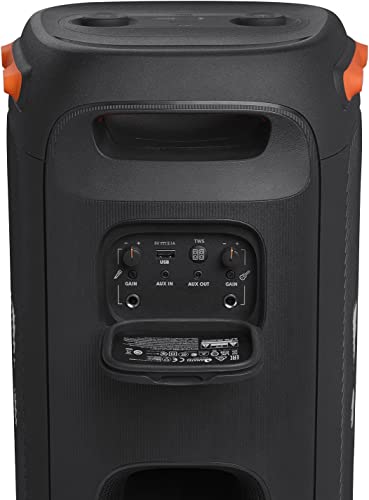
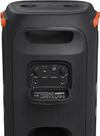
One aspect that sets the JBL PartyBox 110 apart from typical Bluetooth speakers is its professional-grade input options. The quarter-inch microphone and guitar inputs aren't just afterthoughts—they include individual gain controls (volume adjustments for each input) and proper impedance matching, which means microphones and instruments will sound natural and clear rather than thin or distorted.
This opens up use cases beyond simple music playback. Party hosts can do announcements, karaoke enthusiasts can connect their microphones, and musicians can use it for small venue performances or busking. The microphone input even has its own separate volume control, so you can balance speech against background music without affecting the main audio levels.
The JBL PartyBox app transforms how you interact with the speaker. Beyond basic playback controls, it provides access to a graphic equalizer (letting you adjust specific frequency ranges to taste), lighting customization, and firmware updates that can add new features over time.
The True Wireless Stereo (TWS) capability deserves mention because it's genuinely useful rather than just a marketing feature. You can pair two JBL PartyBox 110 speakers wirelessly to create actual stereo separation—one handling left channel, one handling right channel—or simply double your volume coverage for larger areas. Our testers found the pairing process straightforward and the stereo separation noticeably enhanced the listening experience for music with strong stereo mixing.
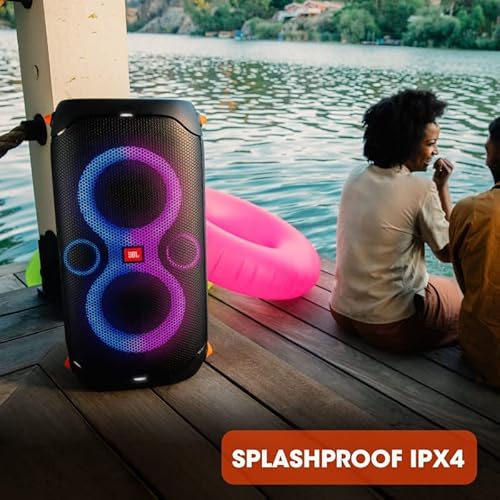
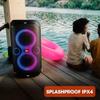
The IPX4 rating means the speaker can handle splashes from any direction, which covers most realistic party scenarios. This isn't full waterproofing—you can't submerge it—but it protects against poolside splashing, light rain, or spilled drinks. The rating requires all input ports to be properly sealed with their rubber covers, something our researchers emphasize is crucial for maintaining protection.
Build quality appears robust based on user reports, with the speaker handling typical party environments without issues. The grille design protects the drivers while allowing unrestricted audio output, and the overall construction feels substantial rather than flimsy.
At the time of writing, the portable party speaker market offers several compelling alternatives. The Sony XV500 provides longer battery life and slightly more balanced audio signature, while the Soundcore Rave 3S offers higher peak volume. However, the JBL PartyBox 110 distinguishes itself through its superior lighting integration and the overall cohesiveness of its feature set.
User comparisons consistently highlight that while individual competitors might excel in specific areas, the PartyBox 110 provides the most well-rounded experience. The lighting system, in particular, receives praise for being more sophisticated and visually impressive than competing offerings.
While primarily designed for portable party use, some users have successfully integrated the JBL PartyBox 110 into home entertainment setups. The AUX input allows connection to TV audio outputs, and the speaker's wide soundstage works reasonably well for movie watching. However, it's important to note that the sound signature is tuned for party music rather than dialogue clarity, so it's not an optimal home theater solution compared to dedicated soundbars or bookshelf speakers.
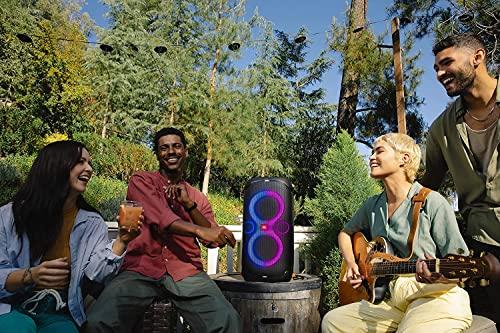
The JBL PartyBox 110 excels for users who host gatherings regularly, enjoy outdoor activities, or need occasional public address capabilities. It's particularly well-suited for pool parties, beach trips, backyard barbecues, and indoor celebrations where both audio quality and visual ambiance matter.
However, it's less ideal for users prioritizing absolute portability, critical listening applications, or situations requiring maximum volume output. The weight and size make it unsuitable for hiking or extended carrying, and audiophiles seeking neutral sound reproduction might prefer alternatives focused purely on audio fidelity.
Based on extensive research and user feedback, the JBL PartyBox 110 represents excellent value in the portable party speaker category. It successfully combines serious audio performance with engaging visual features and practical connectivity options, creating a package that genuinely enhances social experiences rather than simply providing background music. For most users seeking a versatile speaker that can adapt to various entertainment scenarios, it offers a compelling balance of features, performance, and reasonable portability that's hard to match in the current market.
Yes, the JBL PartyBox 110 Portable Party Speaker offers excellent value for users who want powerful portable audio with visual effects. With 160W of power, 12-hour battery life, and synchronized LED lighting, it delivers genuine party-level performance in a relatively portable package. While it's heavier than ultraportable speakers at 23 pounds, the audio quality and feature set justify the weight for most users who prioritize performance over absolute portability.
The JBL PartyBox 110 produces 160W RMS of power, making it loud enough to fill medium to large rooms and outdoor spaces effectively. Users report it can easily handle backyard parties, pool areas, and indoor gatherings without strain. The dual 5.25-inch woofers provide substantial bass output, while the two-level Bass Boost feature adds even more low-end impact when needed.
While the JBL PartyBox 110 can connect to TVs via its AUX input, it's not optimized for home theater use. The speaker is tuned for party music rather than dialogue clarity, and the LED lighting effects may be distracting during movie watching. For dedicated home theater applications, a proper soundbar or bookshelf speakers would provide better dialogue reproduction and more balanced audio for films and TV shows.
The JBL PartyBox 110 provides up to 12 hours of battery life under optimal conditions. In real-world party use with LED lights active, Bass Boost engaged, and volume at 65-70%, expect 6-8 hours of continuous playback. The 36Wh lithium-ion battery takes 3.5 hours to fully recharge, and you can use the speaker while it's plugged in for unlimited playtime.
The JBL PartyBox 110 has an IPX4 splashproof rating, which protects against water splashes from any direction but is not fully waterproof. This makes it suitable for poolside parties, beach use, and light rain, but you cannot submerge it in water. All input ports must be properly sealed with their rubber covers to maintain water protection.
Yes, the JBL PartyBox 110 features a dedicated 1/4-inch microphone input with individual gain control and separate volume adjustment. This enables karaoke, announcements, and live vocal performances. The microphone input integrates seamlessly with the music playback and lighting effects, making it ideal for interactive party experiences and small venue performances.
The JBL PartyBox 110 features dynamic RGB LED light rings that synchronize with your music in real-time. The lighting system uses beat detection technology to create patterns, colors, and effects that match the rhythm and intensity of your audio. You can customize the light show through the JBL PartyBox app, choosing from preset modes or creating your own color schemes and patterns.
Yes, the JBL PartyBox 110 supports True Wireless Stereo (TWS) pairing, allowing you to connect two speakers wirelessly for genuine stereo separation or increased volume coverage. You can also daisy-chain multiple speakers using the AUX output jack. The pairing process is straightforward through dedicated TWS buttons or the JBL PartyBox app.
The JBL PartyBox 110 offers multiple connectivity options including Bluetooth 5.1 (supporting up to 8 paired devices), 3.5mm AUX input, USB port for direct playback of MP3/WMA/WAV files, plus 1/4-inch inputs for microphones and guitars. The USB port also provides 5V/2.1A charging output for your mobile devices while playing music.
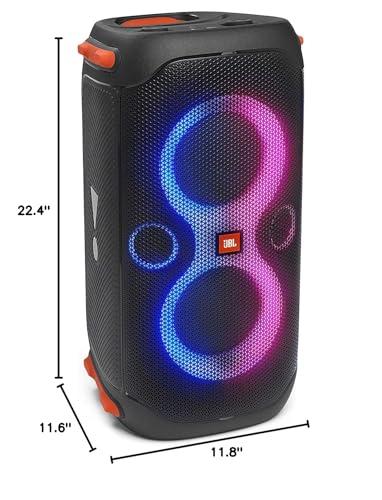
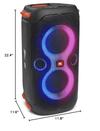
At 23 pounds and measuring 11.6" x 22.4" x 11.8", the JBL PartyBox 110 strikes a balance between portability and performance. It features built-in handles for easier transport and is manageable for most adults to carry from location to location. While not ultraportable like smaller Bluetooth speakers, it's reasonably portable considering its 160W power output and comprehensive feature set including LED lighting and professional inputs.
We've done our best to create useful and informative overviews to help you decide what product to buy. Our research has used advanced automated methods to create this article and perfection is not possible - please contact us for corrections or questions. These are the sites we've researched in the creation of this article: rtings.com - youtube.com - bestbuy.com - gadgets360.com - popsci.com - youtube.com - audioadvice.com - popsci.com - youtube.com - versus.com - youtube.com - rtings.com - jbl.com - in.jbl.com - jbl.com.tw - bhphotovideo.com - in.jbl.com - jbl.com - youtube.com - hu.harmanaudio.com - jbl.com.au - global.jbl.com - support.jbl.com - youtube.com - kh.jbl.com - onward.ph - jbl.com.ph - support.jbl.com - youtube.com
| JBL PartyBox 110 Portable Party Speaker |
|---|
| Output Power - Determines maximum volume and room-filling capability: 160W RMS |
| Battery Life - How long your party can last unplugged: Up to 12 hours |
| Water Resistance - Protection level for outdoor and poolside use: IPX4 splashproof |
| Driver Configuration - More drivers mean better sound separation and clarity: 2x 5.25" woofers + 2x 2.25" tweeters |
| Bass Boost Levels - Customizable low-end enhancement for different environments: 2 adjustable levels |
| Bluetooth Version - Newer versions offer better range and stability: 5.1 |
| LED Lighting - Creates synchronized visual effects with your music: Dynamic RGB lights with beat sync |
| Microphone Input - Enables karaoke and announcements: 1/4" jack with gain control |
| Guitar Input - Direct instrument connection for live performance: 1/4" jack with gain control |
| True Wireless Stereo - Pair two speakers for genuine stereo sound: TWS compatible |
| Frequency Response - The range of sounds the speaker can reproduce: 45 Hz - 20 kHz |
| Weight: 23 lbs (10.84 kg) |
| Dimensions: 11.6" x 22.4" x 11.8" |
| Charge Time: 3.5 hours |
| USB Port - Powers your devices while playing music: 5V/2.1A output |
The Sony SRS-XV500 takes a fundamentally different approach to party audio with its stereo configuration and emphasis on balanced sound quality. Where the PartyBox 110 prioritizes raw power and bass impact, Sony's speaker delivers superior instrument separation and clearer vocal reproduction through its dual X-Balanced woofers and advanced audio processing. The most significant advantage is Sony's Party Connect feature, which allows you to wirelessly link up to 100 compatible speakers across different Sony models—a level of system expandability that JBL simply cannot match with its limited TWS pairing. For karaoke enthusiasts, the Sony SRS-XV500 provides balanced dual microphone inputs with professional Echo and Key Control features, making group singing sessions far more enjoyable than the PartyBox 110's unbalanced mic setup.
In real-world use, the Sony SRS-XV500 shines in scenarios where audio quality matters as much as volume, such as home theater applications where its stereo imaging creates proper spatial effects for movies and TV shows. While it can't quite match the PartyBox 110's maximum volume output or dramatic lighting spectacle, it compensates with longer advertised battery life (though real-world performance is similar), advanced Bluetooth codec support including LDAC for Android devices, and the ability to charge your phone through its USB port. The Sony represents better long-term value for users who want one versatile speaker that excels at parties while also serving as a quality daily audio solution, rather than a single-purpose party machine.
🤖 Read Detailed Comparison
👌Sony SRS-XV500 Wireless Party Speaker Details
💵 See Sony SRS-XV500 Wireless Party Speaker Price
The Sony SRS-XV800 stands out primarily for its exceptional 25-hour battery life, which more than doubles the PartyBox 110's endurance and makes it genuinely suitable for all-day events like weddings or camping trips. Its omnidirectional sound design using five strategically placed tweeters creates a more immersive listening experience that fills rooms evenly, while the optical digital input and TV Sound Booster feature transform it into a capable soundbar alternative—something the PartyBox 110 simply can't match. The Sony's X-Balanced speaker technology also delivers cleaner bass reproduction with less distortion, and its more balanced sound signature avoids the harshness that can creep into the JBL at maximum volumes, making it better suited for longer listening sessions.
However, these advantages come at a significant cost premium and weight penalty that affects real-world usability. At nearly 41 pounds, the Sony SRS-XV800 requires wheels to move around and becomes impractical for beach trips or uneven terrain where the PartyBox 110's 23-pound frame excels. More critically for party environments, the Sony can't match the JBL's raw volume output or deep bass extension that makes music feel physical and exciting. While the Sony offers premium features like LDAC codec support and sophisticated app control, the PartyBox 110 delivers more of what matters most at parties—louder sound, deeper bass, and more impressive lighting—at a substantially lower price point that often allows buyers to purchase two units for true stereo separation.
🤖 Read Detailed Comparison
👌Sony SRS-XV800 X-Series Party Speaker Details
💵 See Sony SRS-XV800 X-Series Party Speaker Price
The JBL PartyBox Encore Essential 2 takes a different approach, prioritizing portability and modern technology over raw power. At just 13.67 pounds compared to the PartyBox 110's 24 pounds, it's genuinely grab-and-go portable while still delivering impressive 100W output enhanced by AI Sound Boost technology. This intelligent processing maintains cleaner sound at high volumes and prevents the compression issues that can plague smaller speakers when pushed hard. The Encore Essential 2 also features a user-replaceable battery providing up to 15 hours of playtime, newer Bluetooth 5.4 with Auracast connectivity for better multi-speaker pairing, and six sophisticated lighting modes that feel more refined than traditional party speaker effects. Its more balanced sound signature works better across diverse music genres, making it less fatiguing during extended listening sessions.
For most users, the PartyBox Encore Essential 2 represents better real-world value despite having less raw power. The 60-watt difference becomes less significant when you consider that the newer speaker's AI optimization and balanced tuning often sound better at typical party volumes. The replaceable battery design alone extends the speaker's useful life by years compared to the PartyBox 110's fixed battery, while the dramatically improved portability encourages more frequent use. Unless you specifically need maximum volume for large outdoor crowds or professional-grade inputs for live performance, the Encore Essential 2 delivers a more practical and future-proof party speaker experience at a lower price point, making it the smarter choice for most buyers.
🤖 Read Detailed Comparison
👌JBL PartyBox Encore Essential 2 Portable Speaker JBLPBENCOREES2AM Details
💵 See JBL PartyBox Encore Essential 2 Portable Speaker JBLPBENCOREES2AM Price
The Marshall Bromley 750 represents a significant step up in both power and sophistication, delivering 500 watts through eight strategically placed drivers compared to the PartyBox 110's 160-watt four-driver setup. This translates to dramatically louder maximum volume (127dB SPL) and the ability to fill large outdoor venues that would overwhelm the JBL. More importantly, the Marshall's 360-degree True Stereophonic design eliminates the dead zones you'll experience with the PartyBox 110's forward-firing configuration – everyone at your party gets the same high-quality audio regardless of where they're standing. The Marshall also boasts exceptional 40+ hour battery life with user-replaceable batteries, solving the PartyBox 110's limitation of needing mid-party charging breaks during extended events.
However, the Marshall Bromley 750 comes with trade-offs that matter in real-world use. At 53 pounds versus the PartyBox 110's manageable 23-pound weight, it requires wheels and planning for transport rather than casual portability. The premium also extends far beyond the PartyBox 110's accessible pricing – roughly triple the cost at the time of writing. While the Marshall delivers professional-grade XLR inputs, built-in effects processing, and superior build quality that justify its positioning, most casual party hosts will find the PartyBox 110 provides all the performance they need at a fraction of the investment. The Marshall makes sense if you frequently host large gatherings, need professional connectivity features, or can justify the premium for best-in-class audio quality and marathon battery life.
🤖 Read Detailed Comparison
👌Marshall Bromley 750 Party Speaker Details
💵 See Marshall Bromley 750 Party Speaker Price
The Sony ULT TOWER 9 represents a significant step up in performance, delivering substantially more impactful sound through its sophisticated 3-way driver system with a massive 12.6-inch X-Balanced woofer, dedicated midrange drivers, and four tweeters that create true 360° sound dispersion. Its ULT bass modes provide chest-thumping low-end that extends down to 35Hz – noticeably deeper than what the PartyBox 110 can achieve. The Sony maintains exceptional clarity even at maximum volume, fills much larger spaces effectively, and offers professional-grade karaoke features with dual microphone inputs, echo control, and key adjustment. The 25-hour battery life is more than double what you'll get from the JBL, and the optical input allows it to double as a legitimate TV soundbar for home theater use.
However, these performance advantages come at roughly twice the cost and with significant trade-offs in portability. At 65.2 pounds compared to the PartyBox 110's 23.9 pounds, the Sony ULT TOWER 9 requires wheels or two people to move and takes up considerably more space. Its water resistance is limited to the top panel only, making it less suitable for poolside or beach parties where the PartyBox 110's full-body IPX4 rating shines. For users who prioritize maximum sound quality and have large spaces to fill regularly, the Sony justifies its premium pricing through superior audio engineering and advanced features. But for those seeking true portability, better value, or frequent outdoor use, the PartyBox 110's more practical design and accessible price point make it the smarter choice despite its performance limitations.
🤖 Read Detailed Comparison
👌Sony ULT TOWER 9 Wireless Party Speaker Details
💵 See Sony ULT TOWER 9 Wireless Party Speaker Price
The Samsung MX-ST50F stands out with its exceptional 18-hour battery life and user-replaceable battery system, making it ideal for extended outdoor events where the JBL's 12-hour runtime might fall short. Samsung's tower design incorporates built-in wheels and a telescopic handle for easier transport on smooth surfaces, while its superior IPX5 water resistance provides better protection against unpredictable weather conditions. The speaker also offers more sophisticated sound customization through its app, with three bass modes and four distinct sound presets, plus the ability to wirelessly connect up to 10 speakers using Auracast technology for massive event setups.
However, the Samsung MX-ST50F comes with significant trade-offs that favor the JBL in real-world party scenarios. While both speakers claim 240W maximum power, the Samsung drops dramatically to just 90W on battery operation—less than half its plugged-in performance—whereas the JBL maintains more consistent sound quality across power modes. User reviews consistently indicate that the JBL delivers more impactful, energizing bass and superior lighting effects that better capture party atmospheres. Most importantly, the Samsung typically costs nearly twice as much as the JBL, making it a premium option that's harder to justify unless you specifically need its extended battery life or advanced connectivity features. For most party scenarios, the JBL offers better sound-per-dollar with more reliable performance whether plugged in or running on battery power.
🤖 Read Detailed Comparison
👌Samsung MX-ST50F Sound Tower Party Speaker Details
💵 See Samsung MX-ST50F Sound Tower Party Speaker Price
The JBL PartyBox 520 represents a significant step up in power and capability, delivering 400W RMS compared to the PartyBox 110's 160W output. This translates to dramatically louder performance—the 520 can reach 114 dB maximum volume versus 107 dB, making it more than twice as loud in perceived volume. The larger speaker features dual 7.5-inch woofers that produce substantially deeper bass extending down to 40 Hz, creating the kind of chest-thumping low-end that energizes large crowds. For big outdoor events, block parties, or gatherings of 75+ people, the JBL PartyBox 520 provides the sheer output power that the PartyBox 110 simply cannot match, filling expansive spaces with authority and impact.
However, this enhanced performance comes with significant trade-offs in portability and cost. The JBL PartyBox 520 weighs 56 pounds—more than double the PartyBox 110's 23-pound weight—requiring its telescopic handle and wheels for transport rather than hand-carrying. While it offers professional features like combo XLR inputs, swappable battery technology, and 15-hour runtime, the premium pricing puts it in a different market category entirely. For most home party scenarios involving 20-40 people, the PartyBox 110 delivers more than adequate performance at a much more accessible price point and with genuine portability. The JBL PartyBox 520 makes sense when you genuinely need maximum volume for large events or professional applications, but represents overkill for typical residential use cases where the PartyBox 110's balanced combination of performance, portability, and value proves more practical.
🤖 Read Detailed Comparison
👌JBL PartyBox 520 Speaker Details
💵 See JBL PartyBox 520 Speaker Price
The Soundboks Go stands out primarily for its extreme volume capability and marathon battery life, reaching 121 dB maximum output that significantly outperforms the PartyBox 110 despite having lower rated wattage. Its swappable battery system delivers up to 40 hours of playtime at moderate volume, with the ability to hot-swap batteries for unlimited runtime—a game-changing feature for multi-day events or professional use. The speaker's IP65 rating provides complete dust and water-jet protection, making it virtually indestructible in outdoor environments where the PartyBox 110's IPX4 rating would be insufficient. However, the Soundboks Go sacrifices entertainment features entirely, offering no RGB lighting, karaoke inputs, or visual effects that make the PartyBox 110 so engaging for typical home parties.
From a performance perspective, the Soundboks Go excels in specialized scenarios but falls short in versatility. Its mono configuration and bright, aggressive sound signature work brilliantly at high volumes outdoors but can sound harsh and unbalanced during casual indoor listening where the PartyBox 110 shines. The significantly higher price point of the Soundboks Go makes it a harder sell for general consumers, though it justifies the premium for users who genuinely need its extreme durability, maximum volume output, and extended battery capabilities. For most party scenarios involving mixed indoor/outdoor use, moderate volumes, and entertainment features, the PartyBox 110 provides superior value and user experience, while the Soundboks Go serves a more specialized market of outdoor enthusiasts, professionals, and users who prioritize raw performance over comprehensive features.
🤖 Read Detailed Comparison
👌Soundboks Go Portable Bluetooth Speaker 11-SBGO_B Details
💵 See Soundboks Go Portable Bluetooth Speaker 11-SBGO_B Price
The Sony SRS-XV900 takes a fundamentally different approach to portable party audio, prioritizing extended battery life and professional-grade sound quality over the JBL's emphasis on maximum impact and visual excitement. Where the PartyBox 110 delivers 6-7 hours of real-world battery life, the Sony provides an impressive 15-20 hours of continuous playback, effectively doubling your party time without charging breaks. This extended runtime comes from a larger 58-pound design that includes wheels for transport, making it feel more like professional equipment than a casual party accessory. The Sony's sound signature favors balance and clarity over raw bass impact, featuring a sophisticated 4-way speaker system with 360-degree sound dispersion that ensures everyone in the room gets consistent audio quality regardless of their position.
From a value perspective, the Sony SRS-XV900 commands a significant premium but justifies it through versatility and longevity that the JBL can't match. The inclusion of optical digital input transforms it into a premium TV soundbar when not hosting parties, effectively making it a 2-in-1 device that adds considerable utility for apartment dwellers or anyone wanting to consolidate their audio setup. While it sacrifices the JBL's dramatic lighting effects and weather resistance, the Sony excels in scenarios requiring professional sound quality—like wedding receptions, corporate events, or all-day festivals where audio clarity matters as much as volume. The trade-off ultimately comes down to whether you prioritize the JBL's party-focused features and portability, or the Sony's marathon battery life and audiophile-grade performance that works equally well for background music and high-energy dancing.
🤖 Read Detailed Comparison
👌Sony SRS-XV900 Portable Bluetooth Speaker Details
💵 See Sony SRS-XV900 Portable Bluetooth Speaker Price
The Marshall Woburn III takes a fundamentally different approach as a premium stationary home speaker, prioritizing audiophile-grade sound quality over portable entertainment features. Its sophisticated 3-way driver system with dedicated midrange drivers delivers significantly clearer vocal reproduction and instrument separation compared to the PartyBox 110's party-optimized tuning. The Marshall extends deeper into bass frequencies (35 Hz versus 45 Hz) while maintaining better tonal balance across all volume levels through its Dynamic Loudness technology. For home theater applications, the Marshall Woburn III excels with HDMI ARC connectivity that seamlessly integrates with your TV, plus a Night Mode that intelligently manages dynamic range for apartment-friendly late-night viewing—capabilities the PartyBox 110 simply cannot match.
However, this audio excellence comes with significant trade-offs that make the Marshall Woburn III unsuitable for the PartyBox 110's core strengths. At roughly 65% higher cost, the Marshall lacks battery power, water resistance, interactive features like karaoke inputs, and the synchronized lighting that defines party speaker experiences. While the Marshall's refined sound signature and iconic rock-inspired aesthetics appeal to serious music listeners and home theater enthusiasts, it cannot follow you to the beach, pool, or camping trip where the PartyBox 110 truly shines. The choice ultimately depends on whether you prioritize portable entertainment versatility or premium stationary audio performance—two completely different value propositions that serve distinct lifestyles and listening priorities.
🤖 Read Detailed Comparison
👌Marshall Woburn III Bluetooth Home Speaker 1006088 Details
💵 See Marshall Woburn III Bluetooth Home Speaker 1006088 Price
The Rockville Rock Party 9 delivers significantly more raw power with its 1000W peak output and dual 8-inch woofers, making it capable of filling much larger outdoor spaces with room-shaking bass that the JBL simply can't match. Its standout feature is comprehensive karaoke functionality, including auto-tune, voice-changing effects, dual microphone inputs with priority controls, and a dedicated guitar input – turning it into a complete entertainment system rather than just a speaker. The larger drivers produce noticeably deeper bass impact, and at maximum volume, it can easily overpower the JBL's more restrained output, making it ideal for large gatherings where sheer volume is the priority. The smartphone slot and slightly lighter weight (19.64 lbs) also make it more convenient for mobile setups.
From a value standpoint, the Rockville Rock Party 9 typically offers exceptional bang for your buck, delivering professional-level karaoke features and significantly more power at a lower price point than the JBL. While it sacrifices battery life (6-8 hours vs 12) and lacks water resistance, it excels in scenarios where maximum impact matters more than endurance – backyard parties, small venue performances, or any event where the goal is immediate audio impact rather than all-day reliability. For budget-conscious buyers who want the loudest possible speaker with serious karaoke capabilities, the Rockville provides features that would cost significantly more in professional PA equipment. However, this value proposition comes with trade-offs in build refinement and weather durability that make it better suited for shorter, high-energy events rather than extended outdoor use.
🤖 Read Detailed Comparison
👌Rockville Rock Party 9 Portable Bluetooth Speaker Details
💵 See Rockville Rock Party 9 Portable Bluetooth Speaker Price
The Sony ULT Tower 10 represents a fundamentally different approach to party audio, trading the PartyBox 110's portability for raw power and sophisticated features. Standing over 3 feet tall and weighing 64 pounds, this AC-powered tower delivers significantly more volume—up to 110 dB compared to the JBL's 160W output—making it capable of filling large rooms and outdoor spaces that would challenge the smaller speaker. The Sony's 3-way driver system, anchored by a massive 12.6-inch X-Balanced woofer, produces deeper bass extension and maintains clarity at high volumes where the PartyBox 110 begins to compress. Its ULT bass technology offers more precise control with dedicated deep bass (ULT 1) and punchy bass (ULT 2) modes, while the 360-degree sound dispersion from rear-mounted tweeters creates better room-filling audio than the JBL's forward-firing design.
Where the Sony ULT Tower 10 truly differentiates itself is in its comprehensive feature set and home integration capabilities. The included wireless Bluetooth microphone eliminates the need for separate purchases, while the optical digital input and TV Sound Booster mode make it excel as a soundbar replacement—something the PartyBox 110 cannot match. The Party Connect feature allows linking up to 100 compatible speakers for massive events, far beyond the JBL's two-speaker stereo pairing limit. However, these advantages come at the cost of mobility and flexibility. Without battery operation and weighing nearly three times as much, the Sony is essentially a stationary solution that requires planning around power availability. For users who prioritize maximum performance in a fixed location and don't need the go-anywhere convenience that makes the PartyBox 110 special, the Sony justifies its higher price point with superior audio output and more sophisticated party features.
🤖 Read Detailed Comparison
👌Sony ULT Tower 10 Party Speaker Details
💵 See Sony ULT Tower 10 Party Speaker Price
The Samsung MX-ST40F Sound Tower takes a notably different approach with its emphasis on advanced features and comprehensive entertainment capabilities. Where it truly excels is in karaoke and live performance functionality, offering dual microphone/guitar inputs, built-in DJ effects, a 12-sound sampler, and voice recording capabilities that transform it into a complete entertainment system. The speaker also boasts superior weather protection with an IPX5 rating versus the PartyBox 110's IPX4, making it more suitable for poolside use and unpredictable outdoor conditions. Samsung's Auracast technology allows wireless linking of up to 10 speakers for large venue applications, while the replaceable battery design provides flexibility for extended events that the JBL's fixed battery cannot match.
However, these advanced features come with meaningful trade-offs that affect daily usability. The Samsung MX-ST40F weighs 18% more than the PartyBox 110, making it noticeably more cumbersome to transport, and multiple user reviews consistently note that its sound quality is "slightly dull" compared to the JBL's clearer, more detailed audio reproduction. While Samsung's bi-directional speaker design provides better room coverage, it doesn't compensate for the less engaging sound signature, particularly in critical midrange frequencies where vocals and instruments reside. For users who prioritize maximum features and don't mind the extra weight and complexity, the Samsung offers compelling value, but most party-goers will find the PartyBox 110's superior sound quality and easier portability more beneficial in real-world use.
🤖 Read Detailed Comparison
👌Samsung MX-ST40F Sound Tower Speaker Details
💵 See Samsung MX-ST40F Sound Tower Speaker Price
The JBL PartyBox Stage 320 represents a significant step up in power and capability, delivering 240W RMS compared to the PartyBox 110's 160W output. This translates to noticeably louder volume and more impactful bass thanks to its dual 6.5-inch woofers versus the single 5.25-inch driver in the 110. The Stage 320 also introduces AI Sound Boost technology that continuously optimizes audio quality in real-time, reducing distortion at high volumes where the 110 can occasionally sound strained. Battery life extends to 18 hours versus 12 hours, and the unique swappable battery system means you can hot-swap fresh batteries instead of waiting for charging—a game-changing feature for extended events or professional use.
However, these advantages come with trade-offs that make the PartyBox 110 more appealing for many users. The Stage 320 weighs 50% more at 36 pounds and requires wheels for practical transport, eliminating the grab-and-go convenience that makes the 110 so versatile. The price premium is substantial, typically 50% higher than the PartyBox 110, which raises questions about value for casual party hosts. While the Stage 320 excels at large outdoor events and professional applications where maximum power is essential, the PartyBox 110 handles the majority of party scenarios admirably at a much more accessible price point. For most users, the 110's combination of solid performance, true portability, and lower cost makes it the smarter choice unless you specifically need the extra power and professional features of the larger model.
🤖 Read Detailed Comparison
👌JBL PartyBox Stage 320 Portable Speaker Details
💵 See JBL PartyBox Stage 320 Portable Speaker Price
The JBL PartyBox 720 represents a completely different class of party speaker, delivering 800 watts RMS through massive 9-inch woofers that extend bass response down to 32 Hz—deep enough to create the chest-thumping sub-bass that makes EDM and hip-hop truly come alive. At 112 dB maximum output, it can fill basketball courts and large outdoor venues where the PartyBox 110 would struggle to compete with ambient noise. The 720's sophisticated features include dual XLR inputs for professional microphones, swappable battery packs for unlimited runtime, and a 360-degree light show with advanced effects that create a festival-like atmosphere. Its AI Sound Boost technology automatically optimizes audio performance based on music content, while Auracast connectivity allows wireless linking with multiple speakers for complex setups.
However, these impressive capabilities come with significant trade-offs that make the JBL PartyBox 720 impractical for many users who would be perfectly served by the PartyBox 110. At 68 pounds, the 720 requires wheels for transport and careful planning for setup, eliminating the grab-and-go convenience that makes the 110 so appealing for spontaneous gatherings. The premium pricing—roughly four to five times higher than the PartyBox 110—only makes sense if you regularly host large events exceeding 50 people or need professional audio features. For typical home parties, backyard barbecues, or apartment living, the 720's massive power output becomes overkill that could disturb neighbors while its size and weight create unnecessary complications. The PartyBox 110 delivers about 80% of the party speaker experience at 25% of the cost, making it the sensible choice for most users who want exciting audio and lighting effects without the complexity and investment of professional-grade equipment.
🤖 Read Detailed Comparison
👌JBL PartyBox 720 Portable Speaker JBLPARTYBOX720AM Details
💵 See JBL PartyBox 720 Portable Speaker JBLPARTYBOX720AM Price
The JBL PartyBox 310 steps up the game with 240W of power compared to the PartyBox 110's 160W, delivering noticeably louder maximum volumes and deeper bass response through its dual 6.5-inch woofers. This 50% power increase becomes most apparent at outdoor events or larger gatherings, where the 310 can comfortably fill spaces with 100+ people without the compression artifacts that occasionally affect the 110 at maximum volume. The 310 also extends battery life to 18 hours versus 12 hours, providing that crucial extra endurance for all-day events. Perhaps most significantly, it includes a telescoping handle with smooth-rolling wheels that transforms transport from a workout into an effortless roll across parking lots and venues.
However, these upgrades come with trade-offs that make the PartyBox 110 appealing for many users. The JBL PartyBox 310 weighs 38.4 pounds compared to the 110's 24 pounds, making manual carrying significantly more challenging when wheels aren't practical—like navigating stairs or tight spaces. The price premium typically runs 25-30% higher, which represents substantial value only if you regularly host larger events or truly need those convenience features. For most home parties, backyard gatherings, or events under 50 people, the PartyBox 110 delivers nearly identical sound quality and features at a more accessible price point, making the 310 feel like overkill unless you're a serious entertainer who values maximum power and professional-grade portability.
🤖 Read Detailed Comparison
👌JBL PartyBox 310 Portable Speaker Details
💵 See JBL PartyBox 310 Portable Speaker Price
The JBL PartyBox 710 represents a significant step up in power and performance, delivering 800W RMS compared to the PartyBox 110's 160W – a difference that's immediately noticeable in real-world use. With dual 8-inch woofers reaching down to 35Hz, the 710 produces the kind of chest-thumping sub-bass that makes electronic music and hip-hop feel authentic, easily filling outdoor spaces up to a third of an acre at moderate volume levels. The lighting system is also far more elaborate, featuring RGB rings around each woofer, interconnected lighting, top strobes, and side RGB strips that create a genuine nightclub atmosphere. However, this power comes with significant trade-offs – the 710 weighs 68 pounds, requires constant AC power, and essentially becomes a semi-permanent installation rather than a truly portable speaker.
For users who need maximum impact and don't mind sacrificing portability, the JBL PartyBox 710 justifies its premium pricing through sheer performance capability. It's designed for large gatherings of 100+ people, professional DJ use, or dedicated outdoor entertainment spaces where power access isn't an issue. While the PartyBox 110 offers better overall value and versatility for most users, the 710 serves those who genuinely need its professional-level capabilities and are willing to accept the mobility limitations. The decision ultimately comes down to whether you prioritize the 110's convenience and battery operation for smaller, varied gatherings, or need the 710's uncompromising power for serious entertainment applications.
🤖 Read Detailed Comparison
👌JBL PartyBox 710 Portable Party Speaker Details
💵 See JBL PartyBox 710 Portable Party Speaker Price
The Sony ULT FIELD 7 stands out with dramatically superior battery endurance at 30 hours versus the PartyBox 110's 12 hours, making it ideal for extended outdoor events, camping trips, and multi-day festivals where charging isn't convenient. Its significantly lighter weight at 13.89 pounds compared to 23 pounds, combined with better-designed carry handles, makes it genuinely portable for frequent transport between venues. The Sony also offers superior water protection with its IP67 rating that allows complete submersion, versus the PartyBox 110's basic splash resistance—a crucial advantage for beach parties and poolside use.
While the PartyBox 110 delivers higher raw power at 160W, the Sony ULT FIELD 7's advanced X-Balanced driver technology and sophisticated ULT Bass Modes provide more nuanced sound customization, with ULT1 adding deep bass and ULT2 delivering aggressive bass boost tailored for different music styles. The Sony's comprehensive app ecosystem through Music Center and Fiestable apps offers more advanced control over EQ settings and lighting customization, plus Party Connect technology that can link up to 100 compatible speakers versus the PartyBox 110's simpler TWS pairing. For users prioritizing maximum portability, extended battery life, and superior weather protection, the Sony represents better real-world value despite the PartyBox 110's higher power output and dedicated microphone/guitar inputs.
🤖 Read Detailed Comparison
👌Sony ULT FIELD 7 Portable Speaker Details
💵 See Sony ULT FIELD 7 Portable Speaker Price
The SOUNDBOKS 4 represents a significant step up in both performance and durability, though at roughly three times the price. Its standout feature is the removable 40-hour battery system that transforms extended outdoor use – where the PartyBox 110 requires careful battery management and eventual charging breaks, the SOUNDBOKS lets you swap batteries for unlimited runtime. The audio performance is noticeably superior, with 216W RMS driving larger 10-inch woofers and a professional compression tweeter that delivers clearer sound at higher volumes. The IP65 rating means it can handle conditions that would damage the PartyBox 110, including rain, dust, and even being hosed down after muddy outdoor events. Professional XLR inputs and TeamUP wireless networking make it suitable for semi-professional applications like DJ gigs or large events.
However, this performance comes with significant trade-offs beyond just price. The SOUNDBOKS 4 weighs 11 pounds more, lacks the entertaining LED light show that makes the PartyBox 110 so engaging at parties, and has no dedicated karaoke features that many casual users love. While it excels in demanding outdoor scenarios and extended use, the PartyBox 110 often provides better value for typical backyard gatherings, pool parties, and family events where the entertainment features, manageable size, and lower price point matter more than ultimate durability and battery life. The SOUNDBOKS 4 makes sense when you need professional-grade performance and reliability, but for most casual party scenarios, it's overkill that doesn't justify the substantial price premium.
🤖 Read Detailed Comparison
👌SOUNDBOKS 4 Portable Bluetooth Speaker Model 11-SB4_B Details
💵 See SOUNDBOKS 4 Portable Bluetooth Speaker Model 11-SB4_B Price
The Sony SRS-XP700 stands out primarily for its exceptional 25-hour battery life, which more than doubles the JBL's endurance and makes it ideal for all-day outdoor events or multi-day festivals where reliable power isn't available. Sony's omnidirectional sound design uses multiple tweeters and X-Balanced woofers to create 360-degree audio coverage, ensuring consistent sound quality whether listeners are in front of, beside, or behind the speaker. The Sony also supports LDAC high-resolution audio codec, delivering significantly better wireless sound quality when paired with compatible Android devices and high-quality audio files.
However, these advantages come at the cost of portability and raw power. At 37 pounds, the Sony SRS-XP700 is 14 pounds heavier than the JBL, making it much more challenging for single-person transport and better suited for semi-permanent installations. With only 60W RMS output compared to the JBL's 160W, the Sony produces noticeably less volume and bass impact, which can be disappointing for bass-heavy music genres or large outdoor gatherings that need serious sound projection. The Sony typically costs 20-30% more than the JBL, making it a premium option that's best justified if you prioritize marathon battery life and sophisticated audio processing over maximum portability and party-focused sound impact.
🤖 Read Detailed Comparison
👌Sony SRS-XP700 Wireless Party Speaker Details
💵 See Sony SRS-XP700 Wireless Party Speaker Price
The Tivoli Audio SongBook MAX takes a fundamentally different approach to portable audio, prioritizing audiophile sound quality and sophisticated engineering over party entertainment features. Where the PartyBox 110 delivers maximum volume and visual spectacle, the Tivoli focuses on revealing musical details through its precision 3-driver system—a dedicated 4-inch subwoofer, 4-inch midrange driver, and 0.75-inch tweeter that creates remarkably clear vocal reproduction and instrument separation. At 11.5 pounds versus the PartyBox's 23 pounds, it offers genuine portability with an integrated carry handle, making it practical for frequent transport between locations. The Tivoli also brings unique functionality like FM radio (DAB/DAB+ in Europe), physical EQ sliders for immediate sound adjustment without app dependency, and a built-in preamp that supports professional equipment like turntables and high-end instruments.
While the Tivoli Audio SongBook MAX can't match the PartyBox 110's raw volume output or party-centric features, it excels in scenarios where sound quality matters more than maximum volume. Its 50-watt output still reaches impressive levels (100 dB at one meter) while maintaining clarity that the PartyBox loses when pushed to its limits. The premium build quality, vintage-inspired design, and USB-C fast charging represent a more refined approach to portable audio. For listeners who prioritize musical accuracy, frequent portability, or need professional-grade connectivity, the Tivoli justifies its higher price point through superior audio engineering and versatile functionality that extends far beyond basic Bluetooth playback.
🤖 Read Detailed Comparison
👌Tivoli Audio SongBook MAX Bluetooth Speaker Details
💵 See Tivoli Audio SongBook MAX Bluetooth Speaker Price
The JBL EON ONE Compact takes a fundamentally different approach as a professional PA system rather than a party speaker. Its standout feature is the built-in 4-channel digital mixer with professional XLR inputs, phantom power for condenser microphones, and studio-quality Lexicon effects including reverb, delay, and chorus. While it produces less peak volume at 112 dB compared to the PartyBox 110's 121 dB, the EON ONE Compact delivers cleaner, distortion-free sound throughout its range and extends bass response down to 37.5Hz - nearly a full octave deeper than the PartyBox 110. The ducking feature automatically lowers background music when speech is detected, and the swappable battery system provides true 12-hour runtime with the ability to hot-swap batteries for unlimited operation.
For users who need mixing capabilities for live instruments, presentations, or professional applications, the EON ONE Compact offers significantly better value despite being in a similar price range. At 17.6 pounds versus the PartyBox 110's 23.9 pounds, it's considerably more portable and genuinely fits the "grab and go" use case. However, it completely lacks the PartyBox 110's entertainment features - no LED light show, no water resistance, and no party-focused connectivity options. The EON ONE Compact makes sense for singer-songwriters, fitness instructors, business presenters, and anyone who values professional audio quality and mixing flexibility over maximum volume and visual spectacle. It's essentially professional audio equipment disguised as a portable speaker, while the PartyBox 110 remains the better choice for pure entertainment and party applications.
🤖 Read Detailed Comparison
👌JBL EON ONE Compact Portable PA Speaker Details
💵 See JBL EON ONE Compact Portable PA Speaker Price
The JBL PartyBox Ultimate represents a massive leap in performance with its 1100W output—nearly seven times more powerful than the PartyBox 110's 160W. This translates to real-world volume that can fill spaces as large as two basketball courts with clear, undistorted sound, while the 110 is better suited for typical house parties of 15-30 people. The Ultimate's sophisticated three-way driver system includes dual 9-inch woofers and dedicated midrange drivers, delivering noticeably clearer vocals and deeper bass extension down to 30Hz compared to the 110's 45Hz limit. Advanced features like Dolby Atmos over Wi-Fi, self-tuning room calibration, and the interactive JBL PartyPad DJ controls make it feel more like professional equipment than a consumer speaker.
However, these performance gains come with significant trade-offs that make the JBL PartyBox Ultimate unsuitable for many users who would love the PartyBox 110. At 87 pounds versus the 110's manageable 23 pounds, the Ultimate requires wheels and vehicle transport—it's essentially a stationary speaker that you might relocate occasionally rather than carry to different parties. While it technically has battery power, it needs AC connection for full output, eliminating the anywhere-use convenience that makes the 110 so versatile. The price difference is substantial enough to buy several other quality speakers, making the Ultimate worthwhile only for users who regularly host large events or need professional-grade volume. For most casual party hosts, the 110 delivers the sweet spot of impressive performance, genuine portability, and reasonable cost that the Ultimate sacrifices in pursuit of maximum impact.
🤖 Read Detailed Comparison
👌JBL PartyBox Ultimate Speaker Details
💵 See JBL PartyBox Ultimate Speaker Price
Original price was: $499.99.$369.99Current price is: $369.99.
Original price was: $579.99.$318.99Current price is: $318.99.

Privacy Policy
Terms and Conditions - Affiliate Policy
Home Security
© Copyright 2008-2026.
11816 Inwood Rd #1211, Dallas, TX 75244