Original price was: $299.95.$249.95Current price is: $249.95.
When it comes to portable party speakers, the JBL PartyBox Encore Essential has carved out an interesting niche in the crowded audio landscape. After extensive research into user experiences and technical specifications, this speaker emerges as a compelling option for anyone looking to bring serious sound to their gatherings without breaking the bank or their back carrying it around.
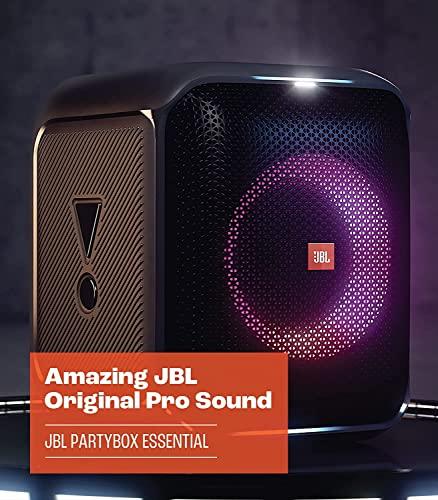
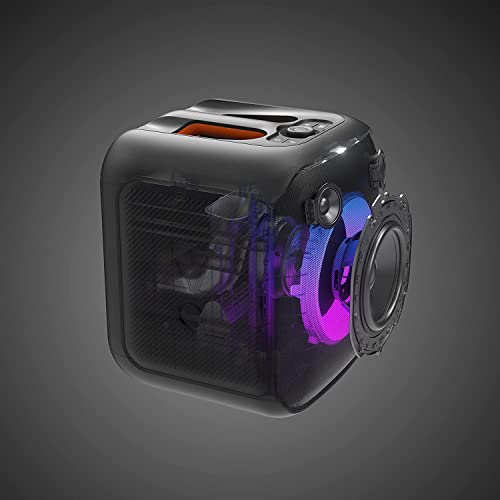
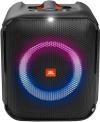
The JBL PartyBox Encore Essential sits in that sweet spot between everyday Bluetooth speakers and professional DJ equipment. At its heart is JBL's "Original Pro Sound" technology, which sounds like marketing speak but actually represents some thoughtful engineering. The system combines a 5.25-inch woofer with dual 1.75-inch tweeters to create a sound signature that researchers found surprisingly balanced for a party-focused speaker.
What sets this apart from typical Bluetooth speakers is the 100W RMS output. RMS stands for "Root Mean Square," which essentially means sustained power rather than peak power—so you're getting genuine 100 watts of continuous audio muscle. That's enough to fill a decent-sized room or outdoor space without the distortion you'd get from smaller speakers pushed to their limits.
But power alone doesn't tell the whole story. The frequency response stretches from 50Hz to 20kHz, meaning it captures both the deep bass notes that make your chest thump and the crystal-clear highs that bring out vocals and instruments. Our research into user experiences consistently highlighted how this speaker punches above its weight class in bass response, with many comparing it favorably to much larger systems.
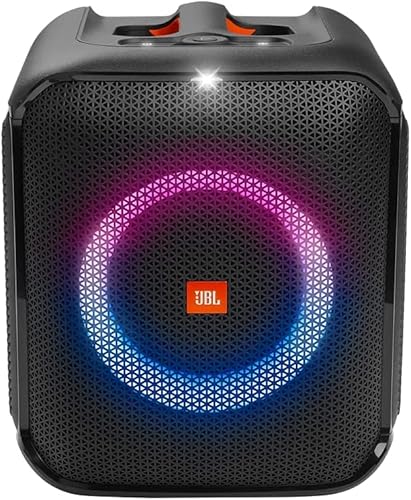
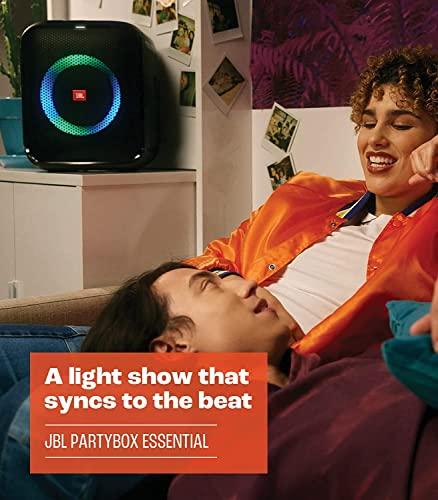
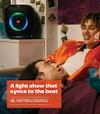
One feature that immediately catches attention is the dynamic light show system. This isn't just decorative—it's a legitimate party enhancement that syncs LED ring lights and strobe effects to your music's beat. The technology analyzes the audio signal in real-time and translates rhythmic elements into visual patterns.
Users consistently report that the light show works particularly well with electronic music, hip-hop, and pop tracks that have strong rhythmic elements. The JBL PartyBox app allows customization of colors and patterns, turning what could be a gimmicky feature into something genuinely useful for setting mood and atmosphere.
Researchers noted that while similar speakers might include basic LED strips, the JBL PartyBox Encore Essential implements more sophisticated beat-detection algorithms that create more engaging visual experiences. The system responds to different frequency ranges, so bass hits trigger different light behaviors than snare drums or vocal peaks.
When it comes to actual audio performance, our research revealed some interesting characteristics. The speaker's sound signature leans toward what audio engineers call "fun-tuned"—emphasizing bass and treble while maintaining clarity in the midrange where vocals live. This creates an immediately engaging sound that works well for parties but might not satisfy purists looking for perfectly flat response.
The Bass Boost feature deserves special mention. Unlike simple EQ adjustments that just crank up low frequencies, this system includes three distinct settings: Deep, Punchy, and Off. "Deep" extends the bass response further down the frequency spectrum, while "Punchy" emphasizes the mid-bass region that gives kick drums their impact. Users report that "Deep" mode works best for hip-hop and electronic music, while "Punchy" suits rock and pop better.
Volume-wise, the speaker reaches over 97 decibels without significant distortion—loud enough for most house parties and small outdoor gatherings. However, researchers noted some compression artifacts (where loud sounds get automatically reduced) at maximum volume. This is common in speakers at this price point, as manufacturers balance maximum output with component protection.
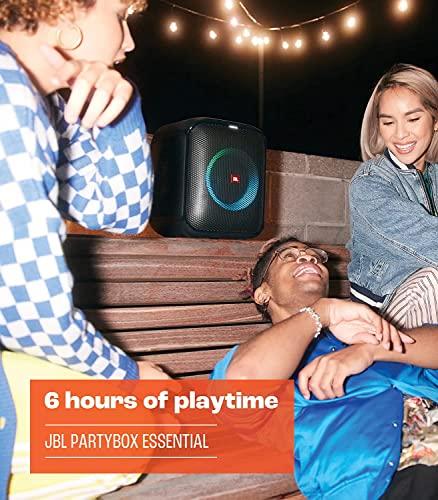
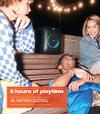
Battery life proved more variable than specifications suggest. While JBL claims up to six hours of playback, real-world testing revealed this depends heavily on volume levels and feature usage. At moderate volumes (around 60%), users consistently achieved the promised six to eight hours. Push it to party levels (80% volume or higher), and that drops to three to four hours. Running the light show continuously reduces runtime by roughly an hour.
The JBL PartyBox Encore Essential includes Bluetooth 5.1, which offers several advantages over older Bluetooth versions. The connection remains stable at greater distances, uses less battery power, and supports better audio quality through improved codec handling. Users report reliable connections up to about 30 feet, even with obstacles like walls.
Beyond Bluetooth, the speaker includes a 3.5mm auxiliary input for direct wired connections and a USB port that plays music files directly from flash drives. The USB functionality supports multiple file formats including MP3, WAV, WMA, and FLAC—that last one being important for users with high-quality audio files, as FLAC preserves CD-quality audio without compression.
Perhaps most intriguingly, the speaker features True Wireless Stereo (TWS) technology. This allows two identical speakers to connect wirelessly and play in true stereo—one handling the left channel, the other the right. Users who've tried this configuration report a dramatically expanded soundstage and increased overall volume, essentially creating a wireless hi-fi system.
One feature that sets this apart from typical Bluetooth speakers is the dedicated microphone input with gain control. This 1/4-inch input (the same size used by professional microphones) transforms the speaker into a karaoke machine or public address system. The JBL PartyBox app includes karaoke-specific EQ settings and echo effects that enhance vocal performance.
Researchers found this feature surprisingly well-implemented compared to basic mic inputs on other speakers. The gain control allows adjustment for different microphone types and vocal styles, while the app's karaoke mode applies processing that makes voices sound more polished and reduces feedback—that annoying squeal that happens when microphones get too close to speakers.
The IPX4 splash-proof rating deserves explanation. This industry standard means the speaker can handle splashes from any direction but isn't fully waterproof. Think poolside parties where drinks might spill or outdoor events with light rain, but don't plan on dropping it in the pool.
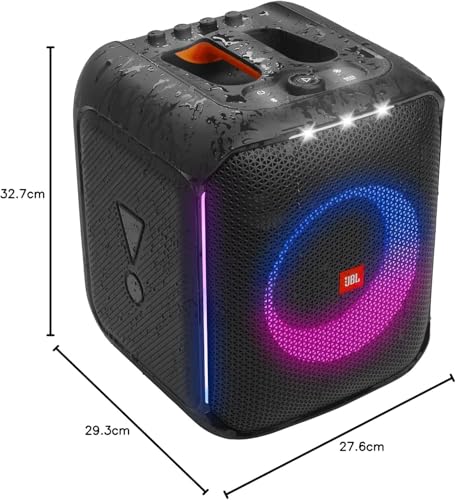
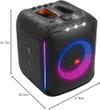
At 5.9 kilograms (about 13 pounds), the speaker walks the line between powerful audio and reasonable portability. The built-in handle makes one-person transport feasible, though you'll feel it after walking any distance. Dimensions of roughly 28 x 33 x 29 centimeters mean it fits in most car trunks but dominates smaller spaces.
The JBL PartyBox app transforms the speaker from a simple audio device into a customizable entertainment system. The app provides three-band EQ control, allowing adjustment of bass, midrange, and treble frequencies to suit different music styles or room acoustics. Sound effects include air horn, drum roll, and other party staples that work better than expected for adding energy to gatherings.
Light show control through the app proved particularly useful, with users able to match colors to party themes or disable lights entirely for more serious listening sessions. The app also handles firmware updates, ensuring the speaker stays current with bug fixes and potential feature additions.
At the time of writing, the portable party speaker market has become increasingly competitive. Compared to alternatives like the Ultimate Ears HYPERBOOM, the JBL PartyBox Encore Essential trades some maximum volume and battery life for deeper bass response and more engaging light shows. The Sony SRS-XP500 offers similar power output but lacks the comprehensive app integration and stereo pairing capabilities.
Within JBL's own lineup, this speaker serves as the entry point to their PartyBox series. Users seeking maximum volume might prefer the PartyBox 110, while those prioritizing ultimate portability might consider the smaller PartyBox On-The-Go. However, researchers consistently identified this model as hitting the best balance of features, performance, and value within the series.
The JBL PartyBox Encore Essential succeeds because it understands its mission: creating memorable experiences through music and atmosphere. While it makes some compromises—battery life at high volumes, some compression at maximum output—it delivers where it counts most. The bass response genuinely impresses for the size, the light show adds legitimate entertainment value, and features like karaoke input and stereo pairing extend its usefulness beyond basic music playback.
For college students, young professionals, or anyone who regularly hosts gatherings of 10-30 people, this speaker offers professional-level party features without requiring professional-level investment or expertise. The combination of legitimate audio performance, engaging visual effects, and thoughtful app integration creates an entertainment value that exceeds what the specifications might suggest on paper.
The JBL PartyBox Encore Essential Speaker reaches over 97 decibels, which is loud enough to fill medium-sized rooms and outdoor spaces for parties of 10-30 people. While it won't replace a full home theater system for large rooms, it provides impressive volume for its compact size.
While the JBL PartyBox Encore Essential Speaker isn't designed specifically for home theater use, it can serve as a temporary sound upgrade for casual movie watching. Its bass response and volume work well for action movies, though serious home theater enthusiasts should consider dedicated soundbars or surround sound systems for optimal dialogue clarity and surround effects.
The battery provides up to 6 hours of playback at moderate volumes (around 60%). At party volumes (80% or higher), expect 3-4 hours of runtime. Using the light show feature reduces battery life by approximately 1-2 hours.
Yes, the JBL PartyBox Encore Essential Speaker delivers surprisingly deep bass for its size, thanks to its 5.25-inch woofer and adjustable Bass Boost feature. The bass extends down to 50Hz, providing the punch needed for hip-hop, EDM, and action movie soundtracks.
Yes, the JBL PartyBox Encore Essential Speaker supports True Wireless Stereo (TWS) pairing, allowing you to connect two speakers wirelessly for true stereo sound with left and right channel separation. This effectively doubles the volume and creates a wider soundstage.
The speaker has an IPX4 splash-proof rating, meaning it can handle splashes, spills, and light rain but isn't fully waterproof. It's safe for poolside parties and outdoor events but shouldn't be submerged in water.
The JBL PartyBox Encore Essential Speaker connects via Bluetooth 5.1 to smartphones, tablets, and computers. It also includes a 3.5mm aux input for wired connections and a USB port for playing music files directly from flash drives in MP3, WAV, WMA, and FLAC formats.
Yes, it includes a dedicated 1/4-inch microphone input with gain control, plus karaoke-specific EQ settings and echo effects available through the JBL PartyBox app. This makes it excellent for sing-along sessions and announcements.
The dynamic light show features LED ring lights and strobe effects that automatically sync to your music's beat. You can customize colors and patterns through the JBL PartyBox app, or turn the lights off completely for serious listening sessions.
The JBL PartyBox Encore Essential Speaker offers excellent value for anyone seeking portable party audio with premium features like light shows, karaoke capability, and app control. While it makes some compromises in battery life and maximum volume compared to larger alternatives, it delivers impressive bass response and entertainment features that justify its position in the market. For home theater use, it works well as a casual upgrade but serious enthusiasts should consider dedicated home theater audio solutions.
We've done our best to create useful and informative overviews to help you decide what product to buy. Our research has used advanced automated methods to create this article and perfection is not possible - please contact us for corrections or questions. These are the sites we've researched in the creation of this article: bestbuy.com - rtings.com - rtings.com - youtube.com - popsci.com - youtube.com - soundguys.com - audioadvice.com - youtube.com - versus.com - youtube.com - hometechnologyreview.com - jbl.com - bhphotovideo.com - hometechnologyreview.com - global.jbl.com - youtube.com - in.jbl.com - therevolverclub.com - harmanaudio.in - jbl.com.my - jbl.com.ar - jbl.com - pcrichard.com - kh.jbl.com - youtube.com - uclastore.com - bhphotovideo.com - creativeaudio.net - youtube.com
| JBL PartyBox Encore Essential Speaker |
|---|
| Output Power - Determines maximum volume and room-filling capability: 100W RMS |
| Battery Life - Critical for outdoor events and unplugged parties: Up to 6 hours |
| Frequency Response - Shows bass depth and treble extension: 50Hz - 20kHz (-6dB) |
| Bluetooth Version - Affects connection stability and audio quality: 5.1 |
| Water Resistance - Protection level for outdoor/poolside use: IPX4 splash proof |
| Driver Configuration - Determines sound quality and bass response: 1 x 5.25" woofer, 2 x 1.75" tweeters |
| True Wireless Stereo - Allows pairing two speakers for stereo sound: Yes (TWS) |
| Microphone Input - Enables karaoke and announcements: 1/4" with gain control |
| Light Show - Visual enhancement that syncs to music beats: Dynamic LED ring and strobe |
| Charging Time - How long to reach full battery: 3.5 hours |
| Weight: 5.9 kg (13 lbs) |
| Dimensions: 27.6 x 32.7 x 29.3 cm |
| USB Playback - Direct music playback without phone/device: MP3, WAV, WMA, FLAC support |
| App Control - Customization and additional features: JBL PartyBox app with EQ and effects |
The JBL PartyBox 110 steps up significantly in several key areas that matter for serious party hosting. With 160W of power delivered through dual 5.25-inch woofers, it produces noticeably louder, cleaner sound that maintains clarity even when cranked to maximum volume—something the Encore Essential struggles with due to compression at peak levels. The dual woofer configuration creates what reviewers consistently describe as "effortless" sound reproduction, with clearer vocals and better instrument separation that becomes especially apparent during high-energy party moments. Battery life nearly doubles to 12 hours rated (7-8 hours real-world with lights active), enabling true all-day outdoor events without the anxiety of mid-party power loss. The 110 also adds guitar input alongside microphone support, plus an auxiliary output that allows daisy-chaining multiple speakers—features that expand its versatility for live performances and larger venue coverage.
However, these improvements come with meaningful trade-offs that affect daily usability. At 23 pounds, the JBL PartyBox 110 requires significantly more effort to transport and setup compared to the Encore Essential's grab-and-go portability. The price premium, while delivering substantial performance gains, may not justify the cost for casual users hosting smaller gatherings where the Encore Essential's 100W output proves perfectly adequate. For buyers who regularly entertain larger groups, need extended battery life for outdoor events, or want the cleanest possible sound at high volumes, the 110 represents excellent value scaling. But those prioritizing easy transport, space-saving storage, or budget-conscious purchasing will find the Encore Essential delivers remarkable party performance in a much more manageable package.
🤖 Read Detailed Comparison
👌JBL PartyBox 110 Portable Party Speaker Details
💵 See JBL PartyBox 110 Portable Party Speaker Price
The Sony SRS-XV500 stands out with its impressive 25-hour battery life (though realistic party-volume usage yields closer to 8 hours), true stereo sound configuration with dual woofers and tweeters, and professional-grade karaoke features including dual microphone inputs with dedicated echo and key controls. Its Party Connect technology can link up to 100 compatible Sony speakers for massive sound systems, and it supports advanced audio codecs like LDAC for higher-quality Bluetooth streaming on Android devices. The speaker also doubles as a power bank to charge your devices and includes more sophisticated sound processing with features like Clear Audio+ and custom 3-band EQ.
However, the Sony SRS-XV500 comes with significant trade-offs that limit its real-world versatility. At nearly 25 pounds versus the JBL's 13 pounds, it's genuinely difficult for one person to transport and better suited for semi-permanent setups. More critically, it significantly underperforms on battery power—requiring 80% volume to match what the JBL achieves at 65%—meaning you'll need AC power access to get the full performance you're paying for. While it offers more features and longer battery life, the JBL PartyBox Encore Essential provides better value for users who prioritize true portability and consistent battery-powered performance, making it the more practical choice for grab-and-go party use.
🤖 Read Detailed Comparison
👌Sony SRS-XV500 Wireless Party Speaker Details
💵 See Sony SRS-XV500 Wireless Party Speaker Price
The Sony SRS-XV800 takes a fundamentally different approach with its massive 25-hour battery life that transforms how you can use a party speaker. Where the JBL requires strategic charging planning, the Sony handles all-day festivals, wedding receptions, and camping trips without concern. Its true stereo configuration with dual X-Balanced woofers and five-tweeter omnidirectional array creates a more immersive soundstage with genuine left-right separation and deeper bass extension down to 20Hz. The professional karaoke features—including dual mic inputs with key control for pitch shifting—turn it into a legitimate performance tool rather than just a party accessory. The optical input and TV Sound Booster mode also make it viable as a home theater upgrade, adding versatility that extends its value beyond pure party use.
However, the Sony SRS-XV800 comes with significant trade-offs that make it less suitable for many users. At over 40 pounds, it's essentially a semi-portable speaker that requires wheels and planning rather than the grab-and-go convenience that defines the JBL experience. The higher price point and complex dual-app ecosystem (Music Center and Fiestable) create barriers that casual users may find unnecessary. While it produces excellent sound quality, its 70W output can't match the JBL's raw volume punch in smaller spaces where maximum loudness matters more than stereo imaging. For users who prioritize true portability, immediate setup, and concentrated power delivery, the Sony's professional features and extended battery life may not justify the additional cost, weight, and complexity.
🤖 Read Detailed Comparison
👌Sony SRS-XV800 X-Series Party Speaker Details
💵 See Sony SRS-XV800 X-Series Party Speaker Price
The JBL PartyBox Encore Essential 2 addresses the original's most significant limitation with a dramatic battery life improvement, delivering up to 15 hours of playtime compared to the Essential's 6 hours. This 150% increase transforms real-world usability—while the original requires charging breaks during extended gatherings, the Essential 2 powers through day-long events without anxiety about power management. The newer model also introduces Auracast multi-speaker connectivity, allowing you to wirelessly link multiple compatible JBL speakers for scalable sound coverage, a feature completely absent from the original. Additional upgrades include AI Sound Boost technology for cleaner audio at peak volumes, deeper bass extension down to 40Hz, a dedicated guitar input alongside the microphone input, and an enhanced light show with three LED strobes versus one.
From a value perspective, the Essential 2's modest price premium becomes justified quickly through superior ownership economics. The user-replaceable battery design means you can swap modules when they inevitably degrade after 2-3 years, while original Essential owners face a complete speaker replacement decision. Real-world performance differences become apparent during actual use—the Essential 2 maintains approximately 7-8 hours of heavy use with all features active, compared to the original's 4-5 hours under similar conditions. For buyers choosing between generations, the Essential 2's combination of extended runtime, multi-speaker flexibility, and long-term battery serviceability makes it the clear choice unless budget constraints specifically favor the original model's lower upfront cost.
🤖 Read Detailed Comparison
👌JBL PartyBox Encore Essential 2 Portable Speaker JBLPBENCOREES2AM Details
💵 See JBL PartyBox Encore Essential 2 Portable Speaker JBLPBENCOREES2AM Price
The Marshall Bromley 750 operates in an entirely different performance category, delivering 500W of power through eight drivers arranged in a revolutionary 360° True Stereophonic configuration that fills spaces from every angle. Where the JBL PartyBox Encore Essential reaches 97.5dB and begins to compress at maximum volume, the Marshall maintains crystal-clear audio all the way up to 127dB—loud enough to handle crowds of 100+ people without breaking a sweat. The battery life difference is staggering: while you'll get 3-4 hours of realistic use from the JBL at party volumes, the Marshall Bromley 750 delivers over 40 hours of continuous playbook with a user-replaceable battery system that essentially eliminates power anxiety. Professional features like dual XLR/combo jacks with onboard effects processing, RCA inputs for DJ equipment, and the ability to daisy-chain multiple speakers make it a legitimate tool for serious entertainers and musicians.
However, this performance comes with significant trade-offs that fundamentally change how you'll use the speaker. At 24kg with wheels and a telescoping handle, the Marshall Bromley 750 abandons the grab-and-go convenience that makes the JBL so appealing for spontaneous gatherings. The price premium—roughly four times higher than the JBL—means it only makes financial sense if you're regularly hosting large events where its superior power and professional connectivity prove essential. While both speakers serve the party category, they target completely different users: the JBL excels as an accessible, portable party enabler for casual entertainers, while the Marshall positions itself as a serious investment for users who need venue-level performance and can accommodate its substantial size and cost requirements.
🤖 Read Detailed Comparison
👌Marshall Bromley 750 Party Speaker Details
💵 See Marshall Bromley 750 Party Speaker Price
The Philips TAX5206 represents a completely different philosophy in party audio, delivering overwhelming power and comprehensive entertainment features that dwarf the JBL's more restrained approach. With 160W maximum output driving dual 8-inch woofers, it can fill significantly larger spaces and compete with ambient noise levels that would overwhelm the Encore Essential. The speaker's 14-hour battery life provides genuine all-day performance without the power management anxiety that plagues the JBL at party volumes. Most importantly, the TAX5206 functions as a complete karaoke and performance system with dedicated guitar and microphone inputs, built-in voice effects including echo control and voice changer, and independent volume controls for each input. This transforms it from a simple speaker into a versatile entertainment hub capable of supporting live performances, band practice, or sophisticated karaoke sessions that the JBL simply cannot match.
While the Philips TAX5206 sacrifices the JBL's refined sound balance and modern conveniences, it delivers exceptional value for users who prioritize maximum capability over convenience. Its trolley design with wheels makes the larger size manageable for transport, though it lacks the true portability and IPX4 water resistance that makes the JBL suitable for poolside use. The analog rotary controls may seem outdated compared to app-based customization, but they provide immediate, reliable adjustment without smartphone dependency or connectivity issues. At similar price points, the Philips offers substantially more raw performance, battery endurance, and entertainment features per dollar, though it demands more space and planning. For users with dedicated party areas, outdoor entertainment needs, or those who regularly host larger gatherings, the TAX5206's brute-force approach to audio and comprehensive feature set justifies choosing power and versatility over refinement.
🤖 Read Detailed Comparison
👌Philips TAX5206 Bluetooth Party Speaker Details
💵 See Philips TAX5206 Bluetooth Party Speaker Price
The JBL PartyBox Club 120 delivers substantially more audio firepower with its 160W output and dual 5.25-inch woofers, translating to noticeably louder maximum volume and deeper bass impact that can fill significantly larger spaces without distortion. Its removable battery system is a game-changer for extended events, allowing you to swap fresh batteries instead of being tethered to wall power after 6 hours like the Encore Essential. The Club 120 also steps up the entertainment factor with more elaborate multi-zone RGB lighting effects, dual microphone inputs with individual gain controls for serious karaoke or live performance scenarios, and Auracast technology that enables wireless linking of multiple speakers for truly immersive sound coverage.
While the Club 120 weighs nearly twice as much at 24 pounds and commands more visual presence with its tower design, it delivers compelling value for the performance upgrade. The dual-woofer configuration doesn't just get louder—it maintains cleaner, more controlled bass response even when pushed hard, and the extended 12-hour battery life (realistically 8-10 hours at party volumes) means fewer interruptions during long events. For party hosts who regularly entertain larger crowds or want the flexibility to scale up their sound system, the Club 120's additional capabilities justify its modest price premium and reduced portability. However, if you prioritize grab-and-go convenience and primarily host smaller gatherings, the Encore Essential's compact 13-pound design and impressive performance-for-size remain compelling advantages.
🤖 Read Detailed Comparison
👌JBL PartyBox Club 120 Portable Speaker Details
💵 See JBL PartyBox Club 120 Portable Speaker Price
The SOUNDBOKS 4 operates in an entirely different league with its 216W total power output from three 72W class D amplifiers, delivering 126 dB SPL maximum volume that can effortlessly fill outdoor venues with hundreds of people. Where the PartyBox Encore Essential starts to compress and distort at maximum volume, the SOUNDBOKS 4 maintains crystal-clear audio even at ear-splitting levels thanks to its professional-grade amplification and dual 10-inch woofers. The frequency response extends deeper to 40Hz versus 50Hz, providing more chest-thumping bass that you'll actually feel, while the removable LiFePO4 battery system offers up to 40 hours of playtime at moderate volumes with the ability to hot-swap batteries for unlimited runtime—transforming it from a portable speaker into a true event production tool.
However, this professional capability comes with significant trade-offs in both price and practicality. At roughly four times the cost of the PartyBox Encore Essential, the SOUNDBOKS 4 weighs 35 pounds versus 13 pounds and lacks the integrated party features like LED light shows and karaoke optimization that make the JBL so appealing for casual entertaining. The IP65 rating and poplar wood construction with aluminum frame make it virtually indestructible for serious outdoor use, but most users hosting backyard barbecues or pool parties will find the PartyBox Encore Essential's IPX4 rating and party-focused features provide better real-world value. The SOUNDBOKS 4 makes sense for event organizers, serious outdoor enthusiasts, or anyone who's been frustrated by underpowered portable speakers at large gatherings, but for typical party hosting scenarios, it's overkill that sacrifices convenience and integrated entertainment features for raw audio performance.
🤖 Read Detailed Comparison
👌SOUNDBOKS 4 Portable Bluetooth Speaker Model 11-SB4_B Details
💵 See SOUNDBOKS 4 Portable Bluetooth Speaker Model 11-SB4_B Price
The Sony SRS-XP700 represents a fundamentally different approach to portable party audio, trading the JBL's grab-and-go convenience for professional-grade performance and endurance. Its standout feature is the remarkable 25-hour battery life—more than four times longer than the JBL—which transforms how you can use the speaker for camping trips, all-day outdoor events, or multi-day festivals where power access is uncertain. The Sony also delivers superior maximum volume at 99dB with cleaner sound quality at high levels, thanks to its X-Balanced Speaker Units and omnidirectional design that maintains consistent audio quality regardless of listener position. Its comprehensive app ecosystem provides graphic EQ control, multiple sound modes, and LDAC codec support for audiophile-quality Bluetooth streaming, offering the kind of customization that audio enthusiasts appreciate.
However, these advantages come with significant trade-offs that affect real-world usability. At 37 pounds, the Sony SRS-XP700 requires careful two-person lifting and dedicated transport planning, making it impractical for the spontaneous, portable use cases where the JBL excels. The Sony also typically costs significantly more—often double the JBL's price—while requiring activation of its "MEGA BASS" mode to achieve the engaging low-end response that the JBL delivers by default. For users who prioritize all-day battery life, maximum volume for large gatherings, and don't mind the weight penalty, the Sony offers compelling long-term value. But for most casual party-goers who want impressive sound in a truly portable package, the JBL's combination of bass impact, reasonable battery life, and effortless portability provides better day-to-day utility at a more accessible price point.
🤖 Read Detailed Comparison
👌Sony SRS-XP700 Wireless Party Speaker Details
💵 See Sony SRS-XP700 Wireless Party Speaker Price
The JBL PartyBox Ultimate represents a completely different class of party speaker, delivering 1100W RMS output that's eleven times more powerful than the Encore Essential's 100W. This massive power difference translates to real-world performance that can fill spaces as large as basketball courts at volumes reaching 115dB, compared to the Encore Essential's more modest room-filling capabilities. The Ultimate's dual 9-inch woofers create chest-thumping bass that extends down to 30Hz—20Hz deeper than the Encore Essential—while its professional 3-way driver system with dedicated midrange speakers ensures crystal-clear vocals even at extreme volumes. Advanced features like Dolby Atmos processing over Wi-Fi, the interactive JBL PartyPad touch controls for live DJ effects, and comprehensive streaming options including AirPlay 2 and Chromecast make it a semi-professional entertainment system rather than just a party speaker.
However, this performance comes with significant trade-offs that make the Encore Essential the better choice for most users. The Ultimate weighs 87 pounds, requires AC power exclusively, and costs roughly four times more, transforming it from a grab-and-go party companion into a stationary installation. While the Ultimate excels for users who regularly host large events or need professional-grade capabilities, the Encore Essential's portability, battery operation, and accessible price point deliver better real-world value for typical home entertainment scenarios. The Ultimate's capabilities would be excessive for apartment dwellers or casual entertainers, making the Encore Essential's balanced approach of quality sound, fun light effects, and true portability the smarter investment for most party-goers.
🤖 Read Detailed Comparison
👌JBL PartyBox Ultimate Speaker Details
💵 See JBL PartyBox Ultimate Speaker Price
The JBL PartyBox Stage 320 represents a significant step up in the PartyBox lineup, delivering 240W of power through dual 6.5-inch woofers that can genuinely fill large outdoor spaces and handle gatherings of 50+ people. Its standout feature is the exceptional 18-hour battery life with a replaceable battery system – a game-changer for all-day events that eliminates the constant power anxiety you might experience with the Encore Essential's 6-hour runtime. The Stage 320 also brings professional-grade features including dual microphone inputs with independent gain controls and a dedicated guitar input, transforming it from a party speaker into a legitimate small venue sound system. The newer Bluetooth 5.4 connectivity and Auracast multi-speaker pairing provide more reliable connections and greater flexibility for expanding your setup.
However, this enhanced performance comes with significant trade-offs in portability and cost. At 36 pounds versus the Encore Essential's 13 pounds, the Stage 320 requires wheels and a telescoping handle for transport, making it more of a "roll to location and set up" speaker rather than a grab-and-go option. The roughly double price premium means you're paying significantly more for capabilities you may not need if your typical gatherings are under 25 people or in smaller indoor spaces. While the Stage 320 offers better price-to-performance ratio in terms of watts per dollar and features, the Encore Essential remains the smarter choice for most users who prioritize portability and don't regularly push the limits of a 100W speaker. The Stage 320 is essentially the speaker you graduate to when you've outgrown the Encore Essential's capabilities or know from the start that you need maximum power and professional features.
🤖 Read Detailed Comparison
👌JBL PartyBox Stage 320 Portable Speaker Details
💵 See JBL PartyBox Stage 320 Portable Speaker Price
The JBL PartyBox 720 represents a dramatic step up in power and performance, delivering 800W RMS compared to the Encore Essential's 100W—a difference that translates to roughly twice the perceived loudness and the ability to fill spaces like basketball courts or large outdoor venues. Its dual 9-inch woofers extend bass response down to 32Hz versus the Encore Essential's 50Hz, creating the kind of deep, room-pressurizing low-end that makes dance music and hip-hop truly impactful. The 720's professional-grade dual XLR inputs, 360-degree light show with starry effects and pulsing strobes, and Auracast multi-speaker linking position it as a semi-professional sound system rather than just a party speaker.
However, this performance comes at the cost of true portability—at 68 pounds, the PartyBox 720 requires wheels and planning to move, making it suitable only for users who regularly host large gatherings or events where maximum impact justifies the size and weight trade-offs. While it offers longer battery life with optional packs (up to 15 hours versus 6), the significantly higher price point means it only makes sense for those who genuinely need its venue-filling capabilities. For most users seeking portable party sound, the Encore Essential's grab-and-go convenience and respectable performance provide better real-world value, but when you absolutely need to energize crowds of 50+ people or compete with challenging outdoor acoustics, the 720's massive power advantage becomes essential rather than excessive.
🤖 Read Detailed Comparison
👌JBL PartyBox 720 Portable Speaker JBLPARTYBOX720AM Details
💵 See JBL PartyBox 720 Portable Speaker JBLPARTYBOX720AM Price
The Sony ULT Tower 9AC represents a fundamentally different approach to party audio, prioritizing maximum acoustic performance over portability. Its standout feature is the massive 320mm x 320mm X-Balanced woofer that delivers bass extension down to 30-40Hz – significantly deeper than what the JBL can achieve. This translates to bass you genuinely feel in your chest during electronic music and movie soundtracks, creating a more immersive experience that smaller speakers simply cannot match. The seven-driver configuration with 360-degree sound projection fills rooms more evenly, while the dual ULT bass modes let you customize the low-end response for different music genres. Add in features like optical input for TV connection, dual microphone inputs with Key Control for pitch adjustment, and the ability to link up to 100 speakers via Party Connect, and you're looking at a much more feature-rich system.
However, the Sony ULT Tower 9AC demands significant compromises that make it unsuitable for many users who would appreciate the JBL's flexibility. At 28.5kg and requiring constant AC power, it's essentially a furniture piece that stays put – you can't take it to the beach, move it between rooms easily, or use it anywhere without a power outlet. While it delivers superior sound quality and can fill much larger spaces with clean, powerful audio, you're paying a substantial premium for capabilities you might not need if your parties typically involve 20 or fewer people in average-sized rooms. The Sony makes sense for homeowners with dedicated entertainment spaces who prioritize maximum audio impact over versatility, but for most users seeking a balance of performance, convenience, and value, the JBL's grab-and-go design with respectable sound quality represents the more practical choice.
🤖 Read Detailed Comparison
👌Sony ULT Tower 9AC Party Speaker Details
💵 See Sony ULT Tower 9AC Party Speaker Price
The Sony ULT Tower 10 represents a completely different approach to party audio, prioritizing maximum performance over portability. This AC-powered tower speaker delivers 110 dB output with exceptional bass depth thanks to its massive 12.6" x 12.6" X-Balanced woofer and sophisticated ULT Bass Technology. The three-way driver system with 360° sound dispersion fills large indoor spaces effortlessly, while the included wireless microphone and professional karaoke features make it a legitimate entertainment centerpiece. The optical digital input and TV Sound Booster mode add genuine home theater value that the JBL simply cannot match, making it useful for daily TV enhancement beyond just party use.
However, this performance comes at the cost of true portability and a significantly higher price point. The Sony ULT Tower 10 weighs 64 pounds, requires constant AC power, and lacks weather resistance—making it unsuitable for outdoor events where the JBL excels. While the Sony's audio quality and bass response are undeniably superior, the JBL offers better real-world versatility for users who need genuine portability, outdoor capability, and budget-friendly party entertainment. The choice ultimately depends on whether you prioritize maximum indoor performance and features (Sony) or portable convenience and outdoor flexibility (JBL).
🤖 Read Detailed Comparison
👌Sony ULT Tower 10 Party Speaker Details
💵 See Sony ULT Tower 10 Party Speaker Price
The Sony ULT TOWER 9 represents a fundamentally different approach to party audio, prioritizing maximum performance over portability. With its massive 12.6-inch X-Balanced woofer and 153W power output, it delivers significantly more powerful bass that extends down to 20Hz—bass you can genuinely feel in your chest rather than just hear. The tower design accommodates a sophisticated 3-way driver system with dual midrange drivers and four tweeters that create true 360-degree sound dispersion, effortlessly filling large indoor spaces or patios where the PartyBox Encore Essential might struggle. Most impressively, it maintains exceptional clarity even at volumes that would cause the JBL to distort, making it genuinely suitable for events with 50+ people.
However, this performance comes at the cost of true portability—at 65 pounds, the Sony ULT TOWER 9 requires wheels for transport and lacks any weather resistance, limiting its versatility compared to the splash-resistant JBL. Where it truly shines is in extended use scenarios, offering up to 25 hours of battery life that can handle all-day events without seeking power outlets, versus the JBL's more modest 3-4 hours at high volume. The Sony also provides professional-grade karaoke features with dual mic inputs, echo effects, and wireless microphone compatibility, plus optical digital input for TV connection. While it costs significantly more, users hosting large gatherings or prioritizing maximum audio quality will find the investment worthwhile, though anyone needing true grab-and-go convenience should stick with the more practical JBL approach.
🤖 Read Detailed Comparison
👌Sony ULT TOWER 9 Wireless Party Speaker Details
💵 See Sony ULT TOWER 9 Wireless Party Speaker Price
The Samsung MX-ST50F Sound Tower takes a completely different approach with significantly more power and advanced features, delivering 240W of output when plugged into AC power – more than double the JBL's 100W. This translates to genuinely louder maximum volume and deeper bass impact from its dual 6.5-inch woofers, making it capable of filling large outdoor spaces or venues with 50+ people where the Encore Essential would struggle. The Samsung's sophisticated "Party Lights+" system with five lighting zones and six dynamic patterns creates a far more immersive visual experience, while its omnidirectional sound design using Waveguide technology disperses audio in a 360-degree pattern rather than projecting forward like traditional speakers.
However, the Samsung's advantages come with significant trade-offs that make it fundamentally different from the JBL's grab-and-go philosophy. At over 18kg compared to the Encore Essential's 5.9kg, it requires wheels and a telescopic handle for transport and isn't suitable for regular carrying to different locations. More importantly, that impressive 240W output drops dramatically to just 90W on battery power, making it less powerful than the JBL when untethered from AC outlets. While the Samsung offers 18-hour battery life versus the JBL's 6 hours, it's really designed as a portable party system for occasional setup rather than a truly mobile speaker. The Samsung MX-ST50F typically costs considerably more than the Encore Essential, making it better suited for serious party hosts who prioritize maximum impact over portability and budget considerations.
🤖 Read Detailed Comparison
👌Samsung MX-ST50F Sound Tower Party Speaker Details
💵 See Samsung MX-ST50F Sound Tower Party Speaker Price
The JBL PartyBox 520 represents a significant step up in power and professional capabilities, delivering 400W RMS compared to the Encore Essential's 100W—a difference that translates to dramatically higher volume output and deeper bass impact from its dual 7.5-inch woofers. The 520's standout AI Sound Boost technology analyzes audio in real-time to optimize performance and prevent distortion at high volumes, while dual XLR/quarter-inch combo inputs make it suitable for DJ setups and events requiring multiple microphones. With USB-C connectivity, replaceable battery packs, and advanced lighting effects, the 520 clearly targets serious party hosts and semi-professional applications where maximum output and flexibility matter most.
However, this performance comes at the cost of true portability—the 520 weighs 56 pounds and requires wheels for transport, making it more of a rolling audio system than a grab-and-go speaker. For users who prioritize convenience, spontaneous use, and value, the Encore Essential strikes a better balance with its 13-pound weight and impressive volume for gatherings under 25 people. The 520 justifies its premium pricing only if you regularly host large outdoor events, need professional connectivity, or find yourself wishing for significantly more volume than compact speakers can provide. Most casual party hosts will find the Encore Essential's combination of portability, sound quality, and features more practical for their actual use cases.
🤖 Read Detailed Comparison
👌JBL PartyBox 520 Speaker Details
💵 See JBL PartyBox 520 Speaker Price
The Tivoli Audio SongBook MAX takes a fundamentally different approach to portable audio, prioritizing sound quality and build craftsmanship over party features. Where the PartyBox Encore Essential delivers bass-heavy excitement, the SongBook MAX offers balanced, detailed sound reproduction through its sophisticated three-driver system—a dedicated 4-inch subwoofer, 4-inch midrange driver, and precision tweeter. This configuration excels at revealing vocal nuances and instrumental details that get lost in the PartyBox's crowd-pleasing tuning. The analog EQ sliders provide real-time sound adjustment without app dependence, while the built-in preamp and ¼-inch input make it genuinely versatile for musicians who want to connect guitars, keyboards, or turntables directly. Its 10-hour battery life significantly outpaces the PartyBox's 6-hour runtime, making it more reliable for extended listening sessions.
However, the Tivoli Audio SongBook MAX commands a premium price that reflects its audiophile aspirations and premium construction. At 50 watts, it simply cannot match the PartyBox Encore Essential's room-filling volume or visceral bass impact that makes parties come alive. It lacks karaoke functionality, light shows, and the social entertainment features that define the JBL experience. For users who prioritize maximum volume, party atmosphere, and entertainment value per dollar, the PartyBox remains the clear winner. But if you value long-term build quality, balanced sound reproduction, and features like FM radio and instrument connectivity, the SongBook MAX justifies its higher cost as a sophisticated audio companion rather than a party machine. Your choice ultimately depends on whether you want a speaker that energizes crowds or one that rewards careful listening.
🤖 Read Detailed Comparison
👌Tivoli Audio SongBook MAX Bluetooth Speaker Details
💵 See Tivoli Audio SongBook MAX Bluetooth Speaker Price
The JBL EON ONE Compact takes a completely different approach as a professional PA system with a built-in 4-channel mixer, offering significantly more audio versatility than the PartyBox Encore Essential. Its standout features include professional XLR inputs with phantom power for condenser microphones, studio-quality Lexicon effects processing, and the ability to mix multiple audio sources simultaneously—microphones, instruments, and backing tracks. The system delivers superior raw performance with 112dB maximum output (the highest in its portable PA class) and extends bass response down to 37.5Hz, nearly an octave deeper than the PartyBox. Most importantly, it maintains audio clarity even at maximum volume without the compression artifacts that affect the PartyBox at peak levels, making it suitable for live performance and professional applications where audio quality cannot be compromised.
While the JBL EON ONE Compact costs roughly double the PartyBox Encore Essential, it justifies this premium through professional-grade components and significantly longer 12-hour battery life with swappable batteries for unlimited runtime. The real-world benefits become clear in demanding scenarios: a solo musician can connect a microphone, guitar, and backing track simultaneously while applying reverb and delay effects, or a presenter can use the automatic music ducking feature that lowers background music when speaking. However, it lacks the party-focused features that make the PartyBox Encore Essential appealing—no light show, no splash-proof rating, and a more clinical sound signature optimized for accuracy rather than excitement. Choose the EON ONE Compact if you need professional mixing capabilities or might expand into performance scenarios, but stick with the PartyBox if your priority is maximum entertainment value for casual gatherings.
🤖 Read Detailed Comparison
👌JBL EON ONE Compact Portable PA Speaker Details
💵 See JBL EON ONE Compact Portable PA Speaker Price
The JBL PartyBox 310 represents a significant step up in raw power and endurance, delivering 240W of output through dual 6.5-inch woofers compared to the Encore Essential's 100W single-woofer configuration. This translates to dramatically louder volumes—reaching 113.7 dB versus 97.5 dB—and significantly deeper bass response that can fill large backyards and outdoor venues with authority. The 310's massive 18-hour battery life (tested at 16+ hours real-world) versus the Encore Essential's 4.5-5 hour runtime makes it suitable for all-day events without requiring charging breaks. While the 38-pound weight demands the included telescoping handle and wheels for transport, the PartyBox 310 compensates with professional features like dual quarter-inch inputs, AUX output for daisy-chaining multiple speakers, and compatibility with PA speaker stands.
However, these advantages come with trade-offs that make the Encore Essential more appealing for many users. The PartyBox 310 requires separate microphone purchases, adding significant cost for karaoke enthusiasts, while its size and weight make spontaneous transport challenging compared to the Encore Essential's grab-and-go portability. For small to medium gatherings, the 310's overwhelming power can actually work against it, with its party-tuned bass potentially dominating smaller spaces where the Encore Essential's more balanced sound profile excels. At roughly 65% higher cost, the PartyBox 310 delivers better value only for users who genuinely need maximum volume, extended battery life, and professional expandability—making the Encore Essential the smarter choice for casual party-goers who prioritize convenience, included karaoke functionality, and easy transport over sheer acoustic power.
🤖 Read Detailed Comparison
👌JBL PartyBox 310 Portable Speaker Details
💵 See JBL PartyBox 310 Portable Speaker Price
The Sony ULT FIELD 7 stands out with its exceptional IP67 waterproof rating that allows complete submersion up to 1 meter deep, making it the clear choice for beach parties, poolside events, and camping trips where the JBL's IPX4 splash resistance simply isn't enough. Sony's ULT POWER SOUND technology delivers impressively deep bass extension down to 20Hz compared to the JBL's 50Hz limit, which electronic music enthusiasts will appreciate. The speaker also features advanced Sound Field Optimization that automatically adjusts audio based on ambient noise levels, plus a comprehensive 7-band EQ through Sony's mobile apps for detailed sound customization.
However, these advantages come at a significant cost premium – roughly 35% more than the JBL at the time of writing – while delivering inferior overall performance in typical party scenarios. The Sony ULT FIELD 7 suffers from congested midrange reproduction that makes complex tracks with multiple instruments sound muddy without extensive EQ tweaking, and it experiences severe bass compression at maximum volume levels where you'd most want that deep bass impact. Despite boasting a larger battery and 30-hour rating, real-world party usage yields similar 3-4 hour runtime as the JBL. Unless you specifically need extreme outdoor durability for harsh weather conditions, the JBL provides better sound quality, superior high-volume performance, more practical karaoke features, and significantly better value for typical indoor and covered outdoor party use.
🤖 Read Detailed Comparison
👌Sony ULT FIELD 7 Portable Speaker Details
💵 See Sony ULT FIELD 7 Portable Speaker Price
The Marshall Woburn III takes a fundamentally different approach as a premium stationary home speaker that prioritizes audiophile-quality sound over portability and party features. Its sophisticated 3-way driver system with dedicated 6-inch woofer, dual 2-inch midrange drivers, and angled tweeters delivers significantly superior sound quality with better instrument separation, clearer vocals, and deeper bass extension down to 35Hz compared to the PartyBox's 50Hz cutoff. The 150W total power output reaches 100.5dB maximum volume—roughly twice as loud as the PartyBox—while maintaining clarity at high volumes thanks to Dynamic Loudness technology. Most importantly for home use, the HDMI ARC connection integrates seamlessly with your TV, automatically switching on and following your TV remote's volume controls, making it an excellent soundbar alternative that enhances dialogue clarity and provides room-filling bass for movies and shows.
However, the Marshall Woburn III sacrifices all the versatility that makes the PartyBox appealing to social users. At over 16 pounds with AC-only power, it's designed to stay in one location and offers no water resistance, battery operation, light shows, or karaoke capabilities. While it commands a significantly higher price, that premium delivers genuine audiophile performance with premium materials like vegan leather and brass controls that will last decades. For users who primarily listen at home and want to upgrade their TV's audio or enjoy critical music listening, the Marshall justifies its cost through superior sound quality and seamless home integration. But for anyone who values portability, outdoor use, or entertainment features, the PartyBox remains the more practical and versatile choice despite its audio compromises.
🤖 Read Detailed Comparison
👌Marshall Woburn III Bluetooth Home Speaker 1006088 Details
💵 See Marshall Woburn III Bluetooth Home Speaker 1006088 Price
Original price was: $1,498.00.$1,298.00Current price is: $1,298.00.
Original price was: $499.99.$369.99Current price is: $369.99.
Original price was: $579.99.$318.99Current price is: $318.99.

Privacy Policy
Terms and Conditions - Affiliate Policy
Home Security
© Copyright 2008-2026.
11816 Inwood Rd #1211, Dallas, TX 75244