






Amazon shook up their smart speaker lineup in 2025 with two compelling options that target very different users. The Echo Studio represents their flagship audio experience, while the Echo Dot Max introduces a new middle-tier category that didn't exist before. Both speakers share Amazon's latest technology, but choosing between them requires understanding some key performance differences and use case scenarios.
Smart speakers have evolved far beyond simple voice assistants. Today's premium models serve as music systems, smart home command centers, and even home theater components. The challenge lies in finding the right balance between audio quality, smart features, space requirements, and budget constraints.
Modern smart speakers need to excel in several areas simultaneously. Audio quality remains paramount—nobody wants a voice assistant that makes their favorite songs sound flat or tinny. Smart home integration has become equally important, with the best speakers serving as central hubs that can control lights, thermostats, and security systems without requiring separate devices.
Room coverage represents another crucial consideration. A speaker that sounds great from three feet away but falls apart across a living room won't satisfy most users. The physical footprint matters too—not everyone has space for a large speaker, regardless of how good it sounds.
Value calculations have become more complex as smart speakers mature. The days of choosing between basic functionality and premium audio are ending. Today's buyers expect both, but at what price point and with which compromises?
Amazon launched both the Echo Studio and Echo Dot Max simultaneously in October 2025, representing their most significant speaker refresh in years. The timing wasn't coincidental—these releases respond to increased competition from Apple's HomePod lineup and growing consumer expectations for premium audio quality.
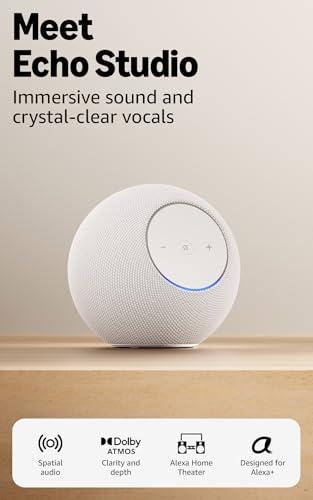
The Echo Studio completely reimagines Amazon's flagship speaker. The 2019 original was a cylindrical tower that, while impressive sonically, occupied substantial shelf space and didn't fit every room's aesthetic. The 2025 version shrinks by 40% while maintaining audio performance—a remarkable engineering achievement that makes premium sound more accessible.
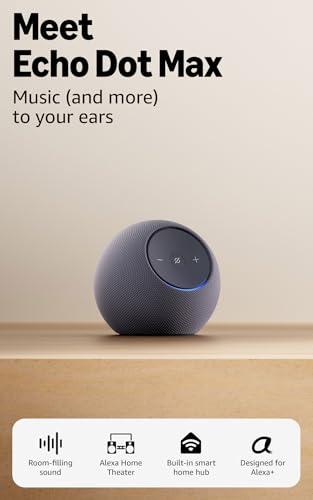
The Echo Dot Max fills a gap that Amazon never properly addressed. Previous Echo Dots prioritized affordability over audio quality, while the full-size Echo couldn't match dedicated music speakers. The Dot Max bridges this divide, offering genuinely improved sound in a compact package.
Both speakers benefit from Amazon's custom AZ3 chip architecture, which processes artificial intelligence tasks locally rather than relying entirely on cloud computing. This enables faster response times and more natural conversation flows with Alexa.
Understanding speaker drivers helps explain why these two products sound so different. Drivers are the individual speakers inside the cabinet that reproduce different frequency ranges. Think of them like musicians in an orchestra—each has a specific role, and the combination creates the full musical experience.
The Echo Studio employs four drivers: one large 5.25-inch woofer dedicated to bass frequencies, plus three smaller full-range drivers that handle midrange and treble sounds. This configuration allows each driver to specialize, reducing distortion and improving clarity. The woofer faces downward, using the surface beneath the speaker to reinforce bass response—a technique called acoustic coupling.
The Echo Dot Max represents the first Echo Dot with dual drivers: a dedicated woofer for bass and a separate tweeter for high frequencies. Previous Echo Dots used a single driver attempting to reproduce the entire frequency spectrum, which inevitably meant compromises. The dual-driver approach allows the Dot Max to deliver much clearer separation between bass and treble.
Based on our research of professional reviews and user feedback, the driver difference translates to distinctly different listening experiences. The Echo Studio creates a wide, immersive soundstage where instruments appear positioned across space rather than coming from a single point. The Echo Dot Max offers improved clarity and separation compared to standard Echo Dots, but within the inherent limitations of compact speakers.
Bass reproduction reveals the most significant performance gap between these speakers. Low-frequency sounds require moving large amounts of air, which depends on both driver size and internal cabinet volume. Physics doesn't compromise—bigger enclosures and larger drivers produce deeper, more powerful bass.
The Echo Studio leverages its larger cabinet and 5.25-inch woofer to reproduce bass frequencies that the Echo Dot Max simply cannot match. Professional reviewers consistently note the Studio's ability to deliver bass that you feel as well as hear, particularly important for genres like hip-hop, electronic music, and movie soundtracks.
The Echo Dot Max achieves impressive bass for its size—Amazon claims nearly three times the bass response of standard Echo Dots. However, compact speakers face fundamental physical limitations. The Dot Max's bass sounds tight and controlled within its range, but it cannot reproduce the lowest frequencies that make drums thump or movie explosions rumble.
This difference becomes most apparent in larger rooms. The Echo Studio can fill a living room with satisfying bass, while the Echo Dot Max works best in near-field situations—desks, bedrooms, or smaller spaces where you're relatively close to the speaker.
Soundstage refers to a speaker's ability to create the illusion of three-dimensional space, making music sound like it's performed in front of you rather than coming from a box. Imaging describes how precisely instruments and voices appear positioned within that space.
The Echo Studio excels here, thanks partly to its room adaptation technology. This feature uses microphones to analyze your room's acoustics—measuring how sound reflects off walls, furniture, and other surfaces—then adjusts the speaker's output accordingly. The result is more natural sound regardless of placement.
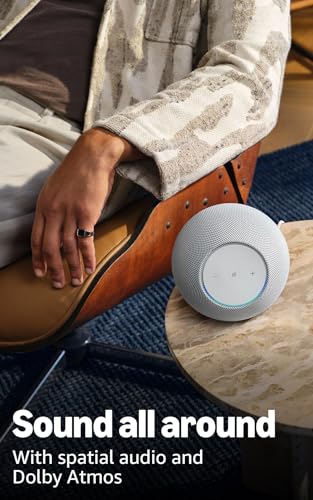
Professional reviews highlight the Studio's ability to create convincing spatial effects with Dolby Atmos content (three-dimensional audio that places sounds above, beside, and around the listener). When streaming supported music from services like Apple Music or Amazon Music, the Echo Studio can make vocals appear to float above the instrumental track or position backing singers to the sides of the main performance.
The Echo Dot Max offers improved soundstage compared to previous Dots but operates within the constraints of its compact design. Near-field listening reveals better stereo separation and instrument placement than you'd expect from such a small speaker, but it cannot create the expansive musical presentation of the Echo Studio.
Both speakers share Amazon's AZ3 chip architecture, but in different configurations. The Echo Studio uses the AZ3 Pro variant with additional processing power for complex audio rendering and advanced artificial intelligence tasks. The Echo Dot Max employs the standard AZ3 chip, which still represents a significant upgrade over previous Echo Dot generations.
This processing difference affects everyday performance in subtle but important ways. The Echo Studio responds more quickly to complex voice commands and handles multiple simultaneous requests better. If you're asking Alexa to adjust multiple smart home devices while streaming music, the additional processing power becomes apparent.
Both speakers improve wake word detection—recognizing when you say "Alexa"—by approximately 50% compared to older models. They also filter background noise more effectively, reducing false activations when the TV is loud or music is playing.
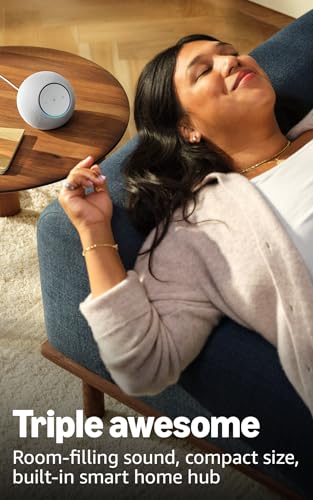
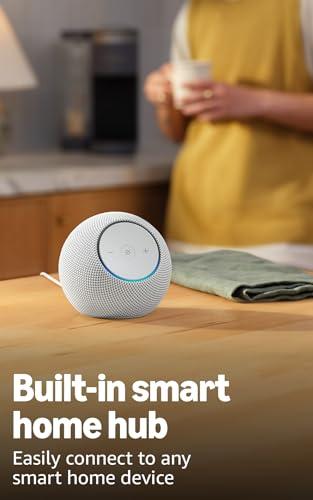
Perhaps the most valuable feature that both speakers share is built-in smart home hub functionality. Previous Echo speakers required separate devices (like SmartThings or Philips Hue hubs) to control many smart home products. These new speakers include Zigbee, Matter, and Thread protocols directly, eliminating the need for additional hardware in most cases.
This integration means you can connect smart lights, door locks, temperature sensors, and other devices directly to either the Echo Studio or Echo Dot Max. The setup process becomes dramatically simpler, and device response times improve when commands don't need to route through multiple hubs.
Both speakers also support Amazon's new Alexa+ experience, which uses advanced artificial intelligence to enable more natural conversations. Instead of rigid command structures, you can speak more conversationally, and the assistant better understands context and follow-up requests.
Home theater integration represents one area where the Echo Studio significantly outperforms the Echo Dot Max. When connected to Fire TV devices, up to five Echo Studio speakers can create a true 5.1 surround sound system with genuine Dolby Atmos processing.
Dolby Atmos adds height to surround sound, placing audio objects in three-dimensional space rather than just around the room's perimeter. When watching movies, this means hearing helicopters fly overhead or raindrops falling from above. The Echo Studio processes these spatial audio cues accurately, creating convincing surround effects.
User reviews of Studio-based home theater setups consistently praise the immersive experience, particularly for action movies and concerts. The speakers' room adaptation technology ensures each unit optimizes its output based on placement—front speakers emphasize dialogue clarity while rear speakers focus on ambient effects.
The Echo Dot Max can participate in Fire TV surround setups, but without Dolby Atmos processing. The experience amounts to distributed stereo rather than true surround sound. For casual TV watching, this works adequately, but it cannot match the cinematic experience of properly configured Echo Studio systems.
Both speakers excel at multi-room audio, allowing synchronized music playback throughout your home. Setup involves grouping speakers through the Alexa app, after which voice commands or app controls can start music on individual speakers or entire groups.
The Echo Studio provides superior audio quality in each room, making it ideal for users who prioritize music reproduction. The Echo Dot Max offers excellent value for distributed audio systems, delivering significantly better sound than standard Echo Dots while maintaining reasonable per-room costs.
One important limitation: you cannot mix Echo Studio and Echo Dot Max speakers in the same surround sound setup. Amazon requires matching speaker types for home theater configurations, though different speaker types can coexist in multi-room music groups.
At the time of writing, the Echo Studio commands roughly twice the price of the Echo Dot Max, which itself costs approximately double the standard Echo Dot. These price relationships create interesting value calculations.
The Echo Dot Max offers the most dramatic relative improvement. Moving from a standard Echo Dot to the Dot Max delivers three times the bass response, much clearer midrange, and significantly improved overall sound quality. For users primarily interested in casual music listening and smart home control, this represents excellent value.
The Echo Studio targets users who prioritize audio quality and room-filling sound. While more expensive, it competes favorably with dedicated wireless speakers from established audio brands. The inclusion of full smart home hub functionality and Alexa integration adds value that standalone speakers cannot match.
However, building multi-speaker systems creates budget considerations. A five-speaker Echo Studio home theater setup approaches the cost of traditional soundbar and subwoofer combinations, which might offer superior performance for dedicated movie watching. The Echo Studios provide flexibility and smart home integration that traditional audio systems lack, but pure home theater performance might favor specialized equipment.
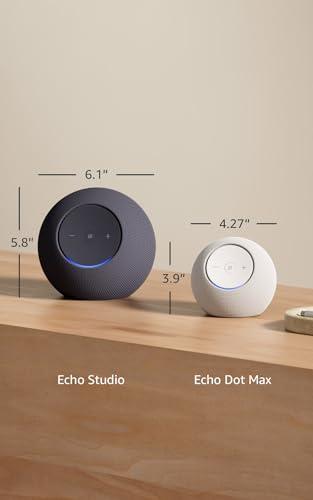
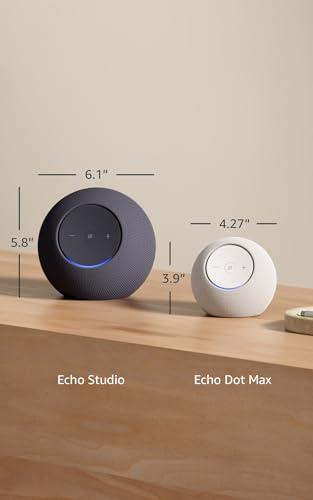
The 2025 redesign significantly improves both speakers' placement flexibility. The Echo Studio sheds the tower design that limited placement options, adopting a spherical form that works on shelves, side tables, or dedicated stands. The 40% size reduction makes it viable in rooms where the original Studio would overwhelm the space.
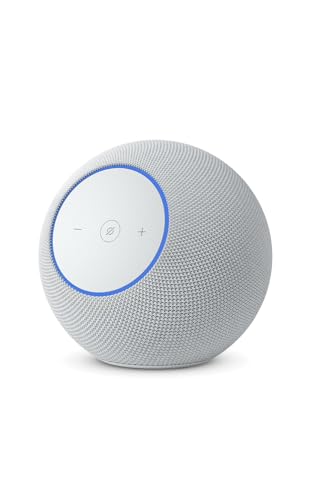
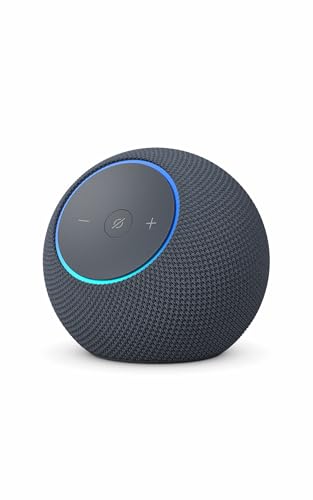
The Echo Dot Max maintains the compact philosophy that makes Echo Dots popular. It fits on bedside tables, desks, kitchen counters, or bookshelves without dominating the space. The spherical design looks modern and sophisticated, matching contemporary home decor better than the utilitarian appearance of previous Echo Dots.
Both speakers use premium fabric coverings that provide acoustic transparency while looking more like home furnishings than electronic devices. The materials feel solid and well-constructed, suggesting durability that justifies the premium pricing.
The Echo Studio makes sense for users who prioritize audio quality and have adequate space and budget. If you're replacing a dedicated music system or building a serious home theater setup, the Studio's superior drivers, processing power, and spatial audio capabilities justify the higher cost. It works best in larger rooms where its full-range capabilities can shine.
Choose the Echo Studio if you regularly listen to music as a primary activity rather than background ambiance. The improved soundstage, bass response, and Dolby Atmos support create a more engaging experience for focused listening. It's also the better choice for home theater applications, particularly in rooms larger than typical bedrooms.
The Echo Dot Max targets users seeking significant audio improvement over standard Echo Dots without the space requirements or expense of the Studio. It excels in secondary rooms, offices, or bedrooms where compact size matters. The audio quality improvement over standard Dots is substantial enough to justify the premium for most users.
Choose the Echo Dot Max for distributed whole-home audio systems where you want better sound than basic Echo Dots but don't need flagship performance in every room. It's also ideal for desktop use, bedside placement, or anywhere space constraints make the larger Studio impractical.
Both speakers represent meaningful advances in Amazon's smart speaker technology. The Echo Studio delivers genuinely impressive audio quality that competes with dedicated wireless speakers while adding comprehensive smart home functionality. The Echo Dot Max finally provides a compelling upgrade path for Echo Dot users who want better sound without major space or budget commitments.
The choice ultimately depends on your priorities and constraints. If audio quality matters most and you have the space and budget, the Echo Studio provides a more satisfying long-term experience. If you're building a multi-room system or need compact placement, the Echo Dot Max offers excellent value and meaningful improvement over previous options.
Consider your primary use cases carefully. For background music and smart home control, the Echo Dot Max provides everything most users need. For focused music listening, home theater, or larger room coverage, the Echo Studio justifies its premium through superior performance and capabilities.
| Amazon Echo Studio Smart Speaker | Amazon Echo Dot Max Smart Speaker |
|---|---|
| Driver Configuration - Foundation of audio quality and power | |
| 4 drivers: 5.25" woofer + 3 full-range drivers | 2 drivers: dedicated woofer + custom tweeter |
| Bass Response - Critical for music enjoyment and room filling sound | |
| Deep, powerful bass suitable for large rooms and bass-heavy music | 3x improvement over standard Echo Dot, but limited by compact size |
| Maximum Volume & Room Coverage - Determines usable listening area | |
| Up to 91.1 dB SPL, fills large living rooms effectively | Optimized for near-field listening in smaller spaces |
| Spatial Audio Support - Premium feature for immersive listening | |
| Full Dolby Atmos processing with 3D audio positioning | Basic spatial enhancement without Dolby Atmos |
| Physical Size - Space requirements and placement flexibility | |
| 8.1" tall, 6.9" diameter, 7.7 lbs (40% smaller than 2019 model) | Compact spherical design, significantly smaller and lighter |
| Processor - Affects smart features and audio processing speed | |
| AZ3 Pro chip with AI Accelerator for complex audio tasks | Standard AZ3 chip with improved voice detection |
| Room Adaptation Technology - Automatic sound optimization | |
| Advanced room tuning that analyzes acoustics and adjusts output | Basic sound adaptation without dedicated room analysis |
| Home Theater Capabilities - Multi-speaker surround sound performance | |
| True 5.1 Dolby Atmos surround with up to 5 Echo Studio units | Basic surround participation without Dolby processing |
| Smart Home Hub Integration - Built-in device control without extra hubs | |
| Zigbee, Matter, Thread support with powerful processing | Same hub capabilities with standard processing power |
| Audio Input Options - Wired connection flexibility | |
| 3.5mm/optical combo input for external sources | Limited to wireless streaming only |
| Value Proposition - Performance per dollar consideration | |
| Premium flagship audio competing with dedicated wireless speakers | Best upgrade from standard Echo Dot without major space/budget commitment |
The Amazon Echo Studio Smart Speaker delivers significantly better sound quality with its four-driver system including a dedicated 5.25-inch woofer and three full-range drivers. The Amazon Echo Dot Max Smart Speaker offers improved audio over standard Echo Dots with its dual-driver setup, but cannot match the Studio's room-filling bass and overall clarity. For serious music listening, the Echo Studio is the clear winner.
The primary difference is audio performance and room coverage. The Amazon Echo Studio Smart Speaker is designed as a premium music speaker that can fill large rooms with powerful, high-quality sound and Dolby Atmos support. The Amazon Echo Dot Max Smart Speaker serves as a compact upgrade from standard Echo Dots, offering much better audio than basic models while maintaining a small footprint for desks and bedrooms.
Yes, but with important differences. The Amazon Echo Studio Smart Speaker supports true 5.1 Dolby Atmos surround sound when paired with Fire TV devices, creating an immersive cinematic experience. The Amazon Echo Dot Max Smart Speaker can participate in multi-speaker Fire TV setups but lacks Dolby Atmos processing, providing basic distributed audio rather than true surround sound. For serious home theater use, the Echo Studio is essential.
The Amazon Echo Dot Max Smart Speaker is ideal for small rooms, bedrooms, and desktop use due to its compact size and near-field optimization. While the Amazon Echo Studio Smart Speaker has been redesigned to be 40% smaller than the original, it's still a larger speaker best suited for medium to large rooms where its full audio capabilities can be appreciated.
Both the Amazon Echo Studio Smart Speaker and Amazon Echo Dot Max Smart Speaker include identical smart home hub functionality with built-in Zigbee, Matter, and Thread support. They both control smart lights, locks, and other devices without requiring separate hubs. The Echo Studio has a more powerful AZ3 Pro processor for faster response to complex commands, while the Echo Dot Max uses the standard AZ3 chip.
Value depends on your priorities. The Amazon Echo Dot Max Smart Speaker provides excellent value for users wanting significant audio improvement over standard Echo Dots without major space or budget commitment. The Amazon Echo Studio Smart Speaker offers better overall value for audio enthusiasts who want premium sound quality and advanced features like Dolby Atmos, competing effectively with dedicated wireless speakers.
Both speakers excel at multi-room audio setups. You can group multiple Amazon Echo Studio Smart Speaker units for high-quality synchronized music throughout your home, or use Amazon Echo Dot Max Smart Speaker units for cost-effective whole-home audio with significantly better sound than basic Echo Dots. However, you cannot mix Studio and Dot Max speakers in the same home theater surround setup.
The Amazon Echo Studio Smart Speaker delivers substantially better bass with its larger 5.25-inch woofer and bigger internal cabinet volume. It reproduces deep, powerful bass suitable for electronic music, hip-hop, and movie soundtracks. The Amazon Echo Dot Max Smart Speaker offers nearly 3x the bass of standard Echo Dots and sounds impressive for its size, but cannot match the depth and impact of the Echo Studio.
The Amazon Echo Studio Smart Speaker measures 8.1 inches tall and 6.9 inches in diameter, weighing 7.7 pounds—though this is 40% smaller than the original 2019 model. The Amazon Echo Dot Max Smart Speaker maintains a compact spherical design that fits easily on desks, nightstands, and bookshelves. Choose the Echo Dot Max if space is limited or the Echo Studio if you have room for larger speakers.
For dedicated music listening, the Amazon Echo Studio Smart Speaker provides superior performance with its advanced driver configuration, room adaptation technology, and spatial audio support. It creates a wide soundstage with excellent instrument separation. The Amazon Echo Dot Max Smart Speaker offers good music quality for casual listening and background music, but serious audiophiles will prefer the Echo Studio's fuller, more detailed sound.
Both the Amazon Echo Studio Smart Speaker and Amazon Echo Dot Max Smart Speaker support major streaming services including Amazon Music, Spotify, Apple Music, Pandora, and Tidal. The Echo Studio can take full advantage of high-resolution audio and spatial audio formats from compatible services, while the Echo Dot Max provides good quality streaming within the limits of its compact design.
If you want the best possible audio quality and have adequate space and budget, choose the Amazon Echo Studio Smart Speaker for a premium experience that will satisfy long-term. If you're looking for a significant upgrade from basic smart speakers without major investment, the Amazon Echo Dot Max Smart Speaker provides excellent value with much better sound than standard Echo Dots. Consider your room size, audio priorities, and whether you might expand to multiple speakers when deciding between the Echo Studio and Echo Dot Max.
We've done our best to create useful and informative comparisons to help you decide what product to buy. Our research uses advanced automated methods to create this comparison and perfection is not possible - please contact us for corrections or questions. These are the sites we've researched in the creation of this article: whathifi.com - crutchfield.com - rtings.com - dxomark.com - youtube.com - dimensions.com - youtube.com - bestbuy.com - techradar.com - dolby.com - consumerreports.org - engadget.com - phonearena.com - aboutamazon.com - askalexa.com - techradar.com - engadget.com - engadget.com - t3.com - telegraph.co.uk - gadgetmatch.com - youtube.com - youtube.com - youtube.com - youtube.com - homecrux.com - tomsguide.com - matteralpha.com - techbuzz.ai - techradar.com - pocket-lint.com - bestbuy.com

Privacy Policy
Terms and Conditions - Affiliate Policy
Home Security
© Copyright 2008-2026.
11816 Inwood Rd #1211, Dallas, TX 75244