


When Amazon released these two devices in 2024, they represented very different approaches to bringing Alexa into your home. The Echo Dot Max is Amazon's answer to premium compact speakers like the Apple HomePod mini, while the Echo Spot 2024 revives a product category that had been dormant since 2017 - the smart alarm clock with a display.
Understanding which device suits your needs requires looking beyond their shared Alexa capabilities. Both can control your smart lights and answer questions, but their core strengths lie in completely different areas. The Echo Dot Max is fundamentally a speaker that happens to be smart, while the Echo Spot 2024 is primarily a bedside companion that happens to play music.
The smart speaker market has evolved dramatically since Amazon introduced the original Echo in 2014. What started as simple voice assistants have become sophisticated home automation hubs, audio systems, and information displays. Today's devices need to balance multiple roles: playing music, controlling smart devices, providing information, and fitting seamlessly into home décor.
The key considerations when choosing between these devices center on your primary use case. Are you looking for impressive audio performance that can fill a room, or do you want visual feedback and alarm clock functionality? Your answer shapes everything from where you'll place the device to how often you'll actually use it.
Audio quality has become increasingly important as streaming services offer higher-quality music and people spend more time at home. Meanwhile, visual interfaces have gained popularity as smart homes become more complex - sometimes it's easier to tap a screen than remember the exact voice command for your bedroom lights.
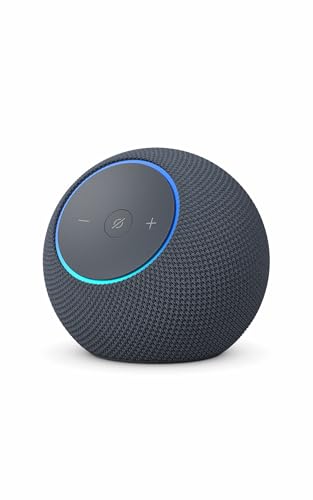
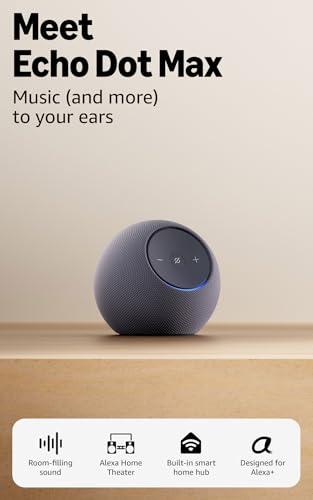
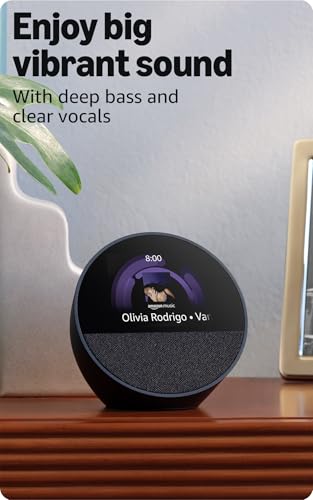
The Echo Dot Max represents Amazon's most significant leap in compact speaker technology. Its internal architecture includes two dedicated drivers - a high-excursion woofer for deep bass and a custom tweeter for crisp high-frequency sounds. This dual-driver system is a major upgrade from typical single-driver designs found in most compact smart speakers.
The bass response deserves special attention because it's often where small speakers struggle most. Amazon claims the Echo Dot Max delivers nearly three times the bass of the standard Echo Dot 5th generation. This improvement comes from both the dedicated woofer and increased internal air space within the spherical design. The result is genuinely surprising low-end response that doesn't sound artificially boosted or muddy.
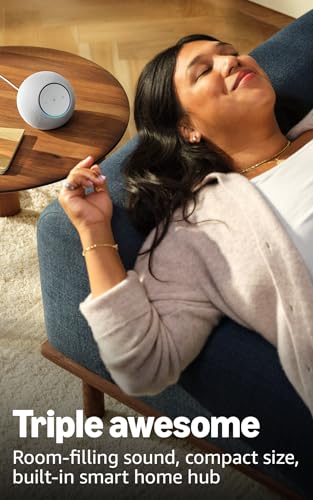
Spatial audio support sets the Echo Dot Max apart in its category. This technology, which includes 360-degree sound dispersion and Dolby Atmos compatibility, creates a more immersive listening experience. Instead of sound coming from a single point, properly mixed spatial audio content appears to surround the listener. For a compact speaker, this is genuinely impressive technology that was previously limited to much larger and more expensive systems.
The Echo Spot 2024 takes a different approach entirely. Its 1.73-inch front-firing mono driver prioritizes clarity over power, which makes sense given its intended use as a bedside device. The audio quality is quite good for podcasts, audiobooks, and casual music listening, but it's clearly designed for near-field listening rather than filling a room with sound.
From our research into user experiences and professional reviews, the Echo Dot Max consistently impresses listeners who aren't expecting serious audio performance from such a compact device. One particularly telling comparison noted that familiar songs revealed details that hadn't been noticeable before - the kind of experience that typically requires upgrading to significantly more expensive speakers.
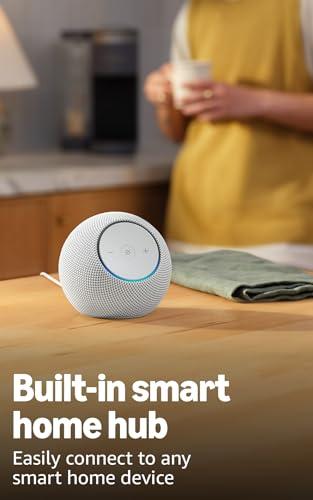
Both devices run Alexa, but their smart home capabilities differ in important ways. The Echo Dot Max includes a built-in Zigbee hub, which is a wireless communication protocol that many smart home devices use. Having this hub built-in means you can directly connect compatible smart lights, sensors, and locks without purchasing additional hardware. This seemingly technical feature has real practical benefits - fewer devices cluttering your network and more reliable connections to your smart home gadgets.
The advanced AZ3 processor in the Echo Dot Max powers what Amazon calls "Alexa+," which promises more natural conversation and better understanding of context. In practice, this means fewer instances of Alexa misunderstanding commands or failing to respond appropriately to follow-up questions.
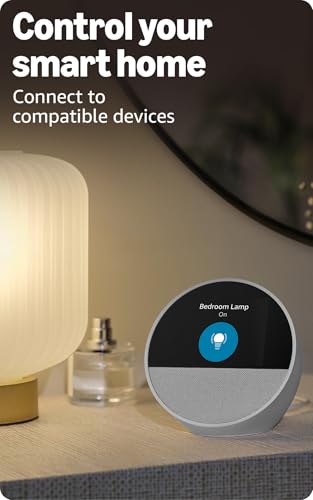
The Echo Spot 2024 offers a different kind of smart home integration through its touchscreen interface. Instead of remembering voice commands, you can tap visual controls to adjust lights, check thermostat settings, or trigger routines. This approach particularly appeals to people who find voice control awkward in certain situations - like early morning when others are still sleeping.
One unique feature of the Echo Spot 2024 is its ultrasonic motion sensor, which can detect when someone enters or leaves a room. This enables occupancy-based automation routines that other Echo devices can't perform without additional sensors. For example, it could automatically turn on bedside lamps when you enter the bedroom and turn them off when you leave.
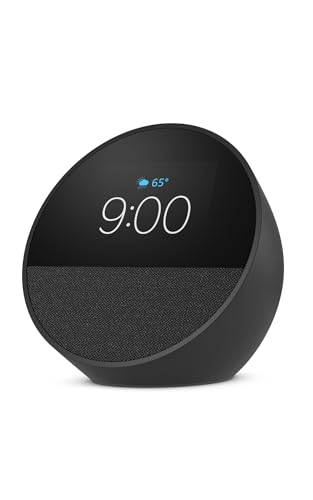
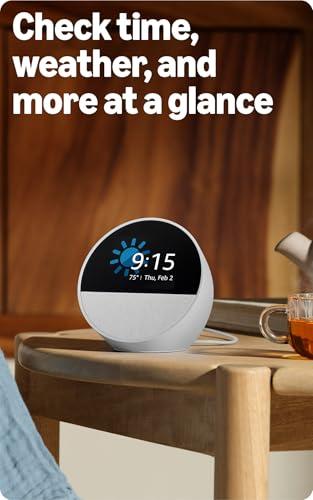
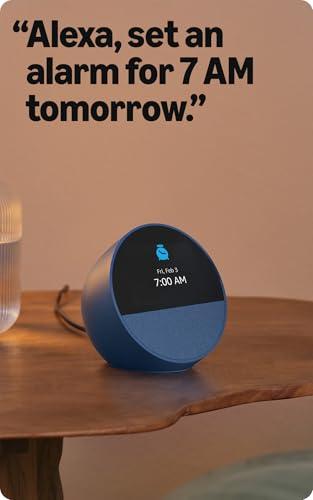
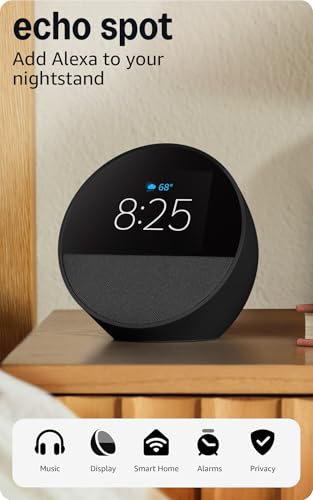
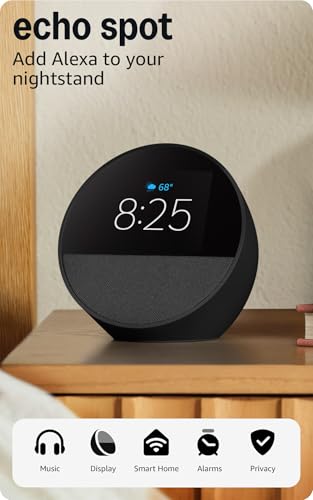
The Echo Spot 2024 built its identity around its 2.83-inch touchscreen display with 320x240 resolution. While these specifications might sound modest compared to smartphone screens, the display serves its purpose well. The six customizable animated clock faces with different color themes let you match the device to your room's décor or your personal preferences.
The display excels at showing information at a glance - current weather, upcoming calendar events, music currently playing, and quick controls for smart home devices. This visual feedback eliminates the need to ask Alexa for information you might want to check silently, which is particularly valuable in bedroom settings.
However, our research reveals some limitations with the display technology. The viewing angles are somewhat restricted, meaning the screen becomes harder to read when viewed from the side. The rectangular display borders also become more visible at certain angles, which can break the otherwise sleek appearance.
The Echo Dot Max deliberately eschews any display in favor of an LED ring that provides basic visual feedback about Alexa's status. This design choice keeps the focus entirely on audio performance while maintaining the clean, spherical aesthetic that works well in any room.
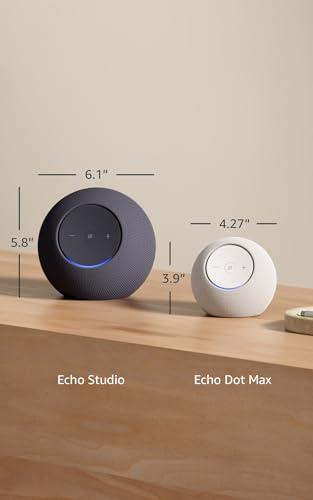
The spherical design of the Echo Dot Max isn't just about aesthetics - it's acoustically optimized for 360-degree sound dispersion. The 3D knit fabric covering provides acoustic transparency, meaning it doesn't interfere with sound quality while looking more premium than typical plastic speaker grilles.
This design makes the Echo Dot Max remarkably flexible in placement. It performs well on shelves, countertops, side tables, or even mounted speakers stands. The omnidirectional audio means it doesn't need to be positioned facing a particular direction, giving you more freedom in room arrangement.
The Echo Spot 2024 takes the opposite approach with its semi-spherical design that's clearly optimized for desk or bedside table placement. The flat front face houses the display and needs to face toward where you'll be looking at it. This constraint makes it less versatile for room placement but more purposeful for its intended use cases.
The absence of a camera in the Echo Spot 2024 represents a significant design decision compared to the original 2017 model. This change addresses privacy concerns that many users have about cameras in bedrooms while maintaining all the smart functionality through voice and touch controls.
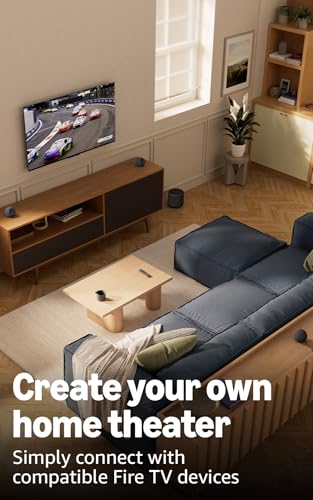
For home theater applications, the Echo Dot Max offers genuinely useful capabilities that the Echo Spot 2024 simply can't match. The support for Dolby Atmos and the ability to pair multiple Echo Dot Max speakers or combine them with Echo Studio speakers creates legitimate surround sound experiences when connected to Fire TV devices.
This multi-speaker functionality transforms what might seem like a simple smart speaker into a building block for a wireless home theater system. While it won't replace a dedicated high-end surround system, it provides a compelling option for people who want better TV audio without the complexity and expense of traditional AV equipment.
The Echo Spot 2024 lacks this multi-speaker capability and isn't designed for home theater use. Its audio performance and directional speaker design make it unsuitable for anything beyond personal listening in bedroom or office environments.
For the Echo Dot Max, the most important performance metrics are audio quality, smart home responsiveness, and multi-device compatibility. Our evaluation of user reviews suggests that bass response and overall sound clarity are the most frequently praised aspects, often exceeding expectations for the device's size and price point.
Voice recognition accuracy and response time are also crucial metrics, particularly given the advanced Alexa+ capabilities. The enhanced microphone array appears to provide meaningful improvements in noisy environments and when speaking from across the room.
For the Echo Spot 2024, the key performance metrics shift to display quality, touch responsiveness, alarm functionality, and near-field audio clarity. User feedback consistently highlights the convenience of visual information and touch controls, though some note limitations in display brightness and viewing angles.
The motion detection accuracy and automation reliability are also important metrics for the Echo Spot 2024, as these features differentiate it from other Echo devices. Based on user reports, the motion sensing works well for intended use cases but requires some adjustment to avoid false triggers.
At the time of writing, both devices are priced in the premium segment of their respective categories, with the Echo Dot Max commanding a higher price point that reflects its advanced audio technology and smart home capabilities. The Echo Spot 2024 is positioned between basic smart speakers and premium options, reflecting its specialized functionality.
The value proposition for the Echo Dot Max becomes clearer when considering its potential to replace separate purchases - a smart speaker, a smart home hub, and potentially multiple speakers for home theater use. The advanced audio technology and Alexa+ capabilities also suggest better longevity as Amazon continues to improve the platform.
The Echo Spot 2024 represents value in a different way - it's the only device that combines smart alarm clock functionality, display-based information access, and decent audio quality in a single package. However, it's worth noting that some features found in less expensive Echo Dot models, like temperature sensing and Eero Wi-Fi mesh capabilities, are absent from the Echo Spot 2024.
The decision between these devices should be driven primarily by your intended use case rather than price considerations, given their relatively similar cost at launch.
Choose the Echo Dot Max if you prioritize audio quality above all else. It's the right choice for people who want a single speaker that can serve multiple rooms, provide the foundation for a home theater setup, or simply deliver impressive music listening in a compact form factor. It's also ideal if you prefer voice-only interaction and don't need visual feedback for your smart home controls.
The Echo Dot Max makes particular sense for people who are building out comprehensive smart home systems, thanks to its built-in Zigbee hub and advanced Alexa capabilities. If you can envision eventually adding more speakers for multi-room audio or home theater use, starting with the Echo Dot Max provides a solid foundation.
Choose the Echo Spot 2024 if you specifically need a smart alarm clock with modern capabilities. It's perfect for bedside use, home office desk setups, or anywhere you want quick visual access to information and controls. The touch interface and motion sensing provide unique capabilities that audio-only devices simply can't match.
The Echo Spot 2024 particularly appeals to people who find voice controls awkward in certain situations or who simply prefer visual confirmation of their smart home device states. If you've ever wished you could see what temperature your thermostat is set to without asking, or quickly check the weather without interrupting a conversation, the display functionality provides genuine value.
For most people, the choice comes down to whether they want a premium smart speaker that happens to be compact, or a smart alarm clock that happens to play music reasonably well. Both devices execute their primary functions excellently, but trying to use them outside their intended roles will likely lead to disappointment.
The Echo Dot Max represents the better long-term investment for households that will expand their smart home and audio systems over time. The Echo Spot 2024 is the clear winner for anyone who has been waiting for a modern take on the smart alarm clock concept. Neither choice is wrong, but understanding their fundamental differences ensures you'll be satisfied with your purchase for years to come.
| Amazon Echo Dot Max Smart Speaker | Amazon Echo Spot 2024 Smart Alarm Clock |
|---|---|
| Primary Purpose - Defines everything about how you'll use the device | |
| Premium compact speaker with smart home hub capabilities | Smart alarm clock with display and basic audio |
| Audio System - Critical for music quality and room-filling sound | |
| Dual-driver system (woofer + tweeter) with 3x bass boost and 360-degree spatial audio | Single 1.73-inch mono driver optimized for near-field listening |
| Display - Essential for visual information and bedside convenience | |
| No display, LED ring for basic status feedback | 2.83-inch touchscreen (320x240) with customizable clock faces |
| Smart Home Hub - Eliminates need for separate hub devices | |
| Built-in Zigbee hub for direct device control | No hub capability, basic Matter compatibility |
| Voice Assistant Technology - Affects response speed and accuracy | |
| Advanced Alexa+ with AZ3 processor for natural conversations | Standard Alexa with MT8519 processor |
| Multi-Speaker Capabilities - Important for home theater and whole-home audio | |
| Supports pairing for Dolby Atmos surround sound with Fire TV | No multi-speaker support |
| Room Placement Flexibility - Affects where you can put the device | |
| Spherical design works anywhere, omnidirectional sound | Semi-spherical, requires forward-facing placement for display |
| Unique Features - Differentiate from standard smart speakers | |
| Omnisense room adaptation, spatial audio, home theater integration | Motion sensor automation, tap-to-snooze, visual smart home controls |
| Best Use Cases - Who should choose each device | |
| Music lovers, home theater builders, smart home enthusiasts | Bedside use, visual learners, privacy-conscious users (no camera) |
| Value Proposition - What you get for the premium pricing | |
| Replaces separate speaker + hub + potential home theater components | Only option combining smart alarm clock + display + decent audio |
The Amazon Echo Dot Max Smart Speaker is primarily a premium compact speaker focused on high-quality audio and smart home control, while the Amazon Echo Spot 2024 Smart Alarm Clock is designed as a bedside smart alarm clock with a touchscreen display. The Echo Dot Max delivers room-filling sound with spatial audio, while the Echo Spot 2024 provides visual information and touch controls ideal for bedroom use.
The Amazon Echo Dot Max Smart Speaker has significantly better sound quality with its dual-driver system featuring a dedicated woofer and tweeter. It provides nearly three times more bass than standard Echo Dots and supports 360-degree spatial audio. The Echo Spot 2024 has adequate sound quality for its size but is designed for personal listening rather than room-filling audio.
Yes, the Amazon Echo Dot Max Smart Speaker can be paired with other Echo devices to create Dolby Atmos surround sound when connected to Fire TV devices, making it suitable for wireless home theater systems. The Amazon Echo Spot 2024 Smart Alarm Clock cannot be used for home theater applications due to its single-speaker design and lack of multi-device pairing capabilities.
The Amazon Echo Spot 2024 Smart Alarm Clock is specifically designed for bedside use with its customizable clock display, tap-to-snooze functionality, motion sensor, and privacy-focused design without a camera. While the Echo Dot Max can work on a nightstand, it lacks the alarm clock features and visual display that make bedside interaction convenient.
The Amazon Echo Dot Max Smart Speaker includes a built-in Zigbee hub that can directly control compatible smart home devices without requiring additional hardware. The Echo Spot 2024 can control smart home devices through Alexa and supports Matter compatibility, but it doesn't function as a hub itself, requiring other hubs for many smart home devices.
The Amazon Echo Dot Max Smart Speaker features advanced Alexa+ technology with an enhanced microphone array and AZ3 processor, providing better voice detection across rooms and in noisy environments. The Echo Spot 2024 Smart Alarm Clock has standard Alexa voice recognition that works well for bedside use but isn't as advanced for far-field detection.
Only the Amazon Echo Spot 2024 Smart Alarm Clock provides visual information through its 2.83-inch touchscreen display, showing time, weather, music information, and smart home controls. The Echo Dot Max relies entirely on voice interaction and audio feedback, with only an LED ring for basic status indication.
The Amazon Echo Dot Max Smart Speaker is more versatile due to its spherical design and 360-degree sound dispersion, allowing it to work well anywhere in a room. The Echo Spot 2024 requires forward-facing placement to view the display effectively, making it best suited for desks, nightstands, or other surfaces where you'll be facing it directly.
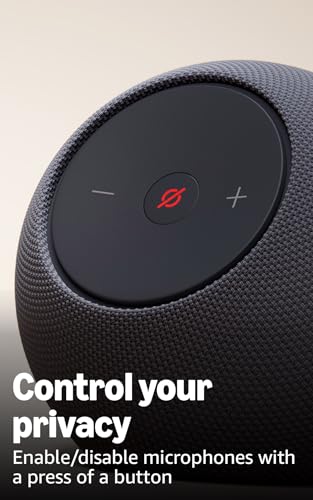
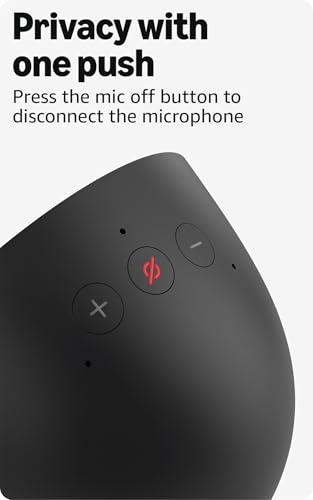
The Amazon Echo Spot 2024 Smart Alarm Clock deliberately omits a camera (unlike the original 2017 model), making it more privacy-focused for bedroom use while still offering visual information through its display. Both devices have microphone mute buttons, but the Echo Dot Max focuses entirely on voice interaction without any camera concerns.
The Amazon Echo Dot Max Smart Speaker offers better value for users prioritizing audio quality and comprehensive smart home features, as it can replace multiple devices (speaker, hub, and home theater components). The Echo Spot 2024 provides unique value for users specifically wanting a smart alarm clock with display functionality, though it costs more than basic Echo Dot models with fewer overall features.
The Amazon Echo Dot Max Smart Speaker provides more advanced smart home control with its built-in Zigbee hub, Alexa+ technology, and better voice recognition across rooms. The Echo Spot 2024 offers convenient touch-based smart home controls through its display and includes motion sensing for automation, but lacks the hub functionality and advanced processing of the Echo Dot Max.
Choose the Amazon Echo Dot Max Smart Speaker if you prioritize audio quality, plan to use it throughout your home, want comprehensive smart home hub capabilities, or might build a home theater system. Choose the Amazon Echo Spot 2024 Smart Alarm Clock if you specifically need a bedside smart alarm clock, prefer visual information display, want touch controls for convenience, or value the privacy of a camera-free bedroom device.
We've done our best to create useful and informative comparisons to help you decide what product to buy. Our research uses advanced automated methods to create this comparison and perfection is not possible - please contact us for corrections or questions. These are the sites we've researched in the creation of this article: techradar.com - engadget.com - engadget.com - t3.com - telegraph.co.uk - gadgetmatch.com - youtube.com - youtube.com - youtube.com - youtube.com - homecrux.com - aboutamazon.com - phonearena.com - tomsguide.com - matteralpha.com - techbuzz.ai - techradar.com - pocket-lint.com - bestbuy.com - bestbuy.com - tomsguide.com - nextpit.com - versus.com - techradar.com - versus.com - youtube.com - youtube.com - manuals.plus - techgadgetscanada.com - bestbuy.com - youtube.com - homedepot.com - homedepot.com - youtube.com - soundguys.com - youtube.com

Privacy Policy
Terms and Conditions - Affiliate Policy
Home Security
© Copyright 2008-2026.
11816 Inwood Rd #1211, Dallas, TX 75244