




When you're shopping for a smart speaker that can handle both your music streaming and voice assistant needs, the choice often comes down to two very different philosophies. Do you want a speaker that can follow you anywhere, or one that delivers the most impressive sound possible from a fixed location? This fundamental question shapes the comparison between the Bose Portable Smart Speaker and the Amazon Echo Studio.
These speakers represent opposite ends of the smart speaker spectrum, and at the time of writing, their price difference reflects this distinction. The Bose Portable Smart Speaker commands a premium price that's nearly double the Amazon Echo Studio, but that gap tells a story about what each product prioritizes.
The Bose Portable Smart Speaker, released around 2019, was designed from the ground up as a portable device. Every engineering decision—from its battery life to its water resistance—serves the goal of giving you great sound wherever you are. Meanwhile, the Amazon Echo Studio, also from 2019, takes the opposite approach. Amazon built it to be the most powerful and immersive smart speaker they could create, with the understanding that it would stay plugged into your wall.
Since their release, both companies have refined their software and added new features, but the core hardware remains largely unchanged. The Echo Studio has benefited from regular Alexa updates and new audio format support, while the Bose has seen improvements to its voice recognition and multi-room capabilities through app updates.
The Amazon Echo Studio packs serious audio hardware into its cylindrical frame. It uses five separate speakers working together: a 1-inch tweeter (for crisp highs), three 2-inch midrange drivers (positioned to fire in different directions), and a substantial 5.25-inch woofer (for deep bass). This multi-driver setup lets the speaker handle different frequency ranges more effectively than single-driver designs.
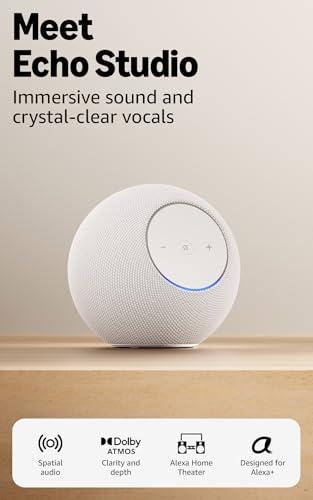
What makes the Echo Studio particularly impressive is its support for Dolby Atmos—a surround sound technology that creates the illusion of sound coming from above and around you. When you're listening to specially mixed tracks on Amazon Music HD, the speaker can make it feel like instruments are positioned in a three-dimensional space around your room. The downward-firing woofer bounces bass off your floor, while the upward-firing driver reflects sound off your ceiling to create this height effect.
The room adaptation feature automatically analyzes your space's acoustics and adjusts the speaker's output accordingly. Place it near a wall, and it compensates for bass buildup. Put it in the center of a large room, and it adjusts to fill the space more effectively.
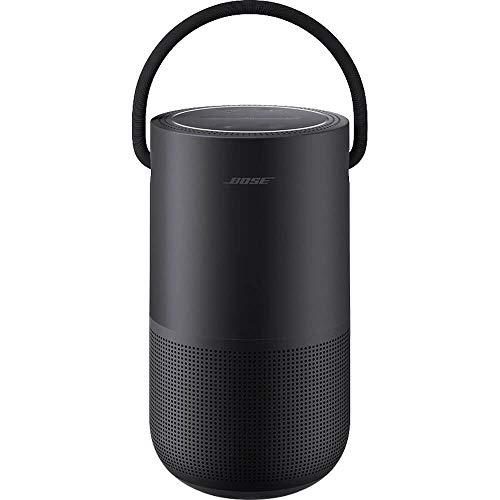
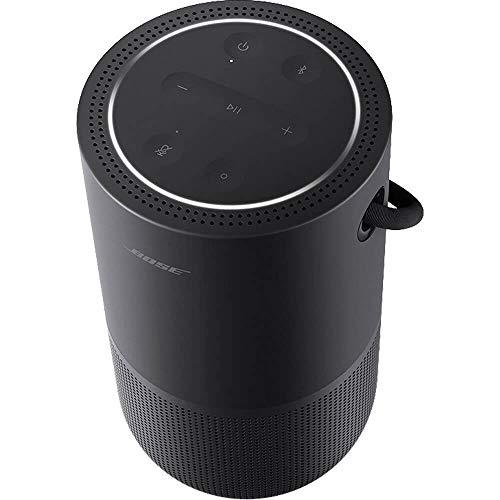
The Bose Portable Smart Speaker takes a completely different approach with its 360-degree sound dispersion. Instead of trying to create a traditional stereo image with left and right channels, it projects sound uniformly in all directions using an acoustic deflector—essentially a curved surface that spreads sound waves evenly around the speaker.
This design philosophy makes more sense when you consider the speaker's portable nature. At a pool party or camping trip, you might not know where people will be sitting relative to the speaker, so having consistent sound in every direction is more valuable than precise stereo imaging.
The Bose also incorporates three passive radiators—surfaces that vibrate in response to the main driver's movement to enhance bass response. This technique allows a smaller speaker to produce deeper bass than would otherwise be possible, though it can't match the raw power of the Echo Studio's larger woofer.
When evaluating these speakers, several key measurements tell the story:
Maximum volume capabilities show a clear winner. The Echo Studio can reach levels suitable for large rooms and house parties, while the Bose is more appropriate for medium-sized spaces. However, both maintain relatively clean sound at their maximum volumes, avoiding the harsh distortion that plagues many speakers when pushed hard.
Frequency response—how evenly the speaker reproduces different pitches—reveals their different tuning philosophies. The Echo Studio emphasizes bass and treble to create an impressive initial impact, which works well for movie soundtracks and bass-heavy music. The Bose aims for more neutral tuning, making it better for critical listening across diverse music genres.
Bass extension shows the Echo Studio reaching deeper into the low frequencies, providing more rumble for action movies and electronic music. The Bose produces tight, controlled bass that doesn't overpower other frequencies, but won't deliver the same physical impact.
Here's where the Bose Portable Smart Speaker offers something unique: it supports both Amazon Alexa and Google Assistant simultaneously. This dual-assistant approach means you can say "Hey Google" or "Alexa" to the same speaker, and it will respond appropriately. For households that use both ecosystems—perhaps Google products for some family members and Amazon for others—this flexibility is invaluable.
The Bose's eight-microphone array excels at picking up voice commands even in challenging conditions. Whether you're by the pool with background noise or have music playing loudly, the speaker's advanced noise cancellation helps it understand your commands clearly.
The Amazon Echo Studio exclusively uses Alexa, but it integrates more deeply with Amazon's ecosystem. It can serve as a Zigbee hub—a communication standard that lets smart home devices talk to each other and your speaker without needing separate hub hardware. This means you can connect compatible smart lights, locks, and sensors directly to your Echo Studio, creating a centralized smart home control point.
Both speakers support multi-room audio, but they handle it differently. The Bose works with other Bose smart speakers through Wi-Fi to create synchronized playback throughout your home. You can also use Bose's SimpleSync technology to pair it with compatible headphones or soundbars.
The Echo Studio shines in Amazon's multi-room ecosystem, easily pairing with other Echo devices for whole-home audio. You can create stereo pairs with two Echo Studios or mix and match with other Echo speakers for different zones.
For wired connections, the Echo Studio includes both analog and digital inputs, making it easy to connect to TVs or other audio sources. The Bose relies entirely on wireless connectivity to maintain its portable design.
The most obvious difference between these speakers is mobility. The Bose Portable Smart Speaker runs on battery power for up to 12 hours and weighs just over 2 pounds. Its IPX4 water resistance rating means it can handle splashes and light rain—perfect for poolside listening or beach trips. The built-in handle makes it easy to carry, and the USB-C charging port lets you power it up anywhere.
This portability opens up use cases that simply aren't possible with the Echo Studio. You can take the Bose to outdoor gatherings, move it between rooms as your day progresses, or pack it for travel. The 360-degree sound design makes perfect sense in these scenarios where you can't predict optimal speaker placement.
The Amazon Echo Studio requires constant power and weighs nearly 8 pounds—clearly designed to stay in one place. While this limits flexibility, it enables the robust amplification and multiple drivers that deliver superior sound quality.
If you're considering either speaker for TV audio enhancement, the Amazon Echo Studio is the clear choice. Its optical input lets you connect directly to your TV, and the Dolby Atmos support can genuinely improve movie watching experiences. The speaker's ability to create height effects makes explosions feel more impactful and ambient sounds more immersive.
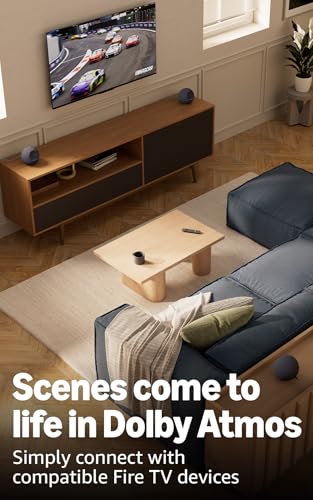
The Echo Studio can also pair with Fire TV devices wirelessly, creating a simple but effective home theater upgrade. While it won't match a dedicated soundbar system, it's a significant improvement over built-in TV speakers.
The Bose Portable Smart Speaker isn't really designed for home theater use. Its lack of wired inputs and 360-degree sound dispersion don't suit the directional audio needs of TV watching.
At the time of writing, the price premium for the Bose Portable Smart Speaker reflects its unique position in the market. Very few smart speakers offer genuine portability with high-quality audio and dual voice assistant support. You're paying for engineering constraints—building a speaker that sounds good, lasts all day on battery, and survives outdoor conditions requires compromises and premium components.
The Amazon Echo Studio represents exceptional value for home-focused users. Its audio capabilities compete with speakers costing much more, and the built-in Zigbee hub adds functionality that would otherwise require separate hardware purchases.
Consider the total cost of ownership: the Bose might save you from buying separate speakers for different locations, while the Echo Studio could eliminate the need for additional smart home hub devices.
Choose the Bose Portable Smart Speaker if you value flexibility above all else. It's ideal for people who move frequently, enjoy outdoor entertainment, or live in smaller spaces where they want to reposition their speaker regularly. The dual voice assistant support is perfect for mixed-ecosystem households, and the weather resistance provides peace of mind for outdoor use.
The Amazon Echo Studio makes sense for users who prioritize audio performance and smart home integration. If you have a dedicated listening space, want the most immersive possible sound for music and movies, or are building an Amazon-centric smart home, it delivers more capability per dollar spent.
Consider your lifestyle honestly: if you find yourself wanting to move speakers around or take them outside, the Bose's portability will quickly justify its premium. If you primarily listen in one room and want the best possible sound quality, the Echo Studio's power advantage and lower price make it the smarter choice.
Both speakers represent mature, well-engineered products that have been refined through years of software updates. Your decision should focus on which design philosophy—portable flexibility or stationary power—better matches your daily usage patterns and audio priorities.
| Bose Portable Smart Speaker | Amazon Echo Studio Smart Speaker |
|---|---|
| Portability - Critical for users who want flexibility beyond fixed placement | |
| Battery-powered (12 hours), 2.3 lbs, built-in handle | Requires wall power, 7.7 lbs, stationary design |
| Speaker Configuration - Determines sound quality and power capabilities | |
| Single driver with 3 passive radiators, 360° sound dispersion | 5 speakers: 1" tweeter, 3x 2" midrange, 5.25" woofer |
| Maximum Volume - How well it fills large rooms or outdoor spaces | |
| Moderate volume suitable for medium rooms and gatherings | High volume capable of filling large rooms and house parties |
| Voice Assistant Support - Affects smart home ecosystem compatibility | |
| Dual support: Amazon Alexa + Google Assistant | Amazon Alexa only |
| Water Resistance - Essential for outdoor and poolside use | |
| IPX4 rating (splash and light rain resistant) | No water resistance rating |
| Audio Technology - Advanced features that enhance listening experience | |
| 360° omnidirectional sound, customizable EQ | Dolby Atmos, 3D spatial audio, automatic room calibration |
| Smart Home Integration - Built-in hub capabilities reduce need for additional hardware | |
| Works with existing hubs via Wi-Fi | Built-in Zigbee hub for direct device control |
| Wired Connectivity - Options for connecting external audio sources | |
| None (wireless only to maintain portability) | 3.5mm aux input + optical digital input |
| Multi-Room Audio - Ability to sync with other speakers throughout home | |
| Bose SimpleSync with other Bose speakers | Amazon multi-room with Echo devices, stereo pairing |
| Home Theater Use - Suitability for enhancing TV audio | |
| Not designed for TV use (360° dispersion not ideal) | Excellent with optical input and Dolby Atmos support |
The Bose Portable Smart Speaker is significantly better for outdoor use. It features a rechargeable battery that lasts up to 12 hours, IPX4 water resistance to handle splashes and light rain, and a portable design with a built-in handle. The Amazon Echo Studio requires constant wall power and has no water resistance, making it unsuitable for outdoor activities.
The Amazon Echo Studio is excellent for home theater use with its optical input for direct TV connection, Dolby Atmos support for immersive surround sound, and powerful 5-speaker array. The Bose Portable Smart Speaker isn't designed for home theater - its 360-degree sound dispersion and lack of wired inputs make it less suitable for TV audio enhancement.
The Amazon Echo Studio gets significantly louder with its 5-speaker configuration and higher power output, making it capable of filling large rooms and powering house parties. The Bose Portable Smart Speaker reaches moderate volume levels suitable for medium-sized rooms and outdoor gatherings but can't match the Echo Studio's raw power.
Yes, both speakers support Amazon Alexa, but the Bose Portable Smart Speaker also supports Google Assistant simultaneously - you can use either "Hey Google" or "Alexa" commands with the same device. The Amazon Echo Studio works exclusively with Alexa but offers deeper integration with Amazon's ecosystem.
The Bose Portable Smart Speaker is designed for mobility with its lightweight 2.3-pound design, built-in handle, and 12-hour battery life. You can easily move it between rooms or take it anywhere. The Amazon Echo Studio weighs nearly 8 pounds and requires constant power, making it impractical to move frequently.
Only the Amazon Echo Studio offers direct TV connectivity through its optical digital input and 3.5mm aux input. This makes it ideal for enhancing TV audio with Dolby Atmos support. The Bose Portable Smart Speaker has no wired inputs and relies entirely on wireless connectivity to maintain its portable design.
Sound quality depends on your priorities. The Amazon Echo Studio delivers more powerful, room-filling sound with deeper bass and Dolby Atmos technology for immersive audio. The Bose Portable Smart Speaker offers more balanced, consistent sound with 360-degree dispersion that sounds good from any angle, plus customizable EQ settings.
The Amazon Echo Studio includes a built-in Zigbee hub, allowing direct connection and control of compatible smart home devices without additional hardware. The Bose Portable Smart Speaker doesn't have hub functionality but can control smart devices through existing hubs via Wi-Fi and voice commands.
Value depends on your needs. The Amazon Echo Studio offers more audio power and smart home features at a lower price point, making it excellent value for stationary use. The Bose Portable Smart Speaker commands a premium but provides unique portability and dual voice assistant support that no other smart speaker offers.
Yes, both support multi-room audio but through different systems. The Bose Portable Smart Speaker works with other Bose speakers via Bose SimpleSync technology. The Amazon Echo Studio integrates with Amazon's multi-room system, can create stereo pairs with another Echo Studio, and works with all Echo devices.
The Bose Portable Smart Speaker is often better for small apartments due to its compact size, ability to move between rooms easily, and 360-degree sound that works well in tight spaces. However, if you want maximum sound quality in a fixed location and don't need portability, the Amazon Echo Studio provides superior audio performance.
Both support high-quality streaming, but the Amazon Echo Studio goes further with support for high-resolution audio up to 24-bit/192kHz, Dolby Atmos, and Sony 360 Reality Audio formats. The Bose Portable Smart Speaker focuses on consistent quality across standard streaming formats with excellent wireless performance and customizable sound tuning.
We've done our best to create useful and informative comparisons to help you decide what product to buy. Our research uses advanced automated methods to create this comparison and perfection is not possible - please contact us for corrections or questions. These are the sites we've researched in the creation of this article: bestbuy.com - assets.bose.com - bestbuy.com - bestbuy.com - bose.com - techforless.com - soundguys.com - youtube.com - youtube.com - newegg.com - youtube.com - dell.com - nfm.com - staples.com - bose.com - sweetwater.com - focuscamera.com - whathifi.com - crutchfield.com - rtings.com - dxomark.com - youtube.com - dimensions.com - youtube.com - bestbuy.com - techradar.com - dolby.com - consumerreports.org - engadget.com - phonearena.com - aboutamazon.com - askalexa.com

Privacy Policy
Terms and Conditions - Affiliate Policy
Home Security
© Copyright 2008-2026.
11816 Inwood Rd #1211, Dallas, TX 75244