

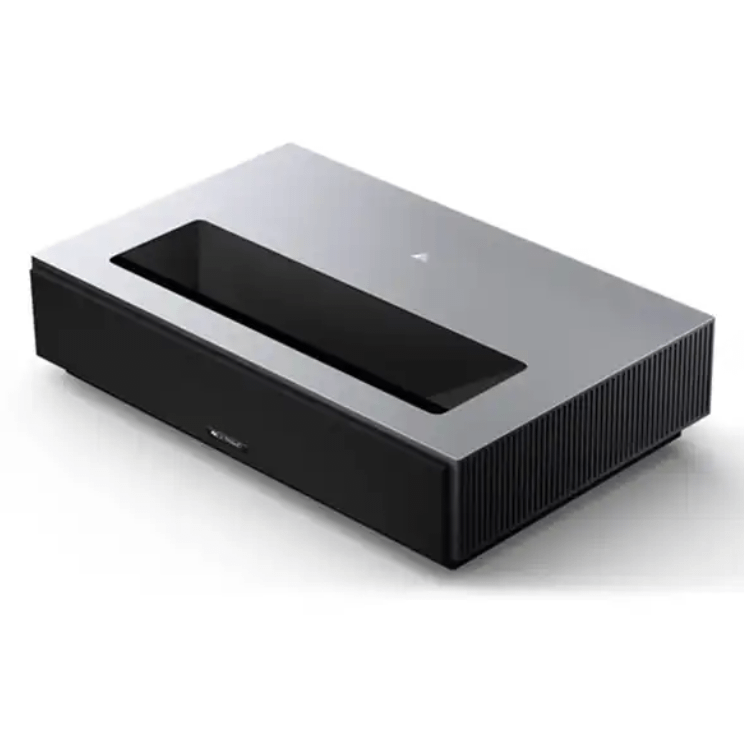
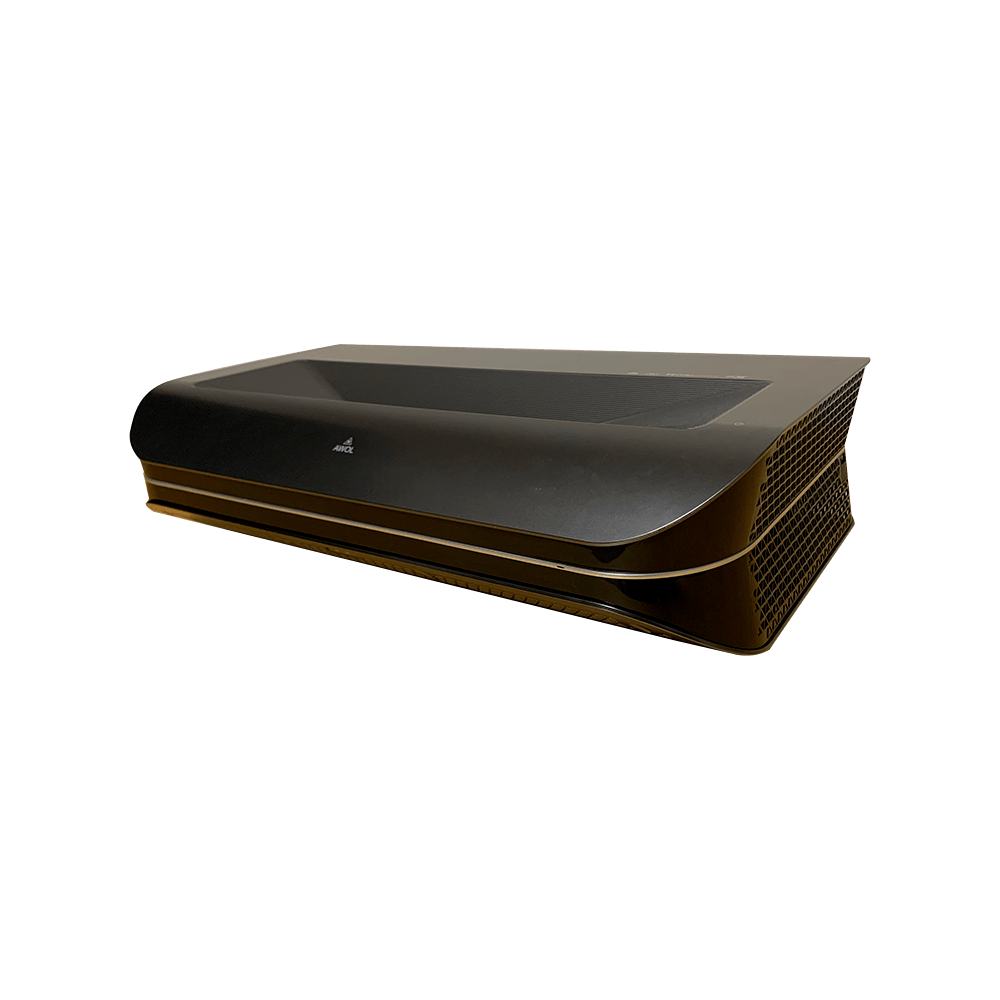

When it comes to creating a truly immersive home theater experience, Formovie 4K Max ($3,699) and AWOL Vision LTV-2500 ($2,999) represent the current state of Ultra Short Throw (UST) projector technology. Let's explore how these two impressive projectors stack up against each other and help you make the right choice for your setup.
Ultra Short Throw projectors have revolutionized home theater by allowing massive screen sizes from just inches away from your wall. Unlike traditional projectors that need significant room depth, USTs can create a 100-inch image from less than a foot away. This technology has made proper home theater setups possible even in smaller spaces.
The Formovie 4K Max employs a single laser system with ALPD 3.0 technology, delivering an impressive 4,500 ANSI lumens. This brightness level is remarkable for a UST projector and makes it particularly suitable for rooms with ambient light. ALPD (Advanced Laser Phosphor Display) technology uses a laser to excite phosphor, creating the light that forms the image.
In contrast, the AWOL LTV-2500 uses an RGB triple laser system producing 2,000 ANSI lumens. While this might seem significantly lower, triple laser systems typically provide better color accuracy and don't need as much raw brightness to create vibrant images. The separate red, green, and blue lasers can produce more precise colors without relying on color wheels or phosphors.
Color reproduction is where these projectors show their distinct approaches. The AWOL's triple laser system achieves 107% of the BT.2020 color space, which is currently the gold standard for digital color. This means it can display more colors than most content even contains - future-proofing your investment.
The Formovie takes a different approach, focusing on brightness while still maintaining good color accuracy within the more common Rec.709 color space. While this covers most current content, it may not fully utilize future HDR content's expanded color range.
Having tested various UST projectors, I can say that brightness handling makes a huge difference in practical use. The Formovie 4K Max really shines here - its 4,500 ANSI lumens mean you don't need perfect darkness to enjoy your content. You can watch sports during the day or keep some lights on for casual viewing without significant image degradation.
The AWOL LTV-2500 performs best in controlled lighting conditions, where its superior color accuracy and contrast can really shine. In a proper home theater setting, many users might actually prefer its image quality, as excessive brightness can sometimes wash out subtle details.
For gamers, input lag is crucial - it's the time between pressing a button and seeing the result on screen. The AWOL impresses with just 15ms at 4K/60Hz and can drop to 8ms at 1080p/120Hz. This makes it suitable for all but the most competitive gaming.
The Formovie hasn't specified its input lag but includes MEMC (Motion Estimation Motion Compensation) technology, which can help smooth motion but typically adds some delay. For casual gaming this shouldn't be an issue, but competitive gamers might want to lean toward the AWOL.
Both projectors require careful placement to achieve optimal image quality. They need to be precisely positioned relative to your screen, as UST projectors are more sensitive to alignment than traditional ones. Both offer electronic keystone correction (which adjusts the image shape), but it's best to avoid using this if possible as it can reduce image quality.
The Formovie can project up to a 200-inch image, while the AWOL maxes out at 150 inches. However, remember that larger images require more brightness to maintain quality, especially with ambient light.
The Formovie runs on FengOS (with a Fire TV stick included for US markets), while the AWOL uses Android 9.0. Both systems provide access to streaming services, but the Fire TV stick might offer a more familiar interface for many users.
Both projectors include multiple HDMI ports and support for various audio formats, including Dolby Atmos. The AWOL's inclusion of Dolby Vision support gives it an edge for HDR content, as this dynamic HDR format can provide better image quality than standard HDR10.
When considering value, look beyond the $700 price difference. The AWOL's triple laser system might provide better longevity, as individual laser degradation is less noticeable than with single laser systems. However, both projectors should last many years with normal use.
Choose the Formovie 4K Max if:
Choose the AWOL Vision LTV-2500 if:
Both projectors represent current technology well, but their different approaches might age differently. The AWOL's wider color gamut and Dolby Vision support might make it more future-proof for upcoming content standards, while the Formovie's brightness advantage will always be valuable for practical viewing situations.
Both projectors excel in their intended use cases. The Formovie 4K Max is a brightness champion that can handle challenging lighting conditions, while the AWOL Vision LTV-2500 offers superior color accuracy and gaming performance at a lower price point. Your choice should primarily depend on your viewing environment and priorities.
For a dedicated home theater room, I'd lean toward the AWOL for its superior color accuracy and Dolby Vision support. For a multipurpose room that can't always be perfectly dark, the Formovie's extra brightness might be worth the premium.
| Formovie 4K Max ($3,699) | AWOL Vision LTV-2500 ($2,999) |
|---|---|
| Brightness - Critical for ambient light handling and image vibrancy | |
| 4,500 ANSI lumens (excellent for bright rooms) | 2,000 ANSI lumens (best in controlled lighting) |
| Light Source - Impacts color accuracy and longevity | |
| Single laser with ALPD 3.0 technology | RGB triple laser system |
| Color Gamut - Determines range of displayable colors | |
| 100% Rec.709 (standard range) | 107% BT.2020 (superior color range) |
| HDR Support - Affects contrast and color depth | |
| HDR10+, HLG | HDR10+, Dolby Vision, HLG |
| Gaming Performance - Important for responsive gameplay | |
| Unspecified latency, includes MEMC | 15ms@4K/60Hz, 8ms@1080p/120Hz |
| Maximum Screen Size - Determines installation flexibility | |
| Up to 200 inches | Up to 150 inches |
| Smart Features - Affects content access and usability | |
| FengOS with Fire TV Stick (US) | Android 9.0 built-in |
| Audio System - Important for built-in sound quality | |
| Two 20W speakers | 36W stereo system |
| Throw Ratio - Determines placement distance | |
| 0.25:1 | 0.25:1 |
| Operating System - Affects user experience and app compatibility | |
| FengOS (external Fire Stick for US) | Android 9.0 |
| Contrast Ratio - Important for black levels and image depth | |
| 3000:1 | 2500:1 |
| Supported Resolutions - Affects content compatibility | |
| 4K UHD (3840x2160) native | 4K UHD (3840x2160) with pixel shifting |
The Formovie 4K Max ($3,699) is significantly better for bright rooms with its 4,500 ANSI lumens compared to the AWOL LTV-2500's ($2,999) 2,000 ANSI lumens. If you plan to watch during daytime or with lights on, the Formovie is the better choice.
The AWOL LTV-2500 offers superior color accuracy with its RGB triple laser system and 107% BT.2020 color coverage, while the Formovie 4K Max uses a single laser system with standard Rec.709 coverage.
The AWOL LTV-2500 is better for gaming with its low input lag of 15ms at 4K/60Hz and 8ms at 1080p/120Hz. The Formovie 4K Max doesn't specify gaming performance but includes MEMC technology which typically adds some delay.
The AWOL LTV-2500 at $2,999 offers better value with superior color accuracy, gaming performance, and Dolby Vision support. The Formovie 4K Max at $3,699 justifies its higher price mainly through superior brightness.
The Formovie 4K Max can project up to 200 inches, while the AWOL LTV-2500 maxes out at 150 inches. However, larger screens require more brightness for optimal image quality.
The AWOL LTV-2500 is better for dedicated home theaters due to its superior color accuracy, Dolby Vision support, and excellent contrast in controlled lighting conditions.
Yes, both the Formovie 4K Max and AWOL LTV-2500 support 4K UHD resolution (3840x2160), though they use different technologies to achieve this.
Both offer smart features, but differently. The Formovie 4K Max comes with FengOS and includes a Fire TV stick for US markets, while the AWOL LTV-2500 runs on Android 9.0 built-in.
The AWOL LTV-2500 has better HDR support with HDR10+, Dolby Vision, and HLG, while the Formovie 4K Max supports HDR10+ and HLG but lacks Dolby Vision.
Both the Formovie 4K Max and AWOL LTV-2500 have a 0.25:1 throw ratio, meaning they need to be placed about 13-14 inches from the wall for a 100-inch image.
The AWOL LTV-2500 features a more powerful 36W stereo system compared to the Formovie 4K Max's two 20W speakers, though external speakers are recommended for both.
The AWOL LTV-2500's triple laser system may provide more consistent performance over time compared to the Formovie 4K Max's single laser system, though both are rated for 25,000+ hours of use.
We've done our best to create useful and informative comparisons to help you decide what product to buy. Our research uses advanced automated methods to create this comparison and perfection is not possible - please contact us for corrections or questions. These are the sites we've researched in the creation of this article: rtings.com - eu.formovie.com - notebookcheck.net - formovie.com - techradar.com - projectorcentral.com - projectorscreen.com - projectorcentral.com - projectorreviews.com - projectorcentral.com - formovie.com - projectorjunkies.com - dreamediaav.com - projectorjunkies.com - avsforum.com - nothingprojector.com - projectorreviews.com - vividstorm.eu - projectorcentral.com - projectorcentral.com - projectorcentral.com - avsforum.com - dreamediaav.com

Privacy Policy
Terms and Conditions - Affiliate Policy
Home Security
© Copyright 2008-2026.
11816 Inwood Rd #1211, Dallas, TX 75244