


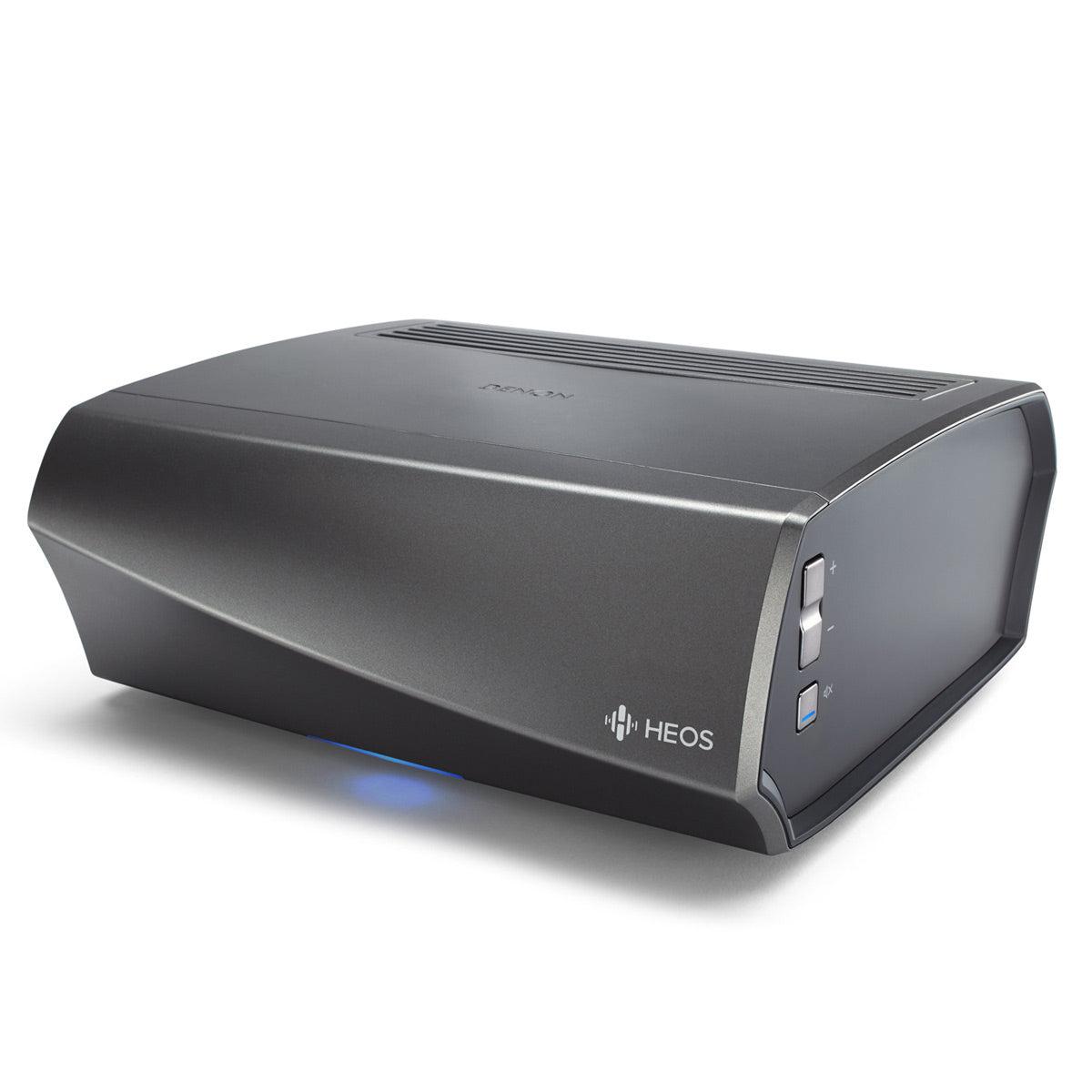
When shopping for a stereo amplifier today, you're essentially choosing between two philosophical approaches to home audio. Do you want the warm, vintage character of tube amplification with traditional hi-fi features? Or are you more interested in the convenience of wireless streaming and multi-room audio? The Dayton Audio HTA200 and Denon HEOS Amp HS2 represent these two paths perfectly, and understanding their differences will help you make the right choice for your listening habits and home setup.
Integrated stereo amplifiers combine two essential functions: preamplification (which boosts weak signals from sources like turntables) and power amplification (which drives your speakers). What's changed dramatically in recent years is how these amplifiers connect to your music and integrate with modern homes.
Traditional amplifiers focus on sound quality and analog sources, often featuring physical controls and emphasis on sonic character. Meanwhile, wireless streaming amplifiers prioritize convenience, app control, and network connectivity. Both approaches have merit, but they serve different types of listeners and setups.
The most important performance characteristics to consider include power output (how loud and clean your music will sound), total harmonic distortion or THD (lower numbers mean cleaner sound), signal-to-noise ratio or SNR (higher numbers mean less background noise), and frequency response (how evenly the amplifier reproduces different musical frequencies from deep bass to sparkling highs).
Released in recent years as part of Dayton Audio's expanded amplifier lineup, the HTA200 represents something increasingly rare: an affordable hybrid tube amplifier with comprehensive connectivity. This isn't your grandfather's tube amp that gets scorching hot and needs constant maintenance.
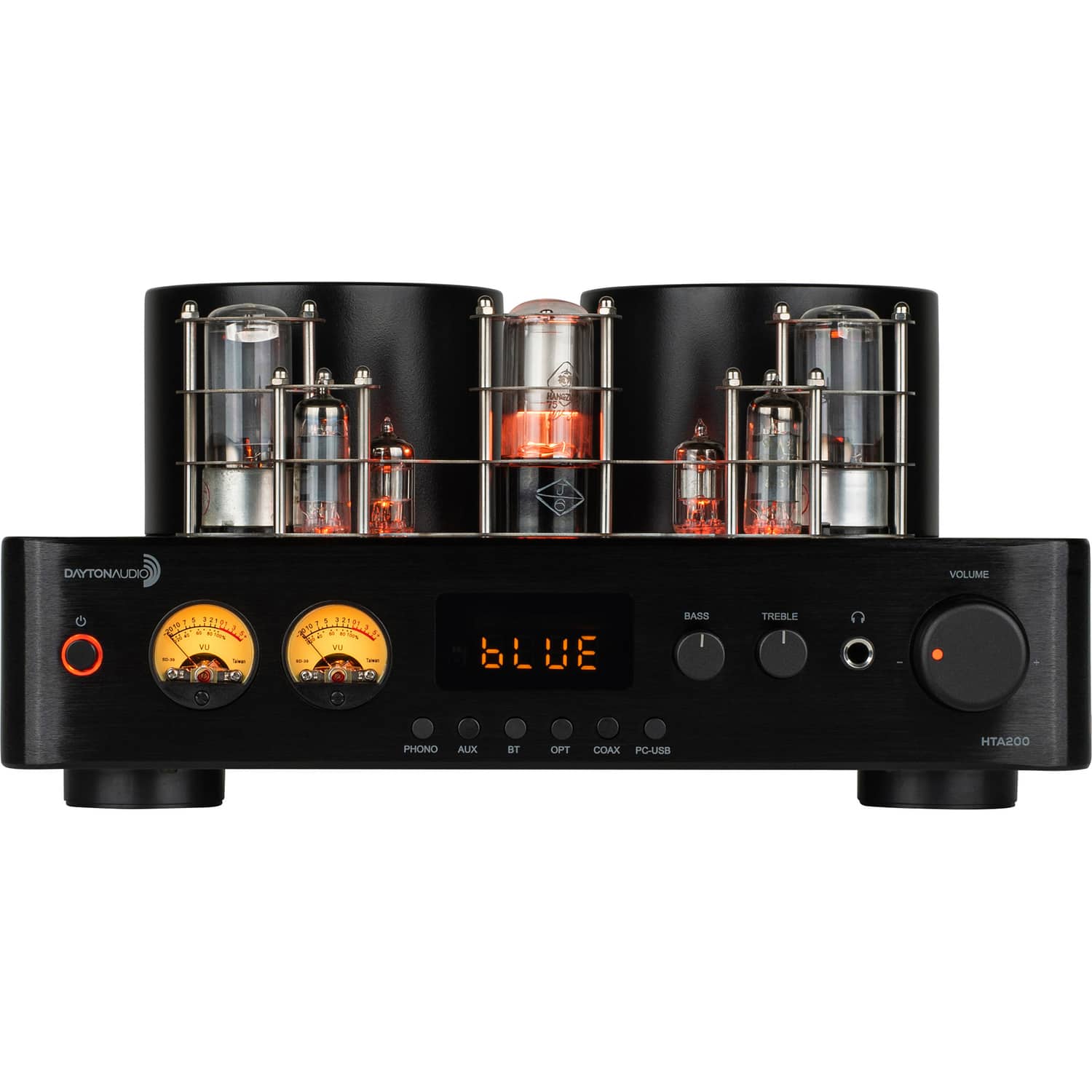
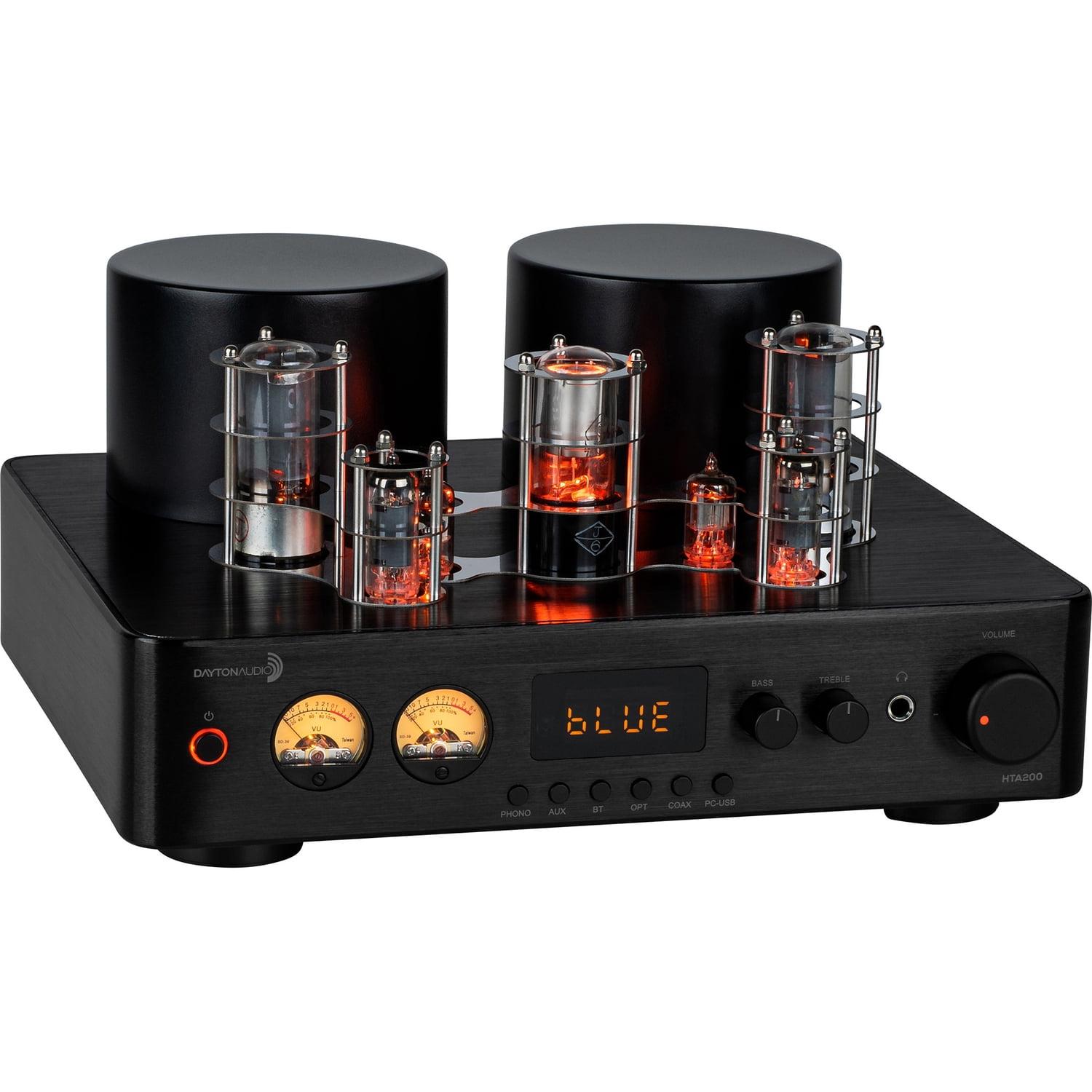
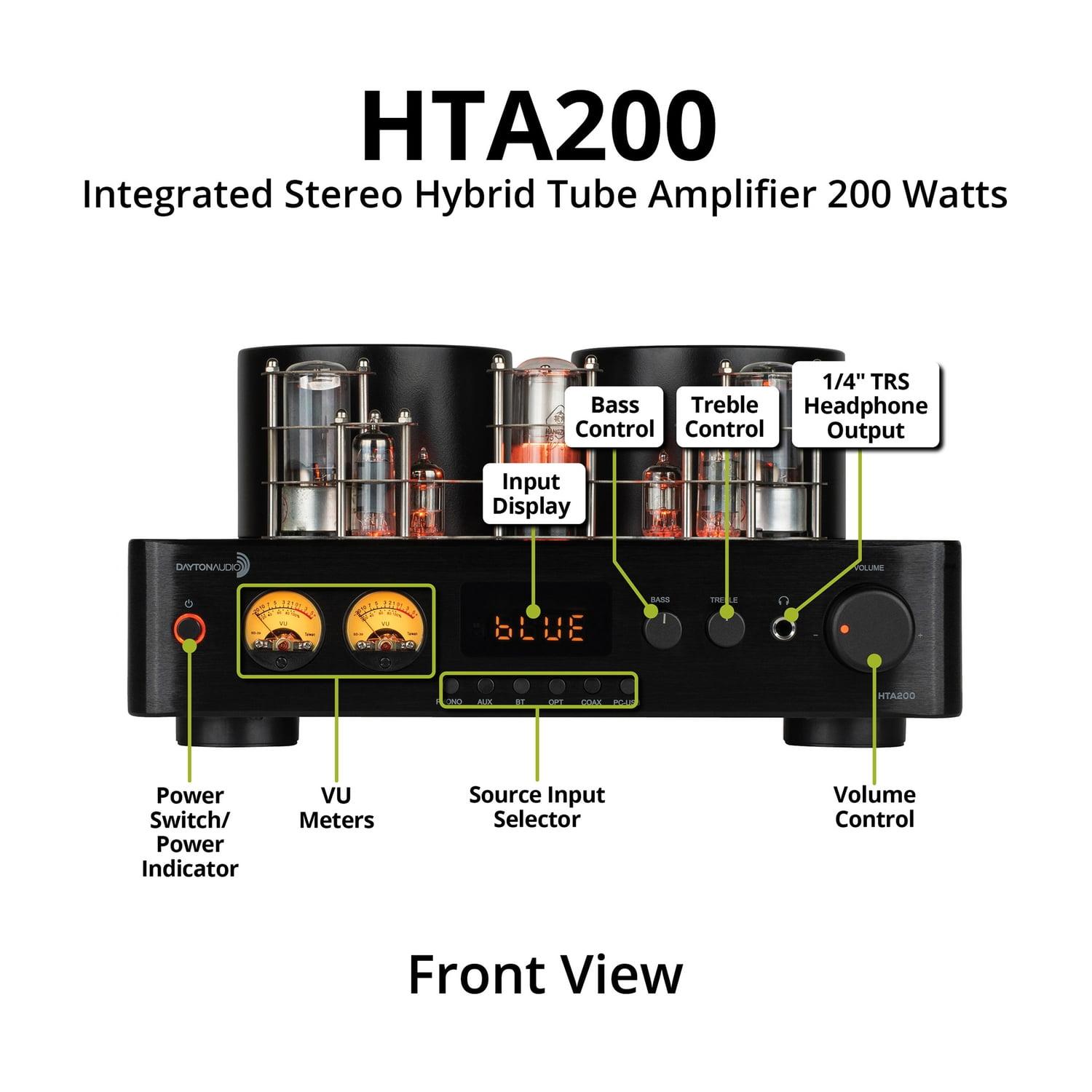
The HTA200's hybrid architecture uses vacuum tubes for preamplification while relying on solid-state transistors for power amplification. This clever combination gives you the warm, musical character that tube enthusiasts love without the reliability concerns and power limitations of traditional all-tube designs.
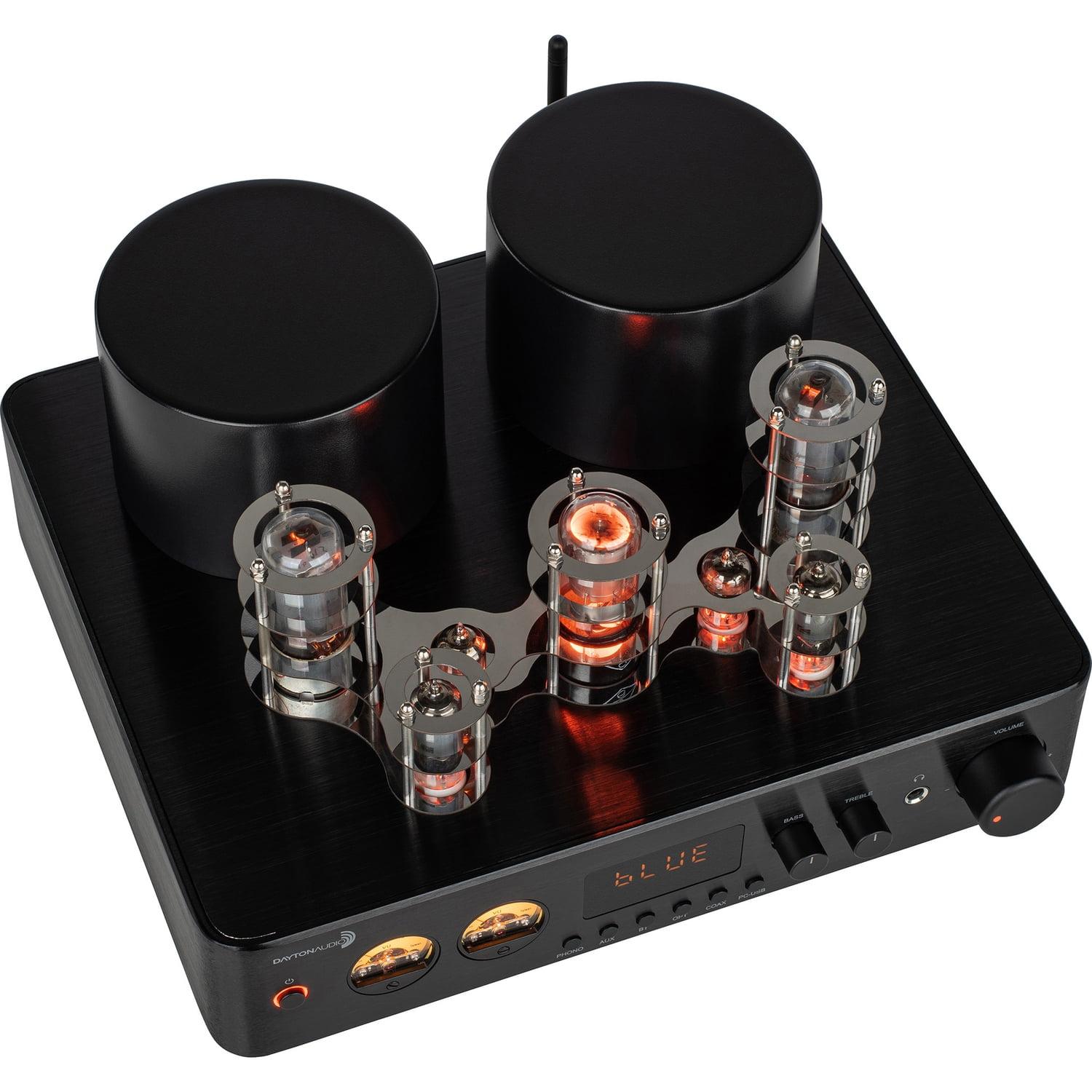
The preamp section features amber-toned vacuum tubes (specifically 13P1P, 6H2, 6A2, and WY3P stabilivolt tubes) that add subtle harmonic coloration to your music. Think of tubes like adding a gentle warmth filter to your audio – they emphasize midrange frequencies where vocals live and add a pleasing richness to instruments. The solid-state power amplifier section then takes this tube-warmed signal and delivers a robust 100 watts per channel into 4-ohm speakers, or 50 watts into 8-ohm speakers.
This power rating puts the HTA200 in serious amplifier territory. For context, 50 watts is enough to drive most bookshelf speakers to satisfying volumes in medium-sized rooms, while 100 watts gives you headroom for larger speakers and rooms, or simply cleaner sound at moderate volumes.
Where the HTA200 really shines is its comprehensive input selection. The dedicated moving-magnet phono input with ground connection means you can plug a turntable directly into the amplifier without needing a separate phono preamp – a significant cost savings and convenience factor for vinyl enthusiasts.
The USB DAC input (digital-to-analog converter) handles computer audio up to 16-bit/48kHz resolution, which covers CD-quality and most streaming service formats. While not cutting-edge by today's high-resolution standards, it's perfectly adequate for most users. The optical and coaxial digital inputs provide additional options for CD players or streaming devices.
The front panel deserves special mention for its old-school appeal. The backlit VU meters (volume unit meters) dance with your music, providing visual feedback about signal levels. The exposed tubes glow warmly, creating an undeniably attractive focal point. Physical knobs for bass, treble, and motorized volume control mean you can adjust settings without reaching for a remote or phone – something that feels increasingly luxurious in our app-controlled world.
Based on extensive user feedback and professional reviews, the HTA200 delivers exactly what hybrid tube amplifiers promise: a warm, engaging sound that makes music feel more organic and less clinical than typical solid-state designs. The tube preamp stage adds subtle harmonic distortion (the good kind) that fills out the midrange and makes vocals more present.
However, this character comes with trade-offs. The published THD specification of less than 1% is higher than what you'd find in pure solid-state designs, though this level is still considered very good and unlikely to be audible under normal listening conditions. The tubes also contribute to the amplifier's 45-watt idle power consumption, making it less energy-efficient than modern Class D designs.
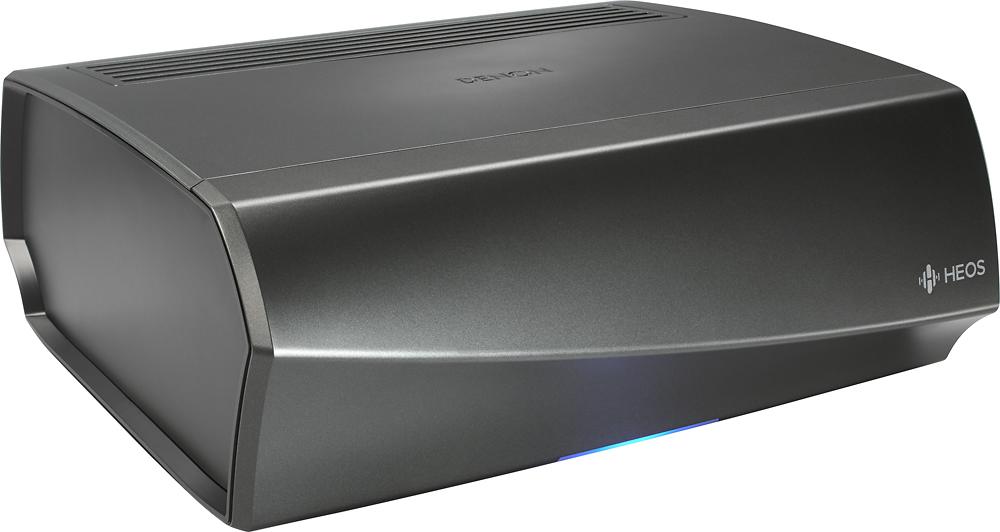
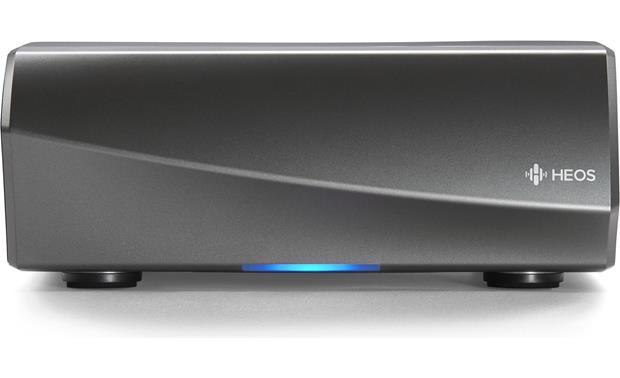
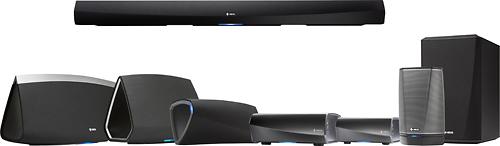
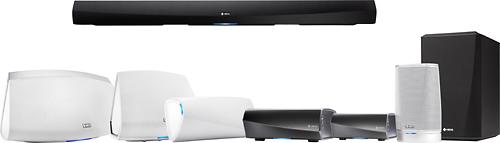
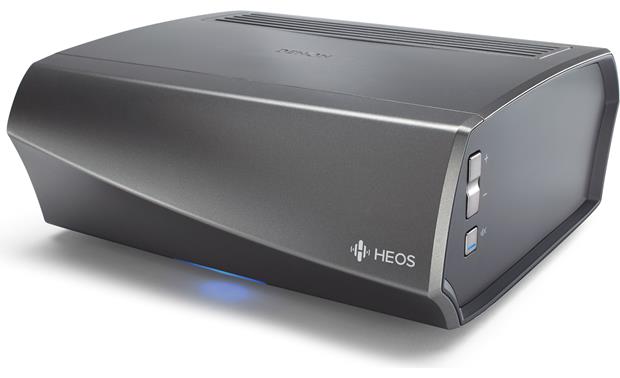
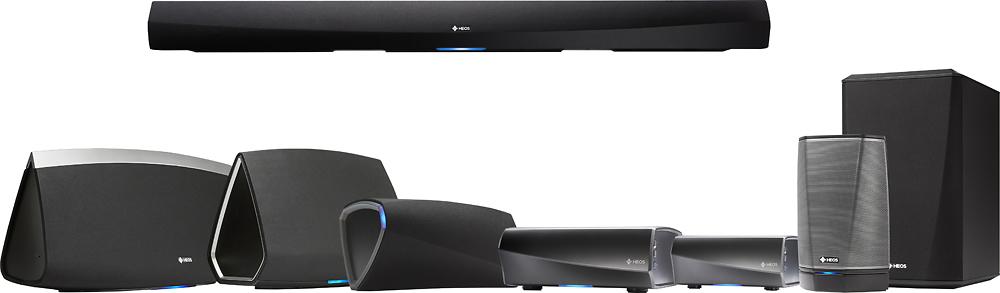
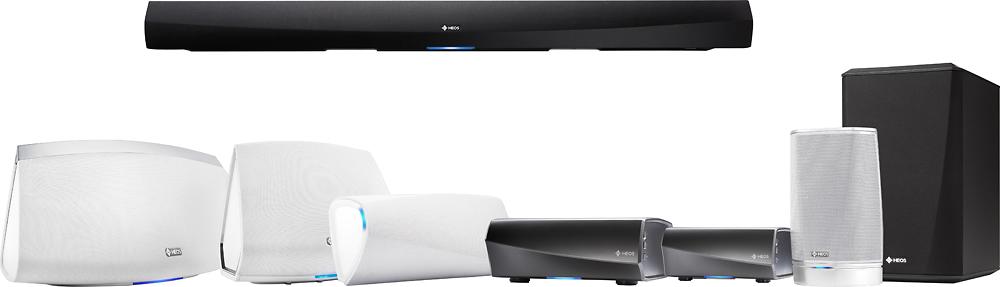
The HEOS Amp HS2, part of Denon's wireless ecosystem launched in 2016, represents the modern approach to home audio. Rather than focusing on analog sources and sonic character, it prioritizes network connectivity and multi-room integration.
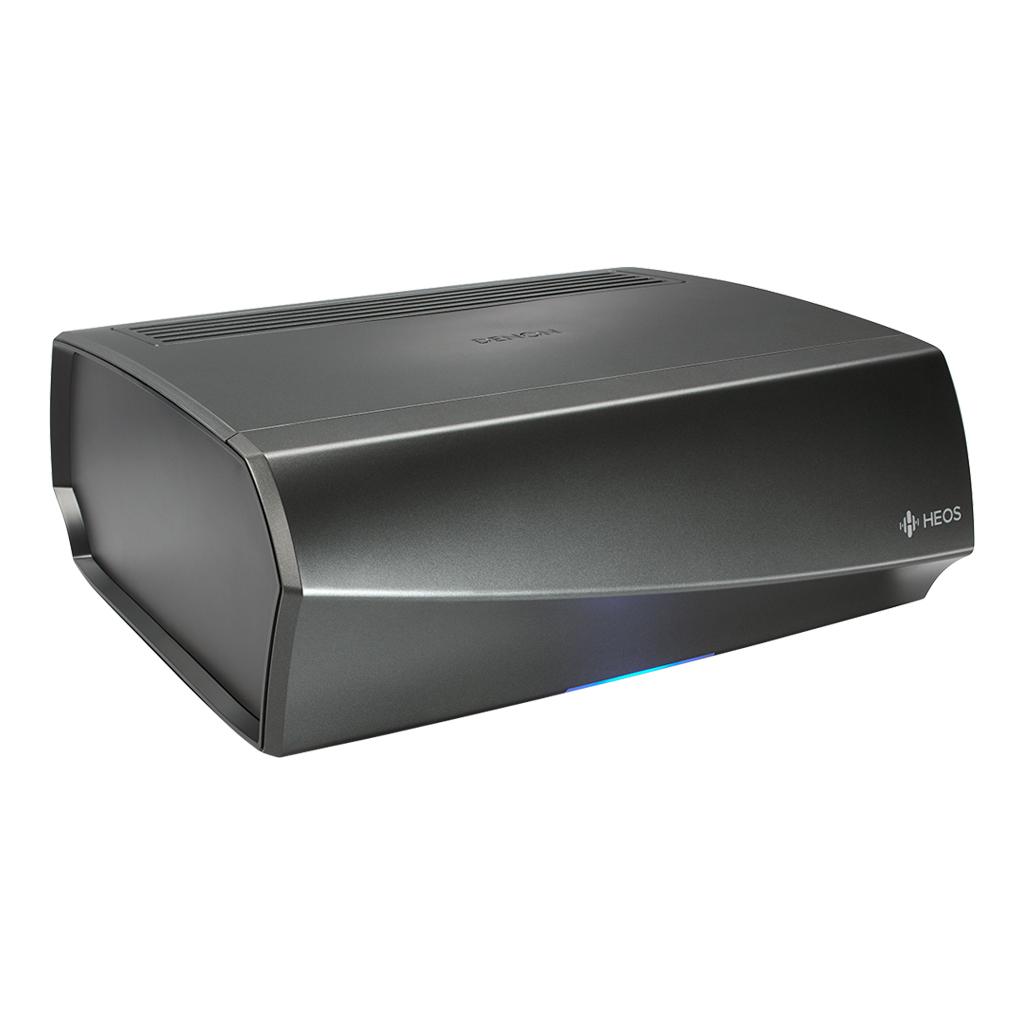
The HEOS Amp HS2 uses Class D amplification, a switching technology that's incredibly efficient compared to traditional designs. While older audiophiles sometimes dismiss Class D as sounding "cold" or "digital," modern implementations have largely overcome these concerns while offering significant advantages in size, heat generation, and power consumption.
At 70 watts per channel into 8 ohms, the HEOS Amp HS2 produces less peak power than the HTA200, but its Class D design means it maintains consistent performance without the heat buildup that can affect traditional amplifiers during extended listening sessions. The published THD specification of just 0.05% is exceptionally low, indicating very clean amplification.
Where the HEOS Amp HS2 truly excels is its integration with Denon's HEOS ecosystem. This allows you to create up to 64 zones of synchronized or independent audio throughout your home. You can group rooms together for parties, send different music to different areas, or create a whole-home audio experience that rivals professionally installed systems.
The streaming capabilities are comprehensive, with native support for major services like Spotify, Tidal, Amazon Music, and many others. High-resolution audio support extends up to 24-bit/192kHz for local files, which exceeds CD quality and captures the full detail of studio master recordings.
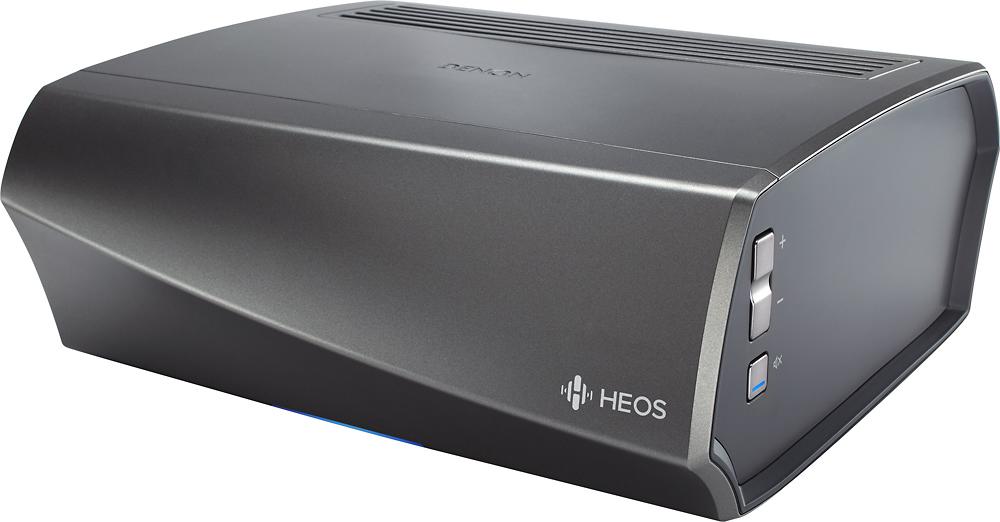
The HEOS app serves as your control center, replacing traditional front-panel controls with smartphone-based management. While this requires adaptation for users accustomed to physical knobs and buttons, it offers powerful features like creating playlists that span multiple streaming services and managing complex multi-room scenarios.

Despite impressive specifications, some technical measurements reveal limitations in the HEOS Amp HS2's internal DAC performance. Independent testing has shown higher noise and distortion levels in the digital conversion stage than the amplification stage specifications would suggest. However, these measurements don't necessarily translate to audible problems in typical listening scenarios.
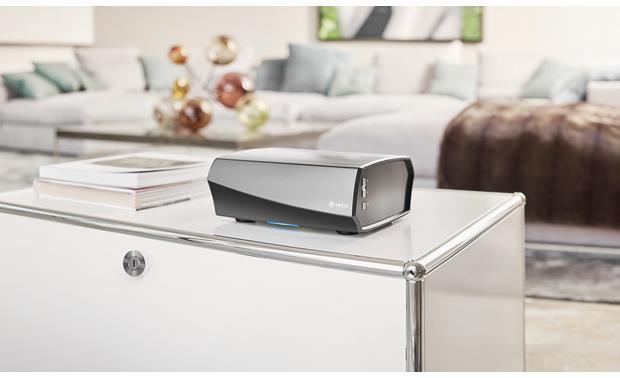
User feedback generally praises the HEOS Amp HS2 for clean, detailed sound with good bass control and clear highs. The compact design makes it easy to hide in entertainment centers or mount in utility areas, contributing to a clean, wire-free aesthetic that many modern homes demand.
The HTA200 wins the raw power comparison, delivering 100 watts into 4-ohm loads versus the HEOS Amp HS2's 70 watts into 8 ohms. This difference becomes significant when driving inefficient speakers or filling large rooms. Inefficient speakers (those rated below 87dB sensitivity) need more power to reach satisfying volume levels, making the HTA200 the better choice for demanding loads.
However, the HEOS Amp HS2's Class D design provides consistent power delivery without thermal limitations. Traditional amplifiers can lose power as they heat up during extended listening sessions, while Class D designs maintain performance regardless of operating temperature.
This comparison highlights the fundamental philosophical difference between these amplifiers. The HTA200 intentionally colors your music with tube warmth, creating a more romantic, engaging presentation that many find addictive. Jazz, blues, and vocal music particularly benefit from this treatment, gaining richness and dimensionality.
The HEOS Amp HS2 aims for accuracy rather than character, reproducing your music as faithfully as possible without editorial comment. This neutral approach works better for genres like electronic music, pop, and classical recordings where you want to hear exactly what the recording engineer intended.
Neither approach is inherently better – it's a matter of preference and musical priorities.
The HTA200 covers traditional hi-fi bases exceptionally well. The built-in phono preamp eliminates the need for external components when using turntables, while multiple digital inputs handle modern sources. Bluetooth 5.0 provides wireless connectivity, though it's limited to basic SBC and AAC codecs.
The HEOS Amp HS2 is designed for the streaming age. Its network connectivity, comprehensive streaming service integration, and multi-room capabilities represent the future of home audio. If you primarily listen to Spotify, Apple Music, or other streaming services, the seamless integration and high-resolution support make daily use more enjoyable.
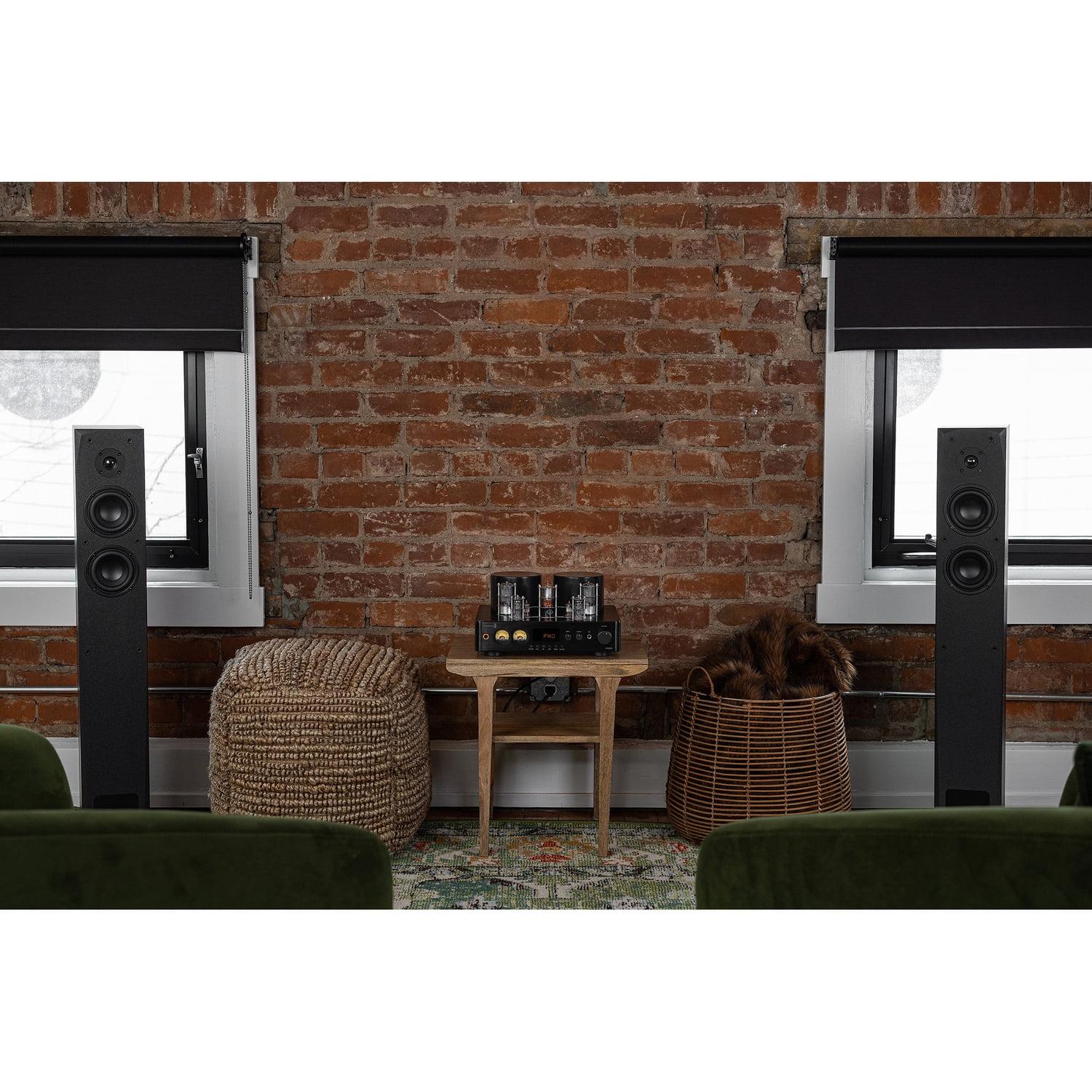
Both amplifiers can integrate into home theater systems, but with different strengths. The HTA200 works well as a dedicated stereo zone in a multi-room setup or as the foundation for a simple 2.1 system using its subwoofer output. The tube warmth can add welcome richness to movie soundtracks, though it's not designed for surround sound processing.
The HEOS Amp HS2 excels in whole-home theater scenarios where you want to distribute audio to multiple zones. You could use it to power rear speakers in a main theater while simultaneously sending music to other rooms. The app control makes managing complex scenarios much easier than traditional amplifier switching.
At the time of writing, both amplifiers occupy similar price territories in the mid-tier integrated amplifier market. The HTA200 represents exceptional value for its feature set, particularly considering that hybrid tube amplifiers traditionally command premium prices. The comprehensive connectivity, substantial power output, and five-year warranty make it a standout in its price range.
The HEOS Amp HS2 costs slightly more but includes technologies that would require multiple separate components to replicate. The wireless streaming capabilities, multi-room functionality, and app control justify the premium for users who value these features.
However, if you're only using it as a simple stereo amplifier without multi-room features, the HEOS Amp HS2 might seem expensive compared to basic stereo amplifiers with similar power output.
The choice between the Dayton Audio HTA200 and Denon HEOS Amp HS2 ultimately depends on your listening habits, source preferences, and home integration needs.
Choose the HTA200 if you're drawn to the warmth and character of tube sound, own vinyl records or other analog sources, prefer physical controls, or need higher power output for demanding speakers. It's also the better choice if you want a standalone amplifier that doesn't depend on network connectivity or smartphone apps for basic operation.
The HEOS Amp HS2 makes more sense if you primarily stream music, want multi-room audio capabilities, prefer app-based control, or need a compact amplifier that can disappear into your home's infrastructure. It's particularly appealing if you're planning to expand into a whole-home audio system over time.
Both amplifiers represent thoughtful approaches to modern audio challenges, but they serve fundamentally different philosophies about how we interact with our music systems. The HTA200 celebrates the traditional hi-fi experience while adding modern conveniences, while the HEOS Amp HS2 reimagines the amplifier as a networked appliance optimized for today's streaming-centric world.
Your choice should reflect not just how you listen today, but how you want to listen in the future. The good news is that both paths lead to great sound – just through very different approaches.
| Dayton Audio HTA200 | Denon HEOS Amp HS2 |
|---|---|
| Power Output - Higher wattage drives larger speakers and fills bigger rooms | |
| 100W @ 4Ω, 50W @ 8Ω (excellent for demanding speakers) | 70W @ 8Ω (sufficient for most bookshelf speakers) |
| Amplifier Type - Affects sound character and efficiency | |
| Hybrid tube preamp + Class A/B power (warm, musical sound) | Class D solid-state (neutral, efficient, compact) |
| Total Harmonic Distortion - Lower numbers mean cleaner sound | |
| <1% (good, with pleasing tube coloration) | 0.05% (exceptional technical performance) |
| Analog Inputs - Essential for turntables and traditional sources | |
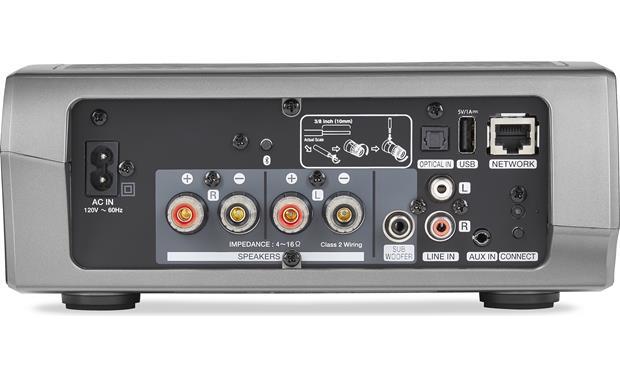
| MM phono input with ground + RCA line input | RCA line input only (no phono preamp) |
| Digital Connectivity - Modern source compatibility | |
| USB DAC (16-bit/48kHz), optical, coaxial, Bluetooth 5.0 | USB, optical, advanced network streaming up to 24-bit/192kHz |
| Multi-Room Audio - Whole-home music distribution | |
| None (standalone stereo amplifier only) | Up to 64 HEOS zones with app control |
| Physical Controls - Direct access without apps | |
| Motorized volume, bass/treble knobs, input selector, remote | App-only control (no front panel controls) |
| Streaming Services - Built-in music platform access | |
| Basic Bluetooth only | Native Spotify, Tidal, Amazon Music, and many others |
| Visual Features - Aesthetic and functional displays | |
| Backlit VU meters, exposed glowing tubes | Minimal LED indicators only |
| Setup Complexity - Time and technical knowledge required | |
| Plug-and-play with any speakers | Network setup required, smartphone app mandatory |
| Subwoofer Integration - Bass extension options | |
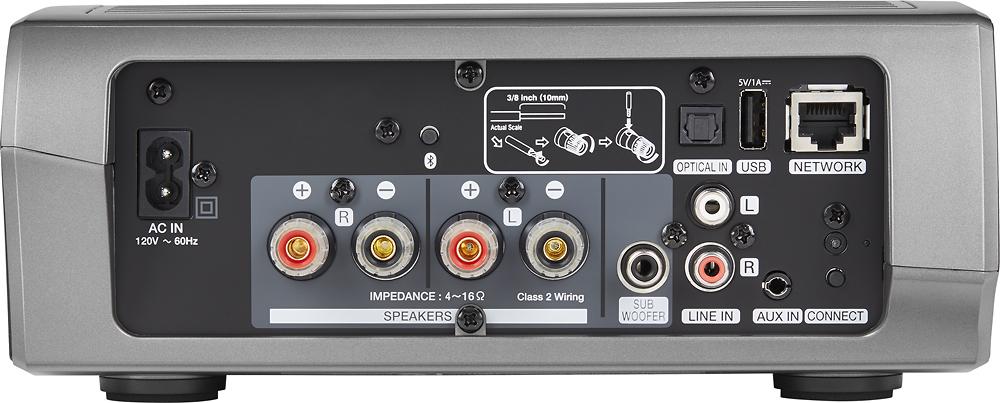
| Dedicated RCA subwoofer output | Mono RCA subwoofer output |
| Warranty Coverage - Long-term reliability protection | |
| 5 years (exceptional coverage) | 2 years (standard coverage) |
The Dayton Audio HTA200 delivers more power with 100 watts per channel into 4-ohm speakers and 50 watts into 8-ohm speakers. The Denon HEOS Amp HS2 provides 70 watts per channel into 8-ohm speakers. The HTA200 has a clear advantage for driving larger or less efficient speakers.
The Dayton Audio HTA200 is a traditional hybrid tube amplifier focused on warm sound quality and analog sources like turntables. The Denon HEOS Amp HS2 is a wireless streaming amplifier designed for multi-room audio and app-based control. They represent completely different approaches to home audio.
Yes, but with different requirements. The Dayton Audio HTA200 has a built-in phono preamp with ground connection, so you can connect most turntables directly. The Denon HEOS Amp HS2 requires a turntable with a built-in preamp or a separate phono preamp since it only has line-level inputs.
The Denon HEOS Amp HS2 excels at streaming with native support for Spotify, Tidal, Amazon Music, and other services, plus high-resolution audio up to 24-bit/192kHz. The HTA200 only offers basic Bluetooth connectivity. For serious streaming, the HEOS Amp HS2 is clearly superior.
Both can work in home theater systems but differently. The Dayton Audio HTA200 works well for stereo music zones or simple 2.1 setups using its subwoofer output. The Denon HEOS Amp HS2 is better for whole-home theater distribution, powering speakers in multiple rooms simultaneously through its multi-room capabilities.
This depends on your preferences. The Dayton Audio HTA200 produces warm, musical sound with tube character that many find engaging, especially for jazz and vocals. The Denon HEOS Amp HS2 delivers neutral, accurate sound reproduction. Neither is objectively better – it's about whether you want colored or transparent sound.
Yes for the Dayton Audio HTA200, which has physical front-panel controls for volume, bass, treble, and input selection, plus a remote control. The Denon HEOS Amp HS2 requires the smartphone app for virtually all functions – there are no meaningful physical controls on the unit itself.
Only the Denon HEOS Amp HS2 supports multi-room audio, connecting up to 64 zones in the HEOS ecosystem. You can play different music in each room or sync everything together. The HTA200 is a standalone stereo amplifier without multi-room capabilities.
The Dayton Audio HTA200 includes an exceptional 5-year warranty, while the Denon HEOS Amp HS2 comes with a standard 2-year warranty. Both brands have good reliability reputations, but the longer warranty coverage gives the HTA200 an advantage for long-term peace of mind.
The Dayton Audio HTA200 is simpler – just connect speakers and sources, then start listening. The Denon HEOS Amp HS2 requires network setup, app installation, and account creation with streaming services. The HTA200 wins for plug-and-play simplicity.
The Denon HEOS Amp HS2 supports high-resolution audio up to 24-bit/192kHz through network streaming and local files. The HTA200 has a USB DAC that handles up to 16-bit/48kHz (CD quality) plus optical and coaxial digital inputs. For hi-res audio enthusiasts, the HEOS Amp HS2 offers better format support.
This depends on your needs. The Dayton Audio HTA200 offers exceptional value for traditional hi-fi features, tube sound, and comprehensive connectivity at its price point. The Denon HEOS Amp HS2 provides good value if you need wireless streaming and multi-room features, but may seem expensive if used only as a basic stereo amplifier.
We've done our best to create useful and informative comparisons to help you decide what product to buy. Our research uses advanced automated methods to create this comparison and perfection is not possible - please contact us for corrections or questions. These are the sites we've researched in the creation of this article: daytonaudio.com - audiosciencereview.com - daytonaudio.com - audioholics.com - soundstageaccess.com - youtube.com - avsforum.com - solen.ca - daytonaudio.com - soundstagenetwork.com - parts-express.com - homedepot.com - device.report - soundstagenetwork.com - petra.com - manualslib.com - audiophonics.fr - manualshelf.com - bestbuy.com - consumerreports.org - audiosciencereview.com - youtube.com - crutchfield.com - avsforum.com - whathifi.com - audiosciencereview.com - youtube.com - versus.com - easylounge.com - snapav.com - crutchfield.com - accessories4less.com - richersounds.com - wave-electronics.com - bestbuy.com - safeandsoundhq.com - theaudiotailor.com.au - retailspecs.com

Privacy Policy
Terms and Conditions - Affiliate Policy
Home Security
© Copyright 2008-2026.
11816 Inwood Rd #1211, Dallas, TX 75244