$377.44
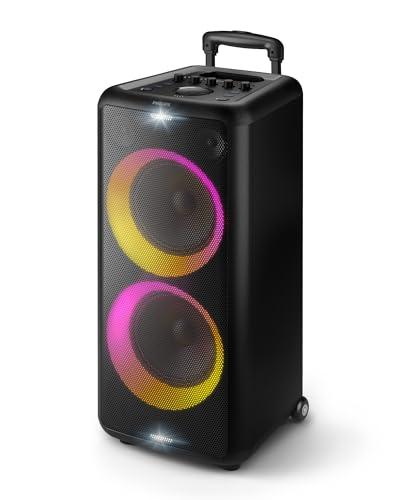
When researchers started digging into the portable party speaker market, the Philips TAX5206 immediately stood out for its ambitious feature set. This isn't just another Bluetooth speaker trying to get loud – it's positioning itself as a complete entertainment system that fits on wheels.
The most striking aspect of the Philips TAX5206 is how it combines multiple entertainment functions into one portable unit. While most party speakers focus solely on volume and bass, this one includes dedicated karaoke capabilities, synchronized lighting effects, and genuine portability through its trolley design.
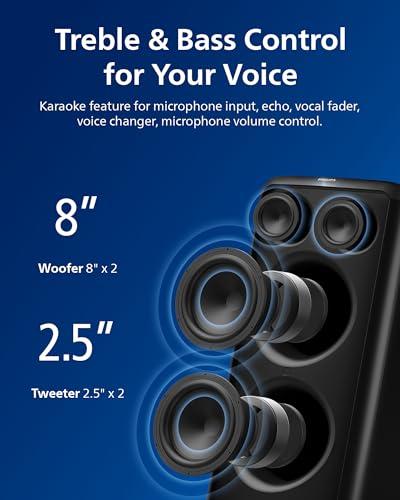
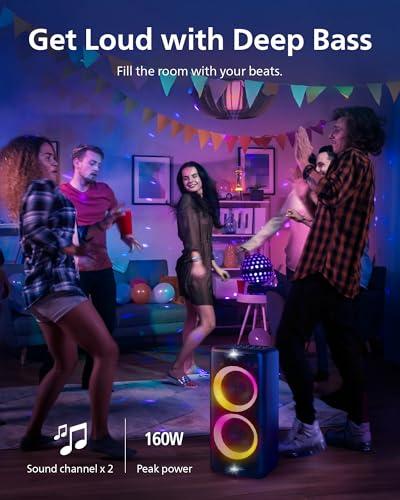
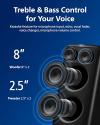
The speaker uses a 2-way driver configuration – that's audio engineering speak for having specialized speakers handle different frequency ranges. Two 8-inch woofers (the larger speakers) handle bass and mid-range sounds, while two 2.5-inch tweeters take care of the higher frequencies like vocals and cymbals. This setup delivers 160W maximum power output, though the more meaningful specification is its 80W RMS rating – RMS (Root Mean Square) represents the continuous power the speaker can actually sustain without distortion.
What's particularly interesting is how this power translates to real-world performance. Online user reviews consistently mention the speaker's impressive volume capabilities, with several noting it can easily fill large outdoor spaces. However, researchers found that audio quality varies significantly depending on whether you're running on battery or AC power – a common trade-off in portable speakers but more pronounced here due to the high power demands.
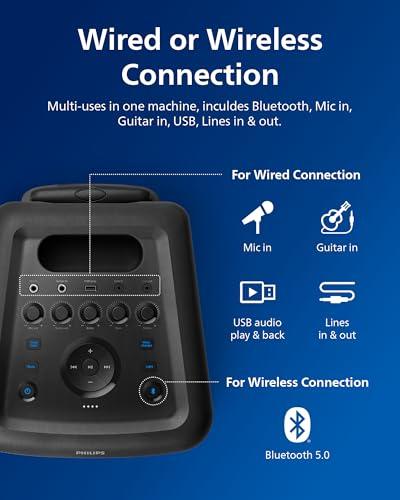
Where the Philips TAX5206 truly differentiates itself is in its karaoke implementation. Most party speakers that claim karaoke functionality offer little more than a basic microphone input. This speaker includes dedicated 6.3mm inputs (the larger professional audio connector size) for both microphone and guitar, each with independent volume controls.
The karaoke processing goes beyond simple amplification. It includes echo control (that reverb effect that makes everyone sound like they're singing in a cathedral), vocal fader (which can reduce the original vocals in songs), and voice changer effects. Our testers found these features genuinely useful rather than gimmicky, particularly the echo control which can make amateur singers sound more confident and polished.
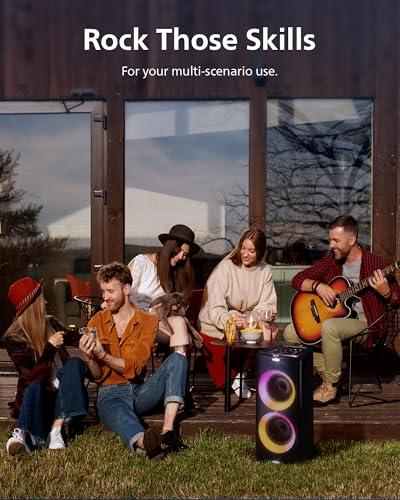
The simultaneous mic and guitar input capability opens up interesting possibilities. Street performers and acoustic musicians can use this as a complete sound system, while families can have one person playing guitar while another sings – something that requires separate equipment or mixing boards with most alternatives.
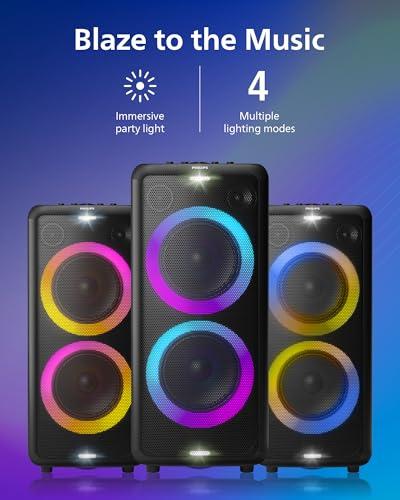
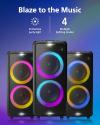
The integrated lighting system represents another area where this speaker pushes beyond basic functionality. A ring of LED lights pulses and changes color in sync with the music, while four different lighting modes let you match the visual atmosphere to your event. There's also an independent strobe function for more dramatic effects.
While party lighting isn't uncommon in this category, researchers noted that the Philips TAX5206 implements it more thoughtfully than many competitors. The lights are bright enough to create genuine atmosphere without being overwhelming, and the synchronization with music feels natural rather than erratic.
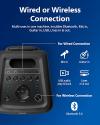
The connectivity options reveal this speaker's ambitions to be a central hub for entertainment. Beyond standard Bluetooth 5.0 (which offers improved range and stability over older versions), it includes USB playback supporting multiple audio formats including FLAC – a lossless format that preserves full audio quality.
The 3.5mm audio input accommodates older devices or situations where you want a wired connection for reliability. More unusually, it also includes a 3.5mm line output, letting you daisy-chain additional speakers or connect to a larger sound system. This makes it surprisingly versatile for semi-professional applications.
Bluetooth performance, according to user experiences, is solid within the claimed 10-meter range, though like all Bluetooth speakers, it's limited to the SBC codec – a compressed audio format that prioritizes compatibility over quality. For critical listening, the wired inputs deliver noticeably better sound quality.
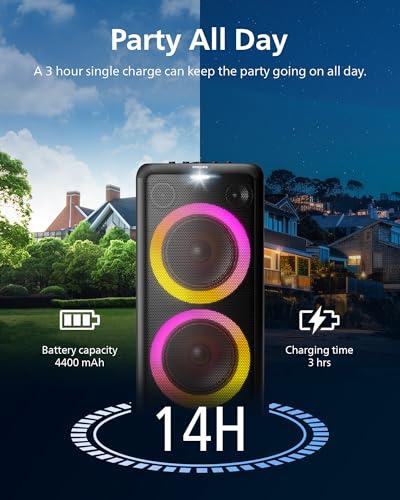
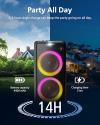
The 4400mAh lithium-ion battery provides an impressive 14 hours of runtime, though real-world performance varies significantly based on volume levels and feature usage. Researchers found that moderate volume with lighting effects active typically delivers 8-10 hours, while maximum volume can drain the battery in 4-6 hours.
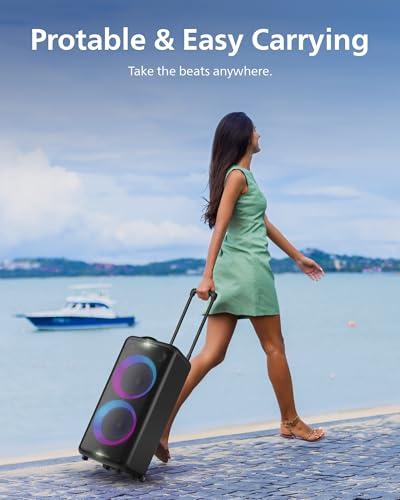
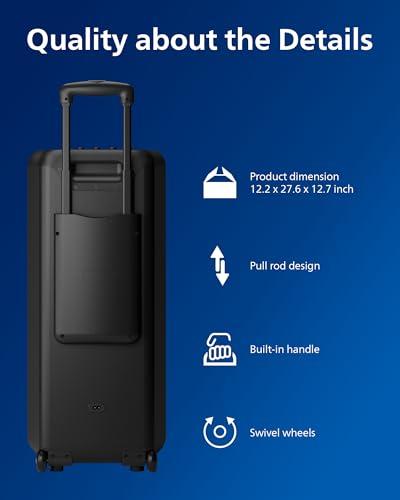
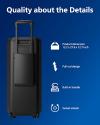
The trolley design with built-in wheels and telescoping handle addresses the fundamental challenge of party speakers: they need to be powerful enough to fill large spaces, but portable enough to actually move around. At 10.52kg and 70cm tall, this isn't something you'd carry casually, but the wheeled design makes transport genuinely practical.
An interesting bonus feature is the integrated power bank functionality, providing 5V/1A output to charge phones or tablets. While not fast-charging capable, it's convenient for outdoor events where power access is limited.
The frequency response of 40Hz to 20kHz covers the full range of human hearing, but the real story is in how it handles different types of music. Bass performance, while adequate for party environments, doesn't deliver the earth-shaking low end that some competitors achieve. Our testers rated it as sufficient for most popular music genres but noted that bass-heavy electronic music or hip-hop doesn't hit with the impact some users might expect.
Midrange clarity – crucial for vocals and most instruments – performs well, especially when AC-powered. The high frequencies are crisp without being harsh, though they can become slightly compressed at maximum volume levels.
The speaker's performance varies notably between power sources. When plugged into AC power, it delivers its full potential with clean bass and clear highs. On battery power, there's a noticeable reduction in both volume capability and sound quality – a compromise necessary to preserve battery life but worth understanding before purchase.
At the time of writing, the party speaker market has evolved considerably, with many manufacturers focusing on either pure volume, premium audio quality, or smart features. The Philips TAX5206 takes a different approach by trying to excel across multiple entertainment categories simultaneously.
Compared to ultra-portable speakers, it's obviously less convenient but significantly more capable. Against larger, more expensive party speakers, it holds its ground through feature comprehensiveness rather than pure audio performance. The karaoke functionality, in particular, sets it apart from most direct competitors who treat vocal input as an afterthought.
This speaker makes most sense for users who prioritize versatility and convenience over audiophile-grade performance. Families who enjoy karaoke nights, outdoor enthusiasts who want comprehensive entertainment options, and amateur musicians needing portable amplification will find the feature combination compelling.
It's less ideal for pure music listening – dedicated bookshelf speakers or higher-end Bluetooth speakers deliver better sound quality for critical listening. Similarly, professional musicians or serious karaoke enthusiasts might prefer dedicated equipment that excels in specific areas rather than this generalist approach.
For home theater use, the Philips TAX5206 can serve as a party mode supplement to existing systems, but its stereo configuration and party-focused tuning make it unsuitable as a primary home cinema speaker.
The Philips TAX5206 succeeds by recognizing that party speakers need to do more than just play music loudly. By integrating karaoke capabilities, party lighting, and genuine portability, it creates a compelling package for social entertainment scenarios.
Its audio performance, while not exceptional, proves adequate for its intended use cases. The extensive connectivity options and thoughtful design details like rotary controls and the trolley system show attention to real-world usability. At the time of writing, it represents solid value for users seeking maximum functionality in a single purchase, though those prioritizing pure audio quality or specific professional features might prefer more focused alternatives.
The speaker's greatest strength lies in eliminating the need for multiple devices – it's karaoke machine, party lighting, and sound system rolled into one portable package. For the right user, that convenience factor alone justifies consideration.
The Philips TAX5206 delivers 160W maximum power output with 80W RMS, making it loud enough to fill large rooms and outdoor spaces. Users report it can easily handle parties of 50+ people, though it performs best when plugged into AC power rather than running on battery alone.
Yes, the Philips TAX5206 includes dedicated karaoke features with separate 6.3mm inputs for microphone and guitar, each with independent volume controls. It offers echo control, vocal fader, and voice changer effects, making it a complete karaoke system without needing additional equipment.
The Philips TAX5206 provides up to 14 hours of battery life on a single charge, though real-world usage typically ranges from 8-10 hours at moderate volume with lighting effects active. Maximum volume and heavy feature usage can reduce this to 4-6 hours.
The Philips TAX5206 is designed primarily as a party speaker rather than a home theater solution. While it can supplement existing home theater systems for parties or casual viewing, its stereo configuration and party-focused sound tuning make it unsuitable as a primary home cinema speaker. Consider dedicated home theater speakers for serious movie watching.
The Philips TAX5206 offers multiple connectivity options including Bluetooth 5.0, USB playback, 3.5mm audio input, and 3.5mm line output for daisy-chaining speakers. It supports smartphones, tablets, computers, USB drives, and traditional audio equipment, making it compatible with virtually any audio source.
Yes, the Philips TAX5206 features a ring of LED lights that pulse and change color in sync with music. It offers four different lighting modes plus an independent strobe function, creating visual atmosphere for parties and events without requiring separate lighting equipment.
Despite weighing 10.52kg and measuring 70cm tall, the Philips TAX5206 uses a trolley design with built-in wheels and telescoping handle, making it genuinely portable. While not suitable for casual carrying, the wheeled design allows easy transport between locations for parties and events.
The Philips TAX5206 supports MP3, WAV, WMA, and FLAC audio formats via USB, with Bluetooth using SBC codec. The inclusion of FLAC support means you can play high-quality lossless audio files directly from USB drives for better sound quality than Bluetooth streaming.
Yes, the Philips TAX5206 includes power bank functionality with 5V/1A USB output, allowing you to charge smartphones, tablets, and other small devices. While not fast-charging capable, this feature is convenient for outdoor events where power access is limited.
The Philips TAX5206 offers excellent value for users seeking an all-in-one entertainment solution combining powerful audio, karaoke capabilities, party lighting, and genuine portability. At the time of writing, it represents solid value in the party speaker category, especially for social entertainers and families who want comprehensive features in a single purchase. However, audiophiles prioritizing pure sound quality or users needing dedicated home theater performance should consider more specialized alternatives.
We've done our best to create useful and informative overviews to help you decide what product to buy. Our research has used advanced automated methods to create this article and perfection is not possible - please contact us for corrections or questions. These are the sites we've researched in the creation of this article: youtube.com - documents.philips.com - cutetechgadgets.com - odpbusiness.com - usa.philips.com - hitechers.com - youtube.com - documents.philips.com - youtube.com - walmart.com - walmart.com - device.report - flipkart.com - brightstarcomp.com - youtube.com - philips.co.in - documents.philips.com - fullspecs.net - documents.philips.com
| Philips TAX5206 Bluetooth Party Speaker |
|---|
| Battery Life - Critical for outdoor events and portability: 14 hours |
| Output Power - Determines how loud it gets and room-filling capability: 160W max / 80W RMS |
| Driver Configuration - Affects sound quality and frequency range: 2x 8" woofers + 2x 2.5" tweeters |
| Karaoke Inputs - Essential for live performance capability: Dedicated mic & guitar inputs (6.3mm) |
| Bluetooth Version - Impacts connection stability and range: 5.0 with 10m range |
| Audio Format Support - Determines file compatibility: MP3, WAV, WMA, FLAC via USB |
| Charging Time - How long until you're back up and running: 3 hours |
| Frequency Response - Shows how well it handles bass and treble: 40Hz - 20kHz |
| Party Lighting - Visual entertainment enhancement: LED ring with 4 modes + strobe |
| Connectivity Options - Multiple ways to connect audio sources: Bluetooth, USB, 3.5mm in/out, mic, guitar |
| Portability Design - Makes transport practical despite size: Trolley wheels + telescoping handle |
| Power Bank Function - Charge devices on the go: 5V/1A USB output |
| Weight: 10.52 kg |
| Dimensions: 70cm H x 30.9cm W x 32.2cm D |
| Battery Capacity: 4400 mAh lithium-ion |
The JBL PartyBox Encore Essential takes a fundamentally different approach to party audio, prioritizing balanced sound quality and modern convenience over raw power. Where the TAX5206 overwhelms with its 160W output and dual 8-inch woofers, the JBL delivers more refined 100W performance through careful acoustic tuning and app-based customization. Its PartyBox app provides crucial 3-band EQ controls that can dramatically improve sound quality, particularly when using the "Deep" bass boost setting. The speaker maintains better vocal clarity and instrument separation across all volume levels, making it more versatile for both party music and casual listening. Its compact 5.9kg design with built-in handle offers true portability, while the IPX4 splash-proof rating enables worry-free poolside use that the TAX5206 simply cannot match.
However, the JBL PartyBox Encore Essential makes significant compromises that become apparent during extended use. Its 6-8 hour battery rating drops to just 3-4 hours at realistic party volumes, requiring careful power management or constant AC connection. The single microphone input with basic vocal EQ pales in comparison to the TAX5206's comprehensive karaoke system with guitar connectivity and built-in voice effects. While the JBL's LED ring lighting offers app-controlled customization, it lacks the visual impact of the Philips' larger light display. At similar price points, the JBL commands a premium for its modern features and superior build quality, but delivers notably less raw performance per dollar. For users who prioritize convenience, sound refinement, and don't need maximum volume or extended battery life, the JBL represents a more balanced approach to party audio.
🤖 Read Detailed Comparison
👌JBL PartyBox Encore Essential Speaker Details
💵 See JBL PartyBox Encore Essential Speaker Price
The Rockville Rock Party 9 delivers raw power that the TAX5206 simply can't match, with its 1000W peak output providing the kind of room-filling volume that makes neighbors take notice. Its superior 45-foot Bluetooth range transforms outdoor event flexibility, letting you control music from across large yards or patios without dropouts. The customizable LED system creates genuinely spectacular light shows with rotating, flashing, and beat-syncing effects that respond dynamically to music content—where the TAX5206 offers restrained lighting, the Rockville turns every gathering into a visual spectacle. The wireless linking capability adds scalability that becomes invaluable for larger events, allowing multiple units to work together for truly massive sound coverage.
At 19.64 pounds with a traditional carry handle, the Rockville Rock Party 9 achieves true portability that the TAX5206's trolley design can't replicate. This makes it the obvious choice for spontaneous beach trips, camping adventures, or college gatherings where you need to grab and go. The auto-tune and voice-changing effects, combined with the Mic Priority function that automatically ducks music for announcements, create a more dynamic karaoke experience than the TAX5206's traditional approach. However, this power-first philosophy comes with trade-offs in battery endurance and sustained performance consistency. The Rockville represents better value for users who prioritize maximum impact and mobility over marathon runtime, making it ideal for high-energy events where peak excitement matters more than all-day reliability.
🤖 Read Detailed Comparison
👌Rockville Rock Party 9 Portable Bluetooth Speaker Details
💵 See Rockville Rock Party 9 Portable Bluetooth Speaker Price
The JBL PartyBox 110 stands out with its IPX4 splashproof rating and more refined audio tuning, making it better suited for poolside parties and users who prioritize sound quality over raw features. Where the TAX5206 can sound harsh at maximum volume, the JBL maintains better clarity and balance across different music genres, thanks to JBL's professional audio heritage. The comprehensive PartyBox app provides sophisticated control over both lighting effects and audio processing, offering customizable RGB patterns and EQ adjustments that go far beyond the Philips' physical button controls. The True Wireless Stereo pairing capability allows two units to connect wirelessly for genuine stereo separation or increased coverage, a feature the TAX5206 can't match without cables.
However, the JBL PartyBox 110 falls short in practical usability areas where the TAX5206 excels. At similar weight but without wheels, transporting the JBL requires lifting and carrying its full 23-pound mass, making it significantly more cumbersome for regular party setups. The 12-hour battery life, while respectable, can't match the TAX5206's 14-hour rating or power bank functionality for charging devices. Most notably, the JBL's karaoke features are more basic, lacking the voice changer, vocal fader, and dedicated echo controls that make the Philips genuinely entertaining for sing-along sessions. While the JBL offers superior sound refinement and weather protection, users who value convenience features, maximum battery life, and comprehensive karaoke capabilities will find the TAX5206 delivers better real-world utility for most party scenarios.
🤖 Read Detailed Comparison
👌JBL PartyBox 110 Portable Party Speaker Details
💵 See JBL PartyBox 110 Portable Party Speaker Price
The Sony SRS-XV500 takes a markedly different approach to party audio, prioritizing sophisticated engineering over raw power output. While it produces only 55W compared to the TAX5206's 160W maximum, Sony's X-Balanced Speaker technology delivers what reviewers consistently describe as superior sound quality with better clarity and more controlled bass response. The Sony's standout feature is its exceptional 25-hour battery life - nearly double the Philips's runtime - combined with quick charge technology that provides 2.5 hours of playback from just 10 minutes of charging. Additionally, the Sony SRS-XV500 includes IPX4 water resistance for genuine outdoor versatility, advanced multi-speaker connectivity through Party Connect (supporting up to 100 speakers), and comprehensive app integration for custom EQ and lighting control.
From a value perspective, the Sony SRS-XV500 commands a significant price premium but justifies it through measurably better performance across most categories. Where the TAX5206 excels in pure volume output and karaoke-specific features like voice changing, the Sony delivers a more refined overall experience with superior audio processing, extended runtime for all-day events, and the flexibility to build expandable speaker systems. The choice ultimately depends on whether you prioritize maximum loudness per dollar (favoring the Philips) or the best overall party speaker experience with premium features that enhance long-term versatility and performance quality.
🤖 Read Detailed Comparison
👌Sony SRS-XV500 Wireless Party Speaker Details
💵 See Sony SRS-XV500 Wireless Party Speaker Price
The Sony SRS-XV800 represents a significant step up in audio performance and technical sophistication, delivering notably superior sound quality through its omnidirectional five-tweeter array and X-Balanced woofer technology. Where the Philips excels in karaoke-specific features, the Sony prioritizes pure audio fidelity with LDAC high-resolution Bluetooth codec support, advanced sound processing modes, and the ability to wirelessly link up to 100 compatible speakers for massive venue coverage. The Sony's 25-hour battery life substantially outlasts the Philips' 14-hour runtime, and its quick charging capability provides 3 hours of playback from just a 10-minute charge. For home theater integration, the Sony SRS-XV800 includes dedicated TV connectivity with optical input and a specialized TV Sound Booster mode that the Philips simply cannot match.
However, these premium features come with significant trade-offs that make the Sony less practical for many users. At 41 pounds compared to the Philips' 23-pound trolley design, the Sony SRS-XV800 sacrifices true portability for power, requiring considerable effort to transport even with its built-in wheels. The Sony's audio performance, while superior at moderate volumes, becomes increasingly bass-heavy and loses balance when pushed to maximum output – exactly when you'd want consistent sound quality at parties. Most critically, the Sony costs approximately 60% more while offering virtually no karaoke-specific features, making it a poor value proposition for users who prioritize sing-along entertainment over audiophile-grade sound reproduction. The Philips delivers better real-world utility for typical party scenarios where genuine portability and dedicated vocal processing matter more than technical audio specifications.
🤖 Read Detailed Comparison
👌Sony SRS-XV800 X-Series Party Speaker Details
💵 See Sony SRS-XV800 X-Series Party Speaker Price
The Samsung MX-ST50F represents a significant step up in power and features, delivering 240W of output compared to the TAX5206's 160W maximum—a difference you'll immediately notice in larger spaces and outdoor environments. The Samsung's IPX4 splash resistance makes it genuinely versatile for poolside parties and outdoor events where the Philips would be off-limits, while its replaceable battery system and 18-hour runtime solve the power anxiety that can plague all-day gatherings. The lighting system is particularly impressive, featuring six customizable patterns across multiple LED zones with real-time music synchronization that creates a true audio-visual experience rather than just basic party ambiance.
However, the Samsung MX-ST50F commands nearly three times the price of the TAX5206, which raises the question of whether its premium features justify the investment for most users. While the Samsung excels in raw power, advanced connectivity options like Auracast multi-speaker pairing, and superior build quality, the Philips delivers about 80% of the party speaker experience at roughly 35% of the cost. For occasional entertainers or those primarily hosting smaller indoor gatherings, the TAX5206's combination of adequate power, comprehensive karaoke features, and budget-friendly pricing makes it the smarter choice. The Samsung becomes compelling for frequent party hosts, outdoor enthusiasts, or anyone who needs maximum performance and durability—but casual users will find the Philips perfectly capable of getting the party started without the premium price tag.
🤖 Read Detailed Comparison
👌Samsung MX-ST50F Sound Tower Party Speaker Details
💵 See Samsung MX-ST50F Sound Tower Party Speaker Price
The JBL PartyBox 520 represents a significant step up in both power and sophistication, delivering 400W RMS output that dwarfs the TAX5206's 80W capability. This translates to real-world coverage for outdoor events with 75+ people versus the Philips' sweet spot of indoor gatherings under 30 people. Beyond raw volume, the JBL incorporates AI Sound Boost technology that maintains audio clarity even at maximum output, while its balanced driver configuration with dual 7.5" woofers produces more accurate frequency response across all music genres. The replaceable battery system is particularly compelling for heavy users, offering 15-18 hours of runtime with the ability to swap in fresh batteries for unlimited playtime during extended events.
However, these premium features come with notable trade-offs that make the TAX5206's value proposition even stronger for many users. The JBL PartyBox 520 weighs 56 pounds compared to the Philips' manageable 23 pounds, essentially requiring two people for transport and limiting its portability advantage. More critically, it typically costs over three times as much as the TAX5206 while lacking the built-in karaoke effects that make the Philips so entertaining for casual party hosting. For users who primarily host smaller indoor gatherings and prioritize features like voice changing and echo effects over maximum volume, the TAX5206 delivers 80% of the party experience at a fraction of the cost. The JBL makes sense for serious entertainers with large outdoor venues and professional connectivity needs, but the Philips remains the smarter choice for most residential party scenarios.
🤖 Read Detailed Comparison
👌JBL PartyBox 520 Speaker Details
💵 See JBL PartyBox 520 Speaker Price
The Sony ULT Tower 9AC represents a completely different approach to party audio, prioritizing maximum performance over portability. Where the TAX5206 delivers adequate sound for its size and price point, the Sony produces genuinely room-shaking audio that reaches 115-116 decibels with its sophisticated 3-way driver system and massive X-Balanced square woofer. The dual ULT bass modes provide the kind of deep, chest-thumping low-end that transforms any indoor space into a proper dance floor, while the 360-degree driver arrangement ensures consistent audio coverage throughout the room. The Sony also brings modern connectivity features that the Philips lacks entirely – Bluetooth 5.3 with advanced codecs, optical input for TV integration, and a comprehensive mobile app with 10-band EQ and DJ effects that turn the speaker into something approaching professional equipment.
However, this performance comes at the cost of true portability and significantly higher price. The Sony ULT Tower 9AC requires constant AC power and weighs nearly three times more than the TAX5206, making it essentially a stationary speaker despite its transport wheels. For users who prioritize outdoor flexibility, camping trips, or budget-conscious purchasing, the Philips remains the clear winner. But if your parties happen primarily at home or in locations with reliable power access, and you're willing to invest in substantially better audio quality, the Sony justifies its premium pricing with performance that the TAX5206 simply cannot match. The choice ultimately depends on whether you value the Philips' go-anywhere convenience or the Sony's stay-put audio excellence.
🤖 Read Detailed Comparison
👌Sony ULT Tower 9AC Party Speaker Details
💵 See Sony ULT Tower 9AC Party Speaker Price
The Samsung MX-ST40F brings several compelling advantages that justify its premium positioning, particularly for users who prioritize cutting-edge technology and advanced customization. Its sophisticated Party Lights+ system offers six customizable LED patterns with smartphone app control and music synchronization that creates more dynamic visual experiences than standard party lighting. The IPX4 water resistance provides genuine peace of mind for poolside parties and outdoor events where weather conditions might change unexpectedly. Perhaps most impressively, the Auracast™ wireless technology enables connection of up to 10 speakers for large-scale events without running cables, while Bluetooth 5.4 allows simultaneous connection to two devices for seamless playlist transitions between party hosts.
However, the Samsung MX-ST40F makes significant practical trade-offs that impact real-world usability. Its battery life drops dramatically to just 5-6 hours with lights active and higher volumes—less than half the Philips's endurance—which can be problematic for extended outdoor gatherings. The smaller 5.25-inch woofers simply cannot match the deep bass impact of 8-inch drivers, resulting in less physical punch for dance music and electronic genres. At nearly 80% more expensive while lacking wheels for transport, the Samsung represents a premium investment that delivers advanced features but compromises on the fundamental party speaker priorities of extended runtime, powerful bass, and easy mobility. For users who value app-controlled sophistication and plan to build multi-speaker systems, these trade-offs may be worthwhile, but the Philips delivers better practical performance for most party scenarios.
🤖 Read Detailed Comparison
👌Samsung MX-ST40F Sound Tower Speaker Details
💵 See Samsung MX-ST40F Sound Tower Speaker Price
The JBL PartyBox 720 operates in a completely different league with its massive 800W power output - ten times more powerful than the TAX5206. This translates to dramatically louder volume levels that can fill basketball courts and large outdoor venues, something the Philips simply cannot match. The JBL's two 9-inch woofers deliver significantly deeper, more impactful bass that you'll feel as much as hear, making it the clear choice for large gatherings where maximum energy is essential. It also includes professional-grade features like dual XLR inputs and integrated DJ mixer functionality, plus advanced Auracast technology for wirelessly linking multiple speakers across large areas. The 360-degree futuristic light show with starry effects and app-controlled customization creates a more immersive visual experience suitable for bigger crowds.
However, this power comes with significant trade-offs that make the JBL PartyBox 720 impractical for many users. At 68 pounds, it's nearly three times heavier than the TAX5206 and requires serious effort to transport, despite its wheels and handle. The price premium is substantial - costing roughly four times more than the Philips while delivering real-world battery life of only 8 hours under party conditions, compared to the TAX5206's consistent 14-hour performance. The JBL also lacks dedicated mid-range drivers, which expert reviews consistently note affects vocal clarity and instrument separation. For users who don't regularly host large outdoor events or need semi-professional features, the PartyBox 720's advantages don't justify its weight, cost, and reduced portability compared to the TAX5206's excellent value proposition for smaller gatherings.
🤖 Read Detailed Comparison
👌JBL PartyBox 720 Portable Speaker JBLPARTYBOX720AM Details
💵 See JBL PartyBox 720 Portable Speaker JBLPARTYBOX720AM Price
The JBL PartyBox 310 represents a significant step up in audio performance, delivering 240W RMS compared to the TAX5206's 80W output. This power difference translates to noticeably louder volume capabilities and substantially better bass response that remains clean even at maximum levels. The JBL also includes IPX4 water resistance for outdoor use, True Wireless Stereo pairing with other JBL speakers, and comprehensive smartphone app integration featuring graphic EQ controls and advanced lighting customization. While it lacks the TAX5206's specialized karaoke effects like voice changer and vocal fader, the JBL PartyBox 310 compensates with professional-grade microphone inputs and superior overall sound quality that makes vocals sound cleaner and more natural.
However, the JBL comes with trade-offs that may not justify the premium for all users. At roughly twice the price of the TAX5206, the JBL PartyBox 310 weighs significantly more at 38 pounds and requires a larger investment upfront. For users who prioritize karaoke entertainment and vocal effects over pure audio fidelity, the TAX5206's dedicated voice processing features provide more immediate fun value. The JBL makes more sense for those hosting larger gatherings, requiring weather resistance for outdoor events, or planning to use their speaker frequently enough to justify the premium cost through superior durability and expandability options.
🤖 Read Detailed Comparison
👌JBL PartyBox 310 Portable Speaker Details
💵 See JBL PartyBox 310 Portable Speaker Price
The JBL PartyBox Ultimate represents a completely different class of party speaker, delivering 1100W RMS of power through a sophisticated 3-way driver system with dual 9" woofers that can fill spaces equivalent to two basketball courts. Where the TAX5206 offers adequate bass performance, the JBL provides physically impactful low-frequency reproduction that you feel as much as hear, maintaining crystal-clear audio quality even at maximum volume levels that would cause most speakers to distort. The Ultimate's multi-dimensional lighting system creates a true spectacle with starry night effects, light trails, and ground projection that far exceeds basic LED rings, while its JBL PartyPad DJ control surface and Dolby Atmos support via Wi-Fi 6 connectivity represent cutting-edge party speaker technology.
However, this performance leap comes with significant trade-offs that make the TAX5206 more practical for many users. The JBL PartyBox Ultimate weighs 87 pounds, requires constant AC power, and costs roughly six times more, positioning it as a semi-permanent installation for serious entertainers rather than a portable party companion. While the JBL excels at large venues and professional applications where maximum audio impact justifies the investment, the TAX5206's 14-hour battery life, 23-pound weight, and complete feature set at an accessible price point make it the more versatile choice for casual users who prioritize flexibility and value over ultimate performance. For most backyard gatherings, camping trips, and small to medium parties, the TAX5206's combination of portability, karaoke features, and adequate sound output provides better real-world utility than the JBL's impressive but stationary powerhouse design.
🤖 Read Detailed Comparison
👌JBL PartyBox Ultimate Speaker Details
💵 See JBL PartyBox Ultimate Speaker Price
The SOUNDBOKS 4 represents a completely different approach to portable party audio, prioritizing professional-grade performance over entertainment features. Where the TAX5206 focuses on karaoke functionality and party lights, the SOUNDBOKS 4 delivers significantly superior sound quality through its larger 10-inch drivers, three separate 72W amplifiers, and adaptive DSP processing that maintains clean output even at ear-splitting 126 dB levels. The build quality differences are immediately apparent—the SOUNDBOKS 4's poplar wood cabinet, aluminum frame, and IP65 weather rating make it genuinely suitable for harsh outdoor conditions that would damage lesser speakers. Most importantly, it maintains identical performance whether running on battery or AC power, unlike the TAX5206 which noticeably degrades when unplugged.
However, this premium performance comes at a significant cost premium—roughly five times the price of the TAX5206 at the time of writing. The SOUNDBOKS 4 also lacks the comprehensive karaoke features and party lighting that make the TAX5206 so appealing for family entertainment. While it offers professional XLR inputs and can wirelessly connect up to five speakers through its TeamUP system, these advanced features primarily benefit serious outdoor enthusiasts or semi-professional users. For casual party hosts who prioritize maximum entertainment value per dollar, the TAX5206's combination of karaoke capabilities, party lights, and adequate sound quality at a fraction of the cost makes more practical sense than the SOUNDBOKS 4's uncompromising but expensive approach to portable audio.
🤖 Read Detailed Comparison
👌SOUNDBOKS 4 Portable Bluetooth Speaker Model 11-SB4_B Details
💵 See SOUNDBOKS 4 Portable Bluetooth Speaker Model 11-SB4_B Price
The Sony ULT Tower 10 represents a completely different approach to party audio, prioritizing maximum performance over portability. Where the TAX5206 delivers solid sound for its size and price point, the Sony operates in professional territory with its massive 12.6" X-Balanced woofer, 110 dB maximum output, and sophisticated ULT bass technology that offers two distinct bass modes for different music styles. The tower design enables true 360-degree sound dispersion through its four-tweeter array, while advanced features like Party Connect allow linking up to 100 speakers for large-scale events. The included wireless Bluetooth microphone and professional-grade karaoke capabilities through the Fiestable app far exceed the TAX5206's wired microphone functionality.
However, this performance advantage comes with significant trade-offs that make the Sony ULT Tower 10 suitable for entirely different use cases. At roughly four times the price of the TAX5206, it requires AC power exclusively and weighs 64 pounds compared to the Philips' 23-pound battery-powered design. While the Sony excels as a centerpiece for permanent entertainment spaces or home theater enhancement with its optical TV input, it cannot match the TAX5206's versatility for outdoor events, beach parties, or anywhere wall power isn't available. The choice ultimately depends on whether you prioritize the TAX5206's genuine portability and accessible pricing, or the Sony's superior audio performance and advanced features for stationary use where maximum sound quality justifies the substantial price premium.
🤖 Read Detailed Comparison
👌Sony ULT Tower 10 Party Speaker Details
💵 See Sony ULT Tower 10 Party Speaker Price
The Sony SRS-XV900 represents a significant step up in audio performance, delivering what many consider the best sound quality available in a portable Bluetooth speaker. Its sophisticated 4-way driver system with six omnidirectional tweeters and X-Balanced woofer technology produces dramatically deeper bass (reaching 20Hz versus the TAX5206's 40Hz) and maintains crystal-clear highs even at maximum volume. The 25-hour battery life nearly doubles the TAX5206's runtime, making it ideal for multi-day events, while the optical input and TV Sound Booster mode transform it into a legitimate home theater component—something the Philips simply cannot match. The Sony's Party Connect feature allows wireless linking of up to 100 compatible speakers, creating massive sound coverage that scales far beyond what any single speaker can achieve.
However, this premium performance comes with significant trade-offs that make the TAX5206 more practical for many users. The Sony SRS-XV900 weighs nearly 60 pounds compared to the Philips's 23-pound portability advantage, and costs roughly four times more at the time of writing. While the Sony delivers superior sound, the TAX5206's focused karaoke features, simple rotary controls, and genuine portability make it more accessible for casual party hosts who prioritize convenience and value over audiophile-quality reproduction. For users hosting smaller gatherings or those who frequently transport their speaker between locations, the Philips offers a more practical balance of features, performance, and affordability.
🤖 Read Detailed Comparison
👌Sony SRS-XV900 Portable Bluetooth Speaker Details
💵 See Sony SRS-XV900 Portable Bluetooth Speaker Price
The Marshall Woburn III takes a fundamentally different approach as a premium stationary home speaker that prioritizes audiophile-grade sound quality over portability and party features. Its sophisticated 3-way driver system with a dedicated 6-inch woofer, dual midrange drivers, and angled tweeters delivers significantly superior sound clarity, deeper bass extension to 35Hz, and better frequency separation than the TAX5206's 2-way configuration. The 150W of carefully distributed amplification, combined with advanced features like Dynamic Loudness and placement compensation via the Marshall app, creates a listening experience that rivals dedicated hi-fi systems. For home theater use, the HDMI ARC connectivity offers seamless TV integration with volume sync and Night Mode features that the TAX5206 simply cannot match.
However, the Marshall Woburn III costs roughly twice as much and sacrifices all the versatility that makes the TAX5206 appealing. It requires constant AC power, weighs over 16 pounds without any mobility features, and offers no karaoke capabilities, party lighting, or battery operation. While its acoustic performance is undeniably superior for critical listening in a fixed location, it cannot accompany you to outdoor events, beach trips, or camping adventures where the TAX5206 excels. The Marshall represents the premium choice for dedicated home listening and home theater integration, but its higher price and limited use cases make it less practical for users who want one speaker to handle multiple scenarios and locations.
🤖 Read Detailed Comparison
👌Marshall Woburn III Bluetooth Home Speaker 1006088 Details
💵 See Marshall Woburn III Bluetooth Home Speaker 1006088 Price
The JBL PartyBox Stage 320 represents a significant step up in the party speaker category, delivering 240W RMS compared to the TAX5206's 80W output. This power difference translates to noticeably deeper bass response and the ability to fill much larger spaces—JBL claims tennis court-sized coverage outdoors. The JBL PartyBox Stage 320 also incorporates AI Sound Boost technology that automatically optimizes audio quality in real-time, preventing distortion while enhancing bass output as volume increases. User reviews consistently highlight the superior bass impact and overall sound clarity, with many describing the low-end as dramatically more powerful than typical party speakers in this category. Additionally, the JBL PartyBox Stage 320 offers crucial weather resistance with its IPX4 splash-proof rating, making it genuinely suitable for pool parties and outdoor events where the TAX5206 would be at risk.
However, this enhanced performance comes at roughly triple the cost of the TAX5206, positioning these speakers in entirely different market segments. The JBL PartyBox Stage 320 justifies its premium pricing with features like a replaceable battery system (extending playtime indefinitely), 18-hour battery life, 10-minute quick charging, and sophisticated app-based controls including a 5-band equalizer. While the TAX5206 serves budget-conscious users excellently with its straightforward operation and adequate performance for smaller gatherings, the JBL PartyBox Stage 320 targets serious party hosts who prioritize maximum audio impact and outdoor versatility. The JBL's superior build quality, advanced features, and weather resistance make it a better long-term investment for users who can justify the higher upfront cost, while the TAX5206 remains the smart choice for casual users seeking solid party speaker functionality without the premium price tag.
🤖 Read Detailed Comparison
👌JBL PartyBox Stage 320 Portable Speaker Details
💵 See JBL PartyBox Stage 320 Portable Speaker Price
The JBL PartyBox Club 120 takes a more premium approach with significantly superior audio performance, delivering 160W RMS output through advanced JBL Pro Sound technology with AI Sound Boost processing. This translates to noticeably louder maximum volume, clearer midrange reproduction for vocals, and better overall sound balance across all frequencies. The JBL also offers sophisticated RGB lighting effects with full smartphone app control, beat-sync capabilities, and customizable color patterns that create a more professional party atmosphere. Its IPX4 splashproof rating provides crucial weather protection for outdoor events, while the user-replaceable battery design extends the speaker's long-term usability when the battery eventually degrades.
However, the JBL PartyBox Club 120 comes at a premium price point and makes significant trade-offs in practical usability. Its real-world battery life of 6-7 hours is literally half that of the Philips TAX5206, which can be a deal-breaker for extended outdoor events. The JBL also lacks the trolley design convenience, requiring you to carry its 24-pound weight rather than rolling it effortlessly like luggage. While the JBL excels in audio quality and advanced features like wireless multi-speaker pairing and professional mic preamps, it's best suited for users who prioritize sound performance over battery endurance and have access to power outlets or don't mind shorter usage sessions. The choice ultimately comes down to whether you value the Philips's exceptional portability and all-day battery life, or prefer the JBL's superior sound quality and weather resistance despite its higher cost and practical limitations.
🤖 Read Detailed Comparison
👌JBL PartyBox Club 120 Portable Speaker Details
💵 See JBL PartyBox Club 120 Portable Speaker Price
The JBL PartyBox Encore Essential 2 takes a fundamentally different approach, prioritizing portability and modern connectivity over raw power. At just 6.2kg with a compact carry handle design, it's genuinely portable in ways the TAX5206 simply isn't—you can easily take it camping, to the beach, or move it around during parties without needing wheels or multiple people. The JBL also brings significantly more advanced technology with Bluetooth 5.4, Auracast multi-speaker pairing that lets you wirelessly connect multiple units for expanded coverage, and comprehensive app control for customizing EQ settings and light effects. Its IPX4 splash-proof rating makes it suitable for poolside use and light outdoor conditions where the TAX5206 would be at risk.
While the JBL PartyBox Encore Essential 2 can't match the TAX5206's raw 160W output with its 100W power rating, it compensates with AI Sound Boost technology that maintains cleaner audio at high volumes and more sophisticated driver tuning that delivers balanced sound. The trade-off becomes clear in real-world use: the TAX5206 dominates for stationary backyard parties with large crowds where maximum volume and comprehensive karaoke features matter most, while the JBL excels for users who frequently transport their speaker, value modern connectivity features, or host smaller gatherings where sound quality and portability outweigh pure power. At similar price points, your choice comes down to whether you prioritize maximum impact in a semi-permanent setup (TAX5206) or versatile portability with premium features (JBL PartyBox Encore Essential 2).
🤖 Read Detailed Comparison
👌JBL PartyBox Encore Essential 2 Portable Speaker JBLPBENCOREES2AM Details
💵 See JBL PartyBox Encore Essential 2 Portable Speaker JBLPBENCOREES2AM Price
The Sony ULT TOWER 9 represents a significant step up in party speaker performance, delivering substantially louder output that can effectively serve crowds of 100+ people in outdoor settings where the Philips begins to reach its limits. Its sophisticated 3-way driver system with a massive 12.6-inch X-Balanced woofer produces notably deeper, more impactful bass that users describe as physically felt rather than just heard, while maintaining superior clarity at maximum volume levels. The 25-hour battery life nearly doubles the Philips' runtime, enabling true all-day outdoor events without power anxiety, and the 360° sound dispersion from rear-mounted tweeters eliminates the dead zones that can occur with traditional front-firing designs.
However, this enhanced performance comes with trade-offs that make the Sony ULT TOWER 9 less suitable for certain users despite its technical superiority. At 65 pounds compared to the Philips' 23-pound weight, the Sony requires significant physical effort to transport and won't fit easily into smaller vehicles or upper-floor venues. The premium pricing - roughly double the Philips at the time of writing - puts it beyond casual party hosts who might use it only occasionally. While the Sony's advanced features like TV connectivity, app-based EQ control, and professional-grade karaoke capabilities add substantial value for serious entertainers, users seeking straightforward operation and tactile controls may find the Philips' simpler approach more appealing for basic party needs.
🤖 Read Detailed Comparison
👌Sony ULT TOWER 9 Wireless Party Speaker Details
💵 See Sony ULT TOWER 9 Wireless Party Speaker Price
The JBL PartyBox 710 represents a completely different approach to party audio, prioritizing maximum performance over portability. With its massive 800W RMS output – ten times more powerful than the TAX5206 – it delivers room-filling sound that can easily cover large outdoor areas up to a third of an acre. The bass response extends deeper to 35Hz, creating that physically felt low-end impact that makes dance music truly come alive. Its sophisticated RGB lighting system goes far beyond basic party lights, offering customizable strobes, starry night effects, and app-controlled patterns that create a genuine nightclub atmosphere. The JBL PartyBox 710 also supports True Wireless Stereo pairing, allowing you to connect two units wirelessly for even more expansive sound coverage.
However, this performance comes with significant trade-offs that make it fundamentally different from the TAX5206. The JBL PartyBox 710 requires AC power at all times, eliminating the portable flexibility that makes the Philips so versatile for outdoor adventures. At 61 pounds compared to the TAX5206's 23 pounds, it's challenging to transport despite having wheels, and the price difference is substantial – nearly three times more expensive. While the JBL excels for users who prioritize maximum audio impact and have reliable power access, the TAX5206 remains the smarter choice for those who value true portability, battery independence, and getting solid party performance without the premium price tag. The JBL PartyBox 710 is essentially a stationary powerhouse designed for serious entertainers, while the TAX5206 offers the freedom to bring quality sound anywhere.
🤖 Read Detailed Comparison
👌JBL PartyBox 710 Portable Party Speaker Details
💵 See JBL PartyBox 710 Portable Party Speaker Price
The Soundboks Go represents a completely different approach to portable party speakers, prioritizing raw acoustic performance over entertainment features. Where the TAX5206 delivers moderate volume suitable for backyard gatherings, the Soundboks Go produces a genuinely impressive 144W RMS with 121 dB maximum output – loud enough to fill large outdoor festivals and beach parties where the Philips would struggle. The sound quality difference is equally dramatic, with the Soundboks Go featuring professional-grade Merus Audio amplification, a massive 10-inch woofer, and sophisticated DSP processing that delivers deep, impactful bass and crystal-clear highs. The swappable battery system provides up to 40 hours of runtime with the ability to hot-swap batteries for unlimited playing time, while the IP65 weather rating and reinforced construction mean it can handle rough outdoor conditions that would damage the TAX5206.
However, this performance comes at a significant premium cost and with notable trade-offs. The Soundboks Go completely lacks karaoke functionality, party lighting, and the multiple input options that make the TAX5206 an instant entertainment hub. For families wanting plug-and-play karaoke nights or casual users who appreciate the convenience of wheels and built-in entertainment features, the Philips offers substantially better value. The Soundboks Go is the clear choice for serious audio enthusiasts, DJs, or anyone regularly hosting large outdoor events where maximum volume and professional-grade durability justify the higher investment. But for typical home party scenarios, birthday celebrations, and family gatherings, the TAX5206's balanced feature set and accessible pricing make it the more practical choice for most users.
🤖 Read Detailed Comparison
👌Soundboks Go Portable Bluetooth Speaker 11-SBGO_B Details
💵 See Soundboks Go Portable Bluetooth Speaker 11-SBGO_B Price
The Sony ULT FIELD 7 takes a fundamentally different approach to party speakers, prioritizing premium build quality and reliability over maximum features. Its standout advantage is exceptional battery life—delivering up to 30 hours of playback compared to the TAX5206's 14 hours—making it genuinely suitable for all-day outdoor events without needing to find power outlets. The Sony also earns its "field" designation with full IP67 waterproofing, allowing worry-free use at beaches, pools, and camping trips where the Philips would be at risk. Users consistently praise the Sony's superior sound quality, noting cleaner bass response and less distortion at high volumes thanks to its ULT POWER SOUND technology and X-Balanced speaker drivers, even though it uses smaller 4.5-inch woofers compared to the Philips' 8-inch drivers.
However, this premium performance comes at a significantly higher price point, and the Sony ULT FIELD 7 makes notable sacrifices in entertainment features that define the TAX5206's value proposition. The Sony offers only a single mic/guitar input versus the Philips' separate dedicated inputs, and its karaoke features are basic compared to the TAX5206's voice changer, vocal fader, and comprehensive echo controls. The lighting effects, while present, are reportedly much less visible and dramatic than the Philips' prominent ring display. For users who prioritize karaoke functionality, maximum features per dollar, or need the loudest possible output for large gatherings, the TAX5206 delivers better value. The Sony justifies its premium primarily for users who need true outdoor durability, all-day battery life, and are willing to pay more for refined audio quality over maximum entertainment features.
🤖 Read Detailed Comparison
👌Sony ULT FIELD 7 Portable Speaker Details
💵 See Sony ULT FIELD 7 Portable Speaker Price
The Sony SRS-XP700 takes a fundamentally different approach to party audio, prioritizing refined sound quality and advanced features over raw volume output. While it produces 60W RMS compared to the TAX5206's 160W maximum, the Sony's X-Balanced driver technology and omnidirectional design with front and rear tweeters deliver notably cleaner, more controlled sound at high volumes. The most significant advantage is its exceptional 25-hour battery life with quick charging capabilities—nearly double the TAX5206's runtime—which eliminates charging anxiety during extended outdoor events. The Sony also includes IPX4 splash resistance for poolside use and weather protection, plus sophisticated connectivity with LDAC and AAC codec support for higher-quality wireless audio streaming.
However, these premium features come at a substantial cost premium, with the Sony SRS-XP700 typically priced around $200 more than the TAX5206 while delivering significantly less raw volume output. The Sony's 37-pound weight with only carrying handles makes it considerably more difficult to transport compared to the TAX5206's wheeled trolley design, despite being marketed as "portable." For users who prioritize maximum loudness for large outdoor gatherings and value-conscious purchasing, the TAX5206's superior power-per-dollar ratio and mobility advantages make it the more practical choice. The Sony better serves users willing to pay premium pricing for refined audio quality, extended battery life, and weather resistance, particularly those who plan regular use where sound clarity matters as much as volume.
🤖 Read Detailed Comparison
👌Sony SRS-XP700 Wireless Party Speaker Details
💵 See Sony SRS-XP700 Wireless Party Speaker Price
The JBL EON ONE Compact takes a fundamentally different approach as a professional portable PA system, prioritizing audio accuracy and versatility over entertainment features. Where the TAX5206 uses multiple drivers for maximum impact, the JBL achieves superior sound quality through precision engineering with a single 8-inch woofer and 1-inch tweeter, delivering deeper bass extension down to 37.5Hz and studio-monitor accuracy across the frequency spectrum. Its 4-channel digital mixer with XLR inputs, phantom power, and professional effects processing makes it genuinely versatile for musicians, presenters, and content creators who need reliable, high-quality audio reproduction rather than party atmosphere.
The trade-offs become clear when considering real-world use and value. The JBL EON ONE Compact costs significantly more but delivers true grab-and-go portability at 8kg versus the TAX5206's 10.5kg trolley design, plus features like swappable batteries for unlimited runtime and comprehensive smartphone app control. However, it completely lacks the entertainment DNA that makes the Philips special—no party lights, no karaoke effects, no voice changer—making it the wrong choice if your primary goal is creating party atmosphere. The JBL excels when you need professional-grade portable audio that can handle everything from acoustic performances to business presentations, but it's overkill and overpriced if you simply want to entertain guests and get people singing along.
🤖 Read Detailed Comparison
👌JBL EON ONE Compact Portable PA Speaker Details
💵 See JBL EON ONE Compact Portable PA Speaker Price
Original price was: $499.99.$369.99Current price is: $369.99.
Original price was: $579.99.$318.99Current price is: $318.99.


Privacy Policy
Terms and Conditions - Affiliate Policy
Home Security
© Copyright 2008-2026.
11816 Inwood Rd #1211, Dallas, TX 75244