



In today's connected world, Bluetooth speakers have become essential companions for music lovers, podcast enthusiasts, and anyone who values good audio on the go. The market has evolved dramatically over the past decade, splitting primarily into two categories that serve different needs despite sharing the same core technology.
When comparing the JBL Authentics 300 and JBL Go 4, we're looking at two fundamentally different approaches to portable audio within JBL's lineup—each with distinct strengths designed for specific user scenarios.
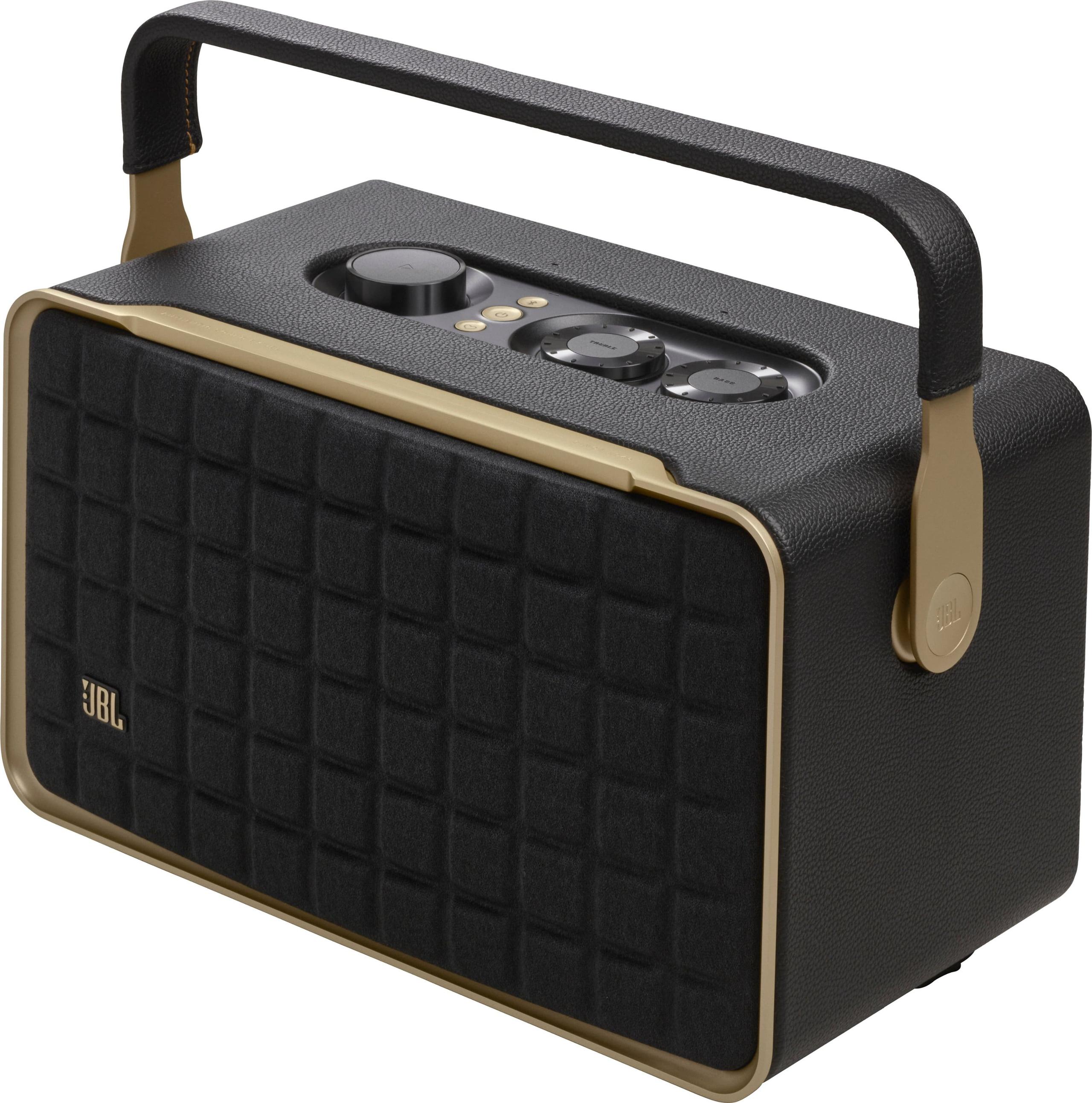
The Authentics 300, released in September 2023, represents JBL's vision of a semi-portable home speaker system that bridges the gap between stationary smart speakers and truly portable options. With its retro-inspired design and modern connectivity features, it aims to serve as both a design piece and a technological hub for your audio needs.
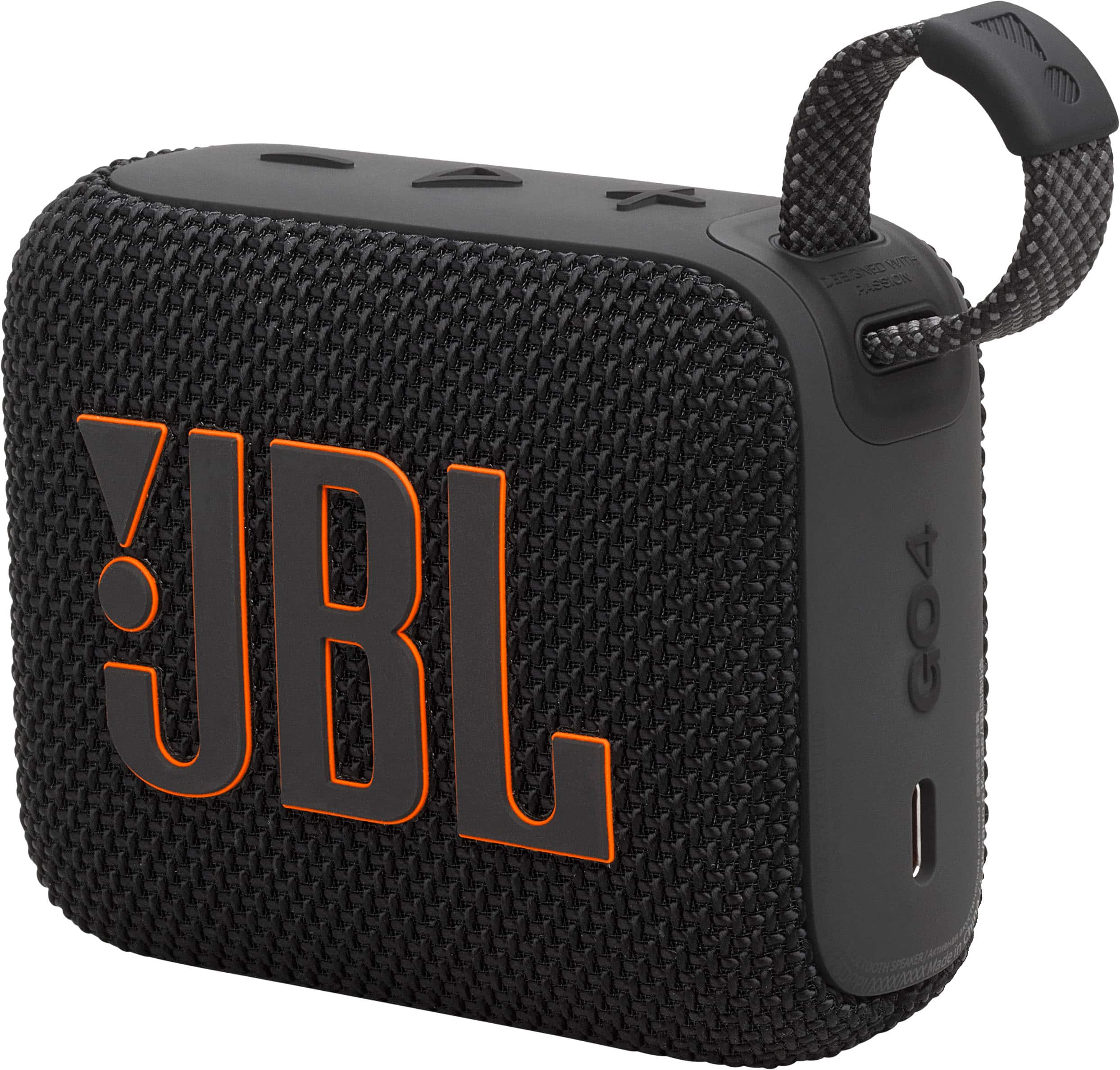
Meanwhile, the JBL Go 4, which launched in August 2023 as the successor to the popular Go 3, embodies the ultra-portable concept—a tiny speaker that sacrifices some audio performance to achieve maximum portability and durability for adventurous listeners.
The key difference in philosophy between these products is evident in their design approach: the Authentics prioritizes sound quality and connectivity while maintaining some portability, whereas the Go 4 maximizes portability and durability while delivering the best possible sound from its tiny frame.
The price gap between these speakers immediately tells you they're targeting different segments of the market:
This nearly 8x price difference reflects more than just the physical size disparity—it represents fundamentally different use cases and technological capabilities. The Authentics 300 is competing with other premium smart speakers like the Sonos Era 100 and Bose Smart Speaker 500, while the Go 4 targets the ultra-portable segment alongside speakers like the Ultimate Ears WONDERBOOM.
Is the Authentics 300 worth almost eight Go 4 speakers? The answer depends entirely on your needs. The value proposition changes dramatically based on how you plan to use your speaker, where you'll use it, and what features matter most to you. Someone seeking maximum portability for outdoor adventures might find better value in the Go 4, while someone prioritizing room-filling sound and smart home integration would likely consider the Authentics 300 the better investment.
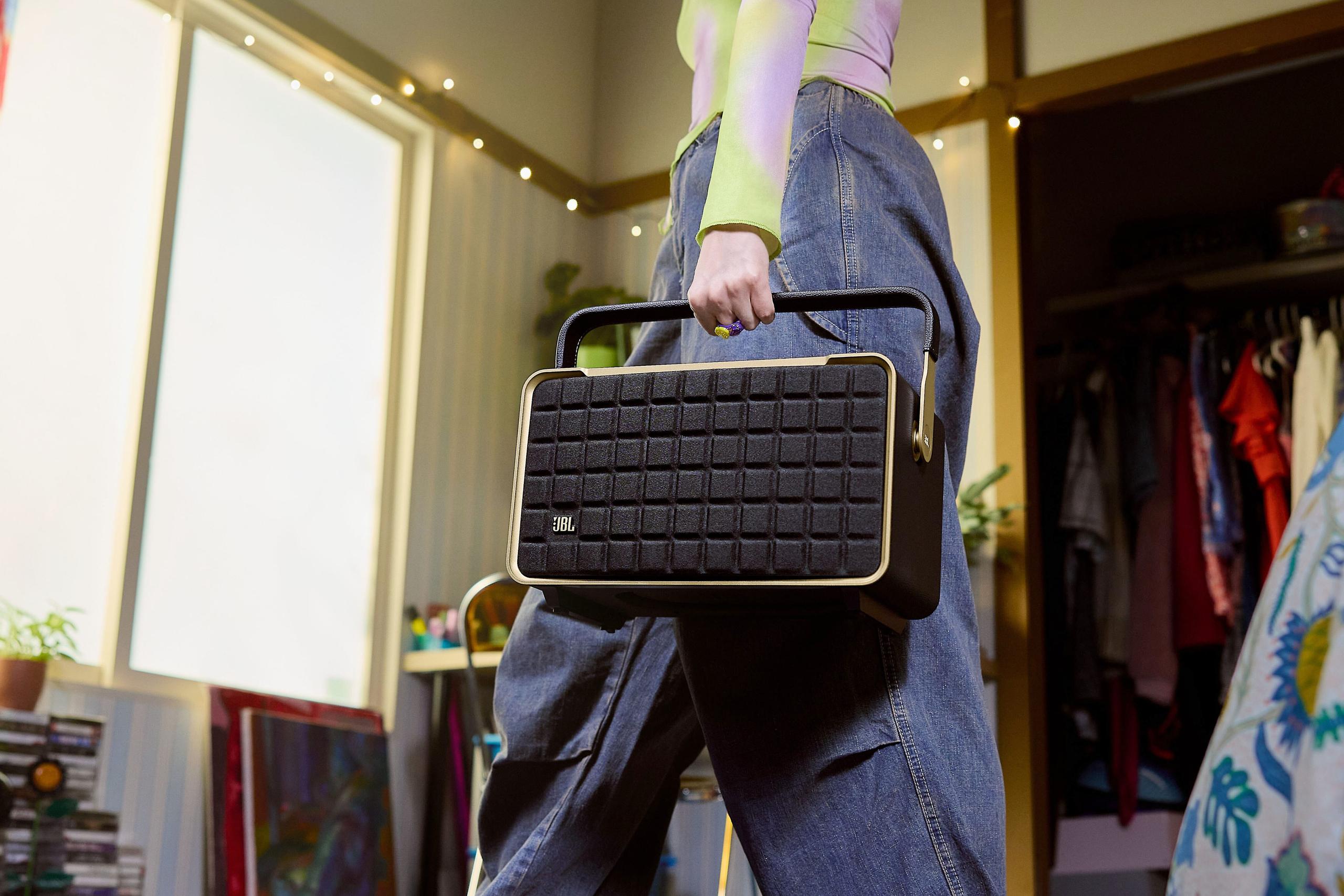
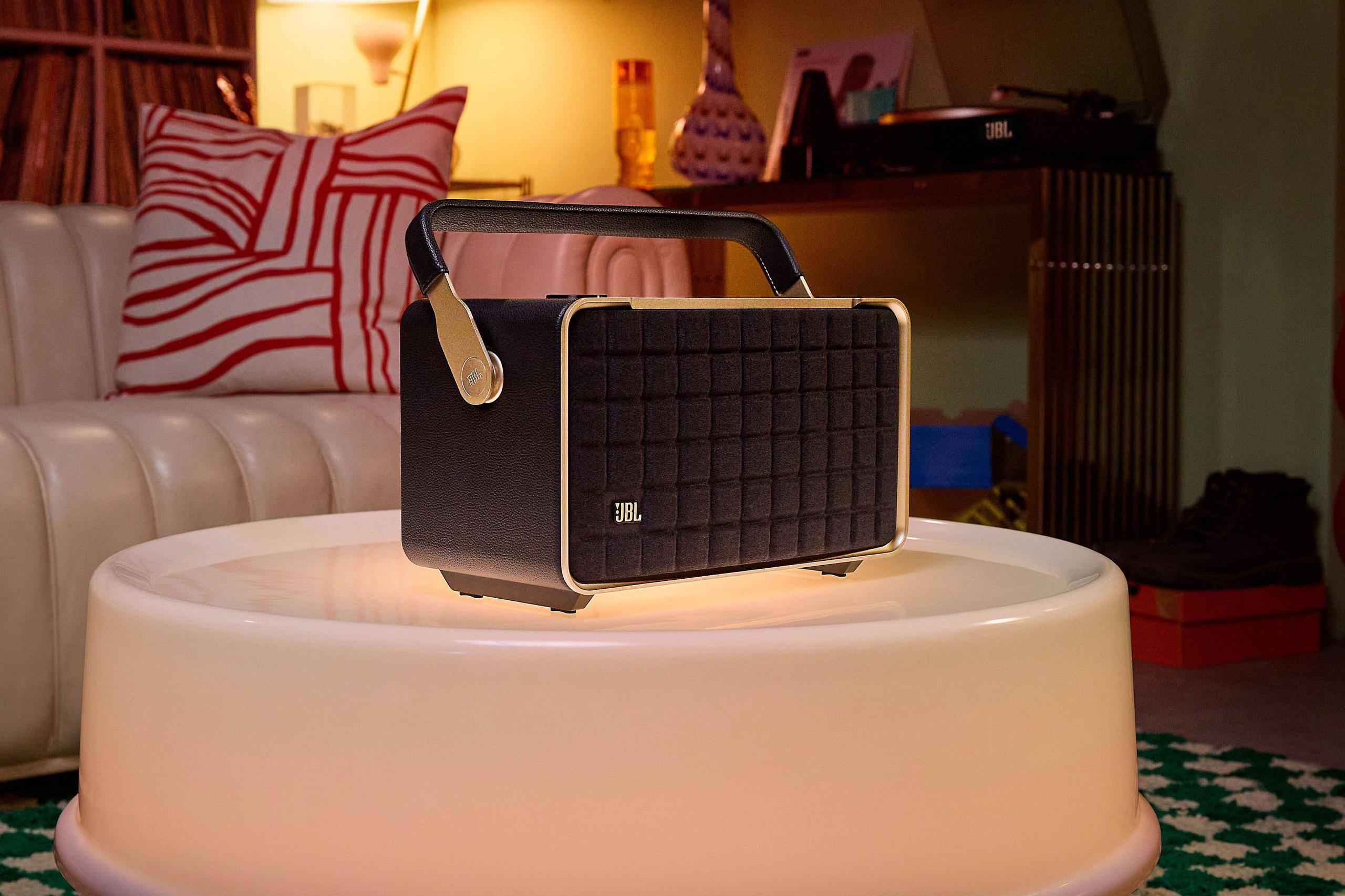
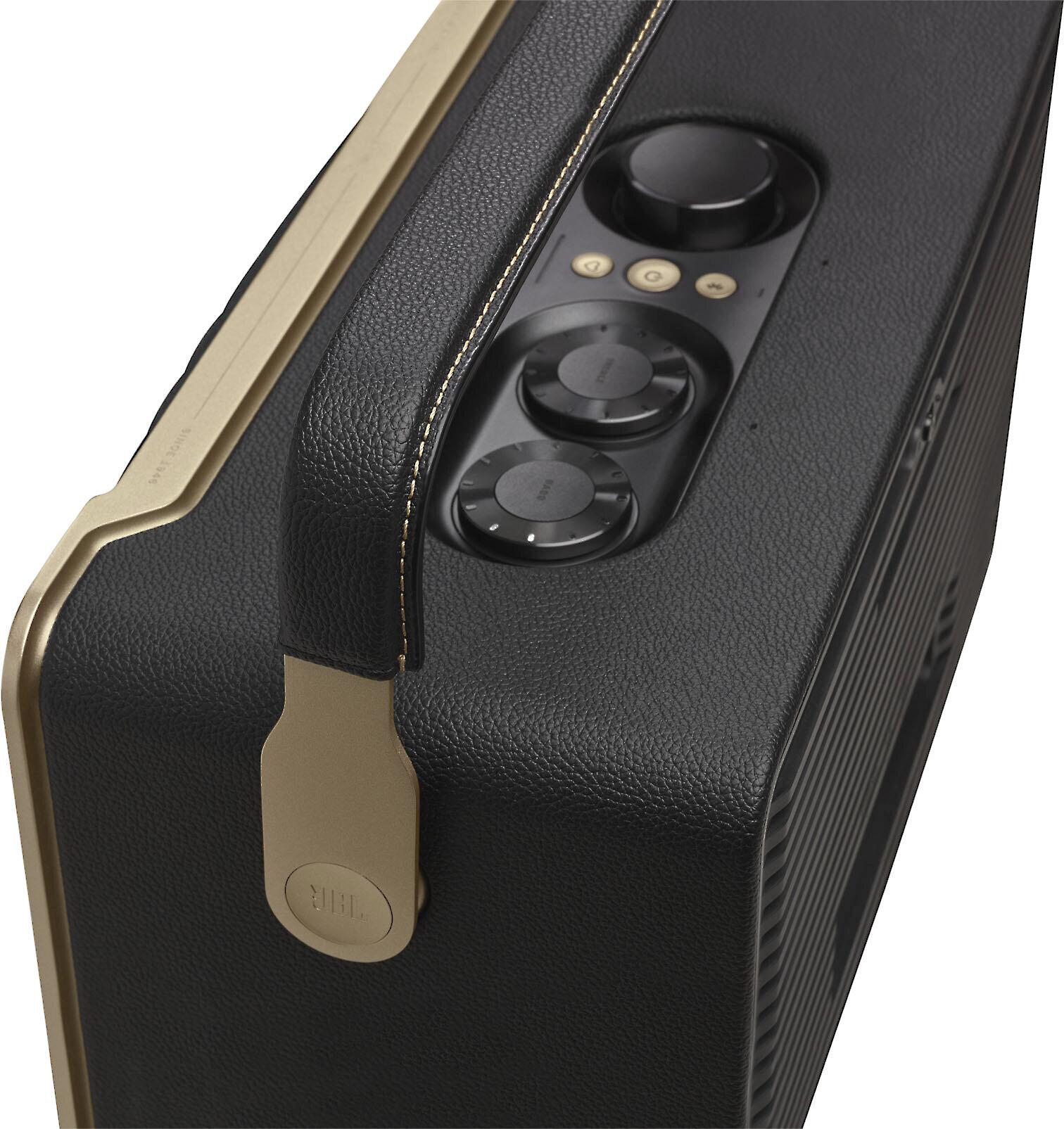
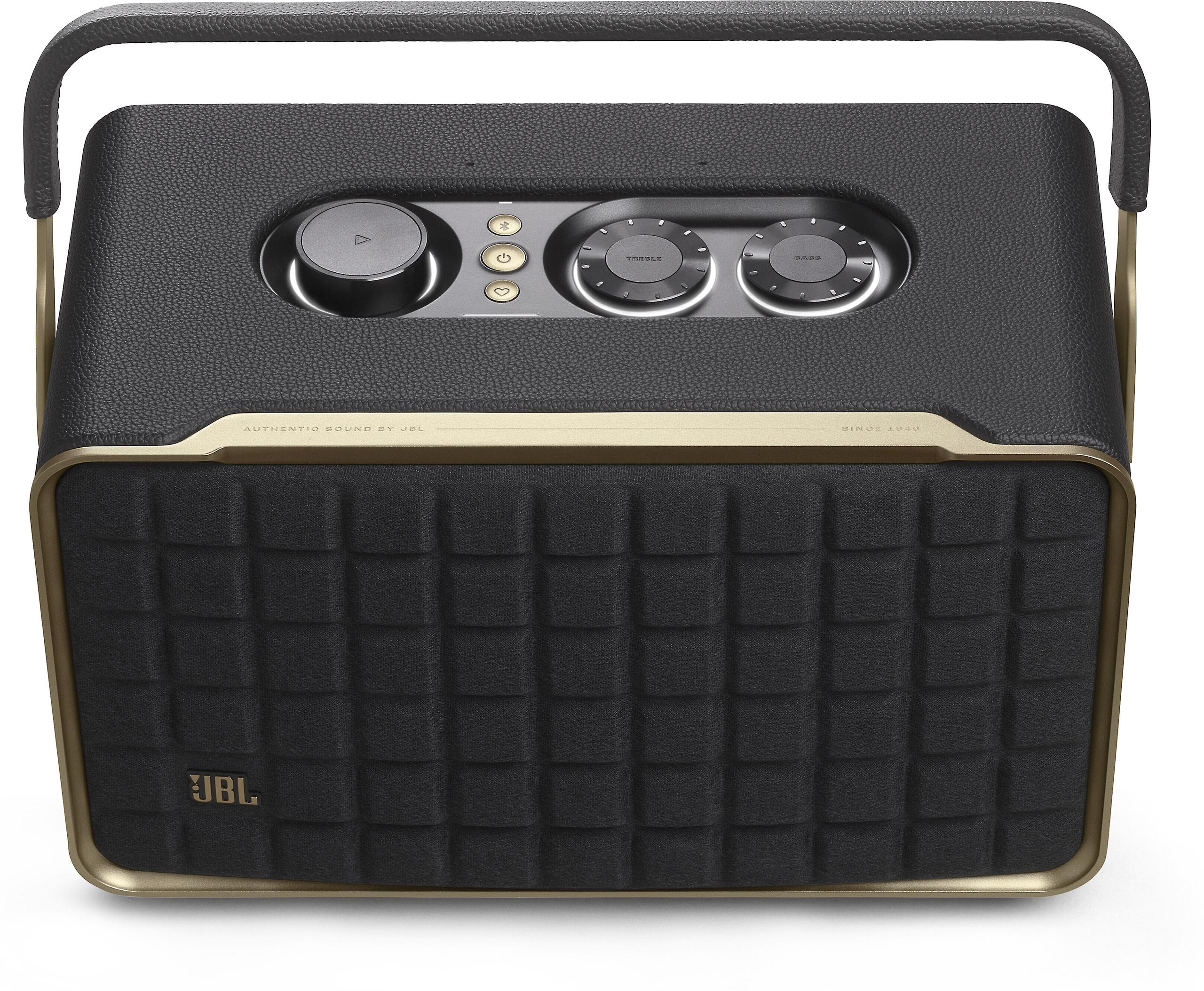
The Authentics 300 makes a bold design statement with its retro-inspired aesthetics that pay homage to classic JBL speakers from the 1970s. The speaker features a distinctive rectangular shape with rounded corners, wrapped in premium materials including 100% recycled fabric for the speaker grille, 85% recycled plastics for the structure, and a leather-like enclosure that adds a touch of luxury.
At 13.46" × 7.7" × 7.1" and weighing a substantial 10.8 pounds, this speaker has presence. It's portable in the sense that you can move it from room to room (aided by its cast-aluminum handle), but it's not something you'll casually toss in a backpack. Think of it more as a speaker that can relocate within your home or occasionally join you on the patio rather than your adventure companion.
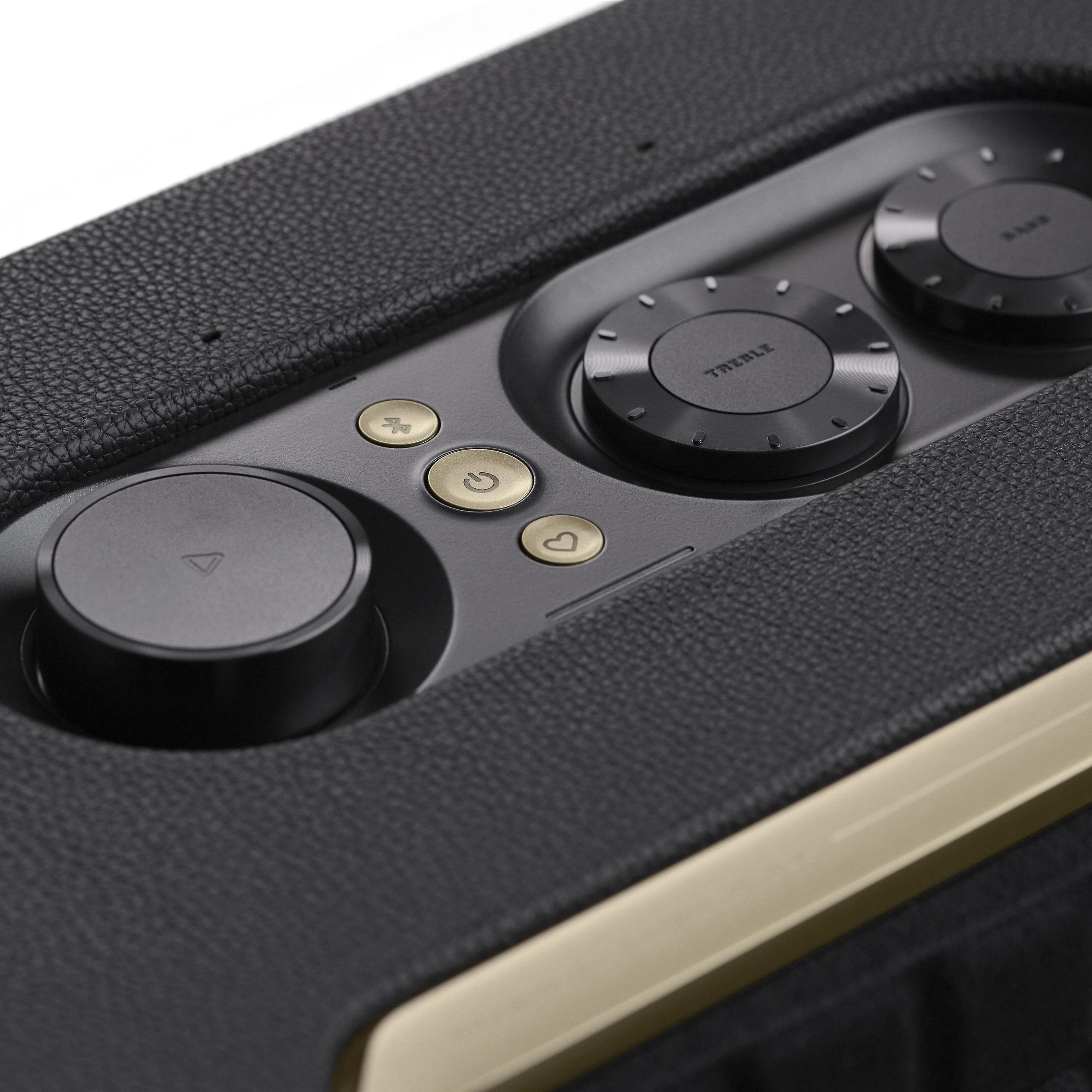
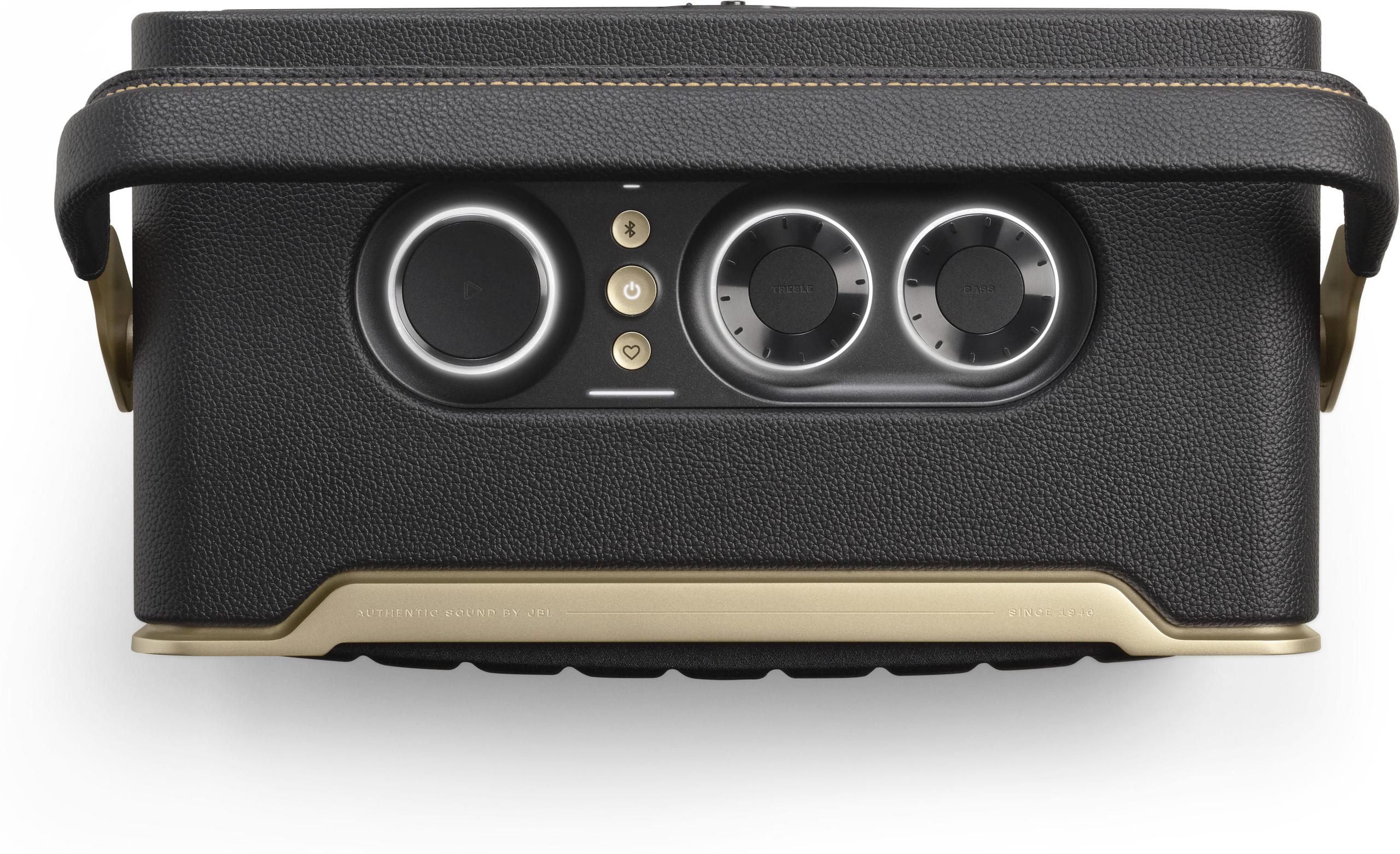
The physical controls are thoughtfully integrated into the top panel, featuring tactile dials for volume, bass, and treble adjustments—a refreshing analog approach in an increasingly touch-controlled world. These allow for quick sound adjustments without needing to open an app.
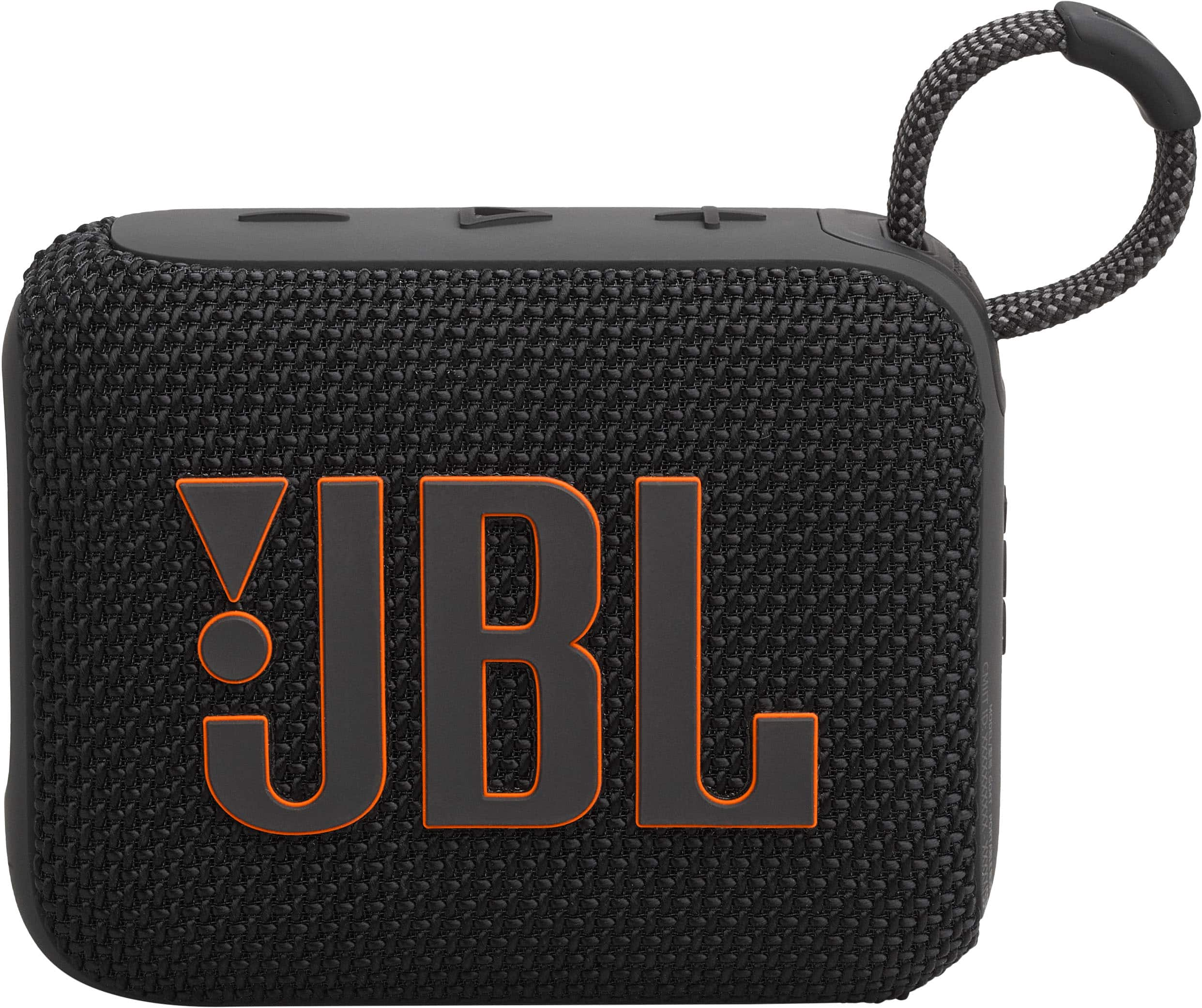
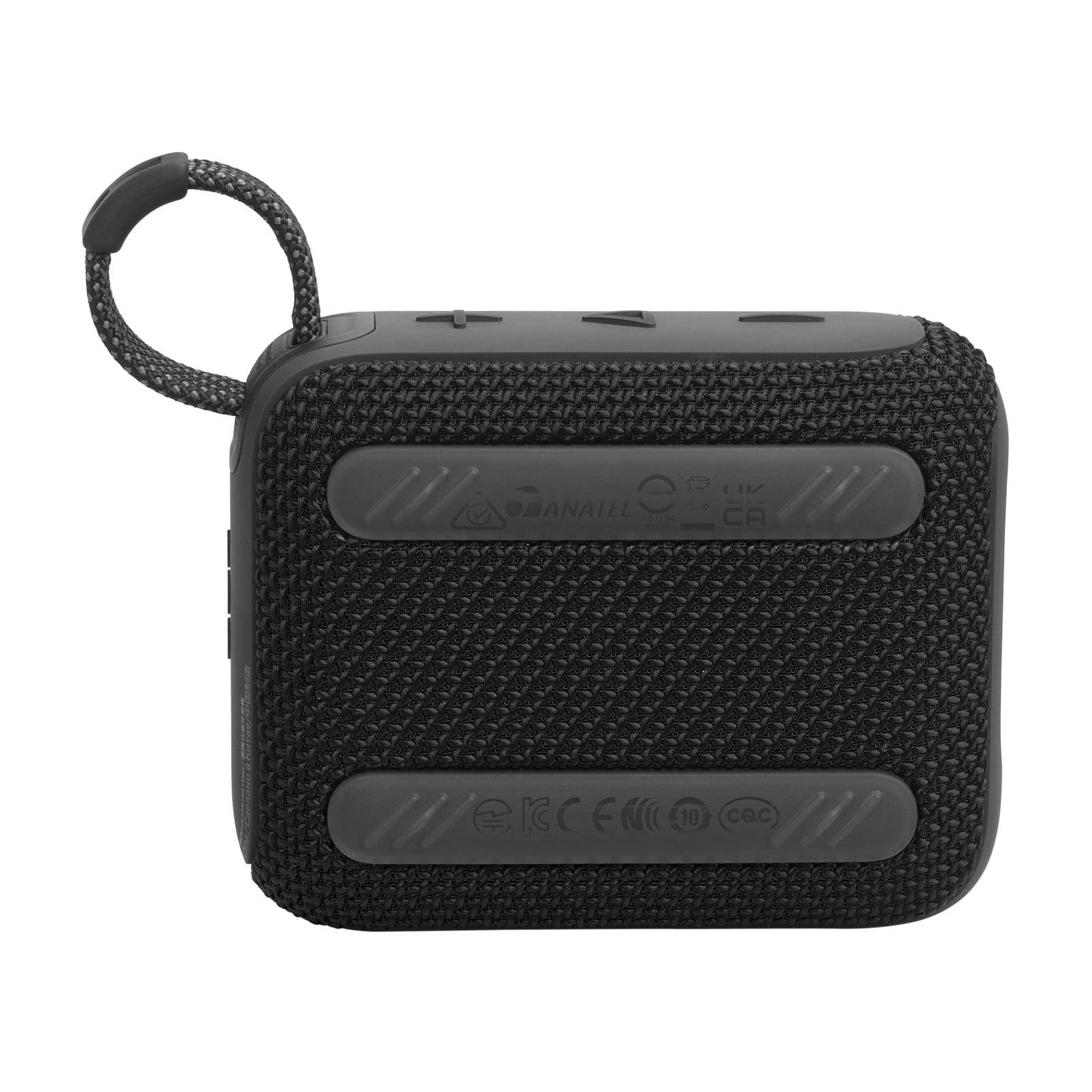
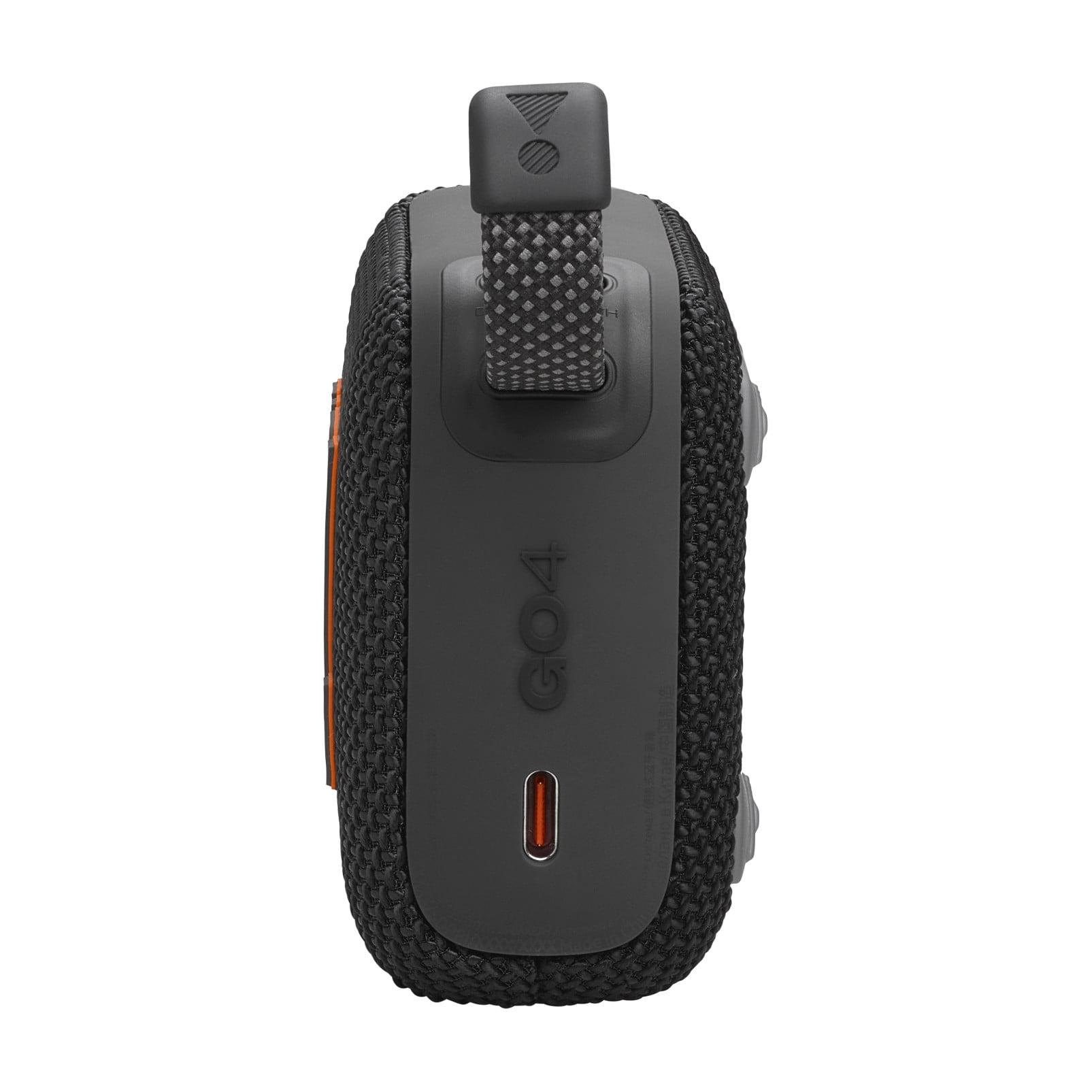
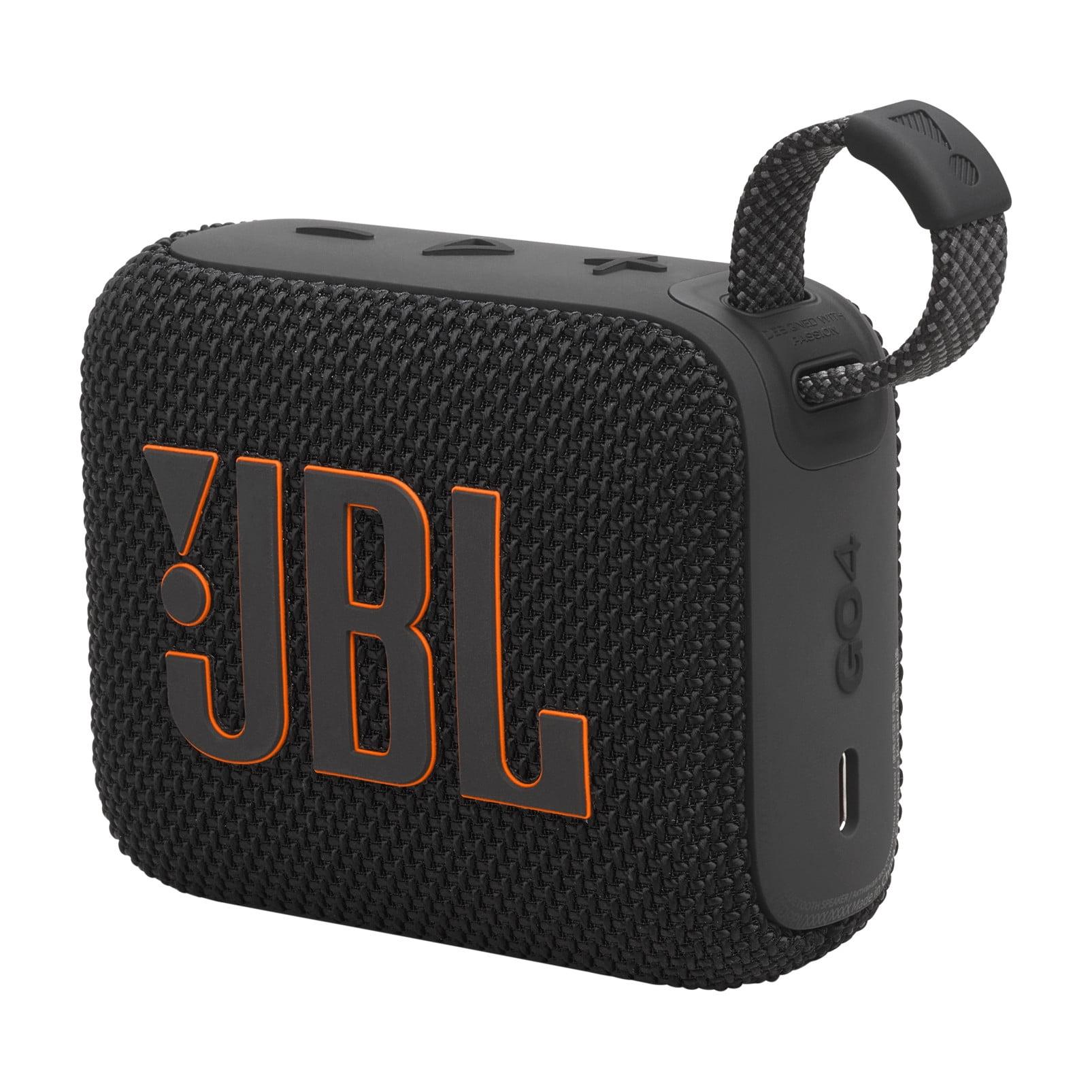
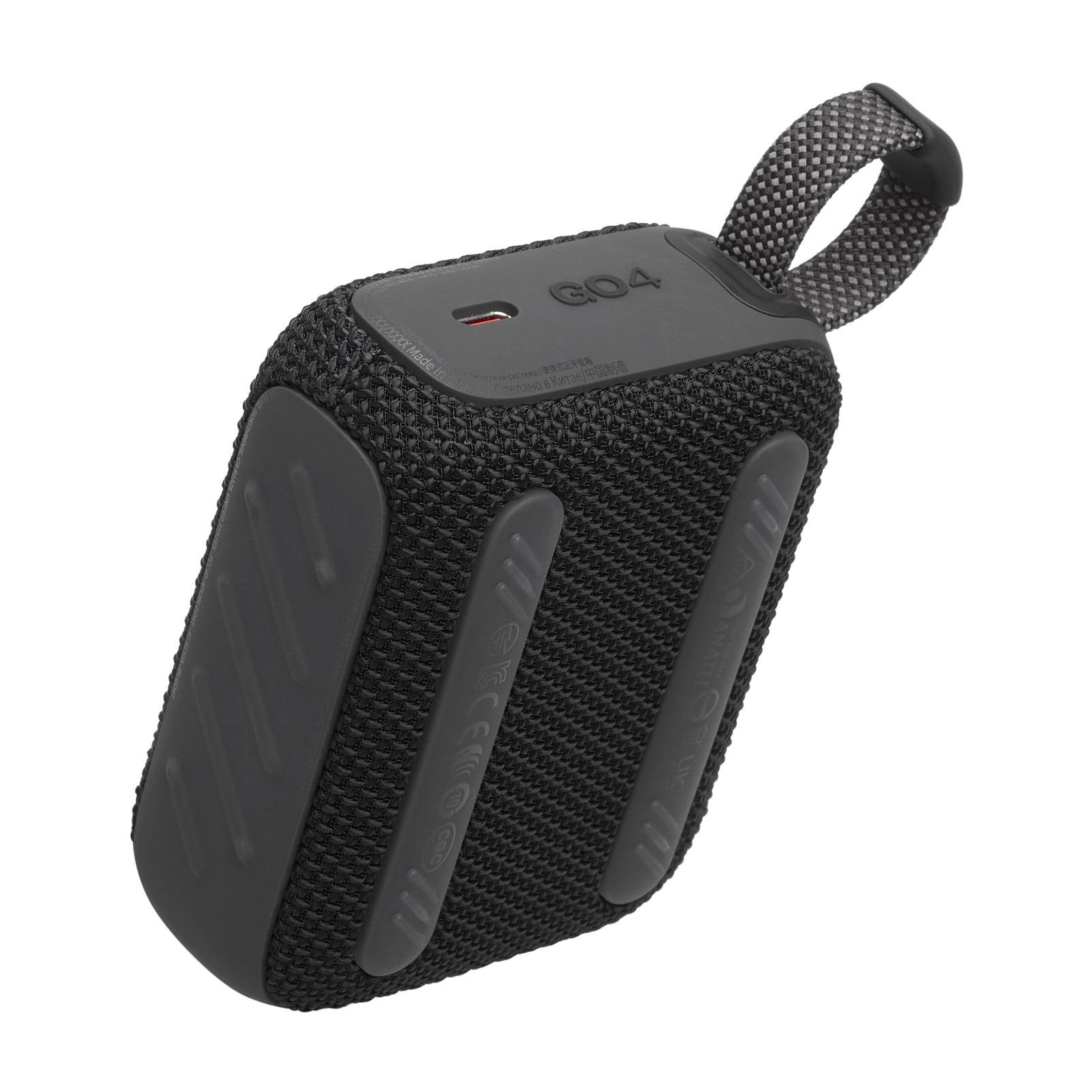
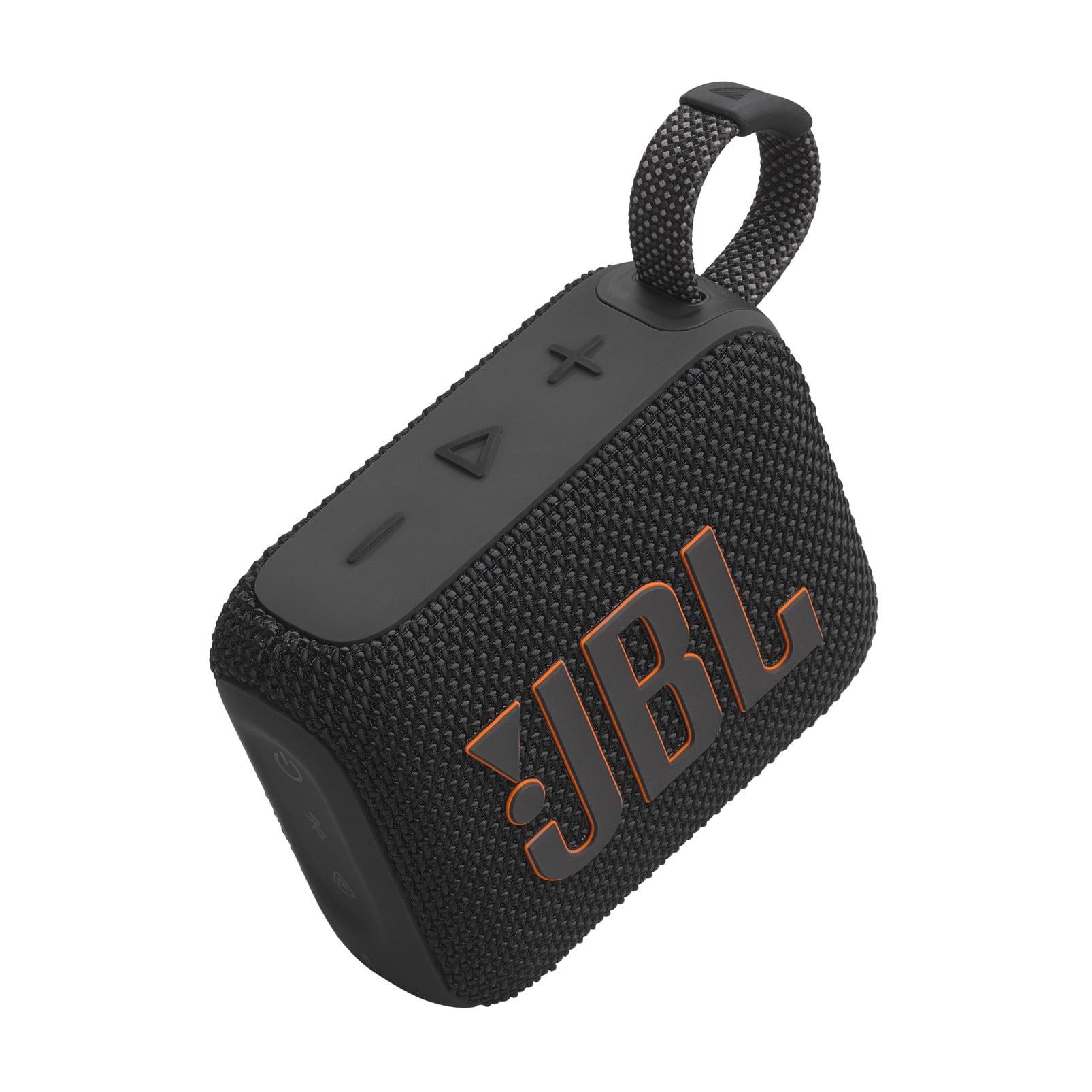
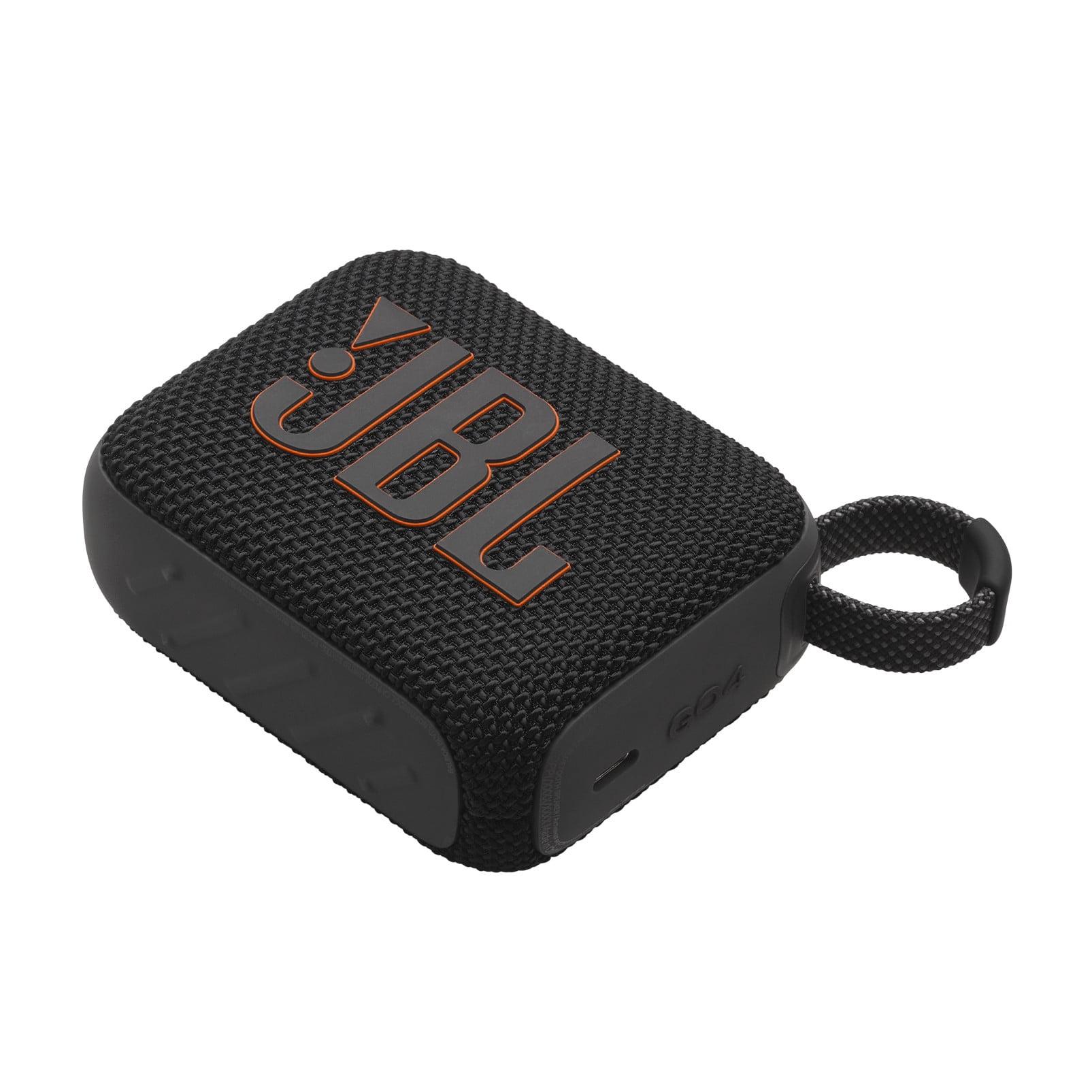
In stark contrast, the JBL Go 4 embraces minimalism with its tiny cube-like design measuring just 3.7" × 3.0" × 1.7"—small enough to fit in a pocket or purse. Weighing a mere 0.42 pounds, it's nearly 26 times lighter than the Authentics 300.
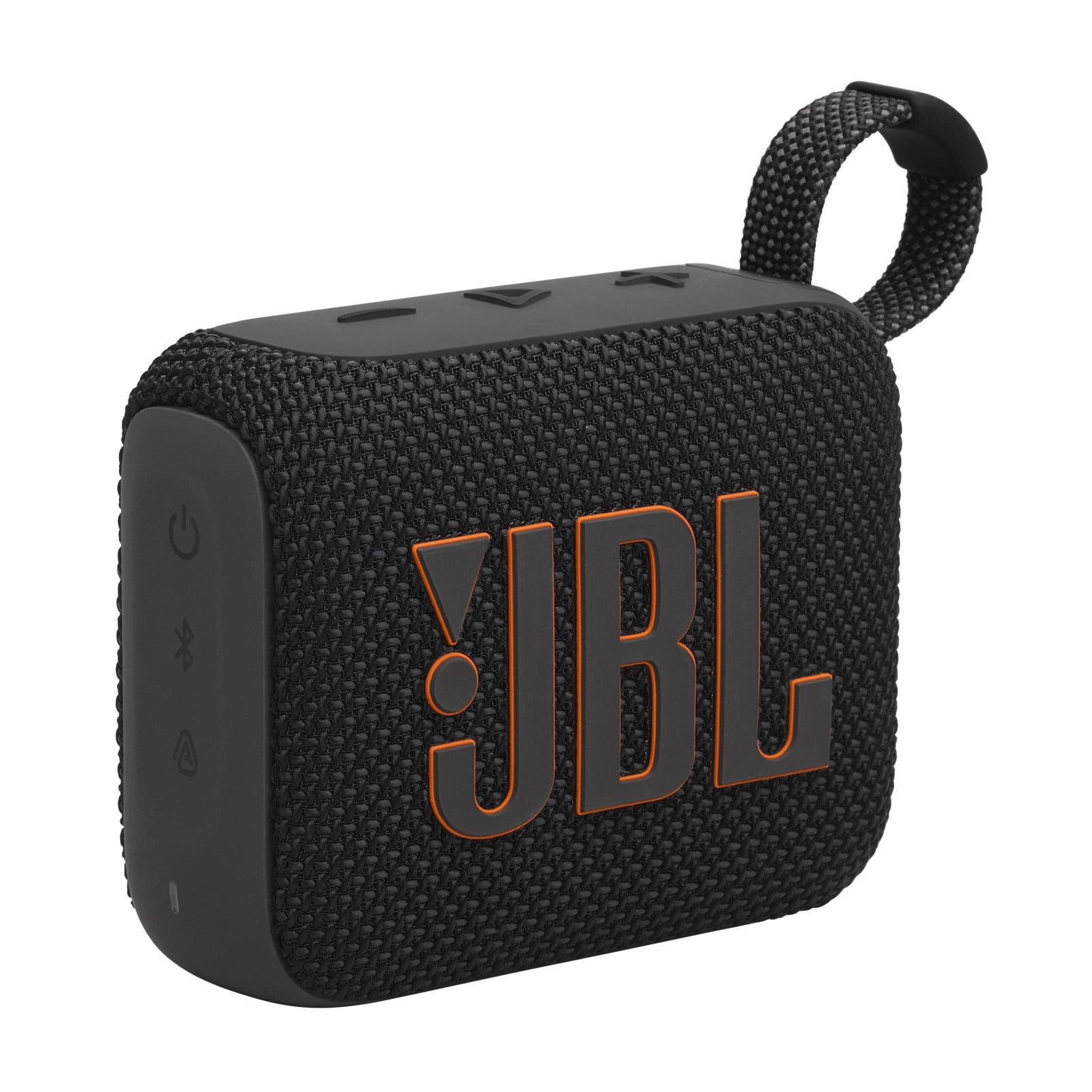
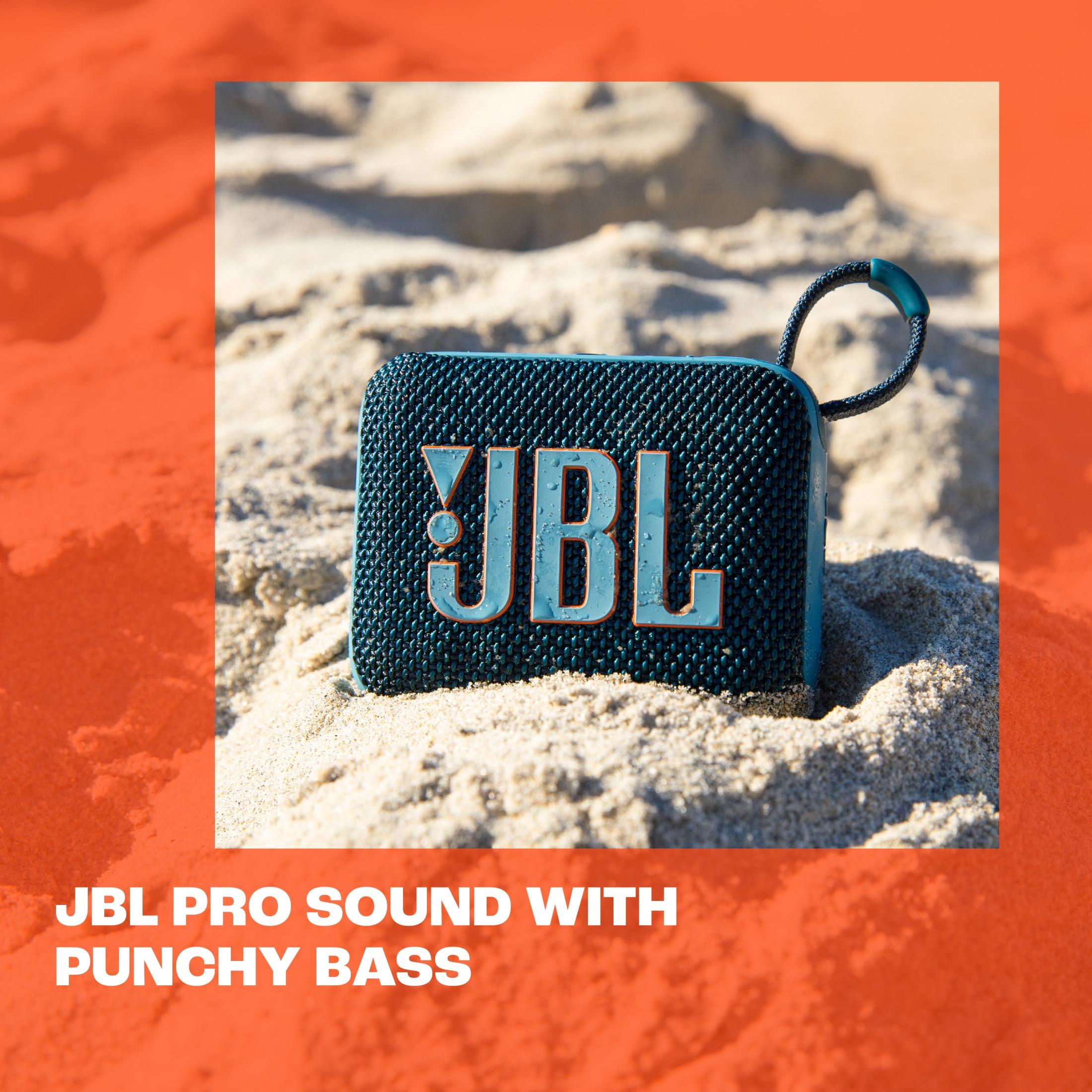
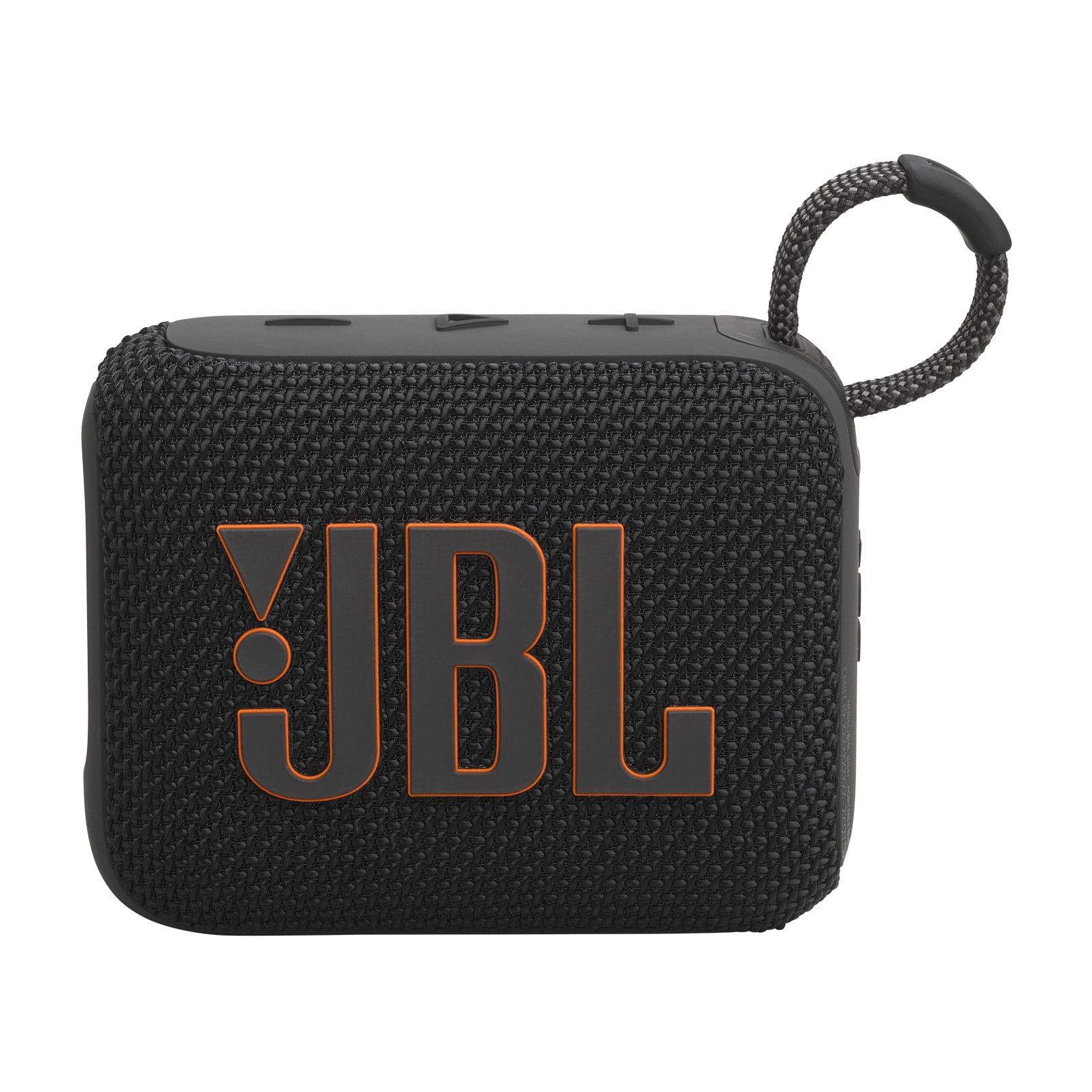
The Go 4 features a clean, modern design with a mesh speaker grille and rugged exterior that's available in seven vibrant colors. The design emphasizes function and durability with its IP67 rating (meaning it's both dustproof and can survive immersion in water up to 1 meter for 30 minutes). This makes it suitable for environments that would be hostile to the Authentics 300—beaches, poolsides, hiking trails, or even the shower.
The speaker includes a small fabric loop for attaching to bags or backpacks, reinforcing its take-anywhere philosophy. Controls are simple and minimal, with buttons for power, Bluetooth pairing, playback, and volume.
What's impressive about the Go 4's design is how JBL has managed to improve durability while incorporating more recycled materials than its predecessor—the speaker uses post-consumer recycled plastic and fabric for the grille, demonstrating that even budget products can embrace sustainability.
The sound quality difference between these speakers is substantial, but that's expected given their size and price disparity.
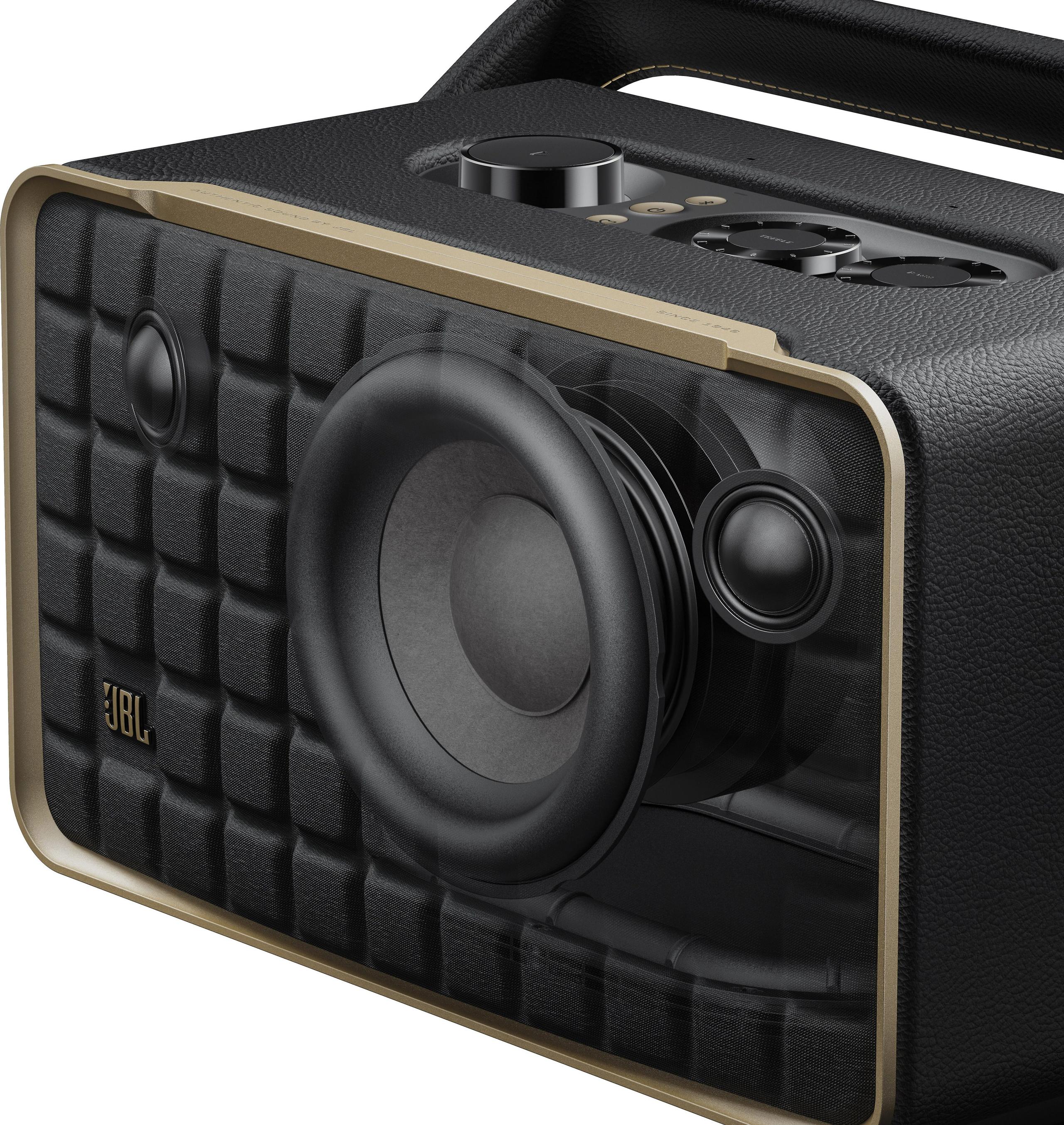
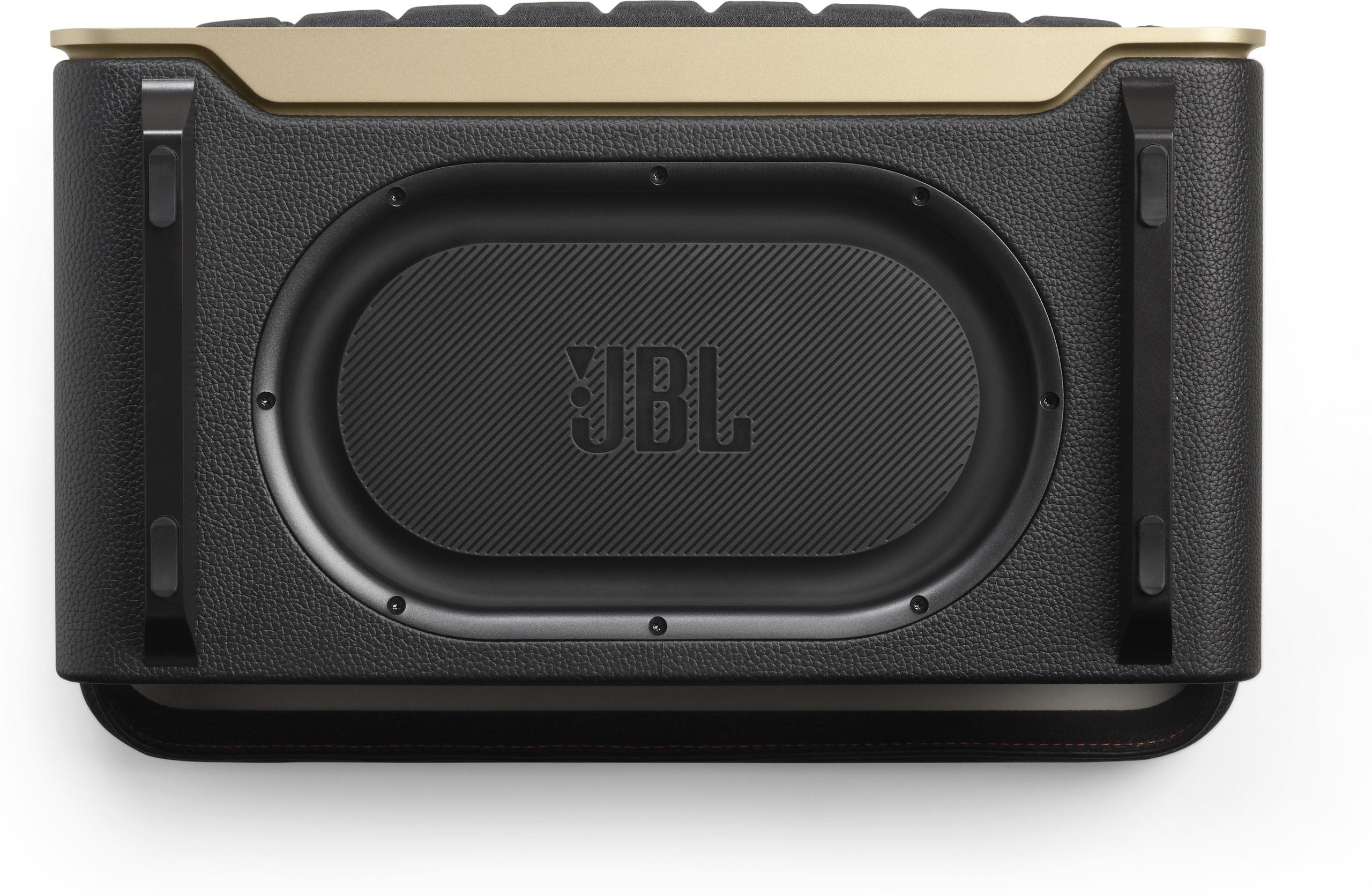
The Authentics 300 delivers impressive audio performance through its 2.0 stereo system powered by 100 watts of amplification. The speaker houses two 1-inch tweeters (small drivers specialized for high-frequency sounds) paired with a substantial 5.25-inch woofer (for handling mid-range and bass frequencies). It also incorporates a 6.5-inch down-firing passive radiator—a non-powered component that enhances bass response by moving in response to air pressure changes inside the cabinet.
This speaker setup allows the Authentics 300 to deliver a frequency response of 45Hz to 20kHz, covering most of the audible spectrum. The low-end extension to 45Hz means you can feel the bass in hip-hop tracks or the rumble in movie soundtracks, while the dedicated tweeters ensure crisp, detailed high frequencies for elements like cymbals, strings, and vocal clarity.
What's particularly impressive is the speaker's ability to create a convincing stereo image despite its single-unit design. When positioned 5-6 feet away, listeners can distinguish left and right channel separation, providing a more immersive listening experience than typical mono portable speakers.
The Authentics 300 also features automatic self-tuning technology that optimizes the sound for its current placement each time it powers up. This means you'll get consistent sound quality whether it's placed on a bookshelf, table, or countertop—the speaker adjusts itself to account for nearby walls and surfaces that might affect its sound.
The JBL Go 4 works with much tighter constraints. It contains a single 45mm (1.75-inch) full-range driver powered by a modest 4.2-watt amplifier. This single driver must handle the entire frequency spectrum from bass to treble, which naturally limits its ability to separate sounds compared to multi-driver systems.
The speaker's frequency response ranges from 90Hz to 20kHz, meaning it simply can't reproduce the lowest bass notes that the Authentics 300 can. For context, the lowest string on a bass guitar is about 41Hz, so the Go 4 will miss some of those fundamental tones.
Despite these physical limitations, JBL has done remarkable engineering work to maximize the sound from this tiny enclosure. The Go 4 sounds notably better than its predecessor, the Go 3, with improvements in volume output, clarity, and perceived bass response. It can reach a maximum volume of about 83 decibels—loud enough for personal listening or small gatherings in quiet environments.
The speaker incorporates a "Playtime Boost" feature that optimizes sound performance through digital signal processing (DSP)—essentially using software algorithms to enhance certain frequencies and compensate for the physical limitations of the small driver.
Bass reproduction is perhaps the most significant differentiator in the listening experience between these two speakers.
The Authentics 300 delivers authoritative bass that you can feel as well as hear. Its 5.25-inch woofer provides the power, while the passive radiator extends the low-frequency response and adds resonance. The physical bass adjustment dial allows listeners to fine-tune the low-end to their preference or the demands of different music genres.
When playing bass-heavy tracks like electronic dance music or hip-hop, the Authentics 300 maintains composure even at higher volumes, with minimal distortion. You'll hear the distinct texture of bass guitars and feel the impact of kick drums—something that smaller speakers simply cannot replicate due to the physics of moving air.
The Go 4, despite its improved performance over previous generations, still faces the fundamental limitations of its size when reproducing bass. Physics simply doesn't allow a driver this small to move enough air to create powerful low frequencies. However, JBL has employed clever passive radiator technology and digital sound processing to create the perception of stronger bass than you might expect.
Bass-forward tracks will sound thin compared to larger speakers, but the Go 4 does an admirable job of preserving the musical balance so that bass lines remain audible, if not physically felt. The EQ settings in the JBL Portable app can boost the perceived bass somewhat, though with diminishing returns at higher volumes where the tiny driver begins to reach its physical limits.
For portable speakers, battery performance is a crucial specification, determining how long you can enjoy your audio away from power outlets.
The JBL Authentics 300 contains a 3.6V, 4800mAh lithium battery that provides up to 8 hours of playback, depending on volume level and connection method. Using Wi-Fi typically consumes more power than Bluetooth, so expect shorter battery life when streaming over your home network. The speaker requires about 3.5 hours to fully charge.
Given its size and power output, 8 hours is reasonable but not exceptional. Other premium speakers in this category often offer 10-12 hours of playback. However, the Authentics 300 allows for playing while charging, so you can keep the music going during longer sessions if you're near a power outlet.
The JBL Go 4 houses a much smaller 3.8V/850mAh battery, yet manages to deliver up to 7 hours of playback—nearly matching the much larger Authentics 300. This efficiency is impressive and speaks to the advantages of powering a single small driver versus multiple larger ones. The Go 4 charges in approximately 3 hours via its USB-C port.
What's particularly noteworthy is that JBL has improved the Go 4's battery life by about 20% compared to the previous Go 3 model, which offered only 5 hours of playback. This improvement comes despite adding new features and better sound quality, demonstrating meaningful engineering progress in power efficiency.
The connectivity options reveal perhaps the starkest difference between these speakers, reflecting their different roles in the audio ecosystem.
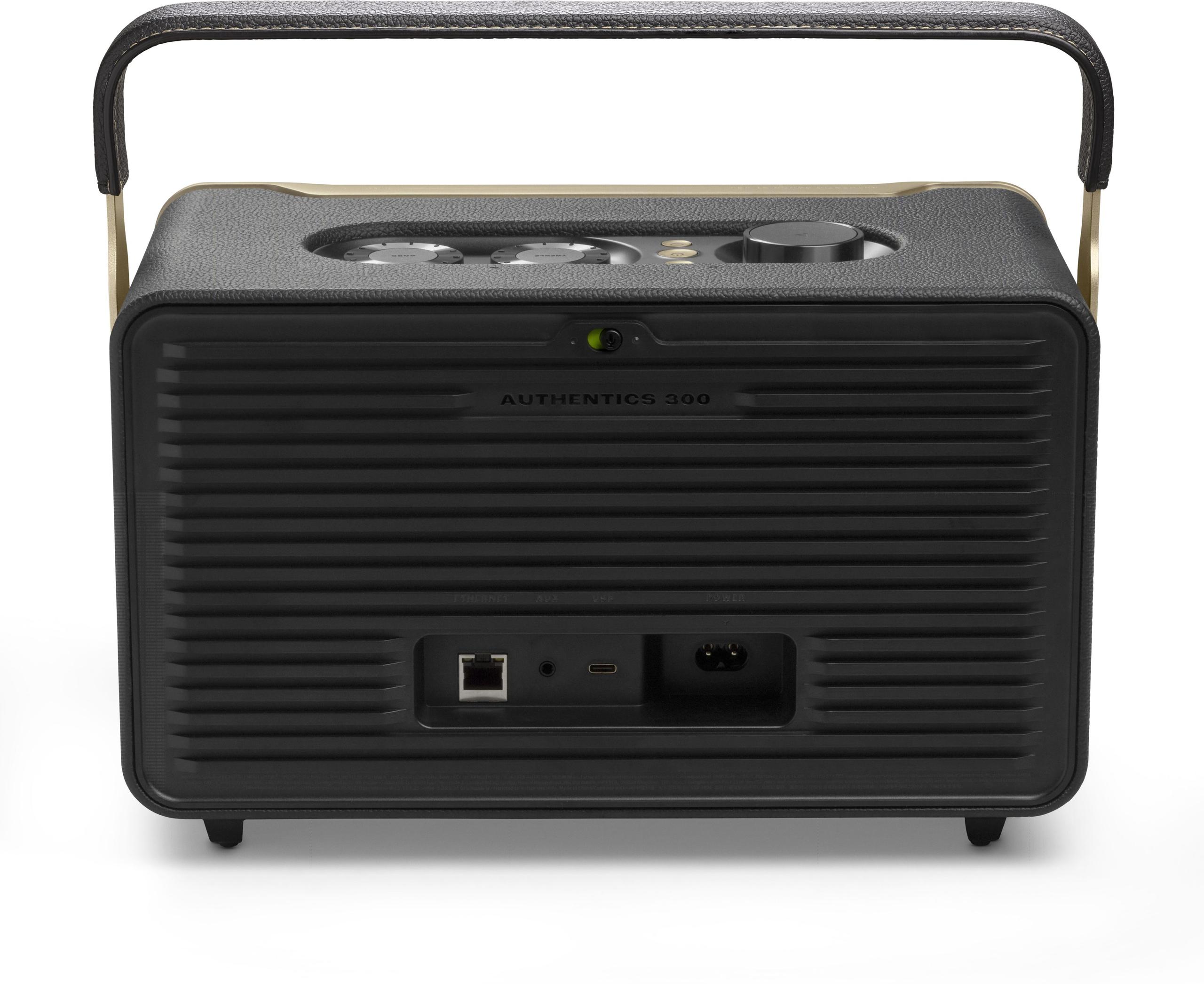
The Authentics 300 functions as a comprehensive audio hub with an impressive array of connection options:
What truly sets the Authentics 300 apart is its dual voice assistant support. Unlike most smart speakers that force you to choose either Google Assistant or Amazon Alexa, the Authentics 300 supports both simultaneously. This means you can say "Hey Google" or "Alexa" to the same speaker and get responses from your preferred assistant depending on the task. This dual-assistant functionality is remarkably rare in the market and offers valuable flexibility for households that use different ecosystems.
The speaker also supports multi-room audio capabilities, allowing you to group multiple compatible speakers throughout your home for synchronized playback—perfect for parties or creating a whole-home audio system.
The JBL Go 4 takes a more straightforward approach with its connectivity:
While much simpler, the Go 4 does introduce Auracast support—a new Bluetooth technology that allows multiple people to listen to the same audio stream from compatible devices. This means you can connect multiple Go 4 speakers (or other Auracast-enabled JBL speakers) to create a bigger sound or achieve stereo separation. This represents a significant upgrade from the Go 3, which lacked this multi-speaker capability.
The Bluetooth range has also been improved from previous generations, with stable connections possible from up to 30-40 feet away in open environments.
Understanding the intended use environments for these speakers helps clarify their design priorities and performance characteristics.
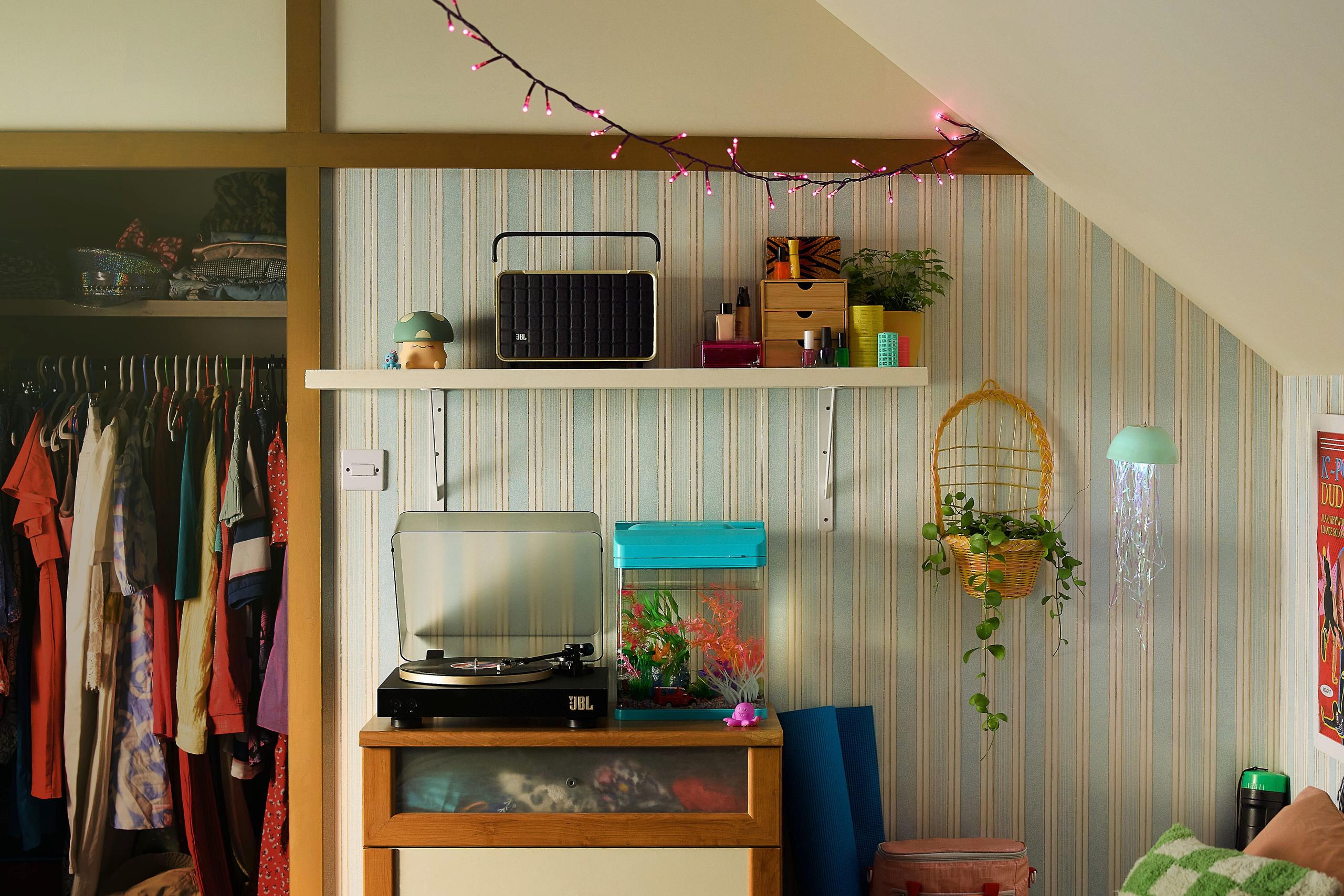
The JBL Authentics 300 is primarily designed for indoor use within the home environment. While its built-in handle and battery make it portable between rooms or for occasional outdoor use on a covered patio, it lacks weatherproofing and would be vulnerable to moisture, dust, and drops. Its premium materials and finish are better suited to shelves, tables, and countertops than rough outdoor conditions.
Ideal use cases include:
For home theater applications, the Authentics 300 can serve as a significant upgrade from built-in TV speakers when space or budget doesn't allow for a full surround sound system. Its powerful bass and clear dialogue reproduction make it suitable for movie watching, though it can't provide the directional audio of a true home theater setup.
In stark contrast, the JBL Go 4 is engineered for adventure with its IP67 waterproof and dustproof rating. This official certification means it's completely protected against dust ingress and can withstand temporary water immersion—making it suitable for beaches, poolsides, hiking trails, and even shower use.
Ideal use cases include:
The Go 4's extreme portability makes it ideal as a secondary speaker that goes where your primary system can't. I've personally found speakers of this size category to be indispensable travel companions, providing much better sound than laptop or phone speakers without taking up valuable luggage space.
Both speakers benefit from companion apps that extend their functionality, though with different capabilities reflecting their market positioning.
The JBL Authentics 300 uses the JBL One app, which provides comprehensive control and customization options:
This level of customization allows users to fine-tune the speaker to their listening preferences and room acoustics. The app's interface is polished and intuitive, making these advanced features accessible even to less technical users.
The JBL Go 4 connects to the simpler JBL Portable app, which offers:
While offering fewer features than the JBL One app, the Portable app provides the essential functions needed for the Go 4's intended use cases. The streamlined interface reflects the speaker's philosophy of simplicity and ease of use.
Choosing between the JBL Authentics 300 and JBL Go 4 ultimately comes down to understanding your own listening habits, priorities, and budget. Here's a framework to help you decide:
Choose the JBL Authentics 300 if:
The Authentics 300 represents a significant investment at $349.99, but its versatility as both a smart home hub and powerful audio system provides value that extends beyond simple music playback. If you're replacing both a smart speaker and a traditional audio system, the price becomes more justifiable.
Choose the JBL Go 4 if:
At $44.99, the Go 4 offers exceptional value for what it delivers—a tiny but mighty speaker that can go virtually anywhere. It's particularly compelling as a secondary speaker or for specific use cases where your primary audio system isn't suitable.
Consider both if:
Many audio enthusiasts ultimately end up with multiple speakers for different scenarios—a larger, more powerful system for home use and a compact, durable option for on-the-go listening. The JBL Authentics 300 and JBL Go 4 would complement each other nicely in such a setup, with each playing to its strengths in appropriate situations.
Both the JBL Authentics 300 and JBL Go 4 excel in their respective categories. The Authentics 300 delivers on its promise of premium sound and smart functionality in a stylish, semi-portable package, while the Go 4 achieves remarkable performance from an incredibly small and durable form factor.
What's particularly impressive is how both speakers represent meaningful improvements over their predecessors or competing products. The Authentics 300 introduces the innovative dual voice assistant support and sustainable materials in a retro-modern design, while the Go 4 improves on the Go 3 with better sound, longer battery life, and new connection capabilities.
Your choice between these two excellent speakers should align with where and how you plan to listen—investing in the right tool for your specific audio needs will ensure satisfaction long after the purchase is made.
| JBL Authentics 300 Smart Speaker | JBL Go 4 Portable Bluetooth Speaker |
|---|---|
| Price - Determines overall value and investment level | |
| $349.99 (premium smart speaker category) | $44.99 (budget portable speaker category) |
| Size & Weight - Impacts portability and placement options | |
| 13.46" x 7.7" x 7.1", 10.8 lbs (room-to-room portable) | 3.7" x 3.0" x 1.7", 0.42 lbs (pocket-sized) |
| Audio Configuration - Determines sound quality and fullness | |
| 2 x 1" tweeters + 5.25" woofer + 6.5" passive radiator (true stereo with dedicated drivers) | Single 45mm (1.75") full-range driver (mono sound from single source) |
| Power Output - Affects maximum volume and sound clarity | |
| 100W total power (room-filling sound even in larger spaces) | 4.2W RMS (adequate for personal listening or small groups) |
| Frequency Response - Range of sounds the speaker can reproduce | |
| 45Hz - 20kHz (includes deep bass and full range) | 90Hz - 20kHz (missing lowest bass frequencies) |
| Battery Life - Determines usage time between charges | |
| Up to 8 hours (varies with volume and connection method) | Up to 7 hours (can extend to 9 hours with Playtime Boost feature) |
| Durability Rating - Indicates where speaker can safely be used | |
| No official IP rating (indoor use, occasional covered outdoor) | IP67 waterproof and dustproof (beach, pool, shower-safe) |
| Connectivity Options - Flexibility for different audio sources | |
| Bluetooth 5.3, Wi-Fi, 3.5mm aux, Ethernet, AirPlay, Chromecast, Spotify Connect | Bluetooth 5.3 only, with Auracast support for multiple speaker connection |
| Smart Features - Additional functionality beyond basic audio playback | |
| Dual voice assistants (Google Assistant and Alexa simultaneously), multi-room audio | No voice assistants or smart home integration |
| App Support - Level of customization available | |
| JBL One app with full parametric EQ, streaming integration, and voice assistant setup | JBL Portable app with basic EQ presets and firmware updates |
| Design - Aesthetic appeal and materials | |
| Retro-inspired with premium materials (recycled fabric and plastics, aluminum handle) | Modern minimalist design with seven color options and recycled materials |
| Best Use Case - Where each speaker performs optimally | |
| Primary home speaker with smart features and room-filling sound | Ultraportable travel companion for adventures and on-the-go listening |
The JBL Authentics 300 is significantly better for home use with its room-filling 100W sound system, Wi-Fi connectivity, and smart home integration. While the JBL Go 4 can function as a small desktop or bedroom speaker, the Authentics 300's superior sound quality, connectivity options, and dual voice assistant support make it the clear choice for primary home audio needs. The JBL Authentics 300's larger drivers and passive radiator deliver fuller sound that can easily fill medium to large rooms.
The JBL Authentics 300 delivers substantially better sound quality with its 2.0 stereo system (two tweeters and a woofer), 100W power output, and frequency response down to 45Hz. The JBL Go 4 produces impressive sound for its tiny size but is limited by its single 45mm driver, 4.2W output, and 90Hz frequency floor. For critical listening, music appreciation, or movie watching, the JBL Authentics 300 provides clearer highs, more defined midrange, and much deeper bass response.
The JBL Go 4 is dramatically more portable at just 3.7" x 3.0" x 1.7" and weighing only 0.42 pounds—small enough to fit in a pocket or purse. While the JBL Authentics 300 has a handle and battery power for room-to-room portability, its 10.8-pound weight and substantial size (13.46" x 7.7" x 7.1") make it less practical for travel or outdoor adventures. The Go 4 is designed specifically for on-the-go use.
The JBL Go 4 is ideal for outdoor use with its IP67 waterproof and dustproof rating, allowing it to withstand rain, splashes, and even temporary immersion in water. The JBL Authentics 300 lacks weatherproofing and is primarily designed for indoor use, though it can be used on a covered patio or deck if protected from the elements. For beach trips, hiking, or poolside listening, the JBL Go 4 is the appropriate choice.
Despite their size difference, both speakers offer similar battery performance. The JBL Authentics 300 provides up to 8 hours of playback, while the JBL Go 4 delivers up to 7 hours (and up to 9 hours with its Playtime Boost feature disabled). However, the Authentics 300's battery drains faster at higher volumes or when using Wi-Fi instead of Bluetooth. Both speakers require approximately 3-3.5 hours to fully charge.
The JBL Authentics 300 offers comprehensive smart home integration with dual voice assistant support (both Google Assistant and Amazon Alexa simultaneously), Wi-Fi connectivity, and compatibility with smart streaming protocols like AirPlay, Chromecast, and Spotify Connect. The JBL Go 4 has no smart home features, functioning strictly as a Bluetooth speaker. For controlling smart devices or integrating with existing smart home ecosystems, only the Authentics 300 provides this functionality.
Whether the JBL Authentics 300 justifies its $349.99 price tag compared to the $44.99 JBL Go 4 depends on your priorities. If you value superior sound quality, smart features, multi-room capabilities, and diverse connectivity options for home use, the Authentics 300 provides commensurate value. However, if you primarily need a simple, ultra-portable speaker for travel or outdoor activities, the Go 4 offers better value within its specific use case.
The JBL Authentics 300 is considerably better for movie watching with its powerful bass response, stereo separation, and ability to produce dialogue clearly. While not a substitute for a dedicated home theater system, it can significantly enhance TV audio compared to built-in speakers. The JBL Go 4 is not well-suited for movie watching due to its limited bass response, mono output, and lower volume capability. For any home theater application, the Authentics 300 is the only viable option between these two speakers.
The JBL Authentics 300 can connect to most modern TVs through multiple methods: via its 3.5mm auxiliary input, through Bluetooth if your TV supports it, or via Wi-Fi using Chromecast or AirPlay depending on your TV's capabilities. The JBL Go 4 can only connect to TVs that have Bluetooth output. For reliable TV audio enhancement, the Authentics 300 offers more connection options and significantly better sound quality.
The JBL Go 4 is more durable with its IP67 waterproof and dustproof rating, allowing it to withstand water immersion, dust, and general rough handling. The JBL Authentics 300, while well-built with quality materials, has no official durability rating and is more vulnerable to environmental factors. If durability and resistance to elements are priorities, the Go 4 is clearly superior despite its lower price point.
Both speakers offer multi-speaker functionality but work differently. The JBL Authentics 300 supports multi-room audio through Wi-Fi, allowing you to create synchronized audio throughout your home using multiple Authentics speakers or other compatible JBL speakers. The JBL Go 4 supports Auracast technology, enabling connection of multiple Go 4 speakers via Bluetooth for expanded sound. However, the speakers cannot be paired with each other as they use different pairing technologies.
The JBL Authentics 300 delivers substantially better bass with its dedicated 5.25-inch woofer and 6.5-inch passive radiator, producing frequencies down to 45Hz that you can actually feel. The JBL Go 4, despite JBL's engineering efforts, is physically limited by its small size and single 1.75-inch driver, with bass that rolls off below 90Hz. For bass-heavy music genres like hip-hop, EDM, or for movie soundtracks with low-frequency effects, the Authentics 300 provides a dramatically more satisfying experience.
We've done our best to create useful and informative comparisons to help you decide what product to buy. Our research uses advanced automated methods to create this comparison and perfection is not possible - please contact us for corrections or questions. These are the sites we've researched in the creation of this article: tomsguide.com - 9to5google.com - bestbuy.com - jbl.com - androidpolice.com - jbl.com - greentoe.com - jbl.com - jbl.com - projectorscreen.com - kh.jbl.com - jbl.com - tomsguide.com - outeraudio.com - youtube.com - techradar.com - corporategift.com - jbl.com - target.com - dell.com - projectorscreen.com - mm.jbl.com

Privacy Policy
Terms and Conditions - Affiliate Policy
Home Security
© Copyright 2008-2026.
11816 Inwood Rd #1211, Dallas, TX 75244