$219.99
When Amazon first entered the smart speaker market, audio quality took a backseat to convenience. The Amazon Echo Studio changes that equation entirely, delivering what researchers consistently describe as Amazon's most impressive audio achievement to date. This isn't just another voice-activated gadget – it's a legitimate attempt to bridge the gap between audiophile-quality sound and the smart home revolution.
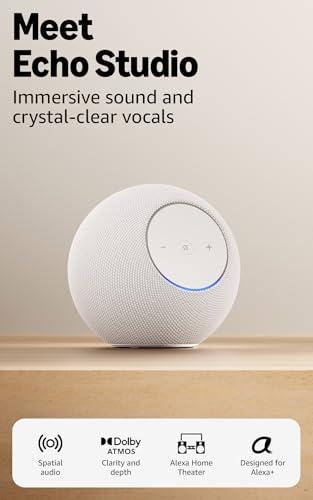
The Amazon Echo Studio stands apart through its sophisticated five-speaker array and advanced audio processing. Unlike typical smart speakers that treat sound as an afterthought, this device puts audio quality front and center. The speaker configuration includes a 1-inch tweeter for crisp highs, three 2-inch midrange drivers positioned strategically around the cylinder, and a substantial 5.25-inch woofer pointing downward. This arrangement isn't just about more speakers – it's about creating what audio engineers call "spatial dispersion," where sound radiates in multiple directions to fill a room naturally.
What's particularly impressive is the automatic room adaptation technology. Using built-in microphones, the Echo Studio continuously listens to how sound bounces off your walls, furniture, and ceiling, then adjusts its output accordingly. This means whether you place it in a corner, on a bookshelf, or in the center of a room, the speaker automatically compensates for acoustic challenges. Our researchers found this feature genuinely transforms the listening experience, especially in challenging acoustic environments like rooms with hard surfaces or awkward layouts.
The sound quality represents a quantum leap from previous Echo devices. With 200 watts of power driving those five speakers, the Amazon Echo Studio can fill large rooms without strain. Online user reviews consistently praise its ability to maintain clarity even at high volumes – something many smart speakers struggle with due to their compact drivers and limited power.
The bass response deserves special mention. The downward-firing woofer creates what's called "omnidirectional bass," using your floor and nearby surfaces to enhance low-frequency output. This approach produces surprisingly deep bass for a speaker this size, though some users report it can become overwhelming in smaller rooms or when placed on hollow surfaces that vibrate. The companion app includes bass and treble controls, allowing you to dial in the perfect balance for your space and preferences.
Where the Echo Studio truly shines is in midrange reproduction – the frequency range where most vocals and instruments live. Researchers note that dialogue in podcasts remains crystal clear, while acoustic instruments sound natural and present. The spatial processing creates a soundstage that extends well beyond the physical boundaries of the speaker, making stereo recordings feel genuinely three-dimensional.
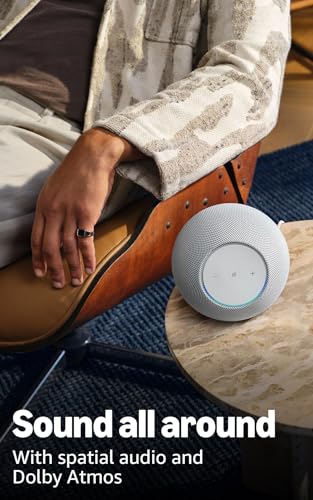
The inclusion of Dolby Atmos support represents one of the most noteworthy features of the Amazon Echo Studio. Dolby Atmos is an audio format that adds height information to traditional surround sound, creating a three-dimensional bubble of audio around the listener. The Echo Studio's upward-firing driver bounces sound off your ceiling to create this height effect.
However, the effectiveness of this feature depends heavily on your content and room setup. Amazon Music HD offers a growing library of Atmos tracks, and the difference is immediately apparent with properly mixed content. Our testers describe hearing instruments floating above and around them, rather than just coming from the speaker's location. Rain sounds genuinely fall from above, while orchestral pieces gain remarkable depth and space.
The caveat is content availability. While streaming services are expanding their spatial audio libraries, most music still exists in traditional stereo format. The Echo Studio applies "spatial enhancement" to regular stereo tracks, but results vary wildly depending on the original recording. Some tracks benefit from the processing, gaining width and depth, while others can sound artificially enhanced or echo-y.
Beyond audio quality, the Amazon Echo Studio functions as a comprehensive smart home hub. The built-in Zigbee radio means you can control compatible smart lights, locks, sensors, and switches without needing separate hubs cluttering your network setup. This integration level sets it apart from audio-focused competitors who treat smart features as secondary additions.
The seven-microphone array ensures reliable voice recognition, even during loud music playback. Alexa's wake-word detection works consistently across the room, though performance naturally degrades in extremely noisy environments. The Drop In feature turns the speaker into an intercom system, useful for communicating between floors or rooms in larger homes.
Multi-room audio coordination works seamlessly with other Echo devices. You can group the Studio with smaller Echo speakers throughout your house, using it as the main driver while synchronizing music playback. This creates an affordable whole-home audio system that rivals more expensive dedicated solutions.
The Echo Studio's Dolby Atmos processing makes it an intriguing option for home theater enhancement. When paired with Fire TV devices, it can serve as a significant upgrade over television speakers. The spatial audio processing adds genuine dimension to movie soundtracks, particularly action sequences and atmospheric scenes.
However, researchers note important limitations. The single-speaker configuration means it can't create true left-right channel separation like a traditional soundbar. While the sound field feels wide and immersive, it doesn't match the precision of dedicated multi-channel audio systems. For casual viewing and smaller rooms, the improvement over TV speakers is dramatic. For dedicated home theaters, it's better viewed as an impressive temporary solution rather than an end goal.
At the time of writing, the Amazon Echo Studio occupies a unique position in the smart speaker landscape. Traditional audiophile speakers often ignore smart features entirely, while most smart speakers compromise significantly on audio quality. The Echo Studio attempts to excel at both, and largely succeeds.
Compared to premium offerings from Sonos or Apple, the Echo Studio generally provides more features and better value proposition, particularly for users already invested in Amazon's ecosystem. The built-in smart home hub alone saves the cost and complexity of separate devices. However, pure audio enthusiasts might find speakers from dedicated audio companies offer superior sound quality, albeit without the smart features and ecosystem integration.
The automatic room adaptation technology alone justifies much of the premium over standard Echo devices. This feature addresses one of the biggest challenges in home audio – how speaker placement affects sound quality. Most users don't have the luxury of optimal speaker positioning, making this adaptive technology genuinely valuable.
The Amazon Echo Studio makes most sense for users wanting serious audio quality without abandoning smart home convenience. It's ideal for music lovers who primarily stream from services like Amazon Music HD, Spotify, or Apple Music, particularly those interested in exploring high-resolution and spatial audio content.
Smart home enthusiasts will appreciate the integrated hub functionality, especially those planning to expand their automation setups. The ability to control lights, locks, and other devices through voice commands while enjoying high-quality music creates a compelling unified experience.
The speaker is less suitable for true audiophiles seeking reference-quality playback, or users preferring other voice assistants like Google Assistant or Siri. Its stationary nature also makes it inappropriate for portable audio needs.
The Amazon Echo Studio represents a genuine breakthrough in smart speaker design, successfully combining impressive audio performance with comprehensive smart home functionality. The automatic room adaptation technology is genuinely innovative, addressing real-world placement challenges that affect every speaker owner.
While it doesn't achieve audiophile reference quality, the Amazon Echo Studio delivers room-filling sound that surpasses most consumer expectations for smart speakers. The Dolby Atmos processing, when paired with compatible content, provides glimpses of immersive audio's potential in mainstream devices.
For users seeking a single device that serves as both entertainment centerpiece and smart home command center, the Echo Studio offers compelling value. It's Amazon's most ambitious audio product, demonstrating that smart speakers can deliver both intelligence and impressive sound quality without significant compromise. The combination of advanced audio processing, extensive streaming support, and deep ecosystem integration creates a product that becomes more valuable as your smart home grows.
The Amazon Echo Studio offers excellent value for users wanting both high-quality audio and smart home integration. It delivers room-filling sound with Dolby Atmos support, automatic room adaptation, and a built-in Zigbee hub that eliminates the need for separate smart home devices. For home theater use, it significantly improves TV audio when paired with Fire TV devices, though dedicated soundbars may offer better channel separation.
Yes, the Amazon Echo Studio works well for home theater applications, especially when paired with Fire TV devices. Its Dolby Atmos processing adds spatial dimension to movie soundtracks, and the 200-watt output provides much better audio than most TV speakers. However, it functions as a single-channel solution rather than true surround sound, so while it creates an immersive soundfield, it can't match multi-speaker home theater systems for precision audio placement.
The Amazon Echo Studio features a five-speaker array with 200 watts of power, compared to smaller Echo devices with basic stereo setups. It includes unique technologies like automatic room adaptation that adjusts sound based on your space, Dolby Atmos support for 3D audio, and high-resolution audio playback up to 24-bit/192kHz. It also has a built-in smart home hub with Zigbee support, making it the most advanced Echo speaker Amazon produces.
Yes, the Amazon Echo Studio fully supports Dolby Atmos playback. It uses an upward-firing speaker to bounce sound off your ceiling, creating height channels that add three-dimensional depth to compatible content. This works best with Dolby Atmos tracks from Amazon Music HD and other streaming services, though the speaker also applies spatial enhancement to regular stereo music with varying results.
The Amazon Echo Studio can reach up to 91.1 dB SPL, which is loud enough to fill large rooms and handle parties. The 200-watt power output ensures it maintains clarity even at high volumes with minimal compression artifacts. Most users find it more than adequate for typical home use, though the actual perceived loudness will depend on your room size and acoustic properties.
Yes, you can pair two Amazon Echo Studio speakers for stereo playback, creating a wider soundstage and more immersive listening experience. This stereo pairing works through the Alexa app and is particularly beneficial for larger rooms or dedicated listening areas. You can also group the Echo Studio with other Echo devices throughout your home for synchronized multi-room audio.
The Amazon Echo Studio includes a built-in Zigbee hub that works with thousands of compatible smart home devices including Philips Hue lights, smart locks, sensors, and switches. It also supports Matter protocol for broader device compatibility and Amazon Sidewalk for extended connectivity. This eliminates the need for separate hubs like SmartThings or Philips Hue Bridge for many devices.
The Amazon Echo Studio requires WiFi for most smart features, voice commands, and streaming music services. However, you can still play music via Bluetooth from your phone or use the 3.5mm input for wired audio sources when WiFi isn't available. The smart home hub features and Alexa voice assistant won't function without an internet connection.
The Amazon Echo Studio offers more features at a typically lower price point than comparable Sonos speakers, including built-in voice assistant, smart home hub, and Dolby Atmos support. Sonos speakers often provide better multi-room audio integration and sound quality consistency, but lack the comprehensive smart home features. The Echo Studio is better for users wanting an all-in-one solution, while Sonos excels for dedicated audio enthusiasts.
The Amazon Echo Studio supports high-resolution audio formats including FLAC, MP3, AAC, Opus, Vorbis, Dolby Digital, Dolby Digital Plus, and Dolby Atmos. It can handle audio up to 24-bit/192kHz resolution, making it compatible with lossless music from Amazon Music HD, Apple Music, Tidal, and other high-quality streaming services. This broad format support ensures compatibility with virtually any audio source.
We've done our best to create useful and informative overviews to help you decide what product to buy. Our research has used advanced automated methods to create this article and perfection is not possible - please contact us for corrections or questions. These are the sites we've researched in the creation of this article: whathifi.com - crutchfield.com - rtings.com - dxomark.com - youtube.com - dimensions.com - youtube.com - bestbuy.com - techradar.com - dolby.com - consumerreports.org - engadget.com - phonearena.com - aboutamazon.com - manuals.plus - askalexa.com - en.wikipedia.org
| Amazon Echo Studio |
|---|
| Speaker Configuration - Determines sound quality and spatial coverage: 5 speakers (1" tweeter, 3x 2" midrange, 5.25" woofer) |
| Power Output - Affects maximum volume and dynamic range: 200 watts |
| Spatial Audio - Creates immersive 3D sound experience: Dolby Atmos, Sony 360 Reality Audio |
| Room Adaptation - Automatically optimizes sound for your space: Built-in acoustic analysis and EQ adjustment |
| Smart Home Hub - Eliminates need for separate hubs: Built-in Zigbee, Matter, Amazon Sidewalk |
| High-Resolution Audio - Preserves original recording quality: Up to 24-bit/192kHz FLAC support |
| Voice Assistant: Alexa with 7-microphone array |
| Multi-Room Audio - Synchronizes with other Echo devices: Yes, with stereo pairing support |
| Connectivity - Multiple input options for flexibility: Wi-Fi, Bluetooth, 3.5mm analog/optical combo |
| Streaming Services - Works with major platforms: Amazon Music, Spotify, Apple Music, Tidal, Pandora |
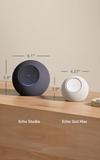
| Height: 8.1 inches |
| Diameter: 6.9 inches |
| Weight: 7.7 lbs |
| Power: AC adapter required (no battery) |
The Echo Show 11 takes a fundamentally different approach with its 11-inch Full HD touchscreen and visual-first philosophy. Where the Echo Studio excels purely in audio, the Show 11 serves as a comprehensive family command center that displays calendars, weather information, security camera feeds, and streaming video content. Its 13-megapixel camera enables high-quality video calling with auto-framing, making it ideal for staying connected with family members. The visual interface transforms smart home management from voice-only commands to an intuitive dashboard where you can see device status at a glance and control multiple systems simultaneously. For families juggling complex schedules or users who prefer visual information over spoken responses, the Show 11 provides capabilities that pure audio devices simply cannot match.
However, this versatility comes with trade-offs in audio performance. While the Echo Show 11 includes front-facing stereo speakers and a custom woofer that deliver respectable sound for video content and casual listening, it can't compete with the Echo Studio's dedicated 5-speaker array and spatial audio processing. The Show 11's audio is optimized for clarity during video calls and streaming rather than immersive music experiences. At similar price points, your choice comes down to priorities: if exceptional audio quality and invisible smart home control matter most, the Echo Studio delivers unmatched value. But if you want a multi-functional device that serves as entertainment center, communication hub, and visual information display with adequate audio performance, the Show 11 offers broader utility for households that value visual interaction and video capabilities.
🤖 Read Detailed Comparison
👌Amazon Echo Show 11 Smart Display Details
💵 See Amazon Echo Show 11 Smart Display Price
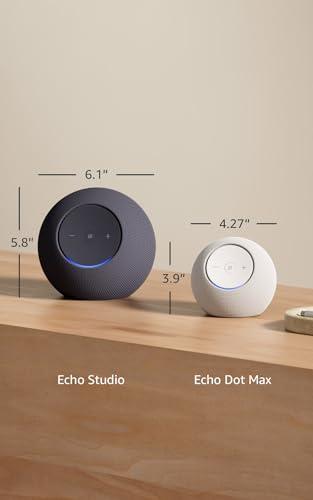
The Amazon Echo Dot Max serves as Amazon's new middle-tier option, offering a compelling alternative for users who want significantly better audio than standard Echo Dots without the space requirements or investment of the Echo Studio. Its dual-driver system—featuring a dedicated woofer and custom tweeter—delivers nearly three times the bass response of regular Echo Dots, creating a much more open and balanced sound profile that eliminates the "boxy" quality of single-driver designs. The compact spherical design makes it ideal for bedside tables, desks, and smaller rooms where the Echo Studio might overwhelm the space, while still providing the same smart home hub functionality with built-in Zigbee, Matter, and Thread support.
From a value perspective, the Amazon Echo Dot Max represents the most dramatic relative improvement in Amazon's speaker lineup, transforming the listening experience for users upgrading from basic Echo devices. While it cannot match the Echo Studio's room-filling bass, spatial audio processing, or Dolby Atmos capabilities, it excels in near-field listening scenarios and offers excellent performance for its size and price point. The Dot Max makes particular sense for multi-room audio systems where you want better sound quality than standard Dots throughout your home without the per-room cost of multiple Echo Studios. For users whose primary needs center on casual music listening, smart home control, and voice assistance—rather than dedicated audiophile experiences or home theater setups—the Amazon Echo Dot Max delivers the essential benefits of Amazon's latest speaker technology in a more accessible package.
🤖 Read Detailed Comparison
👌Amazon Echo Dot Max Smart Speaker Details
💵 See Amazon Echo Dot Max Smart Speaker Price
The Google Nest Mini 2nd Gen takes a completely different approach, prioritizing affordability and convenience over audio performance. At roughly one-fourth the price of the Echo Studio, it delivers Google Assistant functionality in an incredibly compact form factor that can fit virtually anywhere in your home. The device excels at voice recognition for basic commands, smart home control within Google's ecosystem, and seamless integration with Android devices and Google services like Calendar and Gmail. Its wall-mountable design and tiny footprint make it ideal for placing voice control in every room without the space requirements or visual prominence of larger speakers. The Nest Mini also stands out for its environmental consciousness, using fabric made from 100% recycled plastic bottles and housing constructed with 35% post-consumer recycled materials.
However, the audio performance gap between these devices is substantial and non-negotiable. The Nest Mini's single 40mm driver simply cannot compete with the Echo Studio's five-speaker array, producing minimal bass and showing compression artifacts at higher volumes. While Google improved the bass response compared to the original Mini, it remains suitable only for podcasts, voice responses, and background music rather than serious listening. The value proposition becomes clear when you consider use cases: if you primarily need voice assistant functionality and basic smart home control in multiple rooms, several Nest Mini units cost less than one Echo Studio while providing comprehensive coverage. But if audio quality matters for your daily music listening or home theater needs, the Echo Studio's premium pricing reflects genuinely superior capabilities that the compact Nest Mini simply cannot match due to physical constraints.
🤖 Read Detailed Comparison
👌Google Nest Mini 2nd Gen Smart Speaker Details
💵 See Google Nest Mini 2nd Gen Smart Speaker Price
The Google Nest Audio takes a fundamentally different approach, prioritizing affordability, compact design, and superior voice assistant performance over premium audio quality. At roughly one-third the price of the Echo Studio, it delivers Google's excellent Assistant technology with better voice recognition accuracy and more natural conversational abilities. The speaker's unobtrusive fabric-covered design fits seamlessly into smaller spaces like bedrooms, kitchens, or offices where the Echo Studio's substantial footprint would be impractical. Its Ambient IQ feature automatically adjusts volume based on background noise, making it particularly effective for podcasts and news content in changing environments.
However, the audio performance gap is substantial and immediately apparent. The Google Nest Audio's two-driver setup produces adequate sound for casual background listening but lacks the bass depth, volume capability, and overall richness that makes the Echo Studio suitable for serious music enjoyment or home theater use. Professional reviews consistently note compression and harshness at higher volumes, limiting its effectiveness in larger rooms or party situations. While it offers excellent value for users seeking primarily smart home control and voice interaction at an accessible price point, anyone who prioritizes audio quality or plans to use their speaker as a primary music system will find the Nest Audio's performance underwhelming compared to the Echo Studio's room-filling, detailed sound reproduction.
🤖 Read Detailed Comparison
👌Google Nest Audio Speaker Details
💵 See Google Nest Audio Speaker Price
The Echo Show 8 3rd Gen takes a completely different approach than the Echo Studio, prioritizing versatility over pure audio performance. Its standout feature is the responsive 8-inch HD touchscreen that transforms how you interact with Alexa—displaying recipes while cooking, showing video calls with family, streaming Prime Video content, and providing visual feedback for smart home controls. The centered 13MP camera with auto-framing makes video calling surprisingly pleasant, while the Adaptive Content feature intelligently adjusts what's displayed based on your distance from the device. At roughly half the price of the Echo Studio, it delivers impressive functionality breadth with dual neodymium speakers that produce surprisingly robust sound for a display device, though it can't match the Studio's audiophile-grade performance.
Where the Echo Show 8 truly shines is in daily practicality and multi-tasking scenarios that the Echo Studio simply cannot handle. Its compact countertop design fits naturally in kitchens and home offices, while the visual interface makes complex smart home management far more intuitive than voice-only control. The device excels at multimedia consumption—watching cooking videos while preparing meals, displaying weather and calendar information at a glance, or handling work video calls with decent quality. While serious music enthusiasts will notice the audio quality difference compared to the Echo Studio, most users find the Show 8's sound perfectly adequate for background music, podcasts, and video content. For households wanting one device that competently handles entertainment, communication, and smart home control without requiring premium audio investment, the Echo Show 8 represents exceptional value and real-world utility.
🤖 Read Detailed Comparison
👌Amazon Echo Show 8 3rd Gen Smart Display Details
💵 See Amazon Echo Show 8 3rd Gen Smart Display Price
The Amazon Echo Spot 2024 takes a completely different approach as a compact smart alarm clock with a 2.83-inch touchscreen display. Its standout features include always-visible customizable clock faces, weather information, and touch controls that eliminate the need for voice commands during nighttime interactions. The tap-to-snooze functionality and motion sensor for automated routines make it exceptionally convenient for bedside use, while its compact 4.4 x 4.5-inch footprint fits naturally on nightstands without dominating the space. The visual interface proves particularly valuable for quick smart home adjustments—dimming lights or checking device status with simple taps rather than speaking aloud and potentially waking a sleeping partner.
However, the audio performance gap is dramatic. The Echo Spot 2024's single 1.73-inch speaker produces directional sound adequate for alarm clocks and casual listening but lacks the room-filling capability, bass response, and spatial audio processing that make the Echo Studio a serious music device. At its budget-friendly price point, the Spot delivers excellent value as an enhanced alarm clock with smart assistant capabilities, but it's fundamentally designed for convenience and visual information rather than audio quality. For users who already have quality speakers elsewhere and simply want Alexa functionality with visual feedback in their bedroom, the Spot makes perfect sense—just don't expect it to match the Studio's impressive audio performance or comprehensive smart home hub capabilities.
🤖 Read Detailed Comparison
👌Amazon Echo Spot 2024 Smart Alarm Clock Details
💵 See Amazon Echo Spot 2024 Smart Alarm Clock Price
The Sonos Era 100 takes a fundamentally different approach to smart speaker design, prioritizing audio accuracy and ecosystem flexibility over raw power and smart home integration. Its most impressive feature is the dual angled tweeter configuration that creates genuine stereo separation from a single compact speaker - something the Echo Studio can't match despite its larger size. The Era 100's sound signature is notably more neutral and balanced, delivering clearer vocals and more controlled bass that maintains its composure across all volume levels. While it can't reach the Studio's room-shaking volumes, the Sonos Era 100 sounds more natural and less fatiguing during extended listening sessions, making it superior for critical music enjoyment across genres like jazz, acoustic, and vocal-heavy content.
From a value and ecosystem perspective, the Sonos Era 100 offers compelling advantages despite lacking the Studio's built-in smart home hub and spatial audio features. Its integration into the mature Sonos ecosystem means better long-term expandability - you can easily add more speakers throughout your home, create stereo pairs, or integrate with Sonos soundbars for home theater setups. The Era 100 also provides more connectivity flexibility with Wi-Fi 6, Bluetooth 5.0, and AirPlay 2 support, plus compatibility with multiple voice assistants rather than being locked into Amazon's ecosystem. While the Studio delivers more immediate "wow factor" with its powerful bass and Alexa integration, the Era 100 represents a smarter long-term investment for users who prioritize sound quality, build premium multi-room systems, or want the flexibility to work across different smart home platforms.
🤖 Read Detailed Comparison
👌Sonos Era 100 Smart Speaker Details
💵 See Sonos Era 100 Smart Speaker Price
The Amazon Echo Pop takes a completely different approach, prioritizing exceptional voice recognition and smart home functionality over premium audio. Its three-microphone array with AZ2 Neural Edge processor actually outperforms the Studio in noisy environments, delivering faster 1-2 second response times and more reliable wake word detection when TVs are playing or conversations are happening nearby. The Pop's compact half-sphere design fits seamlessly into bedrooms, kitchens, and offices where the Studio's substantial footprint would feel excessive. For smart home control, it supports the modern Matter standard and can extend Eero mesh networks by up to 1,000 square feet, making it surprisingly capable as both a voice assistant and Wi-Fi booster.
From a value perspective, the Echo Pop costs roughly one-eighth the price of the Studio while delivering the complete Alexa experience for casual listeners. Multiple Pops throughout your home provide comprehensive voice coverage and synchronized audio for less than a single Studio, making it ideal for users who prioritize convenience over audiophile sound quality. While its single 1.95-inch driver can't match the Studio's bass depth or room-filling volume, it handles podcasts, audiobooks, and background music admirably in smaller spaces. The Pop represents Amazon's most accessible entry point to smart speakers, proving that sophisticated voice control and basic audio don't require premium pricing.
🤖 Read Detailed Comparison
👌Amazon Echo Pop Smart Speaker Details
💵 See Amazon Echo Pop Smart Speaker Price
The Echo Show 5 (3rd Gen) takes a fundamentally different approach to smart home control, prioritizing visual interaction and versatility over premium audio performance. Its standout feature is the 5.5-inch touchscreen that transforms routine smart home tasks—checking weather, viewing security cameras, managing calendars, and conducting video calls through its 2MP camera. While the Studio excels at filling rooms with high-fidelity sound, the Show 5 excels at information accessibility, displaying multiple data points simultaneously rather than requiring sequential voice queries. The compact form factor (roughly one-quarter the Studio's size and weight) enables flexible placement throughout your home, fitting comfortably on nightstands, kitchen counters, and office desks where the Studio's substantial footprint would be impractical.
From a value perspective, the Echo Show 5 costs significantly less while offering capabilities the Studio simply cannot match—video calling, visual smart home control, recipe displays, and photo slideshow functionality. However, this comes with notable audio compromises; its single 1.75-inch speaker handles voice responses and casual listening adequately but lacks the Studio's room-filling power, stereo separation, and bass response. The Show 5 also requires separate hub hardware for Zigbee smart home devices, whereas the Studio includes this functionality built-in. For users who prioritize visual convenience, communication features, and budget-conscious smart home entry over audiophile-grade sound, the Echo Show 5 delivers exceptional utility per dollar spent, making it the more practical choice for bedrooms, kitchens, and personal spaces where at-a-glance information proves more valuable than immersive audio experiences.
🤖 Read Detailed Comparison
👌Amazon Echo Show 5 3rd Gen Smart Display Details
💵 See Amazon Echo Show 5 3rd Gen Smart Display Price
The Amazon Echo Dot 5th Generation takes a fundamentally different approach, prioritizing affordability and whole-home accessibility over premium audio performance. Its standout feature is the ability to place Alexa throughout your entire home at a fraction of the Studio's cost—you could deploy four or five Dots for the same investment. The compact 4-inch design fits anywhere from nightstands to kitchen counters, while unique sensors like temperature monitoring and motion detection enable automated routines that the Studio lacks. The 5th generation's improved 1.73-inch driver delivers surprisingly good sound for casual listening, with noticeably better bass than previous Dot models, though it can't approach the Studio's room-filling audio or handle high volumes without distortion.
In real-world use, the Echo Dot 5th Generation excels where the Studio struggles—convenience and coverage. Multiple Dots create a seamless voice control experience throughout your home, perfect for families who need timers in the kitchen, bedside alarms, and drop-in communication between rooms. The Dot's faster AZ2 processor actually provides quicker Alexa responses than the Studio, and its unobtrusive design disappears into your décor rather than demanding attention. While it lacks the Studio's Zigbee hub, audio inputs, and advanced sound processing, the Dot's distributed approach often proves more practical for daily smart home tasks. Choose the Dot if you prioritize comprehensive home integration and budget-conscious deployment over audiophile-quality music listening.
🤖 Read Detailed Comparison
👌Amazon Echo Dot 5th Generation Smart Speaker Details
💵 See Amazon Echo Dot 5th Generation Smart Speaker Price
The Amazon Echo Show 8 takes a fundamentally different approach by prioritizing visual versatility and multi-functional capabilities over pure audio performance. Its standout feature is the 8-inch touchscreen display with 1280x800 resolution that transforms how you interact with a smart device—enabling video calls with a 13-megapixel auto-framing camera, displaying recipes step-by-step while cooking, showing weather and calendar information at a glance, and providing intuitive touch controls for smart home management. The Visual ID technology personalizes content based on who approaches the device, while Adaptive Content adjusts information density based on your proximity. These visual capabilities create real-world benefits that audio-only devices simply cannot match, particularly in kitchens where you can follow recipes hands-free, in bedrooms as an intelligent alarm clock and information display, or for staying connected with family through high-quality video calling.
From a value perspective, the Amazon Echo Show 8 represents the Swiss Army knife approach—handling multiple daily tasks adequately rather than excelling at one specific function. While its audio capabilities are respectable for casual listening and voice interaction, they cannot compete with the Studio's dedicated acoustic engineering and room-filling power. However, for users who need video communication, visual information display, and smart home management in addition to basic audio functions, the Show 8 delivers significantly more versatility for slightly less cost. The trade-off is clear: you sacrifice the Studio's exceptional audio quality and large-room performance for a device that can replace multiple other gadgets and serve as a central hub for visual information, communication, and home automation—making it the better choice for users who value multi-functionality over specialized audio excellence.
🤖 Read Detailed Comparison
👌Amazon Echo Show 8 Display Details
💵 See Amazon Echo Show 8 Display Price
The Amazon Echo Show 15 Smart Display represents a fundamentally different philosophy, transforming Alexa from a voice-only assistant into a visual command center for busy households. Its massive 15.6-inch Full HD touchscreen creates capabilities that the Echo Studio simply cannot offer—customizable widgets for family calendars, shopping lists, and reminders all visible at a glance, plus built-in Fire TV streaming for Netflix and Prime Video directly on the display. The 5MP camera (13MP in newer models) enables video calling with auto-framing and Visual ID facial recognition that personalizes content for each family member. Wall-mountable in both portrait and landscape orientations, it functions as a digital photo frame when idle, seamlessly blending into your home's decor while providing constant utility.
For families prioritizing organization and visual interaction over audio quality, the Amazon Echo Show 15 delivers value through consolidation of multiple devices into one hub. While its dual 1.6-inch speakers pale in comparison to the Echo Studio's premium audio system, the Show 15 excels at tasks the Studio cannot perform—displaying security camera feeds, showing recipe instructions while cooking, facilitating group video calls, and serving as a secondary TV for casual viewing. The visual smart home controls eliminate the need to remember voice commands, making it more accessible for all family members. If your household values staying organized, connected, and informed more than audiophile-quality music playback, the Show 15's integrated approach often provides greater daily utility despite typically commanding a higher price point.
🤖 Read Detailed Comparison
👌Amazon Echo Show 15 Smart Display Details
💵 See Amazon Echo Show 15 Smart Display Price
The Bose Portable Smart Speaker offers something the Echo Studio fundamentally cannot: true mobility with premium audio quality. Its 12-hour battery life, IPX4 water resistance, and lightweight 2.3-pound design with built-in handle make it the only smart speaker in its class that can deliver high-quality sound at pool parties, camping trips, or beach outings. The 360-degree sound dispersion ensures consistent audio quality regardless of placement, while the dual voice assistant support (both Alexa and Google Assistant) provides ecosystem flexibility that's particularly valuable for households using mixed smart home platforms. The eight-microphone array excels at voice recognition even in noisy outdoor environments where the Echo Studio would be unusable.
However, this portability comes at a significant cost premium - nearly double the Echo Studio's price at the time of writing - and with notable performance trade-offs. The Bose Portable Smart Speaker can't match the Echo Studio's raw power, deep bass extension, or Dolby Atmos capabilities, making it less suitable for serious home listening or home theater use. It also lacks wired inputs and smart home hub functionality, limiting its integration possibilities. The value proposition centers entirely on whether you need the unique combination of portability, weather resistance, and smart features that no other speaker provides. For users whose listening habits extend beyond fixed indoor locations, the Bose justifies its premium through capabilities the Echo Studio simply cannot replicate, but stationary listeners will find better audio performance and features elsewhere.
🤖 Read Detailed Comparison
👌Bose Portable Smart Speaker Details
💵 See Bose Portable Smart Speaker Price
The Denon Home 250 brings traditional hi-fi expertise to the wireless speaker market, offering refined audio engineering that prioritizes tonal accuracy and musical precision over raw impact. Its sophisticated driver arrangement with angled tweeters and passive radiator design creates genuinely balanced sound that works equally well with classical orchestras and contemporary pop, maintaining clarity and detail at both whisper-quiet and room-filling volumes. The speaker's extensive streaming service integration supports over eight platforms directly, including audiophile favorites like Tidal and high-resolution formats up to 24-bit/192kHz, while dual voice assistant support (Alexa and Google) provides ecosystem flexibility. The HEOS multi-room platform scales up to 32 devices with audiophile-grade synchronization, making it ideal for building sophisticated whole-home audio systems that can integrate with traditional hi-fi components.
While the Denon Home 250 commands a significantly higher price than the Echo Studio, it justifies the premium through superior audio refinement and long-term versatility. The controlled, precise bass response won't disturb apartment neighbors yet still provides satisfying low-end extension, and the balanced midrange ensures vocals and instruments remain clearly defined even in complex musical passages. However, this focus on accuracy means it can't match the Echo Studio's room-shaking power output or dramatic spatial audio effects that make action movies more thrilling. The Denon also lacks built-in smart home hub functionality, requiring separate hardware for comprehensive home automation. For listeners who can appreciate the difference between accurate and exciting sound reproduction, and who value streaming flexibility and multi-room sophistication over maximum impact per dollar, the Denon Home 250 represents a more mature, audiophile-oriented approach to wireless audio.
🤖 Read Detailed Comparison
👌Denon Home 250 Wireless Smart Speaker Details
💵 See Denon Home 250 Wireless Smart Speaker Price
The Google Nest Audio shines with its exceptional value proposition and superior voice assistant capabilities, delivering roughly 80% of smart speaker functionality at about half the cost of the Echo Studio. Google Assistant's conversational abilities are notably more natural and context-aware, handling follow-up questions seamlessly without requiring you to repeat wake words, and excelling at general knowledge queries and web searches. The Nest Audio's compact, minimalist design blends unobtrusively into any room while still providing clear vocal reproduction that's particularly well-suited for podcasts, audiobooks, and casual music listening. Its Ambient IQ feature automatically adjusts volume based on background noise, ensuring spoken content remains audible when the dishwasher starts or kids get loud, while Voice Match technology recognizes up to six household members for personalized responses.
While the Google Nest Audio can't match the Echo Studio's raw audio power or bass response, it holds its own for typical daily use cases where music serves as background rather than the main focus. The speaker's real-time audio processing adapts sound profiles based on content type, optimizing classical music differently than hip-hop for the clearest possible reproduction within its hardware limitations. For users primarily invested in Google's ecosystem – Android phones, Chromecast devices, Gmail, and Google Calendar – the integration feels seamless and intuitive. The Nest Audio represents the sweet spot for most buyers: excellent voice interaction, adequate audio quality for everyday listening, and outstanding value that makes premium features like spatial audio and built-in hubs feel unnecessary rather than essential.
🤖 Read Detailed Comparison
👌Google Nest Audio Smart Speaker Details
💵 See Google Nest Audio Smart Speaker Price
Original price was: $499.99.$369.99Current price is: $369.99.
Original price was: $579.99.$318.99Current price is: $318.99.


Privacy Policy
Terms and Conditions - Affiliate Policy
Home Security
© Copyright 2008-2026.
11816 Inwood Rd #1211, Dallas, TX 75244