




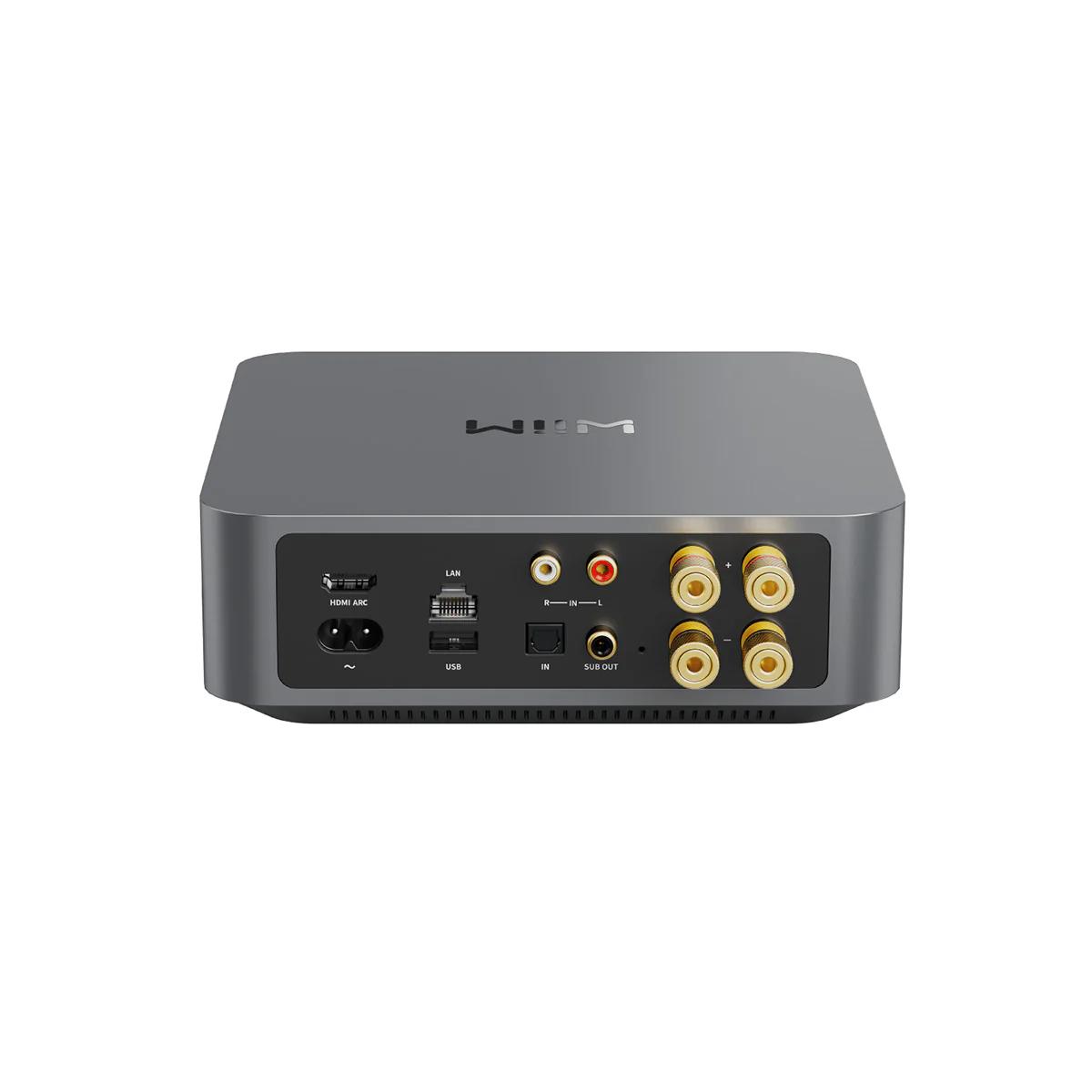
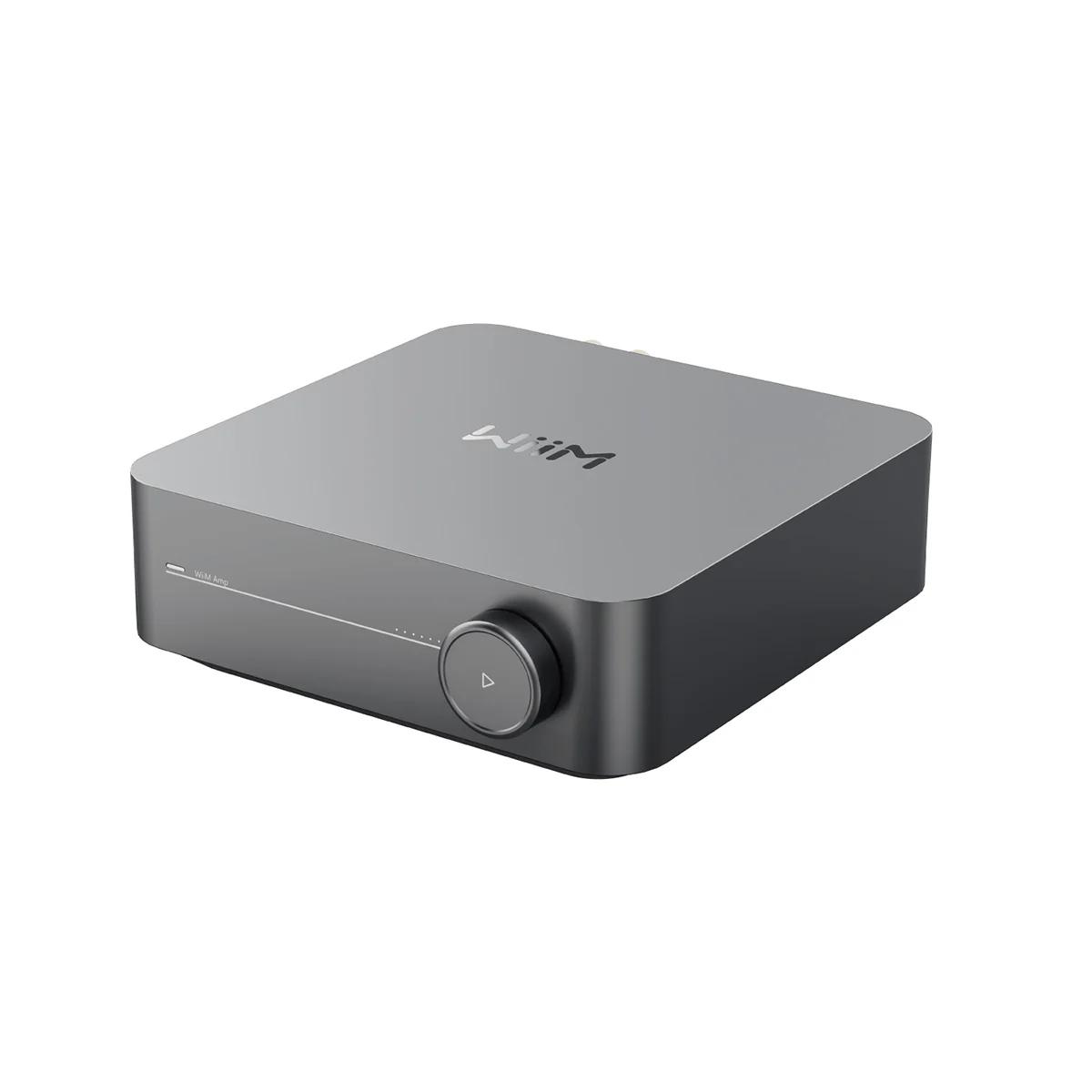
Streaming amplifiers have transformed how we think about home audio. Instead of needing separate components for streaming, digital conversion, and amplification, these all-in-one devices pack everything into a single box that can power your speakers while connecting to Spotify, Tidal, and virtually any other music source you can imagine. It's like having a complete stereo system that fits in the palm of your hands.
WiiM has been making waves in this space since they launched their first products in 2022, quickly establishing themselves as the brand that delivers high-end features at surprisingly accessible prices. Their latest offerings—the WiiM Amp Ultra and the WiiM Amp—represent two different approaches to the same core idea: great sound without the complexity or cost of traditional separate components.
At the time of writing, these products sit at different price tiers, with the WiiM Amp positioned as an affordable entry point and the WiiM Amp Ultra commanding a significant premium for its advanced features. The question isn't whether they're good—both are excellent—but which one makes sense for your specific situation.
The traditional hi-fi approach required multiple boxes: a streamer to access digital music, a DAC (digital-to-analog converter) to convert those 1s and 0s into analog audio signals, and an amplifier to boost those signals enough to drive speakers. Each component needed its own power supply, interconnect cables, and space in your entertainment center.
Streaming amplifiers collapse this entire chain into one device. They connect directly to your home network via Wi-Fi or ethernet, stream music from services like Spotify or your local music library, convert the digital audio to analog signals, and amplify those signals to drive passive speakers. The result is dramatically simplified setup with fewer cables, less space required, and often better performance than you'd get from budget separate components.
The category has exploded in popularity because it addresses real problems. Most people don't want to become audio engineers just to listen to music, and the streaming amplifier approach removes most of the complexity while delivering genuinely impressive sound quality.
The most fundamental difference between the WiiM Amp and WiiM Amp Ultra lies in their amplification sections. Both use Texas Instruments' well-regarded TPA3255 Class-D amplifier chips, but the implementation differs dramatically.
The standard WiiM Amp uses a single TPA3255 chip to deliver approximately 60 watts per channel into 8-ohm speakers, doubling to around 120 watts into 4-ohm loads. For context, 8 ohms and 4 ohms refer to speaker impedance—essentially how much electrical resistance the speaker presents to the amplifier. Lower impedance speakers are harder to drive but can produce more output when given adequate power.
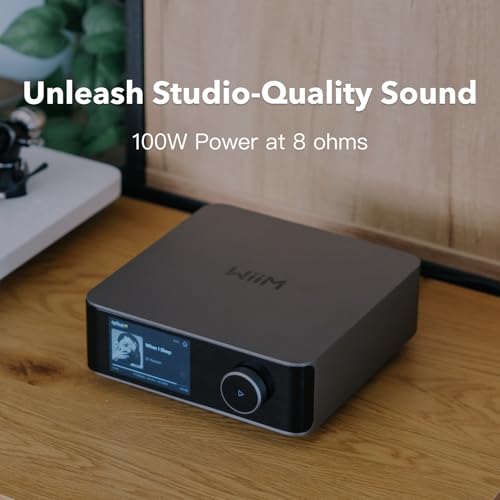
The WiiM Amp Ultra takes a different approach, using dual TPA3255 chips in a more sophisticated configuration that delivers 100 watts per channel into 8 ohms and 200 watts into 4 ohms. That's not just more power on paper—it's a meaningful difference that translates to better dynamic range, tighter bass control, and the ability to drive more demanding speakers without strain.
But raw power numbers only tell part of the story. The WiiM Amp Ultra incorporates Post-Filter Feedback (PFFB) technology, which continuously monitors what's happening at the speaker terminals and adjusts the amplifier's output to compensate for variations in speaker impedance. Real speakers don't present a constant 8-ohm or 4-ohm load—their impedance varies with frequency and volume level. PFFB helps maintain consistent performance across these variations, resulting in tighter bass, clearer midrange, and better overall control.
From our research into user experiences and professional reviews, the power difference is immediately audible with most speakers. The WiiM Amp Ultra consistently delivers better dynamics—the difference between soft and loud passages—and maintains composure at higher volume levels where the standard WiiM Amp might start to compress or distort the sound.
The digital-to-analog conversion section is where streaming amplifiers can really shine or fall flat. Both WiiM models use high-quality ESS Sabre DACs, but there's a significant generational gap between them.
The WiiM Amp features the ES9018K2M DAC, which was considered excellent when it debuted but has been superseded by newer designs. It delivers a respectable 98 dB signal-to-noise ratio (SNR) and total harmonic distortion plus noise (THD+N) of 0.0025%. In practical terms, this means very low background hiss and minimal distortion of the original audio signal.
The WiiM Amp Ultra steps up to the ES9039Q2M SABRE DAC, a much more advanced design capable of handling 32-bit/384kHz signals internally, though it outputs at 24-bit/192kHz for practical compatibility. More importantly, it achieves a 121 dB SNR and THD+N of just 0.0005%—numbers that put it in competition with dedicated DACs costing hundreds of dollars on their own.
These aren't just meaningless specifications. The improved DAC in the WiiM Amp Ultra, combined with six high-quality TI OPA1612 op-amps in the analog section, creates a noticeably cleaner, more detailed sound signature. Bass notes have better definition, vocals sound more natural, and the overall presentation has greater depth and dimensionality.
Both models support high-resolution audio up to 24-bit/192kHz, which covers virtually all available content. Whether you're streaming from Tidal's hi-res catalog or playing local FLAC files, either amplifier will handle the resolution without any downsampling or compression.
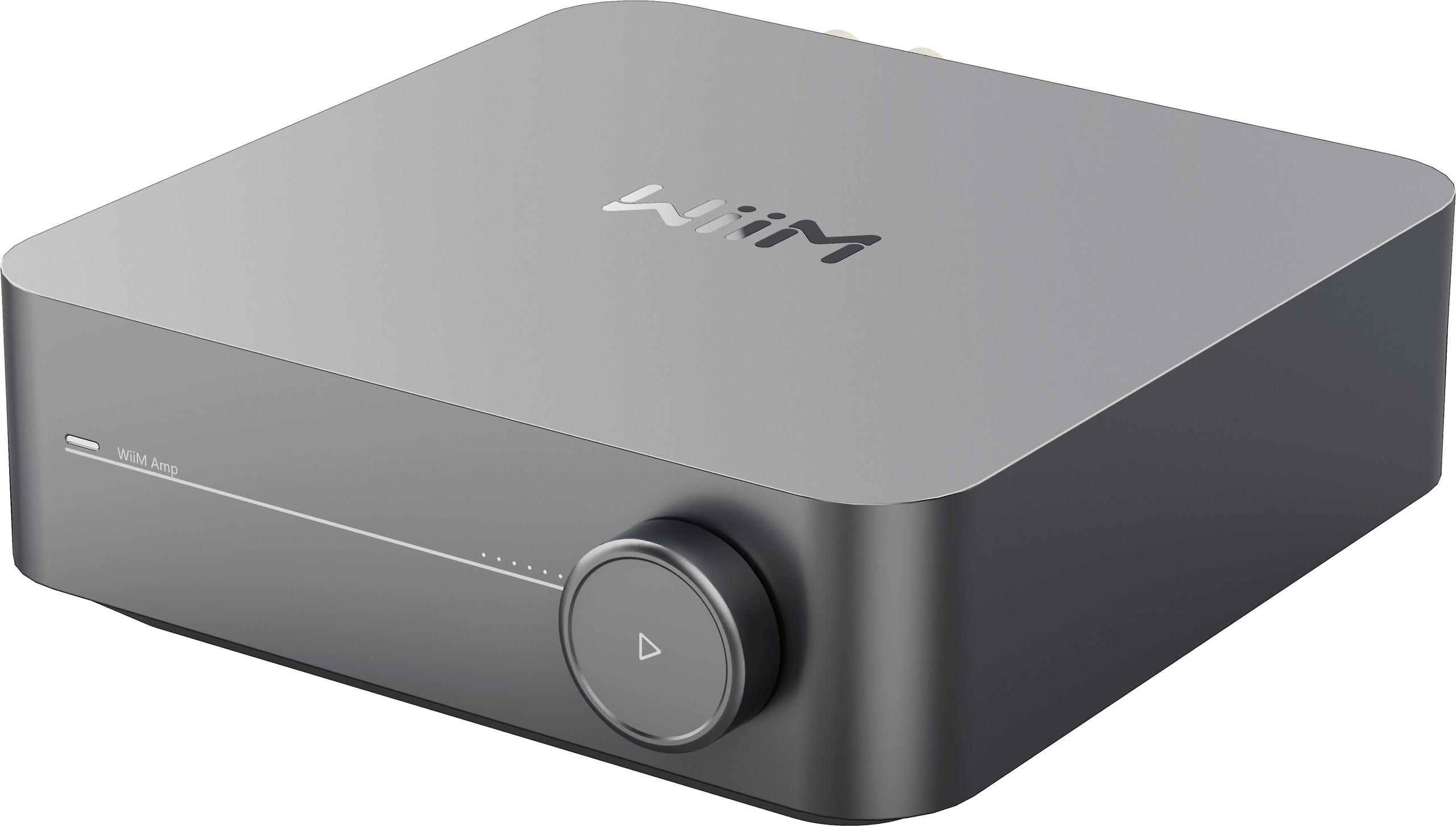
One of the most visible differences between these models is how you interact with them daily. The WiiM Amp follows a traditional approach with a physical volume knob, LED status indicators, and primary control through the WiiM Home app on your phone or tablet.
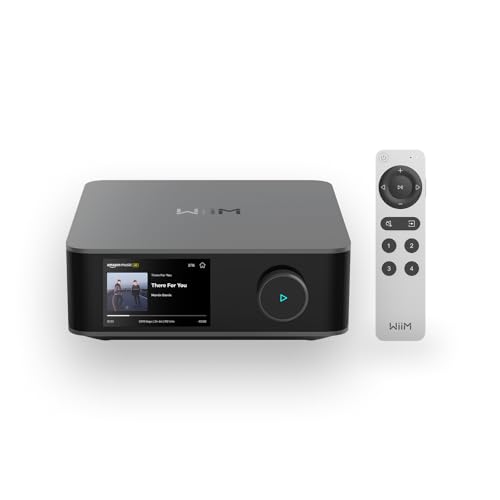
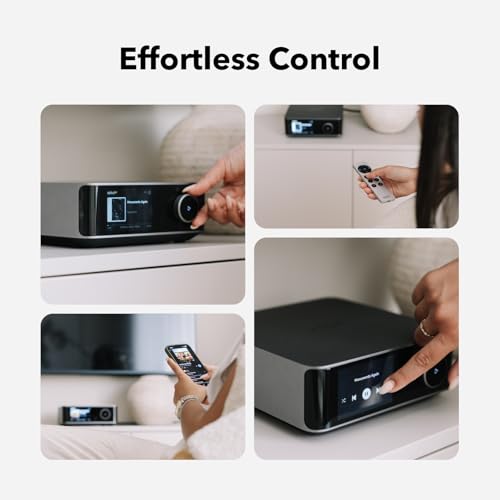
The WiiM Amp Ultra adds a 3.5-inch color touchscreen that fundamentally changes the user experience. You can see album artwork, adjust input selection, monitor playback with VU meters that show real-time audio levels, and access frequently played content without reaching for your phone. The interface isn't trying to replicate a smartphone—it's designed specifically for audio control with large, clear buttons and relevant information prominently displayed.
This might seem like a minor convenience feature, but it addresses a common frustration with app-controlled devices. When you want to quickly change the volume, skip a track, or switch inputs, having physical controls right on the device is genuinely more convenient than unlocking your phone, finding the app, and navigating to the right control.
The touchscreen also serves as a visual confirmation of what's playing. Instead of wondering whether your music service actually connected properly, you can see the album art and track information right on the amplifier. For users who value this immediate feedback, it's a significant quality-of-life improvement.
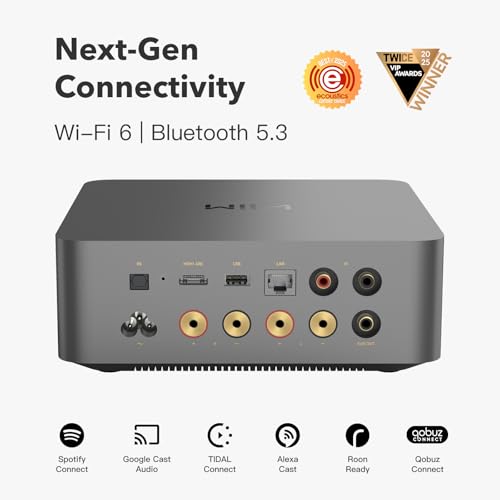
Both amplifiers support an impressive array of streaming services and protocols. Spotify Connect, Tidal Connect, Qobuz, Amazon Music, and most other major services work seamlessly with either device. They also support Google Cast, Alexa Cast, and DLNA for casting from various apps and devices.
The WiiM Amp Ultra gains Wi-Fi 6E tri-band connectivity compared to the WiiM Amp's Wi-Fi 5 dual-band, which provides better performance in congested network environments and improved range. It also upgrades to Bluetooth 5.3 with LE Audio support, enabling more efficient wireless streaming and better battery life for connected devices.
One notable limitation affects both models: neither supports AirPlay, which limits their appeal for users heavily invested in Apple's ecosystem. This means you can't easily stream from Apple Music or cast audio from iOS devices the way you would to an Apple TV or HomePod. It's a significant omission that forces iPhone users to rely on the WiiM Home app or third-party streaming services.
Both amplifiers excel at multi-room audio, allowing you to group them with other WiiM devices or compatible speakers from Google and Amazon for synchronized playback throughout your home. The setup process is straightforward, and the synchronization is reliable—something that can't be said for all multi-room solutions.
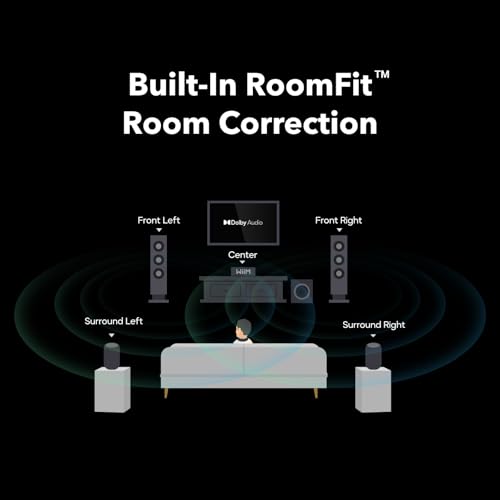
Modern streaming amplifiers often include digital signal processing (DSP) capabilities that would have required expensive separate components just a few years ago. Both WiiM models offer automatic room correction, which uses your smartphone's microphone to analyze your room's acoustics and apply corrective EQ to improve the sound.
The process involves playing test tones through your speakers while you hold your phone at your listening position. The software analyzes how your room affects the sound—which frequencies get boosted or attenuated by reflections, absorption, and room modes—and creates a custom EQ curve to compensate.
Additionally, both models provide 10-band graphic and parametric EQ controls, allowing manual sound tuning. Graphic EQ uses fixed frequency bands that you can boost or cut, while parametric EQ lets you choose specific frequencies and adjust both the boost/cut amount and the bandwidth of the adjustment. This level of control used to require dedicated outboard processors.
The WiiM Amp Ultra has more processing power available for these calculations, potentially providing more precise room correction and allowing more complex EQ curves. However, both models offer enough flexibility to address most room acoustic issues and personal preference adjustments.
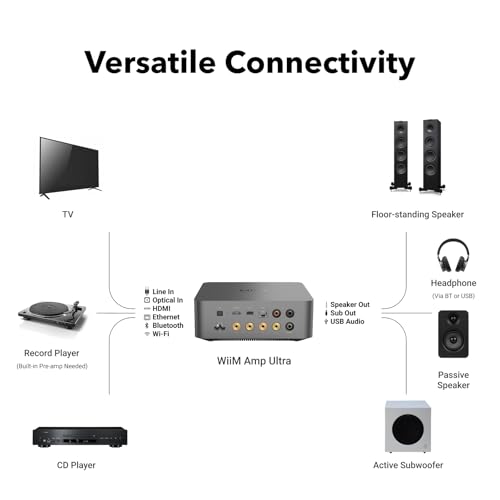
Both amplifiers include HDMI ARC (Audio Return Channel) inputs, making them suitable for simple home theater setups. You can connect the HDMI ARC output from your TV, and the amplifier will automatically switch to TV audio when you turn on the television, then switch back to music sources when you turn off the TV.
For home theater use, the WiiM Amp Ultra's extra power makes a meaningful difference. Movie soundtracks have enormous dynamic range—the difference between quiet dialogue and explosive action sequences—and having adequate power reserves prevents the amplifier from clipping during loud passages. The superior bass control also helps with the low-frequency effects that are crucial for an engaging movie experience.
Both models include dedicated subwoofer outputs with adjustable crossover frequencies, enabling 2.1 channel setups that can rival much more expensive home theater receivers for stereo and TV audio. The crossover setting determines which frequencies go to your main speakers versus the subwoofer, typically set around 80Hz for most bookshelf speakers.
The WiiM Amp Ultra's enhanced DSP capabilities include subwoofer delay compensation, which ensures that bass frequencies from the subwoofer arrive at your listening position at the same time as midrange and treble from the main speakers. This timing alignment is crucial for coherent sound but often overlooked in budget setups.
WiiM launched their first streaming products in 2022, and the rapid evolution in their product line reflects both technological advancement and manufacturing learning curves. The original WiiM Amp established their reputation for delivering high-end features at accessible prices, while the WiiM Amp Ultra, released in 2025, represents their current flagship thinking.
The standard WiiM Amp uses an aluminum chassis with practical design priorities—it's compact enough to fit on most shelves and includes the essential controls and connections without unnecessary complexity. The build quality feels solid and appropriate for its price point, though not luxurious.
The WiiM Amp Ultra steps up to what WiiM calls an "aluminum unibody" construction with more sophisticated thermal management. Class-D amplifiers are efficient but still generate heat, especially at higher power levels. The Ultra incorporates copper heat pipes and larger heat-dissipating surfaces to maintain consistent performance even during demanding use.
This thermal engineering matters more than you might expect. Amplifiers that run too hot can experience thermal compression, where the output power decreases as temperature rises. They may also engage protection circuits that reduce volume or shut down the unit entirely. Proper thermal design ensures consistent performance regardless of how hard you're pushing the system.
When evaluating streaming amplifiers, certain measurements correlate strongly with listening experience quality. Signal-to-noise ratio (SNR) indicates how much background hiss you'll hear during quiet passages—anything above 100 dB is excellent, and both WiiM models exceed this threshold comfortably.
Total harmonic distortion (THD) measures how much the amplifier changes the original audio signal. Lower numbers indicate more faithful reproduction. The WiiM Amp Ultra's 0.0005% THD is genuinely exceptional and rivals dedicated amplifiers costing significantly more.
Damping factor, which describes how well the amplifier controls speaker cone movement, affects bass tightness and overall clarity. The WiiM Amp Ultra's damping factor of 94 indicates excellent speaker control, while the standard WiiM Amp's specifications aren't as widely published but likely achieve respectable performance given the shared TPA3255 foundation.
From our analysis of user reviews and professional measurements, both amplifiers perform well beyond their price points would suggest. The WiiM Amp Ultra reaches performance levels that challenge dedicated components costing much more, while the WiiM Amp delivers surprisingly sophisticated sound for its more accessible pricing.
The WiiM Amp makes sense for several specific scenarios. If you're using efficient bookshelf speakers (sensitivity above 88 dB) in a small to medium-sized room, its 60-watt output provides plenty of clean power. It's also ideal for users who primarily control their music through smartphone apps anyway and don't see value in the touchscreen interface.
Budget-conscious buyers who want to experience high-quality streaming audio without significant investment will find the standard WiiM Amp delivers most of the performance benefits at a lower entry cost. It's also perfect for secondary systems—a bedroom setup, office system, or casual listening area where maximum fidelity isn't the primary concern.
The WiiM Amp Ultra justifies its premium for users with more demanding requirements. If your speakers are less efficient (below 88 dB sensitivity), drop below 6 ohms impedance, or if you're trying to fill a large room with sound, the extra power makes an audible difference. The superior DAC and analog sections also provide genuine improvements in resolution and soundstage depth.
Home theater applications particularly favor the WiiM Amp Ultra. Movie soundtracks stress amplifiers with sudden dynamic peaks, and the extra headroom prevents the compression and distortion that can occur when an amplifier runs out of power. The enhanced bass control also improves the integration with subwoofers, creating a more cohesive surround experience.
Users who value convenience and immediate visual feedback will appreciate the touchscreen interface more than they might initially expect. Being able to see what's playing, adjust settings, and control playback without reaching for a phone becomes surprisingly habitual once you experience it.
Both the WiiM Amp and WiiM Amp Ultra represent exceptional value in the streaming amplifier category, but they serve different user priorities. The standard WiiM Amp delivers the core benefits of streaming amplification—simplified setup, broad service compatibility, and genuinely good sound quality—at an accessible price point that makes it easy to recommend for most users.
The WiiM Amp Ultra commands its premium through meaningful improvements in power delivery, digital audio processing, and user experience. It's not just a luxury version of the same product—it's a fundamentally more capable amplifier that can drive more demanding speakers and deliver higher fidelity audio.
Your decision should be driven primarily by your speakers and listening requirements. Match the amplifier's capabilities to your system's needs, and either choice will provide years of satisfying musical enjoyment. Both represent the current state-of-the-art in affordable streaming amplification, bringing high-end features and performance to price points that would have been impossible just a few years ago.
The streaming amplifier category continues evolving rapidly, but WiiM has established themselves as the brand pushing performance boundaries while maintaining reasonable pricing. Whether you choose the WiiM Amp or WiiM Amp Ultra, you're getting a glimpse of where home audio is heading—and it sounds pretty great.
| WiiM Amp Ultra | WiiM Amp |
|---|---|
| Power Output - Critical for driving demanding speakers and filling larger rooms | |
| 100W @ 8Ω, 200W @ 4Ω (dual TPA3255 chips) | 60W @ 8Ω, 120W @ 4Ω (single TPA3255 chip) |
| DAC Quality - Determines digital audio clarity and resolution | |
| ESS ES9039Q2M SABRE (121dB SNR, 0.0005% THD) | ESS ES9018K2M (98dB SNR, 0.0025% THD) |
| User Interface - How you control daily music listening | |
| 3.5" color touchscreen with album art and VU meters | Volume knob with LED indicators, app control only |
| Amplifier Technology - Affects sound quality and speaker compatibility | |
| Post-Filter Feedback (PFFB) for dynamic load compensation | Standard Class-D amplification |
| Wireless Connectivity - Future-proofing and network performance | |
| Wi-Fi 6E tri-band, Bluetooth 5.3 with LE Audio | Wi-Fi 5 dual-band, Bluetooth 5.0 |
| Audio Processing - Sound customization capabilities | |
| Enhanced DSP with subwoofer delay compensation | 10-band EQ and room correction |
| Build Quality - Durability and thermal management | |
| Aluminum unibody with copper heat pipes | Aluminum chassis with standard cooling |
| Speaker Compatibility - Which speakers work best | |
| Drives inefficient speakers (down to 2Ω stable) | Best with efficient bookshelf speakers (8Ω+) |
| Home Theater Integration - TV and subwoofer setup | |
| HDMI ARC with enhanced dynamics for movies | HDMI ARC with adequate power for casual viewing |
| Value Positioning - Who should consider each model | |
| Premium features justify higher cost for serious listeners | Excellent entry point for most users' needs |
The primary difference is power output and features. The WiiM Amp Ultra delivers 100 watts per channel compared to the WiiM Amp's 60 watts, plus adds a color touchscreen interface, advanced DAC technology, and enhanced room correction capabilities.
The WiiM Amp Ultra is significantly better for home theater applications due to its higher power output, superior dynamic range for movie soundtracks, and enhanced subwoofer integration with delay compensation. The extra power prevents distortion during loud action scenes.
You need the WiiM Amp Ultra's extra power if you have inefficient speakers (below 88dB sensitivity), low-impedance speakers (4 ohms or less), large rooms, or listen at high volumes. For efficient bookshelf speakers in small rooms, the WiiM Amp provides adequate power.
Both the WiiM Amp Ultra and WiiM Amp support Spotify Connect, TIDAL Connect, Qobuz, Amazon Music, Google Cast, and Alexa Cast. Neither supports AirPlay, which limits compatibility with Apple devices and Apple Music.
The touchscreen on the WiiM Amp Ultra provides convenient control without needing your phone, displays album artwork, and shows real-time audio levels. It's particularly valuable for users who frequently adjust settings or prefer immediate visual feedback over app-only control.
The WiiM Amp Ultra offers superior sound quality with its advanced ESS ES9039Q2M DAC, Post-Filter Feedback technology, and six high-quality op-amps. Users report noticeably better dynamics, instrument separation, and overall clarity compared to the standard WiiM Amp.
Yes, both the WiiM Amp Ultra and WiiM Amp include HDMI ARC inputs for direct TV connection. They automatically switch to TV audio when you turn on your television and support Dolby Digital decoding for enhanced movie audio.
The WiiM Amp works well with efficient bookshelf speakers and smaller floor-standing models in moderate-sized rooms. The WiiM Amp Ultra can drive demanding speakers, low-impedance loads, and larger speakers that require more power for optimal performance.
Both the WiiM Amp Ultra and WiiM Amp include dedicated subwoofer outputs with adjustable crossover settings. The Ultra model adds subwoofer delay compensation for better integration and more precise bass management in 2.1 channel setups.
The WiiM Amp is more beginner-friendly due to its simpler operation, lower cost, and adequate performance for most casual listening scenarios. It provides an excellent introduction to streaming amplifiers without overwhelming features or complexity.
Both the WiiM Amp Ultra and WiiM Amp support multi-room audio and can be grouped with other WiiM devices, Google Nest speakers, or Amazon Echo devices for synchronized playback throughout your home using the WiiM Home app.
The WiiM Amp Ultra justifies its premium if you need the extra power, want the touchscreen convenience, have demanding speakers, or prioritize maximum sound quality. For casual listening with efficient speakers, the standard WiiM Amp delivers excellent value and performance.
We've done our best to create useful and informative comparisons to help you decide what product to buy. Our research uses advanced automated methods to create this comparison and perfection is not possible - please contact us for corrections or questions. These are the sites we've researched in the creation of this article: ecoustics.com - audacityaustralia.com.au - forum.wiimhome.com - erinsaudiocorner.com - forum.wiimhome.com - stevehuffphoto.com - darko.audio - bryanruby.com - youtube.com - audiosciencereview.com - ecoustics.com - smarthomesounds.co.uk - socpub.com - audio-2g.com - hifihut.ie - audiosciencereview.com - faq.wiimhome.com - av-export.com - sound-advice.online - av.com - whathifi.com - youtube.com - forum.wiimhome.com - audacityaustralia.com.au - stereophile.com - audiosciencereview.com - audioadvice.com - smarthomesounds.co.uk

Privacy Policy
Terms and Conditions - Affiliate Policy
Home Security
© Copyright 2008-2026.
11816 Inwood Rd #1211, Dallas, TX 75244