

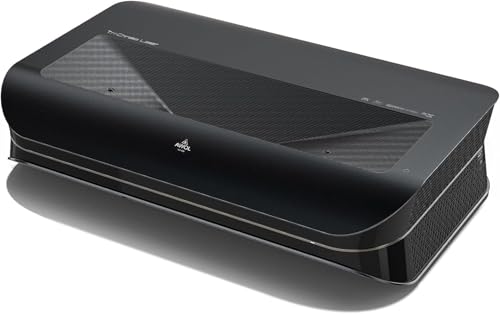
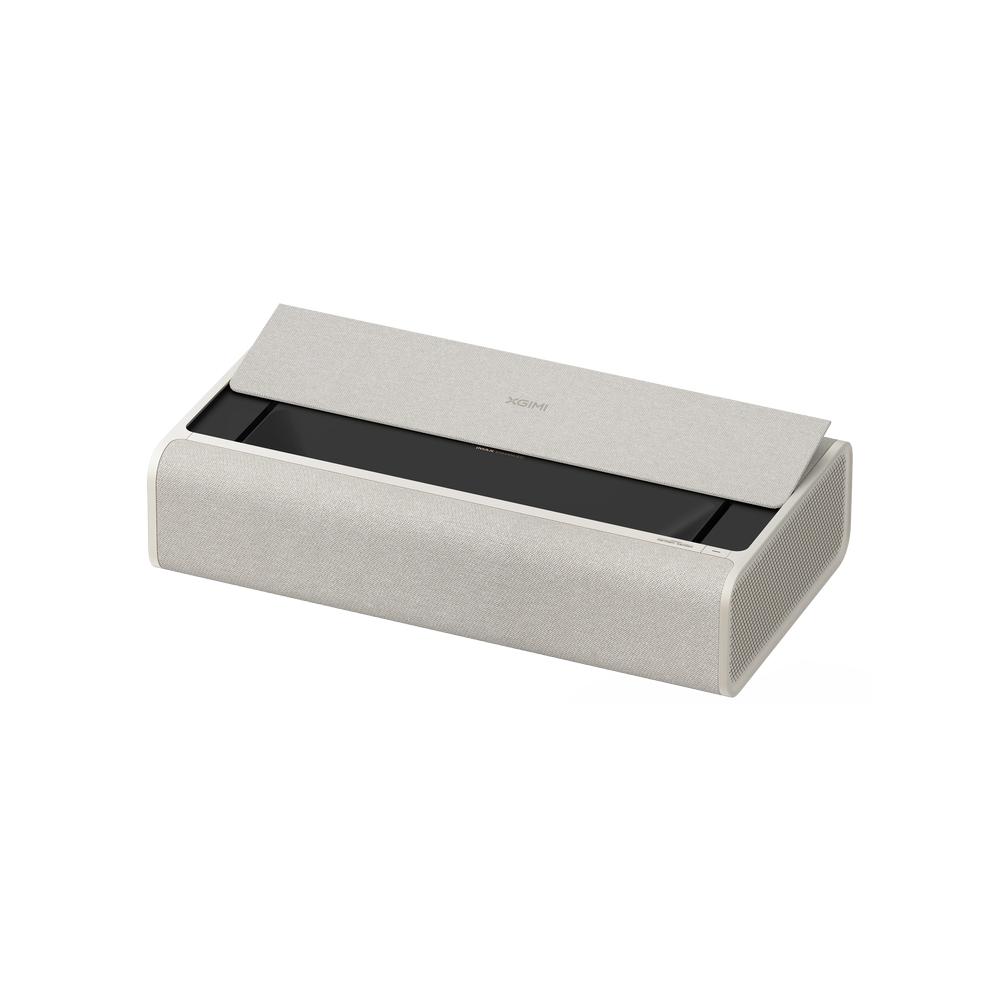
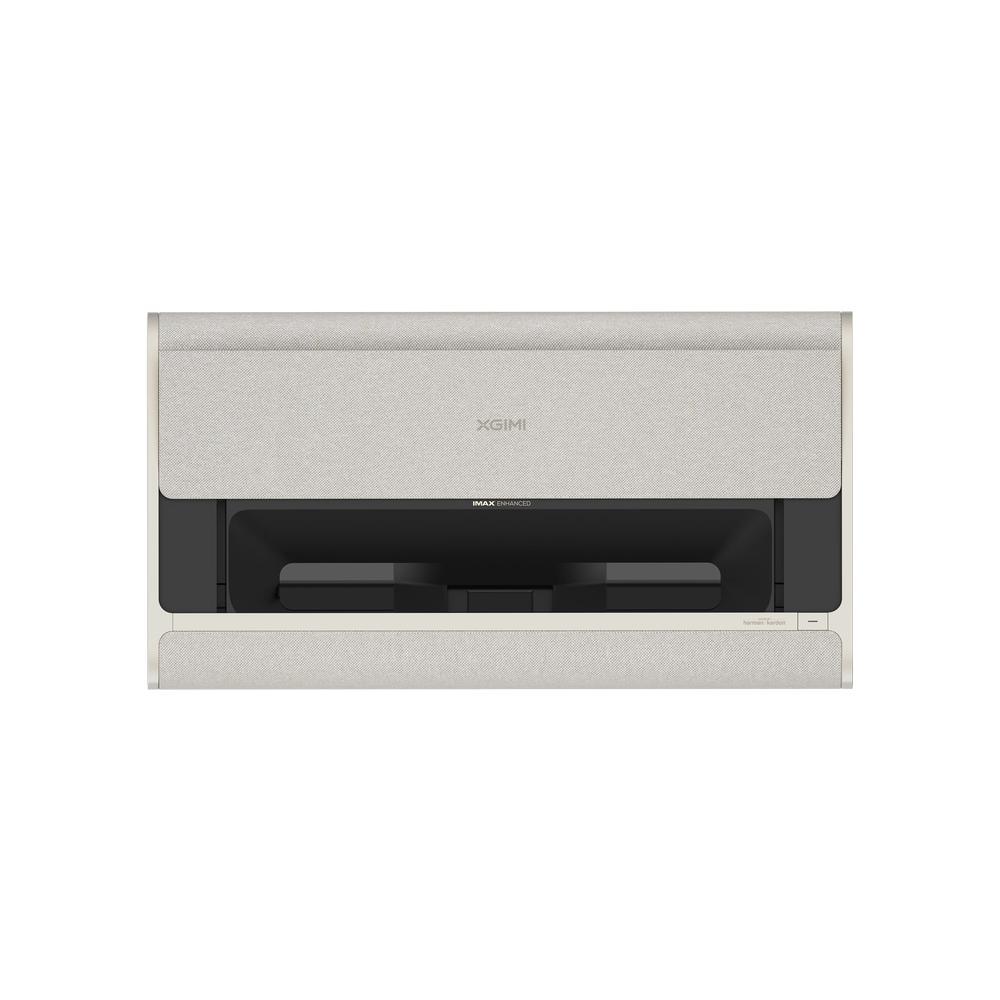
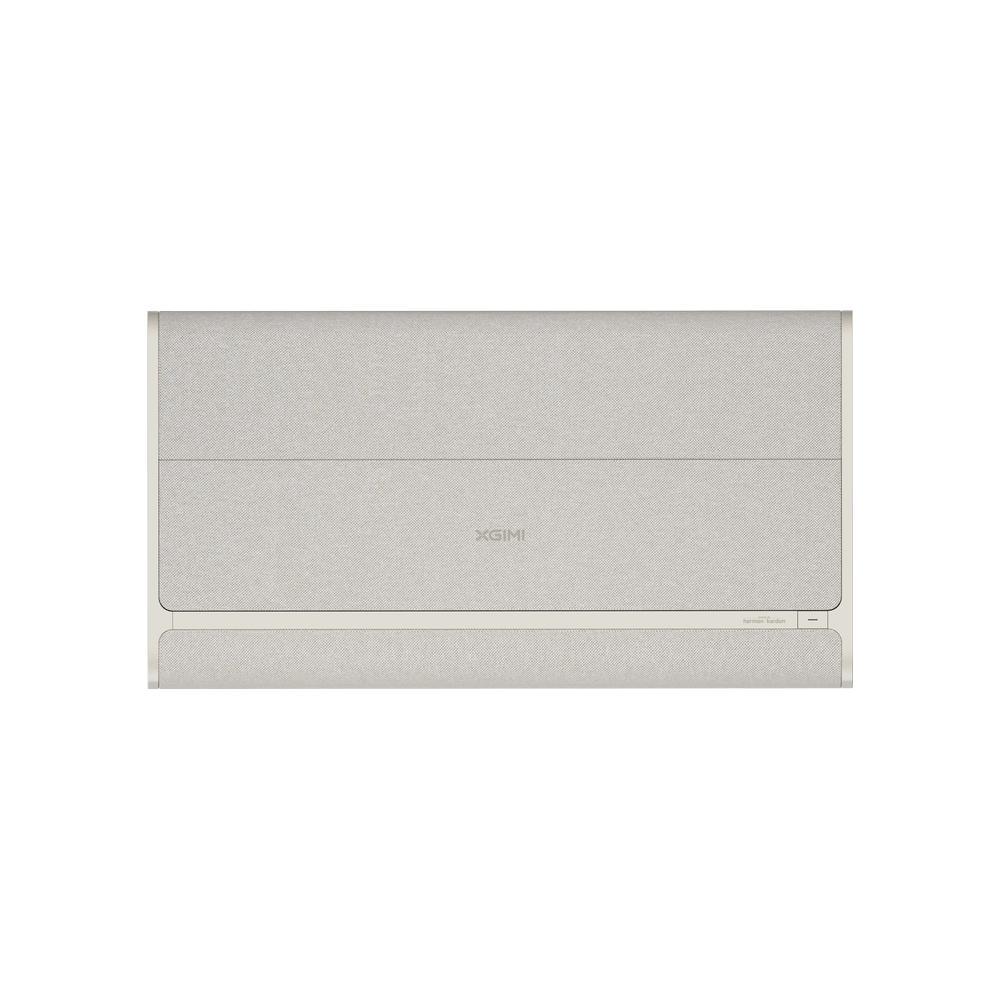
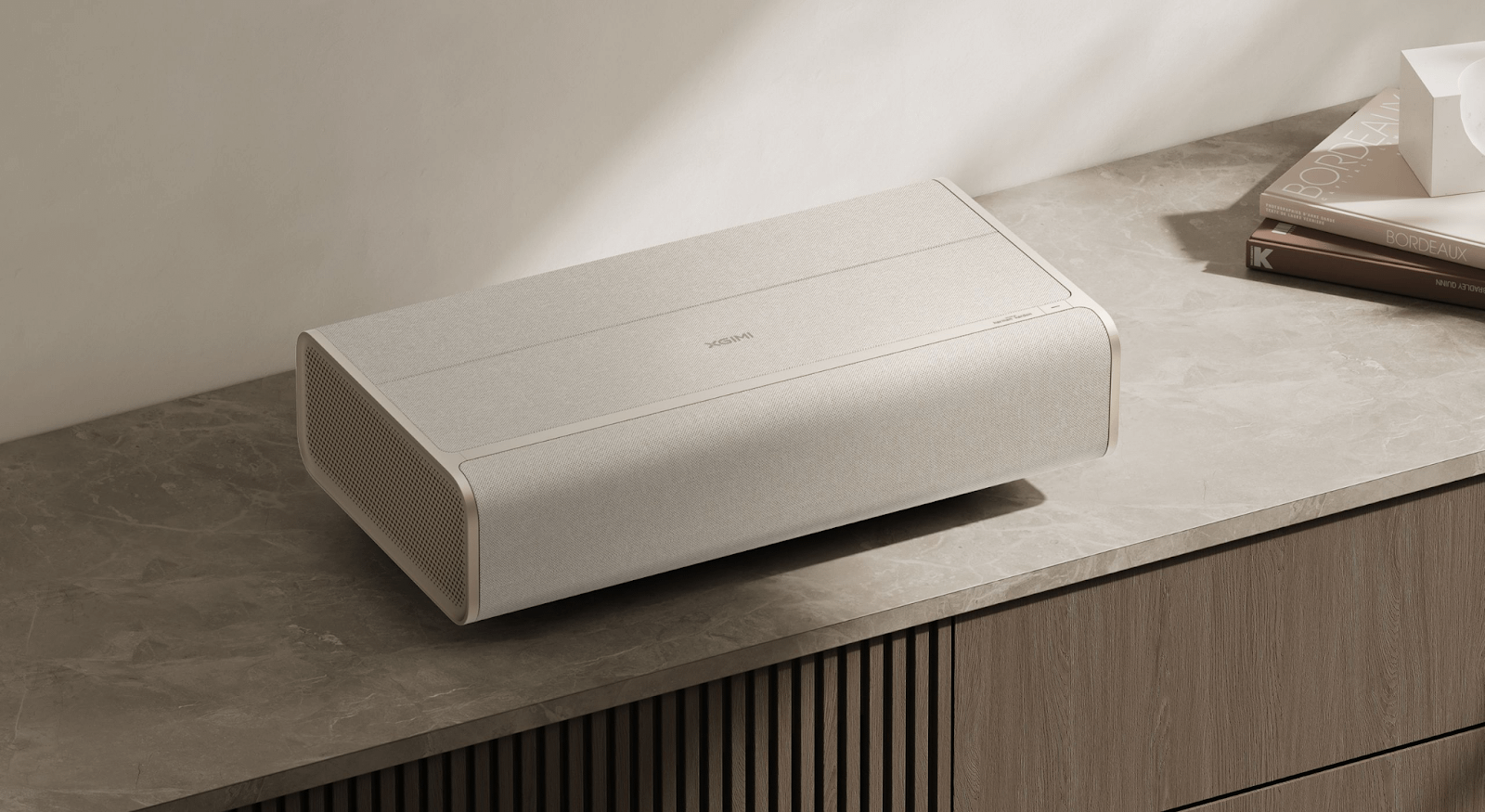
Ultra short throw projectors have completely changed how we think about home theater. Instead of mounting a projector on your ceiling or placing it across the room, these innovative devices sit just inches from your wall and create massive 100-150 inch images that rival the biggest TVs money can buy. It's like having a movie theater in your living room, but without the installation nightmare.
Two standout models have captured serious attention from home theater enthusiasts: the AWOL Vision LTV-3000 Pro and the XGIMI Aura 2. Both launched within the past few years—the AWOL Vision in 2023 and the XGIMI Aura 2 in 2024—representing the cutting edge of this rapidly evolving technology. At the time of writing, these projectors sit in the premium price range, with the XGIMI Aura 2 offering better value while the AWOL Vision commands a premium for specialized features.
Before diving into the comparison, it's crucial to understand what makes ultra short throw projectors special. Traditional projectors use a throw ratio (the distance from projector to screen divided by screen width) of around 1.5:1 to 2:1, meaning you need significant room depth. Ultra short throw projectors achieve ratios of 0.25:1 or less, allowing massive images from minimal distances.
This technology relies on complex optical systems and specialized mirrors that redirect light at extreme angles. The result? You can place these projectors on a TV stand or mount them just inches from your wall, eliminating shadows when people walk by and making installation dramatically simpler.
The key considerations when choosing between models include light source technology (how the projector creates light and color), brightness performance (measured in lumens), color accuracy, smart features, audio quality, and gaming capabilities. Each of these factors significantly impacts your viewing experience and determines which projector suits your specific needs.
The most fundamental difference between the AWOL Vision LTV-3000 Pro and XGIMI Aura 2 lies in their light source technology—essentially how they create the light that becomes your image.
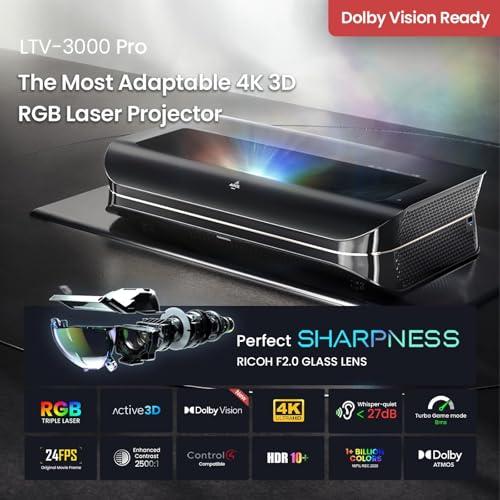
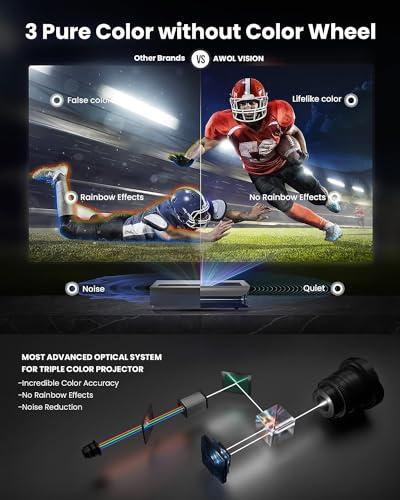
The AWOL Vision uses pure Triple RGB Laser technology. This means it has separate red, green, and blue lasers that combine to create every color you see on screen. Think of it like having three incredibly precise flashlights, each producing a single pure color. This approach eliminates the traditional color wheel (a spinning disc with colored segments) found in many projectors, resulting in more accurate colors and longer lifespan.
The RGB laser system in the AWOL Vision delivers 2,000 ISO lumens with peak brightness reaching 3,000 lumens. ISO lumens represent the industry-standard measurement for projector brightness, providing consistent comparison across brands. The higher peak brightness means the projector can temporarily boost output for HDR content (High Dynamic Range—content with enhanced contrast and color range).
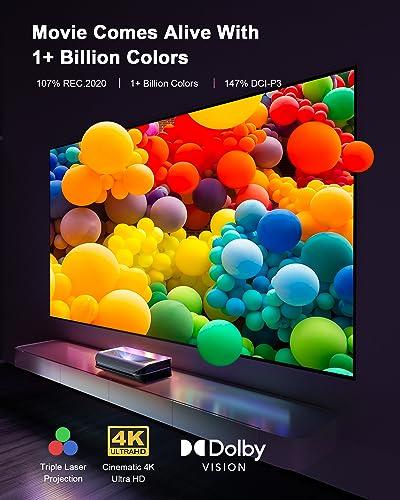
What makes this approach special is the color accuracy. The AWOL Vision covers 107% of the Rec.2020 color space, which is the ultra-wide color standard used for the most premium content. This means it can display colors more vivid and accurate than what most displays can achieve. The laser light source is also rated for 25,000 hours of use—roughly 10-15 years of typical viewing.
The XGIMI Aura 2 takes a completely different approach with its innovative Dual Light 2.0 technology. Instead of pure lasers, it combines an RGB LED system with a red laser in what XGIMI calls a "Wide Spectrum + Narrow Spectrum" configuration. This hybrid approach addresses common laser projector issues like speckle (a grainy texture some people notice with laser light) and color fringe (slight color separation at image edges).
This hybrid system produces 2,300 ISO lumens—about 15% brighter than the AWOL Vision. For most viewing scenarios, this brightness advantage is noticeable and meaningful. The XGIMI Aura 2 covers 99% of the DCI-P3 color space, which is the cinema standard used by most streaming services and Blu-ray content. While not as wide as the AWOL's color gamut, it's more than sufficient for virtually all content you'll watch.
The trade-off is lifespan—the XGIMI's hybrid light source is rated for 20,000 hours, still excellent but 5,000 hours less than the pure laser approach.
Brightness is perhaps the most critical factor for ultra short throw projectors because they're typically used in living rooms with ambient light, unlike traditional home theaters in dark basements.
Our research into user experiences and expert reviews reveals that the XGIMI Aura 2's 2,300 lumens provide a meaningful advantage for daytime viewing. Multiple reviews note that while both projectors handle moderate ambient light well, the XGIMI maintains better image quality when sunlight filters through windows or room lights are on.
However, brightness isn't just about raw lumens. The AWOL Vision LTV-3000 Pro uses its pure laser technology to maintain brightness consistency over time. Laser light sources don't degrade like traditional lamps, meaning the projector will produce the same brightness after years of use. The hybrid LED components in the XGIMI may experience some brightness reduction over time, though this occurs gradually over many years.
For serious home theater use in controlled lighting, both projectors provide sufficient brightness. But if you plan to watch during daytime or in rooms where you can't control ambient light, the XGIMI Aura 2's brightness advantage becomes significant.
This is where the philosophical differences between these projectors become most apparent. The AWOL Vision processes color at 10-bit depth, meaning it can display over one billion different colors with smooth gradations between them. Combined with its wide Rec.2020 color gamut, this creates incredibly accurate and vibrant images—when properly calibrated.
Here's the catch: expert reviews consistently note that the AWOL Vision requires professional calibration to achieve its potential. Out of the box, color accuracy can be disappointing, and the calibration process is reportedly complex, sometimes requiring multiple factory resets. For home theater purists willing to invest in professional setup, the results are exceptional. For casual users, this represents a significant barrier.
The XGIMI Aura 2 processes color at 8-bit depth (about 16.7 million colors) but compensates with better out-of-box calibration and its impressive 1,000,000:1 dynamic contrast ratio. Dynamic contrast means the projector can adjust brightness between scenes to enhance the difference between dark and bright content. While not as technically sophisticated as the AWOL's static contrast, it produces more dramatic visual impact in mixed content.
User reviews consistently praise the XGIMI's immediate visual appeal and ease of setup. The projector's Advanced Screen Adaptation 5.0 automatically adjusts for wall color and surface imperfections, making it much more user-friendly.
Both projectors support HDR content, but the AWOL Vision includes Dolby Vision support—a premium HDR format that provides scene-by-scene optimization. The XGIMI supports HDR10 and HLG, with Dolby Vision promised via future software updates.
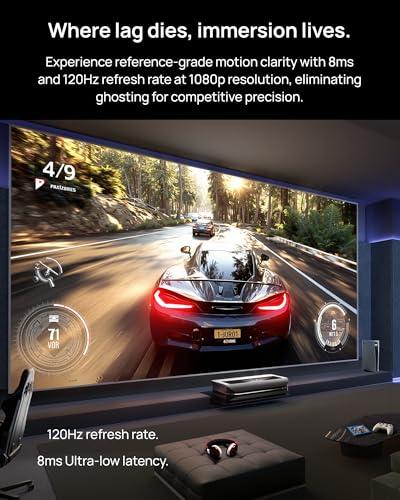
For gaming enthusiasts, the AWOL Vision LTV-3000 Pro offers clear advantages. Input lag—the delay between your controller input and screen response—measures just 15 milliseconds at 4K/60Hz and an impressive 8 milliseconds at 1080p/120Hz. These numbers rival dedicated gaming monitors and make the projector suitable for competitive gaming.
The AWOL also includes MEMC (Motion Estimation, Motion Compensation) technology, which interpolates frames to create smoother motion in games and sports content. While some purists prefer this disabled for movies, it can enhance the gaming experience.
Gaming specifications for the XGIMI Aura 2 weren't detailed in our research, suggesting it's not optimized for competitive gaming. For casual gaming, either projector will work fine, but serious gamers should strongly consider the AWOL Vision.
This category strongly favors the XGIMI Aura 2. Its 60-watt Harman Kardon speaker system uses four 15-watt drivers in a configuration designed to fill rooms with immersive sound. The built-in Dolby Atmos processing creates height effects that simulate overhead audio, while DTS Audio support ensures compatibility with various content formats.
Multiple reviews describe the XGIMI's audio as powerful enough to eliminate the need for external speakers in many setups. This is significant because it reduces system complexity and cost.
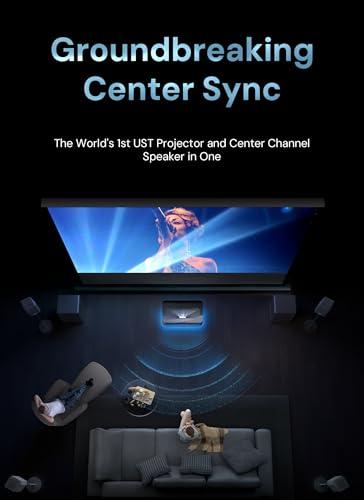
The AWOL Vision includes a more modest 36-watt stereo system (two 18-watt speakers) with Dolby Atmos passthrough capabilities. While adequate for casual viewing, it lacks the power and sophistication of the XGIMI system. However, the AWOL's eARC HDMI port allows easy connection to external audio systems for users building dedicated home theaters.
The XGIMI Aura 2 excels in user convenience. Its 0.18:1 throw ratio means it can be placed even closer to the wall than the AWOL's 0.25:1 ratio—important in tight spaces. The auto-focus system and wall color adaptation technology make setup nearly automatic.
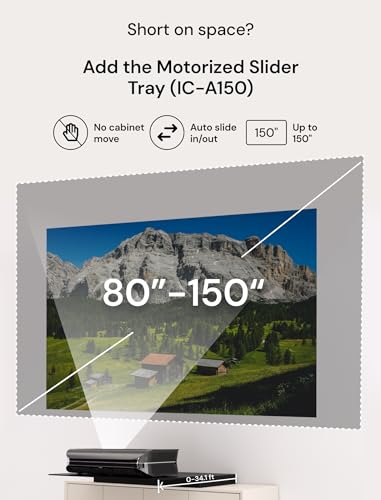
However, the AWOL Vision offers more installation flexibility with its wider screen size range (80-150 inches vs the XGIMI's 90-150 inches) and more precise manual adjustments. For custom installation scenarios or users who want maximum control, the AWOL provides more options.
Smart features reveal another philosophical difference. The AWOL Vision includes an Amazon Fire TV Stick 4K Max, creating a dual-interface system. While this provides access to all streaming services and regular software updates, it means navigating two different menu systems.
The XGIMI Aura 2 integrates Google TV directly, providing seamless access to streaming services including native Netflix support. This creates a cleaner, more intuitive user experience but relies on the manufacturer for software updates.
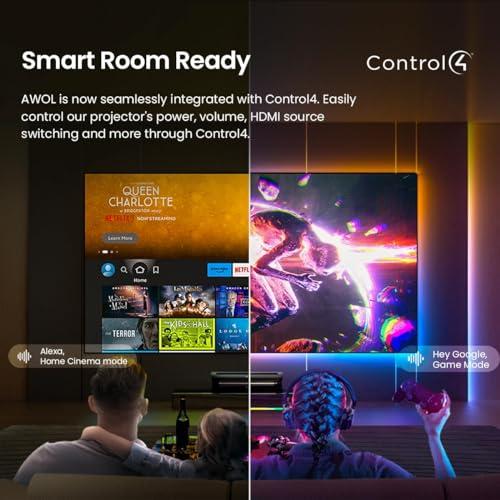
For smart home integration, the AWOL Vision supports professional control systems like Control4, Crestron, and Savant. This makes it attractive for custom installation scenarios but is overkill for most users.
At the time of writing, the XGIMI Aura 2 offers better value for most users. It costs less initially while providing higher brightness, superior audio, and easier setup. The user experience strongly favors the XGIMI, making it more suitable for buyers who want impressive results without complexity.
The AWOL Vision LTV-3000 Pro justifies its premium pricing for specific use cases. The longer 25,000-hour laser life means lower long-term costs for heavy users, and the superior gaming performance appeals to enthusiasts. However, the challenging setup process and need for professional calibration add hidden costs.
Choose the AWOL Vision LTV-3000 Pro if you're a serious gamer who needs low input lag, a color purist willing to invest in professional calibration, or building a custom home theater with smart home integration. The pure laser technology and wider color gamut provide technical advantages that matter for critical viewing.
Choose the XGIMI Aura 2 if you want the brightest image for versatile viewing conditions, prefer simple setup and operation, or value superior built-in audio. The hybrid light technology and user-friendly features make it ideal for living room installations where convenience matters more than ultimate technical specifications.
For most buyers, the XGIMI Aura 2 provides the better overall experience. It's brighter, easier to use, sounds better, and costs less. The AWOL Vision serves specialized needs exceptionally well but requires more investment and expertise to reach its potential.
Both projectors represent excellent examples of how ultra short throw technology has matured, offering genuine alternatives to large TVs. Your choice should align with your specific priorities: maximum convenience and brightness, or ultimate performance potential with corresponding complexity.
| AWOL Vision LTV-3000 Pro | XGIMI Aura 2 |
|---|---|
| Light Source Technology - Determines color accuracy, brightness consistency, and lifespan | |
| Pure Triple RGB Laser (no color wheel, 25,000 hour life) | Hybrid Dual Light 2.0 (laser + LED, 20,000 hour life) |
| Brightness Performance - Critical for daytime viewing and ambient light conditions | |
| 2,000 ISO lumens (3,000 peak for HDR) | 2,300 ISO lumens (15% brighter for better daytime performance) |
| Color Processing & Gamut - Affects color accuracy and vibrance | |
| 10-bit processing, 107% Rec.2020 coverage (wider than most content) | 8-bit processing, 99% DCI-P3 coverage (matches cinema standard) |
| HDR Support - Enhanced contrast and color range for premium content | |
| Dolby Vision, HDR10+, HLG (most comprehensive support) | HDR10, HLG (Dolby Vision coming via future update) |
| Gaming Performance - Input lag determines competitive gaming suitability | |
| 15ms at 4K/60Hz, 8ms at 1080p/120Hz (excellent for gaming) | Gaming specs not specified (likely higher lag) |
| Throw Ratio & Placement - How close to wall and minimum room size needed | |
| 0.25:1 ratio, 1.5'-2.7' from wall, 80"-150" screens | 0.18:1 ratio, 1.2'-1.9' from wall, 90"-150" screens (better for tight spaces) |
| Audio System - Built-in sound quality and power | |
| 36W stereo (18W x 2) with Dolby Atmos passthrough | 60W Harman Kardon quad-speaker with built-in Dolby Atmos processing |
| Smart Features - Streaming and user interface | |
| Android 9.0 + included Fire TV Stick 4K Max (dual interfaces) | Built-in Google TV with native Netflix (single, cleaner interface) |
| Connectivity & Ports - Expansion options and device connections | |
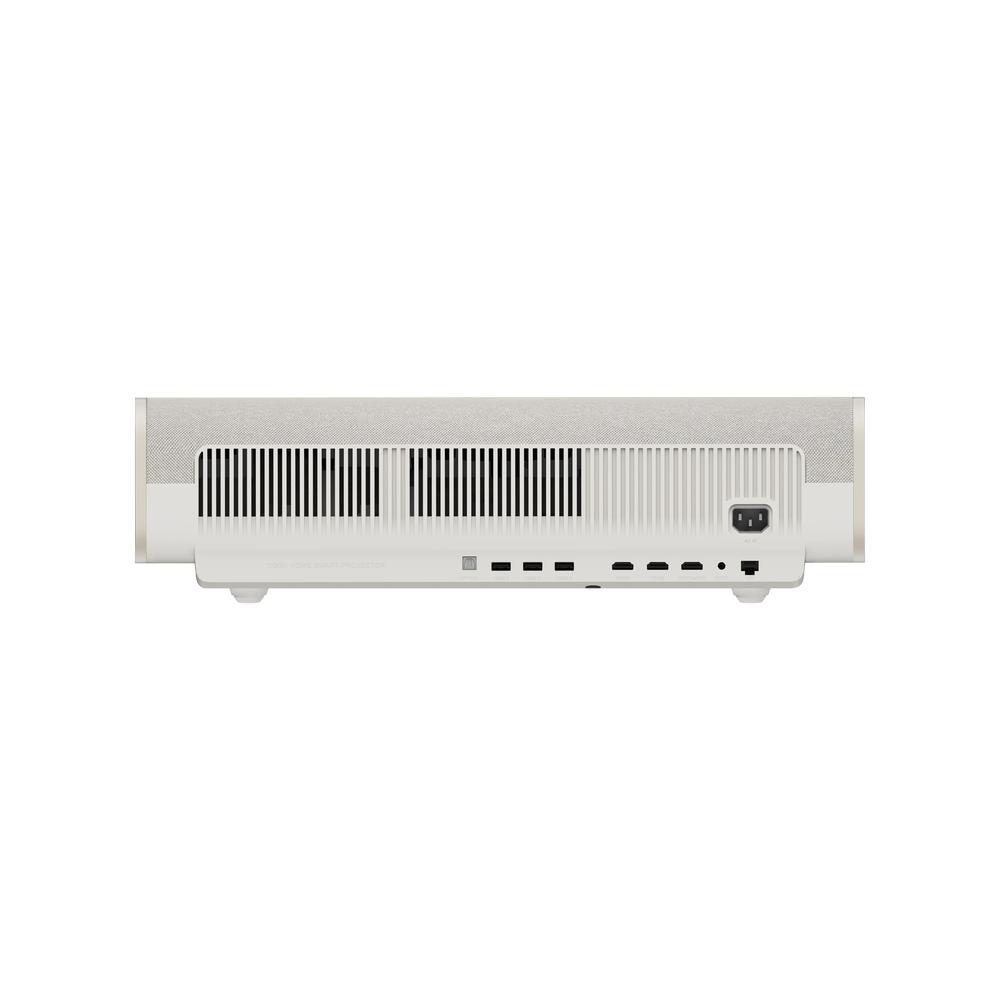
| 3x HDMI (one with eARC), 2x USB, extensive smart home integration | 2x HDMI, basic connectivity (sufficient for most users) |
| Setup Complexity - Installation and calibration requirements | |
| Manual calibration required for best results (professional recommended) | Auto-calibration with wall color adaptation (plug-and-play friendly) |
| Best For - Target user and use cases | |
| Gamers, color purists, custom installations, smart home integration | Living rooms, ease of use priority, daytime viewing, better value |
The XGIMI Aura 2 is brighter with 2,300 ISO lumens compared to the AWOL Vision LTV-3000 Pro's 2,000 ISO lumens. This 15% brightness advantage makes the XGIMI Aura 2 better for rooms with ambient light or daytime viewing without blackout curtains.
The AWOL Vision LTV-3000 Pro is significantly better for gaming with 15ms input lag at 4K/60Hz and just 8ms at 1080p/120Hz. The XGIMI Aura 2 doesn't specify gaming performance metrics, making the AWOL Vision the clear choice for competitive gaming.
The XGIMI Aura 2 can be placed closer with its 0.18:1 throw ratio compared to the AWOL Vision LTV-3000 Pro's 0.25:1 ratio. This means the XGIMI needs less space between the projector and wall, making it better for tight room layouts.
The XGIMI Aura 2 has superior audio with a 60W Harman Kardon quad-speaker system supporting built-in Dolby Atmos processing. The AWOL Vision LTV-3000 Pro has a more basic 36W stereo system, making the XGIMI better for users who rely on built-in audio.
The XGIMI Aura 2 is much easier to set up with automatic calibration, wall color adaptation, and plug-and-play operation. The AWOL Vision LTV-3000 Pro requires manual calibration and often professional setup for optimal color accuracy, making the XGIMI more user-friendly.
The AWOL Vision LTV-3000 Pro has superior color accuracy when properly calibrated, with 10-bit processing and 107% Rec.2020 color coverage. However, the XGIMI Aura 2 offers better out-of-box color accuracy with 99% DCI-P3 coverage, making it more practical for most users.
The AWOL Vision LTV-3000 Pro currently supports more HDR formats including Dolby Vision, HDR10+, and HLG. The XGIMI Aura 2 supports HDR10 and HLG, with Dolby Vision promised in a future software update, giving the AWOL Vision a current advantage.
The XGIMI Aura 2 offers better value with higher brightness, superior audio, easier setup, and typically lower pricing than the AWOL Vision LTV-3000 Pro. The XGIMI provides more features that benefit everyday use at a more accessible price point.
The XGIMI Aura 2 has better integrated smart features with built-in Google TV and native Netflix support. The AWOL Vision LTV-3000 Pro includes a Fire TV Stick but requires navigating two separate interfaces, making the XGIMI more streamlined for streaming.
The AWOL Vision LTV-3000 Pro has a longer-lasting pure laser light source rated for 25,000 hours compared to the XGIMI Aura 2's 20,000-hour hybrid laser/LED system. The AWOL Vision offers 5,000 more hours of use, potentially lasting 2-3 years longer with typical viewing.
For dedicated home theaters with controlled lighting, the AWOL Vision LTV-3000 Pro excels with superior color accuracy, Dolby Vision support, and precise calibration options. For living room home theaters, the XGIMI Aura 2 is better with higher brightness, superior audio, and easier setup.
Choose the XGIMI Aura 2 for better brightness, audio, ease of use, and value - ideal for most living room setups. Choose the AWOL Vision LTV-3000 Pro if you prioritize gaming performance, maximum color accuracy with professional calibration, or need advanced smart home integration features.
We've done our best to create useful and informative comparisons to help you decide what product to buy. Our research uses advanced automated methods to create this comparison and perfection is not possible - please contact us for corrections or questions. These are the sites we've researched in the creation of this article: bestbuy.com - projectorcentral.com - rtings.com - techaeris.com - hometechnologyreview.com - awolvision.de - androidcentral.com - awolvision.com - projectorreviews.com - dreamediaav.com - bestbuy.com - youtube.com - youtube.com - awolvisionpro.com - awolvision.com - awolvision.com - us.xgimi.com - us.xgimi.com - projectorscreen.com - projectorreviews.com - techradar.com - projectorcentral.com - avsforum.com - us.xgimi.com - us.xgimi.com - hometechnologyreview.com

Privacy Policy
Terms and Conditions - Affiliate Policy
Home Security
© Copyright 2008-2026.
11816 Inwood Rd #1211, Dallas, TX 75244