

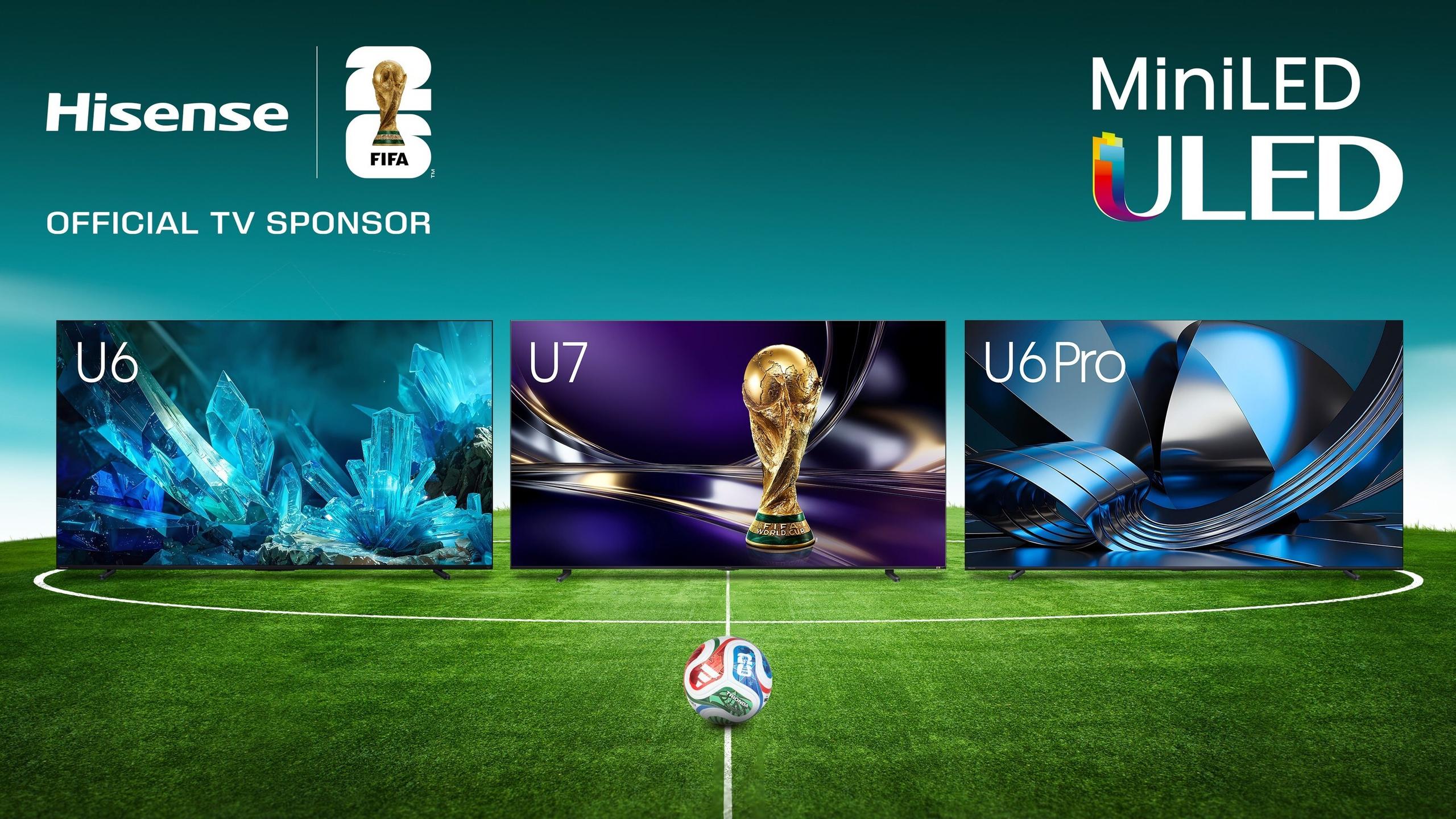
Hisense has announced its 2026 ULED Mini-LED TV lineup, with the new U7 Series arriving first and the U6 Series set to follow in the coming weeks. Together, these two ranges look like the core of the company’s mainstream TV strategy for 2026, aimed at shoppers who want better brightness, contrast, and larger screen sizes without jumping to flagship pricing.
For you as a buyer, the key takeaway is fairly simple: Hisense is continuing to push Mini-LED deeper into the midrange market. The U7 is positioned as the more advanced option for sports, gaming, and bigger-room setups, while the U6 is meant to offer a more affordable path into Mini-LED for households that want a step up from a standard LED TV.
That timing is not accidental. Hisense is clearly tying this launch to the upcoming FIFA World Cup 2026, which will be hosted in the United States, and much of the messaging around the new sets focuses on shared viewing, big-screen sports, and living-room entertainment.
The U7 Series is the first part of the lineup to go on sale, and it covers a very wide size range. According to Hisense, the U7SG will be available in sizes from 55 inches all the way up to 116 inches. That alone tells you a lot about where Hisense sees demand right now: larger TVs are no longer a niche category, and brands increasingly want to meet buyers where they are, whether that means a bedroom-friendly 55-inch model or a wall-dominating 100- or 116-inch screen.
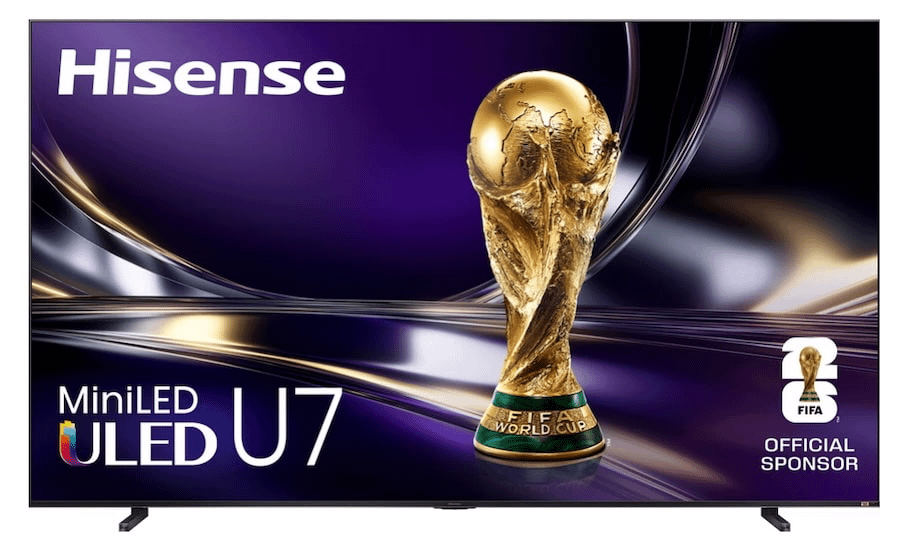
Hisense says the U7 is designed around Mini-LED backlighting with full-array local dimming, along with Quantum Dot color and its Hi-View AI Engine Pro processing. That means the TV is built to improve contrast control, push brightness higher, and offer more precise handling of highlights and darker scenes than a basic LED set.
One of the most notable specs here is the native 165Hz refresh rate. That is unusually high for a TV in this class, and it matters most for two types of viewing: fast sports and gaming. A faster refresh rate can help motion look smoother and reduce some of the blur that tends to show up during fast camera pans, quick player movement, or action-heavy gameplay. Hisense is also including gaming-friendly features such as VRR, ALLM, Dolby Vision Gaming, and HDR10+ Gaming support.
Audio is another part of the U7 pitch. The set includes a 50-watt 2.1.2-channel speaker system with Dolby Atmos and DTS Virtual:X, and one source notes that the system is tuned by Devialet. That does not mean you can skip a soundbar in every setup, but it does suggest Hisense is trying to make the out-of-box experience less thin and flat than what many built-in TV speakers deliver.
The U6 Series sits below the U7 and is aimed more directly at value-conscious shoppers. Hisense is describing it as an easier entry point into Mini-LED, and that may end up being the bigger story for many households. Not everyone needs a 165Hz panel or the largest available screen. A lot of people simply want better picture quality for streaming, sports, and movies without moving too far up the price ladder.
The U6 lineup will reportedly range from 55 to 100 inches and includes the U6SF Pro as well as an additional entry Mini-LED model called the U6SF. Like the U7, the U6 uses Mini-LED backlighting with full-array local dimming and Quantum Dot color. It also adds AI-based picture optimization, which is meant to automatically adjust the image depending on what you are watching.
One interesting feature is the integrated subwoofer. Built-in TV sound is often the weak point in affordable and midpriced sets, so adding a subwoofer is a practical move. It will not replace a dedicated surround system, but it could help give movies, shows, and sports a bit more weight without requiring extra gear right away.
Unlike the U7, the U6 models appear to run Fire TV OS across the lineup.
Hisense is taking a split-platform approach with the U7. The Google TV version is labeled U7SG, while the Fire TV version is labeled U7SF. That gives shoppers some flexibility depending on which smart TV platform they prefer. The U6 lineup, by contrast, is centered on Fire TV.
Pricing for the U7 Series starts at $1,299 and the lineup is already available at Best Buy. Current pricing lists the 55-inch model at $1,299.99, the 65-inch at $1,499.99, the 75-inch at $1,999.99, the 85-inch at $2,499.99, the 100-inch at $4,499.99, and the massive 116-inch version at $19,999.99. The U6 Series is expected to arrive later in spring 2026, though Hisense has not yet announced detailed pricing for those models.
The broader picture here is that Hisense is doubling down on the part of the TV market where a lot of shoppers actually buy: not the ultra-premium flagship category, but the middle ground where features and price still have to make sense together. The U7 looks intended for buyers who care about sports, gaming, and very large screen options, while the U6 appears aimed at people who want Mini-LED benefits in a more accessible package.
For anyone shopping for a new TV in 2026, that makes this launch worth watching. Hisense is not reinventing the category here. What it is doing is expanding Mini-LED across more sizes and price points, which could make advanced backlighting, higher brightness, and larger screens easier to buy than they were a few years ago.
Related Reading:



Privacy Policy
Terms and Conditions - Affiliate Policy
Home Security
© Copyright 2008-2026.
11816 Inwood Rd #1211, Dallas, TX 75244