


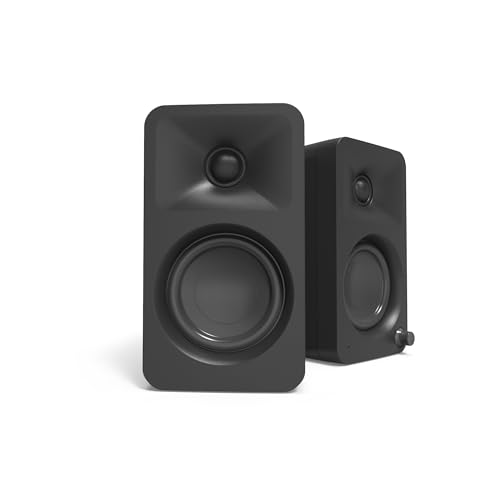
When upgrading from basic computer speakers, you'll quickly discover two distinct approaches to desktop audio: traditional studio monitors and modern reference desktop speakers. While both aim to deliver superior sound quality, they take fundamentally different paths to get there. The PreSonus Eris 3.5 represents the studio monitor philosophy—honest, uncolored sound reproduction designed for critical listening and mixing. The Kanto ORA, on the other hand, blends audiophile-grade sound with modern convenience features that today's users expect.
Understanding these differences is crucial because your choice will shape not just how your music sounds, but how you interact with your audio setup daily. Studio monitors prioritize accuracy above all else, while reference desktop speakers balance accuracy with user-friendly features and enhanced connectivity options.
The desktop audio market has evolved significantly over the past decade. Where once you had to choose between cheap computer speakers or expensive studio monitors, manufacturers now offer products that bridge this gap. At the time of writing, entry-level studio monitors like the PreSonus Eris 3.5 sit in the budget-conscious category, while premium desktop speakers like the Kanto ORA command significantly higher prices for their advanced feature sets.
Studio monitors emerged from professional recording environments where absolute accuracy is paramount. Every frequency must be reproduced faithfully so engineers can make informed mixing decisions. This philosophy means studio monitors often sound "flat" or even boring compared to consumer speakers that artificially boost certain frequencies to sound more exciting.
Reference desktop speakers, however, represent a newer category that emerged as content creators, streamers, and remote workers demanded better audio quality without sacrificing modern conveniences. These speakers maintain high sound quality standards while adding features like wireless connectivity, built-in DACs (digital-to-analog converters that convert digital audio files to analog signals your speakers can play), and automatic room optimization.
The PreSonus Eris 3.5 launched as part of PreSonus's second-generation Eris lineup, representing the company's commitment to making studio-quality monitoring accessible to home users. Since its release, it has maintained the core studio monitor principles that made the Eris series popular: honest frequency response, robust build quality, and professional connectivity options at consumer-friendly prices.
PreSonus, founded in 1995, built its reputation creating audio interfaces and mixing software before expanding into monitors. This background shows in the Eris 3.5's design philosophy—it's engineered like a professional tool first, with user convenience as a secondary consideration.
The Kanto ORA represents a more recent approach to desktop audio, launched as part of the growing "prosumer" market. Kanto, a Canadian company founded in 2008, has consistently pushed the boundaries of what desktop speakers can do. The ORA specifically targets users who want studio-quality sound but with the connectivity and automation features that modern workflows demand.
Since their respective launches, both products have benefited from manufacturing improvements and component optimization, but their core philosophies remain distinct. The Eris 3.5 has refined its driver materials and amplification efficiency while maintaining its studio-focused approach. The ORA has incorporated advances in DSP (digital signal processing) technology and Class-D amplification that weren't cost-effective in desktop speakers just a few years ago.
Sound quality ultimately determines whether these speakers succeed in their intended roles, but measuring and comparing it requires understanding what each product prioritizes.
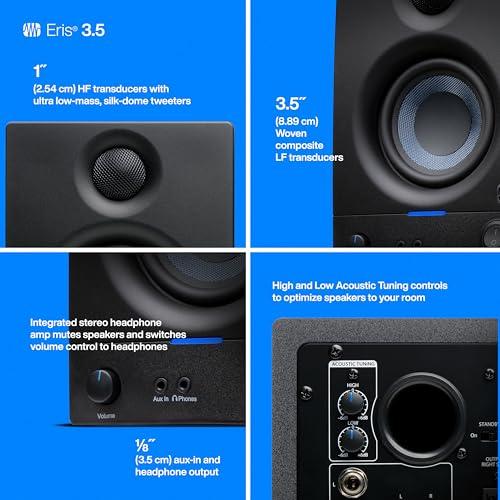
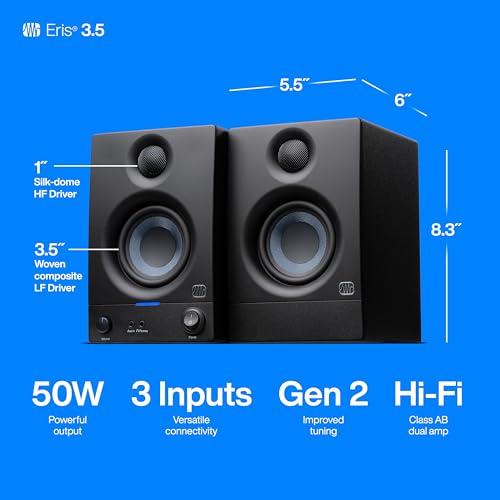
The PreSonus Eris 3.5 delivers its 80 Hz to 20 kHz frequency range with remarkable honesty for its size. The 3.5-inch woven composite woofer provides controlled bass response without the bloated low-end that plagues many small speakers. More importantly, the midrange—where vocals and most instruments live—remains uncolored and accurate. This matters enormously if you're mixing music, editing podcasts, or doing any work where you need to hear exactly what's in your audio files.
The 1-inch silk dome tweeter handles high frequencies with smoothness rather than aggression. Many consumer speakers artificially boost treble to sound more "detailed," but this approach fatigues your ears and can lead to mixes that sound dull on other systems. The Eris 3.5 avoids this trap, delivering highs that reveal detail without becoming harsh.
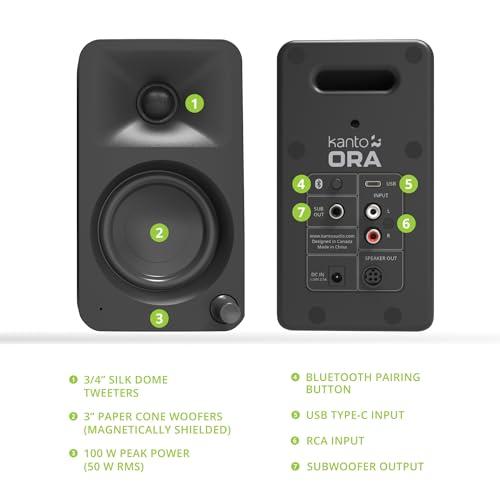
The Kanto ORA, with its 70 Hz to 22 kHz range, takes a more sophisticated approach. Its 3-inch paper cone woofers work with advanced DSP processing to optimize frequency response in real-time. While slightly smaller than the Eris 3.5's drivers, the ORA's woofers benefit from bi-amplification—each driver has its own dedicated amplifier, allowing for more precise control and higher power handling.
The ORA's 3/4-inch silk dome tweeters are smaller than the Eris 3.5's but benefit from DSP tuning that can correct for room acoustics and driver limitations automatically. This results in a sound that's still accurate but slightly warmer and more forgiving than traditional studio monitors.
Power specifications tell only part of the story, but they matter for understanding each speaker's capabilities and limitations.
The PreSonus Eris 3.5 delivers 50 watts total power through Class AB amplification—25 watts per speaker. Class AB amplifiers run cooler and more efficiently than older Class A designs while maintaining excellent sound quality. This power level proves adequate for nearfield monitoring in small rooms, providing clean sound up to moderate volumes. The speakers can hit 98 dB SPL (sound pressure level) at one meter, which is plenty loud for desktop use but may limit their effectiveness in larger spaces.
The Kanto ORA offers 100 watts peak power (50 watts RMS total) through bi-amplified Class-D design. Class-D amplification, sometimes called "digital amplification," switches power on and off rapidly to achieve high efficiency and low heat generation. Combined with DSP processing, this allows the ORA to optimize power delivery to each driver independently. The bi-amplification means the tweeter gets 9 watts RMS while the woofer receives 16 watts RMS—a more sophisticated approach than the Eris 3.5's single amplifier feeding both drivers.
This power advantage becomes most apparent in dynamic range—the difference between the quietest and loudest sounds the speakers can reproduce cleanly. The ORA maintains composure at higher volumes and during complex musical passages where multiple instruments play simultaneously.
Soundstage refers to the three-dimensional space that speakers create around you, while imaging describes how precisely instruments and voices are positioned within that space. Both characteristics significantly impact your listening experience.
The PreSonus Eris 3.5 excels at imaging precision. Vocals remain centered and stable, while instruments occupy distinct positions in the stereo field. This precision proves invaluable for mixing work, where you need to place sounds accurately in the stereo spectrum. The speakers create a convincing sense of depth, allowing you to distinguish between instruments recorded at different distances from the microphone.
The Kanto ORA takes a different approach, using DSP processing to enhance the soundstage beyond what its small drivers might naturally create. The result is a larger, more enveloping presentation that can make movies and music more engaging. While purists might argue this processing colors the sound, most users find it enhances their enjoyment without sacrificing critical detail.
Your speakers are only as good as your ability to connect them to your audio sources, and this is where these products diverge most dramatically.
The PreSonus Eris 3.5 offers the connectivity you'd expect from a professional monitor. Balanced 1/4-inch TRS inputs provide the best sound quality when connected to audio interfaces or mixing boards. These balanced connections reject electrical interference that can introduce noise into your audio signal—crucial in professional environments with lots of electronic equipment.
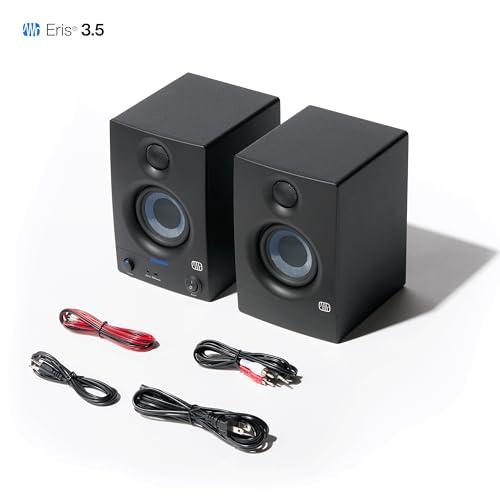
The unbalanced RCA inputs handle connections to consumer devices like audio players or gaming consoles, while the front-panel 1/8-inch input accommodates phones and tablets directly. There's also a headphone output that mutes the speakers when connected—a thoughtful touch for late-night work sessions.
However, the Eris 3.5 lacks any digital inputs or wireless connectivity. If you want to connect directly to your computer's USB port or stream wirelessly from your phone, you'll need additional equipment.
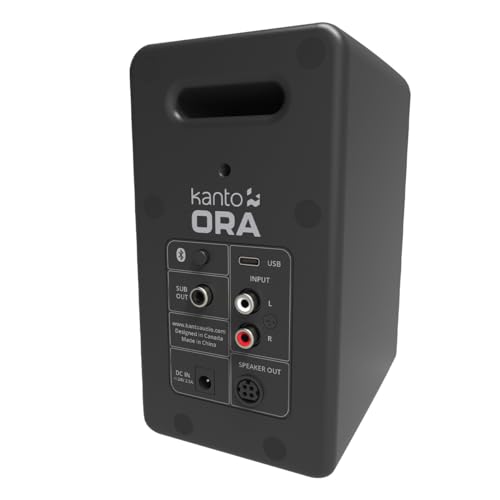
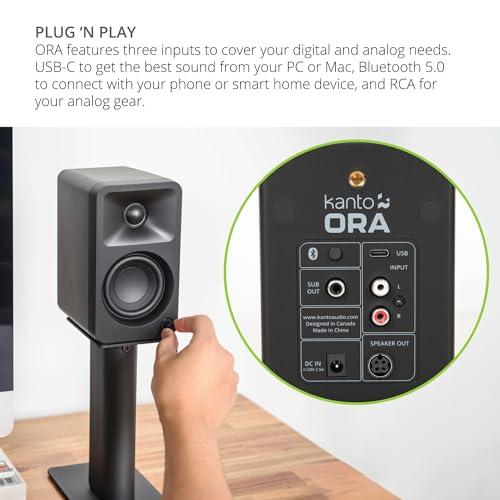
The Kanto ORA embraces modern connectivity with enthusiasm. The USB-C input supports 24-bit/96kHz digital audio, bypassing your computer's potentially noisy internal sound card entirely. This matters more than you might expect—many computers generate electrical interference that can introduce subtle but audible noise into analog audio outputs.
Bluetooth 5.0 connectivity supports high-quality wireless codecs, allowing you to stream from phones, tablets, and computers without sacrificing too much audio quality. While Bluetooth will never match wired connections for absolute fidelity, modern implementations are surprisingly good for casual listening.
The single front-panel knob controls volume, input selection, and power—a clean, intuitive interface that eliminates the clutter of multiple controls. An LED indicator shows which input is active: green for RCA, yellow for USB, blue for Bluetooth.
Beyond basic connectivity, these speakers take opposite approaches to advanced features and user control.
The PreSonus Eris 3.5 includes high and low frequency acoustic tuning controls that let you adjust the sound for your room's acoustics. Room acoustics dramatically affect how speakers sound—hard surfaces reflect sound while soft surfaces absorb it, creating peaks and dips in frequency response.
The high-frequency control adjusts ±6 dB at 10 kHz, useful for taming harsh reflections from hard surfaces or compensating for rooms that absorb too much treble. The low-frequency control operates at 100 Hz, helping balance bass response in different room sizes and positions.
These manual controls require some acoustic knowledge to use effectively, but they offer precise control over the sound. Professional users appreciate this hands-on approach because they can fine-tune the speakers to their specific environment and preferences.
The Kanto ORA handles room optimization automatically through DSP processing. While you can't manually adjust specific frequencies like the Eris 3.5, the DSP continuously analyzes the audio signal and applies corrections in real-time.
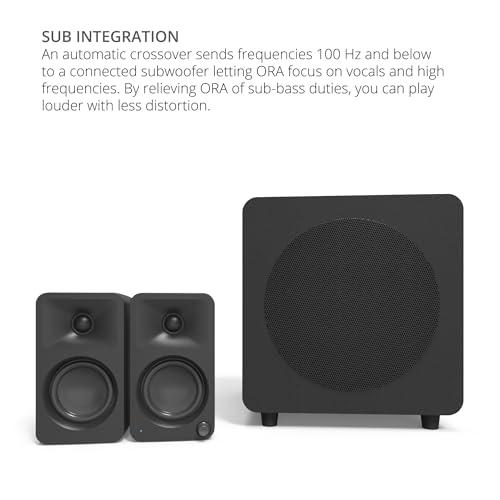
The most sophisticated feature is the automatic 100 Hz crossover that activates when you connect a subwoofer. This relieves the ORA's small woofers of deep bass duties, allowing them to focus on midrange frequencies where they perform best. The crossover is implemented digitally for seamless integration—no manual adjustment required.
This automation makes the ORA much easier to set up and use, especially for users who want great sound without becoming audio engineers. However, it also means you have less control over the final sound character.
Physical construction affects both sound quality and long-term durability, revealing each manufacturer's priorities and compromises.
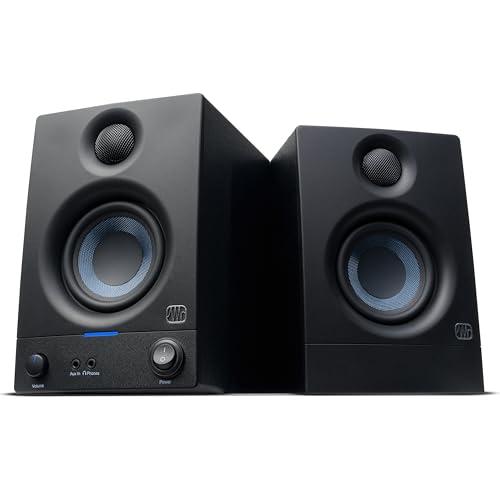
The PreSonus Eris 3.5 uses vinyl-laminated medium-density fiberboard (MDF) cabinets—the same material found in much larger and more expensive studio monitors. MDF is dense and acoustically inert, meaning it doesn't resonate or color the sound from the drivers inside. The vinyl lamination protects against moisture and wear while providing a professional appearance.
The cabinets feel solid and substantial, with minimal flex when pressed. Internal bracing and damping materials control unwanted resonances, ensuring that what you hear comes from the drivers, not the enclosure. The rear-firing port extends bass response while preventing the "boxy" sound that can plague sealed designs.
At 3.1 kg for the pair, these speakers have enough mass to stay planted on your desk without vibrating or moving during loud passages. The included rubber feet provide isolation from desktop vibrations.
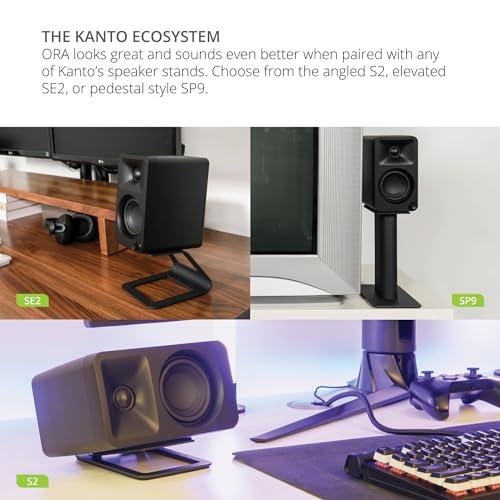
The Kanto ORA prioritizes desktop integration over traditional studio construction. The plastic enclosure keeps weight down—just 2.1 pounds per speaker—making them easy to reposition or transport. The matte finish resists fingerprints and integrates cleanly into modern workspace aesthetics.
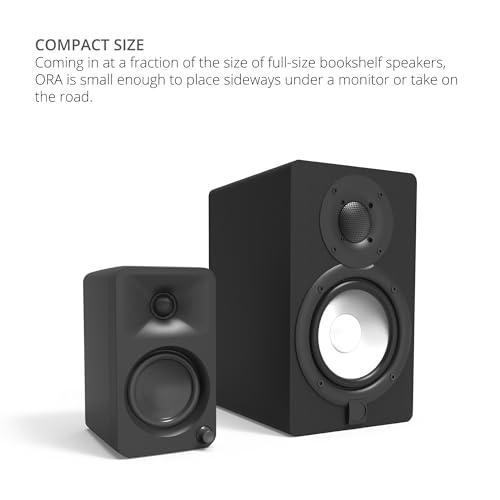
While plastic construction might seem like a compromise, the ORA uses it strategically. The lightweight enclosure reduces desktop vibration transmission, while internal bracing maintains structural integrity. The compact dimensions (6.9" × 3.9" × 5.6") fit comfortably under computer monitors or in tight desktop setups.
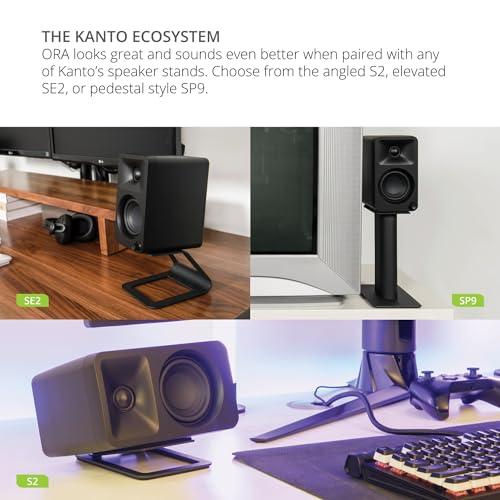
Threaded mounting holes on the rear allow wall or ceiling installation—useful for users who want to free up desk space entirely. The included self-adhesive rubber feet provide multiple mounting options for different surfaces.
Understanding how these speakers perform in various real-world scenarios helps clarify which product suits your specific needs.
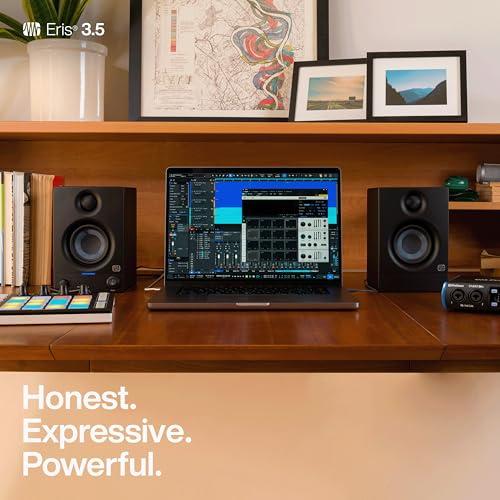
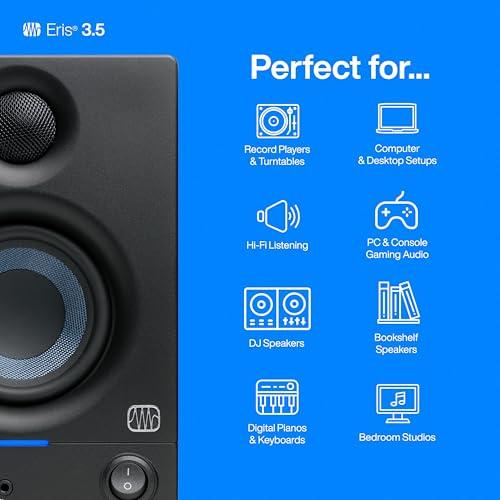
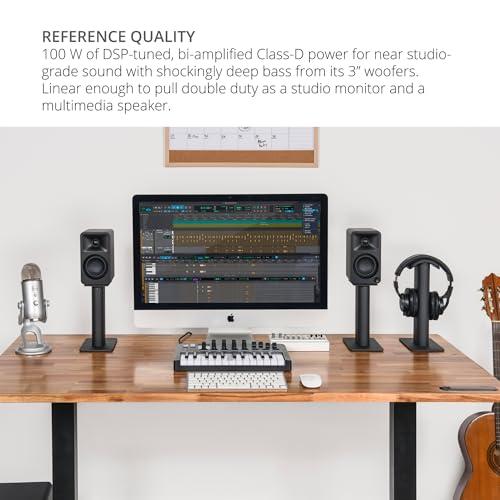
For home studio work, the PreSonus Eris 3.5 provides the accuracy and honest sound reproduction that mixing and mastering demand. When you're editing podcasts, producing music, or creating YouTube content, you need to hear exactly what's in your audio files without coloration or enhancement.
The manual EQ controls prove invaluable in home studios where acoustic treatment is often minimal. You can compensate for room reflections and standing waves that would otherwise make your mixes translate poorly to other playback systems.
However, the lack of digital inputs means you'll likely need an audio interface for optimal results. This adds cost and complexity but provides superior sound quality and professional connectivity options.
The Kanto ORA offers a more streamlined approach for content creators who prioritize workflow efficiency. The USB-C connection provides clean digital audio without additional hardware, while the built-in DAC ensures high-quality playback from your computer.
The automatic subwoofer integration particularly benefits video editors and streamers who need full-range sound for accurate dialogue editing and game audio monitoring. The Bluetooth connectivity allows easy audio reference checks from mobile devices—useful for ensuring your content sounds good across different platforms.
Gaming presents unique challenges for desktop speakers, requiring both accurate positional audio for competitive advantages and immersive sound for entertainment value.
The PreSonus Eris 3.5 excels at positional accuracy—you'll hear exactly where footsteps, gunshots, and other game audio elements originate. The flat frequency response ensures that game developers' audio mixing decisions come through clearly, without artificial enhancement that might mask important audio cues.
However, the limited bass extension might disappoint users who want the rumbling explosions and dramatic impact that many games provide. The lack of wireless connectivity also means you can't easily stream game audio to friends during voice chats.
The Kanto ORA provides a more entertaining gaming experience with its enhanced dynamic range and automatic bass management when paired with a subwoofer. The Bluetooth connectivity allows seamless switching between game audio and voice chat applications on mobile devices.
The DSP processing can make game soundtracks more immersive without sacrificing critical positional information. For competitive gaming, both speakers provide the accuracy needed, but the ORA offers more flexibility for different gaming scenarios.
While neither speaker is designed primarily for home theater use, both can serve as nearfield monitors in bedroom or office theater setups.
The PreSonus Eris 3.5 provides accurate dialogue reproduction and precise sound effects placement, but the limited bass extension requires subwoofer augmentation for movie soundtracks. The RCA inputs accommodate most media devices, though the lack of optical inputs limits some TV connections.
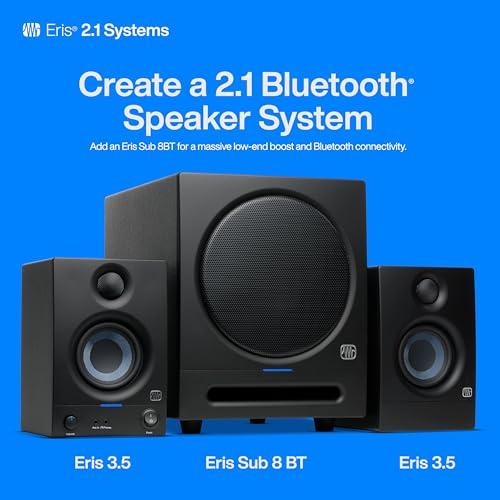
The Kanto ORA offers more flexibility for home theater integration. The automatic subwoofer crossover seamlessly blends with powered subwoofers, creating a more cohesive 2.1 system. The multiple input options accommodate various source devices, while the compact size fits into entertainment centers more easily than traditional bookshelf speakers.
However, both speakers are designed for nearfield listening rather than filling larger rooms. For dedicated home theaters, larger speakers or multiple zones would provide better coverage and impact.
At the time of writing, these speakers occupy different market segments with distinct value propositions that reflect their target audiences and feature sets.
The PreSonus Eris 3.5 offers exceptional value for users prioritizing sound accuracy over convenience features. The combination of professional-grade drivers, robust amplification, and studio monitor design principles typically costs significantly more in competing products. For home studio users, students, and audio enthusiasts on budgets, the price-to-performance ratio is outstanding.
The Kanto ORA commands a premium price that reflects its advanced feature set and convenience factors. The built-in DAC, wireless connectivity, automatic DSP processing, and premium materials justify the higher cost for users who value these capabilities. The target audience includes content creators, professionals with modern workflows, and audiophiles who prioritize convenience alongside sound quality.
Choosing between these speakers ultimately depends on your priorities, workflow, and long-term needs.
Choose the PreSonus Eris 3.5 if:
Choose the Kanto ORA if:
Consider your long-term needs: The Eris 3.5 grows with you as you add professional audio equipment, while the ORA provides more flexibility for different source devices and usage scenarios.
Think about your workspace: If you frequently switch between devices or need wireless connectivity, the ORA eliminates cable management hassles. If you work primarily with one computer and value absolute sound accuracy, the Eris 3.5 focuses on what matters most.
Both speakers represent excellent engineering and thoughtful design within their respective philosophies. The PreSonus Eris 3.5 delivers professional studio monitor performance at an accessible price, while the Kanto ORA bridges the gap between audiophile sound quality and modern user expectations. Your choice should reflect which approach better serves your specific needs and working style.
| PreSonus Eris 3.5 Studio Monitors Pair | Kanto ORA Powered Reference Desktop Speakers Pair |
|---|---|
| Total Power Output - Determines maximum volume and dynamic range | |
| 50W total (25W per speaker) Class AB amplification | 100W peak (50W RMS total) bi-amplified Class D with DSP |
| Driver Configuration - Affects sound quality and frequency response | |
| 3.5" woven composite woofer + 1" silk dome tweeter | 3" paper cone woofer + 3/4" silk dome tweeter |
| Frequency Response - Shows how low bass extends and high treble reaches | |
| 80 Hz - 20 kHz (limited bass, excellent for nearfield monitoring) | 70 Hz - 22 kHz (deeper bass, wider range with DSP optimization) |
| Maximum SPL - How loud they can play cleanly | |
| 98 dB at 1 meter (adequate for desktop use) | Higher output capability due to bi-amplification and DSP |
| Connectivity Options - Critical for modern workflow integration | |
| Balanced 1/4" TRS, RCA, front 3.5mm aux, headphone out | USB-C (24-bit/96kHz), Bluetooth 5.0, RCA, subwoofer output |
| Digital Features - Modern conveniences vs traditional approach | |
| None (purely analog, requires audio interface for best results) | Built-in DAC, DSP processing, automatic subwoofer crossover |
| Room Tuning Capabilities - How you optimize sound for your space | |
| Manual high/low frequency controls (±6 dB at 10kHz/100Hz) | Automatic DSP processing with subwoofer integration |
| Cabinet Construction - Affects sound quality and durability | |
| Vinyl-laminated MDF (professional studio standard) | Lightweight plastic with internal bracing (desktop optimized) |
| Dimensions per Speaker - Desktop footprint considerations | |
| 8.3" H × 5.6" W × 6.5" D (larger, more substantial) | 6.9" H × 3.9" W × 5.6" D (compact, fits under monitors) |
| Weight - Affects stability and portability | |
| 3.1 kg total pair (substantial, stays planted) | 2.1 lbs per speaker (portable, easy repositioning) |
| Sound Character - Studio accuracy vs enhanced listening | |
| Flat, honest studio reference (uncolored, mixing-focused) | Reference-grade with slight warmth (optimized for desktop enjoyment) |
| Wireless Capability - Modern streaming and device flexibility | |
| None (traditional wired connections only) | Bluetooth 5.0 with high-quality codecs |
| Subwoofer Integration - Expanding to full-range system | |
| Manual setup required, no dedicated output | Automatic 100Hz crossover with dedicated subwoofer output |
| Target Use Case - Who each speaker serves best | |
| Home studio monitoring, mixing, traditional audio workflows | Content creation, modern desktops, wireless streaming needs |
The PreSonus Eris 3.5 are specifically designed for home studio recording with their flat, accurate frequency response that reveals exactly what's in your recordings. They include manual EQ controls to compensate for room acoustics and professional connectivity options. The Kanto ORA can work for studio use but prioritize convenience features over pure accuracy, making the PreSonus Eris 3.5 the better choice for serious recording work.
Only the Kanto ORA offers wireless connectivity through Bluetooth 5.0, allowing you to stream from phones, tablets, and computers without cables. The PreSonus Eris 3.5 requires wired connections only, though they do include a front auxiliary input for mobile devices with a cable.
Both speakers excel at gaming but in different ways. The PreSonus Eris 3.5 provides extremely accurate positional audio for competitive gaming, while the Kanto ORA offers more dynamic sound with better bass extension and the flexibility to connect multiple devices simultaneously via Bluetooth and USB.
The Kanto ORA connects directly to your computer via USB-C with support for high-resolution 24-bit/96kHz audio, bypassing your computer's internal sound card. The PreSonus Eris 3.5 requires either your computer's analog outputs or a separate audio interface for the best sound quality.
Both speakers benefit from a subwoofer due to their compact size, but the Kanto ORA makes integration much easier with automatic crossover that activates when you connect a subwoofer. The PreSonus Eris 3.5 can work with subwoofers but requires manual setup and doesn't include a dedicated subwoofer output.
For nearfield movie watching, both speakers work well. The Kanto ORA provides a more cinematic experience with better dynamic range and easier subwoofer integration for full-range sound. The PreSonus Eris 3.5 offers accurate dialogue reproduction but may need a subwoofer for impactful movie soundtracks.
The Kanto ORA is significantly easier to set up with plug-and-play USB-C connection, automatic DSP processing, and simple single-knob control. The PreSonus Eris 3.5 requires more manual adjustment of EQ settings and may need additional equipment like an audio interface for optimal performance.
Yes, but differently. The PreSonus Eris 3.5 includes manual high and low frequency controls (±6 dB) that let you fine-tune the sound for your room's acoustics. The Kanto ORA uses automatic DSP processing to optimize sound without manual adjustment, which is more convenient but offers less control.
The Kanto ORA are more compact and lighter, making them ideal for small desks or setups where space is limited. They can even be wall-mounted using the threaded rear mounting holes. The PreSonus Eris 3.5 are larger and heavier, requiring more desk space but staying more stable during loud playback.
The Kanto ORA work completely standalone with built-in amplification, DAC, and multiple input options. The PreSonus Eris 3.5 are also powered speakers but perform best with a dedicated audio interface, especially for professional studio work, though they can connect directly to consumer devices.
The PreSonus Eris 3.5 provide more accurate, uncolored sound reproduction that reveals exactly what's in your audio source - this is essential for mixing and critical listening. The Kanto ORA offer reference-quality sound but with slight DSP enhancement that makes them more enjoyable for general listening while maintaining good accuracy.
Both speakers work well for nearfield desktop listening. The Kanto ORA can achieve higher peak volumes due to their bi-amplified design and DSP optimization, while the PreSonus Eris 3.5 reach 98 dB SPL at one meter, which is adequate for most desktop applications but may struggle to fill larger rooms effectively.
We've done our best to create useful and informative comparisons to help you decide what product to buy. Our research uses advanced automated methods to create this comparison and perfection is not possible - please contact us for corrections or questions. These are the sites we've researched in the creation of this article: soundref.com - presonus.com - musicradar.com - presonus.com - higherhertz.com - sweetwater.com - erinsaudiocorner.com - gzhls.at - homestudiobasics.com - presonus.com - audiosciencereview.com - youtube.com - audiosciencereview.com - thomannmusic.com - georgesmusic.com - musicalgarage.com - soundonsound.com - audioholics.com - skybygramophone.com - avu.ca - techaeris.com - hometechnologyreview.com - worldwidestereo.com - techradar.com - kantoaudio.com - listenup.com - kantoaudio.com - youtube.com - iworldonline.com.au - audioadvice.com - kantoaudio.com - microcenter.com

Privacy Policy
Terms and Conditions - Affiliate Policy
Home Security
© Copyright 2008-2026.
11816 Inwood Rd #1211, Dallas, TX 75244