


Desktop speakers might seem like a simple purchase, but the difference between mediocre and excellent desktop audio can transform your entire computing experience. Whether you're grinding through work calls, diving into games, or just enjoying music while browsing, your speakers serve as the bridge between digital content and your ears.
The desktop speaker market has evolved dramatically over the past decade. What once required separate amplifiers and complex setups now comes in compact, powered packages that deliver impressive performance straight out of the box. Today, we're comparing two speakers that represent very different philosophies in this space: the Creative Pebble V2, released in 2019 as an update to Creative's popular budget line, and the Kanto ORA, launched in 2020 as a premium desktop solution targeting content creators and audio enthusiasts.
Before diving into specifics, it's worth understanding what separates excellent desktop speakers from the rest. The most critical factors are frequency response (how evenly the speakers reproduce different pitches), power handling (how loud they can play without distortion), and driver quality (the actual components that create sound).
Frequency response measures how well speakers reproduce the full range of human hearing, typically from 20 Hz (very deep bass) to 20,000 Hz (very high treble). Most budget speakers struggle with the extremes, particularly deep bass, which requires larger drivers or clever engineering to reproduce accurately.
Power handling involves both the maximum volume and how clean that volume sounds. More watts don't automatically mean better sound—it's about having enough clean power to drive the speakers properly without introducing distortion.
Driver design makes perhaps the biggest difference. Single full-range drivers try to handle all frequencies through one cone, while two-way designs use separate tweeters for highs and woofers for lows, allowing each driver to specialize in what it does best.
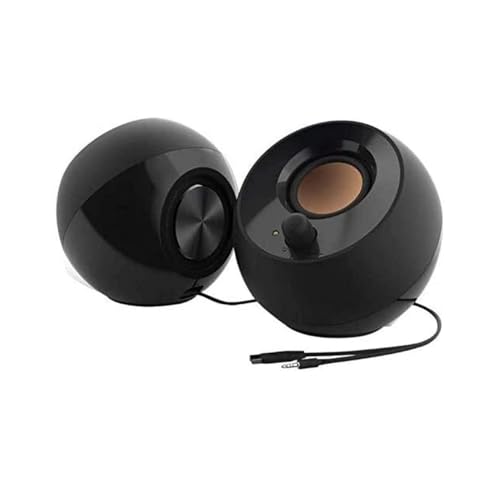
The Creative Pebble V2 represents Creative's refined approach to budget desktop audio. Released in 2019 as an evolution of their popular original Pebble speakers, it incorporates several key improvements that address common complaints about cheap computer speakers.
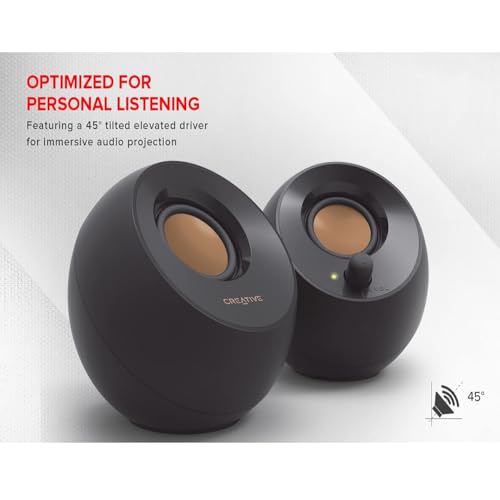
The most immediately noticeable feature is the 45-degree angled design. Unlike traditional speakers that fire sound straight forward, the Pebble V2 tilts its drivers toward your ears. This might seem like a minor detail, but it makes a significant difference in how the sound reaches you at a typical desk setup. The angled drivers create better stereo imaging—that sense of sounds coming from specific locations in the audio landscape.
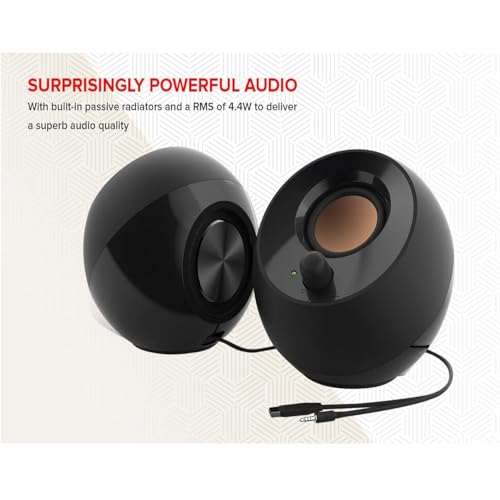
Creative equipped each speaker with 2-inch full-range drivers backed by passive radiators. A passive radiator is essentially a speaker cone without the motor—it moves in response to air pressure changes inside the speaker cabinet, effectively extending bass response beyond what the small active driver could achieve alone. This clever engineering allows the compact Pebble V2 to produce surprisingly full sound despite its tiny footprint.
The power delivery system represents a significant upgrade over typical budget speakers. The Pebble V2 draws power through USB-C, allowing it to pull up to 8 watts RMS (16 watts peak) when connected to an appropriate power source. RMS power represents the continuous power a speaker can handle, while peak power is the maximum it can handle in short bursts. The inclusion of a gain switch lets you optimize performance based on whether you're connected to a standard USB port or a higher-power USB-C source.
Build quality exceeds expectations for speakers at this price point. The matte plastic construction feels solid and resists fingerprints, while rubber feet keep the speakers stable on your desk. The front-facing volume knob provides tactile feedback and includes a power LED that clearly indicates when the speakers are active.
The Kanto ORA, launched in 2020, takes a fundamentally different approach. Rather than maximizing value at a low price point, Kanto designed these speakers to deliver reference-quality audio in a compact desktop form factor.
The most significant technical difference lies in the bi-amplified design. While the Pebble V2 uses a single amplifier to drive its full-range driver, the ORA includes separate amplifiers for its tweeter and woofer. This allows each driver to receive precisely the power and frequency range it's designed to handle, resulting in cleaner, more accurate sound reproduction.
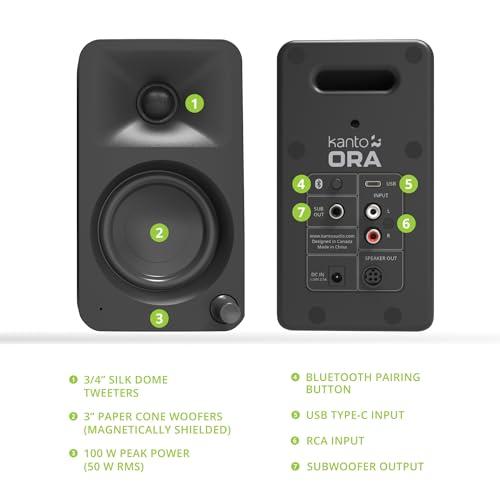
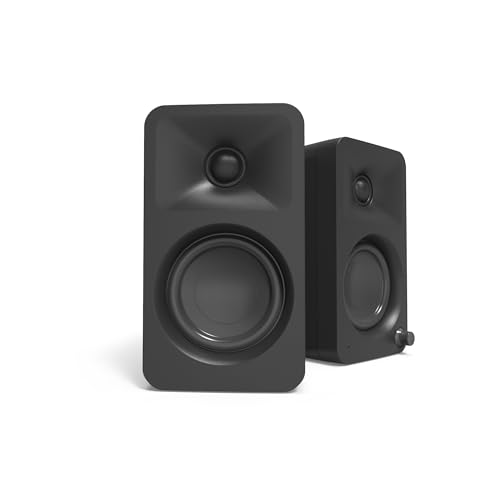
The driver configuration reflects this professional approach. Each ORA speaker features a ¾-inch silk dome tweeter paired with a 3-inch paper cone woofer. Silk dome tweeters are prized in high-end speakers for their smooth frequency response and lack of harshness, while the larger woofer provides significantly more bass extension than the Pebble V2's 2-inch driver.
Power delivery is substantially more robust, with 50 watts RMS total (100 watts peak) distributed as 9 watts per tweeter and 16 watts per woofer. This power advantage becomes apparent when you need to fill larger spaces or want to experience the full dynamic range of well-recorded music.
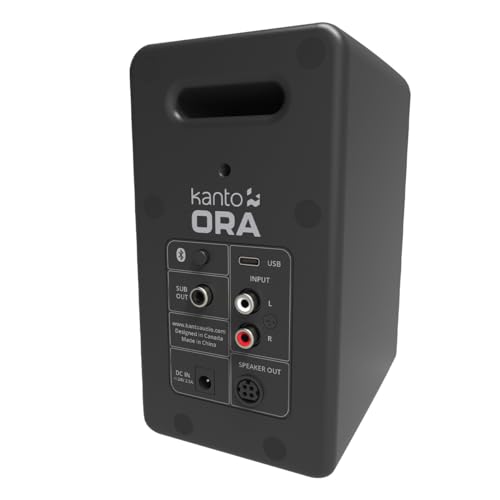
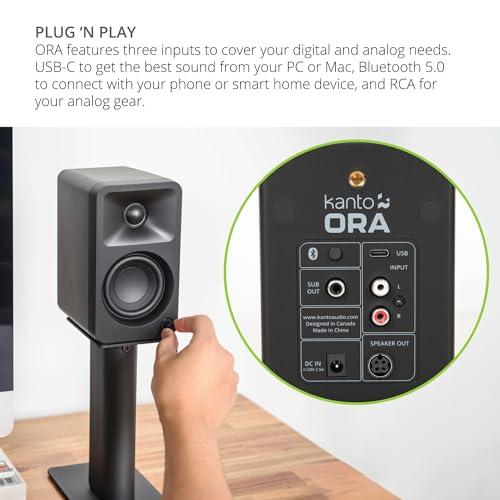
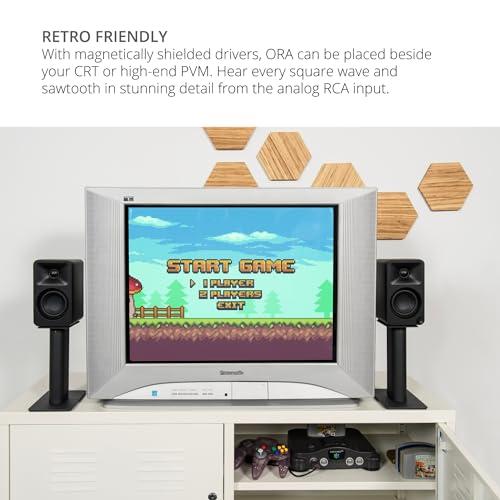
The connectivity options distinguish the ORA as a professional tool. Beyond the standard 3.5mm input, you get USB-C digital input supporting 24-bit/96kHz audio (significantly higher quality than standard CD-quality audio), Bluetooth 5.0 for wireless convenience, and RCA inputs for connecting professional audio equipment.
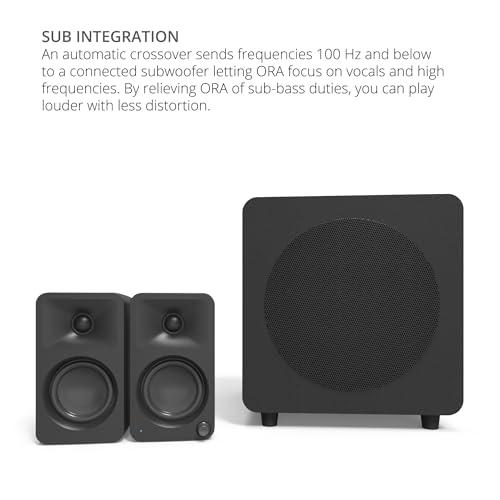
Perhaps most impressive is the automatic subwoofer integration. When you connect a subwoofer to the dedicated output, the ORA automatically engages a digital crossover at 100 Hz. This means the desktop speakers focus on midrange and treble while the subwoofer handles deep bass, allowing each component to perform optimally without interference.
The performance gap between these speakers becomes clear when you consider their sound signatures and capabilities. The Pebble V2 delivers what most reviewers describe as a slightly bright, engaging sound. The emphasis on treble frequencies makes voices clear and adds sparkle to music, though it can occasionally become fatiguing during long listening sessions.
Bass response from the Pebble V2 impresses given its size constraints. The passive radiators extend low-frequency response down to about 100 Hz, providing enough bass punch for most desktop applications. However, deep bass—the kind that adds weight to explosions in movies or the fundamental tones of bass guitars—simply isn't there due to physical limitations.
The Kanto ORA approaches sound reproduction from an entirely different philosophy. Rather than adding excitement through frequency coloration, these speakers aim for accuracy. The result is what audio professionals call a "reference" sound signature—neutral reproduction that reveals recordings as they were intended to be heard.
This neutrality pays dividends across different content types. Music reveals details that colored speakers might mask, while movies and games benefit from accurate dialogue reproduction and precise sound effects placement. The extended bass response, reaching down to 70 Hz, provides genuine low-end impact that the Pebble V2 simply cannot match.
The power difference becomes most apparent at higher volumes. While the Pebble V2 can achieve respectable volume levels for near-field listening, it begins to show strain when pushed hard. The ORA maintains composure and clarity even when filling medium-sized rooms, thanks to its substantial power reserves and superior driver quality.
For typical desktop computing tasks—web browsing, video calls, casual gaming—the Creative Pebble V2 provides a dramatic improvement over laptop speakers or cheap computer speakers. The clear midrange makes voices intelligible during video conferences, while the stereo separation adds immersion to games and movies. The compact size and USB power make it particularly appealing for laptop users who want better audio without sacrificing desk space or requiring wall outlets.
However, the limitations become apparent in more demanding scenarios. Critical music listening reveals the compressed dynamic range and limited bass extension. Complex audio mixes can sound cluttered as the single driver struggles to separate different frequency ranges cleanly.
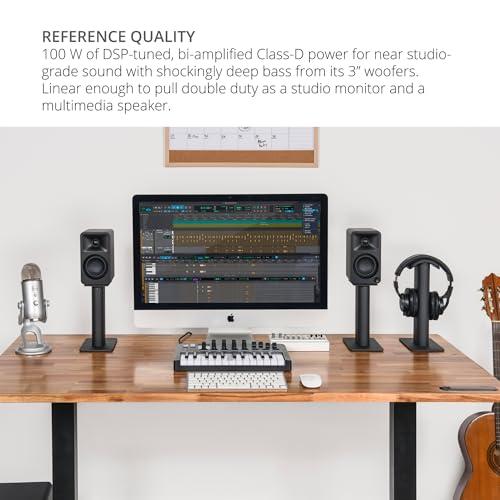
The Kanto ORA excels precisely where the Pebble V2 struggles. Content creators will appreciate the accurate monitoring capabilities—you can trust these speakers to reveal mix issues or audio problems that might be masked by colored speakers. Gamers benefit from the superior spatial awareness and dynamic range, while music enthusiasts get genuine high-fidelity reproduction in a desktop-friendly package.
The multiple connectivity options prove valuable in practice. The USB-C digital input bypasses your computer's often-mediocre digital-to-analog converter, while Bluetooth provides convenient wireless streaming for mobile devices. The ability to integrate a subwoofer transforms the system into something approaching full-range audio reproduction.
While neither speaker is designed primarily for home theater use, they can serve in smaller entertainment setups. The Pebble V2 works adequately for bedroom or dorm room TV audio, providing clearer dialogue and more engaging sound than most TV speakers. However, the limited power and bass response mean it's not suitable for larger rooms or action movies that demand dynamic range.
The ORA is genuinely capable as a compact home theater solution, particularly when paired with a subwoofer. The accurate sound reproduction ensures dialogue clarity while providing enough power for immersive movie watching. The Bluetooth connectivity allows easy streaming from mobile devices, while the multiple inputs accommodate various source components.
Both speakers reflect important trends in desktop audio. The Pebble V2's USB-C power delivery, introduced in 2019, anticipated the widespread adoption of USB-C on laptops and mobile devices. At the time of writing, this foresight has proven valuable as USB-C becomes the standard connection for modern devices.
The ORA's 2020 launch coincided with the boom in content creation and remote work, targeting users who suddenly needed professional-quality audio for streaming, recording, and video conferencing. The emphasis on accurate reproduction and multiple connectivity options reflects this shift toward home-based professional audio needs.
Since their respective releases, both speakers have maintained relevance despite rapid technological change. The Pebble V2 continues to define the budget desktop speaker category, while the ORA has established itself as a benchmark for compact professional monitors.
At the time of writing, the Creative Pebble V2 typically costs about one-seventh the price of the Kanto ORA, making value comparison complex. The Pebble V2 delivers remarkable performance per dollar, providing 80-90% of most users' desktop audio needs at a fraction of the cost of premium alternatives.
However, the ORA justifies its premium pricing through substantially superior performance across every measurable parameter. The question isn't whether it sounds better—it clearly does—but whether that improvement warrants the significant cost increase for your specific needs and budget.
For casual users seeking better desktop audio without major investment, the Pebble V2 represents exceptional value. It transforms the basic computing experience while maintaining the simplicity and affordability that make sense for everyday use.
Content creators, audio enthusiasts, and users requiring professional-quality monitoring should seriously consider the ORA. The accurate reproduction, robust connectivity, and expansion capabilities make it a long-term investment in audio quality that can grow with evolving needs.
Choose the Creative Pebble V2 if you want dramatic improvement over built-in computer audio without breaking the budget. It's perfect for students, casual users, and anyone working within space or financial constraints. The plug-and-play simplicity and compact design make it ideal for frequently changing setups or shared computers.
The Kanto ORA makes sense when audio quality directly impacts your work or entertainment experience. If you're editing videos, producing music, streaming content, or simply have discriminating audio tastes, the superior performance justifies the investment. The multiple connectivity options and subwoofer integration provide flexibility for current and future needs.
Both speakers excel within their intended markets, representing thoughtful engineering approaches to different user priorities. The Pebble V2 maximizes value and convenience, while the ORA prioritizes uncompromising performance and professional features. Your choice ultimately depends on whether you prioritize accessibility or excellence—both are valid paths to better desktop audio.
| Creative Pebble V2 Desktop Speakers | Kanto ORA Powered Reference Desktop Speakers Pair |
|---|---|
| Power Output - Determines maximum volume and clarity at higher levels | |
| 8W RMS total (4W per speaker), 16W peak | 50W RMS total (25W per speaker), 100W peak |
| Driver Configuration - Affects sound quality and frequency separation | |
| Single 2" full-range drivers with passive radiators | Bi-amplified: ¾" silk dome tweeters + 3" paper cone woofers |
| Frequency Response - Shows how well speakers reproduce bass and treble | |
| 100 Hz – 17 kHz (limited deep bass) | 70 Hz – 22 kHz (extends deeper into bass territory) |
| Connectivity Options - Determines compatibility with different devices | |
| USB-C power + 3.5mm AUX input only | USB-C digital (24-bit/96kHz), Bluetooth 5.0, RCA inputs |
| Sound Signature - How the speakers color or reproduce audio | |
| Slightly bright, engaging sound with treble emphasis | Reference-flat, neutral sound for accurate reproduction |
| Subwoofer Integration - Important for users wanting full-range bass | |
| No dedicated subwoofer output | Dedicated sub output with automatic 100Hz crossover |
| Size & Desktop Footprint - Critical for space-limited setups | |
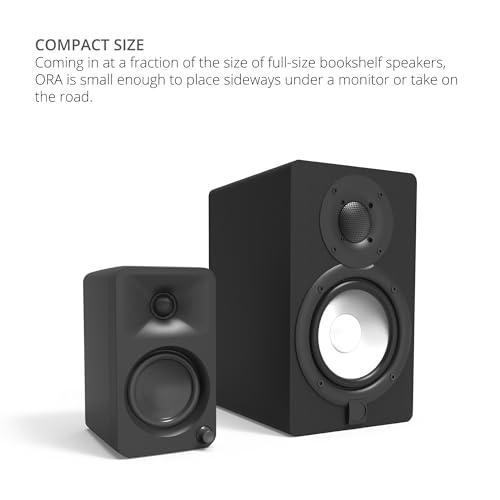
| Compact orb design: 4.5" x 4.4" x 4.6" each | Larger but still desktop-friendly: 3.9" x 5.6" x 6.9" each |
| Build Quality & Features - Affects durability and professional use | |
| Solid plastic, front volume knob, gain switch | Magnetically shielded drivers, rear mounting points, single control knob |
| Power Requirements - Affects setup flexibility | |
| USB-C or USB-A power (no wall outlet needed) | AC power supply required (wall outlet necessary) |
| Target Use Case - Who each speaker is designed for | |
| Budget-conscious users wanting better desktop audio | Content creators and audiophiles needing reference-quality sound |
The Creative Pebble V2 offers exceptional value for budget-conscious users, delivering dramatically better sound than laptop speakers at a fraction of premium speaker costs. The Kanto ORA justifies its higher price with professional-grade audio quality, multiple connectivity options, and reference-accurate sound reproduction. Choose the Pebble V2 for great value, or the ORA if audio quality is your top priority.
The biggest difference is audio approach: the Creative Pebble V2 uses single 2-inch drivers for affordable, compact desktop audio, while the Kanto ORA features bi-amplified professional drivers with separate tweeters and woofers for studio-quality sound. The ORA also offers multiple inputs including Bluetooth and USB-C digital, compared to the Pebble V2's simple 3.5mm connection.
Both work well for gaming, but serve different needs. The Creative Pebble V2 provides clear directional audio and good stereo separation for competitive gaming at a budget price. The Kanto ORA delivers superior spatial awareness, dynamic range, and bass response for immersive gaming experiences. Choose the Pebble V2 for casual gaming or the ORA for serious gaming setups.
The Creative Pebble V2 can improve TV audio in small bedrooms or dorm rooms but lacks the power and bass for larger spaces. The Kanto ORA works genuinely well as a compact home theater solution, especially when paired with a subwoofer through its dedicated output. The ORA's Bluetooth connectivity and multiple inputs make it more versatile for entertainment setups.
The Kanto ORA has significantly better bass response, extending down to 70 Hz compared to the Creative Pebble V2's 100 Hz limitation. The ORA's larger 3-inch woofers and higher power output provide deeper, more impactful bass. However, the Pebble V2 delivers surprising bass for its compact size thanks to passive radiators.
The Creative Pebble V2 doesn't support subwoofer connection and provides adequate bass for most desktop use. The Kanto ORA includes a dedicated subwoofer output with automatic crossover, making subwoofer integration seamless for users wanting full-range audio. A subwoofer isn't necessary for either system but greatly enhances the ORA experience.
The Kanto ORA is designed for music production with its reference-flat sound signature, bi-amplified drivers, and accurate audio reproduction. The Creative Pebble V2 isn't suitable for professional music production due to its colored sound signature and limited frequency response, though it's fine for casual music listening.
The Creative Pebble V2 offers simple connectivity with USB-C power and 3.5mm audio input. The Kanto ORA provides comprehensive options including USB-C digital input (24-bit/96kHz), Bluetooth 5.0, RCA inputs, and subwoofer output. The ORA's multiple inputs make it much more versatile for different devices and use cases.
The Creative Pebble V2 is more compact with its small orb design, making it ideal for cramped desk spaces and laptop setups. The Kanto ORA is larger but still desktop-friendly, offering better performance in exchange for the additional footprint. Choose the Pebble V2 if space is your primary concern.
The Creative Pebble V2 delivers 8W RMS total power, sufficient for near-field desktop listening. The Kanto ORA provides 50W RMS total with bi-amplified design, enabling room-filling volume and maintaining clarity at higher levels. The ORA's power advantage becomes apparent when you need louder volumes or larger room coverage.
The Creative Pebble V2 offers simpler setup with plug-and-play USB-C power and single 3.5mm connection. The Kanto ORA requires AC power and offers multiple connection options, making setup slightly more complex but providing greater flexibility. Both systems are relatively easy to install for most users.
Choose the Creative Pebble V2 if you want excellent value desktop audio improvement without major investment, especially for casual use and small spaces. Select the Kanto ORA if you need professional-quality audio for content creation, critical listening, or have a larger budget for superior sound quality. The ORA is the clear winner for audio performance, while the Pebble V2 wins on value and simplicity.
We've done our best to create useful and informative comparisons to help you decide what product to buy. Our research uses advanced automated methods to create this comparison and perfection is not possible - please contact us for corrections or questions. These are the sites we've researched in the creation of this article: techspinreview.com - cdw.com - youtube.com - richardtech.net - manuals.plus - audiosciencereview.com - us.creative.com - en.creative.com - youtube.com - audiosciencereview.com - lenovo.com - tomshardware.com - youtube.com - manuals.plus - youtube.com - youtube.com - walmart.com - dell.com - youtube.com - microcenter.com - cdwg.com - tvffm.org - asset.conrad.com - us.creative.com - manuals.plus - pangoly.com - audioholics.com - skybygramophone.com - avu.ca - techaeris.com - hometechnologyreview.com - worldwidestereo.com - techradar.com - kantoaudio.com - listenup.com - kantoaudio.com - youtube.com - iworldonline.com.au - audioadvice.com - kantoaudio.com - microcenter.com

Privacy Policy
Terms and Conditions - Affiliate Policy
Home Security
© Copyright 2008-2026.
11816 Inwood Rd #1211, Dallas, TX 75244