


When you're tired of tinny laptop speakers or basic computer audio, the world of powered speakers opens up exciting possibilities. Both the Kanto ORA Powered Reference Desktop Speakers and Saiyin Bluetooth Bookshelf Speakers promise to transform your listening experience, but they take dramatically different approaches to getting there.
Powered speakers, also called active speakers, have built-in amplifiers that boost weak audio signals from your phone, computer, or turntable to drive the speaker cones. This is different from passive speakers, which need a separate amplifier or receiver. The advantage? You can plug powered speakers directly into your audio source and start listening immediately.
The key considerations when choosing powered speakers revolve around sound quality, power output, connectivity options, and how they fit into your space and lifestyle. Some speakers prioritize accuracy—reproducing audio exactly as it was recorded—while others emphasize features like wireless connectivity and multiple input options. Understanding which approach matches your needs is crucial for making the right choice.
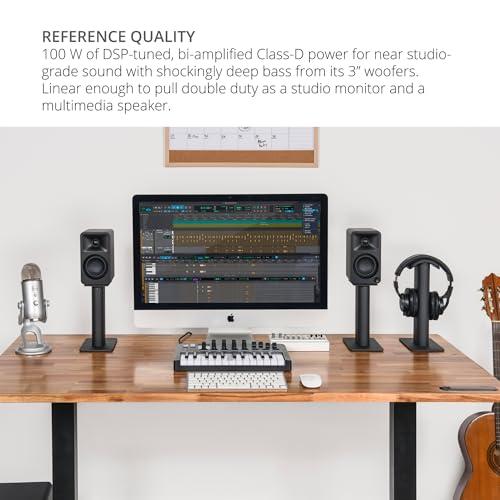
The Kanto ORA represents the reference monitor philosophy: deliver the most accurate sound possible in a compact desktop form. Released in 2024, it incorporates modern technologies like high-resolution USB-C audio and advanced digital signal processing (DSP)—computer algorithms that fine-tune the sound for optimal performance.
The Saiyin Bluetooth Bookshelf Speakers, available since around 2023, take a more traditional approach, emphasizing connectivity variety and classic bookshelf aesthetics while keeping costs reasonable.
Sound quality differences between these speakers start with their fundamental design approaches. The Kanto ORA uses bi-amplification, meaning each driver (the tweeter for high frequencies and woofer for low frequencies) gets its own dedicated amplifier. This is like having separate engines for different parts of your car—each component can be optimized for its specific job.
In contrast, most Saiyin models use traditional amplification where one amplifier powers both drivers through a passive crossover network—electronic components that split the audio signal into high and low frequencies. While this approach works well and costs less to manufacture, it's inherently less precise than bi-amplification.
The Kanto ORA's DSP tuning takes this further by using computer algorithms to correct for driver imperfections and optimize the frequency response. Think of it as having a sound engineer constantly adjusting the audio to ensure accuracy. Our research into professional reviews consistently highlights how this results in a remarkably flat frequency response—meaning all frequencies from bass to treble are reproduced at nearly identical levels, which is the hallmark of reference-quality monitoring.
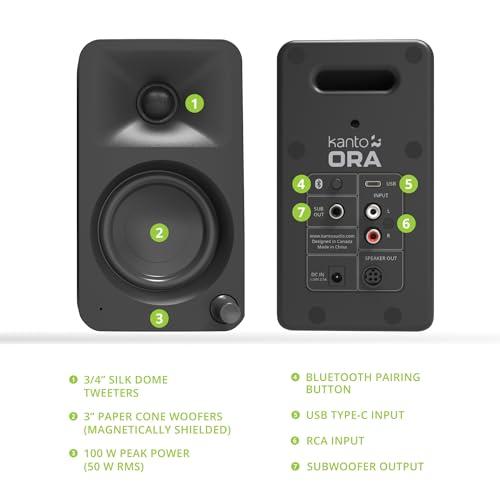
The driver specifications tell an interesting story about each speaker's priorities. The Kanto ORA uses a 3/4-inch silk dome tweeter and 3-inch paper cone woofer. While these might seem small, the bi-amplified design means each driver operates in its optimal range without interference from the other.
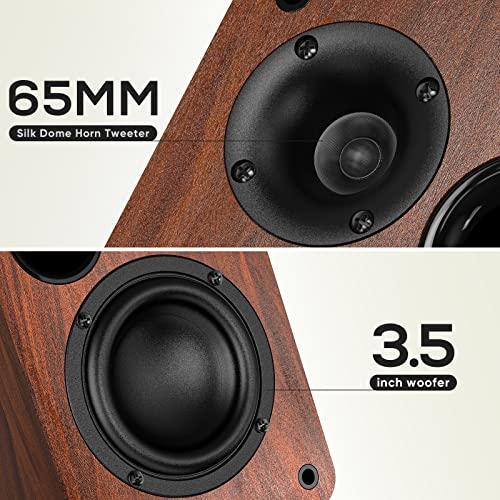
The Saiyin speakers offer more variety in driver sizes, with some models featuring woofers up to 5.2 inches. Larger woofers can move more air, potentially producing deeper bass, but they also require more power to control properly. The Saiyin's horn-loaded tweeters in certain models use a flared design that focuses sound waves more efficiently than standard dome tweeters, though this can sometimes create a more directional sound pattern.
The Kanto ORA delivers frequency response from 70 Hz to 22 kHz, which covers most audible frequencies but doesn't extend into deep bass territory. This isn't a limitation—it's a deliberate design choice. By not trying to reproduce frequencies below 70 Hz, the small woofers can focus on midrange accuracy without distortion from attempting impossible bass notes.
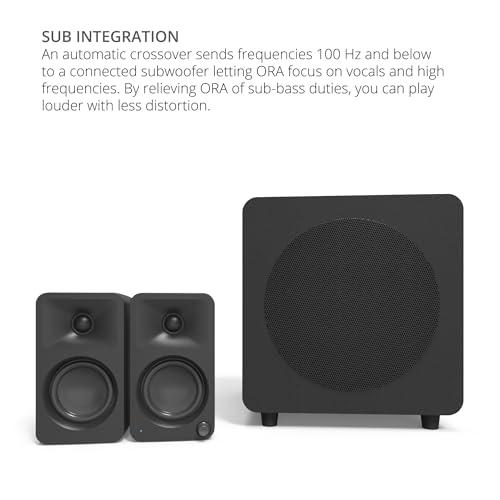
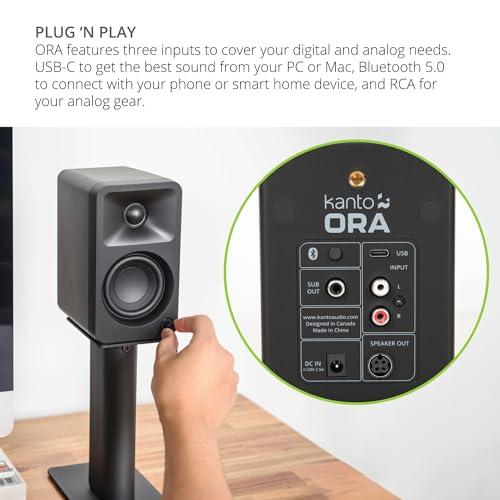
When you connect a subwoofer to the ORA's dedicated output, something clever happens: an automatic 100 Hz crossover activates. This digital filter tells the main speakers to stop reproducing frequencies below 100 Hz, leaving that job to the subwoofer. The result is cleaner, louder output from the main speakers since they're not wasting power on deep bass they can't reproduce well anyway.
The Saiyin speakers don't specify their frequency response in available documentation, but their larger woofers in certain models suggest they attempt to reproduce lower frequencies. This can result in more perceived bass impact out of the box, but potentially at the cost of midrange clarity if the small drivers are pushed beyond their optimal range.
Power specifications can be confusing because manufacturers sometimes emphasize peak power—the maximum burst of power for brief moments—rather than RMS power, which represents sustained output. The Kanto ORA claims 100 watts peak power but, more importantly, delivers 50 watts RMS total, split between 9 watts RMS per tweeter and 16 watts RMS per woofer.
This power distribution matters because it means each driver gets exactly the power it needs. Tweeters require less power than woofers, so dedicating 9 watts specifically to high-frequency reproduction ensures clean, undistorted treble even at high volumes.
The Saiyin speakers typically offer 30-40 watts total power, depending on the specific model. While this is less than the ORA, it's still adequate for near-field listening in small to medium rooms. The difference becomes apparent when you want to fill larger spaces or listen at higher volumes—the ORA's superior power delivery and bi-amplified design provide significantly more headroom before distortion sets in.
Our analysis of user reviews reveals that the Kanto ORA plays noticeably louder without strain compared to similarly sized competitors. This isn't just about raw power—it's about efficiency. Bi-amplification eliminates the power losses that occur in passive crossover networks, meaning more of the amplifier's power actually reaches the drivers.
Class-D amplification, used in the ORA, represents modern switching amplifier technology that's highly efficient and generates minimal heat. This allows for more power in a smaller package compared to traditional analog amplification, though some audiophiles debate whether Class-D has the same "warmth" as older designs. In practice, well-designed Class-D amplifiers like those in the ORA are virtually indistinguishable from other amplifier types in blind listening tests.
The Kanto ORA's USB-C input supporting 24-bit/96 kHz audio represents a significant technical advantage for serious listeners. Standard CD audio is 16-bit/44.1 kHz, so 24-bit/96 kHz provides much more digital headroom and detail. If you stream high-resolution audio from services like Tidal or have high-quality digital music files, this input can fully utilize that extra quality.
USB-C also provides several practical advantages: it carries both audio and power over a single cable (though the ORA still needs its own power supply), it's reversible so you can't plug it in wrong, and it's becoming the universal standard across devices. This future-proofing aspect shouldn't be overlooked—while 3.5mm ports are disappearing from phones and laptops, USB-C is becoming ubiquitous.
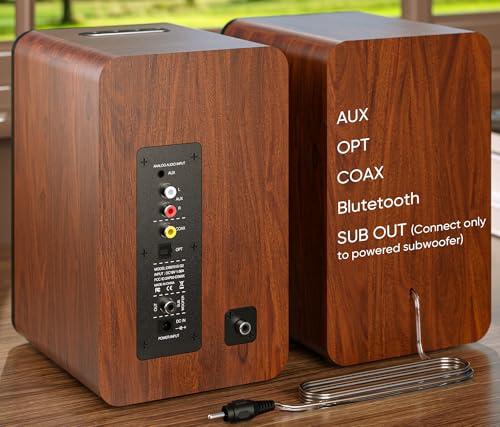
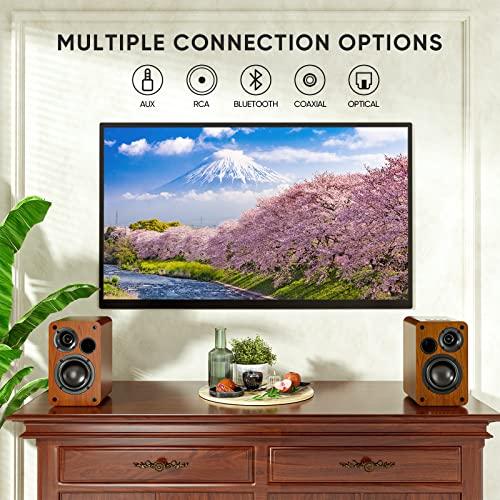
The Saiyin speakers excel in connectivity variety, offering optical and coaxial digital inputs alongside traditional analog connections. Optical input is particularly valuable for TV connections, as it provides digital audio without the potential for interference that can occur with analog cables. The coaxial digital input serves a similar purpose but uses electrical rather than light-based signal transmission.
Both speakers include Bluetooth 5.0, which offers improved range and stability compared to older Bluetooth versions. However, Bluetooth still compresses audio, so while convenient for casual listening, it's not optimal for critical audio evaluation. For serious listening, wired connections always provide superior audio quality.
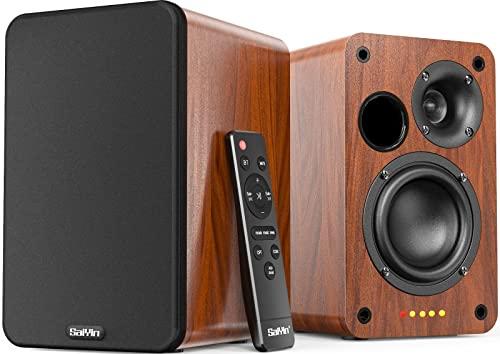
The Saiyin speakers include a remote control, which might seem like a small feature but proves incredibly convenient for daily use. Being able to adjust volume, switch inputs, and mute the speakers from across the room enhances the user experience significantly, especially when the speakers are positioned away from your primary listening position.
The Kanto ORA relies on a single front-mounted knob for all controls, which is elegant but requires physically reaching the speaker for adjustments. This design choice reinforces the ORA's focus as near-field desktop monitors where you're typically within arm's reach of the controls.
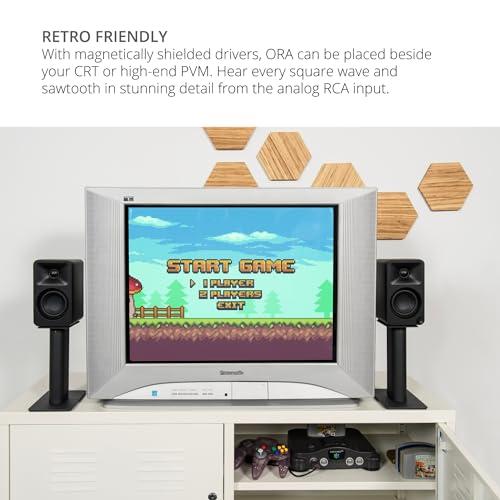
The Kanto ORA uses plastic enclosures, which has drawn some criticism given its premium pricing. However, this choice isn't necessarily about cost-cutting—properly designed plastic cabinets can be acoustically superior to wood in some applications, as they can be molded into optimal shapes and provide consistent material properties. The magnetically shielded drivers represent a professional feature that allows placement near CRT monitors or other sensitive electronics without interference.
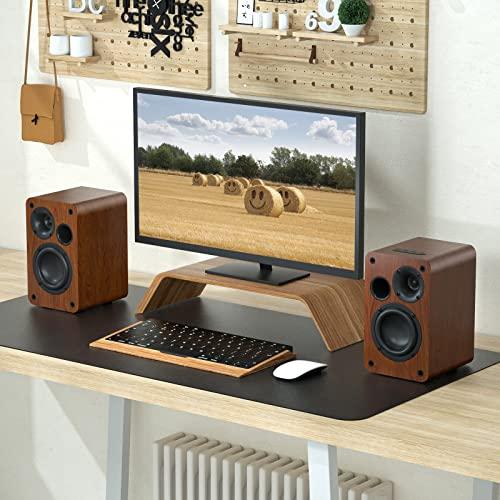
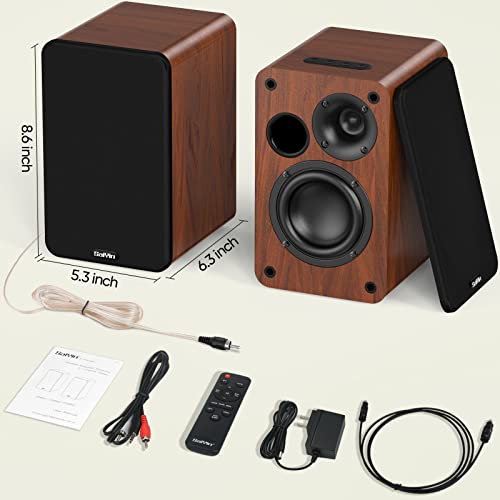
The Saiyin speakers embrace traditional wooden cabinet construction with wood grain finishes. This appeals to users who prefer classic aesthetics and the warm, natural look of wood. From an acoustic standpoint, well-braced wooden cabinets can provide excellent resonance control, though the quality varies significantly based on cabinet thickness and internal bracing.
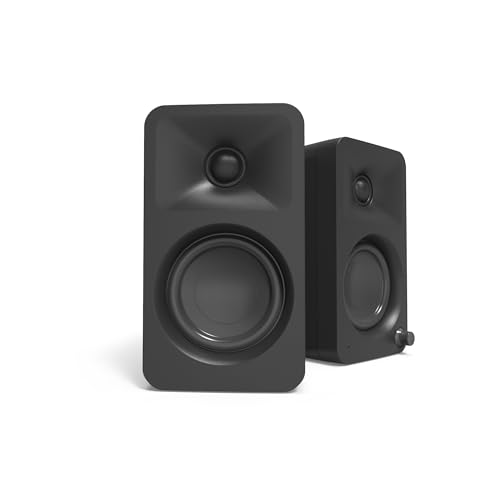
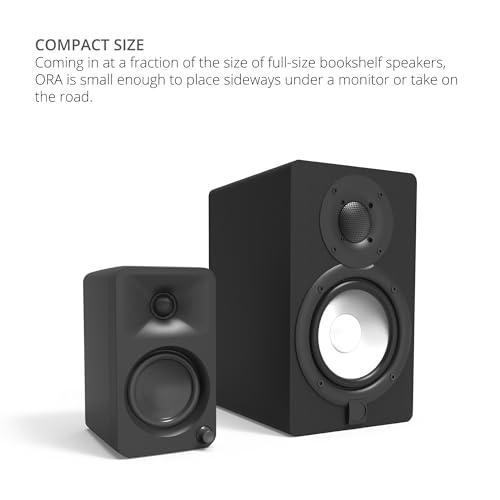
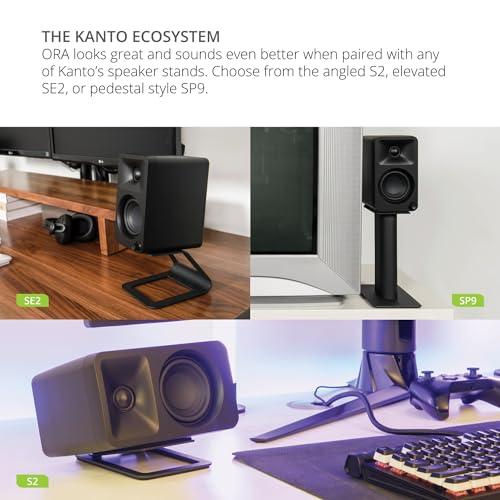
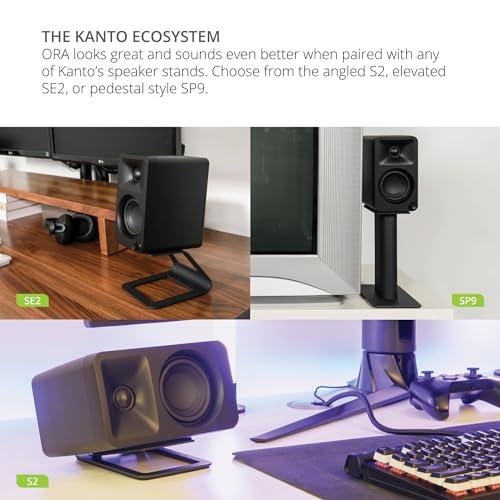
Size differences between these speakers reflect their intended uses. The Kanto ORA measures just 3.9" wide by 6.9" high per speaker, making them ideal for desktop setups where space is premium. The rear-firing port helps with bass response while the compact footprint ensures they won't overwhelm a workspace.
The Saiyin speakers vary in size depending on the specific model, but generally occupy more traditional bookshelf speaker dimensions. This larger size can accommodate bigger drivers and potentially more internal volume for better bass response, but requires more shelf or desktop space.
The ORA's 1/4"-20 threaded mounting holes add professional versatility, allowing wall or ceiling mounting with appropriate brackets. This feature, common in studio monitors, provides placement flexibility that most consumer speakers lack.
At the time of writing, the Kanto ORA commands a significant premium over the Saiyin speakers—roughly two to three times the cost depending on the specific Saiyin model. This price difference reflects fundamentally different approaches to speaker design and target markets.
The ORA's premium pricing includes advanced features like bi-amplification, DSP tuning, high-resolution USB-C input, and automatic subwoofer crossover integration. These technologies represent real engineering investments that improve performance but increase manufacturing costs. For users who can appreciate and utilize these features, the value proposition makes sense.
The Saiyin speakers deliver solid performance at a much more accessible price point. They won't match the ORA's technical precision, but they provide good sound quality, multiple connectivity options, and attractive aesthetics at a fraction of the cost. For many users, this represents better value despite lower absolute performance.
The Kanto ORA's build quality and technical sophistication suggest it will remain relevant longer as audio technology evolves. The high-resolution USB-C input, in particular, positions it well for future high-quality audio sources. The modular nature of the bi-amplified design also means individual amplifier modules could potentially be serviced or upgraded, though this isn't officially supported.
The Saiyin speakers represent a more traditional approach that's proven and reliable, but may not adapt as well to future audio technologies. However, their multiple input options provide current flexibility that could extend their useful life as system requirements change.
Both speakers include subwoofer outputs, making them suitable as the front left/right channels in a basic 2.1 home theater setup. However, their applications differ significantly based on room size and usage patterns.
The Kanto ORA excels as near-field monitors for desktop-based media consumption. If you watch movies at your computer or have a compact entertainment setup, their accuracy and imaging provide an excellent foundation for a small-scale home theater. The automatic crossover management means adding a subwoofer improves performance without complex setup.
The Saiyin speakers work better in traditional living room setups where you're sitting further from the speakers. Their larger drivers and more relaxed sound signature suit casual movie watching, while the optical input simplifies connection to TVs and streaming devices. The remote control becomes essential in this scenario, allowing comfortable volume adjustment from the couch.
Neither speaker is designed for large-room home theater applications. Both lack the power output and bass extension required to fill large spaces with theater-level dynamics. They're best suited for near-to-mid-field applications where their strengths in clarity and imaging can shine without being overwhelmed by room acoustics.
For serious home theater use, you'd typically want larger speakers or a complete surround sound system. However, both options here can serve as excellent starting points that can later be integrated into larger systems as front channels or moved to secondary rooms as upgrades occur.
You're serious about audio accuracy and willing to pay for advanced technology. Content creators, musicians, and audio enthusiasts will appreciate the reference-quality sound reproduction. The ORA makes sense if you primarily listen at your desk, value build quality and technical innovation, and plan to use high-resolution audio sources.
The compact size and professional features make the ORA ideal for home studios, video editing setups, or any application where audio accuracy matters more than convenience features. If you're building a system around a computer as the primary source, the high-resolution USB-C input provides a significant advantage.
You want good sound quality without paying premium prices for features you might not use. The Saiyin speakers excel for general entertainment, casual music listening, and situations where you need to connect multiple audio sources easily.
Choose the Saiyin if you prefer traditional aesthetics, need remote control functionality, or want speakers that can work well in various rooms and applications. They're particularly suitable if you're upgrading from basic computer speakers or TV audio and want a significant improvement without breaking the budget.
The choice between these speakers ultimately comes down to your priorities, budget, and intended use. The Kanto ORA delivers superior technical performance and represents a more future-focused approach to desktop audio. If you can appreciate the difference that bi-amplification, DSP tuning, and high-resolution inputs make, and your budget supports the premium, the ORA provides exceptional value for its performance level.
The Saiyin speakers offer a more practical approach for most users, providing good sound quality with maximum connectivity flexibility at an accessible price. They won't satisfy critical listening demands like the ORA, but they'll significantly improve most users' audio experience without requiring a substantial investment.
Consider your room size, primary listening position, audio sources, and whether you value technical precision over general convenience. Both speakers can transform your audio experience—the question is which approach better matches your specific needs and expectations. The beauty of the current powered speaker market is that both philosophies can coexist and serve different user communities effectively.
| Kanto ORA Powered Reference Desktop Speakers | Saiyin Bluetooth Bookshelf Speakers |
|---|---|
| Amplification Design - Affects sound quality and power efficiency | |
| Class-D bi-amplified (separate amps for tweeter/woofer) | Traditional single amplifier design |
| Total Power Output - Determines maximum volume and dynamics | |
| 100W peak / 50W RMS total | 30-40W total (varies by model) |
| Driver Configuration - Impacts frequency response and bass depth | |
| 3/4" silk dome tweeter, 3" paper woofer | 0.5-2" tweeter (horn or silk dome), 3-5.2" woofer (varies) |
| Digital Signal Processing - Optimizes sound accuracy | |
| DSP-tuned with automatic crossover management | No DSP mentioned |
| High-Resolution Audio Input - Future-proofs for quality sources | |
| USB-C supporting 24-bit/96kHz | No high-resolution digital input |
| Wireless Connectivity - Convenience for streaming | |
| Bluetooth 5.0 | Bluetooth 5.0 |
| Wired Input Options - Flexibility for different sources | |
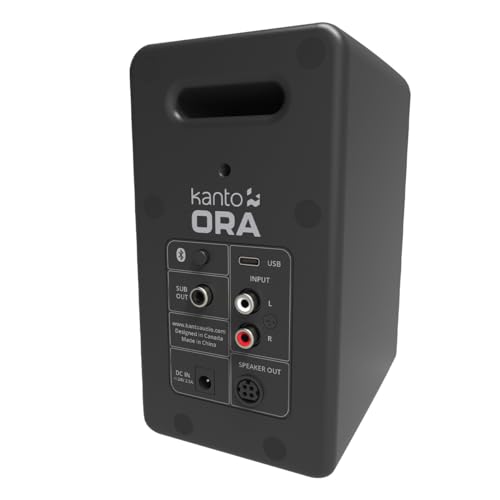
| USB-C, RCA, subwoofer out | Optical, coaxial, RCA, AUX, subwoofer out |
| Control Methods - Daily usability factor | |
| Single front knob only | Remote control + physical buttons |
| Frequency Response - Shows audio range capability | |
| 70 Hz - 22 kHz | Not specified (varies by model) |
| Magnetic Shielding - Important for CRT/professional monitor use | |
| Yes (magnetically shielded drivers) | Not specified |
| Mounting Options - Installation flexibility | |
| 1/4"-20 threaded inserts for wall/ceiling mount | Desktop/bookshelf only |
| Dimensions Per Speaker - Space requirements | |
| 3.9" W x 6.9" H x 5.6" D (compact desktop size) | 4.6-11.8" range (varies significantly by model) |
| Cabinet Material - Affects aesthetics and acoustics | |
| Plastic enclosure | Traditional wood grain finish |
| Target Use Case - Best application scenario | |
| Reference desktop monitoring, content creation | General home entertainment, multiple room types |
| Price Positioning - Value tier at time of writing | |
| Premium pricing for advanced features | Budget-friendly with good feature set |
The Kanto ORA Powered Reference Desktop Speakers are specifically designed for desktop use with their compact 3.9" x 6.9" footprint and near-field monitoring capabilities. They feature a high-resolution USB-C input that connects directly to modern laptops and computers for superior digital audio quality. The Saiyin Bluetooth Bookshelf Speakers can work on desks but are larger and better suited for traditional bookshelf placement away from your immediate workspace.
No, both the Kanto ORA and Saiyin Bluetooth Bookshelf Speakers are powered speakers with built-in amplification. You can connect them directly to your phone, computer, TV, or turntable without needing a separate amplifier or receiver. This makes setup much simpler compared to passive speakers that require external amplification.
The Kanto ORA Powered Reference Desktop Speakers deliver superior sound quality with their bi-amplified design, DSP tuning, and reference-grade accuracy. They're designed for critical listening and content creation. The Saiyin speakers offer good sound quality for casual listening at a more affordable price point, but won't match the technical precision of the ORA speakers.
Yes, both speakers can connect to TVs, but through different methods. The Saiyin Bluetooth Bookshelf Speakers offer optical digital input, which is ideal for TV connections and provides the best compatibility. The Kanto ORA speakers can connect via RCA or Bluetooth, but lack optical input, making TV integration slightly more complex.
The Kanto ORA Powered Reference Desktop Speakers are far better for music production due to their reference-grade tuning, bi-amplified design, and accurate sound reproduction. They're designed as studio monitors and provide the neutral, uncolored sound essential for mixing and mastering. The Saiyin speakers are consumer-oriented and not suitable for professional audio work.
Yes, both the Kanto ORA and Saiyin Bluetooth Bookshelf Speakers feature Bluetooth 5.0 connectivity for wireless streaming from phones, tablets, and computers. However, for the best sound quality, wired connections are recommended, especially with the ORA's high-resolution USB-C input for computer audio.
For home theater use, the Saiyin Bluetooth Bookshelf Speakers have advantages with their optical input for easy TV connection, remote control for convenient volume adjustment, and larger size suitable for living room placement. The Kanto ORA speakers work better for near-field home theater setups like desktop media centers rather than traditional living room configurations.
Both the Kanto ORA and Saiyin speakers include subwoofer outputs for adding bass extension. The ORA speakers feature an automatic 100Hz crossover that optimizes performance when a subwoofer is connected, while the Saiyin speakers provide a basic subwoofer output without automatic crossover management.
The Saiyin Bluetooth Bookshelf Speakers provide more input variety with optical, coaxial, RCA, and AUX connections plus Bluetooth. The Kanto ORA speakers focus on fewer but higher-quality inputs: USB-C for high-resolution digital audio, Bluetooth 5.0, and RCA, making them better for users who prioritize audio quality over input quantity.
The Kanto ORA Powered Reference Desktop Speakers excel for gaming due to their accurate imaging, clear dialogue reproduction, and direct USB-C connection to gaming PCs for lag-free audio. The Saiyin speakers work for casual gaming but lack the precision and desktop optimization that make the ORA speakers ideal for competitive gaming and immersive single-player experiences.
The Saiyin Bluetooth Bookshelf Speakers are more convenient for daily use with their included remote control for volume, input switching, and mute functions from across the room. The Kanto ORA speakers use a single front-mounted knob that requires reaching the speaker for adjustments, which works well for desktop use but is less convenient for remote operation.
The Saiyin Bluetooth Bookshelf Speakers offer better value for casual listeners who want multiple connectivity options and good sound quality at an affordable price. The Kanto ORA Powered Reference Desktop Speakers provide exceptional value for users who need reference-quality audio and can utilize their advanced features, despite the higher cost. Your choice depends on whether you prioritize maximum features per dollar or maximum performance per dollar.
We've done our best to create useful and informative comparisons to help you decide what product to buy. Our research uses advanced automated methods to create this comparison and perfection is not possible - please contact us for corrections or questions. These are the sites we've researched in the creation of this article: audioholics.com - skybygramophone.com - avu.ca - techaeris.com - hometechnologyreview.com - worldwidestereo.com - techradar.com - kantoaudio.com - listenup.com - kantoaudio.com - youtube.com - iworldonline.com.au - audioadvice.com - kantoaudio.com - microcenter.com - newegg.com - manuals.plus - youtube.com - sears.com - youtube.com - walmart.com - youtube.com - device.report - youtube.com - heartwood.church - youtube.com - shopabunda.com - device.report - shopabunda.com - relianthealthcaregroup.com - woodstreetphilly.com - sineaudio.com.cn

Privacy Policy
Terms and Conditions - Affiliate Policy
Home Security
© Copyright 2008-2026.
11816 Inwood Rd #1211, Dallas, TX 75244